Presented
By:
Dr. Saira Nuzhat
(MID)
• Stress test
• Types of stress test
• Indications
• Patient preparation
• Technique
• contraindications
CONTENTS
Stress test
• also called an exercise stress test, shows how your
heart works during physical activity.
• Because exercise makes your heart pump
harder and faster, an exercise stress test can
reveal problems with blood flow within your
heart.
• A stress test usually involves walking on a
treadmill or riding a stationary bike your
heart rhythm, blood pressure and breathing
are monitored. Or you'll receive a drug that
mimics the effects of exercise.
Types of stress test:
Generally ,there are three types of stress
test:
• adenosine stress test
• echocardiogram stress test
• nuclear stress test
Types of stress test
• Adenosine Stress Test:
This test is used in people who are unable to
exercise. A drug is given to make the heart respond
as if the person were exercising. This way the doctor
can still determine how the heart responds to stress,
but no exercise is required.
• Stress echocardiogram:
An echocardiogram (often called "echo") is a graphic
outline of the heart's movement. A stress echo can
accurately visualize the motion of the heart's walls
and pumping action when the heart is stressed; it
may reveal a lack of blood flow that isn't always
apparent on other heart tests.
Nuclear stress test:
• This test helps to determine which parts of the heart
are healthy and function normally and which are not.
• A very small and harmless amount of radioactive
substance is injected into the patient.
• Then the doctor uses a special camera to identify the
rays emitted from the substance within the body; this
produces clear pictures of the heart tissue on a monitor.
• These pictures are done both at rest and after exercise.
• Using this technique, a less than normal amount of
thallium will be seen in those areas of the heart that
have a decreased blood supply
Indications:
• Symptoms suggesting myocardial ischemia
• Acute chest pain in patients excluded for acute
coronary syndrome (ACS)
• Recent ACS treated without coronary angiography
• Known CAD with worsening symptoms
• Prior coronary revascularization (patients 5 years or
longer after Coronary artery bypass grafting [CABG] or
2 years or less after percutaneous coronary
intervention [PCI])
• Certain cardiac arrhythmias to assess chronotropic
competence
• Newly diagnosed heart failure or cardiomyopathy
Your doctor may recommend a test with imaging, such
as a nuclear stress test or echocardiographic stress test, if
an exercise stress test doesn't pinpoint the cause of your
symptoms.
Patient preparations
• not to eat, drink or smoke for a period of
time before a stress test.
• to avoid caffeine the day before and the day
of the test.
• Wear or bring comfortable clothes and
walking shoes.
• If you use an inhaler for your breathing,
please bring it to the test.
• Your stress test will take around an hour,
including both your prep time and the time it
takes to perform the actual test. The actual
test takes only around 15 minutes.
Technique
• is performed in a designated lab, supervised by
a trained healthcare personnel.
• Electrodes are placed on the chest, which is
attached to an ECG machine that is recording
the electrical activity of the heart.
• Your resting ECG, heart rate, and blood
pressure are obtained prior to starting the
exercise regimen.
• The baseline ECG should be evaluated closely
prior to starting the exercise portion of the
test.
• If any of ECG abnormalities are noted, the test
should be performed with the addition of
imaging modality.
• The resting ECG is usually obtained both
supine and standing.
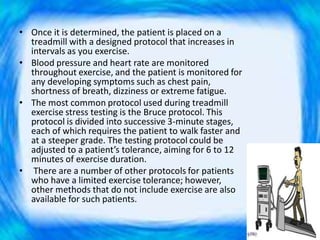
• Once it is determined, the patient is placed on a
treadmill with a designed protocol that increases in
intervals as you exercise.
• Blood pressure and heart rate are monitored
throughout exercise, and the patient is monitored for
any developing symptoms such as chest pain,
shortness of breath, dizziness or extreme fatigue.
• The most common protocol used during treadmill
exercise stress testing is the Bruce protocol. This
protocol is divided into successive 3-minute stages,
each of which requires the patient to walk faster and
at a steeper grade. The testing protocol could be
adjusted to a patient’s tolerance, aiming for 6 to 12
minutes of exercise duration.
• There are a number of other protocols for patients
who have a limited exercise tolerance; however,
other methods that do not include exercise are also
available for such patients.
Procedure:
What you can expect?
Before stress test:
 First, your doctor will ask some
questions about medical history
and how often and strenuously
you exercise. This helps
determine the amount of exercise
that's appropriate for you during
the test.
Your doctor will also listen to your
heart beat and lungs for any
abnormalities that might affect
your test results
During stress test:
• technician will place (electrodes) on your chest,
legs and arms. The electrodes have wires connected
to an electrocardiogram machine, which records the
electrical signals that trigger your heartbeats.
• A cuff on your arm checks your blood pressure
during the test.
• You may be asked to breathe into a tube during the
test to show how well you're able to breathe during
exercise.
• If you're not exercising, your doctor will inject the
drug into your IV that increases blood flow to your
heart. You might feel flushed or short of breath, just
as you would if you were exercising. You might get a
headache.
• You and your doctor will discuss your safe limits for
exercise. You may stop the test anytime you're too
uncomfortable to continue exercising.
After stress test
• After you stop exercising, you may be
asked to stand still for several seconds
and then lie down for a period of time
with the monitors in place.
• Your doctor can watch for any
abnormalities as your heart rate and
breathing return to normal.
• If the information gathered during
your exercise stress test shows your
heart function to be normal, you may
not need any further tests.
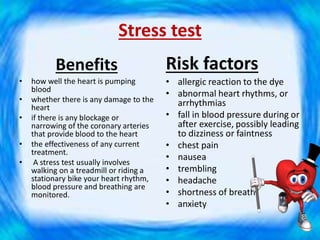
Stress test
Benefits
• how well the heart is pumping
blood
• whether there is any damage to the
heart
• if there is any blockage or
narrowing of the coronary arteries
that provide blood to the heart
• the effectiveness of any current
treatment.
• A stress test usually involves
walking on a treadmill or riding a
stationary bike your heart rhythm,
blood pressure and breathing are
monitored.
Risk factors
• allergic reaction to the dye
• abnormal heart rhythms, or
arrhythmias
• fall in blood pressure during or
after exercise, possibly leading
to dizziness or faintness
• chest pain
• nausea
• trembling
• headache
• shortness of breath
• anxiety
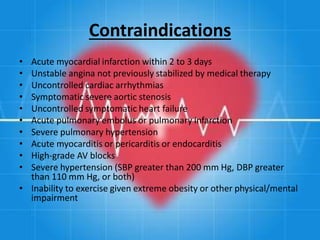
Contraindications
• Acute myocardial infarction within 2 to 3 days
• Unstable angina not previously stabilized by medical therapy
• Uncontrolled cardiac arrhythmias
• Symptomatic severe aortic stenosis
• Uncontrolled symptomatic heart failure
• Acute pulmonary embolus or pulmonary infarction
• Severe pulmonary hypertension
• Acute myocarditis or pericarditis or endocarditis
• High-grade AV blocks
• Severe hypertension (SBP greater than 200 mm Hg, DBP greater
than 110 mm Hg, or both)
• Inability to exercise given extreme obesity or other physical/mental
impairment
ANY
QUESTIONS?
THANK
YOU

stress test

  • 3.
  • 4.
    • Stress test •Types of stress test • Indications • Patient preparation • Technique • contraindications CONTENTS
  • 5.
    Stress test • alsocalled an exercise stress test, shows how your heart works during physical activity. • Because exercise makes your heart pump harder and faster, an exercise stress test can reveal problems with blood flow within your heart. • A stress test usually involves walking on a treadmill or riding a stationary bike your heart rhythm, blood pressure and breathing are monitored. Or you'll receive a drug that mimics the effects of exercise.
  • 6.
    Types of stresstest: Generally ,there are three types of stress test: • adenosine stress test • echocardiogram stress test • nuclear stress test
  • 7.
    Types of stresstest • Adenosine Stress Test: This test is used in people who are unable to exercise. A drug is given to make the heart respond as if the person were exercising. This way the doctor can still determine how the heart responds to stress, but no exercise is required. • Stress echocardiogram: An echocardiogram (often called "echo") is a graphic outline of the heart's movement. A stress echo can accurately visualize the motion of the heart's walls and pumping action when the heart is stressed; it may reveal a lack of blood flow that isn't always apparent on other heart tests.
  • 8.
    Nuclear stress test: •This test helps to determine which parts of the heart are healthy and function normally and which are not. • A very small and harmless amount of radioactive substance is injected into the patient. • Then the doctor uses a special camera to identify the rays emitted from the substance within the body; this produces clear pictures of the heart tissue on a monitor. • These pictures are done both at rest and after exercise. • Using this technique, a less than normal amount of thallium will be seen in those areas of the heart that have a decreased blood supply
  • 10.
    Indications: • Symptoms suggestingmyocardial ischemia • Acute chest pain in patients excluded for acute coronary syndrome (ACS) • Recent ACS treated without coronary angiography • Known CAD with worsening symptoms • Prior coronary revascularization (patients 5 years or longer after Coronary artery bypass grafting [CABG] or 2 years or less after percutaneous coronary intervention [PCI]) • Certain cardiac arrhythmias to assess chronotropic competence • Newly diagnosed heart failure or cardiomyopathy Your doctor may recommend a test with imaging, such as a nuclear stress test or echocardiographic stress test, if an exercise stress test doesn't pinpoint the cause of your symptoms.
  • 11.
    Patient preparations • notto eat, drink or smoke for a period of time before a stress test. • to avoid caffeine the day before and the day of the test. • Wear or bring comfortable clothes and walking shoes. • If you use an inhaler for your breathing, please bring it to the test. • Your stress test will take around an hour, including both your prep time and the time it takes to perform the actual test. The actual test takes only around 15 minutes.
  • 12.
    Technique • is performedin a designated lab, supervised by a trained healthcare personnel. • Electrodes are placed on the chest, which is attached to an ECG machine that is recording the electrical activity of the heart. • Your resting ECG, heart rate, and blood pressure are obtained prior to starting the exercise regimen. • The baseline ECG should be evaluated closely prior to starting the exercise portion of the test. • If any of ECG abnormalities are noted, the test should be performed with the addition of imaging modality. • The resting ECG is usually obtained both supine and standing.
  • 13.
    • Once itis determined, the patient is placed on a treadmill with a designed protocol that increases in intervals as you exercise. • Blood pressure and heart rate are monitored throughout exercise, and the patient is monitored for any developing symptoms such as chest pain, shortness of breath, dizziness or extreme fatigue. • The most common protocol used during treadmill exercise stress testing is the Bruce protocol. This protocol is divided into successive 3-minute stages, each of which requires the patient to walk faster and at a steeper grade. The testing protocol could be adjusted to a patient’s tolerance, aiming for 6 to 12 minutes of exercise duration. • There are a number of other protocols for patients who have a limited exercise tolerance; however, other methods that do not include exercise are also available for such patients.
  • 14.
  • 15.
    What you canexpect? Before stress test:  First, your doctor will ask some questions about medical history and how often and strenuously you exercise. This helps determine the amount of exercise that's appropriate for you during the test. Your doctor will also listen to your heart beat and lungs for any abnormalities that might affect your test results
  • 16.
    During stress test: •technician will place (electrodes) on your chest, legs and arms. The electrodes have wires connected to an electrocardiogram machine, which records the electrical signals that trigger your heartbeats. • A cuff on your arm checks your blood pressure during the test. • You may be asked to breathe into a tube during the test to show how well you're able to breathe during exercise. • If you're not exercising, your doctor will inject the drug into your IV that increases blood flow to your heart. You might feel flushed or short of breath, just as you would if you were exercising. You might get a headache. • You and your doctor will discuss your safe limits for exercise. You may stop the test anytime you're too uncomfortable to continue exercising.
  • 17.
    After stress test •After you stop exercising, you may be asked to stand still for several seconds and then lie down for a period of time with the monitors in place. • Your doctor can watch for any abnormalities as your heart rate and breathing return to normal. • If the information gathered during your exercise stress test shows your heart function to be normal, you may not need any further tests.
  • 18.
    Stress test Benefits • howwell the heart is pumping blood • whether there is any damage to the heart • if there is any blockage or narrowing of the coronary arteries that provide blood to the heart • the effectiveness of any current treatment. • A stress test usually involves walking on a treadmill or riding a stationary bike your heart rhythm, blood pressure and breathing are monitored. Risk factors • allergic reaction to the dye • abnormal heart rhythms, or arrhythmias • fall in blood pressure during or after exercise, possibly leading to dizziness or faintness • chest pain • nausea • trembling • headache • shortness of breath • anxiety
  • 19.
    Contraindications • Acute myocardialinfarction within 2 to 3 days • Unstable angina not previously stabilized by medical therapy • Uncontrolled cardiac arrhythmias • Symptomatic severe aortic stenosis • Uncontrolled symptomatic heart failure • Acute pulmonary embolus or pulmonary infarction • Severe pulmonary hypertension • Acute myocarditis or pericarditis or endocarditis • High-grade AV blocks • Severe hypertension (SBP greater than 200 mm Hg, DBP greater than 110 mm Hg, or both) • Inability to exercise given extreme obesity or other physical/mental impairment
  • 20.
  • 21.