


Stress and its management


                 Dr.Shashikant.S.K
                 Snow Mountain Yoga Center
Views of Stress
Eastern philosophies have viewed
 stress as an absence of inner peace.
Western culture has more recently
 viewed stress as a loss of control.
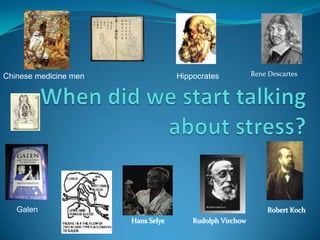
Chinese medicine men                Hippocrates           Rene Descartes


   Galen                                                      Robert Koch
                       Hans Selye       Rudolph Virchow
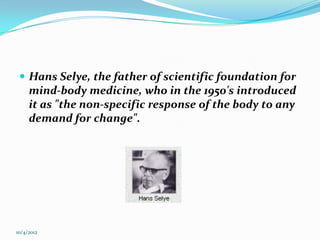
 Hans Selye, the father of scientific foundation for
     mind-body medicine, who in the 1950's introduced
     it as "the non-specific response of the body to any
     demand for change".


10/4/2012
Stress
 The mental and physical response of our bodies to the
  changes and challenges in our live
 Stressor – any physical, social, or psychological event
  or condition that causes the body to adjust to that
  situation
       Adjustment may cause strain or wear and tear on our bodies
        and minds
S=P>R
 Stress occurs when the pressure is
  greater than the resource
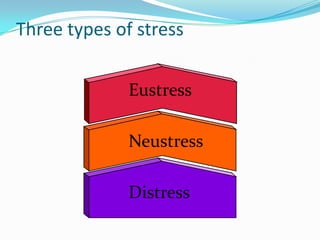
Three types of stress


              Eustress

              Neustress

              Distress
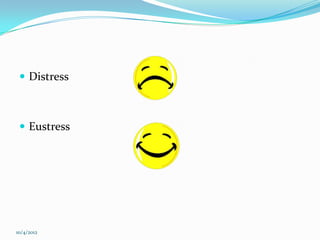
 Distress


  Eustress


10/4/2012
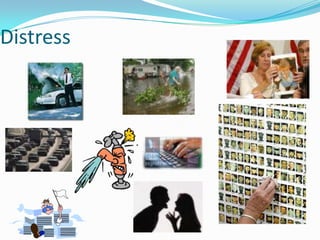
Eustress
Distress
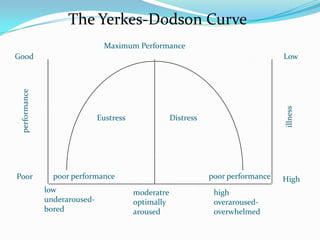
The Yerkes-Dodson Curve
                                Maximum Performance
Good                                                                                Low
 performance


                                                                                    illness
                               Eustress               Distress


Poor             poor performance                                poor performance   High
               low                        moderatre               high
               underaroused-              optimally               overaroused-
               bored                      aroused                 overwhelmed
8 Types of Stress Factors
 Conscious Factors: thought, judgement, decision making
 Unconscious Factors: past influences, memories
 Personality Factors: character and temperament
 Psychological Factors: emotional condition
 Physiologic Factors: biological influences/condition
 Environmental Factors: noise, comfort, ergonomics
 Experiential Factors: situational influences
 Sociocultural Factors: family, finances, life-changes
8 Interactive Stress Variables
 Intensity: magnitude (low vs high)
 quality: insignificant vs significant
 Duration/frequency: short vs long; high/low
 Focus of Stressor: vulnerability (high vs low)
 Extent of Stress: scope of influence (isolated vs extensive)
 Mental/Physical Status: hardiness (high vs low)
 Resistance: active vs inactive
 Perception: reductive vs magnifying
Pathways in Body’s Response to
Stressors
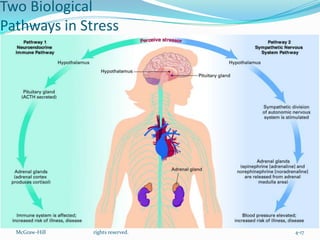
  Two main pathways are involved in the body’s
    response to stressors:
       neuroendocrine-immune pathway
       sympathetic nervous system pathway


                  ©2006 by the McGraw-Hill Companies, Inc. All
McGraw-Hill       rights reserved.                               4-16
Two Biological
Pathways in Stress


                ©2006 by the McGraw-Hill Companies, Inc. All
  McGraw-Hill   rights reserved.                               4-17
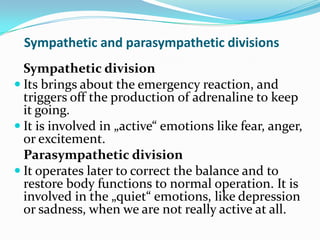
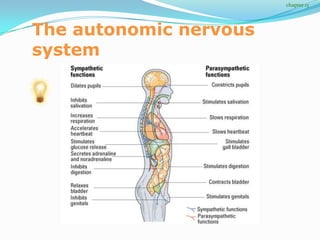
Sympathetic and parasympathetic divisions
  Sympathetic division
 Its brings about the emergency reaction, and
  triggers off the production of adrenaline to keep
  it going.
 It is involved in „active“ emotions like fear, anger,
  or excitement.
  Parasympathetic division
 It operates later to correct the balance and to
  restore body functions to normal operation. It is
  involved in the „quiet“ emotions, like depression
  or sadness, when we are not really active at all.
chapter 13


The autonomic nervous
system
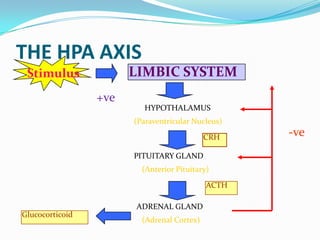
HPA Axis and Role in Stress
THE HPA AXIS
 Stimulus              LIMBIC SYSTEM
                 +ve
                          HYPOTHALAMUS
                       (Paraventricular Nucleus)

                                            CRH    -ve
                       PITUITARY GLAND
                         (Anterior Pituitary)

                                            ACTH

                       ADRENAL GLAND
Glucocorticoid
                         (Adrenal Cortex)
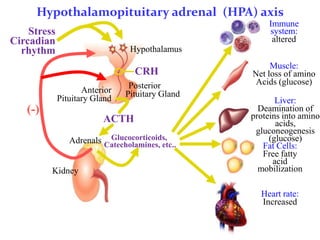
Hypothalamopituitary adrenal (HPA) axis
                                                      Immune
    Stress                                            system:
Circadian                                              altered
  rhythm                         Hypothalamus
                                                      Muscle:
                                  CRH            Net loss of amino
                                Posterior         Acids (glucose)
                    Anterior   Pituitary Gland
             Pituitary Gland                            Liver:
   (-)                                             Deamination of
                                                 proteins into amino
                         ACTH                           acids,
                                                  gluconeogenesis
                          Glucocorticoids,
                Adrenals Catecholamines, etc..        (glucose)
                                                    Fat Cells:
                                                    Free fatty
                                                       acid
         Kidney                                    mobilization

                                                   Heart rate:
                                                   Increased
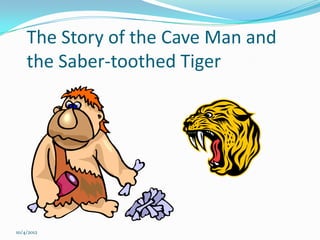
The Story of the Cave Man and
    the Saber-toothed Tiger


10/4/2012
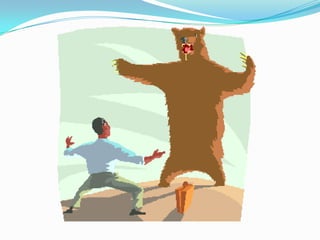
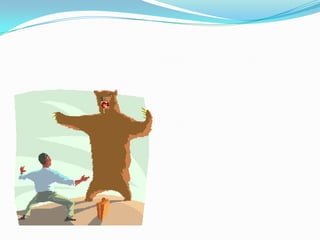
Picture this scene a million years ago. You
  come out of of your cave. The sun is up and
  the birds are chirping. Your heart rate is
  normal.


10/4/2012     www.yogamaarg.com
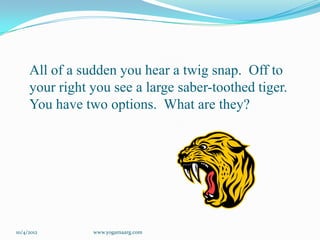
All of a sudden you hear a twig snap. Off to
     your right you see a large saber-toothed tiger.
     You have two options. What are they?


10/4/2012       www.yogamaarg.com
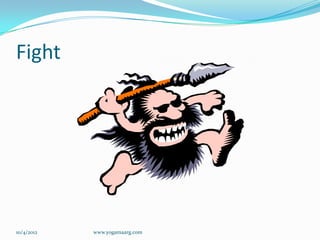
Fight


10/4/2012   www.yogamaarg.com
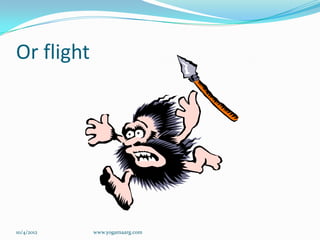
Or flight


10/4/2012   www.yogamaarg.com
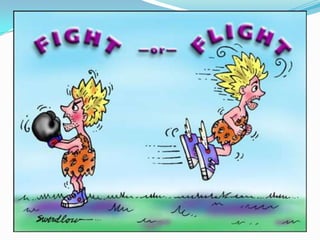
To fight that tiger or run away fast, the
  body prepares by releasing stress
  hormones
      Cortisol increases blood sugar and speeds
       metabolism
      Epinephrine supplies extra glucose
      Norepinephrine speeds up your heart rate and
       raises your blood pressure


10/4/2012        www.yogamaarg.com
There is no longer a tiger to kill or
run away from!


10/4/2012
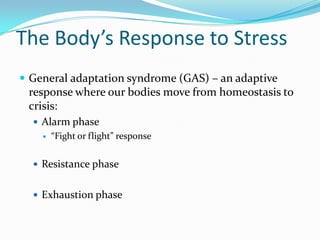
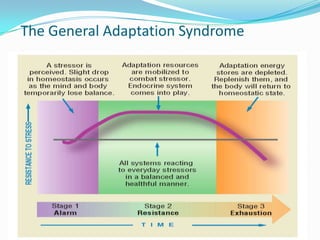
The Body’s Response to Stress
 General adaptation syndrome (GAS) – an adaptive
 response where our bodies move from homeostasis to
 crisis:
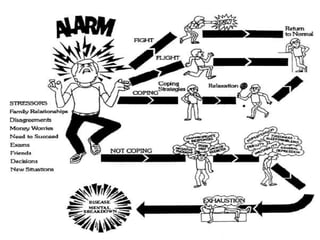
   Alarm phase
       “Fight or flight” response


   Resistance phase


   Exhaustion phase
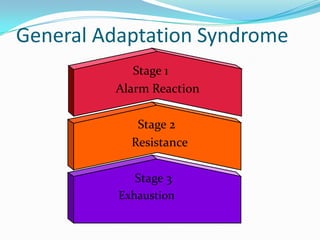
General Adaptation Syndrome
            Stage 1
         Alarm Reaction

             Stage 2
            Resistance

            Stage 3
          Exhaustion
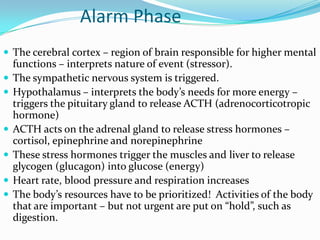
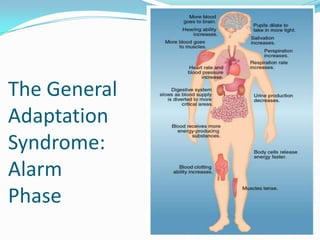
Alarm Phase
 The cerebral cortex – region of brain responsible for higher mental
    functions – interprets nature of event (stressor).
   The sympathetic nervous system is triggered.
   Hypothalamus – interprets the body’s needs for more energy –
    triggers the pituitary gland to release ACTH (adrenocorticotropic
    hormone)
   ACTH acts on the adrenal gland to release stress hormones –
    cortisol, epinephrine and norepinephrine
   These stress hormones trigger the muscles and liver to release
    glycogen (glucagon) into glucose (energy)
   Heart rate, blood pressure and respiration increases
   The body’s resources have to be prioritized! Activities of the body
    that are important – but not urgent are put on “hold”, such as
    digestion.
Resistance Phase
 The body is actively trying to reverse the actions that
  transpired during the alarm phase. During the
  resistance phase the body is under the control of the
  parasympathetic nervous system.
 The body’s vital functions such as heart rate, blood
  pressure, respiration, digestion, spleen function, vision,
  bladder function, glucose level, saliva and mucous,
  endorphins and hearing return to normal functioning.
  Remember – the body is trying to reach Homeostasis as
  a defense mechanism. The body wants to survive!
Exhaustion Phase
 Long term exposure to a stressor or stressors can result
  in overload. When the body is over-taxed and there
  are no recovery periods illness can result.
 This is a depleted state that has been the result of an
  ineffective balance of the alarm and resistance phase.
The General Adaptation Syndrome
The General
Adaptation
Syndrome:
Alarm
Phase
              Figure 3.2
3 components of Stress
 Frustration
 Conflict
 Pressure
Aetiology of Physical Stress Disorders (3)
 Personality

                Friedman & Rosenham

                Strive to Achieve/Competitive
  Type A        Time Urgency/Impatience
                Hostility/Aggression

                ‘Chilled’/Relaxed
  Type B        Less time concerned
                Less aggressive

    NB: Type A behaviour linked to CHD &
                 hypertension
10/4/2012
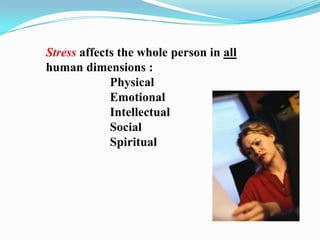
Stress affects the whole person in all
human dimensions :
             Physical
             Emotional
             Intellectual
             Social
             Spiritual
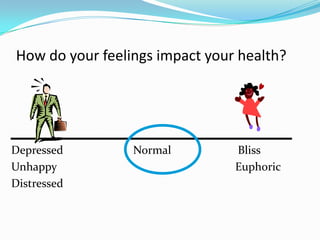
How do your feelings impact your health?


Depressed        Normal         Bliss
Unhappy                         Euphoric
Distressed
Stress: Short-term (Immediate)
consequences
    Physical Signs/Symptoms

    sleep disturbances                         irregular heartbeat, palpitations
    back, shoulder or neck pain                asthma or shortness of breath
    tension or migraine headaches              chest pain
    upset or acid stomach, cramps,             sweaty palms or hands
     heartburn, gas, irritable bowel            cold hands or feet
     syndrome                                   skin problems (hives, eczema,
    constipation, diarrhea                      psoriasis, tics, itching)
    weight gain or loss, eating disorders      periodontal disease, jaw pain
    hair loss                                  reproductive problems
    muscle tension                             immune system suppression: more
    fatigue                                     colds, flu, infections
    high blood pressure                        growth inhibition
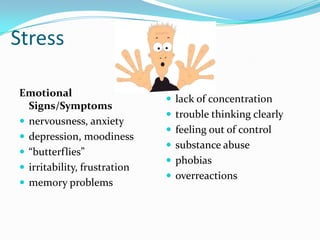
Stress

Emotional
                               lack of concentration
  Signs/Symptoms
                               trouble thinking clearly
 nervousness, anxiety
                               feeling out of control
 depression, moodiness
                               substance abuse
 “butterflies”
                               phobias
 irritability, frustration
                               overreactions
 memory problems
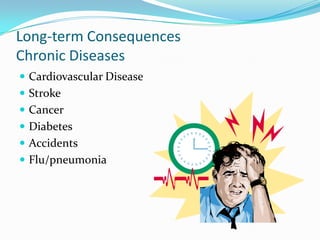
Long-term Consequences
Chronic Diseases
 Cardiovascular Disease
 Stroke
 Cancer
 Diabetes
 Accidents
 Flu/pneumonia
Stress Control
ABC Strategy
ABC STRATEGY


               A = AWARENESS


           What causes you stress?
            How do you react?
ABC STRATEGY

                    B = BALANCE

 There is a fine line between positive / negative stress

How much can you cope with before it becomes negative
                          ?
ABC STRATEGY


                   C = CONTROL

 What can you do to help yourself combat the negative
                   effects of stress ?
Stress Management Techniques

             Change your thinking


             Change your behaviour


              Change your lifestyle
Change your Thinking

                  Re-framing


                Positive thinking
Re-framing
 Re-framing is a technique to change the way you look
 at things in order to feel better about them. There are
 many ways to interpret the same situation so pick the
 one you like. Re-framing does not change the external
 reality, but helps you view things in a different light
 and less stressfully.
Positive Thinking
  Forget powerlessness, dejection, despair, failure
  Stress leaves us vulnerable to negative suggestion so
  focus on positives;
 Focus on your strengths
 Learn from the stress you are under
 Look for opportunities
 Seek out the positive - make a change.
Change your Behaviour

 Be assertive
 Get organised
 Ventilation
 Humour
 Diversion and distraction
Be Assertive
 Assertiveness helps to manage stressful situations, and
 will , in time, help to reduce their frequency. Lack of
 assertiveness often shows low self - esteem and low
 self - confidence. The key to assertiveness is verbal and
 non - verbal communication. Extending our range of
 communication skills will improve our assertiveness.
Equality and Basic Rights
1) The right to express my feelings
2) The right to express opinions / beliefs
3) The right to say ‘Yes/No’ for yourself
4) Right to change your mind
5) Right to say ‘I don’t understand’
6) Right to be yourself, not acting for the benefit of
   others
7) The right to decline responsibility for other people’s
  problems
8) The right to make reasonable requests of others
9) The right to set my own priorities
10) The right to be listened to, and taken seriously
Being Assertive

 Being assertive involves standing up for your personal
 rights and expressing your thoughts, feelings and
 beliefs directly, honestly and spontaneously in ways
 that don’t infringe the rights of others.
Assertive People
 Respect themselves and others
 Take responsibility for actions and choices
 Ask openly for what they want
 Disappointed if ‘want’ denied
 Self - confidence remains intact
 Not reliant on the approval of others
Assertive Skills
 Establish good eye contact / don’t stare
 Stand or sit comfortably - don’t fidget
 Talk in a firm, steady voice
 Use body language
 ‘I think’ / ‘I feel’
 ‘What do you think?’ ‘How do you feel ?’
 Concise and to the point
Benefits
 Higher self-esteem
 Less self-conscious
 Less anxious
 Manage stress more successfully
 Appreciate yourself and others more easily
 Feeling of self-control
Get Organised
 Poor organisation is one of the most common causes of
 stress. Structured approaches offer security against
 ‘out of the blue’ problems. Prioritising objectives,
 duties and activities makes them manageable and
 achievable. Don’t overload your mind. Organisation
 will help avoid personal and professional chaos.
Time Management
                   Make a list
               What MUST be done
             What SHOULD be done
            What would you LIKE to do
              Cut out time wasting
       Learn to drop unimportant activities
                      Say no
 Plan your day
             Set achievable goals
 Don’t waste time making excuses for not doing
                   something
Ventilation
         ‘A problem shared is a problem halved’
 Develop a support network through friends or
 colleagues to talk with. It’s not always events that are
 stressful but how we perceive them.

 Writing a diary or notes may help release feelings but
 do not re-read what has been written.
Humour

 Good stress - reducer
 Applies at home and work
 Relieves muscular tension
 Improves breathing
 Pumps endorphins into the bloodstream - the body’s
 natural painkillers
Diversion and Distraction
 Take time out
 Get away from things that bother you
 Doesn’t solve the problem
 Reduce stress level
 Calm down
 Think logically
Change Your Lifestyle
 Diet
 Smoking & Alcohol
 Exercise
 Sleep
 Leisure
 Relaxation
Benefits of Exercise
 Uses up excess energy released by the ‘Fight or Flight’
    reaction.
   Improves blood circulation
   Lowers blood pressure
   Clears the mind of worrying thoughts
   Improves self image
   Makes you feel better about yourself
   Increases social contact
Sleep
               Good stress reducer
            Difficult to cope when tired
         Wake refreshed after night’s sleep
             Plenty of daytime energy
Leisure
                   Interest
       Gives you a ‘break’ from stresses
           Provides outlet for relief
           Provides social contact
Benefits of Relaxation

               Lowers blood pressure
                 Combats fatigue
                  Promotes sleep
                   Reduces pain
               Eases muscle tension
 Decreases mental worries
 Increases concentration
  Increases productivity
 Increases clear thinking
Alternatives
 Conventional Medicine    Floatation
 Counselling &            Herbalism
    psychotherapy          Biofeedback
   Relaxation             Homeopathy
   Meditation             Hypnotherapy
   Massage                Osteopathy
   Yoga                   Pet Therapy
   Acupuncture            Reflexology
   Aromatherapy
Is a pill dissolving in your stomach more
  effective than a healing thought
  dissolving in your mind?
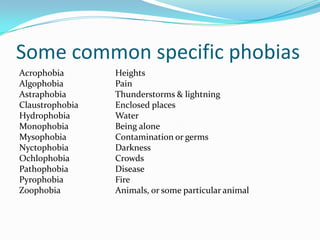
Some common specific phobias
Acrophobia       Heights
Algophobia       Pain
Astraphobia      Thunderstorms & lightning
Claustrophobia   Enclosed places
Hydrophobia      Water
Monophobia       Being alone
Mysophobia       Contamination or germs
Nyctophobia      Darkness
Ochlophobia      Crowds
Pathophobia      Disease
Pyrophobia       Fire
Zoophobia        Animals, or some particular animal

Stress management workshop

  • 1.
    Stress and itsmanagement Dr.Shashikant.S.K Snow Mountain Yoga Center
  • 2.
    Views of Stress Easternphilosophies have viewed stress as an absence of inner peace. Western culture has more recently viewed stress as a loss of control.
  • 3.
    Chinese medicine men Hippocrates Rene Descartes Galen Robert Koch Hans Selye Rudolph Virchow
  • 4.
     Hans Selye,the father of scientific foundation for mind-body medicine, who in the 1950's introduced it as "the non-specific response of the body to any demand for change". 10/4/2012
  • 5.
    Stress  The mentaland physical response of our bodies to the changes and challenges in our live  Stressor – any physical, social, or psychological event or condition that causes the body to adjust to that situation  Adjustment may cause strain or wear and tear on our bodies and minds
  • 6.
    S=P>R  Stress occurswhen the pressure is greater than the resource
  • 8.
    Three types ofstress Eustress Neustress Distress
  • 9.
     Distress Eustress 10/4/2012
  • 10.
  • 11.
  • 12.
    The Yerkes-Dodson Curve Maximum Performance Good Low performance illness Eustress Distress Poor poor performance poor performance High low moderatre high underaroused- optimally overaroused- bored aroused overwhelmed
  • 13.
    8 Types ofStress Factors  Conscious Factors: thought, judgement, decision making  Unconscious Factors: past influences, memories  Personality Factors: character and temperament  Psychological Factors: emotional condition  Physiologic Factors: biological influences/condition  Environmental Factors: noise, comfort, ergonomics  Experiential Factors: situational influences  Sociocultural Factors: family, finances, life-changes
  • 14.
    8 Interactive StressVariables  Intensity: magnitude (low vs high)  quality: insignificant vs significant  Duration/frequency: short vs long; high/low  Focus of Stressor: vulnerability (high vs low)  Extent of Stress: scope of influence (isolated vs extensive)  Mental/Physical Status: hardiness (high vs low)  Resistance: active vs inactive  Perception: reductive vs magnifying
  • 16.
    Pathways in Body’sResponse to Stressors  Two main pathways are involved in the body’s response to stressors:  neuroendocrine-immune pathway  sympathetic nervous system pathway ©2006 by the McGraw-Hill Companies, Inc. All McGraw-Hill rights reserved. 4-16
  • 17.
    Two Biological Pathways inStress ©2006 by the McGraw-Hill Companies, Inc. All McGraw-Hill rights reserved. 4-17
  • 18.
    Sympathetic and parasympatheticdivisions Sympathetic division  Its brings about the emergency reaction, and triggers off the production of adrenaline to keep it going.  It is involved in „active“ emotions like fear, anger, or excitement. Parasympathetic division  It operates later to correct the balance and to restore body functions to normal operation. It is involved in the „quiet“ emotions, like depression or sadness, when we are not really active at all.
  • 19.
  • 20.
    HPA Axis andRole in Stress
  • 21.
    THE HPA AXIS Stimulus LIMBIC SYSTEM +ve HYPOTHALAMUS (Paraventricular Nucleus) CRH -ve PITUITARY GLAND (Anterior Pituitary) ACTH ADRENAL GLAND Glucocorticoid (Adrenal Cortex)
  • 22.
    Hypothalamopituitary adrenal (HPA)axis Immune Stress system: Circadian altered rhythm Hypothalamus Muscle: CRH Net loss of amino Posterior Acids (glucose) Anterior Pituitary Gland Pituitary Gland Liver: (-) Deamination of proteins into amino ACTH acids, gluconeogenesis Glucocorticoids, Adrenals Catecholamines, etc.. (glucose) Fat Cells: Free fatty acid Kidney mobilization Heart rate: Increased
  • 23.
    The Story ofthe Cave Man and the Saber-toothed Tiger 10/4/2012
  • 24.
    Picture this scenea million years ago. You come out of of your cave. The sun is up and the birds are chirping. Your heart rate is normal. 10/4/2012 www.yogamaarg.com
  • 25.
    All of asudden you hear a twig snap. Off to your right you see a large saber-toothed tiger. You have two options. What are they? 10/4/2012 www.yogamaarg.com
  • 26.
    Fight 10/4/2012 www.yogamaarg.com
  • 27.
    Or flight 10/4/2012 www.yogamaarg.com
  • 29.
    To fight thattiger or run away fast, the body prepares by releasing stress hormones  Cortisol increases blood sugar and speeds metabolism  Epinephrine supplies extra glucose  Norepinephrine speeds up your heart rate and raises your blood pressure 10/4/2012 www.yogamaarg.com
  • 30.
    There is nolonger a tiger to kill or run away from! 10/4/2012
  • 31.
    The Body’s Responseto Stress  General adaptation syndrome (GAS) – an adaptive response where our bodies move from homeostasis to crisis:  Alarm phase  “Fight or flight” response  Resistance phase  Exhaustion phase
  • 32.
    General Adaptation Syndrome Stage 1 Alarm Reaction Stage 2 Resistance Stage 3 Exhaustion
  • 33.
    Alarm Phase  Thecerebral cortex – region of brain responsible for higher mental functions – interprets nature of event (stressor).  The sympathetic nervous system is triggered.  Hypothalamus – interprets the body’s needs for more energy – triggers the pituitary gland to release ACTH (adrenocorticotropic hormone)  ACTH acts on the adrenal gland to release stress hormones – cortisol, epinephrine and norepinephrine  These stress hormones trigger the muscles and liver to release glycogen (glucagon) into glucose (energy)  Heart rate, blood pressure and respiration increases  The body’s resources have to be prioritized! Activities of the body that are important – but not urgent are put on “hold”, such as digestion.
  • 35.
    Resistance Phase  Thebody is actively trying to reverse the actions that transpired during the alarm phase. During the resistance phase the body is under the control of the parasympathetic nervous system.  The body’s vital functions such as heart rate, blood pressure, respiration, digestion, spleen function, vision, bladder function, glucose level, saliva and mucous, endorphins and hearing return to normal functioning. Remember – the body is trying to reach Homeostasis as a defense mechanism. The body wants to survive!
  • 36.
    Exhaustion Phase  Longterm exposure to a stressor or stressors can result in overload. When the body is over-taxed and there are no recovery periods illness can result.  This is a depleted state that has been the result of an ineffective balance of the alarm and resistance phase.
  • 37.
  • 38.
  • 39.
    3 components ofStress  Frustration  Conflict  Pressure
  • 40.
    Aetiology of PhysicalStress Disorders (3)  Personality Friedman & Rosenham Strive to Achieve/Competitive Type A Time Urgency/Impatience Hostility/Aggression ‘Chilled’/Relaxed Type B Less time concerned Less aggressive NB: Type A behaviour linked to CHD & hypertension
  • 41.
  • 42.
    Stress affects thewhole person in all human dimensions : Physical Emotional Intellectual Social Spiritual
  • 44.
    How do yourfeelings impact your health? Depressed Normal Bliss Unhappy Euphoric Distressed
  • 45.
    Stress: Short-term (Immediate) consequences Physical Signs/Symptoms  sleep disturbances  irregular heartbeat, palpitations  back, shoulder or neck pain  asthma or shortness of breath  tension or migraine headaches  chest pain  upset or acid stomach, cramps,  sweaty palms or hands heartburn, gas, irritable bowel  cold hands or feet syndrome  skin problems (hives, eczema,  constipation, diarrhea psoriasis, tics, itching)  weight gain or loss, eating disorders  periodontal disease, jaw pain  hair loss  reproductive problems  muscle tension  immune system suppression: more  fatigue colds, flu, infections  high blood pressure  growth inhibition
  • 46.
    Stress Emotional  lack of concentration Signs/Symptoms  trouble thinking clearly  nervousness, anxiety  feeling out of control  depression, moodiness  substance abuse  “butterflies”  phobias  irritability, frustration  overreactions  memory problems
  • 47.
    Long-term Consequences Chronic Diseases Cardiovascular Disease  Stroke  Cancer  Diabetes  Accidents  Flu/pneumonia
  • 64.
  • 65.
    ABC STRATEGY A = AWARENESS What causes you stress? How do you react?
  • 66.
    ABC STRATEGY B = BALANCE There is a fine line between positive / negative stress How much can you cope with before it becomes negative ?
  • 67.
    ABC STRATEGY C = CONTROL What can you do to help yourself combat the negative effects of stress ?
  • 68.
    Stress Management Techniques  Change your thinking  Change your behaviour  Change your lifestyle
  • 70.
    Change your Thinking  Re-framing  Positive thinking
  • 71.
    Re-framing Re-framing isa technique to change the way you look at things in order to feel better about them. There are many ways to interpret the same situation so pick the one you like. Re-framing does not change the external reality, but helps you view things in a different light and less stressfully.
  • 72.
    Positive Thinking Forget powerlessness, dejection, despair, failure Stress leaves us vulnerable to negative suggestion so focus on positives;  Focus on your strengths  Learn from the stress you are under  Look for opportunities  Seek out the positive - make a change.
  • 73.
    Change your Behaviour Be assertive  Get organised  Ventilation  Humour  Diversion and distraction
  • 74.
    Be Assertive Assertivenesshelps to manage stressful situations, and will , in time, help to reduce their frequency. Lack of assertiveness often shows low self - esteem and low self - confidence. The key to assertiveness is verbal and non - verbal communication. Extending our range of communication skills will improve our assertiveness.
  • 75.
    Equality and BasicRights 1) The right to express my feelings 2) The right to express opinions / beliefs 3) The right to say ‘Yes/No’ for yourself 4) Right to change your mind 5) Right to say ‘I don’t understand’ 6) Right to be yourself, not acting for the benefit of others
  • 76.
    7) The rightto decline responsibility for other people’s problems 8) The right to make reasonable requests of others 9) The right to set my own priorities 10) The right to be listened to, and taken seriously
  • 77.
    Being Assertive Beingassertive involves standing up for your personal rights and expressing your thoughts, feelings and beliefs directly, honestly and spontaneously in ways that don’t infringe the rights of others.
  • 78.
    Assertive People  Respectthemselves and others  Take responsibility for actions and choices  Ask openly for what they want  Disappointed if ‘want’ denied  Self - confidence remains intact  Not reliant on the approval of others
  • 79.
    Assertive Skills  Establishgood eye contact / don’t stare  Stand or sit comfortably - don’t fidget  Talk in a firm, steady voice  Use body language  ‘I think’ / ‘I feel’  ‘What do you think?’ ‘How do you feel ?’  Concise and to the point
  • 80.
    Benefits  Higher self-esteem Less self-conscious  Less anxious  Manage stress more successfully  Appreciate yourself and others more easily  Feeling of self-control
  • 81.
    Get Organised Poororganisation is one of the most common causes of stress. Structured approaches offer security against ‘out of the blue’ problems. Prioritising objectives, duties and activities makes them manageable and achievable. Don’t overload your mind. Organisation will help avoid personal and professional chaos.
  • 82.
    Time Management  Make a list What MUST be done What SHOULD be done What would you LIKE to do  Cut out time wasting  Learn to drop unimportant activities  Say no
  • 83.
     Plan yourday  Set achievable goals  Don’t waste time making excuses for not doing something
  • 84.
    Ventilation ‘A problem shared is a problem halved’ Develop a support network through friends or colleagues to talk with. It’s not always events that are stressful but how we perceive them. Writing a diary or notes may help release feelings but do not re-read what has been written.
  • 85.
    Humour  Good stress- reducer  Applies at home and work  Relieves muscular tension  Improves breathing  Pumps endorphins into the bloodstream - the body’s natural painkillers
  • 86.
    Diversion and Distraction Take time out  Get away from things that bother you  Doesn’t solve the problem  Reduce stress level  Calm down  Think logically
  • 87.
    Change Your Lifestyle Diet  Smoking & Alcohol  Exercise  Sleep  Leisure  Relaxation
  • 88.
    Benefits of Exercise Uses up excess energy released by the ‘Fight or Flight’ reaction.  Improves blood circulation  Lowers blood pressure  Clears the mind of worrying thoughts  Improves self image  Makes you feel better about yourself  Increases social contact
  • 89.
    Sleep  Good stress reducer  Difficult to cope when tired  Wake refreshed after night’s sleep  Plenty of daytime energy
  • 90.
    Leisure  Interest  Gives you a ‘break’ from stresses  Provides outlet for relief  Provides social contact
  • 91.
    Benefits of Relaxation  Lowers blood pressure  Combats fatigue  Promotes sleep  Reduces pain  Eases muscle tension
  • 92.
     Decreases mentalworries  Increases concentration  Increases productivity  Increases clear thinking
  • 93.
    Alternatives  Conventional Medicine  Floatation  Counselling &  Herbalism psychotherapy  Biofeedback  Relaxation  Homeopathy  Meditation  Hypnotherapy  Massage  Osteopathy  Yoga  Pet Therapy  Acupuncture  Reflexology  Aromatherapy
  • 94.
    Is a pilldissolving in your stomach more effective than a healing thought dissolving in your mind?
  • 99.
    Some common specificphobias Acrophobia Heights Algophobia Pain Astraphobia Thunderstorms & lightning Claustrophobia Enclosed places Hydrophobia Water Monophobia Being alone Mysophobia Contamination or germs Nyctophobia Darkness Ochlophobia Crowds Pathophobia Disease Pyrophobia Fire Zoophobia Animals, or some particular animal