By
Priyanka Singh
M.Tech (Applied Mechanics)
Motilal Nehru National Institute of Technology
Objectives
1. Define stress & strain.
2. Utilize Hooke’s Law to calculate unknown stresses and strains.
3. Determine material parameters from a stress-strain curve.
4. Recognize elastic and plastic components of deformation in a material.
5. Identify the regions of behavior on a stress-strain diagram.
Intensity of Force
Stress = ____ /____
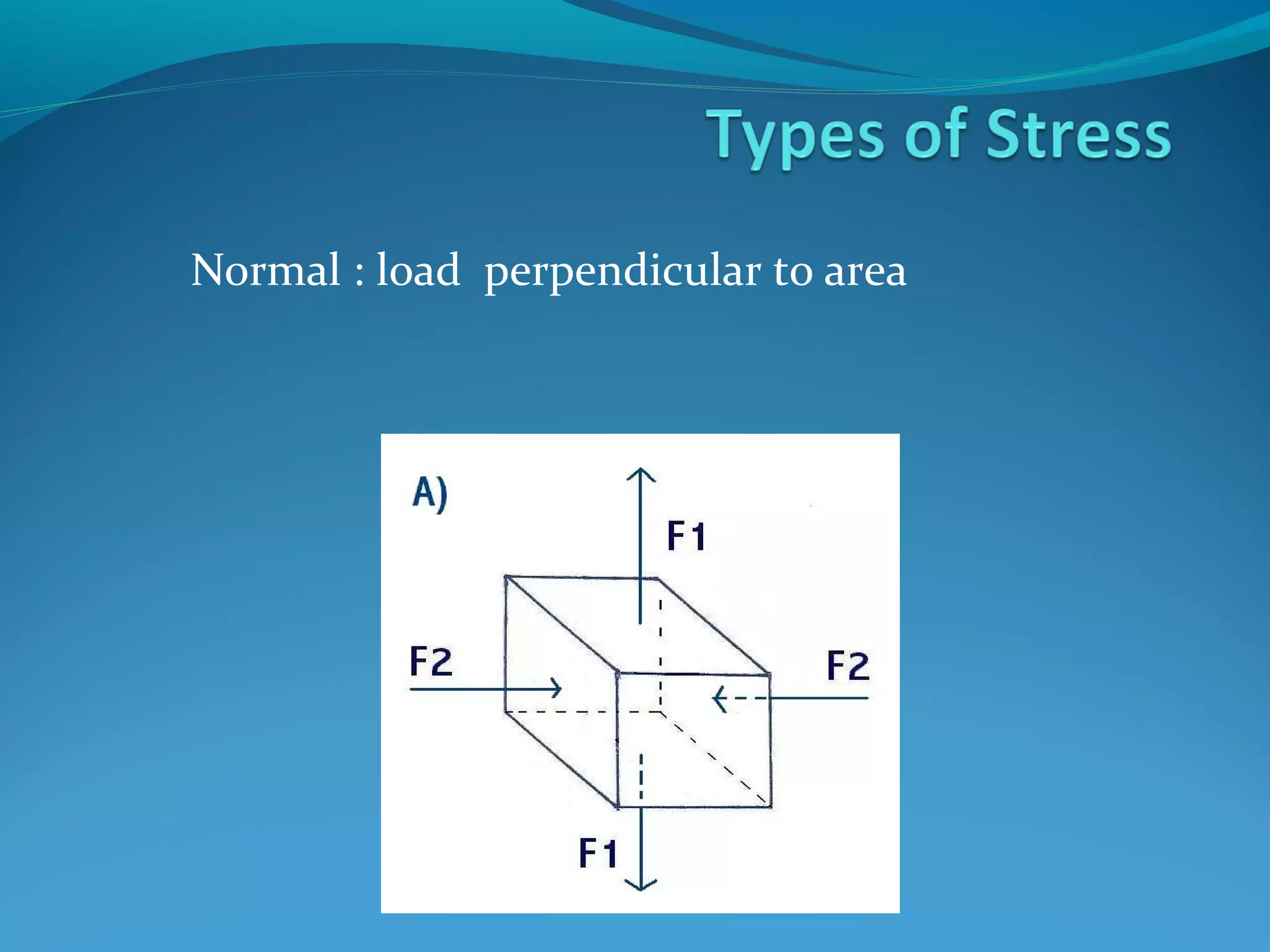
Normal : load perpendicular to area
Types of Stress
a) Normal
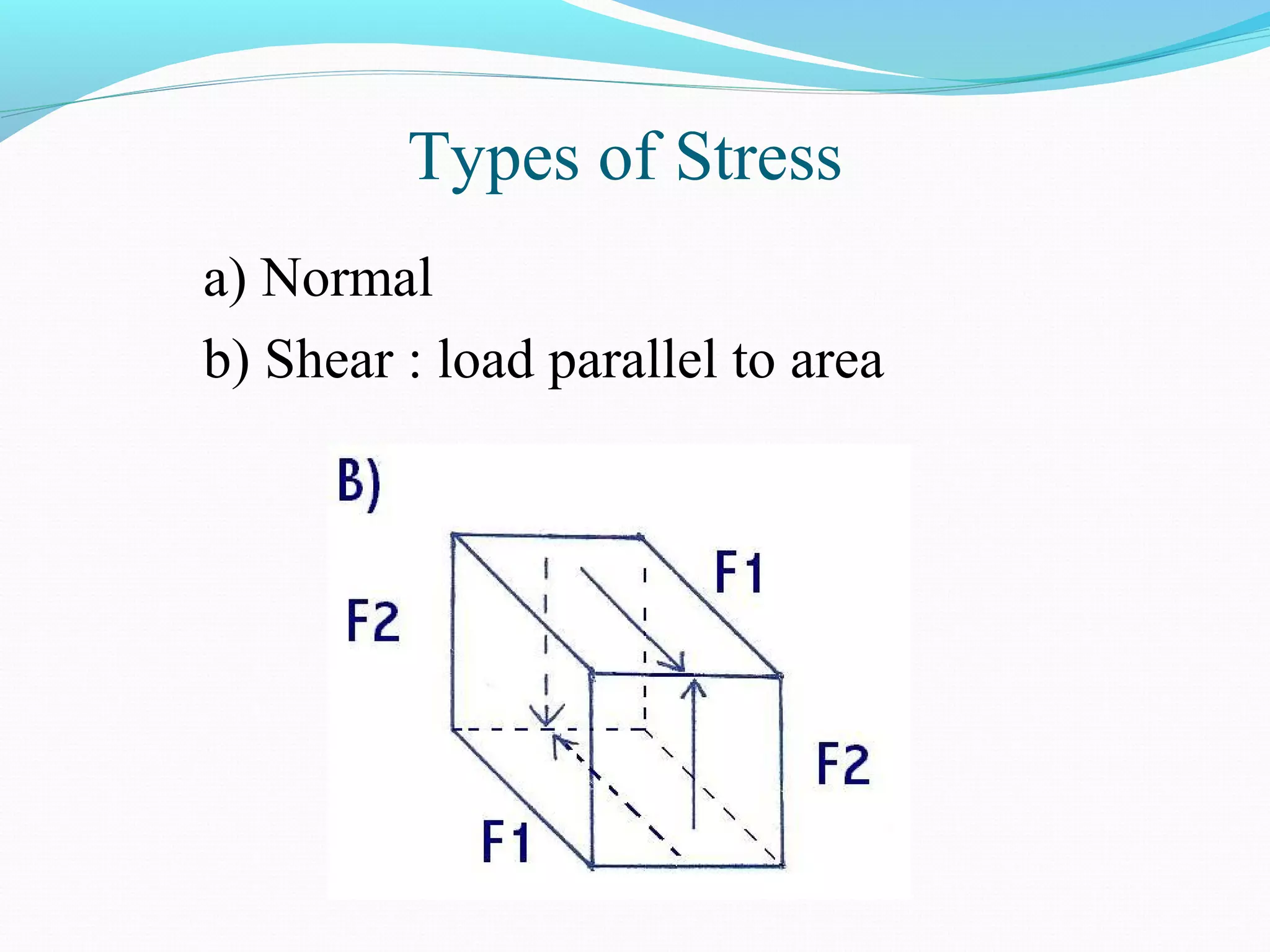
b) Shear : load parallel to area
Types of Stress
a) Normal
b) Shear
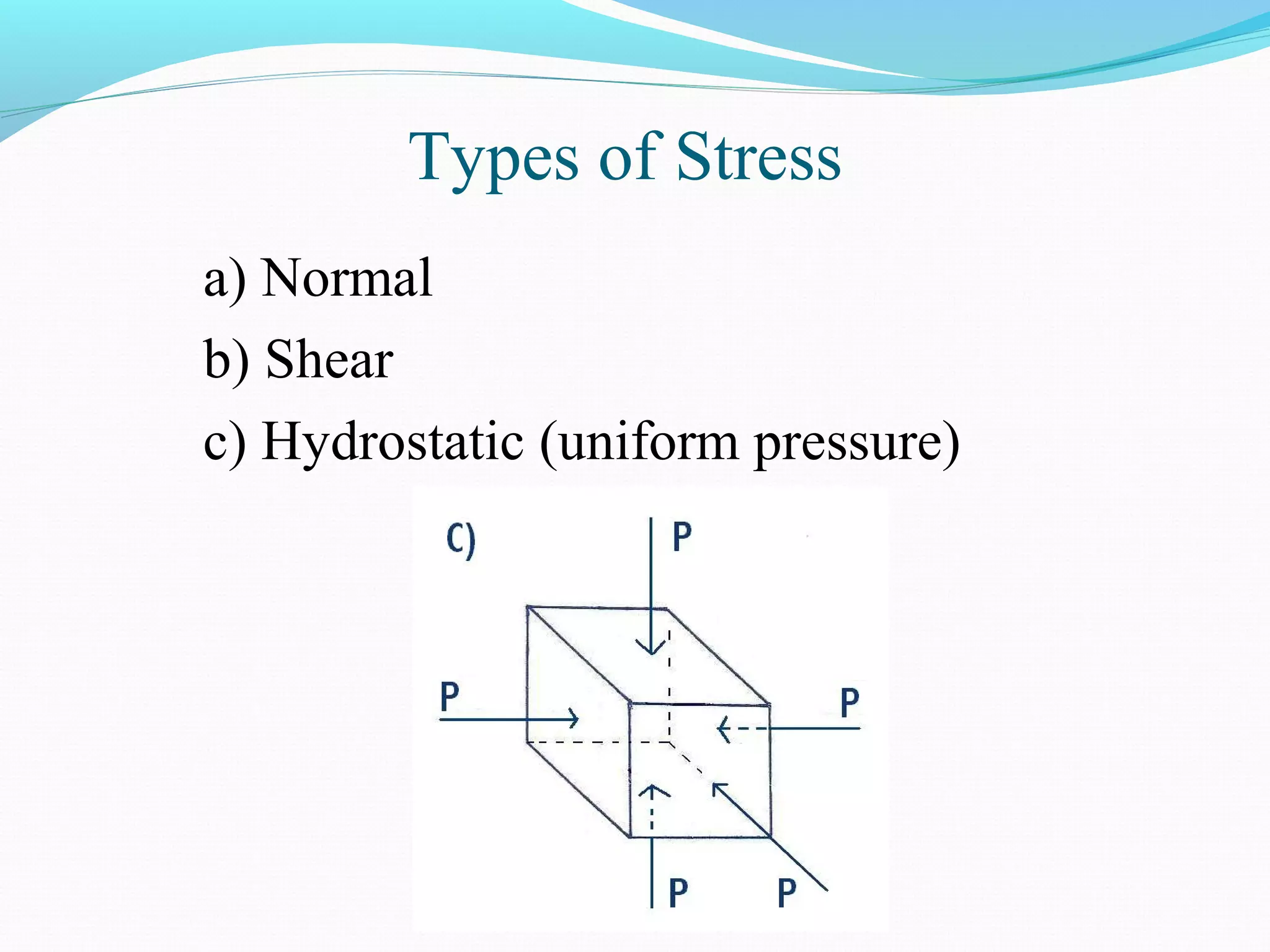
c) Hydrostatic (uniform pressure)
Strain: Intensity of Deformation
e = ____/_____ =dl / lo
Normal : deformation in the the direction of
length
Longitudinal Strain
e = u / l
Transverse Strain
e = v / l
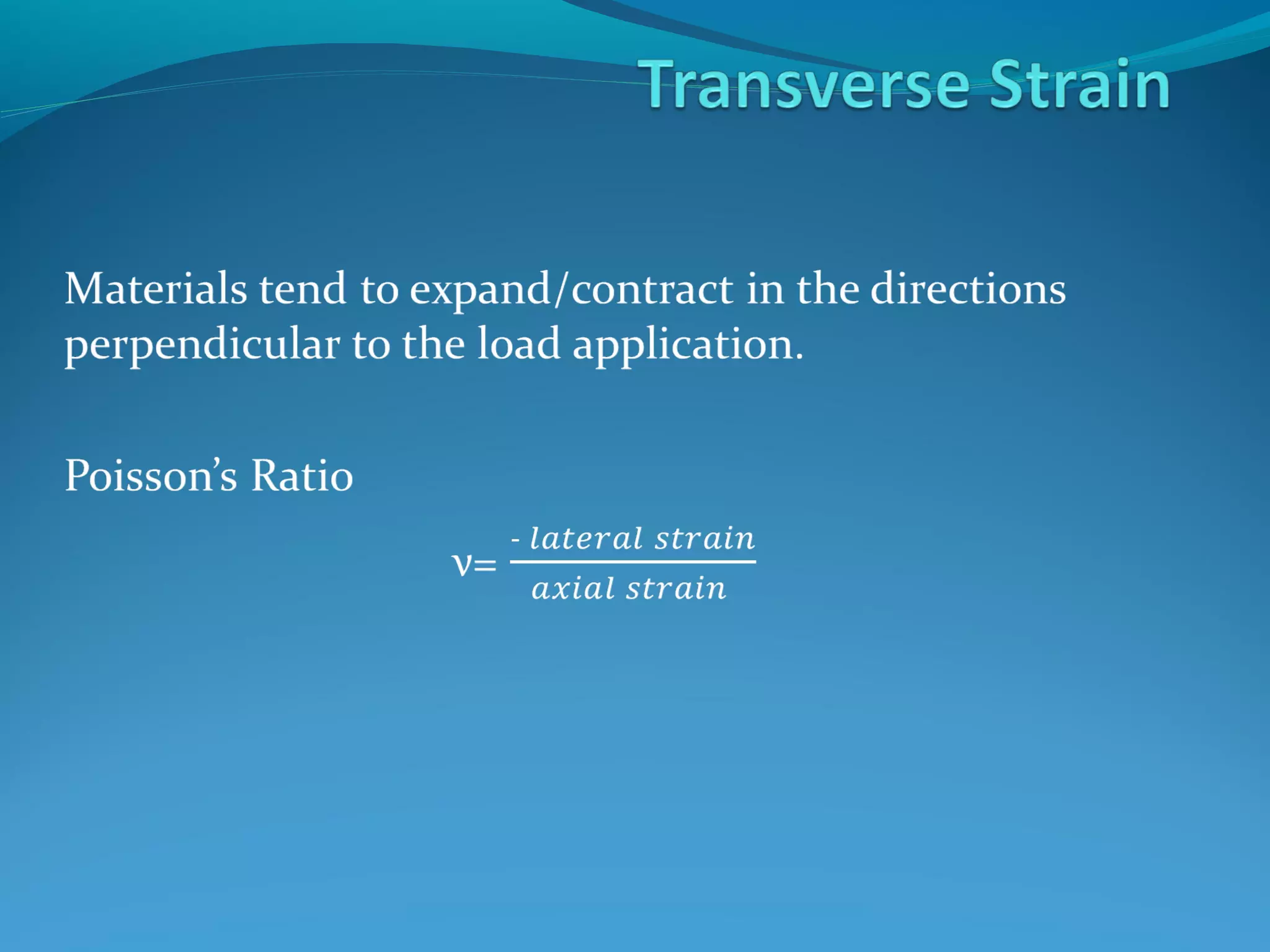
Poissons Ratio Values
ν = 0.5 constant volume
ν = 0.3 good guess for most materials
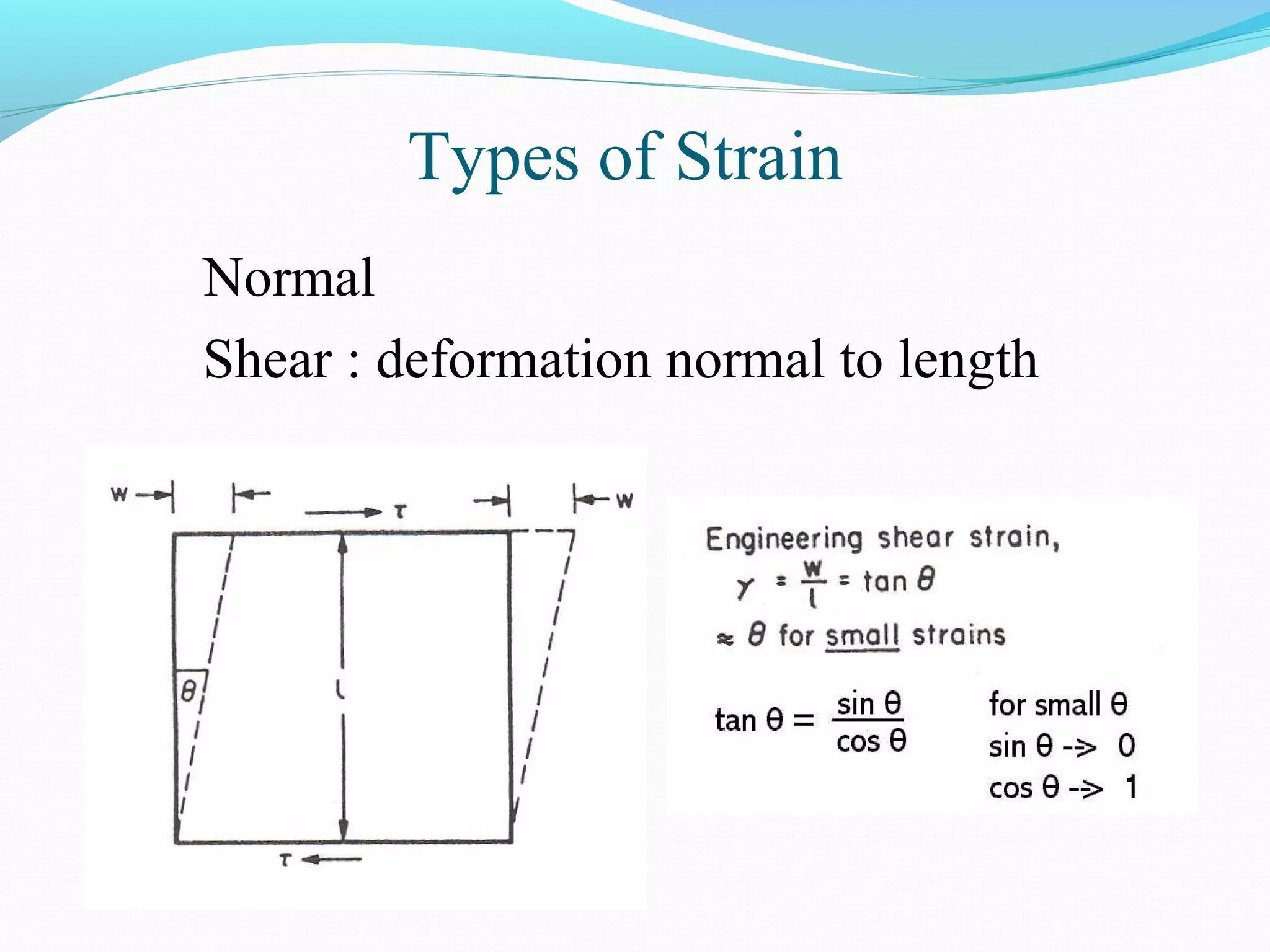
Types of Strain
Normal
Shear : deformation normal to length
Types of Strain
Normal
Shear
Dilatational (volume change)
Called a “Constitutive Model”
Simple Linear Model:
“Hooke’s Law”
Relating Stress and Strain
Normal
S = E e
Stress = Young’s modulus x strain
Relating Stress and Strain
Shear
Hooke’s Law
τ = G γ
Shear Modulus
G = E / [2 (1+ ν )]
τ = shear stress
G = shear modulus
γ = shear strain
Relating Stress and Strain
Dilatational (hydrostatic)
Hooke’s Law
P = K ∆
K= E/3(1-2ν)
P = pressure
K = bulk
modulus
∆ = ∆V/ Vo
-Hookean to a limiting strain
-Proportional limit : Deviation from linear
-After PL
*Linear
*Flat
*Non linear
Tensile Test
Callister, Materials Science & Engineering
What is Elastic Deformation?
*Recoverable strain (elastic)
*Nonrecoverable strain (plastic)
Real Material Behavior
S
e
Elastic
Elastic/plastic
Plastic Elastic
Unload/Reload
Callister, Materials Science & Engineering
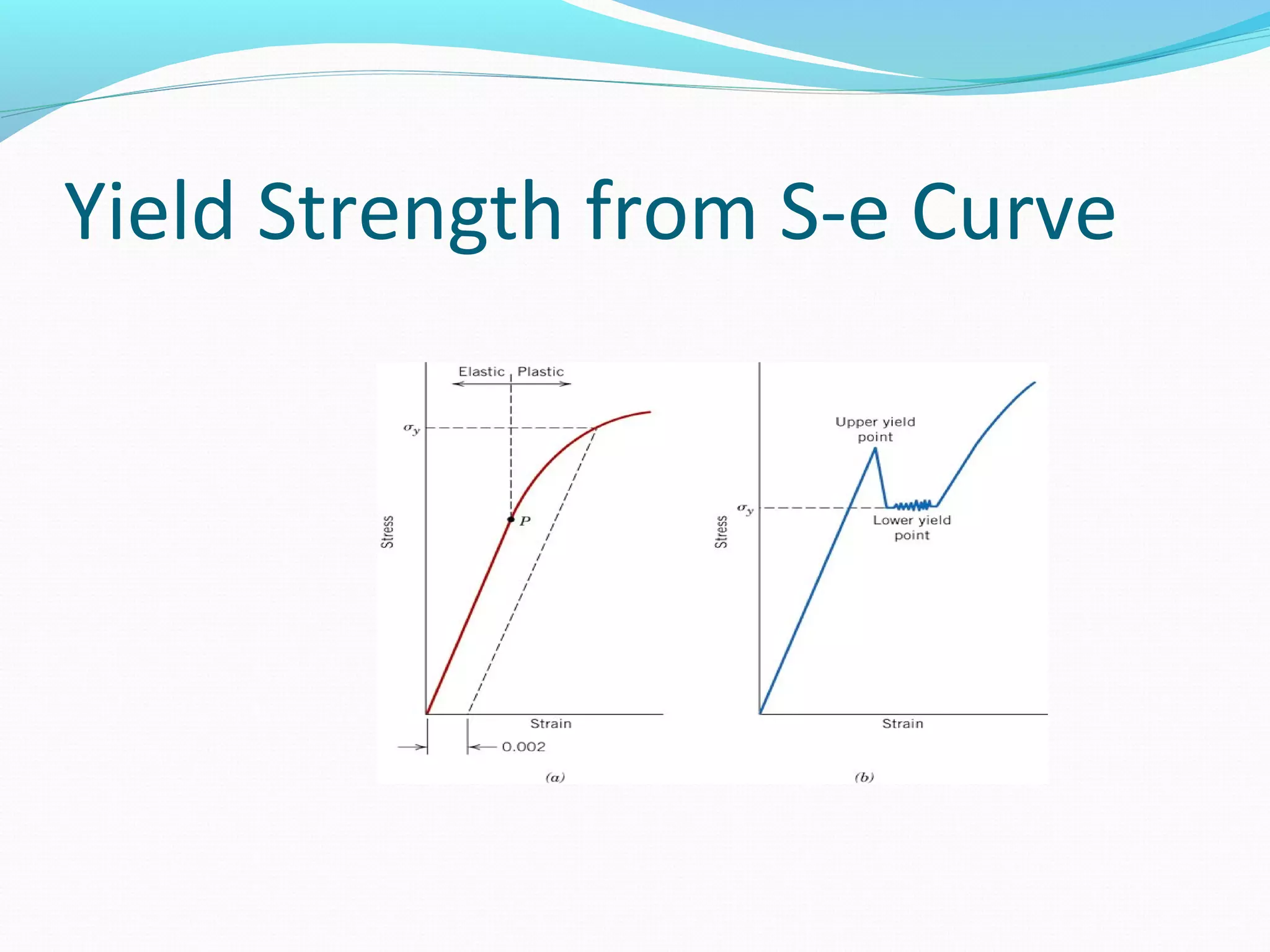
Yield Strength from S-e Curve
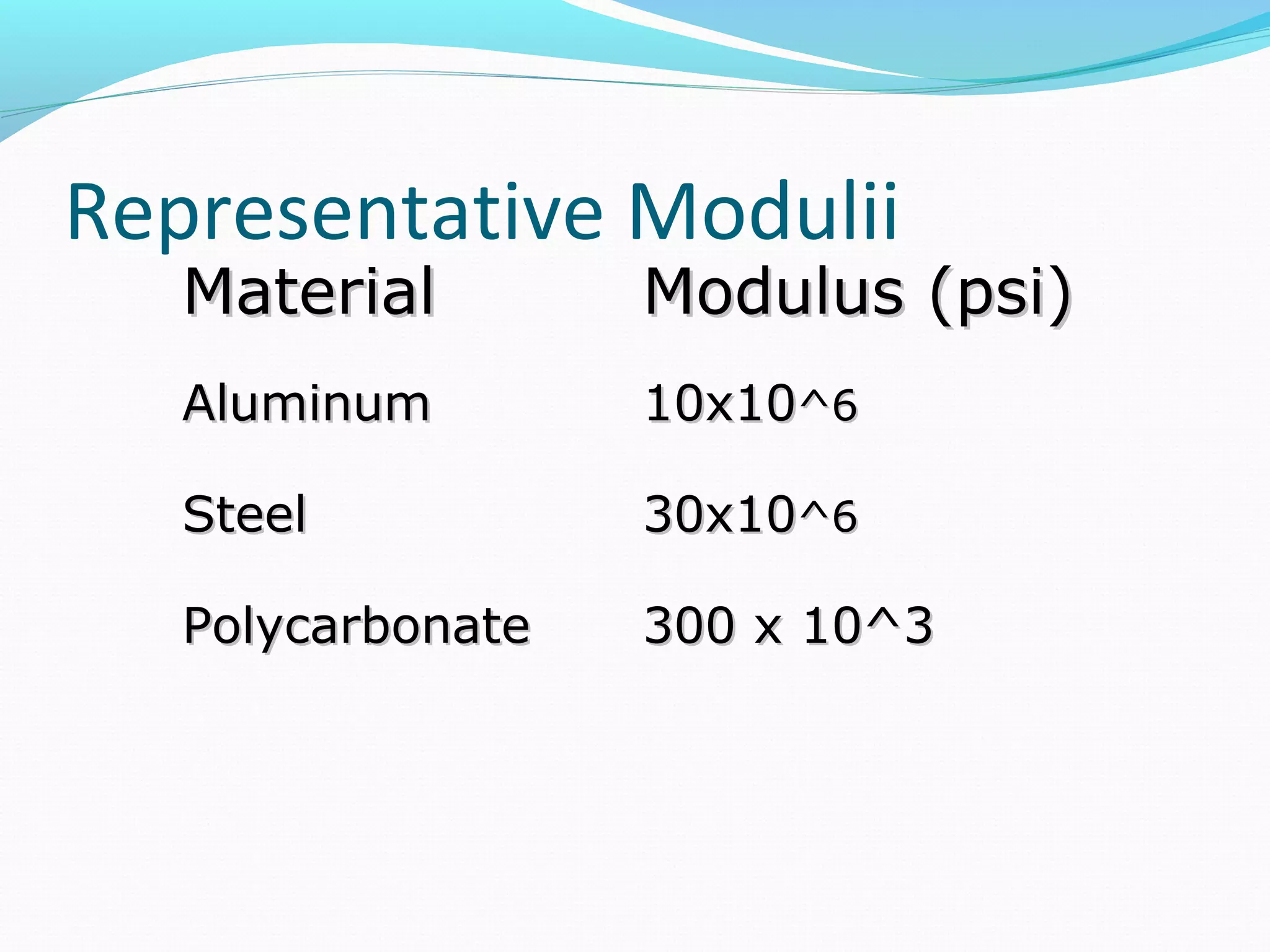
Representative Modulii
MaterialMaterial Modulus (psi)Modulus (psi)
AluminumAluminum 10x1010x10^6^6
SteelSteel 30x1030x10^6^6
PolycarbonatePolycarbonate 300 x 10^3300 x 10^3

Stress and strain section c