Stresses Around Pin Loaded Holes in Mechanically Fastened Joints   By Neville A. Tomlinson, PhD Howard University Washington DC January 2007
Abstract An analytical method for determining the stress distribution in pin loaded orthotropic plates is presented based on the complex stress function approach. The method assumes that the contact boundary at the pin-plate interface is unknown a priori and must be determined as part of the solution. It is further assumed that the pin is rigid, clearance exists between pin and plate, and the coefficient of friction remains constant throughout the contact zone. The boundary conditions at the pin-plate interface are specified in terms of the unknown contact angle and a trigonometric series used to represent the displacement field in the contact zone. Numerical results are presented for normal, tangential and shear stresses on the cavity for different lay-ups of graphite/epoxy laminates.
Introduction The increasing use of composite materials has caused engineers to increase their efforts to understand the stress fields associated with these materials.  One application that has received much attention is the stresses associated with the mechanical joining of composites  Mechanical joining includes bolted, riveted and pinned joints which are relatively easy to assemble and disassemble.  These joints are however prone to high stress concentrations which occurs in the vicinity of the hole, which is undesirable, and is often the source of premature failure.
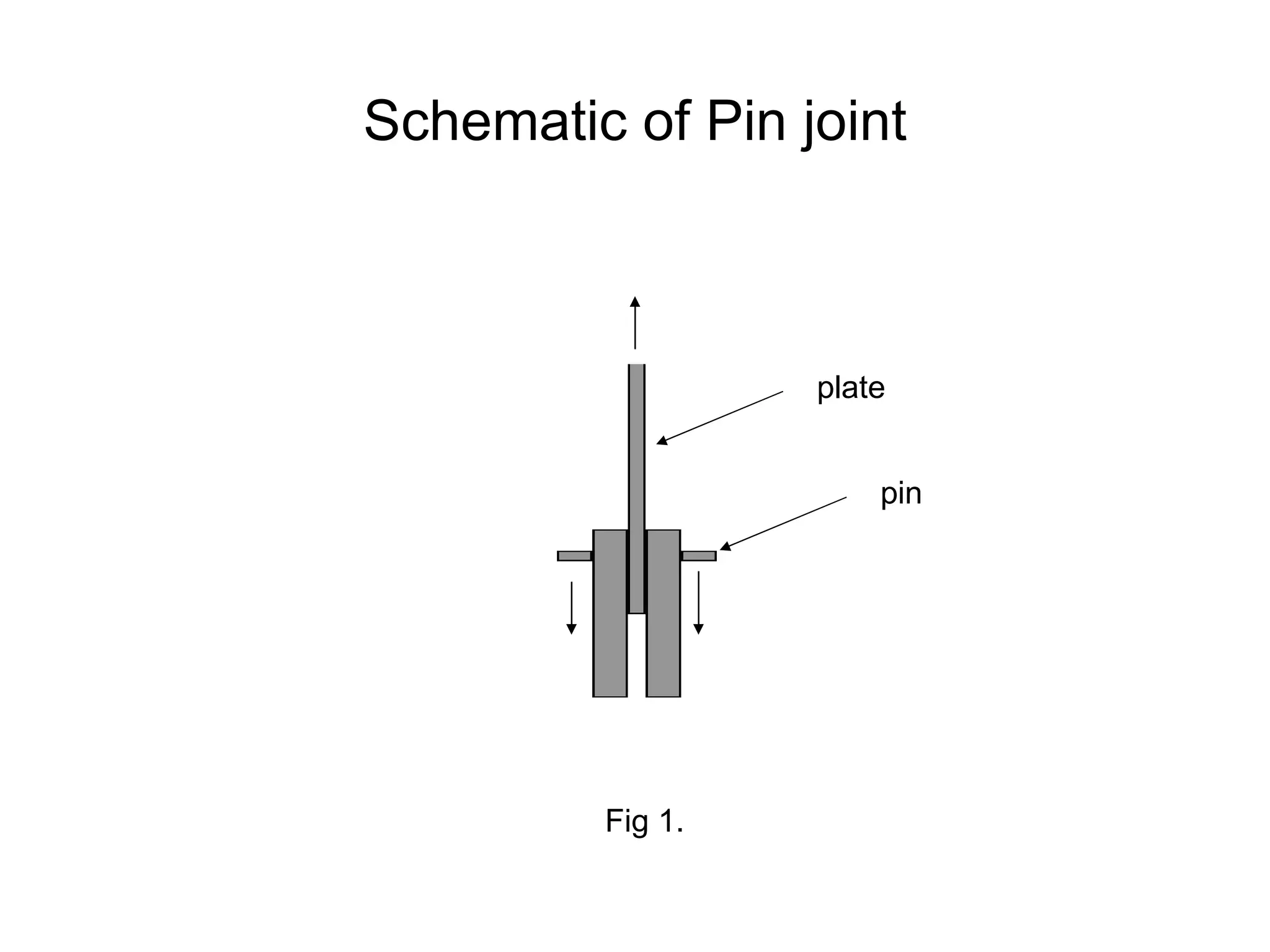
Schematic of Pin joint pin plate Fig 1.
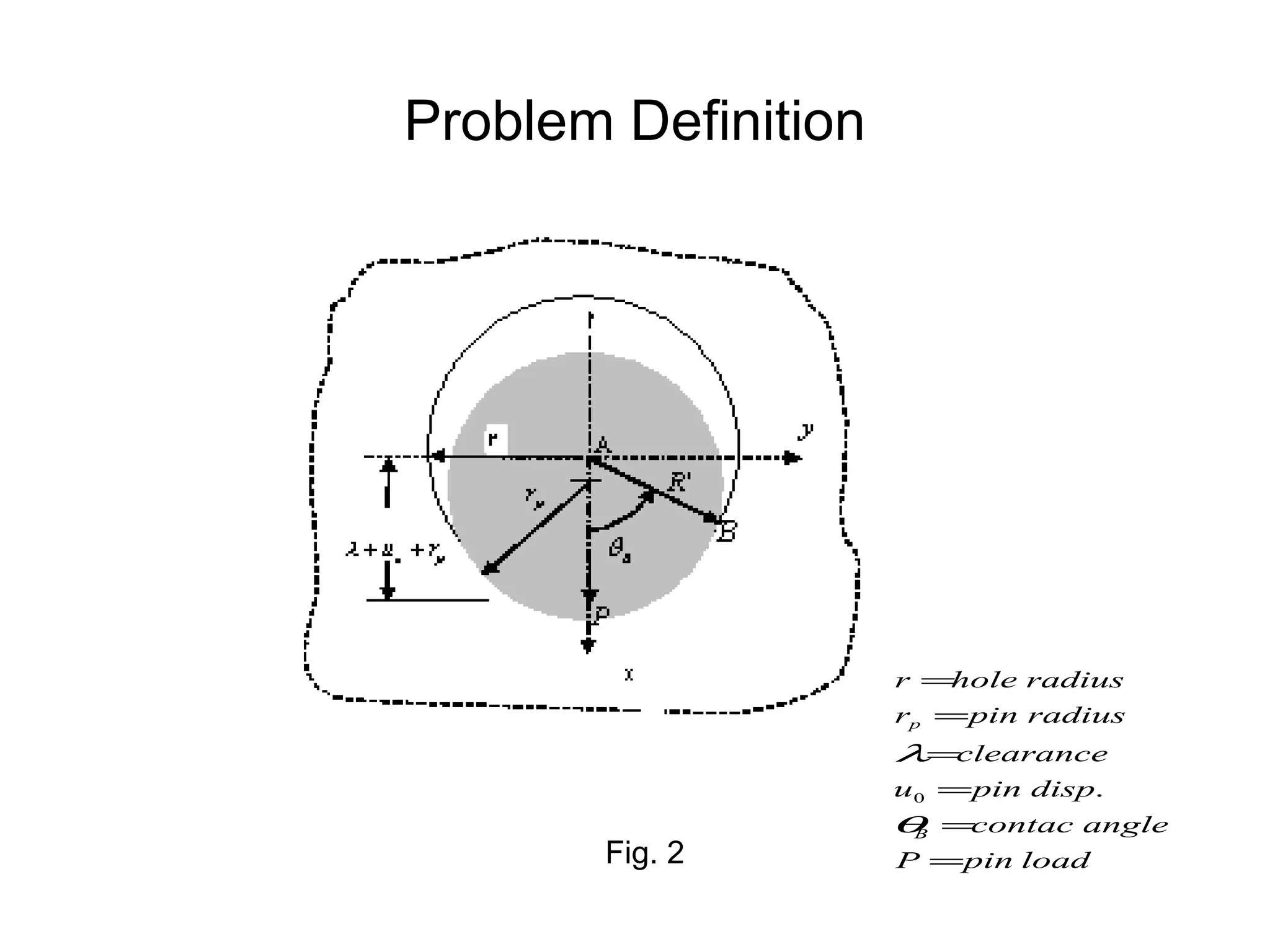
Problem Definition Fig. 2
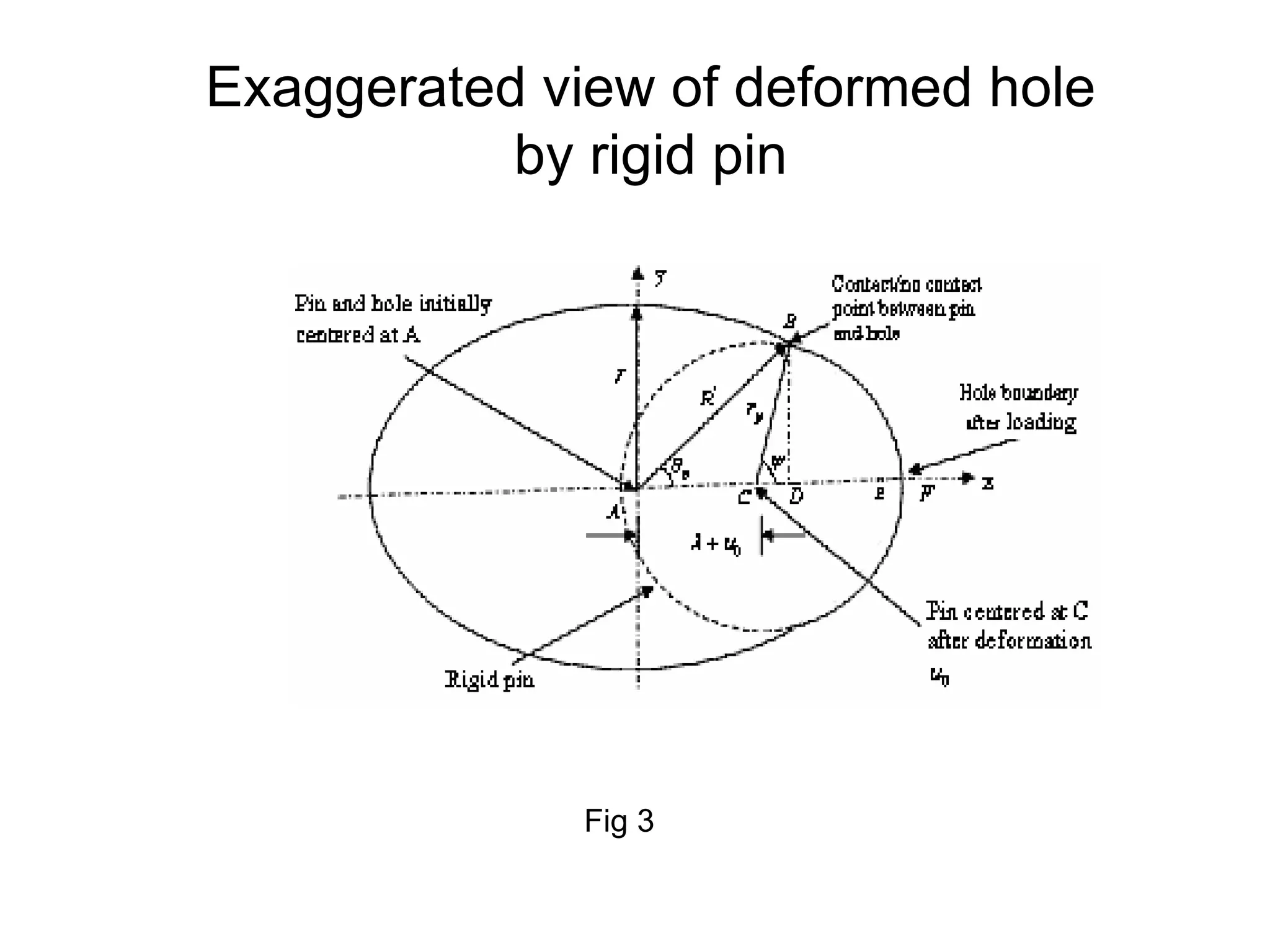
Exaggerated view of deformed hole by rigid pin Fig 3
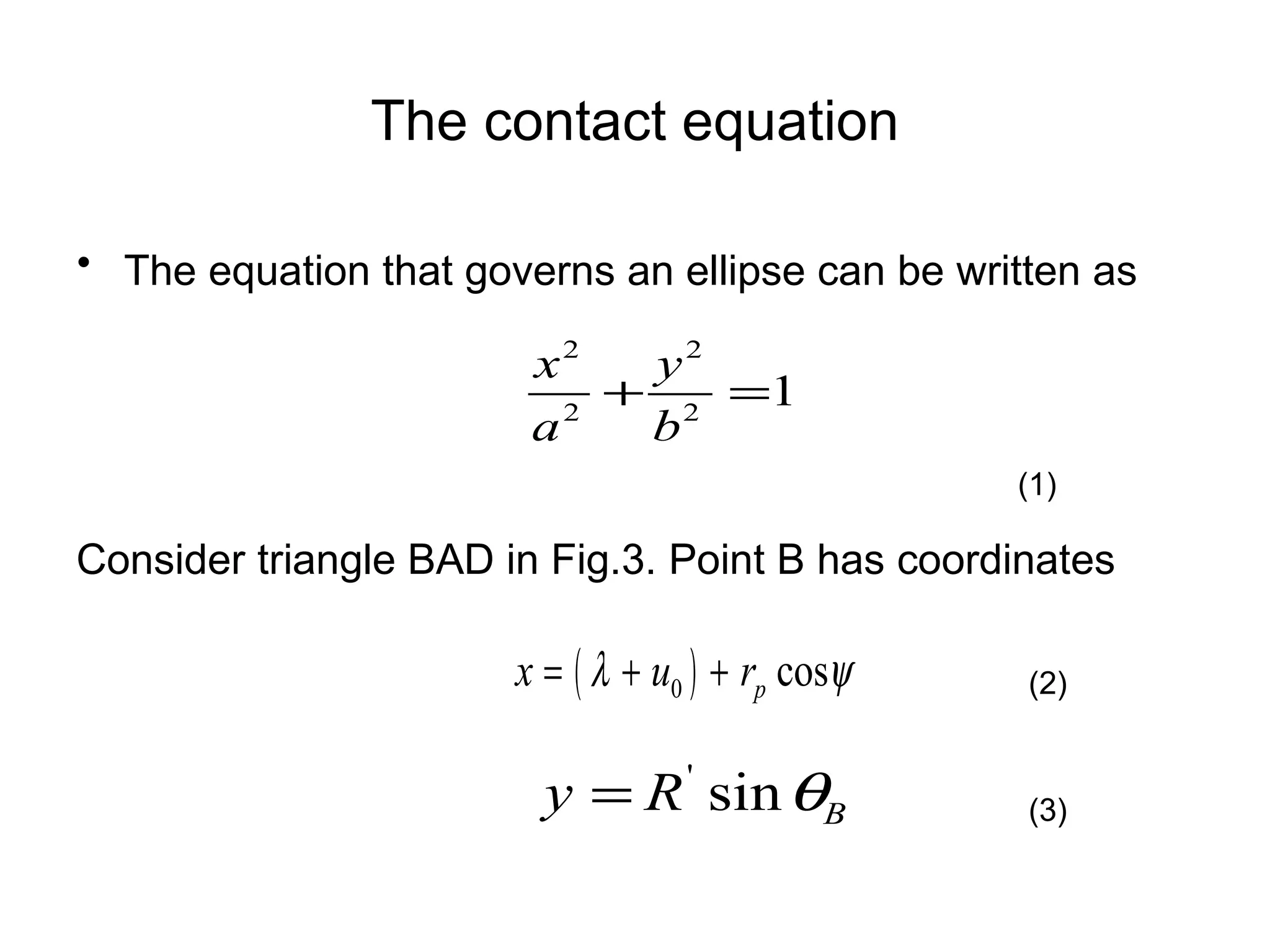
The contact equation The equation that governs an ellipse can be written as   Consider triangle BAD in Fig.3. Point B has coordinates (1) (2) (3)
The contact equation From the ellipse Substituting (2-4) in (1) yields Equation (5) is the non-linear contact equation. (4) (5)
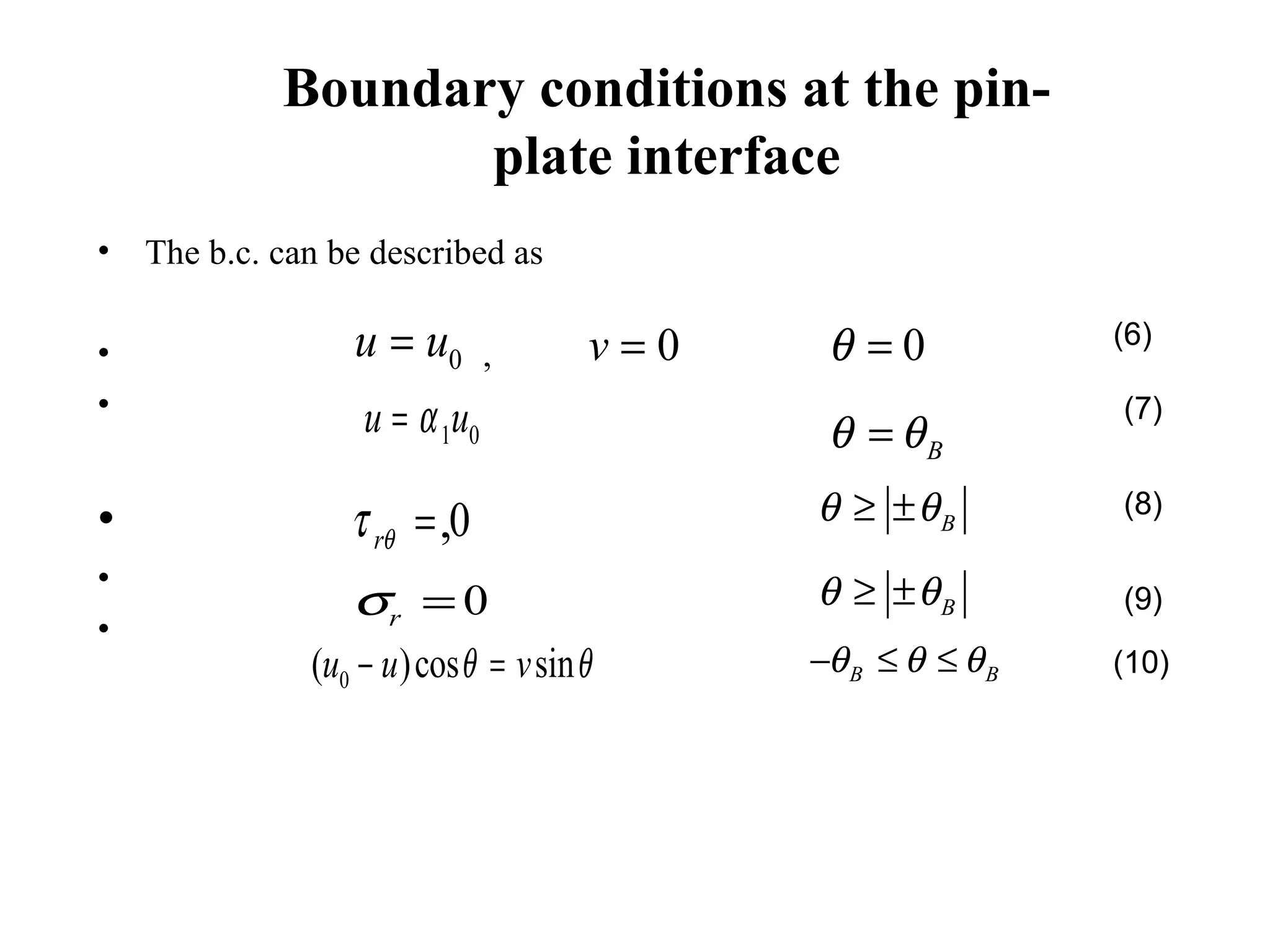
Boundary conditions at the pin-plate interface The b.c. can be described as  ,  ,  (6) (7)  (8) (10)  (9)
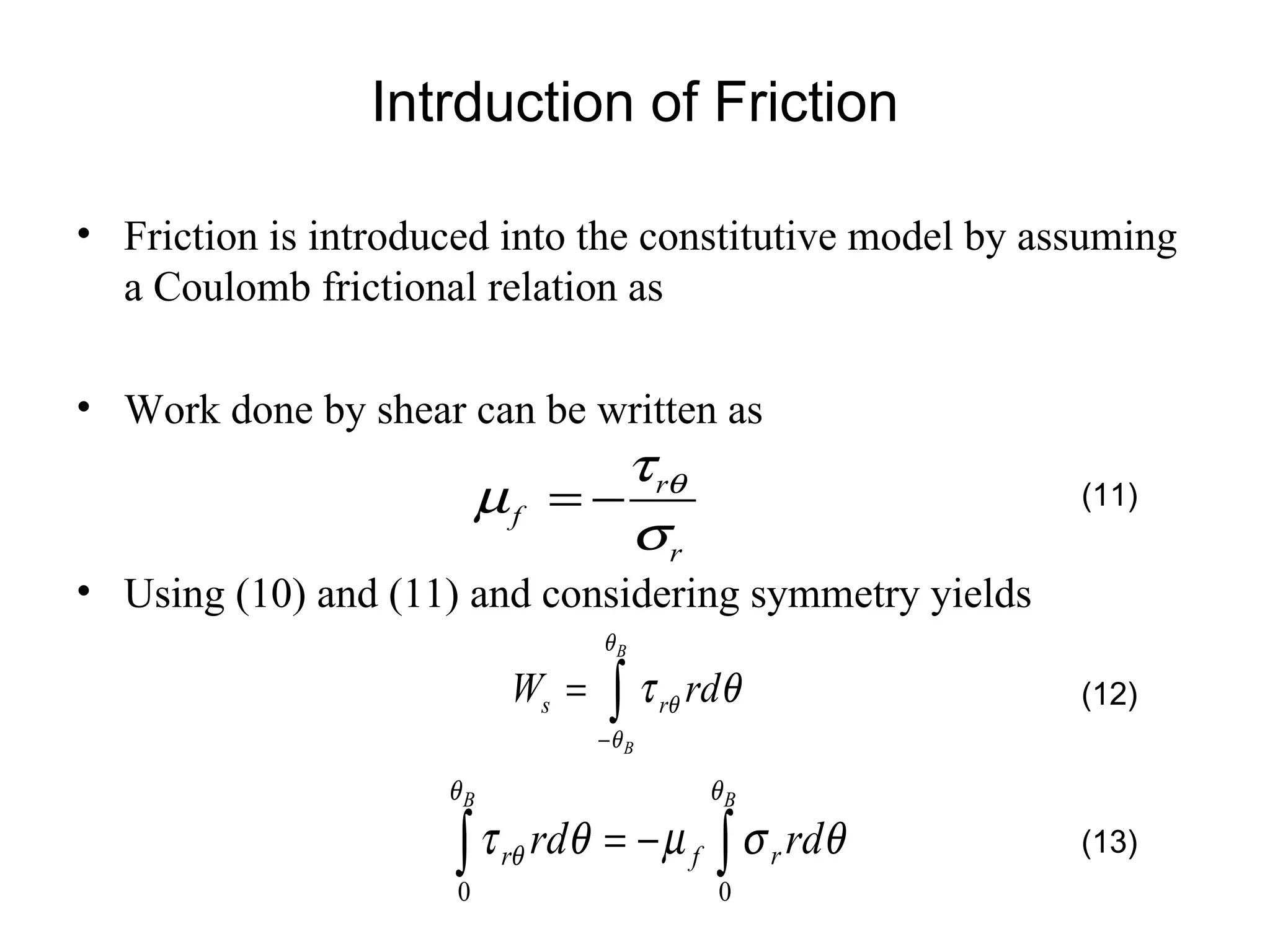
Intrduction of Friction Friction is introduced into the constitutive model by assuming a Coulomb frictional relation as  Work done by shear can be written as Using (10) and (11) and considering symmetry yields (11) (12) (13)
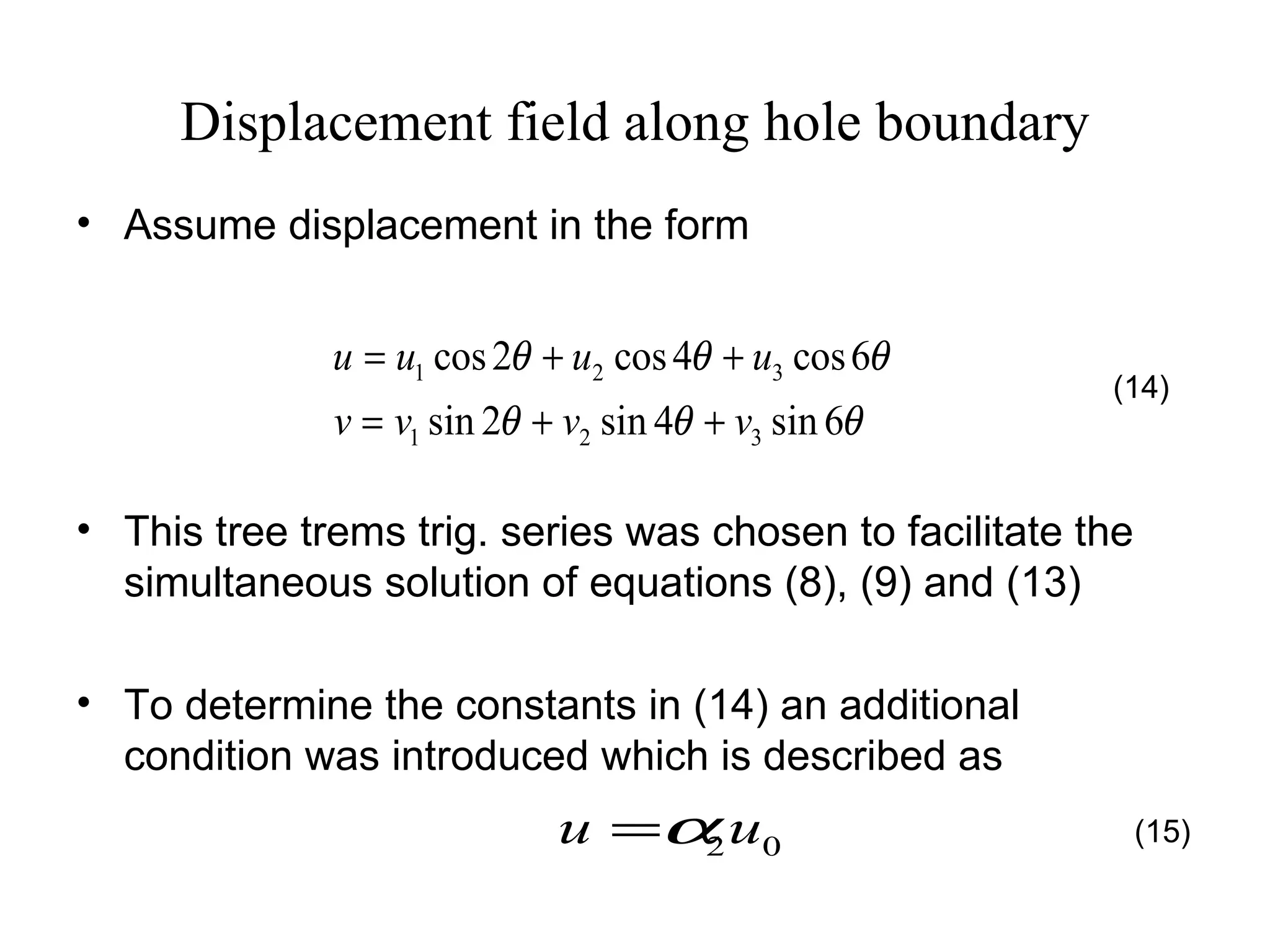
Displacement field along hole boundary Assume displacement in the form This tree trems trig. series was chosen to facilitate the simultaneous solution of equations (8), (9) and (13) To determine the constants in (14) an additional condition was introduced which is described as  (14) (15)
Coefficients of u . (16) (17) (18)
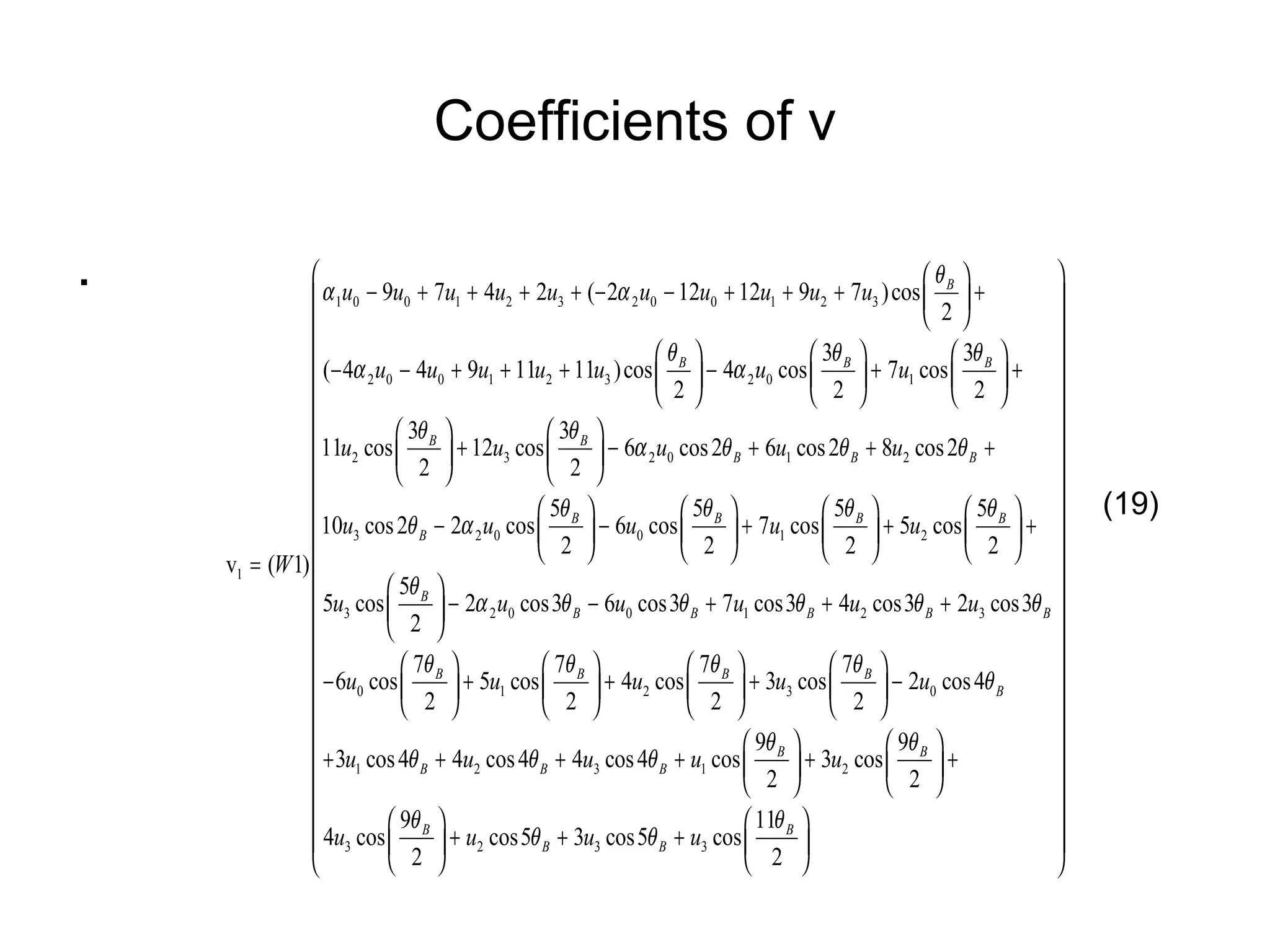
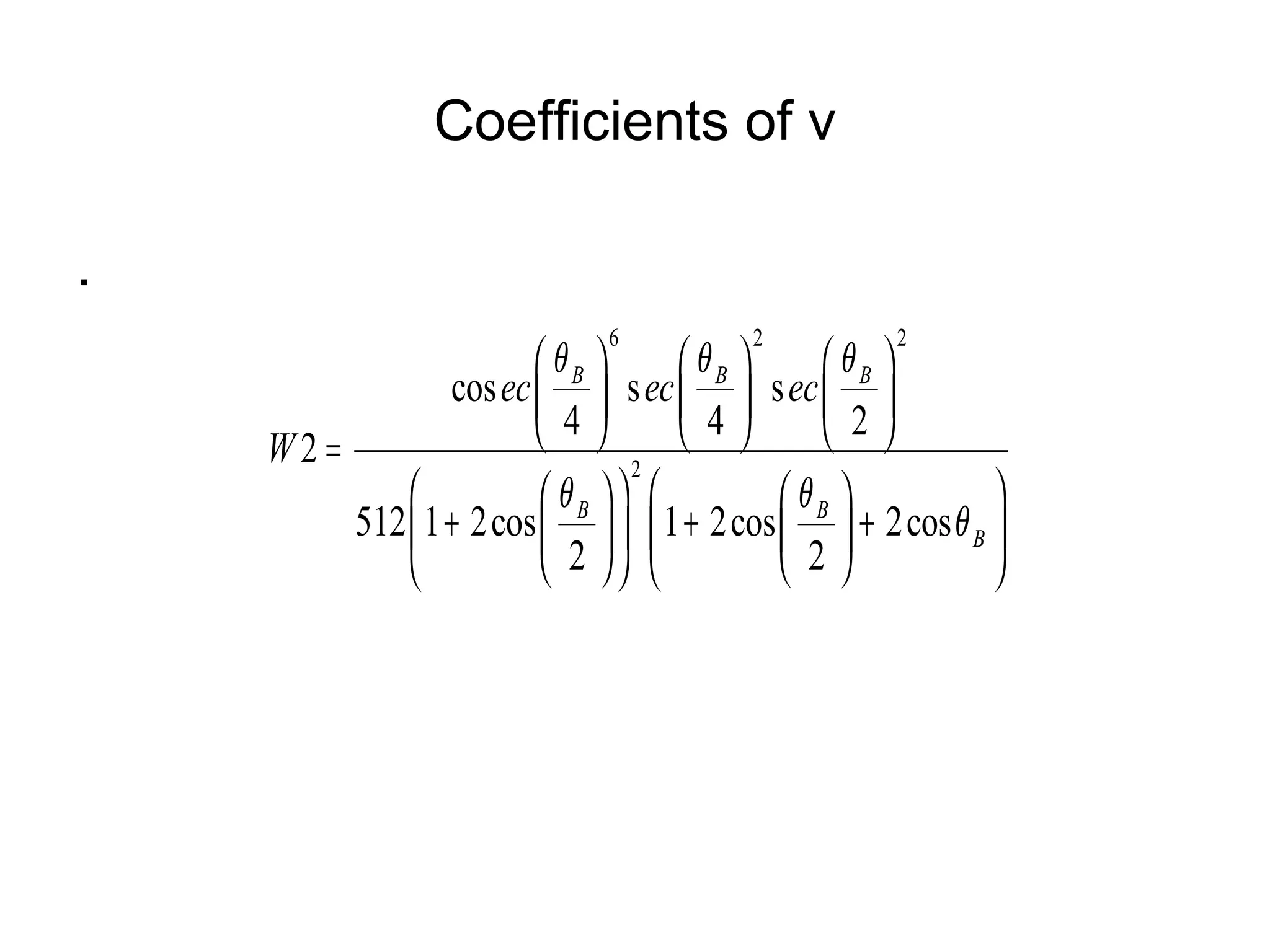
Coefficients of v . (19)
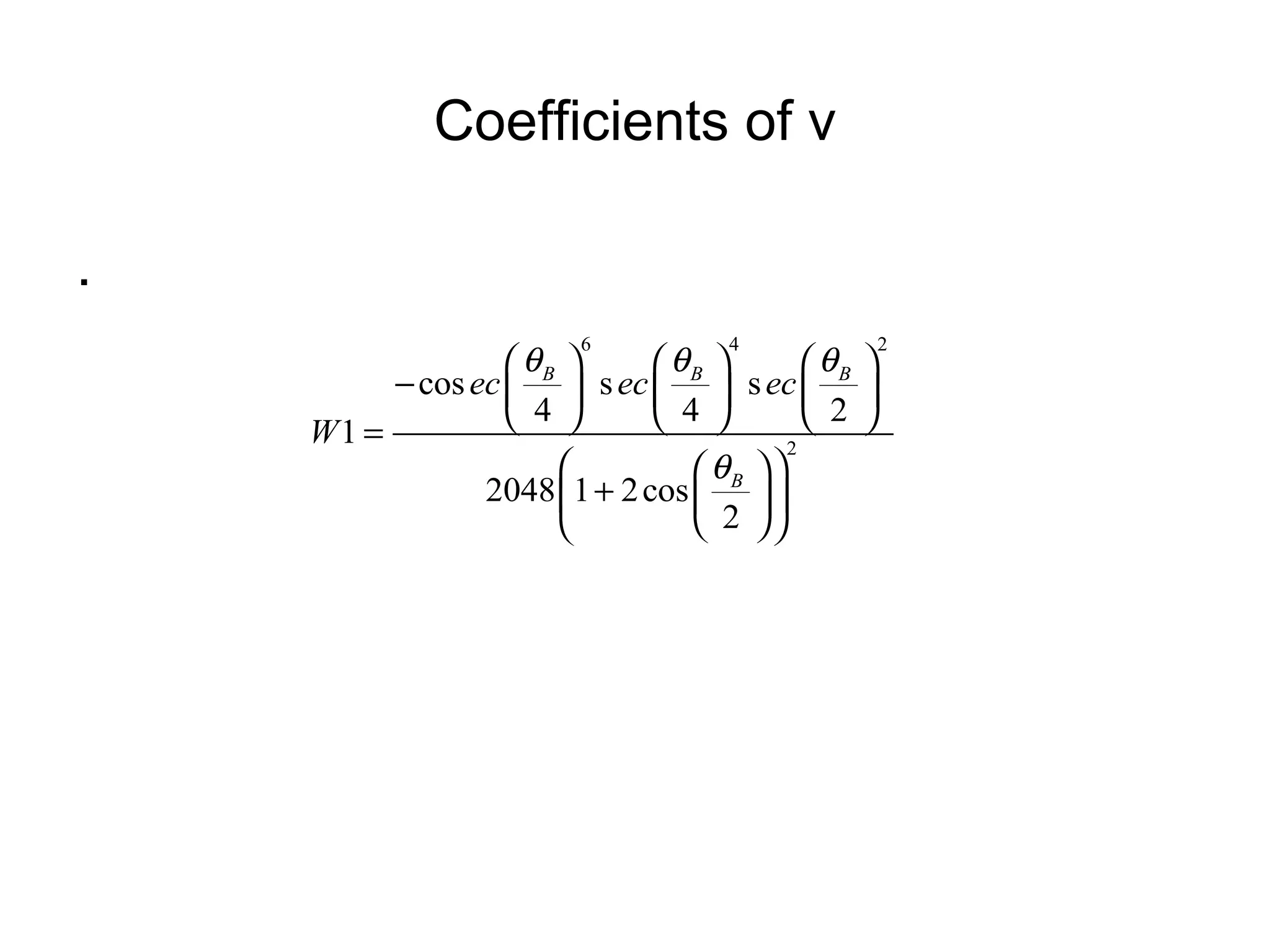
Coefficients of v .
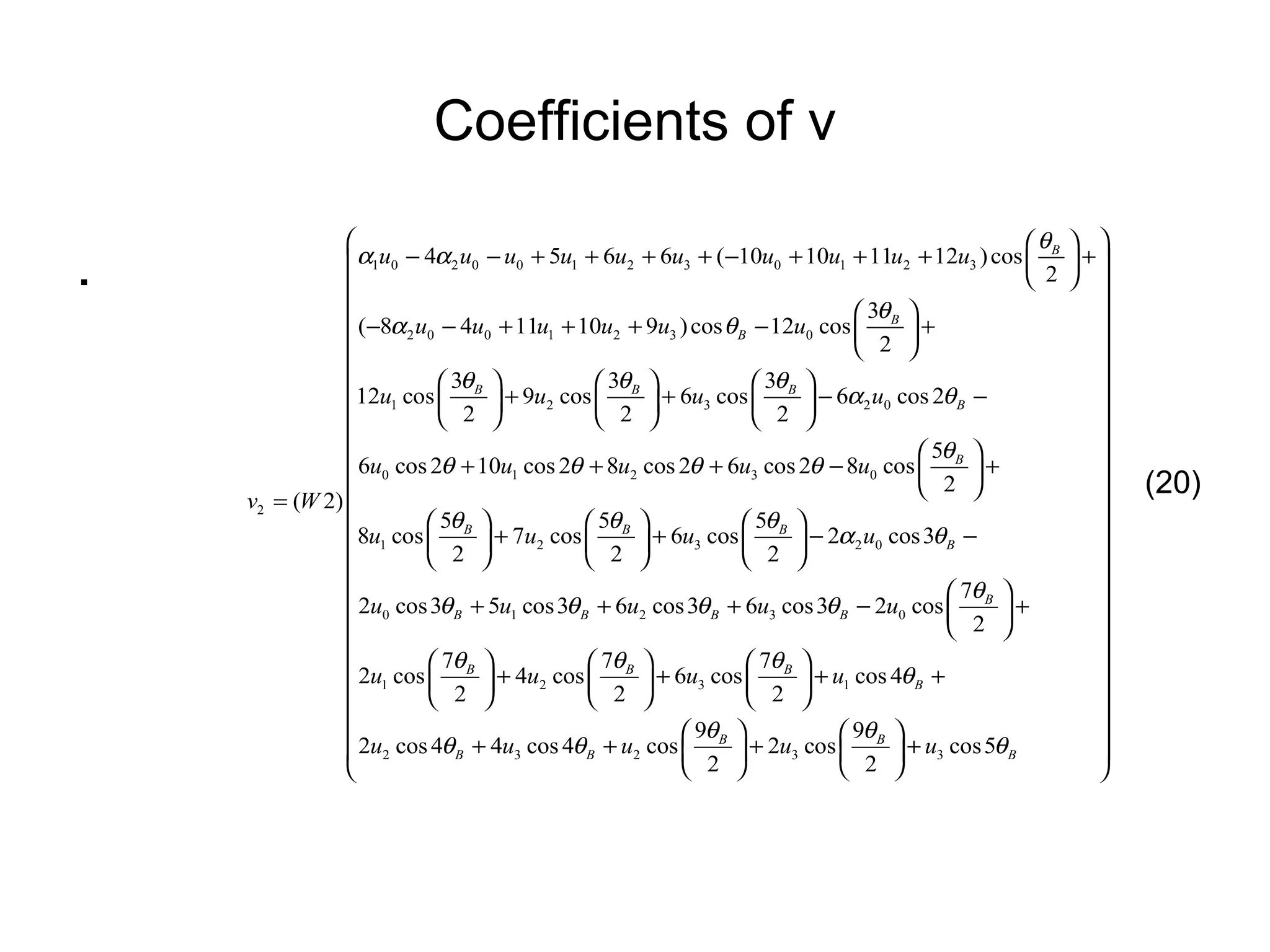
Coefficients of v . (20)
Coefficients of v .
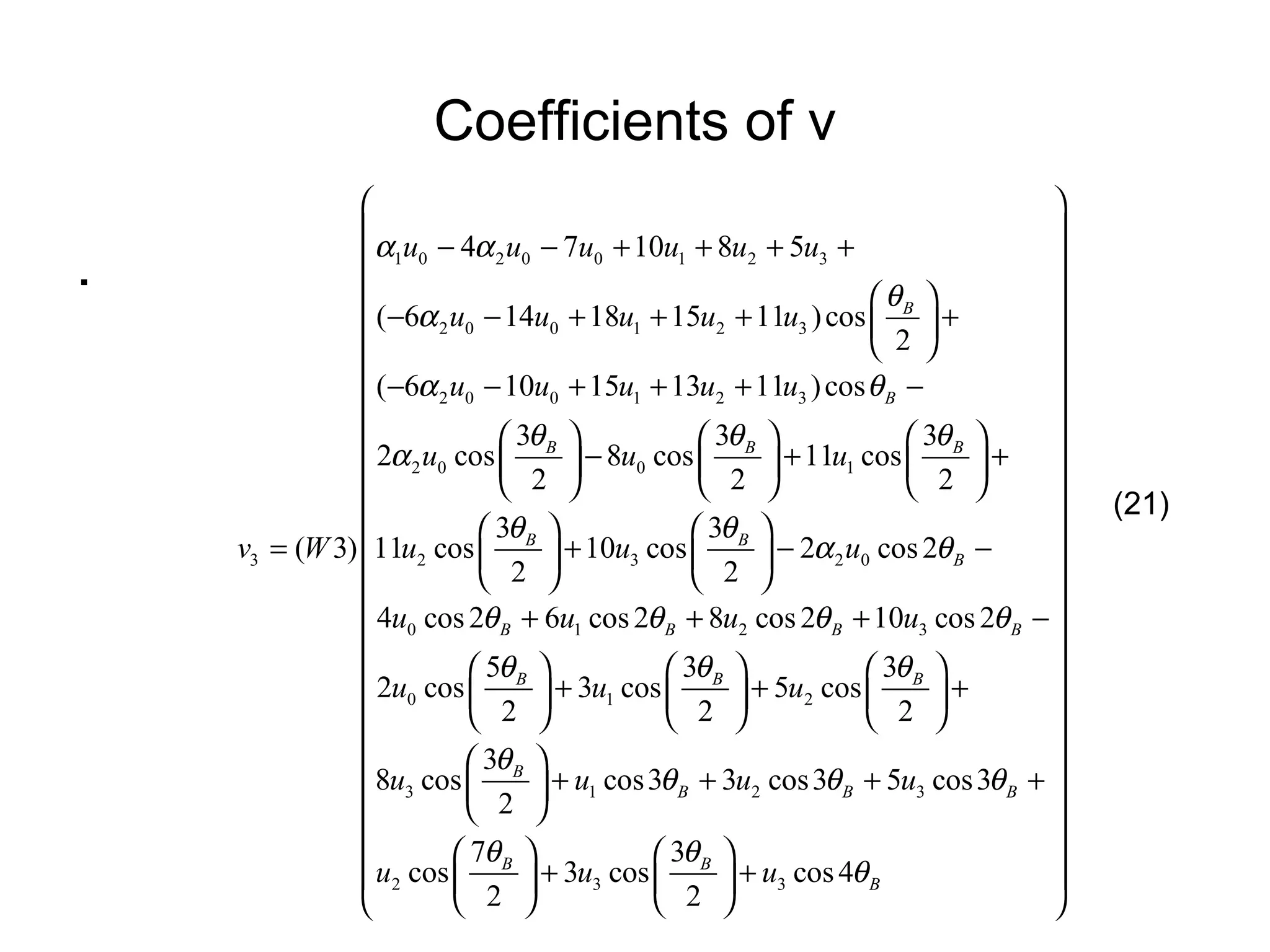
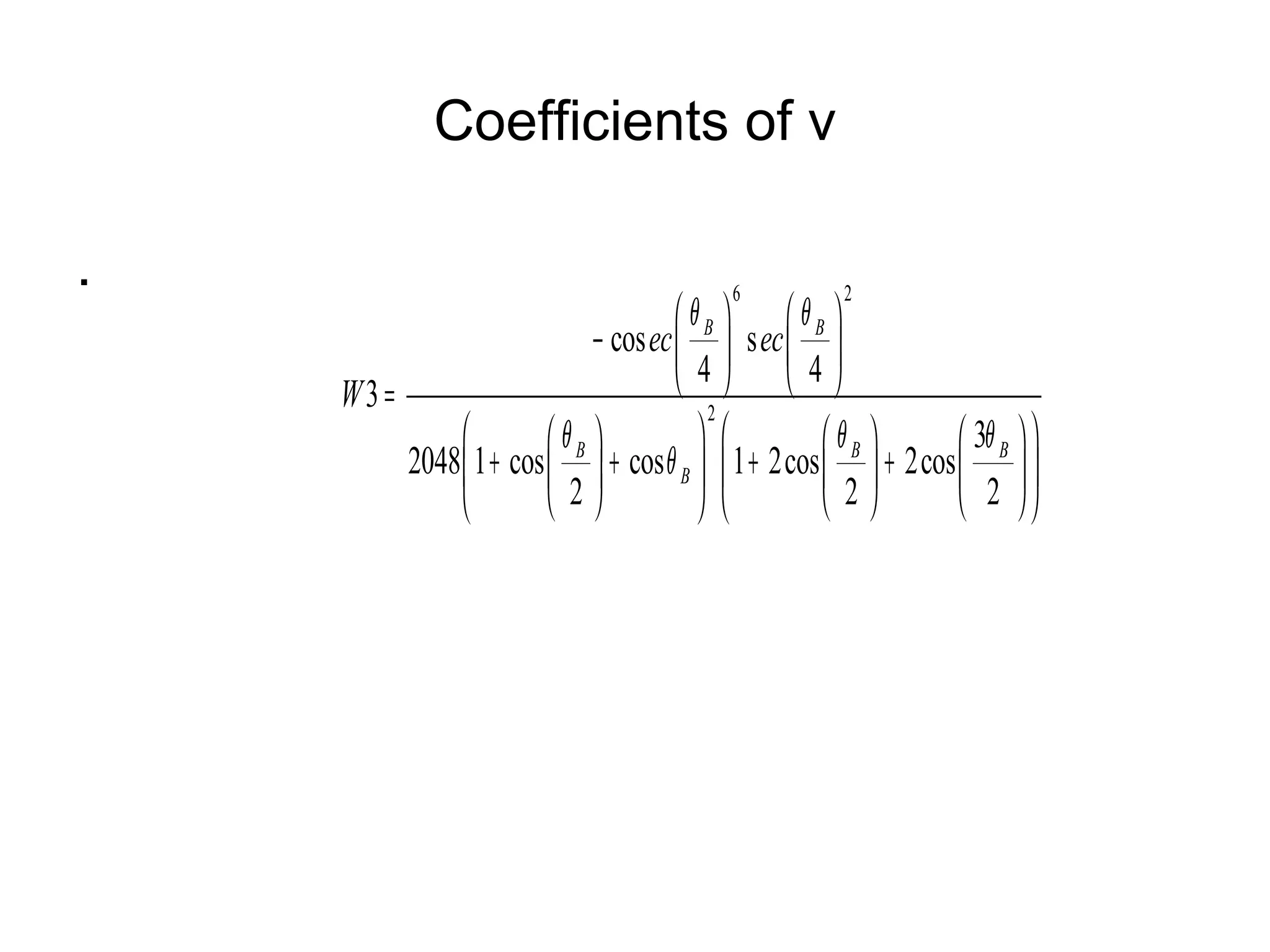
Coefficients of v . (21)
Coefficients of v .
Determination of stress functions Lekhnitskii (1) has shown that if the displacements at the hole edge can be written in the form Then the stress functions can be written as  (22) (23)
Definition of stress function terms .where
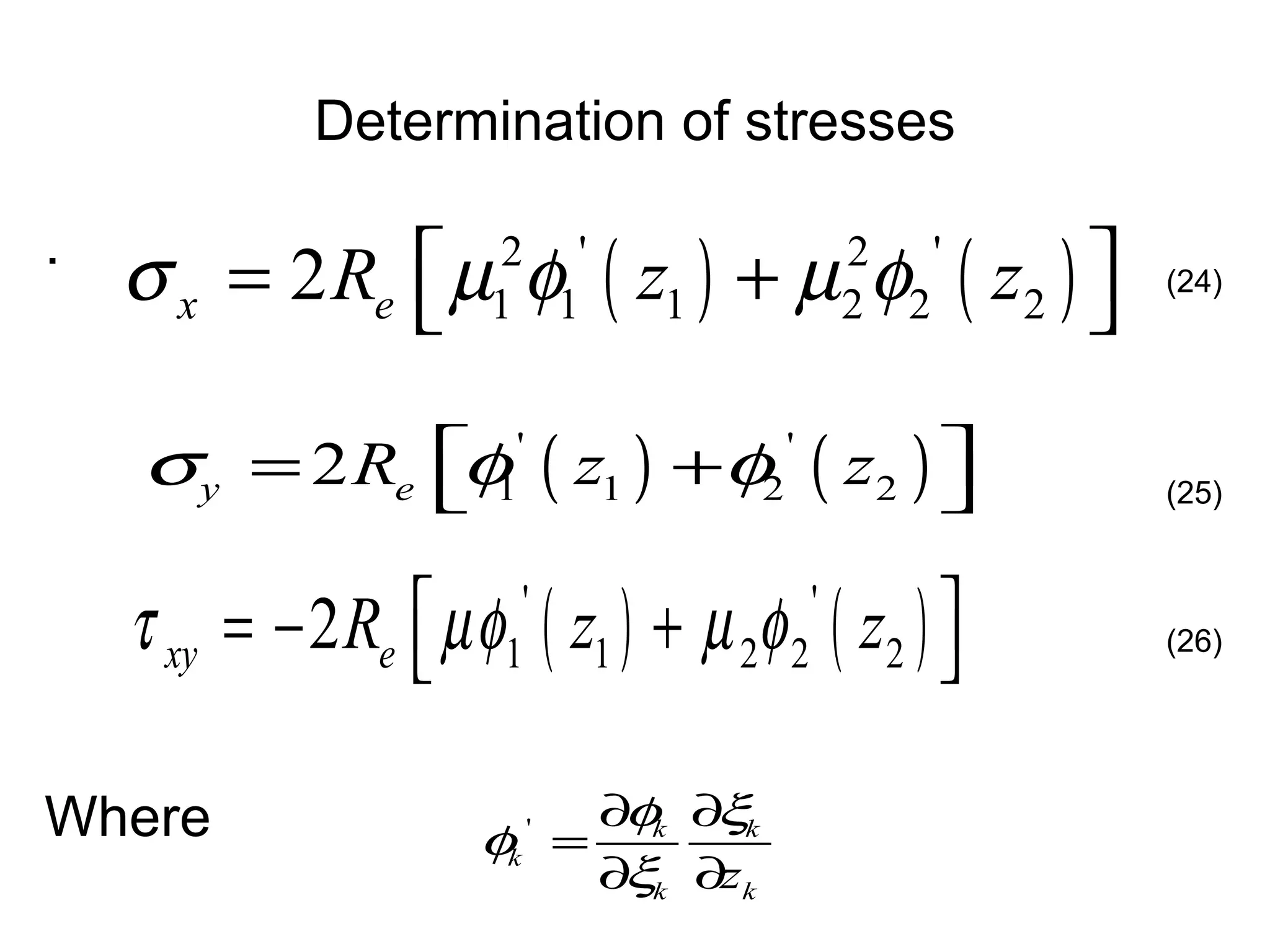
Determination of stresses . Where (24) (25) (26)
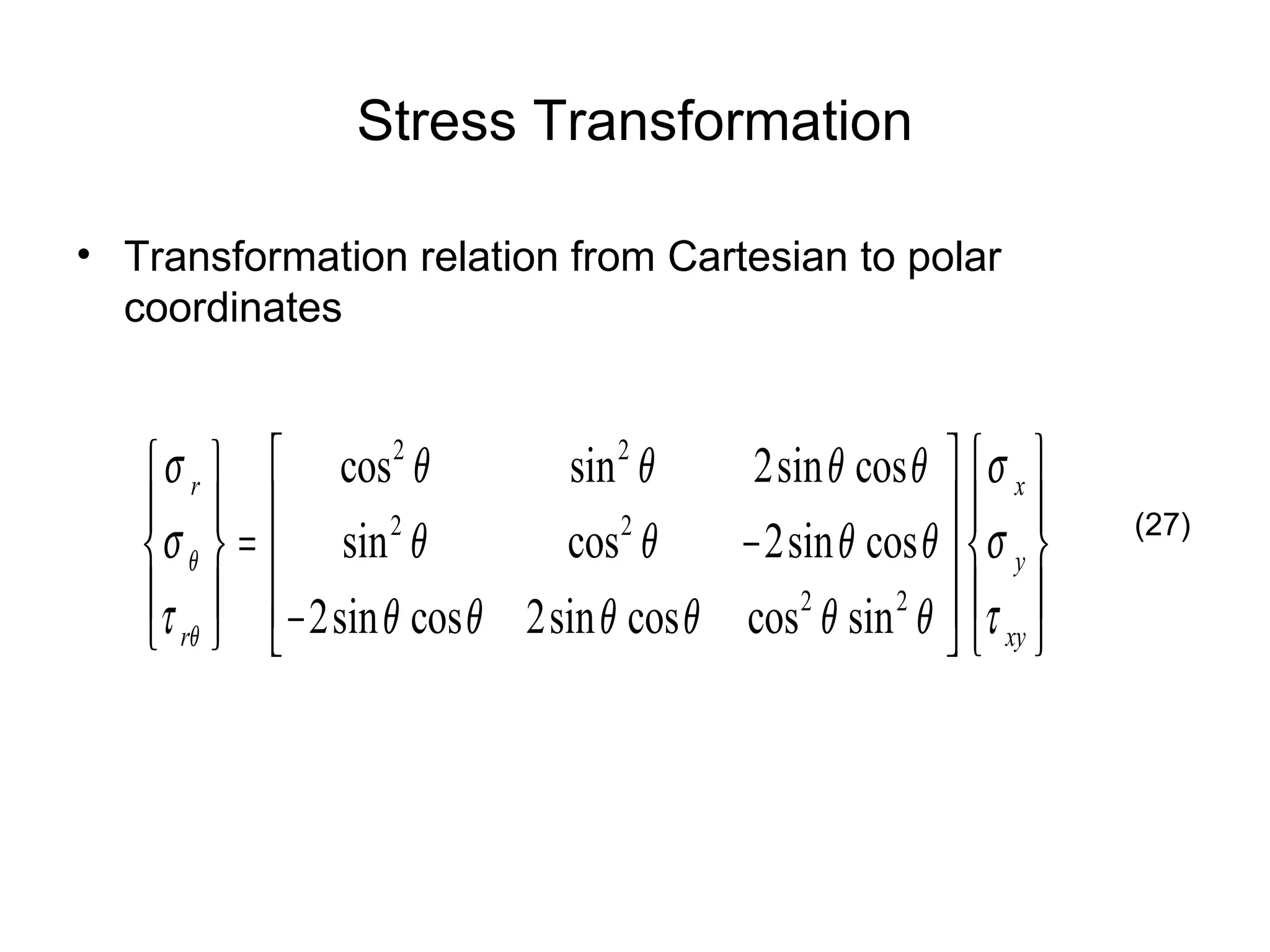
Stress Transformation Transformation relation from Cartesian to polar coordinates (27)
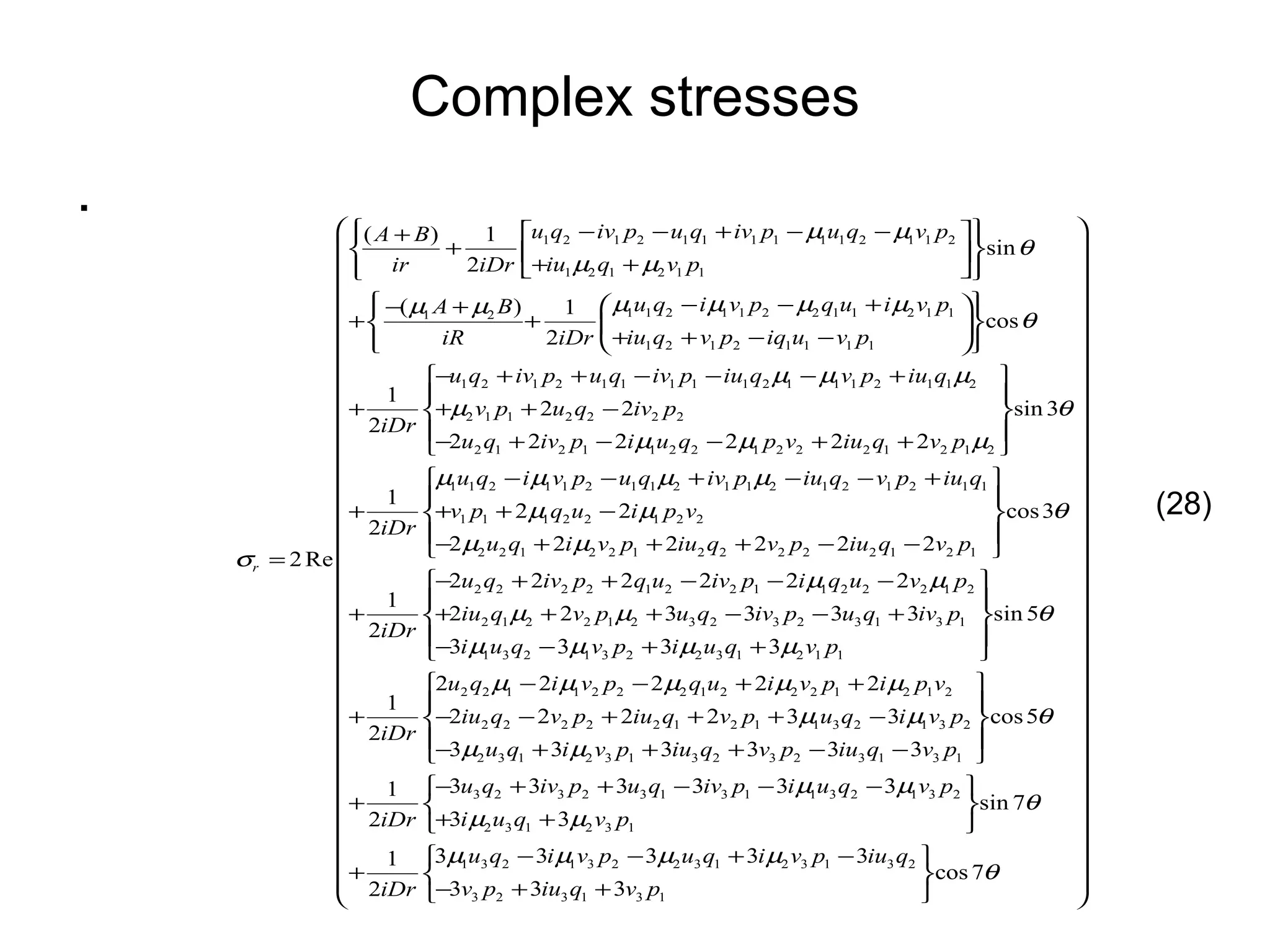
Complex stresses . (28)
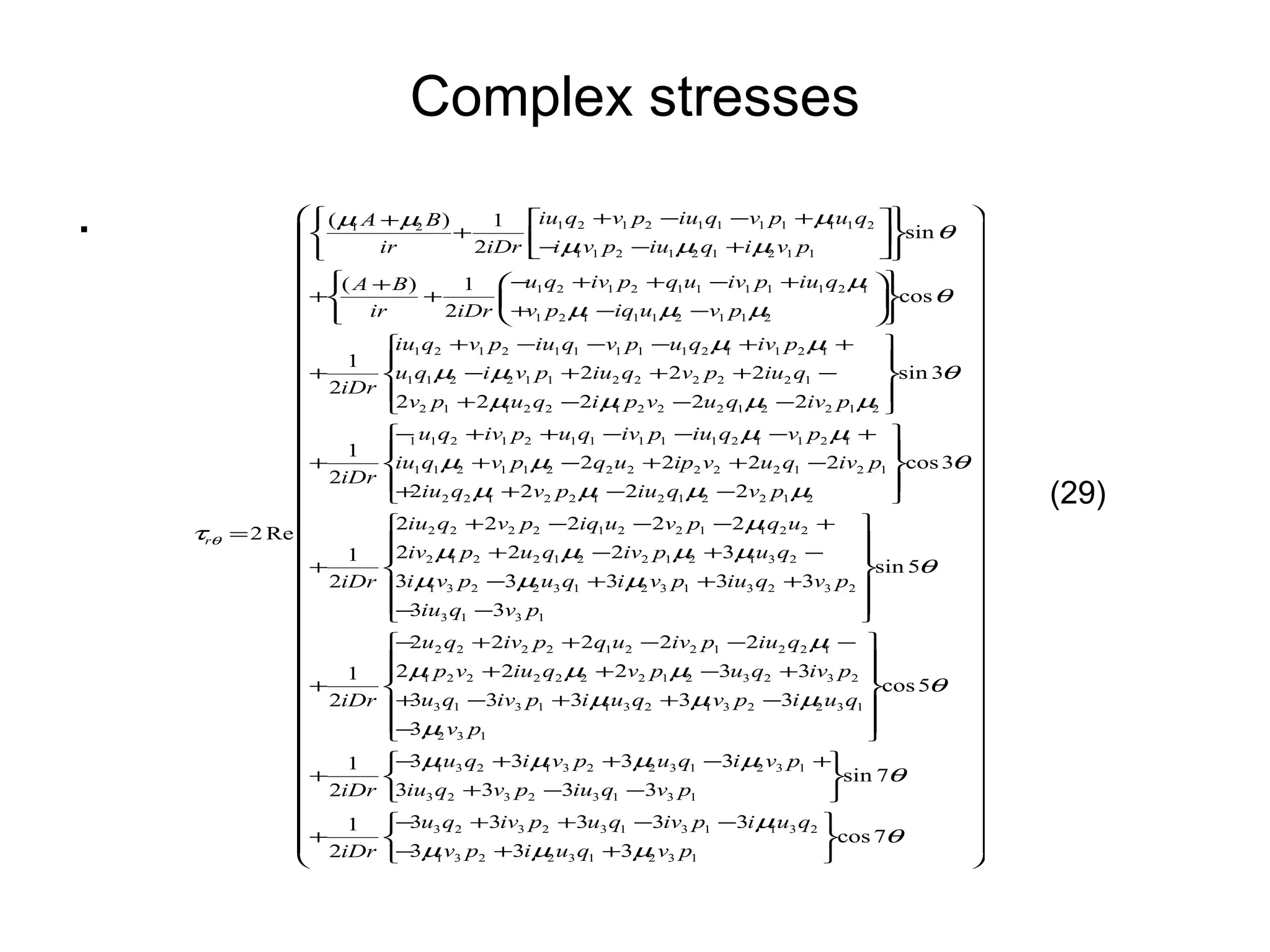
Complex stresses . (29)
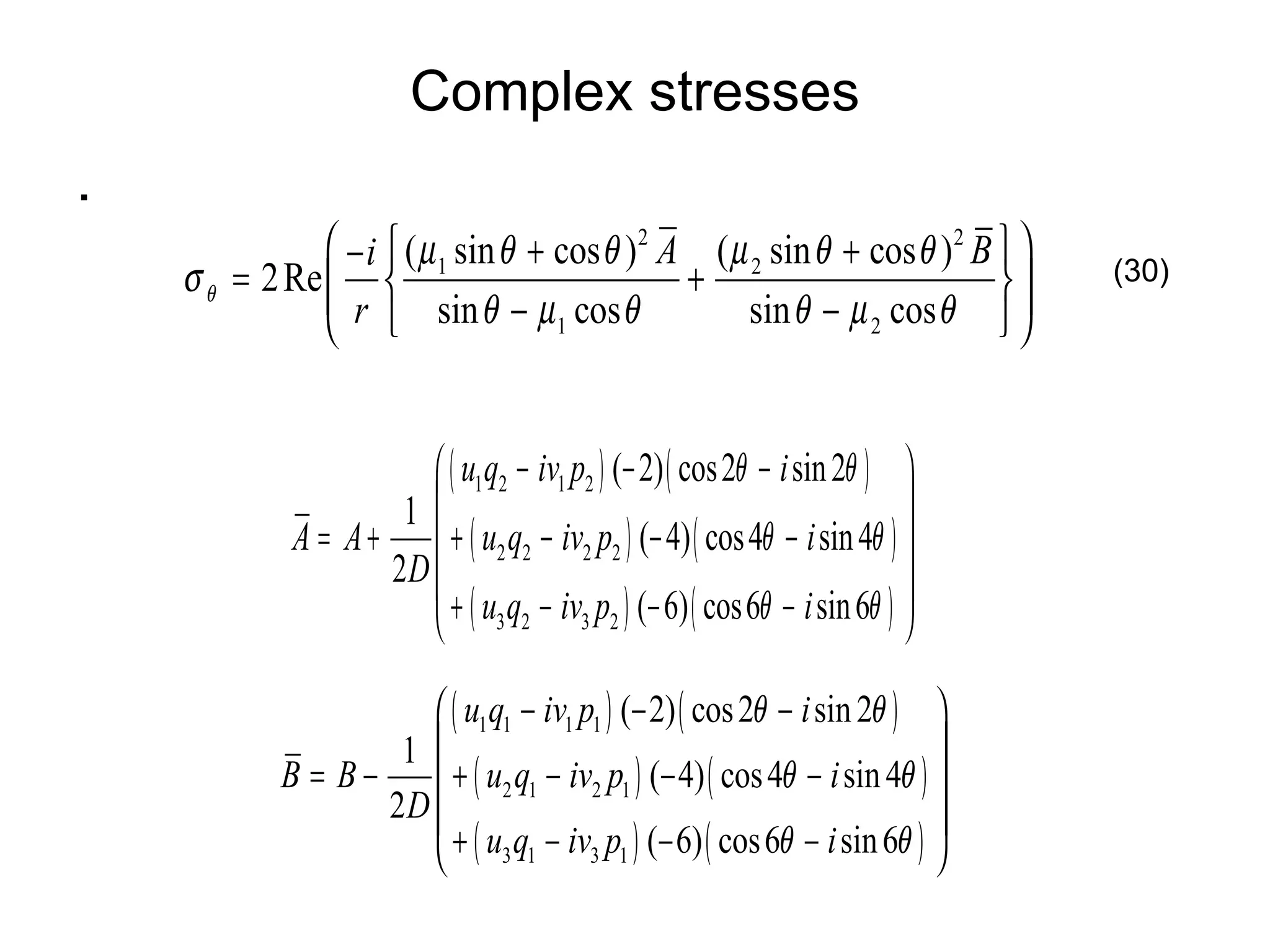
Complex stresses . (30)
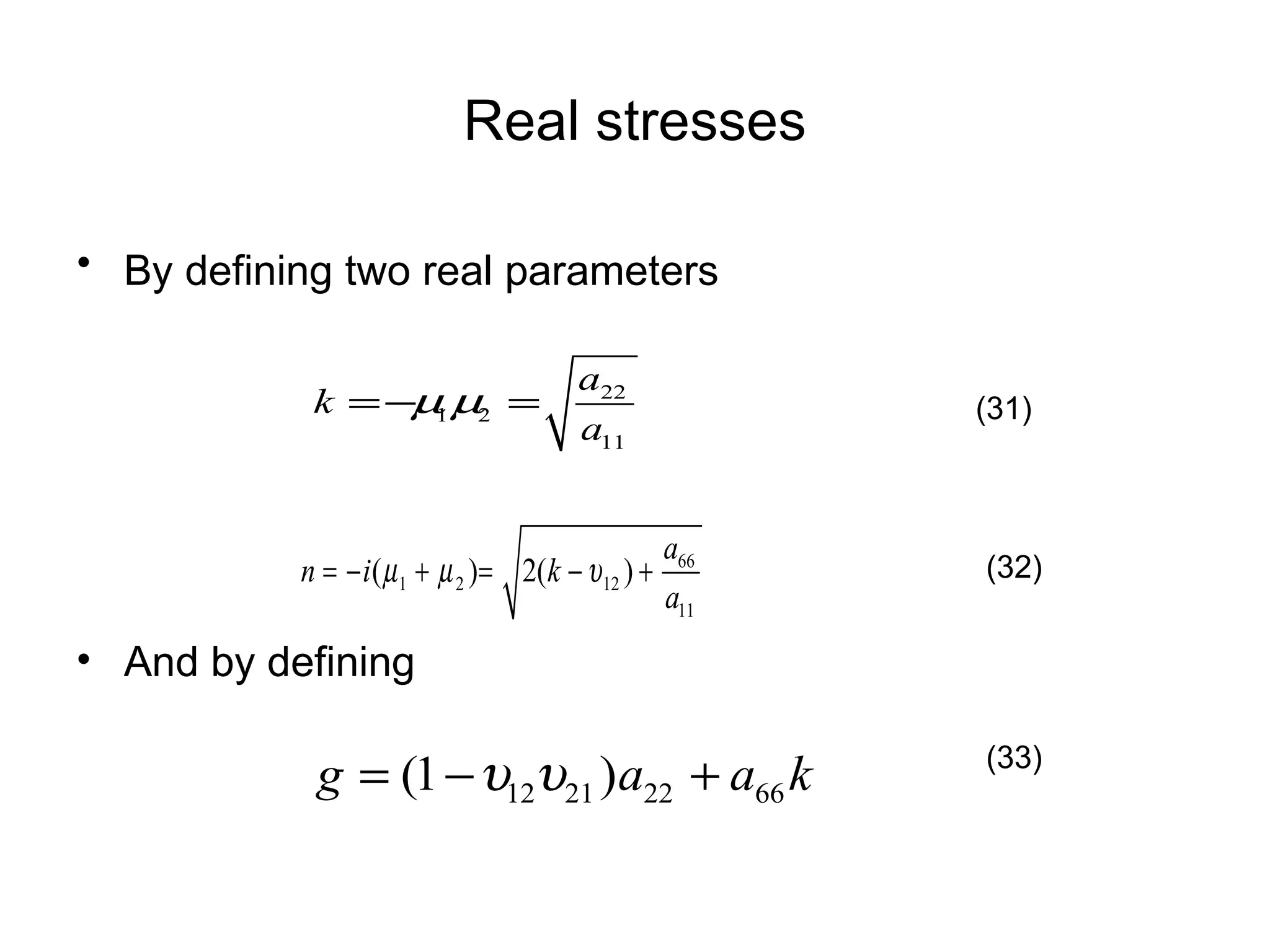
Real stresses By defining two real parameters   And by defining  (31) (32) (33)
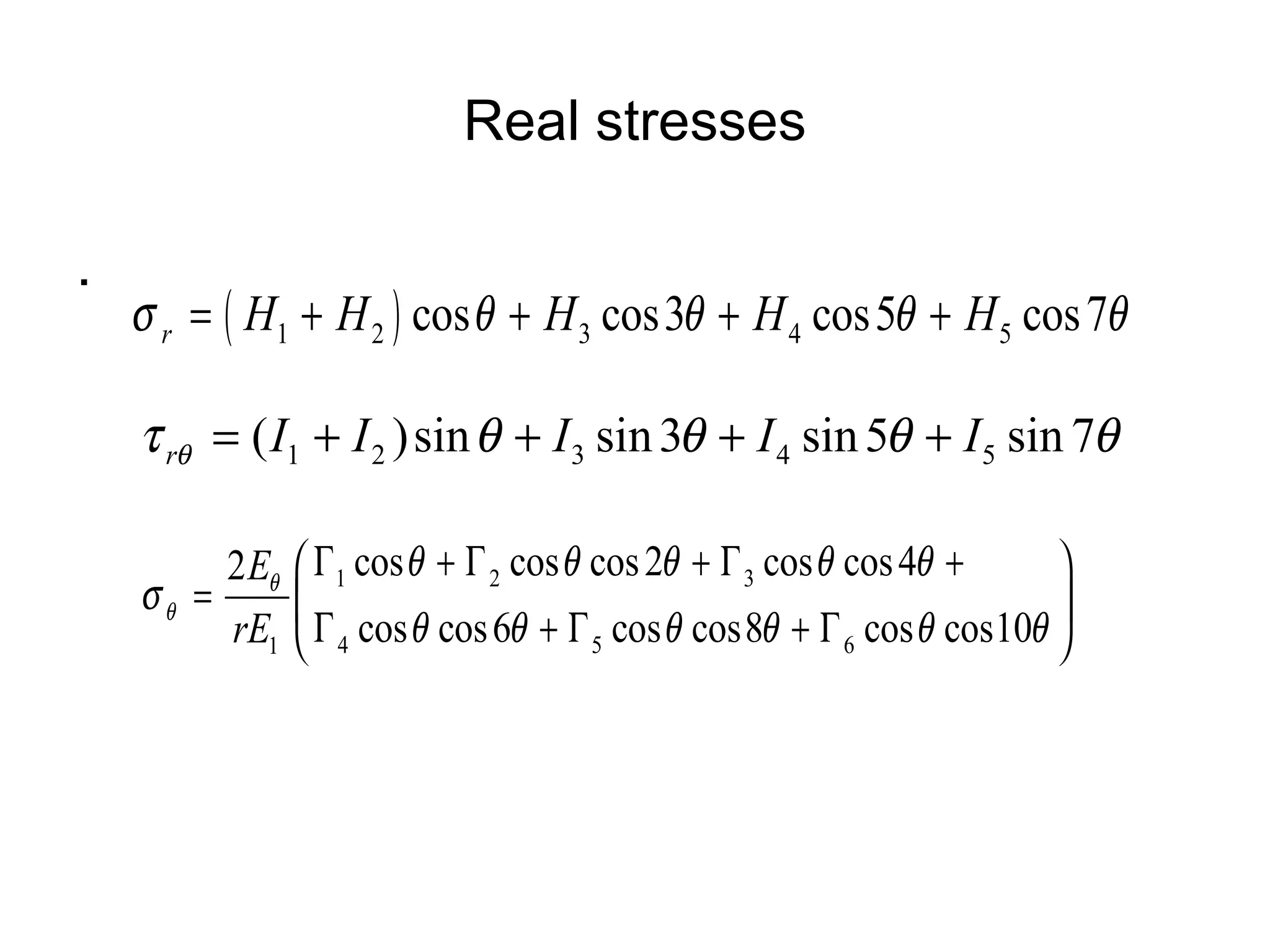
Real stresses .
Stress coefficients .
Stress coefficients . All constants not shown can be obtained from [2] Appendix A
Determination of
Determination of
Determination of Stresses Substituting the values of  and  into (16-21) yields These values completely determines
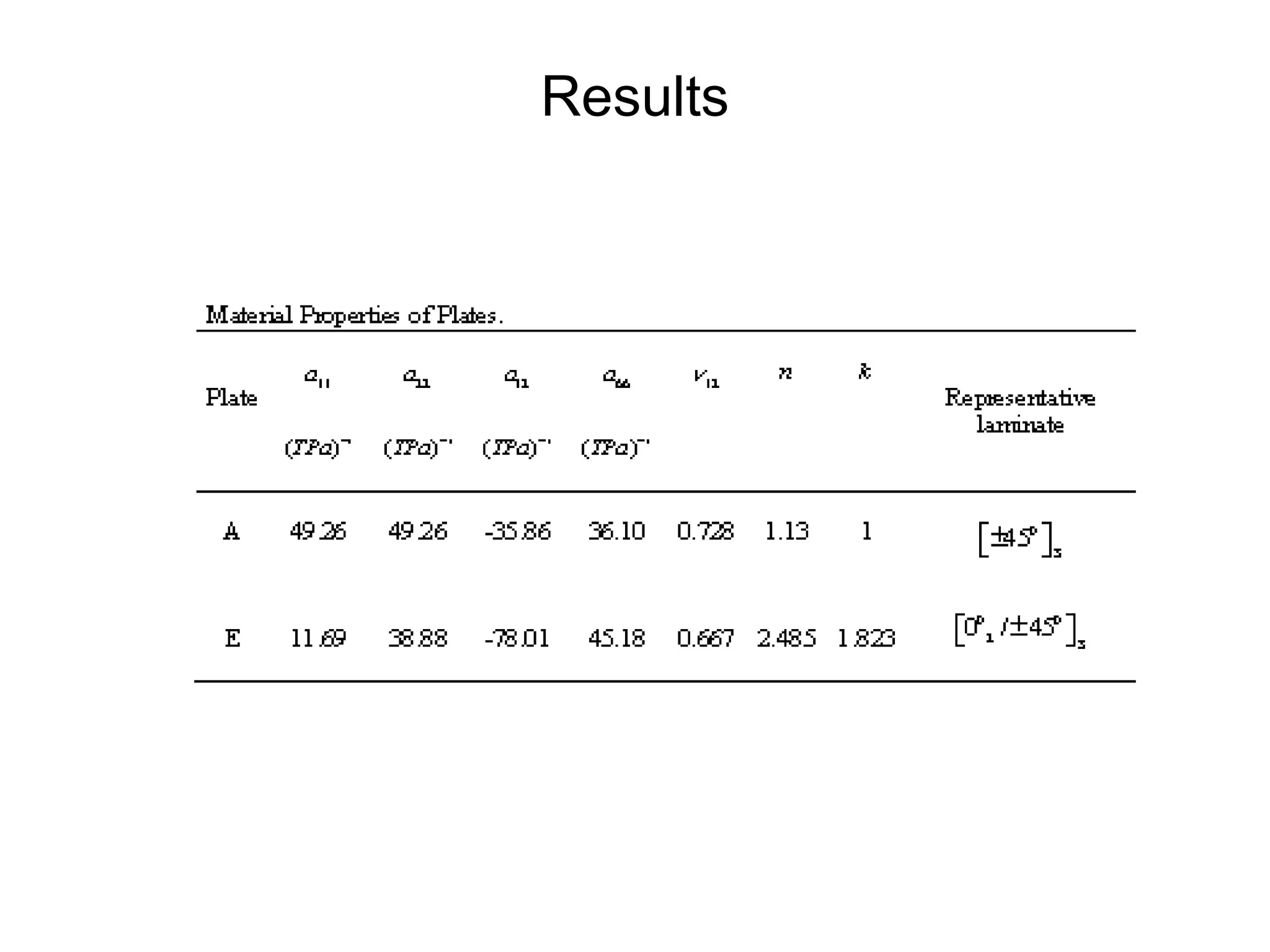
Results
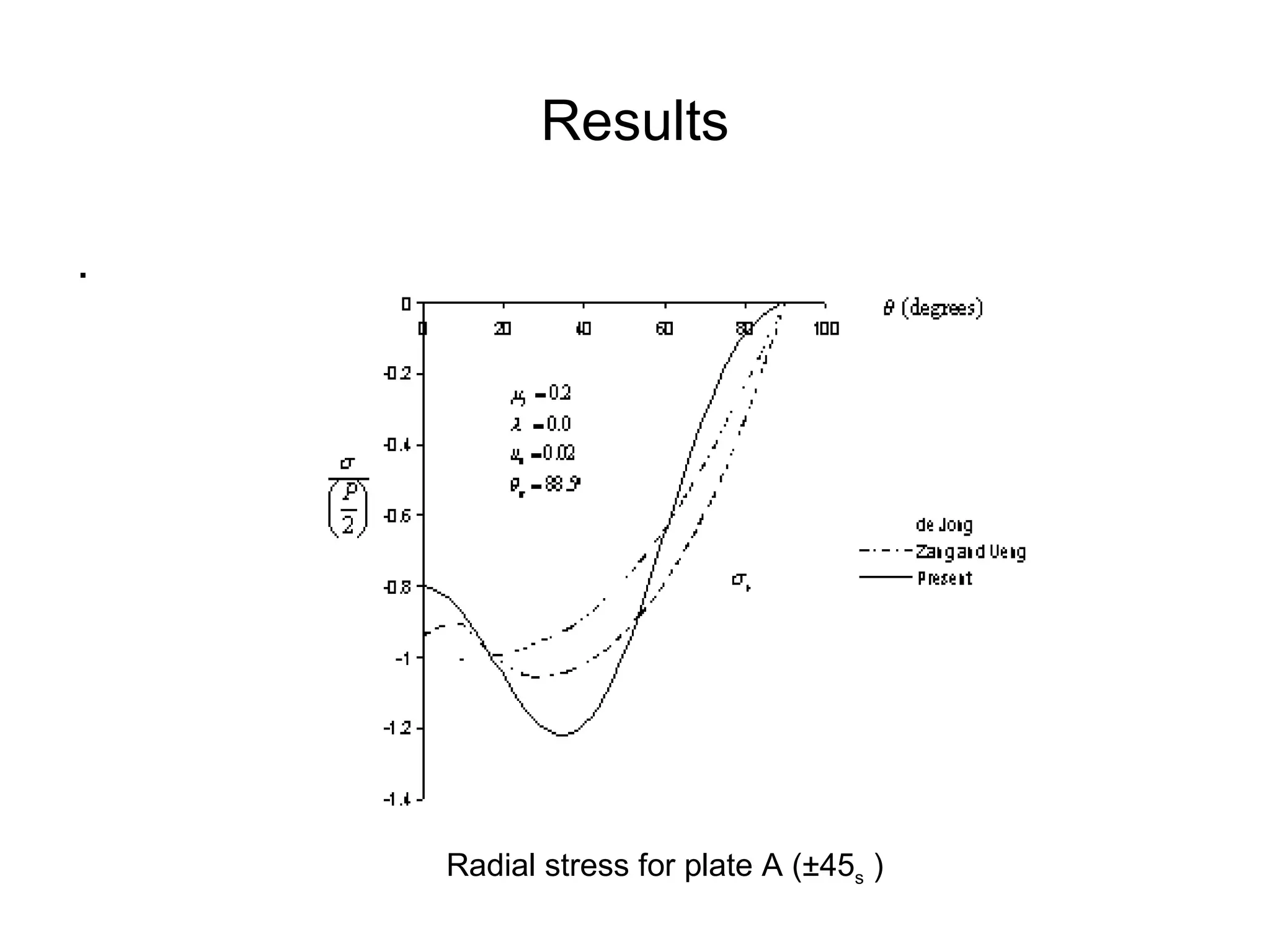
Results . Radial stress for plate A ( ±45 s  )
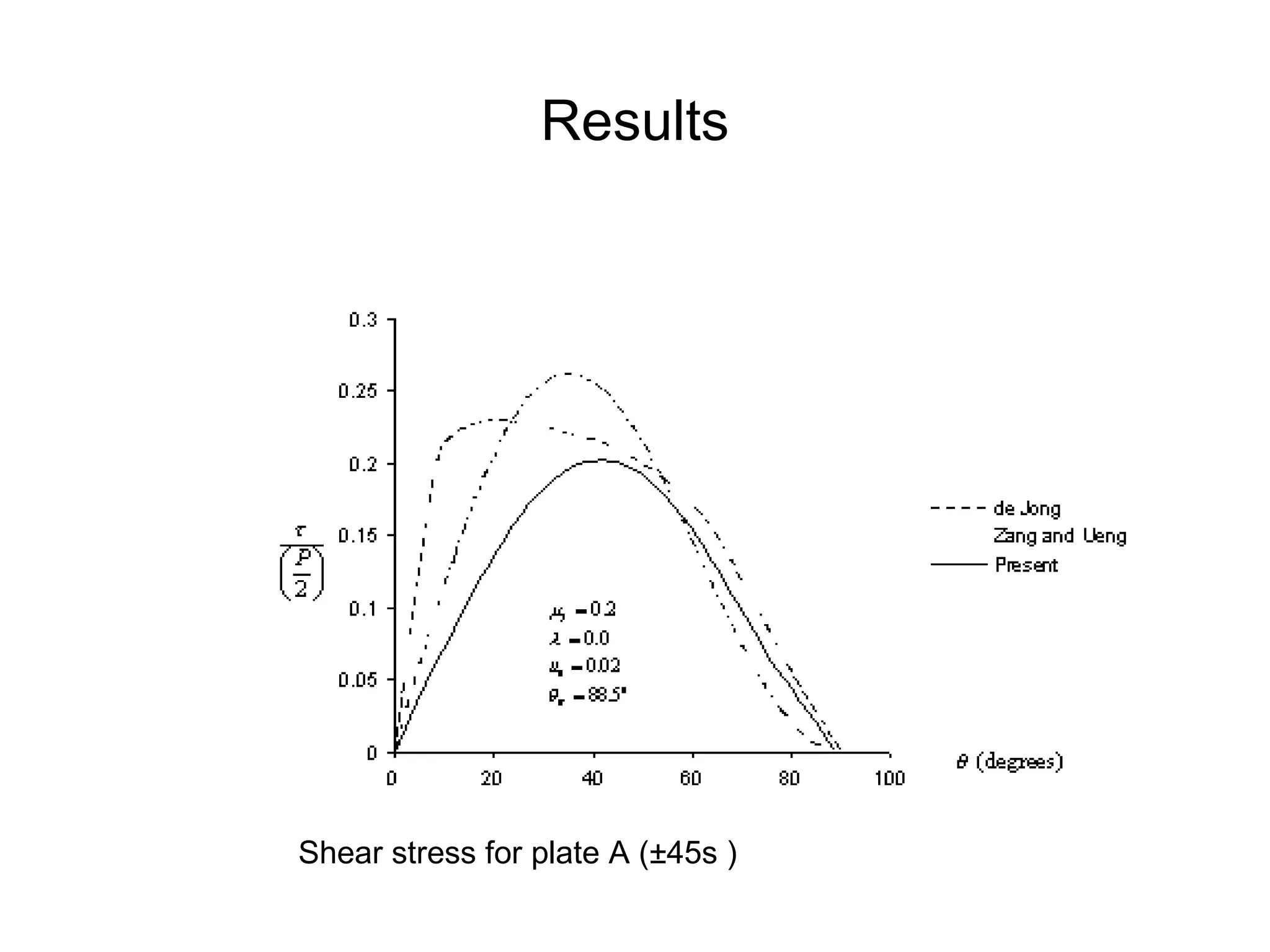
Results Shear stress for plate A (±45s )
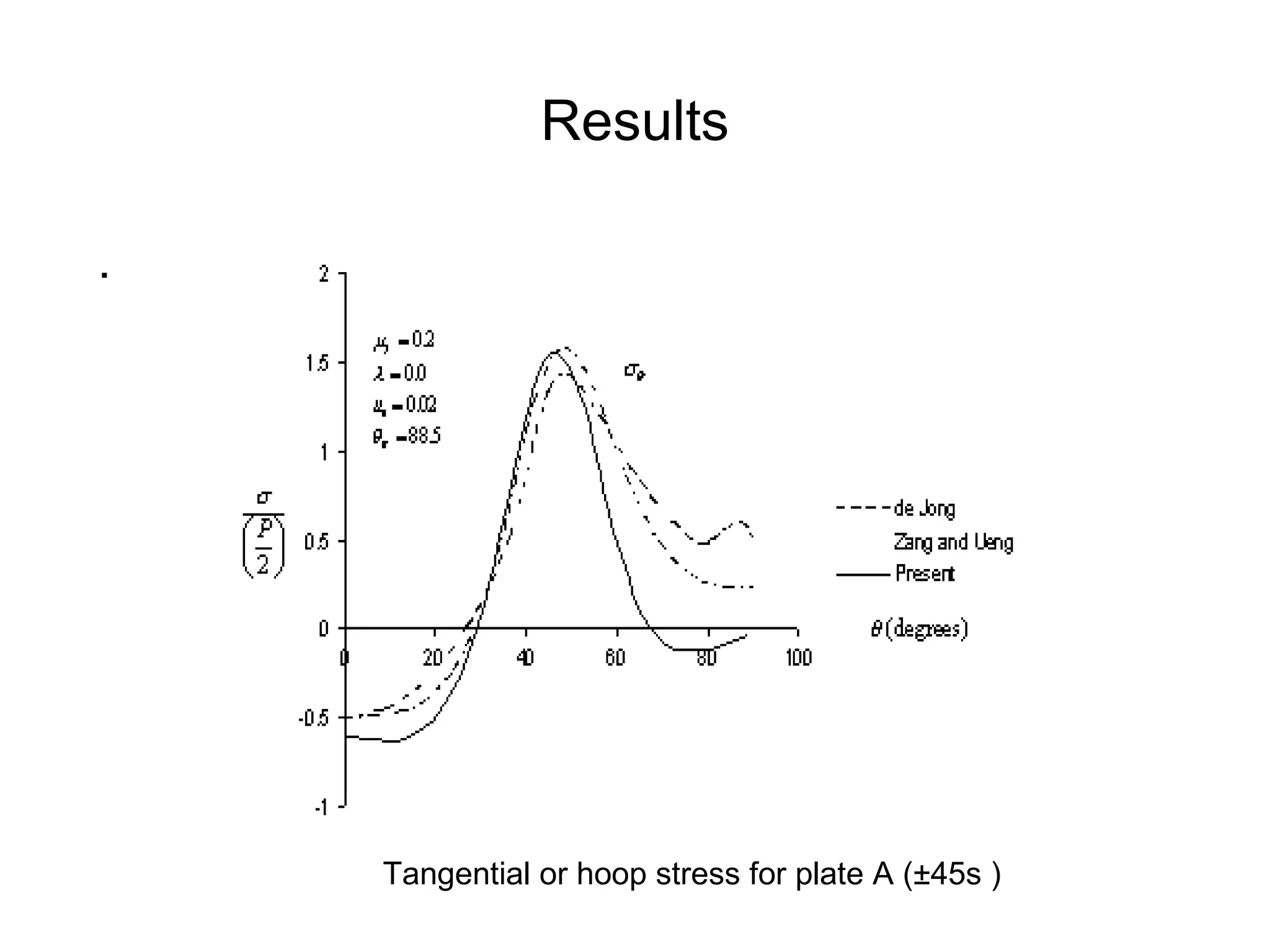
Results . Tangential or hoop stress for plate A (±45s )
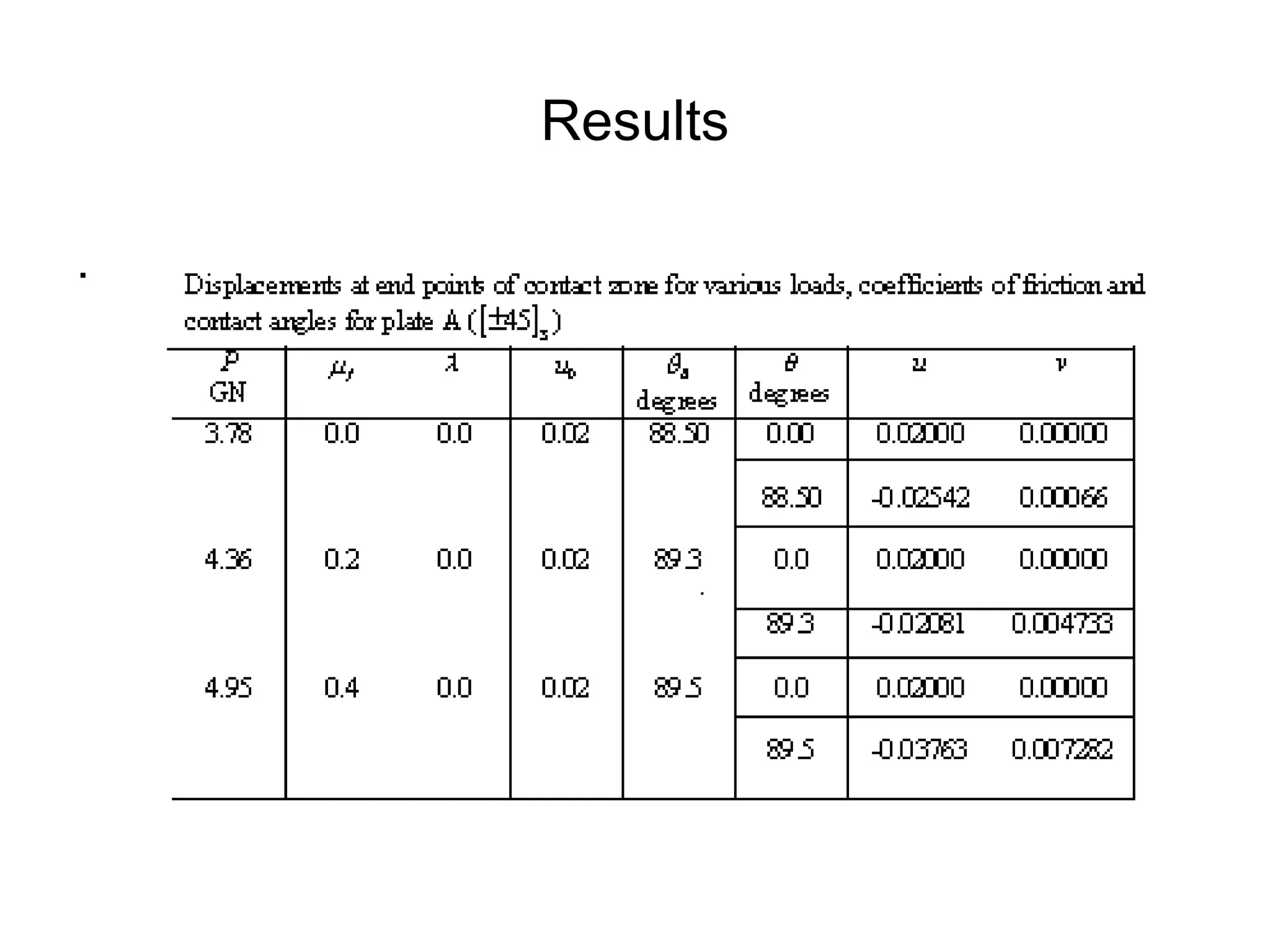
Results .
Results . Radial stress for plate E ( [0 2 / ±45] s  )
Results . Shear stress for plate E ( [02/±45]s )
Results . Tangential or hoop stress for plate E ( [02/±45]s )
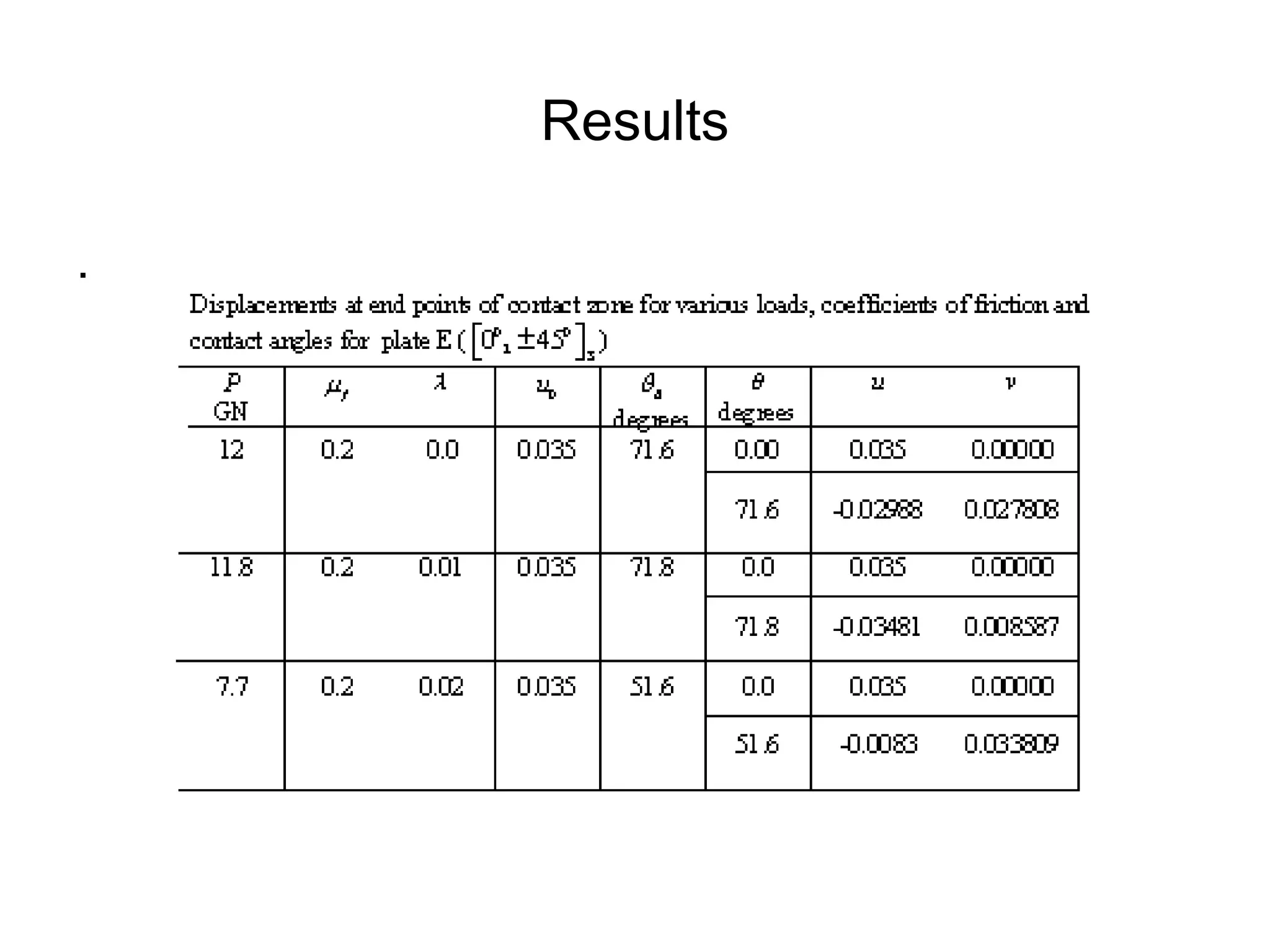
Results .
Conclusion .  A method has been presented for determining the stresses in pin loaded orthotropic plates.  . The method can be used to predict the stresses in joints with varying degrees of clearances including the case of perfectly fitting pins where clearance is zero.  .  Although developed for use with orthotropic plates, the method can be used to evaluate the stresses in isotropic plates as well.
Recommendations .  Better prediction of contact angle .  Further investigation into the no slip zone and its effect on stresses . Investigation into the development and use of a non-Colulombic frictional model . Use of non-trigonometric displacement functions . Experimental inquiry
References Lekhnitskii, S. G.,” Anisotropic Plates, English Edition  (Translated by S. W. Tsai and . Cheron), Gordon and Beach, London (1968). Tomlinson, N. A. “ Stresses Around Pin Loaded Holes in Mechanically Fastened Joints” Thesis Howard University, Washington, DC. Zhang, Kai-Da and Ueng, Charles E. S., “Stresses Around a Pin-Loaded Hole In Orthotropic Plates”, Journal of Composite Materials, Vol. 18, Sept. 1984 pp. 432-446. de Jong, Th., “Stresses around Pin Loaded Holes in Orthotropic Materials”, Mechanics of Composite Materials Recent Advances, Pergamon Press, pp. 339-353, 1982. Hyer, H. W., Klang, E. C., “Contact Stresses in Pin-Loaded Orthotropic Plates”,  Int. Journal of Solids and Structures, Vol. 21, 9, pp.957-975, 1985.

Utech Presentation

  • 1.
    Stresses Around PinLoaded Holes in Mechanically Fastened Joints By Neville A. Tomlinson, PhD Howard University Washington DC January 2007
  • 2.
    Abstract An analyticalmethod for determining the stress distribution in pin loaded orthotropic plates is presented based on the complex stress function approach. The method assumes that the contact boundary at the pin-plate interface is unknown a priori and must be determined as part of the solution. It is further assumed that the pin is rigid, clearance exists between pin and plate, and the coefficient of friction remains constant throughout the contact zone. The boundary conditions at the pin-plate interface are specified in terms of the unknown contact angle and a trigonometric series used to represent the displacement field in the contact zone. Numerical results are presented for normal, tangential and shear stresses on the cavity for different lay-ups of graphite/epoxy laminates.
  • 3.
    Introduction The increasinguse of composite materials has caused engineers to increase their efforts to understand the stress fields associated with these materials. One application that has received much attention is the stresses associated with the mechanical joining of composites Mechanical joining includes bolted, riveted and pinned joints which are relatively easy to assemble and disassemble. These joints are however prone to high stress concentrations which occurs in the vicinity of the hole, which is undesirable, and is often the source of premature failure.
  • 4.
    Schematic of Pinjoint pin plate Fig 1.
  • 5.
  • 6.
    Exaggerated view ofdeformed hole by rigid pin Fig 3
  • 7.
    The contact equationThe equation that governs an ellipse can be written as Consider triangle BAD in Fig.3. Point B has coordinates (1) (2) (3)
  • 8.
    The contact equationFrom the ellipse Substituting (2-4) in (1) yields Equation (5) is the non-linear contact equation. (4) (5)
  • 9.
    Boundary conditions atthe pin-plate interface The b.c. can be described as , , (6) (7) (8) (10) (9)
  • 10.
    Intrduction of FrictionFriction is introduced into the constitutive model by assuming a Coulomb frictional relation as Work done by shear can be written as Using (10) and (11) and considering symmetry yields (11) (12) (13)
  • 11.
    Displacement field alonghole boundary Assume displacement in the form This tree trems trig. series was chosen to facilitate the simultaneous solution of equations (8), (9) and (13) To determine the constants in (14) an additional condition was introduced which is described as (14) (15)
  • 12.
    Coefficients of u. (16) (17) (18)
  • 13.
  • 14.
  • 15.
  • 16.
  • 17.
  • 18.
  • 19.
    Determination of stressfunctions Lekhnitskii (1) has shown that if the displacements at the hole edge can be written in the form Then the stress functions can be written as (22) (23)
  • 20.
    Definition of stressfunction terms .where
  • 21.
    Determination of stresses. Where (24) (25) (26)
  • 22.
    Stress Transformation Transformationrelation from Cartesian to polar coordinates (27)
  • 23.
  • 24.
  • 25.
  • 26.
    Real stresses Bydefining two real parameters And by defining (31) (32) (33)
  • 27.
  • 28.
  • 29.
    Stress coefficients .All constants not shown can be obtained from [2] Appendix A
  • 30.
    Stress coefficients .All constants not shown can be obtained from [2] Appendix A
  • 31.
  • 32.
  • 33.
    Determination of StressesSubstituting the values of and into (16-21) yields These values completely determines
  • 34.
  • 35.
    Results . Radialstress for plate A ( ±45 s )
  • 36.
    Results Shear stressfor plate A (±45s )
  • 37.
    Results . Tangentialor hoop stress for plate A (±45s )
  • 38.
  • 39.
    Results . Radialstress for plate E ( [0 2 / ±45] s )
  • 40.
    Results . Shearstress for plate E ( [02/±45]s )
  • 41.
    Results . Tangentialor hoop stress for plate E ( [02/±45]s )
  • 42.
  • 43.
    Conclusion . A method has been presented for determining the stresses in pin loaded orthotropic plates. . The method can be used to predict the stresses in joints with varying degrees of clearances including the case of perfectly fitting pins where clearance is zero. . Although developed for use with orthotropic plates, the method can be used to evaluate the stresses in isotropic plates as well.
  • 44.
    Recommendations . Better prediction of contact angle . Further investigation into the no slip zone and its effect on stresses . Investigation into the development and use of a non-Colulombic frictional model . Use of non-trigonometric displacement functions . Experimental inquiry
  • 45.
    References Lekhnitskii, S.G.,” Anisotropic Plates, English Edition (Translated by S. W. Tsai and . Cheron), Gordon and Beach, London (1968). Tomlinson, N. A. “ Stresses Around Pin Loaded Holes in Mechanically Fastened Joints” Thesis Howard University, Washington, DC. Zhang, Kai-Da and Ueng, Charles E. S., “Stresses Around a Pin-Loaded Hole In Orthotropic Plates”, Journal of Composite Materials, Vol. 18, Sept. 1984 pp. 432-446. de Jong, Th., “Stresses around Pin Loaded Holes in Orthotropic Materials”, Mechanics of Composite Materials Recent Advances, Pergamon Press, pp. 339-353, 1982. Hyer, H. W., Klang, E. C., “Contact Stresses in Pin-Loaded Orthotropic Plates”, Int. Journal of Solids and Structures, Vol. 21, 9, pp.957-975, 1985.