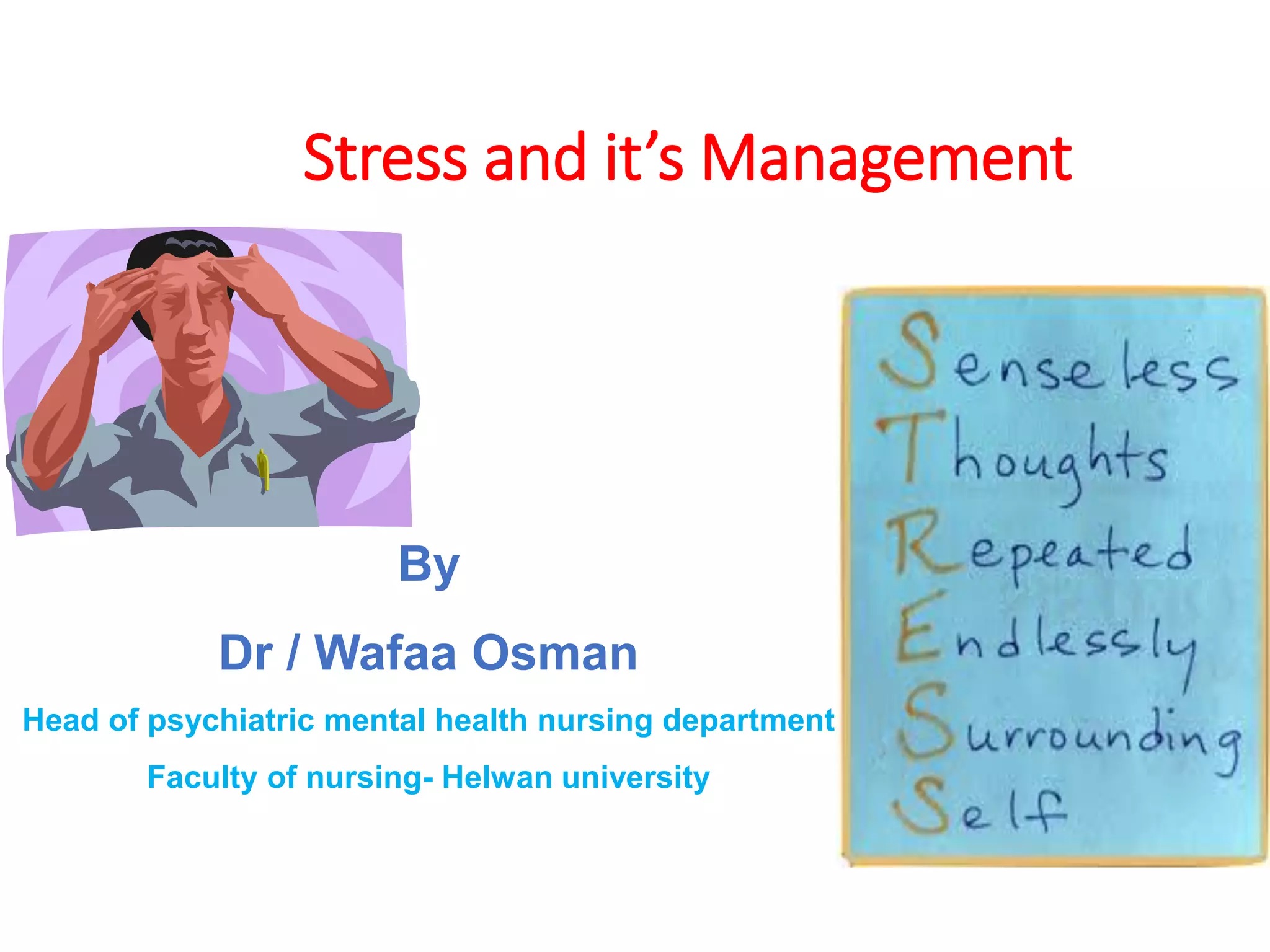
Stress and it’s Management
By
Dr / Wafaa Osman
Head of psychiatric mental health nursing department
Faculty of nursing- Helwan university
Intended learning Outcomes (ILOs)
By the end of this lecture the student will be able to
• • Define stress
• • Recognize the different kinds of stress
• • Mention the different types of stressors
• • Discuss the different models of stress
• • Apply stress management strategies:
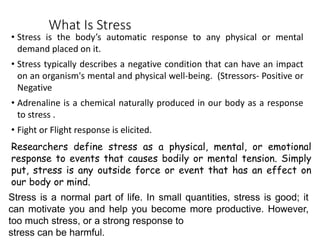
What Is Stress
• Stress is the body’s automatic response to any physical or mental
demand placed on it.
• Stress typically describes a negative condition that can have an impact
on an organism's mental and physical well-being. (Stressors- Positive or
Negative
• Adrenaline is a chemical naturally produced in our body as a response
to stress .
• Fight or Flight response is elicited.
Researchers define stress as a physical, mental, or emotional
response to events that causes bodily or mental tension. Simply
put, stress is any outside force or event that has an effect on
our body or mind.
Stress is a normal part of life. In small quantities, stress is good; it
can motivate you and help you become more productive. However,
too much stress, or a strong response to
stress can be harmful.
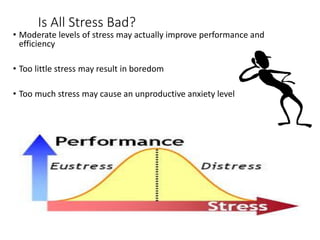
Is All Stress Bad?
• Moderate levels of stress may actually improve performance and
efficiency
• Too little stress may result in boredom
• Too much stress may cause an unproductive anxiety level
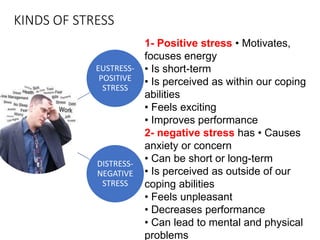
KINDS OF STRESS
EUSTRESS-
POSITIVE
STRESS
DISTRESS-
NEGATIVE
STRESS
1- Positive stress • Motivates,
focuses energy
• Is short-term
• Is perceived as within our coping
abilities
• Feels exciting
• Improves performance
2- negative stress has • Causes
anxiety or concern
• Can be short or long-term
• Is perceived as outside of our
coping abilities
• Feels unpleasant
• Decreases performance
• Can lead to mental and physical
problems
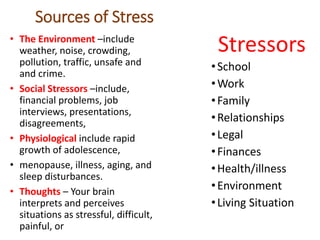
Sources of Stress
• The Environment –include
weather, noise, crowding,
pollution, traffic, unsafe and
and crime.
• Social Stressors –include,
financial problems, job
interviews, presentations,
disagreements,
• Physiological include rapid
growth of adolescence,
• menopause, illness, aging, and
sleep disturbances.
• Thoughts – Your brain
interprets and perceives
situations as stressful, difficult,
painful, or
•School
•Work
•Family
•Relationships
•Legal
•Finances
•Health/illness
•Environment
•Living Situation
Stressors
Response-based model
Hans Seyle’s stress response is characterized by a chain or pattern
of physiologic events called the general adaptation syndrome
(GAS). If the stress is extreme or long standing, the normal
mechanisms may not be sufficient. This case, the stress triggers a
wide – ranging set of bodily changes called general adaptation
syndrome.
ALARM
STAGE
RESISTANCE
STAGE
EXHAUSTION
STAGE
STAGES OF STRESS
Response-based model
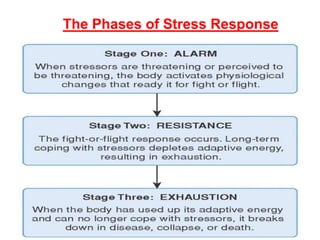
The person response to stress consists of three stages:
1. Alarm or fight-or flight ( a threat is perceived, the body
responds physiologically
2. Resistance ( coping mechanisms are used to try reestablish
homeostasis.
3. Exhaustion (occurs if homeostasis is not achieved)
The Phases of Stress Response
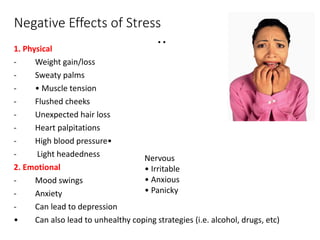
Negative Effects of Stress
1. Physical
- Weight gain/loss
- Sweaty palms
- • Muscle tension
- Flushed cheeks
- Unexpected hair loss
- Heart palpitations
- High blood pressure•
- Light headedness
2. Emotional
- Mood swings
- Anxiety
- Can lead to depression
• Can also lead to unhealthy coping strategies (i.e. alcohol, drugs, etc)
• •
Nervous
• Irritable
• Anxious
• Panicky
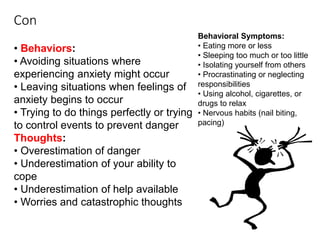
Con
• Behaviors:
• Avoiding situations where
experiencing anxiety might occur
• Leaving situations when feelings of
anxiety begins to occur
• Trying to do things perfectly or trying
to control events to prevent danger
Thoughts:
• Overestimation of danger
• Underestimation of your ability to
cope
• Underestimation of help available
• Worries and catastrophic thoughts
Behavioral Symptoms:
• Eating more or less
• Sleeping too much or too little
• Isolating yourself from others
• Procrastinating or neglecting
responsibilities
• Using alcohol, cigarettes, or
drugs to relax
• Nervous habits (nail biting,
pacing)
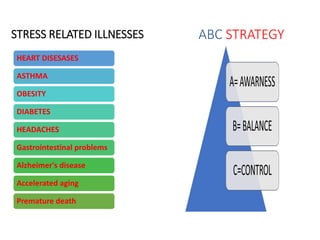
STRESS RELATED ILLNESSES
HEART DISESASES
ASTHMA
OBESITY
DIABETES
HEADACHES
Gastrointestinal problems
Alzheimer's disease
Accelerated aging
Premature death
ABC STRATEGY
coping
The term coping is used to refer to the process by which person attempts to
manage stressful demands.
Coping Resources
Defense Techniques
Social Support ( material and emotional support)
Motivation
Problem solving and social skills
Knowledge and intelligence
Positive beliefs, physical and
wellbeing, health and energy
Culture Stability
Strong ego identity
Coping Strategies
Nurses have a major role in helping patients with
stress to cope more effectively. The major role of
psychiatric nurse is to help patients learn or regain
highly effective coping strategies and avoid
ineffective or destructive strategies.
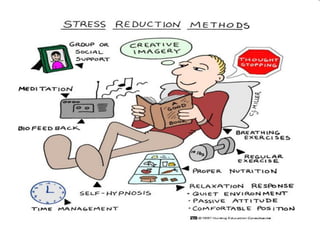
Managing Stress
• Stress Relief Strategies
1. Body relaxation excercises
- breathing techniques
- guided imagery
2. Physical exercise
-yoga
-work out routine
3. Meditation
4. Counseling
-talk therapy
-life coaching
• Changing perceptions and
expectations
• Break jobs/tasks into
manageable parts
• Set reasonable/realistic goals
• Avoid procrastination
• Set boundaries
• Don’t compromise your
values/beliefs
• Schedule “me” time
Other Helpful tips
Problem Solving technique
An extremely adaptive coping strategy is to view the situation
objectively. After an objective assessment of the situation, the
problem-solving/decision-making model can be instituted as
follows:
➢ Assess the facts of the situation.
➢ Formulate goals for resolution of the stressful situation.
➢ Study the alternatives for dealing with the situation.
➢ Determine the risks and benefits of each alternative.
➢ Select an alternative.
➢ Implement the alternative selected.
➢ Evaluate the outcome of the alternative implemented.
➢ If the first choice is ineffective, select and implement a second
option
Benefits of Stress Management
• Physical health gets better
-more energy and stamina
• Emotions stabilized
-positive attitude
-hopeful/happier
• Ability to focus improved
-able to learn and achieve
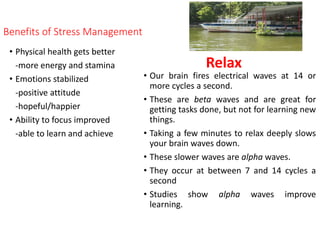
• Our brain fires electrical waves at 14 or
more cycles a second.
• These are beta waves and are great for
getting tasks done, but not for learning new
things.
• Taking a few minutes to relax deeply slows
your brain waves down.
• These slower waves are alpha waves.
• They occur at between 7 and 14 cycles a
second
• Studies show alpha waves improve
learning.
Relax
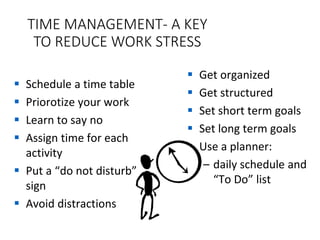
TIME MANAGEMENT- A KEY
TO REDUCE WORK STRESS
▪ Schedule a time table
▪ Priorotize your work
▪ Learn to say no
▪ Assign time for each
activity
▪ Put a “do not disturb”
sign
▪ Avoid distractions
▪ Get organized
▪ Get structured
▪ Set short term goals
▪ Set long term goals
▪ Use a planner:
– daily schedule and
“To Do” list
Cognitive (Thoughts)
▪ Pay attention to what you say to yourself
▪ Identify negative thinking and irrational
beliefs
▪ Negative thinking leads to stress and anxiety
▪ Teach thought-stopping techniques
▪ Teach affirmations
The Key Word Is….
Balance

stress management

  • 1.
    Stress and it’sManagement By Dr / Wafaa Osman Head of psychiatric mental health nursing department Faculty of nursing- Helwan university
  • 2.
    Intended learning Outcomes(ILOs) By the end of this lecture the student will be able to • • Define stress • • Recognize the different kinds of stress • • Mention the different types of stressors • • Discuss the different models of stress • • Apply stress management strategies:
  • 3.
    What Is Stress •Stress is the body’s automatic response to any physical or mental demand placed on it. • Stress typically describes a negative condition that can have an impact on an organism's mental and physical well-being. (Stressors- Positive or Negative • Adrenaline is a chemical naturally produced in our body as a response to stress . • Fight or Flight response is elicited. Researchers define stress as a physical, mental, or emotional response to events that causes bodily or mental tension. Simply put, stress is any outside force or event that has an effect on our body or mind. Stress is a normal part of life. In small quantities, stress is good; it can motivate you and help you become more productive. However, too much stress, or a strong response to stress can be harmful.
  • 4.
    Is All StressBad? • Moderate levels of stress may actually improve performance and efficiency • Too little stress may result in boredom • Too much stress may cause an unproductive anxiety level
  • 5.
    KINDS OF STRESS EUSTRESS- POSITIVE STRESS DISTRESS- NEGATIVE STRESS 1-Positive stress • Motivates, focuses energy • Is short-term • Is perceived as within our coping abilities • Feels exciting • Improves performance 2- negative stress has • Causes anxiety or concern • Can be short or long-term • Is perceived as outside of our coping abilities • Feels unpleasant • Decreases performance • Can lead to mental and physical problems
  • 6.
    Sources of Stress •The Environment –include weather, noise, crowding, pollution, traffic, unsafe and and crime. • Social Stressors –include, financial problems, job interviews, presentations, disagreements, • Physiological include rapid growth of adolescence, • menopause, illness, aging, and sleep disturbances. • Thoughts – Your brain interprets and perceives situations as stressful, difficult, painful, or •School •Work •Family •Relationships •Legal •Finances •Health/illness •Environment •Living Situation Stressors
  • 7.
    Response-based model Hans Seyle’sstress response is characterized by a chain or pattern of physiologic events called the general adaptation syndrome (GAS). If the stress is extreme or long standing, the normal mechanisms may not be sufficient. This case, the stress triggers a wide – ranging set of bodily changes called general adaptation syndrome. ALARM STAGE RESISTANCE STAGE EXHAUSTION STAGE STAGES OF STRESS
  • 8.
    Response-based model The personresponse to stress consists of three stages: 1. Alarm or fight-or flight ( a threat is perceived, the body responds physiologically 2. Resistance ( coping mechanisms are used to try reestablish homeostasis. 3. Exhaustion (occurs if homeostasis is not achieved)
  • 9.
    The Phases ofStress Response
  • 10.
    Negative Effects ofStress 1. Physical - Weight gain/loss - Sweaty palms - • Muscle tension - Flushed cheeks - Unexpected hair loss - Heart palpitations - High blood pressure• - Light headedness 2. Emotional - Mood swings - Anxiety - Can lead to depression • Can also lead to unhealthy coping strategies (i.e. alcohol, drugs, etc) • • Nervous • Irritable • Anxious • Panicky
  • 11.
    Con • Behaviors: • Avoidingsituations where experiencing anxiety might occur • Leaving situations when feelings of anxiety begins to occur • Trying to do things perfectly or trying to control events to prevent danger Thoughts: • Overestimation of danger • Underestimation of your ability to cope • Underestimation of help available • Worries and catastrophic thoughts Behavioral Symptoms: • Eating more or less • Sleeping too much or too little • Isolating yourself from others • Procrastinating or neglecting responsibilities • Using alcohol, cigarettes, or drugs to relax • Nervous habits (nail biting, pacing)
  • 12.
    STRESS RELATED ILLNESSES HEARTDISESASES ASTHMA OBESITY DIABETES HEADACHES Gastrointestinal problems Alzheimer's disease Accelerated aging Premature death ABC STRATEGY
  • 13.
    coping The term copingis used to refer to the process by which person attempts to manage stressful demands. Coping Resources Defense Techniques Social Support ( material and emotional support) Motivation Problem solving and social skills Knowledge and intelligence Positive beliefs, physical and wellbeing, health and energy Culture Stability Strong ego identity
  • 14.
    Coping Strategies Nurses havea major role in helping patients with stress to cope more effectively. The major role of psychiatric nurse is to help patients learn or regain highly effective coping strategies and avoid ineffective or destructive strategies.
  • 15.
    Managing Stress • StressRelief Strategies 1. Body relaxation excercises - breathing techniques - guided imagery 2. Physical exercise -yoga -work out routine 3. Meditation 4. Counseling -talk therapy -life coaching • Changing perceptions and expectations • Break jobs/tasks into manageable parts • Set reasonable/realistic goals • Avoid procrastination • Set boundaries • Don’t compromise your values/beliefs • Schedule “me” time Other Helpful tips
  • 16.
    Problem Solving technique Anextremely adaptive coping strategy is to view the situation objectively. After an objective assessment of the situation, the problem-solving/decision-making model can be instituted as follows: ➢ Assess the facts of the situation. ➢ Formulate goals for resolution of the stressful situation. ➢ Study the alternatives for dealing with the situation. ➢ Determine the risks and benefits of each alternative. ➢ Select an alternative. ➢ Implement the alternative selected. ➢ Evaluate the outcome of the alternative implemented. ➢ If the first choice is ineffective, select and implement a second option
  • 18.
    Benefits of StressManagement • Physical health gets better -more energy and stamina • Emotions stabilized -positive attitude -hopeful/happier • Ability to focus improved -able to learn and achieve • Our brain fires electrical waves at 14 or more cycles a second. • These are beta waves and are great for getting tasks done, but not for learning new things. • Taking a few minutes to relax deeply slows your brain waves down. • These slower waves are alpha waves. • They occur at between 7 and 14 cycles a second • Studies show alpha waves improve learning. Relax
  • 19.
    TIME MANAGEMENT- AKEY TO REDUCE WORK STRESS ▪ Schedule a time table ▪ Priorotize your work ▪ Learn to say no ▪ Assign time for each activity ▪ Put a “do not disturb” sign ▪ Avoid distractions ▪ Get organized ▪ Get structured ▪ Set short term goals ▪ Set long term goals ▪ Use a planner: – daily schedule and “To Do” list
  • 20.
    Cognitive (Thoughts) ▪ Payattention to what you say to yourself ▪ Identify negative thinking and irrational beliefs ▪ Negative thinking leads to stress and anxiety ▪ Teach thought-stopping techniques ▪ Teach affirmations
  • 21.
    The Key WordIs…. Balance