
Introduction to
Nursing Theories
Nursing Theories
Introduction
Definition
Components
Metaparadigm
Characteristics
Importance
scope
• Nursing is both an art and a science. The
science of nursing examines the relationship
among person, health and environment. The
art of nursing is embedded in caring
relationship between nurse and client.
• As an increasingly emerging profession,
nursing is now deeply involved in identifying
its own unique body of knowledge that is
essential to nursing practice.
• The development of a body of knowledge is
basic to any professional discipline, which can
be applied to its practice. Such
knowledge often expressed in terms of
concepts and theories in the area of the
behavioral or social sciences.
Nursing Theories
Definition of Theory: The word
“Theory” evolves from the Greek
word “Theoria” signifying a vision.
Introduction
Theories are a set of interrelated concepts that
give a systematic view of a phenomenon (an
observable fact or event) that is explanatory &
predictive in nature.
Theory is “a creative and rigorous (demanding
that particular rules, processes are strictly
followed) a structuring of ideas that projects
a tentative, purposeful, and systematic view of
phenomena.”
Theory is a set of statements that tentatively
describe, explain or predict relationships
between concepts that have been
systematically selected and organized as an
abstract representation of some phenomenon.
Theories are composed of concepts, definitions,
models, propositions and are based on
assumptions.
• According to Kerlinger, it is a set of
interrelated concepts that give a systematic
view of phenomenon that is explanatory and
predictive in nature.
According to Richl and Roy, "Theory is
scientifically acceptable general principle
which governs practice or is proposed to
explain observed facts.
According to Chinn and Jacobs (1987):
Theory is a set of concepts, definitions,
propositions that projects a systematic view
of phenomena by designating specific
interrelationships among concepts for
purposes of describing, explaining, predicting
and controlling phenomena.
According to Fawcett (1999):
A theory is a way of seeing through a set of
relatively concrete and specific concepts and
propositions that describe or link the
concepts.
Nursing theories address and specify
relationships among four major
Concepts, the building blocks of theory: person
or client, environment, health/illness and
nursing.
According to Meleis 1997:
Nursing theory is a conceptualization of some
aspect of nursing communicated for the
purpose of describing, explaining, predicting
or prescribing nursing care.
• They are derived through two principal
methods; deductive reasoning and inductive
reasoning.
• Nursing theorists use both of these methods.
• Nursing theory provides a perspective from
which to define the what of nursing, to
describe the who of nursing (who is the client)
and when nursing is needed, and to identify
the boundaries and goals of nursing’s
therapeutic activities.
• Theory is fundamental to effective nursing
practice and research. The professionalization
of nursing has been and is being brought
about through the development and use of
nursing theory.
Terminology used in Nursing Theories and
Models:
Philosophy: Philosophy is a science deals with
the values that govern the scientific
development and the justification of the
discipline.
Paradigm: Paradigm is defined as those aspects
in a discipline that are shared by its scientific
community.
Construct: A phenomena that cannot be
observed and must be inferred (suggest
indirectly that is true). Constructs are
concepts developed or adopted for use in a
particular theory. The key concepts of a given
theory are its constructs.
Variables: Variables are the operational forms of
constructs.
Conceptual model: it is made up of concepts
and propositions. It represent ways of thinking
about a problem or ways of representing how
complex things work the way that they do.
Model: representation of the interactions
among & between concepts which shows the
patterns of these interactions.
Nursing Models: they are conceptual models,
constructed of theories and concepts.
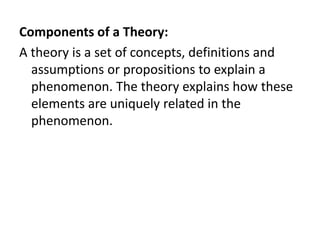
Components of a Theory:
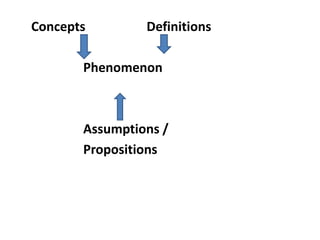
A theory is a set of concepts, definitions and
assumptions or propositions to explain a
phenomenon. The theory explains how these
elements are uniquely related in the
phenomenon.
Concepts Definitions
Phenomenon
Assumptions /
Propositions
A theory consists of interrelated concepts.
Concepts: Concepts are mental formulations of
an object or event that come from individual
perceptual experience.
Concept is a mental idea of a phenomenon.
Concepts are the building blocks – the primary
elements – of a theory.
Definitions: the definitions within the
description of a theory convey the general
meaning of concepts in a manner that fits the
theory.
Assumptions:
They are statements that describe concepts or
connect two concepts that are factual.
Propositions: A statement explaining
relationships among concepts.
Phenomenon:
A phenomenon is an aspect of reality that can
be consciously sensed or experienced.
Nursing phenomena include all client’s
responses, environmental factors and nursing
actions. In nursing phenomena reflect the
domain of nursing practice.
METAPARADIGMS IN NURSING:
The human / individual, society / environment,
health and nursing. Among these four
metaparadigms, the core of the practice of
nursing is the individual.
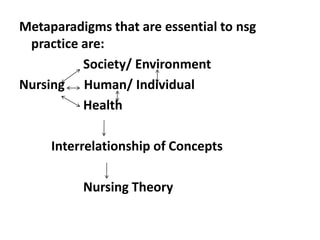
Metaparadigms that are essential to nsg
practice are:
Society/ Environment
Nursing Human/ Individual
Health
Interrelationship of Concepts
Nursing Theory
Definition of 4 Nursing Metaparadigms are:
Person: Person refers to the recipient of nsg care
including physical, spiritual, psychological and
sociocultural components. Person may be
individual, family and community.
Health: Health is a dynamic state of being in
which the developmental & behavioral
potential of individual is realized to the fullest
extent possible. (ANA, 1995)
Health is dynamic and continuously changing. It
is degree of wellness or illness experienced by
the person.
Environment / Situation: Environment includes
all possible conditions affecting the client &
the setting in which health care needs occur.
There is continuous interaction between the
client and environment. All internal and
external conditions, circumstances, and
influences affecting the person.
Nursing: Nursing is the diagnostic and treatment
of human responses to actual or potential
health problems.
Characteristics of theories
1. Theories can inter-relate concepts in
such a way as to create a
different way of looking at a particular
phenomenon.
2. Theories must be logical in nature:
interrelationships must ha sequential and
must follow principles of reasoning.
3. Theories should be relatively simple yet easy
to generalize
4. Theories can be the bases for hypotheses that
can be tested
5. Theories contribute to and assist in increasing
the general body of knowledge within the
discipline through the research implemented to
validate them
Characteristics of theories cont…
6. Theories can be utilized by the practitioners
to guide and improve their practice.
7. Theories must be consistent with other
validated theories, laws and principles but will
leave open unanswered questions that need to
be investigated.
Characteristics of theories cont…
Importance of Nursing Theories
1. Nursing theory aims to describe, predict and
explain the phenomenon of nursing.
2. It provides the foundations of nursing
practice, help to generate further knowledge
and indicate in which direction nursing
should develop in the future.
3. Theory is important because it helps us to
decide what we know and what we need to
know.
Importance of Nursing Theories cont…
4. It helps to distinguish what should form the
basis of practice by explicitly describing nursing.
5. The benefits of having a defined body of theory
in nursing include better patient care, enhanced
professional status for nurses, improved
communication between nurses and guidance
for research and education.
6. The main exponent (support ideas) of nursing-
caring-cannot be measured, it is vital to have the
theory to analyze & explain what nurses do.
Importance of Nursing Theories cont…
7. As medicine tries to make a move towards
adopting a more multidisciplinary approach
to health care, nursing continues to strive
(work hard) to establish a unique body of
knowledge.
8. This can be seen as an attempt by the nursing
profession to maintain its professional
boundaries.
Scope of nursing theories
In practice
• Assist nurses to describe, explain and predict
everyday experiences.
• Serve to guide assessment, intervention and
evaluation of nursing care.
• Provide a rationale for collecting reliable and
valid data about the heath status of clients,
which are essential for effective decision
making and implementation.
• Help to establish criteria to measure the
quality of nursing care
• Help build a common nursing terminology to
use in communication with other health
professionals.
• Enhance autonomy of nursing by defining its
own independent function
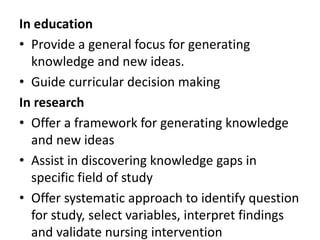
In education
• Provide a general focus for generating
knowledge and new ideas.
• Guide curricular decision making
In research
• Offer a framework for generating knowledge
and new ideas
• Assist in discovering knowledge gaps in
specific field of study
• Offer systematic approach to identify question
for study, select variables, interpret findings
and validate nursing intervention
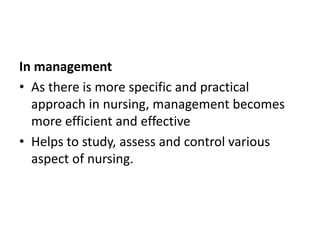
In management
• As there is more specific and practical
approach in nursing, management becomes
more efficient and effective
• Helps to study, assess and control various
aspect of nursing.
THANK YOU

Nursing Theory.ppt

  • 1.
  • 2.
  • 3.
    • Nursing isboth an art and a science. The science of nursing examines the relationship among person, health and environment. The art of nursing is embedded in caring relationship between nurse and client. • As an increasingly emerging profession, nursing is now deeply involved in identifying its own unique body of knowledge that is essential to nursing practice.
  • 4.
    • The developmentof a body of knowledge is basic to any professional discipline, which can be applied to its practice. Such knowledge often expressed in terms of concepts and theories in the area of the behavioral or social sciences.
  • 5.
    Nursing Theories Definition ofTheory: The word “Theory” evolves from the Greek word “Theoria” signifying a vision.
  • 6.
    Introduction Theories are aset of interrelated concepts that give a systematic view of a phenomenon (an observable fact or event) that is explanatory & predictive in nature. Theory is “a creative and rigorous (demanding that particular rules, processes are strictly followed) a structuring of ideas that projects a tentative, purposeful, and systematic view of phenomena.”
  • 7.
    Theory is aset of statements that tentatively describe, explain or predict relationships between concepts that have been systematically selected and organized as an abstract representation of some phenomenon. Theories are composed of concepts, definitions, models, propositions and are based on assumptions.
  • 8.
    • According toKerlinger, it is a set of interrelated concepts that give a systematic view of phenomenon that is explanatory and predictive in nature. According to Richl and Roy, "Theory is scientifically acceptable general principle which governs practice or is proposed to explain observed facts.
  • 9.
    According to Chinnand Jacobs (1987): Theory is a set of concepts, definitions, propositions that projects a systematic view of phenomena by designating specific interrelationships among concepts for purposes of describing, explaining, predicting and controlling phenomena.
  • 10.
    According to Fawcett(1999): A theory is a way of seeing through a set of relatively concrete and specific concepts and propositions that describe or link the concepts.
  • 11.
    Nursing theories addressand specify relationships among four major Concepts, the building blocks of theory: person or client, environment, health/illness and nursing. According to Meleis 1997: Nursing theory is a conceptualization of some aspect of nursing communicated for the purpose of describing, explaining, predicting or prescribing nursing care.
  • 12.
    • They arederived through two principal methods; deductive reasoning and inductive reasoning. • Nursing theorists use both of these methods.
  • 13.
    • Nursing theoryprovides a perspective from which to define the what of nursing, to describe the who of nursing (who is the client) and when nursing is needed, and to identify the boundaries and goals of nursing’s therapeutic activities. • Theory is fundamental to effective nursing practice and research. The professionalization of nursing has been and is being brought about through the development and use of nursing theory.
  • 14.
    Terminology used inNursing Theories and Models: Philosophy: Philosophy is a science deals with the values that govern the scientific development and the justification of the discipline.
  • 15.
    Paradigm: Paradigm isdefined as those aspects in a discipline that are shared by its scientific community. Construct: A phenomena that cannot be observed and must be inferred (suggest indirectly that is true). Constructs are concepts developed or adopted for use in a particular theory. The key concepts of a given theory are its constructs. Variables: Variables are the operational forms of constructs.
  • 16.
    Conceptual model: itis made up of concepts and propositions. It represent ways of thinking about a problem or ways of representing how complex things work the way that they do. Model: representation of the interactions among & between concepts which shows the patterns of these interactions. Nursing Models: they are conceptual models, constructed of theories and concepts.
  • 17.
    Components of aTheory: A theory is a set of concepts, definitions and assumptions or propositions to explain a phenomenon. The theory explains how these elements are uniquely related in the phenomenon.
  • 18.
  • 19.
    A theory consistsof interrelated concepts. Concepts: Concepts are mental formulations of an object or event that come from individual perceptual experience. Concept is a mental idea of a phenomenon. Concepts are the building blocks – the primary elements – of a theory. Definitions: the definitions within the description of a theory convey the general meaning of concepts in a manner that fits the theory.
  • 20.
    Assumptions: They are statementsthat describe concepts or connect two concepts that are factual. Propositions: A statement explaining relationships among concepts. Phenomenon: A phenomenon is an aspect of reality that can be consciously sensed or experienced.
  • 21.
    Nursing phenomena includeall client’s responses, environmental factors and nursing actions. In nursing phenomena reflect the domain of nursing practice. METAPARADIGMS IN NURSING: The human / individual, society / environment, health and nursing. Among these four metaparadigms, the core of the practice of nursing is the individual.
  • 22.
    Metaparadigms that areessential to nsg practice are: Society/ Environment Nursing Human/ Individual Health Interrelationship of Concepts Nursing Theory
  • 23.
    Definition of 4Nursing Metaparadigms are: Person: Person refers to the recipient of nsg care including physical, spiritual, psychological and sociocultural components. Person may be individual, family and community. Health: Health is a dynamic state of being in which the developmental & behavioral potential of individual is realized to the fullest extent possible. (ANA, 1995) Health is dynamic and continuously changing. It is degree of wellness or illness experienced by the person.
  • 24.
    Environment / Situation:Environment includes all possible conditions affecting the client & the setting in which health care needs occur. There is continuous interaction between the client and environment. All internal and external conditions, circumstances, and influences affecting the person. Nursing: Nursing is the diagnostic and treatment of human responses to actual or potential health problems.
  • 25.
    Characteristics of theories 1.Theories can inter-relate concepts in such a way as to create a different way of looking at a particular phenomenon. 2. Theories must be logical in nature: interrelationships must ha sequential and must follow principles of reasoning.
  • 26.
    3. Theories shouldbe relatively simple yet easy to generalize 4. Theories can be the bases for hypotheses that can be tested 5. Theories contribute to and assist in increasing the general body of knowledge within the discipline through the research implemented to validate them Characteristics of theories cont…
  • 27.
    6. Theories canbe utilized by the practitioners to guide and improve their practice. 7. Theories must be consistent with other validated theories, laws and principles but will leave open unanswered questions that need to be investigated. Characteristics of theories cont…
  • 28.
    Importance of NursingTheories 1. Nursing theory aims to describe, predict and explain the phenomenon of nursing. 2. It provides the foundations of nursing practice, help to generate further knowledge and indicate in which direction nursing should develop in the future. 3. Theory is important because it helps us to decide what we know and what we need to know.
  • 29.
    Importance of NursingTheories cont… 4. It helps to distinguish what should form the basis of practice by explicitly describing nursing. 5. The benefits of having a defined body of theory in nursing include better patient care, enhanced professional status for nurses, improved communication between nurses and guidance for research and education. 6. The main exponent (support ideas) of nursing- caring-cannot be measured, it is vital to have the theory to analyze & explain what nurses do.
  • 30.
    Importance of NursingTheories cont… 7. As medicine tries to make a move towards adopting a more multidisciplinary approach to health care, nursing continues to strive (work hard) to establish a unique body of knowledge. 8. This can be seen as an attempt by the nursing profession to maintain its professional boundaries.
  • 31.
    Scope of nursingtheories In practice • Assist nurses to describe, explain and predict everyday experiences. • Serve to guide assessment, intervention and evaluation of nursing care. • Provide a rationale for collecting reliable and valid data about the heath status of clients, which are essential for effective decision making and implementation.
  • 32.
    • Help toestablish criteria to measure the quality of nursing care • Help build a common nursing terminology to use in communication with other health professionals. • Enhance autonomy of nursing by defining its own independent function
  • 33.
    In education • Providea general focus for generating knowledge and new ideas. • Guide curricular decision making In research • Offer a framework for generating knowledge and new ideas • Assist in discovering knowledge gaps in specific field of study • Offer systematic approach to identify question for study, select variables, interpret findings and validate nursing intervention
  • 34.
    In management • Asthere is more specific and practical approach in nursing, management becomes more efficient and effective • Helps to study, assess and control various aspect of nursing.
  • 35.