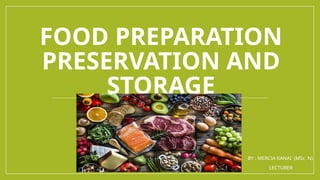
FOOD PREPARATION
PRESERVATION AND
STORAGE
BY : MERCIA KANAI (MSc N)
LECTURER
COOKING
Definition
Cooking is an art itself
and can be defined as the process of
preparing food with any method of heat
application.
Cooking is done in many
ways depending upon the availability of
food stuffs, culture, religion and food
habits. But cooking eventually fulfil the
nutritional needs.
Purposes of Cooking
 Cooking improves flavour and palatability of food.
 It makes the food easily digestible
 Cooking kills the microorganism, parasitic, ova, and eggs and making
food safe for consumption
 Cooking increases the availability of some nutrients.
 Trypsin inhibitor present in protein food is destroyed by cooking and
making trypsin freely available to the body
 Cooking in different ways provide variety in the diet
 Cooking eliminates indigestible material
 Cooking increases appetite and acceptability of food.
Principles Of Cooking
 Cooking should be done at hygienic place.
 There should be sufficient light.
 Cooking area should be at reasonable distance from sanitary area.
 Handling and storing of food should be near the cooking area.
 Always wash the vegetables and fruits before peeling and cutting to
prevent the loss of water soluble vitamins.
 Always cook in a minimal water to preserve the vitamins.
 Cook in a covered pan except green vegetables.
 Foods must not be overcooked or undercooked to prevent the loss of
vitamins and later to control the microbial count.
 Do not add alkalies like sodium bicarbonate to the food while cooking as
alkalies destroy vitamin B and vitamin C.
 Always cook in pressure cooker. It will help retaining the vitamins.
 Avoid cutting into small pieces as more surface area is exposed.
 Soak pulses and rice in water before cooking. It reduces the cooking
time.
 Store foods in a refrigerator, covered with a lid or aluminum foil to retain
nutrients.
 The persons involved in cooking should maintain cooking hygiene by
Methods of Cooking
 Boiling: In this method the foods are cooked in water at 100°C. Rice,
grams, pulses, roots and tubers are cooked by boiling. Boiling should be
done in minimum amount of water to prevent the loss of vitamin.
 Simmering: This method involves cooking below the boiling point of
water, i.e. at about 84°C. It helps in preserving the essential vitamins. Fish
and meat are cooked by this method as the higher temperature causes
hardening of fibers of such foods.
 Steaming: This method is used to cook food in direct heat steaming. The
temperature attained is > 100°C. Pressure cooker is used to cook foods by
steam under pressure. This method is very effective as it saves fuel, time
and preserves the nutrients.
 Grilling: It is cooking by direct heat. Here direct flame, grill pans are used
Stewing: Stewing is the method of cooking vegetables, fruits, and other
foods in small quantity of water, at lower temperature than boiling usually
at 80°C. The foods to be cooked are covered with little water in a pan and
then covered with lid. Cooking is done for prolonged low degree heat. The
nutrients are not lost, but are present in the liquid. This stewing of fruits
and vegetables are used for small children and old people with dentures.
Stewing is highly nutritious
Roasting: In roasting the foods are directly exposed to heat or flame after
smearing with little fat. This makes the food tender. Chicken and tender
meat are cooked by this method. This is also called "Barbeque". This is best
method to cook as it reduces the risk of cardiovascular disorder, obesity
and hypertension.
Baking: In baking the foods are cooked by dry heat in hot air oven. Food is
enclosed in hot air in an oven and heat from all sides is utilized for cooking.
Temperature for baking is 250-500°F. Baking is expensive and slow process.
Foods cooked by this method are cakes, pastry, patties, bread and biscuits
• Frying: Frying is the cooking food in oil.
It is of two types:
(1) Deep fry: In deep frying, foods are immersed in large amount of hot oil.
This method is used for making pakoras, samosa, puri, cutlet, kachori,
etc. The principle of deep frying is that, oil must be enough hot to
prevent absorption of oil in the food.
(2) Shallow fry: It requires less quantity of oil and suitable for making
omlet, dosa, paratha, and precooked food.
• Solar cooKing: This method is used in areas where direct sunlight is
available. In this method solar energy is utilized for cooking foods. Solar
cookers and closed containers are used, which absorbs maximum solar
energy. This is very simple and economical method, but takes longer time
for cooking.
Effects of Cooking on Food
 Cooking softens the texture of food, thus increases its taste.
 It makes the food easily digestible.
 It helps in destruction of microorganism present in food.
 There is a loss of some water soluble vitamins during cooking.
 The fat soluble vitamins have no effect of heat, so they are not lost.
 The antitrypsin substance present in pulses is destroyed to make the
trypsin available for digestion.
 Complex proteins are broken down into simple protein.
 Over cooking destroys essential nutrients
 Under cooking prevents killing of microorganisms present in the food.
Effects of cooking on different types of foods are as
follows:
 Effect on cereals: Cereals and millets contain starch with little protein
enclosed within the cell wall of cellulose. Boiling causes gelatinization
process in cereals in which starch grains swell and burst the cellulose.
Rice are cooked in double quantity of water. Excessive use of water
during cooking results in loss of thiamine. Sodium bicarbonate if used in
cooking destroys thiamine.
After gelatinization, cereals become easily digestible as the protein
content on
their coating coagulates. Cereals when cooked with pulses improves the
quality of
the nutrients and prevent the protein deficiency diseases.
 Effects of cooking on pulses: An antitrypsin substance present in pulses
inhibit complete digestion of proteins. On cooking this antitrypsin
Effect of cooking on green leafy vegetables: Green vegetables like-spinach
if cooked in excess water the minerals and vitamins are lost. If baking soda
is used, it destroys thiamine. Vitamin A is not lost during cooking in water.
To preserve minerals and vitamins, vegetables should be cooked in
pressure cooker using less water.
Effects of cooking on roots and tubers: Roots and tubers like-potatoes and
yam contain abundant starch as compared to other vegetables. These
must be thoroughly cooked for complete gelatinization. These vegetables
must be boiled slowly as rapid boiling breaks the mineral rich skin, less
water should be used for cooking to avoid the loss of minerals.
Effect of cooking on fruits: Fruits mainly contain water, vitamins and
minerals, Protein and fat content is less. Carbohydrates in the form of
sugars are present in varying amount in the fruits. Citrus fruits are rich in
vitamin C and potassium. Majority of fruits are eaten raw and supply good
amount of nutrients. But, during preparation of fruit stews, vitamin C and
little amount of sugar is lost. Fruits contain plenty of fibers and cooking
reduces this level and increase the digestibility.
Effects of cooking on meat fish and liver: Animal foods contain fat and
protein. On cooking fat melts, the protein and fibers are lost to some
extent in soup. On grilling the meat, the protein on surface coagulates and
seals all juices inside the meat. During boiling or stewing, minerals are lost.
Prolonged cooking makes its texture hard and indigestible. Meat soup is
rich in minerals, vitamins and protein. Fish loses its flavors on cooking but
digestibility improves. Liver, kidney and other organs are rich in minerals
and protein but difficult to digest.
 Effect of heat on milk: On heating, a layer of fat forms on surface. Taste
also changes on heating. If cream is removed from surface after boiling,
it reduces casein (protein) and fat content of milk.
Effects of Cooking on Various Nutrients
Effects on carbohydrates: Cereals and starch granules absorb water and
swell up to burst finally. This process is known as gelatinization. Cooked
starch is digested more easily than raw starch. As the carbohydrates are
main source of energy they must be cooked properly for effective digestion
in the gut.
Effects on protein: Proteins coagulate in moist heat. Cooked proteins are
digested easily, proteins are the valuable body building food and secondary
source of energy in carbohydrate deficiency. Overheating of protein foods
result in destruction of their nutritive values. It should be properly cooked
for effective digestion.
Effect on fats: Fats when cooked at normal temperature, during cooking
does not undergo any change in its chemical composition. However, on
overheating while deep frying, it loses some of its essential fatty acids and
Effect on vitamins: Water soluble vitamins B groups and vitamin C are lost
during cooking and loss from dissolved water. Vitamins are destroyed if
alkalies are used in cooking like sodium bicarbonate. But frying or roasting
vegetables causes enough loss of vitamin A .
Minerals: Minerals present in foods like-calcium, phosphorus, iron, sodium,
potassium, magnesium and trace elements are lost when cooked in excess
water for prolonged period.
SAFE FOOD HANDLING, AND HEALTH OF FOOD HANDLERS
Safe food handling is the basic step to prevent food borne diseases in the
food industry as well as at household level. Food can get contaminated at
any stage right from storage, cooking, preservation and distribution. The
contaminated food can cause various food borne diseases and food
poisoning.
The following points has to the observed in safe food handling:
Clean storage place: The place for storage food should be clean and away
from sanitation.
Food hygiene: The perishable foods start deteriorating immediately if not
properly preserved.
Fruits, vegetables, milk, meat should be kept at low temperature in
refrigerator.
The food handlers suffering from any infectious disease should be excluded
Control of rats, rodents and insects:They should not have access to food
storage or preparation places.
Sanitation of all work surfaces, utensils and equipment should be ensured.
All raw vegetables and fruits should be thoroughly washed before use.
Periodical medical examination of the food handlers should be conducted
to exclude the carries of the disease.
Health Education to Food Handlers
 They should be educated regarding personal hygiene, clean habits and
about the food hygiene.
 They should be emphasized and made to practice.
 Hand washing: Hands should be scrubbed and washed with soap and
water immediately after going to toilet.
 Finger nails should be trimmed and free from dirt.
 Hair should be covered with cap.
 Use of apron and gloves while preparing food and serving. Smoking,
coughing, and sneezing in the food premises should be forbidden.
After cooking food, it should be covered and kept in safe place.
Safe water should be used for cooking the food.
Milk, milk product and eggs should be pasteurized.
Food must be thoroughly cooked.
Most of the food poisoning organisms are killed at 60°C.
Foods not eaten immediately should be kept in cold storage to prevent
bacterial contamination.
Cook and eat on the same day is a golden rule.
Health of Food Handlers
Health of the food handler is of paramount importance as the diseases
such as typhoid, and paratyphoid fever, viral, hepatitis, diarrhoea,
dysentery and worm infestations and tuberculosis are spread through
them if they are carriers of the diseases or suffering from these diseases.
The following points are to be carried out to prevent the spread of diseases
through them:
At the time of employment, complete medical examination has to be
carried out including blood. urine and stool test and X-rays chest to exclude
the respiratory tract diseases.
Any person with a previous history of typhoid, fever, chronic dysentery
should not be employed in eating establishment. Persons suffering from
skin diseases, ear discharge or infected wound should not be permitted to
handle food or utensils . Health education regarding personal hygiene
should be frequently reinforced.
Every three months, their medical examination has to be carried out
including urine, stool and blood test to rule out any infection.
Coughing, sneezing and cigarette smoking should be prohibited in the
premises of area where food is prepared and distributed.
Any person suffering from diseases transmitted through food and
coughing, sneezing should be treated immediately and excluded from place
of work till he/she is clear of infection. Periodical immunization during the
outbreak of cholera, viral hepatitis, typhoid and paratyphoid to be done of
all the workers engaged in food preparation and distribution. Special
attention to hand washing after toilet, covering hair with cap and use of
apron and gloves should be strictly implemented
FOOD PRESERVATION
Food preservation is the technique to prevent food spoilage, food
poisoning, and microbial contamination in food.
Purposes of Food Preservation
To have all types of foods available throughout the year, i.e. to make non-
seasonal foods also available.
Readymade canned foods save time and energy.
Variety of foods are available for consumption.
To prevent wastage of food, due to spoilage or destruction.
To preserve foods for future use.
To make commercial profit.
To preserve the taste, odor and flavor of food.
Household Methods of Food Preservation
• Cooking: Cooking is done by various methods like boiling frying stewing,
simmering, roasting and baking. The cooked foods can be stored for
prolonged time than uncooked ones. Cooking at different temperature
kill microbes and destroy toxins in the food.
• Sun drying: Sun drying is used to dry many foods for long-term
preservation, for example, vegetables such as spinach, cauliflower,
carrots, ginger. This method is simple and economical where there is an
abundant sunlight as by drying in sun moisture is removed and the
microorganism cannot grow.
• Refrigeration: Temperature 1-4°C prevents foods from spoiling for a short
time. Fruits, vegetables and cooked foods are preserved in the
refrigerator for few days. The frozen foods kept at -18°C are preserved for
a year.
• Salting and pickling: Salt is a good preservative. By adding certain spices
along with lot of salt, certain foods are preserved, e.g. mango pickle, lime
and vegetable pickles, chutney, and fish can be stored for a long time as
microorganism cannot grow in high concentration of salt. Same way
sugar with certain spices are used to preserve fruits, e.g various fruits
like, apple, amla and jams are also prepared on the same
Commercial Methods of Foods Preservation
• Canning: Some foods such as fruit juices, milk, baby foods, soups and soft
drinks are preserved by canning. The food is sterilized first at a
temperature of 135-175°C for a short time, i.e. only few seconds and then
cooked and filled in presterilized containers in a sterile atmosphere
• Creating a vacuum: This process is just like canning, only difference is
that oxygen is removed from the top, Oxygen removal can stop the
growth of microorganisms. Packing of prepared food in vacuum packs is
an excellent means of preserving food.. Packs should be stored at room
temperature and well labeled.
• Freezing: A number of fruits and vegetables, meat and fish are preserved
by freezing techniques Vegetables can be preserved for 8-10 months and
meat for 3 months.
• Irradiation: Gamma rays of various frequencies ranging from low to high
frequency are being used to preserve various foods. Ultraviolet radiation
is the most widely used in food industry. These are invisible form of light
and used to control mold growth on surface of bakery products and to
prevent spoilage of meat. Treating water for beverages is another use of
ultraviolet rays. These are also used to inhibit sprouting of potatoes and
onions, garlic.
• Drying
• By adding preservatives: Preservatives are used for long-term storage of
foods as the preservatives retard the deterioration of food.
• Sugar: A high concentration of sugar prevents molds, yeast and bacterial
growth. High concentration of sugar is used to preserve jams, jellies and
candied fruits.
• Pasteurization is used to control microorganism in milk, fruit juices and
wines. Foods are pasteurized by any of the 3 methods
1. Low temperature holding method at 62°C for 30 minutes
2. High temperature short time at 92°C for 15 minutes
3. Extra high temperature above 135°C for 2 seconds. This method makes
food commercially sterile.
FOOD-BORNE DISEASES
• Food-borne infections
• Bacterial infections: Typhoid fever, paratyphoid fever caused salmonella
typhi and typhoid bacillus.
• Fungal infection:
• Liver diseases
• Viral infection:Viral hepatitis due to hepatitis A virus.
• Parasitic infections:
• some of the food borne diseases cause mild symptoms whereas others
may cause severe symptoms resulting in emergency hospitalizations due
to food poisoning.
Signs and symptoms of food poisoning
 Vomiting and nausea
 Severe diarrhea resulting into severe dehydration
 Rapid pulse
 Low BP
 Sunken eyes and dry coated tongue
 Low urinary output
 Cold and clammy skin
 Shock may be present.
Management
• Replacement of fluids and electrolyte by intravenous therapy.
• Anti-emetic drugs to stop vomiting
• Antibiotic to treat infection
FOOD ADULTERATION AND RELATED ACTS
Food adulteration: Food adulteration is the addition or subtraction of
anything from the food which affects its nutritional value for unfair
economic gains.
Methods of Adulteration
 Mixing up food products with edible or nonedible substances.
 Substitution of the quality nutrients with substandard adulterants.
 Abstraction of nutrients, i.e. removing something from the original food
article.
 Misbranding
 Concealing the quality
 Mislabeling
 Adding toxic substances
Acts Related to Food Adulteration
To prevent the adulteration of food, the government of India passed an Act.
"Prevention of Food Adulteration Act" in 1954 and it was implemented in
June 1955.
To rectify its drawbacks, some amendments
were made in 1964, 1976, 1986, 2001 and 2002.
Advantages of PFA Act 1955:
Maintaining the quality of food stuffs.
Preventing adulteration.
Punishing the defaulters and organizations responsible for adulteration.
Giving special rights to the consumer and voluntary organization so that
they can play active role in checking adulteration.
Checking the quality of imported edible stuffs.
Fruit product order standard (1961):
This order specifies the standards for
qualities of fruits and vegetables products. The manufacturer is required to
obtain licence to meet the required standard. The main aim of FPO is to
maintain minimum level of quality during farming, manufacturing and
retailing.
Agmark standard
The directorate of marketing and
inspection gives this standards. The foods under this standard are
vegetable oils, ghee, butter, rice, jaggery, eggs, ground nut, spices,
potatoes and pulses. It also specifies various foods according to quality.
Indian standard institution ISI :
The ISI mark symbolizes its quality. Foods
covered under this are vegetable and fruit products, spices, condiments,
meat products, processed foods such as biscuits, sweets, flour, soya
products, tea, coffee, beverages, etc.
Vegetarian and nonvegetarian standard:
According to this standard, on each
packet of food stuff or edible product, if it is vegetarian, a green mark
should be there and brown mark on foods containing nonvegetarian
products.