Microbial Fermentation
BY- SANCHIT DHANKHAR
Introduction
 The fermentation industry is composed of five
major bio-ingredient categories.
 They are:
- Proteins & amino acids.
- Organic acids.
- Antibiotics.
- Enzymes.
- Vitamins & hormones.
2
Fermentation media
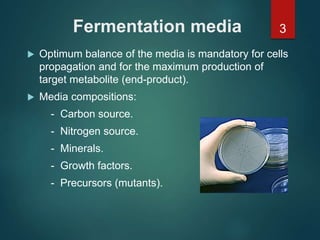
 Optimum balance of the media is mandatory for cells
propagation and for the maximum production of
target metabolite (end-product).
 Media compositions:
- Carbon source.
- Nitrogen source.
- Minerals.
- Growth factors.
- Precursors (mutants).
3
Industrial microorganisms
 Microbial screening.
- Wild strains.
 Microbial yield improvement
- Mutation.
- Recombinant DNA.
- Genetically engineered.
 Microbial selection.
 Industrial microorganism
4
93 C
43 C
21 C
4 C
Types of fermentation
Solid State fermentation (SSF).
Liquid State fermentation (LSF)
Surface culture & submerged
culture
5
Solid State Fermentation (SSF)
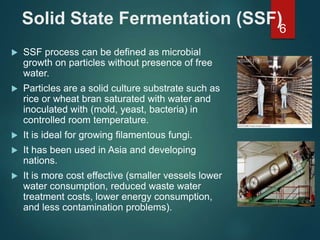
 SSF process can be defined as microbial
growth on particles without presence of free
water.
 Particles are a solid culture substrate such as
rice or wheat bran saturated with water and
inoculated with (mold, yeast, bacteria) in
controlled room temperature.
 It is ideal for growing filamentous fungi.
 It has been used in Asia and developing
nations.
 It is more cost effective (smaller vessels lower
water consumption, reduced waste water
treatment costs, lower energy consumption,
and less contamination problems).
6
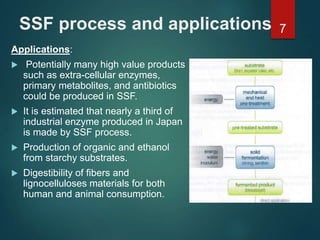
SSF process and applications
Applications:
 Potentially many high value products
such as extra-cellular enzymes,
primary metabolites, and antibiotics
could be produced in SSF.
 It is estimated that nearly a third of
industrial enzyme produced in Japan
is made by SSF process.
 Production of organic and ethanol
from starchy substrates.
 Digestibility of fibers and
lignocelluloses materials for both
human and animal consumption.
7
Liquid State fermentation (LSF)
[Submerged culture]
- Submerged culture is performed in tanks
which can reach in size for over 100,000
gallons.
- It is ideal for the growing unicellular organisms
such as bacteria and yeast.
LSF methods:
- Batch fermentation.
- Fed-batch fermentation.
- Continuous fermentation.
- Semi-continuous fermentation.
8
 Considered to be a closed system.
 The sterilized media in the fermenter is
inoculated with the microorganism.
 Incubation is allowed under the optimum
conditions (aeration, agitation,
temperature).
 During entire fermentation nothing is
added except air, antifoam and acid/base.
9
Batch fermentation
Fed-Batch fermentation
 It is enhancement of batch fermentation.
 Continue adding the nutrients (feeding) in a
small doses during the fermentation.
 The method in controlling nutrients feeding
process is by measuring methods.
 The main advantage of fed-batch fermentation is
the elimination of catabolite repression (feed-back
inhibition).
10
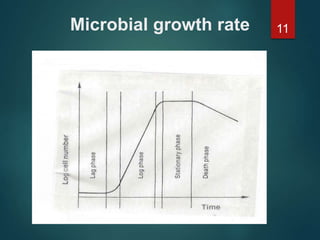
Microbial growth rate 11
Primary
metabolites
Secondary
metabolites
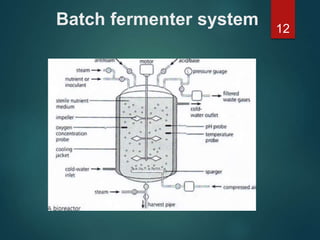
Batch fermenter system 12
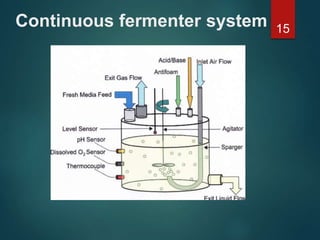
Continuous fermentation
 It is an open system.
 Continuously sterile nutrient is added and the
converted nutrient is taken out from the
fermentor.
 In continuous process cell loss as a result of
outflow must be balanced by growth of the
microorganism.
13
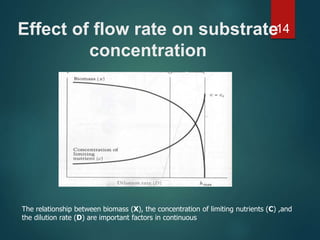
Effect of flow rate on substrate
concentration
14
The relationship between biomass (X), the concentration of limiting nutrients (C) ,and
the dilution rate (D) are important factors in continuous
Continuous fermenter system 15
Important factors for
continuous fermentation
 The system must be stable for at least 500
hours.
 Maintaining sterile conditions for all period of
fermentation time.
 The composition of nutrients must be constant
all the time.
 Maintaining the strain stability for constant high
production yield (concerning about reverse
mutation).
16
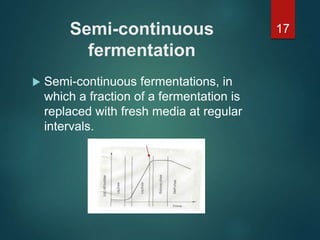
Semi-continuous
fermentation
 Semi-continuous fermentations, in
which a fraction of a fermentation is
replaced with fresh media at regular
intervals.
17
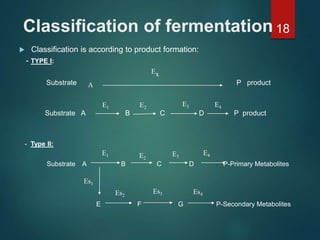
Classification of fermentation
 Classification is according to product formation:
- TYPE I:
Substrate P product
Substrate A B C D P product
- Type II:
Substrate A B C D P-Primary Metabolites
E F G P-Secondary Metabolites
18
A
E1 E2
E3 E4
Ex
E1 E2
E3
E4
Es1
Es2
Es3 Es4
THANKYOU
19

Microbial fermentation- Pharmaceutical Microbiology

  • 1.
  • 2.
    Introduction  The fermentationindustry is composed of five major bio-ingredient categories.  They are: - Proteins & amino acids. - Organic acids. - Antibiotics. - Enzymes. - Vitamins & hormones. 2
  • 3.
    Fermentation media  Optimumbalance of the media is mandatory for cells propagation and for the maximum production of target metabolite (end-product).  Media compositions: - Carbon source. - Nitrogen source. - Minerals. - Growth factors. - Precursors (mutants). 3
  • 4.
    Industrial microorganisms  Microbialscreening. - Wild strains.  Microbial yield improvement - Mutation. - Recombinant DNA. - Genetically engineered.  Microbial selection.  Industrial microorganism 4 93 C 43 C 21 C 4 C
  • 5.
    Types of fermentation SolidState fermentation (SSF). Liquid State fermentation (LSF) Surface culture & submerged culture 5
  • 6.
    Solid State Fermentation(SSF)  SSF process can be defined as microbial growth on particles without presence of free water.  Particles are a solid culture substrate such as rice or wheat bran saturated with water and inoculated with (mold, yeast, bacteria) in controlled room temperature.  It is ideal for growing filamentous fungi.  It has been used in Asia and developing nations.  It is more cost effective (smaller vessels lower water consumption, reduced waste water treatment costs, lower energy consumption, and less contamination problems). 6
  • 7.
    SSF process andapplications Applications:  Potentially many high value products such as extra-cellular enzymes, primary metabolites, and antibiotics could be produced in SSF.  It is estimated that nearly a third of industrial enzyme produced in Japan is made by SSF process.  Production of organic and ethanol from starchy substrates.  Digestibility of fibers and lignocelluloses materials for both human and animal consumption. 7
  • 8.
    Liquid State fermentation(LSF) [Submerged culture] - Submerged culture is performed in tanks which can reach in size for over 100,000 gallons. - It is ideal for the growing unicellular organisms such as bacteria and yeast. LSF methods: - Batch fermentation. - Fed-batch fermentation. - Continuous fermentation. - Semi-continuous fermentation. 8
  • 9.
     Considered tobe a closed system.  The sterilized media in the fermenter is inoculated with the microorganism.  Incubation is allowed under the optimum conditions (aeration, agitation, temperature).  During entire fermentation nothing is added except air, antifoam and acid/base. 9 Batch fermentation
  • 10.
    Fed-Batch fermentation  Itis enhancement of batch fermentation.  Continue adding the nutrients (feeding) in a small doses during the fermentation.  The method in controlling nutrients feeding process is by measuring methods.  The main advantage of fed-batch fermentation is the elimination of catabolite repression (feed-back inhibition). 10
  • 11.
    Microbial growth rate11 Primary metabolites Secondary metabolites
  • 12.
  • 13.
    Continuous fermentation  Itis an open system.  Continuously sterile nutrient is added and the converted nutrient is taken out from the fermentor.  In continuous process cell loss as a result of outflow must be balanced by growth of the microorganism. 13
  • 14.
    Effect of flowrate on substrate concentration 14 The relationship between biomass (X), the concentration of limiting nutrients (C) ,and the dilution rate (D) are important factors in continuous
  • 15.
  • 16.
    Important factors for continuousfermentation  The system must be stable for at least 500 hours.  Maintaining sterile conditions for all period of fermentation time.  The composition of nutrients must be constant all the time.  Maintaining the strain stability for constant high production yield (concerning about reverse mutation). 16
  • 17.
    Semi-continuous fermentation  Semi-continuous fermentations,in which a fraction of a fermentation is replaced with fresh media at regular intervals. 17
  • 18.
    Classification of fermentation Classification is according to product formation: - TYPE I: Substrate P product Substrate A B C D P product - Type II: Substrate A B C D P-Primary Metabolites E F G P-Secondary Metabolites 18 A E1 E2 E3 E4 Ex E1 E2 E3 E4 Es1 Es2 Es3 Es4
  • 19.