
'Untangle your' + async + 'code'
=> with ('RxJS 5')
const by = {
name : 'Luis Atencio',
twitter: '@luijar',
site : 'http://luisatencio.net’,
work : ’Citrix Systems'
};
Who am I?
RxJS in Action
www.manning.com/books/
rxjs-in-action
rxbocajs (39% off RxJS in Action, until May 31 2016)
Functional
Programming in
JavaScript
www.manning.com/atencio
Pre-order in Amazon!
Functional
PHP
https://leanpub.com/functional-php
Free!
Let’s begin!
What is Reactive Programming?
!Platform && !Library && !Framework
!Technique && !Design Pattern
!Language
Paradigm oriented around
Data flows + Propagation of change
Reactive Manifesto
New way of thinking
var A = 40;
var B = 2;
var C = A + B; //-> 42
A = 100;
C = ?
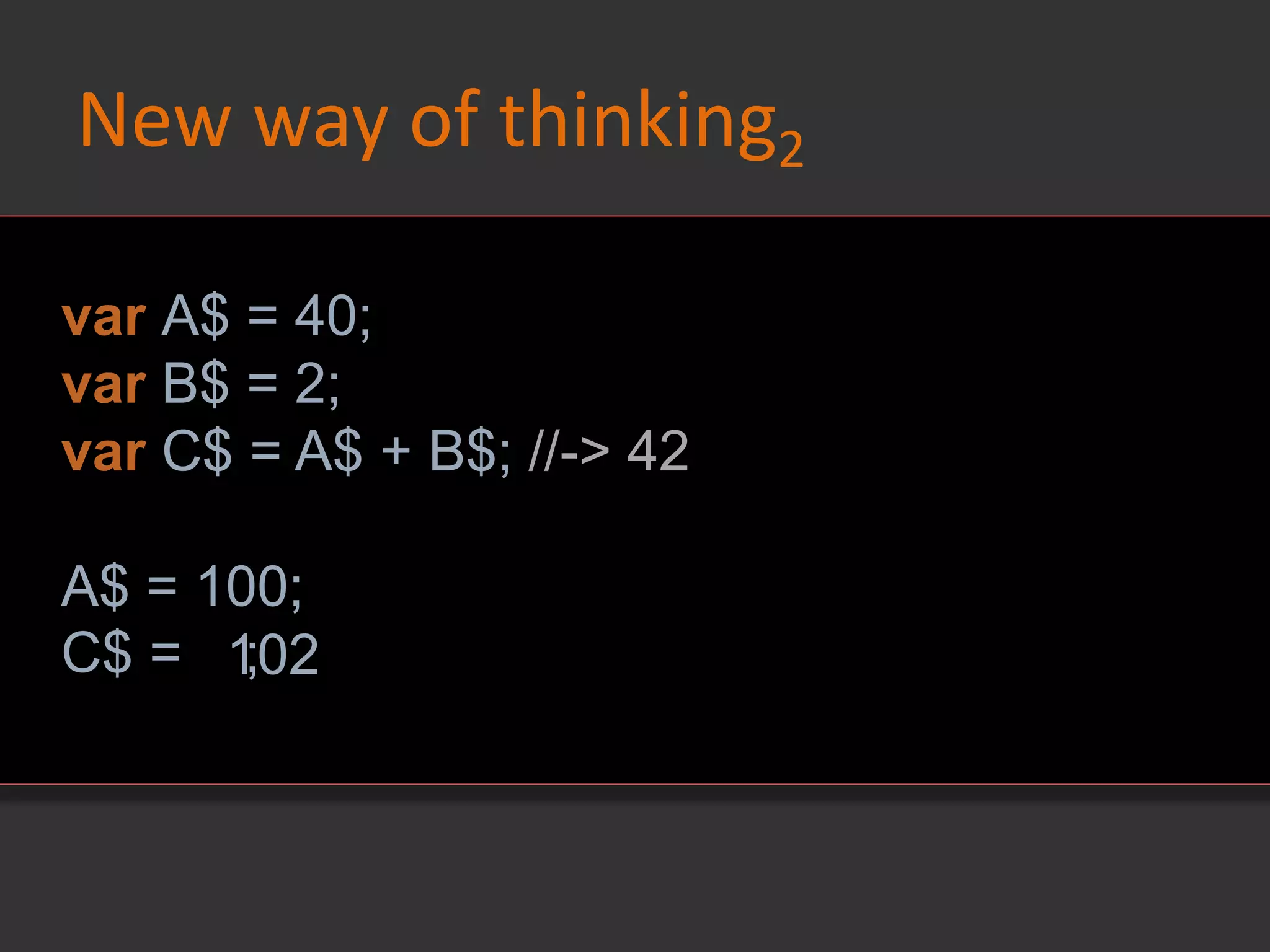
New way of thinking2
var A$ = 40;
var B$ = 2;
var C$ = A$ + B$; //-> 42
A$ = 100;
C$ = ;102
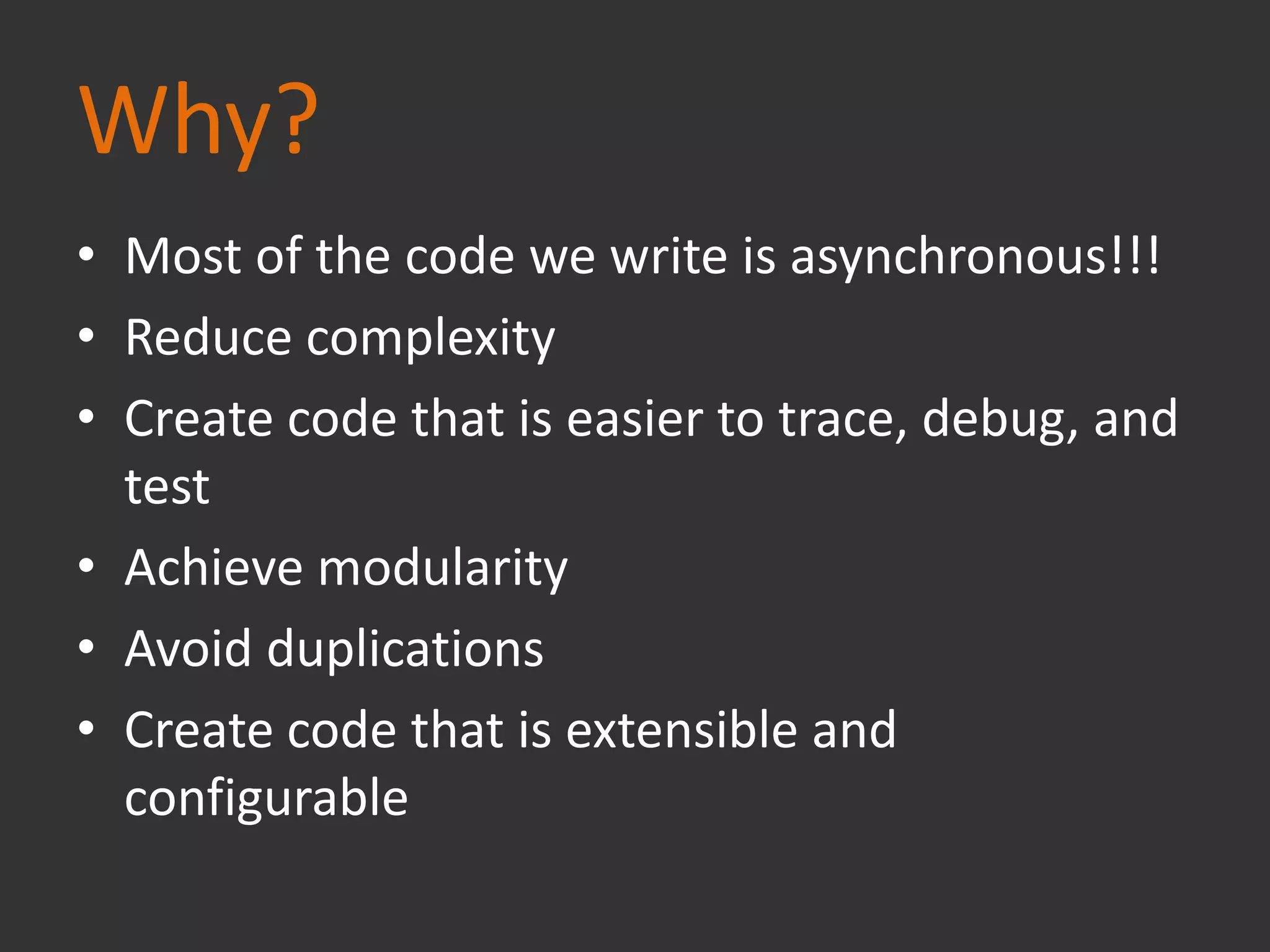
Why?
• Most of the code we write is asynchronous!!!
• Reduce complexity
• Create code that is easier to trace, debug, and
test
• Achieve modularity
• Avoid duplications
• Create code that is extensible and
configurable
Typical async calls look like this...
makeAsyncHttpCall('/data', data => {
for (let item of data) {
// process each item
}
});
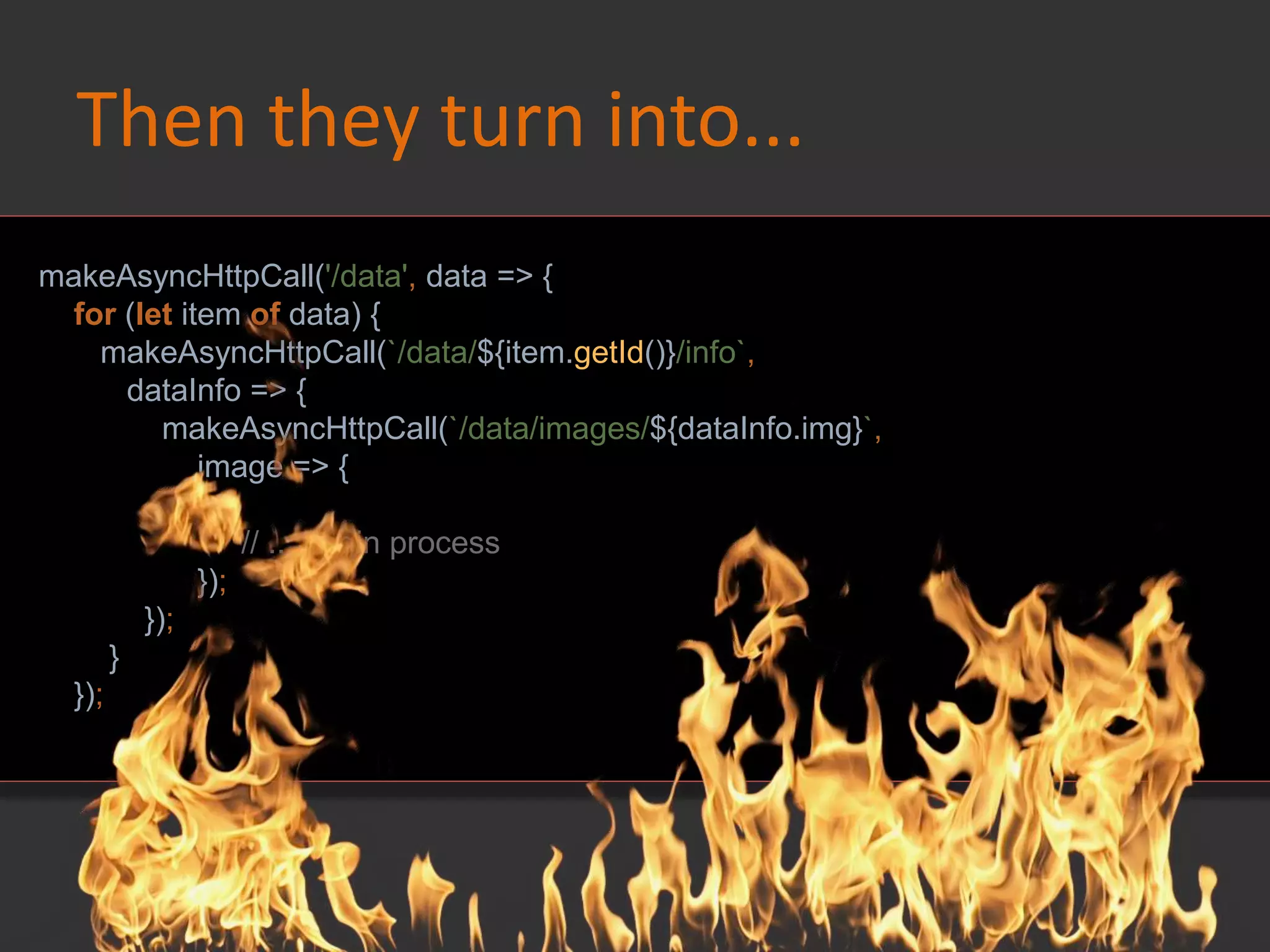
Then they turn into...
makeAsyncHttpCall('/data', data => {
for (let item of data) {
makeAsyncHttpCall(`/data/${item.getId()}/info`,
dataInfo => {
makeAsyncHttpCall(`/data/images/${dataInfo.img}`,
image => {
// ... begin process
});
});
}
});
What is RxJS?
• A reactive programming library for JS, based on the
design of the Reactive Extensions (Rx)
• Treats every source of data with the same computing
model using the Observable: A Stream!
• Designed to handle infinitely many values (events)
https://github.com/ReactiveX/rxjs
Is it important for JS devs?
• Cycle.js
• Redux
• Yolk.js
• React.js
• Angular 2
• TC39 Observable spec ES7
(https://github.com/zenparsing/es-
observable)
RxJS builds on the
shoulders of
Iterators: data agnostic traversal
btw. ES6 has native iterators
var iter1 = ['B', 'o', 'c', 'a', 'J', 'S'][Symbol.iterator]();
iter1.next().value; // B
iter1.next().value; // o
iter1.next().value; // c
iter1.next().value; // a
var iter2 = 'Rocks'[Symbol.iterator]();
iter2.next().value// -> R
iter2.next().value// -> o
Observer: Producers + Consumers
Functional Programming
• RxJS encourages you to use a functional style
of development
–Side effect free functions
–Immutability
–Singular, Pure functions
–Flow of data
–Function composition
–Functors and function chains
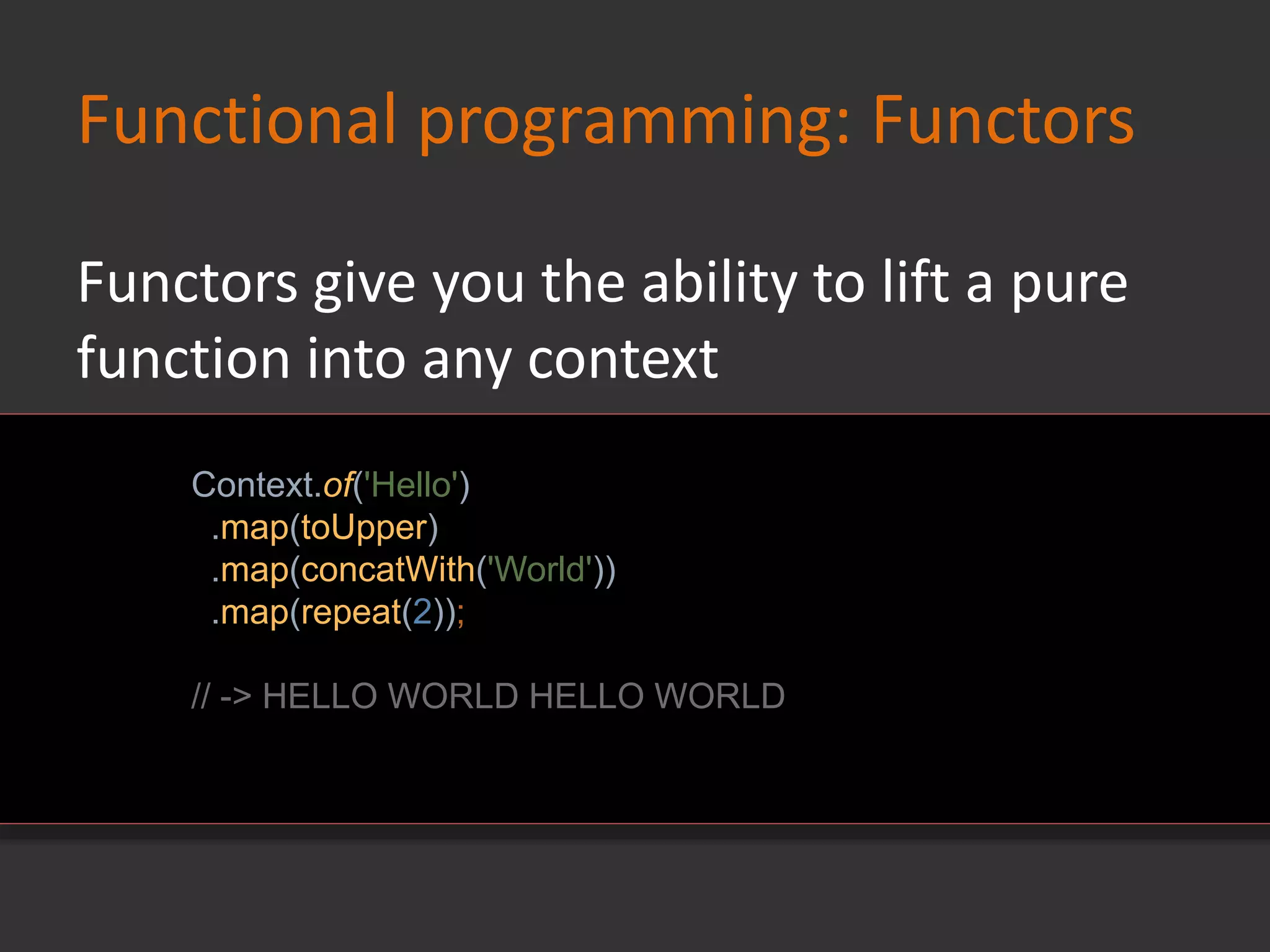
Functional programming: Functors
Context.of('Hello')
.map(toUpper)
.map(concatWith('World'))
.map(repeat(2));
// -> HELLO WORLD HELLO WORLD
Functors give you the ability to lift a pure
function into any context
An RxJS stream is composed of
The Observable
An Observable
• Represents sequences of events (values)
over time
• Asynchronous
• Lazy
• Repeatable, bufferable, pausable,
filterable, mapable, etc-able, ...
• They can be hot or cold
Hello to the World of streams
Rx.Observable.of('Hello', 'World', '!')
.map(toUpper)
.subscribe(console.log);
Consumer
Producer
Pipeline
Hey, it’s a functor too!
Producers
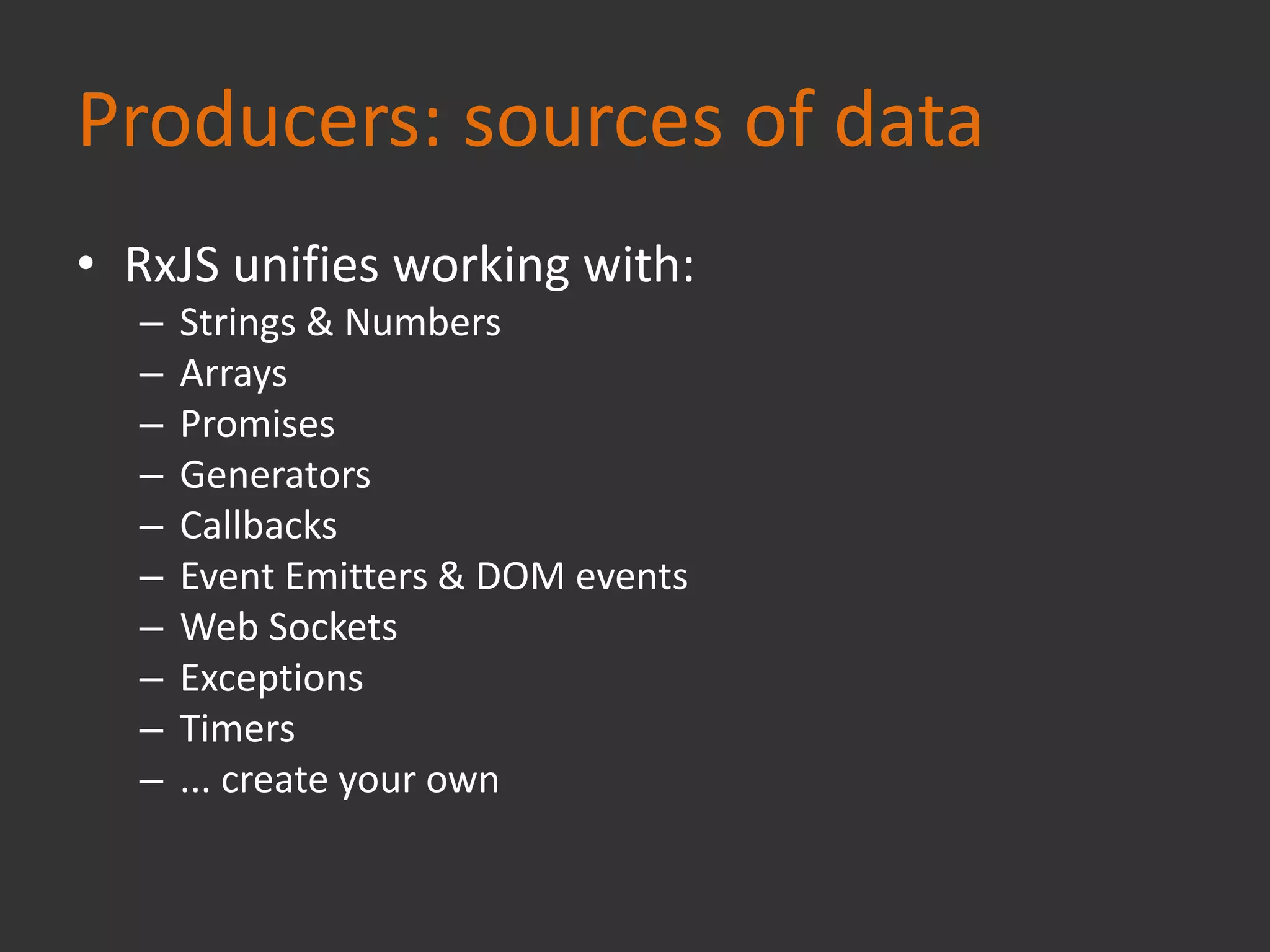
Producers: sources of data
• RxJS unifies working with:
– Strings & Numbers
– Arrays
– Promises
– Generators
– Callbacks
– Event Emitters & DOM events
– Web Sockets
– Exceptions
– Timers
– ... create your own
Creating Observables
Rx.Observable.of('a', 'b', 'c');
Rx.Observable.of(1, 2, 3);
Rx.Observable.of(['a', 'b', 'c’]);
Rx.Observable.from(idGenerator());
Rx.Observable.fromPromise(
$.getJSON('https://api.github.com/users'));
Rx.Observable.fromEvent(button, 'click');
Works with pretty
much anything
Consumers
Consuming Observables
var subscription = Rx.Observable.subscribe(observer);
var subscription = Rx.Observable.forEach(observer);
//....
subscription.unsubscribe();
The Observer
var observer = {
next: function (val) {
// do something with result
},
error: function (msg) {
// alert user
},
complete: function () {
}
};
Pipeline
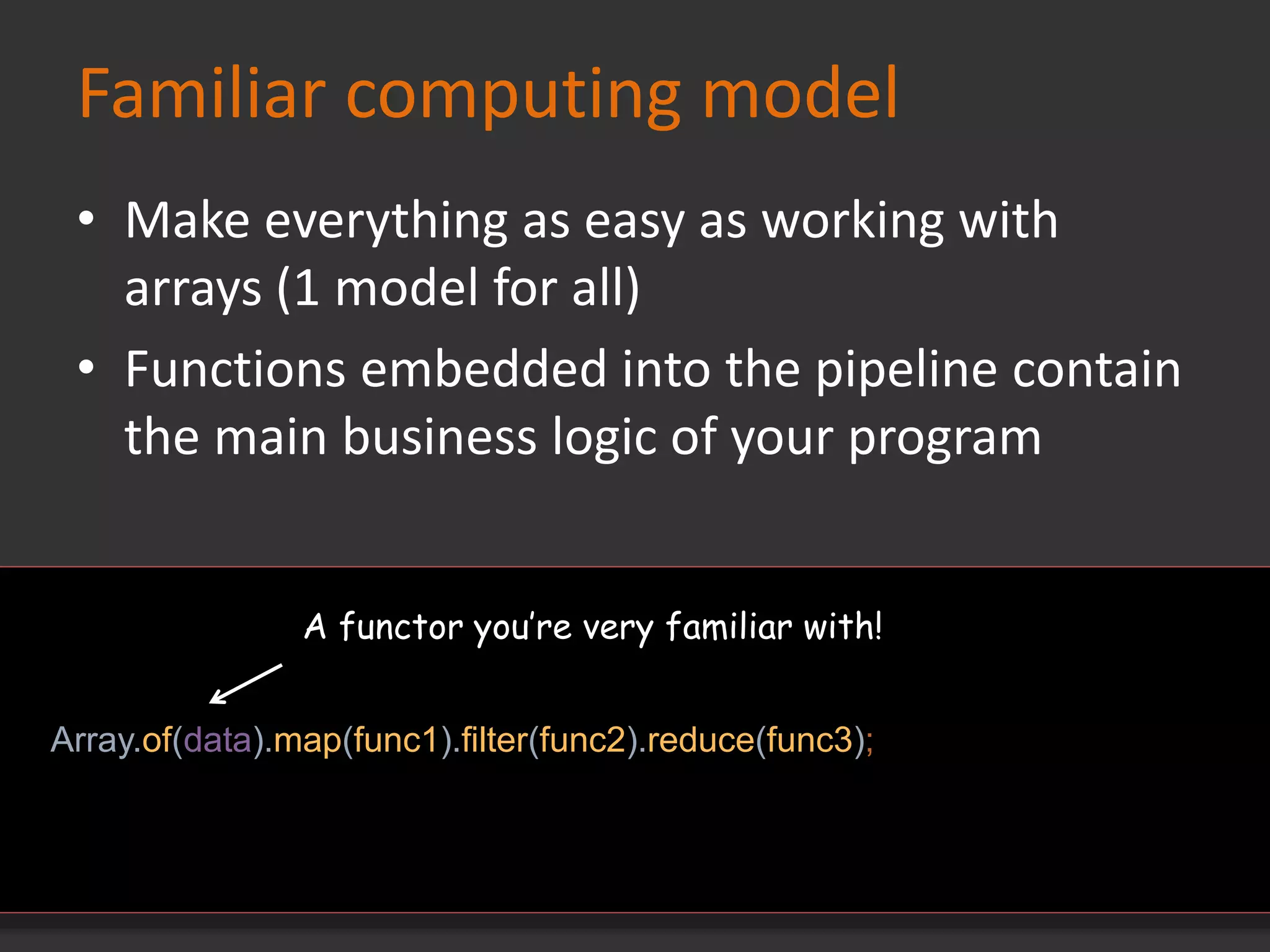
Familiar computing model
• Make everything as easy as working with
arrays (1 model for all)
• Functions embedded into the pipeline contain
the main business logic of your program
Array.of(data).map(func1).filter(func2).reduce(func3);
A functor you’re very familiar with!
An optimized FP toolkit
• Borrows the same FP approach of arrays, but a lot
more optimized than LoDash and Underscore
• Avoid creating temporary data structures
• Additional set operators:
– take = take x amount from infinitely many
– concat = append two streams
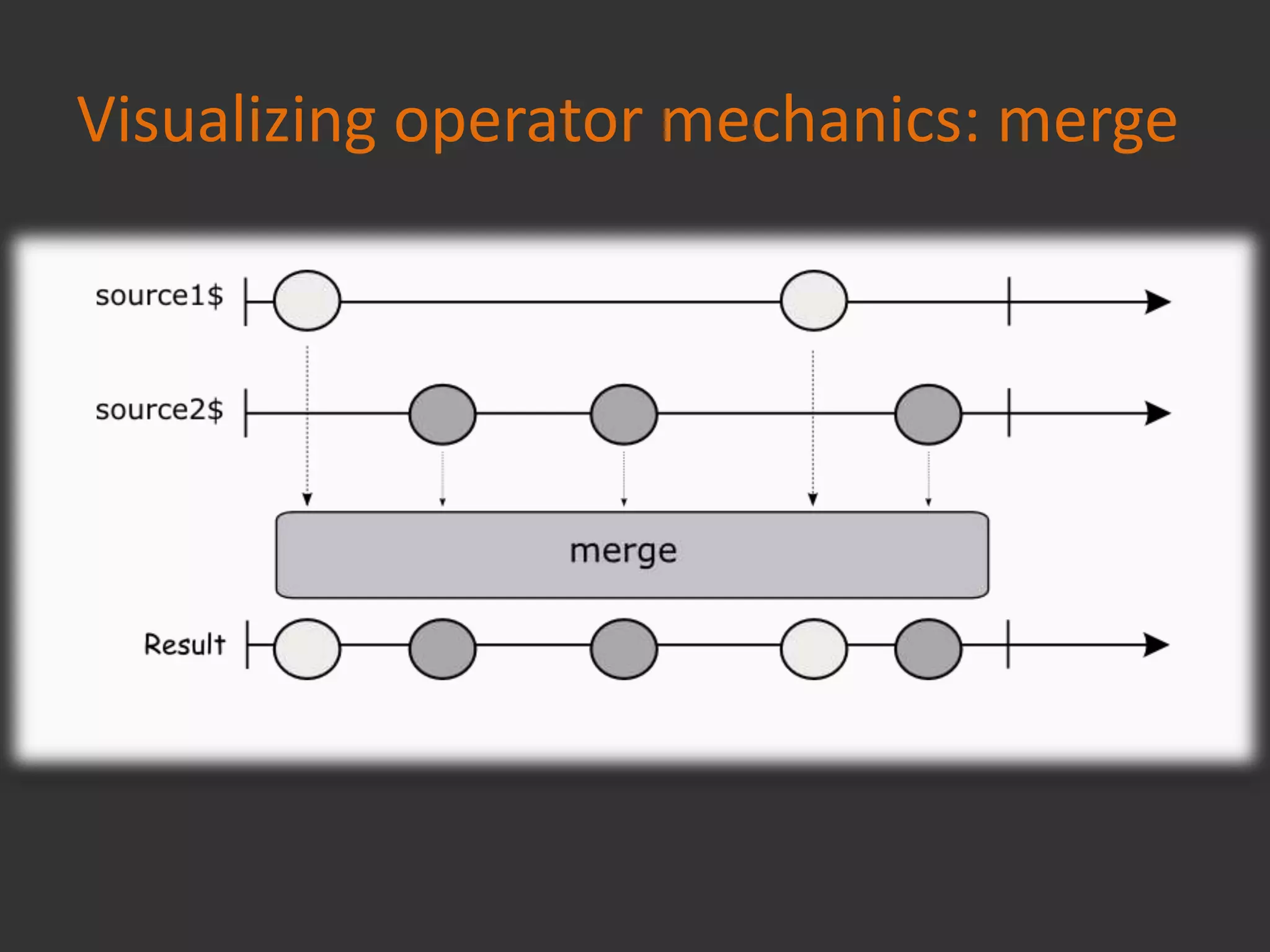
– merge = interleave streams
– zip = interleave streams keeping position
– skip = ignore events based on certain criteria
– scan = like reduce, emit at each iteration
– ... many more
Easier to reason about async data
Rx.Observable.of(localArray)
.map(func1)
.filter(func2)
.take(3)
.forEach(console.log);
Rx.Observable.of(fetchAsyncData())
.map(func1)
.filter(func2)
.take(3)
.forEach(console.log);
Data comes in
async
Data comes in
sync
Visualizing operator mechanics: merge
Visualizing operator mechanics: concat
Example
const genRandomNumber = (max) =>
Array.of(Math.random())
.map(x => max * x)
.map(Math.floor)
.reduce(x => x);
const randomNum$ = Rx.Observable.create(observer => {
const id = setInterval(() => {
observer.next(genRandomNumber(10));
}, 1000);
return () => {
clearInterval(id);
}
});
Pure pipeline
Example
const isEven = num => num % 2 === 0;
const add = (x, y) => x + y;
randomNum$
.filter(isEven)
.take(10)
.reduce(add, 0) // .scan(add, 0)
.subscribe(console.log);
Pipeline
(business logic)
Advanced operators
Advanced operators
• Equivalent stream combinators + flattening
• Extremely useful to implement more advanced
behavior and to join one stream to the next, or many
async data streams
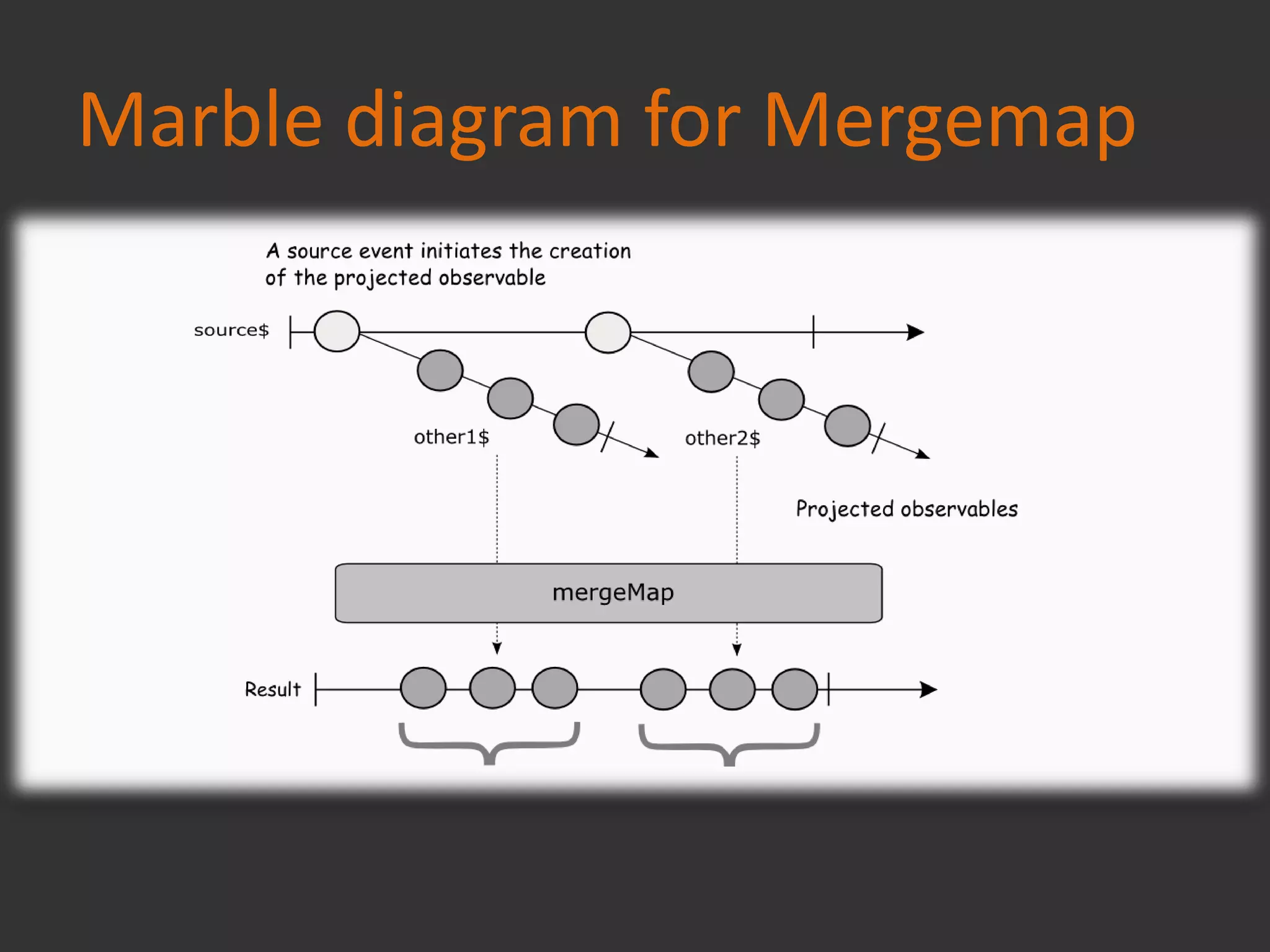
– mergeMap – projects each source value to an another
observable which is merged in the output
– switchMap – like mergeMap, except emitting values only
from most recently projected observable
– concatMap – like mergeMap, but values emitted keep
their order instead of being interleaved.
Marble diagram for Mergemap
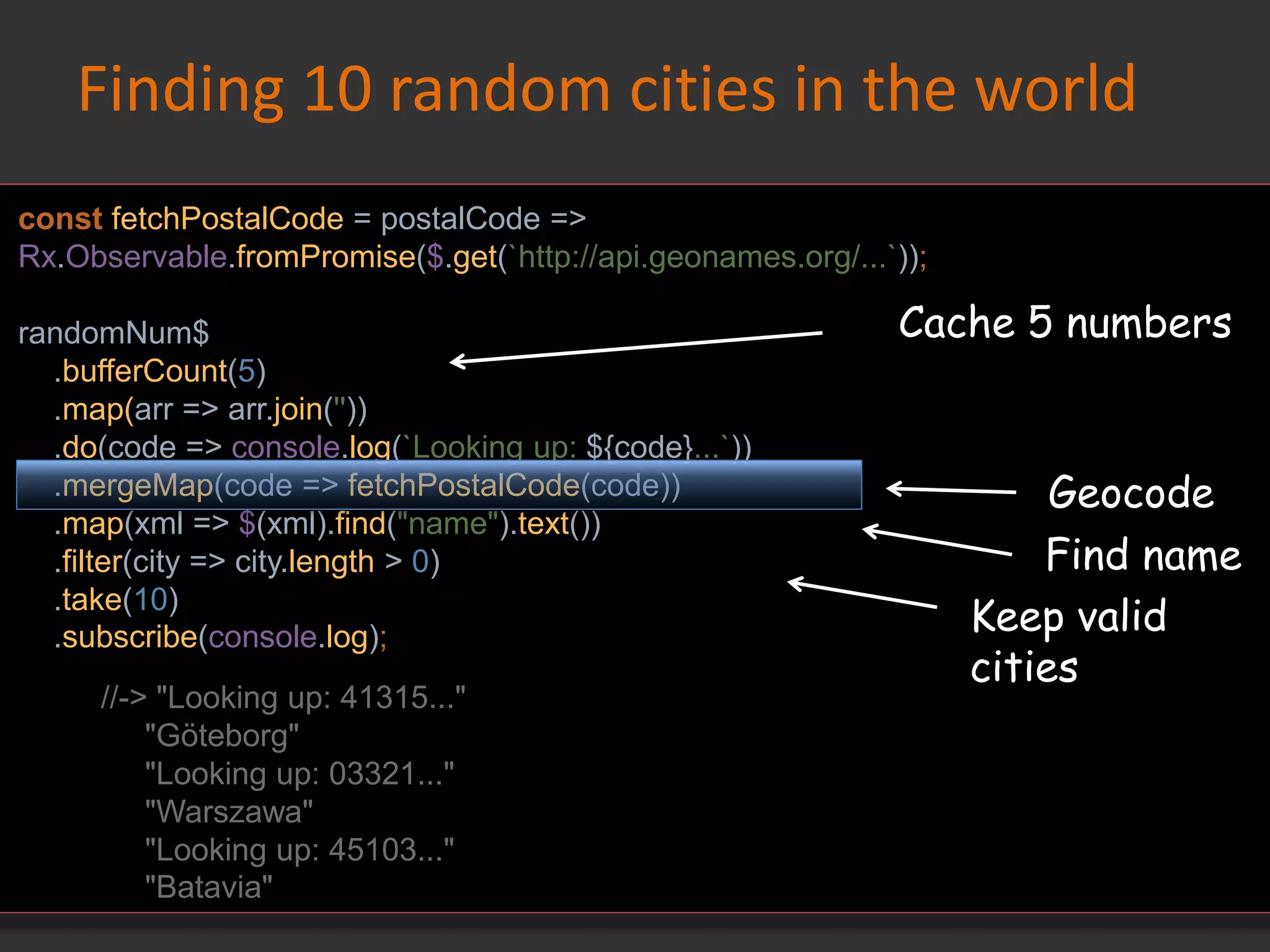
Finding 10 random cities in the world
const fetchPostalCode = postalCode =>
Rx.Observable.fromPromise($.get(`http://api.geonames.org/...`));
randomNum$
.bufferCount(5)
.map(arr => arr.join(''))
.do(code => console.log(`Looking up: ${code}...`))
.mergeMap(code => fetchPostalCode(code))
.map(xml => $(xml).find("name").text())
.filter(city => city.length > 0)
.take(10)
.subscribe(console.log);
Cache 5 numbers
Geocode
Find name
Keep valid
cities
//-> "Looking up: 41315..."
"Göteborg"
"Looking up: 03321..."
"Warszawa"
"Looking up: 45103..."
"Batavia"
Error Handling
“Reactive applications must
always be responsive in the
face of failure”
Error operators
• Promises are not repeatable values,
observables are
– catch: catch and handle an error within a stream
– throw: wrap an exception into an Observable
– repeat: repeat the execution of an observable for
any number of times
– repeatWhen: repeat sequence when an
observable emits a value, timers, exponential
backoff, etc.
Adding error handling to our code
const fetchPostalCode = postalCode =>
Rx.Observable.fromPromise(
$.get(`http://api.geonames.org/...`))
.repeat(3)
.catch(err$ => Rx.Observable.throw('Service is down!'));
const subs = randomNum$
...
.subscribe(
city => console.log(city),
error => console.log('Error detected: ' + error)
);
Time
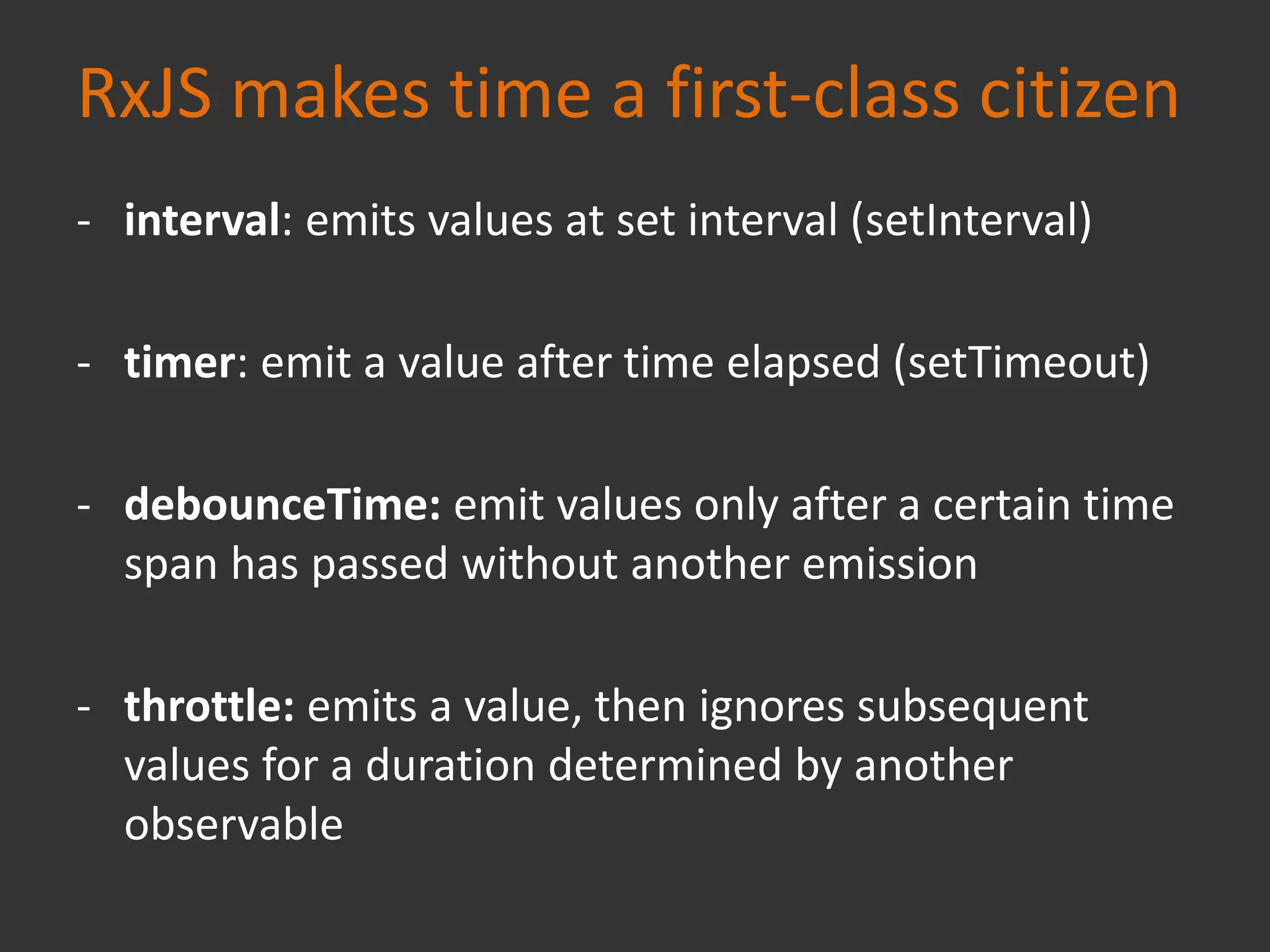
RxJS makes time a first-class citizen
- interval: emits values at set interval (setInterval)
- timer: emit a value after time elapsed (setTimeout)
- debounceTime: emit values only after a certain time
span has passed without another emission
- throttle: emits a value, then ignores subsequent
values for a duration determined by another
observable
Cancelling
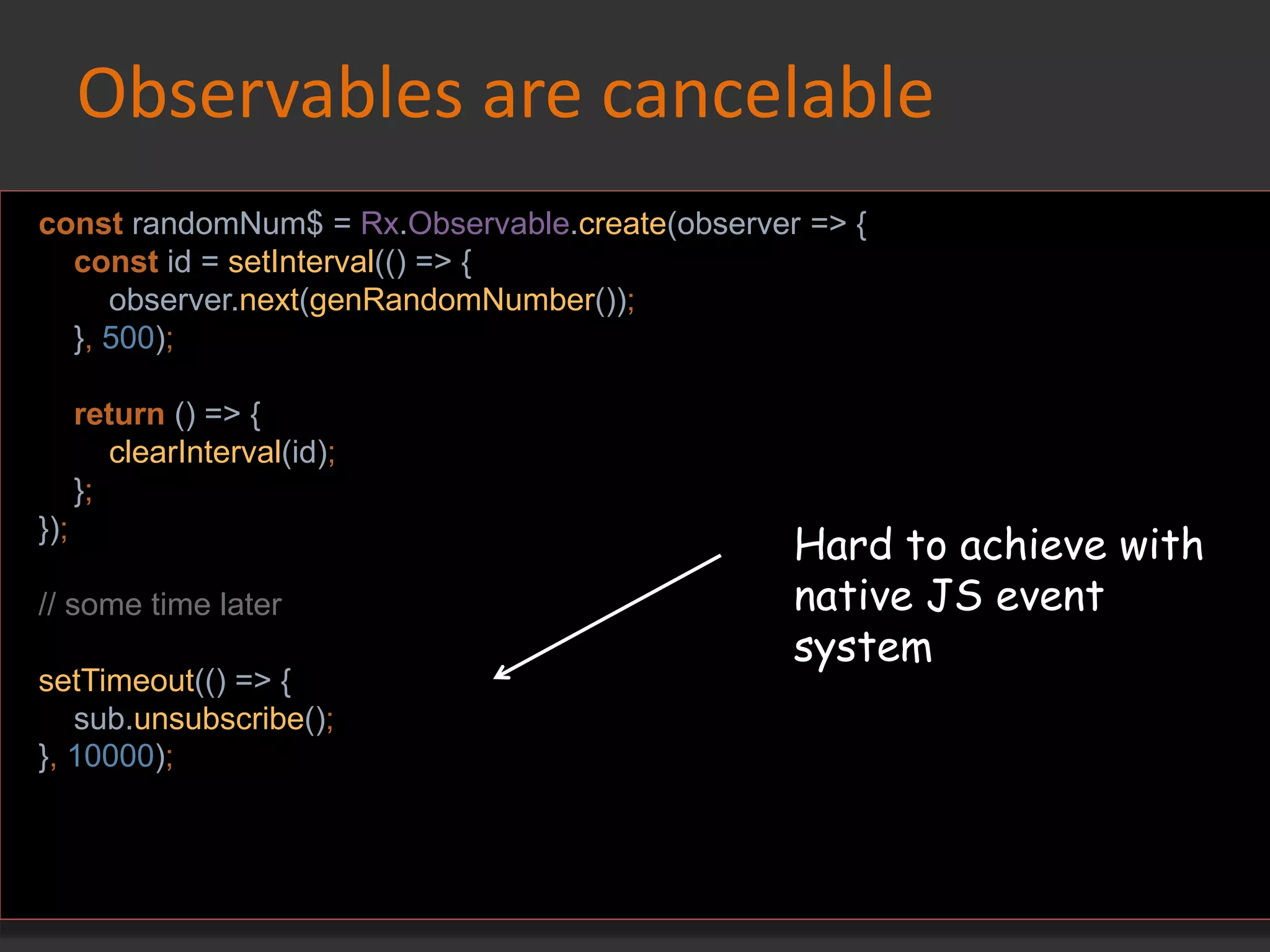
Observables are cancelable
const randomNum$ = Rx.Observable.create(observer => {
const id = setInterval(() => {
observer.next(genRandomNumber());
}, 500);
return () => {
clearInterval(id);
};
});
// some time later
setTimeout(() => {
sub.unsubscribe();
}, 10000);
Hard to achieve with
native JS event
system
Final comments
“LoDash (or
Underscore) for async”
“Any number of things, for
any number of time ”
-Ben Lesh
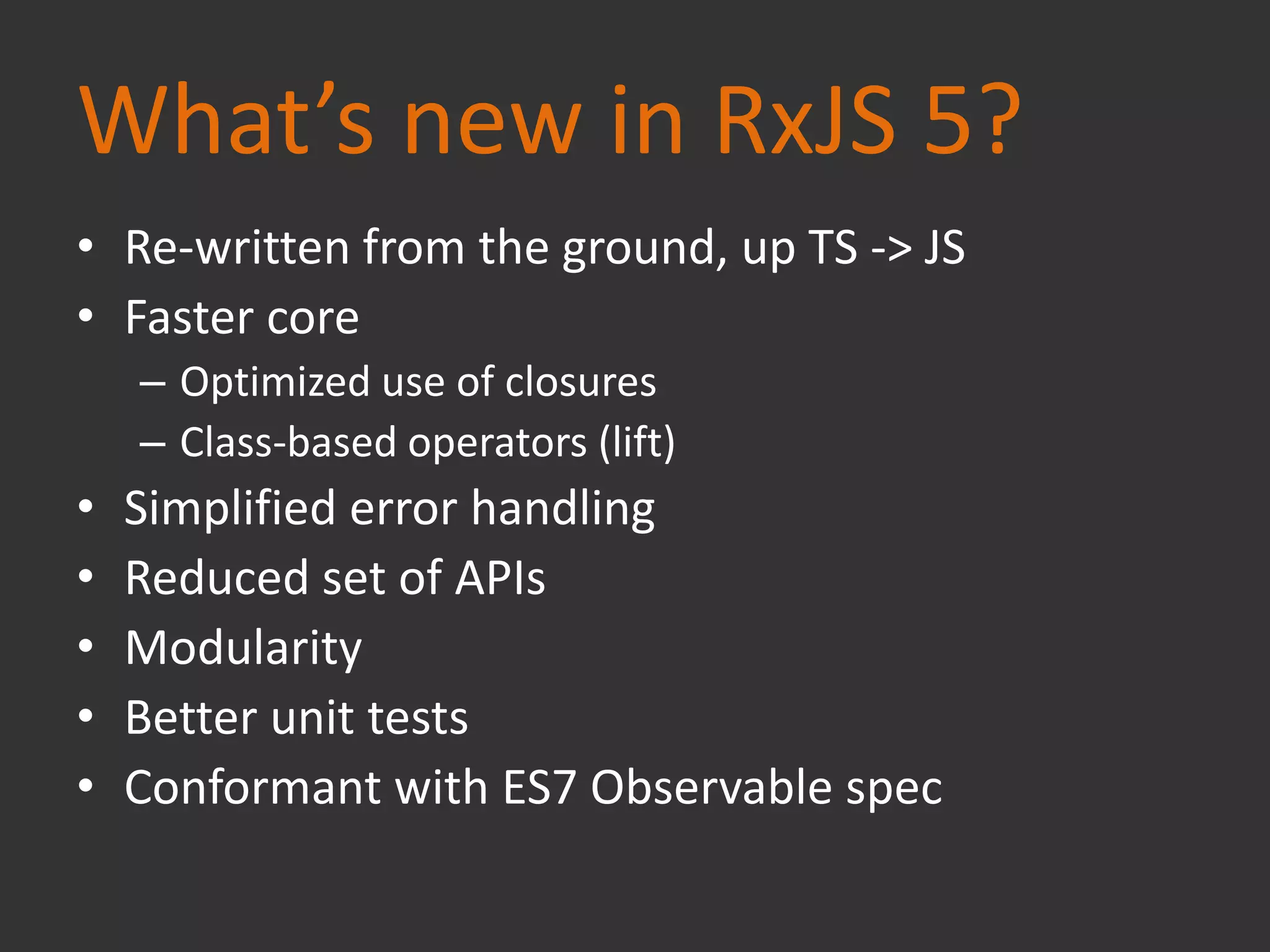
What’s new in RxJS 5?
• Re-written from the ground, up TS -> JS
• Faster core
– Optimized use of closures
– Class-based operators (lift)
• Simplified error handling
• Reduced set of APIs
• Modularity
• Better unit tests
• Conformant with ES7 Observable spec
Companies using RxJS
Important topics not
covered in this talk
• Schedulers
• Hot vs Cold observables
• Back-pressure
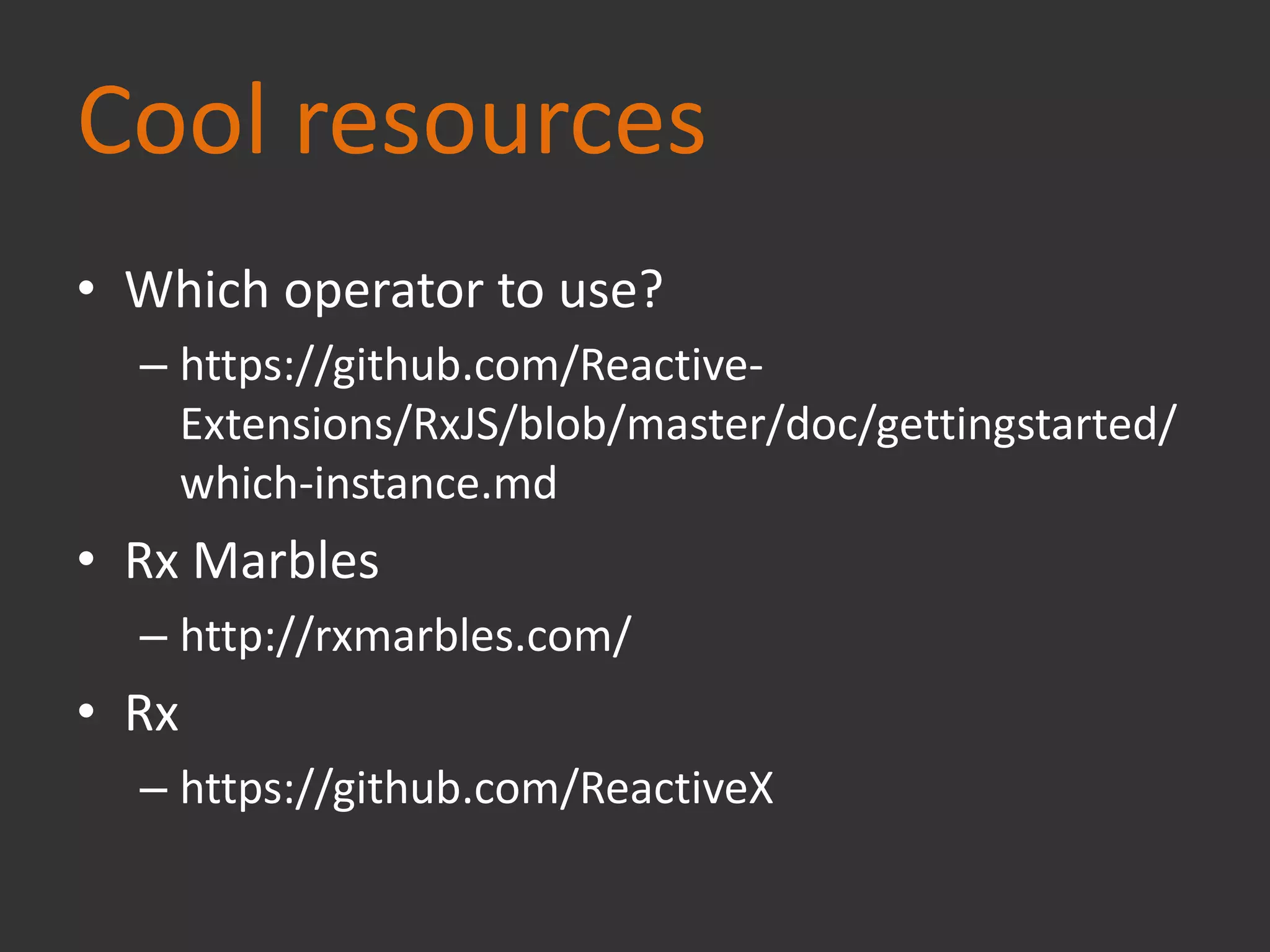
Cool resources
• Which operator to use?
– https://github.com/Reactive-
Extensions/RxJS/blob/master/doc/gettingstarted/
which-instance.md
• Rx Marbles
– http://rxmarbles.com/
• Rx
– https://github.com/ReactiveX
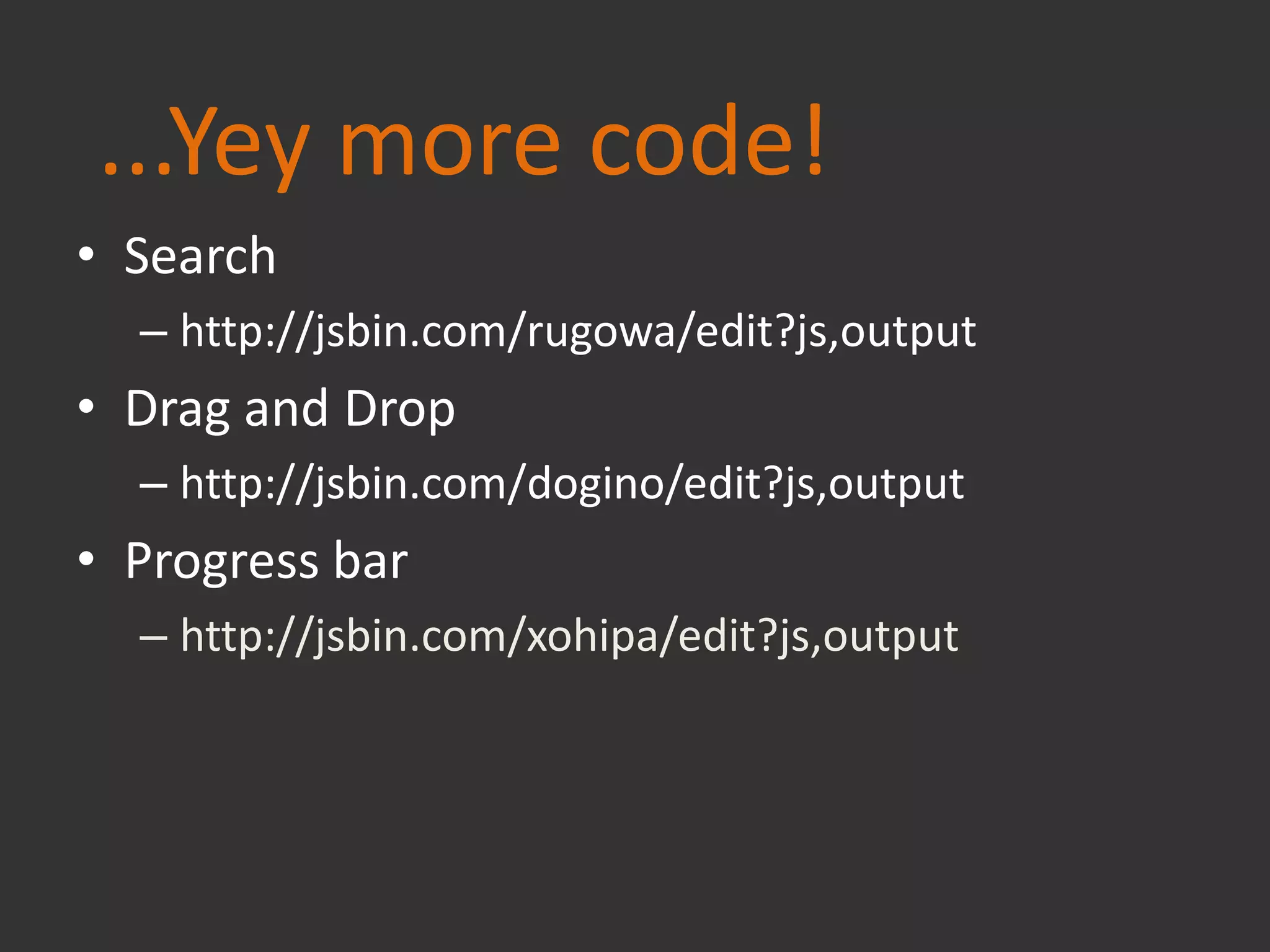
• Search
– http://jsbin.com/rugowa/edit?js,output
• Drag and Drop
– http://jsbin.com/dogino/edit?js,output
• Progress bar
– http://jsbin.com/xohipa/edit?js,output
...Yey more code!
@luijar
Keep in touch!!
Thanks!

Luis Atencio on RxJS

  • 1.
    'Untangle your' +async + 'code' => with ('RxJS 5') const by = { name : 'Luis Atencio', twitter: '@luijar', site : 'http://luisatencio.net’, work : ’Citrix Systems' };
  • 2.
  • 3.
    RxJS in Action www.manning.com/books/ rxjs-in-action rxbocajs(39% off RxJS in Action, until May 31 2016)
  • 4.
  • 5.
  • 6.
  • 7.
    What is ReactiveProgramming? !Platform && !Library && !Framework !Technique && !Design Pattern !Language Paradigm oriented around Data flows + Propagation of change
  • 8.
  • 9.
    New way ofthinking var A = 40; var B = 2; var C = A + B; //-> 42 A = 100; C = ?
  • 10.
    New way ofthinking2 var A$ = 40; var B$ = 2; var C$ = A$ + B$; //-> 42 A$ = 100; C$ = ;102
  • 11.
    Why? • Most ofthe code we write is asynchronous!!! • Reduce complexity • Create code that is easier to trace, debug, and test • Achieve modularity • Avoid duplications • Create code that is extensible and configurable
  • 12.
    Typical async callslook like this... makeAsyncHttpCall('/data', data => { for (let item of data) { // process each item } });
  • 13.
    Then they turninto... makeAsyncHttpCall('/data', data => { for (let item of data) { makeAsyncHttpCall(`/data/${item.getId()}/info`, dataInfo => { makeAsyncHttpCall(`/data/images/${dataInfo.img}`, image => { // ... begin process }); }); } });
  • 14.
    What is RxJS? •A reactive programming library for JS, based on the design of the Reactive Extensions (Rx) • Treats every source of data with the same computing model using the Observable: A Stream! • Designed to handle infinitely many values (events) https://github.com/ReactiveX/rxjs
  • 15.
    Is it importantfor JS devs? • Cycle.js • Redux • Yolk.js • React.js • Angular 2 • TC39 Observable spec ES7 (https://github.com/zenparsing/es- observable)
  • 16.
    RxJS builds onthe shoulders of
  • 17.
  • 18.
    btw. ES6 hasnative iterators var iter1 = ['B', 'o', 'c', 'a', 'J', 'S'][Symbol.iterator](); iter1.next().value; // B iter1.next().value; // o iter1.next().value; // c iter1.next().value; // a var iter2 = 'Rocks'[Symbol.iterator](); iter2.next().value// -> R iter2.next().value// -> o
  • 19.
  • 20.
    Functional Programming • RxJSencourages you to use a functional style of development –Side effect free functions –Immutability –Singular, Pure functions –Flow of data –Function composition –Functors and function chains
  • 21.
    Functional programming: Functors Context.of('Hello') .map(toUpper) .map(concatWith('World')) .map(repeat(2)); //-> HELLO WORLD HELLO WORLD Functors give you the ability to lift a pure function into any context
  • 22.
    An RxJS streamis composed of The Observable
  • 23.
    An Observable • Representssequences of events (values) over time • Asynchronous • Lazy • Repeatable, bufferable, pausable, filterable, mapable, etc-able, ... • They can be hot or cold
  • 24.
    Hello to theWorld of streams Rx.Observable.of('Hello', 'World', '!') .map(toUpper) .subscribe(console.log); Consumer Producer Pipeline Hey, it’s a functor too!
  • 25.
  • 26.
    Producers: sources ofdata • RxJS unifies working with: – Strings & Numbers – Arrays – Promises – Generators – Callbacks – Event Emitters & DOM events – Web Sockets – Exceptions – Timers – ... create your own
  • 27.
    Creating Observables Rx.Observable.of('a', 'b','c'); Rx.Observable.of(1, 2, 3); Rx.Observable.of(['a', 'b', 'c’]); Rx.Observable.from(idGenerator()); Rx.Observable.fromPromise( $.getJSON('https://api.github.com/users')); Rx.Observable.fromEvent(button, 'click'); Works with pretty much anything
  • 28.
  • 29.
    Consuming Observables var subscription= Rx.Observable.subscribe(observer); var subscription = Rx.Observable.forEach(observer); //.... subscription.unsubscribe();
  • 30.
    The Observer var observer= { next: function (val) { // do something with result }, error: function (msg) { // alert user }, complete: function () { } };
  • 31.
  • 32.
    Familiar computing model •Make everything as easy as working with arrays (1 model for all) • Functions embedded into the pipeline contain the main business logic of your program Array.of(data).map(func1).filter(func2).reduce(func3); A functor you’re very familiar with!
  • 33.
    An optimized FPtoolkit • Borrows the same FP approach of arrays, but a lot more optimized than LoDash and Underscore • Avoid creating temporary data structures • Additional set operators: – take = take x amount from infinitely many – concat = append two streams – merge = interleave streams – zip = interleave streams keeping position – skip = ignore events based on certain criteria – scan = like reduce, emit at each iteration – ... many more
  • 34.
    Easier to reasonabout async data Rx.Observable.of(localArray) .map(func1) .filter(func2) .take(3) .forEach(console.log); Rx.Observable.of(fetchAsyncData()) .map(func1) .filter(func2) .take(3) .forEach(console.log); Data comes in async Data comes in sync
  • 35.
  • 37.
  • 38.
    Example const genRandomNumber =(max) => Array.of(Math.random()) .map(x => max * x) .map(Math.floor) .reduce(x => x); const randomNum$ = Rx.Observable.create(observer => { const id = setInterval(() => { observer.next(genRandomNumber(10)); }, 1000); return () => { clearInterval(id); } });
  • 39.
  • 40.
    Example const isEven =num => num % 2 === 0; const add = (x, y) => x + y; randomNum$ .filter(isEven) .take(10) .reduce(add, 0) // .scan(add, 0) .subscribe(console.log); Pipeline (business logic)
  • 41.
  • 42.
    Advanced operators • Equivalentstream combinators + flattening • Extremely useful to implement more advanced behavior and to join one stream to the next, or many async data streams – mergeMap – projects each source value to an another observable which is merged in the output – switchMap – like mergeMap, except emitting values only from most recently projected observable – concatMap – like mergeMap, but values emitted keep their order instead of being interleaved.
  • 43.
  • 44.
    Finding 10 randomcities in the world const fetchPostalCode = postalCode => Rx.Observable.fromPromise($.get(`http://api.geonames.org/...`)); randomNum$ .bufferCount(5) .map(arr => arr.join('')) .do(code => console.log(`Looking up: ${code}...`)) .mergeMap(code => fetchPostalCode(code)) .map(xml => $(xml).find("name").text()) .filter(city => city.length > 0) .take(10) .subscribe(console.log); Cache 5 numbers Geocode Find name Keep valid cities //-> "Looking up: 41315..." "Göteborg" "Looking up: 03321..." "Warszawa" "Looking up: 45103..." "Batavia"
  • 45.
    Error Handling “Reactive applicationsmust always be responsive in the face of failure”
  • 46.
    Error operators • Promisesare not repeatable values, observables are – catch: catch and handle an error within a stream – throw: wrap an exception into an Observable – repeat: repeat the execution of an observable for any number of times – repeatWhen: repeat sequence when an observable emits a value, timers, exponential backoff, etc.
  • 47.
    Adding error handlingto our code const fetchPostalCode = postalCode => Rx.Observable.fromPromise( $.get(`http://api.geonames.org/...`)) .repeat(3) .catch(err$ => Rx.Observable.throw('Service is down!')); const subs = randomNum$ ... .subscribe( city => console.log(city), error => console.log('Error detected: ' + error) );
  • 48.
  • 49.
    RxJS makes timea first-class citizen - interval: emits values at set interval (setInterval) - timer: emit a value after time elapsed (setTimeout) - debounceTime: emit values only after a certain time span has passed without another emission - throttle: emits a value, then ignores subsequent values for a duration determined by another observable
  • 50.
  • 51.
    Observables are cancelable constrandomNum$ = Rx.Observable.create(observer => { const id = setInterval(() => { observer.next(genRandomNumber()); }, 500); return () => { clearInterval(id); }; }); // some time later setTimeout(() => { sub.unsubscribe(); }, 10000); Hard to achieve with native JS event system
  • 52.
  • 53.
  • 54.
    “Any number ofthings, for any number of time ” -Ben Lesh
  • 55.
    What’s new inRxJS 5? • Re-written from the ground, up TS -> JS • Faster core – Optimized use of closures – Class-based operators (lift) • Simplified error handling • Reduced set of APIs • Modularity • Better unit tests • Conformant with ES7 Observable spec
  • 56.
  • 57.
    Important topics not coveredin this talk • Schedulers • Hot vs Cold observables • Back-pressure
  • 58.
    Cool resources • Whichoperator to use? – https://github.com/Reactive- Extensions/RxJS/blob/master/doc/gettingstarted/ which-instance.md • Rx Marbles – http://rxmarbles.com/ • Rx – https://github.com/ReactiveX
  • 59.
    • Search – http://jsbin.com/rugowa/edit?js,output •Drag and Drop – http://jsbin.com/dogino/edit?js,output • Progress bar – http://jsbin.com/xohipa/edit?js,output ...Yey more code!
  • 60.

Editor's Notes

  • #3 Handle with the same elegance? Error handling tends to be very messy with try/catch statements
  • #7 Handle with the same elegance? Error handling tends to be very messy with try/catch statements
  • #17 Handle with the same elegance? Error handling tends to be very messy with try/catch statements
  • #26 Handle with the same elegance? Error handling tends to be very messy with try/catch statements
  • #29 Handle with the same elegance? Error handling tends to be very messy with try/catch statements
  • #32 Handle with the same elegance? Error handling tends to be very messy with try/catch statements
  • #34 Less array allocations, less intermediary arrays, less closures over functions, less GC Observables pass each value through the pipeline, vs entire result
  • #35 Less array allocations, less intermediary arrays, less closures over functions, less GC
  • #42 Handle with the same elegance? Error handling tends to be very messy with try/catch statements
  • #43 Less array allocations, less intermediary arrays, less closures over functions, less GC
  • #46 Handle with the same elegance? Error handling tends to be very messy with try/catch statements
  • #47 Less array allocations, less intermediary arrays, less closures over functions, less GC
  • #49 Handle with the same elegance? Error handling tends to be very messy with try/catch statements
  • #50 Throttling enforces a maximum number of times a function can be called over time. As in "execute this function at most once every 100 milliseconds." Debouncing enforces that a function not be called again until a certain amount of time has passed without it being called. As in "execute this function only if 100 milliseconds have passed without it being called."
  • #51 Handle with the same elegance? Error handling tends to be very messy with try/catch statements
  • #53 Handle with the same elegance? Error handling tends to be very messy with try/catch statements
  • #54 Handle with the same elegance? Error handling tends to be very messy with try/catch statements
  • #55 Handle with the same elegance? Error handling tends to be very messy with try/catch statements