STREAM ECOLOGY BASIC STREAM ASSESSMENT WORKSHOP Chris Mammoliti, Aquatic Biologist
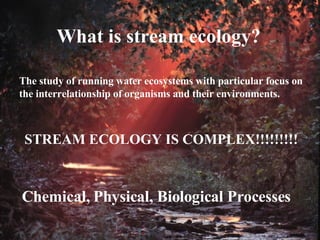
What is stream ecology? The study of running water ecosystems with particular focus on the interrelationship of organisms and their environments. Chemical, Physical, Biological Processes STREAM ECOLOGY IS COMPLEX!!!!!!!!!
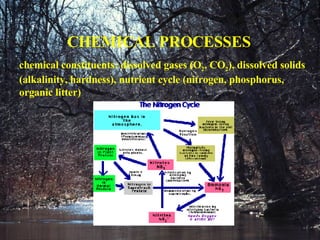
CHEMICAL PROCESSES chemical constituents: dissolved gases (O 2 , CO 2 ), dissolved solids (alkalinity, hardness), nutrient cycle (nitrogen, phosphorus, organic litter)
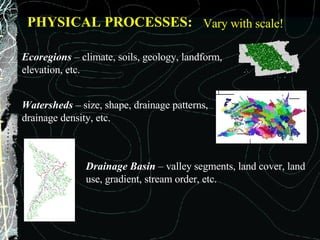
PHYSICAL PROCESSES: Vary with scale! Ecoregions  – climate, soils, geology, landform, elevation, etc. Watersheds  – size, shape, drainage patterns, drainage density, etc. Drainage Basin  – valley segments, land cover, land use, gradient, stream order, etc.
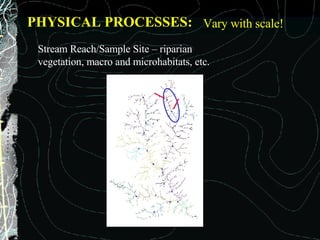
PHYSICAL PROCESSES: Vary with scale! Stream Reach/Sample Site – riparian vegetation, macro and microhabitats, etc.
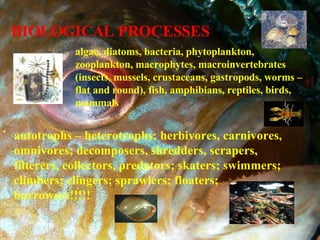
BIOLOGICAL PROCESSES algae, diatoms, bacteria, phytoplankton, zooplankton, macrophytes, macroinvertebrates (insects, mussels, crustaceans, gastropods, worms – flat and round), fish, amphibians, reptiles, birds, mammals autotrophs – heterotrophs; herbivores, carnivores, omnivores; decomposers, shredders, scrapers, filterers, collectors, predators; skaters; swimmers; climbers; clingers; sprawlers; floaters; burrowers!!!!!
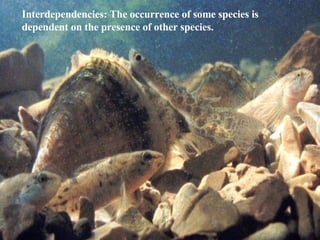
Interdependencies: The occurrence of some species is dependent on the presence of other species.
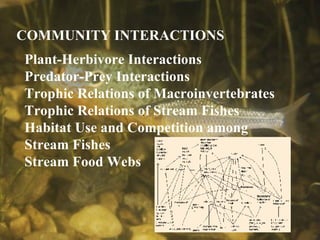
Plant-Herbivore Interactions Predator-Prey Interactions Trophic Relations of Macroinvertebrates Trophic Relations of Stream Fishes Habitat Use and Competition among Stream Fishes Stream Food Webs   COMMUNITY INTERACTIONS
ECOSYSTEM PROCESSES Primary Productivity  Community Respiration Effects of Nutrient Enrichment on Periphyton Surface-Subsurface Interactions in Streams Secondary Production of Macroinvertebrates Drift, Colonization, Emergence Leaf Breakdown in Stream Ecosystems Organic Matter Budgets
 
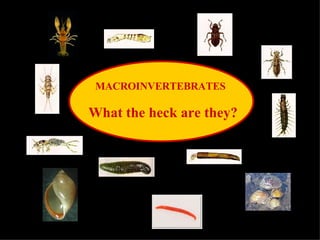
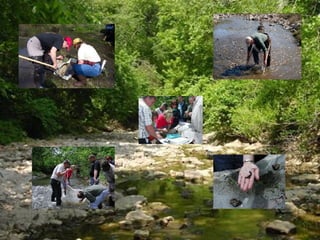
MACROINVERTEBRATES What the heck are they?
WHY STUDY  MACROINVERTEBRATES? They are everywhere and easy to collect. Important component of the food chain. Differing sensitivity to water quality conditions. Provide spatial and temporal information. THEY ARE VERY COOL!!
 
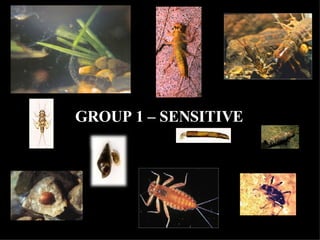
GROUP 1 – SENSITIVE
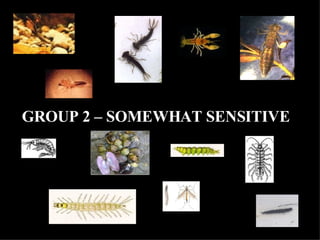
GROUP 2 – SOMEWHAT SENSITIVE
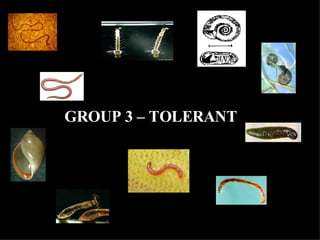
GROUP 3 – TOLERANT
“ In the end we will conserve only what we love.  We love only what we understand.  We will understand only what we are taught.” -Baba Dioum   1968 speech to the general   assembly in New Delhi, India

Stream Ecology

  • 1.
    STREAM ECOLOGY BASICSTREAM ASSESSMENT WORKSHOP Chris Mammoliti, Aquatic Biologist
  • 2.
    What is streamecology? The study of running water ecosystems with particular focus on the interrelationship of organisms and their environments. Chemical, Physical, Biological Processes STREAM ECOLOGY IS COMPLEX!!!!!!!!!
  • 3.
    CHEMICAL PROCESSES chemicalconstituents: dissolved gases (O 2 , CO 2 ), dissolved solids (alkalinity, hardness), nutrient cycle (nitrogen, phosphorus, organic litter)
  • 4.
    PHYSICAL PROCESSES: Varywith scale! Ecoregions – climate, soils, geology, landform, elevation, etc. Watersheds – size, shape, drainage patterns, drainage density, etc. Drainage Basin – valley segments, land cover, land use, gradient, stream order, etc.
  • 5.
    PHYSICAL PROCESSES: Varywith scale! Stream Reach/Sample Site – riparian vegetation, macro and microhabitats, etc.
  • 6.
    BIOLOGICAL PROCESSES algae,diatoms, bacteria, phytoplankton, zooplankton, macrophytes, macroinvertebrates (insects, mussels, crustaceans, gastropods, worms – flat and round), fish, amphibians, reptiles, birds, mammals autotrophs – heterotrophs; herbivores, carnivores, omnivores; decomposers, shredders, scrapers, filterers, collectors, predators; skaters; swimmers; climbers; clingers; sprawlers; floaters; burrowers!!!!!
  • 7.
    Interdependencies: The occurrenceof some species is dependent on the presence of other species.
  • 8.
    Plant-Herbivore Interactions Predator-PreyInteractions Trophic Relations of Macroinvertebrates Trophic Relations of Stream Fishes Habitat Use and Competition among Stream Fishes Stream Food Webs COMMUNITY INTERACTIONS
  • 9.
    ECOSYSTEM PROCESSES PrimaryProductivity Community Respiration Effects of Nutrient Enrichment on Periphyton Surface-Subsurface Interactions in Streams Secondary Production of Macroinvertebrates Drift, Colonization, Emergence Leaf Breakdown in Stream Ecosystems Organic Matter Budgets
  • 10.
  • 11.
  • 12.
    WHY STUDY MACROINVERTEBRATES? They are everywhere and easy to collect. Important component of the food chain. Differing sensitivity to water quality conditions. Provide spatial and temporal information. THEY ARE VERY COOL!!
  • 13.
  • 14.
    GROUP 1 –SENSITIVE
  • 15.
    GROUP 2 –SOMEWHAT SENSITIVE
  • 16.
    GROUP 3 –TOLERANT
  • 17.
    “ In theend we will conserve only what we love. We love only what we understand. We will understand only what we are taught.” -Baba Dioum 1968 speech to the general assembly in New Delhi, India