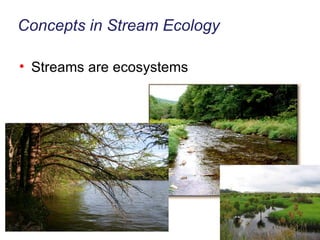
Concepts in Stream Ecology Streams are ecosystems
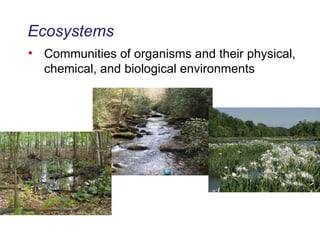
Communities of organisms and their physical, chemical, and biological environments Ecosystems
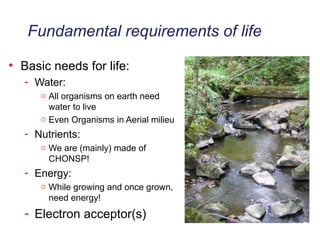
Basic needs for life: Water: All organisms on earth need water to live Even Organisms in Aerial milieu Nutrients: We are (mainly) made of CHONSP! Energy: While growing and once grown, need energy! Electron acceptor(s) Fundamental requirements of life
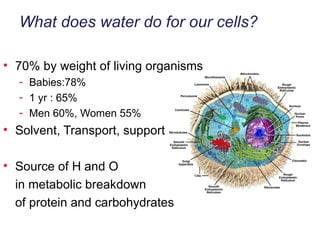
70% by weight of living organisms Babies:78% 1 yr : 65% Men 60%, Women 55% Solvent, Transport, support Source of H and O in metabolic breakdown  of protein and carbohydrates What does water do for our cells?
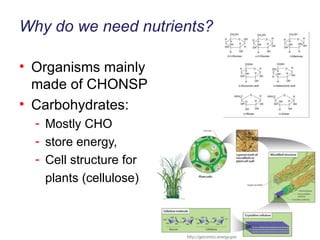
Why do we need nutrients? Organisms mainly made of CHONSP Carbohydrates: Mostly CHO store energy,  Cell structure for  plants (cellulose)
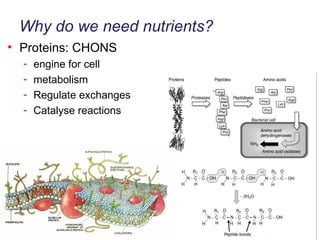
Why do we need nutrients? Proteins: CHONS engine for cell  metabolism Regulate exchanges Catalyse reactions
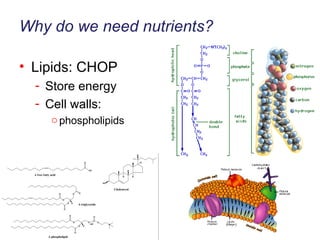
Why do we need nutrients? Lipids: CHOP Store energy Cell walls: phospholipids
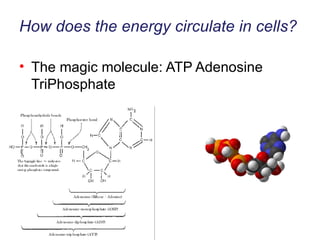
How does the energy circulate in cells? The magic molecule: ATP Adenosine TriPhosphate
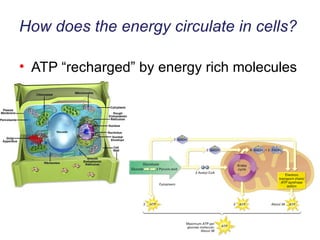
How does the energy circulate in cells? ATP “recharged” by energy rich molecules
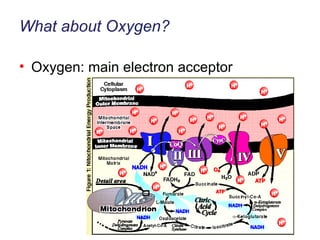
What about Oxygen? Oxygen: main electron acceptor
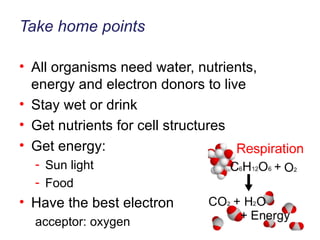
Take home points All organisms need water, nutrients, energy and electron donors to live Stay wet or drink Get nutrients for cell structures Get energy: Sun light Food Have the best electron acceptor: oxygen
 
Who lives in streams? Make a list of all organisms you can think that live in streams
Who lives in streams? Bacteria, virus Amoeba, rotifers Plants: Algae: microscopic and macroscopic Bryophytes (mosses)  Angiosperms (flowering plants) Fungi
Who lives in streams? Animals: Protozoa: Sponges (Bryozoa) Macroinvertebrates Acoelomate worms Planaria or flatworm (Turbellaria) Nematode or Threadworm, Horsehair worm (Nematoda) Mollusca Clams (Bivalva) Snails (Gasteropoda) Annelida Leeches (Hirudinea or Achaeta) Tubifex worm (Oligochaeta) Bristle worms (Polychaeta)
Who lives in streams? Animals: Macroinvertebrates (Cont’d) Arthropods: Spiders (Arachnida) Crayfish, Water flea (Crustacea) Stonefly, Mayflies, Caddisfly (Insects) Vertebrates: Vertebrates Lamprey (Agnatha) Fish (Osteichthyes) Frogs (Amphibians) Water snakes and turtles (Reptiles) Kingfisher, Dipper (Birds)  Otter, beaver (Mammals)
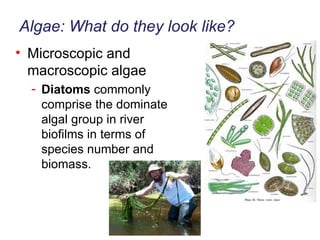
Algae: What do they look like? Microscopic and macroscopic algae Diatoms  commonly comprise the dominate algal group in river biofilms in terms of species number and biomass.
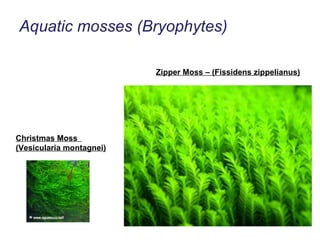
Aquatic mosses (Bryophytes) Christmas Moss  (Vesicularia montagnei) Zipper Moss – (Fissidens zippelianus)
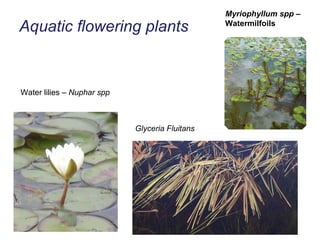
Aquatic flowering plants Myriophyllum spp –  Watermilfoils Water lilies –  Nuphar spp Glyceria Fluitans
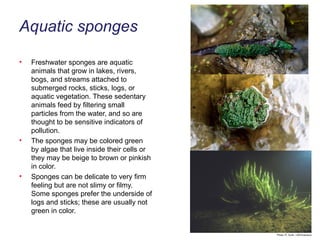
Aquatic sponges Freshwater sponges are aquatic animals that grow in lakes, rivers, bogs, and streams attached to submerged rocks, sticks, logs, or aquatic vegetation. These sedentary animals feed by filtering small particles from the water, and so are thought to be sensitive indicators of pollution. The sponges may be colored green by algae that live inside their cells or they may be beige to brown or pinkish in color.  Sponges can be delicate to very firm feeling but are not slimy or filmy. Some sponges prefer the underside of logs and sticks; these are usually not green in color.
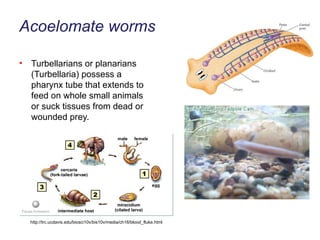
Acoelomate worms Turbellarians or planarians (Turbellaria) possess a pharynx tube that extends to feed on whole small animals or suck tissues from dead or wounded prey. http://trc.ucdavis.edu/biosci10v/bis10v/media/ch16/blood_fluke.html
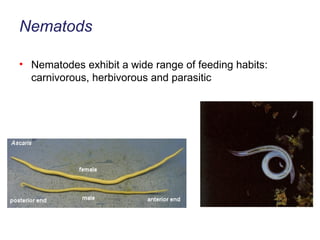
Nematods Nematodes exhibit a wide range of feeding habits: carnivorous, herbivorous and parasitic
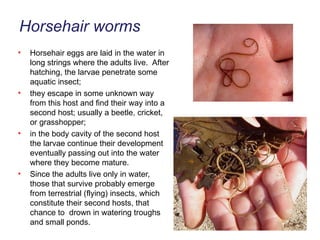
Horsehair worms Horsehair eggs are laid in the water in long strings where the adults live.  After hatching, the larvae penetrate some aquatic insect;  they escape in some unknown way from this host and find their way into a second host; usually a beetle, cricket, or grasshopper;  in the body cavity of the second host the larvae continue their development eventually passing out into the water where they become mature.   Since the adults live only in water, those that survive probably emerge from terrestrial (flying) insects, which constitute their second hosts, that chance to  drown in watering troughs and small ponds.
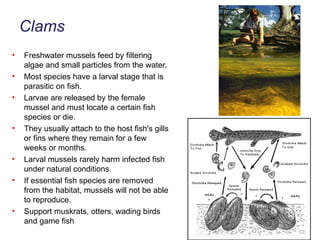
Clams Freshwater mussels feed by filtering algae and small particles from the water.  Most species have a larval stage that is parasitic on fish.  Larvae are released by the female mussel and must locate a certain fish species or die.  They usually attach to the host fish's gills or fins where they remain for a few weeks or months.  Larval mussels rarely harm infected fish under natural conditions.  If essential fish species are removed from the habitat, mussels will not be able to reproduce. Support muskrats, otters, wading birds and game fish
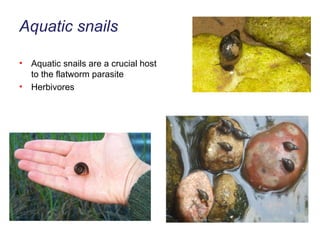
Aquatic snails Aquatic snails are a crucial host to the flatworm parasite Herbivores
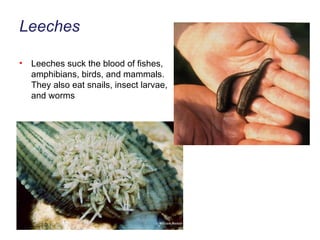
Leeches Leeches suck the blood of fishes, amphibians, birds, and mammals. They also eat snails, insect larvae, and worms
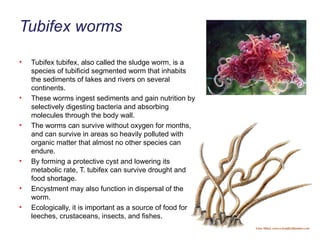
Tubifex worms Tubifex tubifex, also called the sludge worm, is a species of tubificid segmented worm that inhabits the sediments of lakes and rivers on several continents.  These worms ingest sediments and gain nutrition by selectively digesting bacteria and absorbing molecules through the body wall.  The worms can survive without oxygen for months, and can survive in areas so heavily polluted with organic matter that almost no other species can endure.  By forming a protective cyst and lowering its metabolic rate, T. tubifex can survive drought and food shortage.  Encystment may also function in dispersal of the worm.  Ecologically, it is important as a source of food for leeches, crustaceans, insects, and fishes.
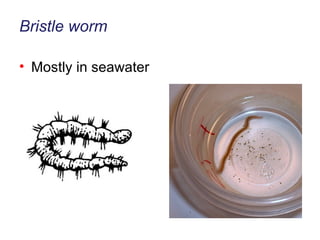
Bristle worm Mostly in seawater
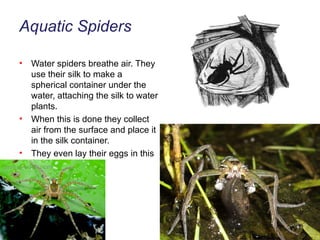
Aquatic Spiders Water spiders breathe air. They use their silk to make a spherical container under the water, attaching the silk to water plants.  When this is done they collect air from the surface and place it in the silk container.  They even lay their eggs in this trapped air bubble
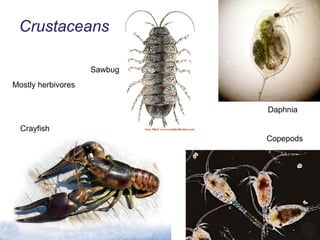
Crustaceans Sawbug Crayfish Daphnia Copepods Mostly herbivores
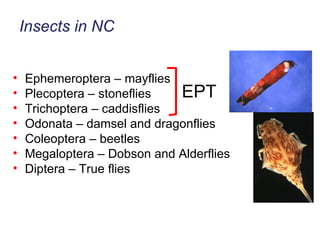
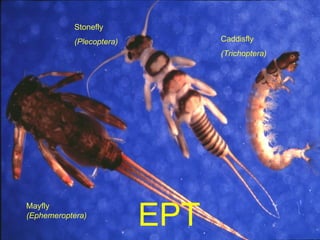
Insects in NC Ephemeroptera – mayflies Plecoptera – stoneflies Trichoptera – caddisflies Odonata – damsel and dragonflies Coleoptera – beetles Megaloptera – Dobson and Alderflies Diptera – True flies EPT
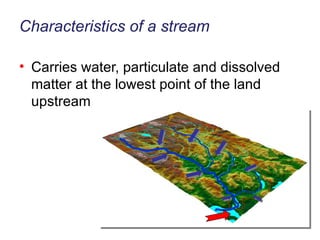
Characteristics of a stream Carries water, particulate and dissolved matter at the lowest point of the land upstream
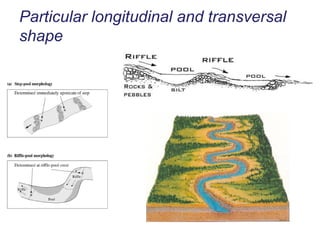
Particular longitudinal and transversal shape
Highly variable parameters of the ecosystem Viscous milieu Velocity and weight of water create momentum and shear stress at the sediment water interface High variability Velocity, momentum and shear stress Transport of bedload  Turbidity and particulate matter Nutrient and oxygen concentrations
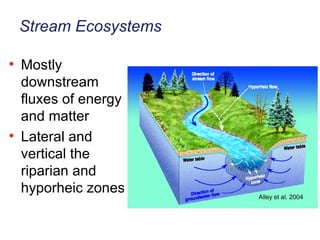
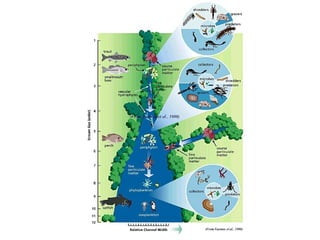
Stream Ecosystems Mostly downstream fluxes of energy and matter Lateral and vertical the riparian and hyporheic zones
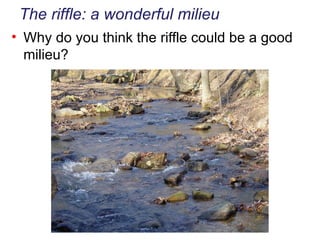
Why do you think the riffle could be a good milieu? The riffle: a wonderful milieu
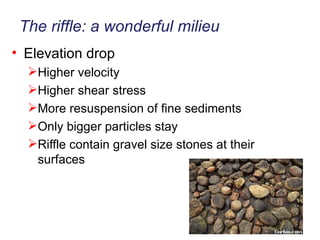
The riffle: a wonderful milieu Elevation drop Higher velocity Higher shear stress More resuspension of fine sediments Only bigger particles stay Riffle contain gravel size stones at their surfaces
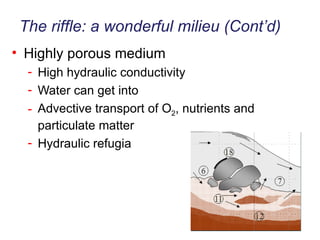
The riffle: a wonderful milieu (Cont’d) Highly porous medium High hydraulic conductivity Water can get into Advective transport of O 2 , nutrients and particulate matter Hydraulic refugia
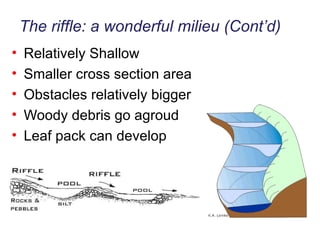
The riffle: a wonderful milieu (Cont’d) Relatively Shallow  Smaller cross section area Obstacles relatively bigger Woody debris go agroud Leaf pack can develop
How do all organisms find their requirements for life in streams? Water? Source of nutrients? Source of energy? Source of electron donor (oxygen)?
 
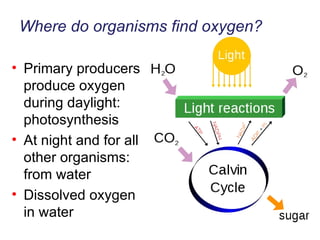
Where do organisms find oxygen? Primary producers produce oxygen during daylight: photosynthesis At night and for all other organisms: from water Dissolved oxygen in water
Sources and sinks of oxygen in water Sources: Photosynthesis from autotrophs Reaeration at the interface between water and atmosphere
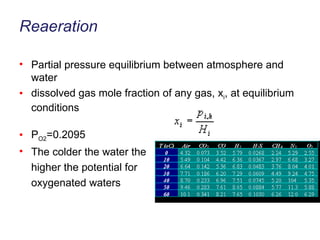
Reaeration Partial pressure equilibrium between atmosphere and water  dissolved gas mole fraction of any gas, x i , at equilibrium conditions P O2 =0.2095 The colder the water the  higher the potential for oxygenated waters
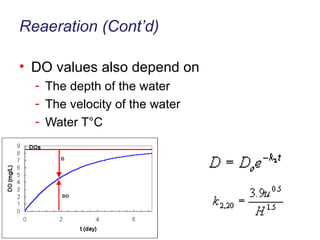
Reaeration (Cont’d) DO values also depend on  The depth of the water The velocity of the water Water T °C
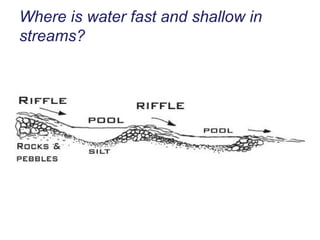
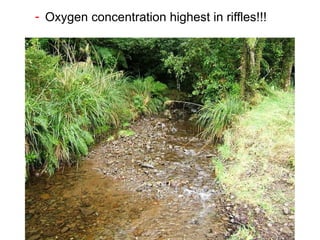
Where is water fast and shallow in streams?
Oxygen concentration highest in riffles!!!
Can oxygen be a problem? Oxygen content in streams and sediment driven by the ratio between supply and demand. All organisms from bacteria to fish respire and consume oxygen In sediment oxygen can be all consumed: anoxia Oxygen: major driver of stream habitat and biogeochemical processes
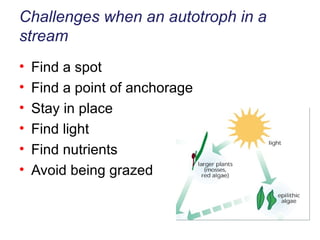
Challenges when an autotroph in a stream Find a spot Find a point of anchorage Stay in place Find light Find nutrients Avoid being grazed
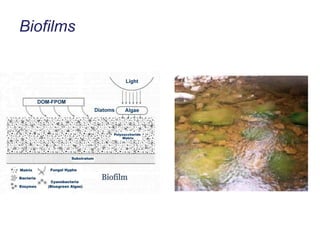
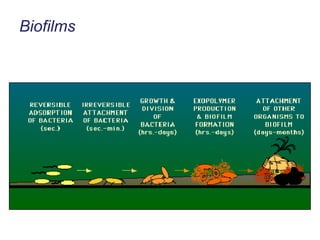
Biofilms
Biofilms
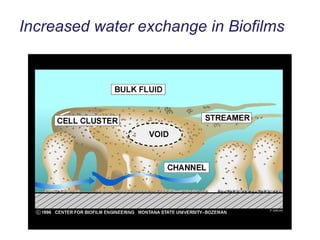
Increased water exchange in Biofilms
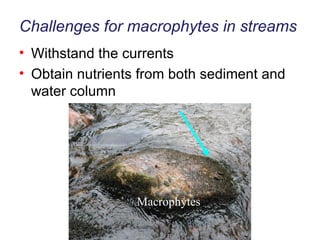
Challenges for macrophytes in streams Withstand the currents Obtain nutrients from both sediment and water column
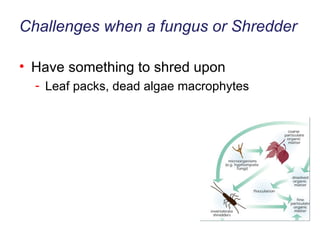
Challenges when a fungus or Shredder Have something to shred upon Leaf packs, dead algae macrophytes
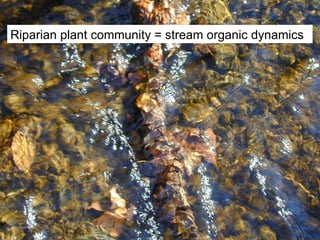
Riparian plant community = stream organic dynamics
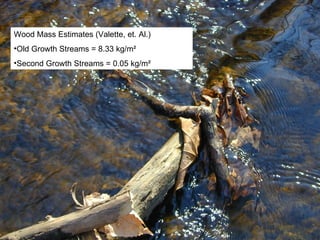
Wood Mass Estimates (Valette, et. Al.) Old Growth Streams = 8.33 kg/m ² Second Growth Streams = 0.05 kg/m²
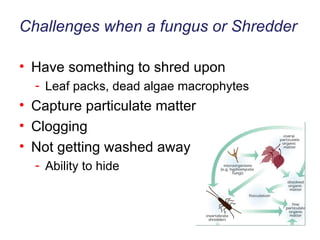
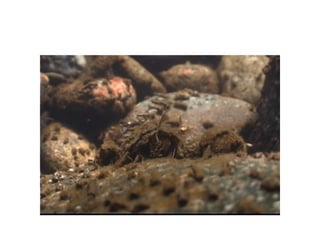
Challenges when a fungus or Shredder Have something to shred upon Leaf packs, dead algae macrophytes Capture particulate matter Clogging Not getting washed away Ability to hide
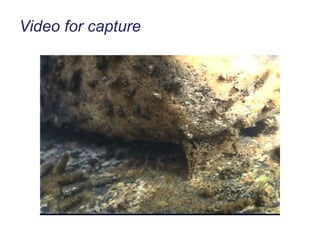
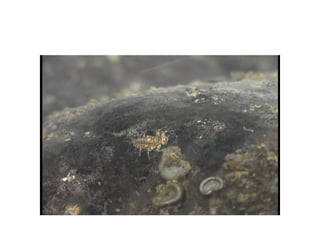
Video for capture
 
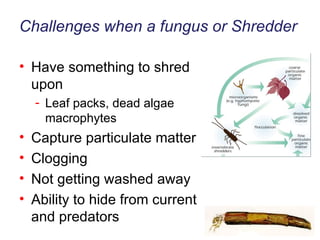
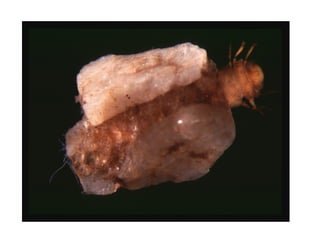
Challenges when a fungus or Shredder Have something to shred upon Leaf packs, dead algae macrophytes Capture particulate matter Clogging Not getting washed away Ability to hide from current and predators
 
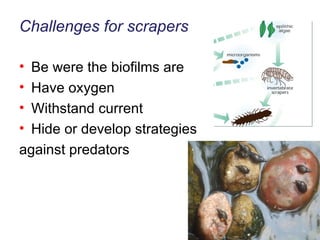
Challenges for scrapers  Be were the biofilms are Have oxygen Withstand current Hide or develop strategies against predators
 
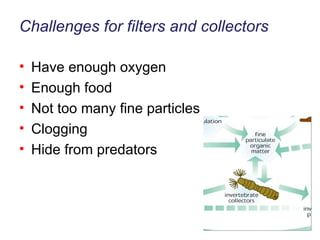
Challenges for filters and collectors Have enough oxygen Enough food Not too many fine particles Clogging Hide from predators
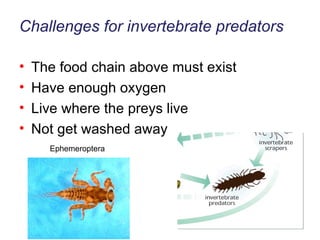
Challenges for invertebrate predators The food chain above must exist Have enough oxygen Live where the preys live Not get washed away Ephemeroptera
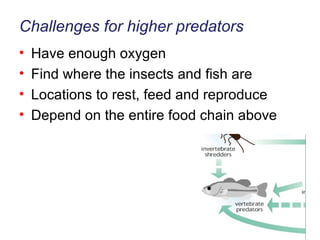
Challenges for higher predators Have enough oxygen Find where the insects and fish are Locations to rest, feed and reproduce Depend on the entire food chain above
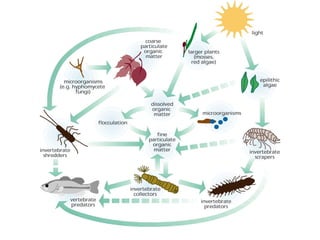
Take home points: Where does energy come from? Light for the autotrophs (autochtonous origin) For most organisms: Dead organic matter Crucial importance of Fine Particulate Organic Matter (FPOM)
Why would anyone want to live in a riffle?
Why would anyone want to live in a riffle? Autotrophs More light More renewal of nutrients Heterotrophs More oxygen in water and sediment Smaller cross section area thus higher probability of capturing food for the same volume scanned Higher chance for obstacle for leaf packs Woody debris essential as physical barriers
Take home points: Why would anyone want to live in a pool? Autotrophs Less shear stress Soft sediment for roots and for nutrient supply Heterotrophs Less shear stress (herbivores) Soft sediment for habitat (Bivalva) Fine particulates for detritivores
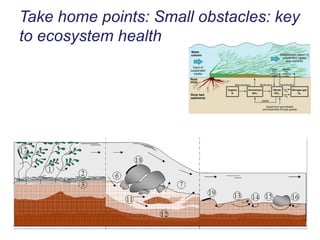
Take home points: Small obstacles: key to ecosystem health
Biological indicators of good health Mayfly  (Ephemeroptera) Stonefly (Plecoptera) Caddisfly (Trichoptera) EPT
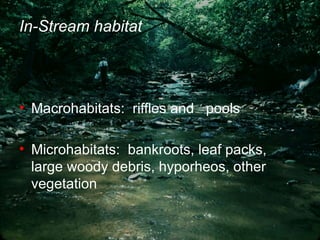
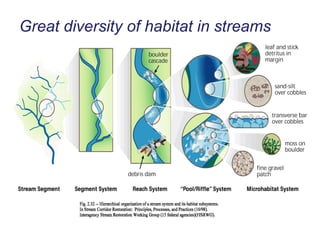
In-Stream habitat Macrohabitats:  riffles and  pools Microhabitats:  bankroots, leaf packs, large woody debris, hyporheos, other vegetation
Great diversity of habitat in streams
 
Can search for nutrient, energy, oxygen be altered? Eutrophication Turbidity of water, erosion and increased bedload No woody debris No habitat for the whole food chain
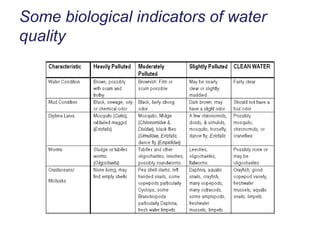
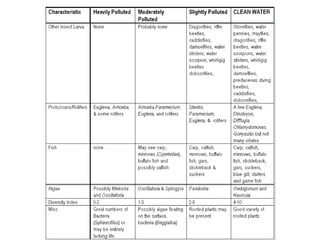
Some biological indicators of water quality
 

Bae 495r Stream Ecology

  • 1.
    Concepts in StreamEcology Streams are ecosystems
  • 2.
    Communities of organismsand their physical, chemical, and biological environments Ecosystems
  • 3.
    Basic needs forlife: Water: All organisms on earth need water to live Even Organisms in Aerial milieu Nutrients: We are (mainly) made of CHONSP! Energy: While growing and once grown, need energy! Electron acceptor(s) Fundamental requirements of life
  • 4.
    70% by weightof living organisms Babies:78% 1 yr : 65% Men 60%, Women 55% Solvent, Transport, support Source of H and O in metabolic breakdown of protein and carbohydrates What does water do for our cells?
  • 5.
    Why do weneed nutrients? Organisms mainly made of CHONSP Carbohydrates: Mostly CHO store energy, Cell structure for plants (cellulose)
  • 6.
    Why do weneed nutrients? Proteins: CHONS engine for cell metabolism Regulate exchanges Catalyse reactions
  • 7.
    Why do weneed nutrients? Lipids: CHOP Store energy Cell walls: phospholipids
  • 8.
    How does theenergy circulate in cells? The magic molecule: ATP Adenosine TriPhosphate
  • 9.
    How does theenergy circulate in cells? ATP “recharged” by energy rich molecules
  • 10.
    What about Oxygen?Oxygen: main electron acceptor
  • 11.
    Take home pointsAll organisms need water, nutrients, energy and electron donors to live Stay wet or drink Get nutrients for cell structures Get energy: Sun light Food Have the best electron acceptor: oxygen
  • 12.
  • 13.
    Who lives instreams? Make a list of all organisms you can think that live in streams
  • 14.
    Who lives instreams? Bacteria, virus Amoeba, rotifers Plants: Algae: microscopic and macroscopic Bryophytes (mosses) Angiosperms (flowering plants) Fungi
  • 15.
    Who lives instreams? Animals: Protozoa: Sponges (Bryozoa) Macroinvertebrates Acoelomate worms Planaria or flatworm (Turbellaria) Nematode or Threadworm, Horsehair worm (Nematoda) Mollusca Clams (Bivalva) Snails (Gasteropoda) Annelida Leeches (Hirudinea or Achaeta) Tubifex worm (Oligochaeta) Bristle worms (Polychaeta)
  • 16.
    Who lives instreams? Animals: Macroinvertebrates (Cont’d) Arthropods: Spiders (Arachnida) Crayfish, Water flea (Crustacea) Stonefly, Mayflies, Caddisfly (Insects) Vertebrates: Vertebrates Lamprey (Agnatha) Fish (Osteichthyes) Frogs (Amphibians) Water snakes and turtles (Reptiles) Kingfisher, Dipper (Birds) Otter, beaver (Mammals)
  • 17.
    Algae: What dothey look like? Microscopic and macroscopic algae Diatoms commonly comprise the dominate algal group in river biofilms in terms of species number and biomass.
  • 18.
    Aquatic mosses (Bryophytes)Christmas Moss (Vesicularia montagnei) Zipper Moss – (Fissidens zippelianus)
  • 19.
    Aquatic flowering plantsMyriophyllum spp – Watermilfoils Water lilies – Nuphar spp Glyceria Fluitans
  • 20.
    Aquatic sponges Freshwatersponges are aquatic animals that grow in lakes, rivers, bogs, and streams attached to submerged rocks, sticks, logs, or aquatic vegetation. These sedentary animals feed by filtering small particles from the water, and so are thought to be sensitive indicators of pollution. The sponges may be colored green by algae that live inside their cells or they may be beige to brown or pinkish in color. Sponges can be delicate to very firm feeling but are not slimy or filmy. Some sponges prefer the underside of logs and sticks; these are usually not green in color.
  • 21.
    Acoelomate worms Turbellariansor planarians (Turbellaria) possess a pharynx tube that extends to feed on whole small animals or suck tissues from dead or wounded prey. http://trc.ucdavis.edu/biosci10v/bis10v/media/ch16/blood_fluke.html
  • 22.
    Nematods Nematodes exhibita wide range of feeding habits: carnivorous, herbivorous and parasitic
  • 23.
    Horsehair worms Horsehaireggs are laid in the water in long strings where the adults live.  After hatching, the larvae penetrate some aquatic insect; they escape in some unknown way from this host and find their way into a second host; usually a beetle, cricket, or grasshopper; in the body cavity of the second host the larvae continue their development eventually passing out into the water where they become mature.  Since the adults live only in water, those that survive probably emerge from terrestrial (flying) insects, which constitute their second hosts, that chance to  drown in watering troughs and small ponds.
  • 24.
    Clams Freshwater musselsfeed by filtering algae and small particles from the water. Most species have a larval stage that is parasitic on fish. Larvae are released by the female mussel and must locate a certain fish species or die. They usually attach to the host fish's gills or fins where they remain for a few weeks or months. Larval mussels rarely harm infected fish under natural conditions. If essential fish species are removed from the habitat, mussels will not be able to reproduce. Support muskrats, otters, wading birds and game fish
  • 25.
    Aquatic snails Aquaticsnails are a crucial host to the flatworm parasite Herbivores
  • 26.
    Leeches Leeches suckthe blood of fishes, amphibians, birds, and mammals. They also eat snails, insect larvae, and worms
  • 27.
    Tubifex worms Tubifextubifex, also called the sludge worm, is a species of tubificid segmented worm that inhabits the sediments of lakes and rivers on several continents. These worms ingest sediments and gain nutrition by selectively digesting bacteria and absorbing molecules through the body wall. The worms can survive without oxygen for months, and can survive in areas so heavily polluted with organic matter that almost no other species can endure. By forming a protective cyst and lowering its metabolic rate, T. tubifex can survive drought and food shortage. Encystment may also function in dispersal of the worm. Ecologically, it is important as a source of food for leeches, crustaceans, insects, and fishes.
  • 28.
  • 29.
    Aquatic Spiders Waterspiders breathe air. They use their silk to make a spherical container under the water, attaching the silk to water plants. When this is done they collect air from the surface and place it in the silk container. They even lay their eggs in this trapped air bubble
  • 30.
    Crustaceans Sawbug CrayfishDaphnia Copepods Mostly herbivores
  • 31.
    Insects in NCEphemeroptera – mayflies Plecoptera – stoneflies Trichoptera – caddisflies Odonata – damsel and dragonflies Coleoptera – beetles Megaloptera – Dobson and Alderflies Diptera – True flies EPT
  • 32.
    Characteristics of astream Carries water, particulate and dissolved matter at the lowest point of the land upstream
  • 33.
    Particular longitudinal andtransversal shape
  • 34.
    Highly variable parametersof the ecosystem Viscous milieu Velocity and weight of water create momentum and shear stress at the sediment water interface High variability Velocity, momentum and shear stress Transport of bedload Turbidity and particulate matter Nutrient and oxygen concentrations
  • 35.
    Stream Ecosystems Mostlydownstream fluxes of energy and matter Lateral and vertical the riparian and hyporheic zones
  • 36.
    Why do youthink the riffle could be a good milieu? The riffle: a wonderful milieu
  • 37.
    The riffle: awonderful milieu Elevation drop Higher velocity Higher shear stress More resuspension of fine sediments Only bigger particles stay Riffle contain gravel size stones at their surfaces
  • 38.
    The riffle: awonderful milieu (Cont’d) Highly porous medium High hydraulic conductivity Water can get into Advective transport of O 2 , nutrients and particulate matter Hydraulic refugia
  • 39.
    The riffle: awonderful milieu (Cont’d) Relatively Shallow Smaller cross section area Obstacles relatively bigger Woody debris go agroud Leaf pack can develop
  • 40.
    How do allorganisms find their requirements for life in streams? Water? Source of nutrients? Source of energy? Source of electron donor (oxygen)?
  • 41.
  • 42.
    Where do organismsfind oxygen? Primary producers produce oxygen during daylight: photosynthesis At night and for all other organisms: from water Dissolved oxygen in water
  • 43.
    Sources and sinksof oxygen in water Sources: Photosynthesis from autotrophs Reaeration at the interface between water and atmosphere
  • 44.
    Reaeration Partial pressureequilibrium between atmosphere and water dissolved gas mole fraction of any gas, x i , at equilibrium conditions P O2 =0.2095 The colder the water the higher the potential for oxygenated waters
  • 45.
    Reaeration (Cont’d) DOvalues also depend on The depth of the water The velocity of the water Water T °C
  • 46.
    Where is waterfast and shallow in streams?
  • 47.
  • 48.
    Can oxygen bea problem? Oxygen content in streams and sediment driven by the ratio between supply and demand. All organisms from bacteria to fish respire and consume oxygen In sediment oxygen can be all consumed: anoxia Oxygen: major driver of stream habitat and biogeochemical processes
  • 49.
    Challenges when anautotroph in a stream Find a spot Find a point of anchorage Stay in place Find light Find nutrients Avoid being grazed
  • 50.
  • 51.
  • 52.
  • 53.
    Challenges for macrophytesin streams Withstand the currents Obtain nutrients from both sediment and water column
  • 54.
    Challenges when afungus or Shredder Have something to shred upon Leaf packs, dead algae macrophytes
  • 55.
    Riparian plant community= stream organic dynamics
  • 56.
    Wood Mass Estimates(Valette, et. Al.) Old Growth Streams = 8.33 kg/m ² Second Growth Streams = 0.05 kg/m²
  • 57.
    Challenges when afungus or Shredder Have something to shred upon Leaf packs, dead algae macrophytes Capture particulate matter Clogging Not getting washed away Ability to hide
  • 58.
  • 59.
  • 60.
    Challenges when afungus or Shredder Have something to shred upon Leaf packs, dead algae macrophytes Capture particulate matter Clogging Not getting washed away Ability to hide from current and predators
  • 61.
  • 62.
    Challenges for scrapers Be were the biofilms are Have oxygen Withstand current Hide or develop strategies against predators
  • 63.
  • 64.
    Challenges for filtersand collectors Have enough oxygen Enough food Not too many fine particles Clogging Hide from predators
  • 65.
    Challenges for invertebratepredators The food chain above must exist Have enough oxygen Live where the preys live Not get washed away Ephemeroptera
  • 66.
    Challenges for higherpredators Have enough oxygen Find where the insects and fish are Locations to rest, feed and reproduce Depend on the entire food chain above
  • 67.
    Take home points:Where does energy come from? Light for the autotrophs (autochtonous origin) For most organisms: Dead organic matter Crucial importance of Fine Particulate Organic Matter (FPOM)
  • 68.
    Why would anyonewant to live in a riffle?
  • 69.
    Why would anyonewant to live in a riffle? Autotrophs More light More renewal of nutrients Heterotrophs More oxygen in water and sediment Smaller cross section area thus higher probability of capturing food for the same volume scanned Higher chance for obstacle for leaf packs Woody debris essential as physical barriers
  • 70.
    Take home points:Why would anyone want to live in a pool? Autotrophs Less shear stress Soft sediment for roots and for nutrient supply Heterotrophs Less shear stress (herbivores) Soft sediment for habitat (Bivalva) Fine particulates for detritivores
  • 71.
    Take home points:Small obstacles: key to ecosystem health
  • 72.
    Biological indicators ofgood health Mayfly (Ephemeroptera) Stonefly (Plecoptera) Caddisfly (Trichoptera) EPT
  • 73.
    In-Stream habitat Macrohabitats: riffles and pools Microhabitats: bankroots, leaf packs, large woody debris, hyporheos, other vegetation
  • 74.
    Great diversity ofhabitat in streams
  • 75.
  • 76.
    Can search fornutrient, energy, oxygen be altered? Eutrophication Turbidity of water, erosion and increased bedload No woody debris No habitat for the whole food chain
  • 77.
  • 78.