STRUCTURE OF
AQUATIC ECOSYSTEMS
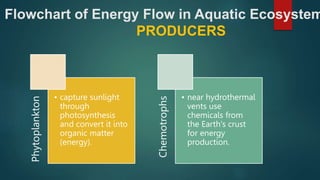
Flowchart of Energy Flow in Aquatic Ecosystem
PRODUCERS
Phytoplankton
• capture sunlight
through
photosynthesis
and convert it into
organic matter
(energy).
Chemotrophs
• near hydrothermal
vents use
chemicals from
the Earth's crust
for energy
production.
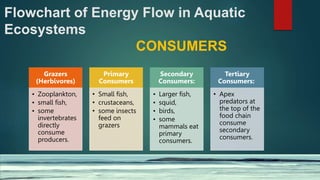
Flowchart of Energy Flow in Aquatic
Ecosystems
CONSUMERS
Grazers
(Herbivores)
• Zooplankton,
• small fish,
• some
invertebrates
directly
consume
producers.
Primary
Consumers
• Small fish,
• crustaceans,
• some insects
feed on
grazers
Secondary
Consumers:
• Larger fish,
• squid,
• birds,
• some
mammals eat
primary
consumers.
Tertiary
Consumers:
• Apex
predators at
the top of the
food chain
consume
secondary
consumers.
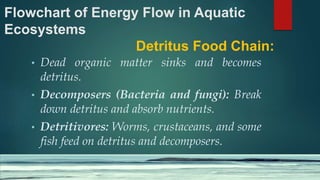
Flowchart of Energy Flow in Aquatic
Ecosystems
Detritus Food Chain:
• Dead organic matter sinks and becomes
detritus.
• Decomposers (Bacteria and fungi): Break
down detritus and absorb nutrients.
• Detritivores: Worms, crustaceans, and some
fish feed on detritus and decomposers.
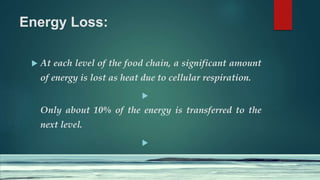
Energy Loss:
 At each level of the food chain, a significant amount
of energy is lost as heat due to cellular respiration.

Only about 10% of the energy is transferred to the
next level.

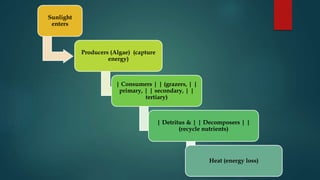
Sunlight
enters
Producers (Algae) (capture
energy)
| Consumers | | (grazers, | |
primary, | | secondary, | |
tertiary)
| Detritus & | | Decomposers | |
(recycle nutrients)
Heat (energy loss)
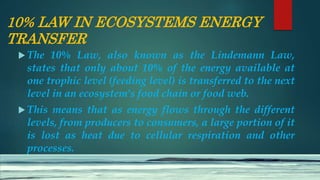
10% LAW IN ECOSYSTEMS ENERGY
TRANSFER
 The 10% Law, also known as the Lindemann Law,
states that only about 10% of the energy available at
one trophic level (feeding level) is transferred to the next
level in an ecosystem's food chain or food web.
 This means that as energy flows through the different
levels, from producers to consumers, a large portion of it
is lost as heat due to cellular respiration and other
processes.
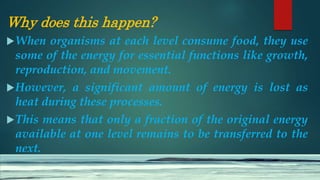
Why does this happen?
When organisms at each level consume food, they use
some of the energy for essential functions like growth,
reproduction, and movement.
However, a significant amount of energy is lost as
heat during these processes.
This means that only a fraction of the original energy
available at one level remains to be transferred to the
next.
Is it always exactly 10%?
No, the 10% is an average and the actual transfer efficiency
can vary depending on several factors, such as:
Type of ecosystem: Aquatic ecosystems tend to have lower
energy transfer efficiencies compared to terrestrial ones.
Organisms involved: Warm-blooded animals generally
have lower efficiencies than cold-blooded ones.
Food source: Different types of food have varying energy
content, affecting transfer efficiency.
What are the implications of the 10% Law?
Limits the number of trophic levels: With energy loss
at each level, food chains typically have a limited
number of levels, usually 3-5.
Importance of producers: As the base of the food chain,
producers play a crucial role in capturing and storing
energy that fuels the entire ecosystem.
Understanding ecosystem stability: The 10% Law
helps us understand why disturbances at lower levels
can have significant impacts on higher levels in the
food chain.
Flowchart of the Structure of a
Freshwater Ecosystem
 Abiotic Components:
• Water: Depth, flow rate, temperature, turbidity, pH, dissolved
oxygen, nutrients.
• Light: Penetration depth, availability for photosynthesis.
• Substrate: Bottom composition (rock, sand, mud, etc.),
topography.
• Temperature: Seasonal variations, stratification (layering) in
lakes.
Flowchart of the Structure of a
Freshwater Ecosystem
 Biotic Components:
• Producers:
• Phytoplankton: Microscopic algae forming the
base of the food web.
• Macrophytes: Rooted plants like reeds and lilies
providing habitat and food.
• Benthic algae: Algae attached to rocks or other
surfaces.
Flowchart of the Structure of a
Freshwater Ecosystem
 Biotic Components:
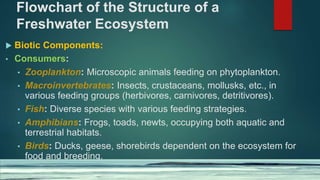
• Consumers:
• Zooplankton: Microscopic animals feeding on phytoplankton.
• Macroinvertebrates: Insects, crustaceans, mollusks, etc., in
various feeding groups (herbivores, carnivores, detritivores).
• Fish: Diverse species with various feeding strategies.
• Amphibians: Frogs, toads, newts, occupying both aquatic and
terrestrial habitats.
• Birds: Ducks, geese, shorebirds dependent on the ecosystem for
food and breeding.
Flowchart of the Structure of a
Freshwater Ecosystem
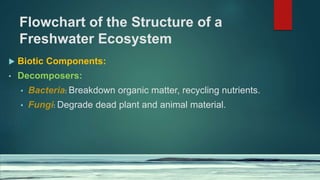
 Biotic Components:
• Decomposers:
• Bacteria: Breakdown organic matter, recycling nutrients.
• Fungi: Degrade dead plant and animal material.
Flowchart of the Structure of a
Freshwater Ecosystem
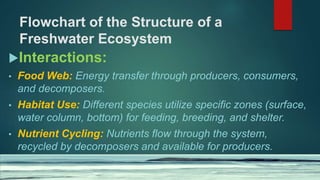
Interactions:
• Food Web: Energy transfer through producers, consumers,
and decomposers.
• Habitat Use: Different species utilize specific zones (surface,
water column, bottom) for feeding, breeding, and shelter.
• Nutrient Cycling: Nutrients flow through the system,
recycled by decomposers and available for producers.
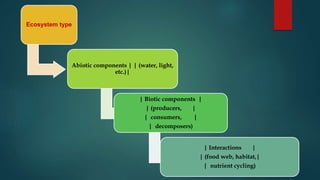
Ecosystem type
Abiotic components | | (water, light,
etc.)|
| Biotic components |
| (producers, |
| consumers, |
| decomposers)
| Interactions |
| (food web, habitat,|
| nutrient cycling)
STRUCTURE OF
MARINE ECOSYSTEMS
Flowchart of the Structure of a
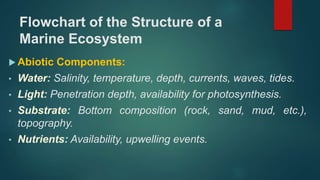
Marine Ecosystem
 Abiotic Components:
• Water: Salinity, temperature, depth, currents, waves, tides.
• Light: Penetration depth, availability for photosynthesis.
• Substrate: Bottom composition (rock, sand, mud, etc.),
topography.
• Nutrients: Availability, upwelling events.
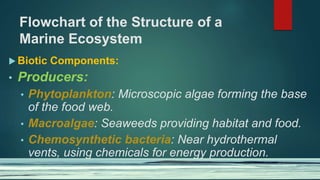
Flowchart of the Structure of a
Marine Ecosystem
 Biotic Components:
• Producers:
• Phytoplankton: Microscopic algae forming the base
of the food web.
• Macroalgae: Seaweeds providing habitat and food.
• Chemosynthetic bacteria: Near hydrothermal
vents, using chemicals for energy production.
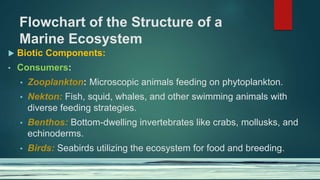
Flowchart of the Structure of a
Marine Ecosystem
 Biotic Components:
• Consumers:
• Zooplankton: Microscopic animals feeding on phytoplankton.
• Nekton: Fish, squid, whales, and other swimming animals with
diverse feeding strategies.
• Benthos: Bottom-dwelling invertebrates like crabs, mollusks, and
echinoderms.
• Birds: Seabirds utilizing the ecosystem for food and breeding.
Flowchart of the Structure of a
Marine Ecosystem
 Biotic Components:
• Decomposers:
• Bacteria: Breakdown organic matter, recycling nutrients.
• Scavengers: Crabs, shrimp, and other animals feeding on dead
organisms.
Flowchart of the Structure of a
Freshwater Ecosystem
Interactions:
• Food Web: Energy transfer through producers, consumers, and
decomposers.
• Habitat Use: Different species utilize specific zones (surface,
water column, bottom) for feeding, breeding, and shelter.
• Nutrient Cycling: Nutrients flow through the system, recycled by
decomposers and bacteria, and replenished by upwelling events.
• Physical factors: Water temperature, salinity, currents, and tides
influence species distribution and abundance.
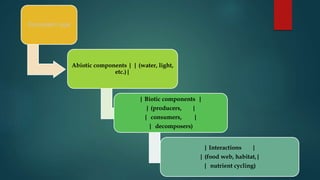
Ecosystem type
Abiotic components | | (water, light,
etc.)|
| Biotic components |
| (producers, |
| consumers, |
| decomposers)
| Interactions |
| (food web, habitat,|
| nutrient cycling)
STRUCTURE OF AQUATIC ecosystems: structure, components and functioning

STRUCTURE OF AQUATIC ecosystems: structure, components and functioning

  • 1.
  • 2.
    Flowchart of EnergyFlow in Aquatic Ecosystem PRODUCERS Phytoplankton • capture sunlight through photosynthesis and convert it into organic matter (energy). Chemotrophs • near hydrothermal vents use chemicals from the Earth's crust for energy production.
  • 3.
    Flowchart of EnergyFlow in Aquatic Ecosystems CONSUMERS Grazers (Herbivores) • Zooplankton, • small fish, • some invertebrates directly consume producers. Primary Consumers • Small fish, • crustaceans, • some insects feed on grazers Secondary Consumers: • Larger fish, • squid, • birds, • some mammals eat primary consumers. Tertiary Consumers: • Apex predators at the top of the food chain consume secondary consumers.
  • 4.
    Flowchart of EnergyFlow in Aquatic Ecosystems Detritus Food Chain: • Dead organic matter sinks and becomes detritus. • Decomposers (Bacteria and fungi): Break down detritus and absorb nutrients. • Detritivores: Worms, crustaceans, and some fish feed on detritus and decomposers.
  • 5.
    Energy Loss:  Ateach level of the food chain, a significant amount of energy is lost as heat due to cellular respiration.  Only about 10% of the energy is transferred to the next level. 
  • 6.
    Sunlight enters Producers (Algae) (capture energy) |Consumers | | (grazers, | | primary, | | secondary, | | tertiary) | Detritus & | | Decomposers | | (recycle nutrients) Heat (energy loss)
  • 7.
    10% LAW INECOSYSTEMS ENERGY TRANSFER  The 10% Law, also known as the Lindemann Law, states that only about 10% of the energy available at one trophic level (feeding level) is transferred to the next level in an ecosystem's food chain or food web.  This means that as energy flows through the different levels, from producers to consumers, a large portion of it is lost as heat due to cellular respiration and other processes.
  • 8.
    Why does thishappen? When organisms at each level consume food, they use some of the energy for essential functions like growth, reproduction, and movement. However, a significant amount of energy is lost as heat during these processes. This means that only a fraction of the original energy available at one level remains to be transferred to the next.
  • 9.
    Is it alwaysexactly 10%? No, the 10% is an average and the actual transfer efficiency can vary depending on several factors, such as: Type of ecosystem: Aquatic ecosystems tend to have lower energy transfer efficiencies compared to terrestrial ones. Organisms involved: Warm-blooded animals generally have lower efficiencies than cold-blooded ones. Food source: Different types of food have varying energy content, affecting transfer efficiency.
  • 10.
    What are theimplications of the 10% Law? Limits the number of trophic levels: With energy loss at each level, food chains typically have a limited number of levels, usually 3-5. Importance of producers: As the base of the food chain, producers play a crucial role in capturing and storing energy that fuels the entire ecosystem. Understanding ecosystem stability: The 10% Law helps us understand why disturbances at lower levels can have significant impacts on higher levels in the food chain.
  • 11.
    Flowchart of theStructure of a Freshwater Ecosystem  Abiotic Components: • Water: Depth, flow rate, temperature, turbidity, pH, dissolved oxygen, nutrients. • Light: Penetration depth, availability for photosynthesis. • Substrate: Bottom composition (rock, sand, mud, etc.), topography. • Temperature: Seasonal variations, stratification (layering) in lakes.
  • 12.
    Flowchart of theStructure of a Freshwater Ecosystem  Biotic Components: • Producers: • Phytoplankton: Microscopic algae forming the base of the food web. • Macrophytes: Rooted plants like reeds and lilies providing habitat and food. • Benthic algae: Algae attached to rocks or other surfaces.
  • 13.
    Flowchart of theStructure of a Freshwater Ecosystem  Biotic Components: • Consumers: • Zooplankton: Microscopic animals feeding on phytoplankton. • Macroinvertebrates: Insects, crustaceans, mollusks, etc., in various feeding groups (herbivores, carnivores, detritivores). • Fish: Diverse species with various feeding strategies. • Amphibians: Frogs, toads, newts, occupying both aquatic and terrestrial habitats. • Birds: Ducks, geese, shorebirds dependent on the ecosystem for food and breeding.
  • 14.
    Flowchart of theStructure of a Freshwater Ecosystem  Biotic Components: • Decomposers: • Bacteria: Breakdown organic matter, recycling nutrients. • Fungi: Degrade dead plant and animal material.
  • 15.
    Flowchart of theStructure of a Freshwater Ecosystem Interactions: • Food Web: Energy transfer through producers, consumers, and decomposers. • Habitat Use: Different species utilize specific zones (surface, water column, bottom) for feeding, breeding, and shelter. • Nutrient Cycling: Nutrients flow through the system, recycled by decomposers and available for producers.
  • 16.
    Ecosystem type Abiotic components| | (water, light, etc.)| | Biotic components | | (producers, | | consumers, | | decomposers) | Interactions | | (food web, habitat,| | nutrient cycling)
  • 17.
  • 18.
    Flowchart of theStructure of a Marine Ecosystem  Abiotic Components: • Water: Salinity, temperature, depth, currents, waves, tides. • Light: Penetration depth, availability for photosynthesis. • Substrate: Bottom composition (rock, sand, mud, etc.), topography. • Nutrients: Availability, upwelling events.
  • 19.
    Flowchart of theStructure of a Marine Ecosystem  Biotic Components: • Producers: • Phytoplankton: Microscopic algae forming the base of the food web. • Macroalgae: Seaweeds providing habitat and food. • Chemosynthetic bacteria: Near hydrothermal vents, using chemicals for energy production.
  • 20.
    Flowchart of theStructure of a Marine Ecosystem  Biotic Components: • Consumers: • Zooplankton: Microscopic animals feeding on phytoplankton. • Nekton: Fish, squid, whales, and other swimming animals with diverse feeding strategies. • Benthos: Bottom-dwelling invertebrates like crabs, mollusks, and echinoderms. • Birds: Seabirds utilizing the ecosystem for food and breeding.
  • 21.
    Flowchart of theStructure of a Marine Ecosystem  Biotic Components: • Decomposers: • Bacteria: Breakdown organic matter, recycling nutrients. • Scavengers: Crabs, shrimp, and other animals feeding on dead organisms.
  • 22.
    Flowchart of theStructure of a Freshwater Ecosystem Interactions: • Food Web: Energy transfer through producers, consumers, and decomposers. • Habitat Use: Different species utilize specific zones (surface, water column, bottom) for feeding, breeding, and shelter. • Nutrient Cycling: Nutrients flow through the system, recycled by decomposers and bacteria, and replenished by upwelling events. • Physical factors: Water temperature, salinity, currents, and tides influence species distribution and abundance.
  • 23.
    Ecosystem type Abiotic components| | (water, light, etc.)| | Biotic components | | (producers, | | consumers, | | decomposers) | Interactions | | (food web, habitat,| | nutrient cycling)