Institute of Asset Management.
The roles of financial modelling
and lifecycle planning in value-
based decision-making.
“People often challenge me about how they can convince their senior
management about asset management. To me the key is to talk their
language. For years, I have suggested that engineers learn and talk
money – the language of business…
Essentially I am talking about value in its many forms.
Identifying how to offer it and gain it. That’s the game we’re in.
So, try talking asset management in terms of outcomes and not the
widgets”
David McKeown CEO IAM
April 17 Newsletter
Agenda
1) Asset Valuation
2) The roles of financial modelling
3) Lifecycle / WLC planning
3) The essential metrics
“We need to learn to talk money”
“The word value… has two different meanings, [it] sometimes
expresses the utility of [something], and sometimes [the purchasing
power of it]. The one may be called "value in use;" the other, "value in
exchange." Adam Smith “Of the Origin and Use of Money”
We’re first going to need to understand what we mean by “Value”
“The regard that something is held to deserve, the importance, worth
or usefulness of something.” Oxford English Dictionary
“The total amount of money for which something can be exchanged in
a market” CIMA Dictionary of Finance and Accounting
Value
Most of us as proponents understand the usefulness (value in use) of our
suggested initiatives (be they asset investments or new methods of
working or entire major projects).
Value
 Can we always express this in terms of financial value (value in
exchange) in ways others can understand?
 Are we always offering the best value option?
 Can we explain why?
Cash Flow: “the movement through an organisation of money that is
generated by its own operations…
It is the money that a business actually receives from sales (the cash
inflow) and the money that it pays out (the cash outflow).”
CIMA Dictionary of Finance and Accounting
Cash Flows for Asset Valuation
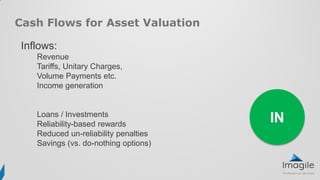
Inflows:
Revenue
Tariffs, Unitary Charges,
Volume Payments etc.
Income generation
Loans / Investments
Reliability-based rewards
Reduced un-reliability penalties
Savings (vs. do-nothing options)
IN
Cash Flows for Asset Valuation
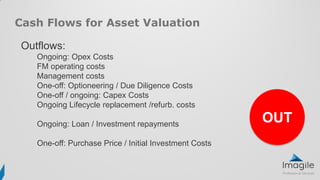
Outflows:
Ongoing: Opex Costs
FM operating costs
Management costs
One-off: Optioneering / Due Diligence Costs
One-off / ongoing: Capex Costs
Ongoing Lifecycle replacement /refurb. costs
Ongoing: Loan / Investment repayments
One-off: Purchase Price / Initial Investment Costs
OUT
Cash Flows for Asset Valuation
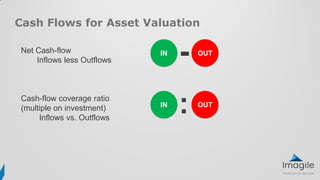
Net Cash-flow
Inflows less Outflows
Cash-flow coverage ratio
(multiple on investment)
Inflows vs. Outflows
:
-
Cash Flows for Asset Valuation
Cash Flow Statement
Fiscal year begins:
(Pre)
Startup JAN FEB MAR APR MAY JUN JUL AUG SEP OCT NOV DEC Total
05/01/2012 EST 05 05 05 05 05 05 05 05 05 05 05 05 ItemEST
Cash on Hand (beginning of month) 100 100 -125 45 -1 224 269 269 269 269 269 269 269 269
Cash Receipts
Cash Sales 125 120 130 100 475
Collections fm CR accounts 75 45 120
Loan/ other cash inj. 50 50 50 50 200
Total 0 175 170 180 225 45 0 0 0 0 0 0 0 795
Total Cash Available (before cash out) 100 275 45 225 224 269 269 269 269 269 269 269 269 1064
Cash Paid Out
Purchases (merchandise) 400 226 626
Purchases (specify) 0
Gross wages (exact withdrawal) 0
Payroll expenses (taxes, etc.) 0
Outside services 0
Supplies (office & oper.) 0
Repairs & maintenance 0
Advertising 0
Car, delivery & travel 0
Accounting & legal 0
Rent 0
Telephone 0
Utilities 0
Insurance 0
Taxes (real estate, etc.) 0
Interest 0
Other expenses (specify) 0
Other (specify) 0
Other (specify) 0
Miscellaneous 0
Total 0 400 0 226 0 0 0 0 0 0 0 0 0 626
Cash Paid Out (Non P&L)
Loan principal payment 0
Capital purchase (specify) 0
Other startup costs 0
Reserve and/or escrow 0
Owners' withdrawal 0
Total 0 0 0 0 0 0 0 0 0 0 0 0 0 0
Total Cash Paid Out 0 400 0 226 0 0 0 0 0 0 0 0 0 626
Cash Position (end of month) 100 -125 45 -1 224 269 269 269 269 269 269 269 269 438
“Financial modeling is the task of building an abstract representation
(a model) of a real world financial situation. This is a mathematical model
designed to represent (a simplified version of) the performance of a
financial asset or portfolio of a business, project, or any other
investment.”
Wikipedia, Financial Modeling Jun 17
Financial Modeling
Financial Modeling
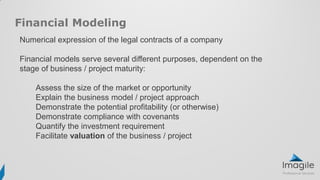
Numerical expression of the legal contracts of a company
Financial models serve several different purposes, dependent on the
stage of business / project maturity:
Assess the size of the market or opportunity
Explain the business model / project approach
Demonstrate the potential profitability (or otherwise)
Demonstrate compliance with covenants
Quantify the investment requirement
Facilitate valuation of the business / project
Financial Modeling
Financial models allow the representation and analysis of all elements of the
project or business cash-flows.
Facilitate assessment and sensitivity analysis to be performed evaluating
various “what-if” scenarios (options appraisals).
BUT a model is only a model and it needs feeding.
The accuracy of inputs determines the accuracy of the outcome.
Poor quality in = poor quality out.
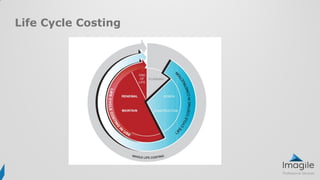
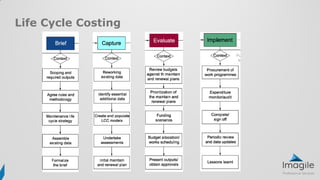
Life Cycle Costing is “[the] methodology for the systematic economic
evaluation of life cycle costs over a period of analysis, as defined in the
agreed scope. Life Cycle Costing can address a period of analysis that
covers the entire life cycle or (a) selected stage(s) or periods of interest
thereof.”
ISO 15686-5:2008, 3.1.8
Life Cycle Costing
Life Cycle Costing
Life Cycle Costing
Discounted Cash-flows:
Metrics, Methods & Misery Challenges
Discounted Cash Flow (“DCF”): “the discounting of the projected net
cash flows of a capital project to ascertain its present value.
DCF you may know as Capital Investment Appraisal:
“The application of a set of methodologies whose purpose is to give
guidance to managers with respect to decisions as to how best to
commit long-term investment funds.”
CIMA Dictionary of Finance and Accounting
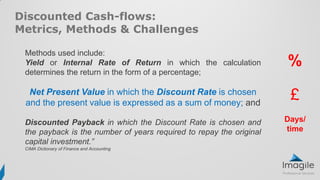
Methods used include:
Yield or Internal Rate of Return in which the calculation
determines the return in the form of a percentage;
Net Present Value in which the Discount Rate is chosen
and the present value is expressed as a sum of money; and
Discounted Payback in which the Discount Rate is chosen and
the payback is the number of years required to repay the original
capital investment.”
CIMA Dictionary of Finance and Accounting
Discounted Cash-flows:
Metrics, Methods & Challenges
%
£
Days/
time
Discounted Cash-flows:
Metrics, Methods & Challenges
TIME VALUE OF MONEY
“Measurement of the difference between future monies and the present
day value of monies [reflecting uncertainty]” BS 8544-2013
DISCOUNT RATES
Inflation
Weighted Average Cost of Capital
Expected / target returns (IRR*)
Risk appetite / premium
Discounted Cash-flows:
Metrics, Methods & Challenges
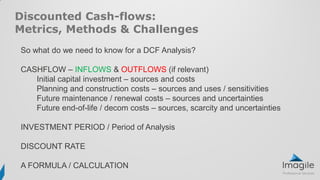
So what do we need to know for a DCF Analysis?
CASHFLOW – INFLOWS & OUTFLOWS (if relevant)
Initial capital investment – sources and costs
Planning and construction costs – sources and uses / sensitivities
Future maintenance / renewal costs – sources and uncertainties
Future end-of-life / decom costs – sources, scarcity and uncertainties
INVESTMENT PERIOD / Period of Analysis
DISCOUNT RATE
A FORMULA / CALCULATION
Discounted Cash-flows:
Metrics, Methods & Challenges
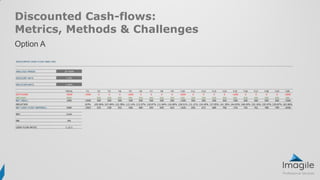
DISCOUNTED CASH-FLOW ANALYSIS
ANALYSIS PERIOD 20 YEAR
DISCOUNT RATE 7.5%
INFLATION RATE 2.50%
TOTAL Y1 Y2 Y3 Y4 Y5 Y6 Y7 Y8 Y9 Y10 Y11 Y12 Y13 Y14 Y15 Y16 Y17 Y18 Y19 Y20
OUTFLOWS -8500 -2500 0 0 0 -1000 0 0 0 0 -2000 0 0 0 0 -1000 0 0 0 0 -2000
INFLOWS 9500 500 500 500 500 500 500 500 500 500 500 500 500 500 500 500 500 500 500 500
NET (REAL) 1000 -2500 500 500 500 -500 500 500 500 500 -1500 500 500 500 500 -500 500 500 500 500 -1500
INFLATION 103% 105.06% 107.69% 110.38% 113.14% 115.97% 118.87% 121.84% 124.89% 128.01% 131.21% 134.49% 137.85% 141.30% 144.83% 148.45% 152.16% 155.97% 159.87% 163.86%
NET CASH-FLOW (NOMINAL) 1600 -2563 525 538 552 -566 580 594 609 624 -1920 656 672 689 706 -724 742 761 780 799 -2458
NPV £144
IRR 9%
CASH-FLOW RATIO 1.12:1
Option A
Discounted Cash-flows:
Metrics, Methods & Challenges
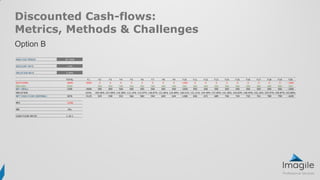
ANALYSIS PERIOD 20 YEAR
DISCOUNT RATE 7.5%
INFLATION RATE 2.50%
TOTAL Y1 Y2 Y3 Y4 Y5 Y6 Y7 Y8 Y9 Y10 Y11 Y12 Y13 Y14 Y15 Y16 Y17 Y18 Y19 Y20
OUTFLOWS -8000 -5000 0 0 0 0 0 0 0 0 -1500 0 0 0 0 0 0 0 0 0 -1500
INFLOWS 9500 500 500 500 500 500 500 500 500 500 500 500 500 500 500 500 500 500 500 500
NET (REAL) 1500 -5000 500 500 500 500 500 500 500 500 -1000 500 500 500 500 500 500 500 500 500 -1000
INFLATION 103% 105.06% 107.69% 110.38% 113.14% 115.97% 118.87% 121.84% 124.89% 128.01% 131.21% 134.49% 137.85% 141.30% 144.83% 148.45% 152.16% 155.97% 159.87% 163.86%
NET CASH-FLOW (NOMINAL) 3076 -5125 525 538 552 566 580 594 609 624 -1280 656 672 689 706 724 742 761 780 799 -1639
NPV -£458
IRR 6%
CASH-FLOW RATIO 1.19:1
Option B
Discounted Cash-flows:
Metrics, Methods & Challenges
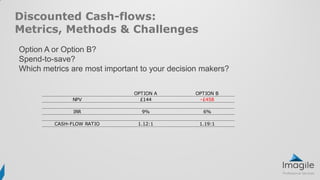
Option A or Option B?
Spend-to-save?
Which metrics are most important to your decision makers?
OPTION A OPTION B
NPV £144 -£458
IRR 9% 6%
CASH-FLOW RATIO 1.12:1 1.19:1
Questions

Stream C_Luke Body

  • 1.
    Institute of AssetManagement. The roles of financial modelling and lifecycle planning in value- based decision-making.
  • 2.
    “People often challengeme about how they can convince their senior management about asset management. To me the key is to talk their language. For years, I have suggested that engineers learn and talk money – the language of business…
  • 3.
    Essentially I amtalking about value in its many forms. Identifying how to offer it and gain it. That’s the game we’re in. So, try talking asset management in terms of outcomes and not the widgets” David McKeown CEO IAM April 17 Newsletter
  • 4.
    Agenda 1) Asset Valuation 2)The roles of financial modelling 3) Lifecycle / WLC planning 3) The essential metrics “We need to learn to talk money”
  • 5.
    “The word value…has two different meanings, [it] sometimes expresses the utility of [something], and sometimes [the purchasing power of it]. The one may be called "value in use;" the other, "value in exchange." Adam Smith “Of the Origin and Use of Money” We’re first going to need to understand what we mean by “Value” “The regard that something is held to deserve, the importance, worth or usefulness of something.” Oxford English Dictionary “The total amount of money for which something can be exchanged in a market” CIMA Dictionary of Finance and Accounting Value
  • 6.
    Most of usas proponents understand the usefulness (value in use) of our suggested initiatives (be they asset investments or new methods of working or entire major projects). Value  Can we always express this in terms of financial value (value in exchange) in ways others can understand?  Are we always offering the best value option?  Can we explain why?
  • 7.
    Cash Flow: “themovement through an organisation of money that is generated by its own operations… It is the money that a business actually receives from sales (the cash inflow) and the money that it pays out (the cash outflow).” CIMA Dictionary of Finance and Accounting Cash Flows for Asset Valuation
  • 8.
    Cash Flows forAsset Valuation Inflows: Revenue Tariffs, Unitary Charges, Volume Payments etc. Income generation Loans / Investments Reliability-based rewards Reduced un-reliability penalties Savings (vs. do-nothing options) IN
  • 9.
    Cash Flows forAsset Valuation Outflows: Ongoing: Opex Costs FM operating costs Management costs One-off: Optioneering / Due Diligence Costs One-off / ongoing: Capex Costs Ongoing Lifecycle replacement /refurb. costs Ongoing: Loan / Investment repayments One-off: Purchase Price / Initial Investment Costs OUT
  • 10.
    Cash Flows forAsset Valuation Net Cash-flow Inflows less Outflows Cash-flow coverage ratio (multiple on investment) Inflows vs. Outflows : -
  • 11.
    Cash Flows forAsset Valuation Cash Flow Statement Fiscal year begins: (Pre) Startup JAN FEB MAR APR MAY JUN JUL AUG SEP OCT NOV DEC Total 05/01/2012 EST 05 05 05 05 05 05 05 05 05 05 05 05 ItemEST Cash on Hand (beginning of month) 100 100 -125 45 -1 224 269 269 269 269 269 269 269 269 Cash Receipts Cash Sales 125 120 130 100 475 Collections fm CR accounts 75 45 120 Loan/ other cash inj. 50 50 50 50 200 Total 0 175 170 180 225 45 0 0 0 0 0 0 0 795 Total Cash Available (before cash out) 100 275 45 225 224 269 269 269 269 269 269 269 269 1064 Cash Paid Out Purchases (merchandise) 400 226 626 Purchases (specify) 0 Purchases (specify) 0 Gross wages (exact withdrawal) 0 Payroll expenses (taxes, etc.) 0 Outside services 0 Supplies (office & oper.) 0 Repairs & maintenance 0 Advertising 0 Car, delivery & travel 0 Accounting & legal 0 Rent 0 Telephone 0 Utilities 0 Insurance 0 Taxes (real estate, etc.) 0 Interest 0 Other expenses (specify) 0 Other (specify) 0 Other (specify) 0 Miscellaneous 0 Total 0 400 0 226 0 0 0 0 0 0 0 0 0 626 Cash Paid Out (Non P&L) Loan principal payment 0 Capital purchase (specify) 0 Other startup costs 0 Reserve and/or escrow 0 Owners' withdrawal 0 Total 0 0 0 0 0 0 0 0 0 0 0 0 0 0 Total Cash Paid Out 0 400 0 226 0 0 0 0 0 0 0 0 0 626 Cash Position (end of month) 100 -125 45 -1 224 269 269 269 269 269 269 269 269 438
  • 12.
    “Financial modeling isthe task of building an abstract representation (a model) of a real world financial situation. This is a mathematical model designed to represent (a simplified version of) the performance of a financial asset or portfolio of a business, project, or any other investment.” Wikipedia, Financial Modeling Jun 17 Financial Modeling
  • 13.
    Financial Modeling Numerical expressionof the legal contracts of a company Financial models serve several different purposes, dependent on the stage of business / project maturity: Assess the size of the market or opportunity Explain the business model / project approach Demonstrate the potential profitability (or otherwise) Demonstrate compliance with covenants Quantify the investment requirement Facilitate valuation of the business / project
  • 14.
    Financial Modeling Financial modelsallow the representation and analysis of all elements of the project or business cash-flows. Facilitate assessment and sensitivity analysis to be performed evaluating various “what-if” scenarios (options appraisals). BUT a model is only a model and it needs feeding. The accuracy of inputs determines the accuracy of the outcome. Poor quality in = poor quality out.
  • 15.
    Life Cycle Costingis “[the] methodology for the systematic economic evaluation of life cycle costs over a period of analysis, as defined in the agreed scope. Life Cycle Costing can address a period of analysis that covers the entire life cycle or (a) selected stage(s) or periods of interest thereof.” ISO 15686-5:2008, 3.1.8 Life Cycle Costing
  • 16.
  • 17.
  • 18.
    Discounted Cash-flows: Metrics, Methods& Misery Challenges Discounted Cash Flow (“DCF”): “the discounting of the projected net cash flows of a capital project to ascertain its present value. DCF you may know as Capital Investment Appraisal: “The application of a set of methodologies whose purpose is to give guidance to managers with respect to decisions as to how best to commit long-term investment funds.” CIMA Dictionary of Finance and Accounting
  • 19.
    Methods used include: Yieldor Internal Rate of Return in which the calculation determines the return in the form of a percentage; Net Present Value in which the Discount Rate is chosen and the present value is expressed as a sum of money; and Discounted Payback in which the Discount Rate is chosen and the payback is the number of years required to repay the original capital investment.” CIMA Dictionary of Finance and Accounting Discounted Cash-flows: Metrics, Methods & Challenges % £ Days/ time
  • 20.
    Discounted Cash-flows: Metrics, Methods& Challenges TIME VALUE OF MONEY “Measurement of the difference between future monies and the present day value of monies [reflecting uncertainty]” BS 8544-2013 DISCOUNT RATES Inflation Weighted Average Cost of Capital Expected / target returns (IRR*) Risk appetite / premium
  • 21.
    Discounted Cash-flows: Metrics, Methods& Challenges So what do we need to know for a DCF Analysis? CASHFLOW – INFLOWS & OUTFLOWS (if relevant) Initial capital investment – sources and costs Planning and construction costs – sources and uses / sensitivities Future maintenance / renewal costs – sources and uncertainties Future end-of-life / decom costs – sources, scarcity and uncertainties INVESTMENT PERIOD / Period of Analysis DISCOUNT RATE A FORMULA / CALCULATION
  • 22.
    Discounted Cash-flows: Metrics, Methods& Challenges DISCOUNTED CASH-FLOW ANALYSIS ANALYSIS PERIOD 20 YEAR DISCOUNT RATE 7.5% INFLATION RATE 2.50% TOTAL Y1 Y2 Y3 Y4 Y5 Y6 Y7 Y8 Y9 Y10 Y11 Y12 Y13 Y14 Y15 Y16 Y17 Y18 Y19 Y20 OUTFLOWS -8500 -2500 0 0 0 -1000 0 0 0 0 -2000 0 0 0 0 -1000 0 0 0 0 -2000 INFLOWS 9500 500 500 500 500 500 500 500 500 500 500 500 500 500 500 500 500 500 500 500 NET (REAL) 1000 -2500 500 500 500 -500 500 500 500 500 -1500 500 500 500 500 -500 500 500 500 500 -1500 INFLATION 103% 105.06% 107.69% 110.38% 113.14% 115.97% 118.87% 121.84% 124.89% 128.01% 131.21% 134.49% 137.85% 141.30% 144.83% 148.45% 152.16% 155.97% 159.87% 163.86% NET CASH-FLOW (NOMINAL) 1600 -2563 525 538 552 -566 580 594 609 624 -1920 656 672 689 706 -724 742 761 780 799 -2458 NPV £144 IRR 9% CASH-FLOW RATIO 1.12:1 Option A
  • 23.
    Discounted Cash-flows: Metrics, Methods& Challenges ANALYSIS PERIOD 20 YEAR DISCOUNT RATE 7.5% INFLATION RATE 2.50% TOTAL Y1 Y2 Y3 Y4 Y5 Y6 Y7 Y8 Y9 Y10 Y11 Y12 Y13 Y14 Y15 Y16 Y17 Y18 Y19 Y20 OUTFLOWS -8000 -5000 0 0 0 0 0 0 0 0 -1500 0 0 0 0 0 0 0 0 0 -1500 INFLOWS 9500 500 500 500 500 500 500 500 500 500 500 500 500 500 500 500 500 500 500 500 NET (REAL) 1500 -5000 500 500 500 500 500 500 500 500 -1000 500 500 500 500 500 500 500 500 500 -1000 INFLATION 103% 105.06% 107.69% 110.38% 113.14% 115.97% 118.87% 121.84% 124.89% 128.01% 131.21% 134.49% 137.85% 141.30% 144.83% 148.45% 152.16% 155.97% 159.87% 163.86% NET CASH-FLOW (NOMINAL) 3076 -5125 525 538 552 566 580 594 609 624 -1280 656 672 689 706 724 742 761 780 799 -1639 NPV -£458 IRR 6% CASH-FLOW RATIO 1.19:1 Option B
  • 24.
    Discounted Cash-flows: Metrics, Methods& Challenges Option A or Option B? Spend-to-save? Which metrics are most important to your decision makers? OPTION A OPTION B NPV £144 -£458 IRR 9% 6% CASH-FLOW RATIO 1.12:1 1.19:1
  • 25.