1
The First World
War: European
Civilization in
Crisis, 1914–1918
An Accident Waiting
to Happen
Nationalism and
territorial disputes in
Europe
Territorial disputes arose
from competing nations.
France resented Germany
for taking Alsace-Lorraine
during the Franco-Prussian
War in 1870. Austria-
Hungary and Russia
competed for dominance
of the Balkans. Nationalist
movements among the
Serbs, Bulgarians,
Romanians and other
ethnic groups further
increased tensions in the
Balkans.
Imperialism
Imperialism, the fierce
competition for
colonies in Africa and
Asia by the countries of
Europe, often pushed
European nations to
the brink of war. Their
sense of mistrust and
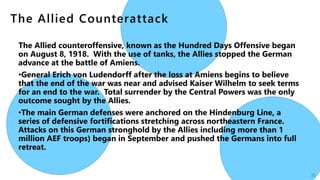
rivalry increased with
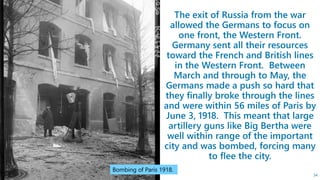
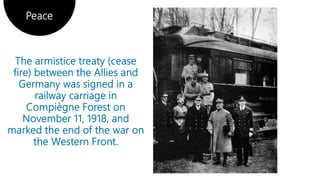
every overseas dispute.
Militarism
policy of glorifying military power
and keeping an army prepared for
war, was increasing as nationalism
led to a dangerous European arms
race. By 1914 all the great nations
of Europe (except Great Britain) had
large standing armies due in part to
conscription or a military draft.
European armies doubled in size
between 1890 to 1914. When war
broke out, the British government
urged women to shame men not in
uniforms with the gift of a white
feather for cowardice. With these
large armies also came detailed
plans for mobilizing and moving
these armies quickly. Military
leaders become very influential and
consequently shape foreign
relations.
Alliances
Tangled alliances, originally
designed to keep peace in
Europe, would push Europe
toward war. It ensured that
a large and costly war
would ensue. The alliance
system drew the Ottoman
Empire in on the side of
Germany and Austria-
Hungary (opening up
several theaters of fighting
in this empire) and the
German attack on American
shipments to Britain drew
the United States into the
war as well. The French and
British used colonial troops
from Africa and Asia and
also placed demands on
China for assistance.
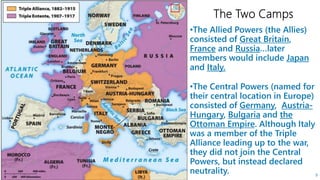
By the turn of the 20th century, an intense rivalry between Germany,
Austria-Hungary, Great Britain, Russia, Italy and France developed. Several
factors led to the increasing competition and ultimate war.
At the turn of the 20th century,
heightened nationalism ensured that any
future European war would be big, costly
and long. Nationalism was strongest
where the nation was least well-
established and felt mostly in those
regions where groups of people found
themselves within a state that did not
reflect their ethnic identities.
4
Case in point, The
Austro-Hungarian
Empire…
5
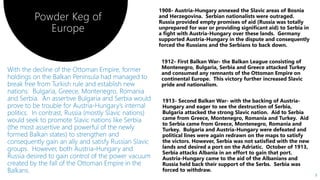
Powder Keg of
Europe
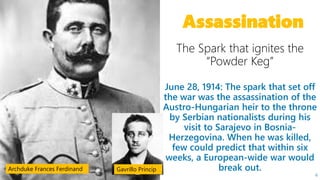
Assassination
6
Gavrillo PrincipArchduke Frances Ferdinand
7
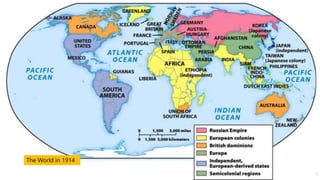
The World in 1914
9
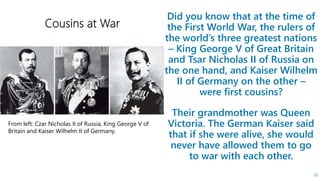
Did you know that at the time of
the First World War, the rulers of
the world’s three greatest nations
– King George V of Great Britain
and Tsar Nicholas II of Russia on
the one hand, and Kaiser Wilhelm
II of Germany on the other –
were first cousins?
Their grandmother was Queen
Victoria. The German Kaiser said
that if she were alive, she would
never have allowed them to go
to war with each other.
10
From left: Czar Nicholas II of Russia, King George V of
Britain and Kaiser Wilhelm II of Germany.
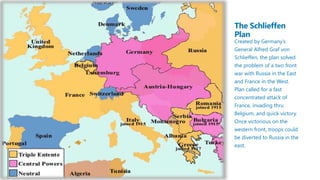
The Schlieffen
Plan
Created by Germany’s
General Alfred Graf von
Schlieffen, the plan solved
the problem of a two front
war with Russia in the East
and France in the West.
Plan called for a fast
concentrated attack of
France, invading thru
Belgium, and quick victory.
Once victorious on the
western front, troops could
be diverted to Russia in the
east.
•A quick campaign could be won in the west against France.
•The capture of a nation’s capital would result in an outright victory.
•The slow movement of Russian troops to the eastern front due to the lack of
railroads.
These assumptions would prove false because they did not take into consideration
military technologies, the size of various armies, the difficulty of terrain and the
popular effects of nationalism.
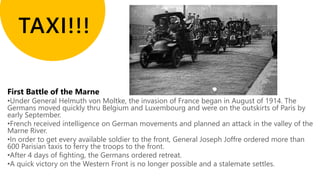
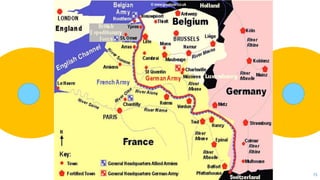
•Under General Helmuth von Moltke, the invasion of France began in August of 1914. The
Germans moved quickly thru Belgium and Luxembourg and were on the outskirts of Paris by
early September.
•French received intelligence on German movements and planned an attack in the valley of the
Marne River.
•In order to get every available soldier to the front, General Joseph Joffre ordered more than
600 Parisian taxis to ferry the troops to the front.
•After 4 days of fighting, the Germans ordered retreat.
•A quick victory on the Western Front is no longer possible and a stalemate settles.
Trench
Warfare
15
To the
trenches!
16
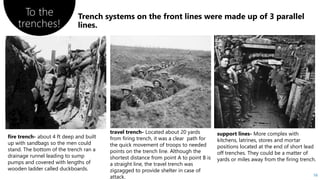
fire trench- about 4 ft deep and built
up with sandbags so the men could
stand. The bottom of the trench ran a
drainage runnel leading to sump
pumps and covered with lengths of
wooden ladder called duckboards.
travel trench- Located about 20 yards
from firing trench, it was a clear path for
the quick movement of troops to needed
points on the trench line. Although the
shortest distance from point A to point B is
a straight line, the travel trench was
zigzagged to provide shelter in case of
attack.
support lines- More complex with
kitchens, latrines, stores and mortar
positions located at the end of short lead
off trenches. They could be a matter of
yards or miles away from the firing trench.
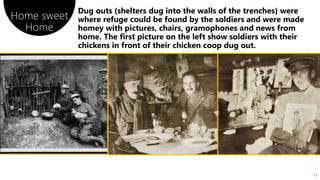
Home sweet
Home
17
18
Neal Creative ©
19
New military technologies changed the
way that wars were fought and made
the Great War, a war of attrition.
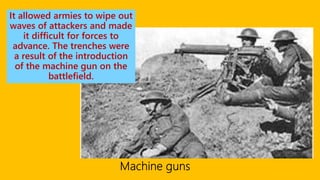
It allowed armies to wipe out
waves of attackers and made
it difficult for forces to
advance. The trenches were
a result of the introduction
of the machine gun on the
battlefield.
21
22
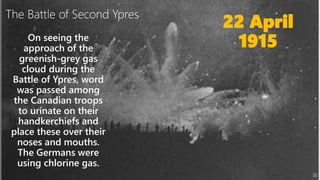
22 April
1915On seeing the
approach of the
greenish-grey gas
cloud during the
Battle of Ypres, word
was passed among
the Canadian troops
to urinate on their
handkerchiefs and
place these over their
noses and mouths.
The Germans were
using chlorine gas.
The Battle of Second Ypres
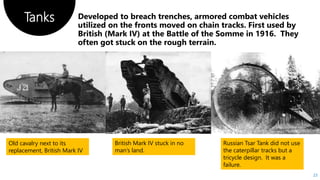
Tanks
23
Old cavalry next to its
replacement, British Mark IV
British Mark IV stuck in no
man’s land.
Russian Tsar Tank did not use
the caterpillar tracks but a
tricycle design. It was a
failure.
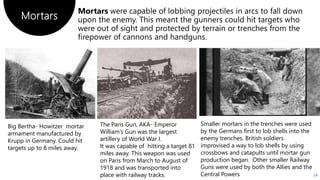
Mortars
24
Big Bertha- Howitzer mortar
armament manufactured by
Krupp in Germany. Could hit
targets up to 8 miles away.
The Paris Gun, AKA- Emperor
William’s Gun was the largest
artillery of World War I.
It was capable of hitting a target 81
miles away. This weapon was used
on Paris from March to August of
1918 and was transported into
place with railway tracks.
Smaller mortars in the trenches were used
by the Germans first to lob shells into the
enemy trenches. British soldiers
improvised a way to lob shells by using
crossbows and catapults until mortar gun
production began. Other smaller Railway
Guns were used by both the Allies and the
Central Powers
Airplanes
25
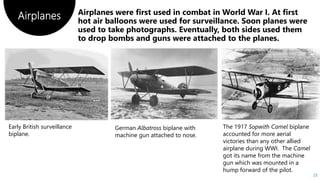
Early British surveillance
biplane.
German Albatross biplane with
machine gun attached to nose.
The 1917 Sopwith Camel biplane
accounted for more aerial
victories than any other allied
airplane during WWI. The Camel
got its name from the machine
gun which was mounted in a
hump forward of the pilot.
ACES
26
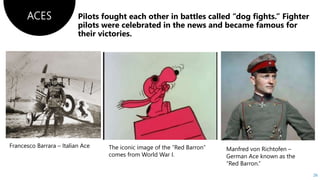
Francesco Barrara – Italian Ace
Manfred von Richtofen –
German Ace known as the
“Red Barron.”
The iconic image of the “Red Barron”
comes from World War I.
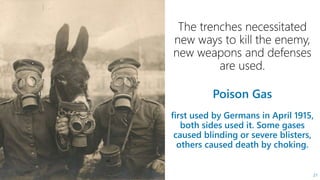
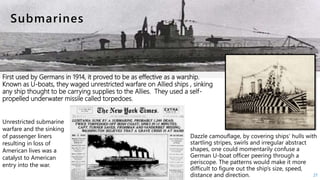
First used by Germans in 1914, it proved to be as effective as a warship.
Known as U-boats, they waged unrestricted warfare on Allied ships , sinking
any ship thought to be carrying supplies to the Allies. They used a self-
propelled underwater missile called torpedoes.
27
Unrestricted submarine
warfare and the sinking
of passenger liners
resulting in loss of
American lives was a
catalyst to American
entry into the war.
28
The Yanks are
coming…
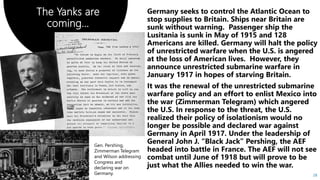
Gen. Pershing,
Zimmerman Telegram
and Wilson addressing
Congress and
declaring war on
Germany.
29
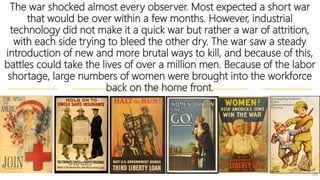
The war shocked almost every observer. Most expected a short war
that would be over within a few months. However, industrial
technology did not make it a quick war but rather a war of attrition,
with each side trying to bleed the other dry. The war saw a steady
introduction of new and more brutal ways to kill, and because of this,
battles could take the lives of over a million men. Because of the labor
shortage, large numbers of women were brought into the workforce
back on the home front.
Eastern
Front
30
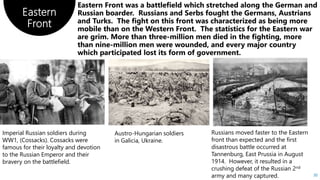
Imperial Russian soldiers during
WW1, (Cossacks). Cossacks were
famous for their loyalty and devotion
to the Russian Emperor and their
bravery on the battlefield.
Austro-Hungarian soldiers
in Galicia, Ukraine.
Russians moved faster to the Eastern
front than expected and the first
disastrous battle occurred at
Tannenburg, East Prussia in August
1914. However, it resulted in a
crushing defeat of the Russian 2nd
army and many captured.
31
32
33
34
Bombing of Paris 1918.
35
Peace
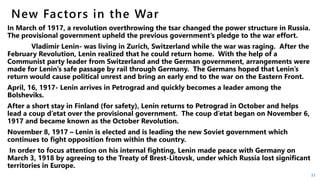
Legacies of the
War
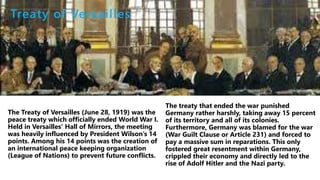
The Treaty of Versailles (June 28, 1919) was the
peace treaty which officially ended World War I.
Held in Versailles’ Hall of Mirrors, the meeting
was heavily influenced by President Wilson’s 14
points. Among his 14 points was the creation of
an international peace keeping organization
(League of Nations) to prevent future conflicts.
Treaty of Versailles
39
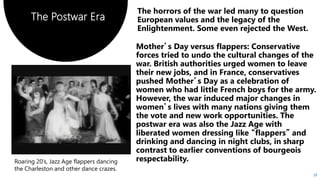
The Postwar Era
Roaring 20’s, Jazz Age flappers dancing
the Charleston and other dance crazes.
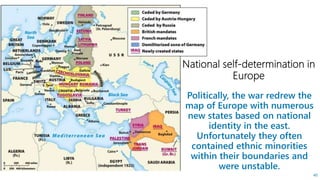
Politically, the war redrew the
map of Europe with numerous
new states based on national
identity in the east.
Unfortunately they often
contained ethnic minorities
within their boundaries and
were unstable.
40
41
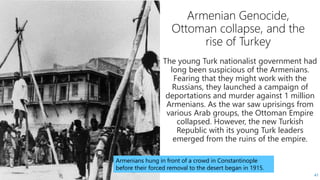
The young Turk nationalist government had
long been suspicious of the Armenians.
Fearing that they might work with the
Russians, they launched a campaign of
deportations and murder against 1 million
Armenians. As the war saw uprisings from
various Arab groups, the Ottoman Empire
collapsed. However, the new Turkish
Republic with its young Turk leaders
emerged from the ruins of the empire.
Armenians hung in front of a crowd in Constantinople
before their forced removal to the desert began in 1915.
View from the colonies: Many in the colonies
were stunned by the slaughter in Europe. In order
to get support for the war, the French and British
made promises for reforms and paths toward
independence after the war. These promises were
not kept.
42
Legacies of the War
Japanese expansion in China: The Japanese
expansionists used the war to move into German
territory in China and place a series of demands on
China. The unwillingness of the allies to check Japan
turned many Chinese nationalists toward the new
Soviet Union, the only power that spoke out against
imperialism.
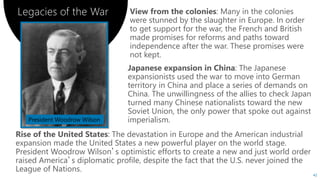
Rise of the United States: The devastation in Europe and the American industrial
expansion made the United States a new powerful player on the world stage.
President Woodrow Wilson’s optimistic efforts to create a new and just world order
raised America’s diplomatic profile, despite the fact that the U.S. never joined the
League of Nations.
President Woodrow Wilson
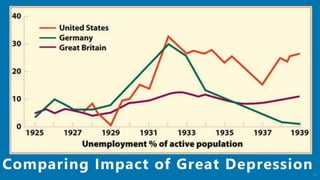
Capitalism
Unraveling:
The Great
Depression
43
44
Neal Creative | click & Learn moreNeal Creative ©
45
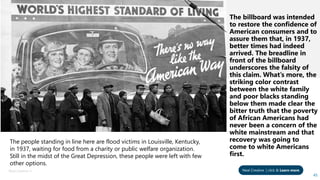
The people standing in line here are flood victims in Louisville, Kentucky,
in 1937, waiting for food from a charity or public welfare organization.
Still in the midst of the Great Depression, these people were left with few
other options.
46
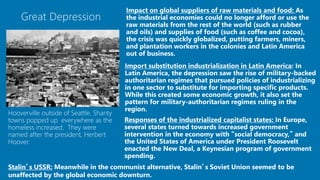
Hooverville outside of Seattle. Shanty
towns popped up everywhere as the
homeless increased. They were
named after the president, Herbert
Hoover.
Great Depression
47
Stalin’s USSR: Meanwhile in the communist alternative, Stalin’s Soviet Union seemed to be
unaffected by the global economic downturn.
Neal Creative ©
Comparing Italy,
Germany and Japan
Neal Creative | click & Learn more
Fascism
50
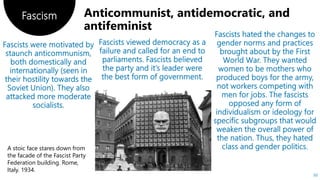
A stoic face stares down from
the facade of the Fascist Party
Federation building. Rome,
Italy. 1934.
51
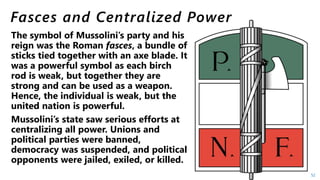
Mussolini’s state saw serious efforts at
centralizing all power. Unions and
political parties were banned,
democracy was suspended, and political
opponents were jailed, exiled, or killed.
52
53
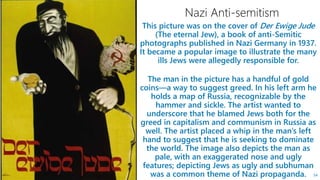
This picture was on the cover of Der Ewige Jude
(The eternal Jew), a book of anti-Semitic
photographs published in Nazi Germany in 1937.
It became a popular image to illustrate the many
ills Jews were allegedly responsible for.
The man in the picture has a handful of gold
coins—a way to suggest greed. In his left arm he
holds a map of Russia, recognizable by the
hammer and sickle. The artist wanted to
underscore that he blamed Jews both for the
greed in capitalism and communism in Russia as
well. The artist placed a whip in the man’s left
hand to suggest that he is seeking to dominate
the world. The image also depicts the man as
pale, with an exaggerated nose and ugly
features; depicting Jews as ugly and subhuman
was a common theme of Nazi propaganda. 54
Rise of
Hitler
55
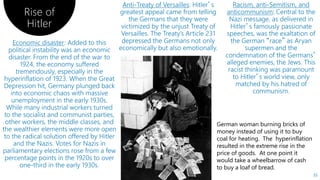
German woman burning bricks of
money instead of using it to buy
coal for heating. The hyperinflation
resulted in the extreme rise in the
price of goods. At one point it
would take a wheelbarrow of cash
to buy a loaf of bread.
Chancellor
1933
56
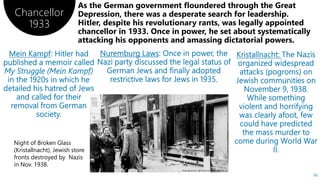
Night of Broken Glass
(Kristallnacht), Jewish store
fronts destroyed by Nazis
in Nov. 1938.
57
Nazi Antifeminism
and male sexuality
58
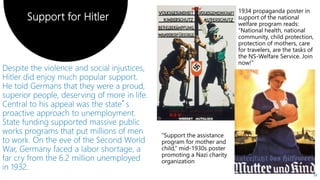
Support for Hitler
Japanese
Authoritarianism
59
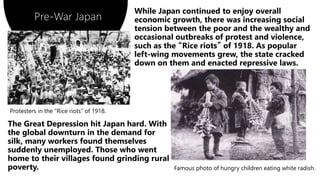
Pre-War Japan
Protesters in the “Rice riots” of 1918.
Famous photo of hungry children eating white radish.
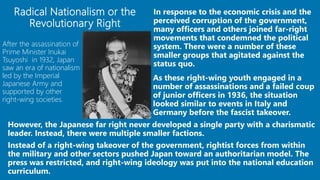
After the assassination of
Prime Minister Inukai
Tsuyoshi in 1932, Japan
saw an era of nationalism
led by the Imperial
Japanese Army and
supported by other
right-wing societies.
Radical Nationalism or the
Revolutionary Right
61
While there were many similarities with the
European fascist states, authoritarian Japan
was a much less repressive system with re-
education rather than execution being the
primary method for dealing with political
dissidents. Laws such as the Public Security
Preservation Law of 1925 were used to deal
with political dissidents.
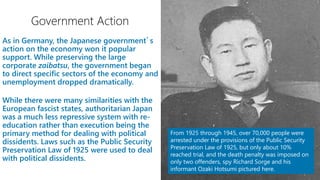
From 1925 through 1945, over 70,000 people were
arrested under the provisions of the Public Security
Preservation Law of 1925, but only about 10%
reached trial, and the death penalty was imposed on
only two offenders, spy Richard Sorge and his
informant Ozaki Hotsumi pictured here.
63
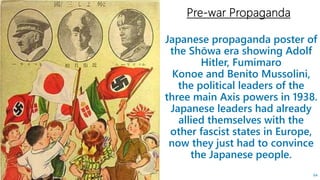
Japanese propaganda poster of
the Shōwa era showing Adolf
Hitler, Fumimaro
Konoe and Benito Mussolini,
the political leaders of the
three main Axis powers in 1938.
Japanese leaders had already
allied themselves with the
other fascist states in Europe,
now they just had to convince
the Japanese people.
64
Japan’s Road to War
65
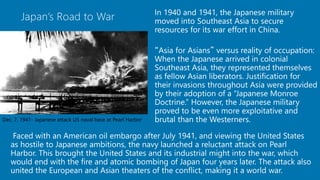
Dec. 7, 1941- Japanese attack US naval base at Pearl Harbor
The Road to War
in Europe
Lebensraum &
Anschluss
67
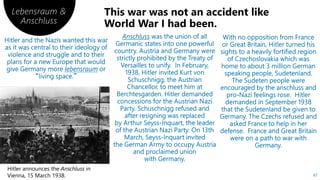
Hitler announces the Anschluss in
Vienna, 15 March 1938.
Rearmament &
expansion, 1935–
1939
68
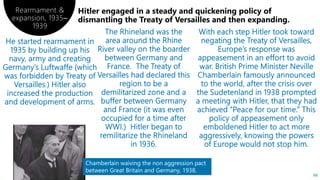
Chamberlain waiving the non aggression pact
between Great Britain and Germany, 1938.
69
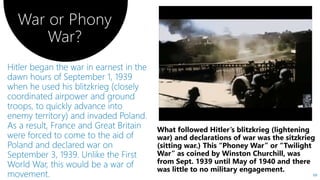
War or Phony
War?
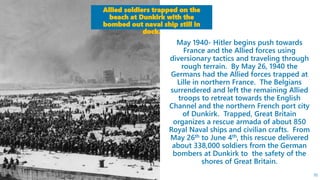
May 1940- Hitler begins push towards
France and the Allied forces using
diversionary tactics and traveling through
rough terrain. By May 26, 1940 the
Germans had the Allied forces trapped at
Lille in northern France. The Belgians
surrendered and left the remaining Allied
troops to retreat towards the English
Channel and the northern French port city
of Dunkirk. Trapped, Great Britain
organizes a rescue armada of about 850
Royal Naval ships and civilian crafts. From
May 26th to June 4th, this rescue delivered
about 338,000 soldiers from the German
bombers at Dunkirk to the safety of the
shores of Great Britain.
Allied soldiers trapped on the
beach at Dunkirk with the
bombed out naval ship still in
dock.
70
71
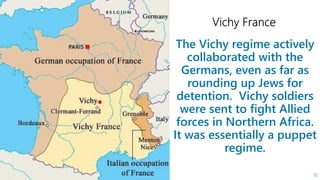
The Vichy regime actively
collaborated with the
Germans, even as far as
rounding up Jews for
detention. Vichy soldiers
were sent to fight Allied
forces in Northern Africa.
It was essentially a puppet
regime.
72
73
The Battle
of Britain
74
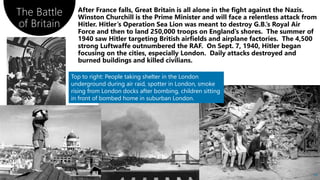
Top to right: People taking shelter in the London
underground during air raid, spotter in London, smoke
rising from London docks after bombing, children sitting
in front of bombed home in suburban London.
75
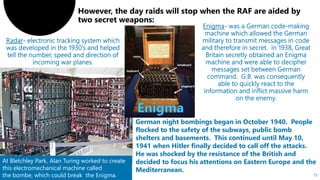
At Bletchley Park, Alan Turing worked to create
this electromechanical machine called
the bombe, which could break the Enigma.
German night bombings began in October 1940. People
flocked to the safety of the subways, public bomb
shelters and basements. This continued until May 10,
1941 when Hitler finally decided to call off the attacks.
He was shocked by the resistance of the British and
decided to focus his attentions on Eastern Europe and the
Mediterranean.
76
D-Day
77
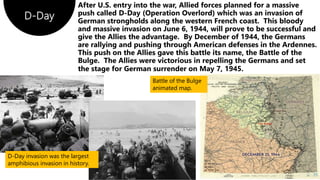
D-Day invasion was the largest
amphibious invasion in history.
Battle of the Bulge
animated map.
78
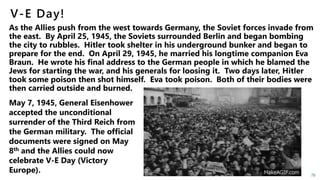
May 7, 1945, General Eisenhower
accepted the unconditional
surrender of the Third Reich from
the German military. The official
documents were signed on May
8th and the Allies could now
celebrate V-E Day (Victory
Europe).
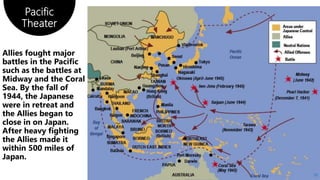
Pacific
Theater
79
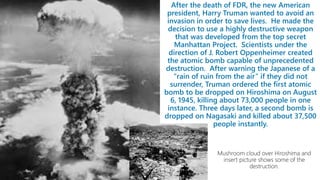
After the death of FDR, the new American
president, Harry Truman wanted to avoid an
invasion in order to save lives. He made the
decision to use a highly destructive weapon
that was developed from the top secret
Manhattan Project. Scientists under the
direction of J. Robert Oppenheimer created
the atomic bomb capable of unprecedented
destruction. After warning the Japanese of a
“rain of ruin from the air” if they did not
surrender, Truman ordered the first atomic
bomb to be dropped on Hiroshima on August
6, 1945, killing about 73,000 people in one
instance. Three days later, a second bomb is
dropped on Nagasaki and killed about 37,500
people instantly.
81
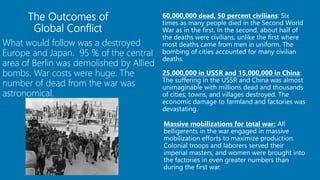
What would follow was a destroyed
Europe and Japan. 95 % of the central
area of Berlin was demolished by Allied
bombs. War costs were huge. The
number of dead from the war was
astronomical.
The Outcomes of
Global Conflict
82
Women of
WWII
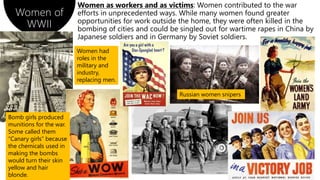
Women as workers and as victims: Women contributed to the war
efforts in unprecedented ways. While many women found greater
opportunities for work outside the home, they were often killed in the
bombing of cities and could be singled out for wartime rapes in China by
Japanese soldiers and in Germany by Soviet soldiers.
Bomb girls produced
munitions for the war.
Some called them
“Canary girls” because
the chemicals used in
making the bombs
would turn their skin
yellow and hair
blonde.
Russian women snipers
Women had
roles in the
military and
industry,
replacing men.
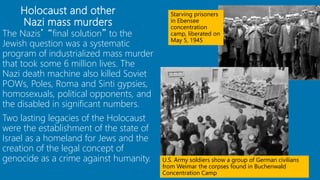
The Nazis’ “final solution” to the
Jewish question was a systematic
program of industrialized mass murder
that took some 6 million lives. The
Nazi death machine also killed Soviet
POWs, Poles, Roma and Sinti gypsies,
homosexuals, political opponents, and
the disabled in significant numbers.
Two lasting legacies of the Holocaust
were the establishment of the state of
Israel as a homeland for Jews and the
creation of the legal concept of
genocide as a crime against humanity.
Holocaust and other
Nazi mass murders
84
Starving prisoners
in Ebensee
concentration
camp, liberated on
May 5, 1945
U.S. Army soldiers show a group of German civilians
from Weimar the corpses found in Buchenwald
Concentration Camp
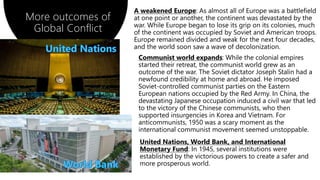
A weakened Europe: As almost all of Europe was a battlefield
at one point or another, the continent was devastated by the
war. While Europe began to lose its grip on its colonies, much
of the continent was occupied by Soviet and American troops.
Europe remained divided and weak for the next four decades,
and the world soon saw a wave of decolonization.
More outcomes of
Global Conflict
Communist world expands: While the colonial empires
started their retreat, the communist world grew as an
outcome of the war. The Soviet dictator Joseph Stalin had a
newfound credibility at home and abroad. He imposed
Soviet-controlled communist parties on the Eastern
European nations occupied by the Red Army. In China, the
devastating Japanese occupation induced a civil war that led
to the victory of the Chinese communists, who then
supported insurgencies in Korea and Vietnam. For
anticommunists, 1950 was a scary moment as the
international communist movement seemed unstoppable.
United Nations, World Bank, and International
Monetary Fund: In 1945, several institutions were
established by the victorious powers to create a safer and
more prosperous world.
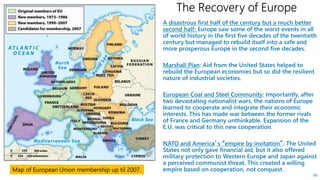
A disastrous first half of the century but a much better
second half: Europe saw some of the worst events in all
of world history in the first five decades of the twentieth
century but managed to rebuild itself into a safe and
more prosperous Europe in the second five decades.
Marshall Plan: Aid from the United States helped to
rebuild the European economies but so did the resilient
nature of industrial societies.
European Coal and Steel Community: Importantly, after
two devastating nationalist wars, the nations of Europe
learned to cooperate and integrate their economic
interests. This has made war between the former rivals
of France and Germany unthinkable. Expansion of the
E.U. was critical to this new cooperation.
NATO and America’s “empire by invitation”: The United
States not only gave financial aid, but it also offered
military protection to Western Europe and Japan against
a perceived communist threat. This created a willing
empire based on cooperation, not conquest.
86
Map of European Union membership up til 2007.

Ch. 20 collapse at the center

  • 1.
  • 2.
    The First World War:European Civilization in Crisis, 1914–1918
  • 3.
    An Accident Waiting toHappen Nationalism and territorial disputes in Europe Territorial disputes arose from competing nations. France resented Germany for taking Alsace-Lorraine during the Franco-Prussian War in 1870. Austria- Hungary and Russia competed for dominance of the Balkans. Nationalist movements among the Serbs, Bulgarians, Romanians and other ethnic groups further increased tensions in the Balkans. Imperialism Imperialism, the fierce competition for colonies in Africa and Asia by the countries of Europe, often pushed European nations to the brink of war. Their sense of mistrust and rivalry increased with every overseas dispute. Militarism policy of glorifying military power and keeping an army prepared for war, was increasing as nationalism led to a dangerous European arms race. By 1914 all the great nations of Europe (except Great Britain) had large standing armies due in part to conscription or a military draft. European armies doubled in size between 1890 to 1914. When war broke out, the British government urged women to shame men not in uniforms with the gift of a white feather for cowardice. With these large armies also came detailed plans for mobilizing and moving these armies quickly. Military leaders become very influential and consequently shape foreign relations. Alliances Tangled alliances, originally designed to keep peace in Europe, would push Europe toward war. It ensured that a large and costly war would ensue. The alliance system drew the Ottoman Empire in on the side of Germany and Austria- Hungary (opening up several theaters of fighting in this empire) and the German attack on American shipments to Britain drew the United States into the war as well. The French and British used colonial troops from Africa and Asia and also placed demands on China for assistance. By the turn of the 20th century, an intense rivalry between Germany, Austria-Hungary, Great Britain, Russia, Italy and France developed. Several factors led to the increasing competition and ultimate war.
  • 4.
    At the turnof the 20th century, heightened nationalism ensured that any future European war would be big, costly and long. Nationalism was strongest where the nation was least well- established and felt mostly in those regions where groups of people found themselves within a state that did not reflect their ethnic identities. 4 Case in point, The Austro-Hungarian Empire…
  • 5.
  • 6.
  • 7.
  • 9.
  • 10.
    Did you knowthat at the time of the First World War, the rulers of the world’s three greatest nations – King George V of Great Britain and Tsar Nicholas II of Russia on the one hand, and Kaiser Wilhelm II of Germany on the other – were first cousins? Their grandmother was Queen Victoria. The German Kaiser said that if she were alive, she would never have allowed them to go to war with each other. 10 From left: Czar Nicholas II of Russia, King George V of Britain and Kaiser Wilhelm II of Germany.
  • 11.
    The Schlieffen Plan Created byGermany’s General Alfred Graf von Schlieffen, the plan solved the problem of a two front war with Russia in the East and France in the West. Plan called for a fast concentrated attack of France, invading thru Belgium, and quick victory. Once victorious on the western front, troops could be diverted to Russia in the east.
  • 12.
    •A quick campaigncould be won in the west against France. •The capture of a nation’s capital would result in an outright victory. •The slow movement of Russian troops to the eastern front due to the lack of railroads. These assumptions would prove false because they did not take into consideration military technologies, the size of various armies, the difficulty of terrain and the popular effects of nationalism.
  • 13.
    •Under General Helmuthvon Moltke, the invasion of France began in August of 1914. The Germans moved quickly thru Belgium and Luxembourg and were on the outskirts of Paris by early September. •French received intelligence on German movements and planned an attack in the valley of the Marne River. •In order to get every available soldier to the front, General Joseph Joffre ordered more than 600 Parisian taxis to ferry the troops to the front. •After 4 days of fighting, the Germans ordered retreat. •A quick victory on the Western Front is no longer possible and a stalemate settles.
  • 14.
  • 15.
  • 16.
    To the trenches! 16 fire trench-about 4 ft deep and built up with sandbags so the men could stand. The bottom of the trench ran a drainage runnel leading to sump pumps and covered with lengths of wooden ladder called duckboards. travel trench- Located about 20 yards from firing trench, it was a clear path for the quick movement of troops to needed points on the trench line. Although the shortest distance from point A to point B is a straight line, the travel trench was zigzagged to provide shelter in case of attack. support lines- More complex with kitchens, latrines, stores and mortar positions located at the end of short lead off trenches. They could be a matter of yards or miles away from the firing trench.
  • 17.
  • 18.
  • 19.
    Neal Creative © 19 Newmilitary technologies changed the way that wars were fought and made the Great War, a war of attrition.
  • 20.
    It allowed armiesto wipe out waves of attackers and made it difficult for forces to advance. The trenches were a result of the introduction of the machine gun on the battlefield.
  • 21.
  • 22.
    22 22 April 1915On seeingthe approach of the greenish-grey gas cloud during the Battle of Ypres, word was passed among the Canadian troops to urinate on their handkerchiefs and place these over their noses and mouths. The Germans were using chlorine gas. The Battle of Second Ypres
  • 23.
    Tanks 23 Old cavalry nextto its replacement, British Mark IV British Mark IV stuck in no man’s land. Russian Tsar Tank did not use the caterpillar tracks but a tricycle design. It was a failure.
  • 24.
    Mortars 24 Big Bertha- Howitzermortar armament manufactured by Krupp in Germany. Could hit targets up to 8 miles away. The Paris Gun, AKA- Emperor William’s Gun was the largest artillery of World War I. It was capable of hitting a target 81 miles away. This weapon was used on Paris from March to August of 1918 and was transported into place with railway tracks. Smaller mortars in the trenches were used by the Germans first to lob shells into the enemy trenches. British soldiers improvised a way to lob shells by using crossbows and catapults until mortar gun production began. Other smaller Railway Guns were used by both the Allies and the Central Powers
  • 25.
    Airplanes 25 Early British surveillance biplane. GermanAlbatross biplane with machine gun attached to nose. The 1917 Sopwith Camel biplane accounted for more aerial victories than any other allied airplane during WWI. The Camel got its name from the machine gun which was mounted in a hump forward of the pilot.
  • 26.
    ACES 26 Francesco Barrara –Italian Ace Manfred von Richtofen – German Ace known as the “Red Barron.” The iconic image of the “Red Barron” comes from World War I.
  • 27.
    First used byGermans in 1914, it proved to be as effective as a warship. Known as U-boats, they waged unrestricted warfare on Allied ships , sinking any ship thought to be carrying supplies to the Allies. They used a self- propelled underwater missile called torpedoes. 27 Unrestricted submarine warfare and the sinking of passenger liners resulting in loss of American lives was a catalyst to American entry into the war.
  • 28.
    28 The Yanks are coming… Gen.Pershing, Zimmerman Telegram and Wilson addressing Congress and declaring war on Germany.
  • 29.
    29 The war shockedalmost every observer. Most expected a short war that would be over within a few months. However, industrial technology did not make it a quick war but rather a war of attrition, with each side trying to bleed the other dry. The war saw a steady introduction of new and more brutal ways to kill, and because of this, battles could take the lives of over a million men. Because of the labor shortage, large numbers of women were brought into the workforce back on the home front.
  • 30.
    Eastern Front 30 Imperial Russian soldiersduring WW1, (Cossacks). Cossacks were famous for their loyalty and devotion to the Russian Emperor and their bravery on the battlefield. Austro-Hungarian soldiers in Galicia, Ukraine. Russians moved faster to the Eastern front than expected and the first disastrous battle occurred at Tannenburg, East Prussia in August 1914. However, it resulted in a crushing defeat of the Russian 2nd army and many captured.
  • 31.
  • 32.
  • 33.
  • 34.
  • 35.
  • 36.
  • 37.
  • 38.
    The Treaty ofVersailles (June 28, 1919) was the peace treaty which officially ended World War I. Held in Versailles’ Hall of Mirrors, the meeting was heavily influenced by President Wilson’s 14 points. Among his 14 points was the creation of an international peace keeping organization (League of Nations) to prevent future conflicts. Treaty of Versailles
  • 39.
    39 The Postwar Era Roaring20’s, Jazz Age flappers dancing the Charleston and other dance crazes.
  • 40.
    Politically, the warredrew the map of Europe with numerous new states based on national identity in the east. Unfortunately they often contained ethnic minorities within their boundaries and were unstable. 40
  • 41.
    41 The young Turknationalist government had long been suspicious of the Armenians. Fearing that they might work with the Russians, they launched a campaign of deportations and murder against 1 million Armenians. As the war saw uprisings from various Arab groups, the Ottoman Empire collapsed. However, the new Turkish Republic with its young Turk leaders emerged from the ruins of the empire. Armenians hung in front of a crowd in Constantinople before their forced removal to the desert began in 1915.
  • 42.
    View from thecolonies: Many in the colonies were stunned by the slaughter in Europe. In order to get support for the war, the French and British made promises for reforms and paths toward independence after the war. These promises were not kept. 42 Legacies of the War Japanese expansion in China: The Japanese expansionists used the war to move into German territory in China and place a series of demands on China. The unwillingness of the allies to check Japan turned many Chinese nationalists toward the new Soviet Union, the only power that spoke out against imperialism. Rise of the United States: The devastation in Europe and the American industrial expansion made the United States a new powerful player on the world stage. President Woodrow Wilson’s optimistic efforts to create a new and just world order raised America’s diplomatic profile, despite the fact that the U.S. never joined the League of Nations. President Woodrow Wilson
  • 43.
  • 44.
  • 45.
    Neal Creative |click & Learn moreNeal Creative © 45 The people standing in line here are flood victims in Louisville, Kentucky, in 1937, waiting for food from a charity or public welfare organization. Still in the midst of the Great Depression, these people were left with few other options.
  • 46.
  • 47.
    Hooverville outside ofSeattle. Shanty towns popped up everywhere as the homeless increased. They were named after the president, Herbert Hoover. Great Depression 47 Stalin’s USSR: Meanwhile in the communist alternative, Stalin’s Soviet Union seemed to be unaffected by the global economic downturn.
  • 48.
    Neal Creative © ComparingItaly, Germany and Japan Neal Creative | click & Learn more
  • 50.
    Fascism 50 A stoic facestares down from the facade of the Fascist Party Federation building. Rome, Italy. 1934.
  • 51.
  • 52.
    Mussolini’s state sawserious efforts at centralizing all power. Unions and political parties were banned, democracy was suspended, and political opponents were jailed, exiled, or killed. 52
  • 53.
  • 54.
    This picture wason the cover of Der Ewige Jude (The eternal Jew), a book of anti-Semitic photographs published in Nazi Germany in 1937. It became a popular image to illustrate the many ills Jews were allegedly responsible for. The man in the picture has a handful of gold coins—a way to suggest greed. In his left arm he holds a map of Russia, recognizable by the hammer and sickle. The artist wanted to underscore that he blamed Jews both for the greed in capitalism and communism in Russia as well. The artist placed a whip in the man’s left hand to suggest that he is seeking to dominate the world. The image also depicts the man as pale, with an exaggerated nose and ugly features; depicting Jews as ugly and subhuman was a common theme of Nazi propaganda. 54
  • 55.
    Rise of Hitler 55 German womanburning bricks of money instead of using it to buy coal for heating. The hyperinflation resulted in the extreme rise in the price of goods. At one point it would take a wheelbarrow of cash to buy a loaf of bread.
  • 56.
    Chancellor 1933 56 Night of BrokenGlass (Kristallnacht), Jewish store fronts destroyed by Nazis in Nov. 1938.
  • 57.
  • 58.
  • 59.
  • 60.
    Pre-War Japan Protesters inthe “Rice riots” of 1918. Famous photo of hungry children eating white radish.
  • 61.
    After the assassinationof Prime Minister Inukai Tsuyoshi in 1932, Japan saw an era of nationalism led by the Imperial Japanese Army and supported by other right-wing societies. Radical Nationalism or the Revolutionary Right 61
  • 62.
    While there weremany similarities with the European fascist states, authoritarian Japan was a much less repressive system with re- education rather than execution being the primary method for dealing with political dissidents. Laws such as the Public Security Preservation Law of 1925 were used to deal with political dissidents. From 1925 through 1945, over 70,000 people were arrested under the provisions of the Public Security Preservation Law of 1925, but only about 10% reached trial, and the death penalty was imposed on only two offenders, spy Richard Sorge and his informant Ozaki Hotsumi pictured here.
  • 63.
  • 64.
    Japanese propaganda posterof the Shōwa era showing Adolf Hitler, Fumimaro Konoe and Benito Mussolini, the political leaders of the three main Axis powers in 1938. Japanese leaders had already allied themselves with the other fascist states in Europe, now they just had to convince the Japanese people. 64
  • 65.
    Japan’s Road toWar 65 Dec. 7, 1941- Japanese attack US naval base at Pearl Harbor
  • 66.
    The Road toWar in Europe
  • 67.
    Lebensraum & Anschluss 67 Hitler announcesthe Anschluss in Vienna, 15 March 1938.
  • 68.
    Rearmament & expansion, 1935– 1939 68 Chamberlainwaiving the non aggression pact between Great Britain and Germany, 1938.
  • 69.
  • 70.
    May 1940- Hitlerbegins push towards France and the Allied forces using diversionary tactics and traveling through rough terrain. By May 26, 1940 the Germans had the Allied forces trapped at Lille in northern France. The Belgians surrendered and left the remaining Allied troops to retreat towards the English Channel and the northern French port city of Dunkirk. Trapped, Great Britain organizes a rescue armada of about 850 Royal Naval ships and civilian crafts. From May 26th to June 4th, this rescue delivered about 338,000 soldiers from the German bombers at Dunkirk to the safety of the shores of Great Britain. Allied soldiers trapped on the beach at Dunkirk with the bombed out naval ship still in dock. 70
  • 71.
  • 72.
    The Vichy regimeactively collaborated with the Germans, even as far as rounding up Jews for detention. Vichy soldiers were sent to fight Allied forces in Northern Africa. It was essentially a puppet regime. 72
  • 73.
  • 74.
    The Battle of Britain 74 Topto right: People taking shelter in the London underground during air raid, spotter in London, smoke rising from London docks after bombing, children sitting in front of bombed home in suburban London.
  • 75.
    75 At Bletchley Park,Alan Turing worked to create this electromechanical machine called the bombe, which could break the Enigma. German night bombings began in October 1940. People flocked to the safety of the subways, public bomb shelters and basements. This continued until May 10, 1941 when Hitler finally decided to call off the attacks. He was shocked by the resistance of the British and decided to focus his attentions on Eastern Europe and the Mediterranean.
  • 76.
  • 77.
    D-Day 77 D-Day invasion wasthe largest amphibious invasion in history. Battle of the Bulge animated map.
  • 78.
    78 May 7, 1945,General Eisenhower accepted the unconditional surrender of the Third Reich from the German military. The official documents were signed on May 8th and the Allies could now celebrate V-E Day (Victory Europe).
  • 79.
  • 80.
    After the deathof FDR, the new American president, Harry Truman wanted to avoid an invasion in order to save lives. He made the decision to use a highly destructive weapon that was developed from the top secret Manhattan Project. Scientists under the direction of J. Robert Oppenheimer created the atomic bomb capable of unprecedented destruction. After warning the Japanese of a “rain of ruin from the air” if they did not surrender, Truman ordered the first atomic bomb to be dropped on Hiroshima on August 6, 1945, killing about 73,000 people in one instance. Three days later, a second bomb is dropped on Nagasaki and killed about 37,500 people instantly.
  • 81.
  • 82.
    What would followwas a destroyed Europe and Japan. 95 % of the central area of Berlin was demolished by Allied bombs. War costs were huge. The number of dead from the war was astronomical. The Outcomes of Global Conflict 82
  • 83.
    Women of WWII Women asworkers and as victims: Women contributed to the war efforts in unprecedented ways. While many women found greater opportunities for work outside the home, they were often killed in the bombing of cities and could be singled out for wartime rapes in China by Japanese soldiers and in Germany by Soviet soldiers. Bomb girls produced munitions for the war. Some called them “Canary girls” because the chemicals used in making the bombs would turn their skin yellow and hair blonde. Russian women snipers Women had roles in the military and industry, replacing men.
  • 84.
    The Nazis’ “finalsolution” to the Jewish question was a systematic program of industrialized mass murder that took some 6 million lives. The Nazi death machine also killed Soviet POWs, Poles, Roma and Sinti gypsies, homosexuals, political opponents, and the disabled in significant numbers. Two lasting legacies of the Holocaust were the establishment of the state of Israel as a homeland for Jews and the creation of the legal concept of genocide as a crime against humanity. Holocaust and other Nazi mass murders 84 Starving prisoners in Ebensee concentration camp, liberated on May 5, 1945 U.S. Army soldiers show a group of German civilians from Weimar the corpses found in Buchenwald Concentration Camp
  • 85.
    A weakened Europe:As almost all of Europe was a battlefield at one point or another, the continent was devastated by the war. While Europe began to lose its grip on its colonies, much of the continent was occupied by Soviet and American troops. Europe remained divided and weak for the next four decades, and the world soon saw a wave of decolonization. More outcomes of Global Conflict Communist world expands: While the colonial empires started their retreat, the communist world grew as an outcome of the war. The Soviet dictator Joseph Stalin had a newfound credibility at home and abroad. He imposed Soviet-controlled communist parties on the Eastern European nations occupied by the Red Army. In China, the devastating Japanese occupation induced a civil war that led to the victory of the Chinese communists, who then supported insurgencies in Korea and Vietnam. For anticommunists, 1950 was a scary moment as the international communist movement seemed unstoppable. United Nations, World Bank, and International Monetary Fund: In 1945, several institutions were established by the victorious powers to create a safer and more prosperous world.
  • 86.
    A disastrous firsthalf of the century but a much better second half: Europe saw some of the worst events in all of world history in the first five decades of the twentieth century but managed to rebuild itself into a safe and more prosperous Europe in the second five decades. Marshall Plan: Aid from the United States helped to rebuild the European economies but so did the resilient nature of industrial societies. European Coal and Steel Community: Importantly, after two devastating nationalist wars, the nations of Europe learned to cooperate and integrate their economic interests. This has made war between the former rivals of France and Germany unthinkable. Expansion of the E.U. was critical to this new cooperation. NATO and America’s “empire by invitation”: The United States not only gave financial aid, but it also offered military protection to Western Europe and Japan against a perceived communist threat. This created a willing empire based on cooperation, not conquest. 86 Map of European Union membership up til 2007.

Editor's Notes

  • #2 To use this title animation slide with a new image simply 1) move the top semi-transparent shape to the side, 2) delete placeholder image, 3) click on the picture icon to add a new picture, 4) Move semi-transparent shape back to original position, 5) Update text on slide.
  • #23 Tip: When using complex image as full-bleed background add a transparency (70%-90%) fill layer to give contrast to text.