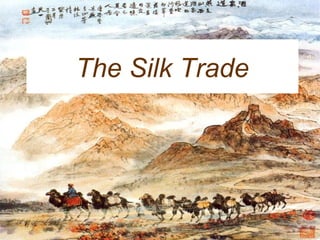
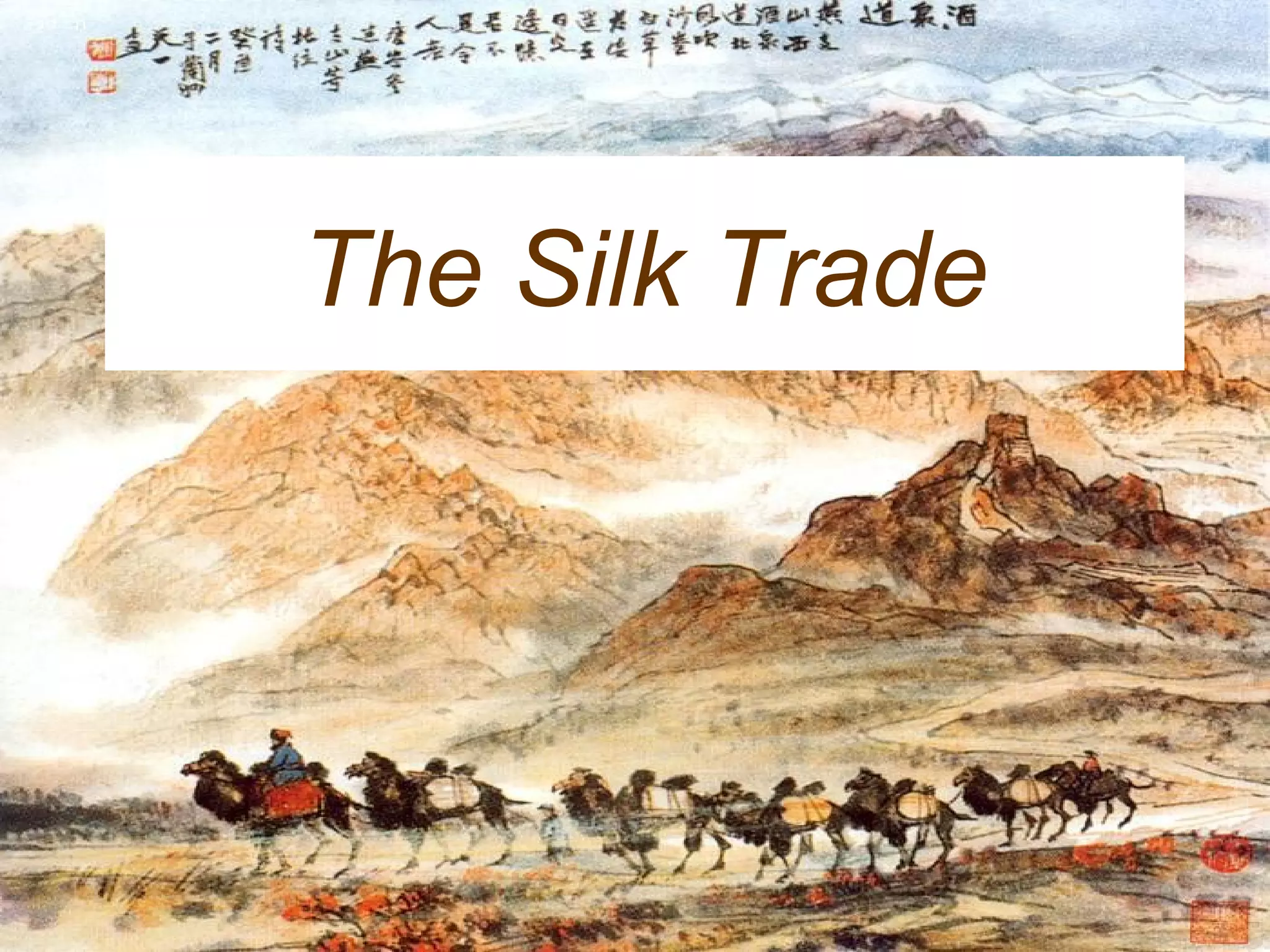

The Silk Trade
2
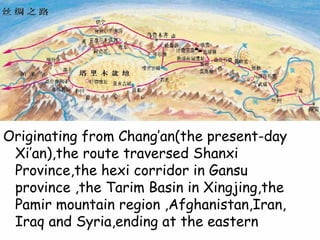
Originating from Chang’an(the present-day
Xi’an),the route traversed Shanxi
Province,the hexi corridor in Gansu
province ,the Tarim Basin in Xingjing,the
Pamir mountain region ,Afghanistan,Iran,
Iraq and Syria,ending at the eastern
3
THE SILK ROAD
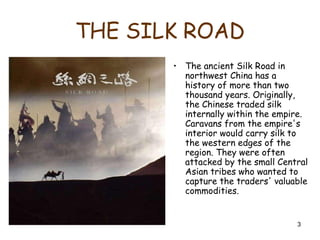
• The ancient Silk Road in
northwest China has a
history of more than two
thousand years. Originally,
the Chinese traded silk
internally within the empire.
Caravans from the empire's
interior would carry silk to
the western edges of the
region. They were often
attacked by the small Central
Asian tribes who wanted to
capture the traders' valuable
commodities.
4
THE SILK ROAD
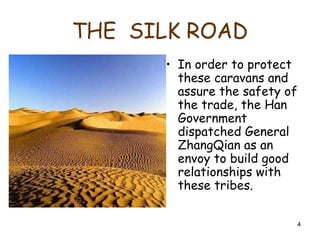
• In order to protect
these caravans and
assure the safety of
the trade, the Han
Government
dispatched General
ZhangQian as an
envoy to build good
relationships with
these tribes.
5
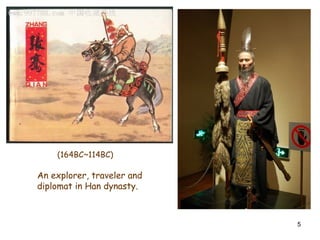
(164BC~114BC)
An explorer, traveler and
diplomat in Han dynasty.
6
THE SILK ROAD
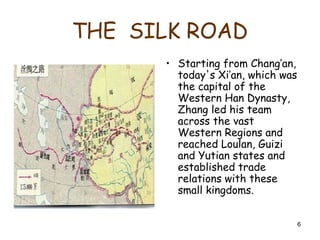
• Starting from Chang’an,
today's Xi’an, which was
the capital of the
Western Han Dynasty,
Zhang led his team
across the vast
Western Regions and
reached Loulan, Guizi
and Yutian states and
established trade
relations with these
small kingdoms.
7
THE SILK ROAD
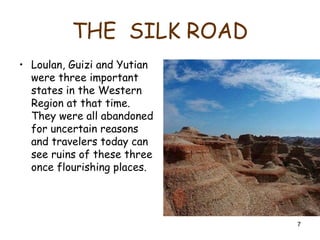
• Loulan, Guizi and Yutian
were three important
states in the Western
Region at that time.
They were all abandoned
for uncertain reasons
and travelers today can
see ruins of these three
once flourishing places.
8
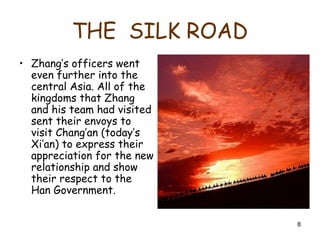
THE SILK ROAD
• Zhang’s officers went
even further into the
central Asia. All of the
kingdoms that Zhang
and his team had visited
sent their envoys to
visit Chang’an (today’s
Xi’an) to express their
appreciation for the new
relationship and show
their respect to the
Han Government.
9
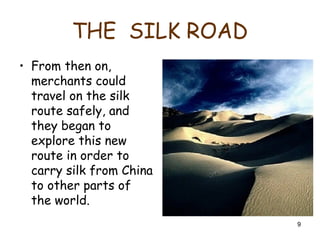
THE SILK ROAD
• From then on,
merchants could
travel on the silk
route safely, and
they began to
explore this new
route in order to
carry silk from China
to other parts of
the world.
10
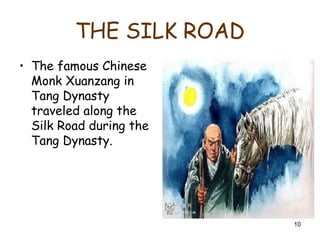
THE SILK ROAD
• The famous Chinese
Monk Xuanzang in
Tang Dynasty
traveled along the
Silk Road during the
Tang Dynasty.
11
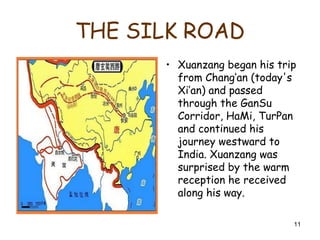
THE SILK ROAD
• The famous Chinese
Monk Xuanzang in Tang
Dynasty traveled along
the Silk Road during the
Tang Dynasty.
• Xuanzang began his trip
from Chang’an (today's
Xi’an) and passed
through the GanSu
Corridor, HaMi, TurPan
and continued his
journey westward to
India. Xuanzang was
surprised by the warm
reception he received
along his way.
12
THE SILK ROAD
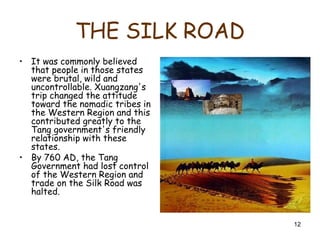
• It was commonly believed
that people in those states
were brutal, wild and
uncontrollable. Xuangzang's
trip changed the attitude
toward the nomadic tribes in
the Western Region and this
contributed greatly to the
Tang government's friendly
relationship with these
states.
• By 760 AD, the Tang
Government had lost control
of the Western Region and
trade on the Silk Road was
halted.
13
THE SILK ROAD
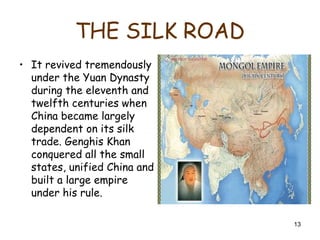
• It revived tremendously
under the Yuan Dynasty
during the eleventh and
twelfth centuries when
China became largely
dependent on its silk
trade. Genghis Khan
conquered all the small
states, unified China and
built a large empire
under his rule.
14
THE SILK ROAD
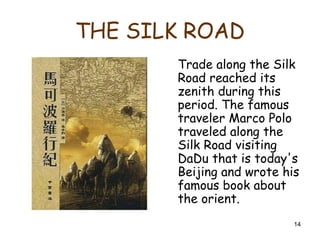
• Trade along the Silk
Road reached its
zenith during this
period. The famous
traveler Marco Polo
traveled along the
Silk Road visiting
DaDu that is today's
Beijing and wrote his
famous book about
the orient.
15
THE SILK ROAD
• As overland trade
became increasingly
dangerous, and travel by
sea became more
popular, trade along the
Silk Road declined.
While the Chinese did
maintain a silk-fur trade
with the Russians north
of the original Silk
Route, by the end of the
fourteenth century,
trade and travel along
the road had decreased
significantly.
16
THE SILK ROAD
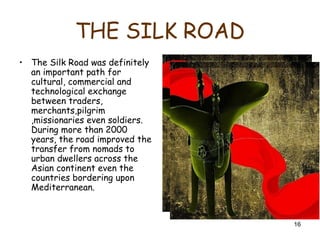
• The Silk Road was definitely
an important path for
cultural, commercial and
technological exchange
between traders,
merchants,pilgrim
,missionaries even soldiers.
During more than 2000
years, the road improved the
transfer from nomads to
urban dwellers across the
Asian continent even the
countries bordering upon
Mediterranean.
17
THE SILK ROAD
• The emergence of the
Silk Road vigorously
promoted the East-West
economic, cultural
exchanges, and
contributed to the rise
of the Han Dynasty.
Further more, that route
is a key pathway of
Intercourse between
East and West, either.
18
• As the road to the
west was popularly
known for its trade of
silk, which was priced
as valuable as gold,
that commercial route
came to be known as
the Silk Road.
19
Ⅱ.Routes of the Silk Road
•Generally speaking , there were two
major routes: one was overland, the
other was across the Indian Ocean.
20
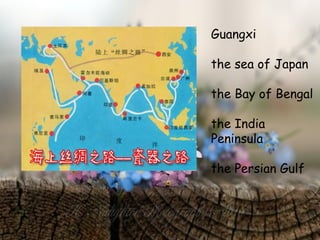
The sea route of “Silk Road” normally starts from
Guangxi or else port towns on the southeastern coast
of China. A fleet extends its voyage through the sea
of Japan, the Yellow Sea, South China Sea, the Bay
of Bengal, around the Malay Peninsula, off the coast
of Burma, and came to Southeast Asia and the India
Peninsula. Then, it continues along a route across the
Indian Ocean, the Arab Sea, the Persian Gulf, the
Red sea and finally arrives at destination ports of
Africa or Europe.
21
Guangxi
the sea of Japan
the Bay of Bengal
the India
Peninsula
the Persian Gulf
22
With the development of seamanship
and navigation, particularly after
Zhenghe successfully sailed to the
West, a sea route to the West took the
place of the silk road overland.
23
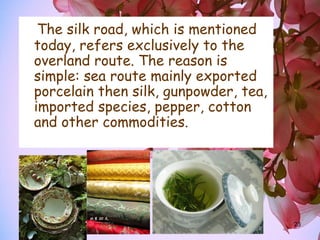
The silk road, which is mentioned
today, refers exclusively to the
overland route. The reason is
simple: sea route mainly exported
porcelain then silk, gunpowder, tea,
imported species, pepper, cotton
and other commodities.
24
The Silk Road had served for tens of
hundreds of years as the main route of
business over the continents of Asia, Europe
and Africa, an artery of Commodity Flow and
cultural exchange that gave immense
impetus to the rise of major economies and
civilization of the world.
It linked such ancient civilizations as China,
India, Greece, Egypt, and Babylonia. In a
sense, the Silk Road was no other than a
route of culture and civilization.
Ⅲ.The meaning of the Silk Road
25
Silk garments is regarded
as characteristic of the
aristocratic and the
genteel. As an important
variety of the cloth world,
under the influence of a
“green revolution”, the
trend of returning to
nature, people find silk to
be an ideal choice for its
health-keeping properties
of natural fiber.

The Silk Road

  • 1.
  • 2.
    2 Originating from Chang’an(thepresent-day Xi’an),the route traversed Shanxi Province,the hexi corridor in Gansu province ,the Tarim Basin in Xingjing,the Pamir mountain region ,Afghanistan,Iran, Iraq and Syria,ending at the eastern
  • 3.
    3 THE SILK ROAD •The ancient Silk Road in northwest China has a history of more than two thousand years. Originally, the Chinese traded silk internally within the empire. Caravans from the empire's interior would carry silk to the western edges of the region. They were often attacked by the small Central Asian tribes who wanted to capture the traders' valuable commodities.
  • 4.
    4 THE SILK ROAD •In order to protect these caravans and assure the safety of the trade, the Han Government dispatched General ZhangQian as an envoy to build good relationships with these tribes.
  • 5.
    5 (164BC~114BC) An explorer, travelerand diplomat in Han dynasty.
  • 6.
    6 THE SILK ROAD •Starting from Chang’an, today's Xi’an, which was the capital of the Western Han Dynasty, Zhang led his team across the vast Western Regions and reached Loulan, Guizi and Yutian states and established trade relations with these small kingdoms.
  • 7.
    7 THE SILK ROAD •Loulan, Guizi and Yutian were three important states in the Western Region at that time. They were all abandoned for uncertain reasons and travelers today can see ruins of these three once flourishing places.
  • 8.
    8 THE SILK ROAD •Zhang’s officers went even further into the central Asia. All of the kingdoms that Zhang and his team had visited sent their envoys to visit Chang’an (today’s Xi’an) to express their appreciation for the new relationship and show their respect to the Han Government.
  • 9.
    9 THE SILK ROAD •From then on, merchants could travel on the silk route safely, and they began to explore this new route in order to carry silk from China to other parts of the world.
  • 10.
    10 THE SILK ROAD •The famous Chinese Monk Xuanzang in Tang Dynasty traveled along the Silk Road during the Tang Dynasty.
  • 11.
    11 THE SILK ROAD •The famous Chinese Monk Xuanzang in Tang Dynasty traveled along the Silk Road during the Tang Dynasty. • Xuanzang began his trip from Chang’an (today's Xi’an) and passed through the GanSu Corridor, HaMi, TurPan and continued his journey westward to India. Xuanzang was surprised by the warm reception he received along his way.
  • 12.
    12 THE SILK ROAD •It was commonly believed that people in those states were brutal, wild and uncontrollable. Xuangzang's trip changed the attitude toward the nomadic tribes in the Western Region and this contributed greatly to the Tang government's friendly relationship with these states. • By 760 AD, the Tang Government had lost control of the Western Region and trade on the Silk Road was halted.
  • 13.
    13 THE SILK ROAD •It revived tremendously under the Yuan Dynasty during the eleventh and twelfth centuries when China became largely dependent on its silk trade. Genghis Khan conquered all the small states, unified China and built a large empire under his rule.
  • 14.
    14 THE SILK ROAD •Trade along the Silk Road reached its zenith during this period. The famous traveler Marco Polo traveled along the Silk Road visiting DaDu that is today's Beijing and wrote his famous book about the orient.
  • 15.
    15 THE SILK ROAD •As overland trade became increasingly dangerous, and travel by sea became more popular, trade along the Silk Road declined. While the Chinese did maintain a silk-fur trade with the Russians north of the original Silk Route, by the end of the fourteenth century, trade and travel along the road had decreased significantly.
  • 16.
    16 THE SILK ROAD •The Silk Road was definitely an important path for cultural, commercial and technological exchange between traders, merchants,pilgrim ,missionaries even soldiers. During more than 2000 years, the road improved the transfer from nomads to urban dwellers across the Asian continent even the countries bordering upon Mediterranean.
  • 17.
    17 THE SILK ROAD •The emergence of the Silk Road vigorously promoted the East-West economic, cultural exchanges, and contributed to the rise of the Han Dynasty. Further more, that route is a key pathway of Intercourse between East and West, either.
  • 18.
    18 • As theroad to the west was popularly known for its trade of silk, which was priced as valuable as gold, that commercial route came to be known as the Silk Road.
  • 19.
    19 Ⅱ.Routes of theSilk Road •Generally speaking , there were two major routes: one was overland, the other was across the Indian Ocean.
  • 20.
    20 The sea routeof “Silk Road” normally starts from Guangxi or else port towns on the southeastern coast of China. A fleet extends its voyage through the sea of Japan, the Yellow Sea, South China Sea, the Bay of Bengal, around the Malay Peninsula, off the coast of Burma, and came to Southeast Asia and the India Peninsula. Then, it continues along a route across the Indian Ocean, the Arab Sea, the Persian Gulf, the Red sea and finally arrives at destination ports of Africa or Europe.
  • 21.
    21 Guangxi the sea ofJapan the Bay of Bengal the India Peninsula the Persian Gulf
  • 22.
    22 With the developmentof seamanship and navigation, particularly after Zhenghe successfully sailed to the West, a sea route to the West took the place of the silk road overland.
  • 23.
    23 The silk road,which is mentioned today, refers exclusively to the overland route. The reason is simple: sea route mainly exported porcelain then silk, gunpowder, tea, imported species, pepper, cotton and other commodities.
  • 24.
    24 The Silk Roadhad served for tens of hundreds of years as the main route of business over the continents of Asia, Europe and Africa, an artery of Commodity Flow and cultural exchange that gave immense impetus to the rise of major economies and civilization of the world. It linked such ancient civilizations as China, India, Greece, Egypt, and Babylonia. In a sense, the Silk Road was no other than a route of culture and civilization. Ⅲ.The meaning of the Silk Road
  • 25.
    25 Silk garments isregarded as characteristic of the aristocratic and the genteel. As an important variety of the cloth world, under the influence of a “green revolution”, the trend of returning to nature, people find silk to be an ideal choice for its health-keeping properties of natural fiber.

Editor's Notes

  • #20 Nest Nest I will tell you about the route of the silk road ,
  • #24 哈哈哈 哈哈哈