Chapter 12
Study Guide
The Worlds of the 15th Century
Key
This - people
This - key terms/vocabulary
This - places
I. The Shapes of Human Communities
IA. Paleolithic Persistence: Australia and North America
● Hunter-gatherer (h/g) societies cont’d to exist into the era 600-1450
○ Australia, Siberia, arctic coastlands, parts of Africa and Americas
○ Split into some 250 separate groups, around until late 18th century
○ Assimilated various innovations from outsiders, were never agricultural
■ Ex: canoes, fishhooks, netting techniques, rituals
● Despite absence of agri, they mastered and manipulated their envi
○ Firestick farming: delib. set fires to “clean up country” - made hunting easier b/c cleared
brush, encouraged growth of plants
○ Exchanged goods over long distances, created elaborate mythologies, ritual practices,
and developed sophisticated sculpture and rock painting
1A cont’d
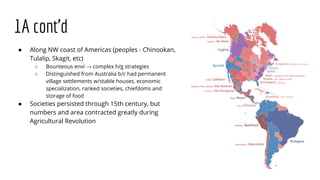
● Along NW coast of Americas (peoples - Chinookan,
Tulalip, Skagit, etc)
○ Bounteous envi → complex h/g strategies
○ Distinguished from Australia b/c had permanent
village settlements w/stable houses, economic
specialization, ranked societies, chiefdoms and
storage of food
● Societies persisted through 15th century, but
numbers and area contracted greatly during
Agricultural Revolution
1B. Agricultural Village Societies: the Igbo and the Iroquois
● Fully agricultural, avoided incorporation into larger civilizations, didn’t develop own
city/state-based society
● Usually small village-based communities (comm’s) organized in terms of kinship relations
● Predominated during 15th (century) in: N. Am., S. Am. and Caribbean, Amazon River Basin, SE
Asia, and Africa s. of equator, throughout Pacific Oceania
○ Marginal to other civilizations, but each had own histories
○ Created societies largely w/o political authority, class inequalities and seclusion of
women like in common civilization (civ)
1B cont’d - Igbo
★ E of Niger River in heavily forested W. Africa - Igbo people
○ Neighbors Yoruba and Bini began to develop states and urban centers
○ Igbo rejected kingship and state building
■ Relied on other things to maintain social cohesion: balances of power, title societies,
women’s associations
■ Was a “stateless society”
● Traded actively among selves and w/distant neighbors (ex: Sognhay)
○ Ex: cotton, cloth, fish, copper and iron goods
○ Artistic traditions reflected cultural unity
● Were eventually caught up in transatlantic slave trade
1B cont’d - Iroquois
★ Iroquois-speaking peoples (lived in now NY)
○ Fully agricultural, adopted maize and bean farming
○ Agri took hold by 1300 → population increased (^), distinct peoples emerged
○ Frequent warfare erupted among 5 peoples: Mohawk, Oneida, Onondaga, Cayuga, Seneca
■ Made agreement known as Great Law of Peace - 5 Nations agreed to settle
differences through peaceful confederation of 50 clan leaders
● Could adjudicate disputes and set reparation payments
● Suppressed blood feuds and tribal conflicts
● Coordinated relationships w/ outsiders
● Became increasingly encompassed in expanding economic networks and
conquest empires based in W. Eu., Russia, China, or India
○ Replicated experience of other village-based farming communities
1C. Pastoral Peoples: Central Asia and W. Africa
● As Mongol rule ended, an attempt to restore it occurred (late 14th-early
15th) under leadership of a Turkic warrior named Timur (born in
Uzbekistan, known as Tamerlane)
○ w/ ferocity, army brought devastation again to Russia, Persia, India
○ Died in 1405 preparing for an invasion of China
○ Conflicts among successors prevented lasting empire
★ State hosted sophisticated elite culture, combining Turkic and Persian
elements
○ Capital: Samarkand
○ Last great military success of nomadic peoples in C. Asia → homelands later swallowed by
Russian and Chinese empires
1C cont’d - West Africa
★ West Africa - people stayed independent of established empires, not until
late 19th were they incorporated into European colonial states
○ Ex: Fulbe (WA’s largest pastoral society) - herding people w/highly signif. role in 15th c.
■ Migrated from W. Sahara along upper Senegal River eastward
■ Small comm’s inside agricultural settlements, paid grazing fees and taxes to and
hated them
■ Adopted Islam, some settled in towns where they could become religious leaders
● In 18th and 19th centuries, became center of a wave of jihads
(religiously-based uprisings) → expanded Islam + rise of new Fulbe states
II. Civilizations of the 15th Century:
Comparing China and Europe
IIA. Ming Dynasty China
● Traditions had been disrupted by Mongol rule, pop. decreased by plague
● Recovered during Ming Dynasty (1368-1644)
○ Early decades - rebuilding, wiping out traces of foreign rule, promoting Confucian rule
and orthodox gender rules
● Emperor Yongle (r. 1402-1422) - sponsored 11K volume encyclopedia
w/contributions of 2K+ scholars
○ Relocated capital of China to Beijing
○ ordered building of imperial residence known as Forbidden City
○ constructed Temple of Heaven
● Culturally speaking, China was looking to its past
IIA cont’d - Ming’s political system
● Reestablished civil service exam system and created a highly centralized
government
○ Power to emperor himself and cadre of eunuchs exercised great authority
○ Acted to repair damage by restoring land to cultivation, rebuilding irrigation works,
planting 1B trees
○ Economy rebounded, trade and population ^
● Undertook impressive maritime expeditions: fleet launched in 1405, followed by 6
more over 28 years
○ Captained by Muslim eunuch Zheng He
○ Visited ports in SE Asia, Indonesia, India, Arabia, E. Africa
○ 1st voyage: 300 ships, 27K men (soldiers, physicians, officials)
● Expeditions established power and prestige, exerted control over trade
● Ended abruptly - after 1433, authorities let it deteriorate after death of Yongle
○ Believed China was a self-sufficient “middle kingdom”, viewed voyages as a waste of
resources and money
IIB. European Comparisons: State Building + Cultural Renewal
● Europe had similar processes of demographic recovery, political
consolidation and cultural flowering
○ After Mongol demise, started regrowing pop. in late 1400s
○ Infrastructure - durable foundation
● Readopted fragmented system of indep. and competitive states
○ Learned to tax effectively, more effective admin structures, raised standing armies
○ Russian state centered on Moscow emerged
○ War was a frequent occurrence
■ Hundred Years’ War (1337-1453): England vs. France over rival claims to territory in
France
IIB cont’d
★ Renewed cultural blossoming: Renaissance (1300-1600)- parallel renewal
of Confucianism in China
○ Reclaimed Greco-Roman tradition
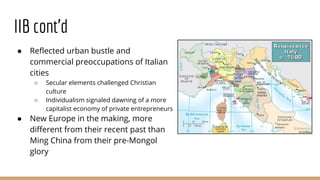
○ Began in commercial cities of Italy
■ Inspo in art and lit of ancient Greece and Rome
■ Purpose: use works as a cultural standard to imitate and then surpass
● Patronized great artists (ex: da Vinci, Michelangelo, Raphael) - paintings more
naturalistic w/portraits and human body
○ Majority of writers and artists were men, few exceptions such as Christine de Pizan
(1363-1430)
■ Works pushed against misogyny
■ Book City of Ladies, written w/help of Lady of Reason
○ Interested in capturing qualities of the individual and describing the world
IIB cont’d
● Reflected urban bustle and
commercial preoccupations of Italian
cities
○ Secular elements challenged Christian
culture
○ Individualism signaled dawning of a more
capitalist economy of private entrepreneurs
● New Europe in the making, more
different from their recent past than
Ming China from their pre-Mongol
glory
IIC. European Comparisons: Maritime Voyaging
● Like Chinese, Euro’s were also launching oceanic expeditions
● Initiated 1415 by Portugal - sailed down W. coast of Africa
● As century ended, 2 expeditions marked major breakthroughs
○ 1492: Columbus made way across Atlantic and hit Americas
■ Funded by Spain, Portugal’s neighbor and rival
○ 1497: Vasco de Gama went around tip of S. Africa, along E. African coast and across Indian
Ocean to Calicut in S. India
● Differences between Chinese and Euro ventures
Europeans Chinese
Size Columbus - 3 ships, 90 men
de Gama - 4 ships, 170 men
Zheng He - 100’s of ships, K’s of
sailors
Motivation Sought wealth of Africa and Asia,
Christian converts and allies
Didn’t need any of these
Duration Continuing, escalating effort Decisive ending of voyages
IIC cont’d
★ Why did Europeans continue a process that the Chinese deliberately
abandoned?
○ Had no unified political authority w/ power to order an end to expeditions
○ Elite had an interest in overseas expansion
○ China: when ZH died, those who opposed him prevailed in court
■ Also believed that if they needed something abroad, others would bring it to them
★ Chinese withdrawal facilitated Euro entry
○ Portuguese could penetrate region, faced only Ottomans
★ To deal w. population ^ and land shortage,
○ China: more extensive use of land, expansion inland → C. Asia
○ Europe: agriculture → new lands overseas, commitment to oceanic expansion
III. Civilizations of the 15th Century:
The Islamic World
● 15th and early 16th’s experiences remarkable changes and continuation of
earlier patterns
● Split into 4 empires
○ Ottoman (16th) - Mid. E, coastal N. Africa, around Black Sea, E. Europe
○ Safavid - Iran
○ Mughal - India
○ Songhay - Africa
IIIA. In the Islamic Heartland: Ottoman and Safavid Empires
★ Ottoman - most impressive and enduring, lasted 14th → early 20th c.
○ Created by a Turkic warrior group that migrated into Anatolia
○ By mid-15th, spread to Anat. peninsula, SE Europe (Balkan habitat)
○ Substantial Christian population
★ Represented emergence of Turks as dominant people of Islamic world, ruled over
many Arabs
○ Claimed legacy of Abbasid empire
○ Sought to bring unity to Islamic world and protect religion
★ New phase in encounters btwn Christian and Islamic worlds - rise of Ottomans
reversed roles (orig: Christians dom, Islamics sub)
○ Seizure of Constantinople in 1453 - demise of Byzantium, opened way to
expansion in heartland Europe
○ 1529: Ottomans lay siege to Vienna
○ Europeans called this the “terror of the Turk”
IIIA cont’d
★ Safavid Empire - Persian lands, E of Ottomans (late 15th, early 16th)
○ Leadership Turkic but emerged from a Sufi religious order founded by
Safi al-Din (1252-1334)
○ Established circa 1510
○ Long-term significance: imposed Shia Islam as official religion of state
■ Introduced divide into political and religious life of Islam
■ Years (1534-1639) - periodic military conflict between Ottoman and
Safavid empires
IIIB. On the Frontiers of Islam: Songhay + Mughal Empires
★ Songhay - W. African savannas, rose late 15th century
○ Derived revenue from commerce of trans-Saharan trade routes
○ Islam a growing faith, limited to urban elites
○ Divide accounts for behavior of 15th century monarch Sonni Ali
■ Gave alms and fasted during Ramadan, but took pride in being a
magician - had invisibility charm that helped his military
○ Became major center of Islamic learning and commerce by early 16th century
○ Successor made hajj, asked to be given title “Caliph of the Land of the Blacks”
IIIB cont’d
★ Mughal - invaded India in 1526
○ Bore similarities to Songhay - governed mainly
non-Islamics
○ Initiated new phase btwn Islamics and Hindus
■ Gave India a rare period of political unity
■ During first 150 years, tried to blend Muslims and
Hindus into a partnership
● Exception: Vijayanagara (distinctly Hindu) -
flourished in southernmost India
IIIB cont’d
★ Together, 4 empires brought political coherence, military power,
economic prosperity, and cultural brilliance
○ New energy (“new flowering of Islam”) → faith spread to other regions
■ Most prominent of these - oceanic SE Asia
○ In SE Asia and Africa, Islam was intro’ed by traveling merchants and solidified through
activities of Sufi holy men
★ Rise of Mala (a major Muslim port city) on waterway btwn Sumatra and
Malaya
○ Facilitated commerce throughout all of Islamic world
○ Became springboard for spread of Islam, which demonstrated much blending w/local and
Hindu/Buddhist traditions
○ Became center for Islamic learning - scholars came from all over to study
IV. Civilizations of the 15th Century:
The Americas
IVA. The Aztec Empire
● Largely work of Mexica people - semi-nomadic, orig. From N. Mexico and
migrated southward, (core population 5-6 mil)
○ By 1325, had est’ed selves on small island on Lake Texcoco
○ Over next century, developed military capacity
○ Built own capital city - Tenochtitlan
■ Metropolis of 150-200K
■ Canals, dikes, causeways, bridges
■ Chinampas - “floating gardens” that surrounded city
● 1428 - Triple Alliance between Mexica and 2 other city-states → launched an
aggressive military conquest that was successful
● Was a loosely structured and unstable conquest state - had frequent rebellions
IVA cont’d
● Collected tribute: conquered’s required to deliver textiles, milit. Supplies,
jewelry, and animal products → local collectors → capital
● Extent of empire and pop. growth stimulated development of markets
and production of craft goods
○ Tlatelco: largest market, near capital city, had every kind of merchandise
○ Pochteca: professional merchants - legally commoners but wealth was above that of
nobles
■ Rose in society, became magnates of the land
■ Also obtained slaves for sacrifice in Aztec rituals
● Tlacael (1398-1480) - prominent official, credited w/ ideology that gave human
sacrifice importance
IVA cont’d - Religious Life and Understanding of the World
● Cyclical understanding: sun is central to all life and identified w/ Aztec patron deity
Huitzilopochtli
○ Constant battle w/darkness and Aztec world viewed as being on edge of catastrophe and
required life-giving force found in human blood
○ High calling of state - supply blood thorough wars and POWs
● Growth of empire became means for maintaining cosmic order and avoiding
catastrophe
○ Ideology shaped techniques of warfare - priority in capturing rather than
killing enemy
○ Priests and rulers became codependent - sacrifice started being carried out
for politics and rituals served to impress guests
● Rituals also included poetic tradition of great beauty, mused on fragility of human
life
○ Outlook characterized work of Nezahualcoyotl - poet and king of city-state
Texcoco
IVB. The Inca Empire
● Relatively small community of Quechua-speaking peoples built an imp. State along
Andes Mtns
○ Incorporated lands and cultures of earlier Andean civ’s
○ Much larger than Aztec: 2,500 miles, 10 mil people
○ Resembled Mongols in speed of creation and extent of territory
● Erected a bureaucratic empire w/strict social structure
○ Emperor: thought of as divine - descendant of creator god Viracocha and son of sun god
Inti
○ Governors for each of 80 provinces
■ State owned all lands and resources
○ Local officials - headed hierarchal units made of grouped subjects
○ Inspectors provided center w/checks on provincial officials
■ Population data recorded on quipus
● Efforts in cultural integration - conquered’s had to learn Quechua, which is still
spoken today
IVB cont’d
● Human diversity required flexibility, had to delegate control and construct effective
admin. systems
○ Required peoples to know major Inca deities, but were largely free to carry on own
religious traditions
○ State depended as much on posture of peoples as on demands of Inca authorities
● Rep’ed a dense and extended network of econ. relationships
○ Mita system: demands expressed through labor service, required periodically of each
household
■ Some on large state farms (“sun farms”)
■ Some herded, mined, served in military, construction projects
■ Those w/skills manufactured textiles, metal, ceramics, stone
■ “Chosen women” - most well-known specialists, trained young → given as wives to
men of distinction or became priestesses in various temples (called “w
Sun”)
● In return, state was required to have feasts and supply resources when
disaster struck
IVB cont’d - Gender Parallelism in both Inca and Andes
● Women and men operated in separate but equal environments
○ Andes: men patrilineal, women matrilineal
○ Mesoam: children belonged equally to both parents
○ Both had parallel religious cults for both sexes
■ (Inca) matching officials, men worshipped son and women worshipped moon
■ Parallel hierarchies of male and female political officials
● Social roles clearly defined, but domestic activities were not thought of as inferior
to men’s
■ Childbirth considered women’s war
■ Taking care of home thought to raise better children
● Gender complementarity, not inequality
○ Men only still in military, in higher court positions
○ Incas imposed rigid patriarchal system
■ Exception: sapay Inca (ruler) and coya (female consort) governed jointly
V. Webs of Connection
● Almost all 15th century civ’s were in various and overlapping webs of
influence, communication and exchange
○ Most obvious: empire and large-scale political systems
● Religion also linked and divided far-flung people
○ Christianity
■ Common culture from England to Russia
■ Divided btwn Roman Cath. and E. Orth. endured
● 16th century Protestant Reformation shattered Christian unity of Latin West
○ Buddhism
■ Largely vanished from C. Asia
■ Remained link btwn China, Korea, Tibet, etc.
○ Islam
■ Brought together many (ex: Africans, Arabs, Persians, Turks, Indians, etc.)
■ Conflicts persisted: Sunni Ottoman vs. Shia Safavid
● Long-established patterns of trade
○ Ex’s: hunting societies of Siberia - Silk Roads; N. African horses → agricultural Nigeria
using trans-Saharan trade; Mississippi River and Orinoco and Amazon Rivers facilitated
canoe-borne commerce
■ Pacific Polynesia - great voyaging networks were in decline by 1500 (cause:
ecological devastation and Little Ice Age - cooling and fluctuating climate change)
○ Afro-Eurasian networks cont’d, but w/changing balance
■ Silk Roads contracted w/Mongol collapse, plague and rise of Ottomans
■ Oceanic trade from Japan, Korea and China through SE Asian islands a
Ocean picked up considerably
● Large ships could accommodate bulk goods (ex: grain) and luxury products
● More sophisticated partnerships and credit mechanisms
● Common Islamic culture smoothed passage of goods among different
peoples
Thanks!
Contact us:
Your Company
123 Your Street
Your City, ST 12345
no_reply@example.com
www.example.com

WHAP Ch. 12 Notes

  • 1.
    Chapter 12 Study Guide TheWorlds of the 15th Century
  • 2.
    Key This - people This- key terms/vocabulary This - places
  • 3.
    I. The Shapesof Human Communities
  • 4.
    IA. Paleolithic Persistence:Australia and North America ● Hunter-gatherer (h/g) societies cont’d to exist into the era 600-1450 ○ Australia, Siberia, arctic coastlands, parts of Africa and Americas ○ Split into some 250 separate groups, around until late 18th century ○ Assimilated various innovations from outsiders, were never agricultural ■ Ex: canoes, fishhooks, netting techniques, rituals ● Despite absence of agri, they mastered and manipulated their envi ○ Firestick farming: delib. set fires to “clean up country” - made hunting easier b/c cleared brush, encouraged growth of plants ○ Exchanged goods over long distances, created elaborate mythologies, ritual practices, and developed sophisticated sculpture and rock painting
  • 5.
    1A cont’d ● AlongNW coast of Americas (peoples - Chinookan, Tulalip, Skagit, etc) ○ Bounteous envi → complex h/g strategies ○ Distinguished from Australia b/c had permanent village settlements w/stable houses, economic specialization, ranked societies, chiefdoms and storage of food ● Societies persisted through 15th century, but numbers and area contracted greatly during Agricultural Revolution
  • 6.
    1B. Agricultural VillageSocieties: the Igbo and the Iroquois ● Fully agricultural, avoided incorporation into larger civilizations, didn’t develop own city/state-based society ● Usually small village-based communities (comm’s) organized in terms of kinship relations ● Predominated during 15th (century) in: N. Am., S. Am. and Caribbean, Amazon River Basin, SE Asia, and Africa s. of equator, throughout Pacific Oceania ○ Marginal to other civilizations, but each had own histories ○ Created societies largely w/o political authority, class inequalities and seclusion of women like in common civilization (civ)
  • 7.
    1B cont’d -Igbo ★ E of Niger River in heavily forested W. Africa - Igbo people ○ Neighbors Yoruba and Bini began to develop states and urban centers ○ Igbo rejected kingship and state building ■ Relied on other things to maintain social cohesion: balances of power, title societies, women’s associations ■ Was a “stateless society” ● Traded actively among selves and w/distant neighbors (ex: Sognhay) ○ Ex: cotton, cloth, fish, copper and iron goods ○ Artistic traditions reflected cultural unity ● Were eventually caught up in transatlantic slave trade
  • 8.
    1B cont’d -Iroquois ★ Iroquois-speaking peoples (lived in now NY) ○ Fully agricultural, adopted maize and bean farming ○ Agri took hold by 1300 → population increased (^), distinct peoples emerged ○ Frequent warfare erupted among 5 peoples: Mohawk, Oneida, Onondaga, Cayuga, Seneca ■ Made agreement known as Great Law of Peace - 5 Nations agreed to settle differences through peaceful confederation of 50 clan leaders ● Could adjudicate disputes and set reparation payments ● Suppressed blood feuds and tribal conflicts ● Coordinated relationships w/ outsiders ● Became increasingly encompassed in expanding economic networks and conquest empires based in W. Eu., Russia, China, or India ○ Replicated experience of other village-based farming communities
  • 9.
    1C. Pastoral Peoples:Central Asia and W. Africa ● As Mongol rule ended, an attempt to restore it occurred (late 14th-early 15th) under leadership of a Turkic warrior named Timur (born in Uzbekistan, known as Tamerlane) ○ w/ ferocity, army brought devastation again to Russia, Persia, India ○ Died in 1405 preparing for an invasion of China ○ Conflicts among successors prevented lasting empire ★ State hosted sophisticated elite culture, combining Turkic and Persian elements ○ Capital: Samarkand ○ Last great military success of nomadic peoples in C. Asia → homelands later swallowed by Russian and Chinese empires
  • 10.
    1C cont’d -West Africa ★ West Africa - people stayed independent of established empires, not until late 19th were they incorporated into European colonial states ○ Ex: Fulbe (WA’s largest pastoral society) - herding people w/highly signif. role in 15th c. ■ Migrated from W. Sahara along upper Senegal River eastward ■ Small comm’s inside agricultural settlements, paid grazing fees and taxes to and hated them ■ Adopted Islam, some settled in towns where they could become religious leaders ● In 18th and 19th centuries, became center of a wave of jihads (religiously-based uprisings) → expanded Islam + rise of new Fulbe states
  • 11.
    II. Civilizations ofthe 15th Century: Comparing China and Europe
  • 12.
    IIA. Ming DynastyChina ● Traditions had been disrupted by Mongol rule, pop. decreased by plague ● Recovered during Ming Dynasty (1368-1644) ○ Early decades - rebuilding, wiping out traces of foreign rule, promoting Confucian rule and orthodox gender rules ● Emperor Yongle (r. 1402-1422) - sponsored 11K volume encyclopedia w/contributions of 2K+ scholars ○ Relocated capital of China to Beijing ○ ordered building of imperial residence known as Forbidden City ○ constructed Temple of Heaven ● Culturally speaking, China was looking to its past
  • 13.
    IIA cont’d -Ming’s political system ● Reestablished civil service exam system and created a highly centralized government ○ Power to emperor himself and cadre of eunuchs exercised great authority ○ Acted to repair damage by restoring land to cultivation, rebuilding irrigation works, planting 1B trees ○ Economy rebounded, trade and population ^ ● Undertook impressive maritime expeditions: fleet launched in 1405, followed by 6 more over 28 years ○ Captained by Muslim eunuch Zheng He ○ Visited ports in SE Asia, Indonesia, India, Arabia, E. Africa ○ 1st voyage: 300 ships, 27K men (soldiers, physicians, officials) ● Expeditions established power and prestige, exerted control over trade ● Ended abruptly - after 1433, authorities let it deteriorate after death of Yongle ○ Believed China was a self-sufficient “middle kingdom”, viewed voyages as a waste of resources and money
  • 14.
    IIB. European Comparisons:State Building + Cultural Renewal ● Europe had similar processes of demographic recovery, political consolidation and cultural flowering ○ After Mongol demise, started regrowing pop. in late 1400s ○ Infrastructure - durable foundation ● Readopted fragmented system of indep. and competitive states ○ Learned to tax effectively, more effective admin structures, raised standing armies ○ Russian state centered on Moscow emerged ○ War was a frequent occurrence ■ Hundred Years’ War (1337-1453): England vs. France over rival claims to territory in France
  • 15.
    IIB cont’d ★ Renewedcultural blossoming: Renaissance (1300-1600)- parallel renewal of Confucianism in China ○ Reclaimed Greco-Roman tradition ○ Began in commercial cities of Italy ■ Inspo in art and lit of ancient Greece and Rome ■ Purpose: use works as a cultural standard to imitate and then surpass ● Patronized great artists (ex: da Vinci, Michelangelo, Raphael) - paintings more naturalistic w/portraits and human body ○ Majority of writers and artists were men, few exceptions such as Christine de Pizan (1363-1430) ■ Works pushed against misogyny ■ Book City of Ladies, written w/help of Lady of Reason ○ Interested in capturing qualities of the individual and describing the world
  • 16.
    IIB cont’d ● Reflectedurban bustle and commercial preoccupations of Italian cities ○ Secular elements challenged Christian culture ○ Individualism signaled dawning of a more capitalist economy of private entrepreneurs ● New Europe in the making, more different from their recent past than Ming China from their pre-Mongol glory
  • 17.
    IIC. European Comparisons:Maritime Voyaging ● Like Chinese, Euro’s were also launching oceanic expeditions ● Initiated 1415 by Portugal - sailed down W. coast of Africa ● As century ended, 2 expeditions marked major breakthroughs ○ 1492: Columbus made way across Atlantic and hit Americas ■ Funded by Spain, Portugal’s neighbor and rival ○ 1497: Vasco de Gama went around tip of S. Africa, along E. African coast and across Indian Ocean to Calicut in S. India ● Differences between Chinese and Euro ventures Europeans Chinese Size Columbus - 3 ships, 90 men de Gama - 4 ships, 170 men Zheng He - 100’s of ships, K’s of sailors Motivation Sought wealth of Africa and Asia, Christian converts and allies Didn’t need any of these Duration Continuing, escalating effort Decisive ending of voyages
  • 18.
    IIC cont’d ★ Whydid Europeans continue a process that the Chinese deliberately abandoned? ○ Had no unified political authority w/ power to order an end to expeditions ○ Elite had an interest in overseas expansion ○ China: when ZH died, those who opposed him prevailed in court ■ Also believed that if they needed something abroad, others would bring it to them ★ Chinese withdrawal facilitated Euro entry ○ Portuguese could penetrate region, faced only Ottomans ★ To deal w. population ^ and land shortage, ○ China: more extensive use of land, expansion inland → C. Asia ○ Europe: agriculture → new lands overseas, commitment to oceanic expansion
  • 19.
    III. Civilizations ofthe 15th Century: The Islamic World ● 15th and early 16th’s experiences remarkable changes and continuation of earlier patterns ● Split into 4 empires ○ Ottoman (16th) - Mid. E, coastal N. Africa, around Black Sea, E. Europe ○ Safavid - Iran ○ Mughal - India ○ Songhay - Africa
  • 20.
    IIIA. In theIslamic Heartland: Ottoman and Safavid Empires ★ Ottoman - most impressive and enduring, lasted 14th → early 20th c. ○ Created by a Turkic warrior group that migrated into Anatolia ○ By mid-15th, spread to Anat. peninsula, SE Europe (Balkan habitat) ○ Substantial Christian population ★ Represented emergence of Turks as dominant people of Islamic world, ruled over many Arabs ○ Claimed legacy of Abbasid empire ○ Sought to bring unity to Islamic world and protect religion ★ New phase in encounters btwn Christian and Islamic worlds - rise of Ottomans reversed roles (orig: Christians dom, Islamics sub) ○ Seizure of Constantinople in 1453 - demise of Byzantium, opened way to expansion in heartland Europe ○ 1529: Ottomans lay siege to Vienna ○ Europeans called this the “terror of the Turk”
  • 21.
    IIIA cont’d ★ SafavidEmpire - Persian lands, E of Ottomans (late 15th, early 16th) ○ Leadership Turkic but emerged from a Sufi religious order founded by Safi al-Din (1252-1334) ○ Established circa 1510 ○ Long-term significance: imposed Shia Islam as official religion of state ■ Introduced divide into political and religious life of Islam ■ Years (1534-1639) - periodic military conflict between Ottoman and Safavid empires
  • 22.
    IIIB. On theFrontiers of Islam: Songhay + Mughal Empires ★ Songhay - W. African savannas, rose late 15th century ○ Derived revenue from commerce of trans-Saharan trade routes ○ Islam a growing faith, limited to urban elites ○ Divide accounts for behavior of 15th century monarch Sonni Ali ■ Gave alms and fasted during Ramadan, but took pride in being a magician - had invisibility charm that helped his military ○ Became major center of Islamic learning and commerce by early 16th century ○ Successor made hajj, asked to be given title “Caliph of the Land of the Blacks”
  • 23.
    IIIB cont’d ★ Mughal- invaded India in 1526 ○ Bore similarities to Songhay - governed mainly non-Islamics ○ Initiated new phase btwn Islamics and Hindus ■ Gave India a rare period of political unity ■ During first 150 years, tried to blend Muslims and Hindus into a partnership ● Exception: Vijayanagara (distinctly Hindu) - flourished in southernmost India
  • 24.
    IIIB cont’d ★ Together,4 empires brought political coherence, military power, economic prosperity, and cultural brilliance ○ New energy (“new flowering of Islam”) → faith spread to other regions ■ Most prominent of these - oceanic SE Asia ○ In SE Asia and Africa, Islam was intro’ed by traveling merchants and solidified through activities of Sufi holy men ★ Rise of Mala (a major Muslim port city) on waterway btwn Sumatra and Malaya ○ Facilitated commerce throughout all of Islamic world ○ Became springboard for spread of Islam, which demonstrated much blending w/local and Hindu/Buddhist traditions ○ Became center for Islamic learning - scholars came from all over to study
  • 25.
    IV. Civilizations ofthe 15th Century: The Americas
  • 26.
    IVA. The AztecEmpire ● Largely work of Mexica people - semi-nomadic, orig. From N. Mexico and migrated southward, (core population 5-6 mil) ○ By 1325, had est’ed selves on small island on Lake Texcoco ○ Over next century, developed military capacity ○ Built own capital city - Tenochtitlan ■ Metropolis of 150-200K ■ Canals, dikes, causeways, bridges ■ Chinampas - “floating gardens” that surrounded city ● 1428 - Triple Alliance between Mexica and 2 other city-states → launched an aggressive military conquest that was successful ● Was a loosely structured and unstable conquest state - had frequent rebellions
  • 27.
    IVA cont’d ● Collectedtribute: conquered’s required to deliver textiles, milit. Supplies, jewelry, and animal products → local collectors → capital ● Extent of empire and pop. growth stimulated development of markets and production of craft goods ○ Tlatelco: largest market, near capital city, had every kind of merchandise ○ Pochteca: professional merchants - legally commoners but wealth was above that of nobles ■ Rose in society, became magnates of the land ■ Also obtained slaves for sacrifice in Aztec rituals ● Tlacael (1398-1480) - prominent official, credited w/ ideology that gave human sacrifice importance
  • 28.
    IVA cont’d -Religious Life and Understanding of the World ● Cyclical understanding: sun is central to all life and identified w/ Aztec patron deity Huitzilopochtli ○ Constant battle w/darkness and Aztec world viewed as being on edge of catastrophe and required life-giving force found in human blood ○ High calling of state - supply blood thorough wars and POWs ● Growth of empire became means for maintaining cosmic order and avoiding catastrophe ○ Ideology shaped techniques of warfare - priority in capturing rather than killing enemy ○ Priests and rulers became codependent - sacrifice started being carried out for politics and rituals served to impress guests ● Rituals also included poetic tradition of great beauty, mused on fragility of human life ○ Outlook characterized work of Nezahualcoyotl - poet and king of city-state Texcoco
  • 29.
    IVB. The IncaEmpire ● Relatively small community of Quechua-speaking peoples built an imp. State along Andes Mtns ○ Incorporated lands and cultures of earlier Andean civ’s ○ Much larger than Aztec: 2,500 miles, 10 mil people ○ Resembled Mongols in speed of creation and extent of territory ● Erected a bureaucratic empire w/strict social structure ○ Emperor: thought of as divine - descendant of creator god Viracocha and son of sun god Inti ○ Governors for each of 80 provinces ■ State owned all lands and resources ○ Local officials - headed hierarchal units made of grouped subjects ○ Inspectors provided center w/checks on provincial officials ■ Population data recorded on quipus ● Efforts in cultural integration - conquered’s had to learn Quechua, which is still spoken today
  • 30.
    IVB cont’d ● Humandiversity required flexibility, had to delegate control and construct effective admin. systems ○ Required peoples to know major Inca deities, but were largely free to carry on own religious traditions ○ State depended as much on posture of peoples as on demands of Inca authorities ● Rep’ed a dense and extended network of econ. relationships ○ Mita system: demands expressed through labor service, required periodically of each household ■ Some on large state farms (“sun farms”) ■ Some herded, mined, served in military, construction projects ■ Those w/skills manufactured textiles, metal, ceramics, stone ■ “Chosen women” - most well-known specialists, trained young → given as wives to men of distinction or became priestesses in various temples (called “w Sun”) ● In return, state was required to have feasts and supply resources when disaster struck
  • 31.
    IVB cont’d -Gender Parallelism in both Inca and Andes ● Women and men operated in separate but equal environments ○ Andes: men patrilineal, women matrilineal ○ Mesoam: children belonged equally to both parents ○ Both had parallel religious cults for both sexes ■ (Inca) matching officials, men worshipped son and women worshipped moon ■ Parallel hierarchies of male and female political officials ● Social roles clearly defined, but domestic activities were not thought of as inferior to men’s ■ Childbirth considered women’s war ■ Taking care of home thought to raise better children ● Gender complementarity, not inequality ○ Men only still in military, in higher court positions ○ Incas imposed rigid patriarchal system ■ Exception: sapay Inca (ruler) and coya (female consort) governed jointly
  • 32.
    V. Webs ofConnection
  • 33.
    ● Almost all15th century civ’s were in various and overlapping webs of influence, communication and exchange ○ Most obvious: empire and large-scale political systems ● Religion also linked and divided far-flung people ○ Christianity ■ Common culture from England to Russia ■ Divided btwn Roman Cath. and E. Orth. endured ● 16th century Protestant Reformation shattered Christian unity of Latin West ○ Buddhism ■ Largely vanished from C. Asia ■ Remained link btwn China, Korea, Tibet, etc. ○ Islam ■ Brought together many (ex: Africans, Arabs, Persians, Turks, Indians, etc.) ■ Conflicts persisted: Sunni Ottoman vs. Shia Safavid
  • 34.
    ● Long-established patternsof trade ○ Ex’s: hunting societies of Siberia - Silk Roads; N. African horses → agricultural Nigeria using trans-Saharan trade; Mississippi River and Orinoco and Amazon Rivers facilitated canoe-borne commerce ■ Pacific Polynesia - great voyaging networks were in decline by 1500 (cause: ecological devastation and Little Ice Age - cooling and fluctuating climate change) ○ Afro-Eurasian networks cont’d, but w/changing balance ■ Silk Roads contracted w/Mongol collapse, plague and rise of Ottomans ■ Oceanic trade from Japan, Korea and China through SE Asian islands a Ocean picked up considerably ● Large ships could accommodate bulk goods (ex: grain) and luxury products ● More sophisticated partnerships and credit mechanisms ● Common Islamic culture smoothed passage of goods among different peoples
  • 35.
    Thanks! Contact us: Your Company 123Your Street Your City, ST 12345 no_reply@example.com www.example.com