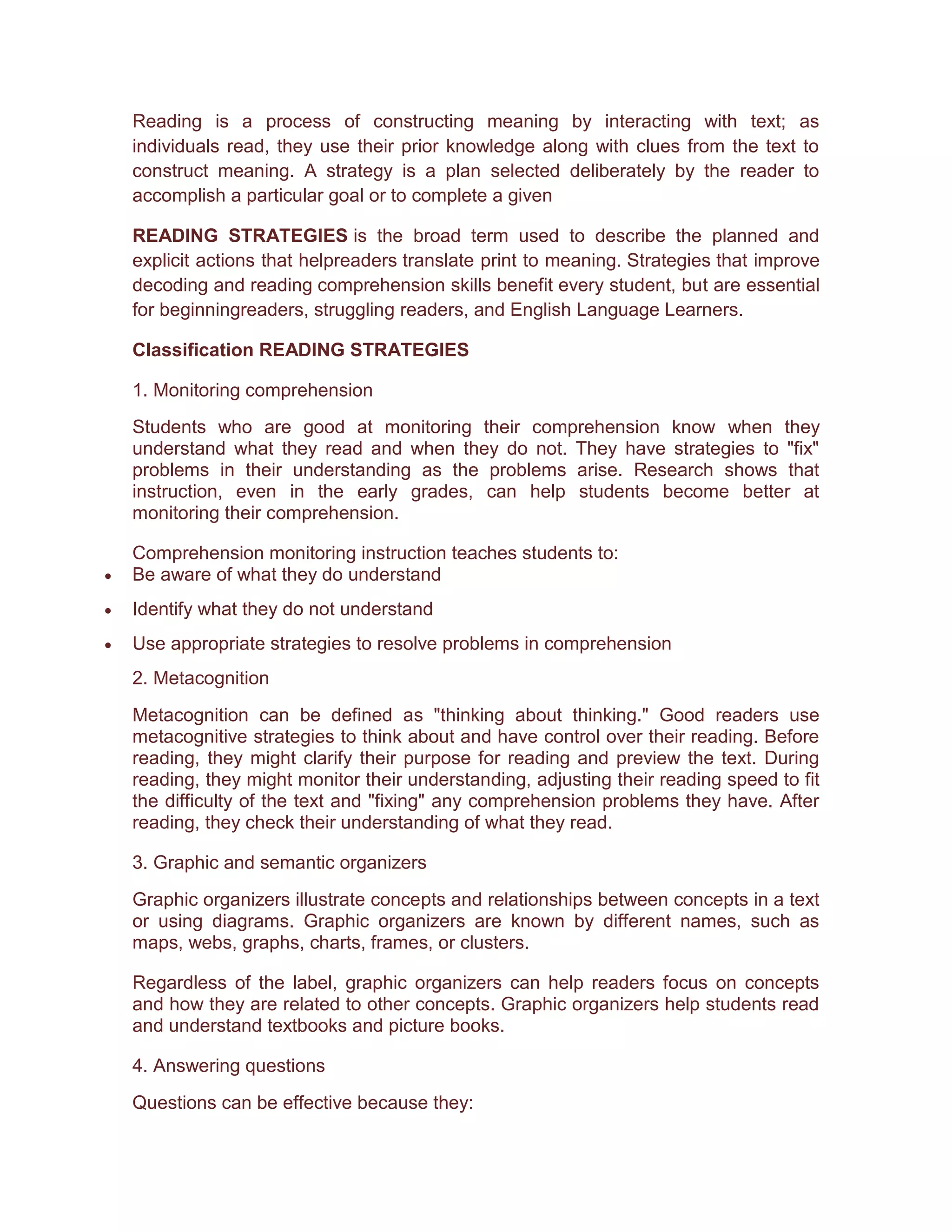
Reading is a process of constructing meaning by interacting with text; as
individuals read, they use their prior knowledge along with clues from the text to
construct meaning. A strategy is a plan selected deliberately by the reader to
accomplish a particular goal or to complete a given
READING STRATEGIES is the broad term used to describe the planned and
explicit actions that helpreaders translate print to meaning. Strategies that improve
decoding and reading comprehension skills benefit every student, but are essential
for beginningreaders, struggling readers, and English Language Learners.
Classification READING STRATEGIES
1. Monitoring comprehension
Students who are good at monitoring their comprehension know when they
understand what they read and when they do not. They have strategies to "fix"
problems in their understanding as the problems arise. Research shows that
instruction, even in the early grades, can help students become better at
monitoring their comprehension.
Comprehension monitoring instruction teaches students to:
 Be aware of what they do understand
 Identify what they do not understand
 Use appropriate strategies to resolve problems in comprehension
2. Metacognition
Metacognition can be defined as "thinking about thinking." Good readers use
metacognitive strategies to think about and have control over their reading. Before
reading, they might clarify their purpose for reading and preview the text. During
reading, they might monitor their understanding, adjusting their reading speed to fit
the difficulty of the text and "fixing" any comprehension problems they have. After
reading, they check their understanding of what they read.
3. Graphic and semantic organizers
Graphic organizers illustrate concepts and relationships between concepts in a text
or using diagrams. Graphic organizers are known by different names, such as
maps, webs, graphs, charts, frames, or clusters.
Regardless of the label, graphic organizers can help readers focus on concepts
and how they are related to other concepts. Graphic organizers help students read
and understand textbooks and picture books.
4. Answering questions
Questions can be effective because they:
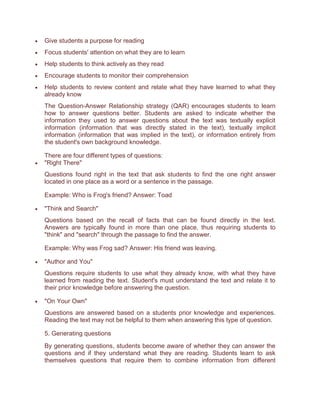
 Give students a purpose for reading
 Focus students' attention on what they are to learn
 Help students to think actively as they read
 Encourage students to monitor their comprehension
 Help students to review content and relate what they have learned to what they
already know
The Question-Answer Relationship strategy (QAR) encourages students to learn
how to answer questions better. Students are asked to indicate whether the
information they used to answer questions about the text was textually explicit
information (information that was directly stated in the text), textually implicit
information (information that was implied in the text), or information entirely from
the student's own background knowledge.
There are four different types of questions:
 "Right There"
Questions found right in the text that ask students to find the one right answer
located in one place as a word or a sentence in the passage.
Example: Who is Frog's friend? Answer: Toad
 "Think and Search"
Questions based on the recall of facts that can be found directly in the text.
Answers are typically found in more than one place, thus requiring students to
"think" and "search" through the passage to find the answer.
Example: Why was Frog sad? Answer: His friend was leaving.
 "Author and You"
Questions require students to use what they already know, with what they have
learned from reading the text. Student's must understand the text and relate it to
their prior knowledge before answering the question.
 "On Your Own"
Questions are answered based on a students prior knowledge and experiences.
Reading the text may not be helpful to them when answering this type of question.
5. Generating questions
By generating questions, students become aware of whether they can answer the
questions and if they understand what they are reading. Students learn to ask
themselves questions that require them to combine information from different
segments of text. For example, students can be taught to ask main idea questions
that relate to important information in a text.
6. Recognizing structure
In structure instruction, students learn to identify the categories of content
(characters, setting, events, problem, resolution). Often, students learn to
recognize story structure through the use of story maps. Instruction in story
structure improves students' comprehension.
7. Summarizing
Summarizing requires students to determine what is important in what they are
reading and to put it into their own words. Instruction in summarizing helps
students:
 Identify or generate main ideas
 Connect the main or central ideas
 Eliminate unnecessary information
 Remember what they read
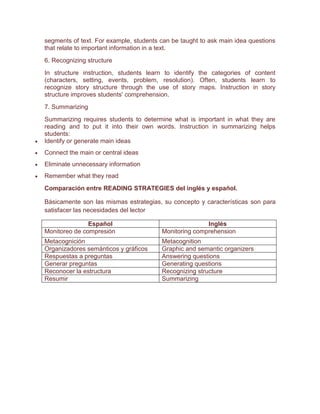
Comparación entre READING STRATEGIES del inglés y español.
Básicamente son las mismas estrategias, su concepto y características son para
satisfacer las necesidades del lector
Español Inglés
Monitoreo de compresión Monitoring comprehension
Metacognición Metacognition
Organizadores semánticos y gráficos Graphic and semantic organizers
Respuestas a preguntas Answering questions
Generar preguntas Generating questions
Reconocer la estructura Recognizing structure
Resumir Summarizing

Yusneidy Zambrano

  • 1.
    Reading is aprocess of constructing meaning by interacting with text; as individuals read, they use their prior knowledge along with clues from the text to construct meaning. A strategy is a plan selected deliberately by the reader to accomplish a particular goal or to complete a given READING STRATEGIES is the broad term used to describe the planned and explicit actions that helpreaders translate print to meaning. Strategies that improve decoding and reading comprehension skills benefit every student, but are essential for beginningreaders, struggling readers, and English Language Learners. Classification READING STRATEGIES 1. Monitoring comprehension Students who are good at monitoring their comprehension know when they understand what they read and when they do not. They have strategies to "fix" problems in their understanding as the problems arise. Research shows that instruction, even in the early grades, can help students become better at monitoring their comprehension. Comprehension monitoring instruction teaches students to:  Be aware of what they do understand  Identify what they do not understand  Use appropriate strategies to resolve problems in comprehension 2. Metacognition Metacognition can be defined as "thinking about thinking." Good readers use metacognitive strategies to think about and have control over their reading. Before reading, they might clarify their purpose for reading and preview the text. During reading, they might monitor their understanding, adjusting their reading speed to fit the difficulty of the text and "fixing" any comprehension problems they have. After reading, they check their understanding of what they read. 3. Graphic and semantic organizers Graphic organizers illustrate concepts and relationships between concepts in a text or using diagrams. Graphic organizers are known by different names, such as maps, webs, graphs, charts, frames, or clusters. Regardless of the label, graphic organizers can help readers focus on concepts and how they are related to other concepts. Graphic organizers help students read and understand textbooks and picture books. 4. Answering questions Questions can be effective because they:
  • 2.
     Give studentsa purpose for reading  Focus students' attention on what they are to learn  Help students to think actively as they read  Encourage students to monitor their comprehension  Help students to review content and relate what they have learned to what they already know The Question-Answer Relationship strategy (QAR) encourages students to learn how to answer questions better. Students are asked to indicate whether the information they used to answer questions about the text was textually explicit information (information that was directly stated in the text), textually implicit information (information that was implied in the text), or information entirely from the student's own background knowledge. There are four different types of questions:  "Right There" Questions found right in the text that ask students to find the one right answer located in one place as a word or a sentence in the passage. Example: Who is Frog's friend? Answer: Toad  "Think and Search" Questions based on the recall of facts that can be found directly in the text. Answers are typically found in more than one place, thus requiring students to "think" and "search" through the passage to find the answer. Example: Why was Frog sad? Answer: His friend was leaving.  "Author and You" Questions require students to use what they already know, with what they have learned from reading the text. Student's must understand the text and relate it to their prior knowledge before answering the question.  "On Your Own" Questions are answered based on a students prior knowledge and experiences. Reading the text may not be helpful to them when answering this type of question. 5. Generating questions By generating questions, students become aware of whether they can answer the questions and if they understand what they are reading. Students learn to ask themselves questions that require them to combine information from different
  • 3.
    segments of text.For example, students can be taught to ask main idea questions that relate to important information in a text. 6. Recognizing structure In structure instruction, students learn to identify the categories of content (characters, setting, events, problem, resolution). Often, students learn to recognize story structure through the use of story maps. Instruction in story structure improves students' comprehension. 7. Summarizing Summarizing requires students to determine what is important in what they are reading and to put it into their own words. Instruction in summarizing helps students:  Identify or generate main ideas  Connect the main or central ideas  Eliminate unnecessary information  Remember what they read Comparación entre READING STRATEGIES del inglés y español. Básicamente son las mismas estrategias, su concepto y características son para satisfacer las necesidades del lector Español Inglés Monitoreo de compresión Monitoring comprehension Metacognición Metacognition Organizadores semánticos y gráficos Graphic and semantic organizers Respuestas a preguntas Answering questions Generar preguntas Generating questions Reconocer la estructura Recognizing structure Resumir Summarizing