DEVELOPING LISTENING AND
READING COMPREHENSION
GERLIE M. DOMINGO
Teacher III
Listening Comprehension
is a complex and active process in
which vocabulary knowledge is a
crucial component and which requires
an intentional and thoughtful
interaction between the listener and
the text.
Factors That Affect Listening &
Reading Comprehension
 Schema (or prior knowledge) is a collection
of information in our brains that contains
related concepts, events, emotions, and
roles taken from our life experiences
 Vocabulary is the knowledge of words and
their meaning.
Other Factors that Affect Listening and
Reading
 Physiological Factors
 Intellectual Factors
 Psychological Factors
 Linguistic Factors
 Sociological Factors
Strategies to Improve Listening
Comprehension (Palmer, 2004)
 Connect. Ask questions to make the students think of
things that they already know about the topic.
(Motivation – integrative question)
 Talk about new words. Select vocabulary from the text
that you think the students will have a difficult time
understanding.
 Predict. Guide the students to make guesses about what
they may learn as they listen.
Before-Listening Strategies
Consider this…
At the Bus Stop
Nan watches the people at the bus stop. They are
going to work. The bus comes. They get on. Then, the
bus leaves.
Nan does not get on that bus. But sometimes she
wishes she did. It could be fun to work.
Then, the school bus comes. Nan gets on. Her friends
are there. She’s happy. Another school day begins.
Strategies to Improve Listening
Comprehension (Palmer, 2004)
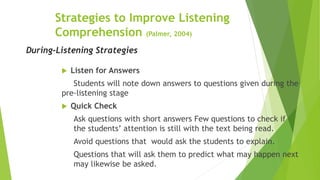
 Listen for Answers
Students will note down answers to questions given during the
pre-listening stage
 Quick Check
Ask questions with short answers Few questions to check if
the students’ attention is still with the text being read.
Avoid questions that would ask the students to explain.
Questions that will ask them to predict what may happen next
may likewise be asked.
During-Listening Strategies
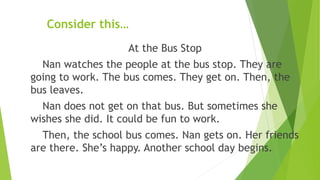
Consider this…
At the Bus Stop
Nan watches the people at the bus stop. They are
going to work. The bus comes. They get on. Then, the
bus leaves.
Nan does not get on that bus. But sometimes she
wishes she did. It could be fun to work.
Then, the school bus comes. Nan gets on. Her friends
are there. She’s happy. Another school day begins.
Strategies to Improve Listening
Comprehension (Palmer, 2004)
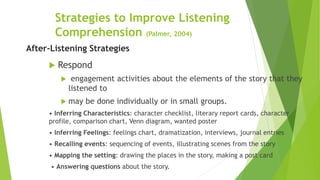
 Respond
 engagement activities about the elements of the story that they
listened to
 may be done individually or in small groups.
• Inferring Characteristics: character checklist, literary report cards, character
profile, comparison chart, Venn diagram, wanted poster
• Inferring Feelings: feelings chart, dramatization, interviews, journal entries
• Recalling events: sequencing of events, illustrating scenes from the story
• Mapping the setting: drawing the places in the story, making a post card
• Answering questions about the story.
After-Listening Strategies
Levels of Comprehension
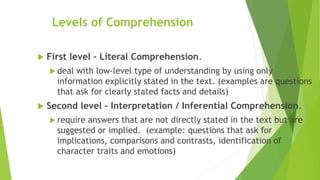
 First level – Literal Comprehension.
 deal with low-level type of understanding by using only
information explicitly stated in the text. (examples are questions
that ask for clearly stated facts and details)
 Second level – Interpretation / Inferential Comprehension.
 require answers that are not directly stated in the text but are
suggested or implied. (example: questions that ask for
implications, comparisons and contrasts, identification of
character traits and emotions)
Formulating Questions
 Third level – Evaluation / Critical Reading.
 involve making personal judgment on the text by the reader
 answers are usually based on their experiences. (examples:
evaluation of accuracy and truthfulness, discrimination of fact and
opinion, identification of the author’s purpose, evaluation of values
presented)
 Fourth level – Integration / Application to Self or Life.
 questions will involve the students to put themselves in place of the
character. These questions would bring out practical purposes and
values clarification. (example: “If you were the character in the
story…”)
Formulating Questions
 Fifth level – Creative Reading
 are questions that would involve coming up with new
ideas or reproducing the text information in other forms:
dramatizing, writing another ending, writing a letter,
musical interpretation.
Reading Comprehension
 a complex and active process in which vocabulary
knowledge is a crucial component and which requires an
intentional and thoughtful interaction between the
reader and the text.
 goals for our students in teaching reading:
“understanding,” “knowledge,” and “comprehension” in
describing our end-goal in reading (Scharer, 2012).
 reading is a message getting, problem-solving activity
(Clay, 2001 in Zoeller, 2015)
Factors Affecting Reading Comprehension
 Schema
Schema is being used by the child as he processes
concepts in the story to summarize, predict, identify
cause and effect.
 Vocabulary
Reading vocabulary are the words we need to know to
understand what we read (Armbruster, et al, National Institute for Literacy,
2003).
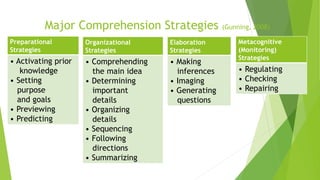
Major Comprehension Strategies (Gunning, 2008)
Preparational
Strategies
• Activating prior
knowledge
• Setting
purpose
and goals
• Previewing
• Predicting
Organizational
Strategies
• Comprehending
the main idea
• Determining
important
details
• Organizing
details
• Sequencing
• Following
directions
• Summarizing
Elaboration
Strategies
• Making
inferences
• Imaging
• Generating
questions
Metacognitive
(Monitoring)
Strategies
• Regulating
• Checking
• Repairing
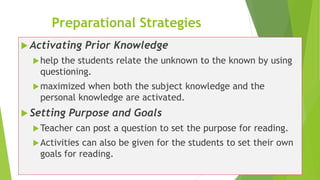
Preparational Strategies
 Activating Prior Knowledge
help the students relate the unknown to the known by using
questioning.
maximized when both the subject knowledge and the
personal knowledge are activated.
 Setting Purpose and Goals
Teacher can post a question to set the purpose for reading.
Activities can also be given for the students to set their own
goals for reading.
Preparational Strategies
 Previewing
acts as the orientation of the text to be read.
students may read the selection’s title, headings,
introduction, and summary, or may look at the illustrations
 Predicting.
activates the reader’s schema because predictions or guesses
are made on the basis of previous knowledge and experience
gives a purpose for the reader, as they would want to know if
they made correct or incorrect predictions.
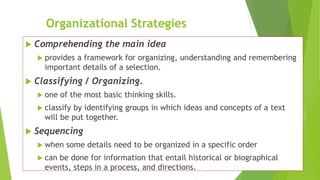
Organizational Strategies
 Comprehending the main idea
 provides a framework for organizing, understanding and remembering
important details of a selection.
 Classifying / Organizing.
 one of the most basic thinking skills.
 classify by identifying groups in which ideas and concepts of a text
will be put together.
 Sequencing
 when some details need to be organized in a specific order
 can be done for information that entail historical or biographical
events, steps in a process, and directions.
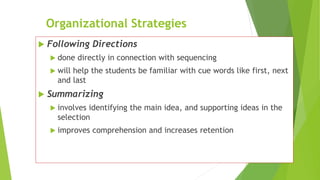
Organizational Strategies
 Following Directions
 done directly in connection with sequencing
 will help the students be familiar with cue words like first, next
and last
 Summarizing
 involves identifying the main idea, and supporting ideas in the
selection
 improves comprehension and increases retention
Elaboration Strategies
 Making Inferences
 highly influence by prior knowledge
 requires putting together two or more pieces of information from the text.
 Imaging
 Make the students create images about what they read.
 Imaging helps foster understanding, retain information, and monitoring for
meaning.
 Generating questions
 Have the students think of their own questions about the selection.
 Encourages the readers to set their own purposes for reading, as they are
transformed from being passive observers to active participants.
Metacognitive or Monitoring Strategies
 Regulating
 student knows what to read and how to read it and is able to put
that knowledge to use.”
 Checking
 students evaluate their reading performance.
 would be able to see their strengths and weaknesses when it comes
to comprehension.
 Repairing
 students take corrective action when comprehension falters.
 be able to identify the source of difficulty as well as think of ways to
address it.
Other Strategies in Developing Reading
Comprehension
Who What Where When Why
Teacher gives words, phrases or pictures of persons, things, places,
things, animals, reasons. Learners classify them by putting them under
the appropriate column. (Note: The level of difficulty should be based
on the level of the reader.)
Wh-Chart
Summarizing: From Reading to Controlled
Writing
 Reading Selection
Tony was in a pet shop. He was playing. Then,
a bird got out of its cage.
Other people were in the shop. Mrs. Olsen
looked at cats. Ruth watched the fish. But
nobody saw the bird. Where was it.
Then, Mrs. Olsen left the shop. The bird got
away. It left on Mrs. Olsen’s hat
Fill in the blank with the missing word
based on the reading selection
____________ was playing in a _________ when a
_________ got out of its cage.
Among the people in the shop are Mrs. Olsen
watching the ___________ and Ruth looking at the
________.
Nobody saw the _____________ because it fell on
the hat of __________ when she went out of the
______________.
Visualization
 A struggling reader may draw what he could imagine after reading
(the setting and the character)
 If the struggling reader can not draw, the teacher may ask the
following after the pupil read the selection:
Let us say the story is a movie you were watching while
reading:
What did you see in the story?
Did you hear something in the story? What is it?
Did you smell something from the story? Describe it.
What did you feel? Why?
Formulating Questions
 Learner formulates comprehension questions
Who ______________________________________?
What _____________________________________?
When _____________________________________?
Where _____________________________________?
Why ________________________________________
 Teacher makes the learner answer the questions and asks the pupil to which
part of the story gives the answer.
Gradual Psychological Unfolding
 developed by the late Prof. Basilisa Manhit, founder of the
Department of Reading of the University of the Philippines
 story is unraveled through a slow yet logical manner with
questions and activities prepared by the teacher
 guide or clues from the teacher enable the learners to
gradually understand the events in the story, perceive the
author’s message, determine his perception of an emotional
phenomenon or of life, and to select and assimilate values
relayed through the selection
Gradual Psychological Unfolding (GPU)
students go through all the dimensions
of reading comprehension
First Level: Knowledge or Literal Level
What is the title of the story? ƒ
Who are the characters? ƒ
Where does the grasshopper stay?
 Why does the ant save food?
Second Dimension: Compréhension or
Interprétation
Compare the grasshopper and the ant.
What words describe the ant? the
grasshopper?
What does the saying “Save for a rainy day”
mean?
Third Dimension: Application
 Do you know of anyone who is like the ant?
 Do you know of anyone who is like the
grasshopper?
 To which do you compare yourself?
Fourth Dimension: Analysis
Let the learners identify the elements
of the story (story grammar)
Let the learners determine the plot of
the story by identifying the events that
correspond to the elements of the plot.
Fifth Dimension: Synthesis
What is the message of the story?
What lesson did you learn from the
story?
Sixth Dimension: Evaluation
 ƒ
Prove that the ant did right in
storing food for the rainy day. ƒ
Did the grasshopper deserve to go
hungry? Cite reasons for your
answer.
Creative Level
If you were the ant, what would have
you done at the end of the story?
Dramatize it.
Write an original slogan that tells the
message of the story.
Our CREED
I will give a child a gift that lasts forever, the GIFT
OF READING AND WRITING.
I will open eyes and ignite dreams with stories that
make children feel, grow, think, learn, and love.
Nothing will stop me, because my heart knows the
POWER OF READING AND WRITING.
To this, I commit myself.

SLAC-Reading-Comprehension.pptx

  • 1.
    DEVELOPING LISTENING AND READINGCOMPREHENSION GERLIE M. DOMINGO Teacher III
  • 2.
    Listening Comprehension is acomplex and active process in which vocabulary knowledge is a crucial component and which requires an intentional and thoughtful interaction between the listener and the text.
  • 3.
    Factors That AffectListening & Reading Comprehension  Schema (or prior knowledge) is a collection of information in our brains that contains related concepts, events, emotions, and roles taken from our life experiences  Vocabulary is the knowledge of words and their meaning.
  • 4.
    Other Factors thatAffect Listening and Reading  Physiological Factors  Intellectual Factors  Psychological Factors  Linguistic Factors  Sociological Factors
  • 5.
    Strategies to ImproveListening Comprehension (Palmer, 2004)  Connect. Ask questions to make the students think of things that they already know about the topic. (Motivation – integrative question)  Talk about new words. Select vocabulary from the text that you think the students will have a difficult time understanding.  Predict. Guide the students to make guesses about what they may learn as they listen. Before-Listening Strategies
  • 6.
    Consider this… At theBus Stop Nan watches the people at the bus stop. They are going to work. The bus comes. They get on. Then, the bus leaves. Nan does not get on that bus. But sometimes she wishes she did. It could be fun to work. Then, the school bus comes. Nan gets on. Her friends are there. She’s happy. Another school day begins.
  • 7.
    Strategies to ImproveListening Comprehension (Palmer, 2004)  Listen for Answers Students will note down answers to questions given during the pre-listening stage  Quick Check Ask questions with short answers Few questions to check if the students’ attention is still with the text being read. Avoid questions that would ask the students to explain. Questions that will ask them to predict what may happen next may likewise be asked. During-Listening Strategies
  • 8.
    Consider this… At theBus Stop Nan watches the people at the bus stop. They are going to work. The bus comes. They get on. Then, the bus leaves. Nan does not get on that bus. But sometimes she wishes she did. It could be fun to work. Then, the school bus comes. Nan gets on. Her friends are there. She’s happy. Another school day begins.
  • 9.
    Strategies to ImproveListening Comprehension (Palmer, 2004)  Respond  engagement activities about the elements of the story that they listened to  may be done individually or in small groups. • Inferring Characteristics: character checklist, literary report cards, character profile, comparison chart, Venn diagram, wanted poster • Inferring Feelings: feelings chart, dramatization, interviews, journal entries • Recalling events: sequencing of events, illustrating scenes from the story • Mapping the setting: drawing the places in the story, making a post card • Answering questions about the story. After-Listening Strategies
  • 10.
    Levels of Comprehension First level – Literal Comprehension.  deal with low-level type of understanding by using only information explicitly stated in the text. (examples are questions that ask for clearly stated facts and details)  Second level – Interpretation / Inferential Comprehension.  require answers that are not directly stated in the text but are suggested or implied. (example: questions that ask for implications, comparisons and contrasts, identification of character traits and emotions)
  • 11.
    Formulating Questions  Thirdlevel – Evaluation / Critical Reading.  involve making personal judgment on the text by the reader  answers are usually based on their experiences. (examples: evaluation of accuracy and truthfulness, discrimination of fact and opinion, identification of the author’s purpose, evaluation of values presented)  Fourth level – Integration / Application to Self or Life.  questions will involve the students to put themselves in place of the character. These questions would bring out practical purposes and values clarification. (example: “If you were the character in the story…”)
  • 12.
    Formulating Questions  Fifthlevel – Creative Reading  are questions that would involve coming up with new ideas or reproducing the text information in other forms: dramatizing, writing another ending, writing a letter, musical interpretation.
  • 13.
    Reading Comprehension  acomplex and active process in which vocabulary knowledge is a crucial component and which requires an intentional and thoughtful interaction between the reader and the text.  goals for our students in teaching reading: “understanding,” “knowledge,” and “comprehension” in describing our end-goal in reading (Scharer, 2012).  reading is a message getting, problem-solving activity (Clay, 2001 in Zoeller, 2015)
  • 14.
    Factors Affecting ReadingComprehension  Schema Schema is being used by the child as he processes concepts in the story to summarize, predict, identify cause and effect.  Vocabulary Reading vocabulary are the words we need to know to understand what we read (Armbruster, et al, National Institute for Literacy, 2003).
  • 15.
    Major Comprehension Strategies(Gunning, 2008) Preparational Strategies • Activating prior knowledge • Setting purpose and goals • Previewing • Predicting Organizational Strategies • Comprehending the main idea • Determining important details • Organizing details • Sequencing • Following directions • Summarizing Elaboration Strategies • Making inferences • Imaging • Generating questions Metacognitive (Monitoring) Strategies • Regulating • Checking • Repairing
  • 16.
    Preparational Strategies  ActivatingPrior Knowledge help the students relate the unknown to the known by using questioning. maximized when both the subject knowledge and the personal knowledge are activated.  Setting Purpose and Goals Teacher can post a question to set the purpose for reading. Activities can also be given for the students to set their own goals for reading.
  • 17.
    Preparational Strategies  Previewing actsas the orientation of the text to be read. students may read the selection’s title, headings, introduction, and summary, or may look at the illustrations  Predicting. activates the reader’s schema because predictions or guesses are made on the basis of previous knowledge and experience gives a purpose for the reader, as they would want to know if they made correct or incorrect predictions.
  • 18.
    Organizational Strategies  Comprehendingthe main idea  provides a framework for organizing, understanding and remembering important details of a selection.  Classifying / Organizing.  one of the most basic thinking skills.  classify by identifying groups in which ideas and concepts of a text will be put together.  Sequencing  when some details need to be organized in a specific order  can be done for information that entail historical or biographical events, steps in a process, and directions.
  • 19.
    Organizational Strategies  FollowingDirections  done directly in connection with sequencing  will help the students be familiar with cue words like first, next and last  Summarizing  involves identifying the main idea, and supporting ideas in the selection  improves comprehension and increases retention
  • 20.
    Elaboration Strategies  MakingInferences  highly influence by prior knowledge  requires putting together two or more pieces of information from the text.  Imaging  Make the students create images about what they read.  Imaging helps foster understanding, retain information, and monitoring for meaning.  Generating questions  Have the students think of their own questions about the selection.  Encourages the readers to set their own purposes for reading, as they are transformed from being passive observers to active participants.
  • 21.
    Metacognitive or MonitoringStrategies  Regulating  student knows what to read and how to read it and is able to put that knowledge to use.”  Checking  students evaluate their reading performance.  would be able to see their strengths and weaknesses when it comes to comprehension.  Repairing  students take corrective action when comprehension falters.  be able to identify the source of difficulty as well as think of ways to address it.
  • 22.
    Other Strategies inDeveloping Reading Comprehension Who What Where When Why Teacher gives words, phrases or pictures of persons, things, places, things, animals, reasons. Learners classify them by putting them under the appropriate column. (Note: The level of difficulty should be based on the level of the reader.) Wh-Chart
  • 23.
    Summarizing: From Readingto Controlled Writing  Reading Selection Tony was in a pet shop. He was playing. Then, a bird got out of its cage. Other people were in the shop. Mrs. Olsen looked at cats. Ruth watched the fish. But nobody saw the bird. Where was it. Then, Mrs. Olsen left the shop. The bird got away. It left on Mrs. Olsen’s hat
  • 24.
    Fill in theblank with the missing word based on the reading selection ____________ was playing in a _________ when a _________ got out of its cage. Among the people in the shop are Mrs. Olsen watching the ___________ and Ruth looking at the ________. Nobody saw the _____________ because it fell on the hat of __________ when she went out of the ______________.
  • 25.
    Visualization  A strugglingreader may draw what he could imagine after reading (the setting and the character)  If the struggling reader can not draw, the teacher may ask the following after the pupil read the selection: Let us say the story is a movie you were watching while reading: What did you see in the story? Did you hear something in the story? What is it? Did you smell something from the story? Describe it. What did you feel? Why?
  • 26.
    Formulating Questions  Learnerformulates comprehension questions Who ______________________________________? What _____________________________________? When _____________________________________? Where _____________________________________? Why ________________________________________  Teacher makes the learner answer the questions and asks the pupil to which part of the story gives the answer.
  • 27.
    Gradual Psychological Unfolding developed by the late Prof. Basilisa Manhit, founder of the Department of Reading of the University of the Philippines  story is unraveled through a slow yet logical manner with questions and activities prepared by the teacher  guide or clues from the teacher enable the learners to gradually understand the events in the story, perceive the author’s message, determine his perception of an emotional phenomenon or of life, and to select and assimilate values relayed through the selection
  • 28.
    Gradual Psychological Unfolding(GPU) students go through all the dimensions of reading comprehension
  • 29.
    First Level: Knowledgeor Literal Level What is the title of the story? ƒ Who are the characters? ƒ Where does the grasshopper stay?  Why does the ant save food?
  • 30.
    Second Dimension: Compréhensionor Interprétation Compare the grasshopper and the ant. What words describe the ant? the grasshopper? What does the saying “Save for a rainy day” mean?
  • 31.
    Third Dimension: Application Do you know of anyone who is like the ant?  Do you know of anyone who is like the grasshopper?  To which do you compare yourself?
  • 32.
    Fourth Dimension: Analysis Letthe learners identify the elements of the story (story grammar) Let the learners determine the plot of the story by identifying the events that correspond to the elements of the plot.
  • 33.
    Fifth Dimension: Synthesis Whatis the message of the story? What lesson did you learn from the story?
  • 34.
    Sixth Dimension: Evaluation ƒ Prove that the ant did right in storing food for the rainy day. ƒ Did the grasshopper deserve to go hungry? Cite reasons for your answer.
  • 35.
    Creative Level If youwere the ant, what would have you done at the end of the story? Dramatize it. Write an original slogan that tells the message of the story.
  • 36.
    Our CREED I willgive a child a gift that lasts forever, the GIFT OF READING AND WRITING. I will open eyes and ignite dreams with stories that make children feel, grow, think, learn, and love. Nothing will stop me, because my heart knows the POWER OF READING AND WRITING. To this, I commit myself.