John Devlin MBA FCCA https://au.linkedin.com/in/JohnDevlinSydney
Strategic positioning and its
implications for performance
measurement
John Devlin, MBA, FCCA
https://au.linkedin.com/in/JohnDevlinSydney
John Devlin MBA FCCA https://au.linkedin.com/in/JohnDevlinSydney
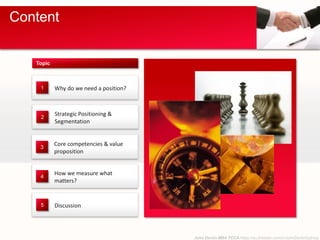
Content
Why do we need a position?
Topic
1
Strategic Positioning &
Segmentation
2
Core competencies & value
proposition
3
How we measure what
matters?
4
Discussion5
John Devlin MBA FCCA https://au.linkedin.com/in/JohnDevlinSydney
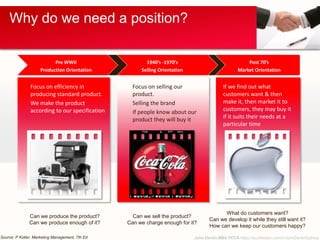
Why do we need a position?
Pre WWII
Production Orientation
Focus on efficiency in
producing standard product.
We make the product
according to our specification
1940’s -1970’s
Selling Orientation
Post 70’s
Market Orientation
Focus on selling our
product.
Selling the brand
If people know about our
product they will buy it
If we find out what
customers want & then
make it, then market it to
customers, they may buy it
if it suits their needs at a
particular time
Source: P Kotler, Marketing Management, 7th Ed
Can we produce the product?
Can we produce enough of it?
Can we sell the product?
Can we charge enough for it?
What do customers want?
Can we develop it while they still want it?
How can we keep our customers happy?
John Devlin MBA FCCA https://au.linkedin.com/in/JohnDevlinSydney
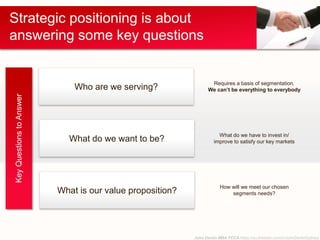
Strategic positioning is about
answering some key questions
KeyQuestionstoAnswer
Who are we serving?
What do we want to be?
What is our value proposition?
Requires a basis of segmentation.
We can’t be everything to everybody
What do we have to invest in/
improve to satisfy our key markets
How will we meet our chosen
segments needs?
John Devlin MBA FCCA https://au.linkedin.com/in/JohnDevlinSydney
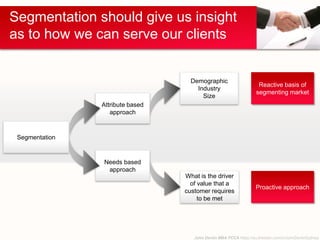
Demographic
Industry
Size
Needs based
approach
Attribute based
approach
Segmentation should give us insight
as to how we can serve our clients
Segmentation
Reactive basis of
segmenting market
Proactive approach
What is the driver
of value that a
customer requires
to be met
John Devlin MBA FCCA https://au.linkedin.com/in/JohnDevlinSydney
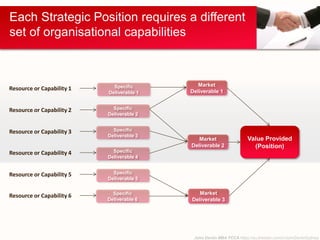
Each Strategic Position requires a different
set of organisational capabilities
Value Provided
(Position)
Market
Deliverable 1
Market
Deliverable 2
Market
Deliverable 3
Specific
Deliverable 1
Specific
Deliverable 2
Specific
Deliverable 3
Specific
Deliverable 4
Specific
Deliverable 6
Specific
Deliverable 5
Resource or Capability 1
Resource or Capability 2
Resource or Capability 3
Resource or Capability 4
Resource or Capability 6
Resource or Capability 5
John Devlin MBA FCCA https://au.linkedin.com/in/JohnDevlinSydney
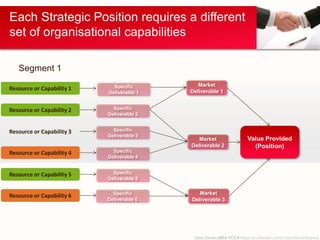
Each Strategic Position requires a different
set of organisational capabilities
Value Provided
(Position)
Market
Deliverable 1
Market
Deliverable 2
Market
Deliverable 3
Specific
Deliverable 1
Specific
Deliverable 2
Specific
Deliverable 3
Specific
Deliverable 4
Specific
Deliverable 6
Specific
Deliverable 5
Resource or Capability 1
Resource or Capability 2
Resource or Capability 3
Resource or Capability 4
Resource or Capability 6
Resource or Capability 5
Segment 1
John Devlin MBA FCCA https://au.linkedin.com/in/JohnDevlinSydney
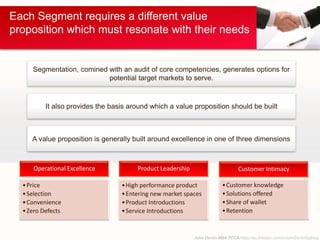
Each Segment requires a different value
proposition which must resonate with their needs
Segmentation, comined with an audit of core competencies, generates options for
potential target markets to serve.
A value proposition is generally built around excellence in one of three dimensions
Operational Excellence
•Price
•Selection
•Convenience
•Zero Defects
Product Leadership
•High performance product
•Entering new market spaces
•Product Introductions
•Service Introductions
Customer Intimacy
•Customer knowledge
•Solutions offered
•Share of wallet
•Retention
It also provides the basis around which a value proposition should be built
John Devlin MBA FCCA https://au.linkedin.com/in/JohnDevlinSydney
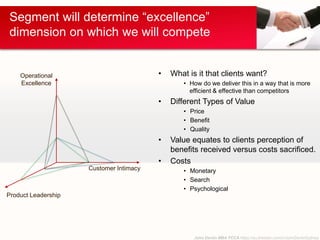
Segment will determine “excellence”
dimension on which we will compete
Operational
Excellence
Customer Intimacy
Product Leadership
• What is it that clients want?
• How do we deliver this in a way that is more
efficient & effective than competitors
• Different Types of Value
• Price
• Benefit
• Quality
• Value equates to clients perception of
benefits received versus costs sacrificed.
• Costs
• Monetary
• Search
• Psychological
John Devlin MBA FCCA https://au.linkedin.com/in/JohnDevlinSydney
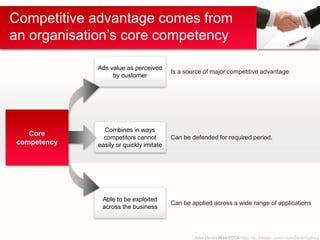
Competitive advantage comes from
an organisation’s core competency
Combines in ways
competitors cannot
easily or quickly imitate
Able to be exploited
across the business
Ads value as perceived
by customer
Core
competency
Is a source of major competitive advantage
Can be defended for required period.
Can be applied across a wide range of applications
John Devlin MBA FCCA https://au.linkedin.com/in/JohnDevlinSydney
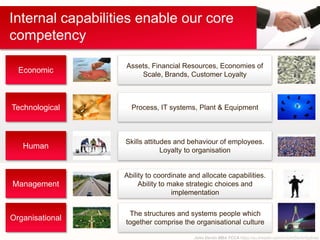
Internal capabilities enable our core
competency
Economic
Technological
Human
Management
Organisational
Assets, Financial Resources, Economies of
Scale, Brands, Customer Loyalty
Process, IT systems, Plant & Equipment
Skills attitudes and behaviour of employees.
Loyalty to organisation
Ability to coordinate and allocate capabilities.
Ability to make strategic choices and
implementation
The structures and systems people which
together comprise the organisational culture
John Devlin MBA FCCA https://au.linkedin.com/in/JohnDevlinSydney
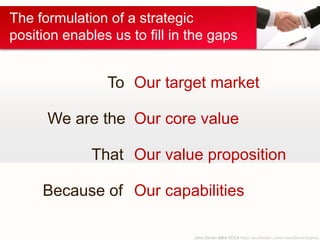
The formulation of a strategic
position enables us to fill in the gaps
We are the
To
That
Because of
Our target market
Our core value
Our value proposition
Our capabilities
John Devlin MBA FCCA https://au.linkedin.com/in/JohnDevlinSydney
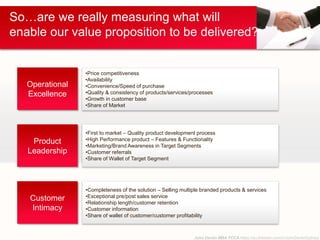
So…are we really measuring what will
enable our value proposition to be delivered?
Operational
Excellence
Product
Leadership
Customer
Intimacy
•Price competitiveness
•Availability
•Convenience/Speed of purchase
•Quality & consistency of products/services/processes
•Growth in customer base
•Share of Market
•First to market – Quality product development process
•High Performance product – Features & Functionality
•Marketing/Brand Awareness in Target Segments
•Customer referrals
•Share of Wallet of Target Segment
•Completeness of the solution – Selling multiple branded products & services
•Exceptional pre/post sales service
•Relationship length/customer retention
•Customer information
•Share of wallet of customer/customer profitability
John Devlin MBA FCCA https://au.linkedin.com/in/JohnDevlinSydney
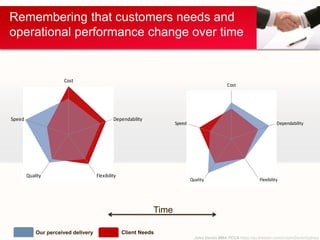
Remembering that customers needs and
operational performance change over time
Cost
Dependability
FlexibilityQuality
Speed
Our perceived delivery Client Needs
Cost
Dependability
FlexibilityQuality
Speed
Time
John Devlin MBA FCCA https://au.linkedin.com/in/JohnDevlinSydney
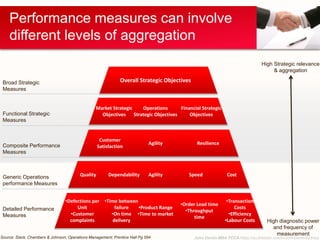
Performance measures can involve
different levels of aggregation
Broad Strategic
Measures
Functional Strategic
Measures
Composite Performance
Measures
Generic Operations
performance Measures
Detailed Performance
Measures
High Strategic relevance
& aggregation
High diagnostic power
and frequency of
measurement
Overall Strategic Objectives
Market Strategic
Objectives
Operations
Strategic Objectives
Financial Strategic
Objectives
Customer
Satisfaction
Agility Resilience
Quality Agility Speed CostDependability
•Defections per
Unit
•Customer
complaints
•Time between
failure
•On time
delivery
•Product Range
•Time to market
•Order Lead time
•Throughput
time
•Transaction
Costs
•Efficiency
•Labour Costs
Source: Slack, Chambers & Johnson; Operations Management; Prentice Hall Pg 584
John Devlin MBA FCCA https://au.linkedin.com/in/JohnDevlinSydney
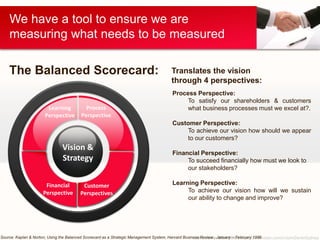
Customer
Perspectives
Financial
Perspective
Process
Perspective
Learning
Perspective
Vision &
Strategy
Process Perspective:
To satisfy our shareholders & customers
what business processes must we excel at?.
Customer Perspective:
To achieve our vision how should we appear
to our customers?
Financial Perspective:
To succeed financially how must we look to
our stakeholders?
Learning Perspective:
To achieve our vision how will we sustain
our ability to change and improve?
Translates the vision
through 4 perspectives:
Source: Kaplan & Norton; Using the Balanced Scorecard as a Strategic Management System, Harvard Business Review , January – February 1996
The Balanced Scorecard:
We have a tool to ensure we are
measuring what needs to be measured
John Devlin MBA FCCA https://au.linkedin.com/in/JohnDevlinSydney
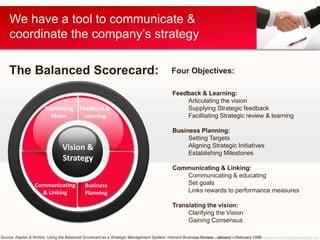
We have a tool to communicate &
coordinate the company’s strategy
Translating
Vision
Feedback &
Learning
Business
Planning
Communicating
& Linking
Vision &
Strategy
Feedback & Learning:
Articulating the vision
Supplying Strategic feedback
Facilitating Strategic review & learning
Business Planning:
Setting Targets
Aligning Strategic Initiatives
Establishing Milestones
Communicating & Linking:
Communicating & educating
Set goals
Links rewards to performance measures
Translating the vision:
Clarifying the Vision
Gaining Consensus
Four Objectives:
Source: Kaplan & Norton; Using the Balanced Scorecard as a Strategic Management System, Harvard Business Review , January – February 1996
The Balanced Scorecard:
John Devlin MBA FCCA https://au.linkedin.com/in/JohnDevlinSydney
Strategic positioning and its
implications for performance
measurement
John Devlin, MBA, FCCA
https://au.linkedin.com/in/JohnDevlinSydney

Strategic Positioning and Performance Measurement

  • 1.
    John Devlin MBAFCCA https://au.linkedin.com/in/JohnDevlinSydney Strategic positioning and its implications for performance measurement John Devlin, MBA, FCCA https://au.linkedin.com/in/JohnDevlinSydney
  • 2.
    John Devlin MBAFCCA https://au.linkedin.com/in/JohnDevlinSydney Content Why do we need a position? Topic 1 Strategic Positioning & Segmentation 2 Core competencies & value proposition 3 How we measure what matters? 4 Discussion5
  • 3.
    John Devlin MBAFCCA https://au.linkedin.com/in/JohnDevlinSydney Why do we need a position? Pre WWII Production Orientation Focus on efficiency in producing standard product. We make the product according to our specification 1940’s -1970’s Selling Orientation Post 70’s Market Orientation Focus on selling our product. Selling the brand If people know about our product they will buy it If we find out what customers want & then make it, then market it to customers, they may buy it if it suits their needs at a particular time Source: P Kotler, Marketing Management, 7th Ed Can we produce the product? Can we produce enough of it? Can we sell the product? Can we charge enough for it? What do customers want? Can we develop it while they still want it? How can we keep our customers happy?
  • 4.
    John Devlin MBAFCCA https://au.linkedin.com/in/JohnDevlinSydney Strategic positioning is about answering some key questions KeyQuestionstoAnswer Who are we serving? What do we want to be? What is our value proposition? Requires a basis of segmentation. We can’t be everything to everybody What do we have to invest in/ improve to satisfy our key markets How will we meet our chosen segments needs?
  • 5.
    John Devlin MBAFCCA https://au.linkedin.com/in/JohnDevlinSydney Demographic Industry Size Needs based approach Attribute based approach Segmentation should give us insight as to how we can serve our clients Segmentation Reactive basis of segmenting market Proactive approach What is the driver of value that a customer requires to be met
  • 6.
    John Devlin MBAFCCA https://au.linkedin.com/in/JohnDevlinSydney Each Strategic Position requires a different set of organisational capabilities Value Provided (Position) Market Deliverable 1 Market Deliverable 2 Market Deliverable 3 Specific Deliverable 1 Specific Deliverable 2 Specific Deliverable 3 Specific Deliverable 4 Specific Deliverable 6 Specific Deliverable 5 Resource or Capability 1 Resource or Capability 2 Resource or Capability 3 Resource or Capability 4 Resource or Capability 6 Resource or Capability 5
  • 7.
    John Devlin MBAFCCA https://au.linkedin.com/in/JohnDevlinSydney Each Strategic Position requires a different set of organisational capabilities Value Provided (Position) Market Deliverable 1 Market Deliverable 2 Market Deliverable 3 Specific Deliverable 1 Specific Deliverable 2 Specific Deliverable 3 Specific Deliverable 4 Specific Deliverable 6 Specific Deliverable 5 Resource or Capability 1 Resource or Capability 2 Resource or Capability 3 Resource or Capability 4 Resource or Capability 6 Resource or Capability 5 Segment 1
  • 8.
    John Devlin MBAFCCA https://au.linkedin.com/in/JohnDevlinSydney Each Segment requires a different value proposition which must resonate with their needs Segmentation, comined with an audit of core competencies, generates options for potential target markets to serve. A value proposition is generally built around excellence in one of three dimensions Operational Excellence •Price •Selection •Convenience •Zero Defects Product Leadership •High performance product •Entering new market spaces •Product Introductions •Service Introductions Customer Intimacy •Customer knowledge •Solutions offered •Share of wallet •Retention It also provides the basis around which a value proposition should be built
  • 9.
    John Devlin MBAFCCA https://au.linkedin.com/in/JohnDevlinSydney Segment will determine “excellence” dimension on which we will compete Operational Excellence Customer Intimacy Product Leadership • What is it that clients want? • How do we deliver this in a way that is more efficient & effective than competitors • Different Types of Value • Price • Benefit • Quality • Value equates to clients perception of benefits received versus costs sacrificed. • Costs • Monetary • Search • Psychological
  • 10.
    John Devlin MBAFCCA https://au.linkedin.com/in/JohnDevlinSydney Competitive advantage comes from an organisation’s core competency Combines in ways competitors cannot easily or quickly imitate Able to be exploited across the business Ads value as perceived by customer Core competency Is a source of major competitive advantage Can be defended for required period. Can be applied across a wide range of applications
  • 11.
    John Devlin MBAFCCA https://au.linkedin.com/in/JohnDevlinSydney Internal capabilities enable our core competency Economic Technological Human Management Organisational Assets, Financial Resources, Economies of Scale, Brands, Customer Loyalty Process, IT systems, Plant & Equipment Skills attitudes and behaviour of employees. Loyalty to organisation Ability to coordinate and allocate capabilities. Ability to make strategic choices and implementation The structures and systems people which together comprise the organisational culture
  • 12.
    John Devlin MBAFCCA https://au.linkedin.com/in/JohnDevlinSydney The formulation of a strategic position enables us to fill in the gaps We are the To That Because of Our target market Our core value Our value proposition Our capabilities
  • 13.
    John Devlin MBAFCCA https://au.linkedin.com/in/JohnDevlinSydney So…are we really measuring what will enable our value proposition to be delivered? Operational Excellence Product Leadership Customer Intimacy •Price competitiveness •Availability •Convenience/Speed of purchase •Quality & consistency of products/services/processes •Growth in customer base •Share of Market •First to market – Quality product development process •High Performance product – Features & Functionality •Marketing/Brand Awareness in Target Segments •Customer referrals •Share of Wallet of Target Segment •Completeness of the solution – Selling multiple branded products & services •Exceptional pre/post sales service •Relationship length/customer retention •Customer information •Share of wallet of customer/customer profitability
  • 14.
    John Devlin MBAFCCA https://au.linkedin.com/in/JohnDevlinSydney Remembering that customers needs and operational performance change over time Cost Dependability FlexibilityQuality Speed Our perceived delivery Client Needs Cost Dependability FlexibilityQuality Speed Time
  • 15.
    John Devlin MBAFCCA https://au.linkedin.com/in/JohnDevlinSydney Performance measures can involve different levels of aggregation Broad Strategic Measures Functional Strategic Measures Composite Performance Measures Generic Operations performance Measures Detailed Performance Measures High Strategic relevance & aggregation High diagnostic power and frequency of measurement Overall Strategic Objectives Market Strategic Objectives Operations Strategic Objectives Financial Strategic Objectives Customer Satisfaction Agility Resilience Quality Agility Speed CostDependability •Defections per Unit •Customer complaints •Time between failure •On time delivery •Product Range •Time to market •Order Lead time •Throughput time •Transaction Costs •Efficiency •Labour Costs Source: Slack, Chambers & Johnson; Operations Management; Prentice Hall Pg 584
  • 16.
    John Devlin MBAFCCA https://au.linkedin.com/in/JohnDevlinSydney Customer Perspectives Financial Perspective Process Perspective Learning Perspective Vision & Strategy Process Perspective: To satisfy our shareholders & customers what business processes must we excel at?. Customer Perspective: To achieve our vision how should we appear to our customers? Financial Perspective: To succeed financially how must we look to our stakeholders? Learning Perspective: To achieve our vision how will we sustain our ability to change and improve? Translates the vision through 4 perspectives: Source: Kaplan & Norton; Using the Balanced Scorecard as a Strategic Management System, Harvard Business Review , January – February 1996 The Balanced Scorecard: We have a tool to ensure we are measuring what needs to be measured
  • 17.
    John Devlin MBAFCCA https://au.linkedin.com/in/JohnDevlinSydney We have a tool to communicate & coordinate the company’s strategy Translating Vision Feedback & Learning Business Planning Communicating & Linking Vision & Strategy Feedback & Learning: Articulating the vision Supplying Strategic feedback Facilitating Strategic review & learning Business Planning: Setting Targets Aligning Strategic Initiatives Establishing Milestones Communicating & Linking: Communicating & educating Set goals Links rewards to performance measures Translating the vision: Clarifying the Vision Gaining Consensus Four Objectives: Source: Kaplan & Norton; Using the Balanced Scorecard as a Strategic Management System, Harvard Business Review , January – February 1996 The Balanced Scorecard:
  • 18.
    John Devlin MBAFCCA https://au.linkedin.com/in/JohnDevlinSydney Strategic positioning and its implications for performance measurement John Devlin, MBA, FCCA https://au.linkedin.com/in/JohnDevlinSydney