Demystifying Strategy
Author: Umair Marfani
Contributor: Atif Aziz
Have utilized multiple works on strategy and stitched them together. All the works have been cited.
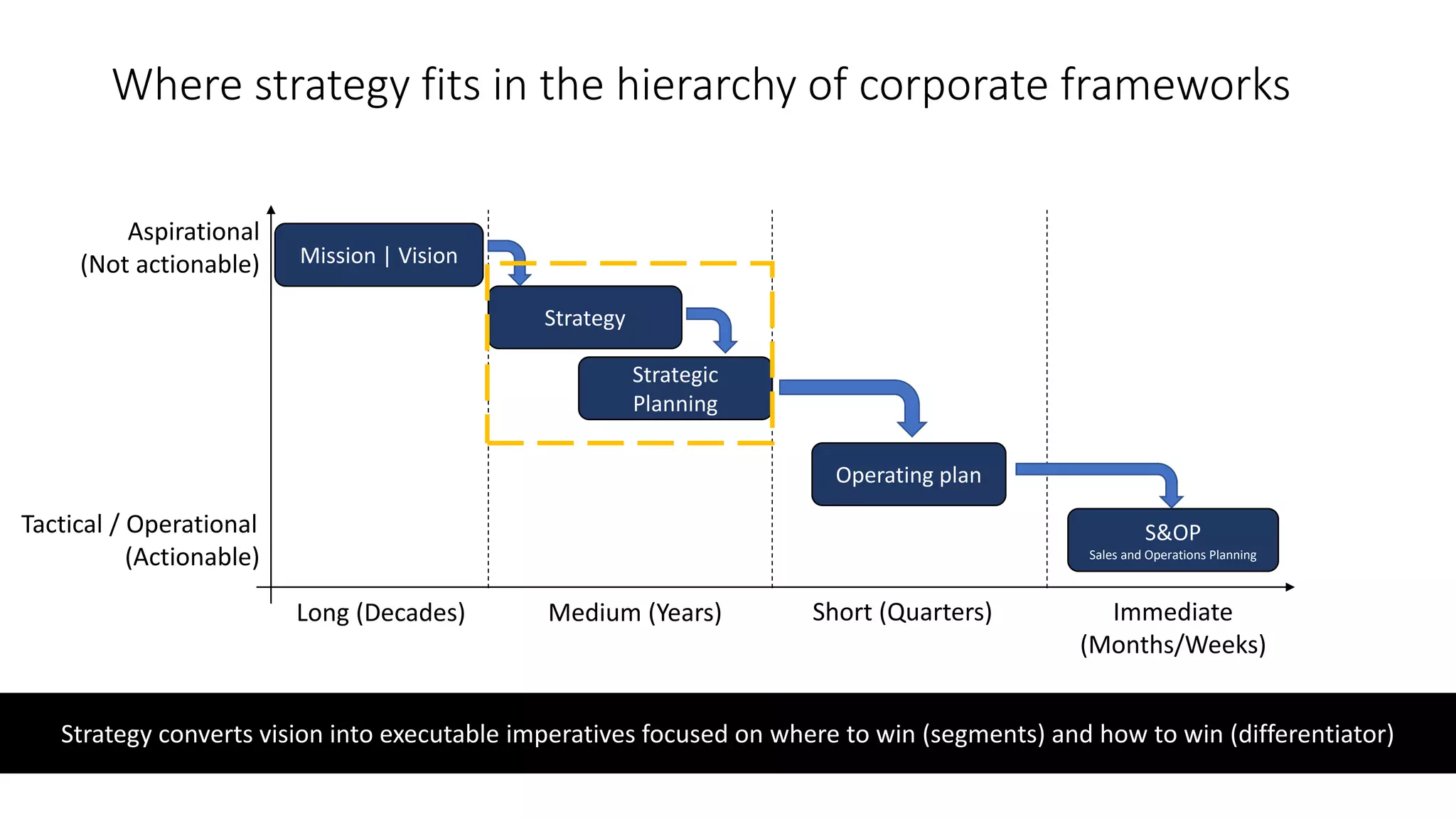
Where strategy fits in the hierarchy of corporate frameworks
Aspirational
(Not actionable)
Tactical / Operational
(Actionable)
Long (Decades) Medium (Years) Short (Quarters) Immediate
(Months/Weeks)
Mission | Vision
Strategy
Strategic
Planning
Operating plan
S&OP
Sales and Operations Planning
Strategy converts vision into executable imperatives focused on where to win (segments) and how to win (differentiator)
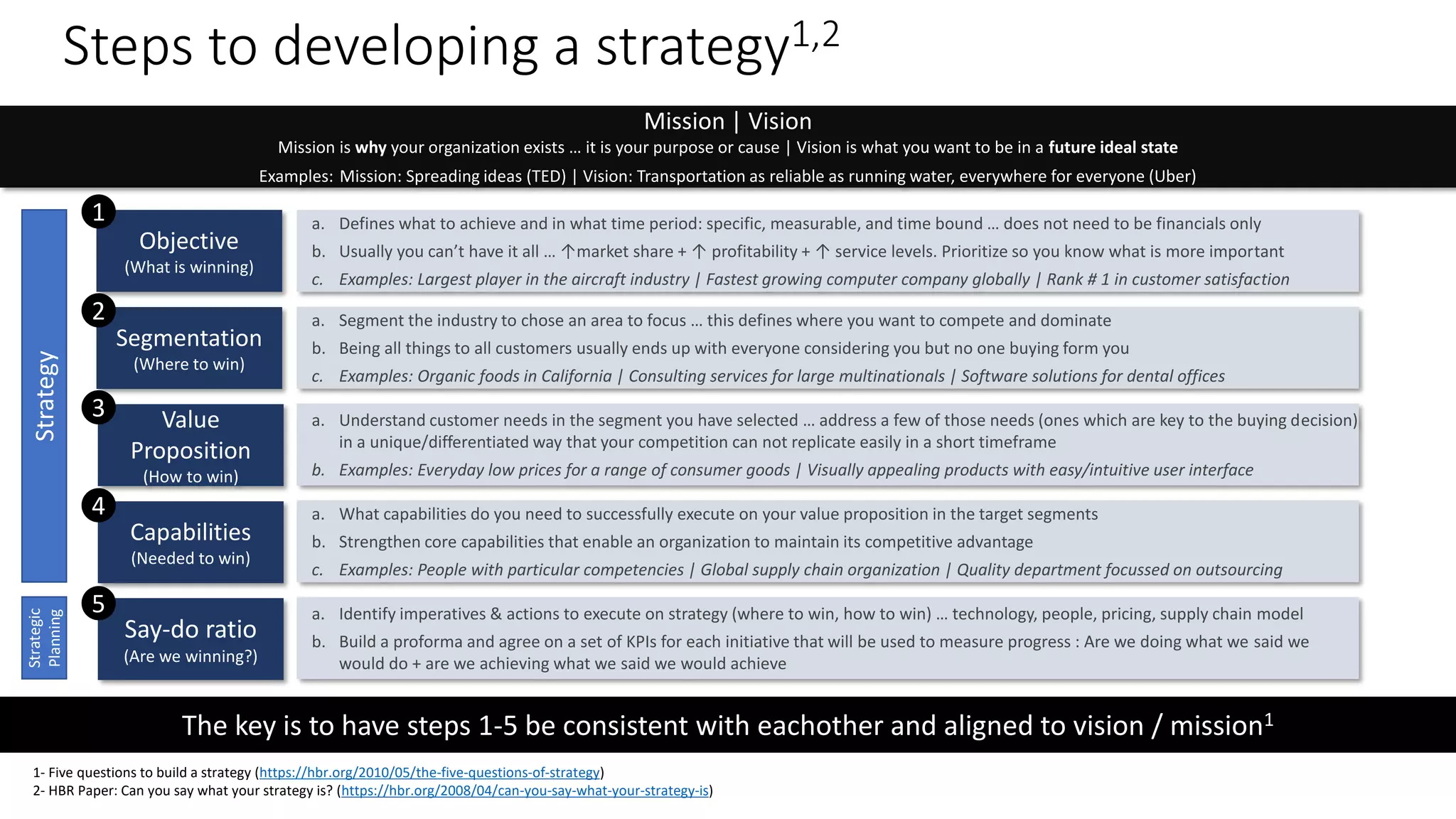
Steps to developing a strategy1,2
a. Defines what to achieve and in what time period: specific, measurable, and time bound … does not need to be financials only
b. Usually you can’t have it all … ↑market share + ↑ profitability + ↑ service levels. Prioritize so you know what is more important
c. Examples: Largest player in the aircraft industry | Fastest growing computer company globally | Rank # 1 in customer satisfaction
Objective
(What is winning)
Segmentation
(Where to win)
Value
Proposition
(How to win)
Capabilities
(Needed to win)
Say-do ratio
(Are we winning?)
a. Understand customer needs in the segment you have selected … address a few of those needs (ones which are key to the buying decision)
in a unique/differentiated way that your competition can not replicate easily in a short timeframe
b. Examples: Everyday low prices for a range of consumer goods | Visually appealing products with easy/intuitive user interface
a. Segment the industry to chose an area to focus … this defines where you want to compete and dominate
b. Being all things to all customers usually ends up with everyone considering you but no one buying form you
c. Examples: Organic foods in California | Consulting services for large multinationals | Software solutions for dental offices
a. What capabilities do you need to successfully execute on your value proposition in the target segments
b. Strengthen core capabilities that enable an organization to maintain its competitive advantage
c. Examples: People with particular competencies | Global supply chain organization | Quality department focussed on outsourcing
a. Identify imperatives & actions to execute on strategy (where to win, how to win) … technology, people, pricing, supply chain model
b. Build a proforma and agree on a set of KPIs for each initiative that will be used to measure progress : Are we doing what we said we
would do + are we achieving what we said we would achieve
The key is to have steps 1-5 be consistent with eachother and aligned to vision / mission1
1
2
3
4
5
Mission | Vision
Mission is why your organization exists … it is your purpose or cause | Vision is what you want to be in a future ideal state
Examples: Mission: Spreading ideas (TED) | Vision: Transportation as reliable as running water, everywhere for everyone (Uber)
1- Five questions to build a strategy (https://hbr.org/2010/05/the-five-questions-of-strategy)
2- HBR Paper: Can you say what your strategy is? (https://hbr.org/2008/04/can-you-say-what-your-strategy-is)
StrategyStrategic
Planning
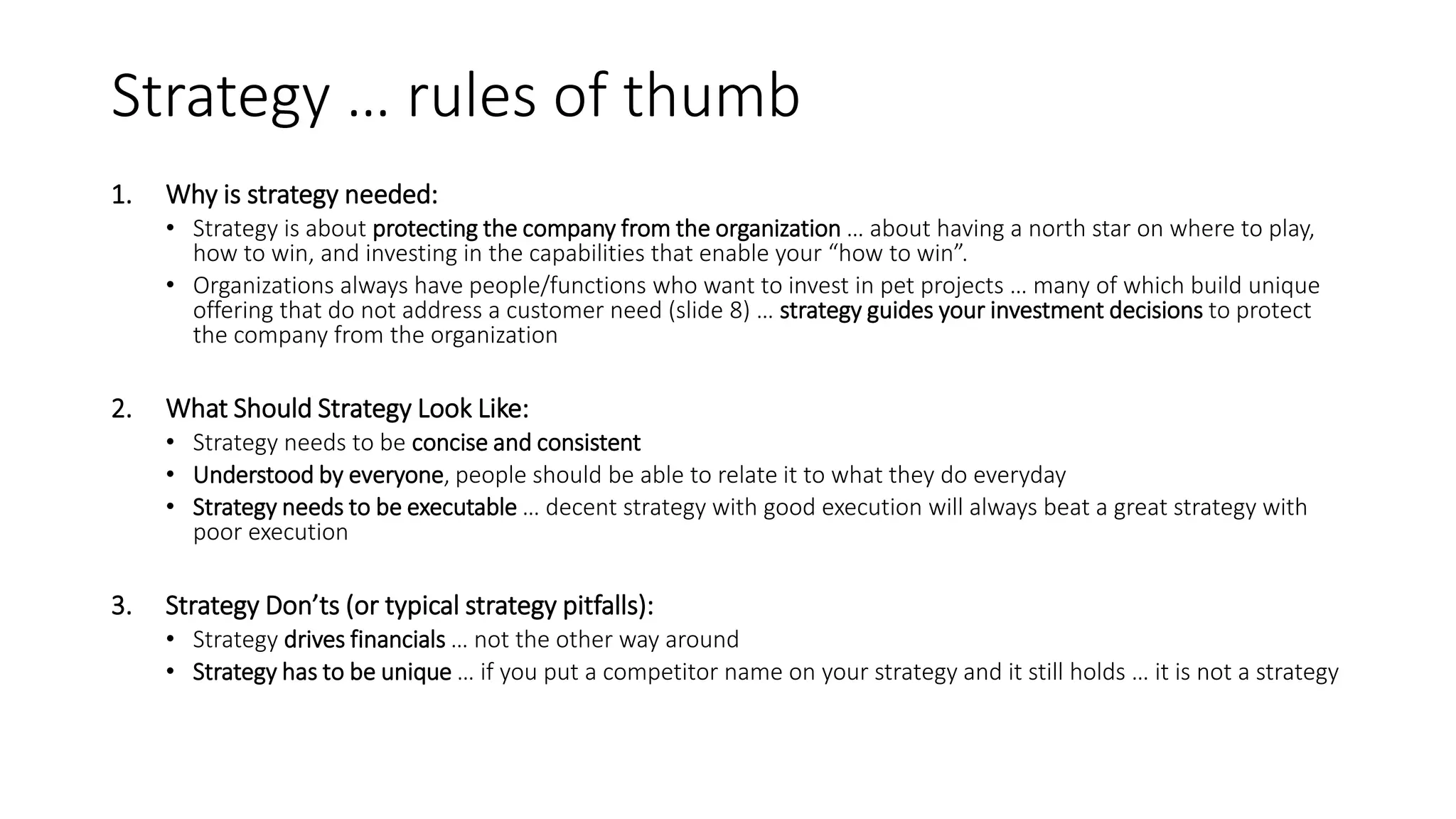
Strategy … rules of thumb
1. Why is strategy needed:
• Strategy is about protecting the company from the organization … about having a north star on where to play,
how to win, and investing in the capabilities that enable your “how to win”.
• Organizations always have people/functions who want to invest in pet projects … many of which build unique
offering that do not address a customer need (slide 8) … strategy guides your investment decisions to protect
the company from the organization
2. What Should Strategy Look Like:
• Strategy needs to be concise and consistent
• Understood by everyone, people should be able to relate it to what they do everyday
• Strategy needs to be executable … decent strategy with good execution will always beat a great strategy with
poor execution
3. Strategy Don’ts (or typical strategy pitfalls):
• Strategy drives financials … not the other way around
• Strategy has to be unique … if you put a competitor name on your strategy and it still holds … it is not a strategy
Defining each of the steps of
developing a strategy
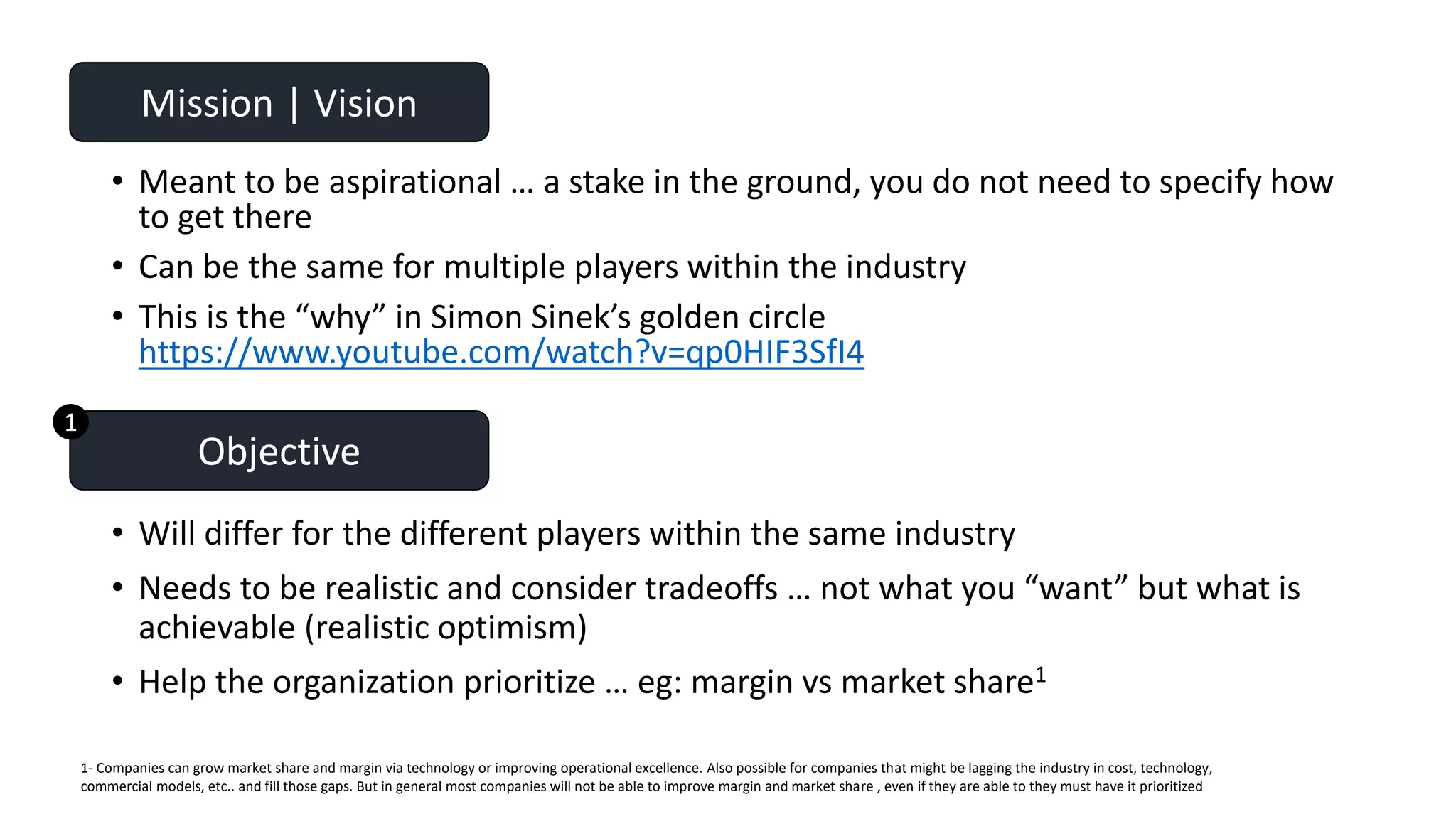
• Meant to be aspirational … a stake in the ground, you do not need to specify how
to get there
• Can be the same for multiple players within the industry
• This is the “why” in Simon Sinek’s golden circle
https://www.youtube.com/watch?v=qp0HIF3SfI4
Mission | Vision
• Will differ for the different players within the same industry
• Needs to be realistic and consider tradeoffs … not what you “want” but what is
achievable (realistic optimism)
• Help the organization prioritize … eg: margin vs market share1
Objective
1- Companies can grow market share and margin via technology or improving operational excellence. Also possible for companies that might be lagging the industry in cost, technology,
commercial models, etc.. and fill those gaps. But in general most companies will not be able to improve margin and market share , even if they are able to they must have it prioritized
1
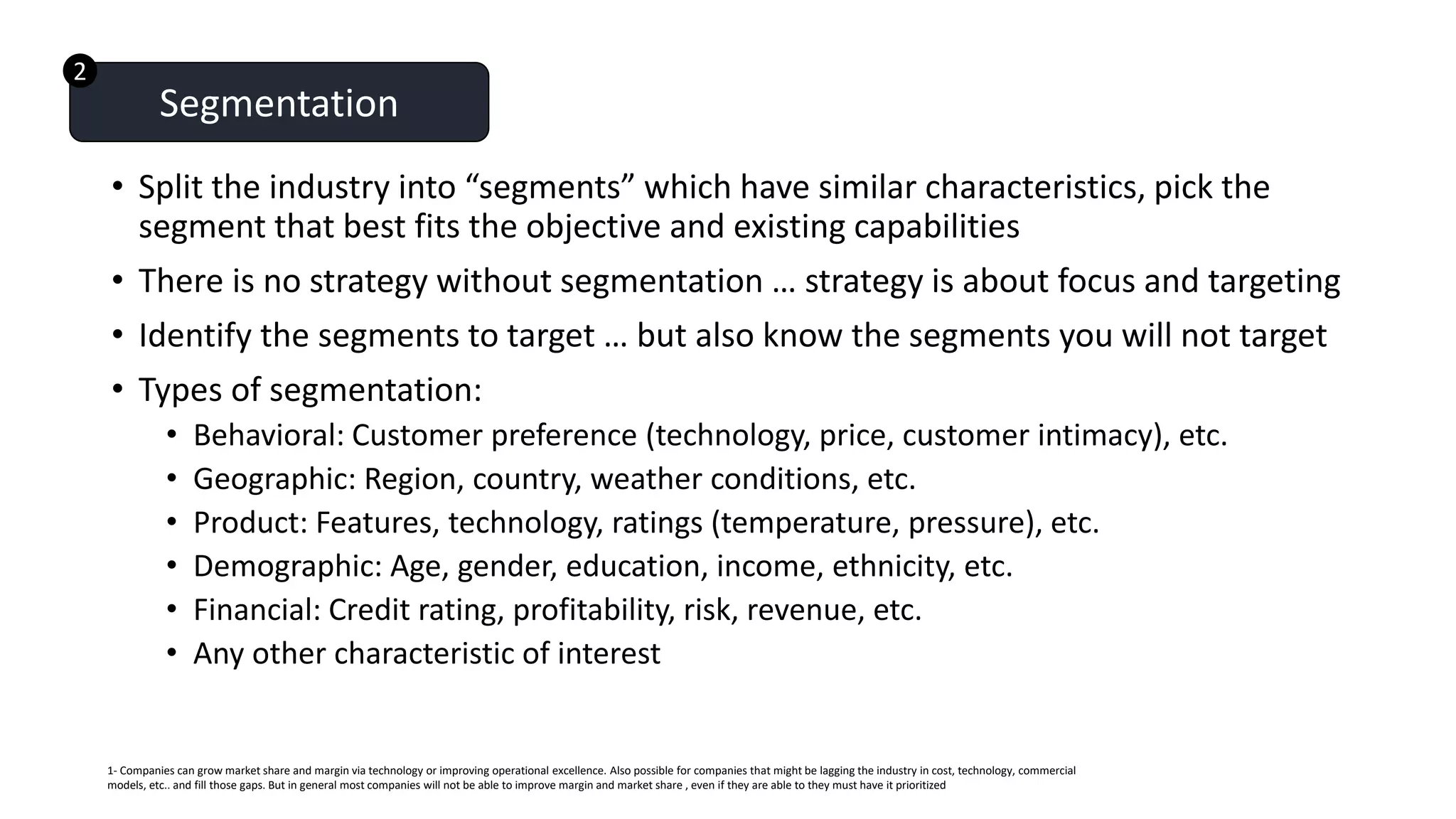
• Split the industry into “segments” which have similar characteristics, pick the
segment that best fits the objective and existing capabilities
• There is no strategy without segmentation … strategy is about focus and targeting
• Identify the segments to target … but also know the segments you will not target
• Types of segmentation:
• Behavioral: Customer preference (technology, price, customer intimacy), etc.
• Geographic: Region, country, weather conditions, etc.
• Product: Features, technology, ratings (temperature, pressure), etc.
• Demographic: Age, gender, education, income, ethnicity, etc.
• Financial: Credit rating, profitability, risk, revenue, etc.
• Any other characteristic of interest
Segmentation
1- Companies can grow market share and margin via technology or improving operational excellence. Also possible for companies that might be lagging the industry in cost, technology, commercial
models, etc.. and fill those gaps. But in general most companies will not be able to improve margin and market share , even if they are able to they must have it prioritized
2
Value Proposition
Customer
Needs
Company
Capabilities
Competitor
offering
1
1- HBR Paper: Can you say what your strategy is? (https://hbr.org/2008/04/can-you-say-what-your-strategy-is)
Company offering / capabilities
Unique Undifferentiated
CustomerNeed
Strong
Focus, this is why
customers will pick
you
Keep at satisfactory
level so it is not a
detractor
Weak
Just because it is
unique does not
mean the customer
cares about it
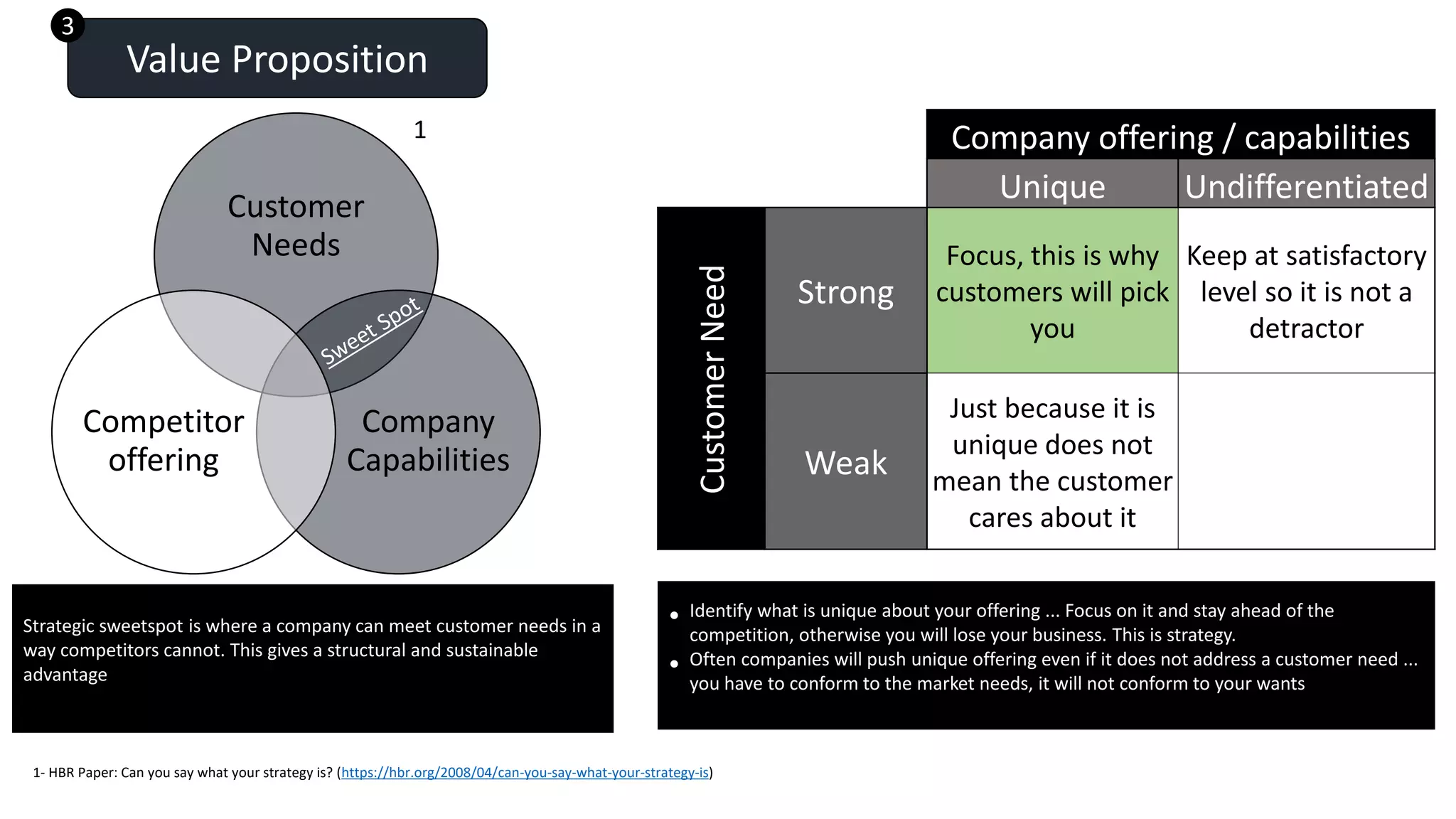
Strategic sweetspot is where a company can meet customer needs in a
way competitors cannot. This gives a structural and sustainable
advantage
• Identify what is unique about your offering ... Focus on it and stay ahead of the
competition, otherwise you will lose your business. This is strategy.
• Often companies will push unique offering even if it does not address a customer need ...
you have to conform to the market needs, it will not conform to your wants
3
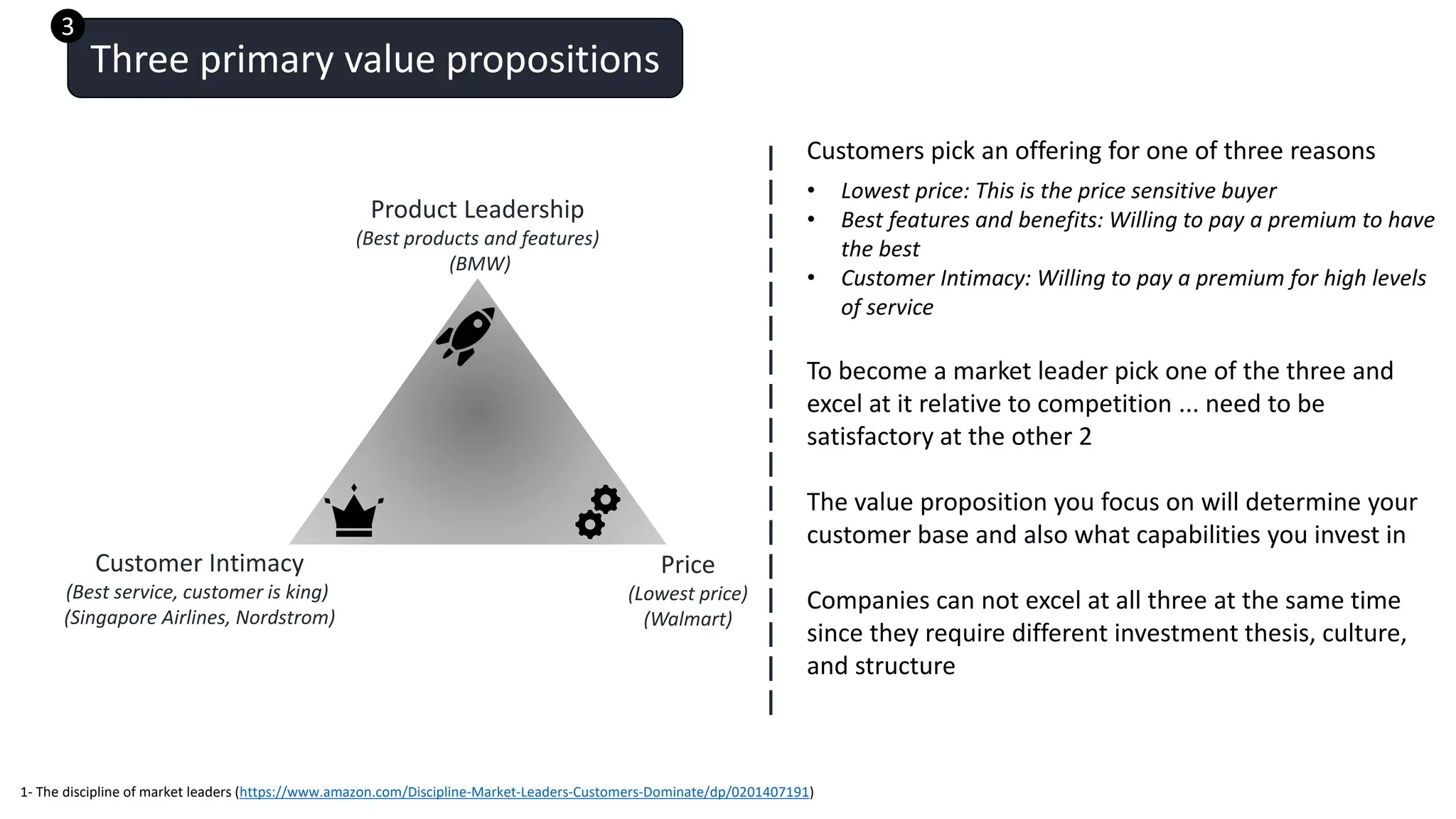
Three primary value propositions
1- The discipline of market leaders (https://www.amazon.com/Discipline-Market-Leaders-Customers-Dominate/dp/0201407191)
Product Leadership
(Best products and features)
(BMW)
Price
(Lowest price)
(Walmart)
Customer Intimacy
(Best service, customer is king)
(Singapore Airlines, Nordstrom)
Customers pick an offering for one of three reasons
• Lowest price: This is the price sensitive buyer
• Best features and benefits: Willing to pay a premium to have
the best
• Customer Intimacy: Willing to pay a premium for high levels
of service
To become a market leader pick one of the three and
excel at it relative to competition ... need to be
satisfactory at the other 2
The value proposition you focus on will determine your
customer base and also what capabilities you invest in
Companies can not excel at all three at the same time
since they require different investment thesis, culture,
and structure
3
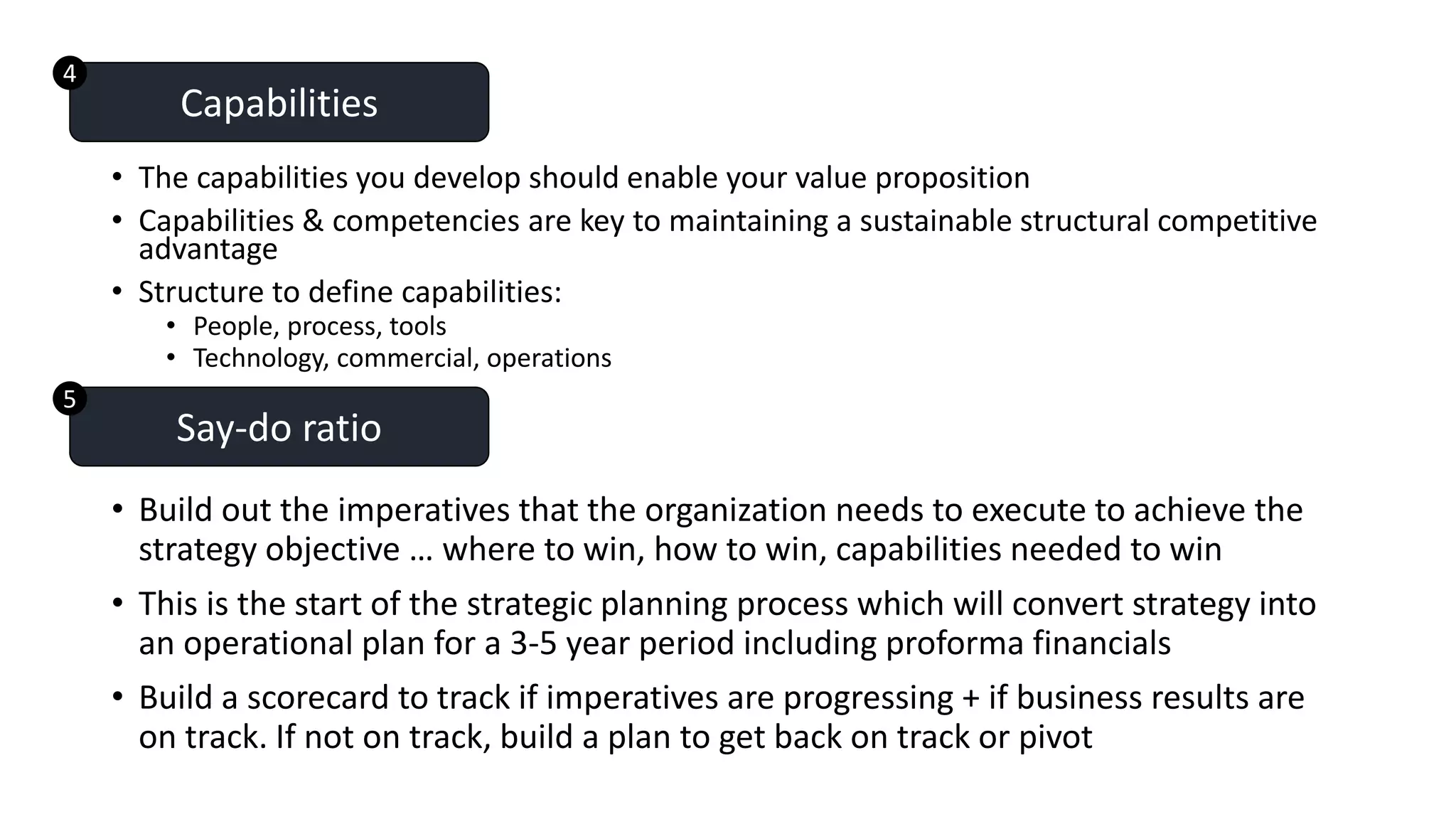
• The capabilities you develop should enable your value proposition
• Capabilities & competencies are key to maintaining a sustainable structural competitive
advantage
• Structure to define capabilities:
• People, process, tools
• Technology, commercial, operations
Capabilities
• Build out the imperatives that the organization needs to execute to achieve the
strategy objective … where to win, how to win, capabilities needed to win
• This is the start of the strategic planning process which will convert strategy into
an operational plan for a 3-5 year period including proforma financials
• Build a scorecard to track if imperatives are progressing + if business results are
on track. If not on track, build a plan to get back on track or pivot
Say-do ratio
5
4
Appendix
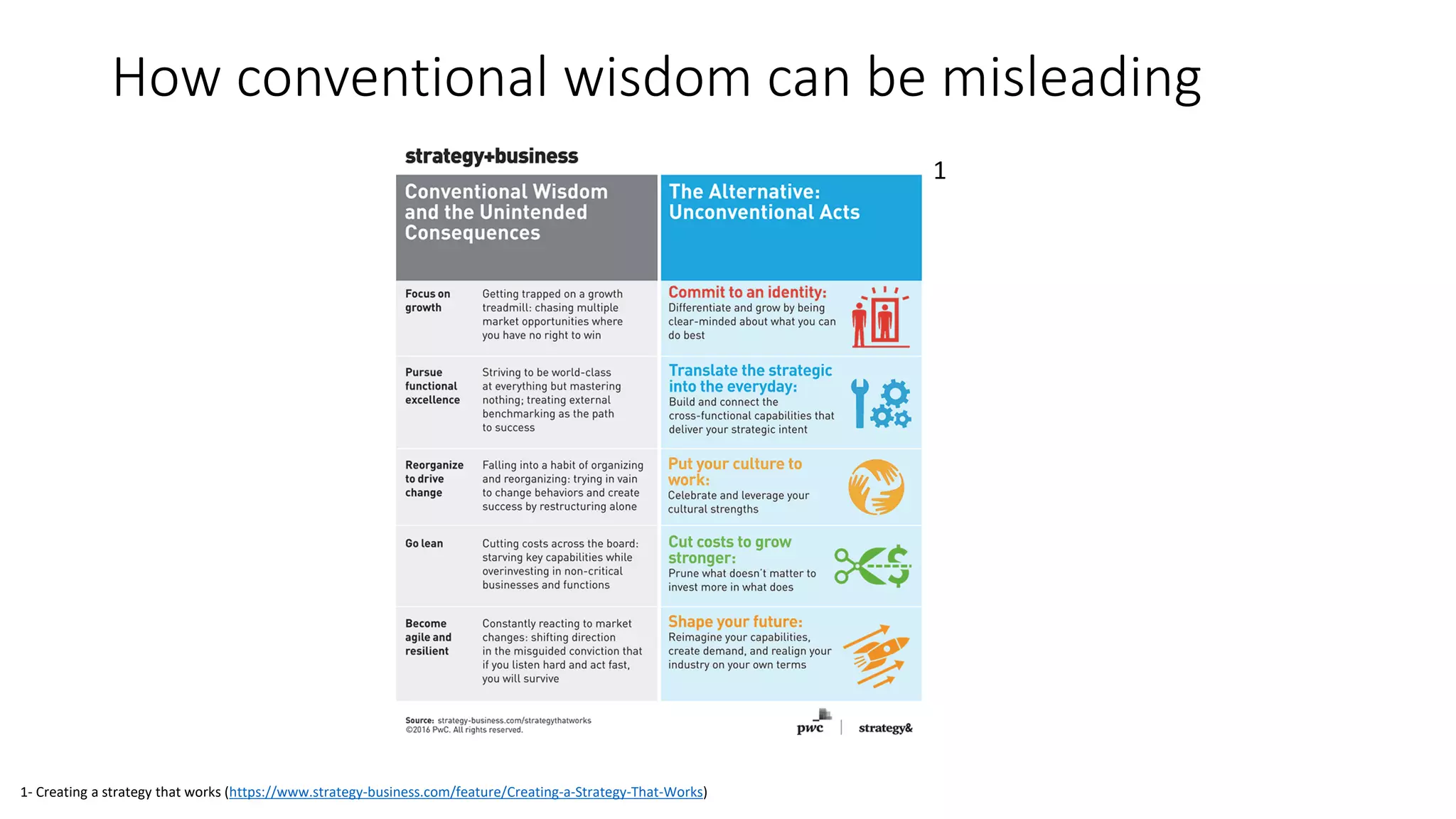
How conventional wisdom can be misleading
1
1- Creating a strategy that works (https://www.strategy-business.com/feature/Creating-a-Strategy-That-Works)

Demystifying strategy

  • 1.
    Demystifying Strategy Author: UmairMarfani Contributor: Atif Aziz Have utilized multiple works on strategy and stitched them together. All the works have been cited.
  • 2.
    Where strategy fitsin the hierarchy of corporate frameworks Aspirational (Not actionable) Tactical / Operational (Actionable) Long (Decades) Medium (Years) Short (Quarters) Immediate (Months/Weeks) Mission | Vision Strategy Strategic Planning Operating plan S&OP Sales and Operations Planning Strategy converts vision into executable imperatives focused on where to win (segments) and how to win (differentiator)
  • 3.
    Steps to developinga strategy1,2 a. Defines what to achieve and in what time period: specific, measurable, and time bound … does not need to be financials only b. Usually you can’t have it all … ↑market share + ↑ profitability + ↑ service levels. Prioritize so you know what is more important c. Examples: Largest player in the aircraft industry | Fastest growing computer company globally | Rank # 1 in customer satisfaction Objective (What is winning) Segmentation (Where to win) Value Proposition (How to win) Capabilities (Needed to win) Say-do ratio (Are we winning?) a. Understand customer needs in the segment you have selected … address a few of those needs (ones which are key to the buying decision) in a unique/differentiated way that your competition can not replicate easily in a short timeframe b. Examples: Everyday low prices for a range of consumer goods | Visually appealing products with easy/intuitive user interface a. Segment the industry to chose an area to focus … this defines where you want to compete and dominate b. Being all things to all customers usually ends up with everyone considering you but no one buying form you c. Examples: Organic foods in California | Consulting services for large multinationals | Software solutions for dental offices a. What capabilities do you need to successfully execute on your value proposition in the target segments b. Strengthen core capabilities that enable an organization to maintain its competitive advantage c. Examples: People with particular competencies | Global supply chain organization | Quality department focussed on outsourcing a. Identify imperatives & actions to execute on strategy (where to win, how to win) … technology, people, pricing, supply chain model b. Build a proforma and agree on a set of KPIs for each initiative that will be used to measure progress : Are we doing what we said we would do + are we achieving what we said we would achieve The key is to have steps 1-5 be consistent with eachother and aligned to vision / mission1 1 2 3 4 5 Mission | Vision Mission is why your organization exists … it is your purpose or cause | Vision is what you want to be in a future ideal state Examples: Mission: Spreading ideas (TED) | Vision: Transportation as reliable as running water, everywhere for everyone (Uber) 1- Five questions to build a strategy (https://hbr.org/2010/05/the-five-questions-of-strategy) 2- HBR Paper: Can you say what your strategy is? (https://hbr.org/2008/04/can-you-say-what-your-strategy-is) StrategyStrategic Planning
  • 4.
    Strategy … rulesof thumb 1. Why is strategy needed: • Strategy is about protecting the company from the organization … about having a north star on where to play, how to win, and investing in the capabilities that enable your “how to win”. • Organizations always have people/functions who want to invest in pet projects … many of which build unique offering that do not address a customer need (slide 8) … strategy guides your investment decisions to protect the company from the organization 2. What Should Strategy Look Like: • Strategy needs to be concise and consistent • Understood by everyone, people should be able to relate it to what they do everyday • Strategy needs to be executable … decent strategy with good execution will always beat a great strategy with poor execution 3. Strategy Don’ts (or typical strategy pitfalls): • Strategy drives financials … not the other way around • Strategy has to be unique … if you put a competitor name on your strategy and it still holds … it is not a strategy
  • 5.
    Defining each ofthe steps of developing a strategy
  • 6.
    • Meant tobe aspirational … a stake in the ground, you do not need to specify how to get there • Can be the same for multiple players within the industry • This is the “why” in Simon Sinek’s golden circle https://www.youtube.com/watch?v=qp0HIF3SfI4 Mission | Vision • Will differ for the different players within the same industry • Needs to be realistic and consider tradeoffs … not what you “want” but what is achievable (realistic optimism) • Help the organization prioritize … eg: margin vs market share1 Objective 1- Companies can grow market share and margin via technology or improving operational excellence. Also possible for companies that might be lagging the industry in cost, technology, commercial models, etc.. and fill those gaps. But in general most companies will not be able to improve margin and market share , even if they are able to they must have it prioritized 1
  • 7.
    • Split theindustry into “segments” which have similar characteristics, pick the segment that best fits the objective and existing capabilities • There is no strategy without segmentation … strategy is about focus and targeting • Identify the segments to target … but also know the segments you will not target • Types of segmentation: • Behavioral: Customer preference (technology, price, customer intimacy), etc. • Geographic: Region, country, weather conditions, etc. • Product: Features, technology, ratings (temperature, pressure), etc. • Demographic: Age, gender, education, income, ethnicity, etc. • Financial: Credit rating, profitability, risk, revenue, etc. • Any other characteristic of interest Segmentation 1- Companies can grow market share and margin via technology or improving operational excellence. Also possible for companies that might be lagging the industry in cost, technology, commercial models, etc.. and fill those gaps. But in general most companies will not be able to improve margin and market share , even if they are able to they must have it prioritized 2
  • 8.
    Value Proposition Customer Needs Company Capabilities Competitor offering 1 1- HBRPaper: Can you say what your strategy is? (https://hbr.org/2008/04/can-you-say-what-your-strategy-is) Company offering / capabilities Unique Undifferentiated CustomerNeed Strong Focus, this is why customers will pick you Keep at satisfactory level so it is not a detractor Weak Just because it is unique does not mean the customer cares about it Strategic sweetspot is where a company can meet customer needs in a way competitors cannot. This gives a structural and sustainable advantage • Identify what is unique about your offering ... Focus on it and stay ahead of the competition, otherwise you will lose your business. This is strategy. • Often companies will push unique offering even if it does not address a customer need ... you have to conform to the market needs, it will not conform to your wants 3
  • 9.
    Three primary valuepropositions 1- The discipline of market leaders (https://www.amazon.com/Discipline-Market-Leaders-Customers-Dominate/dp/0201407191) Product Leadership (Best products and features) (BMW) Price (Lowest price) (Walmart) Customer Intimacy (Best service, customer is king) (Singapore Airlines, Nordstrom) Customers pick an offering for one of three reasons • Lowest price: This is the price sensitive buyer • Best features and benefits: Willing to pay a premium to have the best • Customer Intimacy: Willing to pay a premium for high levels of service To become a market leader pick one of the three and excel at it relative to competition ... need to be satisfactory at the other 2 The value proposition you focus on will determine your customer base and also what capabilities you invest in Companies can not excel at all three at the same time since they require different investment thesis, culture, and structure 3
  • 10.
    • The capabilitiesyou develop should enable your value proposition • Capabilities & competencies are key to maintaining a sustainable structural competitive advantage • Structure to define capabilities: • People, process, tools • Technology, commercial, operations Capabilities • Build out the imperatives that the organization needs to execute to achieve the strategy objective … where to win, how to win, capabilities needed to win • This is the start of the strategic planning process which will convert strategy into an operational plan for a 3-5 year period including proforma financials • Build a scorecard to track if imperatives are progressing + if business results are on track. If not on track, build a plan to get back on track or pivot Say-do ratio 5 4
  • 11.
  • 12.
    How conventional wisdomcan be misleading 1 1- Creating a strategy that works (https://www.strategy-business.com/feature/Creating-a-Strategy-That-Works)