Chapter 2:
Company and Marketing
Strategy
2-1
Strategic Marketing Management
Kotler and Armstrong
Partnering to Build
Customer Engagement,
Value, and Relationships
Copyright © 2016 Pearson Education, Inc.
• Objective 1: Explain company-wide strategic
planning and its four steps.
• Objective 2: Discuss how to design business
portfolios and develop growth strategies.
• Objective 3: Explain marketing’s role in strategic
planning and how marketing works with its
partners to create and deliver customer value.
Learning Objectives
Company and Marketing Strategy
Copyright © 2016 Pearson Education, Inc. 2-2
• Objective 4: Describe the elements of a
customer value-driven marketing strategy
and mix, and the forces that influence it.
• Objective 5: List the marketing
management functions, including the
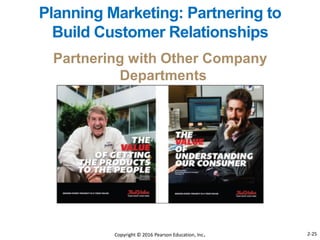
elements of a marketing plan, and discuss
the importance of measuring and managing
marketing return on investment.
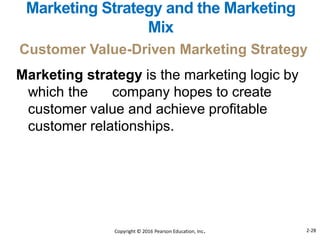
Learning Objectives
Company and Marketing Strategy
Copyright © 2016 Pearson Education, Inc. 2-3
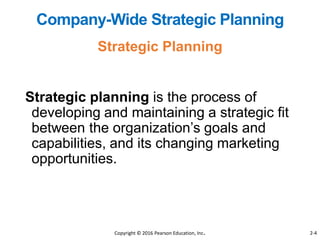
Strategic planning is the process of
developing and maintaining a strategic fit
between the organization’s goals and
capabilities, and its changing marketing
opportunities.
Strategic Planning
Company-Wide Strategic Planning
Copyright © 2016 Pearson Education, Inc. 2-4
Company-Wide Strategic Planning
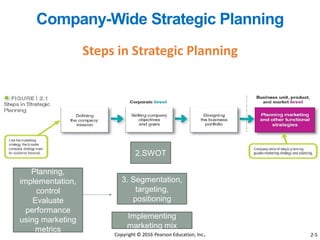
Steps in Strategic Planning
Copyright © 2016 Pearson Education, Inc. 2-5
2.SWOT
3. Segmentation,
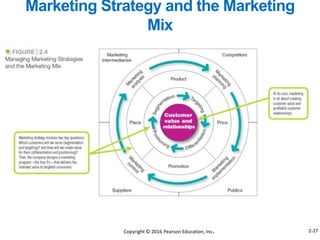
targeting,
positioning
Implementing
marketing mix
Planning,
implementation,
control
Evaluate
performance
using marketing
metrics
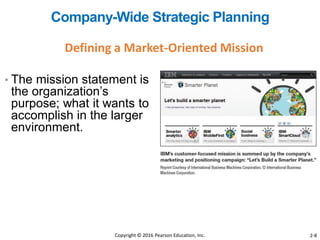
• The mission statement is
the organization’s
purpose; what it wants to
accomplish in the larger
environment.
Defining a Market-Oriented Mission
Company-Wide Strategic Planning
Copyright © 2016 Pearson Education, Inc. 2-8
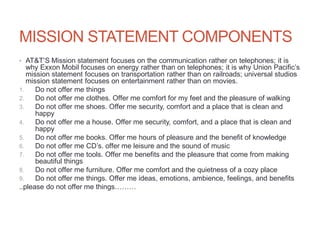
• AT&T’S Mission statement focuses on the communication rather on telephones; it is
why Exxon Mobil focuses on energy rather than on telephones; it is why Union Pacific’s
mission statement focuses on transportation rather than on railroads; universal studios
mission statement focuses on entertainment rather than on movies.
1. Do not offer me things
2. Do not offer me clothes. Offer me comfort for my feet and the pleasure of walking
3. Do not offer me shoes. Offer me security, comfort and a place that is clean and
happy
4. Do not offer me a house. Offer me security, comfort, and a place that is clean and
happy
5. Do not offer me books. Offer me hours of pleasure and the benefit of knowledge
6. Do not offer me CD’s. offer me leisure and the sound of music
7. Do not offer me tools. Offer me benefits and the pleasure that come from making
beautiful things
8. Do not offer me furniture. Offer me comfort and the quietness of a cozy place
9. Do not offer me things. Offer me ideas, emotions, ambience, feelings, and benefits
..please do not offer me things………
MISSION STATEMENT COMPONENTS
• What the customer thinks he/she is buying, what he/she considers
value, is decisive- it determines what a business is, what it produces, and
whether it will prosper, it is always utility, meaning what a product or
service does for him or her. The customer is the foundation of a business
and keeps its existence.
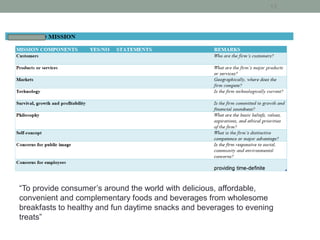
• 1. customers- who are the firm’s customers?
• 2. products or services- what are the firm’s major products and services?
• 3. Markets- Geographically, where does the firm compete?
• 4. Technology- is the firm technologically current??
• 5.concern for survival, growth and profitability- is the firm committed to
growth and financial soundness?
• 6. Philosophy- what are the basic beliefs, values, aspirations, and ethical
priorities of the firm?
• 7. Self-concept- what is the firm’s distinctive competence or major
competitive advantage?
• 8. concern for public image- is the firm responsive to social, community,
and environmental concerns?
• 9. concern for employees- are employees a valuable asset to a firm?
Mission statement
Step 1: Define the business mission
• The mission statement, a broad description of a firm’s
objectives and the scope of activities. It attempts to
answer two main questions: What type of business are
we? What do we need to do to accomplish our goals and
objectives?
• PEPSICos Mission Statement “To provide consumer’s
around the world with delicious, affordable, convenient
and complementary foods and beverages from
wholesome breakfasts to healthy and fun daytime snacks
and beverages to evening treats”
• Coke’s Mission Statement “ To refresh the world… To
inspire moments of optimism and happiness….To create
value and make a difference”
11
PINK RIBBON INTERNATIONAL’S MISSION STATEMENT:
“To create a global community to support breast cancer
patients, survivors and their families all over the world….by
facilitating forums and blogs where thoughts, experience
and information can be shared”
12
13
“To provide consumer’s around the world with delicious, affordable,
convenient and complementary foods and beverages from wholesome
breakfasts to healthy and fun daytime snacks and beverages to evening
treats”
Company-Wide Strategic Planning
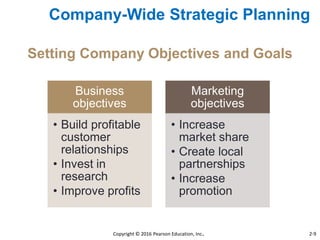
Business
objectives
• Build profitable
customer
relationships
• Invest in
research
• Improve profits
Marketing
objectives
• Increase
market share
• Create local
partnerships
• Increase
promotion
Setting Company Objectives and Goals
Copyright © 2016 Pearson Education, Inc. 2-9
The business portfolio is the collection of
businesses and products that make up the
company.
Portfolio analysis is a major activity in
strategic planning whereby management
evaluates the products and businesses that
make up the company.
Designing the Business Portfolio
Copyright © 2016 Pearson Education, Inc. 2-15
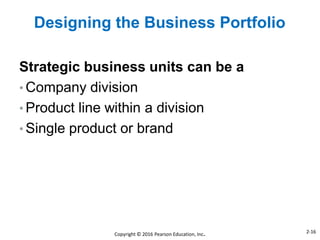
Strategic business units can be a
• Company division
• Product line within a division
• Single product or brand
Designing the Business Portfolio
Copyright © 2016 Pearson Education, Inc. 2-16
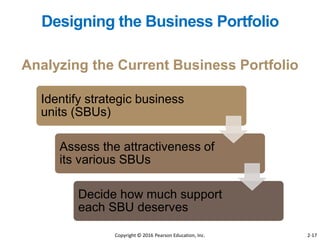
Identify strategic business
units (SBUs)
Assess the attractiveness of
its various SBUs
Decide how much support
each SBU deserves
Analyzing the Current Business Portfolio
Designing the Business Portfolio
Copyright © 2016 Pearson Education, Inc. 2-17
Designing the Business Portfolio
Analyzing the Current Business Portfolio
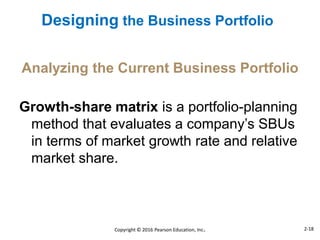
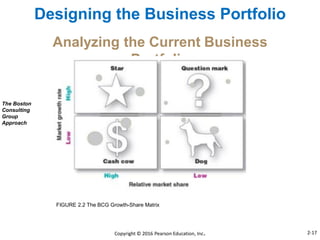
Growth-share matrix is a portfolio-planning
method that evaluates a company’s SBUs
in terms of market growth rate and relative
market share.
Copyright © 2016 Pearson Education, Inc. 2-18
Designing the Business Portfolio
Analyzing the Current Business
Portfolio
The Boston
Consulting
Group
Approach
FIGURE 2.2 The BCG Growth-Share Matrix
Copyright © 2016 Pearson Education, Inc. 2-17
• Difficulty in defining SBUs and measuring
market share and growth
• Time consuming
• Expensive
• Focus on current businesses, not future
planning
Problems with Matrix Approaches
Designing the Business Portfolio
Copyright © 2016 Pearson Education, Inc. 2-18
Designing the Business Portfolio
Developing Strategies for Growth and
Downsizing
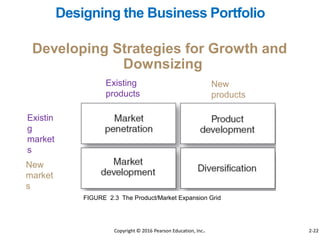
Product/market expansion grid looks at new
products, existing products, new markets, and
existing markets for company growth
opportunities.
Copyright © 2016 Pearson Education, Inc. 2-21
Developing Strategies for Growth and
Downsizing
Designing the Business Portfolio
Existing
products
New
products
Existin
g
market
s
New
market
s
FIGURE 2.3 The Product/Market Expansion Grid
Copyright © 2016 Pearson Education, Inc. 2-22
Downsizing is when a company must
prune, harvest, or divest businesses that
are unprofitable or that no longer fit the
strategy.
Developing Strategies for Growth and
Downsizing
Designing the Business Portfolio
Copyright © 2016 Pearson Education, Inc. 2-23
Value chain is a series of departments that
carry out value-creating activities to design,
produce, market, deliver, and support a
firm’s products.
Partnering with Other Company Departments
Planning Marketing: Partnering to
Build Customer Relationships
Copyright © 2016 Pearson Education, Inc. 2-24
Partnering with Other Company
Departments
Planning Marketing: Partnering to
Build Customer Relationships
Copyright © 2016 Pearson Education, Inc. 2-25
Value delivery network is made up of the
company, suppliers, distributors, and
ultimately customers who partner with each
other to improve performance of the entire
system.
Planning Marketing: Partnering to
Build Customer Relationships
Partnering with Others in the Marketing
System
Copyright © 2016 Pearson Education, Inc. 2-26
Marketing Strategy and the Marketing
Mix
Copyright © 2016 Pearson Education, Inc. 2-27
Marketing strategy is the marketing logic by
which the company hopes to create
customer value and achieve profitable
customer relationships.
Marketing Strategy and the Marketing
Mix
Customer Value-Driven Marketing Strategy
Copyright © 2016 Pearson Education, Inc. 2-28
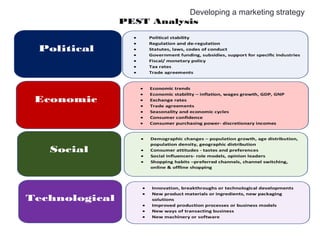
Developing a marketing strategy
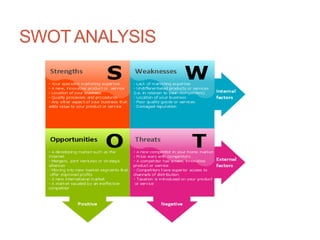
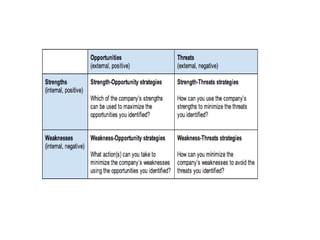
SWOTANALYSIS
35
36
37
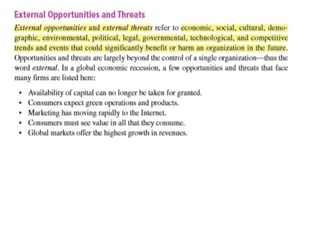
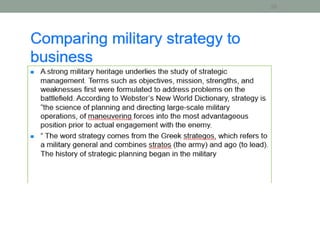
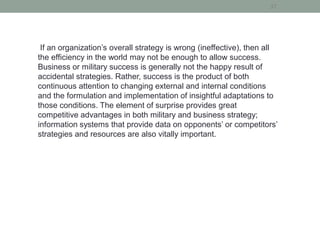
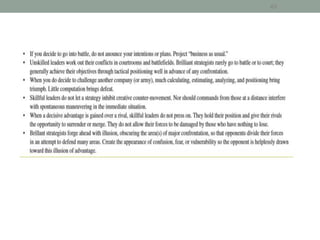
If an organization’s overall strategy is wrong (ineffective), then all
the efficiency in the world may not be enough to allow success.
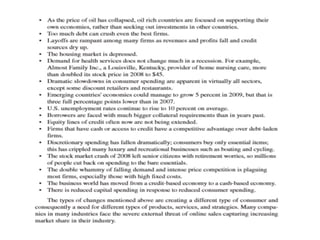
Business or military success is generally not the happy result of
accidental strategies. Rather, success is the product of both
continuous attention to changing external and internal conditions
and the formulation and implementation of insightful adaptations to
those conditions. The element of surprise provides great
competitive advantages in both military and business strategy;
information systems that provide data on opponents’ or competitors’
strategies and resources are also vitally important.
38
39
40
Market segmentation is the division of a market
into distinct groups of buyers who have
different needs, characteristics, or behaviors
and who might require separate products or
marketing mixes.
Market segment is a group of consumers who
respond in a similar way to a given set of
marketing efforts.
Marketing Strategy and the Marketing Mix
Customer Value-Driven Marketing Strategy
Copyright © 2016 Pearson Education, Inc. 2-41
Market targeting is the process of evaluating
each market segment’s attractiveness and
selecting one or more segments to enter.
Market positioning is the arranging for a
product to occupy a clear, distinctive, and
desirable place relative to competing products
in the minds of target consumers.
Differentiation begins the positioning process.
Customer Value-Driven Marketing Strategy
Marketing Strategy and the Marketing
Mix
Copyright © 2016 Pearson Education, Inc. 2-42
Customer Value-Driven Marketing Strategy
Marketing Strategy and the Marketing
Mix
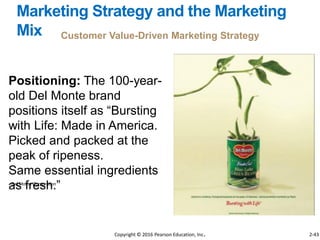
Positioning: The 100-year-
old Del Monte brand
positions itself as “Bursting
with Life: Made in America.
Picked and packed at the
peak of ripeness.
Same essential ingredients
as fresh.”- Del Monte Corporation
Copyright © 2016 Pearson Education, Inc. 2-43
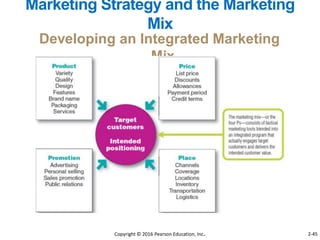
Marketing mix is the set of controllable,
tactical marketing tools—product, price, place,
and promotion—that the firm blends to
produce the response it wants in the target
market.
Developing an Integrated Marketing Mix
Marketing Strategy and the Marketing Mix
Copyright © 2016 Pearson Education, Inc. 2-44
Marketing Strategy and the Marketing
Mix
Developing an Integrated Marketing
Mix
Copyright © 2016 Pearson Education, Inc. 2-45
Marketing Strategy and the Marketing Mix
-Customer Value-Driven Marketing
Strategy
-Developing an Integrated Marketing Mix
Learning Objective 4
Company and Marketing Strategy
• Describe the elements of a customer value-driven
marketing strategy and mix and the forces that
influence it.
Copyright © 2016 Pearson Education, Inc. 2-46
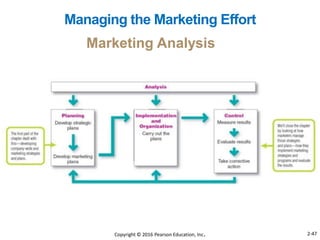
Managing the Marketing Effort
Marketing Analysis
Copyright © 2016 Pearson Education, Inc. 2-47
Managing the Marketing Effort
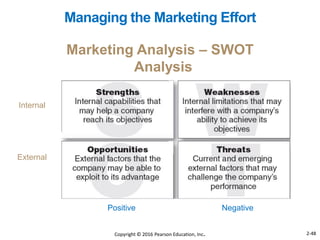
Marketing Analysis – SWOT
Analysis
Internal
External
Positive Negative
Copyright © 2016 Pearson Education, Inc. 2-48
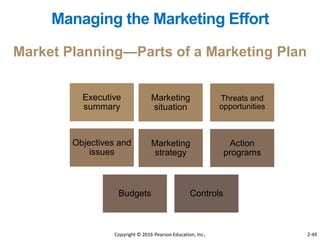
Executive
summary
Marketing
situation
Threats and
opportunities
Objectives and
issues
Marketing
strategy
Action
programs
Budgets Controls
Market Planning—Parts of a Marketing Plan
Managing the Marketing Effort
Copyright © 2016 Pearson Education, Inc. 2-49
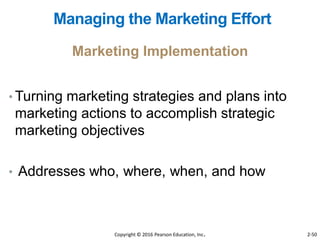
• Turning marketing strategies and plans into
marketing actions to accomplish strategic
marketing objectives
• Addresses who, where, when, and how
Marketing Implementation
Managing the Marketing Effort
Copyright © 2016 Pearson Education, Inc. 2-50
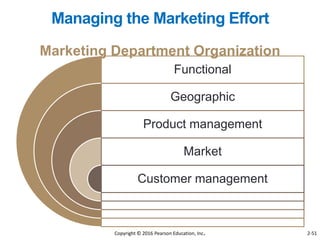
Functional
Geographic
Product management
Market
Customer management
Marketing Department Organization
Managing the Marketing Effort
Copyright © 2016 Pearson Education, Inc. 2-51
• Evaluating results
• Taking corrective action
• Operating control
• Strategic control
Marketing Control
Managing the Marketing Effort
Copyright © 2016 Pearson Education, Inc. 2-52
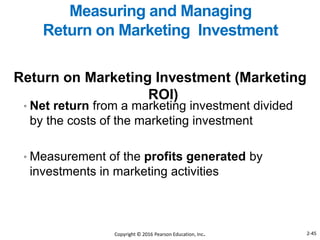
• Net return from a marketing investment divided
by the costs of the marketing investment
• Measurement of the profits generated by
investments in marketing activities
Return on Marketing Investment (Marketing
ROI)
Measuring and Managing
Return on Marketing Investment
Copyright © 2016 Pearson Education, Inc. 2-45
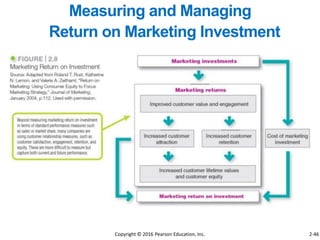
Measuring and Managing
Return on Marketing Investment
Copyright © 2016 Pearson Education, Inc. 2-46

Chapte2 strategic marketing management

  • 1.
    Chapter 2: Company andMarketing Strategy 2-1 Strategic Marketing Management Kotler and Armstrong Partnering to Build Customer Engagement, Value, and Relationships Copyright © 2016 Pearson Education, Inc.
  • 2.
    • Objective 1:Explain company-wide strategic planning and its four steps. • Objective 2: Discuss how to design business portfolios and develop growth strategies. • Objective 3: Explain marketing’s role in strategic planning and how marketing works with its partners to create and deliver customer value. Learning Objectives Company and Marketing Strategy Copyright © 2016 Pearson Education, Inc. 2-2
  • 3.
    • Objective 4:Describe the elements of a customer value-driven marketing strategy and mix, and the forces that influence it. • Objective 5: List the marketing management functions, including the elements of a marketing plan, and discuss the importance of measuring and managing marketing return on investment. Learning Objectives Company and Marketing Strategy Copyright © 2016 Pearson Education, Inc. 2-3
  • 4.
    Strategic planning isthe process of developing and maintaining a strategic fit between the organization’s goals and capabilities, and its changing marketing opportunities. Strategic Planning Company-Wide Strategic Planning Copyright © 2016 Pearson Education, Inc. 2-4
  • 5.
    Company-Wide Strategic Planning Stepsin Strategic Planning Copyright © 2016 Pearson Education, Inc. 2-5 2.SWOT 3. Segmentation, targeting, positioning Implementing marketing mix Planning, implementation, control Evaluate performance using marketing metrics
  • 6.
    • The missionstatement is the organization’s purpose; what it wants to accomplish in the larger environment. Defining a Market-Oriented Mission Company-Wide Strategic Planning Copyright © 2016 Pearson Education, Inc. 2-8
  • 7.
    • AT&T’S Missionstatement focuses on the communication rather on telephones; it is why Exxon Mobil focuses on energy rather than on telephones; it is why Union Pacific’s mission statement focuses on transportation rather than on railroads; universal studios mission statement focuses on entertainment rather than on movies. 1. Do not offer me things 2. Do not offer me clothes. Offer me comfort for my feet and the pleasure of walking 3. Do not offer me shoes. Offer me security, comfort and a place that is clean and happy 4. Do not offer me a house. Offer me security, comfort, and a place that is clean and happy 5. Do not offer me books. Offer me hours of pleasure and the benefit of knowledge 6. Do not offer me CD’s. offer me leisure and the sound of music 7. Do not offer me tools. Offer me benefits and the pleasure that come from making beautiful things 8. Do not offer me furniture. Offer me comfort and the quietness of a cozy place 9. Do not offer me things. Offer me ideas, emotions, ambience, feelings, and benefits ..please do not offer me things……… MISSION STATEMENT COMPONENTS
  • 8.
    • What thecustomer thinks he/she is buying, what he/she considers value, is decisive- it determines what a business is, what it produces, and whether it will prosper, it is always utility, meaning what a product or service does for him or her. The customer is the foundation of a business and keeps its existence. • 1. customers- who are the firm’s customers? • 2. products or services- what are the firm’s major products and services? • 3. Markets- Geographically, where does the firm compete? • 4. Technology- is the firm technologically current?? • 5.concern for survival, growth and profitability- is the firm committed to growth and financial soundness? • 6. Philosophy- what are the basic beliefs, values, aspirations, and ethical priorities of the firm? • 7. Self-concept- what is the firm’s distinctive competence or major competitive advantage? • 8. concern for public image- is the firm responsive to social, community, and environmental concerns? • 9. concern for employees- are employees a valuable asset to a firm? Mission statement
  • 10.
    Step 1: Definethe business mission • The mission statement, a broad description of a firm’s objectives and the scope of activities. It attempts to answer two main questions: What type of business are we? What do we need to do to accomplish our goals and objectives?
  • 11.
    • PEPSICos MissionStatement “To provide consumer’s around the world with delicious, affordable, convenient and complementary foods and beverages from wholesome breakfasts to healthy and fun daytime snacks and beverages to evening treats” • Coke’s Mission Statement “ To refresh the world… To inspire moments of optimism and happiness….To create value and make a difference” 11
  • 12.
    PINK RIBBON INTERNATIONAL’SMISSION STATEMENT: “To create a global community to support breast cancer patients, survivors and their families all over the world….by facilitating forums and blogs where thoughts, experience and information can be shared” 12
  • 13.
    13 “To provide consumer’saround the world with delicious, affordable, convenient and complementary foods and beverages from wholesome breakfasts to healthy and fun daytime snacks and beverages to evening treats”
  • 14.
    Company-Wide Strategic Planning Business objectives •Build profitable customer relationships • Invest in research • Improve profits Marketing objectives • Increase market share • Create local partnerships • Increase promotion Setting Company Objectives and Goals Copyright © 2016 Pearson Education, Inc. 2-9
  • 15.
    The business portfoliois the collection of businesses and products that make up the company. Portfolio analysis is a major activity in strategic planning whereby management evaluates the products and businesses that make up the company. Designing the Business Portfolio Copyright © 2016 Pearson Education, Inc. 2-15
  • 16.
    Strategic business unitscan be a • Company division • Product line within a division • Single product or brand Designing the Business Portfolio Copyright © 2016 Pearson Education, Inc. 2-16
  • 17.
    Identify strategic business units(SBUs) Assess the attractiveness of its various SBUs Decide how much support each SBU deserves Analyzing the Current Business Portfolio Designing the Business Portfolio Copyright © 2016 Pearson Education, Inc. 2-17
  • 18.
    Designing the BusinessPortfolio Analyzing the Current Business Portfolio Growth-share matrix is a portfolio-planning method that evaluates a company’s SBUs in terms of market growth rate and relative market share. Copyright © 2016 Pearson Education, Inc. 2-18
  • 19.
    Designing the BusinessPortfolio Analyzing the Current Business Portfolio The Boston Consulting Group Approach FIGURE 2.2 The BCG Growth-Share Matrix Copyright © 2016 Pearson Education, Inc. 2-17
  • 20.
    • Difficulty indefining SBUs and measuring market share and growth • Time consuming • Expensive • Focus on current businesses, not future planning Problems with Matrix Approaches Designing the Business Portfolio Copyright © 2016 Pearson Education, Inc. 2-18
  • 21.
    Designing the BusinessPortfolio Developing Strategies for Growth and Downsizing Product/market expansion grid looks at new products, existing products, new markets, and existing markets for company growth opportunities. Copyright © 2016 Pearson Education, Inc. 2-21
  • 22.
    Developing Strategies forGrowth and Downsizing Designing the Business Portfolio Existing products New products Existin g market s New market s FIGURE 2.3 The Product/Market Expansion Grid Copyright © 2016 Pearson Education, Inc. 2-22
  • 23.
    Downsizing is whena company must prune, harvest, or divest businesses that are unprofitable or that no longer fit the strategy. Developing Strategies for Growth and Downsizing Designing the Business Portfolio Copyright © 2016 Pearson Education, Inc. 2-23
  • 24.
    Value chain isa series of departments that carry out value-creating activities to design, produce, market, deliver, and support a firm’s products. Partnering with Other Company Departments Planning Marketing: Partnering to Build Customer Relationships Copyright © 2016 Pearson Education, Inc. 2-24
  • 25.
    Partnering with OtherCompany Departments Planning Marketing: Partnering to Build Customer Relationships Copyright © 2016 Pearson Education, Inc. 2-25
  • 26.
    Value delivery networkis made up of the company, suppliers, distributors, and ultimately customers who partner with each other to improve performance of the entire system. Planning Marketing: Partnering to Build Customer Relationships Partnering with Others in the Marketing System Copyright © 2016 Pearson Education, Inc. 2-26
  • 27.
    Marketing Strategy andthe Marketing Mix Copyright © 2016 Pearson Education, Inc. 2-27
  • 28.
    Marketing strategy isthe marketing logic by which the company hopes to create customer value and achieve profitable customer relationships. Marketing Strategy and the Marketing Mix Customer Value-Driven Marketing Strategy Copyright © 2016 Pearson Education, Inc. 2-28
  • 29.
  • 32.
  • 35.
  • 36.
  • 37.
    37 If an organization’soverall strategy is wrong (ineffective), then all the efficiency in the world may not be enough to allow success. Business or military success is generally not the happy result of accidental strategies. Rather, success is the product of both continuous attention to changing external and internal conditions and the formulation and implementation of insightful adaptations to those conditions. The element of surprise provides great competitive advantages in both military and business strategy; information systems that provide data on opponents’ or competitors’ strategies and resources are also vitally important.
  • 38.
  • 39.
  • 40.
  • 41.
    Market segmentation isthe division of a market into distinct groups of buyers who have different needs, characteristics, or behaviors and who might require separate products or marketing mixes. Market segment is a group of consumers who respond in a similar way to a given set of marketing efforts. Marketing Strategy and the Marketing Mix Customer Value-Driven Marketing Strategy Copyright © 2016 Pearson Education, Inc. 2-41
  • 42.
    Market targeting isthe process of evaluating each market segment’s attractiveness and selecting one or more segments to enter. Market positioning is the arranging for a product to occupy a clear, distinctive, and desirable place relative to competing products in the minds of target consumers. Differentiation begins the positioning process. Customer Value-Driven Marketing Strategy Marketing Strategy and the Marketing Mix Copyright © 2016 Pearson Education, Inc. 2-42
  • 43.
    Customer Value-Driven MarketingStrategy Marketing Strategy and the Marketing Mix Positioning: The 100-year- old Del Monte brand positions itself as “Bursting with Life: Made in America. Picked and packed at the peak of ripeness. Same essential ingredients as fresh.”- Del Monte Corporation Copyright © 2016 Pearson Education, Inc. 2-43
  • 44.
    Marketing mix isthe set of controllable, tactical marketing tools—product, price, place, and promotion—that the firm blends to produce the response it wants in the target market. Developing an Integrated Marketing Mix Marketing Strategy and the Marketing Mix Copyright © 2016 Pearson Education, Inc. 2-44
  • 45.
    Marketing Strategy andthe Marketing Mix Developing an Integrated Marketing Mix Copyright © 2016 Pearson Education, Inc. 2-45
  • 46.
    Marketing Strategy andthe Marketing Mix -Customer Value-Driven Marketing Strategy -Developing an Integrated Marketing Mix Learning Objective 4 Company and Marketing Strategy • Describe the elements of a customer value-driven marketing strategy and mix and the forces that influence it. Copyright © 2016 Pearson Education, Inc. 2-46
  • 47.
    Managing the MarketingEffort Marketing Analysis Copyright © 2016 Pearson Education, Inc. 2-47
  • 48.
    Managing the MarketingEffort Marketing Analysis – SWOT Analysis Internal External Positive Negative Copyright © 2016 Pearson Education, Inc. 2-48
  • 49.
    Executive summary Marketing situation Threats and opportunities Objectives and issues Marketing strategy Action programs BudgetsControls Market Planning—Parts of a Marketing Plan Managing the Marketing Effort Copyright © 2016 Pearson Education, Inc. 2-49
  • 50.
    • Turning marketingstrategies and plans into marketing actions to accomplish strategic marketing objectives • Addresses who, where, when, and how Marketing Implementation Managing the Marketing Effort Copyright © 2016 Pearson Education, Inc. 2-50
  • 51.
    Functional Geographic Product management Market Customer management MarketingDepartment Organization Managing the Marketing Effort Copyright © 2016 Pearson Education, Inc. 2-51
  • 52.
    • Evaluating results •Taking corrective action • Operating control • Strategic control Marketing Control Managing the Marketing Effort Copyright © 2016 Pearson Education, Inc. 2-52
  • 53.
    • Net returnfrom a marketing investment divided by the costs of the marketing investment • Measurement of the profits generated by investments in marketing activities Return on Marketing Investment (Marketing ROI) Measuring and Managing Return on Marketing Investment Copyright © 2016 Pearson Education, Inc. 2-45
  • 54.
    Measuring and Managing Returnon Marketing Investment Copyright © 2016 Pearson Education, Inc. 2-46