1
Catalyst Strategies
Make Growth Happen
www.catalyststrategies.com
Brand Positioning Framework
“If you do not position yourself,
your market will gladly do it for you.”
2
To embed into your targets’ minds…
What’s the End Game?
“Why should I buy
your product?”
3
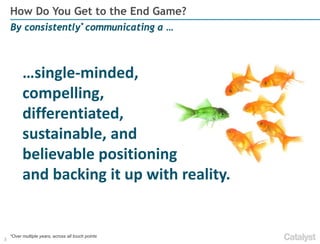
By consistently* communicating a …
How Do You Get to the End Game?
*Over multiple years, across all touch points
…single-minded,
compelling,
differentiated,
sustainable, and
believable positioning
and backing it up with reality.
4
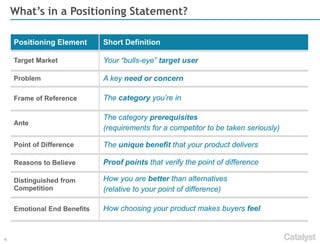
What’s in a Positioning Statement?
Positioning Element Short Definition
Target Market Your “bulls-eye” target user
Problem A key need or concern
Frame of Reference The category you’re in
Ante
The category prerequisites
(requirements for a competitor to be taken seriously)
Point of Difference The unique benefit that your product delivers
Reasons to Believe Proof points that verify the point of difference
Distinguished from
Competition
How you are better than alternatives
(relative to your point of difference)
Emotional End Benefits How choosing your product makes buyers feel
5
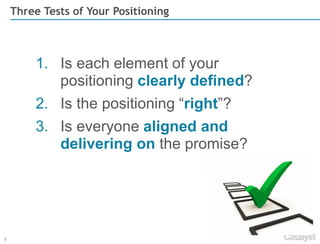
Three Tests of Your Positioning
1. Is each element of your
positioning clearly defined?
2. Is the positioning “right”?
3. Is everyone aligned and
delivering on the promise?
6
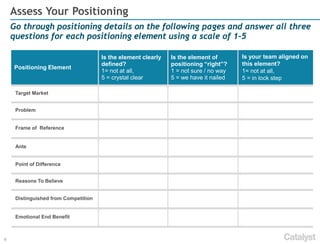
Go through positioning details on the following pages and answer all three
questions for each positioning element using a scale of 1-5
Assess Your Positioning
Positioning Element
Is the element clearly
defined?
1= not at all,
5 = crystal clear
Is the element of
positioning “right”?
1 = not sure / no way
5 = we have it nailed
Is your team aligned on
this element?
1= not at all,
5 = in lock step
Target Market
Problem
Frame of Reference
Ante
Point of Difference
Reasons To Believe
Distinguished from Competition
Emotional End Benefit
7
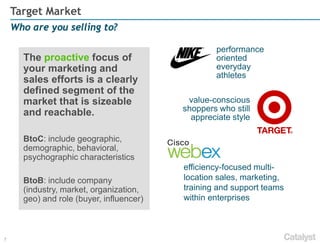
Who are you selling to?
Target Market
The proactive focus of
your marketing and
sales efforts is a clearly
defined segment of the
market that is sizeable
and reachable.
BtoC: include geographic,
demographic, behavioral,
psychographic characteristics
BtoB: include company
(industry, market, organization,
geo) and role (buyer, influencer)
performance
oriented
everyday
athletes
efficiency-focused multi-
location sales, marketing,
training and support teams
within enterprises
value-conscious
shoppers who still
appreciate style
8
What real needs do you solve?
Problems
Your positioning is
anchored on one or
more problem, need,
pain point, or challenge
that is highly frustrating
to the target.
Note: must be related to your
category
high quality
performance gear is
not accessible to the
“common man”
collaboration environments
are inflexible, don’t work the
way we do
shopping experience
for good values can be
depressing
9
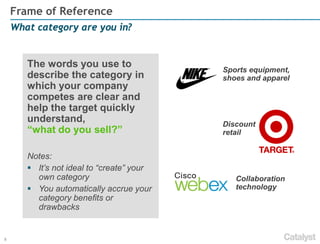
What category are you in?
Frame of Reference
The words you use to
describe the category in
which your company
competes are clear and
help the target quickly
understand,
“what do you sell?”
Notes:
 It’s not ideal to “create” your
own category
 You automatically accrue your
category benefits or
drawbacks
Collaboration
technology
Discount
retail
Sports equipment,
shoes and apparel
10
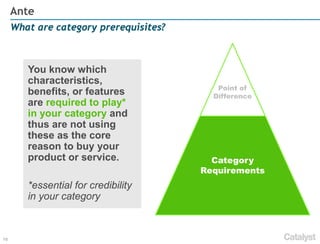
What are category prerequisites?
Ante
You know which
characteristics,
benefits, or features
are required to play*
in your category and
thus are not using
these as the core
reason to buy your
product or service.
*essential for credibility
in your category
Category
Requirements
Point of
Difference
11
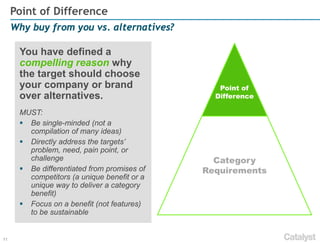
Why buy from you vs. alternatives?
Point of Difference
Category
Requirements
Point of
Difference
You have defined a
compelling reason why
the target should choose
your company or brand
over alternatives.
MUST:
 Be single-minded (not a
compilation of many ideas)
 Directly address the targets’
problem, need, pain point, or
challenge
 Be differentiated from promises of
competitors (a unique benefit or a
unique way to deliver a category
benefit)
 Focus on a benefit (not features)
to be sustainable
12
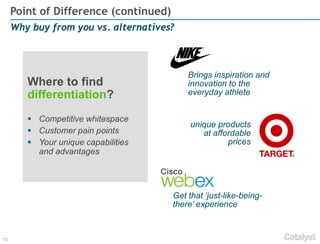
Why buy from you vs. alternatives?
Point of Difference (continued)
Get that ‘just-like-being-
there’ experience
unique products
at affordable
prices
Where to find
differentiation?
 Competitive whitespace
 Customer pain points
 Your unique capabilities
and advantages
Brings inspiration and
innovation to the
everyday athlete
13
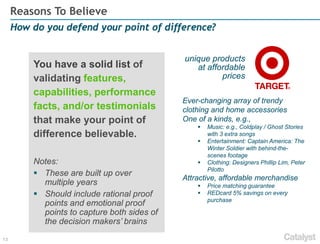
How do you defend your point of difference?
Reasons To Believe
You have a solid list of
validating features,
capabilities, performance
facts, and/or testimonials
that make your point of
difference believable.
Notes:
 These are built up over
multiple years
 Should include rational proof
points and emotional proof
points to capture both sides of
the decision makers’ brains
Ever-changing array of trendy
clothing and home accessories
One of a kinds, e.g.,
 Music: e.g., Coldplay / Ghost Stories
with 3 extra songs
 Entertainment: Captain America: The
Winter Soldier with behind-the-
scenes footage
 Clothing: Designers Phillip Lim, Peter
Pilotto
Attractive, affordable merchandise
 Price matching guarantee
 REDcard 5% savings on every
purchase
unique products
at affordable
prices
14
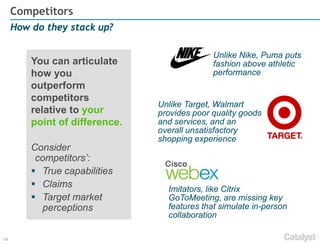
How do they stack up?
Competitors
You can articulate
how you
outperform
competitors
relative to your
point of difference.
Consider
competitors’:
 True capabilities
 Claims
 Target market
perceptions
Unlike Target, Walmart
provides poor quality goods
and services, and an
overall unsatisfactory
shopping experience
Imitators, like Citrix
GoToMeeting, are missing key
features that simulate in-person
collaboration
Unlike Nike, Puma puts
fashion above athletic
performance
15
How does the customer feel?
Emotional End Benefit
You have a clear view of
the positive feeling you
want your customer to
have about using,
displaying, and/or
having attachment to
your product or brand.
I am smart
I am inspired
I belong
16
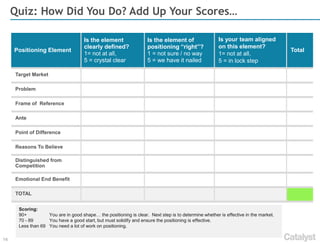
Quiz: How Did You Do? Add Up Your Scores…
Positioning Element
Is the element
clearly defined?
1= not at all,
5 = crystal clear
Is the element of
positioning “right”?
1 = not sure / no way
5 = we have it nailed
Is your team aligned
on this element?
1= not at all,
5 = in lock step
Total
Target Market
Problem
Frame of Reference
Ante
Point of Difference
Reasons To Believe
Distinguished from
Competition
Emotional End Benefit
TOTAL
Scoring:
90+ You are in good shape… the positioning is clear. Next step is to determine whether is effective in the market.
70 - 89 You have a good start, but must solidify and ensure the positioning is effective.
Less than 69 You need a lot of work on positioning.
17
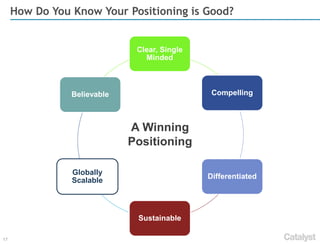
Clear, Single
Minded
Compelling
Differentiated
Sustainable
Globally
Scalable
Believable
How Do You Know Your Positioning is Good?
A Winning
Positioning
18
Use and Restrictions
19
Brand Assets & Terms of Use
Brand Assets:
The brand assets that appear in this document are illustrative examples only,
and have been selected for educational and instructional purposes.
The descriptions of example companies’ positioning is Catalyst Strategies’
interpretation of their positioning. They do not necessarily reflect how the
marketing organizations within the companies have articulated their actual
positioning or messaging.
Terms of Use:
You may use the content only for your own non-commercial use. You agree
not to change or delete any ownership notices from materials downloaded or
printed. You agree not to modify, copy, translate, broadcast, perform, display,
distribute, frame, reproduce, republish, download, display, post, transmit or
sell any intellectual property or content appearing without prior written
consent.
This original content, features and functionality are owned by Catalyst
Strategies and are protected by international copyright, trademark, patent,
trade secret and other intellectual property or proprietary rights laws.
20
About Catalyst Strategies
21
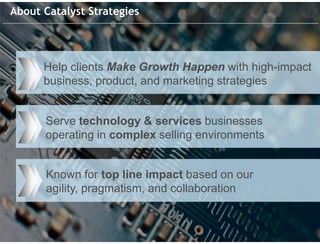
About Catalyst Strategies
Known for top line impact based on our
agility, pragmatism, and collaboration
Serve technology & services businesses
operating in complex selling environments
Help clients Make Growth Happen with high-impact
business, product, and marketing strategies
22
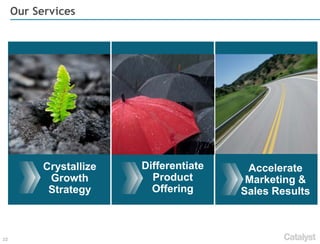
Our Services
Crystallize
Growth
Strategy
Differentiate
Product
Offering
Accelerate
Marketing &
Sales Results
23
Catalyst Strategies Clients
24
Catalyst Strategies
Make Growth Happen
www.catalyststrategies.com
Thank You!

Catalyst Strategies Brand Positioning Framework

  • 1.
    1 Catalyst Strategies Make GrowthHappen www.catalyststrategies.com Brand Positioning Framework “If you do not position yourself, your market will gladly do it for you.”
  • 2.
    2 To embed intoyour targets’ minds… What’s the End Game? “Why should I buy your product?”
  • 3.
    3 By consistently* communicatinga … How Do You Get to the End Game? *Over multiple years, across all touch points …single-minded, compelling, differentiated, sustainable, and believable positioning and backing it up with reality.
  • 4.
    4 What’s in aPositioning Statement? Positioning Element Short Definition Target Market Your “bulls-eye” target user Problem A key need or concern Frame of Reference The category you’re in Ante The category prerequisites (requirements for a competitor to be taken seriously) Point of Difference The unique benefit that your product delivers Reasons to Believe Proof points that verify the point of difference Distinguished from Competition How you are better than alternatives (relative to your point of difference) Emotional End Benefits How choosing your product makes buyers feel
  • 5.
    5 Three Tests ofYour Positioning 1. Is each element of your positioning clearly defined? 2. Is the positioning “right”? 3. Is everyone aligned and delivering on the promise?
  • 6.
    6 Go through positioningdetails on the following pages and answer all three questions for each positioning element using a scale of 1-5 Assess Your Positioning Positioning Element Is the element clearly defined? 1= not at all, 5 = crystal clear Is the element of positioning “right”? 1 = not sure / no way 5 = we have it nailed Is your team aligned on this element? 1= not at all, 5 = in lock step Target Market Problem Frame of Reference Ante Point of Difference Reasons To Believe Distinguished from Competition Emotional End Benefit
  • 7.
    7 Who are youselling to? Target Market The proactive focus of your marketing and sales efforts is a clearly defined segment of the market that is sizeable and reachable. BtoC: include geographic, demographic, behavioral, psychographic characteristics BtoB: include company (industry, market, organization, geo) and role (buyer, influencer) performance oriented everyday athletes efficiency-focused multi- location sales, marketing, training and support teams within enterprises value-conscious shoppers who still appreciate style
  • 8.
    8 What real needsdo you solve? Problems Your positioning is anchored on one or more problem, need, pain point, or challenge that is highly frustrating to the target. Note: must be related to your category high quality performance gear is not accessible to the “common man” collaboration environments are inflexible, don’t work the way we do shopping experience for good values can be depressing
  • 9.
    9 What category areyou in? Frame of Reference The words you use to describe the category in which your company competes are clear and help the target quickly understand, “what do you sell?” Notes:  It’s not ideal to “create” your own category  You automatically accrue your category benefits or drawbacks Collaboration technology Discount retail Sports equipment, shoes and apparel
  • 10.
    10 What are categoryprerequisites? Ante You know which characteristics, benefits, or features are required to play* in your category and thus are not using these as the core reason to buy your product or service. *essential for credibility in your category Category Requirements Point of Difference
  • 11.
    11 Why buy fromyou vs. alternatives? Point of Difference Category Requirements Point of Difference You have defined a compelling reason why the target should choose your company or brand over alternatives. MUST:  Be single-minded (not a compilation of many ideas)  Directly address the targets’ problem, need, pain point, or challenge  Be differentiated from promises of competitors (a unique benefit or a unique way to deliver a category benefit)  Focus on a benefit (not features) to be sustainable
  • 12.
    12 Why buy fromyou vs. alternatives? Point of Difference (continued) Get that ‘just-like-being- there’ experience unique products at affordable prices Where to find differentiation?  Competitive whitespace  Customer pain points  Your unique capabilities and advantages Brings inspiration and innovation to the everyday athlete
  • 13.
    13 How do youdefend your point of difference? Reasons To Believe You have a solid list of validating features, capabilities, performance facts, and/or testimonials that make your point of difference believable. Notes:  These are built up over multiple years  Should include rational proof points and emotional proof points to capture both sides of the decision makers’ brains Ever-changing array of trendy clothing and home accessories One of a kinds, e.g.,  Music: e.g., Coldplay / Ghost Stories with 3 extra songs  Entertainment: Captain America: The Winter Soldier with behind-the- scenes footage  Clothing: Designers Phillip Lim, Peter Pilotto Attractive, affordable merchandise  Price matching guarantee  REDcard 5% savings on every purchase unique products at affordable prices
  • 14.
    14 How do theystack up? Competitors You can articulate how you outperform competitors relative to your point of difference. Consider competitors’:  True capabilities  Claims  Target market perceptions Unlike Target, Walmart provides poor quality goods and services, and an overall unsatisfactory shopping experience Imitators, like Citrix GoToMeeting, are missing key features that simulate in-person collaboration Unlike Nike, Puma puts fashion above athletic performance
  • 15.
    15 How does thecustomer feel? Emotional End Benefit You have a clear view of the positive feeling you want your customer to have about using, displaying, and/or having attachment to your product or brand. I am smart I am inspired I belong
  • 16.
    16 Quiz: How DidYou Do? Add Up Your Scores… Positioning Element Is the element clearly defined? 1= not at all, 5 = crystal clear Is the element of positioning “right”? 1 = not sure / no way 5 = we have it nailed Is your team aligned on this element? 1= not at all, 5 = in lock step Total Target Market Problem Frame of Reference Ante Point of Difference Reasons To Believe Distinguished from Competition Emotional End Benefit TOTAL Scoring: 90+ You are in good shape… the positioning is clear. Next step is to determine whether is effective in the market. 70 - 89 You have a good start, but must solidify and ensure the positioning is effective. Less than 69 You need a lot of work on positioning.
  • 17.
  • 18.
  • 19.
    19 Brand Assets &Terms of Use Brand Assets: The brand assets that appear in this document are illustrative examples only, and have been selected for educational and instructional purposes. The descriptions of example companies’ positioning is Catalyst Strategies’ interpretation of their positioning. They do not necessarily reflect how the marketing organizations within the companies have articulated their actual positioning or messaging. Terms of Use: You may use the content only for your own non-commercial use. You agree not to change or delete any ownership notices from materials downloaded or printed. You agree not to modify, copy, translate, broadcast, perform, display, distribute, frame, reproduce, republish, download, display, post, transmit or sell any intellectual property or content appearing without prior written consent. This original content, features and functionality are owned by Catalyst Strategies and are protected by international copyright, trademark, patent, trade secret and other intellectual property or proprietary rights laws.
  • 20.
  • 21.
    21 About Catalyst Strategies Knownfor top line impact based on our agility, pragmatism, and collaboration Serve technology & services businesses operating in complex selling environments Help clients Make Growth Happen with high-impact business, product, and marketing strategies
  • 22.
  • 23.
  • 24.
    24 Catalyst Strategies Make GrowthHappen www.catalyststrategies.com Thank You!