Market Oriented Strategic Planning Prof.Prasanna Venkatesh
A general framework for Planning A generalized planning model can be used for  strategic planning, tactical planning, and operational planning. Strategic planning:  A firm’s overall master plan that shapes its destiny. Tactical planning:  Planning that translates a firm’s strategic plans into specific goals by organizational unit. Operational planning:  Planning that requires specific procedures and actions at lower levels in an organization.
Objectives Corporate and division strategic planing Business unit planning The marketing process Product level planning The marketing plan
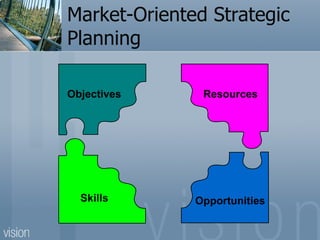
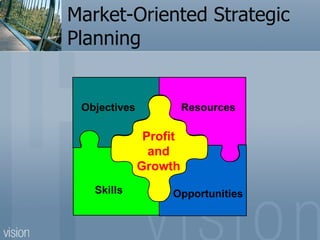
Market-Oriented Strategic Planning Objectives Skills Resources Opportunities
Market-Oriented Strategic Planning Objectives Skills Resources Opportunities Profit and Growth
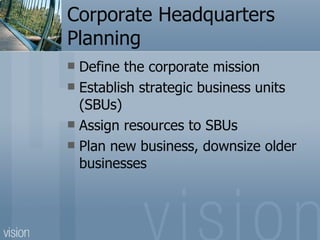
Corporate Headquarters Planning Define the corporate mission Establish strategic business units (SBUs) Assign resources to SBUs Plan new business, downsize older businesses
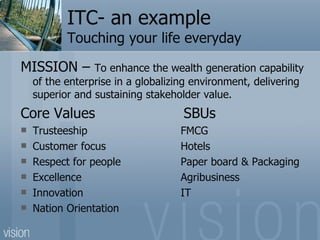
ITC- an example Touching your life everyday MISSION –  To enhance the wealth generation capability of the enterprise in a globalizing environment, delivering superior and sustaining stakeholder value. Core Values  SBUs Trusteeship FMCG Customer focus Hotels  Respect for people Paper board & Packaging Excellence Agribusiness Innovation IT Nation Orientation
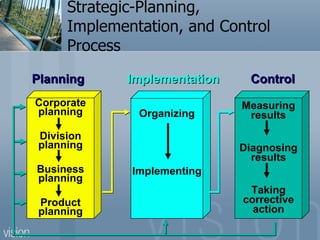
Strategic-Planning, Implementation, and Control Process Planning Measuring results Diagnosing results Taking corrective action Implementation Corporate planning Division planning Business planning Product planning Organizing Implementing Control
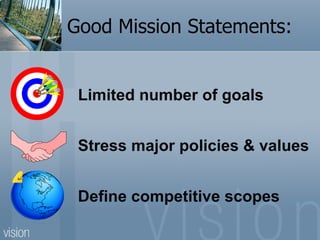
Good Mission Statements: Limited number of goals Stress major policies & values Define competitive scopes
Mission Statement - Infosys example Vision "To be a globally respected corporation that provides best-of-breed business solutions, leveraging technology, delivered by best-in-class people."   Mission "To achieve our objectives in an environment of fairness, honesty, and courtesy towards our clients, employees, vendors and society at large."   Values We believe that the softest pillow is a clear conscience. The values that drive us underscore our commitment to:  Customer Delight:  To surpass customer expectations consistently  Leadership by Example:  To set standards in our business and transactions and be an exemplar for the industry and ourselves  Integrity and Transparency:  To be ethical, sincere and open in all our transactions  Fairness:  To be objective and transaction-oriented, and thereby earn trust and respect  Pursuit of Excellence:  To strive relentlessly, constantly improve ourselves, our teams, our services and products to become the best
Westside Goals we shall develop a comprehensive understanding of their needs, strive to win their confidence, and offer them best-in-class products and services at affordable prices.  We shall always be in the forefront of fashion and services by anticipating and exceeding the expectations of our customers.  Our leadership will be the product of our styling, quality and service consciousness. We will continue to scale new heights of excellence through teamwork, in an atmosphere that encourages creativity and innovativeness.
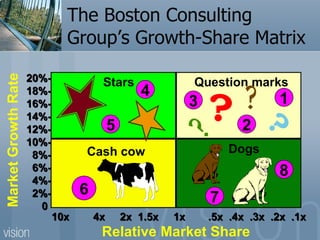
The Boston Consulting Group’s Growth-Share Matrix 20%- 18%- 16%- 14%- 12%- 10%- 8%- 6%- 4%- 2%- 0 Market Growth Rate 3 ? Question marks ? ? ? 2 1 Cash cow 6 Dogs 8 7 10x  4x  2x  1.5x  1x  Relative Market Share .5x  .4x  .3x  .2x  .1x  Stars 5 4
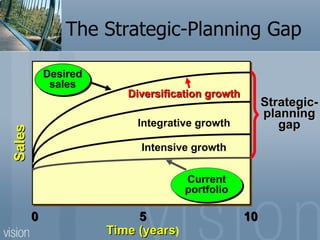
The Strategic-Planning Gap Sales 10 5 0 Time (years ) Desired sales Integrative growth Intensive growth Current portfolio Strategic- planning gap Diversification   growth
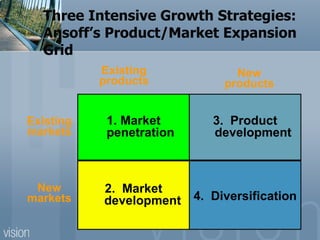
Three Intensive Growth Strategies: Ansoff’s Product/Market Expansion Grid 4.  Diversification 2.  Market development New markets 1. Market penetration Existing markets Existing products 3.  Product development New products
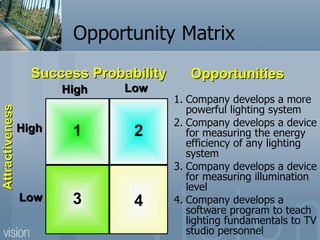
Opportunity Matrix 1. Company develops a more powerful lighting system 2. Company develops a device for measuring the energy efficiency of any lighting system 3. Company develops a device for measuring illumination level 4. Company develops a software program to teach lighting fundamentals to TV studio personnel 1 4 2 3 High Low High Low Attractiveness Success Probability Opportunities
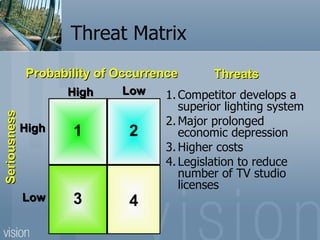
Threat Matrix 1. Competitor develops a superior lighting system 2. Major prolonged economic depression 3. Higher costs 4. Legislation to reduce number of TV studio licenses 1 4 2 3 High Low High Low Seriousness Probability of Occurrence Threats
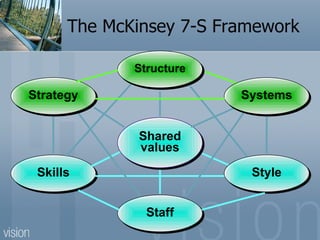
The McKinsey 7-S Framework Skills Shared values Staff Style Strategy Structure Systems
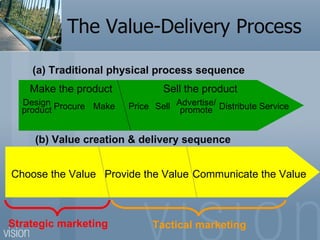
The Value-Delivery Process (a) Traditional physical process sequence (b) Value creation & delivery sequence Sell the product Make the product Procure Design product Make Price Sell Advertise/ promote Distribute Service Choose the Value Provide the Value Communicate the Value Strategic marketing Tactical marketing
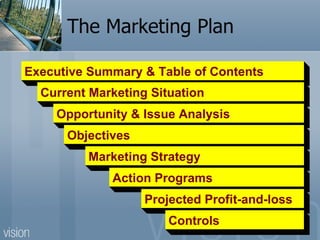
The Marketing Plan Executive Summary & Table of Contents Current Marketing Situation Opportunity & Issue Analysis Objectives Marketing Strategy Action Programs Projected Profit-and-loss Controls
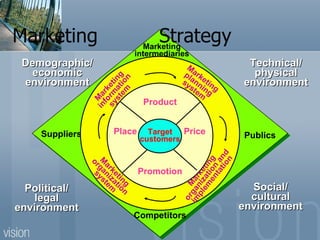
Factors Influencing Company   Marketing  Strategy Target customers Competitors Marketing intermediaries Publics Suppliers Marketing information system Marketing planning system Marketing organization system Marketing organization and implementation Product Promotion Place Price Demographic/ economic environment Social/ cultural environment Technical/ physical environment Political/ legal environment
Thank you

Mktg stratagic planning

  • 1.
    Market Oriented StrategicPlanning Prof.Prasanna Venkatesh
  • 2.
    A general frameworkfor Planning A generalized planning model can be used for strategic planning, tactical planning, and operational planning. Strategic planning: A firm’s overall master plan that shapes its destiny. Tactical planning: Planning that translates a firm’s strategic plans into specific goals by organizational unit. Operational planning: Planning that requires specific procedures and actions at lower levels in an organization.
  • 3.
    Objectives Corporate anddivision strategic planing Business unit planning The marketing process Product level planning The marketing plan
  • 4.
    Market-Oriented Strategic PlanningObjectives Skills Resources Opportunities
  • 5.
    Market-Oriented Strategic PlanningObjectives Skills Resources Opportunities Profit and Growth
  • 6.
    Corporate Headquarters PlanningDefine the corporate mission Establish strategic business units (SBUs) Assign resources to SBUs Plan new business, downsize older businesses
  • 7.
    ITC- an exampleTouching your life everyday MISSION – To enhance the wealth generation capability of the enterprise in a globalizing environment, delivering superior and sustaining stakeholder value. Core Values SBUs Trusteeship FMCG Customer focus Hotels Respect for people Paper board & Packaging Excellence Agribusiness Innovation IT Nation Orientation
  • 8.
    Strategic-Planning, Implementation, andControl Process Planning Measuring results Diagnosing results Taking corrective action Implementation Corporate planning Division planning Business planning Product planning Organizing Implementing Control
  • 9.
    Good Mission Statements:Limited number of goals Stress major policies & values Define competitive scopes
  • 10.
    Mission Statement -Infosys example Vision "To be a globally respected corporation that provides best-of-breed business solutions, leveraging technology, delivered by best-in-class people."   Mission "To achieve our objectives in an environment of fairness, honesty, and courtesy towards our clients, employees, vendors and society at large."   Values We believe that the softest pillow is a clear conscience. The values that drive us underscore our commitment to: Customer Delight: To surpass customer expectations consistently Leadership by Example: To set standards in our business and transactions and be an exemplar for the industry and ourselves Integrity and Transparency: To be ethical, sincere and open in all our transactions Fairness: To be objective and transaction-oriented, and thereby earn trust and respect Pursuit of Excellence: To strive relentlessly, constantly improve ourselves, our teams, our services and products to become the best
  • 11.
    Westside Goals weshall develop a comprehensive understanding of their needs, strive to win their confidence, and offer them best-in-class products and services at affordable prices. We shall always be in the forefront of fashion and services by anticipating and exceeding the expectations of our customers. Our leadership will be the product of our styling, quality and service consciousness. We will continue to scale new heights of excellence through teamwork, in an atmosphere that encourages creativity and innovativeness.
  • 12.
    The Boston ConsultingGroup’s Growth-Share Matrix 20%- 18%- 16%- 14%- 12%- 10%- 8%- 6%- 4%- 2%- 0 Market Growth Rate 3 ? Question marks ? ? ? 2 1 Cash cow 6 Dogs 8 7 10x 4x 2x 1.5x 1x Relative Market Share .5x .4x .3x .2x .1x Stars 5 4
  • 13.
    The Strategic-Planning GapSales 10 5 0 Time (years ) Desired sales Integrative growth Intensive growth Current portfolio Strategic- planning gap Diversification growth
  • 14.
    Three Intensive GrowthStrategies: Ansoff’s Product/Market Expansion Grid 4. Diversification 2. Market development New markets 1. Market penetration Existing markets Existing products 3. Product development New products
  • 15.
    Opportunity Matrix 1.Company develops a more powerful lighting system 2. Company develops a device for measuring the energy efficiency of any lighting system 3. Company develops a device for measuring illumination level 4. Company develops a software program to teach lighting fundamentals to TV studio personnel 1 4 2 3 High Low High Low Attractiveness Success Probability Opportunities
  • 16.
    Threat Matrix 1.Competitor develops a superior lighting system 2. Major prolonged economic depression 3. Higher costs 4. Legislation to reduce number of TV studio licenses 1 4 2 3 High Low High Low Seriousness Probability of Occurrence Threats
  • 17.
    The McKinsey 7-SFramework Skills Shared values Staff Style Strategy Structure Systems
  • 18.
    The Value-Delivery Process(a) Traditional physical process sequence (b) Value creation & delivery sequence Sell the product Make the product Procure Design product Make Price Sell Advertise/ promote Distribute Service Choose the Value Provide the Value Communicate the Value Strategic marketing Tactical marketing
  • 19.
    The Marketing PlanExecutive Summary & Table of Contents Current Marketing Situation Opportunity & Issue Analysis Objectives Marketing Strategy Action Programs Projected Profit-and-loss Controls
  • 20.
    Factors Influencing Company Marketing Strategy Target customers Competitors Marketing intermediaries Publics Suppliers Marketing information system Marketing planning system Marketing organization system Marketing organization and implementation Product Promotion Place Price Demographic/ economic environment Social/ cultural environment Technical/ physical environment Political/ legal environment
  • 21.