Academic Library Services for
the Digital Age: Strengths,
Weaknesses, Opportunities, &
Threats
Angela Rand, Kathy Wheeler, Amy Prendergast
Marx Library
May 9, 2016
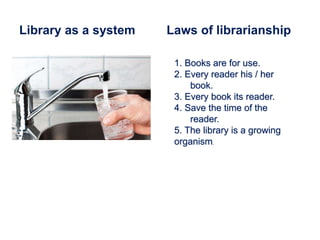
Library as a system Laws of librarianship
1. Books are for use.
2. Every reader his / her
book.
3. Every book its reader.
4. Save the time of the
reader.
5. The library is a growing
organism.
Liaison Librarians in the Digital Age
Focus on
3
• Instruction
• Collections
• Research needs
May 9, 2016 Academic Library Services for the Digital Age: Strengths, Weaknesses, Opportunities, &
Threats
Strengths
4
Materials
• Space
• Network
• Collection
Librarians
• Passion
• Expertise
• Adaptability
May 9, 2016 Title of Presentation
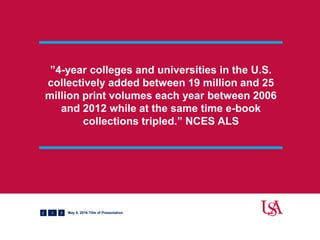
”4-year colleges and universities in the U.S.
collectively added between 19 million and 25
million print volumes each year between 2006
and 2012 while at the same time e-book
collections tripled.” NCES ALS
5 May 9, 2016 Title of Presentation
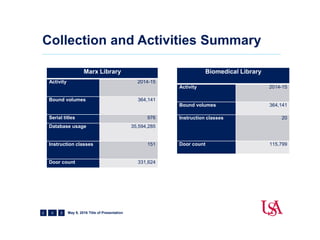
Collection and Activities Summary
6 May 9, 2016 Title of Presentation
Marx Library
Activity 2014-15
Bound volumes 364,141
Serial titles 976
Database usage 35,594,285
Instruction classes 151
Door count 331,624
Biomedical Library
Activity 2014-15
Bound volumes 364,141
Instruction classes 20
Door count 115,799
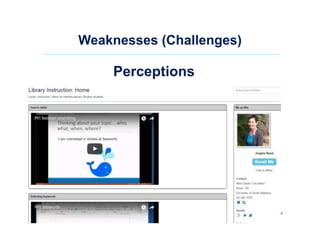
Weaknesses (Challenges)
7
Perceptions
May 9, 2016 Title of Presentation
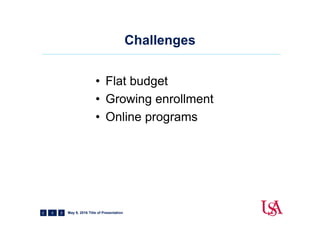
Challenges
8
• Flat budget
• Growing enrollment
• Online programs
May 9, 2016 Title of Presentation
Opportunities
9
• A new model for reference and instruction
• Collection management changes
• 1 credit hour F2F Information Literacy course
May 9, 2016 Title of Presentation
Threats
10
• Online programs
• There’s no there there
• Integration of library services into online courses
• Keeping it fresh and updated
• Assessing information literacy
• The BIG Question!
May 9, 2016 Title of Presentation
Association of College & Research Libraries
11
• Determine the extent of information needed
• Access the needed information effectively and
efficiently
• Evaluate information and its sources critically
• Incorporate selected information into one’s
knowledge base
• Use information effectively to accomplish a specific
purpose
• Understand the economic, legal, and social issues
surrounding the use of information, and access and
use information ethically and legally
May 9, 2016 Title of Presentation
E-book reading is rising but just 4% of
Americans are “e-book only” readers.
Those who read both e-books and printed books
prefer reading in the different formats under
different circumstances.
12 May 9, 2016 Title of Presentation
Purchasing Issues
• Package vs title-by-title
• Access Models
• Unlimited
• Non-linear lending
• Multiple use
• Single Use
• Patron driven or demand driven acquisition
• Evidence-based acquisition
• Cost
• Library copy vs personal copy
• Usage potential
• Marketing problems
Use Challenges
• DRM: digital rights management
• Requires extra software
• Limits copying, printing, and saving
• Expiration dates
• Platforms for use may be limited
• Browsabilty and accessibility
• Through OneSearch
• Through SOUTHcat
• Downloading
• Chapters vs full-book vs sections
• Pdf and epub
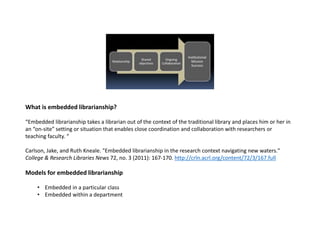
What is embedded librarianship?
“Embedded librarianship takes a librarian out of the context of the traditional library and places him or her in
an “on-site” setting or situation that enables close coordination and collaboration with researchers or
teaching faculty. “
Carlson, Jake, and Ruth Kneale. "Embedded librarianship in the research context navigating new waters."
College & Research Libraries News 72, no. 3 (2011): 167-170. http://crln.acrl.org/content/72/3/167.full
Models for embedded librarianship
• Embedded in a particular class
• Embedded within a department
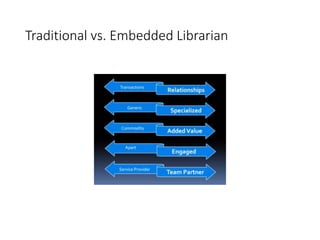
Traditional vs. Embedded Librarian
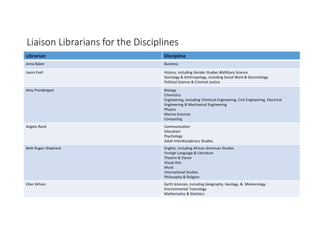
Liaison Librarians for the Disciplines
Librarian Discipline
Amia Baker Business
Jason Ezell History, including Gender Studies &Military Science
Sociology & Anthropology, including Social Work & Gerontology
Political Science & Criminal Justice
Amy Prendergast Biology
Chemistry
Engineering, including Chemical Engineering, Civil Engineering, Electrical
Engineering & Mechanical Engineering
Physics
Marine Sciences
Computing
Angela Rand Communication
Education
Psychology
Adult Interdisciplinary Studies
Beth Rugan Shephard English, including African American Studies
Foreign Language & Literature
Theatre & Dance
Visual Arts
Music
International Studies
Philosophy & Religion
Ellen Wilson Earth Sciences, including Geography, Geology, & Meteorology
Environmental Toxicology
Mathematics & Statistics
“It’s tough to make predictions, especially about
the future.” Yogi Berra
18 May 9, 2016 Title of Presentation

Academic library services for the digital age

  • 1.
    Academic Library Servicesfor the Digital Age: Strengths, Weaknesses, Opportunities, & Threats Angela Rand, Kathy Wheeler, Amy Prendergast Marx Library May 9, 2016
  • 2.
    Library as asystem Laws of librarianship 1. Books are for use. 2. Every reader his / her book. 3. Every book its reader. 4. Save the time of the reader. 5. The library is a growing organism.
  • 3.
    Liaison Librarians inthe Digital Age Focus on 3 • Instruction • Collections • Research needs May 9, 2016 Academic Library Services for the Digital Age: Strengths, Weaknesses, Opportunities, & Threats
  • 4.
    Strengths 4 Materials • Space • Network •Collection Librarians • Passion • Expertise • Adaptability May 9, 2016 Title of Presentation
  • 5.
    ”4-year colleges anduniversities in the U.S. collectively added between 19 million and 25 million print volumes each year between 2006 and 2012 while at the same time e-book collections tripled.” NCES ALS 5 May 9, 2016 Title of Presentation
  • 6.
    Collection and ActivitiesSummary 6 May 9, 2016 Title of Presentation Marx Library Activity 2014-15 Bound volumes 364,141 Serial titles 976 Database usage 35,594,285 Instruction classes 151 Door count 331,624 Biomedical Library Activity 2014-15 Bound volumes 364,141 Instruction classes 20 Door count 115,799
  • 7.
  • 8.
    Challenges 8 • Flat budget •Growing enrollment • Online programs May 9, 2016 Title of Presentation
  • 9.
    Opportunities 9 • A newmodel for reference and instruction • Collection management changes • 1 credit hour F2F Information Literacy course May 9, 2016 Title of Presentation
  • 10.
    Threats 10 • Online programs •There’s no there there • Integration of library services into online courses • Keeping it fresh and updated • Assessing information literacy • The BIG Question! May 9, 2016 Title of Presentation
  • 11.
    Association of College& Research Libraries 11 • Determine the extent of information needed • Access the needed information effectively and efficiently • Evaluate information and its sources critically • Incorporate selected information into one’s knowledge base • Use information effectively to accomplish a specific purpose • Understand the economic, legal, and social issues surrounding the use of information, and access and use information ethically and legally May 9, 2016 Title of Presentation
  • 12.
    E-book reading isrising but just 4% of Americans are “e-book only” readers. Those who read both e-books and printed books prefer reading in the different formats under different circumstances. 12 May 9, 2016 Title of Presentation
  • 13.
    Purchasing Issues • Packagevs title-by-title • Access Models • Unlimited • Non-linear lending • Multiple use • Single Use • Patron driven or demand driven acquisition • Evidence-based acquisition • Cost • Library copy vs personal copy • Usage potential • Marketing problems
  • 14.
    Use Challenges • DRM:digital rights management • Requires extra software • Limits copying, printing, and saving • Expiration dates • Platforms for use may be limited • Browsabilty and accessibility • Through OneSearch • Through SOUTHcat • Downloading • Chapters vs full-book vs sections • Pdf and epub
  • 15.
    What is embeddedlibrarianship? “Embedded librarianship takes a librarian out of the context of the traditional library and places him or her in an “on-site” setting or situation that enables close coordination and collaboration with researchers or teaching faculty. “ Carlson, Jake, and Ruth Kneale. "Embedded librarianship in the research context navigating new waters." College & Research Libraries News 72, no. 3 (2011): 167-170. http://crln.acrl.org/content/72/3/167.full Models for embedded librarianship • Embedded in a particular class • Embedded within a department
  • 16.
  • 17.
    Liaison Librarians forthe Disciplines Librarian Discipline Amia Baker Business Jason Ezell History, including Gender Studies &Military Science Sociology & Anthropology, including Social Work & Gerontology Political Science & Criminal Justice Amy Prendergast Biology Chemistry Engineering, including Chemical Engineering, Civil Engineering, Electrical Engineering & Mechanical Engineering Physics Marine Sciences Computing Angela Rand Communication Education Psychology Adult Interdisciplinary Studies Beth Rugan Shephard English, including African American Studies Foreign Language & Literature Theatre & Dance Visual Arts Music International Studies Philosophy & Religion Ellen Wilson Earth Sciences, including Geography, Geology, & Meteorology Environmental Toxicology Mathematics & Statistics
  • 18.
    “It’s tough tomake predictions, especially about the future.” Yogi Berra 18 May 9, 2016 Title of Presentation

Editor's Notes

  • #4 On 3X5 card (yellow) write what is your idea of a librarian/ what is a significant interaction you’ve had with a librarian?
  • #5 Librarians Highly motivated to work with students and faculty in a way that meets needs. 6 Librarians have 2 Masters degrees and 2 are PhD candidates. Collectively we have 20 articles published in peer-reviewed journals, 37 peer-reviewed handbook and encyclopedia articles; and 78 presentations to various conference audiences. We have also written or contributed to 7 grants (some funded and some unfunded). Our scholarly communication has improved our ability to respond to changes in library services and user needs. Not everyone wants F2F library instruction. 3 models for library instruction are 1)Search and Use; 2) The Pathfinder/Guided path to resources (LibGuides); 3) Process model Faculty expertise – experienced Senior Librarians and incoming librarians with various experiences. Materials Study rooms and spaces throughout the library; Reference and research desk Computer hardware and software; printing; databases and Internet access The collection is established and robust, especially for Undergraduate programs. We continue to maintain and updated print collection as we develop e-resources
  • #6 National Center for Education Statistics Academic Library Survey (NCES ALS) NOTE: refer to handout with statistics.
  • #8 Customer perceptions – taken from the 3X5 cards – Library as Box o’ Books A place to hold reserved items Interactions that did not go well Flat budget and growing enrollment - challenges https://upload.wikimedia.org/wikipedia/commons/thumb/a/a7/1930's_-_ca._-_Alma_Custead,_Librarian,_and_Staff.jpg/1280px-1930's_-_ca._-_Alma_Custead,_Librarian,_and_Staff.jpg https://pixabay.com/static/uploads/photo/2014/03/20/21/43/law-books-291676_960_720.jpg
  • #10 Liaison model – Fs & Bs Collection management changes – evaluation of usage; opportunities for ala carte purchasing; (see also liaison model) A new collection manager from an R1 institution; 4. Fall 2016 – oferring a F2F one credit hour information literacy course.
  • #11 Difficult to create and sustain interaction with students in embedded courses. Interaction with online customers (Gertrude Stein quote). Provide library instruction, but there is danger of lack of presence. Hard to build relationships ; Embedded courses – hard to know the rotation of courses; various embedded models where embeddedness exists on a continuum. Assessment – what to assess? Transfer learning? Who assess it? Evaluation – How will we know what we are doing is working? BIG question – are graduates from USA competent in the 5 IL learning outcomes
  • #12 Difficult to create and sustain interaction with students in embedded courses. Interaction with online customers (Gertrude Stein quote). Provide library instruction, but there is danger of lack of presence. Hard to build relationships ; Embedded courses – hard to know the rotation of courses; various embedded models where embeddedness exists on a continuum. Assessment – what to assess? Transfer learning? Who assess it? Evaluation – How will we know what we are doing is working? BIG question – are graduates from USA competent in the 5 IL learning outcomes
  • #13 http://www.pewresearch.org/fact-tank/2014/06/30/7-surprises-about-libraries-in-our-surveys/