Strategic Planning  for Networks Eugene Eric Kim  <eekim@blueoxen.com> Blue Oxen Associates March 22, 2011
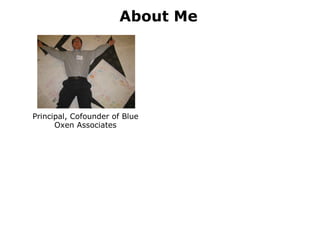
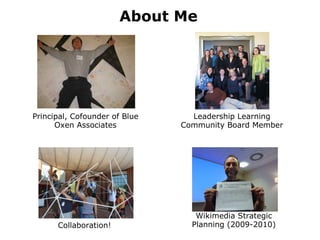
About Me Principal, Cofounder of Blue Oxen Associates
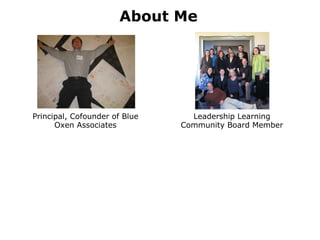
About Me Leadership Learning Community Board Member Principal, Cofounder of Blue Oxen Associates
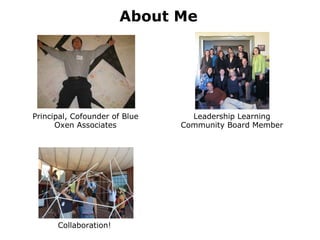
About Me Collaboration! Leadership Learning Community Board Member Principal, Cofounder of Blue Oxen Associates
About Me Collaboration! Leadership Learning Community Board Member Principal, Cofounder of Blue Oxen Associates Wikimedia Strategic Planning (2009-2010)
1. Wikimedia's Challenge 2. Strategic Planning 3. Strategic Planning for Networks
 
279 Language Versions of Wikimedia Projects
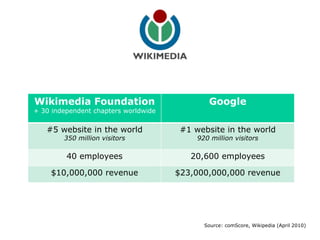
Source: comScore, Wikipedia (April 2010) Wikimedia Foundation + 30 independent chapters worldwide Google #5 website in the world 350 million visitors #1 website in the world 920 million visitors 40 employees 20,600 employees $10,000,000 revenue $23,000,000,000 revenue
100,000 Active Contributors Around the World
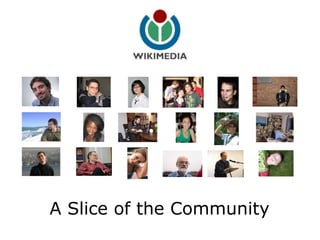
A Slice of the Community
In 2009, Wikimedia was a global movement with a vision... Imagine a world in which every single human being can freely share in the sum of all knowledge. That's our commitment. ... but no  collective  strategy for achieving this vision.
Strategic Planning for Networks? How do you develop a movement-wide five-year strategy in a completely open, collaborative way (the wiki way)?
1. Wikimedia's Challenge 2. Strategic Planning 3. Strategic Planning for Networks
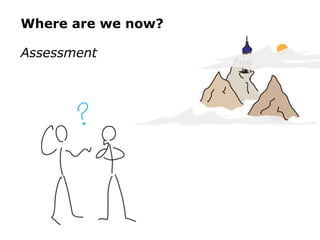
Where are we now?   Assessment
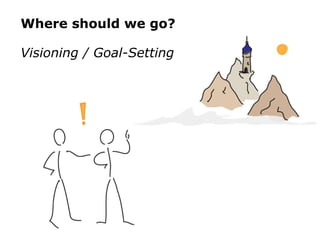
Where should we go?   Visioning / Goal-Setting
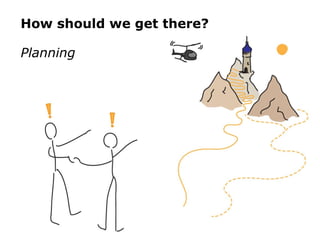
How should we get there?   Planning
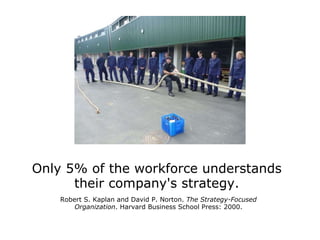
Only 5% of the workforce understands their company's strategy. Robert S. Kaplan and David P. Norton.  The Strategy-Focused Organization . Harvard Business School Press: 2000.
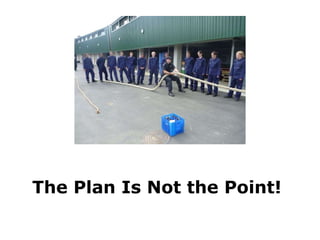
The Plan Is Not the Point!
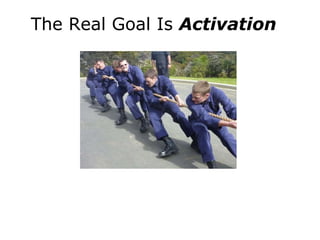
The Real Goal Is  Activation
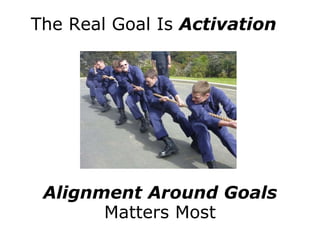
The Real Goal Is  Activation Alignment Around Goals Matters Most
1. Wikimedia's Challenge 2. Strategic Planning 3. Strategic Planning for Networks
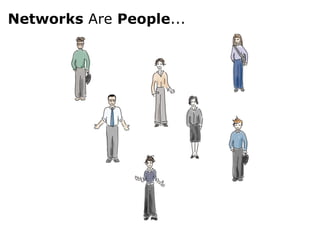
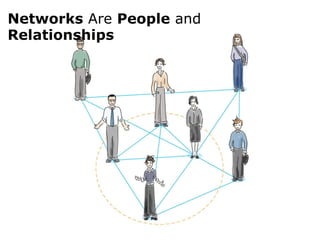
Networks  Are  People ...
Networks  Are  People  and  Relationships
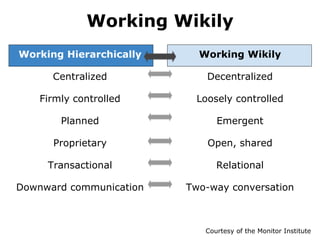
Working Wikily Working Hierarchically Centralized Firmly controlled Planned Proprietary Transactional Downward communication Working Wikily Decentralized Loosely controlled Emergent Open, shared Relational Two-way conversation Courtesy of the Monitor Institute
Strategic Planning for Networks? How do you develop a movement-wide five-year strategy in a completely open, collaborative way (the wiki way)?
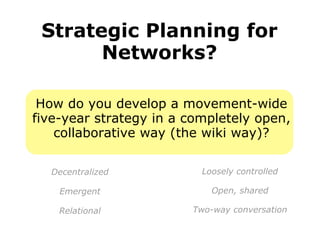
Decentralized Emergent Relational Loosely controlled Open, shared Two-way conversation Strategic Planning for Networks? How do you develop a movement-wide five-year strategy in a completely open, collaborative way (the wiki way)?
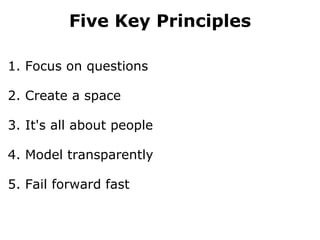
Five Key Principles 1. Focus on questions 2. Create a space 3. It's all about people 4. Model transparently 5. Fail forward fast
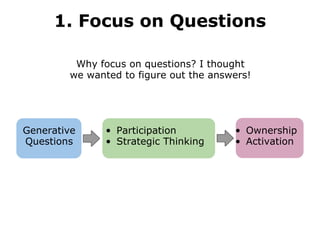
1. Focus on Questions Why focus on questions? I thought we wanted to figure out the answers!
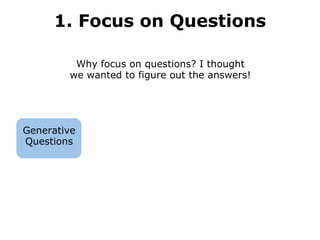
Why focus on questions? I thought we wanted to figure out the answers! 1. Focus on Questions Generative Questions
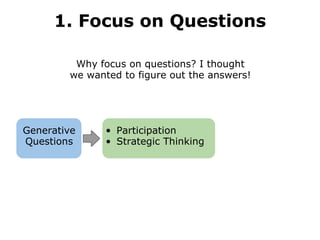
Why focus on questions? I thought we wanted to figure out the answers! 1. Focus on Questions Generative Questions Participation Strategic Thinking
Why focus on questions? I thought we wanted to figure out the answers! 1. Focus on Questions Generative Questions Participation Strategic Thinking Ownership Activation
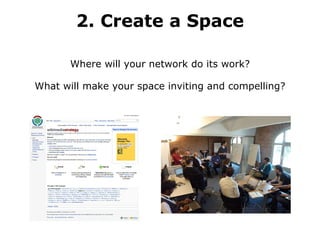
2. Create a Space Where will your network do its work? What will make your space inviting and compelling?
3. It's all about People Who do you want to participate? How many participants should you target? How will you bring people into the process?
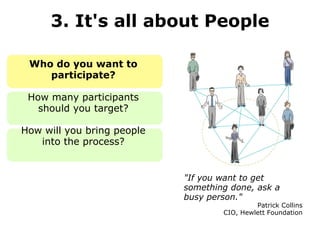
3. It's all about People Who do you want to participate? How many participants should you target? How will you bring people into the process? &quot;If you want to get something done, ask a busy person.&quot; Patrick Collins CIO, Hewlett Foundation
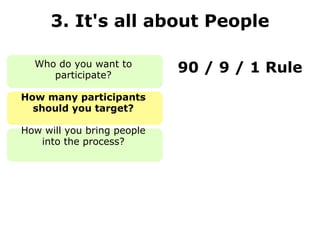
3. It's all about People Who do you want to participate? How many participants should you target? How will you bring people into the process? 90 / 9 / 1 Rule
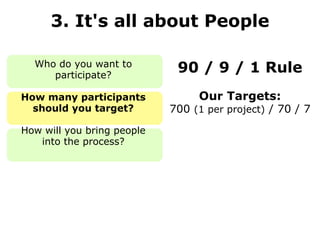
3. It's all about People Who do you want to participate? How many participants should you target? How will you bring people into the process? 90 / 9 / 1 Rule Our Targets: 700  (1 per project)  /   70 / 7
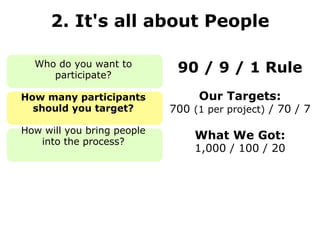
2. It's all about People Who do you want to participate? How many participants should you target? How will you bring people into the process? 90 / 9 / 1 Rule Our Targets: 700  (1 per project)  /   70 / 7 What We Got: 1,000 / 100 / 20
3. It's all about People Who do you want to participate? How many participants should you target? How will you bring people into the process? Ask!
3. It's all about People Who do you want to participate? How many participants should you target? How will you bring people into the process? Ask! Build Relationships
4. Model Transparently How do you leave room for deliberation about process while also making forward progress?
How do you leave room for deliberation about process while also making forward progress? 4. Model Transparently Sharing control , not giving it up
How do you leave room for deliberation about process while also making forward progress? 4. Model Transparently Sharing control , not giving it up Do-acracy  — Put a stake in the ground
How do you leave room for deliberation about process while also making forward progress? 4. Model Transparently Sharing control , not giving it up Do-acracy  — Put a stake in the ground Be open to change
5. Fail Forward Fast How will you know if your process is &quot;right&quot; or not?
5. Fail Forward Fast How will you know if your process is &quot;right&quot; or not? Assume it's not. Design for the best case, learn, and adapt.
5. Fail Forward Fast How will you know if your process is &quot;right&quot; or not? If you're not screwing up, you're not trying hard enough.
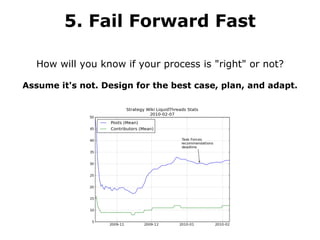
5. Fail Forward Fast How will you know if your process is &quot;right&quot; or not? Assume it's not. Design for the best case, plan, and adapt.
Five Key Principles  (redux) 1. Focus on questions 2. Create a space 3. It's all about people 4. Model transparently 5. Fail forward fast
Questions?
For More Information Eugene Eric Kim / Blue Oxen Associates [email_address] @BlueOxenAssoc / @eekim on Twitter http://blueoxen.com/ http://eekim.com/ These Slides http://www.slideshare.net/eekim/strategic-planning-for-networks http://bit.ly/network-strategic-planning Wikimedia Strategy http://strategy.wikimedia.org/
Credits Thanks to  Kristin Cobble  of Courion Group,  Rebecca Petzel , and  H. Jessica Kim  for their valuable feedback on this presentation and for being thought partners — along with  Diana Scearce  and  Heather McLeod Grant  of the Monitor Institute and the  entire staff of the Leadership Learning Community  — on networks. Thanks to all of the Wikimedians who participated in this wonderful little experiment, especially  Sue Gardner ,  Erik Moeller , and  Philippe Beaudette  of the Wikimedia Foundation. Many thanks to  Amy Wu Wong  < http://wordsdesign.com/ > for the design of this presentation as well as her delightful sketches. Attributions  Slide 11: Photographs from Wikimedia Commons by Goldmund100 (GNU FDL), MichaelDiederich (CC-BY-SA 2.0), Lisarlena (GNU FDL), Serenity (GNU FDL), THWZ (CC-BY-SA 3.0), Timur Mamadrzaev (CC-BY-SA 3.0), Alexanderps (Public Domain), Yumolives (CC-BY-SA 3.0), Rovdyr (GNU FDL), Василий Меленчук (Public Domain), Airon90 (CC-BY-SA 3.0), Wuselig (CC-BY-SA 3.0), Maderibeyza (GNU FDL), Ragesoss (CC-BY-SA 3.0), Nikita (Public Domain), Ragesoss (CC-BY-SA 3.0), Ziko (CC-BY-SA 3.0), JCornelius (CC-BY-SA 2.0) Slides 19-22: Photographs from Flickr by Royal New Zealand Navy (CC-BY-ND 2.0) Slide 26: Working Wikily slide from Monitor Institute's &quot;The Power of Networks&quot; < http://www.slideshare.net/workingwikily/the-power-of-networks > All other photographs by Eugene Eric Kim / Blue Oxen Associates (CC-BY-SA 2.0)

Strategic Planning for Networks

  • 1.
    Strategic Planning  forNetworks Eugene Eric Kim <eekim@blueoxen.com> Blue Oxen Associates March 22, 2011
  • 2.
    About Me Principal,Cofounder of Blue Oxen Associates
  • 3.
    About Me LeadershipLearning Community Board Member Principal, Cofounder of Blue Oxen Associates
  • 4.
    About Me Collaboration!Leadership Learning Community Board Member Principal, Cofounder of Blue Oxen Associates
  • 5.
    About Me Collaboration!Leadership Learning Community Board Member Principal, Cofounder of Blue Oxen Associates Wikimedia Strategic Planning (2009-2010)
  • 6.
    1. Wikimedia's Challenge2. Strategic Planning 3. Strategic Planning for Networks
  • 7.
    1. Wikimedia's Challenge2. Strategic Planning 3. Strategic Planning for Networks
  • 8.
  • 9.
    279 Language Versionsof Wikimedia Projects
  • 10.
    Source: comScore, Wikipedia(April 2010) Wikimedia Foundation + 30 independent chapters worldwide Google #5 website in the world 350 million visitors #1 website in the world 920 million visitors 40 employees 20,600 employees $10,000,000 revenue $23,000,000,000 revenue
  • 11.
  • 12.
    A Slice ofthe Community
  • 13.
    In 2009, Wikimediawas a global movement with a vision... Imagine a world in which every single human being can freely share in the sum of all knowledge. That's our commitment. ... but no collective strategy for achieving this vision.
  • 14.
    Strategic Planning forNetworks? How do you develop a movement-wide five-year strategy in a completely open, collaborative way (the wiki way)?
  • 15.
    1. Wikimedia's Challenge2. Strategic Planning 3. Strategic Planning for Networks
  • 16.
    Where are wenow?   Assessment
  • 17.
    Where should wego?   Visioning / Goal-Setting
  • 18.
    How should weget there?   Planning
  • 19.
    Only 5% ofthe workforce understands their company's strategy. Robert S. Kaplan and David P. Norton. The Strategy-Focused Organization . Harvard Business School Press: 2000.
  • 20.
    The Plan IsNot the Point!
  • 21.
    The Real GoalIs Activation
  • 22.
    The Real GoalIs Activation Alignment Around Goals Matters Most
  • 23.
    1. Wikimedia's Challenge2. Strategic Planning 3. Strategic Planning for Networks
  • 24.
    Networks Are People ...
  • 25.
    Networks Are People and Relationships
  • 26.
    Working Wikily WorkingHierarchically Centralized Firmly controlled Planned Proprietary Transactional Downward communication Working Wikily Decentralized Loosely controlled Emergent Open, shared Relational Two-way conversation Courtesy of the Monitor Institute
  • 27.
    Strategic Planning forNetworks? How do you develop a movement-wide five-year strategy in a completely open, collaborative way (the wiki way)?
  • 28.
    Decentralized Emergent RelationalLoosely controlled Open, shared Two-way conversation Strategic Planning for Networks? How do you develop a movement-wide five-year strategy in a completely open, collaborative way (the wiki way)?
  • 29.
    Five Key Principles1. Focus on questions 2. Create a space 3. It's all about people 4. Model transparently 5. Fail forward fast
  • 30.
    1. Focus onQuestions Why focus on questions? I thought we wanted to figure out the answers!
  • 31.
    Why focus onquestions? I thought we wanted to figure out the answers! 1. Focus on Questions Generative Questions
  • 32.
    Why focus onquestions? I thought we wanted to figure out the answers! 1. Focus on Questions Generative Questions Participation Strategic Thinking
  • 33.
    Why focus onquestions? I thought we wanted to figure out the answers! 1. Focus on Questions Generative Questions Participation Strategic Thinking Ownership Activation
  • 34.
    2. Create aSpace Where will your network do its work? What will make your space inviting and compelling?
  • 35.
    2. Create aSpace Where will your network do its work? What will make your space inviting and compelling?
  • 36.
    3. It's allabout People Who do you want to participate? How many participants should you target? How will you bring people into the process?
  • 37.
    3. It's allabout People Who do you want to participate? How many participants should you target? How will you bring people into the process? &quot;If you want to get something done, ask a busy person.&quot; Patrick Collins CIO, Hewlett Foundation
  • 38.
    3. It's allabout People Who do you want to participate? How many participants should you target? How will you bring people into the process? 90 / 9 / 1 Rule
  • 39.
    3. It's allabout People Who do you want to participate? How many participants should you target? How will you bring people into the process? 90 / 9 / 1 Rule Our Targets: 700 (1 per project) /   70 / 7
  • 40.
    2. It's allabout People Who do you want to participate? How many participants should you target? How will you bring people into the process? 90 / 9 / 1 Rule Our Targets: 700 (1 per project) /   70 / 7 What We Got: 1,000 / 100 / 20
  • 41.
    3. It's allabout People Who do you want to participate? How many participants should you target? How will you bring people into the process? Ask!
  • 42.
    3. It's allabout People Who do you want to participate? How many participants should you target? How will you bring people into the process? Ask! Build Relationships
  • 43.
    4. Model TransparentlyHow do you leave room for deliberation about process while also making forward progress?
  • 44.
    How do youleave room for deliberation about process while also making forward progress? 4. Model Transparently Sharing control , not giving it up
  • 45.
    How do youleave room for deliberation about process while also making forward progress? 4. Model Transparently Sharing control , not giving it up Do-acracy  — Put a stake in the ground
  • 46.
    How do youleave room for deliberation about process while also making forward progress? 4. Model Transparently Sharing control , not giving it up Do-acracy  — Put a stake in the ground Be open to change
  • 47.
    5. Fail ForwardFast How will you know if your process is &quot;right&quot; or not?
  • 48.
    5. Fail ForwardFast How will you know if your process is &quot;right&quot; or not? Assume it's not. Design for the best case, learn, and adapt.
  • 49.
    5. Fail ForwardFast How will you know if your process is &quot;right&quot; or not? If you're not screwing up, you're not trying hard enough.
  • 50.
    5. Fail ForwardFast How will you know if your process is &quot;right&quot; or not? Assume it's not. Design for the best case, plan, and adapt.
  • 51.
    Five Key Principles (redux) 1. Focus on questions 2. Create a space 3. It's all about people 4. Model transparently 5. Fail forward fast
  • 52.
  • 53.
    For More InformationEugene Eric Kim / Blue Oxen Associates [email_address] @BlueOxenAssoc / @eekim on Twitter http://blueoxen.com/ http://eekim.com/ These Slides http://www.slideshare.net/eekim/strategic-planning-for-networks http://bit.ly/network-strategic-planning Wikimedia Strategy http://strategy.wikimedia.org/
  • 54.
    Credits Thanks to Kristin Cobble of Courion Group, Rebecca Petzel , and  H. Jessica Kim  for their valuable feedback on this presentation and for being thought partners — along with Diana Scearce and Heather McLeod Grant of the Monitor Institute and the entire staff of the Leadership Learning Community  — on networks. Thanks to all of the Wikimedians who participated in this wonderful little experiment, especially Sue Gardner , Erik Moeller , and Philippe Beaudette of the Wikimedia Foundation. Many thanks to Amy Wu Wong < http://wordsdesign.com/ > for the design of this presentation as well as her delightful sketches. Attributions  Slide 11: Photographs from Wikimedia Commons by Goldmund100 (GNU FDL), MichaelDiederich (CC-BY-SA 2.0), Lisarlena (GNU FDL), Serenity (GNU FDL), THWZ (CC-BY-SA 3.0), Timur Mamadrzaev (CC-BY-SA 3.0), Alexanderps (Public Domain), Yumolives (CC-BY-SA 3.0), Rovdyr (GNU FDL), Василий Меленчук (Public Domain), Airon90 (CC-BY-SA 3.0), Wuselig (CC-BY-SA 3.0), Maderibeyza (GNU FDL), Ragesoss (CC-BY-SA 3.0), Nikita (Public Domain), Ragesoss (CC-BY-SA 3.0), Ziko (CC-BY-SA 3.0), JCornelius (CC-BY-SA 2.0) Slides 19-22: Photographs from Flickr by Royal New Zealand Navy (CC-BY-ND 2.0) Slide 26: Working Wikily slide from Monitor Institute's &quot;The Power of Networks&quot; < http://www.slideshare.net/workingwikily/the-power-of-networks > All other photographs by Eugene Eric Kim / Blue Oxen Associates (CC-BY-SA 2.0)