6G MOBILE TECHNOLOGY FOR SMART CITIES
S NISHITH
19WJ1A05Q4
CSE-4
CONTEXT:
• WHAT IS A MOBILE PHONE?
• EVOLUTION OF TECHNOLOGY IN MOBILES.
• 6G TECHNOLOGY
• FEATURES
• TECHNOLOGY USED
• ADVANTAGE
• ARCHITECTURE OF 6G TECHNOLOGY .
• CONCLUSION
WHAT IS A MOBILE PHONE ?
A mobile phone is a device that can make and receive telephone calls
over a radio link while moving around a wide geographic area.
Mobile phone uses Wireless Communication for its information
exchange.
EVOLUTION OF TECHNOLOGY IN MOBILE
• OG Technology
• 1G Technology
• 2G Technology
• 2.5 G Technology
• 3G Technology
• 4G Technology
• 5G Technology
• 6G Technology
OG TECHNOLOGY (Mobile Radio Telephone System)
• The Zero Generation (OG) of mobile in 1945
• Mobile Telephone Service, based on "HANDOVER".
• Loggers, construction foremen, realtors, and celebrities.
They used them for basic voice communication
• Technologies were used in OG
PTT (Push to Talk)
MTS (Mobile Telephone System)
IMTS (Improved Mobile Telephone System)
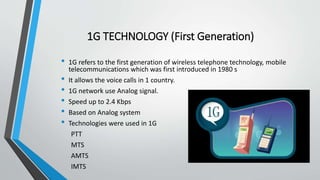
1G TECHNOLOGY (First Generation)
• 1G refers to the first generation of wireless telephone technology, mobile
telecommunications which was first introduced in 1980 s
• It allows the voice calls in 1 country.
• 1G network use Analog signal.
• Speed up to 2.4 Kbps
• Based on Analog system
• Technologies were used in 1G
PTT
MTS
AMTS
IMTS
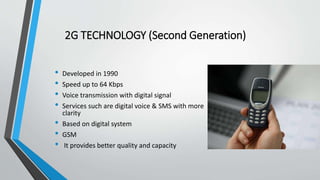
2G TECHNOLOGY (Second Generation)
• Developed in 1990
• Speed up to 64 Kbps
• Voice transmission with digital signal
• Services such are digital voice & SMS with more
clarity
• Based on digital system
• GSM
• It provides better quality and capacity
2.5 G TECHNOLOGY
• 2.5G is a technology between the second (2G) and third (3G) generation of
mobile telephony.
• 2.5G is sometimes described as 2G Cellular Technology combined with GPRS
and GSM.
• Features Include
• Send/Receive E-mail Messages
• Web Browsing
• Speed: 64-144 kbps
• Camera Phones
• Take a time of 6-9 mins. to download a 3 mins. Mp3 song
3G TECHNOLOGY
• 3G technology refer to third generation which was
introduced in year 2000s.
• Data Transmission speed increased from 144kbps-
2Mbps.
• Providing Faster Communication
• Superior Voice Quality
• Send/Receive Large Email Messages
• High Speed Web/More Security/Video
Conferencing/3D Gaming/TV Streaming/ Mobile TV
4G TECHNOLOGY (Anytime, Anywhere)
• 4G technology refer to or short name of fourth Generation which was started from
late 2004s.
• Capable of providing up to 300 Mbps speed.
• One of the basic term used to describe 4G is MAGIC.
MAGIC:
• Mobile Multimedia
• Also known as Mobile Broadband
• Everywhere.
• Global Mobility Support
• Integrated Wireless Solution
• Customized Personal Services
5G TECHNOLOGY (5G As Nano Core)
• 5G technology refer to short name of fifth Generation
which was started from late 2010s.
• Complete wireless communication with no limitations.
• It is highly supportable to WWWW (Wireless World
Wide Web).
• 5G Mobile Network is based on Open people group
what 12 Wireless Architecture(OWA)
• Speed Up To 1 GBPS
• 25 Mbps Connectivity Speed
6G TECHNOLOGY (Next Generation Mobile Technology)
• Complete Wireless Network with no limitation
• Incredible Transmission Speed in Terabit range
• Zero distance connectivity between peoples
• It will be available in the market 2020 with
more reliability than previous mobiles
• Maximizes your data throughput and IOPS
(Input Output Operations per Second)
FEATURES
• Frequency: 5.8 GHz
• Bandwidth: 11 GBPS
• Connectivity Speed
• Ultra Broadband Internet Service
• More Storage
• Capacity 15 Circuit and Packet Switching
• Provide the 3D Internet concept
SMART CITIES WITH 6G TECHNOLOGY
Smart cities refer to urban areas that use technology and data to improve efficiency, sustainability, and
quality of life for their residents. The deployment of 6G wireless technology could significantly enhance
the capabilities of smart cities, enabling them to take advantage of new use cases and services.
With 6G, smart cities could potentially offer even faster and more reliable connectivity, enabling real-time
data analysis and decision-making. This could support a range of applications, such as traffic
management, emergency services, and public safety.
Moreover, 6G could enable the use of more sophisticated technologies, such as autonomous vehicles,
augmented reality, and virtual reality, which could transform the way people interact with and experience
their urban environment.
In addition, 6G could facilitate the development of new Internet of Things (IoT) devices and sensors,
which could be used to monitor and manage various aspects of the city, such as energy consumption, air
quality, and waste management
ADVANTAGES
• Protects your Mobile And Secure your Data
• Streaming without any Superfast buffering
• A Real Time Online Gaming Experience
• Massively reduced Lag while Gaming
• Record Calls and Forward to Email also Forward
Calls to Other Numbers
• Intelligent Batteries
• Improved Storage Capability 17
• High Mobile-TV Resolution
REQUIREMENTS
• Smart Antenna
• Need high speed Network Connection
• Large Internal Memory In Mobile
ARCHITECTURE OF 6G
• GEO : GEOSYNCHRONOUS EQUATORIAL ORBIT
• MEO : MEDIUM EARTH ORBIT
• LEO :LOW EARTH ORBIT
• UAV : UNMANNED AERIAL VEHICLES
• HAPS : HIGH ALTITUDE PLATFORM SYSTEM
• BS : BASE STATION
CONCLUSION
• Increase performance and maximize your data throughput.
• Protect your system and secure your data
6G is the next step in the evolution of wireless technology
and is set to revolutionize the current 5G networks. It is
expected to be faster, more efficient and more secure than the
5G networks that are currently available.
THANK YOU FOR YOUR TIME

6G MOBILE TECHNOLOGY.pptx

  • 1.
    6G MOBILE TECHNOLOGYFOR SMART CITIES S NISHITH 19WJ1A05Q4 CSE-4
  • 2.
    CONTEXT: • WHAT ISA MOBILE PHONE? • EVOLUTION OF TECHNOLOGY IN MOBILES. • 6G TECHNOLOGY • FEATURES • TECHNOLOGY USED • ADVANTAGE • ARCHITECTURE OF 6G TECHNOLOGY . • CONCLUSION
  • 3.
    WHAT IS AMOBILE PHONE ? A mobile phone is a device that can make and receive telephone calls over a radio link while moving around a wide geographic area. Mobile phone uses Wireless Communication for its information exchange.
  • 4.
    EVOLUTION OF TECHNOLOGYIN MOBILE • OG Technology • 1G Technology • 2G Technology • 2.5 G Technology • 3G Technology • 4G Technology • 5G Technology • 6G Technology
  • 5.
    OG TECHNOLOGY (MobileRadio Telephone System) • The Zero Generation (OG) of mobile in 1945 • Mobile Telephone Service, based on "HANDOVER". • Loggers, construction foremen, realtors, and celebrities. They used them for basic voice communication • Technologies were used in OG PTT (Push to Talk) MTS (Mobile Telephone System) IMTS (Improved Mobile Telephone System)
  • 6.
    1G TECHNOLOGY (FirstGeneration) • 1G refers to the first generation of wireless telephone technology, mobile telecommunications which was first introduced in 1980 s • It allows the voice calls in 1 country. • 1G network use Analog signal. • Speed up to 2.4 Kbps • Based on Analog system • Technologies were used in 1G PTT MTS AMTS IMTS
  • 7.
    2G TECHNOLOGY (SecondGeneration) • Developed in 1990 • Speed up to 64 Kbps • Voice transmission with digital signal • Services such are digital voice & SMS with more clarity • Based on digital system • GSM • It provides better quality and capacity
  • 8.
    2.5 G TECHNOLOGY •2.5G is a technology between the second (2G) and third (3G) generation of mobile telephony. • 2.5G is sometimes described as 2G Cellular Technology combined with GPRS and GSM. • Features Include • Send/Receive E-mail Messages • Web Browsing • Speed: 64-144 kbps • Camera Phones • Take a time of 6-9 mins. to download a 3 mins. Mp3 song
  • 9.
    3G TECHNOLOGY • 3Gtechnology refer to third generation which was introduced in year 2000s. • Data Transmission speed increased from 144kbps- 2Mbps. • Providing Faster Communication • Superior Voice Quality • Send/Receive Large Email Messages • High Speed Web/More Security/Video Conferencing/3D Gaming/TV Streaming/ Mobile TV
  • 10.
    4G TECHNOLOGY (Anytime,Anywhere) • 4G technology refer to or short name of fourth Generation which was started from late 2004s. • Capable of providing up to 300 Mbps speed. • One of the basic term used to describe 4G is MAGIC. MAGIC: • Mobile Multimedia • Also known as Mobile Broadband • Everywhere. • Global Mobility Support • Integrated Wireless Solution • Customized Personal Services
  • 11.
    5G TECHNOLOGY (5GAs Nano Core) • 5G technology refer to short name of fifth Generation which was started from late 2010s. • Complete wireless communication with no limitations. • It is highly supportable to WWWW (Wireless World Wide Web). • 5G Mobile Network is based on Open people group what 12 Wireless Architecture(OWA) • Speed Up To 1 GBPS • 25 Mbps Connectivity Speed
  • 12.
    6G TECHNOLOGY (NextGeneration Mobile Technology) • Complete Wireless Network with no limitation • Incredible Transmission Speed in Terabit range • Zero distance connectivity between peoples • It will be available in the market 2020 with more reliability than previous mobiles • Maximizes your data throughput and IOPS (Input Output Operations per Second)
  • 13.
    FEATURES • Frequency: 5.8GHz • Bandwidth: 11 GBPS • Connectivity Speed • Ultra Broadband Internet Service • More Storage • Capacity 15 Circuit and Packet Switching • Provide the 3D Internet concept
  • 14.
    SMART CITIES WITH6G TECHNOLOGY Smart cities refer to urban areas that use technology and data to improve efficiency, sustainability, and quality of life for their residents. The deployment of 6G wireless technology could significantly enhance the capabilities of smart cities, enabling them to take advantage of new use cases and services. With 6G, smart cities could potentially offer even faster and more reliable connectivity, enabling real-time data analysis and decision-making. This could support a range of applications, such as traffic management, emergency services, and public safety. Moreover, 6G could enable the use of more sophisticated technologies, such as autonomous vehicles, augmented reality, and virtual reality, which could transform the way people interact with and experience their urban environment. In addition, 6G could facilitate the development of new Internet of Things (IoT) devices and sensors, which could be used to monitor and manage various aspects of the city, such as energy consumption, air quality, and waste management
  • 15.
    ADVANTAGES • Protects yourMobile And Secure your Data • Streaming without any Superfast buffering • A Real Time Online Gaming Experience • Massively reduced Lag while Gaming • Record Calls and Forward to Email also Forward Calls to Other Numbers • Intelligent Batteries • Improved Storage Capability 17 • High Mobile-TV Resolution
  • 16.
    REQUIREMENTS • Smart Antenna •Need high speed Network Connection • Large Internal Memory In Mobile
  • 17.
    ARCHITECTURE OF 6G •GEO : GEOSYNCHRONOUS EQUATORIAL ORBIT • MEO : MEDIUM EARTH ORBIT • LEO :LOW EARTH ORBIT • UAV : UNMANNED AERIAL VEHICLES • HAPS : HIGH ALTITUDE PLATFORM SYSTEM • BS : BASE STATION
  • 18.
    CONCLUSION • Increase performanceand maximize your data throughput. • Protect your system and secure your data 6G is the next step in the evolution of wireless technology and is set to revolutionize the current 5G networks. It is expected to be faster, more efficient and more secure than the 5G networks that are currently available.
  • 19.
    THANK YOU FORYOUR TIME