Conducting an
Industry Analysis
Seven Questions for Industry Analysis
1. What are the industry dominant economic traits?
2. What competitive forces are at work in the industry and how
   strong are they?
3. What are the forces of change in the industry and what impact
   will they have?
4. Which companies are in the strongest/weakest competitive
   position?
5. Who’s likely to make what competitive moves next?
6. What key factors will determine success or failure?
7. How attractive is the industry in terms of its prospects for
   above average profitability?
Q1. What are the industry
    dominant economic traits?
Market size (Small markets don’t attract big fish)
Scope of competitive rivalry
Market/industry growth rate (life cycle)
 – Fast growth breeds new entry; slowdowns lead to increased
   competition.
Number of rivals and their size
Number of buyers and their size
Level of backward and forward integration
Technological change (rate and scope)
Level of differentiation between firms’ products
Opportunities for economies of scale
Ease of entry and exit
Capital requirements
Q1: Industry’s Dominant Economic Traits

   Market                      Product
   – Size                      – Differentiation
   – Scope                     – Potential for
   – Growth rate                 economies of scale
   – Growth cycle              – Learning effects
   – # & size of               – Entry / exit costs
     competitors               – Technological
   – Distribution channels       change
   – Structure
        Forward Integration
        Backward Integration
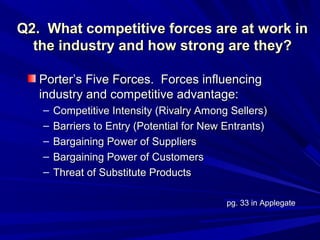
Q2. What competitive forces are at work in
  the industry and how strong are they?

   Porter’s Five Forces. Forces influencing
   industry and competitive advantage:
   –   Competitive Intensity (Rivalry Among Sellers)
   –   Barriers to Entry (Potential for New Entrants)
   –   Bargaining Power of Suppliers
   –   Bargaining Power of Customers
   –   Threat of Substitute Products

                                            pg. 33 in Applegate
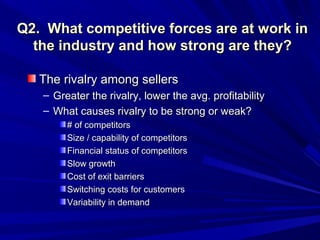
Q2. What competitive forces are at work in
  the industry and how strong are they?

   The rivalry among sellers
   – Greater the rivalry, lower the avg. profitability
   – What causes rivalry to be strong or weak?
        # of competitors
        Size / capability of competitors
        Financial status of competitors
        Slow growth
        Cost of exit barriers
        Switching costs for customers
        Variability in demand
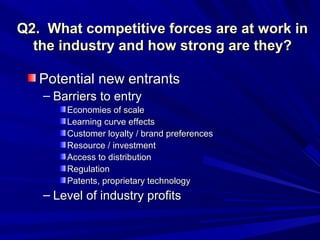
Q2. What competitive forces are at work in
  the industry and how strong are they?

   Potential new entrants
   – Barriers to entry
       Economies of scale
       Learning curve effects
       Customer loyalty / brand preferences
       Resource / investment
       Access to distribution
       Regulation
       Patents, proprietary technology
   – Level of industry profits
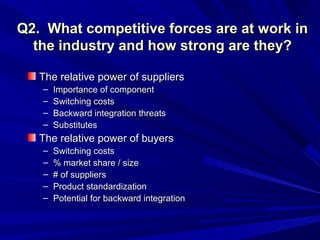
Q2. What competitive forces are at work in
  the industry and how strong are they?

   The relative power of suppliers
   –   Importance of component
   –   Switching costs
   –   Backward integration threats
   –   Substitutes
   The relative power of buyers
   –   Switching costs
   –   % market share / size
   –   # of suppliers
   –   Product standardization
   –   Potential for backward integration
Q2. What competitive forces are at work in
  the industry and how strong are they?

   Substitute products
   –   Place a ceiling on prices and profits of industry
   –   Invite comparison shopping
   –   E.g., eyeglasses vs. contact lenses
   –   E.g., sugar vs. artificial sweeteners
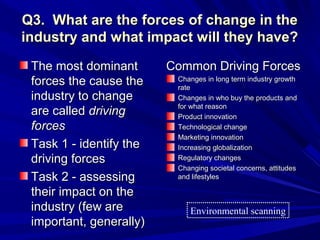
Q3. What are the forces of change in the
industry and what impact will they have?
 The most dominant       Common Driving Forces
 forces the cause the     Changes in long term industry growth
                          rate
 industry to change       Changes in who buy the products and
                          for what reason
 are called driving       Product innovation
 forces                   Technological change
                          Marketing innovation
 Task 1 - identify the    Increasing globalization
 driving forces           Regulatory changes
                          Changing societal concerns, attitudes
 Task 2 - assessing       and lifestyles

 their impact on the
 industry (few are           Environmental scanning
 important, generally)
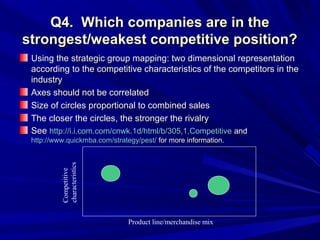
Q4. Which companies are in the
strongest/weakest competitive position?
 Using the strategic group mapping: two dimensional representation
 according to the competitive characteristics of the competitors in the
 industry
 Axes should not be correlated
 Size of circles proportional to combined sales
 The closer the circles, the stronger the rivalry
 See http://i.i.com.com/cnwk.1d/html/b/305,1,Competitive and
 http://www.quickmba.com/strategy/pest/ for more information.
          characteristics
          Competitive


                               Product line/merchandise mix
Q5. Who’s likely to make what
    competitive moves next?
In order to            Identify competitors
outmaneuver your       strategies
competition you have   Evaluate who are the
to evaluate the        major players-- now
competitors’ future    Who will be the major
moves.                 players
                       Evaluate what the
                       major players are
                       going to do
Q6. What key factors will determine
       success or failure?
Key success factors (KSF) are crucial
elements that lead to success.
What are they now? What will they be?
In beer production KSF can be brewing
skills
In retail apparel KSF can be low cost,
superior service, superior design
In your industry, KSF=????
Q7. How attractive is the industry in terms of
its prospects for above average profitability?

Growth potential
Driving forces
Entry/exit
Stability of demand
Competitive forces
Risk and uncertainty
Competition and its
impact on the industry’s
future
7 Questions
1. What are the industry dominant
  economic traits?
2. What competitive forces are at work in
  the industry and how strong are they?
3. What are the forces of change in the
  industry and what impact will they
  have?
7 Questions
4. Which companies are in the
  strongest/weakest competitive position?
5. Who’s likely to make what competitive
  moves next?
6. What key factors will determine success or
  failure?
7. How attractive is the industry in terms of its
  prospects for above average profitability?

Conducting an industry analysis (1)

  • 1.
  • 2.
    Seven Questions forIndustry Analysis 1. What are the industry dominant economic traits? 2. What competitive forces are at work in the industry and how strong are they? 3. What are the forces of change in the industry and what impact will they have? 4. Which companies are in the strongest/weakest competitive position? 5. Who’s likely to make what competitive moves next? 6. What key factors will determine success or failure? 7. How attractive is the industry in terms of its prospects for above average profitability?
  • 3.
    Q1. What arethe industry dominant economic traits? Market size (Small markets don’t attract big fish) Scope of competitive rivalry Market/industry growth rate (life cycle) – Fast growth breeds new entry; slowdowns lead to increased competition. Number of rivals and their size Number of buyers and their size Level of backward and forward integration Technological change (rate and scope) Level of differentiation between firms’ products Opportunities for economies of scale Ease of entry and exit Capital requirements
  • 4.
    Q1: Industry’s DominantEconomic Traits Market Product – Size – Differentiation – Scope – Potential for – Growth rate economies of scale – Growth cycle – Learning effects – # & size of – Entry / exit costs competitors – Technological – Distribution channels change – Structure Forward Integration Backward Integration
  • 5.
    Q2. What competitiveforces are at work in the industry and how strong are they? Porter’s Five Forces. Forces influencing industry and competitive advantage: – Competitive Intensity (Rivalry Among Sellers) – Barriers to Entry (Potential for New Entrants) – Bargaining Power of Suppliers – Bargaining Power of Customers – Threat of Substitute Products pg. 33 in Applegate
  • 6.
    Q2. What competitiveforces are at work in the industry and how strong are they? The rivalry among sellers – Greater the rivalry, lower the avg. profitability – What causes rivalry to be strong or weak? # of competitors Size / capability of competitors Financial status of competitors Slow growth Cost of exit barriers Switching costs for customers Variability in demand
  • 7.
    Q2. What competitiveforces are at work in the industry and how strong are they? Potential new entrants – Barriers to entry Economies of scale Learning curve effects Customer loyalty / brand preferences Resource / investment Access to distribution Regulation Patents, proprietary technology – Level of industry profits
  • 8.
    Q2. What competitiveforces are at work in the industry and how strong are they? The relative power of suppliers – Importance of component – Switching costs – Backward integration threats – Substitutes The relative power of buyers – Switching costs – % market share / size – # of suppliers – Product standardization – Potential for backward integration
  • 9.
    Q2. What competitiveforces are at work in the industry and how strong are they? Substitute products – Place a ceiling on prices and profits of industry – Invite comparison shopping – E.g., eyeglasses vs. contact lenses – E.g., sugar vs. artificial sweeteners
  • 10.
    Q3. What arethe forces of change in the industry and what impact will they have? The most dominant Common Driving Forces forces the cause the Changes in long term industry growth rate industry to change Changes in who buy the products and for what reason are called driving Product innovation forces Technological change Marketing innovation Task 1 - identify the Increasing globalization driving forces Regulatory changes Changing societal concerns, attitudes Task 2 - assessing and lifestyles their impact on the industry (few are Environmental scanning important, generally)
  • 11.
    Q4. Which companiesare in the strongest/weakest competitive position? Using the strategic group mapping: two dimensional representation according to the competitive characteristics of the competitors in the industry Axes should not be correlated Size of circles proportional to combined sales The closer the circles, the stronger the rivalry See http://i.i.com.com/cnwk.1d/html/b/305,1,Competitive and http://www.quickmba.com/strategy/pest/ for more information. characteristics Competitive Product line/merchandise mix
  • 12.
    Q5. Who’s likelyto make what competitive moves next? In order to Identify competitors outmaneuver your strategies competition you have Evaluate who are the to evaluate the major players-- now competitors’ future Who will be the major moves. players Evaluate what the major players are going to do
  • 13.
    Q6. What keyfactors will determine success or failure? Key success factors (KSF) are crucial elements that lead to success. What are they now? What will they be? In beer production KSF can be brewing skills In retail apparel KSF can be low cost, superior service, superior design In your industry, KSF=????
  • 14.
    Q7. How attractiveis the industry in terms of its prospects for above average profitability? Growth potential Driving forces Entry/exit Stability of demand Competitive forces Risk and uncertainty Competition and its impact on the industry’s future
  • 15.
    7 Questions 1. Whatare the industry dominant economic traits? 2. What competitive forces are at work in the industry and how strong are they? 3. What are the forces of change in the industry and what impact will they have?
  • 16.
    7 Questions 4. Whichcompanies are in the strongest/weakest competitive position? 5. Who’s likely to make what competitive moves next? 6. What key factors will determine success or failure? 7. How attractive is the industry in terms of its prospects for above average profitability?