Balanced Scorecard and Strategy Map Lunch Bunch (Cabinet) August 23, 2007
Short-Term Goal (Today) Understand the Balanced Scorecard
Create a Balanced Scorecard that links objectives, initiatives (new and old), and measures to the strategy of our organization.
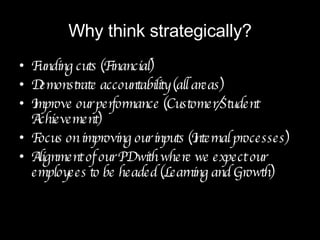
Why think strategically?
Funding cuts (Financial)
Demonstrate accountability (all areas)
Improve our performance (Customer/Student Achievement)
Focus on improving our inputs (Internal processes)
Alignment of our PD with where we expect our employees to be headed (Learning and Growth)
Why think strategically? Funding cuts (Financial) Demonstrate accountability (all areas) Improve our performance (Customer/Student Achievement) Focus on improving our inputs (Internal processes) Alignment of our PD with where we expect our employees to be headed (Learning and Growth)
?
Strategy Strategy  is h ow we inten d   to  create value f or ou r customers
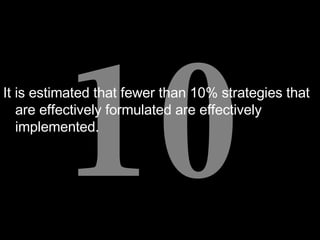
It is estimated that fewer than 10% strategies that are effectively formulated are effectively implemented. 10%
In the majority of those cases (it is estimated to be 70%) the problem is not the strategy, but the execution of the strategy. Forbes Magazine
Barriers to strategic thinking
Vision: Only 5% of workforce understands the strategy
People: Only 25% of managers have incentives linked to strategy
Management: 85% of Executive Teams spend less than 1 hour on strategy
Resources: 60% of organizations do not link budgets to strategy
It is estimated that managers and executives spend less than 1 hour per month on strategy. 1 hour
Steps in this Process Step #1: What is a Balanced Scorecard? Step #2: What is a Strategy Map? Step #3: What method are we going to use to create our Strategy Map?
Step #1: What is BSC?
What is a Balanced Scorecard? … The BSC is a management tool that provides senior executives a comprehensive measure of how the organization is progressing towards achieving its strategic goals.
Balanced Scorecard The idea of the scorecard is to describe the essential ingredients of organizational success. Its underlying philosophy – Provides a tool for clearly communicating the goals and priorities of the organization.
Introduced in 1992, by Robert Kaplan and David Norton, the Balanced Scorecard is the most commonly used framework for ensuring that agencies execute their strategies. Today, about 70% of the Fortune 1,000 companies utilize the Balanced Scorecard to help manage performance. Where it started . . .
Some Basic Principles Quantifies the Organizational  Strategy in measurable terms Strategy is summarized on a Strategy Map over four views of performance (perspectives). Must capture a cause-effect relationship between strategic objectives over the four perspectives on the Strategy Map. Critical Components include: - Measurements - Targets - Initiatives Everything must be linked: Goals to Objectives, Objectives to Measurements, Measurements to Targets.
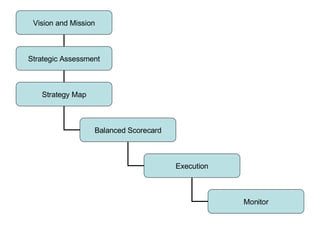
Vision and Mission Strategic Assessment Strategy Map Balanced Scorecard Execution Monitor
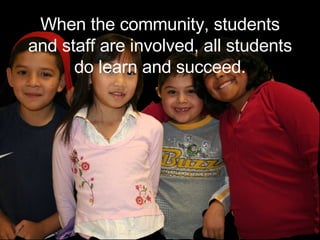
When the community, students and staff are involved, all students do learn and succeed.
… to ensure all students will be at or above grade level
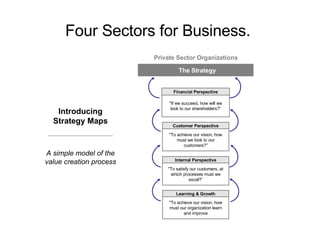
Four Sectors for Business.  "If we succeed, how will we look to our shareholders?” The Strategy Private Sector Organizations Financial Perspective "To achieve our vision, how must we look to our customers?” Customer Perspective "To satisfy our customers, at which processes must we excel?” Internal Perspective "To achieve our vision, how must our organization learn and improve Learning & Growth Introducing Strategy Maps A simple model of the value creation process
Customer Who are our targeted customers? What is our value proposition in serving them?
Processes To satisfy our customers at what processes must we succeed?
Employee Learning and Growth What capabilities and tools do employees require to help then execute our strategy?
Financial Perspective What financial steps are necessary to ensure the execution of our strategy?
“ Simple, not simplistic.” -Kaplan and Norton
Make sure relationship between point A (where we are today) and point B (scorecard) is clear A scorecard is a final measurement tool.  To get there we need to clarify our strategy.  To clarify strategy will need to spend some time analyzing strategic data and then develop a map of strategy.

Balanced Scorecard Introduction

  • 1.
    Balanced Scorecard andStrategy Map Lunch Bunch (Cabinet) August 23, 2007
  • 2.
    Short-Term Goal (Today)Understand the Balanced Scorecard
  • 3.
    Create a BalancedScorecard that links objectives, initiatives (new and old), and measures to the strategy of our organization.
  • 4.
  • 5.
  • 6.
  • 7.
    Improve our performance(Customer/Student Achievement)
  • 8.
    Focus on improvingour inputs (Internal processes)
  • 9.
    Alignment of ourPD with where we expect our employees to be headed (Learning and Growth)
  • 10.
    Why think strategically?Funding cuts (Financial) Demonstrate accountability (all areas) Improve our performance (Customer/Student Achievement) Focus on improving our inputs (Internal processes) Alignment of our PD with where we expect our employees to be headed (Learning and Growth)
  • 11.
  • 12.
    Strategy Strategy is h ow we inten d to create value f or ou r customers
  • 13.
    It is estimatedthat fewer than 10% strategies that are effectively formulated are effectively implemented. 10%
  • 14.
    In the majorityof those cases (it is estimated to be 70%) the problem is not the strategy, but the execution of the strategy. Forbes Magazine
  • 15.
  • 16.
    Vision: Only 5%of workforce understands the strategy
  • 17.
    People: Only 25%of managers have incentives linked to strategy
  • 18.
    Management: 85% ofExecutive Teams spend less than 1 hour on strategy
  • 19.
    Resources: 60% oforganizations do not link budgets to strategy
  • 20.
    It is estimatedthat managers and executives spend less than 1 hour per month on strategy. 1 hour
  • 21.
    Steps in thisProcess Step #1: What is a Balanced Scorecard? Step #2: What is a Strategy Map? Step #3: What method are we going to use to create our Strategy Map?
  • 22.
  • 23.
    What is aBalanced Scorecard? … The BSC is a management tool that provides senior executives a comprehensive measure of how the organization is progressing towards achieving its strategic goals.
  • 24.
    Balanced Scorecard Theidea of the scorecard is to describe the essential ingredients of organizational success. Its underlying philosophy – Provides a tool for clearly communicating the goals and priorities of the organization.
  • 25.
    Introduced in 1992,by Robert Kaplan and David Norton, the Balanced Scorecard is the most commonly used framework for ensuring that agencies execute their strategies. Today, about 70% of the Fortune 1,000 companies utilize the Balanced Scorecard to help manage performance. Where it started . . .
  • 26.
    Some Basic PrinciplesQuantifies the Organizational Strategy in measurable terms Strategy is summarized on a Strategy Map over four views of performance (perspectives). Must capture a cause-effect relationship between strategic objectives over the four perspectives on the Strategy Map. Critical Components include: - Measurements - Targets - Initiatives Everything must be linked: Goals to Objectives, Objectives to Measurements, Measurements to Targets.
  • 27.
    Vision and MissionStrategic Assessment Strategy Map Balanced Scorecard Execution Monitor
  • 28.
    When the community,students and staff are involved, all students do learn and succeed.
  • 29.
    … to ensureall students will be at or above grade level
  • 30.
    Four Sectors forBusiness. "If we succeed, how will we look to our shareholders?” The Strategy Private Sector Organizations Financial Perspective "To achieve our vision, how must we look to our customers?” Customer Perspective "To satisfy our customers, at which processes must we excel?” Internal Perspective "To achieve our vision, how must our organization learn and improve Learning & Growth Introducing Strategy Maps A simple model of the value creation process
  • 31.
    Customer Who areour targeted customers? What is our value proposition in serving them?
  • 32.
    Processes To satisfyour customers at what processes must we succeed?
  • 33.
    Employee Learning andGrowth What capabilities and tools do employees require to help then execute our strategy?
  • 34.
    Financial Perspective Whatfinancial steps are necessary to ensure the execution of our strategy?
  • 35.
    “ Simple, notsimplistic.” -Kaplan and Norton
  • 36.
    Make sure relationshipbetween point A (where we are today) and point B (scorecard) is clear A scorecard is a final measurement tool. To get there we need to clarify our strategy. To clarify strategy will need to spend some time analyzing strategic data and then develop a map of strategy.