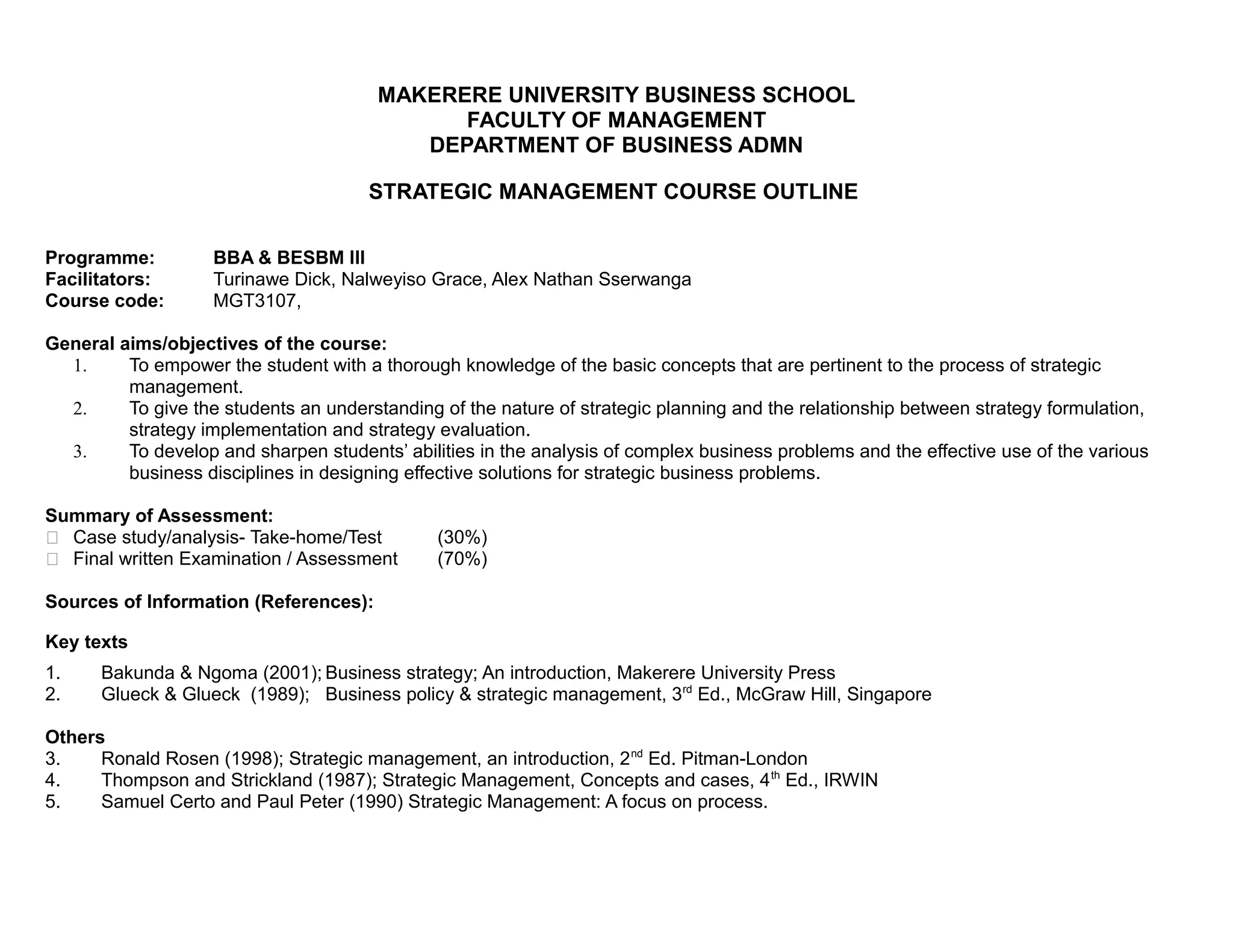
MAKERERE UNIVERSITY BUSINESS SCHOOL
FACULTY OF MANAGEMENT
DEPARTMENT OF BUSINESS ADMN
STRATEGIC MANAGEMENT COURSE OUTLINE
Programme: BBA & BESBM III
Facilitators: Turinawe Dick, Nalweyiso Grace, Alex Nathan Sserwanga
Course code: MGT3107,
General aims/objectives of the course:
1. To empower the student with a thorough knowledge of the basic concepts that are pertinent to the process of strategic
management.
2. To give the students an understanding of the nature of strategic planning and the relationship between strategy formulation,
strategy implementation and strategy evaluation.
3. To develop and sharpen students’ abilities in the analysis of complex business problems and the effective use of the various
business disciplines in designing effective solutions for strategic business problems.
Summary of Assessment:
 Case study/analysis- Take-home/Test (30%)
 Final written Examination / Assessment (70%)
Sources of Information (References):
Key texts
1. Bakunda & Ngoma (2001); Business strategy; An introduction, Makerere University Press
2. Glueck & Glueck (1989); Business policy & strategic management, 3rd
Ed., McGraw Hill, Singapore
Others
3. Ronald Rosen (1998); Strategic management, an introduction, 2nd
Ed. Pitman-London
4. Thompson and Strickland (1987); Strategic Management, Concepts and cases, 4th
Ed., IRWIN
5. Samuel Certo and Paul Peter (1990) Strategic Management: A focus on process.
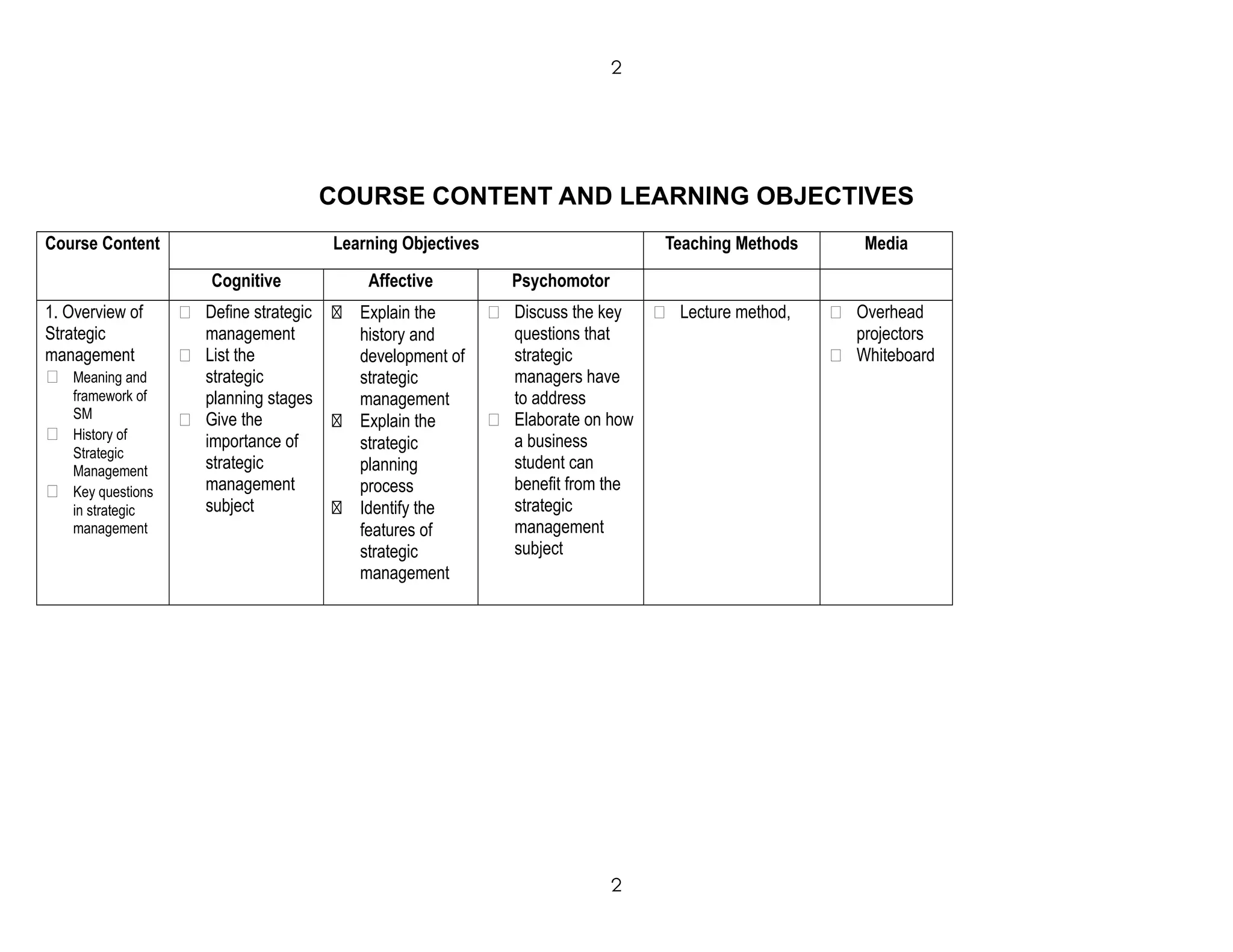
COURSE CONTENT AND LEARNING OBJECTIVES
Course Content Learning Objectives Teaching Methods Media
Cognitive Affective Psychomotor
1. Overview of
Strategic
management
 Meaning and
framework of
SM
 History of
Strategic
Management
 Key questions
in strategic
management
 Define strategic
management
 List the
strategic
planning stages
 Give the
importance of
strategic
management
subject
 Explain the
history and
development of
strategic
management
 Explain the
strategic
planning
process
 Identify the
features of
strategic
management
 Discuss the key
questions that
strategic
managers have
to address
 Elaborate on how
a business
student can
benefit from the
strategic
management
subject
 Lecture method,  Overhead
projectors
 Whiteboard
2
2
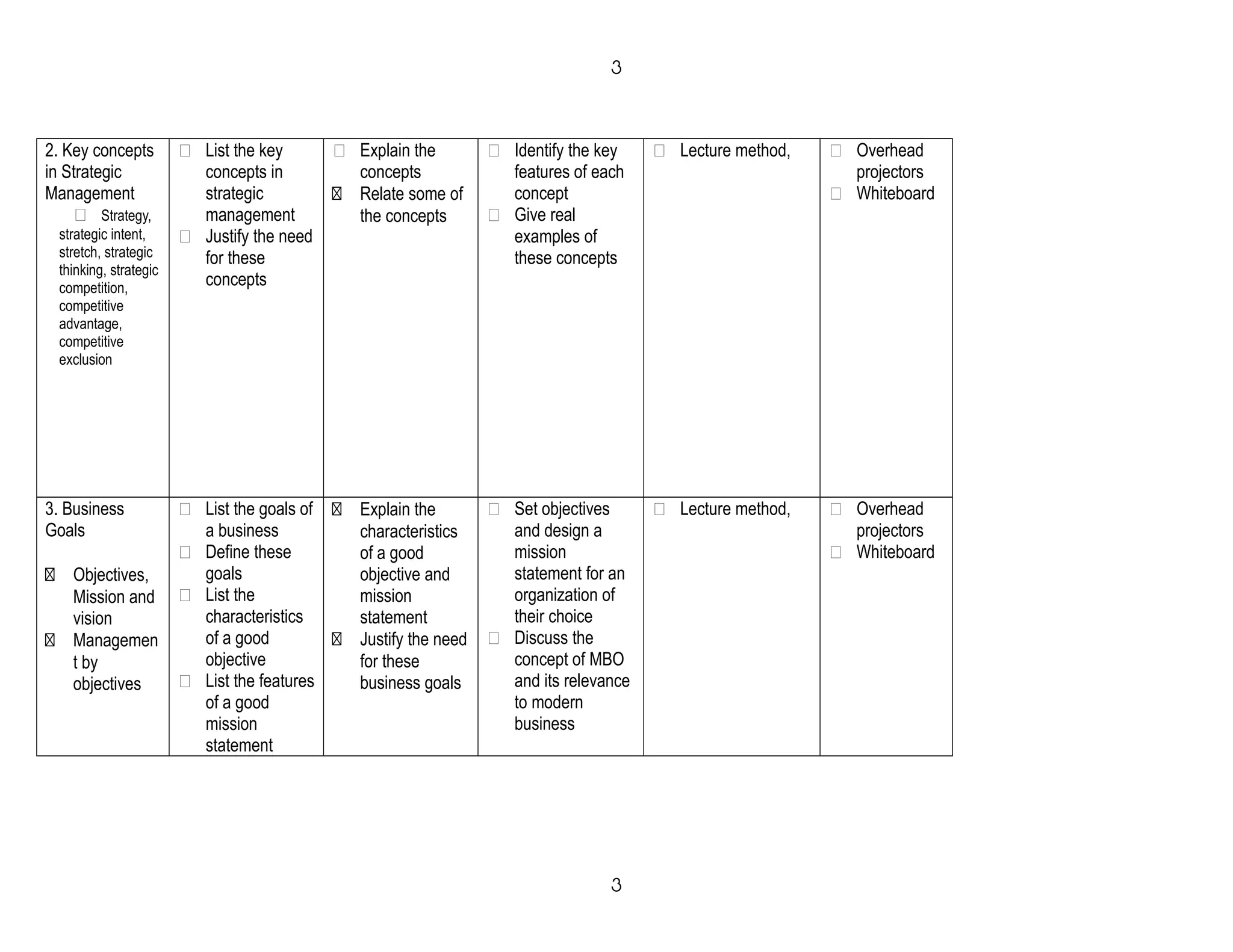
2. Key concepts
in Strategic
Management
 Strategy,
strategic intent,
stretch, strategic
thinking, strategic
competition,
competitive
advantage,
competitive
exclusion
 List the key
concepts in
strategic
management
 Justify the need
for these
concepts
 Explain the
concepts
 Relate some of
the concepts
 Identify the key
features of each
concept
 Give real
examples of
these concepts
 Lecture method,  Overhead
projectors
 Whiteboard
3. Business
Goals
 Objectives,
Mission and
vision
 Managemen
t by
objectives
 List the goals of
a business
 Define these
goals
 List the
characteristics
of a good
objective
 List the features
of a good
mission
statement
 Explain the
characteristics
of a good
objective and
mission
statement
 Justify the need
for these
business goals
 Set objectives
and design a
mission
statement for an
organization of
their choice
 Discuss the
concept of MBO
and its relevance
to modern
business
 Lecture method,  Overhead
projectors
 Whiteboard
3
3
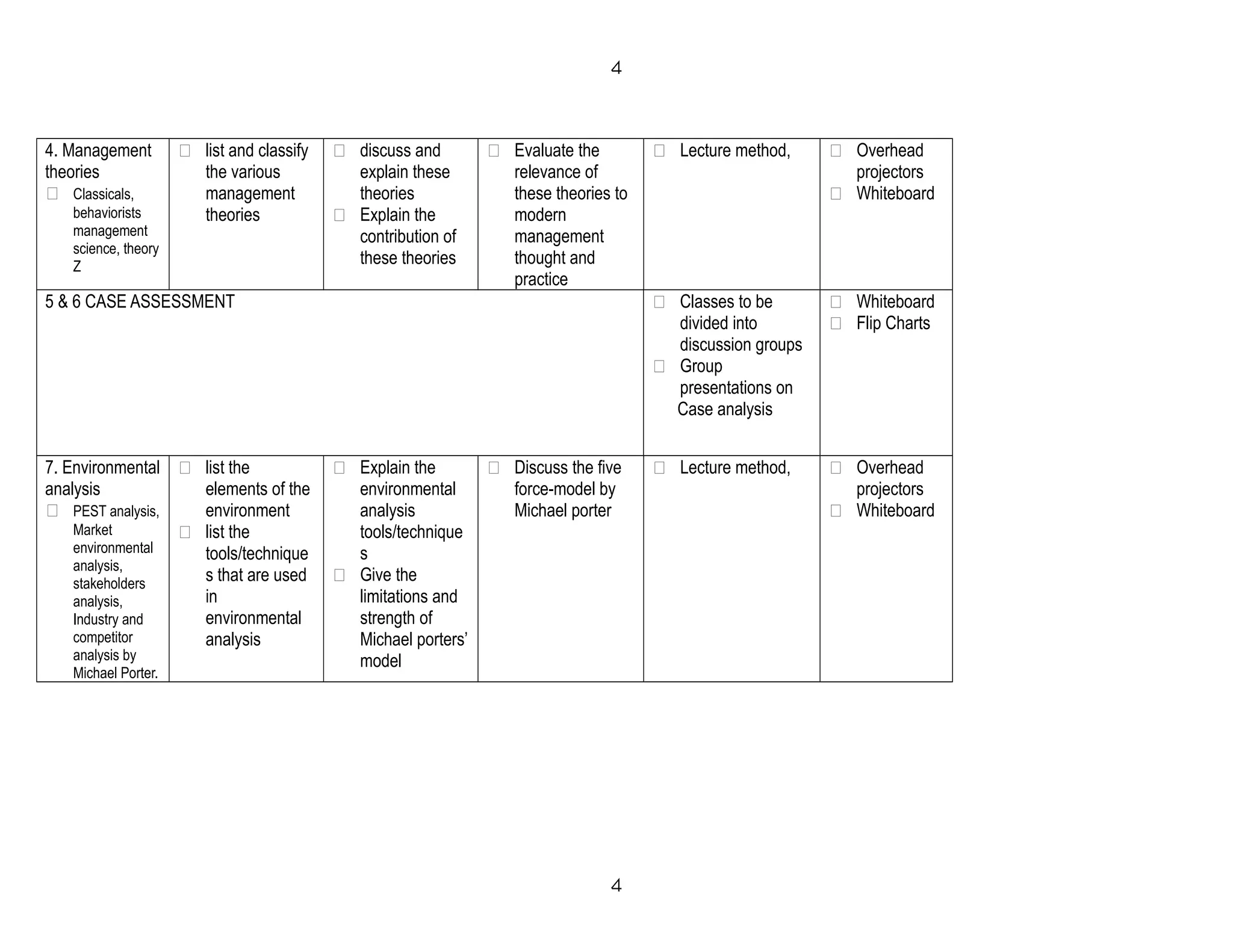
4. Management
theories
 Classicals,
behaviorists
management
science, theory
Z
 list and classify
the various
management
theories
 discuss and
explain these
theories
 Explain the
contribution of
these theories
 Evaluate the
relevance of
these theories to
modern
management
thought and
practice
 Lecture method,  Overhead
projectors
 Whiteboard
5 & 6 CASE ASSESSMENT  Classes to be
divided into
discussion groups
 Group
presentations on
Case analysis
 Whiteboard
 Flip Charts
7. Environmental
analysis
 PEST analysis,
Market
environmental
analysis,
stakeholders
analysis,
Industry and
competitor
analysis by
Michael Porter.
 list the
elements of the
environment
 list the
tools/technique
s that are used
in
environmental
analysis
 Explain the
environmental
analysis
tools/technique
s
 Give the
limitations and
strength of
Michael porters’
model
 Discuss the five
force-model by
Michael porter
 Lecture method,  Overhead
projectors
 Whiteboard
4
4
8. Analyzing the
organization
 Functional
analysis, Value
chain analysis,
strategic gap
analysis, Key
success
factors, Role of
chief
executives
 give examples
of direct
requests in
business
 explain
procedure for
writing direct
request
messages
 Explain the
importance of
analyzing an
organization
 discuss the key
issues to be
looked at when
analyzing the
organization
 illustrate how the
strategic gap can
be ascertained
 demonstrate how
value can be
added using the
value chain
analysis
 Lecture method,  Overhead
projectors
 Whiteboard
9. SWOT
analysis
 Opportunities
and threats
 Strengths and
weaknesses
 Give SWOT in
full
 Categorize
SWOT into the
internal and
external
aspects
 explain how a
SWOT analysis
is conducted
 Lecture method,  Overhead
projectors
 Whiteboard
10. Strategic
Choice
Generic
Alternatives
 Glueck’s
approach
 Porter’s
approach
 Ansoff’s
approach
 Kotler’s
approach
Business Portfolio
models
 The BCG
Growth Share
Matrix
 list the various
strategy options
available to a
firm
 Give the
considerations
in taking choice
of strategy
 list the various
strategy options
available to a
firm
 Give the
considerations
in taking choice
 Explain the
strategy
formulation
process
 Explain the
various
strategies
 Explain the
strategy
formulation
process
 Explain the
various
strategies
 Evaluate the
various strategy
 Chose the most
appropriate
strategy in a
given situation
 Evaluate the
various strategy
 Chose the most
appropriate
strategy in a
given situation
 Lecture method,
 Lecture method,
 Overhead
projectors
 Whiteboard
5
5
 The GE
streng/attractiv
ess Matrix
 The Life Cycle
Matrix
of strategy
11. Strategy
implementation
 Implementation
planning
 Prerequisites
for effective
implementation
 Generic steps
in strategy
implementation
 Mc Kinsey’s 7s
framework
 Give the stages
in strategy
implementation
process
 Justify the need
for
implementation
planning
 explain how the
elements of the
7s framework
are helpful in
strategy
implementation
 Discuss the
prerequisites for
effective
implementation
of a strategy
 Lecture method,  Overhead
projectors
 Whiteboard
12.Strategy
evaluation and
control
 Define strategy
evaluation and
control
 Give the
various
evaluation and
control
techniques
 Justify the need
for strategy
evaluation and
control
 Distinguish
between the
evaluation and
control
techniques
 Demonstrate
ability to evaluate
strategies
 Discuss why
corporate
strategies and
their
implementation
fail
 Lecture method,  Overhead
projectors
 Whiteboard
6
6
13. Revision-
CASE
ASSESSMENT
The focus should
be Case study
analysis and
presentations in
class.
 Classes to be
divided into
discussion groups
 Group
presentations on
Case analysis
.
7
7

Course outline

  • 1.
    MAKERERE UNIVERSITY BUSINESSSCHOOL FACULTY OF MANAGEMENT DEPARTMENT OF BUSINESS ADMN STRATEGIC MANAGEMENT COURSE OUTLINE Programme: BBA & BESBM III Facilitators: Turinawe Dick, Nalweyiso Grace, Alex Nathan Sserwanga Course code: MGT3107, General aims/objectives of the course: 1. To empower the student with a thorough knowledge of the basic concepts that are pertinent to the process of strategic management. 2. To give the students an understanding of the nature of strategic planning and the relationship between strategy formulation, strategy implementation and strategy evaluation. 3. To develop and sharpen students’ abilities in the analysis of complex business problems and the effective use of the various business disciplines in designing effective solutions for strategic business problems. Summary of Assessment:  Case study/analysis- Take-home/Test (30%)  Final written Examination / Assessment (70%) Sources of Information (References): Key texts 1. Bakunda & Ngoma (2001); Business strategy; An introduction, Makerere University Press 2. Glueck & Glueck (1989); Business policy & strategic management, 3rd Ed., McGraw Hill, Singapore Others 3. Ronald Rosen (1998); Strategic management, an introduction, 2nd Ed. Pitman-London 4. Thompson and Strickland (1987); Strategic Management, Concepts and cases, 4th Ed., IRWIN 5. Samuel Certo and Paul Peter (1990) Strategic Management: A focus on process.
  • 2.
    COURSE CONTENT ANDLEARNING OBJECTIVES Course Content Learning Objectives Teaching Methods Media Cognitive Affective Psychomotor 1. Overview of Strategic management  Meaning and framework of SM  History of Strategic Management  Key questions in strategic management  Define strategic management  List the strategic planning stages  Give the importance of strategic management subject  Explain the history and development of strategic management  Explain the strategic planning process  Identify the features of strategic management  Discuss the key questions that strategic managers have to address  Elaborate on how a business student can benefit from the strategic management subject  Lecture method,  Overhead projectors  Whiteboard 2 2
  • 3.
    2. Key concepts inStrategic Management  Strategy, strategic intent, stretch, strategic thinking, strategic competition, competitive advantage, competitive exclusion  List the key concepts in strategic management  Justify the need for these concepts  Explain the concepts  Relate some of the concepts  Identify the key features of each concept  Give real examples of these concepts  Lecture method,  Overhead projectors  Whiteboard 3. Business Goals  Objectives, Mission and vision  Managemen t by objectives  List the goals of a business  Define these goals  List the characteristics of a good objective  List the features of a good mission statement  Explain the characteristics of a good objective and mission statement  Justify the need for these business goals  Set objectives and design a mission statement for an organization of their choice  Discuss the concept of MBO and its relevance to modern business  Lecture method,  Overhead projectors  Whiteboard 3 3
  • 4.
    4. Management theories  Classicals, behaviorists management science,theory Z  list and classify the various management theories  discuss and explain these theories  Explain the contribution of these theories  Evaluate the relevance of these theories to modern management thought and practice  Lecture method,  Overhead projectors  Whiteboard 5 & 6 CASE ASSESSMENT  Classes to be divided into discussion groups  Group presentations on Case analysis  Whiteboard  Flip Charts 7. Environmental analysis  PEST analysis, Market environmental analysis, stakeholders analysis, Industry and competitor analysis by Michael Porter.  list the elements of the environment  list the tools/technique s that are used in environmental analysis  Explain the environmental analysis tools/technique s  Give the limitations and strength of Michael porters’ model  Discuss the five force-model by Michael porter  Lecture method,  Overhead projectors  Whiteboard 4 4
  • 5.
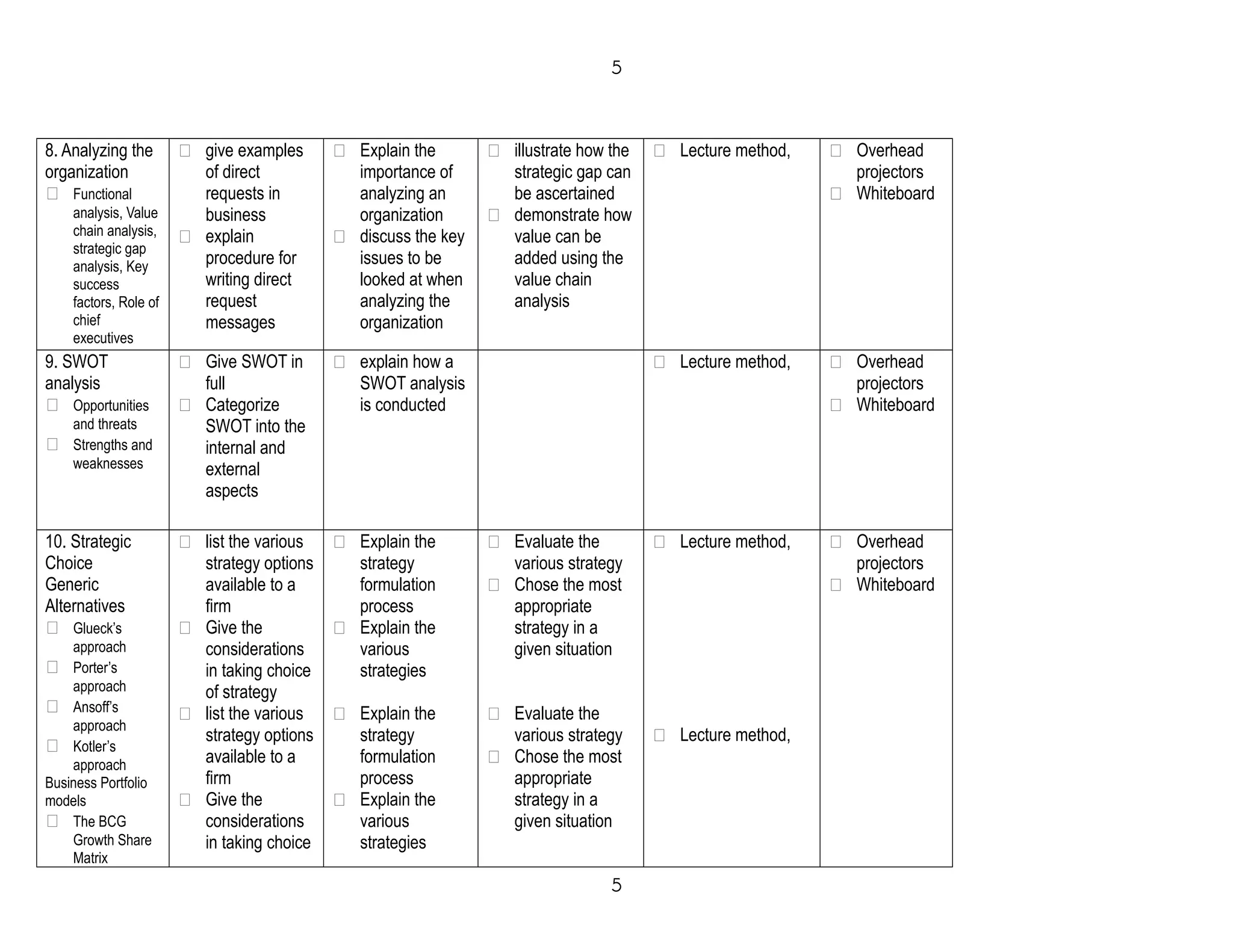
    8. Analyzing the organization Functional analysis, Value chain analysis, strategic gap analysis, Key success factors, Role of chief executives  give examples of direct requests in business  explain procedure for writing direct request messages  Explain the importance of analyzing an organization  discuss the key issues to be looked at when analyzing the organization  illustrate how the strategic gap can be ascertained  demonstrate how value can be added using the value chain analysis  Lecture method,  Overhead projectors  Whiteboard 9. SWOT analysis  Opportunities and threats  Strengths and weaknesses  Give SWOT in full  Categorize SWOT into the internal and external aspects  explain how a SWOT analysis is conducted  Lecture method,  Overhead projectors  Whiteboard 10. Strategic Choice Generic Alternatives  Glueck’s approach  Porter’s approach  Ansoff’s approach  Kotler’s approach Business Portfolio models  The BCG Growth Share Matrix  list the various strategy options available to a firm  Give the considerations in taking choice of strategy  list the various strategy options available to a firm  Give the considerations in taking choice  Explain the strategy formulation process  Explain the various strategies  Explain the strategy formulation process  Explain the various strategies  Evaluate the various strategy  Chose the most appropriate strategy in a given situation  Evaluate the various strategy  Chose the most appropriate strategy in a given situation  Lecture method,  Lecture method,  Overhead projectors  Whiteboard 5 5
  • 6.
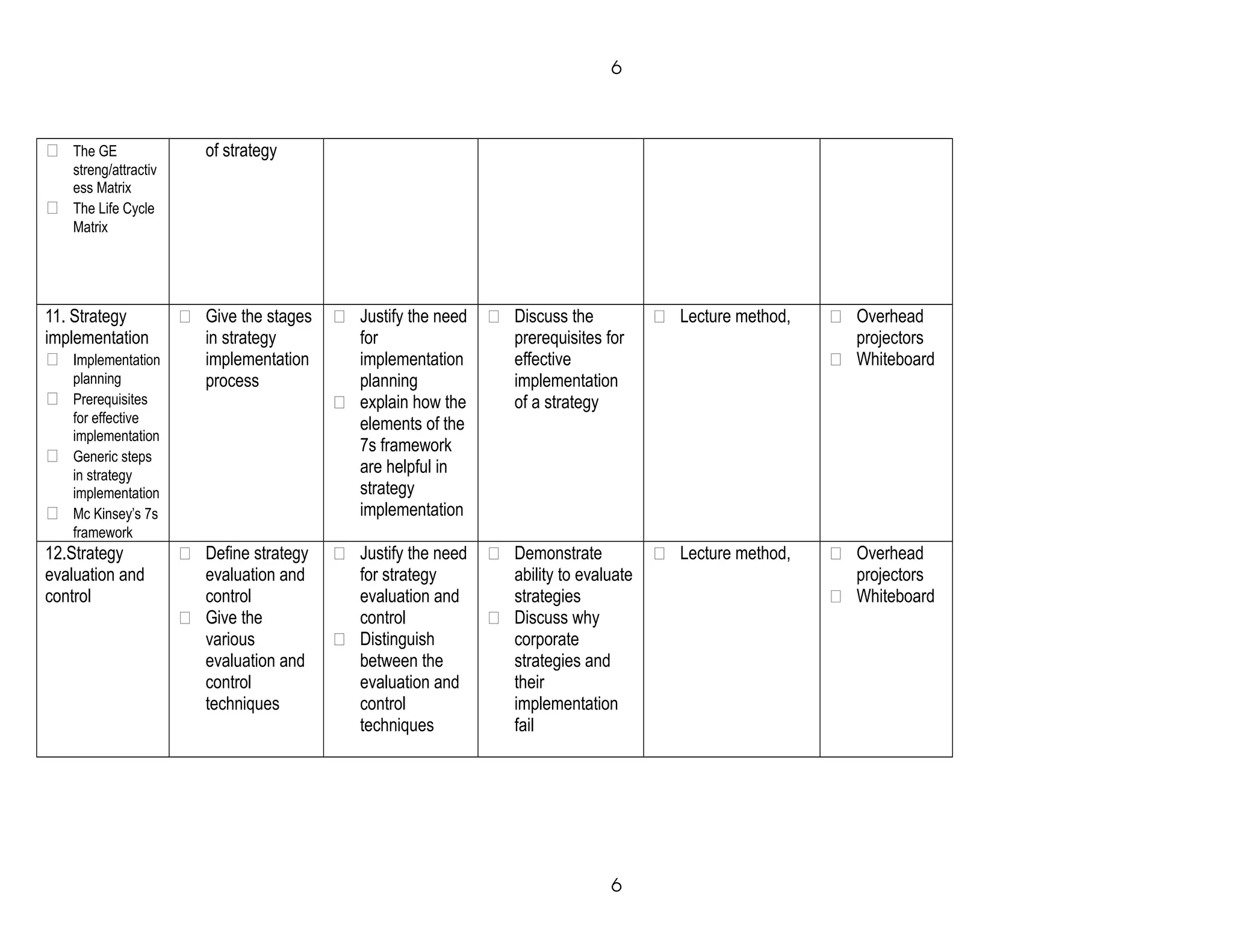
     The GE streng/attractiv essMatrix  The Life Cycle Matrix of strategy 11. Strategy implementation  Implementation planning  Prerequisites for effective implementation  Generic steps in strategy implementation  Mc Kinsey’s 7s framework  Give the stages in strategy implementation process  Justify the need for implementation planning  explain how the elements of the 7s framework are helpful in strategy implementation  Discuss the prerequisites for effective implementation of a strategy  Lecture method,  Overhead projectors  Whiteboard 12.Strategy evaluation and control  Define strategy evaluation and control  Give the various evaluation and control techniques  Justify the need for strategy evaluation and control  Distinguish between the evaluation and control techniques  Demonstrate ability to evaluate strategies  Discuss why corporate strategies and their implementation fail  Lecture method,  Overhead projectors  Whiteboard 6 6
  • 7.
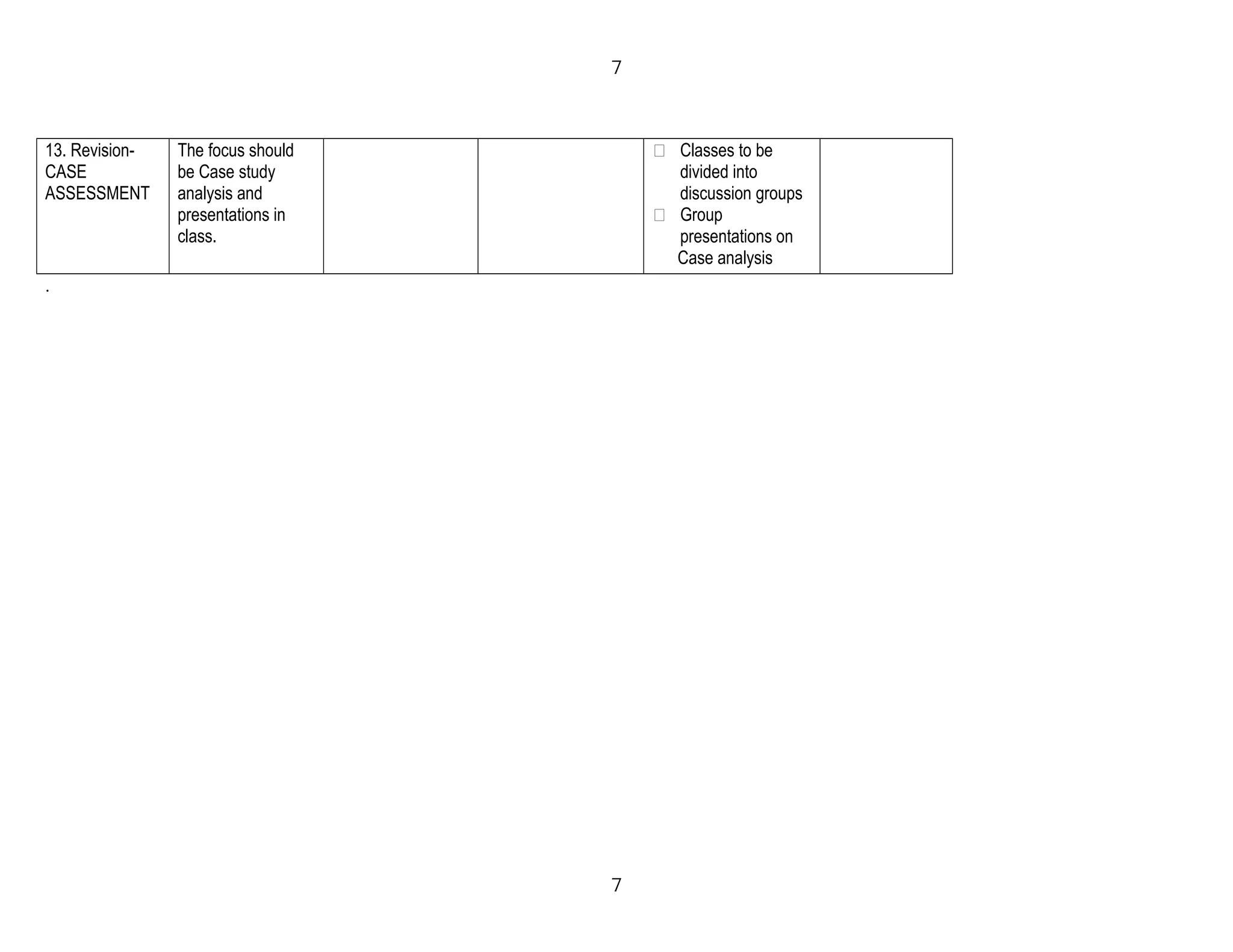
    13. Revision- CASE ASSESSMENT The focusshould be Case study analysis and presentations in class.  Classes to be divided into discussion groups  Group presentations on Case analysis . 7 7