


BENCHMARKING
&
BALANCE SCORE CARD
PRESENTED BY:
Adeline
Pugazh
Nithya
Marshal
Priyanka
Shera
BENCHMARKING
WHAT IS BENCHMARKING?
Benchmarking is the continuous,
systematic process of measuring one’s
output and/or work processes against
the toughest competitors or those
recognized best in the Industry
BENCHMARKING PROCESS
•BM must for Key Business Processes
(KBPs)
–Product Development
–Customer Service
–HR Practices
–Inventory Control
–Research & Development etc
BENCHMARKING PROCESS
•BM must for Critical Success Factors
(CSFs)
–Cost Management
–Product Quality
–Product Design
–Organisation Image etc
BENCHMARKING PROCESS
•4 questions
–What should we benchmark?
–Whom should we benchmark?
–How do we perform the process?
–How do they perform the process?
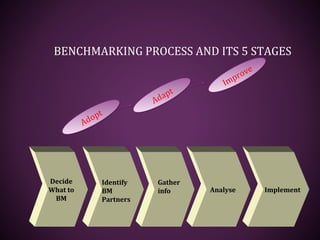
BENCHMARKING PROCESS AND ITS 5 STAGES
Adopt
Adopt
Improve
Improve
Adapt
Adapt
ImplementAnalyse
Decide
What to
BM
Identify
BM
Partners
Gather
info
BENCHMARKING PROCESS
• PLAN
– Select the process
– Form Team
– Understand & document process
– Establish performance measure
• SEARCH
– Listing Criteria for partner selection
– Conduct general / secondary research
– Decide the level to Benchmark
– Identify potential partners & contact
BENCHMARKING STRATEGY
• OBSERVE
– Questionnaire sent to partner
– Telephone contact
– Direct observation / site visit
• ANALYSE
– Sort information & data
– Quality control information & data
– Normalise data if necessary
– Identify gaps in performance Level
– Identify causes for gaps
BENCHMARKING STRATEGY
• ADAPT
– Identify improvement opportunities
– Set target for improvement
– Develop implementation plan, monitor the progress
– Write final report
APPROACHES TO BENCHMARKING
•Internal & External Benchmarking
•Performance or Competitive
Benchmarking
•Functional and Generic
Benchmarking
•Strategic Benchmarking
•Process Benchmarking
•International Bench marking
INTERNAL BENCHMARKING
• Establishing good practices in the organisation
• Comparison of similar functions in different operating units
within the organisation
• Advantages
– Easier to implement
– Easier to access data
• Disadvantages
– No external ideas
– Time-consuming
EXTERNAL BENCHMARKING
• Comparison of organisation functions and key
processes against Good Practices
• Advantages
–Helps to measure one’s own performance
–Helps to search for best practices
• Disadvantages
–Takes time
–Requires support
–Cross-cultural differences
FUNCTIONAL BENCHMARKING
•Comparison of similar functions
against external best in any industry
•Advantages:
–Developing networks
–Discovering innovative practices
•Disadvantage:
–Not suitable for every organisation
PROCESS BENCHMARKING
•Focus on specific operations or
processes
•Examples:
–in higher education-enquiry
management, enrolment
–in Logistics- delivery, safety
–in hotels—housekeeping, customer
care,
GENERIC BENCHMARKING
•Comparison of functions which are
generic in nature in any industry
•Example
–Hospitals in the U.S. routinely
benchmark their patient
management against hotel’s guest
management.
–Mobil benchmark their customers
service with 5 star hotels
PERFORMANCE OR COMPETITIVE
BENCHMARKING
•Organizations using performance
measures to compare themselves
against similar organizations
•Example
–FMCG’s comparing with each other
for Market share, Retention rates,
profits, costs
STRATEGIC BENCHMARKING
• Used where organizations seek to
improve their overall performance by
focusing on specific strategies or
processes
• Example
–Benchmarking against organizations
which have won awards or some other
distinctions
WHAT TO BENCHMARK?
•Products & Services
–Finished Goods
–Product &
–Services Features
WHAT TO BENCHMARK?
•Work Processes
–Manufacturing
–Supplying
–Ordering
–Maintenance
WHAT TO BENCHMARK?
•Support Functions
–Human Resource
Department
–Financial Management
–Marketing
WHAT TO BENCHMARK?
•Organizational Performance
–Sales
–Profitability
–Cost
–Quality
–Manpower
WHAT TO BENCHMARK?
•Strategies
–Cost Leadership
–Differentiation
BENCHMARKING WILL HELP YOU…..
• find who does the process best and close the
gap.
• recognize the leading organizations in a process
or activity.
• create performance standards derived from an
analysis of the best in business.
• ensure that comparisons are relevant.
• measure your performance, your processes, and
your strategies against best in business.
• measure business processes.
• assess performance over time.
BENCHMARKING WILL HELP YOU…..
• accelerate continuous process improvements
(CPI).
• establish more credible goals for CPI.
• establish actionable objectives.
• discover and clarify new goals.
• establish customer expectations of business
standards set by the best suppliers in industry.
• help your organization achieve breakthrough
improvements.
BENCHMARKING WILL HELP YOU…..
• create a sense of urgency for change.
• increase customer satisfaction.
• become direction setting.
• provide a positive, proactive, structured
process.
BENCHMARKING REQUIRES…..
• a thorough understanding of your
organization’s business processes before any
comparisons are attempted.
• planning to identify the best-in-class for
comparison and data collection.
• analysis to determine the performance gaps.
• integration to set new goals and standards.
BENCHMARKING REQUIRES…..
• an action plan to implement the changes to the
process.
• constant updating to keep the standard of
excellence.
• a means to measure.
• commitment by leadership.
• resources, including time.
BENCHMARKING WORKS BEST WHEN…..
• it supports an organization’s strategic plan.
• its done on existing processes that are well-
defined.
• the organizational leader is knowledgeable and
committed to total quality (TQ).
• it is utilized as a tool in a TQ organization.
BENCHMARKING IS NOT…..
• just looking for a better way to do things; it
looks for the best way.
• a mere comparison.
• only competitive analysis.
• site briefings.
• industrial tourism.
• spying.
• easy.
• quick.
BENCHMARKING IS NOT…..
• fool proof.
• free.
• subjective.
• a panacea.
• a program.
• a cookbook process.
• a mechanism for determining resource reductions.
• business as usual.
• a management fad.
BENCHMARKING DOES NOT…..
• Copy... Instead, you must adapt the information
to fit your needs, your culture, and your system.
And, if you copy, you can only be as good as
your competitor, not better.
• Steal... To the contrary, it is an open, honest,
legal study of another organization’s business
practices.
• Stop... Rather, it is a continuous process that
requires recalibration.
THE BALANCED SCORECARD
APPROACH
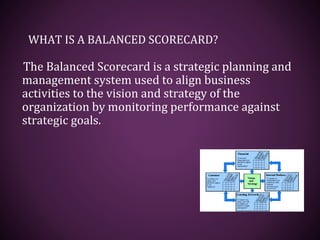
WHAT IS A BALANCED SCORECARD?
The Balanced Scorecard is a strategic planning and
management system used to align business
activities to the vision and strategy of the
organization by monitoring performance against
strategic goals.
BALANCED SCORECARD CONCEPT
• Was first published in 1992 by Kaplan and
Norton, a book followed in 1996.
• Traditional performance measurement that
only focus on external accounting data are
obsolete.
• The approach is to provide 'balance' to the
financial perspective.
WHY USE A BALANCED SCORECARD?
• Improve organizational performance by measuring
what matters
• Increase focus on strategy and results
• Align organization strategy with workers on a day-
to-day basis
• Focus on the drivers key to future performance
• Improve communication of the organization’s
Vision and Strategy
• Prioritize Projects / Initiatives
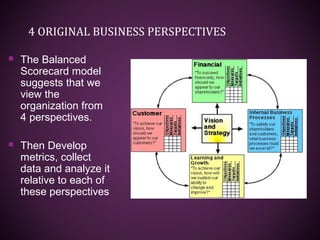
4 ORIGINAL BUSINESS PERSPECTIVES
 The Balanced
Scorecard model
suggests that we
view the
organization from
4 perspectives.
 Then Develop
metrics, collect
data and analyze it
relative to each of
these perspectives
4 BUSINESS PERSPECTIVES QUESTIONS
• Financial
– What must we do to create sustainable economic value?
• Internal Business Process
– To satisfy our stakeholders, what must be our levels of
productivity, efficiency, and quality?
• Learning and Growth
– How does our employee performance management system,
including feedback to employees, support high performance?
• Customer
– What do our customers require from us and how are we doing
according to those requirements?
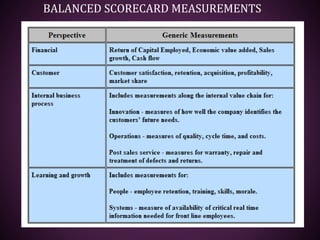
BALANCED SCORECARD MEASUREMENTS
KEY IMPLEMENTATION SUCCESS
FACTORS
• Obtaining executive sponsorship and commitment
• Involving a broad base of leaders, managers and
employees in scorecard development
• Choose the right Scorecard Champion
• Beginning interactive (two-way) communication
first
• Viewing the scorecard as a long-term journey
rather than a short-term project
• Getting outside help if needed
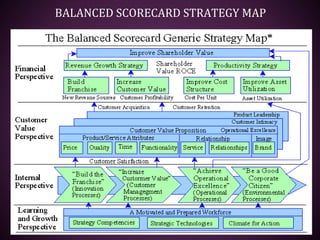
BALANCED SCORECARD STRATEGY MAP
SCORECARD POTENTIAL PITFALLS &
CRITICISMS
• Lack of a well Defined Strategy
– The balanced scorecard relies on a well defined strategy and
understanding of linkages between strategic objections and
metrics. Without this foundation the implementation could fail.
• Too much focus on the lagging measures
– Focusing on only the lagging measures may cause a lack of
priority or opportunity for the leading measures.
• Use of Generic Metrics
– Don’t just copy metrics from another firm. Identify the measures
that apply to your strategy and competitive position .
• Self-serving managers
– Managers whose goal is to achieve a desired result in order to
obtain a bonus or other self reward.
THANK YOU

Strategic management

  • 1.
    BENCHMARKING & BALANCE SCORE CARD PRESENTEDBY: Adeline Pugazh Nithya Marshal Priyanka Shera
  • 2.
  • 3.
    WHAT IS BENCHMARKING? Benchmarkingis the continuous, systematic process of measuring one’s output and/or work processes against the toughest competitors or those recognized best in the Industry
  • 4.
    BENCHMARKING PROCESS •BM mustfor Key Business Processes (KBPs) –Product Development –Customer Service –HR Practices –Inventory Control –Research & Development etc
  • 5.
    BENCHMARKING PROCESS •BM mustfor Critical Success Factors (CSFs) –Cost Management –Product Quality –Product Design –Organisation Image etc
  • 6.
    BENCHMARKING PROCESS •4 questions –Whatshould we benchmark? –Whom should we benchmark? –How do we perform the process? –How do they perform the process?
  • 7.
    BENCHMARKING PROCESS ANDITS 5 STAGES Adopt Adopt Improve Improve Adapt Adapt ImplementAnalyse Decide What to BM Identify BM Partners Gather info
  • 8.
    BENCHMARKING PROCESS • PLAN –Select the process – Form Team – Understand & document process – Establish performance measure • SEARCH – Listing Criteria for partner selection – Conduct general / secondary research – Decide the level to Benchmark – Identify potential partners & contact
  • 9.
    BENCHMARKING STRATEGY • OBSERVE –Questionnaire sent to partner – Telephone contact – Direct observation / site visit • ANALYSE – Sort information & data – Quality control information & data – Normalise data if necessary – Identify gaps in performance Level – Identify causes for gaps
  • 10.
    BENCHMARKING STRATEGY • ADAPT –Identify improvement opportunities – Set target for improvement – Develop implementation plan, monitor the progress – Write final report
  • 11.
    APPROACHES TO BENCHMARKING •Internal& External Benchmarking •Performance or Competitive Benchmarking •Functional and Generic Benchmarking •Strategic Benchmarking •Process Benchmarking •International Bench marking
  • 12.
    INTERNAL BENCHMARKING • Establishinggood practices in the organisation • Comparison of similar functions in different operating units within the organisation • Advantages – Easier to implement – Easier to access data • Disadvantages – No external ideas – Time-consuming
  • 13.
    EXTERNAL BENCHMARKING • Comparisonof organisation functions and key processes against Good Practices • Advantages –Helps to measure one’s own performance –Helps to search for best practices • Disadvantages –Takes time –Requires support –Cross-cultural differences
  • 14.
    FUNCTIONAL BENCHMARKING •Comparison ofsimilar functions against external best in any industry •Advantages: –Developing networks –Discovering innovative practices •Disadvantage: –Not suitable for every organisation
  • 15.
    PROCESS BENCHMARKING •Focus onspecific operations or processes •Examples: –in higher education-enquiry management, enrolment –in Logistics- delivery, safety –in hotels—housekeeping, customer care,
  • 16.
    GENERIC BENCHMARKING •Comparison offunctions which are generic in nature in any industry •Example –Hospitals in the U.S. routinely benchmark their patient management against hotel’s guest management. –Mobil benchmark their customers service with 5 star hotels
  • 17.
    PERFORMANCE OR COMPETITIVE BENCHMARKING •Organizationsusing performance measures to compare themselves against similar organizations •Example –FMCG’s comparing with each other for Market share, Retention rates, profits, costs
  • 18.
    STRATEGIC BENCHMARKING • Usedwhere organizations seek to improve their overall performance by focusing on specific strategies or processes • Example –Benchmarking against organizations which have won awards or some other distinctions
  • 19.
    WHAT TO BENCHMARK? •Products& Services –Finished Goods –Product & –Services Features
  • 20.
    WHAT TO BENCHMARK? •WorkProcesses –Manufacturing –Supplying –Ordering –Maintenance
  • 21.
    WHAT TO BENCHMARK? •SupportFunctions –Human Resource Department –Financial Management –Marketing
  • 22.
    WHAT TO BENCHMARK? •OrganizationalPerformance –Sales –Profitability –Cost –Quality –Manpower
  • 23.
    WHAT TO BENCHMARK? •Strategies –CostLeadership –Differentiation
  • 24.
    BENCHMARKING WILL HELPYOU….. • find who does the process best and close the gap. • recognize the leading organizations in a process or activity. • create performance standards derived from an analysis of the best in business. • ensure that comparisons are relevant. • measure your performance, your processes, and your strategies against best in business. • measure business processes. • assess performance over time.
  • 25.
    BENCHMARKING WILL HELPYOU….. • accelerate continuous process improvements (CPI). • establish more credible goals for CPI. • establish actionable objectives. • discover and clarify new goals. • establish customer expectations of business standards set by the best suppliers in industry. • help your organization achieve breakthrough improvements.
  • 26.
    BENCHMARKING WILL HELPYOU….. • create a sense of urgency for change. • increase customer satisfaction. • become direction setting. • provide a positive, proactive, structured process.
  • 27.
    BENCHMARKING REQUIRES….. • athorough understanding of your organization’s business processes before any comparisons are attempted. • planning to identify the best-in-class for comparison and data collection. • analysis to determine the performance gaps. • integration to set new goals and standards.
  • 28.
    BENCHMARKING REQUIRES….. • anaction plan to implement the changes to the process. • constant updating to keep the standard of excellence. • a means to measure. • commitment by leadership. • resources, including time.
  • 29.
    BENCHMARKING WORKS BESTWHEN….. • it supports an organization’s strategic plan. • its done on existing processes that are well- defined. • the organizational leader is knowledgeable and committed to total quality (TQ). • it is utilized as a tool in a TQ organization.
  • 30.
    BENCHMARKING IS NOT….. •just looking for a better way to do things; it looks for the best way. • a mere comparison. • only competitive analysis. • site briefings. • industrial tourism. • spying. • easy. • quick.
  • 31.
    BENCHMARKING IS NOT….. •fool proof. • free. • subjective. • a panacea. • a program. • a cookbook process. • a mechanism for determining resource reductions. • business as usual. • a management fad.
  • 32.
    BENCHMARKING DOES NOT….. •Copy... Instead, you must adapt the information to fit your needs, your culture, and your system. And, if you copy, you can only be as good as your competitor, not better. • Steal... To the contrary, it is an open, honest, legal study of another organization’s business practices. • Stop... Rather, it is a continuous process that requires recalibration.
  • 33.
  • 34.
    WHAT IS ABALANCED SCORECARD? The Balanced Scorecard is a strategic planning and management system used to align business activities to the vision and strategy of the organization by monitoring performance against strategic goals.
  • 35.
    BALANCED SCORECARD CONCEPT •Was first published in 1992 by Kaplan and Norton, a book followed in 1996. • Traditional performance measurement that only focus on external accounting data are obsolete. • The approach is to provide 'balance' to the financial perspective.
  • 36.
    WHY USE ABALANCED SCORECARD? • Improve organizational performance by measuring what matters • Increase focus on strategy and results • Align organization strategy with workers on a day- to-day basis • Focus on the drivers key to future performance • Improve communication of the organization’s Vision and Strategy • Prioritize Projects / Initiatives
  • 37.
    4 ORIGINAL BUSINESSPERSPECTIVES  The Balanced Scorecard model suggests that we view the organization from 4 perspectives.  Then Develop metrics, collect data and analyze it relative to each of these perspectives
  • 38.
    4 BUSINESS PERSPECTIVESQUESTIONS • Financial – What must we do to create sustainable economic value? • Internal Business Process – To satisfy our stakeholders, what must be our levels of productivity, efficiency, and quality? • Learning and Growth – How does our employee performance management system, including feedback to employees, support high performance? • Customer – What do our customers require from us and how are we doing according to those requirements?
  • 39.
  • 40.
    KEY IMPLEMENTATION SUCCESS FACTORS •Obtaining executive sponsorship and commitment • Involving a broad base of leaders, managers and employees in scorecard development • Choose the right Scorecard Champion • Beginning interactive (two-way) communication first • Viewing the scorecard as a long-term journey rather than a short-term project • Getting outside help if needed
  • 41.
  • 42.
    SCORECARD POTENTIAL PITFALLS& CRITICISMS • Lack of a well Defined Strategy – The balanced scorecard relies on a well defined strategy and understanding of linkages between strategic objections and metrics. Without this foundation the implementation could fail. • Too much focus on the lagging measures – Focusing on only the lagging measures may cause a lack of priority or opportunity for the leading measures. • Use of Generic Metrics – Don’t just copy metrics from another firm. Identify the measures that apply to your strategy and competitive position . • Self-serving managers – Managers whose goal is to achieve a desired result in order to obtain a bonus or other self reward.
  • 43.