What is Benchmarking?
Benchmarking is the process of
measuring an organization’s internal processes
then identifying, understanding, and adapting outstanding practices fromother
organizations considered to be best-in-class.
Definition
Definition
“measuring our performance against that of best-in- class companies,
determining how the best-in-class achieve those performance levels
and using the information as a basis for our own company’s targets,
strategies and implementation .”
Dr. Jignesh Trivedi
The Essence of Benchmarking
“moving from where we are to where we want to be”
Dr. Jignesh Trivedi
Why Benchmarking?
 To Obtain an External Perspective of What Is Possible
 ToAssist in Setting Strategic Targets
 To Promote Improvements in Performance
 To Establish a Competitive Edge
 To Enhance Customer Satisfaction
To Enhance Customer Satisfaction
 To Reduce Costs
 To Improve Employee Morale
 ToAchieve QualityAwards
 To Survive
Dr. Jignesh Trivedi
When Benchmarking?
If the company’s QMS is not properly developed, documented and
implemented.
If company’s great strength areas are not measured.
If company’s great weakness areas are not measured.
If company’s great opportunities are not measured.
If customer needs are not assessed and rectified .
Dr. Jignesh Trivedi
Benchmarking in the Context of TQM
TQM Key principles include:
Comparisons with best practice.
A Strong emphasis on meeting the needs of the customer (internal
and external).
The importance of efficient, effective business processes.
The need for continuous improvement .
Enhances a TQM program .
Dr. Jignesh Trivedi
Levels Of Benchmarking In Competitive Environment
Internal benchmarking - Within one’s org.
Competitive benchmarking - Analysis the performanceand
practices of best in class companies.
Non-competitive benchmarking - Is learning something about a
process a company wants to improve by benchmarking.
World class benchmarking - Ambitious and looking towards
recognized leader.
Dr. Jignesh Trivedi
Benchmarking Methodology
Competitive
• Industry leaders
• Top performers with
similar operating
characteristics
Best Practice
Overlap
Functional
• Top performers
regardless of industry
• Aggressive innovators
utilizing new
technology
Internal
• Top performers
within company
• Top facilities
within company
Dr. Jignesh Trivedi
Types Of Benchmarking
Performance or operational benchmarking:
It involves – pricing, technical quality, features and otherquality.
Process or functional benchmarking:
It involves processes such as billing, order entry or employee training.
Strategic benchmarking:
Examines how companies compute and seeks the winning strategies that have
led to competitive advantage and market success.
Dr. Jignesh Trivedi
Areas Of Benchmarking
Operational Strategies:
• Inventory management
• Inventory control
Supply chain management:
• Warehousing and distribution
• Transportation
Marketing management:
• Customer service levels
• Purchasing
• Billing and collection
• Purchasing practices
H.R. Practices:
• Talent Acquisition / Search
• Training and Development
• Compensation management etc.
Dr. Jignesh Trivedi
Guidelines to Benchmarking
Do not go on a fishing expedition.
 Use company people.
 Exchange Information.
 Legal Concerns.
 Confidentiality.
Dr. Jignesh Trivedi
Five Phases Of Benchmarking
 Planning: Identify the product, service or process to bebenchmarked
 Analysis: Determine the gap between the firm’s current performance and thatof
the firm’s benchmarked and identify the causes of significantgaps.
 Integration: Establish goals and obtain the support of managers whomust
provide the resources for accomplishing the goals
 Action: Develop action plans, and team assignment, implement the plans,
monitor progress and recalibrate benchmark as improvements are made.
 Maturity: Leadership position attended, best practices fully integratedinto
process.
Dr. Jignesh Trivedi
Benchmarking Process
In
In
Motorola
Dr. Jignesh Trivedi
Decide what to benchmark.
 Select companies to benchmark.
 Obtain data and collect information.
Benchmarking Strategy
 Obtain data and collect information.
 Analyze data and forms action plans.
 Recalibrate and start the process again.
Dr. Jignesh Trivedi
The Seven Step Benchmarking Model
Activity What is included
Step 1: Identify what to benchmark  Clarify the benchmark objectives
 Decide whom to involve
 Define the process
 Consider the scope
 Set the boundaries
Agree on what happens in the process
 Flowchart the process
Step 2: Determine what to measure  Examine the flow chart
 Establishes the process measures
 Verify that measures match objectives
Step 3: Identify who to benchmark  Conduct general research
 Choose level to benchmark
Dr. Jignesh Trivedi
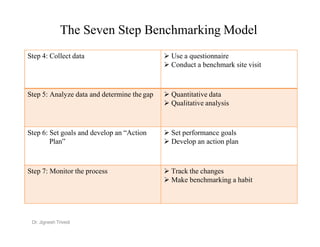
The Seven Step Benchmarking Model
Step 4: Collect data  Use a questionnaire
 Conduct a benchmark site visit
Step 5: Analyze data and determine the gap  Quantitative data
 Qualitative analysis
Step 6: Set goals and develop an “Action
Plan”
 Set performance goals
 Develop an action plan
Step 7: Monitor the process  Track the changes
 Make benchmarking a habit
Dr. Jignesh Trivedi
Factors For Success Of Benchmarking
Benchmarking must have the full support of senior management
and they should actively involve with this process.
For Benchmarking, team and process training is very imp.
Benchmarking should be a team activity.
Benchmarking is an ongoing process.
Benchmarking efforts must be organized, planned, and carefully
managed.
Correct use of benchmarking can lead you to the competitive
edge in today’s business market place.
Dr. Jignesh Trivedi
Advantages
 Benchmarking is a systematic method by which organizations can measure themselves
against the best Industry practices.
 It promotes superior performance by providing an organized framework through which
organization learn how the “ best in class” do things.
 Intensive studies of existing practices often lead to identification of non-value added
activities and plans for process improvement.
 It helps for continuous improvement.
 Benchmarking inspire managers (and organization) to compete.
 Through Benchmark process organization can borrow ideas, adopt and refine them to gain
competitive advantages.
 Benchmarking provides a basis for training human resources.
Dr. Jignesh Trivedi
Disadvantages
 The most resistant criticism of Benchmarking comes from the idea of copying
others.
 It is not a strategy nor is it intended to be a business philosophy. Therefore, it is
a time taking technique.
 Benchmarking is not “instant pudding”. It will not improve performanceif
proper infrastructure of Total Quality Management is not inplace.
Dr. Jignesh Trivedi
Conclusion
Now a days, more than 60% companies in the world uses this
technique for fixing their target for continuous improvement. For
them it is an important tool. But to be effective it must be used
properly. It breaks down (waste money, time and energy and some
times morale too) if process owners and managers feel threatened or
do not accept and act on the findings. Finally, benchmarking is not a
substitute for innovation; however, it is a source of ideas from
outside the organization.
Dr. Jignesh Trivedi
Thank you
and
and
Have a Nice Day…
Dr. Jignesh Trivedi

banchmarking.pdf

  • 1.
    What is Benchmarking? Benchmarkingis the process of measuring an organization’s internal processes then identifying, understanding, and adapting outstanding practices fromother organizations considered to be best-in-class. Definition Definition “measuring our performance against that of best-in- class companies, determining how the best-in-class achieve those performance levels and using the information as a basis for our own company’s targets, strategies and implementation .” Dr. Jignesh Trivedi
  • 2.
    The Essence ofBenchmarking “moving from where we are to where we want to be” Dr. Jignesh Trivedi
  • 3.
    Why Benchmarking?  ToObtain an External Perspective of What Is Possible  ToAssist in Setting Strategic Targets  To Promote Improvements in Performance  To Establish a Competitive Edge  To Enhance Customer Satisfaction To Enhance Customer Satisfaction  To Reduce Costs  To Improve Employee Morale  ToAchieve QualityAwards  To Survive Dr. Jignesh Trivedi
  • 4.
    When Benchmarking? If thecompany’s QMS is not properly developed, documented and implemented. If company’s great strength areas are not measured. If company’s great weakness areas are not measured. If company’s great opportunities are not measured. If customer needs are not assessed and rectified . Dr. Jignesh Trivedi
  • 5.
    Benchmarking in theContext of TQM TQM Key principles include: Comparisons with best practice. A Strong emphasis on meeting the needs of the customer (internal and external). The importance of efficient, effective business processes. The need for continuous improvement . Enhances a TQM program . Dr. Jignesh Trivedi
  • 6.
    Levels Of BenchmarkingIn Competitive Environment Internal benchmarking - Within one’s org. Competitive benchmarking - Analysis the performanceand practices of best in class companies. Non-competitive benchmarking - Is learning something about a Non-competitive benchmarking - Is learning something about a process a company wants to improve by benchmarking. World class benchmarking - Ambitious and looking towards recognized leader. Dr. Jignesh Trivedi
  • 7.
    Benchmarking Methodology Competitive • Industryleaders • Top performers with similar operating characteristics Best Practice Overlap Functional • Top performers regardless of industry • Aggressive innovators utilizing new technology Internal • Top performers within company • Top facilities within company Dr. Jignesh Trivedi
  • 8.
    Types Of Benchmarking Performanceor operational benchmarking: It involves – pricing, technical quality, features and otherquality. Process or functional benchmarking: It involves processes such as billing, order entry or employee training. Strategic benchmarking: Examines how companies compute and seeks the winning strategies that have led to competitive advantage and market success. Dr. Jignesh Trivedi
  • 9.
    Areas Of Benchmarking OperationalStrategies: • Inventory management • Inventory control Supply chain management: • Warehousing and distribution • Transportation Marketing management: • Customer service levels • Purchasing • Billing and collection • Purchasing practices H.R. Practices: • Talent Acquisition / Search • Training and Development • Compensation management etc. Dr. Jignesh Trivedi
  • 10.
    Guidelines to Benchmarking Donot go on a fishing expedition.  Use company people.  Exchange Information.  Exchange Information.  Legal Concerns.  Confidentiality. Dr. Jignesh Trivedi
  • 11.
    Five Phases OfBenchmarking  Planning: Identify the product, service or process to bebenchmarked  Analysis: Determine the gap between the firm’s current performance and thatof the firm’s benchmarked and identify the causes of significantgaps.  Integration: Establish goals and obtain the support of managers whomust provide the resources for accomplishing the goals  Action: Develop action plans, and team assignment, implement the plans, monitor progress and recalibrate benchmark as improvements are made.  Maturity: Leadership position attended, best practices fully integratedinto process. Dr. Jignesh Trivedi
  • 12.
  • 13.
    Decide what tobenchmark.  Select companies to benchmark.  Obtain data and collect information. Benchmarking Strategy  Obtain data and collect information.  Analyze data and forms action plans.  Recalibrate and start the process again. Dr. Jignesh Trivedi
  • 14.
    The Seven StepBenchmarking Model Activity What is included Step 1: Identify what to benchmark  Clarify the benchmark objectives  Decide whom to involve  Define the process  Consider the scope  Set the boundaries Agree on what happens in the process  Flowchart the process  Flowchart the process Step 2: Determine what to measure  Examine the flow chart  Establishes the process measures  Verify that measures match objectives Step 3: Identify who to benchmark  Conduct general research  Choose level to benchmark Dr. Jignesh Trivedi
  • 15.
    The Seven StepBenchmarking Model Step 4: Collect data  Use a questionnaire  Conduct a benchmark site visit Step 5: Analyze data and determine the gap  Quantitative data  Qualitative analysis Step 6: Set goals and develop an “Action Plan”  Set performance goals  Develop an action plan Step 7: Monitor the process  Track the changes  Make benchmarking a habit Dr. Jignesh Trivedi
  • 16.
    Factors For SuccessOf Benchmarking Benchmarking must have the full support of senior management and they should actively involve with this process. For Benchmarking, team and process training is very imp. Benchmarking should be a team activity. Benchmarking is an ongoing process. Benchmarking efforts must be organized, planned, and carefully managed. Correct use of benchmarking can lead you to the competitive edge in today’s business market place. Dr. Jignesh Trivedi
  • 17.
    Advantages  Benchmarking isa systematic method by which organizations can measure themselves against the best Industry practices.  It promotes superior performance by providing an organized framework through which organization learn how the “ best in class” do things.  Intensive studies of existing practices often lead to identification of non-value added activities and plans for process improvement.  It helps for continuous improvement.  Benchmarking inspire managers (and organization) to compete.  Through Benchmark process organization can borrow ideas, adopt and refine them to gain competitive advantages.  Benchmarking provides a basis for training human resources. Dr. Jignesh Trivedi
  • 18.
    Disadvantages  The mostresistant criticism of Benchmarking comes from the idea of copying others.  It is not a strategy nor is it intended to be a business philosophy. Therefore, it is a time taking technique.  Benchmarking is not “instant pudding”. It will not improve performanceif proper infrastructure of Total Quality Management is not inplace. proper infrastructure of Total Quality Management is not inplace. Dr. Jignesh Trivedi
  • 19.
    Conclusion Now a days,more than 60% companies in the world uses this technique for fixing their target for continuous improvement. For them it is an important tool. But to be effective it must be used properly. It breaks down (waste money, time and energy and some times morale too) if process owners and managers feel threatened or times morale too) if process owners and managers feel threatened or do not accept and act on the findings. Finally, benchmarking is not a substitute for innovation; however, it is a source of ideas from outside the organization. Dr. Jignesh Trivedi
  • 20.
    Thank you and and Have aNice Day… Dr. Jignesh Trivedi