BENCHMARKING
Supervisor
Dr. Anjali Sharma
Associate Professor
Presented by
Education Management Student
Swagata Bharali
Debabrot Phukan
Geetika Das
Department of Education, Tezpur University Assam , India
 A measurement of the quality of an organization’s policies,
products, programs and strategies and their comparison
with standard measurements of its peers.
 It is a process for obtaining a measure where
‘BENCHMARKS’ are ‘WHAT’ and ‘BENCHMARKING’ is
‘HOW’.
 It is the process of improving ourselves by learning from
others.
 It is the process of improving performance by continuously
identifying, understanding and adapting outstanding
processes found inside and outside the organization
“Continuous process of measuring products,
services and practices against the toughest
competitors or those companies recognized as
industry leaders” – CAMP 1989.
“A process of finding the world class products,
service and operational system and then adjusting
own products, service and system to meet or beat
those standards” – GEBER 1990.
“A method of finding how to improve processes
quickly by learning from others dealing with
similar issues” – CORTADA 1995.
Traditional techniques for improvement are not
sufficient in today’s competitive market.
Rapidly changing external environment due to
globalization.
Improving product quality and services.
Increasing sales and profit.
To meet the customer’s needs and expectations.
Continuous process of measuring and
comparing a firm’s business process against
those of another firm.
Discover the performance gap between
one’s processes and those of another firms.
Incorporate leading firm’s processes into
one’s own strategy to fill the gap and
improve performance.
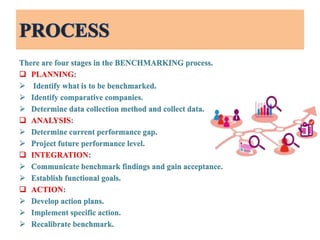
There are four stages in the BENCHMARKING process.
 PLANNING:
 Identify what is to be benchmarked.
 Identify comparative companies.
 Determine data collection method and collect data.
 ANALYSIS:
 Determine current performance gap.
 Project future performance level.
 INTEGRATION:
 Communicate benchmark findings and gain acceptance.
 Establish functional goals.
 ACTION:
 Develop action plans.
 Implement specific action.
 Recalibrate benchmark.
 INTERNAL BENCHMARKING
 Performance comparison of units or departments within
one organization.
 COMPETITIVE BENCHMARKING
 Product oriented comparisons with processes involved.
 FUNCTIONAL BENCHMARKING
 Comparison of particular business functions at one or
more organization.
 GENERIC BENCHMARKING
 Comparison of all business functions with more of best in
class.
Product and process improvement.
Time and cost can be reduced.
Provides direction for change in business .
Provide new ideas for achieving the goal.
Quality improvement.
Leveraging strength ideas.
What is best for someone may not be the
same for us. It varies from organization to
organization.
If it is poorly defined then it will effect in
measuring the performance gap.
There may be incorrect comparisons which
leads to wastage of time and money.
Reluctant to share information.
It may reduce managerial motivation.
It is basically comparing yourself with
others. It helps us to identify where we are
standing today and lacking behind. To
achieve a goal it is mandatory to set a
benchmark whether it is education or
business. It is a continuous process which
circles itself after meeting a particular
benchmark. To be the best among all we
should follow the best in class.
Benchmarking

Benchmarking

  • 1.
    BENCHMARKING Supervisor Dr. Anjali Sharma AssociateProfessor Presented by Education Management Student Swagata Bharali Debabrot Phukan Geetika Das Department of Education, Tezpur University Assam , India
  • 2.
     A measurementof the quality of an organization’s policies, products, programs and strategies and their comparison with standard measurements of its peers.  It is a process for obtaining a measure where ‘BENCHMARKS’ are ‘WHAT’ and ‘BENCHMARKING’ is ‘HOW’.  It is the process of improving ourselves by learning from others.  It is the process of improving performance by continuously identifying, understanding and adapting outstanding processes found inside and outside the organization
  • 3.
    “Continuous process ofmeasuring products, services and practices against the toughest competitors or those companies recognized as industry leaders” – CAMP 1989. “A process of finding the world class products, service and operational system and then adjusting own products, service and system to meet or beat those standards” – GEBER 1990. “A method of finding how to improve processes quickly by learning from others dealing with similar issues” – CORTADA 1995.
  • 4.
    Traditional techniques forimprovement are not sufficient in today’s competitive market. Rapidly changing external environment due to globalization. Improving product quality and services. Increasing sales and profit. To meet the customer’s needs and expectations.
  • 5.
    Continuous process ofmeasuring and comparing a firm’s business process against those of another firm. Discover the performance gap between one’s processes and those of another firms. Incorporate leading firm’s processes into one’s own strategy to fill the gap and improve performance.
  • 6.
    There are fourstages in the BENCHMARKING process.  PLANNING:  Identify what is to be benchmarked.  Identify comparative companies.  Determine data collection method and collect data.  ANALYSIS:  Determine current performance gap.  Project future performance level.  INTEGRATION:  Communicate benchmark findings and gain acceptance.  Establish functional goals.  ACTION:  Develop action plans.  Implement specific action.  Recalibrate benchmark.
  • 7.
     INTERNAL BENCHMARKING Performance comparison of units or departments within one organization.  COMPETITIVE BENCHMARKING  Product oriented comparisons with processes involved.  FUNCTIONAL BENCHMARKING  Comparison of particular business functions at one or more organization.  GENERIC BENCHMARKING  Comparison of all business functions with more of best in class.
  • 8.
    Product and processimprovement. Time and cost can be reduced. Provides direction for change in business . Provide new ideas for achieving the goal. Quality improvement. Leveraging strength ideas.
  • 9.
    What is bestfor someone may not be the same for us. It varies from organization to organization. If it is poorly defined then it will effect in measuring the performance gap. There may be incorrect comparisons which leads to wastage of time and money. Reluctant to share information. It may reduce managerial motivation.
  • 10.
    It is basicallycomparing yourself with others. It helps us to identify where we are standing today and lacking behind. To achieve a goal it is mandatory to set a benchmark whether it is education or business. It is a continuous process which circles itself after meeting a particular benchmark. To be the best among all we should follow the best in class.