Responsibilities of Fleet Managers and How TrackoBit Can
Assist
Tithi Agarwal 10 min June 28, 2024
What do fleet managers do? What are their duties, responsibilities, and challenges? And what makes a fleet manager
effective and successful? This blog answers all these questions.
I plan the routes and track the miles,
Ensure maintenance and manage files.
I keep the fleet running, safe, and sound,
Without me, chaos would be found.
Who am I?
Ans—Of course, a fleet manager.
Author:
 Read Time:
 Published:
 Last Update:

Cookie Consent
We use cookies to enhance and personalize your browsing experience. By continuing to use our website, you
agree to our Privacy Policy.
Accept
Explore our developer-friendly HTML to PDF API Printed using PDFCrowd HTML to PDF
Picture this: As soon as possible in the morning, you have fifty cars and drivers to dispatch, monitor, and manage. This is
because you spend the afternoon formulating fleet regulations and looking for methods to cut expenses and operational
difficulties. If this sounds like any other Tuesday, you’re most likely a fleet manager.
Many skilled people aspire to become fleet managers, as the profession offers an average pay of over $89K in the United
States. Logistics companies depend on highly skilled individuals for fleet management, and it’s not just about the
attractive pay and opportunity.
We examine the role of a fleet manager in detail today. What kinds of abilities do they have? What kinds of duties do they
carry out?
And, finally, what kind of tech is there to help fleet managers carry their load?
Let’s start at the beginning.
What is a Fleet Manager?
The person in charge of overseeing an organization’s fleet of vehicles is known as the fleet manager. This covers every
facet, from finding or employing drivers to ensuring the effective utilisation of vehicles and reducing delivery times and
costs.
Fleet managers assist each vehicle and fleet in navigating and mitigating the tasks and obstacles to which they are
assigned. They also monitor the company’s fleet operations to ensure they are safe, efficient, and compliant with traffic
laws.
Fleet managers are also in charge of planning, assigning, and overseeing the expenses associated with owning, leasing, or
renting vehicles, as well as the operational costs of maintaining and managing them. In addition to drafting driver travel
itineraries, they must design regulations addressing vehicle usage and driver behavior based on the business’s needs.
Cookie Consent
We use cookies to enhance and personalize your browsing experience. By continuing to use our website, you
agree to our Privacy Policy.
Explore our developer-friendly HTML to PDF API Printed using PDFCrowd HTML to PDF
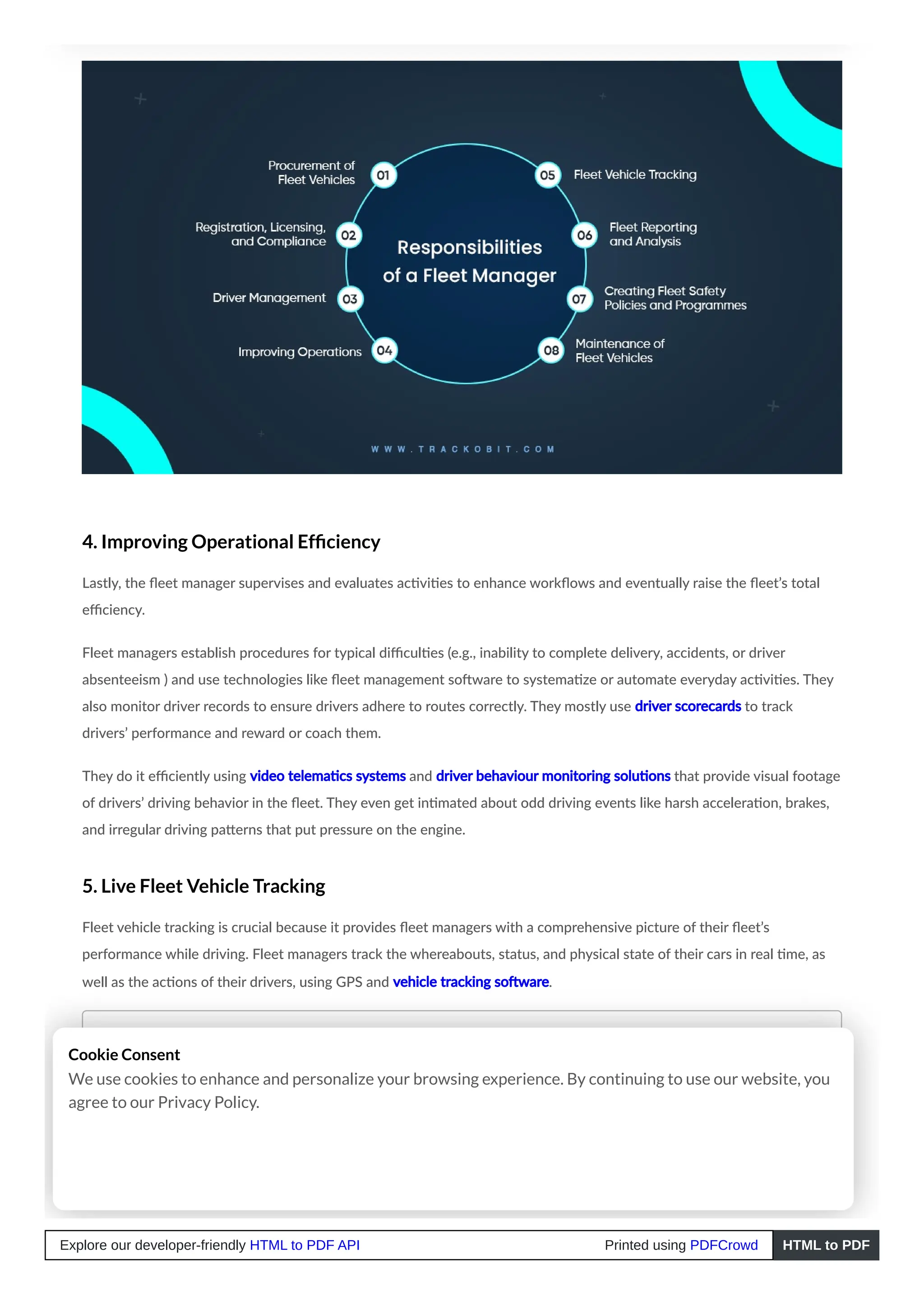
7 Prime Duties and Responsibilities of a Fleet Manager
The fleet manager’s job is not limited to just coordinating with the drivers and monitoring their activities and locations.
Here are some of the major roles, responsibilities, and duties that a fleet manager cannot overlook:
1. Procurement and Maintenance of Fleet Vehicles
Fleet managers’ primary responsibility is ensuring the organisation has the appropriate number and kind of vehicles in
good shape and condition for optimal trip assignment.
Cookie Consent
We use cookies to enhance and personalize your browsing experience. By continuing to use our website, you
agree to our Privacy Policy.
Explore our developer-friendly HTML to PDF API Printed using PDFCrowd HTML to PDF
Fleet managers usually purchase or lease vehicles according to certain specifications, such as business type, delivery
requirements, load capacity, and mileage.
Fleet managers also perform a comprehensive, timely check-up on vehicles to diagnose their engine health and
maintenance needs. Based on that, they set up maintenance and servicing reminders and fill out eDVIR reports through
fleet management software—just to prevent mid-route vehicle breakdowns and delays in consignment delivery and keep
drivers stress-free and safe.
Read Blog – What is Fleet Maintenance? Inspection Criteria & Ways to Improve It
2. Registration, Licensing, and Compliance
As important as it is, compliance is equally challenging for trucking and transportation companies. In 2023, HOS violations
accounted for over 40% of the driver-related violations found during roadside inspections.
Long-haul carriers, in particular, face many regulations. For example, all fleet vehicles must have working ELD devices and
ADAS integration, and all drivers must meet HOS requirements.
Fleet managers ensure all fleet vehicles are registered and licensed according to local, state, and federal regulations. They
maintain compliance by regularly updating registrations, conducting inspections, adhering to safety standards, and
keeping accurate records to avoid fines and ensure smooth operations.
If you wonder how they are so organized and remember all of this, they digitally manage paperwork and set reminders for
permits and licenses using vehicle telematics solutions.
3. Driver Management
Another important responsibility of the fleet manager for many businesses is managing the drivers. This covers daily
communications, route management, hiring, training, and scheduling.
They ensure that the drivers’ documents are complete, they are assigned duties, and they have an itinerary for the day.
Most of all, they ensure that they are logged in to their driver apps to manage attendance, enable tracking, and regulate
to-and-fro communication.
Large organizations occasionally assign a fleet dispatcher to this position; however, smaller companies frequently combine
the dispatcher and management positions.
Cookie Consent
We use cookies to enhance and personalize your browsing experience. By continuing to use our website, you
agree to our Privacy Policy.
Explore our developer-friendly HTML to PDF API Printed using PDFCrowd HTML to PDF
4. Improving Operational Efficiency
Lastly, the fleet manager supervises and evaluates activities to enhance workflows and eventually raise the fleet’s total
efficiency.
Fleet managers establish procedures for typical difficulties (e.g., inability to complete delivery, accidents, or driver
absenteeism ) and use technologies like fleet management software to systematize or automate everyday activities. They
also monitor driver records to ensure drivers adhere to routes correctly. They mostly use driver scorecards to track
drivers’ performance and reward or coach them.
They do it efficiently using video telematics systems and driver behaviour monitoring solutions that provide visual footage
of drivers’ driving behavior in the fleet. They even get intimated about odd driving events like harsh acceleration, brakes,
and irregular driving patterns that put pressure on the engine.
5. Live Fleet Vehicle Tracking
Fleet vehicle tracking is crucial because it provides fleet managers with a comprehensive picture of their fleet’s
performance while driving. Fleet managers track the whereabouts, status, and physical state of their cars in real time, as
well as the actions of their drivers, using GPS and vehicle tracking software.
Read Blog – What is Vehicle Tracking Software? How does it work?
6. Fleet Reporting and Analysis
Cookie Consent
We use cookies to enhance and personalize your browsing experience. By continuing to use our website, you
agree to our Privacy Policy.
Explore our developer-friendly HTML to PDF API Printed using PDFCrowd HTML to PDF
Fleet managers must then create reports using the metrics obtained from vehicle tracking. These reports list a fleet’s key
performance indicators (KPIs) and let managers call out any areas in which it is deficient. Information about fuel usage,
asset utilisation, and idle time is definitely included. A fleet manager will leverage this data to plan better routes and halts.
7. Creating Fleet Safety and Policies and Programmes
Given that on-road accidents can be lethal and damaging to an organization’s reputation, fleet managers have a fiduciary
duty to protect the safety of their drivers. Thus, it’s imperative that fleet management develop explicit safety standards,
carry out driver training initiatives that promote safe driving practices, and have the capacity to act quickly if an incident
does arise.
Fleet Manager Responsibilities Specifically Toward the Company’s
Drivers
The following is a list of driver management operations a fleet manager may oversee:
Monitoring, correcting, and improving driving behaviors and operations
Mentoring, coaching, and rewarding drivers
Assisting in the recruitment, discipline, and termination of drivers
Evaluating drivers’ performances
Setting driving schedules
Tracking driver attendance, health, and other statuses
Ensuring drivers’ adherence to applicable transport regulations (e.g., Hours of Service compliance)
Providing route and operations information and technologies
Maintaining constant communication with drivers
Training drivers on risk management protocols, safety standards, and more
What Makes a Highly Efficient Fleet Manager?
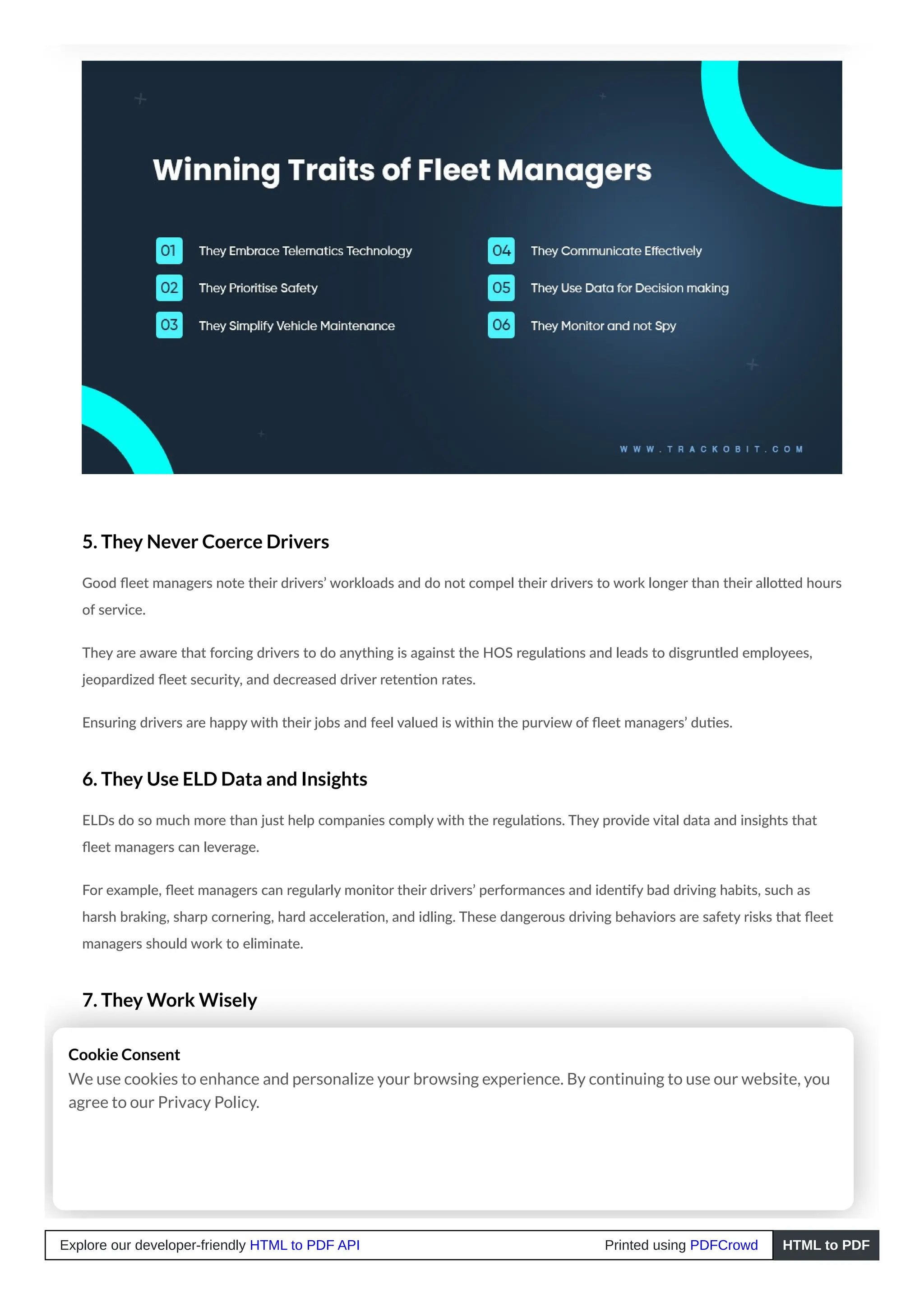
Below are some of the traits of an effective fleet manager:
1. They Embrace Technology
Successful fleet managers welcome and adopt new technology that can enhance business processes.
An ideal fleet manager leverages telematics software and technology to optimize fleet performance and efficiency. By
utilizing GPS tracking, they monitor vehicle locations in real-time, improving route planning and reducing fuel
consumption. Telematics provides critical data on vehicle diagnostics, enabling proactive maintenance and minimizing
downtime.
With advanced analytics, fleet managers can assess driver behavior, identify harsh braking or speeding patterns, and
implement targeted training programs to enhance safety and reduce vehicle wear and tear.
An ideal fleet manager uses telematics to boost productivity, ensure compliance, enhance safety, and reduce operational
costs.
Cookie Consent
We use cookies to enhance and personalize your browsing experience. By continuing to use our website, you
agree to our Privacy Policy.
Explore our developer-friendly HTML to PDF API Printed using PDFCrowd HTML to PDF
2. They Prioritise Safety
Highly effective fleet managers understand that safety is the priority.
When safety is compromised, not only general motorists but also heavy commercial trucks are exposed to life-threatening
risks. On the other hand, the company is just one accident away from paying hundreds of thousands, if not millions, worth
of legal penalties.
Fleet managers prioritize driver and vehicle safety by implementing comprehensive training programs to promote safe
driving practices. They use telematics to monitor driver behavior, addressing issues like speeding or harsh braking. Regular
vehicle inspections and maintenance schedules ensure vehicles are in optimal condition.
Fleet managers enforce adherence to regulatory standards and conduct safety audits. They also equip vehicles with safety
technology, such as collision avoidance systems and dashcams. By fostering a culture of safety and providing continuous
education, fleet managers aim to reduce accidents, enhance driver well-being, and maintain a reliable fleet.
Read Blog – What is Fleet Management? How It Works, Benefits & More
3. They Simplify Vehicle Maintenance
Regular vehicle maintenance is required, but it can be laborious and time-consuming.
Cloud-based fleet management software helps fleet managers optimise every step of the vehicle maintenance procedure.
This streamlines the procedure and improves fuel efficiency.
Fleet managers simplify vehicle maintenance by implementing routine maintenance schedules to prevent breakdowns.
They use telematics to monitor vehicle health and receive real-time alerts for issues, enabling proactive servicing. Fleet
management software tracks maintenance history, schedules services, and automates reminders for upcoming tasks.
Ultimately, this will reduce downtime and maintenance costs while ensuring the fleet remains in optimal condition.
4. They Communicate Effectively
Fleet managers put a premium on effective communication.
Effective communication means:
Drivers fully understand what fleet managers’ expectations are.
Fleet managers keep their clients and industry partners updated.
Fleet managers establish a friendly work environment and encourage the staff to express their observations.
Cookie Consent
We use cookies to enhance and personalize your browsing experience. By continuing to use our website, you
agree to our Privacy Policy.
Explore our developer-friendly HTML to PDF API Printed using PDFCrowd HTML to PDF
5. They Never Coerce Drivers
Good fleet managers note their drivers’ workloads and do not compel their drivers to work longer than their allotted hours
of service.
They are aware that forcing drivers to do anything is against the HOS regulations and leads to disgruntled employees,
jeopardized fleet security, and decreased driver retention rates.
Ensuring drivers are happy with their jobs and feel valued is within the purview of fleet managers’ duties.
6. They Use ELD Data and Insights
ELDs do so much more than just help companies comply with the regulations. They provide vital data and insights that
fleet managers can leverage.
For example, fleet managers can regularly monitor their drivers’ performances and identify bad driving habits, such as
harsh braking, sharp cornering, hard acceleration, and idling. These dangerous driving behaviors are safety risks that fleet
managers should work to eliminate.
7. They Work Wisely
Highly effective fleet managers understand the importance of working smarter, not harder.
They value their time and effort, so they use innovative, high-quality technology to complete their tasks faster instead of
slower manual and traditional methods. As a result, they save time and company resources while producing higher-quality
work.
Cookie Consent
We use cookies to enhance and personalize your browsing experience. By continuing to use our website, you
agree to our Privacy Policy.
Explore our developer-friendly HTML to PDF API Printed using PDFCrowd HTML to PDF
Let’s take the fuel consumption calculation as an example. Manual calculation is tedious, requiring dozens of hours to
complete, and prone to errors.
Instead, fleet managers can use automated fuel monitoring software to generate reports, monitor fleet performances,
track location, and maintain vehicle health.
How TrackoBit is Making Fleet Managers’ Job a Lot Easier
It’s kind of like the Swiss Army knife in a fleet manager’s toolbox. But instead of scissors and a magnifying glass, you get
features that make the life of any fleet manager much easier.
Below, we cover a few vital ways it helps fleet managers save time, improve efficiency and hit their KPIs.
Assist in Planning Efficient Routes, Halts and Trips
Real-time GPS tracking provides accurate location data, enabling managers to monitor vehicle movements and make real-
time adjustments to improve route efficiency. Geofencing capabilities allow managers to set virtual boundaries and
receive instant alerts.
Analyse Every Driver’s and Vehicle’s Performance with TrackoBit’s State of the Art
Features
TrackoBit’s driver behavior monitoring and route monitoring feature shows both the planned and actual driven routes. A
colored line shows the driver’s planned route, and a dotted line shows the actual driven route accompanied by deviation
alerts.
Digitalise Vehicle Maintenance with DVIR and Reminders
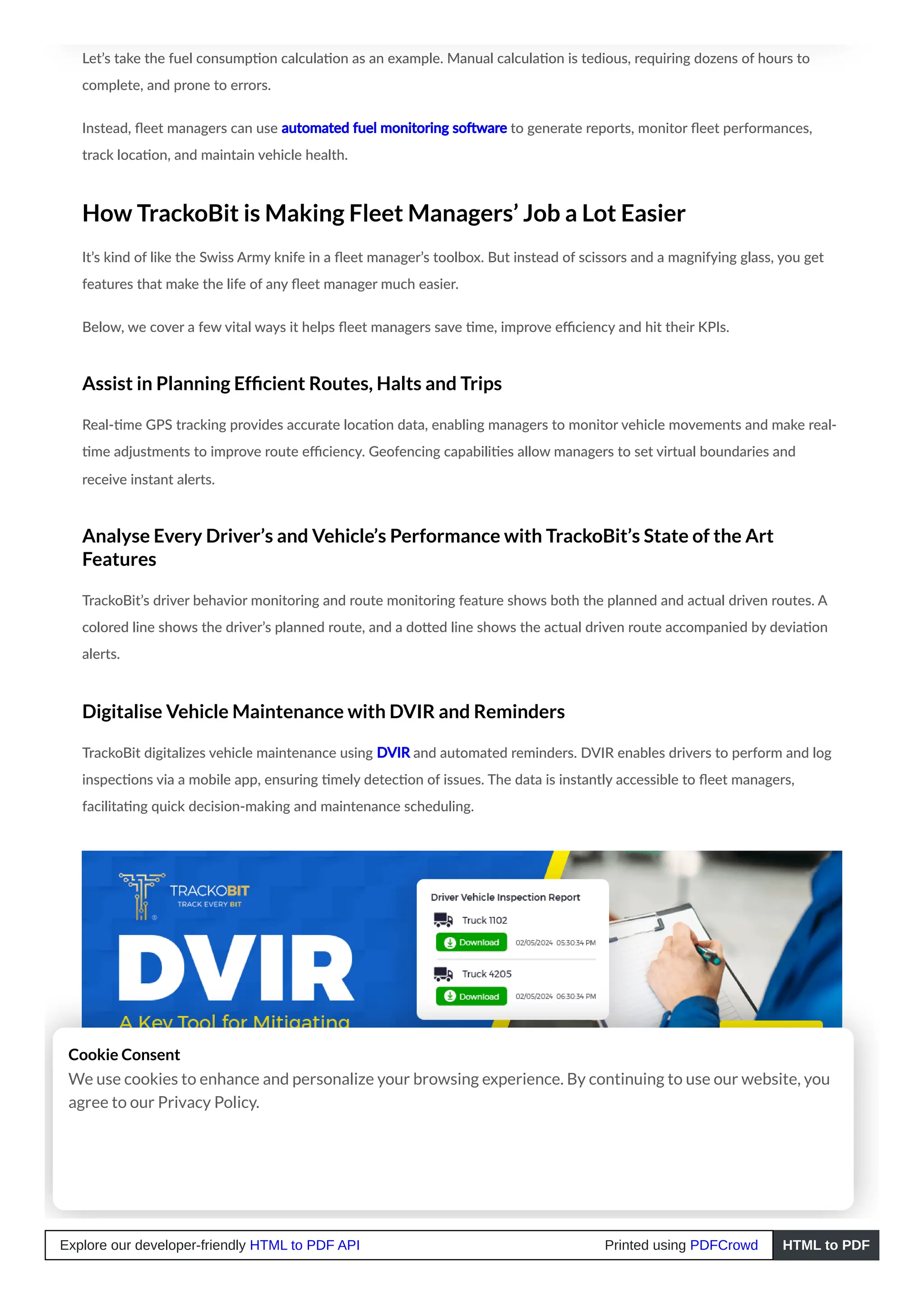
TrackoBit digitalizes vehicle maintenance using DVIR and automated reminders. DVIR enables drivers to perform and log
inspections via a mobile app, ensuring timely detection of issues. The data is instantly accessible to fleet managers,
facilitating quick decision-making and maintenance scheduling.
Conclusion
Cookie Consent
We use cookies to enhance and personalize your browsing experience. By continuing to use our website, you
agree to our Privacy Policy.
Explore our developer-friendly HTML to PDF API Printed using PDFCrowd HTML to PDF
Being a fleet manager is no easy job. However, it becomes easier and more efficient with proper training and the right
tools. Fleet management software like TrackoBit was built after understanding every operational challenge and psyche of
different fleet managers. This means the biggest challenges are addressed by technology so that you can focus on what
software can’t do – be a manager people want to work with.
If you have more questions about how TrackoBit can help your logistics team, book a free demo and see the software in
action.
Tithi Agarwal
Tithi Agarwal is a content writer at TrackoBit. She enjoys writing blogs which are
knowledgeable yet fun to read. And when she is not typing away to glory she has her
nose buried in books.
Author Showcase All Blog Post
Related Blog
Cookie Consent
We use cookies to enhance and personalize your browsing experience. By continuing to use our website, you
agree to our Privacy Policy.
Explore our developer-friendly HTML to PDF API Printed using PDFCrowd HTML to PDF
Stay Updated on tech, telematics and mobility. Don't miss out on the latest in the
industry.
Name Email Subscribe Now
Fleet Management Cost Analysis: Everything You Need to Know
A lot goes into owning and operating a fleet, and money is surely one of them.
If you are looking for ways to reduce the cost of fleet management, here is a
breakdown of the costs involved and areas where expenses can be curbed.
What is Fleet Managem
If you want your fleet ope
management. And what b
management software?
Tithi Agarwal
 2 July 2024
 Tithi Agarwal



Cookie Consent
We use cookies to enhance and personalize your browsing experience. By continuing to use our website, you
agree to our Privacy Policy.
Explore our developer-friendly HTML to PDF API Printed using PDFCrowd HTML to PDF

Responsibilities of Fleet Managers and How TrackoBit Can Assist.pdf

  • 1.
    Responsibilities of FleetManagers and How TrackoBit Can Assist Tithi Agarwal 10 min June 28, 2024 What do fleet managers do? What are their duties, responsibilities, and challenges? And what makes a fleet manager effective and successful? This blog answers all these questions. I plan the routes and track the miles, Ensure maintenance and manage files. I keep the fleet running, safe, and sound, Without me, chaos would be found. Who am I? Ans—Of course, a fleet manager. Author:  Read Time:  Published:  Last Update:  Cookie Consent We use cookies to enhance and personalize your browsing experience. By continuing to use our website, you agree to our Privacy Policy. Accept Explore our developer-friendly HTML to PDF API Printed using PDFCrowd HTML to PDF
  • 2.
    Picture this: Assoon as possible in the morning, you have fifty cars and drivers to dispatch, monitor, and manage. This is because you spend the afternoon formulating fleet regulations and looking for methods to cut expenses and operational difficulties. If this sounds like any other Tuesday, you’re most likely a fleet manager. Many skilled people aspire to become fleet managers, as the profession offers an average pay of over $89K in the United States. Logistics companies depend on highly skilled individuals for fleet management, and it’s not just about the attractive pay and opportunity. We examine the role of a fleet manager in detail today. What kinds of abilities do they have? What kinds of duties do they carry out? And, finally, what kind of tech is there to help fleet managers carry their load? Let’s start at the beginning. What is a Fleet Manager? The person in charge of overseeing an organization’s fleet of vehicles is known as the fleet manager. This covers every facet, from finding or employing drivers to ensuring the effective utilisation of vehicles and reducing delivery times and costs. Fleet managers assist each vehicle and fleet in navigating and mitigating the tasks and obstacles to which they are assigned. They also monitor the company’s fleet operations to ensure they are safe, efficient, and compliant with traffic laws. Fleet managers are also in charge of planning, assigning, and overseeing the expenses associated with owning, leasing, or renting vehicles, as well as the operational costs of maintaining and managing them. In addition to drafting driver travel itineraries, they must design regulations addressing vehicle usage and driver behavior based on the business’s needs. Cookie Consent We use cookies to enhance and personalize your browsing experience. By continuing to use our website, you agree to our Privacy Policy. Explore our developer-friendly HTML to PDF API Printed using PDFCrowd HTML to PDF
  • 3.
    7 Prime Dutiesand Responsibilities of a Fleet Manager The fleet manager’s job is not limited to just coordinating with the drivers and monitoring their activities and locations. Here are some of the major roles, responsibilities, and duties that a fleet manager cannot overlook: 1. Procurement and Maintenance of Fleet Vehicles Fleet managers’ primary responsibility is ensuring the organisation has the appropriate number and kind of vehicles in good shape and condition for optimal trip assignment. Cookie Consent We use cookies to enhance and personalize your browsing experience. By continuing to use our website, you agree to our Privacy Policy. Explore our developer-friendly HTML to PDF API Printed using PDFCrowd HTML to PDF
  • 4.
    Fleet managers usuallypurchase or lease vehicles according to certain specifications, such as business type, delivery requirements, load capacity, and mileage. Fleet managers also perform a comprehensive, timely check-up on vehicles to diagnose their engine health and maintenance needs. Based on that, they set up maintenance and servicing reminders and fill out eDVIR reports through fleet management software—just to prevent mid-route vehicle breakdowns and delays in consignment delivery and keep drivers stress-free and safe. Read Blog – What is Fleet Maintenance? Inspection Criteria & Ways to Improve It 2. Registration, Licensing, and Compliance As important as it is, compliance is equally challenging for trucking and transportation companies. In 2023, HOS violations accounted for over 40% of the driver-related violations found during roadside inspections. Long-haul carriers, in particular, face many regulations. For example, all fleet vehicles must have working ELD devices and ADAS integration, and all drivers must meet HOS requirements. Fleet managers ensure all fleet vehicles are registered and licensed according to local, state, and federal regulations. They maintain compliance by regularly updating registrations, conducting inspections, adhering to safety standards, and keeping accurate records to avoid fines and ensure smooth operations. If you wonder how they are so organized and remember all of this, they digitally manage paperwork and set reminders for permits and licenses using vehicle telematics solutions. 3. Driver Management Another important responsibility of the fleet manager for many businesses is managing the drivers. This covers daily communications, route management, hiring, training, and scheduling. They ensure that the drivers’ documents are complete, they are assigned duties, and they have an itinerary for the day. Most of all, they ensure that they are logged in to their driver apps to manage attendance, enable tracking, and regulate to-and-fro communication. Large organizations occasionally assign a fleet dispatcher to this position; however, smaller companies frequently combine the dispatcher and management positions. Cookie Consent We use cookies to enhance and personalize your browsing experience. By continuing to use our website, you agree to our Privacy Policy. Explore our developer-friendly HTML to PDF API Printed using PDFCrowd HTML to PDF
  • 5.
    4. Improving OperationalEfficiency Lastly, the fleet manager supervises and evaluates activities to enhance workflows and eventually raise the fleet’s total efficiency. Fleet managers establish procedures for typical difficulties (e.g., inability to complete delivery, accidents, or driver absenteeism ) and use technologies like fleet management software to systematize or automate everyday activities. They also monitor driver records to ensure drivers adhere to routes correctly. They mostly use driver scorecards to track drivers’ performance and reward or coach them. They do it efficiently using video telematics systems and driver behaviour monitoring solutions that provide visual footage of drivers’ driving behavior in the fleet. They even get intimated about odd driving events like harsh acceleration, brakes, and irregular driving patterns that put pressure on the engine. 5. Live Fleet Vehicle Tracking Fleet vehicle tracking is crucial because it provides fleet managers with a comprehensive picture of their fleet’s performance while driving. Fleet managers track the whereabouts, status, and physical state of their cars in real time, as well as the actions of their drivers, using GPS and vehicle tracking software. Read Blog – What is Vehicle Tracking Software? How does it work? 6. Fleet Reporting and Analysis Cookie Consent We use cookies to enhance and personalize your browsing experience. By continuing to use our website, you agree to our Privacy Policy. Explore our developer-friendly HTML to PDF API Printed using PDFCrowd HTML to PDF
  • 6.
    Fleet managers mustthen create reports using the metrics obtained from vehicle tracking. These reports list a fleet’s key performance indicators (KPIs) and let managers call out any areas in which it is deficient. Information about fuel usage, asset utilisation, and idle time is definitely included. A fleet manager will leverage this data to plan better routes and halts. 7. Creating Fleet Safety and Policies and Programmes Given that on-road accidents can be lethal and damaging to an organization’s reputation, fleet managers have a fiduciary duty to protect the safety of their drivers. Thus, it’s imperative that fleet management develop explicit safety standards, carry out driver training initiatives that promote safe driving practices, and have the capacity to act quickly if an incident does arise. Fleet Manager Responsibilities Specifically Toward the Company’s Drivers The following is a list of driver management operations a fleet manager may oversee: Monitoring, correcting, and improving driving behaviors and operations Mentoring, coaching, and rewarding drivers Assisting in the recruitment, discipline, and termination of drivers Evaluating drivers’ performances Setting driving schedules Tracking driver attendance, health, and other statuses Ensuring drivers’ adherence to applicable transport regulations (e.g., Hours of Service compliance) Providing route and operations information and technologies Maintaining constant communication with drivers Training drivers on risk management protocols, safety standards, and more What Makes a Highly Efficient Fleet Manager? Below are some of the traits of an effective fleet manager: 1. They Embrace Technology Successful fleet managers welcome and adopt new technology that can enhance business processes. An ideal fleet manager leverages telematics software and technology to optimize fleet performance and efficiency. By utilizing GPS tracking, they monitor vehicle locations in real-time, improving route planning and reducing fuel consumption. Telematics provides critical data on vehicle diagnostics, enabling proactive maintenance and minimizing downtime. With advanced analytics, fleet managers can assess driver behavior, identify harsh braking or speeding patterns, and implement targeted training programs to enhance safety and reduce vehicle wear and tear. An ideal fleet manager uses telematics to boost productivity, ensure compliance, enhance safety, and reduce operational costs. Cookie Consent We use cookies to enhance and personalize your browsing experience. By continuing to use our website, you agree to our Privacy Policy. Explore our developer-friendly HTML to PDF API Printed using PDFCrowd HTML to PDF
  • 7.
    2. They PrioritiseSafety Highly effective fleet managers understand that safety is the priority. When safety is compromised, not only general motorists but also heavy commercial trucks are exposed to life-threatening risks. On the other hand, the company is just one accident away from paying hundreds of thousands, if not millions, worth of legal penalties. Fleet managers prioritize driver and vehicle safety by implementing comprehensive training programs to promote safe driving practices. They use telematics to monitor driver behavior, addressing issues like speeding or harsh braking. Regular vehicle inspections and maintenance schedules ensure vehicles are in optimal condition. Fleet managers enforce adherence to regulatory standards and conduct safety audits. They also equip vehicles with safety technology, such as collision avoidance systems and dashcams. By fostering a culture of safety and providing continuous education, fleet managers aim to reduce accidents, enhance driver well-being, and maintain a reliable fleet. Read Blog – What is Fleet Management? How It Works, Benefits & More 3. They Simplify Vehicle Maintenance Regular vehicle maintenance is required, but it can be laborious and time-consuming. Cloud-based fleet management software helps fleet managers optimise every step of the vehicle maintenance procedure. This streamlines the procedure and improves fuel efficiency. Fleet managers simplify vehicle maintenance by implementing routine maintenance schedules to prevent breakdowns. They use telematics to monitor vehicle health and receive real-time alerts for issues, enabling proactive servicing. Fleet management software tracks maintenance history, schedules services, and automates reminders for upcoming tasks. Ultimately, this will reduce downtime and maintenance costs while ensuring the fleet remains in optimal condition. 4. They Communicate Effectively Fleet managers put a premium on effective communication. Effective communication means: Drivers fully understand what fleet managers’ expectations are. Fleet managers keep their clients and industry partners updated. Fleet managers establish a friendly work environment and encourage the staff to express their observations. Cookie Consent We use cookies to enhance and personalize your browsing experience. By continuing to use our website, you agree to our Privacy Policy. Explore our developer-friendly HTML to PDF API Printed using PDFCrowd HTML to PDF
  • 8.
    5. They NeverCoerce Drivers Good fleet managers note their drivers’ workloads and do not compel their drivers to work longer than their allotted hours of service. They are aware that forcing drivers to do anything is against the HOS regulations and leads to disgruntled employees, jeopardized fleet security, and decreased driver retention rates. Ensuring drivers are happy with their jobs and feel valued is within the purview of fleet managers’ duties. 6. They Use ELD Data and Insights ELDs do so much more than just help companies comply with the regulations. They provide vital data and insights that fleet managers can leverage. For example, fleet managers can regularly monitor their drivers’ performances and identify bad driving habits, such as harsh braking, sharp cornering, hard acceleration, and idling. These dangerous driving behaviors are safety risks that fleet managers should work to eliminate. 7. They Work Wisely Highly effective fleet managers understand the importance of working smarter, not harder. They value their time and effort, so they use innovative, high-quality technology to complete their tasks faster instead of slower manual and traditional methods. As a result, they save time and company resources while producing higher-quality work. Cookie Consent We use cookies to enhance and personalize your browsing experience. By continuing to use our website, you agree to our Privacy Policy. Explore our developer-friendly HTML to PDF API Printed using PDFCrowd HTML to PDF
  • 9.
    Let’s take thefuel consumption calculation as an example. Manual calculation is tedious, requiring dozens of hours to complete, and prone to errors. Instead, fleet managers can use automated fuel monitoring software to generate reports, monitor fleet performances, track location, and maintain vehicle health. How TrackoBit is Making Fleet Managers’ Job a Lot Easier It’s kind of like the Swiss Army knife in a fleet manager’s toolbox. But instead of scissors and a magnifying glass, you get features that make the life of any fleet manager much easier. Below, we cover a few vital ways it helps fleet managers save time, improve efficiency and hit their KPIs. Assist in Planning Efficient Routes, Halts and Trips Real-time GPS tracking provides accurate location data, enabling managers to monitor vehicle movements and make real- time adjustments to improve route efficiency. Geofencing capabilities allow managers to set virtual boundaries and receive instant alerts. Analyse Every Driver’s and Vehicle’s Performance with TrackoBit’s State of the Art Features TrackoBit’s driver behavior monitoring and route monitoring feature shows both the planned and actual driven routes. A colored line shows the driver’s planned route, and a dotted line shows the actual driven route accompanied by deviation alerts. Digitalise Vehicle Maintenance with DVIR and Reminders TrackoBit digitalizes vehicle maintenance using DVIR and automated reminders. DVIR enables drivers to perform and log inspections via a mobile app, ensuring timely detection of issues. The data is instantly accessible to fleet managers, facilitating quick decision-making and maintenance scheduling. Conclusion Cookie Consent We use cookies to enhance and personalize your browsing experience. By continuing to use our website, you agree to our Privacy Policy. Explore our developer-friendly HTML to PDF API Printed using PDFCrowd HTML to PDF
  • 10.
    Being a fleetmanager is no easy job. However, it becomes easier and more efficient with proper training and the right tools. Fleet management software like TrackoBit was built after understanding every operational challenge and psyche of different fleet managers. This means the biggest challenges are addressed by technology so that you can focus on what software can’t do – be a manager people want to work with. If you have more questions about how TrackoBit can help your logistics team, book a free demo and see the software in action. Tithi Agarwal Tithi Agarwal is a content writer at TrackoBit. She enjoys writing blogs which are knowledgeable yet fun to read. And when she is not typing away to glory she has her nose buried in books. Author Showcase All Blog Post Related Blog Cookie Consent We use cookies to enhance and personalize your browsing experience. By continuing to use our website, you agree to our Privacy Policy. Explore our developer-friendly HTML to PDF API Printed using PDFCrowd HTML to PDF
  • 11.
    Stay Updated ontech, telematics and mobility. Don't miss out on the latest in the industry. Name Email Subscribe Now Fleet Management Cost Analysis: Everything You Need to Know A lot goes into owning and operating a fleet, and money is surely one of them. If you are looking for ways to reduce the cost of fleet management, here is a breakdown of the costs involved and areas where expenses can be curbed. What is Fleet Managem If you want your fleet ope management. And what b management software? Tithi Agarwal  2 July 2024  Tithi Agarwal    Cookie Consent We use cookies to enhance and personalize your browsing experience. By continuing to use our website, you agree to our Privacy Policy. Explore our developer-friendly HTML to PDF API Printed using PDFCrowd HTML to PDF