JIM BLACK, Editor


  Canada’s First Book
on Strategic Enrolment
          Management


                   1
Copyright © 2010 by Academica Group. All rights reserved.

Published by Academica Group

CANADIAN OFFICES                     U.S. OFFICES

131 Wharncliffe Road S.              100 Cummings Center
London, ON N6J 2K4, CA               Suite 207p, Beverly, MA 01915

490 Adelaide St. W.                  1175 Revolution Mill Road, Suite 3
Toronto, ON M5V 1T2, CA              Greensboro, NC 27405

No part of this publication may be reproduced without express written consent of Academica Group, the
Publisher. Requests to the Publisher for permission should be addressed to the Permission Department,
Academica Group, 131 Wharncliffe Road S., London, ON N6J 2K4, CA.

Electronic versions of this publication may be retrieved at no cost from www.academicagroup.ca.
Print versions may be purchased from Academica Group by calling 519-433-8302 or online at
www.academicagroup.ca.

Academica Group publishes its books and white papers in electronic formats. Some content that appears in
print may not be available in electronic versions.


Printed in Canada
FIRST EDITION


2 STRATEGIC ENROLMENT INTELLIGENCE
CONTENTS

PREFACE                         ..............................................................................................................................                                                                                                      5

ABOUT THE AUTHORS . . . . . . . . . . . . . . . . . . . . . . . . . . . . . . . . . . . . . . . . . . . . . . . . . . . . . . . . . . . . . . . . . . . . . . . . . . . . . . . . . . . . . . . . . . . . . . . . . . . . . . . 8


PART ONE

INTRODUCTION: Enrolment Issues and Opportunities . . . . . . . . . . . . . . . . . . . . . . . . . . . . . . . . . . . . . . . . . . . . . . . . . . . 14

CHAPTER 1: Strategic Enrolment Issues Facing Higher Education Leaders                                                                                                                                                       .....................                15

CHAPTER 2: The Changing Canadian PSE Landscape                                                                                                                 ......................................................                                           27

CHAPTER 3: Actionable Intelligence: Research for SEM                                                                                                                  ...................................................                                        51


PART TWO

INTRODUCTION: Enrolment Enablers and Core Strategies . . . . . . . . . . . . . . . . . . . . . . . . . . . . . . . . . . . . . . . . . . . . . 70

CHAPTER 4: Reframing SEM from the Academic Lens: Theory in Practice                                                                                                                                                       ......................                 71

CHAPTER 5: Institutional Reputation and Positioning                                                                                                             .....................................................                                           96

CHAPTER 6: Creating a Culture of Student Success                                                                                                       ........................................................                                              126

CHAPTER 7: Leveraging Technology to Power Student Recruitment and Retention                                                                                                                                                                         .....    146

CHAPTER 8: Organizational Capacity for SEM                                                                                                 ...............................................................                                                   165


CONCLUSION
CHAPTER 9: Reputation, Recruitment, and Retention Imperatives                                                                                                                                        ...............................                        202


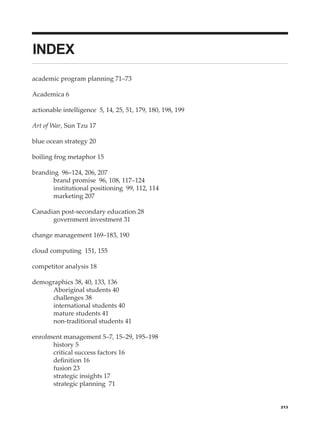
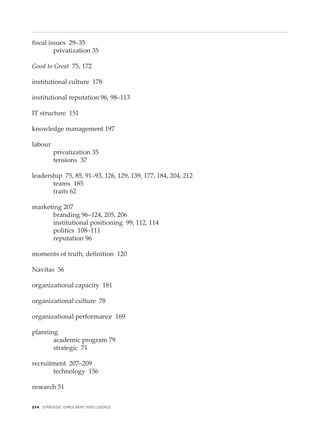
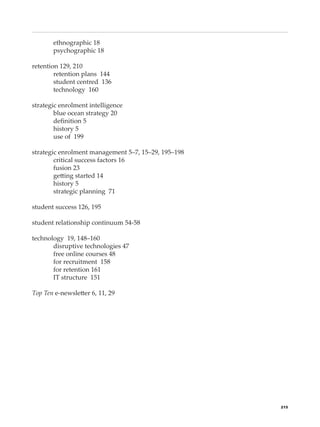
INDEX. . . . . . . . . . . . . . . . . . . . . . . . . . . . . . . . . . . . . . . . . . . . . . . . . . . . . . . . . . . . . . . . . . . . . . . . . . . . . . . . . . . . . . . . . . . . . . . . . . . . . . . . . . . . . . . . . . . . . . . . . . . . . . . . 213


                                                                                                                                                                                                                                                                      3
4 STRATEGIC ENROLMENT INTELLIGENCE
PREFACE


higher education that is increasingly a staple of the business and planning practices of col-


to inform enrolment strategies and practices and thus, position an institution strategically
to achieve optimal enrolment results.” In practical terms, strategic enrolment intelligence
refers to doing the right things, at the right time, with the right people in order to achieve
enrolment-related goals.
   As you may be aware, the discipline of enrolment management has a relatively brief
history. It began in the U.S. at Boston College in the mid-70s. The advent of enrolment
management in Canada did not occur until recently—spurred by increased competition, de-
mographic shifts, and in some provinces, government mandates related to growth expec-
tations, funding levels, or changes to institutional missions. Still in its infancy in Canada,
we believe that enrolment management will play a major role in the vitality of institutions
for the foreseeable future. By applying enrolment management concepts and principles to
a changing postsecondary education (PSE) landscape, institutions will more strategically
position themselves for anticipated, external opportunities and threats as well as hone their
internal strengths and mitigate weaknesses.
   In the early days of its evolution, enrolment management was focused primarily on in-
stitutional marketing followed by student recruitment. Today, however, enrolment man-


and graduating students and often, building loyalty among alums. At its core, enrolment


                                                                                             5
management is about an integrated, data-driven approach to initiating and cultivating rela-
tionships with students throughout their life cycle with an institution. Fundamentally, en-
rolment management embraces both the strategic and tactical, leverages data for decision-
making, works across organizational boundaries to engage the entire campus community,
and focuses on the needs of students as learners and customers.


subsequently, as consultants, researchers, technology service providers for numerous col-
leges and universities throughout Canada and beyond, we have written chapters that bring
to the forefront insightful observations that apply to any institutional type or setting. More-
over, the theory and recommendations in this book are grounded in the reality of our own
experiences and the Canadian PSE environment. In this regard, Academica is best known
for its research with hundreds of thousands of PSE applicants over the past fourteen years
along with the Top Ten, a daily e-newsletter with over 5,000 Canadian PSE subscribers. The
insights gained from surveying applicants and canvassing the PSE environment for emerg-
ing trends are infused into the content of this book.
                                                                 Strategic Enrolment Intelli-
gence will serve as a valuable resource for your institution. We encourage you to share this
book with other leaders on your campus. Host a book club or a Conversation Café around
the implications of the book’s conclusions for your institution. You also are invited to contact
Academica to arrange a Webinar with one or more of the chapter authors.

THE PURPOSE OF THE BOOK
Strategic Enrolment Intelligence is intended to create conversation around the enrolment
issues facing executive leaders on college and university campuses. Our hope is that these
conversations will lead to research, planning, action, and evaluation of enrolment efforts
linked to institutional goals.
    In addition to insights into the literature on enrolment management and other disci-
                                                                                               -
pects of the enrolment enterprise and provides practical strategies and leadership approach-


what leaders can and should do to ensure their institutions have high-performing enrolment
organizations with the capacity and strategic intelligence necessary to execute goal-driven


6 STRATEGIC ENROLMENT INTELLIGENCE
strategies to perfection. Throughout the book, authors advocate for continuous improve-
ment as a means to sustaining competitive advantage.

INTENDED AUDIENCE


direction and strategies, organizational capacity, and institutional culture. On many cam-


targeted to this audience, the authors believe that leaders can and do come from many levels
within the organizational structure. Hence, the book is recommended for anyone who has


THE ORGANIZATION OF THE BOOK
The book is organized into two parts and nine chapters. Part One (Chapters One, Two, and
Three) provides a high-level contextual overview of common enrolment issues, the Cana-
dian PSE landscape, and the actionable intelligence required to inform enrolment strategy.
In Part Two (Chapters Four through Eight), the focus shifts to key enrolment enablers and
core strategy areas, including the organizational capacity necessary to effectively execute
enrolment strategies and foster a strategic enrolment management (SEM) culture. The Con-
clusion conveys imperatives related to reputation, recruitment, and retention—describing
practical actions institutional leaders should pursue.

ACKNOWLEDGEMENTS
The chapter authors and staff of Academica deserve our thanks for sharing their exper-
tise and valuable time. Their commitment to contributing to the literature of enrolment
management has been exemplary.


                                                                                           7
ABOUT THE AUTHORS

DR. JIM BLACK
    Dr. Black is the president and CEO of SEM Works, and an internationally recognized
expert in enrolment management as well as in change management. He has published a
monograph titled, Navigating Change in the New Millennium: Strategies for Enrollment
Leaders, and three books, The Strategic Enrollment Management Revolution, considered
to be a groundbreaking publication for the enrolment management profession; Gen Xers
Return to College; and Essentials of Enrollment Management: Cases in the Field. Among
his other published works are numerous articles and book chapters including a feature ar-
ticle in College & University
Centered Culture,” for a book on best practices in student services published by SCUP and
sponsored by IBM; a chapter on enrolment management in a Jossey-Bass book on student
academic services; as well as a bimonthly feature in The Greentree Gazette.
    Black was honored as the recipient of the 2005 AACRAO Distinguished Service Award. He
has been interviewed by publications such as The Chronicle of Higher Education, Converge
Magazine, The Enrollment Management Report, The Lawlor Review, and was interviewed
for AACRAO’s Data Dispenser. Black also was featured in an international teleconference
on enrolment management sponsored by The Center for the Freshman Year Experience at


Touch Student Services.” Since 1999, Jim Black has been an IBM Best Practices Partner,
one of only twenty-three in the world. He was invited by The College Board to Heidelberg,
Germany, to evaluate the APIEL Exam and most recently was invited to lead conferences on
enrolment management and student services in the United Kingdom and the Netherlands.
    Dr. Black has served on the boards of several technology companies and has consulted
with companies such as Microsoft, Blackboard, and the SAS Institute. Higher education cli-
ents have included over 300 two-year, four-year, public, and private institutions.
    Jim earned a B.A. in English education and M.A. in higher education administration
from the University of South Carolina, as well as a Ph.D. in higher education curriculum
and teaching from The University of North Carolina at Greensboro. His doctoral experi-
ence provides our clients with unique perspectives into innovative pedagogical, curricular,


8 STRATEGIC ENROLMENT INTELLIGENCE
and program opportunities that impact enrolment outcomes. Leveraging his educational
background along with his many years as an associate provost, dean, and faculty member in
a higher education environment, Dr. Black provides institutions with strategic insights that
are grounded in theory and are actionable.

PHILIP BLISS
Philip Bliss, a digital pioneer, has been at the forefront of digital media development for the
                                                                                              -
gist and entrepreneur with the hands-on ability to turn ideas into results. He has founded
and grown three market-leading communications agencies: The Creative Marketing Net-


privately owned agency at the time.


American Indian, and corporate clients, including the Smithsonian Institution National Mu-
seum of the American Indian, Grant MacEwan University, Brock University, Tyndale Univer-
sity & Seminary, Confederation College, First Nations Oweesta Corporation, Georgian College,
Bayshore Bank & Trust, Microsoft, ATI Technologies, NEC, Samsung, and Cisco Systems.
    Since Academica Group acquired x2idea, Philip has led the technology practice of the
company, which provides Web strategy, creative, and development services for medium to
large scale Web projects in the higher education sector. Currently, Philip’s team is also de-
veloping a new collaborative Enrolment Analytics Research Platform for Higher Education
and has just released Version3 of Academica’s Drupal-based HigherEdCMS Module.
    Philip holds an Honours B.A. in English and Media Studies from the University of
Stirling, Scotland.

DR. BRYANT HUTSON
                                                                                              -
                                                                                              -
ence and retention programming and leading assessment efforts as Associate Director for
Student Academic Services at The University of North Carolina at Greensboro (UNCG). He
was also research associate at the Center for Educational Research and Evaluation at UNCG,
where he participated in large-scale program evaluation projects and played a key role in
developing instruments used in K–12 and higher education settings. He served as the tech-

                                                                                              9
nology and research coordinator for The College Foundation of North Carolina Resource


North Carolina at Greensboro, Greensboro College, Rockingham Community College, and
Guilford Technical Community College.
    Hutson holds a Ph.D. in higher education administration with a concentration in edu-
cational research, measurement, and evaluation. His research focuses on the development


been an active member of the National Academic Advising Association (NACADA), Ameri-
can Educational Research Association (AERA), and American Evaluation Association (AEA)


international colleagues, he has presented at international conferences and was an invited
guest lecturer at Shanghai Normal University. His publications include a leading text on
strengths-based academic advising, The Appreciative Advising Revolution; a chapter on
organizational change for a NACADA research monograph; a chapter in Gen Xers Return to
College; a section in the Academic Advising Handbook; and refereed articles in the Journal
of Applied Research in Higher Education and the Journal of College Student Retention.
    Hutson’s work with SEM Works includes planning, conducting, and overseeing research
projects; environmental scanning; conducting market opportunity analyses, academic pro-
gram reviews, and application and retention enrolment decision studies; and developing
program evaluation plans and instrumentation.

ROD SKINKLE
Building upon his background in higher education student affairs research, Rod has led Aca-
demica Group to become a leading provider of higher education focused policy, consumer
research, enrolment consulting, and technology innovation throughout North America.


most of Canada’s leading universities and colleges coast-to-coast, and is growing rapidly in


    Rod has pioneered the development of research tools and studies for North American
institutions and is the founder of the largest ongoing syndicated study of higher education
consumers in North America, the University & College Applicant Survey (UCASTM). This
study has provided valuable insights into the motivations and aspirations of post-secondary
students from 1996 to present. Rod presents research and position papers to a wide range

10 STRATEGIC ENROLMENT INTELLIGENCE
of policy/government groups (e.g., Canada Millennium Scholarship Foundation, Higher
Education Quality Council of Ontario, Council of Ontario Universities, Association of Com-
munity Colleges of Canada, Human Resources and Skills Development Canada) and has
published numerous studies in scholarly journals, including The Journal of College Student
Development, Canadian Journal of Higher Education, the American Psychological Asso-
ciation, and Ivey School of Business Journal.
   Rod has been an invited guest expert addressing trends in higher education on Canada
AM, Report on Business Television, CBC, Maclean’s magazine, Marketing magazine, and
was recently a featured interview guest with University Affairs magazine along with Aca-
demica Group cofounder, Ken Steele.
   In addition to his overall leadership and executive responsibilities, Rod leads and is com-
mitted to maintaining a thriving social policy research division focused on higher education
accessibility, student success, education, and career goal development.
   Rod holds a Diploma in behavioural science, Loyalist College, an Honours Degree in
psychology, The University of Waterloo, and a Master’s degree in applied social research
from the University of Saskatchewan.

KEN STEELE
Steele is cofounder and Senior Vice-President of Academica Group, Inc., with Canadian cor-


leading universities and colleges coast-to-coast, and is growing rapidly in the U.S. with of-


practice is institutional brand strategy and recruitment marketing, and he has led major
projects in recent years for Lethbridge College, the University of the Fraser Valley, Mount
Royal University, and the University of Saskatchewan, among others.
   Four years ago, as a service to Canada’s higher education community, Ken founded a
free daily news brief, Academica’s Top Ten, which summarizes important events, emerging


including college and university presidents and senior executives, government policy ana-
lysts, faculty, high school guidance counselors, and national media editors. Ken has written
numerous articles and white papers on institutional marketing and strategy, a syndicated
column on graphic design, and a regular blog on higher education issues, and now manages
a YouTube channel featuring notable higher education commercials.

                                                                                            11
Literature at the University of Toronto before leaving academia to found a regional adver-
tising agency in 1990. Ken and his team developed branding, marketing, and advertising


1990s, before merging the agency to form Academica Group in 2005.

LYNDA WALLACE-HULECKI
Lynda Wallace-Hulecki, SEM Works’ Vice-President for Strategy, has extensive experience
and a proven record of accomplishments in facilitating campus-wide strategic planning and
transformative change in policies, systems, and practices within both a college and univer-
sity context. Her higher education career spanned more than thirty years and encompassed


a role she served for more than twenty-three years, followed by almost a decade in lead-
ing strategic change in enrolment management operations at both the undergraduate and
                                                                                           -
tinguished Administrator Award” for which she was recognized for her contributions as a
visionary leader of change who has a passion for excellence.
    Regarded as a thought leader within the Canadian higher education system, Wallace-
Hulecki served on provincial and federal task forces related to inter-provincial student
mobility and higher education accountability. As an experienced enrolment management
professional, she has authored numerous white papers and book chapters on the evolving


monthly enrolment management e-newsletter, SEM Canada. She also has been an active
member of numerous professional associations, such as AACRAO, ARUCC, NASPA, AIR,
SCUP, and EDUCAUSE.
    Wallace-Hulecki is an experienced higher education consultant who specializes in facili-
tating an integrated approach to academic and enrolment planning. As a current doctoral
candidate at the University of Nebraska, her graduate research has focused on the evolving


for high enrolment performance. Wallace-Hulecki holds a B.Sc. in the mathematical sci-
ences from the University of Manitoba, and an M.Ed. in higher education from the Univer-
sity of Nebraska. She is currently an Ed.D. candidate in educational leadership and higher
education at the University of Nebraska.

12 STRATEGIC ENROLMENT INTELLIGENCE
PART ONE
                       Enrolment Issues and Opportunities

Strategic Enrolment Issues Facing Higher Education Leaders

                   The Changing Canadian PSE Landscape

                  Actionable Intelligence: Research for SEM


                                                         13
INTRODUCTION:
ENROLMENT ISSUES AND OPPORTUNITIES


                                                                                             -


Whether or not they evolve as stronger entities depends largely on how strategic they are
within the context of enrolment and reputational management. How effectively they use
scarce institutional resources to enhance quality, maintain or increase enrolments, and im-
prove their competitive position in the postsecondary market will determine their viability
and relevance to those they serve.


of environmental factors and take measured steps to seize opportunities and mitigate threats
will falter. Similarly, they must leverage data and research to target institutional responses


and error” are over. In this PSE environment, organizational missteps or negligence will
have profound consequences, and the recovery time will be much longer and more painful
than ever before. Today’s educational consumers are unforgiving.
    The chapters in Part One provide a glimpse into the enrolment context for Canadian
colleges and universities. Chapter One foreshadows key concepts described in detail in the
chapters that follow. In particular, this chapter focuses on the use of strategic intelligence


PSE trends in Canada. The author shares trend data and institutional examples to illustrate
the changing landscape. In Chapter Three, the core message of the book is conveyed—trans-
forming research into actionable intelligence. Without this ingredient, an institution cannot
be strategic. This chapter addresses the need for quality research as well as the best uses of
research in SEM.


14 STRATEGIC ENROLMENT INTELLIGENCE
CHAPTER ONE
STRATEGIC ENROLMENT ISSUES FACING
HIGHER EDUCATION LEADERS
BY JIM BLACK


In today’s economic environment, institutional leaders are painfully aware of the need to
manage costs and grow revenue streams. If leveraged properly, strategic enrolment man-
                                                                                               -
prehensive process designed to achieve and maintain the optimum recruitment, retention,
                                                                                               -
stitution” (Dolence, 1993, 1997). Over the past decade and at an accelerated rate during the
                                                                                               -
tite for integrating enrolment management into institutional strategic planning, analyzing
enrolment data, and investing in a resource hungry enrolment enterprise (Black, 2008a).
However, many still struggle to (1) proactively exploit external opportunities and mitigate
threats, (2) convert raw data into actionable intelligence, (3) utilize technology to enable
enrolment strategies and practices, (4) position the institution effectively among competi-


the goals and capacity of the academic enterprise, and (7) build organizational capacity to
sustain competitive advantage.
   The remainder of this chapter is dedicated to introducing related issues and opportuni-
ties. Chapters that follow delve deeply into each—conveying the underlying theory and rec-
ommending strategies and models for institutional leaders to consider.

THE BOILING FROG METAPHOR
You may recall the metaphor of the boiling frog. According to the metaphor, if a frog is placed
in a pot of boiling water, it instinctively leaps out. However, if the water is room temperature
and the heat is gradually ratcheted up, the frog will remain and eventually boil.
    The lesson for higher education in this metaphor is not to fall prey to incremental shifts
in the environment. As consultants for some 400 institutions across North America, we see

                                                                                              15
this scenario repeated far too often. Usually, institutions at the most risk are those that have
experienced consecutive years of enrolment success. They become comfortable—assuming
that enrolment will continue to grow without intervention or further investments. Institu-
tional paralysis sets in and leaders begin to overlook the obvious and their instincts betray
them (Gladwell, 2005). Eventually, a tipping point is reached and enrolment begins to spi-
ral downward.
                                                                                               -
tal facts.” Chapter Two addresses the emerging Canadian postsecondary education (PSE)
landscape. While this chapter provides an excellent overview of trends and related PSE im-
plications, it should be viewed as a starting point. Longer term, your institution should con-
tinuously monitor the environment for trends that may affect your enrolment positively or
negatively. Trend spotting, environmental scanning, and situational analyses are but a few
of the methodologies to consider. Aguilar (1967) described this process as the systematic
collection and analysis of external information to (1) reduce the randomness of information
                                                                                               -
ing conditions that may impact the organization.
         Regardless of the methodology you deploy, there are three critical success factors.
First, there should be an individual or administrative unit charged with the task of collect-
ing and analyzing environmental trends. At least annually, reports that include analysis and
institutional implications should be presented to the executive team for discussion and ac-
tion. Second, you must get in front of emerging trends. Reacting to them once they arrive
at your doorstep produces minimal results. Your institution’s strategic plan and enrolment
plan should address trends directly with strategies. Frankly, what we most often observe are
plans that are inwardly focused. Third, as a campus leader, you have opportunities to con-
vey these trends to the masses. To guard against your message falling on deaf ears, you must
articulate how these trends may impact the institution and why individuals at your campus
                                                                                               -
talizing on opportunities or mitigating threats. If your message is primarily about looming
threats, you should interject hope—a vision of a better college or university in the midst of
environmental challenges. Most importantly, the executive team needs to have a consistent
message and stay on message.
    The aforementioned recommendations will cause the institution to focus on the right
things. But, doing the right things is another matter. Desired strategies and behaviours fol-

16 STRATEGIC ENROLMENT INTELLIGENCE
low only if the leadership possesses the will to act (Black, 2008b). In this context, the will to
act refers to holding people accountable and letting go of less effective strategies and prac-


organizations to embrace. Our experience with most institutions supports this claim. Insti-
tutions are perhaps instinctively inclined to add new initiatives, programs, and services but
are reluctant to cease or reduce existing activities. Clearly, this is not a sustainable practice
and can effectively stall new initiatives designed to address emerging trends. Begin the pro-


order to free up the organizational capacity to execute new strategies effectively.

ANALYSIS WITHOUT PARALYSIS


However, the most telling question we ask (and one you should ask of your direct reports)


that there has been minimal analysis of the effectiveness of strategies—even resource-
intensive strategies. In Sun Tzu’s The Art of War (Giles, 1910), there are many parallels to
the business of enrolment management. Perhaps the most important tenet practiced by
this ancient consultant of war is that of knowing what works in order to perfect strategy.


within existing capacity. In order to discern what works, you must not only evaluate strat-
egies but you must know your students, your institution, and your competitors as well as
create a culture of evidence.
    Understanding your students as educational consumers is a basic tenet of marketing
(Hayes, 2004). Chapter Three speaks directly to the imperative of knowing your students.
Beyond the need to know basic demographic and academic information about students, the
strategic insights required to manage enrolments include:


                                                                                               17
In addition to these mostly quantitative measures, we fervently believe that institutions
should engage in ethnographic (the study of student cultures) and psychographic (the study
of student values, beliefs, and behaviours) research. By combining quantitative and qualita-
tive research methods, mere numbers become humanized. You will learn from their stories,
rituals, artifacts, social norms, and behaviours.
    Another, perhaps intuitive, necessary analysis is a study of institutional identity. In our


                                                                                                -
ple question often perplexes executive leaders in the sense that an institution’s identity must
be unique, true to its mission, and must resonate with its constituents and stakeholders.
Without this clarity, it is virtually impossible to market an institution effectively to the out-
side world. The reputational positioning described in Chapter Five becomes an elusive goal.
Internally, a blurred identity leads to confusion around priorities, direction, strategy, and
even day-to-day operations. As conveyed in Chapter Eight, organizational capacity building
is hampered without this clarity of identity and purpose.
    Equally as important is knowing as much as possible about your primary competi-
tors (Kotler, 1999 & Whiteside, 2004). A competitor analysis should consist of compari-
sons of program array; program curriculum; co-curricular offers such as apprenticeships,
internships, and co-ops; faculty expertise; class size; available learning options; job
placement rates; transfer rates; and other program or institutional attributes. From an en-
rolment strategy perspective, a competitor analysis also should assess institutional image,
cost, perceived value, marketing message, marketing and enrolment resources, inquiry


frequency of prospective student contacts, and tactics deployed to convert inquiries to ap-
plicants and admits to enrolled students. Armed with competitor comparisons, an institu-


18 STRATEGIC ENROLMENT INTELLIGENCE
tion can identify and secure a desired market position, especially as it relates to unclaimed
market niches (Black, 2008c).
   As alluded to in Chapter Eight, institutional leaders should foster a culture of evidence.
For enrolment management purposes, a culture of evidence should focus on continuous
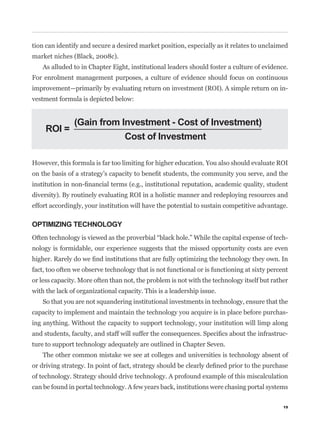
improvement—primarily by evaluating return on investment (ROI). A simple return on in-
vestment formula is depicted below:


               (Gain from Investment - Cost of Investment)
     ROI =
                           Cost of Investment

However, this formula is far too limiting for higher education. You also should evaluate ROI


diversity). By routinely evaluating ROI in a holistic manner and redeploying resources and
effort accordingly, your institution will have the potential to sustain competitive advantage.

OPTIMIZING TECHNOLOGY
                                                                                              -
nology is formidable, our experience suggests that the missed opportunity costs are even


fact, too often we observe technology that is not functional or is functioning at sixty percent
or less capacity. More often than not, the problem is not with the technology itself but rather
with the lack of organizational capacity. This is a leadership issue.
   So that you are not squandering institutional investments in technology, ensure that the
capacity to implement and maintain the technology you acquire is in place before purchas-
ing anything. Without the capacity to support technology, your institution will limp along
                                                                                              -
ture to support technology adequately are outlined in Chapter Seven.
   The other common mistake we see at colleges and universities is technology absent of


of technology. Strategy should drive technology. A profound example of this miscalculation
can be found in portal technology. A few years back, institutions were chasing portal systems

                                                                                             19
that could streamline student services and aid in the recruitment of students. The Informa-
tion Technology Division at most institutions assumed responsibility for portal projects. As
a result, the portals evolved as technically sound systems devoid of strategy. There was no
clear marketing, recruitment, or retention purpose, and no one charged with harvesting in-
formation daily and repurposing said information for the portal, so that it was fresh every
time a student chose to visit. Other than completing required business transactions with
institutions, the true potential has not been realized. But the story does not end with portals.
Most institutions possess enterprise systems, customer relationship management systems,
Web sites, and other applications that suffer from the same omission of strategy.

IN SEARCH OF GAME CHANGING INSTITUTIONAL POSITIONING


internal and external audiences.” The concept of a promise-oriented approach to position-
ing is explored in Chapter Five. In general, reputational positioning follows a tried-and-true
formula. According to Sevier (2003), there are three steps to creating a competitive market
position:


While these tenets are sound, alone they are not game changers. To radically alter your in-
stitution’s position you must search for what Kim and Mauborgne (2005) call a blue ocean
strategy. Fundamentally, blue ocean strategies are those that allow you to leapfrog the com-
petition. In the private sector, the recent introduction of the iPad has changed the electronic
reader and entertainment industry forever. Apple did not seek to emulate best practices in
the industry or marginally surpass competing products such as the Kindle or Sony’s Digital
Reader. Their goal was to become the dominant player in the market.
    In our work with colleges and universities, we search for blue ocean strategies that are con-
gruent with an institution’s mission and its natural personality. Sometimes the game changer is
a new creation, but it always builds on the institution’s existing strengths. Rarely have we found
one thing powerful enough to reposition an institution. Instead, the game changing position usu-
ally involves bundling existing strengths together with compelling and intuitive packaging.

20 STRATEGIC ENROLMENT INTELLIGENCE
We also have learned that timing is everything. The release of the right positioning strat-
egy just at the time when the market is ready for it determines the strategy’s success. For
example, the University of Regina launched the UR Guarantee in the midst of an uncer-
tain economy when student anxiety around future employment possibilities peaked. The
UR Guarantee is a promise to students who engage in career exploration and preparation,
student success support, and leadership and service activities while enrolled that they will
be employed within six months of graduation or be eligible for up to thirty hours of addi-
tional undergraduate course work with no cost for tuition. This strategy proved to be a game
                                                                                                -
crease in admission applications.

STUDENT SUCCESS ONE STUDENT AT A TIME
A premise developed more fully in Chapter Six suggests that retention programs and ser-
vices targeting at-risk students tend to have a short-term effect on a relatively small number
of individuals. Though important, such efforts do not possess the reach or sustained impact
that creating a culture of student success can yield. Correcting deeply engrained learning
                                                                                                -
tions over a protracted timeframe. Similarly, there are seldom easy remedies for complex
psychological, emotional, or social problems. For this reason, institutions that are serious
about improving student outcomes need a comprehensive, integrated approach to student
retention that empowers faculty, staff, and administrators with the skills and resources nec-
essary to address student warning signs as they surface, not a loosely federated array of ser-
vices. More importantly, by ensuring the conditions for student success are in place campus-
wide, an institution can prevent attrition before the situation reaches a tipping point.
                                                                                                -
drawal surveys, there is usually no single event or problem that pushes a student past the


effect of various pressure points over time that leads to a student’s premature departure.


lasting change in a human being’s capacity to learn or to persist” (Black, 2010). Following
                                                                                                -
trition, which are often masked by the obvious symptom (e.g., poor grades, class absences,
or a lack of social integration). Effective interventions are customized, directly related to the

                                                                                               21
individual’s attrition causation factors, and administered over a period of time.
         Executive leaders are in a unique position to promote a culture of student success—an
ethos of caring. That said there must be more than rhetoric. You must demonstrate through
action that student success is among the highest priorities of the institution. The following
actions are recommended:

                                                                                             -
         ence employee behaviour, policies, procedures, and strategies.


         the retention champion.


         available campus resources and referral protocols.


         recognition in the promotion and tenure review process, inclusion of contributions
         to student success in performance evaluations, release time to lead retention ef-
         forts, related professional development).


         (e.g., assigning the best advisors more advisees).


         the effectiveness of retention initiatives.


         strategies with greater potential to impact student outcomes.


         serve, and ensure the conditions exist or are created.


22 STRATEGIC ENROLMENT INTELLIGENCE
ACADEMIC-DRIVEN ENROLMENT STRATEGIES
An isolated focus on traditional enrolment functions such as marketing, recruitment, reten-
tion, and student services will not yield optimal results. Failure to examine the academic
product reduces the probability that programs align with market demand, attract desired


Most program review processes that we examine on campuses lead to marginal changes in
curriculum or simply justify a program’s existence. They typically lack the rigor and often
the data required to support enrolment objectives. Devoid of high quality, market-driven,
learner-centred academic programs, traditional enrolment functions become muted. No in-
stitution can effectively market and recruit for programs that are tone deaf to the needs and
expectations of external constituents.
   To fully realize the synergistic power of enrolment management and ensure that aca-
demic programs are in tune to the needs of the market, an institution must create a SEM cul-
ture that is integrated with the academic enterprise. Our experience suggests that this is an
evolutionary process that begins with sharing enrolment and academic information across
organizational boundaries (e.g., enrolment and retention trend data, academic program and
policy changes, environmental scan information). The second evolutionary stage involves
communication regarding the shared information—cross-divisional and interschool/college
discussions regarding related implications and needed action. In the third stage, there is


action items.
                                                                                            -
tal stage of a SEM culture, fusion, that joint efforts begin to become standard practice. For
example, in a fused SEM culture, there would never be a new academic program launched
without thorough market research at the concept phase of program development to identify
and/or validate the market potential. Pre-launch, a marketing plan would be designed to
support the program rollout with target audiences, key selling points, marketing channels,
recruitment strategies, and promotional collateral. Furthermore, related policies, proce-
dures, and supporting services would be determined before the program launch, so that all


stage, fusion evolves to full integration of the enrolment and academic enterprises such that
the two are functioning with a common purpose and are totally in synch.


                                                                                           23
Never before has an integrated SEM culture been more important than it is today. As
of the writing of this chapter, many Canadian colleges and universities are experiencing
dramatic enrolment growth. Few, however, are growing strategically. Strategic enrolment
growth refers to targeting programs for expansion that have demonstrated untapped de-
mand and unused capacity or capacity that can be developed at a relatively low cost. Growth
for growth’s sake can result in the dilution of the quality of the academic experience. While
random, uncontrolled growth may serve the short-term revenue generation needs of an in-
stitution, the longer term impact can be detrimental to the institution’s reputation and ca-
pacity to effectively serve students.
    Henderson (2004) described a blueprint for enrolment management in which the in-
stitution’s leadership must set an academic tone for enrolment management. Simply put—
academic objectives should drive the enrolment direction. Executive leaders should clearly


priorities. Even though academic priorities are largely aspirational, they should incorporate
business intelligence, institutional capacity, and external forces (e.g., government, oversight


priorities are established considering these factors, they will provide a solid foundation for
strategic enrolment planning.

ORGANIZATIONAL CAPACITY:
YOUR ONLY SUSTAINABLE COMPETITIVE ADVANTAGE
Through our consulting engagements, we have witnessed numerous exceptional enrol-
ment strategies that have failed due to poor execution. In most cases, these failed strate-
gies were embraced by well-intentioned people who intuitively knew what needed to be
done but lacked the capacity to implement. Frequently, capacity constraints were related
                                                                                              -


needed data, and space.
    Providing these necessary antecedents for success is the role of senior leadership. To
guide you in assessing what antecedents are essential, consider the following questions.
                                                                                              -


24 STRATEGIC ENROLMENT INTELLIGENCE
-
duce desired results and often demoralize the enrolment team. You are encouraged not to
pursue a single enrolment strategy without the antecedents for success in place. Your insti-
tution will be better served by implementing fewer strategies well. Clearly, this assumes the
strategies that matter most to achieving enrolment goals are pursued. Institutional leaders


to determine the actual ROI. By doing so, you will increase the likelihood that the right strat-
egies are in the mix.
    Lastly, you should focus less on enrolment numbers and more on the capacity to pro-
duce enrolment results—your people. Invest in human capital. Staff learning and retention
will directly affect your institution’s ability to achieve enrolment outcomes. For example, it
is common for recruiter positions to turn over every two to three years. With such attrition
among your sales team, your institution will never develop relations with school counsel-
lors, and your recruiters will never adequately learn your academic product. They leave your
institution because they are underpaid, overworked, and have limited opportunities for ad-
vancement. You control these staff attrition factors.

SUMMARY
The title of this book, Strategic Enrolment Intelligence, implies that being strategic is funda-
mental to creating and sustaining competitive advantage. Core elements of this chapter and
the entire book demonstrate how executive leaders can position their institutions to increas-
ingly be strategic in enrolment planning, execution, and assessment. The authors fervently
believe that seeing what is on the horizon and proactively seizing anticipated opportunities
and mitigating threats is a prerequisite for becoming strategic. Likewise, it is impossible to
be strategic without leveraging available data and research as actionable intelligence.
    Remaining core elements focus on strategic opportunities that, if supported by institu-
tional leaders, can produce considerable results for your institution. By leveraging technol-
ogy fully, you will enable your faculty and staff to effectively implement enrolment initiatives
and serve students. Out-of-the-box reputational positioning will secure your competitive
foothold in an increasingly saturated and aggressive higher education market. A student
                                                                                               -
gruence between the objectives of the academic enterprise and enrolment efforts will ensure
that your institution is nimble and market responsive.

                                                                                              25
Of course, your success in pursuing these strategic opportunities is largely dependent
upon building organizational capacity to support the attainment of priorities and goals that
matter most to your institution. Only senior leaders are in a position to develop the necessary
capacity for success. Bold leadership combined with a clearly articulated enrolment vision
and the will to act are requirements to realize your enrolment and institutional aspirations.

REFERENCES

Aguilar, F. (1967). Scanning the business environment. New York, NY: Macmillan.

Black, J. (2008a). New directions in strategic enrollment management. VA: Strategic Initiatives.

Black, J. (2008b, May). Enrollment management: A systems approach. [White paper]. Retrieved from http://www.sem-
works.net/white-papers.php

Black, J. (2008c, May). Perfecting enrollment strategy. [White paper]. Retrieved from http://www.semworks.net/white-
papers.php

Black, J. (2010, May). Creating a retention culture. [White paper]. Retrieved from http://www.semworks.net/white-papers.
php

Bridges, W. (1993). Managing transitions: Making the most of change. Reading, MA: Addison-Wesley Publishing Com-
pany.

Collins, J. (2001). Good to great. New York, NY: HarperCollins Publishers Inc.

Dolence, M. G. (1993, 1997). Strategic enrollment management: A primer for campus administrators. (2nd ed.). Washing-
ton, DC: American Association of Collegiate Registrars and Admissions Officers.

Giles, L. (Sun Tzu, trans. 1910). The art of war. English translation published by the U.S. Military. Washington, DC: Guten-
berg Project.

Gladwell, M. (2005). Blink. New York, NY: Time Warner Book Group.

Hayes, T. (2004). Acquiring and using marketing information for strategic decision-making. In Whiteside, R. (Ed.), Student
marketing for colleges and universities, 47–62. Washington, DC: American Association of Collegiate Registrars and
Admissions Officers.
Henderson, S. E. (2004, November). Refocusing enrollment management: Losing structure and finding the academic
context. Fourteenth Annual Enrollment Management Conference, Orlando, Florida.

Kim, W. C. & Mauborgne, R. (2005). Blue ocean strategy. Cambridge, MA: Harvard Business School Publishing Corpora-
tion.

Kotler, P. (1999). Kotler on marketing: How to create and dominate markets. New York, NY: The Free Press.

Massa, R. J. (2004). Mission and vision in institutional marketing. In Whiteside, R. (Ed.), Student marketing for colleges
and universities, 19–28. Washington, DC: American Association of Collegiate Registrars and Admissions Officers.

Sevier, R. A. (2003). An integrated marketing workbook for colleges and universities. Hiawatha, Iowa: Strategy Publishing.

Whiteside, R. (Ed.), (2004). Student marketing for colleges and universities. Washington, DC: American Association of
Collegiate Registrars and Admissions Officers.


26 STRATEGIC ENROLMENT INTELLIGENCE
CHAPTER TWO
THE CHANGING CANADIAN PSE LANDSCAPE
BY KEN STEELE


ACCELERATING EVOLUTION OF PSE—THE LONG VIEW
In the world today there are universities that have endured, largely unchanged, for almost a
millennium: the Università di Bologna traces its origins to 1088 AD, the Université de Paris to
1150 AD, and the University of Oxford to 1167 AD. Canada’s oldest academic institutions are
Université Laval (founded as the Seminaire de Quebec in 1663), the University of New Bruns-
wick (1785), and the University of King’s College in Halifax (1789). Although six hundred years
had passed, the structure, governance, and mechanics of higher education had changed very
little by the time it took root in this country. Academic institutions were still primarily commit-
ted to preserving knowledge, from antiquity to the present day, in massive libraries impervi-
ous to the incidental shocks of plague, warfare, religious schism, or political upheaval. Young


by lectures. For centuries, timelessness was a key virtue of the academic enterprise, and there


    In the mid-twentieth century, however, the global environment surrounding higher edu-
cation began to evolve, and North American institutions have faced a climate of exponen-
tially accelerating change over the past sixty years. Religious foundations gradually gave
way to secular funding, and government interest in academic research has steadily grown
since the 1940s for military, and now economic, ends. In the 1950s, the post-war GI Bill
sparked an unprecedented expansion and democratization of higher education in the U.S.,
and ultimately in Canada. In the 1960s, networks of hundreds of community colleges were
established in both countries to provide career-oriented workforce training, and immense


                                                                                                  -
ingly being seen as a fundamental human right and an essential component of a functioning
democracy, much like elementary and secondary education had been previously. Industrial


                                                                                                 27
and commercial research migrated from dedicated corporate research parks onto the cam-
puses of public universities. Over the course of three decades, from 1940 to 1970, the exter-
nal pressures of military research, workforce development, democratization, and commer-
cialization had breached the ivory tower walls and begun to transform the academic world.
Government was intimately, inextricably involved in the affairs of academe.


academic enterprise. In the mid-1970s, just as female undergraduate enrolments began to
surge, government funding cuts became acute for Canadian universities, who responded by
increasing class sizes and faculty-student ratios, growing their fund-raising arms, and in-


had begun in earnest, and the coming years would see the growth of ever-larger lecture the-
atres, the proliferation of multiple-choice exams, and increasing use of adjunct faculty and
teaching assistants. Faculty associations on campuses across Canada began acting more like
labour unions in the 1980s and 1990s, and tuition fees began rising in most jurisdictions.
Canadian universities and colleges started thinking seriously about international student


and more royalty income through licensing agreements and spin-off companies. Students
and their parents, faced with larger sticker prices for post-secondary education, began act-
ing more like consumers—comparison shopping, demanding luxury features, and measur-


to 2000, Canada’s universities, and to a lesser extent community colleges, became stretched
to capacity, and more susceptible to labour disputes, tuition freezes, international competi-
                                                                                              -
place” of postsecondary education.


universities, who are no longer merely in a pot, but in a pressure cooker. Provincial operating
grants have been increasingly tied to per-capita enrolment and key performance indicators
(KPIs), creating desperation in regions of declining population, and heightening competi-
tion for students in major urban centres. Federal tri-council research funding has been tight-


for degrees—particularly professional degrees, applied degrees, post-degree diplomas, and


28 STRATEGIC ENROLMENT INTELLIGENCE
on post-secondary campuses (Cote & Allahar, 2007). Growing international student recruit-


student academic preparedness, and perhaps set the stage for incidents of racial tension and
                                                                                            -


leading to acts of violence against Indian students studying in the country (Top Ten).


continually updated understanding of the external environment—particularly for market-
focused functions like institutional branding, enrolment management, and recruitment
marketing. Some long-term trends are readily apparent in statistics and research conducted
over several decades, although they can often be ignored because their effects are subtle and
gradual, like the pot of boiling water. More abrupt changes in the competitive landscape,
often resulting from international or private-sector forces, are harder to ignore but more
                                                                                            -
cation can often look to the American experience as a leading indicator of pressures and
changes to come. This chapter will survey some of the most critical trends affecting Canadi-
an colleges and universities, and their enrolment management efforts. (Obviously, it cannot


FISCAL CRISES ON CAMPUS
Canadians were insulated for the better part of a year from the economic recession that
struck American markets in late 2008, but by 2009 Canadians also saw house prices and


rates skyrocket, and government tax and natural resource revenues plummet. In late 2008,
several institutions reported early budget challenges: in October the cautious University of
                                                                                            -
jor spending, and in November the University of British Columbia reported $38 million in
losses on $130 million invested in asset-backed commercial paper. By early 2009, budget
cuts or shortfalls were being announced by dozens of Canadian PSE institutions, includ-
ing $7.5 million at Brock University, $6.5 million at Fanshawe College, $10 million at the
University of Lethbridge, $10 million at the University of New Brunswick, $10.6 million at
Bishop’s University, $13 million at McGill University, and $13 million at the University of


                                                                                           29
Manitoba. McMaster University balanced its 2009 budget through $20 million in deferred


as much as $50 million going forward. In March 2009, the University of Western Ontario


2011 unless action was taken: they therefore announced 5.5% across-the-board budget cuts,
a 4.5% tuition hike, the postponement of capital investments, and the elimination of 114 full-
time positions. (Top Ten)


                                                                                             -
cant demographic challenges in addition to economic pressures: in the past few years the
regional school board had closed almost half of its high schools due to declining enrolment.
Lakehead publicly considered a hiring freeze, and imposed a four-day mandatory unpaid
                                                                                             -
head’s VP for Administration and Finance, said to the media:


way we run our business, we’ll be just like GM . . . The model just doesn’t work under the
current funding arrangements for a university to operate. (Kelly, 2009)
                                                                                             -
dowment funds, who were therefore most dependent on endowment incomes for their oper-
ating budgets: in April 2009, Queen’s University announced 15% in budget cuts in response
to an endowment loss of $152 million, and the University of Toronto announced a loss of
$1.3 billion in endowments, which equated to a $62 million budget cut that year alone. In
July, the University of Calgary announced that it had lost $78 million on its endowments,
and would cut at least 200 jobs to save $14.3 million that year. The University of Alberta
reported that it had lost $112 million on its investments as of April 2009, and anticipated a
$59 million budget shortfall that year. St. Francis Xavier University in Nova Scotia, with a
volunteer-administered endowment fund, faced the steepest loss in the country: a 43% loss
on its investments, which were largely in the stock market. (Top Ten)


retirement plans: by June 2009, York University had lost 18% on its endowment funds and


million by 2012, it was facing a $280 million pension shortfall, which by Ontario regulations

30 STRATEGIC ENROLMENT INTELLIGENCE
would need to be covered by funds from the institution’s operating budget. At time of writing,
the Ontario government is working on special legislation to soften the impact of pension sol-
vency requirements for publicly owned institutions like universities and colleges. (Top Ten)
   The economic recession has simultaneously reduced institutional endowments and gov-
ernment tax revenues, and increased enrolment demand from newly unemployed students.
Enrolment demand has risen most abruptly at Canada’s community colleges, but univer-
sities are also enjoying a pleasant surge in applications and many are allowing their un-
dergraduate enrolments to rise somewhat. The loss of endowment income has reduced the
                                                                                               -


of enrolment success, and institutions need to be conscious that, when economic strength
returns, there will be an adjustment downward in application and enrolment volumes.

TIGHTENING GOVERNMENT PURSE STRINGS


full-time student: AUCC calculates a decline from $21,000 per FTE in 1980 to just $15,000
in 2007, using constant 2007 dollars (AUCC, 2007). Of that per-student budget, the gov-
ernment share has dropped from about $18,000 to just $10,000, while student fees net of
scholarships have almost doubled (CAUT, 2010). Naturally, government grants and tuition
fees per FTE vary considerably from province to province: institutions in Saskatchewan, the
most generous province as of 2008, enjoy a government grant per FTE almost double that
of Nova Scotia, the least generous on this measure (AUCC, 2007). In Ontario, provincial op-
erating grants to universities dropped from 78% of total institutional budgets in 1988 to just
50% in 2008 (Snowdon, 2010). Between 1993 and 2007, overall government investment in


35% per FTE in Alberta, 23% per FTE in Saskatchewan, 16% in Newfoundland & Labrador,
14% in Nova Scotia, and 13% in Ontario, but fell 15% in New Brunswick, 19% in Prince Ed-
ward Island, and 24% in British Columbia (CAUT, 2010). The resource-rich provinces of
Alberta and Saskatchewan are reinvesting in PSE, as part of provincial strategies to diversify
their economies before resource revenues plateau. Quebec and Manitoba are taking a riskier
strategy by holding the status quo, while B.C. seems deliberate about cutting funding to
higher education, perhaps anticipating immense burdens on its health care system as retire-
ment demographics balloon in the province.

                                                                                               31
More seriously, the resources per student of Canadian universities have fallen precipitous-
ly compared to their American competitors: from a per-student funding advantage of $2,000
in 1980, to a per-student disadvantage of $8,000 by 2006 (AUCC, 2007). Competing in a
global arena with American institutions that have vastly superior resources (largely due to
higher tuition fees) is not likely sustainable for Canadian universities, nor is government likely


    The recession of 2008 has impacted provincial budgets differently across the country.
Alberta, facing slowed production in the Athabasca Tar Sands and sharp declines in royal-
ties on natural gas, froze postsecondary budgets in 2009 after years of steady growth. (With
cost-of-living increases enshrined in collective agreements, this meant Alberta colleges and
universities faced budget cuts in real terms.) Ontario, facing massive tax losses because of


cuts are likely to persist well after economic recovery buoys the private sector: the same
taxation lag that insulated public institutions from the onset of the recession, will postpone


longer term, as baby boomers age and provincial governments face steadily more pressure
on their health care budgets, it seems unlikely that provincial higher education budgets will
grow more generous.
    The federal government’s response to the economic crisis of 2008 meant both good news
and bad news for Canadian colleges and universities. In March 2009, tri-council research
funding was cut by almost $120 million: $8.2 million for SSHRC, $40 million for CIHR, and
$70 million for NSERC. At almost the same time, Ottawa announced a $2 billion Knowledge


and renovation announcements rolled out steadily, province by province, throughout 2009
(Top Ten). In effect, the federal government was reducing its support of researcher salaries,
but increasing its commitment to the more visible bricks and mortar on university and col-
lege campuses. Academic leaders expressed concerns about the ongoing operational costs of


CAMPUSES RESPOND TO FISCAL PRESSURES
                                                                                                 -
nizations that are not accustomed to rapid implementation of expense reductions and bud-

32 STRATEGIC ENROLMENT INTELLIGENCE
get changes” (Moody’s, 2009). Bi-cameral and tri-cameral governance is an ideal model to
maintain tradition and quality, but not to implement innovations or manage budgets in the
face of increasing economic pressure. Most academic institutions take a collegial, equitable
approach to budget cuts: across-the-board reductions in budget, evenly between academic
departments and administrative support units. (Although since academic self-governance
typically veers away from cutting faculty positions, administrative units usually suffer the
steepest budget cuts.) Academic institutions are by their very nature conservative, tend-
ing to preserve the status quo and embracing change only in moderate, incremental ways.


decades, but ironically militates against decisive administrative change. This tendency to
incremental management often looks like deference to the status quo, or procrastination:
so far, the most common institutional responses to budget cuts have been deferred mainte-
nance and construction, merging academic departments or research institutes, hiring freez-
es, salary freezes, and increased teaching loads. In the U.S., where private colleges have far
less insulation from the economic downturn, sabbaticals are being cancelled, mandatory
furloughs imposed, campuses are being merged or closed, and in an increasing number of


have reached Canada, and the 2010 O’Neill report encourages mergers among some Nova
Scotia universities (Top Ten
to impact Canadian institutions in the near future. Provincial governments build new cam-
puses to win votes, and invest in bricks and mortar to demonstrate a commitment to post-
secondary accessibility, but none have yet seen it as politically expedient to close a university
or college campus. (When elementary and secondary school closures have been inevitable,
provincial governments have typically downloaded the responsibility, and the political fall-
out, to district school boards.)

TUITION INCREASES


Canadian undergraduate paid $2,000 in annual tuition (in constant 2009 dollars); by 2009
that had more than doubled to $5,583 (CAUT, 2010). Tuition for professional programs,
however, increased from similar starting points to vastly higher tuitions in 2009: Law to

                                                                                               33
more than $8,500, Medicine to more than $10,200, and Dentistry to almost $14,000. Ca-
nadians are socially inclined toward public education, and a recent poll found that 60% of
Canadians would support the elimination of PSE tuition altogether (CAUT, 2009).
    Despite student protests to the contrary, university and college tuition fees in Canada are
still remarkably affordable. Students in the U.S., Australia, Korea, and Japan pay vastly more
                                                                                              -
tially less—particularly in Denmark, Finland, and Norway, where public sources account for
more than 95% of PSE funding (CAUT, 2010). Nonetheless, compared to a student’s opportu-
nity cost of spending a year in higher education—anywhere from $20,000 to $70,000 depend-
ing upon student age and provincial employment rates—tuition of $1,500 to $7,000 is not the
primary impediment to pursuing an education. In fact, recent studies have emphasized the


                                                                                              -
est in Prince Edward Island, Saskatchewan, and Alberta, and considerably lower than aver-
age in Ontario, Newfoundland & Labrador, and particularly in Manitoba (Berger, 2007).
University tuitions, on the other hand, are highest in Nova Scotia, and considerably lower
than average in Alberta, Manitoba, Newfoundland & Labrador, and of course Quebec, where


of diminishing the resources of Quebec universities while raising trade barriers to prevent
other institutions from recruiting many Quebec students. In Atlantic Canada, where prov-
inces with very low and very high tuition are in close proximity, price-sensitive students have
proven quite willing to relocate across provincial boundaries to pursue their education.


return on investment (ROI). Institutions and government have gladly encouraged this ROI


over his lifetime, to justify transferring more of the cost of PSE onto students and away


graduates, and $1 million over college graduates.) The unintended result of this emphasis on


that education for its own sake is rather frivolous” (Rybak, 2007). Students enrol in PSE not

34 STRATEGIC ENROLMENT INTELLIGENCE
to learn, not to grow as individuals, but to obtain a credential that will ensure them greater
career opportunities. Rybak observes that many students he counseled at the University of


unintended consequence of tuition fee increases may ultimately be reduced interest in the
liberal arts and sciences, and more focused demand for career-oriented and professional
                                                                                                -
ative economy” (Florida, 2002).
    Nonetheless, tuition increases are continuing, and in some cases accelerating. Late 2009
and early 2010 saw proposals for some particularly aggressive tuition increases: in Novem-
ber 2009, the Northern Alberta Institute of Technology proposed a 40% tuition increase to
bring its fees in line with those of SAIT Polytechnic, but the province denied the request; the
same week the University of Alberta requested a 66% tuition hike for professional programs,
and got approval from the same government. In April 2010, the University of Manitoba
proposed tuition increases of 46% for Law, 54% for undergraduate business, and 78% for
its MBA program. The same month in Quebec, McGill University proposed raising tuition
for its MBA program from $1,672 to $29,500—a 1664% increase, although still a bargain
compared to $70,000 at other institutions. The government of Quebec publicly opposed the
move and promised to claw back funding equivalent to the MBA fees McGill charges, but at
the time of writing, McGill administration was undeterred (Top Ten).
    In a world of globalizing research and employment, international student recruitment, and
competition, it seems inevitable that Canadian tuitions will eventually rise. At the very least,
                                                                                                -
ment funding and immovable salary expenses, there are few other levers available to campus
administrators, if they are to compete with better-funded U.S. institutions for faculty, research
dollars, and top students. Rising tuitions will place increasing pressure on enrolment, pose


anxieties about ROI, focus on career outcomes, and expectations for campus services.

PRIVATIZATION ON CAMPUS
Many North American institutions have recognized the potential for international student
recruitment, and in the face of budget constraints have sought external partners to achieve
faster results. Many have partnered with North American consultants to recruit more effec-

                                                                                               35
tively overseas, or to join trade missions or postsecondary fairs. Many more have hired over-
seas agents to recruit students directly, sometimes on a thinly disguised commission basis.
But in the past few years, several Canadian universities have made headlines for controver-
sial decisions to partner with private-sector education companies, such as Navitas or Study
Group International (both based in Australia), not only to recruit international students, but


campuses in Canada, until the students are prepared to transfer into the established aca-
demic stream (Top Ten).
                                                                                             -
ternational College,” and the SFU board of governors approved a ten-year renewal of the


of 1,260 students from 40 countries have passed through the FIC program, and that 900
graduates have transferred to SFU. In November 2007, the University of Manitoba admin-


Manitoba, without consulting the Senate or Board of Governors. In February 2008, McMas-
ter was close to a deal to establish McMaster University College with Navitas, but campus
outcry derailed the deal permanently. In January 2010, the University of Windsor senate
voted against a SGI partnership for a business prep academy. As of February 2010, Navitas
reported that it was negotiating with Dalhousie University, and in May 2010 that it was ne-
gotiation with Carleton University, to establish international foundation year programs on
campus in Canada.
    Critics of these partnerships, most notably and vocally faculty associations, are con-


(CAUT, 2010a). Navitas instructors earn lower salaries, have no collective agreements, pen-
sions, tenure, or academic freedom: in the U.K., such arrangements have been criticized as


are trading on the reputation of the public university, charging the same international tu-
ition fees, and paying royalties or fees to the institution for the use of resources such as
classrooms, labs, computers, and health and career services. Some see Navitas paying for
access to better facilities than the university’s own faculty can afford. Others are concerned
about the implicit guarantee of progression into second-year university programs after the
completion of the foundational year (Top Ten). Spokespeople deny it, but the Dalhousie Fac-


36 STRATEGIC ENROLMENT INTELLIGENCE
Pathway to University of Manitoba,” and feature the U of M coat of arms equal in size to the


for international students. Of even greater concern than the current arrangements to deliver
foundational programs, faculty associations claim that the Navitas business plan includes
eventually delivering full degree programs in partnership with universities (UCU, 2010).
   Perhaps the most extreme example of faculty outsourcing to date arose in Michigan in
fall 2010: Washtenaw Community College announced that it was outsourcing 400 adjunct
faculty positions to a temp agency, in order to save $800,000 annually in pension contribu-
tions (Top Ten). It is no coincidence that some of the most radical college strategies have
been implemented in Michigan, a state at the epicenter of the economic recession. It cur-
rently seems unlikely that such desperate measures would appear on Canadian campuses,
but that may depend entirely on circumstances.

RISING LABOUR TENSIONS ON CAMPUS
Since 1970, what faculty associations would call the rising commercialization of the academ-
ic enterprise has led to political tensions on campus between administrators seeking to man-


of traditional academic self-governance (Turk, 2008). Scholars and researchers are by their
very nature intellectual individualists, following their own research interests and respecting
academic freedom and autonomy as self-evident values. Few academics, however, are by
nature intellectual entrepreneurs, alert to opportunities in their environment, and respond-
ing to unmet student enrolment demand or looming labour market shortages. While every
self-respecting campus has a program review cycle, that review is often focused on academic
quality, not relevance to student or societal demand. Canada’s community colleges are much
better at marrying educational function with marketplace needs, largely because their origi-
nal mandates emphasize meeting local and regional industry and workforce needs. Colleges
typically have program advisory committees comprised of representation from industry and
community, and curriculum is reviewed regularly for currency and relevance.
   As campus administrations have responded to budgetary and enrolment pressures by
increasing class sizes, hiring part-time, adjunct, or teaching-stream faculty, freezing sala-


                                                                                            37
more heated and adversarial. Just before Christmas 2007, the administration of St. Thomas
                                                                                             -
nadian campus (Top Ten). The negotiation stalemate persisted until February 2008, when
                                                                                             -
port staff strikes at Concordia University, New Brunswick Community College, and Seneca
College, among others, and faculty strikes at Wilfrid Laurier University, McGill University,
the University of Windsor, the University of Sudbury, Brandon University, Université La-
val, and, of course, York University, where teaching assistants and contract faculty were on
strike from November 7, 2008, until January 30, 2009. That bitter strike persisted through-
out the undergraduate application season, resulting in a decrease of 3,897 applications di-


across Canada in 2009 and 2010, when 27 CUPE locals (Canadian Union of Public Employ-
ees) across Ontario were renegotiating their contracts and multiple faculty associations won
strike mandates (Top Ten).
                                                                                             -
puses, although it seems clear that a protracted strike can have a major negative impact
on student enrolment in subsequent years. The long-term trends would seem to support a
future with escalating labour tension, particularly at universities: since 1975, Canadian uni-
versities have seen a 30% increase in full-time faculty while experiencing a 100% increase
in undergraduate enrolment (AUCC, 2007); over the same period, total university budgets
have increased 150% but expenditures on academic rank salaries have fallen from 30% to
20% of institutional budgets (CAUT, 2010). These Canadian statistics are corroborated by
a controversial Goldwater Institute report, Administrative Bloat at American Universities,


1993 and 2007, but administrative expenses increased 61% (Goldwater, 2010). With steadily
increasing enrolments, capped government funding, rising course loads and class sizes, la-
bour tension on Canadian campuses is unlikely to diminish in the foreseeable future.

LOOMING DEMOGRAPHIC CHALLENGES
Canadian postsecondary institutions will face a full spectrum of demographic challenges in
the coming decades. The natural birthrate in Canada has been declining since the popular-
ization of oral contraception in the 1960s, and Human Resources and Skills Development

38 STRATEGIC ENROLMENT INTELLIGENCE
Canada projects the birthrate will slip into negative territory around 2027. AUCC believes
that rising participation rates, international recruitment, and the recruitment of tradition-
ally underrepresented groups will maintain fairly stable university enrolment over the next
15 years (AUCC, 2007), but the Canada Council on Learning projects overall PSE enrolment
in Canada will drop by 120,000 students by 2025 (CCL, 2007). Canada’s universities are in
a privileged position when it comes to enrolment management, because most can simply
lower entrance average requirements to maintain full enrolment. Combined with growing
student interest in undergraduate and graduate degree programs, universities may skim off
the highest-achieving college applicants and create new enrolment management challenges
for Canada’s community colleges.
   Canada’s population is distributed very unevenly across the country, and demograph-
ic trends look decidedly different depending upon region. In Toronto and the Greater To-
ronto Area, all projections point to massive increases in youth populations and heightened
demand for university and college places well past 2030. Likewise, Calgary can anticipate
positive demographic trends and enrolment growth—as well as plenty of recruitment activ-
ity in their backyard by institutions from across the country. While the population decline
will be moderated in B.C. by plenty of in-migration, demographic projections call for an
increasingly senior population attracted to B.C. for their retirement. (This may represent a
boon for continuing education, but not for traditional full-time undergraduate programs.)
At the opposite extreme, regions of Northern Ontario, Atlantic Canada, and the prairies face
precipitous population declines over the coming 15 years, which will be felt most acutely in
Newfoundland & Labrador, New Brunswick, PEI and Nova Scotia, and possibly Saskatch-


   As the birthrate has declined in Canada, most population growth has occurred through


be an increasingly dominant majority of Canadian youth. StatsCan projects that by 2017, the


conducted by Academica Group for a number of government agencies have detected clear
                                                                                            -
versities: they are twice as interested in commuting to campus and living with their parents
                                                                                            -


and mathematics, and far less interested in the arts, humanities, social sciences, education,


                                                                                           39
-
manities faculties may well face steadily intensifying enrolment challenges.

SHIFTING FOCUS TO “NONTRADITIONAL” STUDENTS
From coast to coast, college and university administrations are aware that traditional demo-


make up the difference and maintain critical mass and institutional momentum. In some
regions of the country, the focus is on Aboriginal students, who are underrepresented in


First Nations University of Canada in Regina has not helped the cause of Aboriginal postsec-
ondary participation (Top Ten). While economic hardship poses a real barrier to some urban
Aboriginal students, the larger obstacles to Aboriginal participation in PSE are geographic,
social, cultural, and educational. Aboriginal communities are often remote and inaccessible,
and are sometimes unsupportive of a young person’s aspirations to go away to university.
Aboriginal youth face heightened identity anxiety over the decision to attend PSE, because
it often simultaneously seems to them like a rejection of family traditions. Many Aboriginal
youth struggle with math and science prerequisites in high school, and are academically


or alienating, and they fail to persist. All of these barriers should be addressed, and campus
retention professionals should certainly make learning supports and cultural supports for
Aboriginal students a priority, but in most regions of the country the actual number of Ab-
original students an institution can conceivable attract will not make up for demographic
declines in the mainstream population.
         On many campuses, the focus is therefore on the higher fee-paying international
student, as a non-traditional market to sustain the academic enterprise. Canadian student
recruitment efforts have been particularly successful in China, the U.S., France, and India
(AUCC, 2007), but colleges and universities are establishing institutional partnerships
with peer institutions in dozens of countries to attract students. On most campuses, in-
ternational students comprise roughly 10% of the total student population, and while the
market in some parts of the world is immense, there are practical limits on how many for-
eign students a campus can absorb before pressures on student support services become
unmanageable. There is also a market-driven limitation: many international students

40 STRATEGIC ENROLMENT INTELLIGENCE
come to Canadian campuses to study alongside Canadian students, and as the ratio shifts
toward international students, an institution will eventually become less desirable as a


year” programs, as noted above.)
   Mature students are another non-traditional market for many Canadian institutions, al-
though administrators may overestimate the market potential and underestimate the com-
petition. Despite considerable institutional marketing and government policy efforts, and
the doubling of university participation rates by youth aged 18–22, the participation rate of


closures and layoffs drive blue-collar workers back to college in particular, but generally
only for short-term retraining programs that government will fund. More than half of ap-
plicants to Ontario universities over age 25 are actually considering community college in-
stead (UCAS, 2009). Mid-career professionals are indeed a growing market for post-degree
diploma programs and professional master’s degrees, but their busy lives spent juggling
employment, spouses, children, and elderly parents mean that online or distance education
providers represent a more attractive option than the traditional campus experience. Many
Canadian institutions still underestimate the competitive threat posed by the University of
Phoenix, Kaplan University, Athabasca University, and Royal Roads University, and by the
distance education offerings of American public universities: the fact is that non-traditional
students may well prefer non-traditional forms of education, and established brands with


SHIFTING EXPECTATIONS OF TRADITIONAL STUDENTS
Although overall university participation rates have been rising in Canada, over the past 35
years almost all of that increase has occurred among the traditional university-bound cohort
of 18- to 25-year-olds. There is no statistical evidence that tough economic times, degree


                                                                                             -


Strauss, 2000). While it is unfair and inaccurate to generalize across an entire generation,

                                                                                            41
there are some clear trends that will almost certainly continue to affect enrolment manage-
ment professionals across Canada for years to come.

THE NEW CAREERISTS
Students have become increasingly focused on career outcomes of their postsecondary ed-
ucation (UCAS, 2000–2010), and recent surveys have found that Canadian students are
                                                                                            -
rity (Brainstorm, 2010). As a result, their dream employers are now governments, charities,
and high-tech superstars Google, Apple, and Microsoft. Fully 57% of applicants indicate that
careerist considerations drive their pursuit of higher education, compared to just 18% who
cite a desire to pursue advanced study, and 14% who seek to develop themselves personally
(UCAS, 2009). Application volumes to university programs in Ontario demonstrate that
students respond within months to shifts in the labour market, losing interest in computer
science or journalism as career opportunities are perceived to be in decline, and focusing on
social work, nursing, and education when government employment appears most secure
(OUAC, 2009).
    There seems to be a movement among Canadian colleges, in particular, to meet the mar-
ketplace demand for career-oriented degree programs through applied degrees, joint and
collaborative degrees, or even hybrid institutions like the University of Guelph-Humber or
Seneca@York, which promise students the best of both worlds. Nine institutions in Ontario,
Alberta, and B.C. have collectively established an organization called Polytechnics Canada to
promote a middle path—degree-granting colleges and technical institutes that conduct ap-
                                                                                            -
technics” per se (Top Ten).
    For decades, Canadian universities have been meeting student demand for more career-
oriented, professional degree programs—but in recent years, some have been catering to
                                                                                            -
gary guarantees undergraduates will complete their program within four years; and the Uni-
versity of Regina guarantees employment in the student’s chosen career within six months
of graduation (provided that students uphold their end of a fairly comprehensive bargain).
These guarantees serve to reinforce the rising tide of consumerism among PSE students,
and reinforce the focus on completion and career returns, rather than quality of education
or development of student character.


42 STRATEGIC ENROLMENT INTELLIGENCE
BALANCING STUDY, EMPLOYMENT, AND CREATURE COMFORTS
Students are increasingly seeking work-life-school balance, not an immersive or fully en-
gaged student experience. Although most undergraduate students continue to enroll full-
time, the amount of paid employment they assume has risen steadily since 1976 (Motte,
2009). U.S. statistics have found in particular a rise in the percentage of college students
working 20–24 hours per week at paid employment, and the U.S. National Center for Edu-


full-time students” (NCES, 2004). As college and university students increasingly divide
their time between studies and paid employment, hours spent studying declines (Babcock,
2010), time to degree completion rises (NCES, 2001), and, inevitably, student engagement
and retention become more and more challenging.


systems, campus Webcams, and even tattle-tale vending machines (Top Ten). In the U.S.,


                                                                                           -


ceremonies to give parents the hint that they should cut the apron strings.
   Student expectations for campus services are also rising, from pervasive Wi-Fi and luxu-
rious computer commons to one-stop service centres, online registration, credit card tuition
payments, and pet-friendly dorms. More and more institutions are constructing luxurious
dorms with private bedrooms, much like students enjoy at home, or repurposing luxury


responsive, from hand-held data collection during high school visits to personalized print-
on-demand viewbooks, from customizable Web portals for applicants to online previewing
of residence rooms and roommates (Top Ten).

MORE AGGRESSIVE MARKETING
Canadian colleges and universities have traditionally been conservative recruitment mar-
keters: continuing education departments and MBA programs have been the biggest adver-
tisers, while foundation and capital campaign purposes have driven many national brand-
ing campaigns. In most cases there has been a collegial respect for institutional catchment


                                                                                          43
with a zero-sum collective gain. Institutions have invested in detailed and insightful market
research for well over a decade now, and increasingly have been attempting regional market
share analysis and geotargeting, but to the casual observer, universities did not need to ac-
tively recruit students, and overt advertising would suggest a whiff of desperation.
    In some ways, the marketing landscape started to change in 2004, when York Univer-
                                                                                            -
mediately beneath the University of Toronto. Then in 2008, Lakehead University moved
the bar for aggressive marketing still further, when it plastered downtown Toronto with


                                                                                            -
sarily mean you’re smart.”)
    Recent years have seen more examples of aggressive PSE marketing in Canada. In 2008,
Colleges Ontario launched a mass media viral marketing campaign touting an imaginary


consider college pathways to solid and lucrative careers. Later in 2008, Algoma University


uses a campaign focused on putting 681 km between you and your parents.) Memorial Uni-
versity of Newfoundland has blanketed transit routes to major university campuses across
                                                                                            -


Rick Mercer. Brock University has clearly invested heavily in a national branding campaign


    Although the most obvious examples of aggressive advertising are originating in re-
gions of Canada facing the steepest demographic declines, PSE advertising is also heating
up in regions with intense competition among neighbouring institutions. Toronto’s Cen-


but was reportedly derailed by lawyers from United Parcel Service. Calgary’s SAIT Poly-


you’ll never want to leave,” while Mount Royal University recently ran an airport-themed

44 STRATEGIC ENROLMENT INTELLIGENCE
about to take off” (Top Ten).
   In 2010, two American universities launched what some detractors might call an even
more unseemly approach to advertising higher education: the music video. In the wake of
the immense popularity of High School Musical, Glee, and American Idol, Yale Universi-
ty surprised the Ivy League by launching a 16-minute student recruitment music video in


the admissions department” sang, danced, and played musical instruments through a re-
markably detailed introduction to the residential college system, Yale’s libraries, student
services, history, and program offerings. (A disclaimer at the conclusion of the video appar-
ently attempts to distance the institution from the production of the video, but the admis-
sions department was pivotal.) Shortly thereafter, in April 2010, the University of Delaware
launched an 8-minute music video on YouTube, featuring an introduction in which the uni-
versity’s president and registrar explicitly endorse the music video project.
   Canadian universities, ever more conservative than their U.S. counterparts, have not
yet embraced the student recruitment music video as a form of marketing, but they have


based on popular songs. In Canada, these lipdubs originated with the Université de Quebec
a Montreal and Université Laval in 2009, and were followed in 2010 by Campus St-Jean in
Edmonton, Brock University, Dalhousie Student Union, the Mount Allison Student Asso-
ciation, the University of Waterloo, and the University of Victoria (Top Ten). The videos do
little to promote academic values or program offerings, but emphasize student spirit and the
friendliness of the student association.

NEW COMPETITION FROM OLD INSTITUTIONS
The competitive landscape for student recruitment is changing. Canadian colleges and uni-
                                                                                             -


institutions are in fact true competitors in the marketplace, but in many cases institutions
are surprised to discover that their real competitors are less direct. In regions experiencing
economic growth, the labour market is the biggest competitor for postsecondary students,


In many jurisdictions, the primary competitor for a community college is the local univer-


                                                                                            45
sity, and likewise colleges are a serious consideration for about one-quarter of university
applicants. In recent years, seven colleges in Alberta and B.C. have been redesignated as
universities, transforming the competitive landscape and disrupting traditional transfer
patterns (Top Ten). Nearly a dozen Ontario universities and colleges have announced plans
to build new satellite campuses in the Greater Toronto Area to meet the projected enrol-
ment demand, and a recent HEQCO report recommended that the province establish a new
undergraduate teaching university in Toronto (HEQCO, 2009). The higher education land-


MULTINATIONAL FOR-PROFIT COMPETITORS
Just as the Internet has proven to be a fundamentally disruptive technology for the music,
newspaper, and magazine businesses, and may soon transform the book and movie indus-
tries, it has the potential to radically change any sector focused on the transfer of informa-
tion that can be digitized. Higher education institutions will need to be alert to online com-
petitors over the next decade, just as American institutions have been surprised to watch
the sudden rise of the University of Phoenix and Kaplan University. In 2010, the University


Ten” U.S. institutions), and 200 campuses across the U.S., Canada, Mexico, and interna-
tionally. The University of Phoenix generates almost $4 billion in tuition revenue annually,
and commits 23.5% of net revenue to marketing. Despite tuitions as much as twice the rate


in the wake of the recession: 2009 enrolment at the University of Phoenix was up 22% from
2008, and Kaplan saw enrolment increases of 28% on enrolment of more than 100,000 stu-


reported a 10% drop in enrolments over the summer of 2010.) The University of Phoenix
has established several Canadian campuses, primarily in western Canada, and a new brand,
Meritus University, in Fredericton (Top Ten). So far, traditional institutions perceive little
threat, but upstart competitors are often dismissed by established players in their early days,
only to grow into strong competitors years later.
    Thus far, the social biases of Canadians (and of course government-subsidized tuitions)
                                                                                              -
petitors. But as students focus more and more on career outcomes as the only metric that
matters, employers—not academic accreditation boards—will hold the balance of power. If


46 STRATEGIC ENROLMENT INTELLIGENCE
and students perceive more attractive program offerings or more convenient service or de-


competitors, as they have in the U.S., despite tuition fee differentials. This is particularly
                                                                                               -
dents juggling busy lives, rural students far from a traditional campus, or even full-time
                                                                                               -
fortable in an online environment.

DISRUPTIVE TECHNOLOGIES
The potentially disruptive power of the Internet on higher education should not be under-
                                                                                               -
tive threat as a result of the Web. For students seeking educational content, the Internet
provides an incredible range of free options, from MIT’s OpenCourseWare consortium to
Webcast.Berkeley, and from iTunesU to TED.com. Lectures have been digitized, published,
commoditized, and priced at free—all in the space of a few short years. Already, some tradi-
tional students on Canadian campuses report that they prefer to watch MIT lectures online,


studies are consistently proving that podcast lectures result in 15% better learning outcomes
for students, are appreciated as an option by most students, and are in fact preferred by
many students (Top Ten). Traditional lecture theatres may well become relics in the next few
years; some campus planners are already reporting a focus on building smaller and more


    In 2010, experiments are just beginning with eTextbooks, iPads, and various tablet
computers as part of the postsecondary curriculum. But as the traditional anchors of any
campus—libraries and lecture halls—are distributed globally across the Web, these shifts
will inevitably impact campus business models: institutions are no longer in the business of
selling lectures to undergraduates, just as they have long since ceased to be in the business of
preserving written books in libraries. The impact of eLearning will extend well beyond tra-
ditional humanities programs: instructors in SAIT Polytechnic’s electrician apprenticeship
program are already experimenting with delivering upper-year education electronically,
and as surgeons increasingly direct surgical robots remotely via the Internet, someday even
brain surgery could conceivably be taught in a virtual or simulated environment.

                                                                                              47
THE DISINTERMEDIATION OF HIGHER EDUCATION
                                                                                          -
ing” power of the Internet (Tapscott, 2006): people can get what they need directly from
each other, without the need for intervening institutions (Li, 2008). Local booksellers ex-
perienced this power early on as Amazon and Indigo offered superior selection, price, and
search capabilities. Kijiji and eBay have replaced the need for consignment shops (and per-
haps soon, real estate agents). Even the mighty Encyclopedia Britannica appears to have
lost the battle against Wikipedia, and the Oxford English Dictionary is relevant today only
                                                      Top Ten).
    Students can now obtain world-class lectures, textbooks, course outlines, and tests on-
line without ever setting foot on a traditional campus. Open courseware makes course con-
tent available free online, anywhere in the world. The Internet already hosts eponymous


University” (Top Ten). Dynamic and inspiring lecturers can easily reach an online audi-


students to socially network among themselves, helping each other learn course content.
(These include Cramster.com, UniversityJunction, Peer2Peer University, and even Stanford
University’s Engineering program.)


Teaching,” in which faculty are also available to students online, at no charge. Many
faculty at traditional institutions are already allowing non-students to audit their online
courses for free. An experimental Web site launched in the fall of 2009 is formalizing
and expanding on the open teaching model: the University of the People (UoPeople.
com) offers students open courseware, social networking among themselves, and access


countries, in business and information technology programs, but it aims to revolutionize
global higher education by offering university degrees to students in developing coun-
                                                                                          -
demic institution dedicated to the global advancement and democratization of higher


exam.) UoPeople is seeking full-blown degree-granting accreditation in the U.S., and
aims for 10,000 students by 2014—about the size of the University of Phoenix back in
1990. UoPeople is no lightweight, either: it was founded by Israeli multi-millionaire Shai

48 STRATEGIC ENROLMENT INTELLIGENCE
Reshef, who sold previous online institutions to Kaplan and Laureate Education, and is
currently chairman of Cramster.com.

FACING A RAPIDLY-CHANGING ENVIRONMENT
The Internet’s disruption of the music and newspaper industries took more than 15 years,
and the full impact of disintermediation on higher education will likely take even longer,
because traditional institutions still enjoy a virtual monopoly on degree credentials in Can-
ada. But just because technological change has not yet transformed the business model of a
campus, does not mean it will not do so in the years ahead. Bill Gates, founder of Microsoft,
famously wrote:
We always overestimate the change that will occur in the next two years and underestimate
the change that will occur in the next ten. Don’t let yourself be lulled into inaction. (Gates,
1995)
     In the face of evolving competition, steadily shifting student expectations, budget con-
straints, unpredictable political interference, transformations in the workforce, globaliza-
tion, and technological change, Canadian college and university leaders need to be alert to
emerging threats and opportunities—but they must also nurture a nimble, entrepreneurial,
and innovative campus culture. Forward-looking institutions will need to challenge long-
held assumptions about program offerings, delivery methods, physical plant, and student
services. In the increasingly global landscape of higher education, future success will belong


ways to meet the sometimes contradictory demands of students, scholars, government, and
the economy.


REFERENCES

AUCC (2007). Trends in higher education, Vols. 1–3. Ottawa: Association of Universities and Colleges of Canada. Avail-
able at www.aucc.ca.

Babcock, Phillip and Mindy Marks (2010). Leisure college USA: The decline in student study time. American Enterprise
Institute for Public Policy Research.

Beloit College (1998–2010). Beloit college mindset list, available annually at www.Beloit.edu/mindset

Berger, J. and Motte, Anne (2007). Mind the access gap: Breaking down barriers to post-secondary education. Canada
Millennium Scholarship Foundation.

Brainstorm Consulting (2010). From Learning to Work, national survey of 16,000 Canadian college and
university students.


                                                                                                                       49
CAUT (2009). Poll: Canadians want tuition fees lowered or eliminated, CAUT Bulletin. Based on a          Harris-Decima poll of
2,036 Canadians, November 2008.

CAUT (2010). Almanac of post-secondary education in Canada, 2010–11. Toronto: Canadian Association of University Teach-
ers.

CAUT (2010a). Outsourcing deals face stiff opposition at U of Windsor, Dalhousie. Canadian Association of University Teach-
ers Web site, 2010.

CCL (2007). Report on learning in Canada 2007: PSE in Canada, strategies for success. Canadian Council on Learning.

Cote, James E. & Anton L. Allahar (2007). Ivory tower blues: A university system in crisis. Toronto: University of Toronto Press.

DFA (2010). An open letter to the Dalhousie University community, on the Dalhousie Faculty Association Web site.

Florida, Richard (2002). The rise of the creative class: And how it’s transforming work, leisure, community and everyday life.
New York: Basic Books.

Gates, William H. III (1995). The road ahead. New York: Viking Penguin.

Goldwater Institute (2010). Administrative bloat at American universities: The real reason for high costs in higher education.
Policy Report, August 2010.

HEQCO (2009). Glen A. Jones & Michael L. Skolnik, Degrees of opportunity: Broadening student access by increasing institu-
tional differentiation in Ontario higher education.

Howe, Neil and William Strauss (2000). Millennials rising: The next great generation. New York: Vintage Books.

Kelly, Jim (2009). Change key to solid future: LU leader. The Chronicle-Journal, Thunder Bay Ontario, May 20, 2009.

Li, Charlene and Josh Bernoff (2008). Groundswell: Winning in a world transformed by social technologies. Boston: Harvard
Business Press.

Moody’s (2009). 2009 U.S. higher education outlook. Moody’s Investor Services.

Motte, Anne and Saul Schwartz (2009). Are student employment and academic success linked? Canada Millennium Scholar-
ship Foundation Research Note 9, April 2009.

NCES (2001). 2000–01 Baccalaureate and beyond longitudinal study. U.S. Department of Education, National Center for
Education Statistics.

NCES (2004). 2003–04 National postsecondary student aid study, U.S. Department of Education, National Center for Educa-
tion Statistics.
OUAC (2009). Application and enrolment volume statistics published annually by the Ontario Universities Application Centre.

Rybak, Jeff (2007). What’s wrong with university: And how to make it work for you anyway. Toronto: ECW Press.

Snowdon, Ken (2010). Percentage contributions to Ontario university operating budgets, data compiled for HEQCO and
reproduced in the Globe & Mail.

Tapscott, Don and Anthony D. Williams (2006). Wikinomics: How mass collaboration changes everything. New York: Portfolio.

Top Ten (2007–10). This chapter references and consolidates news and information contained in thousands of news stories
reported in Academica’s Top Ten, a daily news brief edited by Ken Steele. The news items and links to original sources are
available in a searchable database on the Academica Group Web site at www.academica.ca.

Turk, James L. (2008). Universities at risk: How politics, special interests and corporatization threaten academic integrity.
Toronto: Canadian Association of University Teachers.

UCAS (1997–2010). University college applicant study, a national survey of 200,000 PSE applicants conducted annually by
Academica Group.

UCU (2010). Joint venture watch, on the University and College Union Web site, U.K.


50 STRATEGIC ENROLMENT INTELLIGENCE
CHAPTER THREE
ACTIONABLE INTELLIGENCE: RESEARCH FOR SEM
BY ROD SKINKLE


In thinking about the content for this chapter we challenged ourselves to address several
interrelated questions:

  1) In our collective experience with SEM-related research, what learning (i.e., infor-
  mation, perspective, beliefs, etc.) would provide the greatest value to senior leaders in


  2) Why does SEM-focused research appear to be so successful, and have such impact in


  3) Are these variances most associated with institutional characteristics, or to the re-


                                                                                              -
poses, value, and framing of research for SEM would provide highest value discussion for


RESEARCH: A SEM IMPERATIVE
As consultants who regularly work with institutions to provide SEM-related research pro-
grams, we have come to believe fervently that you should not conduct research unless you


typically being addressed through research. This is the appropriate starting point for insti-


the return on investment (ROI).

                                                                                              51
THE PROOF IS IN THE PUDDING—NOT REALLY
                                                                                             -


need to understand this.” Many of you will be familiar with these types of scenarios, and
they are certainly legitimate questions for which research is well suited to supply answers.


there are costs associated with that problem, and research helps to solve that problem.


in comparison to national averages, so we have no need for retention-focused research.” After


alternative explanations for enrolment and retention increases and more often than not they


economy—to name a few. Thus, we should not conclude that you do not have problems with
recruitment or other enrolment management processes from that information alone. In fact,
problems have a way of not revealing themselves until the system is under increased stress, or


consideration of the value of research in the SEM arena.
    Returning full circle to the question of why research just seems to be more successful
                                                                                             -
ated with institutions that get the most value from research. First, these institutions have
built research programs systematically into their overall SEM planning processes. Second,
they have learned to harness the potential of research to address the institution’s highest
and most strategic priorities. Third, institutional leadership have established a culture of
evidence-based decision-making.
    Our objective in the following pages is to demonstrate in concrete terms how to use and
incorporate research to provide strategic advantage to the institution. This shift in perspec-
tive becomes clearer when SEM is viewed as the fully integrated process bridging the entire
student experience, as argued throughout this text. From this perspective the real ROI po-

52 STRATEGIC ENROLMENT INTELLIGENCE
tential of a strategic research program reveals itself. It is also, in our view, an area of genuine
opportunity for institutional leaders providing (1) intelligence to help monitor and prioritize
strategic opportunities and threats at the institutional level, and (2) access to the detailed
data required to identify, prioritize, and justify the need(s) for action.

DATA—WHAT DATA?


up the leadership ladder you go, the higher the level of data required. The real challenge for
leaders, however, is that data are everywhere and reasonably easy to gather, but data are not
strategic intelligence. Data are really only the raw input to strategic intelligence. To bridge


then help direct the type of data, and point to where and how best to gather it. Finally, this
step is critical to ensure that research results provide maximum value to the institution. To
address this challenge, the remainder of this is organized into three sections:

  1) A Framework for SEM Research—All information is easier to internalize when it can
     be organized within a broader conceptual framework. In the case of SEM research,


                                                                                             -


     institutional data stream. This conceptual framework also is helpful in framing our
     discussion concerning the focus and level of research data that are appropriate to the
     different rungs on our institutional leadership ladder.

  2) Case Studies—In the second section we review two different examples of institutional
      SEM-related research. Not only because a picture is worth a thousand words, but also
      because examples provide you with an effective paradigm for comparing and con-
      trasting the research within your own institution.

                                                                                                 -
      mation and consider it within the context of key leadership roles and functions.

FRAMEWORK FOR SEM RESEARCH
                                                                                                  -
ciples while also providing a useful framework to conceptualize and organize SEM-related

                                                                                                 53
research across the institution. The overarching principle, of course, is that the visual il-
lustrates the continuity of the student’s relationship with your institution and does so in
terms of key SEM touch points. It is clear how different departments within your institution
are accountable for the delivery of services that align with one or more components of the
model. It is also immediately apparent how each component leads to the next and how each
is contingent on success in all those preceding it.


                              Figure 1: Student Relationship Continuum


The model suggests a number of critical points for institutional leaders that bear responsi-
bility for one or more clusters of activities across the experience continuum.


      importance of individual components in isolation, because each literally depends
      upon the preceding. From this perspective, dropping the ball at any one point in the


      need for shared mission, coordination of activities, and communication across the
      student relationship continuum increases.

                                                                                             -


       enabling leaders to spot the weaknesses in both understanding and accountability
       across the whole of the student relationship continuum (i.e., where are the gaps).


54 STRATEGIC ENROLMENT INTELLIGENCE
In Figure 2, below, we use the model to chart and audit the information available verti-
                                                                                            -
partments along the continuum, recognizing that there will be both overlap across depart-
ments and considerable variability in the way that institutions assign responsibilities for
these functions.


                              Figure 2: Departmental Focus


represents key touch points for institution and student. However, the interstitials are also
transition points from one state to the next, and institutions usually monitor the volume


supports. Each is a decision/action point for students and each is a real or potential inter-
vention point for institutional services.There exist long traditions of process and deep bod-
ies of knowledge concerning theory and best practices relevant to each of the above clusters


measurement and insight across the continuum. In Figure 3 below, we can overlay examples
of such tools along the continuum.


                                                                                           55
Figure 3: Research Resources


Figure 3 illustrates how a variety of student experience research resources can be placed


Leaders can readily determine where the gaps in information are. Ultimately, the framework
illustrates how leaders can utilize research to provide a continuum of intelligence that aligns
with the institution’s most important (strategic) information needs.
Consider the following stream of integrated strategic intelligence objectives.


      continuum—and represents strategic information about an institution’s reputational
      advantage, market share and positioning relative to competitors, prospective student
      markets, and market forces that may impact an institution’s ability to realize its enrol-


      Research in these areas provides strategic insights for developing a marketing strategy

56 STRATEGIC ENROLMENT INTELLIGENCE
and can be used to gauge return on investment of marketing efforts (Steele, 2009).

                                                                                          -
     ment Communications and Admissions” on the continuum—and represents strategic
     information about the effectiveness of the institution’s recruitment and admissions


     Student Services and some Registrar functions” on the continuum.
    Research in these areas provides strategic information about student satisfaction and
    engagement and the effectiveness of co-curricular and student life services in meeting
    the needs of current students.


These areas are highly underdeveloped in Canadian PSE and represent strategic informa-


student life cycle (Skinkle, 2005).
    The next step is to illustrate how this research can support SEM objectives. To achieve
this we present two examples that illustrate how institutions have come up with innovative
approaches to the use of research in support of top level SEM objectives.

SELECTIVE CASE STUDIES
Recall how in Chapter One we acknowledged that even while there is a growing appetite
among Canadian institutions for SEM, many still struggle with a number of the highest
management imperatives. The examples provided were: 1) proactively exploit external op-
portunities and mitigate threats, 2) convert raw data into actionable intelligence, 3) utilize
technology to enable enrolment strategies and practices, 4) position the institution effec-


enrolment efforts with the goals and capacity of the academic enterprise, and 7) build orga-
nizational capacity to sustain competitive advantage. We will refer to these periodically in
relation to the following case studies.


CASE STUDY 1: The University of Waterloo—We start with a large research-intensive uni-
versity known to virtually everyone in Canada, not to mention a strong international pres-
ence. The University of Waterloo has worked with Academica Group to conduct applicant

                                                                                              57
research for more than 10 consecutive years. No—that’s not why we’re featuring them here.


example of this work with their peer community.
    We developed the University/College Applicant Survey (UCASTM) with the goal of pro-
viding schools with strategic intelligence focused on the marketing and communications
                                                                                          -
tinuum. The instrument examines everything from the most tactical (how much time did
you spend on our competitor’s Web site) to most strategic (e.g., perceived reputation on
the most critical brand attributes). Figure 4 below illustrates one way the information can
be presented.


                                      Figure 4: Reputation Septograph


58 STRATEGIC ENROLMENT INTELLIGENCE
In addition to these quantitative measures, we collect word association data that provide
another view of the institution—words that come to mind among applicants when thinking
about your school. There are literally hundreds of data points that client schools use from
this type of research, so it’s risky to home in on a particular aspect; however, there is one
particularly striking example that warrants the risk.
   A number of years ago the Director of Marketing and Undergraduate Recruitment at the
University of Waterloo began to notice the frequency with which the school was associated


cooperative education in Canada and is also well known for its incubation role in early days
of the birth of Research in Motion (think BlackBerry). The university is also widely rec-
ognized for its preeminance in Technology and Science, made enormously more preemi-
nant as a widely publicized feeder of graduate talent to Bill Gates’ Microsoft corporation.
No surprise then that this was a strong association in the minds of the public (and prospec-
tive students live in the public). However, the data reinforced the strategic value of this as-
sociation. But the thinking did not stop there. The University of Waterloo, an institution
that was born just over 50 years ago, couldn’t hope to win on reputation attributes that tend


strengths, has trouble cohabitating in peoples’ minds with innovation. And, in fact, the data
reinforced that too. Now a potentially valuable identity pairing becomes decisively more


that we noted previously:

  1)   proactively exploit external opportunities and mitigate threats,

  2)   position the institution effectively among competitors,

  3)   align enrolment efforts with the goals and capacity of the academic enterprise,

  4)   convert raw data into actionable intelligence.


The recruitment and marketing professionals at the school recognized this and gradually
orchestrated increasing pairings between the school and the term. Indeed, at this point, ev-
erything concerned with marketing undergraduate programs goes through the innovation


                                                                                             59
This is not a book about branding; however, it is worth noting that it is not advisable to at-


& Calkins, 2005). In this instance, the research provided evidence that the school’s brand foot-
print was such that it could realistically claim this adjective and importantly, deliver on it.


CASE STUDY 2: A study involving a midsize institution on Canada’s west coast provides
an excellent example of research to support institution-wide SEM objectives. As this project
is ongoing we will keep the school anonymous; however, we bring this example forward at
this point because it is not only the results but also the bold and innovative use of research
and the manner in which it has been developed and integrated by the institution that pro-
vide the highest value learning for institutional leaders.
    The research leadership within this institution presented us with a genuine opportunity:
to assist in the design and execution of a truly integrated and actionable research program. A
                                                                                                  -
ing ongoing timely intelligence to their SEM committee. A tall order—sure, but it is instruc-
tive to recognize the real leadership golden nugget here. Recall in her study of SEM practice
leaders (see Chapter Eight), Lynda Wallace-Hulecki isolated a sequence of strategies and


data: the language of academics.


the establishment of a multidisciplinary SEM committee, but the second, from the Institu-
tional Research leadership, is the realization that if such a committee had both input and
access to a source of ongoing reliable research intelligence, their potential to impact change
would be immeasurably greater.
    The SEM committee had been mainly concentrating on recruitment and other front-end


group had articulated their next priority would be a deeper understanding of retention within
their institution. While there are several retention and student engagement focused instru-
ments available, the IR leadership wanted to develop a customized longer view approach with


    To address this need we deployed our Student Consumer Panel design, which utilizes
a combination cross-sectional and longitudinal design. The project should be considered a
four-year longitudinal study.

60 STRATEGIC ENROLMENT INTELLIGENCE
SAMPLE/DESIGN
This school had worked with us previously and knew the hands-on value of the University/
College Applicant Survey UCASTM, in which dozens of schools in Canada and the U.S. partic-
ipate. Starting with this applicant survey, we added our newly developed Retention Module
that assesses applicant expectations on an array of interaction and engagment behaviours.
    With our applicant research, we routinely invite respondents to participate in our ongo-
ing Consumer Panel studies. For this school, we built on the sample by inviting both incom-


approximately 1000–1200 students.


                        Applicants              First-Year Student      Second–Fourth Year

                        Applicant               Entering Student        Engagement/Retention
                        Perceptions             Engagement

                        N = 2000                N = 750                 N = 350


                          Figure 5: Sample Size by Year of Study


of immediacy (i.e., can gather information from across all years) and the strengths of longi-
tudinal research designs (Cook & Campbell, 1979).

STRATEGIC INFORMATION OBJECTIVES
The overarching purpose of the research is to better understand the college experience
through the eyes of its students in order to develop actionable improvements. There are two


we describe as theoretical or pedagogical. This refers to the study of the broad constructs such
as student engagement, progression/retention, etc. This type of data becomes actionable in-

                                                                                              61
telligence in the hands of the appropriate academic and student support services profession-
als. The second category refers to the less theory driven but equally valuable opportunities
available through the collection of ongoing feedback on a wide range of student experience
and perceptions. Also noteworthy, the Student Consumer Panel presents the opportunity


following list shows the major strategic research themes: 1) Recruitment & Marketing Best
Practices, 2) Entering Student Engagement, 3) Progression/Retention Factors, 4) Ongoing
Student Experience Feedback.

LEADERS & SEM RESEARCH
Through previous sections we have considered research as a SEM imperative, presented
the Student Relationship Continuum as a framework to provide context and structure for
institutional research, and reviewed two examples to demonstrate the application of SEM


within the context of key leadership roles and functions. Throughout this book, much has
been said about the vital role of leadership in setting the example, establishing the culture,
and enabling the processes to achieve a well-integrated and high functioning SEM organiza-


research for SEM.

INSPIRING RESEARCH
Certainly much has been written about the subject of leadership. Most would agree that a


leadership traits:

   1. Honest


   3. Competent


    While the above are all clearly important with respect to leadership in general, number


62 STRATEGIC ENROLMENT INTELLIGENCE
-
pus. This is because research is a revered, sacred activity in our institutions of higher educa-
tion, and an almost black-box-like activity full of complex methods and statistical jargon.
Like higher education itself, participation in research can be a rewarding and transformative
experience, both for the sheer joy of discovery and for the improved effectiveness it can bring
to employees in their day-to-day work. It is inherently rewarding on many levels.
    Many years ago a senior VP charged this investigator (then a Coordinator of Research
for Student Services) with an extraordinarily broad research challenge: Go and conduct re-
search to improve the quality of undergraduate student life. This seemed at the time a pretty
broad and vague mandate. Nevertheless, we began by recruiting what was quite possibly the


this broad research mandate through a succession of quantitative and qualitative studies
with students. Once the students got over the shock of someone actually asking their opin-
ions on this subject, it was truly remarkable how much we learned. We accumulated a wealth
of ideas and perceptions ranging from relatively discrete service improvements to enter-
prise-wide intelligence with potentially game-changing perceptions concerning academic
advising and related student experience.
    The point of this anecdote is that this opportunity, which seemed quite vague then, now
twenty plus years later seems inspired. It was inspired by a senior administrative leader who


Waterman (2004) described, in their now classic book In Search of Excellence, which pro-
vides organizations with competitive advantage because it leads to creative breakthroughs


respect and demonstrate the value of research through example.

RESEARCH SCOPE & FOCUS


the scope of responsibility and the focus also narrows toward more immediate management


previously, there is nothing wrong with this in the sense that research is about providing
intelligence to help solve problems that arise, and there will always be unanticipated prob-
lems, and opportunities, that arise seemingly from nowhere. In fact, it is not uncommon

                                                                                              63
during the course of these discreet investigations, to discover information of much broader
strategic value. Thus, it is an important function of leadership to encourage and enable this
type of focused and more opportunistic research.
    Still there is no sidestepping the reality that these are reactive uses for research and,
moreover, that the institution will typically derive less strategic value (ROI) from this ap-
proach. As you move up the leadership ladder, the scope broadens and you move increas-
ingly toward the institution’s highest and most vital challenges. This is where the senior
leadership can exercise their broader perspective to ensure that research aligns with the
most important strategic objectives of the organization. As noted at the outset of this chap-
ter, this is also an area of genuine opportunity for leaders to identify top-level strategic op-
portunities and threats for the institution.

ORGANIZATIONAL CAPACITY
To realize this opportunity, leaders also need to attend to the more fundamental challenges
associated with the development of organizational capacity. These are addressed in detail


the organization’s capacity to both execute research and to ensure the institution has the


    Several organizational capacity issues are foundational:

1. A culture of evidence-based decision-making—this is truly the purview of leadership.
   Only they establish, via direction and reward, the appetite for evidence and the climate


   from; however, as this culture develops, administrators are encouraged and empowered
   to use existing data more often and more strategically. Likewise, they will be more likely
   to recognize and develop further information needs (i.e., strategic research objectives).

2. Clarifying and communicating the organization’s top-level information needs are also
   strictly the role of institutional leadership. As noted above, leaders have the opportunity
   to use their broader scope to focus on the organization’s highest strategic objectives. Once
   those objectives are established, however, leaders need to ensure the articulation of the
   information required to reach these strategic objectives. What information do we have


3. Prioritizing information needs in relation to the competing demands—as we have dis-


64 STRATEGIC ENROLMENT INTELLIGENCE
cussed previously, given the organizational realities of budget and competing demands
   for resources, this is one of the most important organizational capacity challenges. This
   type of top-level organizational research is an investment, plain and simple, and institu-
   tions have to make the investment before they can realize the return.

4. Ensuring the capacity to act on intelligence—even when information needs and priorities


   leaders will attest, this is much easier said than done. These top-level objectives tend to


   Thus, interdepartmental collaboration is a prerequisite condition of effective SEM re-
   search. This capacity requirement goes beyond simple bidirectional communications to a
   point that demands an integrated, cross silo perspective.

The above capacity matters are, in our view, the most fundamental. These are the cultural hall-


EXECUTION AND RESOURCES
In addition to these organizational capacity challenges, it is also important to consider the
leadership roles with respect to two vital, if more pragmatic, challenges: 1) What is the best
approach to initiate and oversee the execution of SEM research, and 2) How do institutions
resource this research.


leadership has established the broad organizational capacity requirements noted above, the
SEM committee is empowered to contribute directly to the establishment of research objec-


simultaneously improves the relevance of research while enhancing the use and dissemina-


   With respect to the second question, resourcing of the research, institutions vary widely
in terms of internal expertise and resources. Furthermore, leaders should expect that this
topic often elicits mixed, and even somewhat controversial, reactions across university and
college campuses. After all, are not our institutions of higher learning brimming over with
                                                                                              -


                                                                                             65
perience with this matter has been pretty consistent. It is not a matter of expertise but rather
of focus and capacity. The professoriate is correctly focused on their areas of research spe-
cialization and this is their highest best use for the institution.
    Concerning nonacademic institutional research resources (IR), capacity tends to vary a
great deal across institutions. Certainly the appropriate leaders, including IR leadership,
should be involved in the design and coordination of SEM research. Whether the institutional


is also highly variable. This capacity variance is not only a function of size but also of focus.
Larger institutions with more resources tend to have correspondingly larger demands for the
more expedient budget and resource management focused information. For leaders deter-
mined to champion this type of SEM-related research, this is a question that concerns both


internal research capacity. Since this author provides SEM and other PSE research consulting,


important topic that most PSE leaders have and/or will continue to confront.
    With respect to the above matter, leaders will need to weigh several interrelated fac-


champions, these champions are deploying research for the express purpose of identifying
strengths, weaknesses, opportunities, and threats (SWOT) across the student continuum.


an institution’s particular circumstances. Therefore, the SEM expert needs to be directly en-
                                                                                                -
eration is the research expertise. The researchers need to understand the PSE environment
and, most importantly, the SEM processes and goals that the research seeks to inform. The
third consideration is the need for objective and reliable information. In an academic envi-
ronment, it does not pay to underestimate this consideration. Finally, there is the practical
matter of the resources to execute in a timely manner to support the ultimate purpose—the
development of optimal SEM processes.


                                                                                                -
tional capacity.” If this organizational truism was not well understood in the past it should

66 STRATEGIC ENROLMENT INTELLIGENCE
be abundantly clear now. We have seen relatively new colleges and universities move from
start-up, with no reputation, to overtake long established institutions with venerable status,
in a space of 20 years or less. This author has spoken to university presidents who do not
share this fundamental perspective; neither on the threat nor opportunity side. There is an
underlying complacency here, born of a different era when age and geography tended to de-


do not tumble overnight. They lose ground in small, ever so subtle increments. Overreliance
on throughput data can tend to reinforce this problem. By the time you observe change with
this level of data, the antecedent variables are way out in front. Ken Steele’s chapter pro-
vides a glaring reminder of the variety of environmental conditions driving changes in the
landscape of higher education—with unprecedented speed. As in nature, the organism that
anticipates threats and exploits opportunities thrives.

SUMMARY
We’ve argued that your starting point, as leaders, is with a deeper view of the ”need” for
research. Think of research as the eyes and ears, gathering data, which is the input to the
brain. The brain, of course, is your senior leadership who collectively possess the experience
and context to make the best use of the data. It is not really possible for professionals farther
down the leadership ladder to structure and resource broad-based mission critical research
programs in isolation.
    We have presented the Student Relationship Continuum as a useful framework to con-
ceptualize and organize research. The continuum model mirrors the student experience,
which is itself a contiguous and personal journey. For leaders this framework reinforces two


                                                                                                -
force the cross-silo interdependencies and suggests how research can play a crucial role in
enterprise-wide communications.
    When it comes to resourcing research and ensuring the highest ROI, there are a number
of pivotal organizational capacity issues that are the purview of institutional leadership. Our
example on Canada’s west coast illustrates there are innovative and cost-effective ways to
build in exciting research and to ensure that the information is fed directly to key decision-
makers within the context of a broad multidisciplinary SEM group. Experienced IR lead-

                                                                                               67
ers know full well how to get the most value out of research. The most seasoned have led
many studies, large and small, and the most common refrain we hear from them is that the
results were never really used, sometimes not even shared. This author and my colleagues
in various institutions are often befuddled by a commonly heard question from the most
senior leadership: “How can I even contemplate spending on research when we are cutting
teaching faculty and other administration, due to shrinking resources?” The more logical
question would be the other way around: “How can I justify adding more faculty or other
administrative resources in the absence of good intelligence to direct that spending toward
our most mission critical objectives?”


FOOTNOTE
1
 However, because of their closer proximity to the front lines, they can provide valuable guidance toward both design
and interpretation of research.


REFERENCES

Black, J. (2008a). New directions in strategic enrollment management. VA: Strategic Initiatives.

Cook T.D. & Campbell, D.T. (1979). Quasi-experimentation: Design & analysis issues for field settings. Boston, MA:
Houghton-Mifflin.

Kouzes, J. & Posner, B. (2007). The leadership challenge. 4th Ed. John Wiley & Sons.

Peters, T. & Waterman, R. H. (2004, 1982) In search of excellence. HarperCollins Publishers, New York, NY.

Steele, K. (2009). Selling the academy without selling out. Academic Matters, February-March.

Skinkle, R. & McKinley, P. (2005). Strategic engagement of alumni: Integrating research and alumni relations. Presenta-
tion: International Conference Annual Proceedings of Association of Professional Researchers for Advancement. San
Diego, CA.

Tybout, A. & Calkins, T. (2005). Kellogg on branding. John Wiley & Sons, Hoboken, New Jersey.


ACKNOWLEDGEMENTS

For 25 plus years, it has been my good fortune to collaborate on research projects with many dedicated and
passionate higher education professionals across this country. This chapter is really my attempt to bring to-
gether the learning and enthusiasm from those collaborations. I want to sincerely thank those many clients
who have, and continue to provide us the privilege of working with them.
I particularly want to acknowledge an early mentor and dear friend, Dr. Tom Siess, former Director of Stu-
dents Services at The University of Western Ontario. Tom was a pioneer who envisioned and realized the
potential of applied research as an ongoing practice to advance student affairs.
Finally, for their generosity and valuable advice in reviewing early versions of this chapter I wish to thank
Tina Roberts, Director, Marketing and Undergraduate Recruitment, University of Waterloo and Paul Merner,
Associate Vice President, for SEM, Camosun College.


68 STRATEGIC ENROLMENT INTELLIGENCE
PART TWO
                          Enrolment Enablers And Core Strategies

        Reframing SEM from the Academic Lens: Theory in Practice

                           Institutional Reputation and Positioning

                            Creating a Culture of Student Success

Leveraging Technology to Power Student Recruitment and Retention

                                  Organizational Capacity for SEM


                                                                 69
INTRODUCTION
ENROLMENT ENABLERS AND CORE STRATEGIES


With the Canadian enrolment context in mind, now we turn to the enablers of enrolment
strategy as well as the strategies themselves. Through our visits to hundreds of campuses, we


to be best practices that have yielded minimal results, cost thousands of dollars and staff
                                                                                             -
lems we uncovered were usually not in the strategies per se, but in the execution.
    Failure to understand and work within an academic culture or view SEM through an
academic lens can be contributing factors to unsuccessful strategies. Chapter Four reveals
the importance of creating a culture of shared responsibility for enrolment outcomes with
the academic community. The author also presents six strategies and nine practical tips that
provide insights on how to foster campus-wide engagement in SEM planning.
    In Part Two, Chapters Five and Six focus on reputational and student success strategies.
Chapter Five explains the two sides of institutional branding: 1) promotion and positioning,
and 2) brand promise delivery. Both are essential to possessing a brand that is compelling
and real. Chapter Six conveys the importance of a student success culture along with insights
on how to create and sustain such a culture. Most importantly, this chapter focuses on en-
suring the conditions for student success are in place.
    Poor execution of strategies can also be attributed to the lack of organizational capacity
or other enabling factors such as technology—the focus of Chapters Seven and Eight. Now,
more than ever, enrolment enterprises are dependent upon technology to deliver informa-
tion, transact business, serve students, and market the institution. Chapter Seven discusses
emerging technology trends and related institutional opportunities to leverage technology.
While technology represents a vital element of organizational capacity, Chapter Eight ex-
                                                                                             -
ment” organization. In addition, Chapter Eight provides a brief overview of the common bar-
riers to achieving optimal organizational performance, followed by a model and guidelines
for building organizational capacity to create the conditions for optimal SEM performance.


70 STRATEGIC ENROLMENT INTELLIGENCE
CHAPTER FOUR
REFRAMING SEM FROM THE ACADEMIC LENS:
THEORY IN PRACTICE
BY LYNDA WALLACE-HULECKI


Both the literature and research conducted by this author substantiate a brutal fact: while
many institutions operate with the goal of increasing enrolment and net revenues, few have


manage the nexus between enrolment, academic quality, and revenues. This chapter dis-
cusses the symbiotic relationship between enrolment management and academic program
planning and innovation, the power of SEM in focusing strategic planning efforts on a stu-
dent-centred purpose, and the importance of leadership in managing change. The chapter is
structured in two parts. Part I discusses SEM as an academic imperative and the importance
of creating a culture of shared responsibility for enrolment outcomes with the academic
community. Part II draws from a study conducted by this author on exemplary practices
in fostering a SEM ethos within an academic context, and presents six strategies and nine
practical tips that may provide insights and value to you in fostering campus-wide engage-
ment in SEM planning at your institution.


PART I: SEM AS AN ACADEMIC IMPERATIVE:
THE THEORY IN PRACTICE: LEVERAGING THE POWER OF SEM IN STRATE-
GIC PLANNING AND CHANGE
In today’s Canadian higher education context, postsecondary institutions face unprecedent-


academic mission. Since the early 1970s, SEM has evolved in concept and process. What
was initially conceived as an operations management function within admissions and mar-
keting has become an organizing construct applied by a growing number of institutions to


to date, the literature is replete with references to the codependencies between the concepts
and processes associated with the strategic management of enrolment, and the broader in-


                                                                                           71
stitutional processes of strategic planning and resource management linked to accountabil-
ity (Black, 2008; Bontrager (Ed.), 2008; Hossler, 2008; Norris, Baer, Leonard, Pugliese, &
Lefrere, 2008; Massa, 2001; Dolence, 1993, 1997 ).
    Within an ever-expanding and diverse system of higher education providers (private,


environment. To survive, colleges and universities have mimicked the private sector in their
approaches to student recruitment and marketing in order to increase market share of stu-
dents and to secure greater portions of revenue from student enrolment (Hossler & Hoezee,
2001). Opportunities to diversify the enrolment mix have been pursued largely by increasing
access for the traditionally underserved, which represent the largest growing segment of the
population in many jurisdictions. As a result, institutional leaders are increasingly recogniz-
ing the need to infuse a more strategic and systems approach to enrolment planning, with
particular attention on the relationships between enrolment goals, academic development
directions, and resource management decisions (Hossler & Hoezee, 2001; Hossler, 2008).
                                                                                              -
ply be achieved by pressuring admissions and enrolment professionals for improved results,
or by throwing marketing dollars at an enrolment problem. Rather, it is a tool for achiev-
ing sustainable competitive advantage through changing environmental conditions (Black,
2008a, 2008b). Enrolment planning becomes strategic when it is an integral component
of institution-wide planning and resource management processes, fused with the academic
enterprise, and when it advances transformative change.

DEFINING THE ACADEMIC IMPERATIVE
The fusion of enrolment management with the academic enterprise is a necessary condi-


offered, how it is delivered, and the student support systems both within and outside the
classroom create the conditions for a positive student learning experience, which in turn
translates into an institution’s reputational advantage for distinctive excellence. If man-
aged well, an institution’s reputation can protect it from adverse environmental forces,
and serve as institutional currency in attracting and retaining high-value students as well
as faculty and other employees.
    In a rapidly changing and highly competitive marketplace, high performing organizations
                                                                                              -

72 STRATEGIC ENROLMENT INTELLIGENCE
delivered in a manner that is conducive to the learning preferences of potential students you
serve is mission critical (Black, 2008c). For these reasons, academic program innovation
and development is the cornerstone of the enrolment enterprise, and the academic program
mix is central to enrolment success.


and its changing environment is a function of strategic planning (Bryson, 2004). There is
a symbiotic relationship between enrolment management, institutional strategic planning,
and academic program planning processes (Dolence, 1993, 1997). At the core of an institu-
tion’s strategic plan is the academic mission and program plan. Enrolment planning and
the resultant SEM plan are integral components of the academic plan and planning process.
Enrolment planning brings a systems perspective to strategically focus the institution on
its program areas of distinctive competence and competitive advantage. An outcome of the
academic planning process is the articulation of broad institutional enrolment planning pa-
rameters that may include, but are not limited to:


From these, enrolment priorities and strategies are formulated with a view to:

  (a) Uncovering the institution’s existing competencies;

  (b) Leveraging the use of strategic intelligence (research and data) to improve
       competitiveness;

  (c) Fostering collaborative leadership in strategy development;

  (d) Engaging institutional constituents and cultivating buy-in to the process;


                                                                                           73
(e) Identifying strategic opportunities to advance the institution’s market position and
         enrolment goals; and

  (f)    Clarifying organizational capacity conditions for sustained high performance (e.g.,
         people, budget, structures, information, systems, etc.).


                                                                                               -
ment with the academic mission, faculty interests and expertise, organizational capacity
constraints, market demand, competitive context, student selectivity, student diversity and
                                                                                               -
cies. The process of establishing enrolment goals and targets is not atypical of most strategic


  1. Organize—Establish a SEM planning process (e.g., sponsor, leadership team, man-
        date)

  2. Research—Conduct market research, an environmental scan, and a review of institu-
        tional business intelligence information

  3. Plan—Facilitate stakeholder dialogue to identify and prioritize high impact strategic
        opportunities

  4. Implement—Formulate cross-functional strategy teams to develop strategies, tactics,
        and associated key performance indicators and metrics

  5. Assess/Adjust—Evaluate the outcomes and return on investment of strategies imple-
        mented, and adjust the plan accordingly


When effectively aligned with budget plans and priorities, the resultant SEM plan becomes
the lever by which the academic plan is realized, and a touchstone for measuring the effec-
tiveness of institutional enrolment performance. In this way, the enrolment management
plan becomes an integral component of the institution’s strategic plan, rooted within the
academic context, and linked to resource management decisions. Thus, academic program
development and innovation becomes the cornerstone of the enrolment enterprise, enrol-
ment becomes the lifeline to institutional vitality, and the enrolment planning process be-


performance goals.


74 STRATEGIC ENROLMENT INTELLIGENCE
CRITICAL ROLE AND FUNCTION OF INSTITUTIONAL LEADERSHIP
If enrolment management is the vehicle for change, leadership is the engine. In high per-
forming organizations, leadership is what moves the entire organization in a common direc-
tion (Blanchard, 2010; Collins, 2001). In the Jim Collins book, Good to Great, the author
describes a common phenomenon among companies that is equally as prevalent among


pushing in the same direction with equal vigor. Mobilizing a campus community around a
common enrolment purpose is the secret to producing dramatic, sustainable results (Black,


   By design, enrolment management involves solving complex problems, taking calculat-
ed risks, and reaching across departmental and divisional boundaries (Black, 2003b). En-
rolment management requires negotiating campus-wide investment in strategies that serve
the organization as a whole. Therefore, SEM requires strength of institutional leadership.
   Historically, colleges and universities are known to be adverse to change (Goff and
                                                                                             -
sponsive” organizations, and the existence of a comprehensive, integrated, and actionable
strategic enrolment plan is rare (Black, 2008a). While many institutions have adopted
strategies related to the administrative aspects of enrolment operations associated with
student recruitment and admissions, marketing, retention, and customer service, few have
effectively aligned enrolment strategies with the academic priorities of individual facul-
ties/schools, and fostered a culture of shared responsibility for enrolment outcomes with
the academic community. Moreover, when queried about enrolment, more often than not
faculty will respond that enrolment is an administrative responsibility of the administra-
tion. Therefore, institutional leaders face two primary challenges in creating a high per-
formance enrolment organization:

  1. To foster a campus-wide SEM ethos that is rooted within the academic context, and

  2. To build a high performance enrolment organization at the operational level.


The remainder of this chapter focuses on the organizational conditions necessary to address
                                                                                             -
menting these conditions. The second challenge is the subject of another chapter in this
book on building organizational capacity for SEM.
                                                                                             75
PART II: SEM AS A CAMPUS-WIDE SHARED
RESPONSIBILITY

Fostering a campus-wide SEM ethos that is rooted within the academic context requires
more than the formulation of a SEM committee. Research conducted by this author with
                                                                                               -
tivating shared responsibility for enrolment outcomes with the academic community. The


enrolment leaders who were reputed for their effective leadership in realizing positive enrol-
ment change. Results stemming from the research substantiated the relevance of the theo-
retical underpinnings to effective SEM practice described earlier in this chapter, provided
insights on the antecedents for the successful execution of SEM as a change process, as well
as practical strategies for leading the charge in cultivating a SEM ethos within the academic
context. These strategies included:

  1. Cultivating a change in culture

  2. Adopting the use of research and data: the language of academics

  3. Inspiring a campus-wide focus on the student experience

  4. Actively engaging academic deans and faculty in SEM planning, decision-making,
       and change

  5. Incentivizing change tied to accountability with consequences

  6. Visibly leading the charge


The antecedents for cultivating a SEM ethos within the academic context are presented be-
low, followed by a brief discussion of each of the six strategies, including practical tips from


ANTECEDENTS FOR CULTIVATING A SEM ETHOS WITHIN THE
ACADEMIC CONTEXT
Five planning principles and six critical success factors emerged in the research as funda-
mental antecedents for garnering shared responsibility for enrolment outcomes with the


76 STRATEGIC ENROLMENT INTELLIGENCE
academic community (refer to Chart 1, below). Taken at face value, these statements are
like platitudes, where few would disagree. However, living these principles through action is
hard work for even the most adept leader. In reality, any of these conditions can meet with
resistance. As one study participant advised:
[T]he academic community operate as independent contractors who you have to convince
to work together in the spirit of the collective whole. This takes negotiation and leadership,
which starts with an understanding of campus culture. Be a student of the institution by
walking around and talking to people. Keep asking, who do I need to talk with to understand


rubber hits the road in each of these areas before you take action. Then be consistent. (Wal-
lace-Hulecki, 2007)1: Planning Principles and Critical Success Factors
   PLNNING PRINCIPLES CRITICAL SUCCESS FACTORS
   Chart 1: Planning Principles and Critical Success Factors


   CORE PLANNING PRINCIPLES students from across divisions
   Involvement of faculty, staff, and   CRITICAL SUCCESS FACTORS


     students from across divisions


     process
                                                    and analysis
     academic dean and unit heads
                                                    challenging the status quo


Equally as important to creating the conditions for success is an understanding of the
barriers that inhibit progress. Two barriers were repeatedly referenced in the research as
leadership challenges, and include:

                   —Once an initial enrolment urgency is addressed, the tendency is to fall
back to a state of complacency. One strategy suggested by a study participant to counteract

                                                                                           77
agenda item at meetings of the board of governors, executive council, faculty senate, deans’


of enrolment, and holds those in leadership roles accountable and purpose-centred over the
long haul.

                                      —The great irony is that colleges and universities are


tradition-bound places (Goff and Lane, 2007). In order to foster an environment in which
challenging the status quo is tenable, an internal education process is needed. As one study
participant noted:


   play, and what their involvement could be to help reshape that scenario. During that
   nine month period, we . . . were on parallel tracks with raising awareness, raising com-
   mitment, and raising understanding; and creating an enrolment management plan that
   was to have a price tag associated with it—a level of commitment the institution had
   never before made. (Wallace-Hulecki, 2007)

STRATEGIES AND PRACTICAL TIPS FROM THE FIELD
As mentioned previously, six strategies emerged in the research for cultivating a SEM ethos
anchored within the academic context. Each of these strategies will be discussed here. Prac-
tical examples of the application of these strategies are presented that emanate from the
sage advice of the study participants, who collectively possessed over 200 years of higher
education leadership experience, as well as this author’s own experiences as a strategic plan-
ner/researcher and SEM leader for more than thirty years. These perspectives are intended
solely to stimulate your thinking in the hope that you may glean value from the lessons
learned from others who have successfully forged this road.

1. CULTIVATING A CHANGE IN CULTURE


(Blanchard, 2010, p. 241). While there are different meanings and interpretations of culture,
from a functional perspective (versus semiotic), culture refers to the core enduring values


by what is valued, the dominant managerial and leadership styles, the language and symbols,

78 STRATEGIC ENROLMENT INTELLIGENCE
(Cameron and Quinn, 2006). There is substantial literature on the powerful effect that orga-
nizational culture has on the performance and enduring success of organizations (Blanchard,


1999, 2006).
                                                                                             -
enced by culture. For example, an organization’s approach to planning is related to cultural
factors associated with: 1) the degree of structure versus autonomy in strategic decision-
making, 2) tolerance for a long-term orientation versus short-term quick results, 3) empha-
                                                                                             -


cultural factors such as who and where are the sources and locus of power emerge (Hofstede
and Hofstede, 2005).
   SEM is largely about culture change (Kemer, Baldrige, and Green, 1982; Hossler and
Bean, 1990; Henderson, 2001). The fundamental tenet underlying a SEM ethos is that it
fosters campus-wide buy-in and engagement in a highly collaborative and participatory ap-
proach to enrolment planning, where improving the student experience and student success
are focal points of attention (Black, 2008b). However, academic institutions traditionally are
highly decentralized and autonomous organizations (Hossler and Hoezee, 2001). Academic
planning typically occurs at the faculty/school or department level, and individual faculties/
schools often operate with considerable autonomy. This norm engenders independence and
autonomy, as compared to a highly collaborative integrated model of academic and enrol-
ment planning that underlies SEM.
   Therefore, when viewed from an academic lens, it can be expected that natural tensions
will arise given the inherent differences between the traditional value-orientations of an


a cultural context brings balance between achieving the objectives of an organization and
building political loyalty from within the organization (Cameron and Quinn, 2006). It re-


for change. In doing so, institutional leaders must align the vision for change with the in-
trinsic values and beliefs that instill passion and a sense of pride among campus constitu-


                                                                                            79
ents. Within an institutional context in which a traditional academic culture prevails, bold
leadership is required to shift the cultural values to one that has concern for the collective


    The process of culture change requires persistence and sustained attention over time
(Hofstede and Hofstede, 2005). The literature is replete with references to methods for mo-


sense of urgency as an impetus and catalyst for a change effort (Kotter, 1995).

PRACTICAL TIP #1: Create a Compelling Case for Change
                                                                                              -
tutional budget, and the relationship between enrolment and the institution’s market posi-
tioning that created a sense of urgency that leveraged their respective SEM initiative. Effec-
tively managed, communication of a sense of urgency can catapult the transformative change
process; poorly managed, it can be detrimental. The most effective source of communication
                                                                                              -
dent and provost. The message must articulate the relationship between enrolment and the
institution’s aspirational directions, the importance to academic quality and the institution’s


a more strategic approach to enrolment management. Study participants agreed that when
communicating the message, care must be taken not to lay blame for the urgency at hand.
Rather, the call to action should be associated with the changing environmental context,
the need for agility in planning, and the necessity of uncovering the root cause(s) of the
challenge. In doing so, a sense of urgency can foster buy-in to the need for collective action
among campus constituents. For purposes of illustration, the following is an account by one
study participant of how a sense of urgency was used in a positive manner to launch a SEM
planning process at one institution.
    A town hall meeting was called by the president for purposes of communicating the
changing institutional competitive context and enrolment challenges facing the institution.
The president’s message was reinforced by a credible external expert, who presented on en-
vironmental trends and issues impacting enrolment in comparable institutions across the


in the form of the establishment of a SEM planning council. The president highlighted the

80 STRATEGIC ENROLMENT INTELLIGENCE
strategic importance of the SEM planning council by announcing the cross-divisional ap-


student services. The announcement also included: (a) the designation of a respected and
                                                                                               -
cilitating the SEM planning process; (b) appointments to the SEM planning council of other
respected institutional leaders from across divisional boundaries (not necessarily holding
administrative positions); and (c) the establishment of a renewable budget allocation to
seed priority initiatives over the coming years. The president recognized the symbolic na-
ture of the announcement, and knew that announcements regarding resource allocations,
internal appointments, and the like, often impact faculty and staff morale, and can engen-


work of the SEM planning council. (Wallace-Hulecki, 2007).

2. ADOPTING THE USE OF RESEARCH AND DATA:
THE LANGUAGE OF ACADEMICS
Continuing with the analogy of SEM as a vehicle for change and leadership as the engine,
then data become the fuel. For a SEM plan to be strategic, it must be guided by research and
data that are the sources of strategic intelligence in decision-making, in educating others, in
targeting efforts, in planning, and in evaluating the effectiveness and return on investment
of strategies introduced. Research and data also provide actionable intelligence at the oper-
ational level, where the right information is available to the right people at the right time to
effect real-time change in enrolment operations. For example, research and data are critical
to monitoring the impact of such tactics as marketing strategies in generating prospective


acceptances, student communications strategies in realizing enrolment yields, among oth-


serve to build institutional understanding of the drivers underlying change, help to shape
institutional directions and aspirations, and reinforce the need for shared responsibility of
enrolment outcomes.

PRACTICAL TIP #2: Foster a Culture of Evidence
There was resounding agreement among the study participants that there is no alterna-

                                                                                              81
Too often organizations function by people making on-the-ground decisions with no data.
Oftentimes the data required are available to management, but the staff are unaware of its
existence. In other cases, the basic data exist within the institution’s database management
systems, but the data are not easily accessible to or retrievable by staff; therefore, this is
an area often requiring strategic investment of resources and a commitment of leadership
to evidence-based decision-making. The dedicated services of a skilled enrolment analyst


However, to foster the effective use of research and data to inform operational and strate-
                                                                                             -
ating the information. Institutional leaders must promote the routine sharing of informa-
tion at all levels within the organization and its systematic application in decision-making
processes. Drawing from this author’s own experience, an example of a commitment to the
systematic application of data in the decision-making process stems from her experience
as the director of research and planning at one institution, as follows:
    A new president began his tenure with a mission to ready the institution, a two-year
public college, for a transformative change in mandate. At the time, the institutional re-
                                                                                             -
ment accountability requirements and in support of the president’s planning needs. The
new president recognized that in order to advance a transformative change agenda, faculty
would need to be engaged in discussions that would challenge prevailing assumptions and
                                                                                             -
gram and credential mix, and the role of faculty. Among the many strategies introduced


management reporting system to support academic program planning and innovation
linked to resource management. The system was targeted to the needs of the academic


the dynamics associated with the admission and persistence of students through to pro-
gram completion; and the associated implications for program costs, faculty workload,
space allocations, and budget. As new information and reporting tools came available, the
information became the baseline intelligence that launched each cycle of academic pro-
gram planning and budgeting, as well as program review and development. Through this
process, the president used a consistent base of research and data to build understanding

82 STRATEGIC ENROLMENT INTELLIGENCE
of the drivers underlying change, to shape institutional directions and aspirations, and to
reinforce the importance of enrolment to the ongoing health and well-being of the aca-
demic enterprise.

3. INSPIRING A CAMPUS-WIDE FOCUS ON THE STUDENT EXPERIENCE
Students are at the heart of enrolment management. The success of students in achieving
their educational goals—and of the institution in achieving its mission—relies in large mea-
sure on an institution’s ability to optimally allocate its resources to support all students in
achieving their educational goals. There is abundant literature that reveals the power of pro-
actively connecting students with faculty, staff, and their peers. To some degree, relation-
                                                                                              -
curricular activities, and become loyal to the institution (Black, 2008a).
   A high-performing enrolment organization cultivates student relationships from the initial


is that enrolment management focuses largely on managing the relationship between the stu-
dent and institution through a process of seamless service delivery (within and outside the
classroom), where the resources of the institution are brought to bear on meeting the needs
of each individual student. To achieve a seamless service experience for students, planning
and decision-making structures must be in place that promote collaboration and coordination
across functions and divisional boundaries in the delivery of programs and services relative to
the needs of target student segments. Through such planning and decision-making processes,
a campus-wide commitment to a student-centred purpose shapes institutional strategic di-


and practices; and ultimately permeates the organization’s culture.
   When enrolment is viewed as a lifeline to institutional vitality, and becomes a lever for
improving the student experience, enrolment professionals become central to the academic
enterprise and work as partners with the academic community. This model of education fo-


affairs literature, and most notably in the seminal publication, Learning Reconsidered: A
Campus-Wide Focus on the Student Experience, published jointly by the National Associa-
tion of Student Personnel Administrators (NASPA) and the American College Personnel As-

                                                                                             83
sociation (ACPA), this reimaging of the learning process to bring a campus-wide focus on
                                                                                                   -
lowing examples demonstrate strategies applied at several institutions for raising awareness
of the importance of enrolment as an academic imperative, and inspiring a campus-wide
focus on the student experience.

PRACTICAL TIP #3: Communicate the Academic Imperative
The importance of enrolment as an academic imperative is signaled when it is embedded in
the institution’s strategic plan and annual budget planning process; and when the campus
community is engaged in meaningful dialogue to foster buy-in and invigorate idea genera-
tion. Successful strategies applied at several institutions include:


      changing higher education landscape and innovative strategies that comparator and
      competitor institutions have introduced in response to changing enrolment condi-
                                                                                             -
      ence programs, academic program innovations, policy renewal, application of tech-
      nology in the delivery of programs and services).


      between academic and student affairs leaders, to foster understanding of the impor-
      tance of collective action in addressing enrolment challenges. These retreats may be
      facilitated by the internal SEM leader and/or by an external SEM expert, and actively
      involve members of the institution’s SEM planning council. Of utmost importance is
      that institutional leaders use these forums effectively in demonstrating a willingness


      planning principles endorsed by the SEM planning council, and to openly recognize
      and celebrate successes that have been achieved along the way.

                                                                                             -
                                                                                               -
      ing, fostering developmental advising practices, developing a service culture, leverag-
      ing knowledge management, applying a transformative education model of service
      delivery, to name a few.


84 STRATEGIC ENROLMENT INTELLIGENCE
marketing, retention, enrolment planning) in order to identify high impact strategies
     for improving the student experience. Use the review process as an opportunity to
     educate the campus community on SEM as a concept and process, as well as to break
     down silos of practice through the active participation of faculty, staff, administrators,
     and students from across divisional boundaries.


     engage faculty and staff in discussions on matters of common concern. For example, at


     org/) was used to seek input from campus constituents on how to promote institutional
     quality through the recruitment and retention of outstanding faculty, staff, administra-
                                                                                            -


These types of initiatives are time-intensive, and require careful planning and execution;
therefore, it is important that you set boundaries regarding how much time you spend on
gaining institutional buy-in versus getting things done. Oftentimes, you will need to work
on dual fronts of building awareness while moving forward on tactical decisions in tandem.
If properly orchestrated, these initiatives can serve to build organizational capacity for
SEM—a topic discussed in another chapter.

PRACTICAL TIP #4: Demonstrate Support of Executive Leadership
The most visible forms of leadership involve the president and provost in communicating the
importance of each unit and individual to contributing to the change agenda. For example,
the president at one institution made an annual event of speaking to recruitment and ad-


recruitment and admissions cycle. The president’s message conveyed how important a role


of students. Similarly, the president and provost attended new faculty orientation to encour-
age their engagement in student recruitment and orientation activities. At another institution,
emeritus faculty who were highly acclaimed for teaching excellence were personally invited by


                                                                                             85
the provost to serve as mentors to new faculty in creating the conditions for student engage-
ment and success in their approach to classroom instruction. In these ways, executive leaders
demonstrated their support of SEM as a campus-wide shared responsibility.

4. ACTIVELY ENGAGING ACADEMIC LEADERS IN SEM PLANNING,
DECISION-MAKING, AND CHANGE
                                                                                               -
agement effort on improving all aspects of the student experience within and outside the
classroom. The active engagement of faculty in SEM planning is imperative. Faculty need
                                                                                               -
demic enterprise. They need to recognize the value their participation adds to the institu-
tion’s efforts, as well as to their own lives and roles as faculty. While building awareness and


and effect culture change. Fundamental to a transformative change process is an organiza-
tion’s readiness for change, and the ability and willingness of individuals to consider and
embrace change. While there is no shortage of change management models, many are based
upon the leadership and research of John Kotter, a Harvard professor and world-renowned
change expert. In his 1995 book, Leading Change, Kotter introduced the following eight-
step change management process:

  1.     Establish a sense of urgency

  2.     Form a powerful coalition
  3.     Create a vision for change

  4.     Communicate the vision

  5.     Remove obstacles

  6.     Create short-term wins

  7.     Build on change

  8.     Anchor the changes in corporate culture


SEM planning requires the fusion of strategic planning and change management. While the
theories and models presented in the literature offer useful conceptual frameworks, in prac-
tice the approaches taken are generally less methodical (L. Wallace-Hulecki, 2007). Based


86 STRATEGIC ENROLMENT INTELLIGENCE
upon the author’s more than thirty years of experience in leading strategic change, it has


in strategic plans and annual reports, rather than demonstrated in the behaviours and prac-
tices associated with how services are delivered to students every day. Culture change within
mature organizations, such as higher education institutions, must be intentional and care-
fully managed. Advancing a shift in culture requires the collective will of institutional lead-
ers at all levels, involving both those in formal leadership roles as well as others who are


can accomplish (Bohlman and Deal, 1997); therefore, the introduction of structural change
in association with SEM must be carefully considered. Designing a workable structure that
leads to optimal organizational performance must take into account the capacity needs of
the organization as it looks to the future—that is, its size, age, core processes, environment,
culture, strategy and goals, technology, resources, and workforce characteristics. The con-
                                                                                              -
agement suggests the use of structures that foster cross-functional and cross-divisional col-
laboration and coordination. Determining the nature of the structures and who among the
campus constituents should assume lead roles in guiding the change process are crucial to
successfully mobilizing positive change. Insights and suggestions from study participants for
forming a powerful coalition that fosters collaboration and coordination, and for selecting
the right people to sit at the table, are offered below under practical tips #5 and #6.

PRACTICAL TIP #5: Forming a Powerful Coalition that Fosters Collaboration
and Coordination
In launching a SEM change agenda, research conducted by this author suggested that a co-
ordinating council or leadership team was often used as a forum for enrolment planning and
decision-making, and task teams that involved individuals from across divisional boundaries
and functions were often used to facilitate the execution of enrolment strategies (Wallace-
Hulecki, 2007). For example, the use of an existing standing committee such as the deans’
council—augmented by additional decision leaders from across divisions—can demonstrate
the importance of enrolment within the academic context. Suggested strategies to foster ac-
tive engagement and collaboration among participants included:

  (a) appoint a co-chair to facilitate enrolment planning discussions along with
       the provost;

                                                                                             87
(b) set aside adequate time (1–2 hours) at least monthly to address SEM matters;

   (c) prepare white papers or decision documents to inform and focus discussions;

   (d) assign different members of the SEM planning group to work in collaboration with
         the SEM leader in preparing the discussion documents and to lead discussion on
         those topics; and

   (e) ensure that at the end of each meeting there is agreement on the action(s) to be
        taken, and that responsibilities have been appropriately assigned with accountabil-
        ity for reporting back to the committee on progress made.

PRACTICAL TIP #6: Selecting the Right People to Sit at the Table
The decision regarding who to involve on a SEM leadership team and sub-teams is often a
political one. Having the right voices at the table provides politically savvy leaders of change
with opportunities to position enrolment-related requests and concerns among key power
brokers. Guidelines that may be useful in the decision process include:


      from across organizational boundaries, such as academic deans, vice-presidents/asso-
      ciate vice-presidents responsible for student services, registrar, institutional research,


      continuing education, among others.


      the academic deans in identifying who these individuals are. Extend a personal invita-
      tion from the provost to the designated individuals. Invite each individual to a meet-
      ing with the provost in order to explore their perspectives and interests in relation to
      the work of the SEM planning council.


                                                                                               -


      much single-minded thinking or alternatively, negativism, can be counterproductive.


Beyond selecting the right individuals to sit at the table, it is important to nurture trusting re-
lationships with each member both within and outside the work of the SEM leadership team
and sub-teams. Fostering trusting relationships occurs primarily through one-on-one com-

88 STRATEGIC ENROLMENT INTELLIGENCE
munication; therefore, it is important to make time to take individual members to lunch or
for coffee in order to seek their insights on potential barriers to the success of the change
agenda and their perspectives on how to manage the change process, while exerting politi-
cal skills to push the SEM agenda forward.

5. INCENTIVIZING CHANGE TIED TO ACCOUNTABILITY WITH
CONSEQUENCES
More than planning is required to realize transformative change in the pursuit of a student-
centred vision. Campus leaders at all levels and across divisional boundaries must perpetu-
ate the vision through their words and actions (Black, 2003b). In a strategic change process,


to change is demonstrated by how you engage campus constituents in planning, by linking
the planning process to resource allocation and budget decisions, by removing barriers that
inhibit the successful execution of strategies in the workplace, by the use of incentives and
reward systems that align with faculty and staff values and passions, and by holding indi-
viduals accountable for results with tangible consequences (both positive and negative).
It is important to consider whether or not your business model, and principles associated
with funding and resource allocation decisions are aligned with your values underlying the
change agenda. In the context of SEM, at issue is whether the existing business model aligns
with the strategic enrolment goals of the institution and incents an appropriate balance be-
tween collaboration and entrepreneurism for achieving enrolment outcomes. Perspectives
and strategies on linking SEM to resource management decisions, and on fostering shared
responsibility for enrolment outcomes tied to accountability are presented as practical tips
#7 and #8 below.

PRACTICAL TIP #7: Linking SEM to Resource Management Decisions
Both the SEM research conducted by this author and personal experience suggest that the
business models in place at many institutions tend to promote internal competition for en-
rolment and tuition-based revenue, rather than collaboration in realizing new students and
new sources of revenue. While a certain amount of internal competition across schools/fac-


when limited resources across organizational units are working in competition to attract and
recruit essentially the same targeted students, or to even mine each others’ students. The


                                                                                           89
an institution’s image and reputation in the community resulting from uncoordinated activi-
ties. Wholesale change in an institution’s business model is not often practical or desirable;
however, strategies can be introduced to bring the values and principles underlying SEM


resources may be established within the budget planning process to fund incremental costs
associated with high priority SEM initiatives. This may take the form of a renewable fund


that are intended to yield new enrolment, increase conversion, improve retention rates, etc.
This fund would need to be substantial enough to serve as an incentive for collaboration,
while being tied to accountability with consequences.

PRACTICAL TIP #8: Fostering Shared Responsibility for Enrolment Outcomes
Tied to Accountability


illustrated by drawing from an example presented by one study participant in addressing an
enrolment challenge within a single school/faculty. The school/faculty was experiencing an
increasingly serious decline in enrolment. After infusing resources into the marketing of the
school-based programs, no appreciable gain in enrolment was realized. As the study participant


are the problems of the strength of the academic product, its resonance with the marketplace, its
competitive context. You could not just price it more or market it more” (Wallace-Hulecki, 2007).
In considering the issues at hand, a program of action was introduced that fostered shared re-
sponsibility for enrolment outcomes as reported by the study participant below.
    The issues at hand required a focused program innovation and development plan at the
school/faculty level. To support this effort, the provost, dean, and enrolment manager (the
study participant) developed a plan of action tied to accountabilities, timelines, and support
resources. A cost-sharing model was agreed upon to support the initial planning, research,
and strategy development stages of the process. Appropriate reward systems linked to per-
formance metrics were negotiated to incent collaboration across units (e.g., incremental/
decremental allocations of professional development funds to departments, release time for
faculty/staff to introduce required curricular innovations). To support the dean and faculty
in this process, the enrolment leader facilitated the engagement of appropriate service units

90 STRATEGIC ENROLMENT INTELLIGENCE
to provide expertise in:


     key enrolment services personnel (e.g., admissions, recruitment, student transitions,
     academic advisors)


     target student audiences (e.g., high school direct students, mature students, etc.), and


     to the needs and preferences of target student segments.
In this manner, the resources of the institution were brought to bear on an enrolment chal-
                                                                                             -
ed in leading the process, and accountability for addressing the challenge rested with a col-
lective team, who worked in collaboration with the dean, faculty, and enrolment leader. The
outcomes of this initiative were tied to performance management of individuals as well as to
budgetary decisions with consequences.

6. VISIBLY LEADING THE CHARGE


                                                                                             -
ership of the SEM planning and change management process. The development, imple-
mentation, and ongoing renewal of the SEM plan requires the focused attention of a single
                                                                                             -


and function of the professional SEM leader (Black, Ed., 2001; Black, 2003a, 2003b, 2003c,
2003d; Huddleston in Black, Ed., 2001; Goff and Lane, 2007). The literature suggests that
the pursuit of a high-performing enrolment organization requires a SEM leader who is ad-
ept at leading change and in bringing alignment between the organization and the chang-
ing environmental context. Operationally, the SEM leader must work in harmony with the


decision-making tables. In some cases, the position has oversight of enrolment operations


position is akin to an internal consultant (Goff and Lane, 2007). Regardless of whether or


                                                                                           91
not the position has oversight of enrolment operations, the SEM leader must occupy a po-


with responsibility and accountability for engaging the campus community in a process of
enrolment planning, idea generation, strategy formulation, and implementation.
    A review of position postings in Canada over the past two years conducted by this author
suggested that the role of the enrolment leader increasingly reports directly to the provost or


others. In terms of education and experience, position postings called for an educational


higher education leadership, and/or in organizational assessment and performance mea-
surement; as well as a proven track record in facilitating change management and in real-


and represents a critical success factor to achieving transformative change. SEM is a matur-


PRACTICAL TIP #9: Designate an Enrolment Leader to a Position of Influence


autocratic or overly collaborative; is student focused, knowledgeable in the business aspect
of enrolment (e.g., admissions, recruitment), politically astute, data literate, as well as who


void if such an individual is not readily available include:

   (a) Secure temporary support of a skilled academic or administrative professional with-
        in the institution to work in tandem with a highly regarded and capable enrolment/
        student affairs leader;

   (b) Secure the expertise of a professional SEM consultant to mentor a newly appointed
         individual, or a less experienced SEM professional; and/or


92 STRATEGIC ENROLMENT INTELLIGENCE
(c) Secure the expertise of a professional SEM consultant to facilitate the initial SEM
         planning and implementation processes through which a potential candidate(s) for


SUMMARY
The process of SEM planning can be revolutionary in terms of positioning an institution
for enrolment success. SEM planning has the potential to change the institution’s culture—
creating a source of sustained competitive advantage; however, relatively few colleges or
universities have successfully fused SEM within the academic context. If you subscribe to
the notion that academic program innovation and development is the cornerstone of the
enrolment enterprise, then the success of your efforts in creating a high performance enrol-
ment organization hinges on your ability to create the conditions for shared responsibility


disciplined” leadership in cultivating a change in culture, adopting the systematic use of re-
search and data, inspiring a campus-wide focus on the student experience, actively engaging
academic deans and faculty in SEM planning and change processes, incentivizing change
tied to accountability with consequences, and in visibly leading the charge. Are you up for


REFERENCES

Black, J. (Ed.). (2001). The strategic enrollment management revolution. Washington, DC: American Association of Col-
legiate Registrars and Admissions Officers.

Black, J. (2003a, October). Defining enrollment management: The structural frame. [White paper]. Retrieved from http://
www.semworks.net/about-us/resources/jim-black-publications.php

Black, J. (2003b, October). Defining enrollment management: The human resource frame. [White paper]. Retrieved from
http://www.semworks.net/about-us/resources/jim-black-publications.php

Black, J. (2003c, October). Defining enrollment management: The political frame. [White paper]. Retrieved from http://
www.semworks.net/about-us/resources/jim-black-publications.php

Black, J. (2003d, October). Defining enrollment management: The symbolic frame. [White paper]. Retrieved from http://
www.semworks.net/about-us/resources/jim-black-publications.php

Black, J. (2008a, January). The art and science of enrollment planning. [White paper]. Retrieved from http://www.sem-
works.net/white-papers.php

Black, J. (2008b, May). Enrollment management: A systems approach. [White paper]. Retrieved from http://www.sem-
works.net/white-papers.php

Black, J. (2008c, May). Perfecting enrollment strategy. [White paper]. Retrieved from http://www.semworks.net/white-
papers.php

Black, J. (2010, May). Creating a retention culture. [Whitepaper]. Retrieved from http://www.semworks.net/white-papers.


                                                                                                                          93
php

Blanchard, K. (2010). Leading at a higher level. New Jersey: Blanchard Management Corporation Publishing.

Bolman, L. & Deal, T. (1997). Reframing organizations: Artistry, choice and leadership (2nd ed.). San Francisco: Jossey-
Bass.

Bontrager, B. (Ed.). (2008). SEM and institutional success: integrating enrollment, finance and student success. Washing-
ton, DC: American Association of Collegiate Registrars and Admissions Officers.

Bryson, J. (2004). Strategic planning for public and nonprofit organizations: A guide to strengthening and sustaining
organizational achievement (3rd ed.). San Francisco: Jossey-Bass.

Cameron, K. S., & Quinn, R. E. (2006). Diagnosing and changing organizational culture: Based on the competing values
framework. Revised Edition. San Francisco: Jossey-Bass.

Collins, J. (2001). Good to great. New York, NY: HarperCollins Publishing Inc..

Collins, J. (2005). Good to great and the social sectors. New York, NY: HarperCollins Publishing Inc.

Copeland, T. (2009). The recruitment and outreach scorecard: moving from a tactically driven to a strategy driven enroll-
ment office. College and University Journal, 84 (3), 35-39. Available from http://www.enrollmentmarketing.org/research/
College-University-Recruitment-Outreach-Scorecard-Tim-Copeland.pdf

Dolence, M. G. (1993, 1997). Strategic enrollment management: A primer for campus administrators. (2nd ed.). Washing-
ton, D.C.: American Association of Collegiate Registrars and Admissions Officers.

Goff, J. W., & Lane, J. E. (2007). Building a SEM organization: the internal consultant approach. [White paper]. Pre-
conference article for the 2007 AACRAO Strategic Enrollment Management Conference. Retrieved from http://consulting.
aacrao.org/publications-events/publications/ building-a-sem-organization-the-internal-consultant-approach/

Henderson, S. E. (2001, November). On the brink of a profession: A history of enrollment management in higher
education. In Black, J. (Ed.). (2001). The strategic enrollment management revolution, 3–36. Washington, DC: American
Association of Collegiate Registrars and Admissions Officers.

Henderson, S. E. (2004, November). Refocusing enrollment management: Losing structure and finding the academic
context. Fourteenth Annual Enrollment Management Conference, Orlando, Florida.

Hofstede, G. & Hofstede, G. J. (2005). Cultures and organizations: Software of the mind. New York: McGraw Hill.

Hossler, D. (2008). The public landscape: Financing higher education in America. In Bontrager, B. (Ed.). SEM and insti-
tutional success: integrating enrollment, finance and student success, 2–13. Washington, DC: American Association of
Collegiate Registrars and Admissions Officers.

Hossler, D. & Hoezee L. (2001). Conceptual and theoretical thinking about enrollment management. In Black, J. (Ed.).
(2001). The strategic enrollment management revolution, 57–76. Washington, DC: American Association of Collegiate
Registrars and Admissions Officers.

Hossler, D., Bean, J. P., & Associates. (1990). The strategic planning of college enrollments. San Francisco: Jossey-Bass.

Huddleston, T. (2001). Building the enrolment organizational model. In Black, J. (Ed.). (2001). The strategic enrollment
management revolution, 125–148. Washington, DC: American Association of Collegiate Registrars and Admissions Of-
ficers.

Keeling, R. (Ed.). (2004). Learning reconsidered: A campus-wide focus on the student experience. The National Associa-
tion of Student Personnel Administrators, and The American College Personnel Association. Retrieved October 1, 2009,
at http://www.learningreconsidered.org/

Kemer, F., Baldrige, J. V., & Green, K. (1982). Strategies for effective enrollment management. Washington, DC: Ameri-
can Association of State Colleges and Universities.

Kotter, P. & Fox, F. A. (1985). Marketing strategies for educational institutions. Englewood Cliffs, NJ: Prentice-Hall.

Massa, R. (2001). Developing a SEM plan. In J. Black (Ed.), The strategic enrollment management revolution, 149–171.

94 STRATEGIC ENROLMENT INTELLIGENCE
Washington, DC: American Association of Collegiate Registrars and Admissions Officers.

Norris, D., Baer, L., Leonard, J., Pugliese, L. & Lefrere, P. (2008, January/February). Action analytics: Measuring and
improving performance that matters in higher education. EDUCAUSE Review, 43 (1) 42–67. Retrieved from http://www.
educause.edu/EDUCAUSE+Review/EDUCAUSEReview MagazineVolume43/ActionAnalyticsMeasuringandImp/162422

Quinn, R. (2004). Building the bridge as you walk on it: A guide to leading change. Jossey-Bass. John Wiley & Sons, Inc.

Sandmeyer, L. E., Dooris, M. J., & Barlock, R. W. (2004). Integrated planning for enrollment, facilities, budget, and staff-
ing: Penn State University. New Directions for Institutional Research, 2004 (123), 89–96.

Wallace-Hulecki, L. (2007). Creating the conditions for shared responsibility of enrollment outcomes: Reframing strategic
enrollment management (SEM) from the academic lens. Unpublished master’s thesis, University of Nebraska-Lincoln,
Nebraska.


                                                                                                                           95
CHAPTER FIVE
INSTITUTIONAL REPUTATION AND POSITIONING


and distinctive institutional position in the current higher education landscape, and second-
ly, ensuring congruence between promotional claims and the experiences of stakeholders,
particularly students. Part I of this chapter, written by a seasoned marketer and higher edu-
cation branding consultant, Ken Steele, examines the growing importance of effective insti-
tutional positioning for Canadian colleges and universities, and describes the challenge of
distilling the complexity and multiplicity of a campus to a clear, concise institutional brand.
Part II of this chapter, written from the perspective of an experienced campus leader and
noted strategic enrolment management consultant, Dr. Jim Black, describes the creation of
a differentiating brand promise, approaches to ignite the passions of internal stakeholders,
and the ingredients necessary to deliver on an institution’s promise consistently.


PART I:

DEFINING AN EFFECTIVE INSTITUTIONAL BRAND
BY KEN STEELE


THE MARKETING IMPERATIVE
In the face of demographic, economic, and competitive forces (see Chapter Two), most Ca-
nadian colleges and universities have long since accepted marketing as a necessary evil, to
attract enrolment outside traditional catchment areas or in a highly competitive urban en-
vironment, to secure alumni loyalty and donor support, to enhance town-gown relations, or
to attract prospective faculty members. The senior leadership at most institutions I have vis-
ited openly desire national or even international awareness and reputation, almost always
for the same fundamental qualities: academic excellence, a comprehensive range of quality
programs, outstanding research, and/or a student-centred campus culture. Hundreds of Ca-

96 STRATEGIC ENROLMENT INTELLIGENCE
nadian colleges and universities (and thousands of international institutions) are simultane-
ously trying to communicate very similar messages, in a very similar tone of voice.
   Although most institutions of higher education now acknowledge the importance of so-


(design and offering of courses, programs, majors, degrees), Price (tuition, scholarships,
bursaries, work terms), Place (classrooms, residences, recreational facilities, instructional
delivery, class timetabling), and lastly—and arguably least critical to enrolment success—
Promotion (Web and print communications, media relations, advertising). (Some market-


chapter.) Typically, these responsibilities are scattered across campus and beyond: academ-


                                                                                              -


to hold campus recruitment marketers solely accountable for enrolment results, when they


   When an institution is founded on marketing principles, like Royal Roads University in
                                                                                              -
dinated strategically, based on consumer research, and institutional structures and policies
evolve to serve the marketing strategy of the institution. Royal Roads was established from
the outset to provide degree completion and professional graduate-level credentials to mid-
career professionals working in select sectors of the economy, and therefore the institution
developed degrees and a unique blended learning model, to meet the needs of that target
market. Athabasca offers distance learning courses to students with greater convenience of
time and place than conventional universities, and many of their students are in fact full-
time undergraduates at other institutions that have inadequate variety or capacity in their
course offerings. Both institutions make strategic investments, program decisions, faculty


   These two universities are the exceptions that prove the rule: many academics at tradi-
tional institutions still harbour misgivings about universities that cater consciously to their
markets. Yet while marketing and branding may seem out of place on many campuses, few

                                                                                             97
would disagree that institutional reputation is a valuable asset to any college or university.
Faculty members take pride in their institution’s reputation, and prospective faculty mem-


have shown consistently that prospective students consider the academic reputation of an
institution or program to be the most compelling factor in their decision process (UCASTM).


their institutions, are increasingly turning to the proven disciplines of corporate branding to
achieve their goals.

THE BRANDING IMPERATIVE
Higher education institutions must compete for attention from prospective students, donors,
                                                                                                 -


                                                                                                 -
ing budget in excess of $500 million.) To maximize marketing effectiveness, most institu-


site navigation, and perhaps even consistent photographic style or tone of voice. The chal-
lenge on a decentralized campus is building support for a consistent visual brand among di-
verse faculties, schools, institutes, and service units, and frequently such internal wrangling
consumes all the energy of marketing communications professionals, who become known
                                                                                                 -
                                                                                                 -
opers to follow. As a result of this misconception, faculty, staff, and many students on these


are irrelevant to their working lives.
    Properly understood, however, an institutional brand should be much more than mere
promotional window dressing (Aaker, 1991): a college or university brand is a concise, com-
pelling expression of campus identity, a distillation of institutional mission, vision, and values
that focuses passion and enthusiasm among stakeholders, attracts external audiences, and
drives strategic decision-making at every level of the organization. An institutional brand,
in this fuller sense, is an organizing principle that attracts and guides faculty, students, and


98 STRATEGIC ENROLMENT INTELLIGENCE
and distinctive value the school brings to its constituents. To be effective, such a positioning
strategy must be championed by the president and led by senior administration, and should
be integrally connected to the institution’s academic plan, strategic plan, business plan, en-
rolment plan, and marketing (promotion) plan. Ideally, the positioning strategy is carefully
developed with solid market research, thorough stakeholder consultation, and careful com-
petitive analysis, and can, in fact, survive as a long-term, multi-decade strategy.
                                                                                               -
                                                                                               -
graduate student experience” (although the university’s full mission statement elaborates,


by a long tradition of school spirit and extracurriculars, varsity athletics, and off-campus


social life and party atmosphere, and also to their parents, who imagine their child reading
a textbook on the campus green or participating in a campus club. It suits the institution’s
enrolment strategy, which appears to focus on attracting full-time residential students from
the Greater Toronto Area, located an optimal two hours away up the nation’s busiest free-
way. (And though faculty might have worried about attracting less studious students with


increased entrance averages.) But Western’s brand is more than a marketing statement that


and guides decisions on policy, procedure, and budget. The campus master plan allocated
                                                                                               -


campus. Over time, Western’s succinct declaration of its mission and focus—its brand—will


on the front lines. This is how an institutional brand can help advance institutional strategy,
                                                                                               -
rience” position in Canada.

THE IMPACT OF INSTITUTIONAL POSITIONING
                                                                                   Positioning,
by legendary marketers Al Ries and Jack Trout (Ries & Trout, 1981). They argue that con-

                                                                                              99
sumers in our prosperous society do not simply buy quality products, they choose between
competing products based on the distinctive features or values those products offer. Since
consumers are deluged with thousands of marketing messages every day, their mental map


own a word in the prospect’s mind.” Automotive brands may be the clearest examples of
positioning: Volvo = safety, BMW = excitement, Mercedes = prestige, Kia = practical value.
Each automotive brand owns a distinctive position, and when it ceases to be unique, or
loses the clarity of its brand focus, it loses market share. The same sort of positioning occurs
in much lower price categories too: Coca-Cola sells its heritage, while Pepsi sells to a new
youthful generation (even though the brand dates back to 1898).
     Postsecondary recruiters know all too well that prospective students are weighing their
alternatives carefully: most university applicants visit six or more Web sites, visit two or three
campuses, and even apply to three or more institutions that make their shortlist (UCASTM).
For applicants, how a college or university differs from other institutions is far more critical
than all the many things those institutions have in common. Canadian consumers assume
that all public institutions will offer quality, accredited programs, a safe campus environ-


pressure to make the right choice, since they are making a major investment in an abstract


of focus groups, I have heard young people repeatedly express frustration at how similar all


university hopes to attract students across hundreds of miles, past dozens of competing in-
stitutions, it needs to offer something truly compelling, credible, and distinctive.

EMPTY CLAIMS TO EXCELLENCE
Almost without exception, faculty and administration on every campus believe their insti-
tution is fundamentally about academic excellence, and perhaps also world-class research.
Academic culture is extraordinarily focused on excellence: once campus stakeholders grasp
                                                                                                 -
cellence” of some kind. Unfortunately, claims of quality almost always ring hollow in any
product category (Ries & Trout, 1981), and certainly they cannot be distinctive when hun-


100 STRATEGIC ENROLMENT INTELLIGENCE
quality alone” (Ries, 2002). Ries and Trout maintain that only one brand can occupy a given


competing options—a concept quite familiar to higher education, thanks to the Maclean’s
University Rankings and the Globe & Mail University Report Card.
                                                                                               -
tutions to enter a prospective student’s mind wind up owning the top position for quality.
Over more than fourteen years conducting the UCAS Applicant Study, university applicants
have perceived institutional reputation with remarkable consistency year over year. They are


experience,” and the two tend to correlate, although the exceptions are naturally interesting
(UCAS). Generally, institutions are rated more highly if they are older, larger, or in closer


minds, often in elementary school, own the highest positions on these two axes of reputa-
tion. While applicants overall perceive perhaps half a dozen universities in Canada to inhabit
a top tier for academic quality, the vast majority of institutions are clustered in an undiffer-
entiated mass— essentially occupying a relatively neutral position in the marketplace (see
Figure 1). This is what broad claims of academic excellence will earn an institution: an undif-


                                                   Figure 1: Reputations of Canadian
                                                   universities for academic quality and
                                                   student life experience, as perceived by
                                                   university applicants (UCAS, 2005).


                                                                                             101
Instead of competing directly over identical market positions, Ries and Trout emphasize


sometimes, involves repositioning a more established competitor (Ries & Trout, 1981). It is
hardly surprising that prospective students, parents, guidance counselors, and even peer
academics would be highly skeptical of claims from a regional college to academic excellence
on par with Harvard. It might be possible, however, for that same regional college to es-
tablish an international reputation for excellence in a particular discipline (such as Grande
Prairie Regional College has in Harley-Davidson motorcycle repair), or for a unique peda-
gogical approach (such as Colorado College or Quest University have with their modular
block system for one-at-a-time courses). Instead of a bland, undifferentiated, and ultimately
less than credible claim for academic excellence in the abstract, a more focused claim is


and reputation.


in fact raise the credibility and reputation of the entire institution. Albeit without conscious
strategy, this is how McGill University’s reputation for pioneering neuroscience in the early
twentieth century developed into an all-encompassing reputation for academic quality that
persists to this day, despite decades of underfunding. This is how the University of Water-


Open Text and Microsoft—has translated into a remarkably strong institutional reputation


from massive federal research investments in its synchrotron. MIT’s Web site has become


                                                                                               -
sity,” but can leverage that strength to promote humanities and business programs. Building
an institution’s reputation for something in particular, making strategic investments to grow
                                                                                               -
bly, and consistently for years, will gradually differentiate an institution from its competi-
tors, and raise perceptions of quality among a broad range of audiences.

THE THREE C’S OF SUCCESSFUL BRANDING
An institutional position could conceivably be constructed around almost anything, from an
academic discipline, a research institute, a prominent professor, or a prominent graduate,

102 STRATEGIC ENROLMENT INTELLIGENCE
to a corporate partnership, a pedagogical approach, a style of architecture, an athletics team,
a provincial stereotype, or an implementation of technology. To be successful, however, an


of branding: the institution’s brand position must be simultaneously Credible, Compelling,
and Competitively Distinct. In many ways, these align with the three intersecting circles of
corporate strategy: company capabilities, customer needs, and competitor offerings (Collis


student needs and institutional strengths, where it is distinct from competing institutions’
positions (see Figure 2).


Figure 2: Successful institutional brands arise from the intersection of the “Three C’s” of
branding (Ken Steele).


                                                                                            103
CREDIBLE POSITIONS


of what they know or have heard, prospective students must regard the claim as believable,
faculty and staff as achievable, and education professionals as reasonable. In other words,


ensure there is no major disconnect when students arrive on campus. Rightly or wrongly,
if prospective students perceive an institution as having lax academic standards, any brand
messages celebrating academic excellence will be met with incredulity and derision. If fac-
ulty believe an institution is committed to research, but students expect it to be student-
centred, one or both parties will be severely disappointed, and strategic planning will be
contentious. If students know little about an institution aside from its geographic location,


whether urban nightlife, cosmopolitan culture, outdoor recreation, or sleepy college town.
If a brand positioning strategy fails to incorporate attributes that are perceived as credible


is doomed to failure.
    Solid market research is the best way to objectively establish and measure existing brand


future (see Chapter Three). For example, if consumer research clearly shows that an institu-


brand on academic rigour or quiet study. An institutional brand can certainly be aspira-


present reality. If the campus reality needs time to catch up with the vision, a branding cam-
paign must either be delayed, or phased in so that credibility is always maintained.

COMPETITIVELY DISTINCTIVE POSITIONS
An institutional brand position will not be effective if it is not distinct from the perceived po-
sitions of key competitor institutions. (The only way to supplant an established competitor
                                                                                                 -
tions, consistently and memorably.) Whether writing a mission statement or brainstorm-
ing for an institutional branding project, campus stakeholders have a stubborn tendency
to focus on traditional academic principles that are common to virtually every college or

104 STRATEGIC ENROLMENT INTELLIGENCE
-
ments, which fail to differentiate an institution.
    For example, over the past decade environmental concerns have swept across every cam-


Green University,” may not be particularly strong as a differentiator. The University of Brit-
ish Columbia has a credible claim to this title, thanks to its highly successful EcoTrek sus-
tainability programs, and other institutions certainly focus on environmental programs and
LEED gold or platinum campus buildings. However, at this point only UNBC is attempting
                                                                                              -


    When multiple institutions are simultaneously pouring their limited marketing bud-
gets into identical brand positions, however, most of those marketing dollars are wasted. In
2007, as globalization and international student recruitment became a priority for almost


statements or taglines) converged on a collision course. UBC proudly proclaimed it was


University. One World. Yours.” and Nova Scotia Agricultural College invited prospective


Belongs to those Who Understand it.” Sadly these were by no means all of the institutions
                                                                                              -


economy, but it is not tenable as a distinctive position in the higher education landscape.
    At the time of writing, a series of institutions are competing head-to-head to own the


                                                                                              -
sities in Nova Scotia launched a collective campaign to position the maritime province as
                                                                                              -
lar language, undermine the effectiveness of all three brand campaigns, and leave prospec-
tive students even more confused and frustrated.
    Quantitative research can help build campus consensus and focus branding efforts on
the credible, distinctive, and compelling qualities of an institution. The UCASTM survey asks

                                                                                           105
300,000 applicants to universities and colleges to gauge the impact, positive or negative, of
                                                           TM
                                                              ). Academica Group often poses
the same question to current students, faculty, and alumni to measure the perceptions of
a range of stakeholder groups. (In effect, the push-pull gaps measure simultaneously how
compelling a factor is, how credibly it is associated with a given institution, and how dis-
tinctive it is from competitor positions.) When the scores given to competing institutions


are differentiated most strongly on only a handful of decision factors: in this example, the
strongest distinctions are that School A offers a small student population, small surrounding
community, and small class sizes, while School B is perceived to offer greater student diver-
sity, relevant industry in the area, and relative ease of acceptance. If other stakeholders and
other competitor comparisons yielded corroborating evidence, School A could reasonably
proceed with a positioning strategy emphasizing nurturing qualities in some way. It would


costs or institutional reputation.


106 STRATEGIC ENROLMENT INTELLIGENCE
(1=Not at all, 2=Not very, 3=Somewhat, 4=Very, 5=Completely)


Figure 3: Compelling, credible, and distinctive qualities of institutions, as perceived by
prospective students, measured in a “push-pull” graph (UCASTM).


   DECISION FACTORS                                                                       Competitor   Your Institution

                                               Academic reputation of institution
                                          Academic reputation of program/major
   Academic                                               High admission average
   Factors                                                  High-profile research
                                          Institution rankings/guidebook ratings
                                                 Investments in latest technology
                                                      Library collections/facilities
                                                                 Quality of faculty
                               Special programs for academically gifted students

                                      Attending the school your parents attended
                                                                  Attractive campus
                                               Availability of off-campus housing
                                           Campus cafeteria/food service options

   Campus                                            Campus housing/residences
                                                         Clubs and social activities
   Factors                                         Diversity of student population
                                                       History/tradition of school
                                                         Large student population
                                                             Off-campus urban life
                                              Recreational sports/fitness facilities
                                               Reputation for student experience
                                                Successful teams/varsity athletics

                                                              Availability of childcare
                                           Availability of merit-based scholarships

   Financial
                               Availability of needs-based financial aid/bursaries
                         Costs of attending university/college (excluding tuition)
   Factors             Flexible course delivery (evenings, weekends, online, etc.)
                                                         Institution is close to home
                               Part-time job opportunities or work-study options
                                                                         Tuition costs

                              Ability to transfer credits earned to another school
                                                Acceptance of my previous credits
                                                      Co-op programs/internships
                                                               Easy to get accepted

   Outcome                                         Graduates get high-quality jobs
                            Graduates get into top professional and grad schools
   Factors                                          International exchange options
                                               National/professional accreditation
                                             Opportunities for student leadership
                                                       Relevant industry in the area
                                            Undergraduate research opportunities

                                                          Campus safety/security
                                                     Faculty-student interaction
                                                                Friends attending

   Nurturing            Personal attention during application/admission process
                                                         Religious considerations
   Factors                                                       Small class sizes
                                                        Small student population
                                                  Small surrounding community
                                               Student evaluations of professors


                                                                                                                     107
COMPELLING POSITIONS
Finally, perhaps it seems obvious that a successful brand position for a college or university
must also be compelling—but it may not be so obvious that it should be compelling not only
for the primary target market (usually prospective undergraduate students), but also for
graduate students, faculty and staff, prospective faculty, alumni and donors. If the strategic


engaged in the process of uncovering the core of the institution’s mission and vision. Mar-
ket research can measure the appeal and impact of the most compelling brand promises,
and help identify the language that can clearly communicate the concepts to various audi-
ences. Student recruitment marketing will express the brand in language, visuals, and terms
that are most compelling and memorable for the primary target market, but the underlying
brand position must be compelling to other campus stakeholders as well.
         Many colleges and universities undertake expensive branding or positioning exercis-


                                                                                               -
thority in the strategic positioning process: if the institution’s president does not champion
the brand strategy, if the task force or committee is trying to satisfy too many masters, if the
process has a lack of clarity about the primary target market or a lack of research evidence


a horse designed by committee). Effective institutional strategy is all about making tough
choices; bland strategy results from a failure of will to make choices at all. Instead of focus-
ing the mission of the institution, and its marketing messages, on a single word or concept,
                                                                                               -
ent concepts simultaneously.

FINDING THE GRAND OVERSIMPLIFICATION


(Ries, 2002). The biggest challenge to university marketers is that scholarly training and the


                                                                                               -
dom and intelligent debate: a coherent, consistent message from the entire institution runs

108 STRATEGIC ENROLMENT INTELLIGENCE
counter to the academic mindset. On community college campuses, it can be equally dif-


committed to breadth of programming and providing access to education for all students,


it easy to launch additional programs to expand the breadth of offerings at the institution,
but face public outcry from faculty and students, and often legal opposition from faculty as-
sociations, when they attempt to narrow program offerings in any way.
    It seems to be the natural inclination of postsecondary institutions to seek breadth, not
focus, and this makes the strategic positioning process particularly sensitive and often po-


the media clutter and communicate meaningfully with audiences. Effective institutional
marketing must identify what is credible, compelling, and truly distinctive about an institu-
tion, and express that kernel of truth creatively in language that resonates with the target
audience—usually high school seniors.
                                                                                                 -
cated and dismiss the obvious as being too simplistic” (Ries & Trout, 1981). Academic minds
take this reverence for sophistication and complexity to a whole new level. With a few notable
exceptions, institutions of higher learning are very reluctant to stand for something concrete,
                                                                                                 -
sure if they are to arrive at a brand position that is comprehensible to teenagers, let alone one


    But if an institution fails to express its brand position credibly, distinctively, and compel-
lingly—if it attempts to stand for too many things simultaneously—the institution ultimately
stands for nothing in particular at all in the minds of the public and the marketplace. And if


through rankings, word of mouth, gossip, perceptions, and misperceptions.

THE “WISDOM” OF THE MASSES
When thousands of twelfth-graders decide what your institution of higher learning is really


                                                                                               109
a carefully managed branding strategy. The UCAS survey asks postsecondary applicants to
provide a top-of-mind word or phrase that they associate with particular Canadian institu-
tions; analysis of the results for hundreds of institutions reveals the sort of brand positions
the marketplace invents on its own. (Quotations that follow are taken verbatim from open-
ended responses by university applicants to the 2006 UCASTM applicant survey.)


(UCASTM)—either students have never heard of the institution, or cannot provide any asso-
ciation whatsoever; this is brand position purgatory. The risk of attempting to be all things
to all people, is that in fact an institution becomes nothing to anyone. To achieve an effective


cultivate interest through a clear position, and only thereafter can it attempt to communicate
a more complex and comprehensive understanding of all that the institution has to offer.
    The next most frequent brand associations applicants offer are fairly obvious associa-
tions with geographic locations. The implication, obviously, is that an institutional brand
can be tightly connected to its provincial or municipal namesake, and all the positive and
negative connotations that may entail. Many applicants are miles off target when they as-
cribe a location to a college or university, adding insult to injury when this is the top-of-mind
association they have with the institution.
    When an association with academic quality comes to mind for applicants, it is typical-
ly polarized into extremely positive or relatively negative terms. Institutions are perceived


such reputation is, naturally, obscurity. Applicants also ascribe academic quality to institu-


perceived quality shift very little over years or even decades.
    Applicants also associate institutions with their size, usually in a pejorative sense. Small


110 STRATEGIC ENROLMENT INTELLIGENCE
-
                                                                                               -


or faculty, often a professional school like business, medicine, engineering, law, or veteri-
nary medicine. Many respondents are conscious of the brands of named professional schools
like Osgoode Hall Law School, the Schulich School of Medicine and Dentistry, the DeGroot
                                                                                               -


                                                                                               -
ondary institutions, these programs are seldom dominant brand associations. Positioning
an institution on the basis of unique, respected, quality programming—sometimes called


                                                                                               -
posure for the work being done across the institution. Dangerous because unique programs
can quickly be imitated by competing institutions, or fall out of funding or market demand.
Positioning should be solid ground you can claim and defend for years to come, not an ever-


strategic recruitment programs and public relations initiatives at the program level, but an
institution’s brand position usually needs to surpass individual program areas.
    Although the UCAS data demonstrates some minimal recall of marketing slogans and
taglines, generally these are cited by very few respondents when providing top-of-mind as-
sociations with a college or university. (The applicants do, however, ascribe a variety of in-


                                                                                               -


on campus stakeholders or target markets, but positioning strategies that are integral to
institutional mission and vision, that guide strategic planning and resource allocation, and
that are communicated clearly and compellingly to all audiences, have the power to shape
institutional reputation and create a shared sense of direction. Taglines are important as
tools to crystallize the brand position in a few words, particularly for internal audiences, but

                                                                                             111
prospective students are likely to retain only a general impression drawn from the tagline,
photography, and perhaps news headlines.

A CONCEPTUAL FRAMEWORK FOR POSITIONING
Over the past two decades, we have developed a new conceptual framework for positioning
colleges and universities in the higher education landscape, based on quantitative research
data, hundreds of focus groups, and working with dozens of institutions on rebranding and
positioning strategies. The remainder of this section will outline our approach to institu-
tional positioning.
    We believe that a complete institutional position is formed by identifying and present-
ing three levels of differentiation: in our terminology, a broad institutional Category is then


and imagery to convey that position to key target markets.

CATEGORY:


with nineteen sub-types (Orton, 2009):


                                       Primarily Undergraduate
                                       Comprehensive
                                       Medical Doctoral
                                       Special Purpose

                                       Degree-Granting College and Institute
                                       Multi-Purpose
                                       Special Purpose

                                       Degree-Granting Career College
                                       Multi-Purpose
                                       Special Purpose

                                       Art                       Immigration Centres
                                       Language                  Literacy, Upgrading, ESL
                                       Medical/Health            Native Friendship Centres
                                       Professional              School Board Adult Ed
                                       Other


112 STRATEGIC ENROLMENT INTELLIGENCE
Generally, prospective students are relatively clear about the category of institution to which
they are applying, and provincial governments are explicit about the mandate of each institu-
tion. Applicants to each Category of institution are demographically and psychographically
different; although roughly one-quarter will cross-apply, this is generally between adjacent
categories. Institutional evolution between Categories, such as when a college is granted
university status, inevitably shifts the institution’s applicant pool, although adjacency may
retain some portion of the market.

STYLE:
extent or another, when comparing their postsecondary options. Applicants perceive most


(Steele, 2008). To simplify the complexity of a life-changing decision, applicants generally
ascribe each institution to a single Style, which can be roughly aligned with four quadrants of
institutional reputation for academic quality and student experience.


                                                   Figure 4: A conceptual map of possible
                                                   institutional positioning “Styles” (Ken
                                                   Steele).


Internal stakeholders are likely to see their own institution as comparatively strong in many
of these Styles, but measurement of applicant decision factors and top-of-mind brand asso-
                                                                                              -

                                                                                            113
cally. Complexities and subtleties that are important and readily apparent to internal stake-
holders are not always evident to casual observers in the marketplace. Moreover, the danger
of attempting to position an institution in multiple quadrants simultaneously is that the
position instead is watered down to a central, neutral position, not perceived as particularly
strong on any aspect. Over time, a bland position can gravitate downward into a commodity
position, attracting only local or regional students.

FOCUS: Focus is the narrowing of the institutional positioning yet further, within a Style,
to a singular, unique focus. There are potentially thousands of distinctive Focus positions
for an institution, and multiple universities can possess unique positions within the same
general Style. For example, the University of Toronto, McGill University, and Queen’s Uni-
versity, are all Elite universities, but can be ascribed distinctive foci: Toronto is known for its
sheer magnitude, McGill for its international prestige, and Queen’s for its historical tradi-
tions. The outcome of a strategic positioning exercise is to identify the focal point, the precise


focal point will also serve as a star to guide the institutional vision and strategic plan. Insti-
tutional resources, energy, and talent must necessarily continue to be directed to ensure that


investments, resources, strategic thinking, and marketing emphasis need to be channeled to
ensure that the positioning focus truly outshines all other institutions within the scope of its
marketplace.


                                                     Figure 5: A conceptual map of some
                                                     possible institutional positioning “Foci”
                                                     (Ken Steele)


114 STRATEGIC ENROLMENT INTELLIGENCE
SCOPE:
marketplace, their historical or aspirational catchment for student recruitment: institutions
typically have local, regional, national, or international scope. Where brand strategy is con-
cerned, Scope denotes the competitive landscape in which an institution must establish a
unique and attractive position. If students nationally are to consider an institution, it must
stand out nationally. By comparison, a commuter university may be successful in its local


There is, however, a risk in setting one’s sights too low. Greater globalization is reducing the


across the country and around the world. The growth of the University of Phoenix and other


                                                                                               -
tional position relative only to local competitors is that the position may not be credible or


a national or international scope) will better insulate an institution from encroachment into
its region, and prepare it to extend its brand to a wider marketplace in future.


CREATIVE EXPRESSION OF THE BRAND
The process of developing an institutional positioning strategy, taking into consideration
Category, Type, Focus, and Scale described above, typically takes six months to a full year to
complete thoroughly. Institutions must amass solid consumer research, if it is not preexist-
ing; conduct a thorough competitive analysis; and undertake wide-ranging and repeated
consultation with campus stakeholders to gather their input and perceptions and inform
them of the process as it unfolds. By the end of the process, the university or college has
reached a shared understanding of its unique mission, and its credible, compelling, and
competitively distinctive position in the higher education landscape. Yet, in many ways the
branding process is only halfway complete. Once an institution understands its unique Fo-


it to key target markets, and to engage and motivate campus stakeholders to become true
ambassadors of the brand.


                                                                                             115
Although some larger universities have well-staffed graphics or creative communications


keep up with regular online and print communications needs for the institution. In many
cases, internal staff do not have the creative experience to convert an institutional positioning
strategy into a truly effective visual brand. Most institutions will turn to external brand exper-
tise to develop a memorable, creative, attention-getting, and sustainable creative framework
for messaging, visuals, and content—usually with a teenage market in mind.
     For a successful brand positioning exercise, it is critical to have widespread input and
engagement in the process leading up to the development of the institutional positioning
strategy. Senior administration from the president on down need to champion the position-
ing exercise, and input needs to be sought from faculty and staff, students, alumni, and the
governing board. But it is often equally important that senior campus leadership adopt a
                                                                                                 -
perienced creative agencies can develop a powerful expression of the institutional brand


groups and online panels.
     Senior administrators and faculty are almost never the primary target market for insti-
tutional branding campaigns. The central purpose of university recruitment marketing is to
attract the attention of prospective students with very little true comprehension of higher
education. Marketing aims to resonate with its target audience, addressing their current con-
cerns and priorities with a simple, focused, and often emotional appeal. Brand campaigns do
not and cannot challenge the intellect, open minds, or expand horizons—that is the transfor-
mative role played by faculty, once applicants become students at your institution.


116 STRATEGIC ENROLMENT INTELLIGENCE
PART II:

DELIVERING ON THE BRAND PROMISE
BY JIM BLACK


value in this approach, a marketing focus alone simply does not leverage the opportunity
to align the campus culture, practices, policies, and behaviours with the promises inherent
in the brand. Alternatively, a combined focus on marketing strategies and promise delivery


DEFINING BRAND PROMISE
A brand promise is essentially the point of difference the brand commits an institution to
delivering consistently to its constituents (Krueger, 2007, March). Through focus groups
with thousands of students in Canada and the U.S., our consultants have found that these


promises as expectations while others view them as guarantees. Regardless of how they
articulate the promise, students universally see themselves as educational consumers with
certain rights and privileges. When promises are kept, student commitment and loyalty to
an institution grows. Conversely, when perceived covenants are broken, student dissatisfac-
tion, attrition, and negative word-of-mouth become natural consequences.


in higher education are abbreviated versions of institutional mission statements. This ap-
                                                                                           -
ments are purpose statements that convey why an institution exists. Mission statements


what institutions will deliver to students and other constituents.
   With that said, a school’s mission statement, vision, and core values should be the foun-
dation for the brand promise (Ehret, 2008, July). The challenge in creating a brand promise
                                                                                           -
ating the institution among its competitors and identifying a promise that employees and
others can become passionate about, and constituents can experience with every encounter
they have with the institution. To illustrate, one Canadian college we have worked with has


                                                                                         117
to focus the campus community on inspiring students in every encounter they have with
students—inspirational teaching, service, communications, facilities, etc.

A BRAND PROMISE THAT DIFFERENTIATES
To differentiate effectively, the brand promise must be bold yet credible. The higher educa-
tion marketing landscape is replete with brand messages using words like excellence, qual-
ity, and learning. Few, however, claim something profoundly different or life changing. In
developing a brand promise, consider an element of the institution’s personality that goes


Think about a relationship or an experience you want to create for all students.


curriculum or pedagogy, a unique integration of the living and learning experience, a study
abroad experience for every student, or simply packaging what you already do in a way that


different from all the other cows and thus is memorable (2002). The magic in creating a


just when they are ready for it (Kerner & Pressman, 2007). Whatever distinctive position
you claim, you must be prepared to deliver on its promise 100% of the time.

A BRAND PROMISE THAT INSPIRES PASSION
Brand promise statements are powerless unless everyone on campus passionately embraces
and lives them. Certainly, college and university employees do not come to work each day
with the intention of undermining the institution’s brand. More likely, they are not neces-
sarily even cognizant of the brand or its importance to the school’s vitality. Generally speak-


They naturally respond to teaching, advising, and service encounters in ways that are largely
driven by their personalities and styles (Lebard, Rendleman, & Dolan, 2006).
    To help faculty and staff transition from a state of minimal brand awareness into brand en-
thusiasts, institutional brand champions must facilitate the metamorphosis. The following is an
                                                                                              -


118 STRATEGIC ENROLMENT INTELLIGENCE
-
ality—congruent with what the institution espouses to be and more importantly, consistent
with institutional behaviour. Most colleges and universities have clearly articulated core val-


and thus, the brand promise must be relevant both to internal and external constituents.
Relevancy does not equate to standardized adoption, but instead it translates to individual-
ized interpretations and behaviour associated with the promise. Hence, the promise must be
malleable enough to be accepted and practiced by different subcultures within an institution
as well as individuals with their own unique beliefs and values. In the academy, this is the
only practical way to strike a balance between the objective of universal adoption and main-
taining a modicum of autonomy. Collectively, the college or university community must de-


                                  Consider the role of all faculty, staff, and administrators as


experience either fosters or diminishes institutional trust. Think for a moment about your
own personal and professional relationships. Is there a single valued relationship in your life


alumni, and others we serve are fundamentally the same. They will desire a relationship with
the institution only if they trust you.


services, business transactions, human interactions, information delivery, and learning ex-
periences. It must be embedded in the culture and become a part of your institutional DNA.
It must be viewed as a covenant between the institution and those you serve—never to be
broken. Finally, it requires an unfaltering focus on identifying and eradicating promise gaps
using some combination of people, processes, pedagogy, and technology.

                                                      To achieve consistency, institutions must


aligned with the desired constituent experience. For instance, if a staff member feels mistreat-
ed by the institution, it will be virtually impossible for that individual to effectively represent
the brand promise to the students they serve. So, to improve consistency of promise delivery


                                                                                                119
feeling passionate about the organization and its promise. The campus environment must be
one that values the contributions of individuals and proactively enhances human capacity.

                                       Too often, higher education organizations permit their
constituents to form impressions of the institution in an information vacuum—usually
based on anecdotes, media coverage, and the negative experiences of the few. Effectively
conveying the promise requires an ongoing internal and external campaign. It requires
careful management of constituent expectations, the promotion of promise delivery suc-
cesses, as well as intentional efforts to build institutional loyalty over time.
    In forming a brand promise, you must engage the campus community in the process.
Gain an understanding of what your people already are passionate about, or could be if a


a single brand promise that the community will actively support (Lull & Thiebolt, 2004).
In order to identify a brand promise that will be fervently believed and practiced, you will


A BRAND PROMISE THAT DELIVERS


application of this phrase to higher education simply means that colleges and universities


is delivering on the promise of its brand. With each encounter, trust in the brand is either


and its inherent promise worthless—often with severely negative consequences to the im-
age of the institution.


the focus from the institution (or faculty) to the students. In November of 1995, the cover
article in Change initiated discourse in the academy over a paradigm shift from instructor-
centred teaching to student-centred learning (Barr & Tagg, 1995, November). Admittedly,
it has taken years for this seismic shift to infect academic culture, but the metamorphosis


by faculty who engage their students in active learning; coach and facilitate rather than lec-
ture; customize the learners’ experience based on their needs and learning styles; and lever-

120 STRATEGIC ENROLMENT INTELLIGENCE
age technology to enable learning. By fostering a learning environment where students are
encouraged to collaborate, create knowledge, synthesize and apply information, strategize,


   In the service sector of higher education, the movement gained momentum with a


to student services (Beede & Burnett, 1999). However, it was the second book published
by these organizations that directly addressed the notion of delivering on the promise
of the brand. In that book, Innovations in Student Services: Planning Models Blending
High Touch/High Tech, a rising star at Disney, Cynthia Wheatley, wrote vividly about the


focused on the areas of engineering the service experience; having reliable delivery sys-
tems; utilizing a service lens that considered three dimensions of service delivery: people,
processes, and place; mapping the service; aligning the employee’s experience with the


in his or her own learning experience.
   Although the learner-centred model of delivering education and services has been em-
braced by most institutions—in theory by virtually all and in practice by a growing number—
it is just now being adopted as part of the brand strategy by colleges and universities. Until
recently, branding on most campuses has been viewed as purely a promotional endeavor
and thus, has been relegated to a marketing department or a division of institutional ad-
vancement or enrolment management to implement. Arguably, brand positioning, promo-
tion, and the other facets of brand development are essential to any institution that com-
petes for students and external funding. However, successful brands deliver on the claims
they promote.


than the promotional dimension. As illustrated in the following graph, Lebard, Rendleman,
and Dolan outlined a two-year, four-stage process to creating brand enthusiasts through-
out an organization (2006). The process begins with promoting brand awareness among
employees, followed by teaching brand knowledge, then developing brand believers, and
lastly delivering consistently on the brand promise. It is important to note that the frame
of reference for these authors is business, not higher education. In my experience, this is a


                                                                                           121
protracted evolutionary process in the academy, which unlike business is not a command
and control environment.


                  CHANGING EMPLOYEE BEHAVIOR DOESN’T HAPPEN OVERNIGHT
                                                           Path to brand enthusiasm


      Develop to Change Attitude
                                                                                                          Inspire to Affect Behavior
                                             6 months                         12 months                       18-24 months

                  BRAND                        BRAND                          BRAND                        BRAND
                  AWARE                        KNOWLEDGEABLE                  BELIEVER                     DELIVERER


                   Understand what brands         Is familiar with brand        Believe can personally        Actively and
                   are                            positioning components        make a difference             enthusiastically deliver
                                                  and features                                                branded promise to
                   Understand the role and                                      Believe can be a brand        customers
                   the benefits of brands          Is familiar with examples     ambassador
                                                  of excellent brand                                          Is recognized and
                   Understand the                 experience delivered          Believe it is in their        rewarded for success in
                   company’s emphasis             through employees             interest to deliver the       the brand delivery
                   on delivering brand                                          brand
                   experience                     Know what is expected                                       Convince other
                                                  of them in terms of                                         employees to become
                                                  behavior                                                    brand ambassadors


                   Culture                        Culture                       Skills                        Compensation systems
   ORGANIZATION


                   Soft skills                    Hard skills                   Measurement systems           Processes
                   Structure                      Structure                                                   Information systems
   LEVELS


                   Events                         Training                      Training                      Cascading
   MEDIUM


                   Indirect communications        Face-to-face internal         Face-to-face internal         Face-to-face internal
                   Top management                 communications                communications                communications
                                                                                                              HR policy

Source: Lebard, Rendleman, and Dolan, 2006.

                                                                                                                                         -


endeavor requires patience, focus, and the will to stay the course. According to Heaton and
Guzzo, aligning a human capital strategy like the one proposed by Lebard, Rendleman, and


worthy of such a prolonged investment of time and resources—constituent needs end up
driving the entire enterprise (2007).
Beyond the time and resources required to create a brand-oriented, learner-centred culture,

122 STRATEGIC ENROLMENT INTELLIGENCE
common barriers to delivering on the promise are substantial and include:


                                                                                             -
     ise principles and values


     delivery

Daunting as it may be, the Herculean effort to deliver what is promised is a requisite to a
successful brand strategy. Without it, institutional branding will be an exercise in futility.


CONCLUSION
In an increasingly competitive student recruitment environment, institutional positioning
and strategic marketing are becoming vital techniques to advance the mission of Canadian
colleges and universities. Effective institutional brand positions must arise organically from


Compelling not only to prospective students but also to faculty and staff, and they must be
Competitively Distinctive or the institution will fade into a neutral, commodity position in


create a concise message that can be delivered clearly to an indifferent public, and creative
executions that appeal more to teenage prospective students than to middle-aged faculty
members.
                                                                                                 -
ferentiating a Canadian college or university among its competitors is as much a product,
place, and people exercise as a promotional one. (As tuitions rise and greater disparities
appear, even price will become an important aspect of the postsecondary marketing mix.)

                                                                                             123
Even the best promotional efforts will not overcome lackluster or low-demand programs,
unreasonably large class sizes and outdated lecture techniques, or cumbersome and inef-


     Higher education is above all else a people business: campus communities are comprised
of intelligent, questioning, and independent faculty and staff, and the education process is
very much a collaborative one between faculty and students. An institutional brand that fails
to inspire its leadership, faculty, staff, and students has little chance of receiving broad-scale


                                                                                                                         -
ing” (Shakespeare, 1605–06): there will be obvious incongruence between the expectations
created with external constituents through related marketing activities and their experiences
with the institution. Campus master plans, academic plans, budgets, and strategic decisions


of the brand promise. All stakeholders must experience, and exemplify, the brand promise
consistently with each interaction, or the immense potential of a strong institutional brand
is squandered and becomes merely a marketing slogan.


REFERENCES

Aaker, David A. (1991). Managing brand equity: Capitalizing on the value of a brand name. New York: Macmillan.

Barr, R. B. & Tagg, J. (1995, November). From teaching to learning—A new paradigm for undergraduate education.
Change. Washington, D.C.: Heldref Publications.

Beede, M. & Burnett, D. (1999). Planning for student services: Best practices for the 21st Century. Ann Arbor, MI: Society
for College and University Planning.

Black, J. (2007). The branding of higher education. Retrieved from: http://www.semworks.net/white-papers.php

Carlzon, J. (1987). Moments of truth. Cambridge, MA: Ballinger Publishing Company.

Collis, David J. & Michael G. Rukstad (2008). Can you say what your strategy is? Harvard Business Review April 2008.

Ehret, J. (2008, July). The brand promise. The marketing spot. Retrieved from: http://themarketingspot. blogspot.
com/2008/07/brand-promise.html

Heaton, C. and Guzzo, R. (2007). Delivering on the brand promise: Making every employee a brand manager. Lippincott.
Retrieved from: http://www.lippincott.com/insights/a_heaton01.shtml

Kerner, N. & Pressman, G. (2007). Chasing cool. New York: Atria Books.

Klein, Naomi (2000). No logo: Taking aim at the brand bullies. Toronto: Vintage Books.

Krueger, J.R. (2007, March). Brand promise: Providing the “second wow.” JCK Magazine. India: Reed Business
Information.

Lebard, P., Rendleman, K., & Dolan, K. (2006). Delivering the brand promise through employees. Viewpoint. Retrieved
from: http://www.mmc.com/knowledgecenter/viewpoint/ archive/lebard2006.php


124 STRATEGIC ENROLMENT INTELLIGENCE
Lull, C. & Thiebolt, B. A. (2004). Creating the institutional marketing statement. In R. Whiteside (Ed.), Student marketing for
colleges and universities. Washington, D.C.: American Association of Collegiate Registrars and Admissions Officers.

Godin, S. (2002). Purple cow: Transform your business by being remarkable. New York: Penguin Group.

Ries, Al and Jack Trout (1981). Positioning: The battle for your mind. New York: McGraw-Hill.

Ries, Al and Laura (2002). The 22 immutable laws of branding: How to build a product or service into a world-class
brand. New York: HarperCollins.

Shakespeare, W. (1605–06). Macbeth.

Orton, Larry (2009). Statistics Canada’s definition and classification of postsecondary and adult education providers in
Canada. Ottawa: Ministry of Industry. Retrieved from: http://www.statcan.gc.ca/pub/81-595-m/81-595-m2009071-eng.pdf

Steele, Ken (2008). Classifying universities: Institutional brands from the market’s perspective. Toronto: Academica Group
White Paper. (Available at www.academica.ca )

Steele, Ken (2009). Selling the academy without selling out. Ontario Confederation of University Faculty Associations
Academic Matters, Feb-Mar 2009.

Tapscott, D. (2009). Grown up digital. New York: McGraw-Hill.

Westervelt, R. (2007). A brand statement? Ubrander: The wild west of higher education marketing. Retrieved from: http://
ubrander.wordpress.com/2007/08/30/a-brand-promise-statement/

Wheatley, C. (2002). Delivering the brand experience: Keeping the promise. In D. Burnett & D. G. Oblinger (Eds.). In-
novations in student services: Planning models blending high touch/high tech. Ann Arbor, MI: Society for College and
University Planning.


                                                                                                                           125
CHAPTER SIX
CREATING A CULTURE OF STUDENT SUCCESS
BY BRYANT HUTSON & ROD SKINKLE


Traditionally, higher education executive leaders rely on a number of useful key perfor-
mance indicators (KPIs) such as application and admissions rates, retention rates, and
graduation rates, to help gauge student success. As indicated in Chapter Three, this type
of throughput data is essential; however, there are two limitations particularly relevant to
this discussion: 1) By the time these data reveal problems, the antecedent conditions may
be quite entrenched; and 2) These KPIs do not reveal the underlying causes and conditions


behind the design and delivery of such programs is that as long as we identify what our prob-


retention programs), we will improve retention or graduation rates. In reality, however, the
retention and academic success programs designed with this logic in mind tend to have only
short-term impact. Even though some programming may show encouraging immediate re-
sults and contributes to retention efforts, the impact of these programs is not sustainable.


the institution from initiating efforts to promote student success proactively and gaining
momentum to reach comprehensive, long-term, campus-wide student success. In order to
establish and maintain proactive and sustainable retention efforts, we need to focus on the
creation of a campus culture for student success. The primary role of the chief executive is
to create this culture.
    All institutions have their unique cultures. Culture represents the shared beliefs, values,
customs, and traditions that impact our actions and interactions. We cannot simply declare
an institutional culture. It needs to be cultivated, shaped, and maintained by leadership


126 STRATEGIC ENROLMENT INTELLIGENCE
with a visionary outlook and strategic mindset. In this chapter, we will explore features that
constitute a positive institutional culture that supports student success, and examine how
institutional leaders could be proactively involved in cultivating and maintaining a culture
for student success. We also discuss strategies to develop a culture of evidence to support a
culture of student success.

ESSENTIAL FEATURES OF AN INSTITUTIONAL CULTURE
OF STUDENT SUCCESS
National studies identify executive leadership as indispensable for communicating commit-
ment and for developing a results-oriented institutional culture in which academic and stu-
dent affairs collaborate to provide programs and services that engage students, build a strong
sense of community, and track internal data to inform ongoing improvement (Engle and
O’Brien, 2007; American Association of State Colleges and Universities, 2007; Carey, 2005).
In order to support student success, executive leaders must understand their institutional
culture, and leverage—or change—that culture to have an impact. Your particular institution
may already have a strong student success oriented culture; in which case, your objective is
to build on this and ensure that it is sustainable and capable of continuous improvement.
Alternatively, and more commonly, your institution includes a mix of positive and negative
student success procedural and cultural features. A culture of student success involves many
components, including a shared vision, a student-centred attitude across campus, strategic


this happen. Below, we detail these components and adopt the position that student success
can always be improved and should start with a realistic appraisal of your environment.

A SHARED VISION


we seek to create” (Senge, 1990, p. 9). Such a vision not only encourages effort and innova-
tion to improve institutional culture, but more importantly, it ensures congruency in such
efforts. Since postsecondary institutions tend to have different units with varying purposes
and goals, providing and reinforcing a shared vision becomes especially critical. In addition
to having an institution-wide vision, it is critical to ensure that all stakeholders be aware of
the vision and attentive to potential inconsistencies that may exist. For example, if the in-
stitution adopts a goal of improving retention rates through long-term programs that may

                                                                                             127
an apparent misalignment between the institutional vision and departmental practice. In-
creased clarity of the vision, and congruent commitment from all units on campus would be


COORDINATED COLLABORATION
Related to the shared vision is the involvement of both faculty and staff in working toward
the common goal of student success. Faculty from academic units and student support spe-
cialists all work with students simultaneously, and bring different expertise to the student


and are unaware of or have misconceptions about each others’ student success efforts. This
is somewhat ironic, since students tend to see the institution as a single entity, and may be
                                                                                               -
tutional leadership must develop mechanisms to make each unit on campus aware of each


working at cross-purposes and duplicating efforts. Additionally, improved communication
will uncover opportunities for collaboration across different stakeholders on campus. The


coordinating these efforts.

STRATEGIC AND SYSTEMATIC EFFORTS TOWARD A COHESIVE STUDENT
EXPERIENCE
                                                                                               -
lem that pushes a student past the tipping point—where the costs of staying exceed the ben-


to a student’s premature departure (Gladwell, 2002; Black, 2010). Therefore, it is clear that


masked by the obvious symptoms (e.g., poor grades, class absences, or a lack of social inte-
gration). Effective interventions are customized, directly related to the individual’s attrition
causation factors, and administered over a period of time.
    Many institutions provide a fragmented approach to student success programming,


128 STRATEGIC ENROLMENT INTELLIGENCE
data must be collected about the students who are currently enrolled and programs should
                                                                                             -
cess, we must create organizational structures and policies that provide a comprehensive,


challenges, and goals of your students.

A CAMPUS “CHAMPION”
While there may be buy-in and commitment to a culture of student success among faculty
and staff, there still needs to be someone who is in the campus community who is coordi-
nating all these efforts, organizing data collection, advocating for policy changes, driving


                                                                                             -
forces them. At their most effective, these champions clarify the best practices and programs
that enhance students’ opportunities for degree completion, and they allocate money and
staff to achieve the goal of graduation. They then assess their progress and change course
where necessary. Just as no single individual or group can tackle every issue, the retention
champion creates opportunities for team-building and collaboration among individuals and
departments that lead to improved student success. Finally, they recognize all contributors—
faculty, department heads, administrators, students—who sustain this environment.


procedures, strategies, and employee behaviour. For example, this individual would serve
as an advocate for student-centred policies and curricular changes in faculty assemblies,
which may require that the role be at a dean or associate provost level. They will likely need
to devise training opportunities and implement incentives for staff to pursue outstanding
service to students, which would necessitate a permanent budget and the authority to put
into practice new human resources policies.
   The introduction of a retention champion may require some organizational changes. As
an executive leader, you should consider the organizational alignment of retention programs
and services under the retention champion. For example, should academic advising be cen-
tralized under the retention champion’s leadership, or is it best to maintain a decentralized

                                                                                           129
Similarly, does it make sense for enrolment management functions such as the Registrar’s


Such questions need to be carefully weighed by the institution’s executive leadership, with
the strategic goals of the institution, the needs of students, and the institution’s readiness for
change in mind. The organizational changes that are implemented with the introduction of


culture. Executive leadership should therefore be able to anticipate and envision how these
changes will play out over the long term.

ONGOING PROFESSIONAL DEVELOPMENT
Key to the success of retention initiatives is a well-trained frontline staff. Members of the
campus community who work with students on a daily basis such as academic advisors,
                                                                                                 -
tention theory and how it applies to their interaction with students. They also should under-
stand the institution’s retention goals and objectives, how their work with students supports
these goals, and how they can partner with other campus stakeholders to better support stu-
dents. One role for your champion is to identify and provide appropriate training to campus
personnel on retention theory and practice, as well as how this information will support the
institution’s student retention goals. Further, your retention champion should develop and
offer training in the campus resources and how to make the most effective referrals.

STRATEGIC ALLOCATION OF RESOURCES
If there is to be any serious improvement of retention, executive leadership should secure
a permanent budget to support the efforts of the retention champion. Long-term funding
must be obtained for retention efforts to be successful; new initiatives not linked to the bud-
get process will die and thus increase campus scepticism about efforts to improve retention.


achieved short-term success, but that eventually declined in impact because of lack of long-
term support. While one-time funds and grants can launch initiatives, the most successful
programs in terms of impact and longevity have a permanent budget line. Without funding,


130 STRATEGIC ENROLMENT INTELLIGENCE
that institutions face, one of the retention champion’s roles will be to examine the impact of
programs, and eliminate or scale back less effective retention initiatives and replace them
with strategies with greater potential to impact student outcomes.

USING A CULTURE OF EVIDENCE TO SUPPORT A CULTURE OF SUCCESS
A culture of student success is widely engaging and evidenced based. It engages faculty, stu-
dent services staff, and administrators on a wide scale in using data to 1) understand where
their students are experiencing success and problems, 2) design strategies to enhance suc-
cess and address problems, 3) evaluate the effectiveness of the strategies, and 4) make revi-


responsibility for student success, a readiness to accept both positive and negative evidence
of student success, and the will to act on the evidence.
   Initial discussions often begin with questions such as:


Note that the above questions require us to have already addressed the strategic questions


to identify the data that would be necessary to answer these questions. This is more chal-
lenging than it sounds. Even when buy-in exists among campus stakeholders, many faculty
and staff are not accustomed to analyzing data to devise improvements, or even knowing
what questions to ask. It may require some investment in educating faculty and staff about
how to use (i.e., gather and interpret) data to identify student support considerations. In


While these sources offer a starting place, they are not a substitute for carefully examining
your own institution’s practices, students, and opportunities.

                                                                                           131
The overall objective is to identify and then align your institutional goals with programs
and services and insist on a culture of evidence including articulated program logic and eval-
uation criteria. To assist with this we recommend the use of Program Logic Modelling tech-
niques. Program logic modelling is a well-established and powerful approach to mapping
your particular institutional programs/services to goals and evaluation criteria (Wholey &
McLaughlin, 1998). This approach requires that you break your program into its different
                                                                                                 -
gram activities (i.e., training, curriculum, workshops), outputs (i.e., the number of students
served each week, hours of service provided), and more long-term outcomes (i.e., longitu-
dinal goals for participant change, retention rates, etc.). It also requires that you identify
how to measure the value and impact of each component. This is a very powerful approach


institution is receiving on its investment in different retention efforts.
    Once you have mapped your program/services, goals, and evaluation criteria, there are
several tactical steps that campus leadership can take to promote a culture of evidence:

                                                                                             -
      trition and the effectiveness of retention initiatives.


      information systems and data-management technology. Integrated data dashboards
      that are shared across the student support community can be particularly useful in
      this regard.


      for stakeholders at all decision-making levels. Not only will this help promote
      student success, it also assures buy-in among faculty and staff. In fact, incentives
      should be provided for using and applying evidence in decision-making and
      program development.

                                                                                             -
      gic plans of the institution.


In order to successfully integrate the data collection and review process with student success


may chair the committee and may coordinate the overall effort.


132 STRATEGIC ENROLMENT INTELLIGENCE
The importance of collecting current data cannot be overemphasized. Recommenda-
tions from the current academic research may not necessarily be helpful to your institution,
as they are generalized from data drawn from institutions that may be dissimilar to yours.
Student success is a localized concern, and data from past student cohorts are not helpful.
Padilla (2009) notes that policy, practice, and programs that improve student success are
driven by data that is collected locally and is provided by current students and other stake-
holders. Efforts to improve student success must be supported with timely local data that
can point the retention champion to the policy challenges that are most salient for student
success on their particular campus. Additionally, faculty and staff, using local data, can iden-


they work, and devise focused responses accordingly.
    Additionally, localized data collection can assist student services in addressing the bar-
riers that current student are actually facing. Too often, student services on campus are
designed to address barriers for students who once attended the institution but who are no
longer the dominant type of student on campus. With most campuses facing rapidly chang-
ing demographics, new students often enrol with different needs that are left underserved.
One way to realign student services with actual student needs is to make sure that all stu-


at least once a semester students may be surveyed to identify the needs that they have and
the barriers that they face. Then, a comprehensive self-assessment of each student service is
conducted to see to what degree these student needs are being addressed. Finally, an action
plan is developed to refocus student services so that the services are responsive to current
barriers on campus. Such an approach uses data to keep student services targeted and re-
sponsive to student needs.

CAMPUS-WIDE ENGAGEMENT
You can have all the right services, resources, and data, but if you do not have the right people
in the right roles, any effort at creating a culture of increased student success will struggle.


Rather, you need to identify and support campus champions for the key student success
issues. There needs to be someone who is in the campus community telling the success sto-
ries, advocating for policy changes, coordinating efforts, and driving consensus-building.
More than any other single factor in organizational life, a well-motivated, well-managed

                                                                                              133
staff is the key to the execution of student success initiatives, and the retention champion
can play a key role in bringing this about. As described earlier, by maintaining constant and
consistent communication with campus stakeholders about best practices and the best use
of institutional policies to support student success, providing professional development op-
portunities, putting systems in place for collecting and distributing meaningful data, and
recognising the impact of faculty and staff on student achievement, the retention champion
can help bring about a greater level of campus-wide engagement.
    Still, it is self-evident that this type of meaningful intervention is not really possible with-
out broad, multidisciplinary engagement across academic and student support services. To
                                                                                                   -
bine the champion and taskforce approaches. The retention champion can provide leader-
ship and continuity in the development of retention task forces or committees with the goal
to design a master plan for retention. Just as no single individual or group can tackle every
issue, the retention champion creates opportunities for team-building and collaboration
among individuals and departments that lead to improved student success. For example,
the most effective plans focus on academic achievement, which requires the insight and
support of academic leaders from among the faculty in addition to student support special-
ists. This approach recognizes all contributors—faculty, department heads, administrators,
students—who sustain this student success environment. This approach is also invaluable in
that it offers an opportunity for input and buy-in from a range of campus stakeholders, and
it takes advantage of the range of experience and knowledge that these individuals possess.

STUDENT CHARACTERISTICS
To this point we have concentrated on the institutional side of the student success equation.
However, like all equations, there are two sides and we cannot solve the equation by looking
at either in isolation. It is important to acknowledge that the characteristics of the student,
including academic preparedness, study habits and values, expectations, past experiences,


nature of student experience (i.e., student success). Thus, there is merit in considering some


characteristics—in so far as they relate to student success.
    In Canada, it is safe to say that the landscape of higher education has changed more in
the past 50 years than in the combined total change of the preceding 400 years. As Ken Steele

134 STRATEGIC ENROLMENT INTELLIGENCE
makes abundantly clear in his chapter on trends in higher education, there is a multitude of


themes associated with this (r)evolution in higher education, is the increase in the propor-
                                                                                                -
ity” of the student population. Gone is the largely homogeneous (mostly male, wealthy class)
5–10 percent of youth cohort that once populated institutions of higher learning. In Canada,
Côté and Allahar (2007) have described many aspects of this growth in the face of shrink-
ing resources and what they see as increasingly negative outcomes for the quality of student
experience, engagement, and learning outcomes. While the debate concerning this growth,
shrinking resources, and implications at the system level is beyond the scope of this discus-
sion, it is not irrelevant. We think this issue is extremely important to higher education qual-
ity generally and, moreover, that there are clear implications for student experience (i.e.,
student success). There are both positive and negative implications associated with these
macro-level changes; the challenge for institutional leaders is to understand these at the
micro (classroom) level in order to direct student success initiatives for maximum impact


consider implications for student success intervention planning.

STUDENT DIVERSITY
As noted above, with increasing participation comes greater heterogeneity of incoming stu-


has the most important implications for student success planning. When we think of diver-
sity we tend to think of ethnic diversity, which can include race, religion, and language, all of
which are important. However, we are at the same time experiencing unprecedented change
in accompanying areas important to postsecondary pedagogy, including for example, age,
experience, and lifestyle (e.g., family, income, employment). Clearly, this increased diversity
has the potential to improve the quality of student experience and is consistent with some


from learning of students with more life/work experience) (Light, 2001; Kuh et al., 2005);
                                                                                                -
ing diversity in all of the critical student success characteristics noted above (academic pre-
paredness, study habits and values, expectations, past experiences, goals and aspirations).
Moreover, this increasing diversity of student success characteristics has been accompanied

                                                                                              135
by decreasing per student funding levels and related challenges, including increasing class
sizes (student/faculty ratios), and use of part-time faculty.

A FOCUS ON STUDENT NEEDS AND MOTIVATION
In order to support their success, it is important to assess the needs and strengths of your
students at regular intervals, beginning with the pre-admission stage. Incoming student as-
sessments can be administered with incoming students to learn more about their devel-
opmental and cognitive needs, as well as their academic and social motivations. There are
a range of assessments that might be used, depending on the goals of the institution. For
example, there are several instruments that measure emotional intelligence—i.e., the abil-


emotions so as to promote emotional and intellectual growth—which has been examined
as a predictor of student achievement (Mayer, Salovey, & Caruso, 2004). These include the
EQ-I, Multifactor Emotional Intelligence Scale, and the Emotional Competence Inventory.
Additionally, instruments based on the Holland Codes, such as the Strong Interest Inven-


More qualitative instruments also may be useful. For example, Oregon State University has
adapted Sedlacek’s (2004) model of eight noncognitive variables that predict student suc-
cess into a qualitative instrument called the Insight Resumé, in which applicants respond
to six prompts, with only 100 words for each section. The institution has also discovered a
direct correlation between higher scores on the Insight Resumé and retention rates, and
has experienced a slight increase in mean GPA (Jaschik, 2007). Assessments such as these


and personal goals.
     Similarly, predictive modeling can help identify newly admitted students who may be
more at risk. In this process, a model is created to try to best predict the probability of an out-
come based on the analysis of patterns found in the large sets of data that institutions collect
about students, such as demographics, previous education, registration patterns, and other
information. These models can assist in identifying what kinds of programming and support
would be most effective for the different types of students who enroll in your institution.
     Student-centred retention efforts start with the enrolment process, well before students
are admitted into the institution. Given an understanding of student motivation, we are in a

136 STRATEGIC ENROLMENT INTELLIGENCE
position to shape the student population through a) sending the right messages to the mar-
ket (branding, etc.), attracting students whose motivations/expectations will be aligned with
the institution’s; and b) building on and nurturing this messaging throughout the student
experience. Black (2010) notes that, whether it is intentional or not, institutions make prom-
                                                                                               -
ment between students’ motivations and what the institution has to offer. When students
perceive their expectations as having been met or exceeded, they are far more likely to stay.
Note this is not to suggest the institution should change its goals to match incoming student
needs/expectations, rather, that the institution should articulate clearly and deliver con-
sistently. Black (2010) suggests two methods for ensuring the alignment: communicating
clearly institutional expectations including limits for addressing student needs and wants,
and ensuring that all realistic student expectations, such as class availability and quality in-
struction, are met. This is a process that can begin even before matriculation with the right
marketing and communication toward prospective students. Similarly, investing in pre-en-
rolment academic counselling and advising can ensure that students enrol in programs of


    According to Feldman (2005), fostering the career development of incoming freshmen


efforts. Indeed, in a study of university alumni, Skinkle and Dawson (1996) found that per-
ceived career competency and program satisfaction were positively related even after gradu-
ation. In addition, career development interventions present opportunities for students to
connect college activities with a future career path (Niles & Bowlsbey, 2005). Tinto (1987)
indicated a lack of clear academic focus and career goals as factors for students stopping,
or dropping, out. This is supported by recent Canadian data that show that a majority of
students that leave a PSE institution go on to eventually attend a different PSE institution
(Parkin & Baldwin, 2009). Targeting, tracking, and engaging students as they identify their
course of study can be a useful way to institutionally support students exploring majors


career goal development” to help distinguish it from basic career or vocational counselling.
In another recent Canadian study at the University of Toronto, investigators showed that a
program as simple as having students write about their education and career plans among


with a control group (Morisano, et al., 2010).

                                                                                             137
The social aspects of integration are of as great a concern as the academic dimensions.
It is vital that orientation programs facilitate both social and academic integration, and that
the institution provides opportunities for students to establish social networks throughout
their enrolment. Examples include facilitating social networks through special programming
such as clubs, cultural groups, and sporting activities. While there is some evidence that too
much social activity may negatively affect academic outcomes, their value should not be un-
derestimated. These social networks present the higher education experience to students
in a more comprehensive way that goes beyond academic studies. They prepare students
for future social interactions in their works environment, among other things. Additionally,
social networking helps students establish support groups for their academic pursuits, and
offers opportunities to develop interdependence strategies for overcoming academic chal-
lenges. In fact, a key role for the institution should be to coach students in the skills required
to take advantage of these social networks (Kuh, et al., 2005).
    Orientation programs afford students the opportunity to start developing these social
networks prior to enrolment. Such efforts not only help students overcome problems with
course selection and the transition from high school, these programs also assist students in
anticipating the values, norms, and behaviours they will encounter at the institution. As a


that offers prospective students campus tours, classroom experiences, course registration
information, opportunities to meet students, staff and faculty members in an effort to help


addition to programs designed to offer a series of experiences that are representative of the


at home prior to orientation events may also help anticipate the culture of the institution.
    While institutions often hope that students will adapt to the institutional culture, it is
not a matter of simple assimilation. Many students have only intermittent contact with their
institution, as work and other aspects of their lives take precedent. Additionally, there is


well their own cultural attributes are valued and accommodated, and how differences be-
tween their cultures of origin and those of the campus are bridged. Students should sense
that they are valued for individuality and uniqueness, and that they do not struggle with

138 STRATEGIC ENROLMENT INTELLIGENCE
discrimination (Kuh & Love, 2000). In addition to assisting students with transitioning into
                                                                                                -
tion, the institutional social and academic culture should welcome diverse cultural capital
and make efforts to adapt to diverse students’ needs. A key challenge for the institution is


students feel at home, and recognizing, accommodating, and celebrating student individu-
ality and difference. Increasingly, institutions are recognizing and accepting learners’ goal
and cultural capital, and are adapting their mores and practices to accommodate these in a
learner-centred way (Zepke & Leach, 2005).

THE ROLES OF INSTITUTIONAL LEADERSHIP
Kuh and Whitt (1988) noted that efforts to enhance student success often falter because too
little attention is given to understanding the properties of the institution’s culture that rein-
force the status quo and perpetuate everyday actions. Fullan (2001) observed in his studies
of school performance that culture is the single most important element that must be altered
and managed in order to change what an organization or institution values and how it acts,


norms, tacit beliefs, and other cultural properties on behaviour to determine what needs to
be addressed to effect change. To move an institution toward cultivating an ever improving
ethos of student success, it is essential to address aspects of its culture that are antithetical
to the culture of improved student success (Kuh, et al., 2005). In other words, look for, and


challenges may include a lack of communication and duplication of efforts across adminis-
trative units, or a severe mismatch between stated retention goals and the policies that the
institution has in place regarding student academic standing. An objective assessment of an
institution’s readiness to embrace a student success imperative is a sound place to start. In


executive in order to bring about a culture of student success.

ASSESSING READINESS FOR A STUDENT SUCCESS CULTURE


to investigate and improve student success. Often we speak in terms of students’ readiness
to attend higher education—that is, having developed the knowledge, skills, and behaviours

                                                                                              139
necessary to complete a college-level course of study. Student readiness, which we address
below, is of course an important component of their success. From the institutional perspec-
tive, however, a culture of student success is focused on making the most of strengths that
students bring with them and creating opportunities for students to leverage these strengths.
Regardless of students’ backgrounds and previous experiences, as Kuh, et al. (2005) noted,
what matters most in bringing about positive student outcomes is what students do once
they get to campus. Likewise, institutional goals are not only important because of what
is gained by achieving them, but how the institution changes as a result of having pursued
them. While setting student success goals are essential elements of planning, they are really
a statement of the direction the institution hopes to move in.
    A revealing question is: Are the institution’s retention goals aligned with institutional
                                                                                                 -
proving retention rates over time, yet many departments maintain a culture in which the


apparent misalignment between goals and behaviours. While this illustration may seem ob-
vious, there are more subtle examples of institutional readiness for retention. It is important
to assess to what degree the institution is ready to identify and attend to high-risk experi-
ences that can be controlled (Black, 2010). There are several foundational questions such
as the following that will help reveal the degree to which the institution is ready to improve
student success:

                                                                                            -
      ences with processes such as class availability, institutional bureaucracy, and institu-


                                                                                            -


OFFERING A VISION


to talk with campus constituents in order to understand the history, values, and traditions
of the institution and how they impact current behaviours and attitudes, identifying and ex-


140 STRATEGIC ENROLMENT INTELLIGENCE
ploring areas of pride and success that are recognized by campus stakeholders, and learning
how the institution is recognized by members of other institutions and incoming students.
                                                                                              -


there are components that can be leveraged to bring about change. Additionally, such an ef-
fort allows leadership to evaluate the current situation. It may in fact reveal student-centred
culture that can be improved upon, or at least identify pockets of success across campus that
can be integrated and used as the basis for expanded efforts.
   As executive leaders, you are engaged in the process of understanding, articulating, and
changing the culture through your daily decision-making. Hence, if you do not have a far-
sighted and systematic approach in mind when it comes to creating a culture of student
success, it may lead to wasted resources, an unclear set of priorities, and faculty and staff
that receive mixed messages as to their role in supporting students. Institutional leadership
is in a position to alter the way people look at their own institution. You can raise a topic
like building a culture of student success, and create an environment in which stakehold-
ers discuss how to achieve it in such a way as to create a shared sense of ownership and
understanding. The key to making the process work is to be as concrete and as collective


that campus stakeholders can engage in that promotes student success, and collectiveness
demands that leadership create a number of mechanisms through which members of the
campus community come together to discuss how student success may be achieved.
   Institutional leadership should, above all, recognize that their own personal rhetoric and


build or sustain a campus culture centred on student success need to regularly examine their
own day-to-day behaviour, ensuring that they are consistent in making visible strategic deci-
sions and investments to sustain efforts toward creating a culture of student success. You
also should remember that the symbolic, cultural dimensions of your decisions are just as
important as its direct operational consequences—the decisions you make will indicate to
campus stakeholders the emerging values and direction of the changing campus culture.

CELEBRATING INDIVIDUAL EFFORTS
One of the key responsibilities of the institutional leader is to recognize the efforts of its
members in creating the culture for student success and establish a system that recognizes

                                                                                            141
and transform a culture. You need big results or they won’t see or appreciate the changes. If
it takes too long to see change, they will give up before they even get started.” When positive
outcomes are achieved, they need to be publicized. The contributions of staff to student suc-
cess should be recognized, and programs that have been distinguished by their support to
students should be rewarded. Stakeholders in the campus community need to see that the
work they are doing is making a difference, and it needs to be emphasized as often as pos-
sible. An important role of the retention champion is overseeing and monitoring this system
to assure that achievements are recognized and that individual efforts are rewarded.


in it” (1999, p. 187). For a retention plan to succeed, buy-in from all stakeholders is essential.
While most faculty and staff will generally support the notion of student success, to sustain
long-term impact there must be a system in place to recognize and reward the work of in-
dividuals in supporting the institution’s retention and student success goals. Without such
a system in place, campus stakeholders will perceive their work as not valued, and their en-


                                                                                                 -
dent success cannot exist unless there is broad-based buy-in, which often is linked to con-
crete, tangible rewards to campus stakeholders. If campus leadership is not willing to invest


recognition, or other methods for recognizing campus community members’ contributions
to an emerging culture of student success, the effort will not be sustained.

SETTING PRIORITIES
Since there are many potential innovations that could support and extend the culture for
student success, setting priorities is an important task for the institutional leader. Your re-


are for the population of students that your institution serves, and ensure those conditions
are created. While the retention champion can help develop and execute the programs and
policies that lead to a culture of success, it is ultimately up to the executive leadership to


142 STRATEGIC ENROLMENT INTELLIGENCE
As we start to examine institutional cultures, it is crucial that we ask ourselves the right
                                                                                                    -


tactical thinking and do not get at strategic issues. They narrowly focus on the search for
how to intervene so that students who are likely to leave have a reduced probability of doing
so, rather than building a campus culture that is focused on long-term, sustainable student
achievement. For understanding the culture of an institution, however, a far more important


institution, you need to uncover what it is that leads students, some of them under the most
adverse and challenging circumstances, to successfully become a part of the campus com-
                                                                                                    -
tion, and offers insight into what is working on your campus and for whom. Perhaps equally
important, exploring this question can help uncover the barriers to student success that exist
on your campus, and identify how successful students overcome them, so that the impact of
these barriers may be eliminated either through institutional changes or through teaching
incoming student-tested strategies for negotiating them.

   The operationalization of priorities can be facilitated by the retention champion through
collaboration with campus stakeholders. Part of the role of the retention champion is to lead
in the development of an integrated retention plan through a series of forums with campus
stakeholders. Such a plan would involve a number of the components to a culture of student
success that we have already described:

                                                                                                -
     laboration with representative campus stakeholders, that indicates the institution’s
     commitment to student success and offers an explanation of how student success is


                                                                                            -
     cruitment goals, persistence goals, and student learning outcomes. These goals should
     be informed by retention and student academic achievement data from previous
     years, and should be developed with a thorough understanding of the students your

                                                                                            143
institution typically enrols. In addition to measures of student achievement, these


                                                                                                    -
      ing, and student activities.


      timeline for implementation of retention efforts and when to conduct assessment.
      Ideally, a comprehensive evaluation model is adopted and a full-time research analyst
      is responsible for overseeing this process.


      goals should leverage programs and services that are already in place. The plan should
      examine available data to identify what student services are most needed at different
      points in a student’s academic career. For example, it is generally considered good
      practice to frontload student interaction with your best teachers and advisors during
                                                                                                        -
      sition to college. On the other hand, career services and internship experiences may
      be most valuable closer to the end of their academic experience.

                                                                                            -
      lieve their planning efforts are worthwhile if they are not assured of funding from the
      outset.

                                                                                                -
      bilities of members of the campus community in improving student success. Action


The development of the plan is an area in which involvement and buy-in of campus stake-
                                                                                                        -
encies to believe that the planning process is authentic and that they have a personal stake in
the process and outcomes, and that the entire campus is working toward common goals.


144 STRATEGIC ENROLMENT INTELLIGENCE
CONCLUSION
Institutions that are serious about improving student outcomes need a comprehensive, inte-
grated approach to student retention that empowers faculty, staff, and administrators with
the skills and resources necessary to address student warning signs as they surface. More
importantly, by ensuring the conditions for student success are in place campus-wide, an
institution can prevent attrition before the situation reaches a tipping point. A culture of
student success helps make the most of strengths that students bring with them and create
opportunities for students to leverage these strengths. Regardless of student backgrounds
and previous experiences, as Kuh et al. (2005) noted, what matters most in bringing about
positive student outcomes is what student do once they get to campus. Likewise, institu-
tional goals are not important because of what is gained by achieving them, but how the
institution changes as a result of having pursued them. While setting student success goals
are essential, they are really a statement of the direction in which the institution hopes to
move. Executive leaders are in a unique position in that they can set goals that—if supported
through a labour-intensive effort of implementing new organizational structures, providing
appropriate services, training staff, and investing in data collection and analysis—can bring
about a culture of student success.

FOOTNOTES
2
 Numerous resources exist to describe and explain the use of PLM. For example, W.K. Kellogg Foundation: Logic Model
Development Guide www.wkkf.org/knowledge-center/resources/2010/W-K-Kellogg-Foundation-Evaluation-Handbook.aspx
3
    AUCC calculates a decline from $21,000 per FTE in 1980 to $15,000 in 2007, using constant dollars.


REFERENCES

American Association of State Colleges and Universities. (2007). Hispanic student success. Retrieved August 2, 2010,
from http://www.aascu.org/media/publications/hispanic_success.htm.

AUCC (2007). Trends in higher education, Vols. 1–3. Ottawa: Association of Universities and Colleges of Canada. Avail-
able at www.aucc.ca.

Black, J. (2010, May). Creating a retention culture. [White paper]. Retrieved August 2, 2010, from http://www.semworks.
net/white-papers.php.

Black, J. (Ed.). (2001). The strategic enrollment management revolution. Washington, DC: American Association of Col-
legiate Registrars and Admissions Officers.

Buckingham, M., & Coffman, C. (1999). First, break all the rules. New York: Simon & Schuster.

Carey, K. (2005). One step from the finish line. Retrieved August 9, 2010, from http://www2.edtrust.org/NR/
rdonlyres/10D6E141-08E4-42D7-B7E5-773A281BCDB7/0/onestep_.pdf.


                                                                                                                       145
CHAPTER SEVEN
LEVERAGING TECHNOLOGY TO POWER STUDENT
RECRUITMENT AND RETENTION
BY PHILIP J. BLISS


proverbial black hole.” It does appear that one of the few certainties in life is that the cost of
technology is going to rise, but how often is this increase in cost really measured against a


     Technology in higher education is in the process of immense change. Technologies are
becoming increasingly collaborative and are changing not simply the delivery of learning
(e-textbooks) but the way it is being taught. Technology in higher education in the future


their new book Macrowikinomics (2010), they assert that,

   If universities open up and embrace collaborative learning and collaborative
   knowledge production, they have a chance of surviving and even thriving in the net-
   worked, global economy.

To be fair, such things as content management systems, customer relationship management
systems, student portal or enterprise resource planning systems are often simply not mea-
sured very effectively after the implementation phase to determine return on investment
(ROI). The more compelling need for technology investment in the next decade may have a
somewhat different focus from the past twenty years. In a recent article it was noted that,

   Universities that cannot meet the demands of today’s society and technologically


   decreased enrolment and, consequently, decreased federal and state funding (Fathi
   & Wilson, 2009).

Like many other areas of society, with the adaption of social computing and the emergence
of a new collaborative or conversational paradigm in personal and now business technology,
customer-driven technology solutions will be at the forefront of investment. This chapter


146 STRATEGIC ENROLMENT INTELLIGENCE
will focus primarily on the marketing and delivery-focused strategic technology issues that
need to be considered over the next decade. We will discuss the recruitment and retention
areas of higher education and how and what technology can best be deployed to enhance
enrolment management objectives. In a time of aggressive competitive marketing for stu-
dents, a decline in the traditional applicant pool, and increasing problems occurring with


well-thought-through enrolment processes to be applied.


foundation of the decision, then from a strategic point of view you are on dangerous ground.
In the 2009 IBM Global CEO Study, The New Voice of the CEO, IBM researchers talked to
                                                                                               -
tegic issues for technology in business are:


this drastically different world.” Seventy-nine percent of them expected the level of complexity


bigger challenges than any they have had to deal with in the near past. The combined insights
of 1,541 interviews came up with the following priorities for IT in Education:


                                                                                             147
CEOs with only 19 percent versus 48 percent from the overall sample focusing on simplify-
ing their products and operations to manage complexity more effectively. Education CEOs
also were much less concerned with having to act rapidly and simplifying their products and
processes to better manage complexity.

STRATEGIC TECHNOLOGY OVERVIEW
The eleventh annual 2010 EDUCAUSE Current Issues Survey shows some very familiar
themes among the top-ten IT issues of strategic importance to technology leaders. What is
interesting, however, is that strategic planning is an issue of renewed importance, highlight-
ing the renewed need for a focus on strategic business issues and how technology can help
deliver these. The following eleven items (#6 was a tie) were recorded as the most important
issues to IT in higher education in 2009:

   1. Funding IT

   2. Administrative/ERP/Information Systems

   3. Security

   4. Teaching and Learning with Technology

   5. Identity/Access Management

   6. Disaster Recovery/Business Continuity

   6. Governance, Organization, and Leadership

   7. Agility, Adaptability, and Responsiveness

   8. Learning Management Systems

   9. Strategic Planning

   10. Infrastructure/Cyber Infrastructure


148 STRATEGIC ENROLMENT INTELLIGENCE
missing from the list: mobile distribution, outsourcing, and cloud computing, although in re-


and as such may not be part of the internal strategic focus, these factors will have the most


outsourcing provides, this option is likely to be taken up more and more as budgets become
increasingly restrictive. Moving to an increasingly outsourced labour model and adopting a
cloud computing IT structure may be the two most important strategic technology issues to


    Outsourcing has been around for many years, and it generally trends upward when high
operating and capital costs become prohibitive and when reduced complexity and rapid de-
ployment are needed. This is certainly why it is gaining increased importance. Outsourcing is
certainly not a panacea to reduce costs; however, as revenues become tighter, it can potentially
offer an ability to decrease costs in some areas of IT . . . and maybe Web services as well.
    An example of the effectiveness and maybe the future of outsourcing in higher education
can be found in the public sector in the U.K. where the U.K. National Health Service has cre-
                                                                                                -
edly reducing operating costs by as much as 30 percent. Outsourcing requires strong inter-
nal management controls and equally accomplished negotiating skills—but it does seem to
offer the cost savings that will be a necessary part of the future in higher education.
    Cloud computing refers to accessing software and a variety of other services from the
                                                                                                -
ware, and information are provided to computers and other devices on demand, like the
electricity grid” (Wikipedia, 2010).
    According to Nicholas Carr, the strategic importance of information technology is di-
minishing as it becomes standardized and less expensive (2004). He argues that the cloud
computing paradigm shift is similar to the displacement of electricity generators by electric-
ity grids early in the twentieth century.


                                                                                               149
The above illustration (Wikipedia, 2010) provides an example of how the cloud structure


other virtual service offerings.
    Cloud computing is the new technology glue. Ramping up your cloud computing struc-
ture may be the most important strategic technology issue to consider over the next three


challenge that has to be managed. Dan Farber, the Editor in Chief of CNET News, puts it
best when he describes the new era of cloud computing:

   We are at the beginning of the age of planetary computing. Billions of people will be
   wirelessly interconnected, and the only way to achieve that kind of massive scale usage


                                                                                             -
puting architecture are known as the front end and the back end. The front end is the part
seen by the client, i.e., the computer user. This includes the client’s network (or computer)
and the applications used to access the cloud via a user interfaces such as a Web browser.


data and infrastructure intensive application.


150 STRATEGIC ENROLMENT INTELLIGENCE
cloud technology is paid for incrementally, saving organizations
money and not requiring up-front capital expenditure.

                       organizations can store more data less expensively than on
private computer systems and they do not have to provide increased server capacity
and support on site.

                       internal IT personnel spend less time keeping software up to
date and supporting increasing banks of servers in their data facilities.


as the network and storage.

                   employees can access information wherever they are, rather than
                                                                                    -
sues that cloud computing throws up for the organization.

                              with IT no longer having to worry about constant server
updates and other time-consuming computing support issues, they are free to be more


                                                                                      151
Even now the origins of cloud computing are changing. With the arrival of social or collab-
orative computing the new Cloud 2.0 is beginning to look like the diagram below.


As you can see, the cloud now encompasses social media technologies. By now we all realize
the impact of Facebook, Twitter, LinkedIn, blogs, and other collaborative or social media
trends. The reality is that most of us are still uncertain how best to leverage these technolo-


it become less of a gimmick and more of a utility or platform that supports collaboration
in many ways. A superb example of this in the Web recruitment area can be found at
http://www.rit.edu/emcs/admissions/accepted-student-homepage.

152 STRATEGIC ENROLMENT INTELLIGENCE
Here we see collaboration computing front and centre on the school’s home page. In the
words of a true visionary on cloud computing:

  The key apps we use in productivity, collaboration, communication, entertainment, edu-
  cation, and even health, will all be rewritten to take advantage of the new capabilities.
  This will result in a new generation that looks more like Facebook on the iPad than Yahoo
  on the PC. Our industry is changing. We all need to step up to meet this change head-on
  or we will leave an incredible opportunity behind. (Benioff, 2010).

With the dominance of smartphones and now the iPad and soon a host of competitive slate-
based devices, the means of accessing and delivering information is changing radically so
you need be ready to address these trends. Using the iPad as an example is covered in more
depth later in the chapter. This throws up key issues—not the least of which is what will hap-


have to come to grips with the emerging consumer-driven delivery model that competes
with the bricks and mortar institutional model that exists today. For traditional schools,
possibly the single most important strategic technology issue to consider over the next two
to three years is the delivery of learning. With median household income up by a factor of
6.5 in the past 40 years and the cost of attending a public college up by a factor of 15 for in-
province students and 24 for out-of-province students (Schumpeter, 2010), something has
to give in the institutional model with today’s economic reality.
    When you equate the fact the college fees have for decades risen faster than a family’s ability


online collaborative technologies have to play a key role in decreasing student expenses in the
future. On a strategic level, universities and colleges need to meet the demands of the new tech-
nologically driven, mobile student constituents or fall behind and suffer decreased enrolment.
    To conclude this overview, it is safe to say that success in the future will distil down to
sound management and innovation of the Cloud. The new technology equation looks some-
thing like this:
                    Facebook + iPad + Cloud Computing = Future

And that Future in the equation looks like a digital sheet of paper, where it is less about typ-
ing or clicking and it is more about touching. It is less about textbooks, and it is more about
downloadable, interactive text readers that have animation and integrated video. And suc-


                                                                                                153
cessful applications will even have a quick link (maybe video) to the teacher or administra-


To deal with the future, new applications and processes will need to be developed (and yes
that means more budgets) but if schools are to maintain their enrolment, reputation, and
revenues they will have to adapt to a customer or student-driven business model that en-


    In the remainder of this chapter, we will illustrate how strategic technology decisions
might expand the reach and effectiveness of an institution’s message and increase student
satisfaction. The rest of this discussion is broken down into the following two sections:


When correct strategies and resources are in place, the technology solutions, if well imple-
mented and supported, can provide better services and communications with an improved
ROI that might increasingly be measured as student recruitment and retention.


RECRUITMENT: HOW TECHNOLOGY IMPACTS THE DECISION-MAKING
PROCESS OF A STUDENT
Today, when you think of recruiting new students, you initially think of how new prospects


and, increasingly, complete their application process. Recent data from the PEW Internet
and American Life Project revealed that 93 percent of 18- to 29-year-olds in the United
States use the Internet (Rainie, 2010). According to Academica’s own 2009 WebTrends Sur-
vey, prospective students spent an average of 25 hours online per week, with 60 percent
connecting to the Internet through a high-speed wireless connection.
    The online communicative purposes cited most often by prospective students for using
the Internet are checking their e-mail (97 percent), social network sites (75 percent) and
instant messaging (72 percent). In terms of entertainment, video streaming Web sites draw
the most attention from prospective students (86 percent), followed by downloading music
and videos (66 percent) and listening to streaming audio (54 percent).


154 STRATEGIC ENROLMENT INTELLIGENCE
of online 18- to 29-year-olds use social networking Web sites (Lenhart, et al., 2010) and 90
percent use video- sharing Web sites, such as YouTube (Madden, 2009).
                                                                                               -
ucation institutions looking to attract prospective applicants. Indeed, Academica Group’s
2009 University and College Applicant Survey (UCAS™) found that 87 percent of higher
education applicants visit institutional Web sites when considering enrolment. Our 2008
Acceptance Declined Survey™ revealed that an institution’s Web site is one of the top ten


   Blue Hue Education also revealed in a recent study (with Noel-Levitz, James Tower,
OmniUpdate, and the National Research Center for College & University Admissions) that
70 percent of applicants prefer to complete university and college applications online, 60
percent prefer to communicate with students online, sev70enty percent prefer to commu-
nicate with faculty online, and 34 percent want to receive answers to their questions online.
These results illustrate how vital it is for institutions to understand the importance of their
Web site as a vehicle for strategic recruitment and marketing.


The questions you need to ask today before even thinking about the technology are:


In one of Academica’s recent white papers, Admissions 3.0: successfully connecting and
converting students online, it is interesting that at no time did we really consider technol-
ogy as a part of the review. Instead, we focused on how a number of admissions Web sites
in Canada and the U.S. provided or failed to provide usable and useful solutions to students
thinking of enrolling. The conclusion we came to follows:

  The current state of university and college admissions sites illustrates the need for vast im-
  provement. In order to be truly effective, institutions should focus on providing relevant
  content in an intuitive manner and using conventions that are focused on the applicant


                                                                                             155
rather than the institution. Admissions sites should maintain consistency with program
   and department pages, as well as with the institutional home page in order to encourage
   trust in the information, generate return visits, and establish a dialogue between the in-
   stitution and prospective students. An institution’s social media and rich media presence
   needs to be tightly integrated into the admissions process and context, and video should
   be embedded directly on the site.


What we also concluded from this review was that many sites were effectively broken
for most prospective student and parent visitors. Many of the application processes we
reviewed were lacking in usability logic, ease of access and the contextual data needed
to assist the applicants as they progress through their online discovery. In many cases
the student application processes were distributed across a number of sites, without
providing continuous contextual information. Although this might make sense from an
institutional level, for the prospective student and parent it just causes confusion, loss
of interest, and loss of conversion.
    This kind of disconnect is what we term inside-out thinking. Many higher education sites
                                                                                              -
cracy of the school and not the thinking and needs of the external constituent that is visiting
                                                                                              -
side-in thinking and providing plain and simple language and navigation, in our experience,
is sometimes a radical shift for the school. However, if this can be achieved, recruitment
from the Web site will improve. This approach and the continuing strategic importance of
the Web for recruitment (and all of these rules also apply to internal Web sites and online
retention techniques for current students).


156 STRATEGIC ENROLMENT INTELLIGENCE
In Gerry McGovern’s new book, The Stranger’s Long Neck, he refers to the Web site as
                                                                                              -


states that:


The 25:5 rule states that at least 25 percent of demand
                                                                           LONG NECK:
is for 5 percent of tasks; that 5 percent of content is
                                                                           5% of your
read by 25 percent of people. The 25:5 rule is a type of                   website delivers
distillation of the 80:20 rule (McGovern, 2010). Viewed in                 25% of your
graphical form this creates a Long Neck. Admissions Web                    value. Do you
sites are the Long Neck of any school.                                     know which 5%?


Increasingly, technology itself is not the issue on school Web sites. The apparent lack of
cohesion and logic in many admissions processes clearly shows the need for schools to be


simple and the process was highly internalized. These disconnects on the admissions sites
we reviewed are symbolic of the organizational disconnects that exist in academic organiza-
tions today.


faculty, program, or school sub-sites. It is absolutely imperative that while, internally,


level, the prospective student/parent motivation and direction remains surrounded by an
overall branded Web presence that is accessible and innovative. This can be achieved by
                                                                                              -


overly elaborate process.
    In the recent IBM study already mentioned—in most areas the challenges and approach-
es of higher education mirrored the business world IT issues—education CEOs were found


and course selection processes need and as a result their technology infrastructures also suf-
fer from similar confusion.

                                                                                           157
In a 2008 U.K. study by JISC, The Use of Technology to Support Admissions to
Higher Education, the following recommendations were made in regard to the online
applications process.


                                                                                                     -
                                                                                                     -
ings listed below ring true for North American schools.


and provide related contextual information as they navigate the site, and encourage them
take action, or interact, when the time is right.

                                                               This is of tremendous importance and
the key to online conversion is to get your online visitor to ask you to respond. When it comes
to the application process on many higher education Web sites, we are reminded of the early
days of e-commerce. In those early days the drop-off prior to transacting was enormous.
This was overcome in the long run, because technology began to support dynamic contex-


the site, applications will increase. It is this interactive or collaborative aspect of technology
that makes it able to respond strategically and improve recruitment conversion and prospec-
tive student relationships.


                                       The technologies at play in this new picture are new generation
content management systems (CMS) that ensure you can analyze the path and results of
your recruiting efforts, and on the back-end the critical constituent relationship manage-
ment system (CRM) that may be the key data backbone of your prospective, current, and
graduate student relationship and development processes.


158 STRATEGIC ENROLMENT INTELLIGENCE
RETENTION: HOW TECHNOLOGY IS A CRITICAL ENABLER OF STUDENT
SUCCESS
A good example of how to use technology to retain students is the Virtual Campus initiative
by Career Education Corp. Chosen as the 2009 Computerworld Honours award recipient
in the Education and Academia category, Virtual Campus lets students attend classes; visit


administrative services; and participate in clubs all online. They can also take part in social
activities through areas like a Virtual Commons and can even attend virtual graduation cer-
emonies. Instructors can interact with students and one another, and they can access course
development systems.
    Virtual Campus is a distance education initiative that absolutely addresses the growing
strategic importance of delivering education in the format that is best for the student. The
development of campus portals that integrate Learning Management Systems (LMS) and
encourage a sense of community, along with providing the day-to-day information that your
constituents require is an increasingly important element for student retention. The early
days of failed initiatives and massive expenses on student portals were not all in vain. Mov-
ing forward, portals will be less about technology and more about communication, delivery,
and interaction.
    Today’s students have a culture of communication that is both immediate and constant.
Institutions need to adjust to managing this or suffer the consequences, which is often higher
dropout rates. A simple example of utilizing technology to solve strategic issues is in the logic
that Georgia Gwinnett College employed when it decided to offer cell phones to its more than
300 full- and part-time faculty members and encouraged them to respond to any calls or
texts from students. According to Lonnie D. Harvel, Georgia Gwinnett’s vice-president for


                                                                                                -
tion is intent on expending resources on student engagement.” As Tom Mundie, dean of the


faculty are expected to be responsive to the needs of students, just as students are expected
to be responsive to the expectations of their professors.” So it would appear that encouraging
engagement is a key success factor in the drive for student retention.


                                                                                              159
Staying in this mobility vein, consider the latest mobile/wireless trend, the Apple iPad.


the iPad is shaking the very foundation of information delivery and interaction. The iPad
revolution is happening in the midst of a generational shift in technology that will see the
decline of the PC as we know it and the rise of mobile Web and the Cloud. A proliferation of
smart mobile devices (iPad, Android, BlackBerry, and other smartphones) connecting to the
                                                                                            -


be the winners—although we can expect some new names.
    The chart below shows that after only a few months, iPad usage has moved closer to
                                                                                            -
cation commentators the jury is still out on iPad acceptance; however, we do not think they


160 STRATEGIC ENROLMENT INTELLIGENCE
In July 2010, iSuppli predicted Apple will ship 12.9 million iPads in 2010 and that ship-
ments will rise to 36.5 million in 2011 and 50.4 million in 2012. With these kinds of numbers
in play, it is evident that tablet-based delivery of information will become the standard in the
                                                                                               -
tures, peer collaboration, and research. Everything becomes more immediate and portable.


information to these kinds of devices as soon as possible to improve its relationship with
future and current students. Naturally, any technology enabler still requires users who to
want to learn, and no device can do that, but we are living in changing times and the iPad is
exactly the kind of disruptive technology that provides challenges to the existing informa-


represents the prevailing higher education infrastructure is unlikely to survive what is turn-
ing into a prolonged economic downturn. Parents are much less willing to take on debt than
they were and much more willing to look abroad for better deals or to encourage their kids


    This year, APOL (University of Phoenix) has an enrolment of 478,000 students with a
budget of $4.8 billion. This year, the University of Florida has an enrolment of 50,000 stu-
dents with a budget of $4.9 billion. APOL employs 49,800 teachers and staff with a ratio of
nine students for each staff member. Meanwhile, the University of Florida, with more than

                                                                                             161
900 buildings on a 2,000-plus-acre campus and a staff of 16,000 has a ratio of three stu-
dents for each staff member. And while the University of Florida continues to raise its rates
and beg the legislature for more money because its budget runs more red ink than Chairman
Mao’s Little Red Book
university-of-phoenix-stocks-may-soon-soar/article/3503062).


Online, you can listen to the world’s best lecturers for next to nothing—yet because of the
cost of delivery the business of online education is very good. To a degree many of America’s


they may go the way of General Motors; therefore, on the retention front, like the recruit-
ment area, it is the delivery of information that represents the greatest need for strategic and
innovative approaches.


receive a 13-inch MacBook Pro laptop and an iPad. Students will have complete access to
these mobile technologies for classes as well as at all times for personal use. After two years,
Seton Hill will replace the laptop with a new one—one that students can take with them


time learning environment, stay in touch with professors, advisors, and classmates, research
any topic at any time, engage in hybrid and fully online courses, and access a whole host of
Seton Hill technology services. In doing so, students will be learning the technological skills


    Seton Hill faculty members (who will be equipped with the same mobile technologies
as the students) have been trained to use the best of modern technology to expand learning
opportunities. In this way, Seton Hill is training students of all learning styles and abilities to
be better researchers, better at compiling and organizing data, and better at publishing and
presenting information—better, in fact, at becoming lifelong learners who can easily adapt
to new situations and new technologies in their lives and careers. (http://www.setonhill.
edu/techadvantage/)


162 STRATEGIC ENROLMENT INTELLIGENCE
expect an even faster and more competitive adoption of technologies that will facilitate the
creation and adoption of new methods of distributing information, learning and collabora-
tion online, from the public Web site, from learning systems, and from student information
systems. On his www.m-trends.org blog, Rudey de Waele compiled a list of mobile trends


hopefully reinforces some of the thoughts we have offered here and also may provide more


   1. Over 50 percent of the world’s households will carry a mobile device, i.e., 3G+ (what


   2. Mobile Internet will surpass the wireline Internet in global REACH (distance learn-
       ing will become a true mobile trend).

   3. Thanks to Bluetooth and wireless display technology, the mobile phone will literally
       be the only computer people own (so whether it is iPad or not, new learning apps will
       have to be developed to retain students).

   4. All urban areas offer free (or funded by taxpayer) Wimax connectivity. Landlines are
       gone and with them go our current limitations with connectivity—bandwidth will not
       be an issue).

   5. Mobile overtakes the PC as the largest marketing channel, offering the best results
       and tracking in the history of marketing (current PC applications will change dramat-
       ically on a functional and platform level).


REFERENCES

Benioff, Marc (2010, March). Hello, iPad. Hello, Cloud 2., TechCrunch. Accessed at http://techcrunch.com/

Blue Hue Education. Scrolling towards enrollment: Web site content and the e-expectations of college-bound seniors.
Retrieved April 9, 2010, from http://www.bluehueeducation.com/pdfs/9_ScrollTowardEnrollment.pdf

Carr, N. G. (2004). Does IT matter? Information technology and the corrosion of competitive advantage. Boston, MA:
Harvard Business School Publishing.

de Waele, R. (2010). Change and innovation in the new mobile economy. Retrieved from http://www.m-trends.org

Farber, D. (2008, June). CNET News. Accessed at http://news.cnet.com/

Fathi, M. & Wilson, L. (2009). Strategic planning in colleges and universities, The business renaissance quarterly: En-
hancing the quality of life at work, 4 (1).

IBM Global CEO Study: Capitalizing on complexity (2010). Full report available at: www.ibm.com/capitalizingoncomplexity


                                                                                                                          163
Ingerman, B. & Yang, C. (2010). EDUCAUSE: The top ten IT issues.

JISC (2008). The use of technology to support admissions to higher education. Retrieved from http://www.jisc.ac.uk/
whatwedo/programmes/elearningcapital/admissions.aspx

Kolowich, S. (2010). Can you hear me now? Inside highered. Retrieved from http://www.insidehighered.com/layout/set/
popup/news/2010/08/19/cellphones

Lenhart, A., Purcell, K., Smith, A. and Zickuhr, K. (2010). Social media and young adults, The PEW Internet and American
Life Project. Retrieved March 25, 2010, from http://www.pewinternet.org/Reports/2010/Social-Media-and-Young-Adults.
aspx

Madden, M. (2009). The audience for online video sharing shoots up. The PEW Internet and American life project.
Retrieved March 25, 2010, from http://www.pewinternet.org/Reports/2009/13--The-Audience-for-Online-VideoSharing-Sites-
Shoots-Up.aspx

Martin, K. & Todorov, I. (2010). Blitz, engine digital. Accessed at http://blog.enginedigital.com/tag/2010/

McGovern, G. (2010). The stranger’s long neck: How to deliver what your customers really want online. London: A&C
Black.

Rainie, L. (2010). Internet, broadband and cell phone statistics. The PEW Internet and American life project. Retrieved
March 25, 2010, from http://www.pewinternet.org/Reports/2010/Internet-broadband-and-cell-phone-statistics.aspx

Schumpeter. (2010, September). Declining by degree: Will America’s universities go the way of its car companies? The
Economist. Retrieved from http://www.economist.com/node/16941775?story_id=16941775

Tapscott, D. & Williams, A. (2010) Macrowikinomics: Rebooting business and the world. New York: Penguin Group.


164 STRATEGIC ENROLMENT INTELLIGENCE
CHAPTER EIGHT
ORGANIZATIONAL CAPACITY FOR SEM
BY LYNDA WALLACE-HULECKI


of two primary challenges in creating a high performance enrolment organization was


enrolment organization at the operational level.
   This chapter is structured in two parts. Part I begins with a brief introduction on the im-
portance of performance management within today’s higher education context and a simple
framework to clarify the interrelated concepts of organizational performance and capacity,
followed by a discussion of the characteristics commonly associated with high performing
organizations with particular attention to higher education. Drawing from the concepts and
                                                                                             -


brief overview of the common barriers to achieving optimal organizational performance,
followed by a model and guidelines for building organizational capacity to create the condi-
tions for optimal SEM performance.

PART I

DEFINING HIGH PERFORMANCE WITHIN THE
CONTEXT OF HIGHER EDUCATION AND SEM
INTRODUCTION
Higher education is not immune to the forces of environmental conditions or to changes in
the marketplace. Since the mid-1990s, following a dramatic reduction in the level of federal-
provincial government transfer payments in Canada, the higher education system has been
under strain. With the advent of rising costs and declining funding within a social policy
                                                                                             -


                                                                                           165
petually challenged to increase enrolment while simultaneously reducing reliance on public
funding and responding to rising expectations of students and their parents who have borne


to reconsider traditional models across all aspects of operation. Issues of postsecondary ac-
cess, quality, funding and affordability, and accountability have been at the forefront of pol-
icy review and have led to higher education reforms across the provinces. These events have
had reverberating effects on individual institutions and on the role of institutional leaders of
those organizations.
    With the ever-present challenges of managing the nexus between student enrolment,


                                                                                               -
vive, prosper, and do good, must respond to the changing environmental context (Bryson,
                                                                                               -


we approach and respond to the changing environmental context (Horton, 2003).
    Over the past three decades, the literature has exploded with new strands of research in
                                                                                               -


excellence, and to understand the relationship between organizational performance and the
conditions associated with performance improvement, such as leadership styles, change-
management approaches, applications of systems theory and strategic management, ser-
vice orientation, quality improvement processes, performance measurement, to name a few.
Much of this research has been grounded in the practices of the private sector. However, in
recent years there has been growing attention given to these concepts within the public and


    A discussion of the characteristics of a high-performing organization within the context
                                                                                               -
tional performance, which is undeniably broad and complex in nature; therefore, it is impor-
tant to begin this chapter with a simple framework to clarify the concepts and language that
frame the discussion of building a high performing enrolment organization.

166 STRATEGIC ENROLMENT INTELLIGENCE
OVERVIEW OF THE INTER-RELATED CONCEPTS OF ORGANIZATIONAL PER-
FORMANCE AND CAPACITY
A simple, yet empirically grounded framework for understanding the complexities of organi-
zational performance has been developed by the International Development Research Cen-
tre (IDRC) and Universalia Management Group based upon extensive research in a range of


Carden, 1999). In the schematic representation of the IDRC/Universalia model presented in
Figure 1 below, organizational performance and capacity are shown as interrelated concepts.


      its mission


                                                                                           -
      tivities with the evolving needs of its key stakeholders and constituents


      its functional requirements in the short, medium, and longer term


The framework implies that certain contextual forces drive an organization’s performance,
and include:


     reward systems;

                                                                                           -
     cial, physical, infrastructure, information, technology) to learn and change in realiza-
     tion of its goals through the application of management systems and practices (e.g.,
     strategic leadership, change management, governance structures, etc.);


     (e.g., economic, political, socio-cultural, demographic, technological) that impact the
     organization’s ability to perform effectively and realize its goals


                                                                                            167
Figure 1: Schematic Representation of the IDRC/Universalia Model


Source: From Organizational Assessment: A Framework for Improving Performance, by
C. Lusthaus, M-H Adrien, G. Anderson, F. Carden, & G. Montalván (2002, p. 10). Interna-
tional Development Research Centre and Inter-American Development Bank. Reproduced
with permission.


results relative to resources invested), and relevance to stakeholders over time (implying an


Adrien, Anderson, Carden, & Montalván, 2002, pp. 11–12). By extension, the measurement
of organizational performance in relation to each of the four elements is a function of its mis-


cited in Bryson, 2004, p. 8).
    In considering the capacity of an organization to improve its performance, it follows that
it is the ability of an organization to adapt old capabilities (i.e., resources, infrastructure) to

168 STRATEGIC ENROLMENT INTELLIGENCE
new environmental threats and opportunities, as well as to create new capabilities in consid-
eration of environmental forces of change. Strategic planning, organizational assessment,
and change management processes are often the vehicles by which capacity development


CRITERIA COMMONLY ASSOCIATED WITH HIGH PERFORMING
ORGANIZATIONS
                                                                                             -


of growing interest to today’s organizational leaders (Judge & Blocker, 2008). While much
of the current research emanates from studies in the private sector, many useful insights


the following examples have been drawn from contemporary authors of popular books on
organizational performance and leadership.
                         author of the best selling series Leading at a Higher Level (2010),
      purported that in high-performing organizations, everyone’s energy is focused on be-
      ing: 1) a provider of choice, 2) an employer of choice, and 3) the investment of choice.
      He associated high-performing organizations with
                                                   that can demonstrate results consistently
      over time. Blanchard drew from the extensive research of Drs. Carew, Kandarian,
                                                                                             -


      over time continue to produce outstanding results with the highest level of HUMAN
      SATISFACTION and commitment to success” (p. 9). According to this line of
      research, six elements of strength were commonly exhibited by HPO organizations:

     S = SHARED INFORMATION AND OPEN COMMUNICATION
     C = COMPELLING VISION
     O = ONGOING LEARNING
     R = RELENTLESS FOCUS ON CUSTOMER RESULTS
     E = ENERGIZING SYSTEMS AND STRUCTURES
     S = SHARED POWER AND HIGH INVOLVEMENT


                                                                                           169
At the core of the HPO SCORES™ model is the ability to build a
NIZATION that endures beyond the leader (p. 13), whereby participatory and collabora-
tive                                          and values permeate the organization. According to the
authors, in HPO organizations, attention is given to the
              and to the                                                                           -
ularized by Peter Senge in his 1990 book The Fifth Discipline. A learning organization in this
context refers generally to an organization’s investment in the learning and development
of both its people, as well as in the continuous improvement of its programs, services, and
processes, and to the application of the knowledge gained to new situations.

         Jim Collins is perhaps best known for his popular book, Good to Great (2001). The


         of which is to attain piercing clarity about how to produce the best long-term results,
         and then to exercise                                        in focusing the organization on
         three things: 1) What you are deeply passionate about, 2) What you can be the best
         in the world at, and 3) How can you develop a sustainable resource engine to deliver
         superior performance relative to your mission. Collins suggested that in good-to-


         of ENTREPRENEURSHIP led to magical alchemy of great performance (p. 13).
         In his monograph, Good to Great and the Social Sectors: Why Business Thinking Is
         Not the Answer (2005), Collins rejected the idea that the primary path to greatness


         the standpoint that most businesses are mediocre, so why would you want to emu-


         leaders must rely on people who are often underpaid (or unpaid as is the case with
         volunteers) relative to the private sector. Collins advanced the perspective that it is
         not how (or how much) you pay, but who you have on the bus. From his informed
         perspective, people are not your most important asset.
                                       are.

                                in their 1997 highly acclaimed book, Reframing Organizations:
         Artistry, Choice, and Leadership, presented a four-frame model for diagnosing an
         organization’s situational context to assist change leaders in conceptualizing different
         approaches to leadership. The model is based on four frames from which to reimag-

170 STRATEGIC ENROLMENT INTELLIGENCE
ine the reality of a situation (i.e., structural, human resource, political, and cultural).
Pivotal to their model is A THOUGHTFUL, EXPLICIT PHILOSOPHY OF HOW TO
TREAT PEOPLE (p. 122).

                  conceptualized a new model of leadership, not as behaviours and
techniques, but as a state of being. In his book, Building the Bridge as You Walk
On It: A Guide for Leading Change (2004), Quinn theorized that organizational


                  . He posited that transformative leaders know how to enter a cre-
ative personal state of leadership that becomes infectious and gives rise to a creative
collective state of leadership that permeates all levels of operation of an organization.

                                                                                          -
eron, Freeman, & Mishra, 1991; Cameron, 1992; Cameron, 1995) in more than 100
organizations that had engaged in Total Quality Management (TQM) and downsiz-
ing as strategies for enhancing effectiveness, produced unequivocal results. When
TQM, downsizing, and other change initiatives were implemented independent of
a culture change, they were unsuccessful (Cameron and Quinn, 1999, 2006). While
the literature suggests that in most organizations, culture evolves over time by de-
                                                                                          -
tions, some have postulated that there is one common feature among high performing


                                            (Blanchard, 2010). Therefore, understand-
ing the predominant culture value orientations within an organization is a critical ele-
ment in motivating change and improved performance (Lusthaus et al., 2002, p. 87).
                                                                                          -
tion functions (Cameron and Quinn, 1999, 2006). There is abundant literature that
substantiates the symbiotic relationship between employee satisfaction and customer
satisfaction. Highly regarded scholars and researchers such as Tom Peters, Ron Zem-
sky, Peter Drucker, Jack Zenger (and Zenger-Miller executives) among others have all
reached the same conclusion. People are the institution’s capacity to produce results.
How you deploy them, support them, develop them, treat them, and lead them largely
determines how well your students (among other key constituents) are served and, in
turn, how well your organization performs (Clemmer, 1992).

                                                                                        171
Admittedly, the selected resources represent a very few within a literature pool that is
rich and extensive; however, two general observations can be drawn from these notable


   1. Strategic leadership, visioning, culture management, and investment in people are
       repeatedly emphasized as fundamental conditions for high performance; and

   2. There is striking similarity between the general themes ascribed throughout the
       above-referenced literature that emanates from the private sector and the categories


       Baldrige Education Criteria for Performance Excellence presented in Table 1 below.

PERFORMANCE EXCELLENCE IN HIGHER EDUCATION
The Malcolm Baldrige Education Criteria for Performance Excellence (MBECPE) is among
the best known published frameworks to measure, assess, and improve quality and perfor-


the MBECPE have been increasingly used within higher education as a tool for measur-
ing performance and planning in an uncertain environment. The Malcolm Baldrige assess-
ment framework is intended to assist educational institutions with an integrated approach
to performance management that results in delivery of ever-improving value to students and
stakeholders, and that contributes to education quality and organizational stability, overall
organizational effectiveness and capabilities, and organizational and personal learning.

Table 1: Malcolm Baldrige Education Criteria for Performance Excellence

    CATEGORIES OF PERFORMANCE                         CORE VALUES AND CONCEPTS

    1. Leadership
    2. Strategic planning
    3. Customer management
    4. Knowledge management
    5. Workforce engagement
    6. Process management
    7. Results orientation


Source: 2009–10 Baldrige National Quality Program Education Criteria for Performance Excellence
(pp. 1, 51, 57). Available at: http://www.baldrige.nist.gov/PDF_files/2009_2010_Education_Criteria.pdf


172 STRATEGIC ENROLMENT INTELLIGENCE
An abridged description of the 2009–10 MBECPE model is presented below. This
description serves as the contextual background and organizing construct for discussion


context of SEM.

                                                         are highlighted as critical to guiding
and sustaining an organization, stimulating innovation, building knowledge and capabilities,
and to setting organizational vision, values, and performance expectations. The importance of
the                                        is emphasized as a critical role of leadership in ful-


plans are deployed and aligned with adequate resources, how plans are changed if circum-
stances require a change, and how accomplishments are measured and sustained. Perfor-
mance excellence is associated with the capability of an organization to both develop and ex-
ecute plans.


engage students and stakeholders, with a focus on meeting student and stakeholder needs,
building relationships, and building loyalty to the organization and its programs, offerings,
and services.


of key information in driving improvement in student and operational performance and in
stimulating innovation and strategy.


creating and maintaining a high-performance work environment with a strong focus on stu-
dents and learning, where faculty staff are engaged and empowered.

                                                                                                -
cies, and work process decisions create value for students and other key stakeholders and im-
prove the organization’s educational                              of operations, and          in


outcomes, with the aim of demonstrating the effectiveness of educational programs and ser-
vices in achieving value that leads to student and stakeholder satisfaction and engagement.


                                                                                              173
Embedded within the above-referenced seven performance criteria are a set of interre-
lated core values and concepts that derive from the literature on high-performing organiza-
tions and include:

                                        in creating a student-focused, learning-oriented climate;

                                                that involves ongoing monitoring of the changing
      and emerging needs of students and stakeholders and the factors that drive student
      learning, satisfaction, and persistence; and the appropriate translation of these needs
      into curricula and developmental experiences;

                                                            through the continuous improvement of
      existing programs and services to effect meaningful change and innovation; as well
      as through education and training opportunities for all staff and faculty (including
      volunteers) to enhance personal learning and skill development;

                                                                 by creating workplace conditions
      that engender faculty and staff commitment, engagement, satisfaction, development,
      and well-being;


      needs of students, stakeholders, and society;

                                       through a forward looking and anticipatory approach to insti-
      tutional planning and assessment;

                                             that is ingrained within the learning culture of the orga-
      nization to improve programs, services, processes, operations, and business model, if
      appropriate, in creating new value for stakeholders;

                                       that is informed by a comprehensive and integrated perfor-
      mance measurement and analysis system that supports decisions related to student
      learning, performance improvement, and change management;

                                          whereby institutional leaders serve as role models in focus-
      ing the organization on ethics and on the protection of public health, safety, and the
      environment;

                               and creating value for students and key stakeholders with the aim
      of building loyalty;

                                       that involves a holistic and integrated approach to planning

174 STRATEGIC ENROLMENT INTELLIGENCE
by which all resources of the organization are consistently focused on goals for perfor-
     mance improvement and on meeting the needs of students and stakeholders.


The Malcolm Baldrige performance criteria, values, and concepts align closely with the fun-
damental tenets underlying effective SEM planning and practices, which are discussed in
more detail below. The importance of
                                           , within a cultural context that is


high-performing enrolment organization.

APPLICATION OF HIGH PERFORMANCE CRITERIA TO STRATEGIC
ENROLMENT MANAGEMENT


patchwork of the best practices found in business and industry” that have been adapted to
the academic context (Black, 2003). Backdating to the early 1990s, SEM was described as a
process associated with                                                             (Hossler
& Bean, 1990; Dolence, 1993, 1997), and more recently as a
          linked to resource management and accountability (Black, 2008c; Bontrager,
2004; Hossler, 2008; Norris, Baer, Leonard, Pugliese, & Lefrere, 2008; Kisling & Riggs,
2004). Throughout the literature, SEM has been referred to as a process of
(Kemer, Baldrige, and Green, 1982; Hossler and Bean, 1990; Henderson, 2001), and as a
tool by which an organization of learning is transformed into a
(Dolence, 1993, 1997; Senge, 1990).
   An illustration of the relationship of SEM to performance management can be drawn
from the work of George Kuh, who has conducted extensive research on the conditions that
foster student engagement and success. Kuh is particularly known for his empirically-based
research pertaining to the National Survey of Student Engagement (NSSE)—a study spe-


practices” and what they gain from their educational experience. He is also reputed for his


designed to discover and describe what strong-performing four-year colleges and universi-


engagement, satisfaction, and educational attainment.

                                                                                          175
size, and multiple missions of teaching, research, and service to create the conditions for
student success; and concluded that aspiring to anything less is a recipe for mediocrity.
On the strength of his research, Kuh maintained that successful DEEP schools created a
culture over time of
AND STUDENT SUCCESS
processes required                                     and                                  of policy
and practice to test prevailing assumptions about student aspirations, motivations, as well
as preferred learning styles, teaching approaches, and institutional practices, and the contri-
                                                                                                    -
ness” that values student success, Kuh asserted that at the core is the need to address aspects
of                                          including whether reward systems and the criteria for
distributing resources encourage or discourage people to work toward desired ends (Kuh &
Whitt, 1988, In Kuh, 2006).
     Drawing from the Malcolm Baldrige model of performance excellence in higher educa-


a high performing enrolment organization has been developed and is presented in Table 2
below.                                   and associated characteristics of a high-performing en-
rolment organization are presented that align closely with the Malcolm Baldrige model, as
shown below:

PRIMARY FEATURES OF HIGH                                     MALCOLM BALDRIGE
PERFORMANCE IN SEM                                           PERFORMANCE CATEGORIES
1. Bold and disciplined leadership                           Leadership

2. A visionary enterprise                                    Strategic Planning

3. Enabling structures & governance model                    Governance—a sub-set of Leadership

4. A campus-wide focus on students and student success       Customer Focus

5. Knowledge management and people driven strategy           Knowledge Management

6. Shared responsibility for performance improvement         Workforce Focus

7. Service-oriented systems and practices                    Process Management

8. Effective use of strategic enrolment intelligence         Results Orientation


176 STRATEGIC ENROLMENT INTELLIGENCE
A SEM capacity-building model and guidelines for creating the conditions for
optimal SEM performance associated with these eight features are presented in Part II of this
chapter, which follows.


Table 2: Portrait of a High-performing Enrolment Organization


   FEATURES                           DEFINING CHARACTERISTICS

 1. BOLD AND DISCIPLINED                             is demonstrated at all levels of the organization to:
    LEADERSHIP


 2. A VISIONARY ENTERPRISE                               leads to the development of a clear and

                                      seeks to deliver to all students that:


                                        conditions


 3. ENABLING STRUCTURES &                                                                 enable
    GOVERNANCE MODEL                  strategic thinking, dexterity in acting, and organizational
                                      learning through:


                                        decision-making


 4. A CAMPUS-WIDE FOCUS ON                                                     in policies, systems,
    STUDENTS AND STUDENT              and processes are:
    SUCCESS


                                        and development


                                                                                                             177
FEATURES                           DEFINING CHARACTERISTICS

  5. KNOWLEDGE MANAGEMENT                                        and people drive strategy
     AND PEOPLE DRIVE STRATEGY         development and implementation, whereby:


                                         highest priorities


  6. SHARED RESPONSIBILITY FOR                                        and people drive strategy devel-
     PERFORMANCE IMPROVEMENT           opWorkforce focus is demonstrated by a work environment
                                       that creates the conditions for:


                                         the relevance of programs and services in meeting
                                         stakeholder needs


                                         performance management, reward systems, and
                                         accountability with consequences


  7. SERVICE-ORIENTED SYSTEMS                                    is service-oriented in nature with
     & PRACTICES                       the aim of:


                                         through seamless service delivery (inside and outside the
                                         classroom)


                                         operations, and agility in adapting to change


  8. EFFECTIVE USE OF STRATEGIC                               is demonstrated by the systematic use
     ENROLMENT INTELLIGENCE            of research and data as:


                                         people at the right time to inform operational performance


                                         innovation, and renewal of programs and services


                                         on-investment is demonstrated on strategic initiatives


178 STRATEGIC ENROLMENT INTELLIGENCE
PART II

A MODEL AND GUIDELINES FOR BUILDING
ORGANIZATIONAL CAPACITY FOR SEM

Jim Clemmer wrote in his book, Firing on All Cylinders: The Service/Quality System for
High-Powered Corporate Performance


(1992, p. 339). He argued that performance improvement requires commitment of the man-
                                                                                                -
sources with a focus on those you serve, and staying power during the period of cultural


of change during turbulent times. Part II of this chapter begins with a review of common
barriers to achieving high organizational performance, and is followed by a presentation of a
SEM capacity-building model and guidelines for building organizational capacity conditions
for optimal SEM performance.

COMMON BARRIERS TO ACHIEVING OPTIMAL ORGANIZATIONAL
PERFORMANCE
As previously discussed, organizational capacity pertains to the ability of an organization to
use its resources in order to learn and change in realization of its goals. An organization’s ca-
pacity to improve its performance is a function of its leadership (doing the right thing), man-
agement (doing this right), and the application of sound strategic planning and management
concepts that leads to strategic thinking, acting, and learning (Bryson, 2004). Clemmer’s
                                                                                                -
ers the substantive barriers to high performance that may be encountered. Drawing from the
research of Bolman and Deal (1997) among others, typical barriers may include:


     lack of investment in organizational learning, lack of employee incentives tied to ac-
     countability)


                                                                                              179
inaccessible information, inadequate or poorly utilized technology, poor communi-
      cations particularly across functional and organizational boundaries, organizational
      structures that inhibit seamless service delivery)


      with change)


To effectively anticipate and respond to the dramatic changes that have and will likely con-
tinue to affect higher education, today’s institutional leaders must be adept at effectively de-
ploying strategic planning and management concepts in assessing the institution’s current
performance relative to its mission, mandate, and stakeholder values; identifying environ-
mental factors that present opportunities and threats to its future well-being; and promot-
ing strategic thinking, action and learning (Bryson, 2004). These same concepts underlie
effective SEM planning processes.

A SEM CAPACITY-BUILDING MODEL
While many institutions have invested in strategic planning and in the development of en-
rolment plans to enhance student recruitment, marketing, and retention practices, many
suffer from an inability to execute the plans (Black, 2008a, Copeland, 2009). At a leadership
symposium this author attended a few years ago, a prominent and accomplished Canadian
university president was the keynote speaker. At the end of the speech, the president was
                                                                                               -
                                                                                               -
ting the right team of people into the right positions from day one.” Interestingly, this is the


    The wisdom shared here applies at all levels of operation in high performing organiza-
tions, and has been adopted as the underlying tenets of the SEM capacity-building model
for a high performing enrolment organization advocated by this author and depicted in Fig-
ure 2 below. As shown in Figure 2, the SEM capacity-building model involves three core
elements:


people in the right seats to lead the way in creating the workplace conditions associated with
a high performance organization.

180 STRATEGIC ENROLMENT INTELLIGENCE
a SEM visioning and change management process by which a clear, single purpose for


constituents.


management and reward systems that motivate your people around a central purpose, em-
power them to assume shared responsibility for enrolment performance outcomes, and sup-
port them in achieving their highest potential in realization of the vision for change.


                                                                                          181
182 STRATEGIC ENROLMENT INTELLIGENCE
SEM CAPACITY-BUILDING GUIDELINES
Guidelines for implementing the SEM capacity-building model described in Figure 2 are


each of the features of a high performing enrolment organization presented in Table 2. In
combination, the model and guidelines provide a foundation to guide your journey in build-
ing organizational capacity for a high performing enrolment organization.

1. THE “WHO”— BUILD AN ENROLMENT LEADERSHIP TEAM
Central to all SEM initiatives are strategies that require change in the core enrolment man-


admissions, registrarial services, student services, and retention (e.g., student orientation,


management of barriers to implementation. The effective management of barriers goes well
beyond the responsibility of those who occupy formal leadership roles. In high performing
organizations, the key is the empowerment of others, from the receptionist to the designated
enrolment leader, in order that each individual can release their knowledge, experience, and
motivation in contributing to the realization of the vision (Blanchard, 2010).
   Leadership is a process that inspires and mobilizes others to take collective action in pur-
suit of a common purpose (Bryson, 2004). Leadership is needed throughout the organiza-
tion to achieve optimal results that can be sustained over time. Within a workplace environ-
ment where people are empowered, individuals are driven by a sense of pride in performing
their responsibilities and take ownership of the results achieved. Three keys are often as-
sociated with empowerment in the workplace: 1) information is shared freely to build trust,
organizational learning, and responsibility, 2) there is clarity of performance boundaries,
expectations, and accountabilities associated with the vision, and 3) cross-functional and
self-directed teams work collectively to realize results (Blanchard, 2010). However, to foster
empowerment within the workplace, strong leadership is required from those who hold for-
mal leadership roles and are accountable for effecting change; therefore, your initial focus
should be on identifying the very best people to occupy formal leadership roles associated
with the following three fundamental capacity conditions for a high performing enrolment
organization:


                                                                                            183
1. A Dedicated Enrolment Leader

   2. A Skilled Enrolment Analyst

   3. The Right Leaders of Enrolment Operations

Capacity Condition 1—A SEM Leader
                                                                                             -
cussed in detail in the chapter on reframing SEM from the academic lens. The critical at-


available were also presented; however, beyond securing the right person in the role, you
must ensure the conditions for the individual’s success are in place. On the strength of expe-
rience, this author ardently believes that to be successful, the designated enrolment leader
requires the following support conditions:

                                                                                         -


     or is a less-experienced professional;

                                                                                         -
     dent academic;


The latter support condition is unarguably a fundamental condition to effective SEM prac-
tice and constitutes capacity condition #2.

Capacity Condition 2—A Skilled Enrolment Analyst
For SEM planning to be strategic, it must be guided by research and data. In its absence, an
investment in the SEM planning process and implementation strategies are likely to provide


collection and analysis of enrolment performance measurement information and market
research are prerequisites to creating a highly functional enrolment management organiza-
tion that is strategic and market-oriented. In the least, one skilled enrolment analyst must
be in place to support the enrolment leader. This is a fundamental capacity condition that

184 STRATEGIC ENROLMENT INTELLIGENCE
may require a recalibration of how human resources are allocated. The responsibilities of
this position may include:

                                                                                        -
    dent inquiries, applications, admits/declined offers, enrolment yields, student attri-
    tion and persistence rates, etc.)


    analyses)


    competitive marketplace

However, generating the information and research intelligence meets only half of the capac-
ity condition. The other half of the equation resides in the appropriate use of the research
                                                                                              -
sponsibility and accountability that must be engrained in organizational performance man-


11 below.

Capacity Condition 3—The Right Leaders of Enrolment
Operations
The process of introducing transformative change that shifts the culture of an organization
requires both a willingness and ability to change (Kotter, 1995 and Owen, 2001). Unless
your management team is in synch with the new direction, embarking on the change effort
will only lead to cynicism (Clemmer, 1992). Therefore, choose your leadership team within
enrolment operations wisely. Determining who should be on your leadership team (and who
should not be) requires bold decisions and informed judgment about the character and attri-
butes of people. In keeping with the features of a high- performing enrolment organization,
these individuals should be purpose-centred, people-focused, strategic thinkers, innovators,
and managed risk-takers. In selecting people to assume leadership positions, consideration


basic intelligence, values, political acumen, among other desired leadership attributes. As


                                                                                             185
change leaders, these individuals must possess the ability to engender open and trusting
relationships and also be willing to commit to deep change and embrace uncertainty. From
personal experience, this author recommends that the following criteria be weighted heavily
in determining who should lead your enrolment services operations:


                                                                                                 -
ership potential in others through effective mentorship and through more formal leadership
                                                                                                 -
tal to the role of those who occupy leadership positions (Quinn, 2004); therefore, consider
carefully who occupies formal leadership roles in your enrolment services operations. The
following three guiding principles may prove useful in governing this process:

    . When hiring into a vacant or new position and you are in doubt, don’t hire. Find


       the interim situation might include negotiating a temporary assignment of an experi-
       enced staff member from within the unit or from another unit, securing a consultant


       on a temporary assignment. Be creative. There is always a solution.


       occupy, do not avoid making a decision. Seek a creative solution to redeploy the indi-
       vidual to a role that better suits his/her talents or to transition the individual to a new
       career opportunity.


      responsibilities, and skill requirements in keeping with the vision and changing
      environment.


186 STRATEGIC ENROLMENT INTELLIGENCE
Your actions in selecting your leadership team will send symbolic messages throughout
the organization regarding your commitment to purpose, your support of people, and your
leadership style. The importance of working with your human resource specialist to ensure
integrity of process cannot be overstated.

2. THE “WHAT”—FOSTER STRATEGIC THINKING, ACTION, AND LEARNING
THROUGH A SEM VISIONING AND CHANGE MANAGEMENT PROCESS
For leadership to be effective there must be a clearly articulated vision that is passionately
embraced throughout your organization and that actively guides everyday decision-making.
A student focus helps to anchor an enrolment management effort to a common purpose
that most in higher education can embrace. The focus in articulating the vision needs to


have, as each interaction shapes the perception of those you serve (Black, 2008c). Through
building student loyalty, you will be making a long-term investment in the future of the in-
stitution. However, if the culture does not change, your efforts will be futile. Therefore, the


process that engages and builds buy-in early on to increase the probability of the acceptance
of change. An inclusive visioning process will engender trust and foster collaboration. Staff
and faculty need to know that their perspectives matter and that they are valued. If well
executed, there is incredible power of organizational visioning in inspiring excitement and


that a strong, focused culture starts with a compelling vision (Blanchard, 2010; Clemmer,
1992). However, the process by which to create a compelling vision that is shared through-
out the enterprise can be elusive. To address this capacity imperative, strong consideration


ends, and bogs on the perilous road” (Clemmer, 1992, p. 342).

Capacity Condition 4—Secure Expertise to Facilitate a SEM Visioning Process
Often, it is helpful to secure the expertise of professional experts to facilitate the visioning
process. If selecting an external expert to your institution, it is essential that you select an


you in the process. The following guidelines have been adapted from Clemmer (1992) to a
SEM context, and may prove useful in this process:

                                                                                             187
-
     play between the internal and external forces of change) approach to planning that is
     adaptable to your organization’s culture and context;

                                                                                                -
     tical strategies in tandem;


     that are aligned with your organization’s capacity needs, such as expertise in strategic
     planning and change management, strategic research, staff development programs
     and workshops, among other areas;

                                                                                            -
     tices and benchmarking data;


     the development and execution of strategies; and


     practical strategies that are grounded in good practice concepts and theories.

Capacity Condition 5—Engage in a SEM Visioning Process
Ideally, a vision for the student experience should be a campus-wide initiative. With that said,


2010, p. 27). The power of visioning is in the process of engaging your constituents in shap-
ing the direction, and then in supporting people in achieving the desired ideal state of ser-
vice to students. If effectively and expertly led, the SEM visioning process should result in


                                                                                                -


188 STRATEGIC ENROLMENT INTELLIGENCE
dimensions of delivering on the student experience, such as the learning/teaching en-
    vironment, student learning supports, student life environment, infrastructure condi-
    tions (e.g., teaching capacity, study space, technology, etc.), to name a few


    values of each constituent group


    performance management and accountability within the workplace


    which to build


    to focus the development of enrolment strategies


    and implementation


Capacity Condition 6—Strategically Manage Culture to Drive Performance
                                                                                            -


living organizational values” in how they perform their respective roles (Blanchard, 2010,
p. 249). A high-performing enrolment enterprise possesses an organization culture where
student enrolment, student learning, and student success are viewed as shared responsibili-
ties; where student relationships are cultivated from the initial point of inquiry throughout
the student life cycle; and where knowledge sharing and accurate information are valued.
In such a culture, it is everyone’s job to ensure students are provided with the information
they need to make sound and timely decisions. All employees take pride in maintaining data
integrity, reducing student runaround, and preventing errors that cause student problems.
The underlying premise of culture change is that you begin with an understanding of the
existing culture in relation to two questions:


                                                                                          189
1. Do you understand the predominant values and beliefs that underlie how decisions are


    Recognizing that the process of assessing culture is not an exact science, there are a
number of tools that have been empirically tested, validated, and applied within the aca-
demic context, and that can offer valuable insights. For example, the Organizational Cul-
tural Assessment Instrument (OCAI) developed by Cameron and Quinn (1999, 2006) is a
six-item questionnaire that has been found to be useful in diagnosing the desire for change
and discrepancies between the current and preferred culture values associated with change
(refer to http://www.ocai-online.com/about-OCAI).
    Regardless of the tool or methods you choose to use, what is important is that you ascer-
tain an understanding of prevailing versus desired organizational values associated with the
change effort. In this context, the basis of analysis can be at the institutional level and/or at
the unit level where unique subcultures exist. Once known, you can determine what leader-
ship styles, management roles, human resource management philosophy, service standards,
quality management program, and effectiveness criteria may contribute to organizational
performance improvement (Cameron and Quinn, 2002). Following from an understanding
of the prevailing versus desired organizational values, the symbolic decisions and actions
advanced by institutional leaders, if effectively and consistently managed, have the power to
galvanize a change initiative.

3. “THE HOW” INVEST IN CREATING THE CONDITIONS FOR SUCCESS OF
YOUR GREATEST ASSET—YOUR PEOPLE
Focusing on the critical gaps between the desired and the existing capacity conditions is what
sets apart high performing organizations from those that are constantly dealing with the
crisis of the day or are responding to enrolment challenges in a panic-driven mode (Black,
2008b). To successfully deliver the ideal student experience, you must focus on creating


gaps in capacity conditions offer the greatest potential return on investment in relation to
the realization of your vision emanates from the SEM visioning process. While it is natural
to focus on enhancing the conditions that already exist and on developing new capacities
where none exist, there also must be a willingness to examine: a) what capacities in the form


190 STRATEGIC ENROLMENT INTELLIGENCE
of people, processes, and systems should be discontinued, b) what resources should be real-


the successful execution of your vision for change. Your openness to exploring new possibili-
ties and letting go of the old will determine the impact of the SEM visioning process.
   Fundamental capacity conditions associated with the features of a high performing en-


Each of the capacity conditions is described in relation to the core tenets underlying effec-


Table 2. It should be noted that each of these capacity conditions is deserving of a level of
discussion that goes well beyond what can be justly served within the scope of this chapter;
therefore, it is anticipated that these topics will formulate the basis of future white papers
and/or book chapters.

Capacity Condition 7—“Bold and Disciplined Leadership” and “A Visionary
Enterprise”
Given the interrelatedness of the role of leadership in SEM visioning and strategic plan-
ning, the capacity conditions associated with these two features of a high performing en-
rolment organization are discussed in combination here. The elusive nature of the terms


(Bennis and Nanus, 1985 In Bohlman and Deal, 1997). By extension, the concept of manage-
ment has often been associated with maintaining the peak performance of an organization
in its present state, while leadership has been associated with developing the organization to
sustain peak performance into the future. Others have argued that all managers should be


2009). Regardless of the nuances of the vernacular, few would argue that both functions are
required to successfully navigate today’s rapidly changing environmental conditions.
   Within the context of SEM, enrolment strategies have the highest potential of impacting
institutional goals when those occupying leadership roles know the institution and those
you serve, know the competition, know how to get things done on the campus, and know the


                                                                                           191
planning perspective. Institutional leaders serve a critical role in inspiring and encouraging
workforce engagement in strategic thinking, learning and acting, thereby creating a learn-
ing-oriented organization that is open to strategic innovation and change. The process of


part of those in leadership roles; therefore, leadership development and change manage-
ment programs are essential. Key capacity conditions include:


   Leadership and management development programs are in place that address the follow-
   ing competency and skill areas (adapted from Lufthaus et al., 2002):


     dialogue), innovation (e.g., visioning, championing, and diffusing), integration (e.g.,
     organizing, improving, and bridging), and production (e.g., targeting, improving, and
     measuring)


     competencies


   Beyond formal training programs, strategies must be in place to sustain strategic in-
   telligence that is gained through professional networks and strategic alliances, as well
   as to ensure the currency of institutional leaders is maintained on evolving trends and


                                                                                               -
   nancial exigency. Institutional leaders at all levels and across all functions must foster
   healthy relationships with other education providers, government at all levels, research
   and funding agencies, professional associations, and the like. Organizational capacity
   and performance can effectively be leveraged through such means as maintaining ac-
   tive involvement in professional associations and networking groups, engaging in inter-
   institutional collaborations and joint ventures, to name a few.


192 STRATEGIC ENROLMENT INTELLIGENCE
Capacity Condition 8—Enabling Structures and Governance Model
In its application, organizational structures deal with both how to allocate work and how to
coordinate work across different roles and units. Coordination and control are achieved in
two primary ways: 1) hierarchically—through top-down assigned authority, rules and poli-
cies, and planning and control systems (e.g., performance management systems), and 2) lat-
erally—through meetings, task forces, coordinating roles, matrix structures, and networks.
Formal structures both enhance and constrain what organizations can accomplish, and
change over time as the capacity needs of the organization change. The literature suggests
that organizations operating within more stable environmental contexts tend to create more
vertical structures, while organizations operating within rapidly changing contexts tend to


into alignment with its changing environmental context through processes that yield cam-
pus-wide cooperation and coordination. With that said, designing a workable structure that
leads to optimal organizational performance must take into account the capacity needs of
the organization as it looks to the future—that is, its size, age, core processes, environment,
culture, strategy and goals, technology, resources, and workforce characteristics. Therefore,
there is no single structure that creates the ideal organizational conditions for SEM. How-
ever, the structures should serve to support cross-functional and cross-divisional coordina-
tion and collaboration to optimize resource use and maintain consistency in strategic focus.
Key capacity conditions in Organizational Structures include:


    with institutional marketing, student communications, admissions, orientation, enrol-
    ment services, as well as with the academic units.

                                                                                             -
    tions in identifying and supporting students at risk, starting in the student recruit-
    ment process and throughout the student enrolment life cycle.


In relation to the governance model and decision-making processes, high-performing enrol-
ment organizations align all of their institutional resources with the achievement of a single


grounded in the principles of shared responsibility for performance improvement, the busi-


                                                                                             193
ness model and funding decisions serve as important levers. Of critical importance is the
need for an enabling governance model through which agility in strategic decision-making
can be achieved to support innovation and change and to advance institutional competitive-
ness. Key capacity conditions include:


     whereby academic program innovation and development are responsive to evolving
     constituent needs and emergent strategic opportunities that enhance institutional
     competitiveness.


     entrepreneurism with incentives for collaboration and coordination across
     divisional boundaries.

Capacity Condition 9—A Campus-Wide Focus on Students and
Student Success
    Having the right programs and services in the right markets, delivered in a manner that
is conducive to the needs and preferences of those served in those markets is mission critical;
therefore, high- performing enrolment organizations engage in integrated planning with a
focus on the needs of students, and on creating a student experience that engenders student


that the learning and development needs of students are understood and incorporated in
an integrated manner in the design and delivery of academic programs and services. To this
end, a holistic approach to student learning and development is required by which student
affairs and enrolment professionals partner with the academic community in the education
process. Key capacity conditions include:


     other key constituents with the aim of building a more student- and stakeholder-fo-
     cused culture and identifying opportunities for innovation.


     experience.


     allocation and budgetary decisions.


194 STRATEGIC ENROLMENT INTELLIGENCE
Capacity Condition 10—Knowledge Management and People Driving Strategy
High-performing organizations attract, retain, and grow faculty, staff, and administrators


decisions and actions are driven by ensuring the right people are in the right positions to
lead and execute the strategy. In creating a student-focused and learning-oriented culture,
investments must be made to ensure that faculty, staff, and administrators have the infor-
mation, skills, competencies, and tools they need to: a) remain sensitive to changing and
emerging student/ stakeholder needs and the factors that drive student learning, satisfac-
tion, and persistence; b) translate student/stakeholder needs into appropriate changes in
curricula and developmental experiences; and c) critically assess student/stakeholder needs
and effectively ensure that those needs are met through the provision of accurate informa-
tion, timely decisions, and services of the highest quality. When service providers (academ-
ic and administrative) place the needs of students ahead of their own, they perform job
tasks and make decisions within a student-centred context. This mindset combined with a


services. An investment in individual learning and knowledge management systems that
support organizational learning are key elements in ensuring effective service delivery as
well as the continuous improvement of programs and services. While the return on invest-
ment that can be realized from employee training and development is well documented, this
is an area where many organizations fail to invest (Bolman and Deal, 1997). Key capacity
conditions include:


                                                                                         -
    tion, student development principles), and the skills/competencies they require to
    maintain currency and relevancy in the performance of their responsibilities.


    orientation, learning and development strategies, and performance management
    systems.


                                                                                         -
    zational learning, and the delivery of consistent and accurate information to students.


                                                                                         195
Capacity Condition 11—Shared Responsibility for Performance Improvement
In high-performing organizations, employees (faculty, staff, and administrators) are en-
gaged and empowered to respond to students’ educational needs, to improve processes,
and to improve student learning and the organization’s performance results. High levels


and student/stakeholder satisfaction. Employee engagement is enhanced when the desired
organizational culture values are aligned with the personal values of individuals and rein-
forced within hiring, performance management, and reward systems. Therefore, a work-
force environment conducive to high performance within the context of SEM reinforces
organizational values associated with a student-centred and learning-oriented ethos that
is demonstrated through teamwork and collaboration, knowledge sharing, a focus on con-


professionalism and performance. Key capacity conditions include:


     and reward systems.


     boundaries are incorporated into regular work processes.


     centred and learning-oriented ethos.

Capacity Condition 12—Service-Oriented Systems and Practices


services to the needs of target student segments. High-performing enrolment organizations
focus on improving their capabilities through continuous improvement of their programs
and services. In a student-focused environment, the primary goal is to make the processes
of the institution as intuitive and invisible as possible for students. To accomplish this goal,
processes must be viewed through the students’ eyes and add value to the student experi-
ence. Typically, students do not view student services through our hierarchical organiza-
tional structures, but rather as a means to an end. Consequently, organizational boundaries
need to be made invisible and processes that cross those boundaries should be seamless.
In addition, both formative evaluation to innovate and reinvent and summative evaluation


196 STRATEGIC ENROLMENT INTELLIGENCE
to gauge return on investment and achievement of goals are needed to guide enrolment
management efforts. What is learned from these processes must be translated and adopted
into routine operations as an accountability linked to employee performance. Key capacity
conditions include:

     Mechanisms to support cross-functional planning are in place in order to identify
     critical student needs, bottlenecks, and/or gaps in program and service delivery.

     Mechanisms to support systematic improvements in business processes are in place
     that ensure:


      student segments.


      scheduling systems, online course management systems).


      through enabling technologies (e.g., document imaging).

     Systematic evaluation processes (both formative and summative) support the con-
     tinuous improvement of academic programs and services for students.


Capacity Condition 13—Effective Use of Strategic Enrolment Intelligence
SEM is inherently goal-driven and results-oriented. While many institutions operate with
                                                                                           -


future, you must have the actionable intelligence that allows your institution to focus on
the right strategic issues, and to strategically deploy your resources where the highest po-
                                                                                           -
termined in large measure by the degree to which the institution develops, shares, and uses
information to inform action related to immediate situations or to a forecasted challenge

                                                                                         197
or opportunity. Therefore, organizational policies, systems and structures must be in place
that support the collection and management of the right data, the translation of data into
information, and the communication of information to those who require it. In doing so,
technology becomes the vehicle that high performing enrolment organizations leverage to


      There is a robust enrolment performance measurement and reporting system to
      support both tactical and strategic enrolment decisions and assessment of return on
      investment of strategies implemented.

      Technology is leveraged in support of functions associated with:


        services

                                                                                          -
        gence

SUMMARY
To create the capacity conditions for success, high performing enrolment organizations start
                                                                                               -


visioning”; and by investing in people to create the conditions for their success in realization


conditions for high performance and success (Clemmer, 1992). Therefore, the aforemen-
tioned capacity conditions are not mutually exclusive. Bold and disciplined leadership is


creating the conditions for optimal enrolment performance. While the road ahead may ap-
pear to be formidable, now more than ever before, higher education needs leaders among
                                                                                               -
er good” (Blanchard, 2010).


198 STRATEGIC ENROLMENT INTELLIGENCE
REFERENCES

Baldrige National Quality Program: Education Criteria for Performance Excellence. Web site. Available @ http://www.
baldrige.nist.gov/Education_Criteria.htm

Black, J. (2003, October). Defining enrollment management: The symbolic frame. [White paper]. Retrieved from http://
www.semworks.net/about-us/resources/jim-black-publications.php

Black, J. (2008a, January). The art and science of enrollment planning. [White paper]. Retrieved from http://www.sem-
works.net/white-papers.php

Black, J. (2008b, May). Enrollment management: A systems approach. [White paper]. Retrieved from http://www.sem-
works.net/white-papers.php

Black, J. (2008c, May). Perfecting enrollment strategy. [White paper]. Retrieved from http://www.semworks.net/white-
papers.php

Blanchard, K. (2010). Leading at a higher level. New Jersey: Blanchard Management Corporation Publishing.

Bryson, J. (2004). Strategic planning for public and nonprofit organizations: A guide to strengthening and sustaining
organizational achievement (3rd ed.). San Francisco: Jossey-Bass.

Bolman, L. & Deal, T. (1997). Reframing organizations: Artistry, choice and leadership (2nd ed.). San Francisco: Jossey-
Bass.

Bontrager, B. (2004). Enrollment management: An introduction to concepts and structures. College and University Jour-
nal, 79 (3), 11–16.

Cameron, K. S., & Quinn, R. E. (1999, 2006). Diagnosing and changing organizational culture: Based on the competing
values framework. Revised Edition. Jossey-Bass, San Francisco, CA. OCAI Instrument available at http://www.ocai-online.
com/about-OCAI .

Clemmer, J. (1992). Firing on all cylinders: The service/quality system for high-powered corporate performance (2nd ed).
Toronto: Macmillan Canada, a Division of Canada Publishing Corporation.

Collins, J. (2001). Good to great. New York, NY: HarperCollins Publishing Inc.

Collins, J. (2005). Good to great and the social sectors. New York, NY: HarperCollins Publishing Inc.

Copeland, T. (2009). The recruitment and outreach scorecard: moving from a tactically driven to a strategy driven enroll-
ment office. College and University Journal, 84 (3), 35–39. Retrieved August 21, 2009, from http://www.enrollmentmarket-
ing.org/research/College-University-Recruitment-Outreach-Scorecard-Tim-Copeland.pdf

Dennison, D., and Gallagher, P. (1986). Canada’s community colleges, a critical analysis. Vancouver: University of British
Columbia Press.

Dolence, M. G. (1993, 1997). Strategic enrollment management: A primer for campus administrators. Second edition.
Washington, D.C.: American Association of Collegiate Registrars and Admissions Officers.

Henderson, S. E. (2001, November). On the brink of a profession: A history of enrollment management in higher educa-
tion. In Black, J. (Ed.). (2001). The strategic enrollment management revolution, 3–36. Washington, DC: American Asso-
ciation of Collegiate Registrars and Admissions Officers.

Horton, D.; Alexaki, A.; Bennett-Lartey, S.; Brice, K. N; Campilan, D.; Carden, F.; de Souza Silva, J.; Duong, L. T.; Khadar,
I.; Maestrey Boza, A.; Kayes Muniruzzaman, I., Perez, J.; Somarriba Chang, M.; Vernooy, R.; & Watts, J. (2003). Evaluat-
ing capacity development: experiences from research and development organizations around the world. The Nether-
lands: International Service for National Agricultural Research (ISNAR); Canada: International Development Research
Centre (IDRC), the Netherlands: ACP-EU Technical Centre for Agricultural and Rural Cooperation (CTA). Available at
http://www.idrc.ca/en/ev-31556-201-1-DO_TOPIC.html


                                                                                                                         199
Hossler, D., Bean, J. P., & Associates. (1990). The strategic planning of college enrollments. San Francisco: Jossey-Bass.

Hossler, D. (2008). The public landscape: Financing higher education in America. In Bontrager, B. (Ed.). SEM and insti-
tutional success: integrating enrollment, finance and student success, 2–13. Washington, DC: American Association of
Collegiate Registrars and Admissions Officers.

Judge, W. & Elenkov, D. (2005). Organizational capacity for change and environmental performance: an empirical as-
sessment of Bulgarian firms. Journal of Business Research, 58 (7) 893–901.

Judge, W. & Blocker, C. (2008). Organizational capacity for change and strategic ambidexterity: Flying the plane while
rewiring it. European Journal of Marketing, 42 (9/10) 915–926.

Kemer, F., Baldrige, J. V., & Green, K. (1982). Strategies for effective enrollment management. Washington, DC: Ameri-
can Association of State Colleges and Universities.

Kisling, R. & Riggs, R. (2004, April). Moving toward a SEM plan: Part II. AACRAO SEM Source Newsletter.

Kotter, J. P. (1995, March-April). Leading change: Why transformation efforts fail. Harvard Business Review, 73, 59–67.

Kuh, G. D., & Whitt, E. J. (1988). The invisible tapestry: Culture in American colleges and universities, ASHE-ERIC Higher
Education Report, 17[1]. San Francisco, CA: Jossey-Bass.

Kuh, Kinzie, Schuh, Whitt, & Associates. 2005. Student success incollege: creating conditions that matter. San Francisco:
Jossey-Bass, Inc.

Kuh, G. D. (2006). Making students matter. In J.C. Burke (Ed.), Fixing the fragmented university: Decentralization with
Direction, 235–264). Bolton, MA: Jossey-Bass.

Lusthaus, C., Adrien M-H., Anderson,G., Carden, F., & Montalván, G. (2002). Organizational assessment: A framework for
improving performance. Published jointly by the International Development Research Centre and Inter-American Develop-
ment Bank.

Lusthaus, C., Adrien M-H., Anderson,G., & Carden, F. (1999). Enhancing organizational performance: A toolkit for self-
assessment. Published by the International Development Research Centre.

Mintzberg, H. (2009, August). The best leadership is good management. Bloomberg Business Week. Retrieved from
www.businessweek.com/magazine/content/09_33/b4143068890733.htm

Norris, D.M. & Leonard, J. (2008, March). What every campus leader needs to know about analytics. [White paper].
Retrieved from www.istrategysolutions.com/documents/AnalyticsWhitePaper.pdf

Norris, D.M. (2008, September). Metrics and analytics in SEM. White paper. Retrieved July 24, 2010, from http://www.
semworks.net/papers/wp_Metrics-and-Analytics-in-SEM.php

Norris, D., Baer, L., Leonard, J., Pugliese, L. & Lefrere, P. (2008, January/February). Action analytics: Measuring and
improving performance that matters in higher education. EDUCAUSE Review, 43 (1) 42–67. Retrieved from http://www.
educause.edu/EDUCAUSE+Review/EDUCAUSEReviewMagazineVolume43/ActionAnalyticsMeasuringandImp/162422

Owen, Rita, R. (2001). SEM as a driver for institutional change. In J. Black (Ed.), The strategic enrollment management
revolution, 111–128. Washington, DC: American Association of Collegiate Registrars and Admissions Officers.

Quinn, R. (2004). Building the bridge as you walk on it: A guide to leading change. Jossey-Bass, John Wiley & Sons, Inc.

Shanahan, T. and Jones, G. (2007). Shifting roles and approaches: Government coordination of postsecondary education
in Canada from 1995 to 2006. Journal of Higher Education Research and Development. 26 (1), 31–43.

Senge, P. (1990). The fifth discipline: The art and practice of the learning organization. New York: Doubleday.

Swail, W. S. (2002, July/August). Higher education and the new demographics: questions for policy. Change, 15–23.
Retrieved from www.educationalpolicy.org/pdf/higherED_demographics02.pdf


200 STRATEGIC ENROLMENT INTELLIGENCE
CONCLUSION


         201
CHAPTER NINE
REPUTATION, RECRUITMENT, AND RETENTION
IMPERATIVES
BY JIM BLACK


A considerable portion of this book is devoted to strategic issues such as the use of actionable
intelligence, change management, institutional culture, and building organizational capac-
ity. However, we would be remiss not to share insights into the role of executive leaders in
guiding the tactical side of the enrolment enterprise. In particular, this chapter will identify
                                                                                                 -
tives will be explored: 1) goal-driven, integrated plans; 2) adequate resource deployment to
support plans; 3) assessment; 4) strategy-related metrics; and 5) accountability. The conclu-
sion is centred on translating the theory espoused in earlier chapters into leadership action
related to these imperatives.
    To be clear, we are not recommending draconian oversight of day-to-day operations.
When leaders wade too far into the weeds, they are prone to lose sight of the strategic. This
is a fatal misstep. Consequently, the author is advocating for visionary, inspirational leader-
ship. Your support of tactical efforts will aid in the attainment of institutional enrolment goals
if your leadership is laser focused on the right things: articulating a clear direction, asking
thought-provoking questions, ensuring the antecedents for success are present, motivating the
troops, holding people accountable for quality execution and timely deliverables, recognizing
contributions to enrolment goals in meaningful ways, evaluating ROI to inform strategy, and
demonstrating the courage to stay the course even when internal and external pressures beg
for immediate, panic-driven responses. Truthfully, there is no substitute for strong leadership.
In large measure, your institution’s enrolment vitality is dependent upon your leadership.

REPUTATIONAL LEADERSHIP IMPERATIVES


but you are cautioned not to dismiss this claim summarily. The reputation your institution
possesses in the PSE landscape matters, particularly as it is weighed against the reputations
of your primary competitors.

202 STRATEGIC ENROLMENT INTELLIGENCE
-
er Education Research Institute, 2007). However, an alternate conclusion is found in the
extensive research of Canadian college and university applicants conducted by Academica
Group. Steele (2008, May) observed that academic reputation is one of the top two decision


averages. Results from Academica’s University and College Applicant Study (UCASTM) re-
veal that the top decision factors vary by perceived reputation of an institution. For instance,
                                                                                                 -
ity to home are the primary decision drivers, not academic reputation.
    Using the naming conventions adopted by Academica, schools that are perceived as elite,
outcome, nurturing, campus, or commodity institutions have different categorical reputation-
al attributes. The point here is that regardless of your reputational category, your institution


                                                       In order to be goal-driven, an institu-


    the desired position for the future—the goals. To begin this process, unearth existing
                                                                                           -
    tion as well as for the competitor institutions they choose. Next, identify reputational
    data and research gaps. And then, conduct the necessary research internally or out-


    institution’s integrated brand platform—the compass for the strategies in the plan.
    The brand platform should include elements such as a succinct positioning statement,
    a brand rationale, brand attributes, proof points that support the brand position, as
    well as messaging and supporting visual identity elements. Throughout this process,
    you are encouraged to engage the campus community in the development of goals and
    the subsequent plan.


                                                                                               203
Our
     marketing and communication audits at North American colleges and universities


     missions, enrolments, and reputational goals. This variance is almost always directly
     correlated to an institution’s ability to achieve its reputational objectives. Therefore,
     you must accurately gauge the resource requirements of your branding plan—dollars


     right composition of needed skill sets among marketing personnel, and enabling tech-
     nologies. This requires an extensive assessment of organizational capacity around the
     marketing enterprise. The assessment should be holistic—searching for duplication of
     effort as well as possible synergies. Regardless of the exact resources required, you are
     strongly encouraged to appoint a brand champion, an individual with the expertise
     to facilitate strategy development and deployment and who has the political acumen
     necessary to foster brand adoption and compliance.


                                                  As the plan is implemented, the institution
     needs to assess the degree to which constituent awareness and perception are shift-


     goals. Replicating prior image and applicant studies will demonstrate the effective-
     ness of your branding efforts. Other assessments can provide indirect evidence of
     your effectiveness: monitoring the number and quality of inquiries and applicants
     over time; comparing win rates with competitors (the percentage of admits who
     select your institution over a competitor when offered admission to both); and stud-
     ies that reveal the level of congruence between your marketing claims and the actual
     experiences of your students.


     being captured, and metric analysis is informing future strategies. Senior leadership
     must create a culture of evidence in order to ensure the research and data are used ap-
     propriately in the strategy decision-making and prioritization process.

                                        Actively support campus-wide brand adoption
     and compliance with established brand guidelines. For example, consider requiring
     all marketing materials produced internally to be vetted through a central market-


204 STRATEGIC ENROLMENT INTELLIGENCE
ing unit, and ensure that any outsourced marketing projects must be awarded to an
    approved agency of record (AOR) that has agreed to adhere to the brand guidelines.
    Your Procurement Department can control the use of the approved AOR when institu-
    tional funds are being expended.

Through our consultancies, we have witnessed many reputational positioning efforts get
derailed or become diluted to the point of being ineffective. The fallout from a failed posi-


to overcome. Your leadership is required to prevent this cataclysmic outcome. More impor-


RECRUITMENT LEADERSHIP IMPERATIVES
Most undergraduate recruitment operations remain bound to the traditional mode of re-
cruitment—travel to high schools and in some cases, to two-year colleges. Even worse, grad-
uate recruitment operations tend to passively wait for interested students to self-identify.
The recruitment process parallels the prospective student life cycle and as such, includes
the prospect, inquiry, application, admission, and enrolment stages of the life cycle (com-
monly referred to as the enrolment funnel). Travel outreach primarily is designed to move
prospects (any potential student) to inquiries (students who express an interest in the insti-
tution). This strategy seldom addresses the other stages of the life cycle.
   Applying a horticultural analogy, recruitment outreach through travel and other means
                                                                                             -
                                                                                             -
pose of this recruitment stage is to aggressively cultivate interest. Unfortunately, we often


operations we assess do a reasonably good job of facilitating the admit conversion to enrol-
ment stage. They keep students focused on elements needed to complete the enrolment
process and assist them as needed in navigating processes and the institution. With that
said, recruitment efforts at this stage are habitually, and sometimes singularly, focused on


with other incoming and returning students, fostering critical relationships with faculty and


                                                                                           205
While recruitment solutions will be different for each college or university based on in-


                                                                                                -
jor focus of any recruitment strategy should be on cultivating a relationship between the
prospective student and the institution (e.g., with current students, faculty, staff, alumni).
Second, students want to be treated as individuals. The customization of communications,
so that it is personalized, timely, and relevant to an individual is of paramount importance.
Regardless of the medium through which the message is delivered, a customized message
is always more powerful than one that is generic. Third, communications should be deliv-
ered through multiple channels (e.g., promotional advertising, direct mail, social media, and
digital media) by multiple people (e.g., the chancellor, recruiter, faculty, and the parents
of current students) with a single voice. Repetition is necessary to expand interest in the
school and move a prospective student to action (e.g., visit the campus, apply for admission,
attend orientation, register for classes, and pay the bill). Fourth, every interaction with a


interaction should be carefully orchestrated to ensure the desired outcome. For example, the


just feels right.” This suggests, at least for most traditional-aged undergraduates, the deci-
sion is more emotional than intellectual. Following this premise, campus visits should be
engineered to deliver emotional appeal rather than voluminous facts that are not retained
                                                                                                -
verbial kiss of death. A slow response signals to the student that the institution does not care.
Nothing else the institution can do will matter.
    As an executive leader, you are encouraged to ensure that recruitment efforts are appro-
priately distributed across the prospective student life cycle and focused on the right things.
Equally as important, you should evaluate the existence and quality of the following:


     and support institutional enrolment goals. In this context, an integrated recruitment
     plan includes EVERY recruitment activity engaged by the institution (inclusive of
     those implemented by academic departments), not just those that are implemented
     centrally. Such coordination and planning will reduce duplication of effort, ensure

206 STRATEGIC ENROLMENT INTELLIGENCE
potential synergies are maximized, and most importantly, cause centralized and de-
    centralized recruitment interactions with prospective students to appear as if they are
    orchestrated and coming from the same institution.

                                                                                                 -
    forts that are under resourced tend to be poorly executed. As stated previously, execu-
    tion, not strategies per se, represents your institution’s competitive advantage. Your
    role is to ensure that the necessary antecedents are in place to execute your recruit-
    ment plan better than competitors can. This includes, but is not limited to, having
    the right level and mix of staff, adequate funding, information structures, and needed
    technologies.


    is an area where you may want to contract with an objective third party. Experienced
    consultants know what to look for in such an assessment—number of touch points at
    each stage of the enrolment funnel, quality and relevance of touch points, effectiveness
    of touch points, etc.


    being captured, and metric analysis is informing future strategies. Senior leadership
    must create a culture of evidence in order to ensure the research and data are used ap-
    propriately in the strategy decision-making and prioritization process.

                                                                                         -
    porting to senior leadership on progress toward goals and metric attainment. You are
    cautioned not to rely solely on applicant and admission numbers as barometers of
    effectiveness. These measures alone produce false positive as well as false negative in-
    dicators. We have observed several recruitment operations where enrolment numbers
                                                                                             -
    tional organization. The converse is also true.

RETENTION LEADERSHIP IMPERATIVES
In prior chapters, authors have discussed the need for a culture of student success along with
the role of leaders in creating and sustaining such a culture. While the culture is the heart of
any retention initiative, it must be undergirded with the right conditions for student success
to occur. The retention literature is replete with examples of success conditions such as:


                                                                                                 207
-
     dures (Berger, 2001–02; Braxton & McClendon, 2001–02; Kuh, 2001–02);


     Keeler, 2004);


     campus resources available to support student retention (Hossler, Bean, & Associates,
     1990);

                                                                                               -
     ing) that enhance the probability of student success (Tinto, 1993);
                                                                                                   -
     cational goals than course scheduling (Light, 2001; Damminger, 2007);


     (Gardner & Jewler, 1985; Tinto, 1993);


     (Boyer,1990; Kuh, 2001, May/June; Nilson, 2010);


     practices (Braxton & McClendon, 2001–02);


     that appropriate interventions can occur (Tinto, 1993; Light, 2001).


                                                      Retention goals should be aligned with
     and support institutional enrolment goals. An integrated retention plan pulls together
     loosely coupled services, programs, and success conditions in an orchestrated fashion,
     so that these elements work in harmony to enhance the potential for student success to
     occur. It is imperative that student affairs and academic units work collaboratively to
     this end.

                                                                                          Gen-


208 STRATEGIC ENROLMENT INTELLIGENCE
under resource success initiatives, particularly in comparison with institutional invest-
ments in marketing and recruitment. Consider the revenue savings every time you
retain a student. The positive ROI for retention efforts is compelling.


dents. Again, you may want to consider utilizing external reviewers for this purpose.
Both the quantity and quality of interactions are directly correlated to retention.


or have minimal impact on retention because they are limited to one or two interac-
tions with students. For the latter, many retention programs are not evaluated for
effectiveness routinely. As a campus leader, you should insist on annual evaluations
and redeploy resources from less effective initiatives to those with more potential to
support retention goals.


being captured, and metric analysis is informing future strategies. Senior leadership
must create a culture of evidence in order to ensure the research and data are used ap-
propriately in the strategy decision-making and prioritization process.

                                   Accountability is challenging due to the broadly


no one to hold accountable for related outcomes. Consequently, you need to assign
ownership for overall retention outcomes as well as for ensuring each of the condi-
tions for success is in place. Accountability can be assigned to a retention champion,


units. Linking funding to the retention and enrolment outcomes will demonstrate that
the institution values and expects contributions to student success.


                                                                                         209
FINAL THOUGTHS ON LEADERSHIP
One of the early contemporary writers on leadership theory, Max DePree (1989), described


Though much of this book is dedicated to practical ways in which campus leaders can sup-
port strategic enrolment efforts, this author subscribes to DePree’s perspective on leader-
ship. Taskmasters are seldom effective in an academic environment. A much more sophis-
ticated array of skills than task management is required to navigate the leadership terrain
within the ivy-covered walls of the academy.
    Stephen Covey’s (1989) seminal book on leadership, The Seven Habits of Highly Effec-
tive People, references soft skills of an effective leader: being proactive, beginning with the
end in mind, discerning urgent priorities from important priorities, searching for win-wins,
seeking to understand before being understood, and recognizing the importance of con-
tinuous improvement. A multitude of other leadership experts advocate for characteristics
such as being grounded in reality, possessing strong convictions, creating shared values, co-
opting others into your vision, enabling others to act, modeling desired behaviours, leaving
a legacy, developing learning organizations, and being a servant leader—just to name a few
(Senge, 1991; Kouzes & Posner, 1995; Hesselbein, 1996; Greenleaf, 2002). If the reader is
interested in leadership as it relates to the domain of enrolment management, there are two
noteworthy publications you should consider: Becoming a Leader in Enrollment Services
(Swanson & Weese, 1997) and Navigating Change in the New Millennium: Enrollment
Leadership Strategies (Black, 1999). Reading these works may provide additional insights
into how best to incorporate leadership theory into the world of enrolment management.
    Regardless of the characteristics you possess or aspire to, recognize that leadership in


nonexistent, and there are natural tensions that exist between an academic culture and en-
rolment objectives. Examples of the latter are presented here: 1) By nature, academic cul-
tures promote autonomy, yet SEM is intrinsically intertwined with the common good of the
institution. 2) As stated in Chapter Seven, academic organizations are highly decentralized.
At times, decentralized structures present impediments to a core objective of SEM—inte-
gration. 3) Because colleges and universities often possess rich traditions and rituals, they
are inclined to revel in maintaining a modicum of sameness. When pressed to an extreme,
this phenomenon results in people and the organization clinging to the status quo. SEM,
on the other hand, lives in the midst of constant change. In fact, change is a prerequisite for

210 STRATEGIC ENROLMENT INTELLIGENCE
successful SEM. 4) Academic cultures are founded on intellectual inquiry and cognitive dis-
sonance, which can be at odds with the SEM objective of seeking broad-based buy-in and in-
volvement. 5) Lastly, academic organizations tend to be faculty- or administration-centred
while SEM is always student-centred.
     Be conscious of these tensions as you wade into leading the SEM effort at your institu-
tion. Though daunting, these challenges are not insurmountable for the politically savvy
leader. Set your sights on the enrolment goals of the institution and remain committed to
stay the course. You will prevail.


REFERENCES

Berger, J. B. (2001–2002). Understanding the organizational nature of student persistence: Empirically-based recommen-
dations for practice. Journal of College Student Retention, 3 (1), 3–21. New York: Baywood Publishing Company.

Black, J. (1999). Navigating change in the new millennium: Enrollment leadership strategies. Washington, DC: American
Association of Collegiate Registrars and Admissions Officers.

Boyer, E. L. (1990). Scholarship reconsidered: Priorities for the professorate. San Francisco: John Wiley & Sons, Inc.

Braxton, J. & McClendon, S. (2001–2002). The fostering of social integration and retention through institutional practice.
Journal of College Student Retention: Research, Theory, and Practice, 3 (1). New York: Baywood Publishing Company.

Carlson, J. (1987). Moment of truth. New York: Harper & Row Publishing, Inc.

Covey, S. R. (1989). The 7 habits of highly effective people. New York: Simon & Schuster, Inc.

Damminger, J. K. (2007). Self-assessment: Relevance and value in first-year advising. In M. S. Hunter, B. McCalla-Wrig-
gins, & E. R. White (Eds.), Academic advising: New insights for teaching and learning in the first year. 59–69. Columbia,
SC: University of South Carolina, National Resource Center for The First-Year Experience and Students in Transition.

Greenleaf, R. K. (2002). Servant leadership: A journey into the nature of legitimate power & greatness (3rd ed.). Mahwah,
NJ: Paulist Press.

Hesselbein, F. (1996). The “how to be” leader. In F. Hesselbein, M. Goldsmith, & R. Beckhard (Eds.), The leader of the
future. 121–124. San Francisco: Jossey-Bass.

Higher Education Research Institute (2007). The American freshman. Los Angeles, CA: UCLA Graduate School of Educa-
tion and Information Studies. Retrieved from http://www.heri.ucla.edu/cirpoverview.php.

Hossler, D., Bean, J. P., & Associates. (1990). The strategic planning of college enrollments. San Francisco: Jossey-Bass.

Keeler, R. P. (2004). Learning reconsidered: A campus-wide focus on the student experience. Washington, DC: National
Association of Student Personnel Administrators & American College Personnel Association.

Kouzes, J. M. & Posner, B. Z. (1995). The leadership challenge. San Francisco: Jossey-Bass.

Kouzes, J. M. & Posner, B. Z. (1996). Seven lessons for leading the voyage to the future. In F. Hesselbein, M. Goldsmith,
& R. Beckhard (Eds.), The leader of the future. 99–110. San Francisco: Jossey-Bass.

Kuh, G. D. (2001, May/June). Assessing what really matters to student learning. Washington, DC: Change.

Kuh, G. D. (2001–2002). Organizational culture and student persistence: Prospects and puzzles. Journal of College Stu-
dent Retention, 3 (1), 23–29. New York: Baywood Publishing Company.

Light, R. J. (2001). Making the most of college: Students speak their minds. Cambridge: Harvard University Press.


                                                                                                                         211
Nilson, L. B. (2010). Teaching at its best: A resource-based resource for college instructors (3rd ed.). San Francisco:
John Wiley & Sons, Inc.

Senge, P. (1990). The fifth discipline: The art and practice of the learning organization. New York: Doubleday.

Sevier, R. A. (1998). Integrated marketing for colleges, universities, and schools. Hiawatha, Iowa: Strategy Publishing.
Washington, DC: Council for Advancement and Support of Education.

Steele, K. (2008, May). Classifying universities: Institutional brands from the market’s perspective. London, Ontario: Aca-
demica Group. Retrieved from http://www.academicagroup.com/sites/academicagroup.com/files/ClassifyingU-2008.pdf.

Swanson, R. M. & Weese, F. A. (1997). Becoming a leader in enrollment services. Washington, DC: American Associa-
tion of Collegiate Registrars and Admissions Officers.

Tinto, V. (1993). Leaving college: Rethinking the causes and cures of student attrition (2nd ed.). Chicago: The University
of Chicago Press.


212 STRATEGIC ENROLMENT INTELLIGENCE
INDEX
academic
 

program
 

planning
 

71–73

Academica

Strategic Enrolment Intelligence book

  • 1.
    JIM BLACK, Editor Canada’s First Book on Strategic Enrolment Management 1
  • 2.
    Copyright © 2010by Academica Group. All rights reserved. Published by Academica Group CANADIAN OFFICES U.S. OFFICES 131 Wharncliffe Road S. 100 Cummings Center London, ON N6J 2K4, CA Suite 207p, Beverly, MA 01915 490 Adelaide St. W. 1175 Revolution Mill Road, Suite 3 Toronto, ON M5V 1T2, CA Greensboro, NC 27405 No part of this publication may be reproduced without express written consent of Academica Group, the Publisher. Requests to the Publisher for permission should be addressed to the Permission Department, Academica Group, 131 Wharncliffe Road S., London, ON N6J 2K4, CA. Electronic versions of this publication may be retrieved at no cost from www.academicagroup.ca. Print versions may be purchased from Academica Group by calling 519-433-8302 or online at www.academicagroup.ca. Academica Group publishes its books and white papers in electronic formats. Some content that appears in print may not be available in electronic versions. Printed in Canada FIRST EDITION 2 STRATEGIC ENROLMENT INTELLIGENCE
  • 3.
    CONTENTS PREFACE .............................................................................................................................. 5 ABOUT THE AUTHORS . . . . . . . . . . . . . . . . . . . . . . . . . . . . . . . . . . . . . . . . . . . . . . . . . . . . . . . . . . . . . . . . . . . . . . . . . . . . . . . . . . . . . . . . . . . . . . . . . . . . . . . 8 PART ONE INTRODUCTION: Enrolment Issues and Opportunities . . . . . . . . . . . . . . . . . . . . . . . . . . . . . . . . . . . . . . . . . . . . . . . . . . . 14 CHAPTER 1: Strategic Enrolment Issues Facing Higher Education Leaders ..................... 15 CHAPTER 2: The Changing Canadian PSE Landscape ...................................................... 27 CHAPTER 3: Actionable Intelligence: Research for SEM ................................................... 51 PART TWO INTRODUCTION: Enrolment Enablers and Core Strategies . . . . . . . . . . . . . . . . . . . . . . . . . . . . . . . . . . . . . . . . . . . . . 70 CHAPTER 4: Reframing SEM from the Academic Lens: Theory in Practice ...................... 71 CHAPTER 5: Institutional Reputation and Positioning ..................................................... 96 CHAPTER 6: Creating a Culture of Student Success ........................................................ 126 CHAPTER 7: Leveraging Technology to Power Student Recruitment and Retention ..... 146 CHAPTER 8: Organizational Capacity for SEM ............................................................... 165 CONCLUSION CHAPTER 9: Reputation, Recruitment, and Retention Imperatives ............................... 202 INDEX. . . . . . . . . . . . . . . . . . . . . . . . . . . . . . . . . . . . . . . . . . . . . . . . . . . . . . . . . . . . . . . . . . . . . . . . . . . . . . . . . . . . . . . . . . . . . . . . . . . . . . . . . . . . . . . . . . . . . . . . . . . . . . . . 213 3
  • 4.
  • 5.
    PREFACE higher education thatis increasingly a staple of the business and planning practices of col- to inform enrolment strategies and practices and thus, position an institution strategically to achieve optimal enrolment results.” In practical terms, strategic enrolment intelligence refers to doing the right things, at the right time, with the right people in order to achieve enrolment-related goals. As you may be aware, the discipline of enrolment management has a relatively brief history. It began in the U.S. at Boston College in the mid-70s. The advent of enrolment management in Canada did not occur until recently—spurred by increased competition, de- mographic shifts, and in some provinces, government mandates related to growth expec- tations, funding levels, or changes to institutional missions. Still in its infancy in Canada, we believe that enrolment management will play a major role in the vitality of institutions for the foreseeable future. By applying enrolment management concepts and principles to a changing postsecondary education (PSE) landscape, institutions will more strategically position themselves for anticipated, external opportunities and threats as well as hone their internal strengths and mitigate weaknesses. In the early days of its evolution, enrolment management was focused primarily on in- stitutional marketing followed by student recruitment. Today, however, enrolment man- and graduating students and often, building loyalty among alums. At its core, enrolment 5
  • 6.
    management is aboutan integrated, data-driven approach to initiating and cultivating rela- tionships with students throughout their life cycle with an institution. Fundamentally, en- rolment management embraces both the strategic and tactical, leverages data for decision- making, works across organizational boundaries to engage the entire campus community, and focuses on the needs of students as learners and customers. subsequently, as consultants, researchers, technology service providers for numerous col- leges and universities throughout Canada and beyond, we have written chapters that bring to the forefront insightful observations that apply to any institutional type or setting. More- over, the theory and recommendations in this book are grounded in the reality of our own experiences and the Canadian PSE environment. In this regard, Academica is best known for its research with hundreds of thousands of PSE applicants over the past fourteen years along with the Top Ten, a daily e-newsletter with over 5,000 Canadian PSE subscribers. The insights gained from surveying applicants and canvassing the PSE environment for emerg- ing trends are infused into the content of this book. Strategic Enrolment Intelli- gence will serve as a valuable resource for your institution. We encourage you to share this book with other leaders on your campus. Host a book club or a Conversation Café around the implications of the book’s conclusions for your institution. You also are invited to contact Academica to arrange a Webinar with one or more of the chapter authors. THE PURPOSE OF THE BOOK Strategic Enrolment Intelligence is intended to create conversation around the enrolment issues facing executive leaders on college and university campuses. Our hope is that these conversations will lead to research, planning, action, and evaluation of enrolment efforts linked to institutional goals. In addition to insights into the literature on enrolment management and other disci- - pects of the enrolment enterprise and provides practical strategies and leadership approach- what leaders can and should do to ensure their institutions have high-performing enrolment organizations with the capacity and strategic intelligence necessary to execute goal-driven 6 STRATEGIC ENROLMENT INTELLIGENCE
  • 7.
    strategies to perfection.Throughout the book, authors advocate for continuous improve- ment as a means to sustaining competitive advantage. INTENDED AUDIENCE direction and strategies, organizational capacity, and institutional culture. On many cam- targeted to this audience, the authors believe that leaders can and do come from many levels within the organizational structure. Hence, the book is recommended for anyone who has THE ORGANIZATION OF THE BOOK The book is organized into two parts and nine chapters. Part One (Chapters One, Two, and Three) provides a high-level contextual overview of common enrolment issues, the Cana- dian PSE landscape, and the actionable intelligence required to inform enrolment strategy. In Part Two (Chapters Four through Eight), the focus shifts to key enrolment enablers and core strategy areas, including the organizational capacity necessary to effectively execute enrolment strategies and foster a strategic enrolment management (SEM) culture. The Con- clusion conveys imperatives related to reputation, recruitment, and retention—describing practical actions institutional leaders should pursue. ACKNOWLEDGEMENTS The chapter authors and staff of Academica deserve our thanks for sharing their exper- tise and valuable time. Their commitment to contributing to the literature of enrolment management has been exemplary. 7
  • 8.
    ABOUT THE AUTHORS DR.JIM BLACK Dr. Black is the president and CEO of SEM Works, and an internationally recognized expert in enrolment management as well as in change management. He has published a monograph titled, Navigating Change in the New Millennium: Strategies for Enrollment Leaders, and three books, The Strategic Enrollment Management Revolution, considered to be a groundbreaking publication for the enrolment management profession; Gen Xers Return to College; and Essentials of Enrollment Management: Cases in the Field. Among his other published works are numerous articles and book chapters including a feature ar- ticle in College & University Centered Culture,” for a book on best practices in student services published by SCUP and sponsored by IBM; a chapter on enrolment management in a Jossey-Bass book on student academic services; as well as a bimonthly feature in The Greentree Gazette. Black was honored as the recipient of the 2005 AACRAO Distinguished Service Award. He has been interviewed by publications such as The Chronicle of Higher Education, Converge Magazine, The Enrollment Management Report, The Lawlor Review, and was interviewed for AACRAO’s Data Dispenser. Black also was featured in an international teleconference on enrolment management sponsored by The Center for the Freshman Year Experience at Touch Student Services.” Since 1999, Jim Black has been an IBM Best Practices Partner, one of only twenty-three in the world. He was invited by The College Board to Heidelberg, Germany, to evaluate the APIEL Exam and most recently was invited to lead conferences on enrolment management and student services in the United Kingdom and the Netherlands. Dr. Black has served on the boards of several technology companies and has consulted with companies such as Microsoft, Blackboard, and the SAS Institute. Higher education cli- ents have included over 300 two-year, four-year, public, and private institutions. Jim earned a B.A. in English education and M.A. in higher education administration from the University of South Carolina, as well as a Ph.D. in higher education curriculum and teaching from The University of North Carolina at Greensboro. His doctoral experi- ence provides our clients with unique perspectives into innovative pedagogical, curricular, 8 STRATEGIC ENROLMENT INTELLIGENCE
  • 9.
    and program opportunitiesthat impact enrolment outcomes. Leveraging his educational background along with his many years as an associate provost, dean, and faculty member in a higher education environment, Dr. Black provides institutions with strategic insights that are grounded in theory and are actionable. PHILIP BLISS Philip Bliss, a digital pioneer, has been at the forefront of digital media development for the - gist and entrepreneur with the hands-on ability to turn ideas into results. He has founded and grown three market-leading communications agencies: The Creative Marketing Net- privately owned agency at the time. American Indian, and corporate clients, including the Smithsonian Institution National Mu- seum of the American Indian, Grant MacEwan University, Brock University, Tyndale Univer- sity & Seminary, Confederation College, First Nations Oweesta Corporation, Georgian College, Bayshore Bank & Trust, Microsoft, ATI Technologies, NEC, Samsung, and Cisco Systems. Since Academica Group acquired x2idea, Philip has led the technology practice of the company, which provides Web strategy, creative, and development services for medium to large scale Web projects in the higher education sector. Currently, Philip’s team is also de- veloping a new collaborative Enrolment Analytics Research Platform for Higher Education and has just released Version3 of Academica’s Drupal-based HigherEdCMS Module. Philip holds an Honours B.A. in English and Media Studies from the University of Stirling, Scotland. DR. BRYANT HUTSON - - ence and retention programming and leading assessment efforts as Associate Director for Student Academic Services at The University of North Carolina at Greensboro (UNCG). He was also research associate at the Center for Educational Research and Evaluation at UNCG, where he participated in large-scale program evaluation projects and played a key role in developing instruments used in K–12 and higher education settings. He served as the tech- 9
  • 10.
    nology and researchcoordinator for The College Foundation of North Carolina Resource North Carolina at Greensboro, Greensboro College, Rockingham Community College, and Guilford Technical Community College. Hutson holds a Ph.D. in higher education administration with a concentration in edu- cational research, measurement, and evaluation. His research focuses on the development been an active member of the National Academic Advising Association (NACADA), Ameri- can Educational Research Association (AERA), and American Evaluation Association (AEA) international colleagues, he has presented at international conferences and was an invited guest lecturer at Shanghai Normal University. His publications include a leading text on strengths-based academic advising, The Appreciative Advising Revolution; a chapter on organizational change for a NACADA research monograph; a chapter in Gen Xers Return to College; a section in the Academic Advising Handbook; and refereed articles in the Journal of Applied Research in Higher Education and the Journal of College Student Retention. Hutson’s work with SEM Works includes planning, conducting, and overseeing research projects; environmental scanning; conducting market opportunity analyses, academic pro- gram reviews, and application and retention enrolment decision studies; and developing program evaluation plans and instrumentation. ROD SKINKLE Building upon his background in higher education student affairs research, Rod has led Aca- demica Group to become a leading provider of higher education focused policy, consumer research, enrolment consulting, and technology innovation throughout North America. most of Canada’s leading universities and colleges coast-to-coast, and is growing rapidly in Rod has pioneered the development of research tools and studies for North American institutions and is the founder of the largest ongoing syndicated study of higher education consumers in North America, the University & College Applicant Survey (UCASTM). This study has provided valuable insights into the motivations and aspirations of post-secondary students from 1996 to present. Rod presents research and position papers to a wide range 10 STRATEGIC ENROLMENT INTELLIGENCE
  • 11.
    of policy/government groups(e.g., Canada Millennium Scholarship Foundation, Higher Education Quality Council of Ontario, Council of Ontario Universities, Association of Com- munity Colleges of Canada, Human Resources and Skills Development Canada) and has published numerous studies in scholarly journals, including The Journal of College Student Development, Canadian Journal of Higher Education, the American Psychological Asso- ciation, and Ivey School of Business Journal. Rod has been an invited guest expert addressing trends in higher education on Canada AM, Report on Business Television, CBC, Maclean’s magazine, Marketing magazine, and was recently a featured interview guest with University Affairs magazine along with Aca- demica Group cofounder, Ken Steele. In addition to his overall leadership and executive responsibilities, Rod leads and is com- mitted to maintaining a thriving social policy research division focused on higher education accessibility, student success, education, and career goal development. Rod holds a Diploma in behavioural science, Loyalist College, an Honours Degree in psychology, The University of Waterloo, and a Master’s degree in applied social research from the University of Saskatchewan. KEN STEELE Steele is cofounder and Senior Vice-President of Academica Group, Inc., with Canadian cor- leading universities and colleges coast-to-coast, and is growing rapidly in the U.S. with of- practice is institutional brand strategy and recruitment marketing, and he has led major projects in recent years for Lethbridge College, the University of the Fraser Valley, Mount Royal University, and the University of Saskatchewan, among others. Four years ago, as a service to Canada’s higher education community, Ken founded a free daily news brief, Academica’s Top Ten, which summarizes important events, emerging including college and university presidents and senior executives, government policy ana- lysts, faculty, high school guidance counselors, and national media editors. Ken has written numerous articles and white papers on institutional marketing and strategy, a syndicated column on graphic design, and a regular blog on higher education issues, and now manages a YouTube channel featuring notable higher education commercials. 11
  • 12.
    Literature at theUniversity of Toronto before leaving academia to found a regional adver- tising agency in 1990. Ken and his team developed branding, marketing, and advertising 1990s, before merging the agency to form Academica Group in 2005. LYNDA WALLACE-HULECKI Lynda Wallace-Hulecki, SEM Works’ Vice-President for Strategy, has extensive experience and a proven record of accomplishments in facilitating campus-wide strategic planning and transformative change in policies, systems, and practices within both a college and univer- sity context. Her higher education career spanned more than thirty years and encompassed a role she served for more than twenty-three years, followed by almost a decade in lead- ing strategic change in enrolment management operations at both the undergraduate and - tinguished Administrator Award” for which she was recognized for her contributions as a visionary leader of change who has a passion for excellence. Regarded as a thought leader within the Canadian higher education system, Wallace- Hulecki served on provincial and federal task forces related to inter-provincial student mobility and higher education accountability. As an experienced enrolment management professional, she has authored numerous white papers and book chapters on the evolving monthly enrolment management e-newsletter, SEM Canada. She also has been an active member of numerous professional associations, such as AACRAO, ARUCC, NASPA, AIR, SCUP, and EDUCAUSE. Wallace-Hulecki is an experienced higher education consultant who specializes in facili- tating an integrated approach to academic and enrolment planning. As a current doctoral candidate at the University of Nebraska, her graduate research has focused on the evolving for high enrolment performance. Wallace-Hulecki holds a B.Sc. in the mathematical sci- ences from the University of Manitoba, and an M.Ed. in higher education from the Univer- sity of Nebraska. She is currently an Ed.D. candidate in educational leadership and higher education at the University of Nebraska. 12 STRATEGIC ENROLMENT INTELLIGENCE
  • 13.
    PART ONE Enrolment Issues and Opportunities Strategic Enrolment Issues Facing Higher Education Leaders The Changing Canadian PSE Landscape Actionable Intelligence: Research for SEM 13
  • 14.
    INTRODUCTION: ENROLMENT ISSUES ANDOPPORTUNITIES - Whether or not they evolve as stronger entities depends largely on how strategic they are within the context of enrolment and reputational management. How effectively they use scarce institutional resources to enhance quality, maintain or increase enrolments, and im- prove their competitive position in the postsecondary market will determine their viability and relevance to those they serve. of environmental factors and take measured steps to seize opportunities and mitigate threats will falter. Similarly, they must leverage data and research to target institutional responses and error” are over. In this PSE environment, organizational missteps or negligence will have profound consequences, and the recovery time will be much longer and more painful than ever before. Today’s educational consumers are unforgiving. The chapters in Part One provide a glimpse into the enrolment context for Canadian colleges and universities. Chapter One foreshadows key concepts described in detail in the chapters that follow. In particular, this chapter focuses on the use of strategic intelligence PSE trends in Canada. The author shares trend data and institutional examples to illustrate the changing landscape. In Chapter Three, the core message of the book is conveyed—trans- forming research into actionable intelligence. Without this ingredient, an institution cannot be strategic. This chapter addresses the need for quality research as well as the best uses of research in SEM. 14 STRATEGIC ENROLMENT INTELLIGENCE
  • 15.
    CHAPTER ONE STRATEGIC ENROLMENTISSUES FACING HIGHER EDUCATION LEADERS BY JIM BLACK In today’s economic environment, institutional leaders are painfully aware of the need to manage costs and grow revenue streams. If leveraged properly, strategic enrolment man- - prehensive process designed to achieve and maintain the optimum recruitment, retention, - stitution” (Dolence, 1993, 1997). Over the past decade and at an accelerated rate during the - tite for integrating enrolment management into institutional strategic planning, analyzing enrolment data, and investing in a resource hungry enrolment enterprise (Black, 2008a). However, many still struggle to (1) proactively exploit external opportunities and mitigate threats, (2) convert raw data into actionable intelligence, (3) utilize technology to enable enrolment strategies and practices, (4) position the institution effectively among competi- the goals and capacity of the academic enterprise, and (7) build organizational capacity to sustain competitive advantage. The remainder of this chapter is dedicated to introducing related issues and opportuni- ties. Chapters that follow delve deeply into each—conveying the underlying theory and rec- ommending strategies and models for institutional leaders to consider. THE BOILING FROG METAPHOR You may recall the metaphor of the boiling frog. According to the metaphor, if a frog is placed in a pot of boiling water, it instinctively leaps out. However, if the water is room temperature and the heat is gradually ratcheted up, the frog will remain and eventually boil. The lesson for higher education in this metaphor is not to fall prey to incremental shifts in the environment. As consultants for some 400 institutions across North America, we see 15
  • 16.
    this scenario repeatedfar too often. Usually, institutions at the most risk are those that have experienced consecutive years of enrolment success. They become comfortable—assuming that enrolment will continue to grow without intervention or further investments. Institu- tional paralysis sets in and leaders begin to overlook the obvious and their instincts betray them (Gladwell, 2005). Eventually, a tipping point is reached and enrolment begins to spi- ral downward. - tal facts.” Chapter Two addresses the emerging Canadian postsecondary education (PSE) landscape. While this chapter provides an excellent overview of trends and related PSE im- plications, it should be viewed as a starting point. Longer term, your institution should con- tinuously monitor the environment for trends that may affect your enrolment positively or negatively. Trend spotting, environmental scanning, and situational analyses are but a few of the methodologies to consider. Aguilar (1967) described this process as the systematic collection and analysis of external information to (1) reduce the randomness of information - ing conditions that may impact the organization. Regardless of the methodology you deploy, there are three critical success factors. First, there should be an individual or administrative unit charged with the task of collect- ing and analyzing environmental trends. At least annually, reports that include analysis and institutional implications should be presented to the executive team for discussion and ac- tion. Second, you must get in front of emerging trends. Reacting to them once they arrive at your doorstep produces minimal results. Your institution’s strategic plan and enrolment plan should address trends directly with strategies. Frankly, what we most often observe are plans that are inwardly focused. Third, as a campus leader, you have opportunities to con- vey these trends to the masses. To guard against your message falling on deaf ears, you must articulate how these trends may impact the institution and why individuals at your campus - talizing on opportunities or mitigating threats. If your message is primarily about looming threats, you should interject hope—a vision of a better college or university in the midst of environmental challenges. Most importantly, the executive team needs to have a consistent message and stay on message. The aforementioned recommendations will cause the institution to focus on the right things. But, doing the right things is another matter. Desired strategies and behaviours fol- 16 STRATEGIC ENROLMENT INTELLIGENCE
  • 17.
    low only ifthe leadership possesses the will to act (Black, 2008b). In this context, the will to act refers to holding people accountable and letting go of less effective strategies and prac- organizations to embrace. Our experience with most institutions supports this claim. Insti- tutions are perhaps instinctively inclined to add new initiatives, programs, and services but are reluctant to cease or reduce existing activities. Clearly, this is not a sustainable practice and can effectively stall new initiatives designed to address emerging trends. Begin the pro- order to free up the organizational capacity to execute new strategies effectively. ANALYSIS WITHOUT PARALYSIS However, the most telling question we ask (and one you should ask of your direct reports) that there has been minimal analysis of the effectiveness of strategies—even resource- intensive strategies. In Sun Tzu’s The Art of War (Giles, 1910), there are many parallels to the business of enrolment management. Perhaps the most important tenet practiced by this ancient consultant of war is that of knowing what works in order to perfect strategy. within existing capacity. In order to discern what works, you must not only evaluate strat- egies but you must know your students, your institution, and your competitors as well as create a culture of evidence. Understanding your students as educational consumers is a basic tenet of marketing (Hayes, 2004). Chapter Three speaks directly to the imperative of knowing your students. Beyond the need to know basic demographic and academic information about students, the strategic insights required to manage enrolments include: 17
  • 18.
    In addition tothese mostly quantitative measures, we fervently believe that institutions should engage in ethnographic (the study of student cultures) and psychographic (the study of student values, beliefs, and behaviours) research. By combining quantitative and qualita- tive research methods, mere numbers become humanized. You will learn from their stories, rituals, artifacts, social norms, and behaviours. Another, perhaps intuitive, necessary analysis is a study of institutional identity. In our - ple question often perplexes executive leaders in the sense that an institution’s identity must be unique, true to its mission, and must resonate with its constituents and stakeholders. Without this clarity, it is virtually impossible to market an institution effectively to the out- side world. The reputational positioning described in Chapter Five becomes an elusive goal. Internally, a blurred identity leads to confusion around priorities, direction, strategy, and even day-to-day operations. As conveyed in Chapter Eight, organizational capacity building is hampered without this clarity of identity and purpose. Equally as important is knowing as much as possible about your primary competi- tors (Kotler, 1999 & Whiteside, 2004). A competitor analysis should consist of compari- sons of program array; program curriculum; co-curricular offers such as apprenticeships, internships, and co-ops; faculty expertise; class size; available learning options; job placement rates; transfer rates; and other program or institutional attributes. From an en- rolment strategy perspective, a competitor analysis also should assess institutional image, cost, perceived value, marketing message, marketing and enrolment resources, inquiry frequency of prospective student contacts, and tactics deployed to convert inquiries to ap- plicants and admits to enrolled students. Armed with competitor comparisons, an institu- 18 STRATEGIC ENROLMENT INTELLIGENCE
  • 19.
    tion can identifyand secure a desired market position, especially as it relates to unclaimed market niches (Black, 2008c). As alluded to in Chapter Eight, institutional leaders should foster a culture of evidence. For enrolment management purposes, a culture of evidence should focus on continuous improvement—primarily by evaluating return on investment (ROI). A simple return on in- vestment formula is depicted below: (Gain from Investment - Cost of Investment) ROI = Cost of Investment However, this formula is far too limiting for higher education. You also should evaluate ROI diversity). By routinely evaluating ROI in a holistic manner and redeploying resources and effort accordingly, your institution will have the potential to sustain competitive advantage. OPTIMIZING TECHNOLOGY - nology is formidable, our experience suggests that the missed opportunity costs are even fact, too often we observe technology that is not functional or is functioning at sixty percent or less capacity. More often than not, the problem is not with the technology itself but rather with the lack of organizational capacity. This is a leadership issue. So that you are not squandering institutional investments in technology, ensure that the capacity to implement and maintain the technology you acquire is in place before purchas- ing anything. Without the capacity to support technology, your institution will limp along - ture to support technology adequately are outlined in Chapter Seven. The other common mistake we see at colleges and universities is technology absent of of technology. Strategy should drive technology. A profound example of this miscalculation can be found in portal technology. A few years back, institutions were chasing portal systems 19
  • 20.
    that could streamlinestudent services and aid in the recruitment of students. The Informa- tion Technology Division at most institutions assumed responsibility for portal projects. As a result, the portals evolved as technically sound systems devoid of strategy. There was no clear marketing, recruitment, or retention purpose, and no one charged with harvesting in- formation daily and repurposing said information for the portal, so that it was fresh every time a student chose to visit. Other than completing required business transactions with institutions, the true potential has not been realized. But the story does not end with portals. Most institutions possess enterprise systems, customer relationship management systems, Web sites, and other applications that suffer from the same omission of strategy. IN SEARCH OF GAME CHANGING INSTITUTIONAL POSITIONING internal and external audiences.” The concept of a promise-oriented approach to position- ing is explored in Chapter Five. In general, reputational positioning follows a tried-and-true formula. According to Sevier (2003), there are three steps to creating a competitive market position: While these tenets are sound, alone they are not game changers. To radically alter your in- stitution’s position you must search for what Kim and Mauborgne (2005) call a blue ocean strategy. Fundamentally, blue ocean strategies are those that allow you to leapfrog the com- petition. In the private sector, the recent introduction of the iPad has changed the electronic reader and entertainment industry forever. Apple did not seek to emulate best practices in the industry or marginally surpass competing products such as the Kindle or Sony’s Digital Reader. Their goal was to become the dominant player in the market. In our work with colleges and universities, we search for blue ocean strategies that are con- gruent with an institution’s mission and its natural personality. Sometimes the game changer is a new creation, but it always builds on the institution’s existing strengths. Rarely have we found one thing powerful enough to reposition an institution. Instead, the game changing position usu- ally involves bundling existing strengths together with compelling and intuitive packaging. 20 STRATEGIC ENROLMENT INTELLIGENCE
  • 21.
    We also havelearned that timing is everything. The release of the right positioning strat- egy just at the time when the market is ready for it determines the strategy’s success. For example, the University of Regina launched the UR Guarantee in the midst of an uncer- tain economy when student anxiety around future employment possibilities peaked. The UR Guarantee is a promise to students who engage in career exploration and preparation, student success support, and leadership and service activities while enrolled that they will be employed within six months of graduation or be eligible for up to thirty hours of addi- tional undergraduate course work with no cost for tuition. This strategy proved to be a game - crease in admission applications. STUDENT SUCCESS ONE STUDENT AT A TIME A premise developed more fully in Chapter Six suggests that retention programs and ser- vices targeting at-risk students tend to have a short-term effect on a relatively small number of individuals. Though important, such efforts do not possess the reach or sustained impact that creating a culture of student success can yield. Correcting deeply engrained learning - tions over a protracted timeframe. Similarly, there are seldom easy remedies for complex psychological, emotional, or social problems. For this reason, institutions that are serious about improving student outcomes need a comprehensive, integrated approach to student retention that empowers faculty, staff, and administrators with the skills and resources nec- essary to address student warning signs as they surface, not a loosely federated array of ser- vices. More importantly, by ensuring the conditions for student success are in place campus- wide, an institution can prevent attrition before the situation reaches a tipping point. - drawal surveys, there is usually no single event or problem that pushes a student past the effect of various pressure points over time that leads to a student’s premature departure. lasting change in a human being’s capacity to learn or to persist” (Black, 2010). Following - trition, which are often masked by the obvious symptom (e.g., poor grades, class absences, or a lack of social integration). Effective interventions are customized, directly related to the 21
  • 22.
    individual’s attrition causationfactors, and administered over a period of time. Executive leaders are in a unique position to promote a culture of student success—an ethos of caring. That said there must be more than rhetoric. You must demonstrate through action that student success is among the highest priorities of the institution. The following actions are recommended: - ence employee behaviour, policies, procedures, and strategies. the retention champion. available campus resources and referral protocols. recognition in the promotion and tenure review process, inclusion of contributions to student success in performance evaluations, release time to lead retention ef- forts, related professional development). (e.g., assigning the best advisors more advisees). the effectiveness of retention initiatives. strategies with greater potential to impact student outcomes. serve, and ensure the conditions exist or are created. 22 STRATEGIC ENROLMENT INTELLIGENCE
  • 23.
    ACADEMIC-DRIVEN ENROLMENT STRATEGIES Anisolated focus on traditional enrolment functions such as marketing, recruitment, reten- tion, and student services will not yield optimal results. Failure to examine the academic product reduces the probability that programs align with market demand, attract desired Most program review processes that we examine on campuses lead to marginal changes in curriculum or simply justify a program’s existence. They typically lack the rigor and often the data required to support enrolment objectives. Devoid of high quality, market-driven, learner-centred academic programs, traditional enrolment functions become muted. No in- stitution can effectively market and recruit for programs that are tone deaf to the needs and expectations of external constituents. To fully realize the synergistic power of enrolment management and ensure that aca- demic programs are in tune to the needs of the market, an institution must create a SEM cul- ture that is integrated with the academic enterprise. Our experience suggests that this is an evolutionary process that begins with sharing enrolment and academic information across organizational boundaries (e.g., enrolment and retention trend data, academic program and policy changes, environmental scan information). The second evolutionary stage involves communication regarding the shared information—cross-divisional and interschool/college discussions regarding related implications and needed action. In the third stage, there is action items. - tal stage of a SEM culture, fusion, that joint efforts begin to become standard practice. For example, in a fused SEM culture, there would never be a new academic program launched without thorough market research at the concept phase of program development to identify and/or validate the market potential. Pre-launch, a marketing plan would be designed to support the program rollout with target audiences, key selling points, marketing channels, recruitment strategies, and promotional collateral. Furthermore, related policies, proce- dures, and supporting services would be determined before the program launch, so that all stage, fusion evolves to full integration of the enrolment and academic enterprises such that the two are functioning with a common purpose and are totally in synch. 23
  • 24.
    Never before hasan integrated SEM culture been more important than it is today. As of the writing of this chapter, many Canadian colleges and universities are experiencing dramatic enrolment growth. Few, however, are growing strategically. Strategic enrolment growth refers to targeting programs for expansion that have demonstrated untapped de- mand and unused capacity or capacity that can be developed at a relatively low cost. Growth for growth’s sake can result in the dilution of the quality of the academic experience. While random, uncontrolled growth may serve the short-term revenue generation needs of an in- stitution, the longer term impact can be detrimental to the institution’s reputation and ca- pacity to effectively serve students. Henderson (2004) described a blueprint for enrolment management in which the in- stitution’s leadership must set an academic tone for enrolment management. Simply put— academic objectives should drive the enrolment direction. Executive leaders should clearly priorities. Even though academic priorities are largely aspirational, they should incorporate business intelligence, institutional capacity, and external forces (e.g., government, oversight priorities are established considering these factors, they will provide a solid foundation for strategic enrolment planning. ORGANIZATIONAL CAPACITY: YOUR ONLY SUSTAINABLE COMPETITIVE ADVANTAGE Through our consulting engagements, we have witnessed numerous exceptional enrol- ment strategies that have failed due to poor execution. In most cases, these failed strate- gies were embraced by well-intentioned people who intuitively knew what needed to be done but lacked the capacity to implement. Frequently, capacity constraints were related - needed data, and space. Providing these necessary antecedents for success is the role of senior leadership. To guide you in assessing what antecedents are essential, consider the following questions. - 24 STRATEGIC ENROLMENT INTELLIGENCE
  • 25.
    - duce desired resultsand often demoralize the enrolment team. You are encouraged not to pursue a single enrolment strategy without the antecedents for success in place. Your insti- tution will be better served by implementing fewer strategies well. Clearly, this assumes the strategies that matter most to achieving enrolment goals are pursued. Institutional leaders to determine the actual ROI. By doing so, you will increase the likelihood that the right strat- egies are in the mix. Lastly, you should focus less on enrolment numbers and more on the capacity to pro- duce enrolment results—your people. Invest in human capital. Staff learning and retention will directly affect your institution’s ability to achieve enrolment outcomes. For example, it is common for recruiter positions to turn over every two to three years. With such attrition among your sales team, your institution will never develop relations with school counsel- lors, and your recruiters will never adequately learn your academic product. They leave your institution because they are underpaid, overworked, and have limited opportunities for ad- vancement. You control these staff attrition factors. SUMMARY The title of this book, Strategic Enrolment Intelligence, implies that being strategic is funda- mental to creating and sustaining competitive advantage. Core elements of this chapter and the entire book demonstrate how executive leaders can position their institutions to increas- ingly be strategic in enrolment planning, execution, and assessment. The authors fervently believe that seeing what is on the horizon and proactively seizing anticipated opportunities and mitigating threats is a prerequisite for becoming strategic. Likewise, it is impossible to be strategic without leveraging available data and research as actionable intelligence. Remaining core elements focus on strategic opportunities that, if supported by institu- tional leaders, can produce considerable results for your institution. By leveraging technol- ogy fully, you will enable your faculty and staff to effectively implement enrolment initiatives and serve students. Out-of-the-box reputational positioning will secure your competitive foothold in an increasingly saturated and aggressive higher education market. A student - gruence between the objectives of the academic enterprise and enrolment efforts will ensure that your institution is nimble and market responsive. 25
  • 26.
    Of course, yoursuccess in pursuing these strategic opportunities is largely dependent upon building organizational capacity to support the attainment of priorities and goals that matter most to your institution. Only senior leaders are in a position to develop the necessary capacity for success. Bold leadership combined with a clearly articulated enrolment vision and the will to act are requirements to realize your enrolment and institutional aspirations. REFERENCES Aguilar, F. (1967). Scanning the business environment. New York, NY: Macmillan. Black, J. (2008a). New directions in strategic enrollment management. VA: Strategic Initiatives. Black, J. (2008b, May). Enrollment management: A systems approach. [White paper]. Retrieved from http://www.sem- works.net/white-papers.php Black, J. (2008c, May). Perfecting enrollment strategy. [White paper]. Retrieved from http://www.semworks.net/white- papers.php Black, J. (2010, May). Creating a retention culture. [White paper]. Retrieved from http://www.semworks.net/white-papers. php Bridges, W. (1993). Managing transitions: Making the most of change. Reading, MA: Addison-Wesley Publishing Com- pany. Collins, J. (2001). Good to great. New York, NY: HarperCollins Publishers Inc. Dolence, M. G. (1993, 1997). Strategic enrollment management: A primer for campus administrators. (2nd ed.). Washing- ton, DC: American Association of Collegiate Registrars and Admissions Officers. Giles, L. (Sun Tzu, trans. 1910). The art of war. English translation published by the U.S. Military. Washington, DC: Guten- berg Project. Gladwell, M. (2005). Blink. New York, NY: Time Warner Book Group. Hayes, T. (2004). Acquiring and using marketing information for strategic decision-making. In Whiteside, R. (Ed.), Student marketing for colleges and universities, 47–62. Washington, DC: American Association of Collegiate Registrars and Admissions Officers. Henderson, S. E. (2004, November). Refocusing enrollment management: Losing structure and finding the academic context. Fourteenth Annual Enrollment Management Conference, Orlando, Florida. Kim, W. C. & Mauborgne, R. (2005). Blue ocean strategy. Cambridge, MA: Harvard Business School Publishing Corpora- tion. Kotler, P. (1999). Kotler on marketing: How to create and dominate markets. New York, NY: The Free Press. Massa, R. J. (2004). Mission and vision in institutional marketing. In Whiteside, R. (Ed.), Student marketing for colleges and universities, 19–28. Washington, DC: American Association of Collegiate Registrars and Admissions Officers. Sevier, R. A. (2003). An integrated marketing workbook for colleges and universities. Hiawatha, Iowa: Strategy Publishing. Whiteside, R. (Ed.), (2004). Student marketing for colleges and universities. Washington, DC: American Association of Collegiate Registrars and Admissions Officers. 26 STRATEGIC ENROLMENT INTELLIGENCE
  • 27.
    CHAPTER TWO THE CHANGINGCANADIAN PSE LANDSCAPE BY KEN STEELE ACCELERATING EVOLUTION OF PSE—THE LONG VIEW In the world today there are universities that have endured, largely unchanged, for almost a millennium: the Università di Bologna traces its origins to 1088 AD, the Université de Paris to 1150 AD, and the University of Oxford to 1167 AD. Canada’s oldest academic institutions are Université Laval (founded as the Seminaire de Quebec in 1663), the University of New Bruns- wick (1785), and the University of King’s College in Halifax (1789). Although six hundred years had passed, the structure, governance, and mechanics of higher education had changed very little by the time it took root in this country. Academic institutions were still primarily commit- ted to preserving knowledge, from antiquity to the present day, in massive libraries impervi- ous to the incidental shocks of plague, warfare, religious schism, or political upheaval. Young by lectures. For centuries, timelessness was a key virtue of the academic enterprise, and there In the mid-twentieth century, however, the global environment surrounding higher edu- cation began to evolve, and North American institutions have faced a climate of exponen- tially accelerating change over the past sixty years. Religious foundations gradually gave way to secular funding, and government interest in academic research has steadily grown since the 1940s for military, and now economic, ends. In the 1950s, the post-war GI Bill sparked an unprecedented expansion and democratization of higher education in the U.S., and ultimately in Canada. In the 1960s, networks of hundreds of community colleges were established in both countries to provide career-oriented workforce training, and immense - ingly being seen as a fundamental human right and an essential component of a functioning democracy, much like elementary and secondary education had been previously. Industrial 27
  • 28.
    and commercial researchmigrated from dedicated corporate research parks onto the cam- puses of public universities. Over the course of three decades, from 1940 to 1970, the exter- nal pressures of military research, workforce development, democratization, and commer- cialization had breached the ivory tower walls and begun to transform the academic world. Government was intimately, inextricably involved in the affairs of academe. academic enterprise. In the mid-1970s, just as female undergraduate enrolments began to surge, government funding cuts became acute for Canadian universities, who responded by increasing class sizes and faculty-student ratios, growing their fund-raising arms, and in- had begun in earnest, and the coming years would see the growth of ever-larger lecture the- atres, the proliferation of multiple-choice exams, and increasing use of adjunct faculty and teaching assistants. Faculty associations on campuses across Canada began acting more like labour unions in the 1980s and 1990s, and tuition fees began rising in most jurisdictions. Canadian universities and colleges started thinking seriously about international student and more royalty income through licensing agreements and spin-off companies. Students and their parents, faced with larger sticker prices for post-secondary education, began act- ing more like consumers—comparison shopping, demanding luxury features, and measur- to 2000, Canada’s universities, and to a lesser extent community colleges, became stretched to capacity, and more susceptible to labour disputes, tuition freezes, international competi- - place” of postsecondary education. universities, who are no longer merely in a pot, but in a pressure cooker. Provincial operating grants have been increasingly tied to per-capita enrolment and key performance indicators (KPIs), creating desperation in regions of declining population, and heightening competi- tion for students in major urban centres. Federal tri-council research funding has been tight- for degrees—particularly professional degrees, applied degrees, post-degree diplomas, and 28 STRATEGIC ENROLMENT INTELLIGENCE
  • 29.
    on post-secondary campuses(Cote & Allahar, 2007). Growing international student recruit- student academic preparedness, and perhaps set the stage for incidents of racial tension and - leading to acts of violence against Indian students studying in the country (Top Ten). continually updated understanding of the external environment—particularly for market- focused functions like institutional branding, enrolment management, and recruitment marketing. Some long-term trends are readily apparent in statistics and research conducted over several decades, although they can often be ignored because their effects are subtle and gradual, like the pot of boiling water. More abrupt changes in the competitive landscape, often resulting from international or private-sector forces, are harder to ignore but more - cation can often look to the American experience as a leading indicator of pressures and changes to come. This chapter will survey some of the most critical trends affecting Canadi- an colleges and universities, and their enrolment management efforts. (Obviously, it cannot FISCAL CRISES ON CAMPUS Canadians were insulated for the better part of a year from the economic recession that struck American markets in late 2008, but by 2009 Canadians also saw house prices and rates skyrocket, and government tax and natural resource revenues plummet. In late 2008, several institutions reported early budget challenges: in October the cautious University of - jor spending, and in November the University of British Columbia reported $38 million in losses on $130 million invested in asset-backed commercial paper. By early 2009, budget cuts or shortfalls were being announced by dozens of Canadian PSE institutions, includ- ing $7.5 million at Brock University, $6.5 million at Fanshawe College, $10 million at the University of Lethbridge, $10 million at the University of New Brunswick, $10.6 million at Bishop’s University, $13 million at McGill University, and $13 million at the University of 29
  • 30.
    Manitoba. McMaster Universitybalanced its 2009 budget through $20 million in deferred as much as $50 million going forward. In March 2009, the University of Western Ontario 2011 unless action was taken: they therefore announced 5.5% across-the-board budget cuts, a 4.5% tuition hike, the postponement of capital investments, and the elimination of 114 full- time positions. (Top Ten) - cant demographic challenges in addition to economic pressures: in the past few years the regional school board had closed almost half of its high schools due to declining enrolment. Lakehead publicly considered a hiring freeze, and imposed a four-day mandatory unpaid - head’s VP for Administration and Finance, said to the media: way we run our business, we’ll be just like GM . . . The model just doesn’t work under the current funding arrangements for a university to operate. (Kelly, 2009) - dowment funds, who were therefore most dependent on endowment incomes for their oper- ating budgets: in April 2009, Queen’s University announced 15% in budget cuts in response to an endowment loss of $152 million, and the University of Toronto announced a loss of $1.3 billion in endowments, which equated to a $62 million budget cut that year alone. In July, the University of Calgary announced that it had lost $78 million on its endowments, and would cut at least 200 jobs to save $14.3 million that year. The University of Alberta reported that it had lost $112 million on its investments as of April 2009, and anticipated a $59 million budget shortfall that year. St. Francis Xavier University in Nova Scotia, with a volunteer-administered endowment fund, faced the steepest loss in the country: a 43% loss on its investments, which were largely in the stock market. (Top Ten) retirement plans: by June 2009, York University had lost 18% on its endowment funds and million by 2012, it was facing a $280 million pension shortfall, which by Ontario regulations 30 STRATEGIC ENROLMENT INTELLIGENCE
  • 31.
    would need tobe covered by funds from the institution’s operating budget. At time of writing, the Ontario government is working on special legislation to soften the impact of pension sol- vency requirements for publicly owned institutions like universities and colleges. (Top Ten) The economic recession has simultaneously reduced institutional endowments and gov- ernment tax revenues, and increased enrolment demand from newly unemployed students. Enrolment demand has risen most abruptly at Canada’s community colleges, but univer- sities are also enjoying a pleasant surge in applications and many are allowing their un- dergraduate enrolments to rise somewhat. The loss of endowment income has reduced the - of enrolment success, and institutions need to be conscious that, when economic strength returns, there will be an adjustment downward in application and enrolment volumes. TIGHTENING GOVERNMENT PURSE STRINGS full-time student: AUCC calculates a decline from $21,000 per FTE in 1980 to just $15,000 in 2007, using constant 2007 dollars (AUCC, 2007). Of that per-student budget, the gov- ernment share has dropped from about $18,000 to just $10,000, while student fees net of scholarships have almost doubled (CAUT, 2010). Naturally, government grants and tuition fees per FTE vary considerably from province to province: institutions in Saskatchewan, the most generous province as of 2008, enjoy a government grant per FTE almost double that of Nova Scotia, the least generous on this measure (AUCC, 2007). In Ontario, provincial op- erating grants to universities dropped from 78% of total institutional budgets in 1988 to just 50% in 2008 (Snowdon, 2010). Between 1993 and 2007, overall government investment in 35% per FTE in Alberta, 23% per FTE in Saskatchewan, 16% in Newfoundland & Labrador, 14% in Nova Scotia, and 13% in Ontario, but fell 15% in New Brunswick, 19% in Prince Ed- ward Island, and 24% in British Columbia (CAUT, 2010). The resource-rich provinces of Alberta and Saskatchewan are reinvesting in PSE, as part of provincial strategies to diversify their economies before resource revenues plateau. Quebec and Manitoba are taking a riskier strategy by holding the status quo, while B.C. seems deliberate about cutting funding to higher education, perhaps anticipating immense burdens on its health care system as retire- ment demographics balloon in the province. 31
  • 32.
    More seriously, theresources per student of Canadian universities have fallen precipitous- ly compared to their American competitors: from a per-student funding advantage of $2,000 in 1980, to a per-student disadvantage of $8,000 by 2006 (AUCC, 2007). Competing in a global arena with American institutions that have vastly superior resources (largely due to higher tuition fees) is not likely sustainable for Canadian universities, nor is government likely The recession of 2008 has impacted provincial budgets differently across the country. Alberta, facing slowed production in the Athabasca Tar Sands and sharp declines in royal- ties on natural gas, froze postsecondary budgets in 2009 after years of steady growth. (With cost-of-living increases enshrined in collective agreements, this meant Alberta colleges and universities faced budget cuts in real terms.) Ontario, facing massive tax losses because of cuts are likely to persist well after economic recovery buoys the private sector: the same taxation lag that insulated public institutions from the onset of the recession, will postpone longer term, as baby boomers age and provincial governments face steadily more pressure on their health care budgets, it seems unlikely that provincial higher education budgets will grow more generous. The federal government’s response to the economic crisis of 2008 meant both good news and bad news for Canadian colleges and universities. In March 2009, tri-council research funding was cut by almost $120 million: $8.2 million for SSHRC, $40 million for CIHR, and $70 million for NSERC. At almost the same time, Ottawa announced a $2 billion Knowledge and renovation announcements rolled out steadily, province by province, throughout 2009 (Top Ten). In effect, the federal government was reducing its support of researcher salaries, but increasing its commitment to the more visible bricks and mortar on university and col- lege campuses. Academic leaders expressed concerns about the ongoing operational costs of CAMPUSES RESPOND TO FISCAL PRESSURES - nizations that are not accustomed to rapid implementation of expense reductions and bud- 32 STRATEGIC ENROLMENT INTELLIGENCE
  • 33.
    get changes” (Moody’s,2009). Bi-cameral and tri-cameral governance is an ideal model to maintain tradition and quality, but not to implement innovations or manage budgets in the face of increasing economic pressure. Most academic institutions take a collegial, equitable approach to budget cuts: across-the-board reductions in budget, evenly between academic departments and administrative support units. (Although since academic self-governance typically veers away from cutting faculty positions, administrative units usually suffer the steepest budget cuts.) Academic institutions are by their very nature conservative, tend- ing to preserve the status quo and embracing change only in moderate, incremental ways. decades, but ironically militates against decisive administrative change. This tendency to incremental management often looks like deference to the status quo, or procrastination: so far, the most common institutional responses to budget cuts have been deferred mainte- nance and construction, merging academic departments or research institutes, hiring freez- es, salary freezes, and increased teaching loads. In the U.S., where private colleges have far less insulation from the economic downturn, sabbaticals are being cancelled, mandatory furloughs imposed, campuses are being merged or closed, and in an increasing number of have reached Canada, and the 2010 O’Neill report encourages mergers among some Nova Scotia universities (Top Ten to impact Canadian institutions in the near future. Provincial governments build new cam- puses to win votes, and invest in bricks and mortar to demonstrate a commitment to post- secondary accessibility, but none have yet seen it as politically expedient to close a university or college campus. (When elementary and secondary school closures have been inevitable, provincial governments have typically downloaded the responsibility, and the political fall- out, to district school boards.) TUITION INCREASES Canadian undergraduate paid $2,000 in annual tuition (in constant 2009 dollars); by 2009 that had more than doubled to $5,583 (CAUT, 2010). Tuition for professional programs, however, increased from similar starting points to vastly higher tuitions in 2009: Law to 33
  • 34.
    more than $8,500,Medicine to more than $10,200, and Dentistry to almost $14,000. Ca- nadians are socially inclined toward public education, and a recent poll found that 60% of Canadians would support the elimination of PSE tuition altogether (CAUT, 2009). Despite student protests to the contrary, university and college tuition fees in Canada are still remarkably affordable. Students in the U.S., Australia, Korea, and Japan pay vastly more - tially less—particularly in Denmark, Finland, and Norway, where public sources account for more than 95% of PSE funding (CAUT, 2010). Nonetheless, compared to a student’s opportu- nity cost of spending a year in higher education—anywhere from $20,000 to $70,000 depend- ing upon student age and provincial employment rates—tuition of $1,500 to $7,000 is not the primary impediment to pursuing an education. In fact, recent studies have emphasized the - est in Prince Edward Island, Saskatchewan, and Alberta, and considerably lower than aver- age in Ontario, Newfoundland & Labrador, and particularly in Manitoba (Berger, 2007). University tuitions, on the other hand, are highest in Nova Scotia, and considerably lower than average in Alberta, Manitoba, Newfoundland & Labrador, and of course Quebec, where of diminishing the resources of Quebec universities while raising trade barriers to prevent other institutions from recruiting many Quebec students. In Atlantic Canada, where prov- inces with very low and very high tuition are in close proximity, price-sensitive students have proven quite willing to relocate across provincial boundaries to pursue their education. return on investment (ROI). Institutions and government have gladly encouraged this ROI over his lifetime, to justify transferring more of the cost of PSE onto students and away graduates, and $1 million over college graduates.) The unintended result of this emphasis on that education for its own sake is rather frivolous” (Rybak, 2007). Students enrol in PSE not 34 STRATEGIC ENROLMENT INTELLIGENCE
  • 35.
    to learn, notto grow as individuals, but to obtain a credential that will ensure them greater career opportunities. Rybak observes that many students he counseled at the University of unintended consequence of tuition fee increases may ultimately be reduced interest in the liberal arts and sciences, and more focused demand for career-oriented and professional - ative economy” (Florida, 2002). Nonetheless, tuition increases are continuing, and in some cases accelerating. Late 2009 and early 2010 saw proposals for some particularly aggressive tuition increases: in Novem- ber 2009, the Northern Alberta Institute of Technology proposed a 40% tuition increase to bring its fees in line with those of SAIT Polytechnic, but the province denied the request; the same week the University of Alberta requested a 66% tuition hike for professional programs, and got approval from the same government. In April 2010, the University of Manitoba proposed tuition increases of 46% for Law, 54% for undergraduate business, and 78% for its MBA program. The same month in Quebec, McGill University proposed raising tuition for its MBA program from $1,672 to $29,500—a 1664% increase, although still a bargain compared to $70,000 at other institutions. The government of Quebec publicly opposed the move and promised to claw back funding equivalent to the MBA fees McGill charges, but at the time of writing, McGill administration was undeterred (Top Ten). In a world of globalizing research and employment, international student recruitment, and competition, it seems inevitable that Canadian tuitions will eventually rise. At the very least, - ment funding and immovable salary expenses, there are few other levers available to campus administrators, if they are to compete with better-funded U.S. institutions for faculty, research dollars, and top students. Rising tuitions will place increasing pressure on enrolment, pose anxieties about ROI, focus on career outcomes, and expectations for campus services. PRIVATIZATION ON CAMPUS Many North American institutions have recognized the potential for international student recruitment, and in the face of budget constraints have sought external partners to achieve faster results. Many have partnered with North American consultants to recruit more effec- 35
  • 36.
    tively overseas, orto join trade missions or postsecondary fairs. Many more have hired over- seas agents to recruit students directly, sometimes on a thinly disguised commission basis. But in the past few years, several Canadian universities have made headlines for controver- sial decisions to partner with private-sector education companies, such as Navitas or Study Group International (both based in Australia), not only to recruit international students, but campuses in Canada, until the students are prepared to transfer into the established aca- demic stream (Top Ten). - ternational College,” and the SFU board of governors approved a ten-year renewal of the of 1,260 students from 40 countries have passed through the FIC program, and that 900 graduates have transferred to SFU. In November 2007, the University of Manitoba admin- Manitoba, without consulting the Senate or Board of Governors. In February 2008, McMas- ter was close to a deal to establish McMaster University College with Navitas, but campus outcry derailed the deal permanently. In January 2010, the University of Windsor senate voted against a SGI partnership for a business prep academy. As of February 2010, Navitas reported that it was negotiating with Dalhousie University, and in May 2010 that it was ne- gotiation with Carleton University, to establish international foundation year programs on campus in Canada. Critics of these partnerships, most notably and vocally faculty associations, are con- (CAUT, 2010a). Navitas instructors earn lower salaries, have no collective agreements, pen- sions, tenure, or academic freedom: in the U.K., such arrangements have been criticized as are trading on the reputation of the public university, charging the same international tu- ition fees, and paying royalties or fees to the institution for the use of resources such as classrooms, labs, computers, and health and career services. Some see Navitas paying for access to better facilities than the university’s own faculty can afford. Others are concerned about the implicit guarantee of progression into second-year university programs after the completion of the foundational year (Top Ten). Spokespeople deny it, but the Dalhousie Fac- 36 STRATEGIC ENROLMENT INTELLIGENCE
  • 37.
    Pathway to Universityof Manitoba,” and feature the U of M coat of arms equal in size to the for international students. Of even greater concern than the current arrangements to deliver foundational programs, faculty associations claim that the Navitas business plan includes eventually delivering full degree programs in partnership with universities (UCU, 2010). Perhaps the most extreme example of faculty outsourcing to date arose in Michigan in fall 2010: Washtenaw Community College announced that it was outsourcing 400 adjunct faculty positions to a temp agency, in order to save $800,000 annually in pension contribu- tions (Top Ten). It is no coincidence that some of the most radical college strategies have been implemented in Michigan, a state at the epicenter of the economic recession. It cur- rently seems unlikely that such desperate measures would appear on Canadian campuses, but that may depend entirely on circumstances. RISING LABOUR TENSIONS ON CAMPUS Since 1970, what faculty associations would call the rising commercialization of the academ- ic enterprise has led to political tensions on campus between administrators seeking to man- of traditional academic self-governance (Turk, 2008). Scholars and researchers are by their very nature intellectual individualists, following their own research interests and respecting academic freedom and autonomy as self-evident values. Few academics, however, are by nature intellectual entrepreneurs, alert to opportunities in their environment, and respond- ing to unmet student enrolment demand or looming labour market shortages. While every self-respecting campus has a program review cycle, that review is often focused on academic quality, not relevance to student or societal demand. Canada’s community colleges are much better at marrying educational function with marketplace needs, largely because their origi- nal mandates emphasize meeting local and regional industry and workforce needs. Colleges typically have program advisory committees comprised of representation from industry and community, and curriculum is reviewed regularly for currency and relevance. As campus administrations have responded to budgetary and enrolment pressures by increasing class sizes, hiring part-time, adjunct, or teaching-stream faculty, freezing sala- 37
  • 38.
    more heated andadversarial. Just before Christmas 2007, the administration of St. Thomas - nadian campus (Top Ten). The negotiation stalemate persisted until February 2008, when - port staff strikes at Concordia University, New Brunswick Community College, and Seneca College, among others, and faculty strikes at Wilfrid Laurier University, McGill University, the University of Windsor, the University of Sudbury, Brandon University, Université La- val, and, of course, York University, where teaching assistants and contract faculty were on strike from November 7, 2008, until January 30, 2009. That bitter strike persisted through- out the undergraduate application season, resulting in a decrease of 3,897 applications di- across Canada in 2009 and 2010, when 27 CUPE locals (Canadian Union of Public Employ- ees) across Ontario were renegotiating their contracts and multiple faculty associations won strike mandates (Top Ten). - puses, although it seems clear that a protracted strike can have a major negative impact on student enrolment in subsequent years. The long-term trends would seem to support a future with escalating labour tension, particularly at universities: since 1975, Canadian uni- versities have seen a 30% increase in full-time faculty while experiencing a 100% increase in undergraduate enrolment (AUCC, 2007); over the same period, total university budgets have increased 150% but expenditures on academic rank salaries have fallen from 30% to 20% of institutional budgets (CAUT, 2010). These Canadian statistics are corroborated by a controversial Goldwater Institute report, Administrative Bloat at American Universities, 1993 and 2007, but administrative expenses increased 61% (Goldwater, 2010). With steadily increasing enrolments, capped government funding, rising course loads and class sizes, la- bour tension on Canadian campuses is unlikely to diminish in the foreseeable future. LOOMING DEMOGRAPHIC CHALLENGES Canadian postsecondary institutions will face a full spectrum of demographic challenges in the coming decades. The natural birthrate in Canada has been declining since the popular- ization of oral contraception in the 1960s, and Human Resources and Skills Development 38 STRATEGIC ENROLMENT INTELLIGENCE
  • 39.
    Canada projects thebirthrate will slip into negative territory around 2027. AUCC believes that rising participation rates, international recruitment, and the recruitment of tradition- ally underrepresented groups will maintain fairly stable university enrolment over the next 15 years (AUCC, 2007), but the Canada Council on Learning projects overall PSE enrolment in Canada will drop by 120,000 students by 2025 (CCL, 2007). Canada’s universities are in a privileged position when it comes to enrolment management, because most can simply lower entrance average requirements to maintain full enrolment. Combined with growing student interest in undergraduate and graduate degree programs, universities may skim off the highest-achieving college applicants and create new enrolment management challenges for Canada’s community colleges. Canada’s population is distributed very unevenly across the country, and demograph- ic trends look decidedly different depending upon region. In Toronto and the Greater To- ronto Area, all projections point to massive increases in youth populations and heightened demand for university and college places well past 2030. Likewise, Calgary can anticipate positive demographic trends and enrolment growth—as well as plenty of recruitment activ- ity in their backyard by institutions from across the country. While the population decline will be moderated in B.C. by plenty of in-migration, demographic projections call for an increasingly senior population attracted to B.C. for their retirement. (This may represent a boon for continuing education, but not for traditional full-time undergraduate programs.) At the opposite extreme, regions of Northern Ontario, Atlantic Canada, and the prairies face precipitous population declines over the coming 15 years, which will be felt most acutely in Newfoundland & Labrador, New Brunswick, PEI and Nova Scotia, and possibly Saskatch- As the birthrate has declined in Canada, most population growth has occurred through be an increasingly dominant majority of Canadian youth. StatsCan projects that by 2017, the conducted by Academica Group for a number of government agencies have detected clear - versities: they are twice as interested in commuting to campus and living with their parents - and mathematics, and far less interested in the arts, humanities, social sciences, education, 39
  • 40.
    - manities faculties maywell face steadily intensifying enrolment challenges. SHIFTING FOCUS TO “NONTRADITIONAL” STUDENTS From coast to coast, college and university administrations are aware that traditional demo- make up the difference and maintain critical mass and institutional momentum. In some regions of the country, the focus is on Aboriginal students, who are underrepresented in First Nations University of Canada in Regina has not helped the cause of Aboriginal postsec- ondary participation (Top Ten). While economic hardship poses a real barrier to some urban Aboriginal students, the larger obstacles to Aboriginal participation in PSE are geographic, social, cultural, and educational. Aboriginal communities are often remote and inaccessible, and are sometimes unsupportive of a young person’s aspirations to go away to university. Aboriginal youth face heightened identity anxiety over the decision to attend PSE, because it often simultaneously seems to them like a rejection of family traditions. Many Aboriginal youth struggle with math and science prerequisites in high school, and are academically or alienating, and they fail to persist. All of these barriers should be addressed, and campus retention professionals should certainly make learning supports and cultural supports for Aboriginal students a priority, but in most regions of the country the actual number of Ab- original students an institution can conceivable attract will not make up for demographic declines in the mainstream population. On many campuses, the focus is therefore on the higher fee-paying international student, as a non-traditional market to sustain the academic enterprise. Canadian student recruitment efforts have been particularly successful in China, the U.S., France, and India (AUCC, 2007), but colleges and universities are establishing institutional partnerships with peer institutions in dozens of countries to attract students. On most campuses, in- ternational students comprise roughly 10% of the total student population, and while the market in some parts of the world is immense, there are practical limits on how many for- eign students a campus can absorb before pressures on student support services become unmanageable. There is also a market-driven limitation: many international students 40 STRATEGIC ENROLMENT INTELLIGENCE
  • 41.
    come to Canadiancampuses to study alongside Canadian students, and as the ratio shifts toward international students, an institution will eventually become less desirable as a year” programs, as noted above.) Mature students are another non-traditional market for many Canadian institutions, al- though administrators may overestimate the market potential and underestimate the com- petition. Despite considerable institutional marketing and government policy efforts, and the doubling of university participation rates by youth aged 18–22, the participation rate of closures and layoffs drive blue-collar workers back to college in particular, but generally only for short-term retraining programs that government will fund. More than half of ap- plicants to Ontario universities over age 25 are actually considering community college in- stead (UCAS, 2009). Mid-career professionals are indeed a growing market for post-degree diploma programs and professional master’s degrees, but their busy lives spent juggling employment, spouses, children, and elderly parents mean that online or distance education providers represent a more attractive option than the traditional campus experience. Many Canadian institutions still underestimate the competitive threat posed by the University of Phoenix, Kaplan University, Athabasca University, and Royal Roads University, and by the distance education offerings of American public universities: the fact is that non-traditional students may well prefer non-traditional forms of education, and established brands with SHIFTING EXPECTATIONS OF TRADITIONAL STUDENTS Although overall university participation rates have been rising in Canada, over the past 35 years almost all of that increase has occurred among the traditional university-bound cohort of 18- to 25-year-olds. There is no statistical evidence that tough economic times, degree - Strauss, 2000). While it is unfair and inaccurate to generalize across an entire generation, 41
  • 42.
    there are someclear trends that will almost certainly continue to affect enrolment manage- ment professionals across Canada for years to come. THE NEW CAREERISTS Students have become increasingly focused on career outcomes of their postsecondary ed- ucation (UCAS, 2000–2010), and recent surveys have found that Canadian students are - rity (Brainstorm, 2010). As a result, their dream employers are now governments, charities, and high-tech superstars Google, Apple, and Microsoft. Fully 57% of applicants indicate that careerist considerations drive their pursuit of higher education, compared to just 18% who cite a desire to pursue advanced study, and 14% who seek to develop themselves personally (UCAS, 2009). Application volumes to university programs in Ontario demonstrate that students respond within months to shifts in the labour market, losing interest in computer science or journalism as career opportunities are perceived to be in decline, and focusing on social work, nursing, and education when government employment appears most secure (OUAC, 2009). There seems to be a movement among Canadian colleges, in particular, to meet the mar- ketplace demand for career-oriented degree programs through applied degrees, joint and collaborative degrees, or even hybrid institutions like the University of Guelph-Humber or Seneca@York, which promise students the best of both worlds. Nine institutions in Ontario, Alberta, and B.C. have collectively established an organization called Polytechnics Canada to promote a middle path—degree-granting colleges and technical institutes that conduct ap- - technics” per se (Top Ten). For decades, Canadian universities have been meeting student demand for more career- oriented, professional degree programs—but in recent years, some have been catering to - gary guarantees undergraduates will complete their program within four years; and the Uni- versity of Regina guarantees employment in the student’s chosen career within six months of graduation (provided that students uphold their end of a fairly comprehensive bargain). These guarantees serve to reinforce the rising tide of consumerism among PSE students, and reinforce the focus on completion and career returns, rather than quality of education or development of student character. 42 STRATEGIC ENROLMENT INTELLIGENCE
  • 43.
    BALANCING STUDY, EMPLOYMENT,AND CREATURE COMFORTS Students are increasingly seeking work-life-school balance, not an immersive or fully en- gaged student experience. Although most undergraduate students continue to enroll full- time, the amount of paid employment they assume has risen steadily since 1976 (Motte, 2009). U.S. statistics have found in particular a rise in the percentage of college students working 20–24 hours per week at paid employment, and the U.S. National Center for Edu- full-time students” (NCES, 2004). As college and university students increasingly divide their time between studies and paid employment, hours spent studying declines (Babcock, 2010), time to degree completion rises (NCES, 2001), and, inevitably, student engagement and retention become more and more challenging. systems, campus Webcams, and even tattle-tale vending machines (Top Ten). In the U.S., - ceremonies to give parents the hint that they should cut the apron strings. Student expectations for campus services are also rising, from pervasive Wi-Fi and luxu- rious computer commons to one-stop service centres, online registration, credit card tuition payments, and pet-friendly dorms. More and more institutions are constructing luxurious dorms with private bedrooms, much like students enjoy at home, or repurposing luxury responsive, from hand-held data collection during high school visits to personalized print- on-demand viewbooks, from customizable Web portals for applicants to online previewing of residence rooms and roommates (Top Ten). MORE AGGRESSIVE MARKETING Canadian colleges and universities have traditionally been conservative recruitment mar- keters: continuing education departments and MBA programs have been the biggest adver- tisers, while foundation and capital campaign purposes have driven many national brand- ing campaigns. In most cases there has been a collegial respect for institutional catchment 43
  • 44.
    with a zero-sumcollective gain. Institutions have invested in detailed and insightful market research for well over a decade now, and increasingly have been attempting regional market share analysis and geotargeting, but to the casual observer, universities did not need to ac- tively recruit students, and overt advertising would suggest a whiff of desperation. In some ways, the marketing landscape started to change in 2004, when York Univer- - mediately beneath the University of Toronto. Then in 2008, Lakehead University moved the bar for aggressive marketing still further, when it plastered downtown Toronto with - sarily mean you’re smart.”) Recent years have seen more examples of aggressive PSE marketing in Canada. In 2008, Colleges Ontario launched a mass media viral marketing campaign touting an imaginary consider college pathways to solid and lucrative careers. Later in 2008, Algoma University uses a campaign focused on putting 681 km between you and your parents.) Memorial Uni- versity of Newfoundland has blanketed transit routes to major university campuses across - Rick Mercer. Brock University has clearly invested heavily in a national branding campaign Although the most obvious examples of aggressive advertising are originating in re- gions of Canada facing the steepest demographic declines, PSE advertising is also heating up in regions with intense competition among neighbouring institutions. Toronto’s Cen- but was reportedly derailed by lawyers from United Parcel Service. Calgary’s SAIT Poly- you’ll never want to leave,” while Mount Royal University recently ran an airport-themed 44 STRATEGIC ENROLMENT INTELLIGENCE
  • 45.
    about to takeoff” (Top Ten). In 2010, two American universities launched what some detractors might call an even more unseemly approach to advertising higher education: the music video. In the wake of the immense popularity of High School Musical, Glee, and American Idol, Yale Universi- ty surprised the Ivy League by launching a 16-minute student recruitment music video in the admissions department” sang, danced, and played musical instruments through a re- markably detailed introduction to the residential college system, Yale’s libraries, student services, history, and program offerings. (A disclaimer at the conclusion of the video appar- ently attempts to distance the institution from the production of the video, but the admis- sions department was pivotal.) Shortly thereafter, in April 2010, the University of Delaware launched an 8-minute music video on YouTube, featuring an introduction in which the uni- versity’s president and registrar explicitly endorse the music video project. Canadian universities, ever more conservative than their U.S. counterparts, have not yet embraced the student recruitment music video as a form of marketing, but they have based on popular songs. In Canada, these lipdubs originated with the Université de Quebec a Montreal and Université Laval in 2009, and were followed in 2010 by Campus St-Jean in Edmonton, Brock University, Dalhousie Student Union, the Mount Allison Student Asso- ciation, the University of Waterloo, and the University of Victoria (Top Ten). The videos do little to promote academic values or program offerings, but emphasize student spirit and the friendliness of the student association. NEW COMPETITION FROM OLD INSTITUTIONS The competitive landscape for student recruitment is changing. Canadian colleges and uni- - institutions are in fact true competitors in the marketplace, but in many cases institutions are surprised to discover that their real competitors are less direct. In regions experiencing economic growth, the labour market is the biggest competitor for postsecondary students, In many jurisdictions, the primary competitor for a community college is the local univer- 45
  • 46.
    sity, and likewisecolleges are a serious consideration for about one-quarter of university applicants. In recent years, seven colleges in Alberta and B.C. have been redesignated as universities, transforming the competitive landscape and disrupting traditional transfer patterns (Top Ten). Nearly a dozen Ontario universities and colleges have announced plans to build new satellite campuses in the Greater Toronto Area to meet the projected enrol- ment demand, and a recent HEQCO report recommended that the province establish a new undergraduate teaching university in Toronto (HEQCO, 2009). The higher education land- MULTINATIONAL FOR-PROFIT COMPETITORS Just as the Internet has proven to be a fundamentally disruptive technology for the music, newspaper, and magazine businesses, and may soon transform the book and movie indus- tries, it has the potential to radically change any sector focused on the transfer of informa- tion that can be digitized. Higher education institutions will need to be alert to online com- petitors over the next decade, just as American institutions have been surprised to watch the sudden rise of the University of Phoenix and Kaplan University. In 2010, the University Ten” U.S. institutions), and 200 campuses across the U.S., Canada, Mexico, and interna- tionally. The University of Phoenix generates almost $4 billion in tuition revenue annually, and commits 23.5% of net revenue to marketing. Despite tuitions as much as twice the rate in the wake of the recession: 2009 enrolment at the University of Phoenix was up 22% from 2008, and Kaplan saw enrolment increases of 28% on enrolment of more than 100,000 stu- reported a 10% drop in enrolments over the summer of 2010.) The University of Phoenix has established several Canadian campuses, primarily in western Canada, and a new brand, Meritus University, in Fredericton (Top Ten). So far, traditional institutions perceive little threat, but upstart competitors are often dismissed by established players in their early days, only to grow into strong competitors years later. Thus far, the social biases of Canadians (and of course government-subsidized tuitions) - petitors. But as students focus more and more on career outcomes as the only metric that matters, employers—not academic accreditation boards—will hold the balance of power. If 46 STRATEGIC ENROLMENT INTELLIGENCE
  • 47.
    and students perceivemore attractive program offerings or more convenient service or de- competitors, as they have in the U.S., despite tuition fee differentials. This is particularly - dents juggling busy lives, rural students far from a traditional campus, or even full-time - fortable in an online environment. DISRUPTIVE TECHNOLOGIES The potentially disruptive power of the Internet on higher education should not be under- - tive threat as a result of the Web. For students seeking educational content, the Internet provides an incredible range of free options, from MIT’s OpenCourseWare consortium to Webcast.Berkeley, and from iTunesU to TED.com. Lectures have been digitized, published, commoditized, and priced at free—all in the space of a few short years. Already, some tradi- tional students on Canadian campuses report that they prefer to watch MIT lectures online, studies are consistently proving that podcast lectures result in 15% better learning outcomes for students, are appreciated as an option by most students, and are in fact preferred by many students (Top Ten). Traditional lecture theatres may well become relics in the next few years; some campus planners are already reporting a focus on building smaller and more In 2010, experiments are just beginning with eTextbooks, iPads, and various tablet computers as part of the postsecondary curriculum. But as the traditional anchors of any campus—libraries and lecture halls—are distributed globally across the Web, these shifts will inevitably impact campus business models: institutions are no longer in the business of selling lectures to undergraduates, just as they have long since ceased to be in the business of preserving written books in libraries. The impact of eLearning will extend well beyond tra- ditional humanities programs: instructors in SAIT Polytechnic’s electrician apprenticeship program are already experimenting with delivering upper-year education electronically, and as surgeons increasingly direct surgical robots remotely via the Internet, someday even brain surgery could conceivably be taught in a virtual or simulated environment. 47
  • 48.
    THE DISINTERMEDIATION OFHIGHER EDUCATION - ing” power of the Internet (Tapscott, 2006): people can get what they need directly from each other, without the need for intervening institutions (Li, 2008). Local booksellers ex- perienced this power early on as Amazon and Indigo offered superior selection, price, and search capabilities. Kijiji and eBay have replaced the need for consignment shops (and per- haps soon, real estate agents). Even the mighty Encyclopedia Britannica appears to have lost the battle against Wikipedia, and the Oxford English Dictionary is relevant today only Top Ten). Students can now obtain world-class lectures, textbooks, course outlines, and tests on- line without ever setting foot on a traditional campus. Open courseware makes course con- tent available free online, anywhere in the world. The Internet already hosts eponymous University” (Top Ten). Dynamic and inspiring lecturers can easily reach an online audi- students to socially network among themselves, helping each other learn course content. (These include Cramster.com, UniversityJunction, Peer2Peer University, and even Stanford University’s Engineering program.) Teaching,” in which faculty are also available to students online, at no charge. Many faculty at traditional institutions are already allowing non-students to audit their online courses for free. An experimental Web site launched in the fall of 2009 is formalizing and expanding on the open teaching model: the University of the People (UoPeople. com) offers students open courseware, social networking among themselves, and access countries, in business and information technology programs, but it aims to revolutionize global higher education by offering university degrees to students in developing coun- - demic institution dedicated to the global advancement and democratization of higher exam.) UoPeople is seeking full-blown degree-granting accreditation in the U.S., and aims for 10,000 students by 2014—about the size of the University of Phoenix back in 1990. UoPeople is no lightweight, either: it was founded by Israeli multi-millionaire Shai 48 STRATEGIC ENROLMENT INTELLIGENCE
  • 49.
    Reshef, who soldprevious online institutions to Kaplan and Laureate Education, and is currently chairman of Cramster.com. FACING A RAPIDLY-CHANGING ENVIRONMENT The Internet’s disruption of the music and newspaper industries took more than 15 years, and the full impact of disintermediation on higher education will likely take even longer, because traditional institutions still enjoy a virtual monopoly on degree credentials in Can- ada. But just because technological change has not yet transformed the business model of a campus, does not mean it will not do so in the years ahead. Bill Gates, founder of Microsoft, famously wrote: We always overestimate the change that will occur in the next two years and underestimate the change that will occur in the next ten. Don’t let yourself be lulled into inaction. (Gates, 1995) In the face of evolving competition, steadily shifting student expectations, budget con- straints, unpredictable political interference, transformations in the workforce, globaliza- tion, and technological change, Canadian college and university leaders need to be alert to emerging threats and opportunities—but they must also nurture a nimble, entrepreneurial, and innovative campus culture. Forward-looking institutions will need to challenge long- held assumptions about program offerings, delivery methods, physical plant, and student services. In the increasingly global landscape of higher education, future success will belong ways to meet the sometimes contradictory demands of students, scholars, government, and the economy. REFERENCES AUCC (2007). Trends in higher education, Vols. 1–3. Ottawa: Association of Universities and Colleges of Canada. Avail- able at www.aucc.ca. Babcock, Phillip and Mindy Marks (2010). Leisure college USA: The decline in student study time. American Enterprise Institute for Public Policy Research. Beloit College (1998–2010). Beloit college mindset list, available annually at www.Beloit.edu/mindset Berger, J. and Motte, Anne (2007). Mind the access gap: Breaking down barriers to post-secondary education. Canada Millennium Scholarship Foundation. Brainstorm Consulting (2010). From Learning to Work, national survey of 16,000 Canadian college and university students. 49
  • 50.
    CAUT (2009). Poll:Canadians want tuition fees lowered or eliminated, CAUT Bulletin. Based on a Harris-Decima poll of 2,036 Canadians, November 2008. CAUT (2010). Almanac of post-secondary education in Canada, 2010–11. Toronto: Canadian Association of University Teach- ers. CAUT (2010a). Outsourcing deals face stiff opposition at U of Windsor, Dalhousie. Canadian Association of University Teach- ers Web site, 2010. CCL (2007). Report on learning in Canada 2007: PSE in Canada, strategies for success. Canadian Council on Learning. Cote, James E. & Anton L. Allahar (2007). Ivory tower blues: A university system in crisis. Toronto: University of Toronto Press. DFA (2010). An open letter to the Dalhousie University community, on the Dalhousie Faculty Association Web site. Florida, Richard (2002). The rise of the creative class: And how it’s transforming work, leisure, community and everyday life. New York: Basic Books. Gates, William H. III (1995). The road ahead. New York: Viking Penguin. Goldwater Institute (2010). Administrative bloat at American universities: The real reason for high costs in higher education. Policy Report, August 2010. HEQCO (2009). Glen A. Jones & Michael L. Skolnik, Degrees of opportunity: Broadening student access by increasing institu- tional differentiation in Ontario higher education. Howe, Neil and William Strauss (2000). Millennials rising: The next great generation. New York: Vintage Books. Kelly, Jim (2009). Change key to solid future: LU leader. The Chronicle-Journal, Thunder Bay Ontario, May 20, 2009. Li, Charlene and Josh Bernoff (2008). Groundswell: Winning in a world transformed by social technologies. Boston: Harvard Business Press. Moody’s (2009). 2009 U.S. higher education outlook. Moody’s Investor Services. Motte, Anne and Saul Schwartz (2009). Are student employment and academic success linked? Canada Millennium Scholar- ship Foundation Research Note 9, April 2009. NCES (2001). 2000–01 Baccalaureate and beyond longitudinal study. U.S. Department of Education, National Center for Education Statistics. NCES (2004). 2003–04 National postsecondary student aid study, U.S. Department of Education, National Center for Educa- tion Statistics. OUAC (2009). Application and enrolment volume statistics published annually by the Ontario Universities Application Centre. Rybak, Jeff (2007). What’s wrong with university: And how to make it work for you anyway. Toronto: ECW Press. Snowdon, Ken (2010). Percentage contributions to Ontario university operating budgets, data compiled for HEQCO and reproduced in the Globe & Mail. Tapscott, Don and Anthony D. Williams (2006). Wikinomics: How mass collaboration changes everything. New York: Portfolio. Top Ten (2007–10). This chapter references and consolidates news and information contained in thousands of news stories reported in Academica’s Top Ten, a daily news brief edited by Ken Steele. The news items and links to original sources are available in a searchable database on the Academica Group Web site at www.academica.ca. Turk, James L. (2008). Universities at risk: How politics, special interests and corporatization threaten academic integrity. Toronto: Canadian Association of University Teachers. UCAS (1997–2010). University college applicant study, a national survey of 200,000 PSE applicants conducted annually by Academica Group. UCU (2010). Joint venture watch, on the University and College Union Web site, U.K. 50 STRATEGIC ENROLMENT INTELLIGENCE
  • 51.
    CHAPTER THREE ACTIONABLE INTELLIGENCE:RESEARCH FOR SEM BY ROD SKINKLE In thinking about the content for this chapter we challenged ourselves to address several interrelated questions: 1) In our collective experience with SEM-related research, what learning (i.e., infor- mation, perspective, beliefs, etc.) would provide the greatest value to senior leaders in 2) Why does SEM-focused research appear to be so successful, and have such impact in 3) Are these variances most associated with institutional characteristics, or to the re- - poses, value, and framing of research for SEM would provide highest value discussion for RESEARCH: A SEM IMPERATIVE As consultants who regularly work with institutions to provide SEM-related research pro- grams, we have come to believe fervently that you should not conduct research unless you typically being addressed through research. This is the appropriate starting point for insti- the return on investment (ROI). 51
  • 52.
    THE PROOF ISIN THE PUDDING—NOT REALLY - need to understand this.” Many of you will be familiar with these types of scenarios, and they are certainly legitimate questions for which research is well suited to supply answers. there are costs associated with that problem, and research helps to solve that problem. in comparison to national averages, so we have no need for retention-focused research.” After alternative explanations for enrolment and retention increases and more often than not they economy—to name a few. Thus, we should not conclude that you do not have problems with recruitment or other enrolment management processes from that information alone. In fact, problems have a way of not revealing themselves until the system is under increased stress, or consideration of the value of research in the SEM arena. Returning full circle to the question of why research just seems to be more successful - ated with institutions that get the most value from research. First, these institutions have built research programs systematically into their overall SEM planning processes. Second, they have learned to harness the potential of research to address the institution’s highest and most strategic priorities. Third, institutional leadership have established a culture of evidence-based decision-making. Our objective in the following pages is to demonstrate in concrete terms how to use and incorporate research to provide strategic advantage to the institution. This shift in perspec- tive becomes clearer when SEM is viewed as the fully integrated process bridging the entire student experience, as argued throughout this text. From this perspective the real ROI po- 52 STRATEGIC ENROLMENT INTELLIGENCE
  • 53.
    tential of astrategic research program reveals itself. It is also, in our view, an area of genuine opportunity for institutional leaders providing (1) intelligence to help monitor and prioritize strategic opportunities and threats at the institutional level, and (2) access to the detailed data required to identify, prioritize, and justify the need(s) for action. DATA—WHAT DATA? up the leadership ladder you go, the higher the level of data required. The real challenge for leaders, however, is that data are everywhere and reasonably easy to gather, but data are not strategic intelligence. Data are really only the raw input to strategic intelligence. To bridge then help direct the type of data, and point to where and how best to gather it. Finally, this step is critical to ensure that research results provide maximum value to the institution. To address this challenge, the remainder of this is organized into three sections: 1) A Framework for SEM Research—All information is easier to internalize when it can be organized within a broader conceptual framework. In the case of SEM research, - institutional data stream. This conceptual framework also is helpful in framing our discussion concerning the focus and level of research data that are appropriate to the different rungs on our institutional leadership ladder. 2) Case Studies—In the second section we review two different examples of institutional SEM-related research. Not only because a picture is worth a thousand words, but also because examples provide you with an effective paradigm for comparing and con- trasting the research within your own institution. - mation and consider it within the context of key leadership roles and functions. FRAMEWORK FOR SEM RESEARCH - ciples while also providing a useful framework to conceptualize and organize SEM-related 53
  • 54.
    research across theinstitution. The overarching principle, of course, is that the visual il- lustrates the continuity of the student’s relationship with your institution and does so in terms of key SEM touch points. It is clear how different departments within your institution are accountable for the delivery of services that align with one or more components of the model. It is also immediately apparent how each component leads to the next and how each is contingent on success in all those preceding it. Figure 1: Student Relationship Continuum The model suggests a number of critical points for institutional leaders that bear responsi- bility for one or more clusters of activities across the experience continuum. importance of individual components in isolation, because each literally depends upon the preceding. From this perspective, dropping the ball at any one point in the need for shared mission, coordination of activities, and communication across the student relationship continuum increases. - enabling leaders to spot the weaknesses in both understanding and accountability across the whole of the student relationship continuum (i.e., where are the gaps). 54 STRATEGIC ENROLMENT INTELLIGENCE
  • 55.
    In Figure 2,below, we use the model to chart and audit the information available verti- - partments along the continuum, recognizing that there will be both overlap across depart- ments and considerable variability in the way that institutions assign responsibilities for these functions. Figure 2: Departmental Focus represents key touch points for institution and student. However, the interstitials are also transition points from one state to the next, and institutions usually monitor the volume supports. Each is a decision/action point for students and each is a real or potential inter- vention point for institutional services.There exist long traditions of process and deep bod- ies of knowledge concerning theory and best practices relevant to each of the above clusters measurement and insight across the continuum. In Figure 3 below, we can overlay examples of such tools along the continuum. 55
  • 56.
    Figure 3: ResearchResources Figure 3 illustrates how a variety of student experience research resources can be placed Leaders can readily determine where the gaps in information are. Ultimately, the framework illustrates how leaders can utilize research to provide a continuum of intelligence that aligns with the institution’s most important (strategic) information needs. Consider the following stream of integrated strategic intelligence objectives. continuum—and represents strategic information about an institution’s reputational advantage, market share and positioning relative to competitors, prospective student markets, and market forces that may impact an institution’s ability to realize its enrol- Research in these areas provides strategic insights for developing a marketing strategy 56 STRATEGIC ENROLMENT INTELLIGENCE
  • 57.
    and can beused to gauge return on investment of marketing efforts (Steele, 2009). - ment Communications and Admissions” on the continuum—and represents strategic information about the effectiveness of the institution’s recruitment and admissions Student Services and some Registrar functions” on the continuum. Research in these areas provides strategic information about student satisfaction and engagement and the effectiveness of co-curricular and student life services in meeting the needs of current students. These areas are highly underdeveloped in Canadian PSE and represent strategic informa- student life cycle (Skinkle, 2005). The next step is to illustrate how this research can support SEM objectives. To achieve this we present two examples that illustrate how institutions have come up with innovative approaches to the use of research in support of top level SEM objectives. SELECTIVE CASE STUDIES Recall how in Chapter One we acknowledged that even while there is a growing appetite among Canadian institutions for SEM, many still struggle with a number of the highest management imperatives. The examples provided were: 1) proactively exploit external op- portunities and mitigate threats, 2) convert raw data into actionable intelligence, 3) utilize technology to enable enrolment strategies and practices, 4) position the institution effec- enrolment efforts with the goals and capacity of the academic enterprise, and 7) build orga- nizational capacity to sustain competitive advantage. We will refer to these periodically in relation to the following case studies. CASE STUDY 1: The University of Waterloo—We start with a large research-intensive uni- versity known to virtually everyone in Canada, not to mention a strong international pres- ence. The University of Waterloo has worked with Academica Group to conduct applicant 57
  • 58.
    research for morethan 10 consecutive years. No—that’s not why we’re featuring them here. example of this work with their peer community. We developed the University/College Applicant Survey (UCASTM) with the goal of pro- viding schools with strategic intelligence focused on the marketing and communications - tinuum. The instrument examines everything from the most tactical (how much time did you spend on our competitor’s Web site) to most strategic (e.g., perceived reputation on the most critical brand attributes). Figure 4 below illustrates one way the information can be presented. Figure 4: Reputation Septograph 58 STRATEGIC ENROLMENT INTELLIGENCE
  • 59.
    In addition tothese quantitative measures, we collect word association data that provide another view of the institution—words that come to mind among applicants when thinking about your school. There are literally hundreds of data points that client schools use from this type of research, so it’s risky to home in on a particular aspect; however, there is one particularly striking example that warrants the risk. A number of years ago the Director of Marketing and Undergraduate Recruitment at the University of Waterloo began to notice the frequency with which the school was associated cooperative education in Canada and is also well known for its incubation role in early days of the birth of Research in Motion (think BlackBerry). The university is also widely rec- ognized for its preeminance in Technology and Science, made enormously more preemi- nant as a widely publicized feeder of graduate talent to Bill Gates’ Microsoft corporation. No surprise then that this was a strong association in the minds of the public (and prospec- tive students live in the public). However, the data reinforced the strategic value of this as- sociation. But the thinking did not stop there. The University of Waterloo, an institution that was born just over 50 years ago, couldn’t hope to win on reputation attributes that tend strengths, has trouble cohabitating in peoples’ minds with innovation. And, in fact, the data reinforced that too. Now a potentially valuable identity pairing becomes decisively more that we noted previously: 1) proactively exploit external opportunities and mitigate threats, 2) position the institution effectively among competitors, 3) align enrolment efforts with the goals and capacity of the academic enterprise, 4) convert raw data into actionable intelligence. The recruitment and marketing professionals at the school recognized this and gradually orchestrated increasing pairings between the school and the term. Indeed, at this point, ev- erything concerned with marketing undergraduate programs goes through the innovation 59
  • 60.
    This is nota book about branding; however, it is worth noting that it is not advisable to at- & Calkins, 2005). In this instance, the research provided evidence that the school’s brand foot- print was such that it could realistically claim this adjective and importantly, deliver on it. CASE STUDY 2: A study involving a midsize institution on Canada’s west coast provides an excellent example of research to support institution-wide SEM objectives. As this project is ongoing we will keep the school anonymous; however, we bring this example forward at this point because it is not only the results but also the bold and innovative use of research and the manner in which it has been developed and integrated by the institution that pro- vide the highest value learning for institutional leaders. The research leadership within this institution presented us with a genuine opportunity: to assist in the design and execution of a truly integrated and actionable research program. A - ing ongoing timely intelligence to their SEM committee. A tall order—sure, but it is instruc- tive to recognize the real leadership golden nugget here. Recall in her study of SEM practice leaders (see Chapter Eight), Lynda Wallace-Hulecki isolated a sequence of strategies and data: the language of academics. the establishment of a multidisciplinary SEM committee, but the second, from the Institu- tional Research leadership, is the realization that if such a committee had both input and access to a source of ongoing reliable research intelligence, their potential to impact change would be immeasurably greater. The SEM committee had been mainly concentrating on recruitment and other front-end group had articulated their next priority would be a deeper understanding of retention within their institution. While there are several retention and student engagement focused instru- ments available, the IR leadership wanted to develop a customized longer view approach with To address this need we deployed our Student Consumer Panel design, which utilizes a combination cross-sectional and longitudinal design. The project should be considered a four-year longitudinal study. 60 STRATEGIC ENROLMENT INTELLIGENCE
  • 61.
    SAMPLE/DESIGN This school hadworked with us previously and knew the hands-on value of the University/ College Applicant Survey UCASTM, in which dozens of schools in Canada and the U.S. partic- ipate. Starting with this applicant survey, we added our newly developed Retention Module that assesses applicant expectations on an array of interaction and engagment behaviours. With our applicant research, we routinely invite respondents to participate in our ongo- ing Consumer Panel studies. For this school, we built on the sample by inviting both incom- approximately 1000–1200 students. Applicants First-Year Student Second–Fourth Year Applicant Entering Student Engagement/Retention Perceptions Engagement N = 2000 N = 750 N = 350 Figure 5: Sample Size by Year of Study of immediacy (i.e., can gather information from across all years) and the strengths of longi- tudinal research designs (Cook & Campbell, 1979). STRATEGIC INFORMATION OBJECTIVES The overarching purpose of the research is to better understand the college experience through the eyes of its students in order to develop actionable improvements. There are two we describe as theoretical or pedagogical. This refers to the study of the broad constructs such as student engagement, progression/retention, etc. This type of data becomes actionable in- 61
  • 62.
    telligence in thehands of the appropriate academic and student support services profession- als. The second category refers to the less theory driven but equally valuable opportunities available through the collection of ongoing feedback on a wide range of student experience and perceptions. Also noteworthy, the Student Consumer Panel presents the opportunity following list shows the major strategic research themes: 1) Recruitment & Marketing Best Practices, 2) Entering Student Engagement, 3) Progression/Retention Factors, 4) Ongoing Student Experience Feedback. LEADERS & SEM RESEARCH Through previous sections we have considered research as a SEM imperative, presented the Student Relationship Continuum as a framework to provide context and structure for institutional research, and reviewed two examples to demonstrate the application of SEM within the context of key leadership roles and functions. Throughout this book, much has been said about the vital role of leadership in setting the example, establishing the culture, and enabling the processes to achieve a well-integrated and high functioning SEM organiza- research for SEM. INSPIRING RESEARCH Certainly much has been written about the subject of leadership. Most would agree that a leadership traits: 1. Honest 3. Competent While the above are all clearly important with respect to leadership in general, number 62 STRATEGIC ENROLMENT INTELLIGENCE
  • 63.
    - pus. This isbecause research is a revered, sacred activity in our institutions of higher educa- tion, and an almost black-box-like activity full of complex methods and statistical jargon. Like higher education itself, participation in research can be a rewarding and transformative experience, both for the sheer joy of discovery and for the improved effectiveness it can bring to employees in their day-to-day work. It is inherently rewarding on many levels. Many years ago a senior VP charged this investigator (then a Coordinator of Research for Student Services) with an extraordinarily broad research challenge: Go and conduct re- search to improve the quality of undergraduate student life. This seemed at the time a pretty broad and vague mandate. Nevertheless, we began by recruiting what was quite possibly the this broad research mandate through a succession of quantitative and qualitative studies with students. Once the students got over the shock of someone actually asking their opin- ions on this subject, it was truly remarkable how much we learned. We accumulated a wealth of ideas and perceptions ranging from relatively discrete service improvements to enter- prise-wide intelligence with potentially game-changing perceptions concerning academic advising and related student experience. The point of this anecdote is that this opportunity, which seemed quite vague then, now twenty plus years later seems inspired. It was inspired by a senior administrative leader who Waterman (2004) described, in their now classic book In Search of Excellence, which pro- vides organizations with competitive advantage because it leads to creative breakthroughs respect and demonstrate the value of research through example. RESEARCH SCOPE & FOCUS the scope of responsibility and the focus also narrows toward more immediate management previously, there is nothing wrong with this in the sense that research is about providing intelligence to help solve problems that arise, and there will always be unanticipated prob- lems, and opportunities, that arise seemingly from nowhere. In fact, it is not uncommon 63
  • 64.
    during the courseof these discreet investigations, to discover information of much broader strategic value. Thus, it is an important function of leadership to encourage and enable this type of focused and more opportunistic research. Still there is no sidestepping the reality that these are reactive uses for research and, moreover, that the institution will typically derive less strategic value (ROI) from this ap- proach. As you move up the leadership ladder, the scope broadens and you move increas- ingly toward the institution’s highest and most vital challenges. This is where the senior leadership can exercise their broader perspective to ensure that research aligns with the most important strategic objectives of the organization. As noted at the outset of this chap- ter, this is also an area of genuine opportunity for leaders to identify top-level strategic op- portunities and threats for the institution. ORGANIZATIONAL CAPACITY To realize this opportunity, leaders also need to attend to the more fundamental challenges associated with the development of organizational capacity. These are addressed in detail the organization’s capacity to both execute research and to ensure the institution has the Several organizational capacity issues are foundational: 1. A culture of evidence-based decision-making—this is truly the purview of leadership. Only they establish, via direction and reward, the appetite for evidence and the climate from; however, as this culture develops, administrators are encouraged and empowered to use existing data more often and more strategically. Likewise, they will be more likely to recognize and develop further information needs (i.e., strategic research objectives). 2. Clarifying and communicating the organization’s top-level information needs are also strictly the role of institutional leadership. As noted above, leaders have the opportunity to use their broader scope to focus on the organization’s highest strategic objectives. Once those objectives are established, however, leaders need to ensure the articulation of the information required to reach these strategic objectives. What information do we have 3. Prioritizing information needs in relation to the competing demands—as we have dis- 64 STRATEGIC ENROLMENT INTELLIGENCE
  • 65.
    cussed previously, giventhe organizational realities of budget and competing demands for resources, this is one of the most important organizational capacity challenges. This type of top-level organizational research is an investment, plain and simple, and institu- tions have to make the investment before they can realize the return. 4. Ensuring the capacity to act on intelligence—even when information needs and priorities leaders will attest, this is much easier said than done. These top-level objectives tend to Thus, interdepartmental collaboration is a prerequisite condition of effective SEM re- search. This capacity requirement goes beyond simple bidirectional communications to a point that demands an integrated, cross silo perspective. The above capacity matters are, in our view, the most fundamental. These are the cultural hall- EXECUTION AND RESOURCES In addition to these organizational capacity challenges, it is also important to consider the leadership roles with respect to two vital, if more pragmatic, challenges: 1) What is the best approach to initiate and oversee the execution of SEM research, and 2) How do institutions resource this research. leadership has established the broad organizational capacity requirements noted above, the SEM committee is empowered to contribute directly to the establishment of research objec- simultaneously improves the relevance of research while enhancing the use and dissemina- With respect to the second question, resourcing of the research, institutions vary widely in terms of internal expertise and resources. Furthermore, leaders should expect that this topic often elicits mixed, and even somewhat controversial, reactions across university and college campuses. After all, are not our institutions of higher learning brimming over with - 65
  • 66.
    perience with thismatter has been pretty consistent. It is not a matter of expertise but rather of focus and capacity. The professoriate is correctly focused on their areas of research spe- cialization and this is their highest best use for the institution. Concerning nonacademic institutional research resources (IR), capacity tends to vary a great deal across institutions. Certainly the appropriate leaders, including IR leadership, should be involved in the design and coordination of SEM research. Whether the institutional is also highly variable. This capacity variance is not only a function of size but also of focus. Larger institutions with more resources tend to have correspondingly larger demands for the more expedient budget and resource management focused information. For leaders deter- mined to champion this type of SEM-related research, this is a question that concerns both internal research capacity. Since this author provides SEM and other PSE research consulting, important topic that most PSE leaders have and/or will continue to confront. With respect to the above matter, leaders will need to weigh several interrelated fac- champions, these champions are deploying research for the express purpose of identifying strengths, weaknesses, opportunities, and threats (SWOT) across the student continuum. an institution’s particular circumstances. Therefore, the SEM expert needs to be directly en- - eration is the research expertise. The researchers need to understand the PSE environment and, most importantly, the SEM processes and goals that the research seeks to inform. The third consideration is the need for objective and reliable information. In an academic envi- ronment, it does not pay to underestimate this consideration. Finally, there is the practical matter of the resources to execute in a timely manner to support the ultimate purpose—the development of optimal SEM processes. - tional capacity.” If this organizational truism was not well understood in the past it should 66 STRATEGIC ENROLMENT INTELLIGENCE
  • 67.
    be abundantly clearnow. We have seen relatively new colleges and universities move from start-up, with no reputation, to overtake long established institutions with venerable status, in a space of 20 years or less. This author has spoken to university presidents who do not share this fundamental perspective; neither on the threat nor opportunity side. There is an underlying complacency here, born of a different era when age and geography tended to de- do not tumble overnight. They lose ground in small, ever so subtle increments. Overreliance on throughput data can tend to reinforce this problem. By the time you observe change with this level of data, the antecedent variables are way out in front. Ken Steele’s chapter pro- vides a glaring reminder of the variety of environmental conditions driving changes in the landscape of higher education—with unprecedented speed. As in nature, the organism that anticipates threats and exploits opportunities thrives. SUMMARY We’ve argued that your starting point, as leaders, is with a deeper view of the ”need” for research. Think of research as the eyes and ears, gathering data, which is the input to the brain. The brain, of course, is your senior leadership who collectively possess the experience and context to make the best use of the data. It is not really possible for professionals farther down the leadership ladder to structure and resource broad-based mission critical research programs in isolation. We have presented the Student Relationship Continuum as a useful framework to con- ceptualize and organize research. The continuum model mirrors the student experience, which is itself a contiguous and personal journey. For leaders this framework reinforces two - force the cross-silo interdependencies and suggests how research can play a crucial role in enterprise-wide communications. When it comes to resourcing research and ensuring the highest ROI, there are a number of pivotal organizational capacity issues that are the purview of institutional leadership. Our example on Canada’s west coast illustrates there are innovative and cost-effective ways to build in exciting research and to ensure that the information is fed directly to key decision- makers within the context of a broad multidisciplinary SEM group. Experienced IR lead- 67
  • 68.
    ers know fullwell how to get the most value out of research. The most seasoned have led many studies, large and small, and the most common refrain we hear from them is that the results were never really used, sometimes not even shared. This author and my colleagues in various institutions are often befuddled by a commonly heard question from the most senior leadership: “How can I even contemplate spending on research when we are cutting teaching faculty and other administration, due to shrinking resources?” The more logical question would be the other way around: “How can I justify adding more faculty or other administrative resources in the absence of good intelligence to direct that spending toward our most mission critical objectives?” FOOTNOTE 1 However, because of their closer proximity to the front lines, they can provide valuable guidance toward both design and interpretation of research. REFERENCES Black, J. (2008a). New directions in strategic enrollment management. VA: Strategic Initiatives. Cook T.D. & Campbell, D.T. (1979). Quasi-experimentation: Design & analysis issues for field settings. Boston, MA: Houghton-Mifflin. Kouzes, J. & Posner, B. (2007). The leadership challenge. 4th Ed. John Wiley & Sons. Peters, T. & Waterman, R. H. (2004, 1982) In search of excellence. HarperCollins Publishers, New York, NY. Steele, K. (2009). Selling the academy without selling out. Academic Matters, February-March. Skinkle, R. & McKinley, P. (2005). Strategic engagement of alumni: Integrating research and alumni relations. Presenta- tion: International Conference Annual Proceedings of Association of Professional Researchers for Advancement. San Diego, CA. Tybout, A. & Calkins, T. (2005). Kellogg on branding. John Wiley & Sons, Hoboken, New Jersey. ACKNOWLEDGEMENTS For 25 plus years, it has been my good fortune to collaborate on research projects with many dedicated and passionate higher education professionals across this country. This chapter is really my attempt to bring to- gether the learning and enthusiasm from those collaborations. I want to sincerely thank those many clients who have, and continue to provide us the privilege of working with them. I particularly want to acknowledge an early mentor and dear friend, Dr. Tom Siess, former Director of Stu- dents Services at The University of Western Ontario. Tom was a pioneer who envisioned and realized the potential of applied research as an ongoing practice to advance student affairs. Finally, for their generosity and valuable advice in reviewing early versions of this chapter I wish to thank Tina Roberts, Director, Marketing and Undergraduate Recruitment, University of Waterloo and Paul Merner, Associate Vice President, for SEM, Camosun College. 68 STRATEGIC ENROLMENT INTELLIGENCE
  • 69.
    PART TWO Enrolment Enablers And Core Strategies Reframing SEM from the Academic Lens: Theory in Practice Institutional Reputation and Positioning Creating a Culture of Student Success Leveraging Technology to Power Student Recruitment and Retention Organizational Capacity for SEM 69
  • 70.
    INTRODUCTION ENROLMENT ENABLERS ANDCORE STRATEGIES With the Canadian enrolment context in mind, now we turn to the enablers of enrolment strategy as well as the strategies themselves. Through our visits to hundreds of campuses, we to be best practices that have yielded minimal results, cost thousands of dollars and staff - lems we uncovered were usually not in the strategies per se, but in the execution. Failure to understand and work within an academic culture or view SEM through an academic lens can be contributing factors to unsuccessful strategies. Chapter Four reveals the importance of creating a culture of shared responsibility for enrolment outcomes with the academic community. The author also presents six strategies and nine practical tips that provide insights on how to foster campus-wide engagement in SEM planning. In Part Two, Chapters Five and Six focus on reputational and student success strategies. Chapter Five explains the two sides of institutional branding: 1) promotion and positioning, and 2) brand promise delivery. Both are essential to possessing a brand that is compelling and real. Chapter Six conveys the importance of a student success culture along with insights on how to create and sustain such a culture. Most importantly, this chapter focuses on en- suring the conditions for student success are in place. Poor execution of strategies can also be attributed to the lack of organizational capacity or other enabling factors such as technology—the focus of Chapters Seven and Eight. Now, more than ever, enrolment enterprises are dependent upon technology to deliver informa- tion, transact business, serve students, and market the institution. Chapter Seven discusses emerging technology trends and related institutional opportunities to leverage technology. While technology represents a vital element of organizational capacity, Chapter Eight ex- - ment” organization. In addition, Chapter Eight provides a brief overview of the common bar- riers to achieving optimal organizational performance, followed by a model and guidelines for building organizational capacity to create the conditions for optimal SEM performance. 70 STRATEGIC ENROLMENT INTELLIGENCE
  • 71.
    CHAPTER FOUR REFRAMING SEMFROM THE ACADEMIC LENS: THEORY IN PRACTICE BY LYNDA WALLACE-HULECKI Both the literature and research conducted by this author substantiate a brutal fact: while many institutions operate with the goal of increasing enrolment and net revenues, few have manage the nexus between enrolment, academic quality, and revenues. This chapter dis- cusses the symbiotic relationship between enrolment management and academic program planning and innovation, the power of SEM in focusing strategic planning efforts on a stu- dent-centred purpose, and the importance of leadership in managing change. The chapter is structured in two parts. Part I discusses SEM as an academic imperative and the importance of creating a culture of shared responsibility for enrolment outcomes with the academic community. Part II draws from a study conducted by this author on exemplary practices in fostering a SEM ethos within an academic context, and presents six strategies and nine practical tips that may provide insights and value to you in fostering campus-wide engage- ment in SEM planning at your institution. PART I: SEM AS AN ACADEMIC IMPERATIVE: THE THEORY IN PRACTICE: LEVERAGING THE POWER OF SEM IN STRATE- GIC PLANNING AND CHANGE In today’s Canadian higher education context, postsecondary institutions face unprecedent- academic mission. Since the early 1970s, SEM has evolved in concept and process. What was initially conceived as an operations management function within admissions and mar- keting has become an organizing construct applied by a growing number of institutions to to date, the literature is replete with references to the codependencies between the concepts and processes associated with the strategic management of enrolment, and the broader in- 71
  • 72.
    stitutional processes ofstrategic planning and resource management linked to accountabil- ity (Black, 2008; Bontrager (Ed.), 2008; Hossler, 2008; Norris, Baer, Leonard, Pugliese, & Lefrere, 2008; Massa, 2001; Dolence, 1993, 1997 ). Within an ever-expanding and diverse system of higher education providers (private, environment. To survive, colleges and universities have mimicked the private sector in their approaches to student recruitment and marketing in order to increase market share of stu- dents and to secure greater portions of revenue from student enrolment (Hossler & Hoezee, 2001). Opportunities to diversify the enrolment mix have been pursued largely by increasing access for the traditionally underserved, which represent the largest growing segment of the population in many jurisdictions. As a result, institutional leaders are increasingly recogniz- ing the need to infuse a more strategic and systems approach to enrolment planning, with particular attention on the relationships between enrolment goals, academic development directions, and resource management decisions (Hossler & Hoezee, 2001; Hossler, 2008). - ply be achieved by pressuring admissions and enrolment professionals for improved results, or by throwing marketing dollars at an enrolment problem. Rather, it is a tool for achiev- ing sustainable competitive advantage through changing environmental conditions (Black, 2008a, 2008b). Enrolment planning becomes strategic when it is an integral component of institution-wide planning and resource management processes, fused with the academic enterprise, and when it advances transformative change. DEFINING THE ACADEMIC IMPERATIVE The fusion of enrolment management with the academic enterprise is a necessary condi- offered, how it is delivered, and the student support systems both within and outside the classroom create the conditions for a positive student learning experience, which in turn translates into an institution’s reputational advantage for distinctive excellence. If man- aged well, an institution’s reputation can protect it from adverse environmental forces, and serve as institutional currency in attracting and retaining high-value students as well as faculty and other employees. In a rapidly changing and highly competitive marketplace, high performing organizations - 72 STRATEGIC ENROLMENT INTELLIGENCE
  • 73.
    delivered in amanner that is conducive to the learning preferences of potential students you serve is mission critical (Black, 2008c). For these reasons, academic program innovation and development is the cornerstone of the enrolment enterprise, and the academic program mix is central to enrolment success. and its changing environment is a function of strategic planning (Bryson, 2004). There is a symbiotic relationship between enrolment management, institutional strategic planning, and academic program planning processes (Dolence, 1993, 1997). At the core of an institu- tion’s strategic plan is the academic mission and program plan. Enrolment planning and the resultant SEM plan are integral components of the academic plan and planning process. Enrolment planning brings a systems perspective to strategically focus the institution on its program areas of distinctive competence and competitive advantage. An outcome of the academic planning process is the articulation of broad institutional enrolment planning pa- rameters that may include, but are not limited to: From these, enrolment priorities and strategies are formulated with a view to: (a) Uncovering the institution’s existing competencies; (b) Leveraging the use of strategic intelligence (research and data) to improve competitiveness; (c) Fostering collaborative leadership in strategy development; (d) Engaging institutional constituents and cultivating buy-in to the process; 73
  • 74.
    (e) Identifying strategicopportunities to advance the institution’s market position and enrolment goals; and (f) Clarifying organizational capacity conditions for sustained high performance (e.g., people, budget, structures, information, systems, etc.). - ment with the academic mission, faculty interests and expertise, organizational capacity constraints, market demand, competitive context, student selectivity, student diversity and - cies. The process of establishing enrolment goals and targets is not atypical of most strategic 1. Organize—Establish a SEM planning process (e.g., sponsor, leadership team, man- date) 2. Research—Conduct market research, an environmental scan, and a review of institu- tional business intelligence information 3. Plan—Facilitate stakeholder dialogue to identify and prioritize high impact strategic opportunities 4. Implement—Formulate cross-functional strategy teams to develop strategies, tactics, and associated key performance indicators and metrics 5. Assess/Adjust—Evaluate the outcomes and return on investment of strategies imple- mented, and adjust the plan accordingly When effectively aligned with budget plans and priorities, the resultant SEM plan becomes the lever by which the academic plan is realized, and a touchstone for measuring the effec- tiveness of institutional enrolment performance. In this way, the enrolment management plan becomes an integral component of the institution’s strategic plan, rooted within the academic context, and linked to resource management decisions. Thus, academic program development and innovation becomes the cornerstone of the enrolment enterprise, enrol- ment becomes the lifeline to institutional vitality, and the enrolment planning process be- performance goals. 74 STRATEGIC ENROLMENT INTELLIGENCE
  • 75.
    CRITICAL ROLE ANDFUNCTION OF INSTITUTIONAL LEADERSHIP If enrolment management is the vehicle for change, leadership is the engine. In high per- forming organizations, leadership is what moves the entire organization in a common direc- tion (Blanchard, 2010; Collins, 2001). In the Jim Collins book, Good to Great, the author describes a common phenomenon among companies that is equally as prevalent among pushing in the same direction with equal vigor. Mobilizing a campus community around a common enrolment purpose is the secret to producing dramatic, sustainable results (Black, By design, enrolment management involves solving complex problems, taking calculat- ed risks, and reaching across departmental and divisional boundaries (Black, 2003b). En- rolment management requires negotiating campus-wide investment in strategies that serve the organization as a whole. Therefore, SEM requires strength of institutional leadership. Historically, colleges and universities are known to be adverse to change (Goff and - sponsive” organizations, and the existence of a comprehensive, integrated, and actionable strategic enrolment plan is rare (Black, 2008a). While many institutions have adopted strategies related to the administrative aspects of enrolment operations associated with student recruitment and admissions, marketing, retention, and customer service, few have effectively aligned enrolment strategies with the academic priorities of individual facul- ties/schools, and fostered a culture of shared responsibility for enrolment outcomes with the academic community. Moreover, when queried about enrolment, more often than not faculty will respond that enrolment is an administrative responsibility of the administra- tion. Therefore, institutional leaders face two primary challenges in creating a high per- formance enrolment organization: 1. To foster a campus-wide SEM ethos that is rooted within the academic context, and 2. To build a high performance enrolment organization at the operational level. The remainder of this chapter focuses on the organizational conditions necessary to address - menting these conditions. The second challenge is the subject of another chapter in this book on building organizational capacity for SEM. 75
  • 76.
    PART II: SEMAS A CAMPUS-WIDE SHARED RESPONSIBILITY Fostering a campus-wide SEM ethos that is rooted within the academic context requires more than the formulation of a SEM committee. Research conducted by this author with - tivating shared responsibility for enrolment outcomes with the academic community. The enrolment leaders who were reputed for their effective leadership in realizing positive enrol- ment change. Results stemming from the research substantiated the relevance of the theo- retical underpinnings to effective SEM practice described earlier in this chapter, provided insights on the antecedents for the successful execution of SEM as a change process, as well as practical strategies for leading the charge in cultivating a SEM ethos within the academic context. These strategies included: 1. Cultivating a change in culture 2. Adopting the use of research and data: the language of academics 3. Inspiring a campus-wide focus on the student experience 4. Actively engaging academic deans and faculty in SEM planning, decision-making, and change 5. Incentivizing change tied to accountability with consequences 6. Visibly leading the charge The antecedents for cultivating a SEM ethos within the academic context are presented be- low, followed by a brief discussion of each of the six strategies, including practical tips from ANTECEDENTS FOR CULTIVATING A SEM ETHOS WITHIN THE ACADEMIC CONTEXT Five planning principles and six critical success factors emerged in the research as funda- mental antecedents for garnering shared responsibility for enrolment outcomes with the 76 STRATEGIC ENROLMENT INTELLIGENCE
  • 77.
    academic community (referto Chart 1, below). Taken at face value, these statements are like platitudes, where few would disagree. However, living these principles through action is hard work for even the most adept leader. In reality, any of these conditions can meet with resistance. As one study participant advised: [T]he academic community operate as independent contractors who you have to convince to work together in the spirit of the collective whole. This takes negotiation and leadership, which starts with an understanding of campus culture. Be a student of the institution by walking around and talking to people. Keep asking, who do I need to talk with to understand rubber hits the road in each of these areas before you take action. Then be consistent. (Wal- lace-Hulecki, 2007)1: Planning Principles and Critical Success Factors PLNNING PRINCIPLES CRITICAL SUCCESS FACTORS Chart 1: Planning Principles and Critical Success Factors CORE PLANNING PRINCIPLES students from across divisions Involvement of faculty, staff, and CRITICAL SUCCESS FACTORS students from across divisions process and analysis academic dean and unit heads challenging the status quo Equally as important to creating the conditions for success is an understanding of the barriers that inhibit progress. Two barriers were repeatedly referenced in the research as leadership challenges, and include: —Once an initial enrolment urgency is addressed, the tendency is to fall back to a state of complacency. One strategy suggested by a study participant to counteract 77
  • 78.
    agenda item atmeetings of the board of governors, executive council, faculty senate, deans’ of enrolment, and holds those in leadership roles accountable and purpose-centred over the long haul. —The great irony is that colleges and universities are tradition-bound places (Goff and Lane, 2007). In order to foster an environment in which challenging the status quo is tenable, an internal education process is needed. As one study participant noted: play, and what their involvement could be to help reshape that scenario. During that nine month period, we . . . were on parallel tracks with raising awareness, raising com- mitment, and raising understanding; and creating an enrolment management plan that was to have a price tag associated with it—a level of commitment the institution had never before made. (Wallace-Hulecki, 2007) STRATEGIES AND PRACTICAL TIPS FROM THE FIELD As mentioned previously, six strategies emerged in the research for cultivating a SEM ethos anchored within the academic context. Each of these strategies will be discussed here. Prac- tical examples of the application of these strategies are presented that emanate from the sage advice of the study participants, who collectively possessed over 200 years of higher education leadership experience, as well as this author’s own experiences as a strategic plan- ner/researcher and SEM leader for more than thirty years. These perspectives are intended solely to stimulate your thinking in the hope that you may glean value from the lessons learned from others who have successfully forged this road. 1. CULTIVATING A CHANGE IN CULTURE (Blanchard, 2010, p. 241). While there are different meanings and interpretations of culture, from a functional perspective (versus semiotic), culture refers to the core enduring values by what is valued, the dominant managerial and leadership styles, the language and symbols, 78 STRATEGIC ENROLMENT INTELLIGENCE
  • 79.
    (Cameron and Quinn,2006). There is substantial literature on the powerful effect that orga- nizational culture has on the performance and enduring success of organizations (Blanchard, 1999, 2006). - enced by culture. For example, an organization’s approach to planning is related to cultural factors associated with: 1) the degree of structure versus autonomy in strategic decision- making, 2) tolerance for a long-term orientation versus short-term quick results, 3) empha- - cultural factors such as who and where are the sources and locus of power emerge (Hofstede and Hofstede, 2005). SEM is largely about culture change (Kemer, Baldrige, and Green, 1982; Hossler and Bean, 1990; Henderson, 2001). The fundamental tenet underlying a SEM ethos is that it fosters campus-wide buy-in and engagement in a highly collaborative and participatory ap- proach to enrolment planning, where improving the student experience and student success are focal points of attention (Black, 2008b). However, academic institutions traditionally are highly decentralized and autonomous organizations (Hossler and Hoezee, 2001). Academic planning typically occurs at the faculty/school or department level, and individual faculties/ schools often operate with considerable autonomy. This norm engenders independence and autonomy, as compared to a highly collaborative integrated model of academic and enrol- ment planning that underlies SEM. Therefore, when viewed from an academic lens, it can be expected that natural tensions will arise given the inherent differences between the traditional value-orientations of an a cultural context brings balance between achieving the objectives of an organization and building political loyalty from within the organization (Cameron and Quinn, 2006). It re- for change. In doing so, institutional leaders must align the vision for change with the in- trinsic values and beliefs that instill passion and a sense of pride among campus constitu- 79
  • 80.
    ents. Within aninstitutional context in which a traditional academic culture prevails, bold leadership is required to shift the cultural values to one that has concern for the collective The process of culture change requires persistence and sustained attention over time (Hofstede and Hofstede, 2005). The literature is replete with references to methods for mo- sense of urgency as an impetus and catalyst for a change effort (Kotter, 1995). PRACTICAL TIP #1: Create a Compelling Case for Change - tutional budget, and the relationship between enrolment and the institution’s market posi- tioning that created a sense of urgency that leveraged their respective SEM initiative. Effec- tively managed, communication of a sense of urgency can catapult the transformative change process; poorly managed, it can be detrimental. The most effective source of communication - dent and provost. The message must articulate the relationship between enrolment and the institution’s aspirational directions, the importance to academic quality and the institution’s a more strategic approach to enrolment management. Study participants agreed that when communicating the message, care must be taken not to lay blame for the urgency at hand. Rather, the call to action should be associated with the changing environmental context, the need for agility in planning, and the necessity of uncovering the root cause(s) of the challenge. In doing so, a sense of urgency can foster buy-in to the need for collective action among campus constituents. For purposes of illustration, the following is an account by one study participant of how a sense of urgency was used in a positive manner to launch a SEM planning process at one institution. A town hall meeting was called by the president for purposes of communicating the changing institutional competitive context and enrolment challenges facing the institution. The president’s message was reinforced by a credible external expert, who presented on en- vironmental trends and issues impacting enrolment in comparable institutions across the in the form of the establishment of a SEM planning council. The president highlighted the 80 STRATEGIC ENROLMENT INTELLIGENCE
  • 81.
    strategic importance ofthe SEM planning council by announcing the cross-divisional ap- student services. The announcement also included: (a) the designation of a respected and - cilitating the SEM planning process; (b) appointments to the SEM planning council of other respected institutional leaders from across divisional boundaries (not necessarily holding administrative positions); and (c) the establishment of a renewable budget allocation to seed priority initiatives over the coming years. The president recognized the symbolic na- ture of the announcement, and knew that announcements regarding resource allocations, internal appointments, and the like, often impact faculty and staff morale, and can engen- work of the SEM planning council. (Wallace-Hulecki, 2007). 2. ADOPTING THE USE OF RESEARCH AND DATA: THE LANGUAGE OF ACADEMICS Continuing with the analogy of SEM as a vehicle for change and leadership as the engine, then data become the fuel. For a SEM plan to be strategic, it must be guided by research and data that are the sources of strategic intelligence in decision-making, in educating others, in targeting efforts, in planning, and in evaluating the effectiveness and return on investment of strategies introduced. Research and data also provide actionable intelligence at the oper- ational level, where the right information is available to the right people at the right time to effect real-time change in enrolment operations. For example, research and data are critical to monitoring the impact of such tactics as marketing strategies in generating prospective acceptances, student communications strategies in realizing enrolment yields, among oth- serve to build institutional understanding of the drivers underlying change, help to shape institutional directions and aspirations, and reinforce the need for shared responsibility of enrolment outcomes. PRACTICAL TIP #2: Foster a Culture of Evidence There was resounding agreement among the study participants that there is no alterna- 81
  • 82.
    Too often organizationsfunction by people making on-the-ground decisions with no data. Oftentimes the data required are available to management, but the staff are unaware of its existence. In other cases, the basic data exist within the institution’s database management systems, but the data are not easily accessible to or retrievable by staff; therefore, this is an area often requiring strategic investment of resources and a commitment of leadership to evidence-based decision-making. The dedicated services of a skilled enrolment analyst However, to foster the effective use of research and data to inform operational and strate- - ating the information. Institutional leaders must promote the routine sharing of informa- tion at all levels within the organization and its systematic application in decision-making processes. Drawing from this author’s own experience, an example of a commitment to the systematic application of data in the decision-making process stems from her experience as the director of research and planning at one institution, as follows: A new president began his tenure with a mission to ready the institution, a two-year public college, for a transformative change in mandate. At the time, the institutional re- - ment accountability requirements and in support of the president’s planning needs. The new president recognized that in order to advance a transformative change agenda, faculty would need to be engaged in discussions that would challenge prevailing assumptions and - gram and credential mix, and the role of faculty. Among the many strategies introduced management reporting system to support academic program planning and innovation linked to resource management. The system was targeted to the needs of the academic the dynamics associated with the admission and persistence of students through to pro- gram completion; and the associated implications for program costs, faculty workload, space allocations, and budget. As new information and reporting tools came available, the information became the baseline intelligence that launched each cycle of academic pro- gram planning and budgeting, as well as program review and development. Through this process, the president used a consistent base of research and data to build understanding 82 STRATEGIC ENROLMENT INTELLIGENCE
  • 83.
    of the driversunderlying change, to shape institutional directions and aspirations, and to reinforce the importance of enrolment to the ongoing health and well-being of the aca- demic enterprise. 3. INSPIRING A CAMPUS-WIDE FOCUS ON THE STUDENT EXPERIENCE Students are at the heart of enrolment management. The success of students in achieving their educational goals—and of the institution in achieving its mission—relies in large mea- sure on an institution’s ability to optimally allocate its resources to support all students in achieving their educational goals. There is abundant literature that reveals the power of pro- actively connecting students with faculty, staff, and their peers. To some degree, relation- - curricular activities, and become loyal to the institution (Black, 2008a). A high-performing enrolment organization cultivates student relationships from the initial is that enrolment management focuses largely on managing the relationship between the stu- dent and institution through a process of seamless service delivery (within and outside the classroom), where the resources of the institution are brought to bear on meeting the needs of each individual student. To achieve a seamless service experience for students, planning and decision-making structures must be in place that promote collaboration and coordination across functions and divisional boundaries in the delivery of programs and services relative to the needs of target student segments. Through such planning and decision-making processes, a campus-wide commitment to a student-centred purpose shapes institutional strategic di- and practices; and ultimately permeates the organization’s culture. When enrolment is viewed as a lifeline to institutional vitality, and becomes a lever for improving the student experience, enrolment professionals become central to the academic enterprise and work as partners with the academic community. This model of education fo- affairs literature, and most notably in the seminal publication, Learning Reconsidered: A Campus-Wide Focus on the Student Experience, published jointly by the National Associa- tion of Student Personnel Administrators (NASPA) and the American College Personnel As- 83
  • 84.
    sociation (ACPA), thisreimaging of the learning process to bring a campus-wide focus on - lowing examples demonstrate strategies applied at several institutions for raising awareness of the importance of enrolment as an academic imperative, and inspiring a campus-wide focus on the student experience. PRACTICAL TIP #3: Communicate the Academic Imperative The importance of enrolment as an academic imperative is signaled when it is embedded in the institution’s strategic plan and annual budget planning process; and when the campus community is engaged in meaningful dialogue to foster buy-in and invigorate idea genera- tion. Successful strategies applied at several institutions include: changing higher education landscape and innovative strategies that comparator and competitor institutions have introduced in response to changing enrolment condi- - ence programs, academic program innovations, policy renewal, application of tech- nology in the delivery of programs and services). between academic and student affairs leaders, to foster understanding of the impor- tance of collective action in addressing enrolment challenges. These retreats may be facilitated by the internal SEM leader and/or by an external SEM expert, and actively involve members of the institution’s SEM planning council. Of utmost importance is that institutional leaders use these forums effectively in demonstrating a willingness planning principles endorsed by the SEM planning council, and to openly recognize and celebrate successes that have been achieved along the way. - - ing, fostering developmental advising practices, developing a service culture, leverag- ing knowledge management, applying a transformative education model of service delivery, to name a few. 84 STRATEGIC ENROLMENT INTELLIGENCE
  • 85.
    marketing, retention, enrolmentplanning) in order to identify high impact strategies for improving the student experience. Use the review process as an opportunity to educate the campus community on SEM as a concept and process, as well as to break down silos of practice through the active participation of faculty, staff, administrators, and students from across divisional boundaries. engage faculty and staff in discussions on matters of common concern. For example, at org/) was used to seek input from campus constituents on how to promote institutional quality through the recruitment and retention of outstanding faculty, staff, administra- - These types of initiatives are time-intensive, and require careful planning and execution; therefore, it is important that you set boundaries regarding how much time you spend on gaining institutional buy-in versus getting things done. Oftentimes, you will need to work on dual fronts of building awareness while moving forward on tactical decisions in tandem. If properly orchestrated, these initiatives can serve to build organizational capacity for SEM—a topic discussed in another chapter. PRACTICAL TIP #4: Demonstrate Support of Executive Leadership The most visible forms of leadership involve the president and provost in communicating the importance of each unit and individual to contributing to the change agenda. For example, the president at one institution made an annual event of speaking to recruitment and ad- recruitment and admissions cycle. The president’s message conveyed how important a role of students. Similarly, the president and provost attended new faculty orientation to encour- age their engagement in student recruitment and orientation activities. At another institution, emeritus faculty who were highly acclaimed for teaching excellence were personally invited by 85
  • 86.
    the provost toserve as mentors to new faculty in creating the conditions for student engage- ment and success in their approach to classroom instruction. In these ways, executive leaders demonstrated their support of SEM as a campus-wide shared responsibility. 4. ACTIVELY ENGAGING ACADEMIC LEADERS IN SEM PLANNING, DECISION-MAKING, AND CHANGE - agement effort on improving all aspects of the student experience within and outside the classroom. The active engagement of faculty in SEM planning is imperative. Faculty need - demic enterprise. They need to recognize the value their participation adds to the institu- tion’s efforts, as well as to their own lives and roles as faculty. While building awareness and and effect culture change. Fundamental to a transformative change process is an organiza- tion’s readiness for change, and the ability and willingness of individuals to consider and embrace change. While there is no shortage of change management models, many are based upon the leadership and research of John Kotter, a Harvard professor and world-renowned change expert. In his 1995 book, Leading Change, Kotter introduced the following eight- step change management process: 1. Establish a sense of urgency 2. Form a powerful coalition 3. Create a vision for change 4. Communicate the vision 5. Remove obstacles 6. Create short-term wins 7. Build on change 8. Anchor the changes in corporate culture SEM planning requires the fusion of strategic planning and change management. While the theories and models presented in the literature offer useful conceptual frameworks, in prac- tice the approaches taken are generally less methodical (L. Wallace-Hulecki, 2007). Based 86 STRATEGIC ENROLMENT INTELLIGENCE
  • 87.
    upon the author’smore than thirty years of experience in leading strategic change, it has in strategic plans and annual reports, rather than demonstrated in the behaviours and prac- tices associated with how services are delivered to students every day. Culture change within mature organizations, such as higher education institutions, must be intentional and care- fully managed. Advancing a shift in culture requires the collective will of institutional lead- ers at all levels, involving both those in formal leadership roles as well as others who are can accomplish (Bohlman and Deal, 1997); therefore, the introduction of structural change in association with SEM must be carefully considered. Designing a workable structure that leads to optimal organizational performance must take into account the capacity needs of the organization as it looks to the future—that is, its size, age, core processes, environment, culture, strategy and goals, technology, resources, and workforce characteristics. The con- - agement suggests the use of structures that foster cross-functional and cross-divisional col- laboration and coordination. Determining the nature of the structures and who among the campus constituents should assume lead roles in guiding the change process are crucial to successfully mobilizing positive change. Insights and suggestions from study participants for forming a powerful coalition that fosters collaboration and coordination, and for selecting the right people to sit at the table, are offered below under practical tips #5 and #6. PRACTICAL TIP #5: Forming a Powerful Coalition that Fosters Collaboration and Coordination In launching a SEM change agenda, research conducted by this author suggested that a co- ordinating council or leadership team was often used as a forum for enrolment planning and decision-making, and task teams that involved individuals from across divisional boundaries and functions were often used to facilitate the execution of enrolment strategies (Wallace- Hulecki, 2007). For example, the use of an existing standing committee such as the deans’ council—augmented by additional decision leaders from across divisions—can demonstrate the importance of enrolment within the academic context. Suggested strategies to foster ac- tive engagement and collaboration among participants included: (a) appoint a co-chair to facilitate enrolment planning discussions along with the provost; 87
  • 88.
    (b) set asideadequate time (1–2 hours) at least monthly to address SEM matters; (c) prepare white papers or decision documents to inform and focus discussions; (d) assign different members of the SEM planning group to work in collaboration with the SEM leader in preparing the discussion documents and to lead discussion on those topics; and (e) ensure that at the end of each meeting there is agreement on the action(s) to be taken, and that responsibilities have been appropriately assigned with accountabil- ity for reporting back to the committee on progress made. PRACTICAL TIP #6: Selecting the Right People to Sit at the Table The decision regarding who to involve on a SEM leadership team and sub-teams is often a political one. Having the right voices at the table provides politically savvy leaders of change with opportunities to position enrolment-related requests and concerns among key power brokers. Guidelines that may be useful in the decision process include: from across organizational boundaries, such as academic deans, vice-presidents/asso- ciate vice-presidents responsible for student services, registrar, institutional research, continuing education, among others. the academic deans in identifying who these individuals are. Extend a personal invita- tion from the provost to the designated individuals. Invite each individual to a meet- ing with the provost in order to explore their perspectives and interests in relation to the work of the SEM planning council. - much single-minded thinking or alternatively, negativism, can be counterproductive. Beyond selecting the right individuals to sit at the table, it is important to nurture trusting re- lationships with each member both within and outside the work of the SEM leadership team and sub-teams. Fostering trusting relationships occurs primarily through one-on-one com- 88 STRATEGIC ENROLMENT INTELLIGENCE
  • 89.
    munication; therefore, itis important to make time to take individual members to lunch or for coffee in order to seek their insights on potential barriers to the success of the change agenda and their perspectives on how to manage the change process, while exerting politi- cal skills to push the SEM agenda forward. 5. INCENTIVIZING CHANGE TIED TO ACCOUNTABILITY WITH CONSEQUENCES More than planning is required to realize transformative change in the pursuit of a student- centred vision. Campus leaders at all levels and across divisional boundaries must perpetu- ate the vision through their words and actions (Black, 2003b). In a strategic change process, to change is demonstrated by how you engage campus constituents in planning, by linking the planning process to resource allocation and budget decisions, by removing barriers that inhibit the successful execution of strategies in the workplace, by the use of incentives and reward systems that align with faculty and staff values and passions, and by holding indi- viduals accountable for results with tangible consequences (both positive and negative). It is important to consider whether or not your business model, and principles associated with funding and resource allocation decisions are aligned with your values underlying the change agenda. In the context of SEM, at issue is whether the existing business model aligns with the strategic enrolment goals of the institution and incents an appropriate balance be- tween collaboration and entrepreneurism for achieving enrolment outcomes. Perspectives and strategies on linking SEM to resource management decisions, and on fostering shared responsibility for enrolment outcomes tied to accountability are presented as practical tips #7 and #8 below. PRACTICAL TIP #7: Linking SEM to Resource Management Decisions Both the SEM research conducted by this author and personal experience suggest that the business models in place at many institutions tend to promote internal competition for en- rolment and tuition-based revenue, rather than collaboration in realizing new students and new sources of revenue. While a certain amount of internal competition across schools/fac- when limited resources across organizational units are working in competition to attract and recruit essentially the same targeted students, or to even mine each others’ students. The 89
  • 90.
    an institution’s imageand reputation in the community resulting from uncoordinated activi- ties. Wholesale change in an institution’s business model is not often practical or desirable; however, strategies can be introduced to bring the values and principles underlying SEM resources may be established within the budget planning process to fund incremental costs associated with high priority SEM initiatives. This may take the form of a renewable fund that are intended to yield new enrolment, increase conversion, improve retention rates, etc. This fund would need to be substantial enough to serve as an incentive for collaboration, while being tied to accountability with consequences. PRACTICAL TIP #8: Fostering Shared Responsibility for Enrolment Outcomes Tied to Accountability illustrated by drawing from an example presented by one study participant in addressing an enrolment challenge within a single school/faculty. The school/faculty was experiencing an increasingly serious decline in enrolment. After infusing resources into the marketing of the school-based programs, no appreciable gain in enrolment was realized. As the study participant are the problems of the strength of the academic product, its resonance with the marketplace, its competitive context. You could not just price it more or market it more” (Wallace-Hulecki, 2007). In considering the issues at hand, a program of action was introduced that fostered shared re- sponsibility for enrolment outcomes as reported by the study participant below. The issues at hand required a focused program innovation and development plan at the school/faculty level. To support this effort, the provost, dean, and enrolment manager (the study participant) developed a plan of action tied to accountabilities, timelines, and support resources. A cost-sharing model was agreed upon to support the initial planning, research, and strategy development stages of the process. Appropriate reward systems linked to per- formance metrics were negotiated to incent collaboration across units (e.g., incremental/ decremental allocations of professional development funds to departments, release time for faculty/staff to introduce required curricular innovations). To support the dean and faculty in this process, the enrolment leader facilitated the engagement of appropriate service units 90 STRATEGIC ENROLMENT INTELLIGENCE
  • 91.
    to provide expertisein: key enrolment services personnel (e.g., admissions, recruitment, student transitions, academic advisors) target student audiences (e.g., high school direct students, mature students, etc.), and to the needs and preferences of target student segments. In this manner, the resources of the institution were brought to bear on an enrolment chal- - ed in leading the process, and accountability for addressing the challenge rested with a col- lective team, who worked in collaboration with the dean, faculty, and enrolment leader. The outcomes of this initiative were tied to performance management of individuals as well as to budgetary decisions with consequences. 6. VISIBLY LEADING THE CHARGE - ership of the SEM planning and change management process. The development, imple- mentation, and ongoing renewal of the SEM plan requires the focused attention of a single - and function of the professional SEM leader (Black, Ed., 2001; Black, 2003a, 2003b, 2003c, 2003d; Huddleston in Black, Ed., 2001; Goff and Lane, 2007). The literature suggests that the pursuit of a high-performing enrolment organization requires a SEM leader who is ad- ept at leading change and in bringing alignment between the organization and the chang- ing environmental context. Operationally, the SEM leader must work in harmony with the decision-making tables. In some cases, the position has oversight of enrolment operations position is akin to an internal consultant (Goff and Lane, 2007). Regardless of whether or 91
  • 92.
    not the positionhas oversight of enrolment operations, the SEM leader must occupy a po- with responsibility and accountability for engaging the campus community in a process of enrolment planning, idea generation, strategy formulation, and implementation. A review of position postings in Canada over the past two years conducted by this author suggested that the role of the enrolment leader increasingly reports directly to the provost or others. In terms of education and experience, position postings called for an educational higher education leadership, and/or in organizational assessment and performance mea- surement; as well as a proven track record in facilitating change management and in real- and represents a critical success factor to achieving transformative change. SEM is a matur- PRACTICAL TIP #9: Designate an Enrolment Leader to a Position of Influence autocratic or overly collaborative; is student focused, knowledgeable in the business aspect of enrolment (e.g., admissions, recruitment), politically astute, data literate, as well as who void if such an individual is not readily available include: (a) Secure temporary support of a skilled academic or administrative professional with- in the institution to work in tandem with a highly regarded and capable enrolment/ student affairs leader; (b) Secure the expertise of a professional SEM consultant to mentor a newly appointed individual, or a less experienced SEM professional; and/or 92 STRATEGIC ENROLMENT INTELLIGENCE
  • 93.
    (c) Secure theexpertise of a professional SEM consultant to facilitate the initial SEM planning and implementation processes through which a potential candidate(s) for SUMMARY The process of SEM planning can be revolutionary in terms of positioning an institution for enrolment success. SEM planning has the potential to change the institution’s culture— creating a source of sustained competitive advantage; however, relatively few colleges or universities have successfully fused SEM within the academic context. If you subscribe to the notion that academic program innovation and development is the cornerstone of the enrolment enterprise, then the success of your efforts in creating a high performance enrol- ment organization hinges on your ability to create the conditions for shared responsibility disciplined” leadership in cultivating a change in culture, adopting the systematic use of re- search and data, inspiring a campus-wide focus on the student experience, actively engaging academic deans and faculty in SEM planning and change processes, incentivizing change tied to accountability with consequences, and in visibly leading the charge. Are you up for REFERENCES Black, J. (Ed.). (2001). The strategic enrollment management revolution. Washington, DC: American Association of Col- legiate Registrars and Admissions Officers. Black, J. (2003a, October). Defining enrollment management: The structural frame. [White paper]. Retrieved from http:// www.semworks.net/about-us/resources/jim-black-publications.php Black, J. (2003b, October). Defining enrollment management: The human resource frame. [White paper]. Retrieved from http://www.semworks.net/about-us/resources/jim-black-publications.php Black, J. (2003c, October). Defining enrollment management: The political frame. [White paper]. Retrieved from http:// www.semworks.net/about-us/resources/jim-black-publications.php Black, J. (2003d, October). Defining enrollment management: The symbolic frame. [White paper]. Retrieved from http:// www.semworks.net/about-us/resources/jim-black-publications.php Black, J. (2008a, January). The art and science of enrollment planning. [White paper]. Retrieved from http://www.sem- works.net/white-papers.php Black, J. (2008b, May). Enrollment management: A systems approach. [White paper]. Retrieved from http://www.sem- works.net/white-papers.php Black, J. (2008c, May). Perfecting enrollment strategy. [White paper]. Retrieved from http://www.semworks.net/white- papers.php Black, J. (2010, May). Creating a retention culture. [Whitepaper]. Retrieved from http://www.semworks.net/white-papers. 93
  • 94.
    php Blanchard, K. (2010).Leading at a higher level. New Jersey: Blanchard Management Corporation Publishing. Bolman, L. & Deal, T. (1997). Reframing organizations: Artistry, choice and leadership (2nd ed.). San Francisco: Jossey- Bass. Bontrager, B. (Ed.). (2008). SEM and institutional success: integrating enrollment, finance and student success. Washing- ton, DC: American Association of Collegiate Registrars and Admissions Officers. Bryson, J. (2004). Strategic planning for public and nonprofit organizations: A guide to strengthening and sustaining organizational achievement (3rd ed.). San Francisco: Jossey-Bass. Cameron, K. S., & Quinn, R. E. (2006). Diagnosing and changing organizational culture: Based on the competing values framework. Revised Edition. San Francisco: Jossey-Bass. Collins, J. (2001). Good to great. New York, NY: HarperCollins Publishing Inc.. Collins, J. (2005). Good to great and the social sectors. New York, NY: HarperCollins Publishing Inc. Copeland, T. (2009). The recruitment and outreach scorecard: moving from a tactically driven to a strategy driven enroll- ment office. College and University Journal, 84 (3), 35-39. Available from http://www.enrollmentmarketing.org/research/ College-University-Recruitment-Outreach-Scorecard-Tim-Copeland.pdf Dolence, M. G. (1993, 1997). Strategic enrollment management: A primer for campus administrators. (2nd ed.). Washing- ton, D.C.: American Association of Collegiate Registrars and Admissions Officers. Goff, J. W., & Lane, J. E. (2007). Building a SEM organization: the internal consultant approach. [White paper]. Pre- conference article for the 2007 AACRAO Strategic Enrollment Management Conference. Retrieved from http://consulting. aacrao.org/publications-events/publications/ building-a-sem-organization-the-internal-consultant-approach/ Henderson, S. E. (2001, November). On the brink of a profession: A history of enrollment management in higher education. In Black, J. (Ed.). (2001). The strategic enrollment management revolution, 3–36. Washington, DC: American Association of Collegiate Registrars and Admissions Officers. Henderson, S. E. (2004, November). Refocusing enrollment management: Losing structure and finding the academic context. Fourteenth Annual Enrollment Management Conference, Orlando, Florida. Hofstede, G. & Hofstede, G. J. (2005). Cultures and organizations: Software of the mind. New York: McGraw Hill. Hossler, D. (2008). The public landscape: Financing higher education in America. In Bontrager, B. (Ed.). SEM and insti- tutional success: integrating enrollment, finance and student success, 2–13. Washington, DC: American Association of Collegiate Registrars and Admissions Officers. Hossler, D. & Hoezee L. (2001). Conceptual and theoretical thinking about enrollment management. In Black, J. (Ed.). (2001). The strategic enrollment management revolution, 57–76. Washington, DC: American Association of Collegiate Registrars and Admissions Officers. Hossler, D., Bean, J. P., & Associates. (1990). The strategic planning of college enrollments. San Francisco: Jossey-Bass. Huddleston, T. (2001). Building the enrolment organizational model. In Black, J. (Ed.). (2001). The strategic enrollment management revolution, 125–148. Washington, DC: American Association of Collegiate Registrars and Admissions Of- ficers. Keeling, R. (Ed.). (2004). Learning reconsidered: A campus-wide focus on the student experience. The National Associa- tion of Student Personnel Administrators, and The American College Personnel Association. Retrieved October 1, 2009, at http://www.learningreconsidered.org/ Kemer, F., Baldrige, J. V., & Green, K. (1982). Strategies for effective enrollment management. Washington, DC: Ameri- can Association of State Colleges and Universities. Kotter, P. & Fox, F. A. (1985). Marketing strategies for educational institutions. Englewood Cliffs, NJ: Prentice-Hall. Massa, R. (2001). Developing a SEM plan. In J. Black (Ed.), The strategic enrollment management revolution, 149–171. 94 STRATEGIC ENROLMENT INTELLIGENCE
  • 95.
    Washington, DC: AmericanAssociation of Collegiate Registrars and Admissions Officers. Norris, D., Baer, L., Leonard, J., Pugliese, L. & Lefrere, P. (2008, January/February). Action analytics: Measuring and improving performance that matters in higher education. EDUCAUSE Review, 43 (1) 42–67. Retrieved from http://www. educause.edu/EDUCAUSE+Review/EDUCAUSEReview MagazineVolume43/ActionAnalyticsMeasuringandImp/162422 Quinn, R. (2004). Building the bridge as you walk on it: A guide to leading change. Jossey-Bass. John Wiley & Sons, Inc. Sandmeyer, L. E., Dooris, M. J., & Barlock, R. W. (2004). Integrated planning for enrollment, facilities, budget, and staff- ing: Penn State University. New Directions for Institutional Research, 2004 (123), 89–96. Wallace-Hulecki, L. (2007). Creating the conditions for shared responsibility of enrollment outcomes: Reframing strategic enrollment management (SEM) from the academic lens. Unpublished master’s thesis, University of Nebraska-Lincoln, Nebraska. 95
  • 96.
    CHAPTER FIVE INSTITUTIONAL REPUTATIONAND POSITIONING and distinctive institutional position in the current higher education landscape, and second- ly, ensuring congruence between promotional claims and the experiences of stakeholders, particularly students. Part I of this chapter, written by a seasoned marketer and higher edu- cation branding consultant, Ken Steele, examines the growing importance of effective insti- tutional positioning for Canadian colleges and universities, and describes the challenge of distilling the complexity and multiplicity of a campus to a clear, concise institutional brand. Part II of this chapter, written from the perspective of an experienced campus leader and noted strategic enrolment management consultant, Dr. Jim Black, describes the creation of a differentiating brand promise, approaches to ignite the passions of internal stakeholders, and the ingredients necessary to deliver on an institution’s promise consistently. PART I: DEFINING AN EFFECTIVE INSTITUTIONAL BRAND BY KEN STEELE THE MARKETING IMPERATIVE In the face of demographic, economic, and competitive forces (see Chapter Two), most Ca- nadian colleges and universities have long since accepted marketing as a necessary evil, to attract enrolment outside traditional catchment areas or in a highly competitive urban en- vironment, to secure alumni loyalty and donor support, to enhance town-gown relations, or to attract prospective faculty members. The senior leadership at most institutions I have vis- ited openly desire national or even international awareness and reputation, almost always for the same fundamental qualities: academic excellence, a comprehensive range of quality programs, outstanding research, and/or a student-centred campus culture. Hundreds of Ca- 96 STRATEGIC ENROLMENT INTELLIGENCE
  • 97.
    nadian colleges anduniversities (and thousands of international institutions) are simultane- ously trying to communicate very similar messages, in a very similar tone of voice. Although most institutions of higher education now acknowledge the importance of so- (design and offering of courses, programs, majors, degrees), Price (tuition, scholarships, bursaries, work terms), Place (classrooms, residences, recreational facilities, instructional delivery, class timetabling), and lastly—and arguably least critical to enrolment success— Promotion (Web and print communications, media relations, advertising). (Some market- chapter.) Typically, these responsibilities are scattered across campus and beyond: academ- - to hold campus recruitment marketers solely accountable for enrolment results, when they When an institution is founded on marketing principles, like Royal Roads University in - dinated strategically, based on consumer research, and institutional structures and policies evolve to serve the marketing strategy of the institution. Royal Roads was established from the outset to provide degree completion and professional graduate-level credentials to mid- career professionals working in select sectors of the economy, and therefore the institution developed degrees and a unique blended learning model, to meet the needs of that target market. Athabasca offers distance learning courses to students with greater convenience of time and place than conventional universities, and many of their students are in fact full- time undergraduates at other institutions that have inadequate variety or capacity in their course offerings. Both institutions make strategic investments, program decisions, faculty These two universities are the exceptions that prove the rule: many academics at tradi- tional institutions still harbour misgivings about universities that cater consciously to their markets. Yet while marketing and branding may seem out of place on many campuses, few 97
  • 98.
    would disagree thatinstitutional reputation is a valuable asset to any college or university. Faculty members take pride in their institution’s reputation, and prospective faculty mem- have shown consistently that prospective students consider the academic reputation of an institution or program to be the most compelling factor in their decision process (UCASTM). their institutions, are increasingly turning to the proven disciplines of corporate branding to achieve their goals. THE BRANDING IMPERATIVE Higher education institutions must compete for attention from prospective students, donors, - - ing budget in excess of $500 million.) To maximize marketing effectiveness, most institu- site navigation, and perhaps even consistent photographic style or tone of voice. The chal- lenge on a decentralized campus is building support for a consistent visual brand among di- verse faculties, schools, institutes, and service units, and frequently such internal wrangling consumes all the energy of marketing communications professionals, who become known - - opers to follow. As a result of this misconception, faculty, staff, and many students on these are irrelevant to their working lives. Properly understood, however, an institutional brand should be much more than mere promotional window dressing (Aaker, 1991): a college or university brand is a concise, com- pelling expression of campus identity, a distillation of institutional mission, vision, and values that focuses passion and enthusiasm among stakeholders, attracts external audiences, and drives strategic decision-making at every level of the organization. An institutional brand, in this fuller sense, is an organizing principle that attracts and guides faculty, students, and 98 STRATEGIC ENROLMENT INTELLIGENCE
  • 99.
    and distinctive valuethe school brings to its constituents. To be effective, such a positioning strategy must be championed by the president and led by senior administration, and should be integrally connected to the institution’s academic plan, strategic plan, business plan, en- rolment plan, and marketing (promotion) plan. Ideally, the positioning strategy is carefully developed with solid market research, thorough stakeholder consultation, and careful com- petitive analysis, and can, in fact, survive as a long-term, multi-decade strategy. - - graduate student experience” (although the university’s full mission statement elaborates, by a long tradition of school spirit and extracurriculars, varsity athletics, and off-campus social life and party atmosphere, and also to their parents, who imagine their child reading a textbook on the campus green or participating in a campus club. It suits the institution’s enrolment strategy, which appears to focus on attracting full-time residential students from the Greater Toronto Area, located an optimal two hours away up the nation’s busiest free- way. (And though faculty might have worried about attracting less studious students with increased entrance averages.) But Western’s brand is more than a marketing statement that and guides decisions on policy, procedure, and budget. The campus master plan allocated - campus. Over time, Western’s succinct declaration of its mission and focus—its brand—will on the front lines. This is how an institutional brand can help advance institutional strategy, - rience” position in Canada. THE IMPACT OF INSTITUTIONAL POSITIONING Positioning, by legendary marketers Al Ries and Jack Trout (Ries & Trout, 1981). They argue that con- 99
  • 100.
    sumers in ourprosperous society do not simply buy quality products, they choose between competing products based on the distinctive features or values those products offer. Since consumers are deluged with thousands of marketing messages every day, their mental map own a word in the prospect’s mind.” Automotive brands may be the clearest examples of positioning: Volvo = safety, BMW = excitement, Mercedes = prestige, Kia = practical value. Each automotive brand owns a distinctive position, and when it ceases to be unique, or loses the clarity of its brand focus, it loses market share. The same sort of positioning occurs in much lower price categories too: Coca-Cola sells its heritage, while Pepsi sells to a new youthful generation (even though the brand dates back to 1898). Postsecondary recruiters know all too well that prospective students are weighing their alternatives carefully: most university applicants visit six or more Web sites, visit two or three campuses, and even apply to three or more institutions that make their shortlist (UCASTM). For applicants, how a college or university differs from other institutions is far more critical than all the many things those institutions have in common. Canadian consumers assume that all public institutions will offer quality, accredited programs, a safe campus environ- pressure to make the right choice, since they are making a major investment in an abstract of focus groups, I have heard young people repeatedly express frustration at how similar all university hopes to attract students across hundreds of miles, past dozens of competing in- stitutions, it needs to offer something truly compelling, credible, and distinctive. EMPTY CLAIMS TO EXCELLENCE Almost without exception, faculty and administration on every campus believe their insti- tution is fundamentally about academic excellence, and perhaps also world-class research. Academic culture is extraordinarily focused on excellence: once campus stakeholders grasp - cellence” of some kind. Unfortunately, claims of quality almost always ring hollow in any product category (Ries & Trout, 1981), and certainly they cannot be distinctive when hun- 100 STRATEGIC ENROLMENT INTELLIGENCE
  • 101.
    quality alone” (Ries,2002). Ries and Trout maintain that only one brand can occupy a given competing options—a concept quite familiar to higher education, thanks to the Maclean’s University Rankings and the Globe & Mail University Report Card. - tutions to enter a prospective student’s mind wind up owning the top position for quality. Over more than fourteen years conducting the UCAS Applicant Study, university applicants have perceived institutional reputation with remarkable consistency year over year. They are experience,” and the two tend to correlate, although the exceptions are naturally interesting (UCAS). Generally, institutions are rated more highly if they are older, larger, or in closer minds, often in elementary school, own the highest positions on these two axes of reputa- tion. While applicants overall perceive perhaps half a dozen universities in Canada to inhabit a top tier for academic quality, the vast majority of institutions are clustered in an undiffer- entiated mass— essentially occupying a relatively neutral position in the marketplace (see Figure 1). This is what broad claims of academic excellence will earn an institution: an undif- Figure 1: Reputations of Canadian universities for academic quality and student life experience, as perceived by university applicants (UCAS, 2005). 101
  • 102.
    Instead of competingdirectly over identical market positions, Ries and Trout emphasize sometimes, involves repositioning a more established competitor (Ries & Trout, 1981). It is hardly surprising that prospective students, parents, guidance counselors, and even peer academics would be highly skeptical of claims from a regional college to academic excellence on par with Harvard. It might be possible, however, for that same regional college to es- tablish an international reputation for excellence in a particular discipline (such as Grande Prairie Regional College has in Harley-Davidson motorcycle repair), or for a unique peda- gogical approach (such as Colorado College or Quest University have with their modular block system for one-at-a-time courses). Instead of a bland, undifferentiated, and ultimately less than credible claim for academic excellence in the abstract, a more focused claim is and reputation. in fact raise the credibility and reputation of the entire institution. Albeit without conscious strategy, this is how McGill University’s reputation for pioneering neuroscience in the early twentieth century developed into an all-encompassing reputation for academic quality that persists to this day, despite decades of underfunding. This is how the University of Water- Open Text and Microsoft—has translated into a remarkably strong institutional reputation from massive federal research investments in its synchrotron. MIT’s Web site has become - sity,” but can leverage that strength to promote humanities and business programs. Building an institution’s reputation for something in particular, making strategic investments to grow - bly, and consistently for years, will gradually differentiate an institution from its competi- tors, and raise perceptions of quality among a broad range of audiences. THE THREE C’S OF SUCCESSFUL BRANDING An institutional position could conceivably be constructed around almost anything, from an academic discipline, a research institute, a prominent professor, or a prominent graduate, 102 STRATEGIC ENROLMENT INTELLIGENCE
  • 103.
    to a corporatepartnership, a pedagogical approach, a style of architecture, an athletics team, a provincial stereotype, or an implementation of technology. To be successful, however, an of branding: the institution’s brand position must be simultaneously Credible, Compelling, and Competitively Distinct. In many ways, these align with the three intersecting circles of corporate strategy: company capabilities, customer needs, and competitor offerings (Collis student needs and institutional strengths, where it is distinct from competing institutions’ positions (see Figure 2). Figure 2: Successful institutional brands arise from the intersection of the “Three C’s” of branding (Ken Steele). 103
  • 104.
    CREDIBLE POSITIONS of whatthey know or have heard, prospective students must regard the claim as believable, faculty and staff as achievable, and education professionals as reasonable. In other words, ensure there is no major disconnect when students arrive on campus. Rightly or wrongly, if prospective students perceive an institution as having lax academic standards, any brand messages celebrating academic excellence will be met with incredulity and derision. If fac- ulty believe an institution is committed to research, but students expect it to be student- centred, one or both parties will be severely disappointed, and strategic planning will be contentious. If students know little about an institution aside from its geographic location, whether urban nightlife, cosmopolitan culture, outdoor recreation, or sleepy college town. If a brand positioning strategy fails to incorporate attributes that are perceived as credible is doomed to failure. Solid market research is the best way to objectively establish and measure existing brand future (see Chapter Three). For example, if consumer research clearly shows that an institu- brand on academic rigour or quiet study. An institutional brand can certainly be aspira- present reality. If the campus reality needs time to catch up with the vision, a branding cam- paign must either be delayed, or phased in so that credibility is always maintained. COMPETITIVELY DISTINCTIVE POSITIONS An institutional brand position will not be effective if it is not distinct from the perceived po- sitions of key competitor institutions. (The only way to supplant an established competitor - tions, consistently and memorably.) Whether writing a mission statement or brainstorm- ing for an institutional branding project, campus stakeholders have a stubborn tendency to focus on traditional academic principles that are common to virtually every college or 104 STRATEGIC ENROLMENT INTELLIGENCE
  • 105.
    - ments, which failto differentiate an institution. For example, over the past decade environmental concerns have swept across every cam- Green University,” may not be particularly strong as a differentiator. The University of Brit- ish Columbia has a credible claim to this title, thanks to its highly successful EcoTrek sus- tainability programs, and other institutions certainly focus on environmental programs and LEED gold or platinum campus buildings. However, at this point only UNBC is attempting - When multiple institutions are simultaneously pouring their limited marketing bud- gets into identical brand positions, however, most of those marketing dollars are wasted. In 2007, as globalization and international student recruitment became a priority for almost statements or taglines) converged on a collision course. UBC proudly proclaimed it was University. One World. Yours.” and Nova Scotia Agricultural College invited prospective Belongs to those Who Understand it.” Sadly these were by no means all of the institutions - economy, but it is not tenable as a distinctive position in the higher education landscape. At the time of writing, a series of institutions are competing head-to-head to own the - sities in Nova Scotia launched a collective campaign to position the maritime province as - lar language, undermine the effectiveness of all three brand campaigns, and leave prospec- tive students even more confused and frustrated. Quantitative research can help build campus consensus and focus branding efforts on the credible, distinctive, and compelling qualities of an institution. The UCASTM survey asks 105
  • 106.
    300,000 applicants touniversities and colleges to gauge the impact, positive or negative, of TM ). Academica Group often poses the same question to current students, faculty, and alumni to measure the perceptions of a range of stakeholder groups. (In effect, the push-pull gaps measure simultaneously how compelling a factor is, how credibly it is associated with a given institution, and how dis- tinctive it is from competitor positions.) When the scores given to competing institutions are differentiated most strongly on only a handful of decision factors: in this example, the strongest distinctions are that School A offers a small student population, small surrounding community, and small class sizes, while School B is perceived to offer greater student diver- sity, relevant industry in the area, and relative ease of acceptance. If other stakeholders and other competitor comparisons yielded corroborating evidence, School A could reasonably proceed with a positioning strategy emphasizing nurturing qualities in some way. It would costs or institutional reputation. 106 STRATEGIC ENROLMENT INTELLIGENCE
  • 107.
    (1=Not at all,2=Not very, 3=Somewhat, 4=Very, 5=Completely) Figure 3: Compelling, credible, and distinctive qualities of institutions, as perceived by prospective students, measured in a “push-pull” graph (UCASTM). DECISION FACTORS Competitor Your Institution Academic reputation of institution Academic reputation of program/major Academic High admission average Factors High-profile research Institution rankings/guidebook ratings Investments in latest technology Library collections/facilities Quality of faculty Special programs for academically gifted students Attending the school your parents attended Attractive campus Availability of off-campus housing Campus cafeteria/food service options Campus Campus housing/residences Clubs and social activities Factors Diversity of student population History/tradition of school Large student population Off-campus urban life Recreational sports/fitness facilities Reputation for student experience Successful teams/varsity athletics Availability of childcare Availability of merit-based scholarships Financial Availability of needs-based financial aid/bursaries Costs of attending university/college (excluding tuition) Factors Flexible course delivery (evenings, weekends, online, etc.) Institution is close to home Part-time job opportunities or work-study options Tuition costs Ability to transfer credits earned to another school Acceptance of my previous credits Co-op programs/internships Easy to get accepted Outcome Graduates get high-quality jobs Graduates get into top professional and grad schools Factors International exchange options National/professional accreditation Opportunities for student leadership Relevant industry in the area Undergraduate research opportunities Campus safety/security Faculty-student interaction Friends attending Nurturing Personal attention during application/admission process Religious considerations Factors Small class sizes Small student population Small surrounding community Student evaluations of professors 107
  • 108.
    COMPELLING POSITIONS Finally, perhapsit seems obvious that a successful brand position for a college or university must also be compelling—but it may not be so obvious that it should be compelling not only for the primary target market (usually prospective undergraduate students), but also for graduate students, faculty and staff, prospective faculty, alumni and donors. If the strategic engaged in the process of uncovering the core of the institution’s mission and vision. Mar- ket research can measure the appeal and impact of the most compelling brand promises, and help identify the language that can clearly communicate the concepts to various audi- ences. Student recruitment marketing will express the brand in language, visuals, and terms that are most compelling and memorable for the primary target market, but the underlying brand position must be compelling to other campus stakeholders as well. Many colleges and universities undertake expensive branding or positioning exercis- - thority in the strategic positioning process: if the institution’s president does not champion the brand strategy, if the task force or committee is trying to satisfy too many masters, if the process has a lack of clarity about the primary target market or a lack of research evidence a horse designed by committee). Effective institutional strategy is all about making tough choices; bland strategy results from a failure of will to make choices at all. Instead of focus- ing the mission of the institution, and its marketing messages, on a single word or concept, - ent concepts simultaneously. FINDING THE GRAND OVERSIMPLIFICATION (Ries, 2002). The biggest challenge to university marketers is that scholarly training and the - dom and intelligent debate: a coherent, consistent message from the entire institution runs 108 STRATEGIC ENROLMENT INTELLIGENCE
  • 109.
    counter to theacademic mindset. On community college campuses, it can be equally dif- committed to breadth of programming and providing access to education for all students, it easy to launch additional programs to expand the breadth of offerings at the institution, but face public outcry from faculty and students, and often legal opposition from faculty as- sociations, when they attempt to narrow program offerings in any way. It seems to be the natural inclination of postsecondary institutions to seek breadth, not focus, and this makes the strategic positioning process particularly sensitive and often po- the media clutter and communicate meaningfully with audiences. Effective institutional marketing must identify what is credible, compelling, and truly distinctive about an institu- tion, and express that kernel of truth creatively in language that resonates with the target audience—usually high school seniors. - cated and dismiss the obvious as being too simplistic” (Ries & Trout, 1981). Academic minds take this reverence for sophistication and complexity to a whole new level. With a few notable exceptions, institutions of higher learning are very reluctant to stand for something concrete, - sure if they are to arrive at a brand position that is comprehensible to teenagers, let alone one But if an institution fails to express its brand position credibly, distinctively, and compel- lingly—if it attempts to stand for too many things simultaneously—the institution ultimately stands for nothing in particular at all in the minds of the public and the marketplace. And if through rankings, word of mouth, gossip, perceptions, and misperceptions. THE “WISDOM” OF THE MASSES When thousands of twelfth-graders decide what your institution of higher learning is really 109
  • 110.
    a carefully managedbranding strategy. The UCAS survey asks postsecondary applicants to provide a top-of-mind word or phrase that they associate with particular Canadian institu- tions; analysis of the results for hundreds of institutions reveals the sort of brand positions the marketplace invents on its own. (Quotations that follow are taken verbatim from open- ended responses by university applicants to the 2006 UCASTM applicant survey.) (UCASTM)—either students have never heard of the institution, or cannot provide any asso- ciation whatsoever; this is brand position purgatory. The risk of attempting to be all things to all people, is that in fact an institution becomes nothing to anyone. To achieve an effective cultivate interest through a clear position, and only thereafter can it attempt to communicate a more complex and comprehensive understanding of all that the institution has to offer. The next most frequent brand associations applicants offer are fairly obvious associa- tions with geographic locations. The implication, obviously, is that an institutional brand can be tightly connected to its provincial or municipal namesake, and all the positive and negative connotations that may entail. Many applicants are miles off target when they as- cribe a location to a college or university, adding insult to injury when this is the top-of-mind association they have with the institution. When an association with academic quality comes to mind for applicants, it is typical- ly polarized into extremely positive or relatively negative terms. Institutions are perceived such reputation is, naturally, obscurity. Applicants also ascribe academic quality to institu- perceived quality shift very little over years or even decades. Applicants also associate institutions with their size, usually in a pejorative sense. Small 110 STRATEGIC ENROLMENT INTELLIGENCE
  • 111.
    - - or faculty, often a professional school like business, medicine, engineering, law, or veteri- nary medicine. Many respondents are conscious of the brands of named professional schools like Osgoode Hall Law School, the Schulich School of Medicine and Dentistry, the DeGroot - - ondary institutions, these programs are seldom dominant brand associations. Positioning an institution on the basis of unique, respected, quality programming—sometimes called - posure for the work being done across the institution. Dangerous because unique programs can quickly be imitated by competing institutions, or fall out of funding or market demand. Positioning should be solid ground you can claim and defend for years to come, not an ever- strategic recruitment programs and public relations initiatives at the program level, but an institution’s brand position usually needs to surpass individual program areas. Although the UCAS data demonstrates some minimal recall of marketing slogans and taglines, generally these are cited by very few respondents when providing top-of-mind as- sociations with a college or university. (The applicants do, however, ascribe a variety of in- - on campus stakeholders or target markets, but positioning strategies that are integral to institutional mission and vision, that guide strategic planning and resource allocation, and that are communicated clearly and compellingly to all audiences, have the power to shape institutional reputation and create a shared sense of direction. Taglines are important as tools to crystallize the brand position in a few words, particularly for internal audiences, but 111
  • 112.
    prospective students arelikely to retain only a general impression drawn from the tagline, photography, and perhaps news headlines. A CONCEPTUAL FRAMEWORK FOR POSITIONING Over the past two decades, we have developed a new conceptual framework for positioning colleges and universities in the higher education landscape, based on quantitative research data, hundreds of focus groups, and working with dozens of institutions on rebranding and positioning strategies. The remainder of this section will outline our approach to institu- tional positioning. We believe that a complete institutional position is formed by identifying and present- ing three levels of differentiation: in our terminology, a broad institutional Category is then and imagery to convey that position to key target markets. CATEGORY: with nineteen sub-types (Orton, 2009): Primarily Undergraduate Comprehensive Medical Doctoral Special Purpose Degree-Granting College and Institute Multi-Purpose Special Purpose Degree-Granting Career College Multi-Purpose Special Purpose Art Immigration Centres Language Literacy, Upgrading, ESL Medical/Health Native Friendship Centres Professional School Board Adult Ed Other 112 STRATEGIC ENROLMENT INTELLIGENCE
  • 113.
    Generally, prospective studentsare relatively clear about the category of institution to which they are applying, and provincial governments are explicit about the mandate of each institu- tion. Applicants to each Category of institution are demographically and psychographically different; although roughly one-quarter will cross-apply, this is generally between adjacent categories. Institutional evolution between Categories, such as when a college is granted university status, inevitably shifts the institution’s applicant pool, although adjacency may retain some portion of the market. STYLE: extent or another, when comparing their postsecondary options. Applicants perceive most (Steele, 2008). To simplify the complexity of a life-changing decision, applicants generally ascribe each institution to a single Style, which can be roughly aligned with four quadrants of institutional reputation for academic quality and student experience. Figure 4: A conceptual map of possible institutional positioning “Styles” (Ken Steele). Internal stakeholders are likely to see their own institution as comparatively strong in many of these Styles, but measurement of applicant decision factors and top-of-mind brand asso- - 113
  • 114.
    cally. Complexities andsubtleties that are important and readily apparent to internal stake- holders are not always evident to casual observers in the marketplace. Moreover, the danger of attempting to position an institution in multiple quadrants simultaneously is that the position instead is watered down to a central, neutral position, not perceived as particularly strong on any aspect. Over time, a bland position can gravitate downward into a commodity position, attracting only local or regional students. FOCUS: Focus is the narrowing of the institutional positioning yet further, within a Style, to a singular, unique focus. There are potentially thousands of distinctive Focus positions for an institution, and multiple universities can possess unique positions within the same general Style. For example, the University of Toronto, McGill University, and Queen’s Uni- versity, are all Elite universities, but can be ascribed distinctive foci: Toronto is known for its sheer magnitude, McGill for its international prestige, and Queen’s for its historical tradi- tions. The outcome of a strategic positioning exercise is to identify the focal point, the precise focal point will also serve as a star to guide the institutional vision and strategic plan. Insti- tutional resources, energy, and talent must necessarily continue to be directed to ensure that investments, resources, strategic thinking, and marketing emphasis need to be channeled to ensure that the positioning focus truly outshines all other institutions within the scope of its marketplace. Figure 5: A conceptual map of some possible institutional positioning “Foci” (Ken Steele) 114 STRATEGIC ENROLMENT INTELLIGENCE
  • 115.
    SCOPE: marketplace, their historicalor aspirational catchment for student recruitment: institutions typically have local, regional, national, or international scope. Where brand strategy is con- cerned, Scope denotes the competitive landscape in which an institution must establish a unique and attractive position. If students nationally are to consider an institution, it must stand out nationally. By comparison, a commuter university may be successful in its local There is, however, a risk in setting one’s sights too low. Greater globalization is reducing the across the country and around the world. The growth of the University of Phoenix and other - tional position relative only to local competitors is that the position may not be credible or a national or international scope) will better insulate an institution from encroachment into its region, and prepare it to extend its brand to a wider marketplace in future. CREATIVE EXPRESSION OF THE BRAND The process of developing an institutional positioning strategy, taking into consideration Category, Type, Focus, and Scale described above, typically takes six months to a full year to complete thoroughly. Institutions must amass solid consumer research, if it is not preexist- ing; conduct a thorough competitive analysis; and undertake wide-ranging and repeated consultation with campus stakeholders to gather their input and perceptions and inform them of the process as it unfolds. By the end of the process, the university or college has reached a shared understanding of its unique mission, and its credible, compelling, and competitively distinctive position in the higher education landscape. Yet, in many ways the branding process is only halfway complete. Once an institution understands its unique Fo- it to key target markets, and to engage and motivate campus stakeholders to become true ambassadors of the brand. 115
  • 116.
    Although some largeruniversities have well-staffed graphics or creative communications keep up with regular online and print communications needs for the institution. In many cases, internal staff do not have the creative experience to convert an institutional positioning strategy into a truly effective visual brand. Most institutions will turn to external brand exper- tise to develop a memorable, creative, attention-getting, and sustainable creative framework for messaging, visuals, and content—usually with a teenage market in mind. For a successful brand positioning exercise, it is critical to have widespread input and engagement in the process leading up to the development of the institutional positioning strategy. Senior administration from the president on down need to champion the position- ing exercise, and input needs to be sought from faculty and staff, students, alumni, and the governing board. But it is often equally important that senior campus leadership adopt a - perienced creative agencies can develop a powerful expression of the institutional brand groups and online panels. Senior administrators and faculty are almost never the primary target market for insti- tutional branding campaigns. The central purpose of university recruitment marketing is to attract the attention of prospective students with very little true comprehension of higher education. Marketing aims to resonate with its target audience, addressing their current con- cerns and priorities with a simple, focused, and often emotional appeal. Brand campaigns do not and cannot challenge the intellect, open minds, or expand horizons—that is the transfor- mative role played by faculty, once applicants become students at your institution. 116 STRATEGIC ENROLMENT INTELLIGENCE
  • 117.
    PART II: DELIVERING ONTHE BRAND PROMISE BY JIM BLACK value in this approach, a marketing focus alone simply does not leverage the opportunity to align the campus culture, practices, policies, and behaviours with the promises inherent in the brand. Alternatively, a combined focus on marketing strategies and promise delivery DEFINING BRAND PROMISE A brand promise is essentially the point of difference the brand commits an institution to delivering consistently to its constituents (Krueger, 2007, March). Through focus groups with thousands of students in Canada and the U.S., our consultants have found that these promises as expectations while others view them as guarantees. Regardless of how they articulate the promise, students universally see themselves as educational consumers with certain rights and privileges. When promises are kept, student commitment and loyalty to an institution grows. Conversely, when perceived covenants are broken, student dissatisfac- tion, attrition, and negative word-of-mouth become natural consequences. in higher education are abbreviated versions of institutional mission statements. This ap- - ments are purpose statements that convey why an institution exists. Mission statements what institutions will deliver to students and other constituents. With that said, a school’s mission statement, vision, and core values should be the foun- dation for the brand promise (Ehret, 2008, July). The challenge in creating a brand promise - ating the institution among its competitors and identifying a promise that employees and others can become passionate about, and constituents can experience with every encounter they have with the institution. To illustrate, one Canadian college we have worked with has 117
  • 118.
    to focus thecampus community on inspiring students in every encounter they have with students—inspirational teaching, service, communications, facilities, etc. A BRAND PROMISE THAT DIFFERENTIATES To differentiate effectively, the brand promise must be bold yet credible. The higher educa- tion marketing landscape is replete with brand messages using words like excellence, qual- ity, and learning. Few, however, claim something profoundly different or life changing. In developing a brand promise, consider an element of the institution’s personality that goes Think about a relationship or an experience you want to create for all students. curriculum or pedagogy, a unique integration of the living and learning experience, a study abroad experience for every student, or simply packaging what you already do in a way that different from all the other cows and thus is memorable (2002). The magic in creating a just when they are ready for it (Kerner & Pressman, 2007). Whatever distinctive position you claim, you must be prepared to deliver on its promise 100% of the time. A BRAND PROMISE THAT INSPIRES PASSION Brand promise statements are powerless unless everyone on campus passionately embraces and lives them. Certainly, college and university employees do not come to work each day with the intention of undermining the institution’s brand. More likely, they are not neces- sarily even cognizant of the brand or its importance to the school’s vitality. Generally speak- They naturally respond to teaching, advising, and service encounters in ways that are largely driven by their personalities and styles (Lebard, Rendleman, & Dolan, 2006). To help faculty and staff transition from a state of minimal brand awareness into brand en- thusiasts, institutional brand champions must facilitate the metamorphosis. The following is an - 118 STRATEGIC ENROLMENT INTELLIGENCE
  • 119.
    - ality—congruent with whatthe institution espouses to be and more importantly, consistent with institutional behaviour. Most colleges and universities have clearly articulated core val- and thus, the brand promise must be relevant both to internal and external constituents. Relevancy does not equate to standardized adoption, but instead it translates to individual- ized interpretations and behaviour associated with the promise. Hence, the promise must be malleable enough to be accepted and practiced by different subcultures within an institution as well as individuals with their own unique beliefs and values. In the academy, this is the only practical way to strike a balance between the objective of universal adoption and main- taining a modicum of autonomy. Collectively, the college or university community must de- Consider the role of all faculty, staff, and administrators as experience either fosters or diminishes institutional trust. Think for a moment about your own personal and professional relationships. Is there a single valued relationship in your life alumni, and others we serve are fundamentally the same. They will desire a relationship with the institution only if they trust you. services, business transactions, human interactions, information delivery, and learning ex- periences. It must be embedded in the culture and become a part of your institutional DNA. It must be viewed as a covenant between the institution and those you serve—never to be broken. Finally, it requires an unfaltering focus on identifying and eradicating promise gaps using some combination of people, processes, pedagogy, and technology. To achieve consistency, institutions must aligned with the desired constituent experience. For instance, if a staff member feels mistreat- ed by the institution, it will be virtually impossible for that individual to effectively represent the brand promise to the students they serve. So, to improve consistency of promise delivery 119
  • 120.
    feeling passionate aboutthe organization and its promise. The campus environment must be one that values the contributions of individuals and proactively enhances human capacity. Too often, higher education organizations permit their constituents to form impressions of the institution in an information vacuum—usually based on anecdotes, media coverage, and the negative experiences of the few. Effectively conveying the promise requires an ongoing internal and external campaign. It requires careful management of constituent expectations, the promotion of promise delivery suc- cesses, as well as intentional efforts to build institutional loyalty over time. In forming a brand promise, you must engage the campus community in the process. Gain an understanding of what your people already are passionate about, or could be if a a single brand promise that the community will actively support (Lull & Thiebolt, 2004). In order to identify a brand promise that will be fervently believed and practiced, you will A BRAND PROMISE THAT DELIVERS application of this phrase to higher education simply means that colleges and universities is delivering on the promise of its brand. With each encounter, trust in the brand is either and its inherent promise worthless—often with severely negative consequences to the im- age of the institution. the focus from the institution (or faculty) to the students. In November of 1995, the cover article in Change initiated discourse in the academy over a paradigm shift from instructor- centred teaching to student-centred learning (Barr & Tagg, 1995, November). Admittedly, it has taken years for this seismic shift to infect academic culture, but the metamorphosis by faculty who engage their students in active learning; coach and facilitate rather than lec- ture; customize the learners’ experience based on their needs and learning styles; and lever- 120 STRATEGIC ENROLMENT INTELLIGENCE
  • 121.
    age technology toenable learning. By fostering a learning environment where students are encouraged to collaborate, create knowledge, synthesize and apply information, strategize, In the service sector of higher education, the movement gained momentum with a to student services (Beede & Burnett, 1999). However, it was the second book published by these organizations that directly addressed the notion of delivering on the promise of the brand. In that book, Innovations in Student Services: Planning Models Blending High Touch/High Tech, a rising star at Disney, Cynthia Wheatley, wrote vividly about the focused on the areas of engineering the service experience; having reliable delivery sys- tems; utilizing a service lens that considered three dimensions of service delivery: people, processes, and place; mapping the service; aligning the employee’s experience with the in his or her own learning experience. Although the learner-centred model of delivering education and services has been em- braced by most institutions—in theory by virtually all and in practice by a growing number— it is just now being adopted as part of the brand strategy by colleges and universities. Until recently, branding on most campuses has been viewed as purely a promotional endeavor and thus, has been relegated to a marketing department or a division of institutional ad- vancement or enrolment management to implement. Arguably, brand positioning, promo- tion, and the other facets of brand development are essential to any institution that com- petes for students and external funding. However, successful brands deliver on the claims they promote. than the promotional dimension. As illustrated in the following graph, Lebard, Rendleman, and Dolan outlined a two-year, four-stage process to creating brand enthusiasts through- out an organization (2006). The process begins with promoting brand awareness among employees, followed by teaching brand knowledge, then developing brand believers, and lastly delivering consistently on the brand promise. It is important to note that the frame of reference for these authors is business, not higher education. In my experience, this is a 121
  • 122.
    protracted evolutionary processin the academy, which unlike business is not a command and control environment. CHANGING EMPLOYEE BEHAVIOR DOESN’T HAPPEN OVERNIGHT Path to brand enthusiasm Develop to Change Attitude Inspire to Affect Behavior 6 months 12 months 18-24 months BRAND BRAND BRAND BRAND AWARE KNOWLEDGEABLE BELIEVER DELIVERER Understand what brands Is familiar with brand Believe can personally Actively and are positioning components make a difference enthusiastically deliver and features branded promise to Understand the role and Believe can be a brand customers the benefits of brands Is familiar with examples ambassador of excellent brand Is recognized and Understand the experience delivered Believe it is in their rewarded for success in company’s emphasis through employees interest to deliver the the brand delivery on delivering brand brand experience Know what is expected Convince other of them in terms of employees to become behavior brand ambassadors Culture Culture Skills Compensation systems ORGANIZATION Soft skills Hard skills Measurement systems Processes Structure Structure Information systems LEVELS Events Training Training Cascading MEDIUM Indirect communications Face-to-face internal Face-to-face internal Face-to-face internal Top management communications communications communications HR policy Source: Lebard, Rendleman, and Dolan, 2006. - endeavor requires patience, focus, and the will to stay the course. According to Heaton and Guzzo, aligning a human capital strategy like the one proposed by Lebard, Rendleman, and worthy of such a prolonged investment of time and resources—constituent needs end up driving the entire enterprise (2007). Beyond the time and resources required to create a brand-oriented, learner-centred culture, 122 STRATEGIC ENROLMENT INTELLIGENCE
  • 123.
    common barriers todelivering on the promise are substantial and include: - ise principles and values delivery Daunting as it may be, the Herculean effort to deliver what is promised is a requisite to a successful brand strategy. Without it, institutional branding will be an exercise in futility. CONCLUSION In an increasingly competitive student recruitment environment, institutional positioning and strategic marketing are becoming vital techniques to advance the mission of Canadian colleges and universities. Effective institutional brand positions must arise organically from Compelling not only to prospective students but also to faculty and staff, and they must be Competitively Distinctive or the institution will fade into a neutral, commodity position in create a concise message that can be delivered clearly to an indifferent public, and creative executions that appeal more to teenage prospective students than to middle-aged faculty members. - ferentiating a Canadian college or university among its competitors is as much a product, place, and people exercise as a promotional one. (As tuitions rise and greater disparities appear, even price will become an important aspect of the postsecondary marketing mix.) 123
  • 124.
    Even the bestpromotional efforts will not overcome lackluster or low-demand programs, unreasonably large class sizes and outdated lecture techniques, or cumbersome and inef- Higher education is above all else a people business: campus communities are comprised of intelligent, questioning, and independent faculty and staff, and the education process is very much a collaborative one between faculty and students. An institutional brand that fails to inspire its leadership, faculty, staff, and students has little chance of receiving broad-scale - ing” (Shakespeare, 1605–06): there will be obvious incongruence between the expectations created with external constituents through related marketing activities and their experiences with the institution. Campus master plans, academic plans, budgets, and strategic decisions of the brand promise. All stakeholders must experience, and exemplify, the brand promise consistently with each interaction, or the immense potential of a strong institutional brand is squandered and becomes merely a marketing slogan. REFERENCES Aaker, David A. (1991). Managing brand equity: Capitalizing on the value of a brand name. New York: Macmillan. Barr, R. B. & Tagg, J. (1995, November). From teaching to learning—A new paradigm for undergraduate education. Change. Washington, D.C.: Heldref Publications. Beede, M. & Burnett, D. (1999). Planning for student services: Best practices for the 21st Century. Ann Arbor, MI: Society for College and University Planning. Black, J. (2007). The branding of higher education. Retrieved from: http://www.semworks.net/white-papers.php Carlzon, J. (1987). Moments of truth. Cambridge, MA: Ballinger Publishing Company. Collis, David J. & Michael G. Rukstad (2008). Can you say what your strategy is? Harvard Business Review April 2008. Ehret, J. (2008, July). The brand promise. The marketing spot. Retrieved from: http://themarketingspot. blogspot. com/2008/07/brand-promise.html Heaton, C. and Guzzo, R. (2007). Delivering on the brand promise: Making every employee a brand manager. Lippincott. Retrieved from: http://www.lippincott.com/insights/a_heaton01.shtml Kerner, N. & Pressman, G. (2007). Chasing cool. New York: Atria Books. Klein, Naomi (2000). No logo: Taking aim at the brand bullies. Toronto: Vintage Books. Krueger, J.R. (2007, March). Brand promise: Providing the “second wow.” JCK Magazine. India: Reed Business Information. Lebard, P., Rendleman, K., & Dolan, K. (2006). Delivering the brand promise through employees. Viewpoint. Retrieved from: http://www.mmc.com/knowledgecenter/viewpoint/ archive/lebard2006.php 124 STRATEGIC ENROLMENT INTELLIGENCE
  • 125.
    Lull, C. &Thiebolt, B. A. (2004). Creating the institutional marketing statement. In R. Whiteside (Ed.), Student marketing for colleges and universities. Washington, D.C.: American Association of Collegiate Registrars and Admissions Officers. Godin, S. (2002). Purple cow: Transform your business by being remarkable. New York: Penguin Group. Ries, Al and Jack Trout (1981). Positioning: The battle for your mind. New York: McGraw-Hill. Ries, Al and Laura (2002). The 22 immutable laws of branding: How to build a product or service into a world-class brand. New York: HarperCollins. Shakespeare, W. (1605–06). Macbeth. Orton, Larry (2009). Statistics Canada’s definition and classification of postsecondary and adult education providers in Canada. Ottawa: Ministry of Industry. Retrieved from: http://www.statcan.gc.ca/pub/81-595-m/81-595-m2009071-eng.pdf Steele, Ken (2008). Classifying universities: Institutional brands from the market’s perspective. Toronto: Academica Group White Paper. (Available at www.academica.ca ) Steele, Ken (2009). Selling the academy without selling out. Ontario Confederation of University Faculty Associations Academic Matters, Feb-Mar 2009. Tapscott, D. (2009). Grown up digital. New York: McGraw-Hill. Westervelt, R. (2007). A brand statement? Ubrander: The wild west of higher education marketing. Retrieved from: http:// ubrander.wordpress.com/2007/08/30/a-brand-promise-statement/ Wheatley, C. (2002). Delivering the brand experience: Keeping the promise. In D. Burnett & D. G. Oblinger (Eds.). In- novations in student services: Planning models blending high touch/high tech. Ann Arbor, MI: Society for College and University Planning. 125
  • 126.
    CHAPTER SIX CREATING ACULTURE OF STUDENT SUCCESS BY BRYANT HUTSON & ROD SKINKLE Traditionally, higher education executive leaders rely on a number of useful key perfor- mance indicators (KPIs) such as application and admissions rates, retention rates, and graduation rates, to help gauge student success. As indicated in Chapter Three, this type of throughput data is essential; however, there are two limitations particularly relevant to this discussion: 1) By the time these data reveal problems, the antecedent conditions may be quite entrenched; and 2) These KPIs do not reveal the underlying causes and conditions behind the design and delivery of such programs is that as long as we identify what our prob- retention programs), we will improve retention or graduation rates. In reality, however, the retention and academic success programs designed with this logic in mind tend to have only short-term impact. Even though some programming may show encouraging immediate re- sults and contributes to retention efforts, the impact of these programs is not sustainable. the institution from initiating efforts to promote student success proactively and gaining momentum to reach comprehensive, long-term, campus-wide student success. In order to establish and maintain proactive and sustainable retention efforts, we need to focus on the creation of a campus culture for student success. The primary role of the chief executive is to create this culture. All institutions have their unique cultures. Culture represents the shared beliefs, values, customs, and traditions that impact our actions and interactions. We cannot simply declare an institutional culture. It needs to be cultivated, shaped, and maintained by leadership 126 STRATEGIC ENROLMENT INTELLIGENCE
  • 127.
    with a visionaryoutlook and strategic mindset. In this chapter, we will explore features that constitute a positive institutional culture that supports student success, and examine how institutional leaders could be proactively involved in cultivating and maintaining a culture for student success. We also discuss strategies to develop a culture of evidence to support a culture of student success. ESSENTIAL FEATURES OF AN INSTITUTIONAL CULTURE OF STUDENT SUCCESS National studies identify executive leadership as indispensable for communicating commit- ment and for developing a results-oriented institutional culture in which academic and stu- dent affairs collaborate to provide programs and services that engage students, build a strong sense of community, and track internal data to inform ongoing improvement (Engle and O’Brien, 2007; American Association of State Colleges and Universities, 2007; Carey, 2005). In order to support student success, executive leaders must understand their institutional culture, and leverage—or change—that culture to have an impact. Your particular institution may already have a strong student success oriented culture; in which case, your objective is to build on this and ensure that it is sustainable and capable of continuous improvement. Alternatively, and more commonly, your institution includes a mix of positive and negative student success procedural and cultural features. A culture of student success involves many components, including a shared vision, a student-centred attitude across campus, strategic this happen. Below, we detail these components and adopt the position that student success can always be improved and should start with a realistic appraisal of your environment. A SHARED VISION we seek to create” (Senge, 1990, p. 9). Such a vision not only encourages effort and innova- tion to improve institutional culture, but more importantly, it ensures congruency in such efforts. Since postsecondary institutions tend to have different units with varying purposes and goals, providing and reinforcing a shared vision becomes especially critical. In addition to having an institution-wide vision, it is critical to ensure that all stakeholders be aware of the vision and attentive to potential inconsistencies that may exist. For example, if the in- stitution adopts a goal of improving retention rates through long-term programs that may 127
  • 128.
    an apparent misalignmentbetween the institutional vision and departmental practice. In- creased clarity of the vision, and congruent commitment from all units on campus would be COORDINATED COLLABORATION Related to the shared vision is the involvement of both faculty and staff in working toward the common goal of student success. Faculty from academic units and student support spe- cialists all work with students simultaneously, and bring different expertise to the student and are unaware of or have misconceptions about each others’ student success efforts. This is somewhat ironic, since students tend to see the institution as a single entity, and may be - tutional leadership must develop mechanisms to make each unit on campus aware of each working at cross-purposes and duplicating efforts. Additionally, improved communication will uncover opportunities for collaboration across different stakeholders on campus. The coordinating these efforts. STRATEGIC AND SYSTEMATIC EFFORTS TOWARD A COHESIVE STUDENT EXPERIENCE - lem that pushes a student past the tipping point—where the costs of staying exceed the ben- to a student’s premature departure (Gladwell, 2002; Black, 2010). Therefore, it is clear that masked by the obvious symptoms (e.g., poor grades, class absences, or a lack of social inte- gration). Effective interventions are customized, directly related to the individual’s attrition causation factors, and administered over a period of time. Many institutions provide a fragmented approach to student success programming, 128 STRATEGIC ENROLMENT INTELLIGENCE
  • 129.
    data must becollected about the students who are currently enrolled and programs should - cess, we must create organizational structures and policies that provide a comprehensive, challenges, and goals of your students. A CAMPUS “CHAMPION” While there may be buy-in and commitment to a culture of student success among faculty and staff, there still needs to be someone who is in the campus community who is coordi- nating all these efforts, organizing data collection, advocating for policy changes, driving - forces them. At their most effective, these champions clarify the best practices and programs that enhance students’ opportunities for degree completion, and they allocate money and staff to achieve the goal of graduation. They then assess their progress and change course where necessary. Just as no single individual or group can tackle every issue, the retention champion creates opportunities for team-building and collaboration among individuals and departments that lead to improved student success. Finally, they recognize all contributors— faculty, department heads, administrators, students—who sustain this environment. procedures, strategies, and employee behaviour. For example, this individual would serve as an advocate for student-centred policies and curricular changes in faculty assemblies, which may require that the role be at a dean or associate provost level. They will likely need to devise training opportunities and implement incentives for staff to pursue outstanding service to students, which would necessitate a permanent budget and the authority to put into practice new human resources policies. The introduction of a retention champion may require some organizational changes. As an executive leader, you should consider the organizational alignment of retention programs and services under the retention champion. For example, should academic advising be cen- tralized under the retention champion’s leadership, or is it best to maintain a decentralized 129
  • 130.
    Similarly, does itmake sense for enrolment management functions such as the Registrar’s Such questions need to be carefully weighed by the institution’s executive leadership, with the strategic goals of the institution, the needs of students, and the institution’s readiness for change in mind. The organizational changes that are implemented with the introduction of culture. Executive leadership should therefore be able to anticipate and envision how these changes will play out over the long term. ONGOING PROFESSIONAL DEVELOPMENT Key to the success of retention initiatives is a well-trained frontline staff. Members of the campus community who work with students on a daily basis such as academic advisors, - tention theory and how it applies to their interaction with students. They also should under- stand the institution’s retention goals and objectives, how their work with students supports these goals, and how they can partner with other campus stakeholders to better support stu- dents. One role for your champion is to identify and provide appropriate training to campus personnel on retention theory and practice, as well as how this information will support the institution’s student retention goals. Further, your retention champion should develop and offer training in the campus resources and how to make the most effective referrals. STRATEGIC ALLOCATION OF RESOURCES If there is to be any serious improvement of retention, executive leadership should secure a permanent budget to support the efforts of the retention champion. Long-term funding must be obtained for retention efforts to be successful; new initiatives not linked to the bud- get process will die and thus increase campus scepticism about efforts to improve retention. achieved short-term success, but that eventually declined in impact because of lack of long- term support. While one-time funds and grants can launch initiatives, the most successful programs in terms of impact and longevity have a permanent budget line. Without funding, 130 STRATEGIC ENROLMENT INTELLIGENCE
  • 131.
    that institutions face,one of the retention champion’s roles will be to examine the impact of programs, and eliminate or scale back less effective retention initiatives and replace them with strategies with greater potential to impact student outcomes. USING A CULTURE OF EVIDENCE TO SUPPORT A CULTURE OF SUCCESS A culture of student success is widely engaging and evidenced based. It engages faculty, stu- dent services staff, and administrators on a wide scale in using data to 1) understand where their students are experiencing success and problems, 2) design strategies to enhance suc- cess and address problems, 3) evaluate the effectiveness of the strategies, and 4) make revi- responsibility for student success, a readiness to accept both positive and negative evidence of student success, and the will to act on the evidence. Initial discussions often begin with questions such as: Note that the above questions require us to have already addressed the strategic questions to identify the data that would be necessary to answer these questions. This is more chal- lenging than it sounds. Even when buy-in exists among campus stakeholders, many faculty and staff are not accustomed to analyzing data to devise improvements, or even knowing what questions to ask. It may require some investment in educating faculty and staff about how to use (i.e., gather and interpret) data to identify student support considerations. In While these sources offer a starting place, they are not a substitute for carefully examining your own institution’s practices, students, and opportunities. 131
  • 132.
    The overall objectiveis to identify and then align your institutional goals with programs and services and insist on a culture of evidence including articulated program logic and eval- uation criteria. To assist with this we recommend the use of Program Logic Modelling tech- niques. Program logic modelling is a well-established and powerful approach to mapping your particular institutional programs/services to goals and evaluation criteria (Wholey & McLaughlin, 1998). This approach requires that you break your program into its different - gram activities (i.e., training, curriculum, workshops), outputs (i.e., the number of students served each week, hours of service provided), and more long-term outcomes (i.e., longitu- dinal goals for participant change, retention rates, etc.). It also requires that you identify how to measure the value and impact of each component. This is a very powerful approach institution is receiving on its investment in different retention efforts. Once you have mapped your program/services, goals, and evaluation criteria, there are several tactical steps that campus leadership can take to promote a culture of evidence: - trition and the effectiveness of retention initiatives. information systems and data-management technology. Integrated data dashboards that are shared across the student support community can be particularly useful in this regard. for stakeholders at all decision-making levels. Not only will this help promote student success, it also assures buy-in among faculty and staff. In fact, incentives should be provided for using and applying evidence in decision-making and program development. - gic plans of the institution. In order to successfully integrate the data collection and review process with student success may chair the committee and may coordinate the overall effort. 132 STRATEGIC ENROLMENT INTELLIGENCE
  • 133.
    The importance ofcollecting current data cannot be overemphasized. Recommenda- tions from the current academic research may not necessarily be helpful to your institution, as they are generalized from data drawn from institutions that may be dissimilar to yours. Student success is a localized concern, and data from past student cohorts are not helpful. Padilla (2009) notes that policy, practice, and programs that improve student success are driven by data that is collected locally and is provided by current students and other stake- holders. Efforts to improve student success must be supported with timely local data that can point the retention champion to the policy challenges that are most salient for student success on their particular campus. Additionally, faculty and staff, using local data, can iden- they work, and devise focused responses accordingly. Additionally, localized data collection can assist student services in addressing the bar- riers that current student are actually facing. Too often, student services on campus are designed to address barriers for students who once attended the institution but who are no longer the dominant type of student on campus. With most campuses facing rapidly chang- ing demographics, new students often enrol with different needs that are left underserved. One way to realign student services with actual student needs is to make sure that all stu- at least once a semester students may be surveyed to identify the needs that they have and the barriers that they face. Then, a comprehensive self-assessment of each student service is conducted to see to what degree these student needs are being addressed. Finally, an action plan is developed to refocus student services so that the services are responsive to current barriers on campus. Such an approach uses data to keep student services targeted and re- sponsive to student needs. CAMPUS-WIDE ENGAGEMENT You can have all the right services, resources, and data, but if you do not have the right people in the right roles, any effort at creating a culture of increased student success will struggle. Rather, you need to identify and support campus champions for the key student success issues. There needs to be someone who is in the campus community telling the success sto- ries, advocating for policy changes, coordinating efforts, and driving consensus-building. More than any other single factor in organizational life, a well-motivated, well-managed 133
  • 134.
    staff is thekey to the execution of student success initiatives, and the retention champion can play a key role in bringing this about. As described earlier, by maintaining constant and consistent communication with campus stakeholders about best practices and the best use of institutional policies to support student success, providing professional development op- portunities, putting systems in place for collecting and distributing meaningful data, and recognising the impact of faculty and staff on student achievement, the retention champion can help bring about a greater level of campus-wide engagement. Still, it is self-evident that this type of meaningful intervention is not really possible with- out broad, multidisciplinary engagement across academic and student support services. To - bine the champion and taskforce approaches. The retention champion can provide leader- ship and continuity in the development of retention task forces or committees with the goal to design a master plan for retention. Just as no single individual or group can tackle every issue, the retention champion creates opportunities for team-building and collaboration among individuals and departments that lead to improved student success. For example, the most effective plans focus on academic achievement, which requires the insight and support of academic leaders from among the faculty in addition to student support special- ists. This approach recognizes all contributors—faculty, department heads, administrators, students—who sustain this student success environment. This approach is also invaluable in that it offers an opportunity for input and buy-in from a range of campus stakeholders, and it takes advantage of the range of experience and knowledge that these individuals possess. STUDENT CHARACTERISTICS To this point we have concentrated on the institutional side of the student success equation. However, like all equations, there are two sides and we cannot solve the equation by looking at either in isolation. It is important to acknowledge that the characteristics of the student, including academic preparedness, study habits and values, expectations, past experiences, nature of student experience (i.e., student success). Thus, there is merit in considering some characteristics—in so far as they relate to student success. In Canada, it is safe to say that the landscape of higher education has changed more in the past 50 years than in the combined total change of the preceding 400 years. As Ken Steele 134 STRATEGIC ENROLMENT INTELLIGENCE
  • 135.
    makes abundantly clearin his chapter on trends in higher education, there is a multitude of themes associated with this (r)evolution in higher education, is the increase in the propor- - ity” of the student population. Gone is the largely homogeneous (mostly male, wealthy class) 5–10 percent of youth cohort that once populated institutions of higher learning. In Canada, Côté and Allahar (2007) have described many aspects of this growth in the face of shrink- ing resources and what they see as increasingly negative outcomes for the quality of student experience, engagement, and learning outcomes. While the debate concerning this growth, shrinking resources, and implications at the system level is beyond the scope of this discus- sion, it is not irrelevant. We think this issue is extremely important to higher education qual- ity generally and, moreover, that there are clear implications for student experience (i.e., student success). There are both positive and negative implications associated with these macro-level changes; the challenge for institutional leaders is to understand these at the micro (classroom) level in order to direct student success initiatives for maximum impact consider implications for student success intervention planning. STUDENT DIVERSITY As noted above, with increasing participation comes greater heterogeneity of incoming stu- has the most important implications for student success planning. When we think of diver- sity we tend to think of ethnic diversity, which can include race, religion, and language, all of which are important. However, we are at the same time experiencing unprecedented change in accompanying areas important to postsecondary pedagogy, including for example, age, experience, and lifestyle (e.g., family, income, employment). Clearly, this increased diversity has the potential to improve the quality of student experience and is consistent with some from learning of students with more life/work experience) (Light, 2001; Kuh et al., 2005); - ing diversity in all of the critical student success characteristics noted above (academic pre- paredness, study habits and values, expectations, past experiences, goals and aspirations). Moreover, this increasing diversity of student success characteristics has been accompanied 135
  • 136.
    by decreasing perstudent funding levels and related challenges, including increasing class sizes (student/faculty ratios), and use of part-time faculty. A FOCUS ON STUDENT NEEDS AND MOTIVATION In order to support their success, it is important to assess the needs and strengths of your students at regular intervals, beginning with the pre-admission stage. Incoming student as- sessments can be administered with incoming students to learn more about their devel- opmental and cognitive needs, as well as their academic and social motivations. There are a range of assessments that might be used, depending on the goals of the institution. For example, there are several instruments that measure emotional intelligence—i.e., the abil- emotions so as to promote emotional and intellectual growth—which has been examined as a predictor of student achievement (Mayer, Salovey, & Caruso, 2004). These include the EQ-I, Multifactor Emotional Intelligence Scale, and the Emotional Competence Inventory. Additionally, instruments based on the Holland Codes, such as the Strong Interest Inven- More qualitative instruments also may be useful. For example, Oregon State University has adapted Sedlacek’s (2004) model of eight noncognitive variables that predict student suc- cess into a qualitative instrument called the Insight Resumé, in which applicants respond to six prompts, with only 100 words for each section. The institution has also discovered a direct correlation between higher scores on the Insight Resumé and retention rates, and has experienced a slight increase in mean GPA (Jaschik, 2007). Assessments such as these and personal goals. Similarly, predictive modeling can help identify newly admitted students who may be more at risk. In this process, a model is created to try to best predict the probability of an out- come based on the analysis of patterns found in the large sets of data that institutions collect about students, such as demographics, previous education, registration patterns, and other information. These models can assist in identifying what kinds of programming and support would be most effective for the different types of students who enroll in your institution. Student-centred retention efforts start with the enrolment process, well before students are admitted into the institution. Given an understanding of student motivation, we are in a 136 STRATEGIC ENROLMENT INTELLIGENCE
  • 137.
    position to shapethe student population through a) sending the right messages to the mar- ket (branding, etc.), attracting students whose motivations/expectations will be aligned with the institution’s; and b) building on and nurturing this messaging throughout the student experience. Black (2010) notes that, whether it is intentional or not, institutions make prom- - ment between students’ motivations and what the institution has to offer. When students perceive their expectations as having been met or exceeded, they are far more likely to stay. Note this is not to suggest the institution should change its goals to match incoming student needs/expectations, rather, that the institution should articulate clearly and deliver con- sistently. Black (2010) suggests two methods for ensuring the alignment: communicating clearly institutional expectations including limits for addressing student needs and wants, and ensuring that all realistic student expectations, such as class availability and quality in- struction, are met. This is a process that can begin even before matriculation with the right marketing and communication toward prospective students. Similarly, investing in pre-en- rolment academic counselling and advising can ensure that students enrol in programs of According to Feldman (2005), fostering the career development of incoming freshmen efforts. Indeed, in a study of university alumni, Skinkle and Dawson (1996) found that per- ceived career competency and program satisfaction were positively related even after gradu- ation. In addition, career development interventions present opportunities for students to connect college activities with a future career path (Niles & Bowlsbey, 2005). Tinto (1987) indicated a lack of clear academic focus and career goals as factors for students stopping, or dropping, out. This is supported by recent Canadian data that show that a majority of students that leave a PSE institution go on to eventually attend a different PSE institution (Parkin & Baldwin, 2009). Targeting, tracking, and engaging students as they identify their course of study can be a useful way to institutionally support students exploring majors career goal development” to help distinguish it from basic career or vocational counselling. In another recent Canadian study at the University of Toronto, investigators showed that a program as simple as having students write about their education and career plans among with a control group (Morisano, et al., 2010). 137
  • 138.
    The social aspectsof integration are of as great a concern as the academic dimensions. It is vital that orientation programs facilitate both social and academic integration, and that the institution provides opportunities for students to establish social networks throughout their enrolment. Examples include facilitating social networks through special programming such as clubs, cultural groups, and sporting activities. While there is some evidence that too much social activity may negatively affect academic outcomes, their value should not be un- derestimated. These social networks present the higher education experience to students in a more comprehensive way that goes beyond academic studies. They prepare students for future social interactions in their works environment, among other things. Additionally, social networking helps students establish support groups for their academic pursuits, and offers opportunities to develop interdependence strategies for overcoming academic chal- lenges. In fact, a key role for the institution should be to coach students in the skills required to take advantage of these social networks (Kuh, et al., 2005). Orientation programs afford students the opportunity to start developing these social networks prior to enrolment. Such efforts not only help students overcome problems with course selection and the transition from high school, these programs also assist students in anticipating the values, norms, and behaviours they will encounter at the institution. As a that offers prospective students campus tours, classroom experiences, course registration information, opportunities to meet students, staff and faculty members in an effort to help addition to programs designed to offer a series of experiences that are representative of the at home prior to orientation events may also help anticipate the culture of the institution. While institutions often hope that students will adapt to the institutional culture, it is not a matter of simple assimilation. Many students have only intermittent contact with their institution, as work and other aspects of their lives take precedent. Additionally, there is well their own cultural attributes are valued and accommodated, and how differences be- tween their cultures of origin and those of the campus are bridged. Students should sense that they are valued for individuality and uniqueness, and that they do not struggle with 138 STRATEGIC ENROLMENT INTELLIGENCE
  • 139.
    discrimination (Kuh &Love, 2000). In addition to assisting students with transitioning into - tion, the institutional social and academic culture should welcome diverse cultural capital and make efforts to adapt to diverse students’ needs. A key challenge for the institution is students feel at home, and recognizing, accommodating, and celebrating student individu- ality and difference. Increasingly, institutions are recognizing and accepting learners’ goal and cultural capital, and are adapting their mores and practices to accommodate these in a learner-centred way (Zepke & Leach, 2005). THE ROLES OF INSTITUTIONAL LEADERSHIP Kuh and Whitt (1988) noted that efforts to enhance student success often falter because too little attention is given to understanding the properties of the institution’s culture that rein- force the status quo and perpetuate everyday actions. Fullan (2001) observed in his studies of school performance that culture is the single most important element that must be altered and managed in order to change what an organization or institution values and how it acts, norms, tacit beliefs, and other cultural properties on behaviour to determine what needs to be addressed to effect change. To move an institution toward cultivating an ever improving ethos of student success, it is essential to address aspects of its culture that are antithetical to the culture of improved student success (Kuh, et al., 2005). In other words, look for, and challenges may include a lack of communication and duplication of efforts across adminis- trative units, or a severe mismatch between stated retention goals and the policies that the institution has in place regarding student academic standing. An objective assessment of an institution’s readiness to embrace a student success imperative is a sound place to start. In executive in order to bring about a culture of student success. ASSESSING READINESS FOR A STUDENT SUCCESS CULTURE to investigate and improve student success. Often we speak in terms of students’ readiness to attend higher education—that is, having developed the knowledge, skills, and behaviours 139
  • 140.
    necessary to completea college-level course of study. Student readiness, which we address below, is of course an important component of their success. From the institutional perspec- tive, however, a culture of student success is focused on making the most of strengths that students bring with them and creating opportunities for students to leverage these strengths. Regardless of students’ backgrounds and previous experiences, as Kuh, et al. (2005) noted, what matters most in bringing about positive student outcomes is what students do once they get to campus. Likewise, institutional goals are not only important because of what is gained by achieving them, but how the institution changes as a result of having pursued them. While setting student success goals are essential elements of planning, they are really a statement of the direction the institution hopes to move in. A revealing question is: Are the institution’s retention goals aligned with institutional - proving retention rates over time, yet many departments maintain a culture in which the apparent misalignment between goals and behaviours. While this illustration may seem ob- vious, there are more subtle examples of institutional readiness for retention. It is important to assess to what degree the institution is ready to identify and attend to high-risk experi- ences that can be controlled (Black, 2010). There are several foundational questions such as the following that will help reveal the degree to which the institution is ready to improve student success: - ences with processes such as class availability, institutional bureaucracy, and institu- - OFFERING A VISION to talk with campus constituents in order to understand the history, values, and traditions of the institution and how they impact current behaviours and attitudes, identifying and ex- 140 STRATEGIC ENROLMENT INTELLIGENCE
  • 141.
    ploring areas ofpride and success that are recognized by campus stakeholders, and learning how the institution is recognized by members of other institutions and incoming students. - there are components that can be leveraged to bring about change. Additionally, such an ef- fort allows leadership to evaluate the current situation. It may in fact reveal student-centred culture that can be improved upon, or at least identify pockets of success across campus that can be integrated and used as the basis for expanded efforts. As executive leaders, you are engaged in the process of understanding, articulating, and changing the culture through your daily decision-making. Hence, if you do not have a far- sighted and systematic approach in mind when it comes to creating a culture of student success, it may lead to wasted resources, an unclear set of priorities, and faculty and staff that receive mixed messages as to their role in supporting students. Institutional leadership is in a position to alter the way people look at their own institution. You can raise a topic like building a culture of student success, and create an environment in which stakehold- ers discuss how to achieve it in such a way as to create a shared sense of ownership and understanding. The key to making the process work is to be as concrete and as collective that campus stakeholders can engage in that promotes student success, and collectiveness demands that leadership create a number of mechanisms through which members of the campus community come together to discuss how student success may be achieved. Institutional leadership should, above all, recognize that their own personal rhetoric and build or sustain a campus culture centred on student success need to regularly examine their own day-to-day behaviour, ensuring that they are consistent in making visible strategic deci- sions and investments to sustain efforts toward creating a culture of student success. You also should remember that the symbolic, cultural dimensions of your decisions are just as important as its direct operational consequences—the decisions you make will indicate to campus stakeholders the emerging values and direction of the changing campus culture. CELEBRATING INDIVIDUAL EFFORTS One of the key responsibilities of the institutional leader is to recognize the efforts of its members in creating the culture for student success and establish a system that recognizes 141
  • 142.
    and transform aculture. You need big results or they won’t see or appreciate the changes. If it takes too long to see change, they will give up before they even get started.” When positive outcomes are achieved, they need to be publicized. The contributions of staff to student suc- cess should be recognized, and programs that have been distinguished by their support to students should be rewarded. Stakeholders in the campus community need to see that the work they are doing is making a difference, and it needs to be emphasized as often as pos- sible. An important role of the retention champion is overseeing and monitoring this system to assure that achievements are recognized and that individual efforts are rewarded. in it” (1999, p. 187). For a retention plan to succeed, buy-in from all stakeholders is essential. While most faculty and staff will generally support the notion of student success, to sustain long-term impact there must be a system in place to recognize and reward the work of in- dividuals in supporting the institution’s retention and student success goals. Without such a system in place, campus stakeholders will perceive their work as not valued, and their en- - dent success cannot exist unless there is broad-based buy-in, which often is linked to con- crete, tangible rewards to campus stakeholders. If campus leadership is not willing to invest recognition, or other methods for recognizing campus community members’ contributions to an emerging culture of student success, the effort will not be sustained. SETTING PRIORITIES Since there are many potential innovations that could support and extend the culture for student success, setting priorities is an important task for the institutional leader. Your re- are for the population of students that your institution serves, and ensure those conditions are created. While the retention champion can help develop and execute the programs and policies that lead to a culture of success, it is ultimately up to the executive leadership to 142 STRATEGIC ENROLMENT INTELLIGENCE
  • 143.
    As we startto examine institutional cultures, it is crucial that we ask ourselves the right - tactical thinking and do not get at strategic issues. They narrowly focus on the search for how to intervene so that students who are likely to leave have a reduced probability of doing so, rather than building a campus culture that is focused on long-term, sustainable student achievement. For understanding the culture of an institution, however, a far more important institution, you need to uncover what it is that leads students, some of them under the most adverse and challenging circumstances, to successfully become a part of the campus com- - tion, and offers insight into what is working on your campus and for whom. Perhaps equally important, exploring this question can help uncover the barriers to student success that exist on your campus, and identify how successful students overcome them, so that the impact of these barriers may be eliminated either through institutional changes or through teaching incoming student-tested strategies for negotiating them. The operationalization of priorities can be facilitated by the retention champion through collaboration with campus stakeholders. Part of the role of the retention champion is to lead in the development of an integrated retention plan through a series of forums with campus stakeholders. Such a plan would involve a number of the components to a culture of student success that we have already described: - laboration with representative campus stakeholders, that indicates the institution’s commitment to student success and offers an explanation of how student success is - cruitment goals, persistence goals, and student learning outcomes. These goals should be informed by retention and student academic achievement data from previous years, and should be developed with a thorough understanding of the students your 143
  • 144.
    institution typically enrols.In addition to measures of student achievement, these - ing, and student activities. timeline for implementation of retention efforts and when to conduct assessment. Ideally, a comprehensive evaluation model is adopted and a full-time research analyst is responsible for overseeing this process. goals should leverage programs and services that are already in place. The plan should examine available data to identify what student services are most needed at different points in a student’s academic career. For example, it is generally considered good practice to frontload student interaction with your best teachers and advisors during - sition to college. On the other hand, career services and internship experiences may be most valuable closer to the end of their academic experience. - lieve their planning efforts are worthwhile if they are not assured of funding from the outset. - bilities of members of the campus community in improving student success. Action The development of the plan is an area in which involvement and buy-in of campus stake- - encies to believe that the planning process is authentic and that they have a personal stake in the process and outcomes, and that the entire campus is working toward common goals. 144 STRATEGIC ENROLMENT INTELLIGENCE
  • 145.
    CONCLUSION Institutions that areserious about improving student outcomes need a comprehensive, inte- grated approach to student retention that empowers faculty, staff, and administrators with the skills and resources necessary to address student warning signs as they surface. More importantly, by ensuring the conditions for student success are in place campus-wide, an institution can prevent attrition before the situation reaches a tipping point. A culture of student success helps make the most of strengths that students bring with them and create opportunities for students to leverage these strengths. Regardless of student backgrounds and previous experiences, as Kuh et al. (2005) noted, what matters most in bringing about positive student outcomes is what student do once they get to campus. Likewise, institu- tional goals are not important because of what is gained by achieving them, but how the institution changes as a result of having pursued them. While setting student success goals are essential, they are really a statement of the direction in which the institution hopes to move. Executive leaders are in a unique position in that they can set goals that—if supported through a labour-intensive effort of implementing new organizational structures, providing appropriate services, training staff, and investing in data collection and analysis—can bring about a culture of student success. FOOTNOTES 2 Numerous resources exist to describe and explain the use of PLM. For example, W.K. Kellogg Foundation: Logic Model Development Guide www.wkkf.org/knowledge-center/resources/2010/W-K-Kellogg-Foundation-Evaluation-Handbook.aspx 3 AUCC calculates a decline from $21,000 per FTE in 1980 to $15,000 in 2007, using constant dollars. REFERENCES American Association of State Colleges and Universities. (2007). Hispanic student success. Retrieved August 2, 2010, from http://www.aascu.org/media/publications/hispanic_success.htm. AUCC (2007). Trends in higher education, Vols. 1–3. Ottawa: Association of Universities and Colleges of Canada. Avail- able at www.aucc.ca. Black, J. (2010, May). Creating a retention culture. [White paper]. Retrieved August 2, 2010, from http://www.semworks. net/white-papers.php. Black, J. (Ed.). (2001). The strategic enrollment management revolution. Washington, DC: American Association of Col- legiate Registrars and Admissions Officers. Buckingham, M., & Coffman, C. (1999). First, break all the rules. New York: Simon & Schuster. Carey, K. (2005). One step from the finish line. Retrieved August 9, 2010, from http://www2.edtrust.org/NR/ rdonlyres/10D6E141-08E4-42D7-B7E5-773A281BCDB7/0/onestep_.pdf. 145
  • 146.
    CHAPTER SEVEN LEVERAGING TECHNOLOGYTO POWER STUDENT RECRUITMENT AND RETENTION BY PHILIP J. BLISS proverbial black hole.” It does appear that one of the few certainties in life is that the cost of technology is going to rise, but how often is this increase in cost really measured against a Technology in higher education is in the process of immense change. Technologies are becoming increasingly collaborative and are changing not simply the delivery of learning (e-textbooks) but the way it is being taught. Technology in higher education in the future their new book Macrowikinomics (2010), they assert that, If universities open up and embrace collaborative learning and collaborative knowledge production, they have a chance of surviving and even thriving in the net- worked, global economy. To be fair, such things as content management systems, customer relationship management systems, student portal or enterprise resource planning systems are often simply not mea- sured very effectively after the implementation phase to determine return on investment (ROI). The more compelling need for technology investment in the next decade may have a somewhat different focus from the past twenty years. In a recent article it was noted that, Universities that cannot meet the demands of today’s society and technologically decreased enrolment and, consequently, decreased federal and state funding (Fathi & Wilson, 2009). Like many other areas of society, with the adaption of social computing and the emergence of a new collaborative or conversational paradigm in personal and now business technology, customer-driven technology solutions will be at the forefront of investment. This chapter 146 STRATEGIC ENROLMENT INTELLIGENCE
  • 147.
    will focus primarilyon the marketing and delivery-focused strategic technology issues that need to be considered over the next decade. We will discuss the recruitment and retention areas of higher education and how and what technology can best be deployed to enhance enrolment management objectives. In a time of aggressive competitive marketing for stu- dents, a decline in the traditional applicant pool, and increasing problems occurring with well-thought-through enrolment processes to be applied. foundation of the decision, then from a strategic point of view you are on dangerous ground. In the 2009 IBM Global CEO Study, The New Voice of the CEO, IBM researchers talked to - tegic issues for technology in business are: this drastically different world.” Seventy-nine percent of them expected the level of complexity bigger challenges than any they have had to deal with in the near past. The combined insights of 1,541 interviews came up with the following priorities for IT in Education: 147
  • 148.
    CEOs with only19 percent versus 48 percent from the overall sample focusing on simplify- ing their products and operations to manage complexity more effectively. Education CEOs also were much less concerned with having to act rapidly and simplifying their products and processes to better manage complexity. STRATEGIC TECHNOLOGY OVERVIEW The eleventh annual 2010 EDUCAUSE Current Issues Survey shows some very familiar themes among the top-ten IT issues of strategic importance to technology leaders. What is interesting, however, is that strategic planning is an issue of renewed importance, highlight- ing the renewed need for a focus on strategic business issues and how technology can help deliver these. The following eleven items (#6 was a tie) were recorded as the most important issues to IT in higher education in 2009: 1. Funding IT 2. Administrative/ERP/Information Systems 3. Security 4. Teaching and Learning with Technology 5. Identity/Access Management 6. Disaster Recovery/Business Continuity 6. Governance, Organization, and Leadership 7. Agility, Adaptability, and Responsiveness 8. Learning Management Systems 9. Strategic Planning 10. Infrastructure/Cyber Infrastructure 148 STRATEGIC ENROLMENT INTELLIGENCE
  • 149.
    missing from thelist: mobile distribution, outsourcing, and cloud computing, although in re- and as such may not be part of the internal strategic focus, these factors will have the most outsourcing provides, this option is likely to be taken up more and more as budgets become increasingly restrictive. Moving to an increasingly outsourced labour model and adopting a cloud computing IT structure may be the two most important strategic technology issues to Outsourcing has been around for many years, and it generally trends upward when high operating and capital costs become prohibitive and when reduced complexity and rapid de- ployment are needed. This is certainly why it is gaining increased importance. Outsourcing is certainly not a panacea to reduce costs; however, as revenues become tighter, it can potentially offer an ability to decrease costs in some areas of IT . . . and maybe Web services as well. An example of the effectiveness and maybe the future of outsourcing in higher education can be found in the public sector in the U.K. where the U.K. National Health Service has cre- - edly reducing operating costs by as much as 30 percent. Outsourcing requires strong inter- nal management controls and equally accomplished negotiating skills—but it does seem to offer the cost savings that will be a necessary part of the future in higher education. Cloud computing refers to accessing software and a variety of other services from the - ware, and information are provided to computers and other devices on demand, like the electricity grid” (Wikipedia, 2010). According to Nicholas Carr, the strategic importance of information technology is di- minishing as it becomes standardized and less expensive (2004). He argues that the cloud computing paradigm shift is similar to the displacement of electricity generators by electric- ity grids early in the twentieth century. 149
  • 150.
    The above illustration(Wikipedia, 2010) provides an example of how the cloud structure other virtual service offerings. Cloud computing is the new technology glue. Ramping up your cloud computing struc- ture may be the most important strategic technology issue to consider over the next three challenge that has to be managed. Dan Farber, the Editor in Chief of CNET News, puts it best when he describes the new era of cloud computing: We are at the beginning of the age of planetary computing. Billions of people will be wirelessly interconnected, and the only way to achieve that kind of massive scale usage - puting architecture are known as the front end and the back end. The front end is the part seen by the client, i.e., the computer user. This includes the client’s network (or computer) and the applications used to access the cloud via a user interfaces such as a Web browser. data and infrastructure intensive application. 150 STRATEGIC ENROLMENT INTELLIGENCE
  • 151.
    cloud technology ispaid for incrementally, saving organizations money and not requiring up-front capital expenditure. organizations can store more data less expensively than on private computer systems and they do not have to provide increased server capacity and support on site. internal IT personnel spend less time keeping software up to date and supporting increasing banks of servers in their data facilities. as the network and storage. employees can access information wherever they are, rather than - sues that cloud computing throws up for the organization. with IT no longer having to worry about constant server updates and other time-consuming computing support issues, they are free to be more 151
  • 152.
    Even now theorigins of cloud computing are changing. With the arrival of social or collab- orative computing the new Cloud 2.0 is beginning to look like the diagram below. As you can see, the cloud now encompasses social media technologies. By now we all realize the impact of Facebook, Twitter, LinkedIn, blogs, and other collaborative or social media trends. The reality is that most of us are still uncertain how best to leverage these technolo- it become less of a gimmick and more of a utility or platform that supports collaboration in many ways. A superb example of this in the Web recruitment area can be found at http://www.rit.edu/emcs/admissions/accepted-student-homepage. 152 STRATEGIC ENROLMENT INTELLIGENCE
  • 153.
    Here we seecollaboration computing front and centre on the school’s home page. In the words of a true visionary on cloud computing: The key apps we use in productivity, collaboration, communication, entertainment, edu- cation, and even health, will all be rewritten to take advantage of the new capabilities. This will result in a new generation that looks more like Facebook on the iPad than Yahoo on the PC. Our industry is changing. We all need to step up to meet this change head-on or we will leave an incredible opportunity behind. (Benioff, 2010). With the dominance of smartphones and now the iPad and soon a host of competitive slate- based devices, the means of accessing and delivering information is changing radically so you need be ready to address these trends. Using the iPad as an example is covered in more depth later in the chapter. This throws up key issues—not the least of which is what will hap- have to come to grips with the emerging consumer-driven delivery model that competes with the bricks and mortar institutional model that exists today. For traditional schools, possibly the single most important strategic technology issue to consider over the next two to three years is the delivery of learning. With median household income up by a factor of 6.5 in the past 40 years and the cost of attending a public college up by a factor of 15 for in- province students and 24 for out-of-province students (Schumpeter, 2010), something has to give in the institutional model with today’s economic reality. When you equate the fact the college fees have for decades risen faster than a family’s ability online collaborative technologies have to play a key role in decreasing student expenses in the future. On a strategic level, universities and colleges need to meet the demands of the new tech- nologically driven, mobile student constituents or fall behind and suffer decreased enrolment. To conclude this overview, it is safe to say that success in the future will distil down to sound management and innovation of the Cloud. The new technology equation looks some- thing like this: Facebook + iPad + Cloud Computing = Future And that Future in the equation looks like a digital sheet of paper, where it is less about typ- ing or clicking and it is more about touching. It is less about textbooks, and it is more about downloadable, interactive text readers that have animation and integrated video. And suc- 153
  • 154.
    cessful applications willeven have a quick link (maybe video) to the teacher or administra- To deal with the future, new applications and processes will need to be developed (and yes that means more budgets) but if schools are to maintain their enrolment, reputation, and revenues they will have to adapt to a customer or student-driven business model that en- In the remainder of this chapter, we will illustrate how strategic technology decisions might expand the reach and effectiveness of an institution’s message and increase student satisfaction. The rest of this discussion is broken down into the following two sections: When correct strategies and resources are in place, the technology solutions, if well imple- mented and supported, can provide better services and communications with an improved ROI that might increasingly be measured as student recruitment and retention. RECRUITMENT: HOW TECHNOLOGY IMPACTS THE DECISION-MAKING PROCESS OF A STUDENT Today, when you think of recruiting new students, you initially think of how new prospects and, increasingly, complete their application process. Recent data from the PEW Internet and American Life Project revealed that 93 percent of 18- to 29-year-olds in the United States use the Internet (Rainie, 2010). According to Academica’s own 2009 WebTrends Sur- vey, prospective students spent an average of 25 hours online per week, with 60 percent connecting to the Internet through a high-speed wireless connection. The online communicative purposes cited most often by prospective students for using the Internet are checking their e-mail (97 percent), social network sites (75 percent) and instant messaging (72 percent). In terms of entertainment, video streaming Web sites draw the most attention from prospective students (86 percent), followed by downloading music and videos (66 percent) and listening to streaming audio (54 percent). 154 STRATEGIC ENROLMENT INTELLIGENCE
  • 155.
    of online 18-to 29-year-olds use social networking Web sites (Lenhart, et al., 2010) and 90 percent use video- sharing Web sites, such as YouTube (Madden, 2009). - ucation institutions looking to attract prospective applicants. Indeed, Academica Group’s 2009 University and College Applicant Survey (UCAS™) found that 87 percent of higher education applicants visit institutional Web sites when considering enrolment. Our 2008 Acceptance Declined Survey™ revealed that an institution’s Web site is one of the top ten Blue Hue Education also revealed in a recent study (with Noel-Levitz, James Tower, OmniUpdate, and the National Research Center for College & University Admissions) that 70 percent of applicants prefer to complete university and college applications online, 60 percent prefer to communicate with students online, sev70enty percent prefer to commu- nicate with faculty online, and 34 percent want to receive answers to their questions online. These results illustrate how vital it is for institutions to understand the importance of their Web site as a vehicle for strategic recruitment and marketing. The questions you need to ask today before even thinking about the technology are: In one of Academica’s recent white papers, Admissions 3.0: successfully connecting and converting students online, it is interesting that at no time did we really consider technol- ogy as a part of the review. Instead, we focused on how a number of admissions Web sites in Canada and the U.S. provided or failed to provide usable and useful solutions to students thinking of enrolling. The conclusion we came to follows: The current state of university and college admissions sites illustrates the need for vast im- provement. In order to be truly effective, institutions should focus on providing relevant content in an intuitive manner and using conventions that are focused on the applicant 155
  • 156.
    rather than theinstitution. Admissions sites should maintain consistency with program and department pages, as well as with the institutional home page in order to encourage trust in the information, generate return visits, and establish a dialogue between the in- stitution and prospective students. An institution’s social media and rich media presence needs to be tightly integrated into the admissions process and context, and video should be embedded directly on the site. What we also concluded from this review was that many sites were effectively broken for most prospective student and parent visitors. Many of the application processes we reviewed were lacking in usability logic, ease of access and the contextual data needed to assist the applicants as they progress through their online discovery. In many cases the student application processes were distributed across a number of sites, without providing continuous contextual information. Although this might make sense from an institutional level, for the prospective student and parent it just causes confusion, loss of interest, and loss of conversion. This kind of disconnect is what we term inside-out thinking. Many higher education sites - cracy of the school and not the thinking and needs of the external constituent that is visiting - side-in thinking and providing plain and simple language and navigation, in our experience, is sometimes a radical shift for the school. However, if this can be achieved, recruitment from the Web site will improve. This approach and the continuing strategic importance of the Web for recruitment (and all of these rules also apply to internal Web sites and online retention techniques for current students). 156 STRATEGIC ENROLMENT INTELLIGENCE
  • 157.
    In Gerry McGovern’snew book, The Stranger’s Long Neck, he refers to the Web site as - states that: The 25:5 rule states that at least 25 percent of demand LONG NECK: is for 5 percent of tasks; that 5 percent of content is 5% of your read by 25 percent of people. The 25:5 rule is a type of website delivers distillation of the 80:20 rule (McGovern, 2010). Viewed in 25% of your graphical form this creates a Long Neck. Admissions Web value. Do you sites are the Long Neck of any school. know which 5%? Increasingly, technology itself is not the issue on school Web sites. The apparent lack of cohesion and logic in many admissions processes clearly shows the need for schools to be simple and the process was highly internalized. These disconnects on the admissions sites we reviewed are symbolic of the organizational disconnects that exist in academic organiza- tions today. faculty, program, or school sub-sites. It is absolutely imperative that while, internally, level, the prospective student/parent motivation and direction remains surrounded by an overall branded Web presence that is accessible and innovative. This can be achieved by - overly elaborate process. In the recent IBM study already mentioned—in most areas the challenges and approach- es of higher education mirrored the business world IT issues—education CEOs were found and course selection processes need and as a result their technology infrastructures also suf- fer from similar confusion. 157
  • 158.
    In a 2008U.K. study by JISC, The Use of Technology to Support Admissions to Higher Education, the following recommendations were made in regard to the online applications process. - - ings listed below ring true for North American schools. and provide related contextual information as they navigate the site, and encourage them take action, or interact, when the time is right. This is of tremendous importance and the key to online conversion is to get your online visitor to ask you to respond. When it comes to the application process on many higher education Web sites, we are reminded of the early days of e-commerce. In those early days the drop-off prior to transacting was enormous. This was overcome in the long run, because technology began to support dynamic contex- the site, applications will increase. It is this interactive or collaborative aspect of technology that makes it able to respond strategically and improve recruitment conversion and prospec- tive student relationships. The technologies at play in this new picture are new generation content management systems (CMS) that ensure you can analyze the path and results of your recruiting efforts, and on the back-end the critical constituent relationship manage- ment system (CRM) that may be the key data backbone of your prospective, current, and graduate student relationship and development processes. 158 STRATEGIC ENROLMENT INTELLIGENCE
  • 159.
    RETENTION: HOW TECHNOLOGYIS A CRITICAL ENABLER OF STUDENT SUCCESS A good example of how to use technology to retain students is the Virtual Campus initiative by Career Education Corp. Chosen as the 2009 Computerworld Honours award recipient in the Education and Academia category, Virtual Campus lets students attend classes; visit administrative services; and participate in clubs all online. They can also take part in social activities through areas like a Virtual Commons and can even attend virtual graduation cer- emonies. Instructors can interact with students and one another, and they can access course development systems. Virtual Campus is a distance education initiative that absolutely addresses the growing strategic importance of delivering education in the format that is best for the student. The development of campus portals that integrate Learning Management Systems (LMS) and encourage a sense of community, along with providing the day-to-day information that your constituents require is an increasingly important element for student retention. The early days of failed initiatives and massive expenses on student portals were not all in vain. Mov- ing forward, portals will be less about technology and more about communication, delivery, and interaction. Today’s students have a culture of communication that is both immediate and constant. Institutions need to adjust to managing this or suffer the consequences, which is often higher dropout rates. A simple example of utilizing technology to solve strategic issues is in the logic that Georgia Gwinnett College employed when it decided to offer cell phones to its more than 300 full- and part-time faculty members and encouraged them to respond to any calls or texts from students. According to Lonnie D. Harvel, Georgia Gwinnett’s vice-president for - tion is intent on expending resources on student engagement.” As Tom Mundie, dean of the faculty are expected to be responsive to the needs of students, just as students are expected to be responsive to the expectations of their professors.” So it would appear that encouraging engagement is a key success factor in the drive for student retention. 159
  • 160.
    Staying in thismobility vein, consider the latest mobile/wireless trend, the Apple iPad. the iPad is shaking the very foundation of information delivery and interaction. The iPad revolution is happening in the midst of a generational shift in technology that will see the decline of the PC as we know it and the rise of mobile Web and the Cloud. A proliferation of smart mobile devices (iPad, Android, BlackBerry, and other smartphones) connecting to the - be the winners—although we can expect some new names. The chart below shows that after only a few months, iPad usage has moved closer to - cation commentators the jury is still out on iPad acceptance; however, we do not think they 160 STRATEGIC ENROLMENT INTELLIGENCE
  • 161.
    In July 2010,iSuppli predicted Apple will ship 12.9 million iPads in 2010 and that ship- ments will rise to 36.5 million in 2011 and 50.4 million in 2012. With these kinds of numbers in play, it is evident that tablet-based delivery of information will become the standard in the - tures, peer collaboration, and research. Everything becomes more immediate and portable. information to these kinds of devices as soon as possible to improve its relationship with future and current students. Naturally, any technology enabler still requires users who to want to learn, and no device can do that, but we are living in changing times and the iPad is exactly the kind of disruptive technology that provides challenges to the existing informa- represents the prevailing higher education infrastructure is unlikely to survive what is turn- ing into a prolonged economic downturn. Parents are much less willing to take on debt than they were and much more willing to look abroad for better deals or to encourage their kids This year, APOL (University of Phoenix) has an enrolment of 478,000 students with a budget of $4.8 billion. This year, the University of Florida has an enrolment of 50,000 stu- dents with a budget of $4.9 billion. APOL employs 49,800 teachers and staff with a ratio of nine students for each staff member. Meanwhile, the University of Florida, with more than 161
  • 162.
    900 buildings ona 2,000-plus-acre campus and a staff of 16,000 has a ratio of three stu- dents for each staff member. And while the University of Florida continues to raise its rates and beg the legislature for more money because its budget runs more red ink than Chairman Mao’s Little Red Book university-of-phoenix-stocks-may-soon-soar/article/3503062). Online, you can listen to the world’s best lecturers for next to nothing—yet because of the cost of delivery the business of online education is very good. To a degree many of America’s they may go the way of General Motors; therefore, on the retention front, like the recruit- ment area, it is the delivery of information that represents the greatest need for strategic and innovative approaches. receive a 13-inch MacBook Pro laptop and an iPad. Students will have complete access to these mobile technologies for classes as well as at all times for personal use. After two years, Seton Hill will replace the laptop with a new one—one that students can take with them time learning environment, stay in touch with professors, advisors, and classmates, research any topic at any time, engage in hybrid and fully online courses, and access a whole host of Seton Hill technology services. In doing so, students will be learning the technological skills Seton Hill faculty members (who will be equipped with the same mobile technologies as the students) have been trained to use the best of modern technology to expand learning opportunities. In this way, Seton Hill is training students of all learning styles and abilities to be better researchers, better at compiling and organizing data, and better at publishing and presenting information—better, in fact, at becoming lifelong learners who can easily adapt to new situations and new technologies in their lives and careers. (http://www.setonhill. edu/techadvantage/) 162 STRATEGIC ENROLMENT INTELLIGENCE
  • 163.
    expect an evenfaster and more competitive adoption of technologies that will facilitate the creation and adoption of new methods of distributing information, learning and collabora- tion online, from the public Web site, from learning systems, and from student information systems. On his www.m-trends.org blog, Rudey de Waele compiled a list of mobile trends hopefully reinforces some of the thoughts we have offered here and also may provide more 1. Over 50 percent of the world’s households will carry a mobile device, i.e., 3G+ (what 2. Mobile Internet will surpass the wireline Internet in global REACH (distance learn- ing will become a true mobile trend). 3. Thanks to Bluetooth and wireless display technology, the mobile phone will literally be the only computer people own (so whether it is iPad or not, new learning apps will have to be developed to retain students). 4. All urban areas offer free (or funded by taxpayer) Wimax connectivity. Landlines are gone and with them go our current limitations with connectivity—bandwidth will not be an issue). 5. Mobile overtakes the PC as the largest marketing channel, offering the best results and tracking in the history of marketing (current PC applications will change dramat- ically on a functional and platform level). REFERENCES Benioff, Marc (2010, March). Hello, iPad. Hello, Cloud 2., TechCrunch. Accessed at http://techcrunch.com/ Blue Hue Education. Scrolling towards enrollment: Web site content and the e-expectations of college-bound seniors. Retrieved April 9, 2010, from http://www.bluehueeducation.com/pdfs/9_ScrollTowardEnrollment.pdf Carr, N. G. (2004). Does IT matter? Information technology and the corrosion of competitive advantage. Boston, MA: Harvard Business School Publishing. de Waele, R. (2010). Change and innovation in the new mobile economy. Retrieved from http://www.m-trends.org Farber, D. (2008, June). CNET News. Accessed at http://news.cnet.com/ Fathi, M. & Wilson, L. (2009). Strategic planning in colleges and universities, The business renaissance quarterly: En- hancing the quality of life at work, 4 (1). IBM Global CEO Study: Capitalizing on complexity (2010). Full report available at: www.ibm.com/capitalizingoncomplexity 163
  • 164.
    Ingerman, B. &Yang, C. (2010). EDUCAUSE: The top ten IT issues. JISC (2008). The use of technology to support admissions to higher education. Retrieved from http://www.jisc.ac.uk/ whatwedo/programmes/elearningcapital/admissions.aspx Kolowich, S. (2010). Can you hear me now? Inside highered. Retrieved from http://www.insidehighered.com/layout/set/ popup/news/2010/08/19/cellphones Lenhart, A., Purcell, K., Smith, A. and Zickuhr, K. (2010). Social media and young adults, The PEW Internet and American Life Project. Retrieved March 25, 2010, from http://www.pewinternet.org/Reports/2010/Social-Media-and-Young-Adults. aspx Madden, M. (2009). The audience for online video sharing shoots up. The PEW Internet and American life project. Retrieved March 25, 2010, from http://www.pewinternet.org/Reports/2009/13--The-Audience-for-Online-VideoSharing-Sites- Shoots-Up.aspx Martin, K. & Todorov, I. (2010). Blitz, engine digital. Accessed at http://blog.enginedigital.com/tag/2010/ McGovern, G. (2010). The stranger’s long neck: How to deliver what your customers really want online. London: A&C Black. Rainie, L. (2010). Internet, broadband and cell phone statistics. The PEW Internet and American life project. Retrieved March 25, 2010, from http://www.pewinternet.org/Reports/2010/Internet-broadband-and-cell-phone-statistics.aspx Schumpeter. (2010, September). Declining by degree: Will America’s universities go the way of its car companies? The Economist. Retrieved from http://www.economist.com/node/16941775?story_id=16941775 Tapscott, D. & Williams, A. (2010) Macrowikinomics: Rebooting business and the world. New York: Penguin Group. 164 STRATEGIC ENROLMENT INTELLIGENCE
  • 165.
    CHAPTER EIGHT ORGANIZATIONAL CAPACITYFOR SEM BY LYNDA WALLACE-HULECKI of two primary challenges in creating a high performance enrolment organization was enrolment organization at the operational level. This chapter is structured in two parts. Part I begins with a brief introduction on the im- portance of performance management within today’s higher education context and a simple framework to clarify the interrelated concepts of organizational performance and capacity, followed by a discussion of the characteristics commonly associated with high performing organizations with particular attention to higher education. Drawing from the concepts and - brief overview of the common barriers to achieving optimal organizational performance, followed by a model and guidelines for building organizational capacity to create the condi- tions for optimal SEM performance. PART I DEFINING HIGH PERFORMANCE WITHIN THE CONTEXT OF HIGHER EDUCATION AND SEM INTRODUCTION Higher education is not immune to the forces of environmental conditions or to changes in the marketplace. Since the mid-1990s, following a dramatic reduction in the level of federal- provincial government transfer payments in Canada, the higher education system has been under strain. With the advent of rising costs and declining funding within a social policy - 165
  • 166.
    petually challenged toincrease enrolment while simultaneously reducing reliance on public funding and responding to rising expectations of students and their parents who have borne to reconsider traditional models across all aspects of operation. Issues of postsecondary ac- cess, quality, funding and affordability, and accountability have been at the forefront of pol- icy review and have led to higher education reforms across the provinces. These events have had reverberating effects on individual institutions and on the role of institutional leaders of those organizations. With the ever-present challenges of managing the nexus between student enrolment, - vive, prosper, and do good, must respond to the changing environmental context (Bryson, - we approach and respond to the changing environmental context (Horton, 2003). Over the past three decades, the literature has exploded with new strands of research in - excellence, and to understand the relationship between organizational performance and the conditions associated with performance improvement, such as leadership styles, change- management approaches, applications of systems theory and strategic management, ser- vice orientation, quality improvement processes, performance measurement, to name a few. Much of this research has been grounded in the practices of the private sector. However, in recent years there has been growing attention given to these concepts within the public and A discussion of the characteristics of a high-performing organization within the context - tional performance, which is undeniably broad and complex in nature; therefore, it is impor- tant to begin this chapter with a simple framework to clarify the concepts and language that frame the discussion of building a high performing enrolment organization. 166 STRATEGIC ENROLMENT INTELLIGENCE
  • 167.
    OVERVIEW OF THEINTER-RELATED CONCEPTS OF ORGANIZATIONAL PER- FORMANCE AND CAPACITY A simple, yet empirically grounded framework for understanding the complexities of organi- zational performance has been developed by the International Development Research Cen- tre (IDRC) and Universalia Management Group based upon extensive research in a range of Carden, 1999). In the schematic representation of the IDRC/Universalia model presented in Figure 1 below, organizational performance and capacity are shown as interrelated concepts. its mission - tivities with the evolving needs of its key stakeholders and constituents its functional requirements in the short, medium, and longer term The framework implies that certain contextual forces drive an organization’s performance, and include: reward systems; - cial, physical, infrastructure, information, technology) to learn and change in realiza- tion of its goals through the application of management systems and practices (e.g., strategic leadership, change management, governance structures, etc.); (e.g., economic, political, socio-cultural, demographic, technological) that impact the organization’s ability to perform effectively and realize its goals 167
  • 168.
    Figure 1: SchematicRepresentation of the IDRC/Universalia Model Source: From Organizational Assessment: A Framework for Improving Performance, by C. Lusthaus, M-H Adrien, G. Anderson, F. Carden, & G. Montalván (2002, p. 10). Interna- tional Development Research Centre and Inter-American Development Bank. Reproduced with permission. results relative to resources invested), and relevance to stakeholders over time (implying an Adrien, Anderson, Carden, & Montalván, 2002, pp. 11–12). By extension, the measurement of organizational performance in relation to each of the four elements is a function of its mis- cited in Bryson, 2004, p. 8). In considering the capacity of an organization to improve its performance, it follows that it is the ability of an organization to adapt old capabilities (i.e., resources, infrastructure) to 168 STRATEGIC ENROLMENT INTELLIGENCE
  • 169.
    new environmental threatsand opportunities, as well as to create new capabilities in consid- eration of environmental forces of change. Strategic planning, organizational assessment, and change management processes are often the vehicles by which capacity development CRITERIA COMMONLY ASSOCIATED WITH HIGH PERFORMING ORGANIZATIONS - of growing interest to today’s organizational leaders (Judge & Blocker, 2008). While much of the current research emanates from studies in the private sector, many useful insights the following examples have been drawn from contemporary authors of popular books on organizational performance and leadership. author of the best selling series Leading at a Higher Level (2010), purported that in high-performing organizations, everyone’s energy is focused on be- ing: 1) a provider of choice, 2) an employer of choice, and 3) the investment of choice. He associated high-performing organizations with that can demonstrate results consistently over time. Blanchard drew from the extensive research of Drs. Carew, Kandarian, - over time continue to produce outstanding results with the highest level of HUMAN SATISFACTION and commitment to success” (p. 9). According to this line of research, six elements of strength were commonly exhibited by HPO organizations: S = SHARED INFORMATION AND OPEN COMMUNICATION C = COMPELLING VISION O = ONGOING LEARNING R = RELENTLESS FOCUS ON CUSTOMER RESULTS E = ENERGIZING SYSTEMS AND STRUCTURES S = SHARED POWER AND HIGH INVOLVEMENT 169
  • 170.
    At the coreof the HPO SCORES™ model is the ability to build a NIZATION that endures beyond the leader (p. 13), whereby participatory and collabora- tive and values permeate the organization. According to the authors, in HPO organizations, attention is given to the and to the - ularized by Peter Senge in his 1990 book The Fifth Discipline. A learning organization in this context refers generally to an organization’s investment in the learning and development of both its people, as well as in the continuous improvement of its programs, services, and processes, and to the application of the knowledge gained to new situations. Jim Collins is perhaps best known for his popular book, Good to Great (2001). The of which is to attain piercing clarity about how to produce the best long-term results, and then to exercise in focusing the organization on three things: 1) What you are deeply passionate about, 2) What you can be the best in the world at, and 3) How can you develop a sustainable resource engine to deliver superior performance relative to your mission. Collins suggested that in good-to- of ENTREPRENEURSHIP led to magical alchemy of great performance (p. 13). In his monograph, Good to Great and the Social Sectors: Why Business Thinking Is Not the Answer (2005), Collins rejected the idea that the primary path to greatness the standpoint that most businesses are mediocre, so why would you want to emu- leaders must rely on people who are often underpaid (or unpaid as is the case with volunteers) relative to the private sector. Collins advanced the perspective that it is not how (or how much) you pay, but who you have on the bus. From his informed perspective, people are not your most important asset. are. in their 1997 highly acclaimed book, Reframing Organizations: Artistry, Choice, and Leadership, presented a four-frame model for diagnosing an organization’s situational context to assist change leaders in conceptualizing different approaches to leadership. The model is based on four frames from which to reimag- 170 STRATEGIC ENROLMENT INTELLIGENCE
  • 171.
    ine the realityof a situation (i.e., structural, human resource, political, and cultural). Pivotal to their model is A THOUGHTFUL, EXPLICIT PHILOSOPHY OF HOW TO TREAT PEOPLE (p. 122). conceptualized a new model of leadership, not as behaviours and techniques, but as a state of being. In his book, Building the Bridge as You Walk On It: A Guide for Leading Change (2004), Quinn theorized that organizational . He posited that transformative leaders know how to enter a cre- ative personal state of leadership that becomes infectious and gives rise to a creative collective state of leadership that permeates all levels of operation of an organization. - eron, Freeman, & Mishra, 1991; Cameron, 1992; Cameron, 1995) in more than 100 organizations that had engaged in Total Quality Management (TQM) and downsiz- ing as strategies for enhancing effectiveness, produced unequivocal results. When TQM, downsizing, and other change initiatives were implemented independent of a culture change, they were unsuccessful (Cameron and Quinn, 1999, 2006). While the literature suggests that in most organizations, culture evolves over time by de- - tions, some have postulated that there is one common feature among high performing (Blanchard, 2010). Therefore, understand- ing the predominant culture value orientations within an organization is a critical ele- ment in motivating change and improved performance (Lusthaus et al., 2002, p. 87). - tion functions (Cameron and Quinn, 1999, 2006). There is abundant literature that substantiates the symbiotic relationship between employee satisfaction and customer satisfaction. Highly regarded scholars and researchers such as Tom Peters, Ron Zem- sky, Peter Drucker, Jack Zenger (and Zenger-Miller executives) among others have all reached the same conclusion. People are the institution’s capacity to produce results. How you deploy them, support them, develop them, treat them, and lead them largely determines how well your students (among other key constituents) are served and, in turn, how well your organization performs (Clemmer, 1992). 171
  • 172.
    Admittedly, the selectedresources represent a very few within a literature pool that is rich and extensive; however, two general observations can be drawn from these notable 1. Strategic leadership, visioning, culture management, and investment in people are repeatedly emphasized as fundamental conditions for high performance; and 2. There is striking similarity between the general themes ascribed throughout the above-referenced literature that emanates from the private sector and the categories Baldrige Education Criteria for Performance Excellence presented in Table 1 below. PERFORMANCE EXCELLENCE IN HIGHER EDUCATION The Malcolm Baldrige Education Criteria for Performance Excellence (MBECPE) is among the best known published frameworks to measure, assess, and improve quality and perfor- the MBECPE have been increasingly used within higher education as a tool for measur- ing performance and planning in an uncertain environment. The Malcolm Baldrige assess- ment framework is intended to assist educational institutions with an integrated approach to performance management that results in delivery of ever-improving value to students and stakeholders, and that contributes to education quality and organizational stability, overall organizational effectiveness and capabilities, and organizational and personal learning. Table 1: Malcolm Baldrige Education Criteria for Performance Excellence CATEGORIES OF PERFORMANCE CORE VALUES AND CONCEPTS 1. Leadership 2. Strategic planning 3. Customer management 4. Knowledge management 5. Workforce engagement 6. Process management 7. Results orientation Source: 2009–10 Baldrige National Quality Program Education Criteria for Performance Excellence (pp. 1, 51, 57). Available at: http://www.baldrige.nist.gov/PDF_files/2009_2010_Education_Criteria.pdf 172 STRATEGIC ENROLMENT INTELLIGENCE
  • 173.
    An abridged descriptionof the 2009–10 MBECPE model is presented below. This description serves as the contextual background and organizing construct for discussion context of SEM. are highlighted as critical to guiding and sustaining an organization, stimulating innovation, building knowledge and capabilities, and to setting organizational vision, values, and performance expectations. The importance of the is emphasized as a critical role of leadership in ful- plans are deployed and aligned with adequate resources, how plans are changed if circum- stances require a change, and how accomplishments are measured and sustained. Perfor- mance excellence is associated with the capability of an organization to both develop and ex- ecute plans. engage students and stakeholders, with a focus on meeting student and stakeholder needs, building relationships, and building loyalty to the organization and its programs, offerings, and services. of key information in driving improvement in student and operational performance and in stimulating innovation and strategy. creating and maintaining a high-performance work environment with a strong focus on stu- dents and learning, where faculty staff are engaged and empowered. - cies, and work process decisions create value for students and other key stakeholders and im- prove the organization’s educational of operations, and in outcomes, with the aim of demonstrating the effectiveness of educational programs and ser- vices in achieving value that leads to student and stakeholder satisfaction and engagement. 173
  • 174.
    Embedded within theabove-referenced seven performance criteria are a set of interre- lated core values and concepts that derive from the literature on high-performing organiza- tions and include: in creating a student-focused, learning-oriented climate; that involves ongoing monitoring of the changing and emerging needs of students and stakeholders and the factors that drive student learning, satisfaction, and persistence; and the appropriate translation of these needs into curricula and developmental experiences; through the continuous improvement of existing programs and services to effect meaningful change and innovation; as well as through education and training opportunities for all staff and faculty (including volunteers) to enhance personal learning and skill development; by creating workplace conditions that engender faculty and staff commitment, engagement, satisfaction, development, and well-being; needs of students, stakeholders, and society; through a forward looking and anticipatory approach to insti- tutional planning and assessment; that is ingrained within the learning culture of the orga- nization to improve programs, services, processes, operations, and business model, if appropriate, in creating new value for stakeholders; that is informed by a comprehensive and integrated perfor- mance measurement and analysis system that supports decisions related to student learning, performance improvement, and change management; whereby institutional leaders serve as role models in focus- ing the organization on ethics and on the protection of public health, safety, and the environment; and creating value for students and key stakeholders with the aim of building loyalty; that involves a holistic and integrated approach to planning 174 STRATEGIC ENROLMENT INTELLIGENCE
  • 175.
    by which allresources of the organization are consistently focused on goals for perfor- mance improvement and on meeting the needs of students and stakeholders. The Malcolm Baldrige performance criteria, values, and concepts align closely with the fun- damental tenets underlying effective SEM planning and practices, which are discussed in more detail below. The importance of , within a cultural context that is high-performing enrolment organization. APPLICATION OF HIGH PERFORMANCE CRITERIA TO STRATEGIC ENROLMENT MANAGEMENT patchwork of the best practices found in business and industry” that have been adapted to the academic context (Black, 2003). Backdating to the early 1990s, SEM was described as a process associated with (Hossler & Bean, 1990; Dolence, 1993, 1997), and more recently as a linked to resource management and accountability (Black, 2008c; Bontrager, 2004; Hossler, 2008; Norris, Baer, Leonard, Pugliese, & Lefrere, 2008; Kisling & Riggs, 2004). Throughout the literature, SEM has been referred to as a process of (Kemer, Baldrige, and Green, 1982; Hossler and Bean, 1990; Henderson, 2001), and as a tool by which an organization of learning is transformed into a (Dolence, 1993, 1997; Senge, 1990). An illustration of the relationship of SEM to performance management can be drawn from the work of George Kuh, who has conducted extensive research on the conditions that foster student engagement and success. Kuh is particularly known for his empirically-based research pertaining to the National Survey of Student Engagement (NSSE)—a study spe- practices” and what they gain from their educational experience. He is also reputed for his designed to discover and describe what strong-performing four-year colleges and universi- engagement, satisfaction, and educational attainment. 175
  • 176.
    size, and multiplemissions of teaching, research, and service to create the conditions for student success; and concluded that aspiring to anything less is a recipe for mediocrity. On the strength of his research, Kuh maintained that successful DEEP schools created a culture over time of AND STUDENT SUCCESS processes required and of policy and practice to test prevailing assumptions about student aspirations, motivations, as well as preferred learning styles, teaching approaches, and institutional practices, and the contri- - ness” that values student success, Kuh asserted that at the core is the need to address aspects of including whether reward systems and the criteria for distributing resources encourage or discourage people to work toward desired ends (Kuh & Whitt, 1988, In Kuh, 2006). Drawing from the Malcolm Baldrige model of performance excellence in higher educa- a high performing enrolment organization has been developed and is presented in Table 2 below. and associated characteristics of a high-performing en- rolment organization are presented that align closely with the Malcolm Baldrige model, as shown below: PRIMARY FEATURES OF HIGH MALCOLM BALDRIGE PERFORMANCE IN SEM PERFORMANCE CATEGORIES 1. Bold and disciplined leadership Leadership 2. A visionary enterprise Strategic Planning 3. Enabling structures & governance model Governance—a sub-set of Leadership 4. A campus-wide focus on students and student success Customer Focus 5. Knowledge management and people driven strategy Knowledge Management 6. Shared responsibility for performance improvement Workforce Focus 7. Service-oriented systems and practices Process Management 8. Effective use of strategic enrolment intelligence Results Orientation 176 STRATEGIC ENROLMENT INTELLIGENCE
  • 177.
    A SEM capacity-buildingmodel and guidelines for creating the conditions for optimal SEM performance associated with these eight features are presented in Part II of this chapter, which follows. Table 2: Portrait of a High-performing Enrolment Organization FEATURES DEFINING CHARACTERISTICS 1. BOLD AND DISCIPLINED is demonstrated at all levels of the organization to: LEADERSHIP 2. A VISIONARY ENTERPRISE leads to the development of a clear and seeks to deliver to all students that: conditions 3. ENABLING STRUCTURES & enable GOVERNANCE MODEL strategic thinking, dexterity in acting, and organizational learning through: decision-making 4. A CAMPUS-WIDE FOCUS ON in policies, systems, STUDENTS AND STUDENT and processes are: SUCCESS and development 177
  • 178.
    FEATURES DEFINING CHARACTERISTICS 5. KNOWLEDGE MANAGEMENT and people drive strategy AND PEOPLE DRIVE STRATEGY development and implementation, whereby: highest priorities 6. SHARED RESPONSIBILITY FOR and people drive strategy devel- PERFORMANCE IMPROVEMENT opWorkforce focus is demonstrated by a work environment that creates the conditions for: the relevance of programs and services in meeting stakeholder needs performance management, reward systems, and accountability with consequences 7. SERVICE-ORIENTED SYSTEMS is service-oriented in nature with & PRACTICES the aim of: through seamless service delivery (inside and outside the classroom) operations, and agility in adapting to change 8. EFFECTIVE USE OF STRATEGIC is demonstrated by the systematic use ENROLMENT INTELLIGENCE of research and data as: people at the right time to inform operational performance innovation, and renewal of programs and services on-investment is demonstrated on strategic initiatives 178 STRATEGIC ENROLMENT INTELLIGENCE
  • 179.
    PART II A MODELAND GUIDELINES FOR BUILDING ORGANIZATIONAL CAPACITY FOR SEM Jim Clemmer wrote in his book, Firing on All Cylinders: The Service/Quality System for High-Powered Corporate Performance (1992, p. 339). He argued that performance improvement requires commitment of the man- - sources with a focus on those you serve, and staying power during the period of cultural of change during turbulent times. Part II of this chapter begins with a review of common barriers to achieving high organizational performance, and is followed by a presentation of a SEM capacity-building model and guidelines for building organizational capacity conditions for optimal SEM performance. COMMON BARRIERS TO ACHIEVING OPTIMAL ORGANIZATIONAL PERFORMANCE As previously discussed, organizational capacity pertains to the ability of an organization to use its resources in order to learn and change in realization of its goals. An organization’s ca- pacity to improve its performance is a function of its leadership (doing the right thing), man- agement (doing this right), and the application of sound strategic planning and management concepts that leads to strategic thinking, acting, and learning (Bryson, 2004). Clemmer’s - ers the substantive barriers to high performance that may be encountered. Drawing from the research of Bolman and Deal (1997) among others, typical barriers may include: lack of investment in organizational learning, lack of employee incentives tied to ac- countability) 179
  • 180.
    inaccessible information, inadequateor poorly utilized technology, poor communi- cations particularly across functional and organizational boundaries, organizational structures that inhibit seamless service delivery) with change) To effectively anticipate and respond to the dramatic changes that have and will likely con- tinue to affect higher education, today’s institutional leaders must be adept at effectively de- ploying strategic planning and management concepts in assessing the institution’s current performance relative to its mission, mandate, and stakeholder values; identifying environ- mental factors that present opportunities and threats to its future well-being; and promot- ing strategic thinking, action and learning (Bryson, 2004). These same concepts underlie effective SEM planning processes. A SEM CAPACITY-BUILDING MODEL While many institutions have invested in strategic planning and in the development of en- rolment plans to enhance student recruitment, marketing, and retention practices, many suffer from an inability to execute the plans (Black, 2008a, Copeland, 2009). At a leadership symposium this author attended a few years ago, a prominent and accomplished Canadian university president was the keynote speaker. At the end of the speech, the president was - - ting the right team of people into the right positions from day one.” Interestingly, this is the The wisdom shared here applies at all levels of operation in high performing organiza- tions, and has been adopted as the underlying tenets of the SEM capacity-building model for a high performing enrolment organization advocated by this author and depicted in Fig- ure 2 below. As shown in Figure 2, the SEM capacity-building model involves three core elements: people in the right seats to lead the way in creating the workplace conditions associated with a high performance organization. 180 STRATEGIC ENROLMENT INTELLIGENCE
  • 181.
    a SEM visioningand change management process by which a clear, single purpose for constituents. management and reward systems that motivate your people around a central purpose, em- power them to assume shared responsibility for enrolment performance outcomes, and sup- port them in achieving their highest potential in realization of the vision for change. 181
  • 182.
  • 183.
    SEM CAPACITY-BUILDING GUIDELINES Guidelinesfor implementing the SEM capacity-building model described in Figure 2 are each of the features of a high performing enrolment organization presented in Table 2. In combination, the model and guidelines provide a foundation to guide your journey in build- ing organizational capacity for a high performing enrolment organization. 1. THE “WHO”— BUILD AN ENROLMENT LEADERSHIP TEAM Central to all SEM initiatives are strategies that require change in the core enrolment man- admissions, registrarial services, student services, and retention (e.g., student orientation, management of barriers to implementation. The effective management of barriers goes well beyond the responsibility of those who occupy formal leadership roles. In high performing organizations, the key is the empowerment of others, from the receptionist to the designated enrolment leader, in order that each individual can release their knowledge, experience, and motivation in contributing to the realization of the vision (Blanchard, 2010). Leadership is a process that inspires and mobilizes others to take collective action in pur- suit of a common purpose (Bryson, 2004). Leadership is needed throughout the organiza- tion to achieve optimal results that can be sustained over time. Within a workplace environ- ment where people are empowered, individuals are driven by a sense of pride in performing their responsibilities and take ownership of the results achieved. Three keys are often as- sociated with empowerment in the workplace: 1) information is shared freely to build trust, organizational learning, and responsibility, 2) there is clarity of performance boundaries, expectations, and accountabilities associated with the vision, and 3) cross-functional and self-directed teams work collectively to realize results (Blanchard, 2010). However, to foster empowerment within the workplace, strong leadership is required from those who hold for- mal leadership roles and are accountable for effecting change; therefore, your initial focus should be on identifying the very best people to occupy formal leadership roles associated with the following three fundamental capacity conditions for a high performing enrolment organization: 183
  • 184.
    1. A DedicatedEnrolment Leader 2. A Skilled Enrolment Analyst 3. The Right Leaders of Enrolment Operations Capacity Condition 1—A SEM Leader - cussed in detail in the chapter on reframing SEM from the academic lens. The critical at- available were also presented; however, beyond securing the right person in the role, you must ensure the conditions for the individual’s success are in place. On the strength of expe- rience, this author ardently believes that to be successful, the designated enrolment leader requires the following support conditions: - or is a less-experienced professional; - dent academic; The latter support condition is unarguably a fundamental condition to effective SEM prac- tice and constitutes capacity condition #2. Capacity Condition 2—A Skilled Enrolment Analyst For SEM planning to be strategic, it must be guided by research and data. In its absence, an investment in the SEM planning process and implementation strategies are likely to provide collection and analysis of enrolment performance measurement information and market research are prerequisites to creating a highly functional enrolment management organiza- tion that is strategic and market-oriented. In the least, one skilled enrolment analyst must be in place to support the enrolment leader. This is a fundamental capacity condition that 184 STRATEGIC ENROLMENT INTELLIGENCE
  • 185.
    may require arecalibration of how human resources are allocated. The responsibilities of this position may include: - dent inquiries, applications, admits/declined offers, enrolment yields, student attri- tion and persistence rates, etc.) analyses) competitive marketplace However, generating the information and research intelligence meets only half of the capac- ity condition. The other half of the equation resides in the appropriate use of the research - sponsibility and accountability that must be engrained in organizational performance man- 11 below. Capacity Condition 3—The Right Leaders of Enrolment Operations The process of introducing transformative change that shifts the culture of an organization requires both a willingness and ability to change (Kotter, 1995 and Owen, 2001). Unless your management team is in synch with the new direction, embarking on the change effort will only lead to cynicism (Clemmer, 1992). Therefore, choose your leadership team within enrolment operations wisely. Determining who should be on your leadership team (and who should not be) requires bold decisions and informed judgment about the character and attri- butes of people. In keeping with the features of a high- performing enrolment organization, these individuals should be purpose-centred, people-focused, strategic thinkers, innovators, and managed risk-takers. In selecting people to assume leadership positions, consideration basic intelligence, values, political acumen, among other desired leadership attributes. As 185
  • 186.
    change leaders, theseindividuals must possess the ability to engender open and trusting relationships and also be willing to commit to deep change and embrace uncertainty. From personal experience, this author recommends that the following criteria be weighted heavily in determining who should lead your enrolment services operations: - ership potential in others through effective mentorship and through more formal leadership - tal to the role of those who occupy leadership positions (Quinn, 2004); therefore, consider carefully who occupies formal leadership roles in your enrolment services operations. The following three guiding principles may prove useful in governing this process: . When hiring into a vacant or new position and you are in doubt, don’t hire. Find the interim situation might include negotiating a temporary assignment of an experi- enced staff member from within the unit or from another unit, securing a consultant on a temporary assignment. Be creative. There is always a solution. occupy, do not avoid making a decision. Seek a creative solution to redeploy the indi- vidual to a role that better suits his/her talents or to transition the individual to a new career opportunity. responsibilities, and skill requirements in keeping with the vision and changing environment. 186 STRATEGIC ENROLMENT INTELLIGENCE
  • 187.
    Your actions inselecting your leadership team will send symbolic messages throughout the organization regarding your commitment to purpose, your support of people, and your leadership style. The importance of working with your human resource specialist to ensure integrity of process cannot be overstated. 2. THE “WHAT”—FOSTER STRATEGIC THINKING, ACTION, AND LEARNING THROUGH A SEM VISIONING AND CHANGE MANAGEMENT PROCESS For leadership to be effective there must be a clearly articulated vision that is passionately embraced throughout your organization and that actively guides everyday decision-making. A student focus helps to anchor an enrolment management effort to a common purpose that most in higher education can embrace. The focus in articulating the vision needs to have, as each interaction shapes the perception of those you serve (Black, 2008c). Through building student loyalty, you will be making a long-term investment in the future of the in- stitution. However, if the culture does not change, your efforts will be futile. Therefore, the process that engages and builds buy-in early on to increase the probability of the acceptance of change. An inclusive visioning process will engender trust and foster collaboration. Staff and faculty need to know that their perspectives matter and that they are valued. If well executed, there is incredible power of organizational visioning in inspiring excitement and that a strong, focused culture starts with a compelling vision (Blanchard, 2010; Clemmer, 1992). However, the process by which to create a compelling vision that is shared through- out the enterprise can be elusive. To address this capacity imperative, strong consideration ends, and bogs on the perilous road” (Clemmer, 1992, p. 342). Capacity Condition 4—Secure Expertise to Facilitate a SEM Visioning Process Often, it is helpful to secure the expertise of professional experts to facilitate the visioning process. If selecting an external expert to your institution, it is essential that you select an you in the process. The following guidelines have been adapted from Clemmer (1992) to a SEM context, and may prove useful in this process: 187
  • 188.
    - play between the internal and external forces of change) approach to planning that is adaptable to your organization’s culture and context; - tical strategies in tandem; that are aligned with your organization’s capacity needs, such as expertise in strategic planning and change management, strategic research, staff development programs and workshops, among other areas; - tices and benchmarking data; the development and execution of strategies; and practical strategies that are grounded in good practice concepts and theories. Capacity Condition 5—Engage in a SEM Visioning Process Ideally, a vision for the student experience should be a campus-wide initiative. With that said, 2010, p. 27). The power of visioning is in the process of engaging your constituents in shap- ing the direction, and then in supporting people in achieving the desired ideal state of ser- vice to students. If effectively and expertly led, the SEM visioning process should result in - 188 STRATEGIC ENROLMENT INTELLIGENCE
  • 189.
    dimensions of deliveringon the student experience, such as the learning/teaching en- vironment, student learning supports, student life environment, infrastructure condi- tions (e.g., teaching capacity, study space, technology, etc.), to name a few values of each constituent group performance management and accountability within the workplace which to build to focus the development of enrolment strategies and implementation Capacity Condition 6—Strategically Manage Culture to Drive Performance - living organizational values” in how they perform their respective roles (Blanchard, 2010, p. 249). A high-performing enrolment enterprise possesses an organization culture where student enrolment, student learning, and student success are viewed as shared responsibili- ties; where student relationships are cultivated from the initial point of inquiry throughout the student life cycle; and where knowledge sharing and accurate information are valued. In such a culture, it is everyone’s job to ensure students are provided with the information they need to make sound and timely decisions. All employees take pride in maintaining data integrity, reducing student runaround, and preventing errors that cause student problems. The underlying premise of culture change is that you begin with an understanding of the existing culture in relation to two questions: 189
  • 190.
    1. Do youunderstand the predominant values and beliefs that underlie how decisions are Recognizing that the process of assessing culture is not an exact science, there are a number of tools that have been empirically tested, validated, and applied within the aca- demic context, and that can offer valuable insights. For example, the Organizational Cul- tural Assessment Instrument (OCAI) developed by Cameron and Quinn (1999, 2006) is a six-item questionnaire that has been found to be useful in diagnosing the desire for change and discrepancies between the current and preferred culture values associated with change (refer to http://www.ocai-online.com/about-OCAI). Regardless of the tool or methods you choose to use, what is important is that you ascer- tain an understanding of prevailing versus desired organizational values associated with the change effort. In this context, the basis of analysis can be at the institutional level and/or at the unit level where unique subcultures exist. Once known, you can determine what leader- ship styles, management roles, human resource management philosophy, service standards, quality management program, and effectiveness criteria may contribute to organizational performance improvement (Cameron and Quinn, 2002). Following from an understanding of the prevailing versus desired organizational values, the symbolic decisions and actions advanced by institutional leaders, if effectively and consistently managed, have the power to galvanize a change initiative. 3. “THE HOW” INVEST IN CREATING THE CONDITIONS FOR SUCCESS OF YOUR GREATEST ASSET—YOUR PEOPLE Focusing on the critical gaps between the desired and the existing capacity conditions is what sets apart high performing organizations from those that are constantly dealing with the crisis of the day or are responding to enrolment challenges in a panic-driven mode (Black, 2008b). To successfully deliver the ideal student experience, you must focus on creating gaps in capacity conditions offer the greatest potential return on investment in relation to the realization of your vision emanates from the SEM visioning process. While it is natural to focus on enhancing the conditions that already exist and on developing new capacities where none exist, there also must be a willingness to examine: a) what capacities in the form 190 STRATEGIC ENROLMENT INTELLIGENCE
  • 191.
    of people, processes,and systems should be discontinued, b) what resources should be real- the successful execution of your vision for change. Your openness to exploring new possibili- ties and letting go of the old will determine the impact of the SEM visioning process. Fundamental capacity conditions associated with the features of a high performing en- Each of the capacity conditions is described in relation to the core tenets underlying effec- Table 2. It should be noted that each of these capacity conditions is deserving of a level of discussion that goes well beyond what can be justly served within the scope of this chapter; therefore, it is anticipated that these topics will formulate the basis of future white papers and/or book chapters. Capacity Condition 7—“Bold and Disciplined Leadership” and “A Visionary Enterprise” Given the interrelatedness of the role of leadership in SEM visioning and strategic plan- ning, the capacity conditions associated with these two features of a high performing en- rolment organization are discussed in combination here. The elusive nature of the terms (Bennis and Nanus, 1985 In Bohlman and Deal, 1997). By extension, the concept of manage- ment has often been associated with maintaining the peak performance of an organization in its present state, while leadership has been associated with developing the organization to sustain peak performance into the future. Others have argued that all managers should be 2009). Regardless of the nuances of the vernacular, few would argue that both functions are required to successfully navigate today’s rapidly changing environmental conditions. Within the context of SEM, enrolment strategies have the highest potential of impacting institutional goals when those occupying leadership roles know the institution and those you serve, know the competition, know how to get things done on the campus, and know the 191
  • 192.
    planning perspective. Institutionalleaders serve a critical role in inspiring and encouraging workforce engagement in strategic thinking, learning and acting, thereby creating a learn- ing-oriented organization that is open to strategic innovation and change. The process of part of those in leadership roles; therefore, leadership development and change manage- ment programs are essential. Key capacity conditions include: Leadership and management development programs are in place that address the follow- ing competency and skill areas (adapted from Lufthaus et al., 2002): dialogue), innovation (e.g., visioning, championing, and diffusing), integration (e.g., organizing, improving, and bridging), and production (e.g., targeting, improving, and measuring) competencies Beyond formal training programs, strategies must be in place to sustain strategic in- telligence that is gained through professional networks and strategic alliances, as well as to ensure the currency of institutional leaders is maintained on evolving trends and - nancial exigency. Institutional leaders at all levels and across all functions must foster healthy relationships with other education providers, government at all levels, research and funding agencies, professional associations, and the like. Organizational capacity and performance can effectively be leveraged through such means as maintaining ac- tive involvement in professional associations and networking groups, engaging in inter- institutional collaborations and joint ventures, to name a few. 192 STRATEGIC ENROLMENT INTELLIGENCE
  • 193.
    Capacity Condition 8—EnablingStructures and Governance Model In its application, organizational structures deal with both how to allocate work and how to coordinate work across different roles and units. Coordination and control are achieved in two primary ways: 1) hierarchically—through top-down assigned authority, rules and poli- cies, and planning and control systems (e.g., performance management systems), and 2) lat- erally—through meetings, task forces, coordinating roles, matrix structures, and networks. Formal structures both enhance and constrain what organizations can accomplish, and change over time as the capacity needs of the organization change. The literature suggests that organizations operating within more stable environmental contexts tend to create more vertical structures, while organizations operating within rapidly changing contexts tend to into alignment with its changing environmental context through processes that yield cam- pus-wide cooperation and coordination. With that said, designing a workable structure that leads to optimal organizational performance must take into account the capacity needs of the organization as it looks to the future—that is, its size, age, core processes, environment, culture, strategy and goals, technology, resources, and workforce characteristics. Therefore, there is no single structure that creates the ideal organizational conditions for SEM. How- ever, the structures should serve to support cross-functional and cross-divisional coordina- tion and collaboration to optimize resource use and maintain consistency in strategic focus. Key capacity conditions in Organizational Structures include: with institutional marketing, student communications, admissions, orientation, enrol- ment services, as well as with the academic units. - tions in identifying and supporting students at risk, starting in the student recruit- ment process and throughout the student enrolment life cycle. In relation to the governance model and decision-making processes, high-performing enrol- ment organizations align all of their institutional resources with the achievement of a single grounded in the principles of shared responsibility for performance improvement, the busi- 193
  • 194.
    ness model andfunding decisions serve as important levers. Of critical importance is the need for an enabling governance model through which agility in strategic decision-making can be achieved to support innovation and change and to advance institutional competitive- ness. Key capacity conditions include: whereby academic program innovation and development are responsive to evolving constituent needs and emergent strategic opportunities that enhance institutional competitiveness. entrepreneurism with incentives for collaboration and coordination across divisional boundaries. Capacity Condition 9—A Campus-Wide Focus on Students and Student Success Having the right programs and services in the right markets, delivered in a manner that is conducive to the needs and preferences of those served in those markets is mission critical; therefore, high- performing enrolment organizations engage in integrated planning with a focus on the needs of students, and on creating a student experience that engenders student that the learning and development needs of students are understood and incorporated in an integrated manner in the design and delivery of academic programs and services. To this end, a holistic approach to student learning and development is required by which student affairs and enrolment professionals partner with the academic community in the education process. Key capacity conditions include: other key constituents with the aim of building a more student- and stakeholder-fo- cused culture and identifying opportunities for innovation. experience. allocation and budgetary decisions. 194 STRATEGIC ENROLMENT INTELLIGENCE
  • 195.
    Capacity Condition 10—KnowledgeManagement and People Driving Strategy High-performing organizations attract, retain, and grow faculty, staff, and administrators decisions and actions are driven by ensuring the right people are in the right positions to lead and execute the strategy. In creating a student-focused and learning-oriented culture, investments must be made to ensure that faculty, staff, and administrators have the infor- mation, skills, competencies, and tools they need to: a) remain sensitive to changing and emerging student/ stakeholder needs and the factors that drive student learning, satisfac- tion, and persistence; b) translate student/stakeholder needs into appropriate changes in curricula and developmental experiences; and c) critically assess student/stakeholder needs and effectively ensure that those needs are met through the provision of accurate informa- tion, timely decisions, and services of the highest quality. When service providers (academ- ic and administrative) place the needs of students ahead of their own, they perform job tasks and make decisions within a student-centred context. This mindset combined with a services. An investment in individual learning and knowledge management systems that support organizational learning are key elements in ensuring effective service delivery as well as the continuous improvement of programs and services. While the return on invest- ment that can be realized from employee training and development is well documented, this is an area where many organizations fail to invest (Bolman and Deal, 1997). Key capacity conditions include: - tion, student development principles), and the skills/competencies they require to maintain currency and relevancy in the performance of their responsibilities. orientation, learning and development strategies, and performance management systems. - zational learning, and the delivery of consistent and accurate information to students. 195
  • 196.
    Capacity Condition 11—SharedResponsibility for Performance Improvement In high-performing organizations, employees (faculty, staff, and administrators) are en- gaged and empowered to respond to students’ educational needs, to improve processes, and to improve student learning and the organization’s performance results. High levels and student/stakeholder satisfaction. Employee engagement is enhanced when the desired organizational culture values are aligned with the personal values of individuals and rein- forced within hiring, performance management, and reward systems. Therefore, a work- force environment conducive to high performance within the context of SEM reinforces organizational values associated with a student-centred and learning-oriented ethos that is demonstrated through teamwork and collaboration, knowledge sharing, a focus on con- professionalism and performance. Key capacity conditions include: and reward systems. boundaries are incorporated into regular work processes. centred and learning-oriented ethos. Capacity Condition 12—Service-Oriented Systems and Practices services to the needs of target student segments. High-performing enrolment organizations focus on improving their capabilities through continuous improvement of their programs and services. In a student-focused environment, the primary goal is to make the processes of the institution as intuitive and invisible as possible for students. To accomplish this goal, processes must be viewed through the students’ eyes and add value to the student experi- ence. Typically, students do not view student services through our hierarchical organiza- tional structures, but rather as a means to an end. Consequently, organizational boundaries need to be made invisible and processes that cross those boundaries should be seamless. In addition, both formative evaluation to innovate and reinvent and summative evaluation 196 STRATEGIC ENROLMENT INTELLIGENCE
  • 197.
    to gauge returnon investment and achievement of goals are needed to guide enrolment management efforts. What is learned from these processes must be translated and adopted into routine operations as an accountability linked to employee performance. Key capacity conditions include: Mechanisms to support cross-functional planning are in place in order to identify critical student needs, bottlenecks, and/or gaps in program and service delivery. Mechanisms to support systematic improvements in business processes are in place that ensure: student segments. scheduling systems, online course management systems). through enabling technologies (e.g., document imaging). Systematic evaluation processes (both formative and summative) support the con- tinuous improvement of academic programs and services for students. Capacity Condition 13—Effective Use of Strategic Enrolment Intelligence SEM is inherently goal-driven and results-oriented. While many institutions operate with - future, you must have the actionable intelligence that allows your institution to focus on the right strategic issues, and to strategically deploy your resources where the highest po- - termined in large measure by the degree to which the institution develops, shares, and uses information to inform action related to immediate situations or to a forecasted challenge 197
  • 198.
    or opportunity. Therefore,organizational policies, systems and structures must be in place that support the collection and management of the right data, the translation of data into information, and the communication of information to those who require it. In doing so, technology becomes the vehicle that high performing enrolment organizations leverage to There is a robust enrolment performance measurement and reporting system to support both tactical and strategic enrolment decisions and assessment of return on investment of strategies implemented. Technology is leveraged in support of functions associated with: services - gence SUMMARY To create the capacity conditions for success, high performing enrolment organizations start - visioning”; and by investing in people to create the conditions for their success in realization conditions for high performance and success (Clemmer, 1992). Therefore, the aforemen- tioned capacity conditions are not mutually exclusive. Bold and disciplined leadership is creating the conditions for optimal enrolment performance. While the road ahead may ap- pear to be formidable, now more than ever before, higher education needs leaders among - er good” (Blanchard, 2010). 198 STRATEGIC ENROLMENT INTELLIGENCE
  • 199.
    REFERENCES Baldrige National QualityProgram: Education Criteria for Performance Excellence. Web site. Available @ http://www. baldrige.nist.gov/Education_Criteria.htm Black, J. (2003, October). Defining enrollment management: The symbolic frame. [White paper]. Retrieved from http:// www.semworks.net/about-us/resources/jim-black-publications.php Black, J. (2008a, January). The art and science of enrollment planning. [White paper]. Retrieved from http://www.sem- works.net/white-papers.php Black, J. (2008b, May). Enrollment management: A systems approach. [White paper]. Retrieved from http://www.sem- works.net/white-papers.php Black, J. (2008c, May). Perfecting enrollment strategy. [White paper]. Retrieved from http://www.semworks.net/white- papers.php Blanchard, K. (2010). Leading at a higher level. New Jersey: Blanchard Management Corporation Publishing. Bryson, J. (2004). Strategic planning for public and nonprofit organizations: A guide to strengthening and sustaining organizational achievement (3rd ed.). San Francisco: Jossey-Bass. Bolman, L. & Deal, T. (1997). Reframing organizations: Artistry, choice and leadership (2nd ed.). San Francisco: Jossey- Bass. Bontrager, B. (2004). Enrollment management: An introduction to concepts and structures. College and University Jour- nal, 79 (3), 11–16. Cameron, K. S., & Quinn, R. E. (1999, 2006). Diagnosing and changing organizational culture: Based on the competing values framework. Revised Edition. Jossey-Bass, San Francisco, CA. OCAI Instrument available at http://www.ocai-online. com/about-OCAI . Clemmer, J. (1992). Firing on all cylinders: The service/quality system for high-powered corporate performance (2nd ed). Toronto: Macmillan Canada, a Division of Canada Publishing Corporation. Collins, J. (2001). Good to great. New York, NY: HarperCollins Publishing Inc. Collins, J. (2005). Good to great and the social sectors. New York, NY: HarperCollins Publishing Inc. Copeland, T. (2009). The recruitment and outreach scorecard: moving from a tactically driven to a strategy driven enroll- ment office. College and University Journal, 84 (3), 35–39. Retrieved August 21, 2009, from http://www.enrollmentmarket- ing.org/research/College-University-Recruitment-Outreach-Scorecard-Tim-Copeland.pdf Dennison, D., and Gallagher, P. (1986). Canada’s community colleges, a critical analysis. Vancouver: University of British Columbia Press. Dolence, M. G. (1993, 1997). Strategic enrollment management: A primer for campus administrators. Second edition. Washington, D.C.: American Association of Collegiate Registrars and Admissions Officers. Henderson, S. E. (2001, November). On the brink of a profession: A history of enrollment management in higher educa- tion. In Black, J. (Ed.). (2001). The strategic enrollment management revolution, 3–36. Washington, DC: American Asso- ciation of Collegiate Registrars and Admissions Officers. Horton, D.; Alexaki, A.; Bennett-Lartey, S.; Brice, K. N; Campilan, D.; Carden, F.; de Souza Silva, J.; Duong, L. T.; Khadar, I.; Maestrey Boza, A.; Kayes Muniruzzaman, I., Perez, J.; Somarriba Chang, M.; Vernooy, R.; & Watts, J. (2003). Evaluat- ing capacity development: experiences from research and development organizations around the world. The Nether- lands: International Service for National Agricultural Research (ISNAR); Canada: International Development Research Centre (IDRC), the Netherlands: ACP-EU Technical Centre for Agricultural and Rural Cooperation (CTA). Available at http://www.idrc.ca/en/ev-31556-201-1-DO_TOPIC.html 199
  • 200.
    Hossler, D., Bean,J. P., & Associates. (1990). The strategic planning of college enrollments. San Francisco: Jossey-Bass. Hossler, D. (2008). The public landscape: Financing higher education in America. In Bontrager, B. (Ed.). SEM and insti- tutional success: integrating enrollment, finance and student success, 2–13. Washington, DC: American Association of Collegiate Registrars and Admissions Officers. Judge, W. & Elenkov, D. (2005). Organizational capacity for change and environmental performance: an empirical as- sessment of Bulgarian firms. Journal of Business Research, 58 (7) 893–901. Judge, W. & Blocker, C. (2008). Organizational capacity for change and strategic ambidexterity: Flying the plane while rewiring it. European Journal of Marketing, 42 (9/10) 915–926. Kemer, F., Baldrige, J. V., & Green, K. (1982). Strategies for effective enrollment management. Washington, DC: Ameri- can Association of State Colleges and Universities. Kisling, R. & Riggs, R. (2004, April). Moving toward a SEM plan: Part II. AACRAO SEM Source Newsletter. Kotter, J. P. (1995, March-April). Leading change: Why transformation efforts fail. Harvard Business Review, 73, 59–67. Kuh, G. D., & Whitt, E. J. (1988). The invisible tapestry: Culture in American colleges and universities, ASHE-ERIC Higher Education Report, 17[1]. San Francisco, CA: Jossey-Bass. Kuh, Kinzie, Schuh, Whitt, & Associates. 2005. Student success incollege: creating conditions that matter. San Francisco: Jossey-Bass, Inc. Kuh, G. D. (2006). Making students matter. In J.C. Burke (Ed.), Fixing the fragmented university: Decentralization with Direction, 235–264). Bolton, MA: Jossey-Bass. Lusthaus, C., Adrien M-H., Anderson,G., Carden, F., & Montalván, G. (2002). Organizational assessment: A framework for improving performance. Published jointly by the International Development Research Centre and Inter-American Develop- ment Bank. Lusthaus, C., Adrien M-H., Anderson,G., & Carden, F. (1999). Enhancing organizational performance: A toolkit for self- assessment. Published by the International Development Research Centre. Mintzberg, H. (2009, August). The best leadership is good management. Bloomberg Business Week. Retrieved from www.businessweek.com/magazine/content/09_33/b4143068890733.htm Norris, D.M. & Leonard, J. (2008, March). What every campus leader needs to know about analytics. [White paper]. Retrieved from www.istrategysolutions.com/documents/AnalyticsWhitePaper.pdf Norris, D.M. (2008, September). Metrics and analytics in SEM. White paper. Retrieved July 24, 2010, from http://www. semworks.net/papers/wp_Metrics-and-Analytics-in-SEM.php Norris, D., Baer, L., Leonard, J., Pugliese, L. & Lefrere, P. (2008, January/February). Action analytics: Measuring and improving performance that matters in higher education. EDUCAUSE Review, 43 (1) 42–67. Retrieved from http://www. educause.edu/EDUCAUSE+Review/EDUCAUSEReviewMagazineVolume43/ActionAnalyticsMeasuringandImp/162422 Owen, Rita, R. (2001). SEM as a driver for institutional change. In J. Black (Ed.), The strategic enrollment management revolution, 111–128. Washington, DC: American Association of Collegiate Registrars and Admissions Officers. Quinn, R. (2004). Building the bridge as you walk on it: A guide to leading change. Jossey-Bass, John Wiley & Sons, Inc. Shanahan, T. and Jones, G. (2007). Shifting roles and approaches: Government coordination of postsecondary education in Canada from 1995 to 2006. Journal of Higher Education Research and Development. 26 (1), 31–43. Senge, P. (1990). The fifth discipline: The art and practice of the learning organization. New York: Doubleday. Swail, W. S. (2002, July/August). Higher education and the new demographics: questions for policy. Change, 15–23. Retrieved from www.educationalpolicy.org/pdf/higherED_demographics02.pdf 200 STRATEGIC ENROLMENT INTELLIGENCE
  • 201.
  • 202.
    CHAPTER NINE REPUTATION, RECRUITMENT,AND RETENTION IMPERATIVES BY JIM BLACK A considerable portion of this book is devoted to strategic issues such as the use of actionable intelligence, change management, institutional culture, and building organizational capac- ity. However, we would be remiss not to share insights into the role of executive leaders in guiding the tactical side of the enrolment enterprise. In particular, this chapter will identify - tives will be explored: 1) goal-driven, integrated plans; 2) adequate resource deployment to support plans; 3) assessment; 4) strategy-related metrics; and 5) accountability. The conclu- sion is centred on translating the theory espoused in earlier chapters into leadership action related to these imperatives. To be clear, we are not recommending draconian oversight of day-to-day operations. When leaders wade too far into the weeds, they are prone to lose sight of the strategic. This is a fatal misstep. Consequently, the author is advocating for visionary, inspirational leader- ship. Your support of tactical efforts will aid in the attainment of institutional enrolment goals if your leadership is laser focused on the right things: articulating a clear direction, asking thought-provoking questions, ensuring the antecedents for success are present, motivating the troops, holding people accountable for quality execution and timely deliverables, recognizing contributions to enrolment goals in meaningful ways, evaluating ROI to inform strategy, and demonstrating the courage to stay the course even when internal and external pressures beg for immediate, panic-driven responses. Truthfully, there is no substitute for strong leadership. In large measure, your institution’s enrolment vitality is dependent upon your leadership. REPUTATIONAL LEADERSHIP IMPERATIVES but you are cautioned not to dismiss this claim summarily. The reputation your institution possesses in the PSE landscape matters, particularly as it is weighed against the reputations of your primary competitors. 202 STRATEGIC ENROLMENT INTELLIGENCE
  • 203.
    - er Education ResearchInstitute, 2007). However, an alternate conclusion is found in the extensive research of Canadian college and university applicants conducted by Academica Group. Steele (2008, May) observed that academic reputation is one of the top two decision averages. Results from Academica’s University and College Applicant Study (UCASTM) re- veal that the top decision factors vary by perceived reputation of an institution. For instance, - ity to home are the primary decision drivers, not academic reputation. Using the naming conventions adopted by Academica, schools that are perceived as elite, outcome, nurturing, campus, or commodity institutions have different categorical reputation- al attributes. The point here is that regardless of your reputational category, your institution In order to be goal-driven, an institu- the desired position for the future—the goals. To begin this process, unearth existing - tion as well as for the competitor institutions they choose. Next, identify reputational data and research gaps. And then, conduct the necessary research internally or out- institution’s integrated brand platform—the compass for the strategies in the plan. The brand platform should include elements such as a succinct positioning statement, a brand rationale, brand attributes, proof points that support the brand position, as well as messaging and supporting visual identity elements. Throughout this process, you are encouraged to engage the campus community in the development of goals and the subsequent plan. 203
  • 204.
    Our marketing and communication audits at North American colleges and universities missions, enrolments, and reputational goals. This variance is almost always directly correlated to an institution’s ability to achieve its reputational objectives. Therefore, you must accurately gauge the resource requirements of your branding plan—dollars right composition of needed skill sets among marketing personnel, and enabling tech- nologies. This requires an extensive assessment of organizational capacity around the marketing enterprise. The assessment should be holistic—searching for duplication of effort as well as possible synergies. Regardless of the exact resources required, you are strongly encouraged to appoint a brand champion, an individual with the expertise to facilitate strategy development and deployment and who has the political acumen necessary to foster brand adoption and compliance. As the plan is implemented, the institution needs to assess the degree to which constituent awareness and perception are shift- goals. Replicating prior image and applicant studies will demonstrate the effective- ness of your branding efforts. Other assessments can provide indirect evidence of your effectiveness: monitoring the number and quality of inquiries and applicants over time; comparing win rates with competitors (the percentage of admits who select your institution over a competitor when offered admission to both); and stud- ies that reveal the level of congruence between your marketing claims and the actual experiences of your students. being captured, and metric analysis is informing future strategies. Senior leadership must create a culture of evidence in order to ensure the research and data are used ap- propriately in the strategy decision-making and prioritization process. Actively support campus-wide brand adoption and compliance with established brand guidelines. For example, consider requiring all marketing materials produced internally to be vetted through a central market- 204 STRATEGIC ENROLMENT INTELLIGENCE
  • 205.
    ing unit, andensure that any outsourced marketing projects must be awarded to an approved agency of record (AOR) that has agreed to adhere to the brand guidelines. Your Procurement Department can control the use of the approved AOR when institu- tional funds are being expended. Through our consultancies, we have witnessed many reputational positioning efforts get derailed or become diluted to the point of being ineffective. The fallout from a failed posi- to overcome. Your leadership is required to prevent this cataclysmic outcome. More impor- RECRUITMENT LEADERSHIP IMPERATIVES Most undergraduate recruitment operations remain bound to the traditional mode of re- cruitment—travel to high schools and in some cases, to two-year colleges. Even worse, grad- uate recruitment operations tend to passively wait for interested students to self-identify. The recruitment process parallels the prospective student life cycle and as such, includes the prospect, inquiry, application, admission, and enrolment stages of the life cycle (com- monly referred to as the enrolment funnel). Travel outreach primarily is designed to move prospects (any potential student) to inquiries (students who express an interest in the insti- tution). This strategy seldom addresses the other stages of the life cycle. Applying a horticultural analogy, recruitment outreach through travel and other means - - pose of this recruitment stage is to aggressively cultivate interest. Unfortunately, we often operations we assess do a reasonably good job of facilitating the admit conversion to enrol- ment stage. They keep students focused on elements needed to complete the enrolment process and assist them as needed in navigating processes and the institution. With that said, recruitment efforts at this stage are habitually, and sometimes singularly, focused on with other incoming and returning students, fostering critical relationships with faculty and 205
  • 206.
    While recruitment solutionswill be different for each college or university based on in- - jor focus of any recruitment strategy should be on cultivating a relationship between the prospective student and the institution (e.g., with current students, faculty, staff, alumni). Second, students want to be treated as individuals. The customization of communications, so that it is personalized, timely, and relevant to an individual is of paramount importance. Regardless of the medium through which the message is delivered, a customized message is always more powerful than one that is generic. Third, communications should be deliv- ered through multiple channels (e.g., promotional advertising, direct mail, social media, and digital media) by multiple people (e.g., the chancellor, recruiter, faculty, and the parents of current students) with a single voice. Repetition is necessary to expand interest in the school and move a prospective student to action (e.g., visit the campus, apply for admission, attend orientation, register for classes, and pay the bill). Fourth, every interaction with a interaction should be carefully orchestrated to ensure the desired outcome. For example, the just feels right.” This suggests, at least for most traditional-aged undergraduates, the deci- sion is more emotional than intellectual. Following this premise, campus visits should be engineered to deliver emotional appeal rather than voluminous facts that are not retained - verbial kiss of death. A slow response signals to the student that the institution does not care. Nothing else the institution can do will matter. As an executive leader, you are encouraged to ensure that recruitment efforts are appro- priately distributed across the prospective student life cycle and focused on the right things. Equally as important, you should evaluate the existence and quality of the following: and support institutional enrolment goals. In this context, an integrated recruitment plan includes EVERY recruitment activity engaged by the institution (inclusive of those implemented by academic departments), not just those that are implemented centrally. Such coordination and planning will reduce duplication of effort, ensure 206 STRATEGIC ENROLMENT INTELLIGENCE
  • 207.
    potential synergies aremaximized, and most importantly, cause centralized and de- centralized recruitment interactions with prospective students to appear as if they are orchestrated and coming from the same institution. - forts that are under resourced tend to be poorly executed. As stated previously, execu- tion, not strategies per se, represents your institution’s competitive advantage. Your role is to ensure that the necessary antecedents are in place to execute your recruit- ment plan better than competitors can. This includes, but is not limited to, having the right level and mix of staff, adequate funding, information structures, and needed technologies. is an area where you may want to contract with an objective third party. Experienced consultants know what to look for in such an assessment—number of touch points at each stage of the enrolment funnel, quality and relevance of touch points, effectiveness of touch points, etc. being captured, and metric analysis is informing future strategies. Senior leadership must create a culture of evidence in order to ensure the research and data are used ap- propriately in the strategy decision-making and prioritization process. - porting to senior leadership on progress toward goals and metric attainment. You are cautioned not to rely solely on applicant and admission numbers as barometers of effectiveness. These measures alone produce false positive as well as false negative in- dicators. We have observed several recruitment operations where enrolment numbers - tional organization. The converse is also true. RETENTION LEADERSHIP IMPERATIVES In prior chapters, authors have discussed the need for a culture of student success along with the role of leaders in creating and sustaining such a culture. While the culture is the heart of any retention initiative, it must be undergirded with the right conditions for student success to occur. The retention literature is replete with examples of success conditions such as: 207
  • 208.
    - dures (Berger, 2001–02; Braxton & McClendon, 2001–02; Kuh, 2001–02); Keeler, 2004); campus resources available to support student retention (Hossler, Bean, & Associates, 1990); - ing) that enhance the probability of student success (Tinto, 1993); - cational goals than course scheduling (Light, 2001; Damminger, 2007); (Gardner & Jewler, 1985; Tinto, 1993); (Boyer,1990; Kuh, 2001, May/June; Nilson, 2010); practices (Braxton & McClendon, 2001–02); that appropriate interventions can occur (Tinto, 1993; Light, 2001). Retention goals should be aligned with and support institutional enrolment goals. An integrated retention plan pulls together loosely coupled services, programs, and success conditions in an orchestrated fashion, so that these elements work in harmony to enhance the potential for student success to occur. It is imperative that student affairs and academic units work collaboratively to this end. Gen- 208 STRATEGIC ENROLMENT INTELLIGENCE
  • 209.
    under resource successinitiatives, particularly in comparison with institutional invest- ments in marketing and recruitment. Consider the revenue savings every time you retain a student. The positive ROI for retention efforts is compelling. dents. Again, you may want to consider utilizing external reviewers for this purpose. Both the quantity and quality of interactions are directly correlated to retention. or have minimal impact on retention because they are limited to one or two interac- tions with students. For the latter, many retention programs are not evaluated for effectiveness routinely. As a campus leader, you should insist on annual evaluations and redeploy resources from less effective initiatives to those with more potential to support retention goals. being captured, and metric analysis is informing future strategies. Senior leadership must create a culture of evidence in order to ensure the research and data are used ap- propriately in the strategy decision-making and prioritization process. Accountability is challenging due to the broadly no one to hold accountable for related outcomes. Consequently, you need to assign ownership for overall retention outcomes as well as for ensuring each of the condi- tions for success is in place. Accountability can be assigned to a retention champion, units. Linking funding to the retention and enrolment outcomes will demonstrate that the institution values and expects contributions to student success. 209
  • 210.
    FINAL THOUGTHS ONLEADERSHIP One of the early contemporary writers on leadership theory, Max DePree (1989), described Though much of this book is dedicated to practical ways in which campus leaders can sup- port strategic enrolment efforts, this author subscribes to DePree’s perspective on leader- ship. Taskmasters are seldom effective in an academic environment. A much more sophis- ticated array of skills than task management is required to navigate the leadership terrain within the ivy-covered walls of the academy. Stephen Covey’s (1989) seminal book on leadership, The Seven Habits of Highly Effec- tive People, references soft skills of an effective leader: being proactive, beginning with the end in mind, discerning urgent priorities from important priorities, searching for win-wins, seeking to understand before being understood, and recognizing the importance of con- tinuous improvement. A multitude of other leadership experts advocate for characteristics such as being grounded in reality, possessing strong convictions, creating shared values, co- opting others into your vision, enabling others to act, modeling desired behaviours, leaving a legacy, developing learning organizations, and being a servant leader—just to name a few (Senge, 1991; Kouzes & Posner, 1995; Hesselbein, 1996; Greenleaf, 2002). If the reader is interested in leadership as it relates to the domain of enrolment management, there are two noteworthy publications you should consider: Becoming a Leader in Enrollment Services (Swanson & Weese, 1997) and Navigating Change in the New Millennium: Enrollment Leadership Strategies (Black, 1999). Reading these works may provide additional insights into how best to incorporate leadership theory into the world of enrolment management. Regardless of the characteristics you possess or aspire to, recognize that leadership in nonexistent, and there are natural tensions that exist between an academic culture and en- rolment objectives. Examples of the latter are presented here: 1) By nature, academic cul- tures promote autonomy, yet SEM is intrinsically intertwined with the common good of the institution. 2) As stated in Chapter Seven, academic organizations are highly decentralized. At times, decentralized structures present impediments to a core objective of SEM—inte- gration. 3) Because colleges and universities often possess rich traditions and rituals, they are inclined to revel in maintaining a modicum of sameness. When pressed to an extreme, this phenomenon results in people and the organization clinging to the status quo. SEM, on the other hand, lives in the midst of constant change. In fact, change is a prerequisite for 210 STRATEGIC ENROLMENT INTELLIGENCE
  • 211.
    successful SEM. 4)Academic cultures are founded on intellectual inquiry and cognitive dis- sonance, which can be at odds with the SEM objective of seeking broad-based buy-in and in- volvement. 5) Lastly, academic organizations tend to be faculty- or administration-centred while SEM is always student-centred. Be conscious of these tensions as you wade into leading the SEM effort at your institu- tion. Though daunting, these challenges are not insurmountable for the politically savvy leader. Set your sights on the enrolment goals of the institution and remain committed to stay the course. You will prevail. REFERENCES Berger, J. B. (2001–2002). Understanding the organizational nature of student persistence: Empirically-based recommen- dations for practice. Journal of College Student Retention, 3 (1), 3–21. New York: Baywood Publishing Company. Black, J. (1999). Navigating change in the new millennium: Enrollment leadership strategies. Washington, DC: American Association of Collegiate Registrars and Admissions Officers. Boyer, E. L. (1990). Scholarship reconsidered: Priorities for the professorate. San Francisco: John Wiley & Sons, Inc. Braxton, J. & McClendon, S. (2001–2002). The fostering of social integration and retention through institutional practice. Journal of College Student Retention: Research, Theory, and Practice, 3 (1). New York: Baywood Publishing Company. Carlson, J. (1987). Moment of truth. New York: Harper & Row Publishing, Inc. Covey, S. R. (1989). The 7 habits of highly effective people. New York: Simon & Schuster, Inc. Damminger, J. K. (2007). Self-assessment: Relevance and value in first-year advising. In M. S. Hunter, B. McCalla-Wrig- gins, & E. R. White (Eds.), Academic advising: New insights for teaching and learning in the first year. 59–69. Columbia, SC: University of South Carolina, National Resource Center for The First-Year Experience and Students in Transition. Greenleaf, R. K. (2002). Servant leadership: A journey into the nature of legitimate power & greatness (3rd ed.). Mahwah, NJ: Paulist Press. Hesselbein, F. (1996). The “how to be” leader. In F. Hesselbein, M. Goldsmith, & R. Beckhard (Eds.), The leader of the future. 121–124. San Francisco: Jossey-Bass. Higher Education Research Institute (2007). The American freshman. Los Angeles, CA: UCLA Graduate School of Educa- tion and Information Studies. Retrieved from http://www.heri.ucla.edu/cirpoverview.php. Hossler, D., Bean, J. P., & Associates. (1990). The strategic planning of college enrollments. San Francisco: Jossey-Bass. Keeler, R. P. (2004). Learning reconsidered: A campus-wide focus on the student experience. Washington, DC: National Association of Student Personnel Administrators & American College Personnel Association. Kouzes, J. M. & Posner, B. Z. (1995). The leadership challenge. San Francisco: Jossey-Bass. Kouzes, J. M. & Posner, B. Z. (1996). Seven lessons for leading the voyage to the future. In F. Hesselbein, M. Goldsmith, & R. Beckhard (Eds.), The leader of the future. 99–110. San Francisco: Jossey-Bass. Kuh, G. D. (2001, May/June). Assessing what really matters to student learning. Washington, DC: Change. Kuh, G. D. (2001–2002). Organizational culture and student persistence: Prospects and puzzles. Journal of College Stu- dent Retention, 3 (1), 23–29. New York: Baywood Publishing Company. Light, R. J. (2001). Making the most of college: Students speak their minds. Cambridge: Harvard University Press. 211
  • 212.
    Nilson, L. B.(2010). Teaching at its best: A resource-based resource for college instructors (3rd ed.). San Francisco: John Wiley & Sons, Inc. Senge, P. (1990). The fifth discipline: The art and practice of the learning organization. New York: Doubleday. Sevier, R. A. (1998). Integrated marketing for colleges, universities, and schools. Hiawatha, Iowa: Strategy Publishing. Washington, DC: Council for Advancement and Support of Education. Steele, K. (2008, May). Classifying universities: Institutional brands from the market’s perspective. London, Ontario: Aca- demica Group. Retrieved from http://www.academicagroup.com/sites/academicagroup.com/files/ClassifyingU-2008.pdf. Swanson, R. M. & Weese, F. A. (1997). Becoming a leader in enrollment services. Washington, DC: American Associa- tion of Collegiate Registrars and Admissions Officers. Tinto, V. (1993). Leaving college: Rethinking the causes and cures of student attrition (2nd ed.). Chicago: The University of Chicago Press. 212 STRATEGIC ENROLMENT INTELLIGENCE
  • 213.
  • 214.
  • 215.
  • 216.