Excerpts from the training program on ‘Personality Development’ conducted by L. R. Associates Pvt. Ltd.


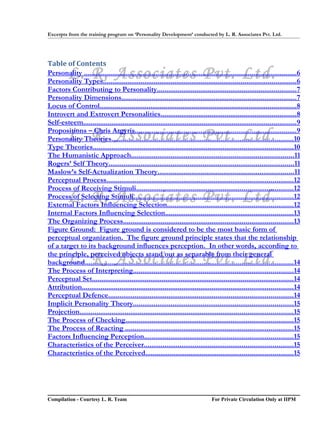
Table of Contents
          L. R. Associates Pvt. Ltd.
Personality .................................................................................................................6
Personality Types......................................................................................................6
Factors Contributing to Personality..........................................................................7
Personality Dimensions.............................................................................................7
Locus of Control........................................................................................................8
Introvert and Extrovert Personalities........................................................................8
Self-esteem.................................................................................................................9

          L. R. Associates Pvt. Ltd.
Propositions – Chris Argyris......................................................................................9
Personality Theories................................................................................................10
Type Theories..........................................................................................................10
The Humanistic Approach......................................................................................11
Rogers’ Self Theory..................................................................................................11
Maslow’s Self-Actualization Theory........................................................................11
Perceptual Process...................................................................................................12
Process of Receiving Stimuli...................................................................................12
          L. R. Associates Pvt. Ltd.
Process of Selecting Stimuli.....................................................................................12
External Factors Influencing Selection...................................................................12
Internal Factors Influencing Selection....................................................................13
The Organizing Process..........................................................................................13
Figure Ground: Figure ground is considered to be the most basic form of
perceptual organization. The figure ground principle states that the relationship
of a target to its background influences perception. In other words, according to

          L. R. Associates Pvt. Ltd.
the principle, perceived objects stand out as separable from their general
background..............................................................................................................14
The Process of Interpreting.....................................................................................14
Perceptual Set...........................................................................................................14
Attribution................................................................................................................14
Perceptual Defence..................................................................................................14
Implicit Personality Theory.....................................................................................15
Projection.................................................................................................................15
The Process of Checking.........................................................................................15
The Process of Reacting .........................................................................................15
Factors Influencing Perception...............................................................................15
Characteristics of the Perceiver...............................................................................15
Characteristics of the Perceived..............................................................................15


Compilation - Courtesy L. R. Team                                                For Private Circulation Only at IIPM
Excerpts from the training program on ‘Personality Development’ conducted by L. R. Associates Pvt. Ltd.
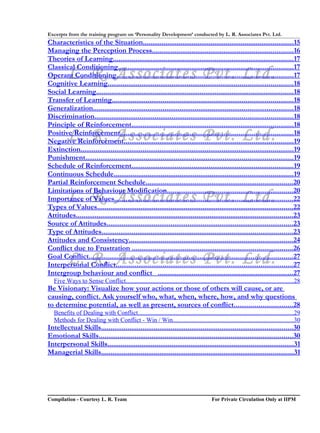
Characteristics of the Situation................................................................................15
Managing the Perception Process...........................................................................16
Theories of Learning................................................................................................17
Classical Conditioning.............................................................................................17
          L. R. Associates Pvt. Ltd.
Operant Conditioning..............................................................................................17
Cognitive Learning..................................................................................................18
Social Learning.........................................................................................................18
Transfer of Learning................................................................................................18
Generalization..........................................................................................................18
Discrimination.........................................................................................................18
Principle of Reinforcement......................................................................................18
          L. R. Associates Pvt. Ltd.
Positive Reinforcement............................................................................................18
Negative Reinforcement..........................................................................................19
Extinction.................................................................................................................19
Punishment..............................................................................................................19
Schedule of Reinforcement......................................................................................19
Continuous Schedule...............................................................................................19
Partial Reinforcement Schedule..............................................................................20
Limitations of Behaviour Modification...................................................................20
          L. R. Associates Pvt. Ltd.
Importance of Values...............................................................................................22
Types of Values........................................................................................................22
Attitudes...................................................................................................................23
Source of Attitudes...................................................................................................23
Type of Attitudes.....................................................................................................23
Attitudes and Consistency.......................................................................................24
Conflict due to Frustration .....................................................................................26
          L. R. Associates Pvt. Ltd.
Goal Conflict............................................................................................................27
Interpersonal Conflict..............................................................................................27
Intergroup behaviour and conflict ........................................................................27
   Five Ways to Sense Conflict...........................................................................................................28
Be Visionary: Visualize how your actions or those of others will cause, or are
causing, conflict. Ask yourself who, what, when, where, how, and why questions
to determine potential, as well as present, sources of conflict...............................28
   Benefits of Dealing with Conflict...................................................................................................29
   Methods for Dealing with Conflict - Win / Win.............................................................................30
Intellectual Skills......................................................................................................30
Emotional Skills.......................................................................................................30
Interpersonal Skills...................................................................................................31
Managerial Skills......................................................................................................31


Compilation - Courtesy L. R. Team                                                         For Private Circulation Only at IIPM
Excerpts from the training program on ‘Personality Development’ conducted by L. R. Associates Pvt. Ltd.
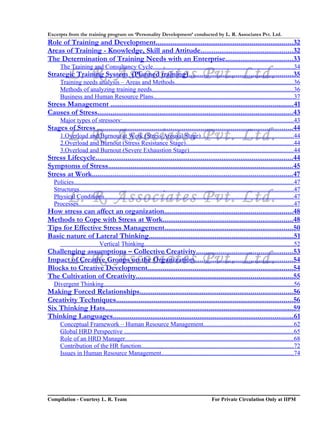
Role of Training and Development.........................................................................32
Areas of Training - Knowledge, Skill and Attitude.................................................32
The Determination of Training Needs with an Enterprise....................................33
      The Training and Consultancy Cycle.........................................................................................34
           L. R. Associates Pvt. Ltd.
Strategic Training System (Planned training).......................................................35
      Training needs analysis – Areas and Methods............................................................................36
      Methods of analyzing training needs..........................................................................................36
      Business and Human Resource Plans.........................................................................................37
Stress Management .................................................................................................41
Causes of Stress........................................................................................................43
      Major types of stressors:.............................................................................................................43
Stages of Stress ........................................................................................................44
           L. R. Associates Pvt. Ltd.
      1.Overload and Burnout at Work (Stress Arousal Stage)...........................................................44
      2.Overload and Burnout (Stress Resistance Stage).....................................................................44
      3.Overload and Burnout (Severe Exhaustion Stage)..................................................................44
Stress Lifecycle.........................................................................................................44
Symptoms of Stress..................................................................................................45
Stress at Work..........................................................................................................47
   Policies............................................................................................................................................47
   Structures........................................................................................................................................47
           L. R. Associates Pvt. Ltd.
   Physical Conditions........................................................................................................................47
   Processes.........................................................................................................................................47
How stress can affect an organization....................................................................48
Methods to Cope with Stress at Work.....................................................................48
Tips for Effective Stress Management....................................................................50
Basic nature of Lateral Thinking.............................................................................51
                              Vertical Thinking...............................................................................................52
Challenging assumptions – Collective Creativity...................................................53
           L. R. Associates Pvt. Ltd.
Impact of Creative Groups on the Organization....................................................54
Blocks to Creative Development.............................................................................54
The Cultivation of Creativity...................................................................................55
   Divergent Thinking.........................................................................................................................56
Making Forced Relationships.................................................................................56
Creativity Techniques..............................................................................................56
Six Thinking Hats....................................................................................................59
Thinking Languages................................................................................................61
      Conceptual Framework – Human Resource Management.........................................................62
      Global HRD Perspective ............................................................................................................65
      Role of an HRD Manager...........................................................................................................68
      Contribution of the HR function.................................................................................................72
      Issues in Human Resource Management....................................................................................74


Compilation - Courtesy L. R. Team                                                                  For Private Circulation Only at IIPM
Excerpts from the training program on ‘Personality Development’ conducted by L. R. Associates Pvt. Ltd.
Areas of Self Development.......................................................................................78
Self-Discipline .........................................................................................................79
Personal Effectiveness.............................................................................................79
Self-Awareness and Personal Effectiveness............................................................79
         L. R. Associates Pvt. Ltd.


         L. R. Associates Pvt. Ltd.


         L. R. Associates Pvt. Ltd.


         L. R. Associates Pvt. Ltd.


Compilation - Courtesy L. R. Team                                              For Private Circulation Only at IIPM
Excerpts from the training program on ‘Personality Development’ conducted by L. R. Associates Pvt. Ltd.


        L. R. Associates Pvt. Ltd.


        L. R. Associates Pvt. Ltd.


        L. R. Associates Pvt. Ltd.


        L. R. Associates Pvt. Ltd.


Compilation - Courtesy L. R. Team                                       For Private Circulation Only at IIPM
Excerpts from the training program on ‘Personality Development’ conducted by L. R. Associates Pvt. Ltd.
Personality
Personality is a concept that we use continuously in our day-to-day routine, when dealing with people.
We talk about people as having a good personality or a bad personality or arrogant and aggressive

        L. R. Associates Pvt. Ltd.
personality. Personality can be reflected in a person’s temperament and is a key factor influencing
individual behaviour in organizations. Often the wrong type of personality of a superior proves
disastrous in terms of worker unrest and protests.
Salvatore Maddi has defined personality as:
“Personality is a stable set of characteristics and tendencies that determine those commonalities and
differences in the psychological behaviour (thoughts, feelings and actions) of people that have
continuity in time and that may not be easily understood as the sole result of the social and biological
pressures of the moment.”
        L. R. Associates Pvt. Ltd.
There are several aspects of this definition that need to be considered. The first aspect is - relative
stability of characteristics. These characteristics account for “consistent patterns” of behaviour.
The second aspect is the “commonalities and differences” in the behaviour of people. We are
interested in understanding as to what an individual has in common with others as well as what sets that
individual apart from others. Every person is in certain aspects,

•   Like all other people
•
•       L. R. Associates Pvt. Ltd.
    Like some other people
    Like no other person

Personality Types
There are two types of individual personality Type A and Type B. A person exhibiting Type A
behaviour is generally restless, impatient with a desire for quick achievement and perfectionism. Type
B is much more easy going relaxed about time pressure, less competitive and more philosophical in
nature. Some of the characteristics of Type A personality are given below.

•
•       L. R. Associates Pvt. Ltd.
    Is restless, so that he always moves, walks and eats rapidly.
    Is impatient with the pace of things, dislikes waiting and is impatient with those who are not
    impatient.
•   Does several things at once.
•   Tries to schedule more and more in less and less time, irrespective of whether everything is done or
    not.
•   Usually does not complete one thing before starting on another.
•   Uses nervous gestures such as clenched fist and banging on table.
•   Does not have time to relax and enjoy life.


Type B behaviour is just the opposite and is more relaxed, sociable and has a balanced outlook on life.
Type A behaviour profile tends to be obsessive and managers with such behaviour are hard driving,
detailed-oriented people with high performance standards.


Compilation - Courtesy L. R. Team                                       For Private Circulation Only at IIPM
Excerpts from the training program on ‘Personality Development’ conducted by L. R. Associates Pvt. Ltd.

Personality traits related to job performance
   • Extraversion
   • Agreeableness

        L. R. Associates Pvt. Ltd.
   • Emotional stability
   • Openness to experience.
Factors Contributing to Personality
According to Maier, “knowledge, skill and language are obviously acquired and represent important
modifications of behaviour. Learned modifications in behaviour are not passed on to children, they
must be acquired by them through their own personal experience.”
The probable consensus is that heredity and environment jointly affect personality development. The

        L. R. Associates Pvt. Ltd.
full potential of a person may or may not be achieved due to environmental constraints and
requirements, but the potential for development, both physically and psychologically is determined by
the complex set of genes.
The factors affecting personality development are illustrated as follows:

    •   Heredity
    •   Culture
    •   Family
    •
    •
    •
        L. R. Associates Pvt. Ltd.
        Environment
        Personality
        Social
    •   Situational

Personality Dimensions

Some of the more important dimensions of personality that are closely linked with interpersonal and
organizational behaviour are discussed as follows:
        L. R. Associates Pvt. Ltd.
Authoritarianism:
Authoritarianism refers to blind acceptance of authority. Authoritarian people believe in obedience and
respect for authority. Because of their beliefs in hierarchical order, they make good followers; work
better under directive supervision and more productive within authoritarian organizational structure.
A closely related term to authoritarians is “dogmatism” which refers to the rigidity of a person’s beliefs.

Bureaucratic Personality:
A bureaucratic person respects for authority is not total and blind, but is based upon respect for
organizational rules and regulations. A bureaucratic person values subordination, rules, conformity,
orderly processes in the organization and impersonal and formal relationships.

Machiavellianism:
Machiavellianism is a term associated with Niccolo Machiavelli, a sixteenth century author who
identified personality profiles of noble men. This personality merges in manipulating others for purely


Compilation - Courtesy L. R. Team                                       For Private Circulation Only at IIPM
Excerpts from the training program on ‘Personality Development’ conducted by L. R. Associates Pvt. Ltd.
personal gains, to gain and keep control of others. People who are Machiavellian types have high self-
confidence and high self-esteem. They are cool and calculating and have no hesitation in using others or
taking advantages of others in order to serve their own goals.


        L. R. Associates Pvt. Ltd.
Problem Solving Style:
Individuals have their own style of making decisions and this style reflects their personality in certain
ways. Some people are very through, meticulous and detail oriented. Others are impulsive and become
easily swayed by what seems to be obvious.
The problem solving style has two dimensions. One is the information gathering and the second
dimension is evaluation of data and taking of decisions. Further, there are two styles involved in
information gathering. One is known as Sensation and the second style known as intuitive style,
The evaluation style also has two dimensions. One style involves more emphasis on feeling while the

        L. R. Associates Pvt. Ltd.
other involves more emphasis on thinking.
When the two dimensions of information gathering and the two dimensions of evaluation are
combined, it results in four problem-solving styles. These are:
1. Sensation-feeling style. These people are dependable, friendly, social and approach facts with
   human concerns. They are pragmatic, methodical and like jobs that involve human contact and
   public relations. Some suitable areas of jobs include teaching customer relations, social workers,
   and sales people.

        L. R. Associates Pvt. Ltd.
2. Sensation-thinking style. They are practical, logical, decisive, and sensitive to details they also
   prefer bureaucratic type organizations. They are not highly skilled in interpersonal relations and are
   more suited to such technical jobs as those of production, accounting, engineering and computer
   programming.
3. Intuition-feeling style. These people are enthusiastic, people oriented, charismatic and helpful.
   Some of the professions suitable for this style are public relations, advertising, politics and
   personnel.
4. Intuition-thinking style. These people are creative, energetic, ingenious, and like jobs that are
   challenging in terms of design and analysis such as system design, law, research and development,
        L. R. Associates Pvt. Ltd.
   top management and so on.
Locus of Control

Locus of control is the extent to which the individuals believes that:
• They control their own lives, or
• External forces control their lives, which are beyond their control.
A person with a strong “internal locus of control” believes that he controls events concerning his own
life and that his internal traits determine what happens in given situation. A person with a strong
“external locus of control” feels that outside forces are affecting the events in his life and he is at the
mercy of destiny, chance or other people. He believes that “whatever will be, will be” and everything
happens by the will of God.

Introvert and Extrovert Personalities


Compilation - Courtesy L. R. Team                                       For Private Circulation Only at IIPM
Excerpts from the training program on ‘Personality Development’ conducted by L. R. Associates Pvt. Ltd.
Introvert persons are basically shy, they prefer to be alone and have difficulty in communicating.
Extroverts are outgoing, objective, and aggressive they also relate well with people.
Self-esteem

         L. R. Associates Pvt. Ltd.
Self-esteem is the degree of respect a person has for himself. Self-esteem is a measure of self-
confidence and respect for one’s abilities and motivation. It is also a higher level need in Maslow’s
model of hierarchical needs. Self-esteem is positively related to assertiveness, independence and
creativity.
The socialization process
    a)   Organizational socialization – values, norms, behavior pattern
    •    Provide a challenging job
    •    Provide relevant training
    •
    •
         L. R. Associates Pvt. Ltd.
         Provide timely and consistent feedback
         Select a good first supervisor to be in charge of socialization
    •    Design a relaxed orientation program
    •    Place new recruits in work groups with high morals


    b) Characteristics of organizational socialization of employees

         L. R. Associates Pvt. Ltd.
       • Change of attitude, values and behaviour.
       • Continuity of socialization over time.
       • Adjustment to new jobs, work groups and organizational practices.
       • Mutual influence between new recruits and managers.
       • Criticality of early socialization period.

Propositions – Chris Argyris
   • There is lack of congruency between the needs of healthy individuals and the demands of the

         L. R. Associates Pvt. Ltd.
      formal organization.
   • The resultant of this disturbance are frustration, failure, short – time perspective and conflict.
   • Under certain conditions the degree of frustration, failure, short – time perspective and conflict
      will tend to increase.
   • The nature of the formal principles of the organization cause the subordinate, at any given level,
      to experience competition, rivalry, inter – subordinate hostility and to develop a focus toward
      the parts rather than the whole.
   • The employee adaptive behaviour maintains self – integration and impedes integration with the
      formal organization.
   • The adaptive behaviour of the employees has a cumulative effect, feedback into the
      organization and reinforces itself.
   • Certain management reactions tend to increase the antagonisms underlying the adaptive
      behaviour.


Compilation - Courtesy L. R. Team                                       For Private Circulation Only at IIPM
Excerpts from the training program on ‘Personality Development’ conducted by L. R. Associates Pvt. Ltd.
    •   Other management actions can decrease the degree of incongruence between the individual and
        formal organization.
    •   Job or role enlargement and employee – centred leadership will not tend to work to the extent
        that the adaptive behaviour (propositions III, IV, V and VI) has embedded in organizational

    •
        L. R. Associates Pvt. Ltd.
        culture and the self – concept of the individual.
        The difficulties involved in proposition IX may be minimized by the use of reality oriented
        leadership.
Personality Theories
There are several theories but the more prominent among them are: (i) type, (ii) trait,                   (iii)
psychoanalytic, (iv) social learning and (v) humanistic.
Type Theories

        L. R. Associates Pvt. Ltd.
Type theories place personalities into clearly identifiable categories. Kretschmer and Sheldon are
credited with this classification. In type theories relationship was sought to be established between
features of face or body and personality. Thus, a short, plumb person (endomorph) was said to be
sociable, relaxed, and even tempered; a tall, thin person (ectomorph) was characterized as restrained,
self conscious, and fond of solitude; a heavy set muscular individual (mesomorph) was described as
noisy, callous, and found of physical activity. Although a person’s physique may have some influence
on personality, the relationship is much more subtle than this sort of classification implies. Thus
classification of personalities on body basis is subjective.
The second basis to type personalities is psychological factors. Carl Jung, divided all personalities into
        L. R. Associates Pvt. Ltd.
introverts and extroverts. These terms are normally associated with an individual’s sociability and
interpersonal orientation. Extroverts are gregarious, sociable individuals, while introverts are shy, quiet
and retiring.
Trait Theories
Trait theorists assume that a personality can be described by its position on a number of continuous
dimensions or scales, each of which represents a trait. Thus, we could rate an individual on a scale of
intelligence, emotional stability, aggressiveness, creativeness, or any of a number of other dimensions.

        L. R. Associates Pvt. Ltd.
Psychologists working in an area of trait theory are concerned with (a) determining the basic traits that
provide a meaningful description of personality, and (b) finding some way to measure them.
Psychoanalytic theory is based on the in-depth study of individual personalities.
Social Learning Theory
There are two ways of learning : Learning through reinforcement – direct experience and learning by
observing others, also called vicarious learning. For social learning theorists reinforcement is not always
necessary for learning. They believe that since an individual can make use of complex symbolic
processes to code and store his observations in memory, he can learn by observing the actions of others
and by noting the consequences of those actions.
Some of the person variables that determine what an individual will do in a particular situation include
the following :
    • Competencies
    • Cognitive strategies
    • Outcome expectations


Compilation - Courtesy L. R. Team                                       For Private Circulation Only at IIPM
Excerpts from the training program on ‘Personality Development’ conducted by L. R. Associates Pvt. Ltd.
    •   Subjective value outcome
    •   Self regulatory systems and plans
The Humanistic Approach

        L. R. Associates Pvt. Ltd.
The humanistic approach to the study of personality includes number of theories, although different in
some respects, share a common emphasis on man’s potential for self direction and freedom of choice.
Carl Rogers and Abraham Maslow are credited with the humanistic theory of personality.
Rogers’ Self Theory
Roger’s approach to personality is described as phenomenological. For Rogers, behaviour is utterly
dependent upon how one perceives the world – that is, behaviour is the result of immediate events as
they are actually perceived and interpreted by the individual. Such an approach to personality
emphasizes the self and its characteristics. Indeed, this theory is often, referred to as self theory of
personality because the best vantage point for understanding behaviour is from the internal frame of
        L. R. Associates Pvt. Ltd.
reference of the individual himself.
Maslow’s Self-Actualization Theory
Abraham Maslow is regarded as the spiritual father of humanism in American psychology. Humanistic
psychology of Maslow radically differs from psychoanalytic and learning or behaviouristic theories.
Humanistic psychology of Maslow, on the other hand, postulates man as a self-actualizer. By self-
actualization Maslow meant the development of full individually, with all parts of the personality in
harmony.


        L. R. Associates Pvt. Ltd.
Existential philosophy is concerned with man as an individual and each person alone is responsible for
his own existence. This drive of man, which is inherent in him, is called self-actualization.

* Also refer to “Personality Theories – Ziegler” for Freud’s Personality theory


        L. R. Associates Pvt. Ltd.


Compilation - Courtesy L. R. Team                                       For Private Circulation Only at IIPM
Excerpts from the training program on ‘Personality Development’ conducted by L. R. Associates Pvt. Ltd.
Perception
“If everyone perceived everything the same way, things would be a lot simpler”
                                                                       -Moorhead & Griffin

        L. R. Associates Pvt. Ltd.
In its simple sense perception is understood as the act of seeing what is there to be seen. But the
perceiver, the object, and the environment influence what is seen. The meaning of perception will be
complete when all the three aspects are stressed. A few definitions of perception are given below:
     “Perception can be defined as a process by which individuals organize and interpret their sensory
    impressions in order to give meaning to their environments.”
    “Perception includes all those processes by which an individual receives information about his
    environment – seeing, hearing, feeling, tasting, and smelling. The study of these perceptional

        L. R. Associates Pvt. Ltd.
    processes shows that their functioning is affected by three classes of variables – the objects or
    events being perceived, the environment in which perception occurs, and the individuals doing the
    perceiving.”
Perceptual Process
Perception, as revealed by the definitions, is composed of six processes, viz., receiving, selecting,
organizing, interpreting, checking, and reacting to stimuli. These processes are influenced by the
perceived and the situation.
Process of Receiving Stimuli
        L. R. Associates Pvt. Ltd.
The human organism is structured with five sensory organs, viz., vision, hearing, smell, touch and
tasting. There is the sixth sense about which much is speculated and nothing is known. We receive
stimuli through the organs. Secondary organs receive not only physical objects; they receive events or
objects that have been repressed. We may not be able to report the existence of certain stimuli but our
behaviour reveals that we are often subject to their influence. Similarly, stimuli need not be external to
us. They may be inside also.
Process of Selecting Stimuli
Myriad of stimuli seemingly clamour for our attention at any given time. We need to filter or screen out
        L. R. Associates Pvt. Ltd.
most of them so that we may deal with the important or relevant ones. Two sets of factors govern the
selection of stimuli: external and internal.
External Factors Influencing Selection
The external factors influencing selection are:
Nature: By nature we mean, whether the object is visual or auditory, and whether it involves pictures,
people or animals.
Location: The best location of a visual stimulus for attracting attention is directly in the front of the
eyes in the center of a page. When this location is not possible in a newspaper or a magazine, a position
in the upper portion of a page in more favourable than one in the lower portions, and the left hand side
receives more attention than the right hand side.
Intensity: Stimuli of higher intensity are perceived more than the objects with low intensity. A loud
noise, strong odour, or bright light will be noticed more than a soft sound, weak odour, or dim light.


Compilation - Courtesy L. R. Team                                       For Private Circulation Only at IIPM
Excerpts from the training program on ‘Personality Development’ conducted by L. R. Associates Pvt. Ltd.
Size: Generally objects of larger size attract more attention than the smaller ones. The maintenance
engineering staff may pay more attention to a big machine than to a small one, even though the smaller
one costs as much and as important to the operation.
Contrast: The contrast principle states that external stimuli which stand out against the background, or
        L. R. Associates Pvt. Ltd.
which are not what people are expecting, will receive their attention.
Movement: The principle of motion states that a moving object receives more attention than an
object that is standing still.
Repetition: The repetition principle states that a repeated external stimulus is more attention drawing
than a single one.
Novelty and Familiarity: The novelty and familiarity principle states that either a novel or a familiar
external situation can serve as an attention getter. New objects in familiar settings or familiar objects in
        L. R. Associates Pvt. Ltd.
new setting will draw the attention of the perceiver.

Internal Factors Influencing Selection
Internal factors influencing selection of stimuli include learning, psychological needs, age differences,
interests, ambivalence, and paranoid perception. These factors relate to oneself.
Learning: Learning, a cognitive factor, has considerable influence on perception.                   It creates
expectancy in people. People tend to perceive what they want to perceive.
Psychological Needs: Needs play a significant role in perceptual selectivity. Unreal things often look
        L. R. Associates Pvt. Ltd.
real because of deprived needs.
Age Difference: Older senior executives complain about the inability of the new young to take tough
decisions concerning terminating or resigning people and paying attention to details and paper work.
The young managers in turn complain about the “old guards” resisting change and using paper and
rules as ends in themselves. Different perceptions of old and young executives are due to their age
differences perceptions.
Interest: The interests of the perceiver unconsciously influence perception. An architect will notice

        L. R. Associates Pvt. Ltd.
many details of buildings that he passes only once. It has been argued that, in their influence on
perception, interests cannot be distinguished from needs. That is, the person with a particular interest
has a need to involve himself in activities pertaining to it. Yet there is some value in conceiving the two
as distinct. Once they have been satisfied, most needs no longer influence perception. But if the
person has a special interest, his perception is likely to be selective at any time.
Ambivalence:      Another factor in perceptual selection is ambivalence or mixed feelings about a
situation.
Paranoid Perception: When the person’s perception is so selective that he can find little common
ground for communication with others, he is likely to be paranoid.

The Organizing Process
The perceptual selection related to the discussion of external and Internal factors which helped gain the
perceiver’s attention. This aspect of forming bits of information into meaningful wholes is called the


Compilation - Courtesy L. R. Team                                       For Private Circulation Only at IIPM
Excerpts from the training program on ‘Personality Development’ conducted by L. R. Associates Pvt. Ltd.
perceptual organization. There are three dimensions to the perceptual organization, viz., figure ground,
perceptual grouping, and perceptual constancy.
Figure Ground: Figure ground is considered to be the most basic form of perceptual organization.
The figure ground principle states that the relationship of a target to its background influences
        L. R. Associates Pvt. Ltd.
perception. In other words, according to the principle, perceived objects stand out as separable from
their general background.
Perceptual Grouping: The principles of grouping first defined by gestalt psychologists include
similarity, proximity, closure, and continuity.
Perceptual Constancy: A more subtle part of perceptual organization is constancy, our ability to
perceive certain characteristics of an object as remaining constant, despite variations in the stimuli that
provide us with our information. Such constancy amidst changing stimuli is indispensable if we are to

        L. R. Associates Pvt. Ltd.
adjust to our world. There are several aspects of constancy such as shape, size, colour.
The Process of Interpreting
After the data have been received and organized, the perceiver interprets or assigns meaning to the
information. In fact, perception is said to have taken place only after the data have been interpreted.
Several factors contribute towards what has been interpreted. More important amongst them are
Perceptual Set
Previously held beliefs about objects influence an individual’s perceptions of similar objects. This is
called perceptual set.

        L. R. Associates Pvt. Ltd.
Attribution
Attribution refers to the process by which the individual assigns causes to the behaviour he conceives.
There are critics who argue that perceptual distortion occurs because of attribution. As too much credit
or blame for behaviour is placed on persons rather than on environment.
Factors such as status, intentions, and consequences influence the attribution process.
Stereotyping
Stereotyping is the tendency for a person’s perceptions of another to be influenced by the social group
to which the others belong. In perceiving another, a person is likely to categories the other according
        L. R. Associates Pvt. Ltd.
to some silent characteristic such as sex, race, religion, nationality, occupation, or organizational
affiliation. The individual’s experiences with others in the category in which he has placed them lead
him to believe that they have certain traits in common. Thus, he is ready to perceive the other as
possessing the same trait.
Halo Effect
The halo effect refers to the tendency of perceiving people in terms of good and bad, and ascribing all
good qualities to one who is liked and all bad qualities to another who is disliked.
Perceptual Context
The context in which an object is placed influences perception. The visual stimuli by themselves are
meaningless. Only when the doodles are placed in a verbal context do they take on meaning and value
to the perceiver.
Perceptual Defence
According to the principle of perceptual defence, an individual is likely to put a defence when
confronted with conflicting, unacceptable or threatening stimuli. The defence mechanisms put up by


Compilation - Courtesy L. R. Team                                       For Private Circulation Only at IIPM
Excerpts from the training program on ‘Personality Development’ conducted by L. R. Associates Pvt. Ltd.
the perceiver may assume any of the four forms: outright denial, modification of the data received,
change in perception but refusal to change, and change in perception itself.
Implicit Personality Theory

        L. R. Associates Pvt. Ltd.
In judging and making inferences about others, an individual’s perceptions are influenced by his belief
that certain human traits are associated, with one another.
Projection
Under certain conditions, people tend to see in another person traits that they themselves posses. That
is, they project their own feelings, tendencies, or motives into their judgement of others. This may be
particularly true regarding undesirable traits, which the perceiver possesses but fails to recognize
himself.
The Process of Checking

        L. R. Associates Pvt. Ltd.
After data have been received and interpreted, the perceiver tends to check whether his interpretations
are right or wrong. One way of checking is for the person himself to indulge in introspection. He will
put a series of questions to himself and the answers will confirm whether his perception about an
individual or object is correct or not. Another way is to check the veracity about the interpretation with
others.
The Process of Reacting
The last phase in perception is the reaction. The perceiver shall indulge in some action in relation to his
perception. The action depends on whether the perception is favorable or unfavorable. The action is

        L. R. Associates Pvt. Ltd.
positive when the perception is favourable. It is negative when the perception is unfavourable.
Factors Influencing Perception
The perceiver, the perceived and situation are some of the factors that influence perception.
Characteristics of the Perceiver
A perceiver needs to have, past experience, habits, personality, values, and attitudes, which may
influence the perception process. He should be someone with a strong need for ego satisfaction.
Characteristics of the Perceived
The physical attributes, appearance, and behaviour of persons in the situation also influence how a
        L. R. Associates Pvt. Ltd.
situation is perceived. We tend to notice the physical attributes of a person in terms of age, sex, height,
and weight.
Characteristics of the Situation
The physical, social and organizational settings of the situation or event in question can influence
perceptions.
Perception and Organizational Behaviour
In an interview for the selection of a candidate, the interviewers’ judgement about the suitability or
otherwise of a candidate depends on how his behaviour is perceived by them. A rejected applicant
might feel that he was wronged by the interview though he deserved selection. But the fact is that
interviewers generally form an early impression that becomes quickly entrenched. If the inadequacies of
the candidate are exposed early, they weigh against him in the final selection
Specific applications in organization


Compilation - Courtesy L. R. Team                                       For Private Circulation Only at IIPM
Excerpts from the training program on ‘Personality Development’ conducted by L. R. Associates Pvt. Ltd.
    •   Employment interview
    •   Performance expectations
    •   Performance evaluation
    •   Employee effort
    •   L. R. Associates Pvt. Ltd.
        Employee loyalty
Managing the Perception Process
•   Have a high level of self-awareness.
•   Seek information from various sources to confirm or disconfirm personal impressions of a decision
    situation.
•   Be empathetic – that is, be able to see a situation, as others perceive it.
•   Influence of perceptions of other people when they are drawing incorrect or incomplete

•
        L. R. Associates Pvt. Ltd.
    impressions of events in the work setting.
    Avoid common perceptual distortions that biased in our view of people and situations.
•   Avoid inappropriate attributions.
Reasons why a person misperceives – Zalkind and Costello
   • You are influenced by cues below your own threshold i.e., the cues you don’t know you
      perceived
   • You respond to irrelevant cues to arrive at a judgment.

        L. R. Associates Pvt. Ltd.
   • You are influenced by emotional factors, i.e., what is liked is perceived as correct.
   • You weigh perceptual evidence heavily if it comes from respectable sources.
   • You are not able to identify all factors, i.e., not realizing how much weight is given to a single
      item.


        L. R. Associates Pvt. Ltd.


Compilation - Courtesy L. R. Team                                       For Private Circulation Only at IIPM
Excerpts from the training program on ‘Personality Development’ conducted by L. R. Associates Pvt. Ltd.


LearningL. R. Associates Pvt. Ltd.
“ You cannot teach a man anything. You can only help him discover it within himself.”
                                                                            - Galileo
Learning can be defined as a “relatively permanent change in behaviour or potential behaviour as a
result of direct or indirect experience”. There are two primary elements in this definition that must
both be present in order to identify the process of learning. First is the element that the change must

        L. R. Associates Pvt. Ltd.
be relatively permanent. This means that after “learning” our behaviour must be different, either better
or worse as compared to our behaviour prior to this experience of learning.
The second aspect of the definition is that this change must occur due to some kind of experience or
practice. This learning is not caused by biological maturation.

Theories of Learning
There are four general approaches to learning – classical conditioning, operant conditioning, cognitive
learning and social learning.
        L. R. Associates Pvt. Ltd.
Classical Conditioning
The most well known experiments on classical conditioning were undoubtedly conducted by I.P.
Pavlov with dogs, and he established a Stimulus-Response (S-R) connection. This means that certain
responses can be predicted which continuously result from certain induced stimuli.
Classical conditioning introduces a simple cause-and-effect relationship between one stimulus and one
response. It also makes the response reflexive or involuntary after the stimulus-response relationship
has been established. This leaves no ground for making choices, which differentiates human beings
        L. R. Associates Pvt. Ltd.
from dogs. Under certain situations classical conditioning does explain human behaviour.

Operant Conditioning
Operant conditioning induces a voluntary change in behaviour and learning occurs as a “consequence”
of such change. It is also known as reinforcement theory and it suggests that behaviour is a function of
its consequences. It is based upon the premise that behaviour or job performance is not a function of
inner thoughts, feelings, emotions or perceptions but is keyed to the nature of the outcome of such
behaviour. This relationship is built around two principles. First, that behaviour which results in
positive rewards tends to be repeated and behaviour with negative consequences tends not to be
repeated. Second, based upon such consequences, the behavior can be predicted and controlled.
Hence, certain types of consequences can be used to increase the occurrence of a desired behaviour and
other types of consequences can be used to decrease the occurrence of undesired behaviour.
From an organizational point of view, any stimulus from the work environment will elicit a response.


Compilation - Courtesy L. R. Team                                       For Private Circulation Only at IIPM
Excerpts from the training program on ‘Personality Development’ conducted by L. R. Associates Pvt. Ltd.
Cognitive Learning
Learning is considered as the outcome of deliberate thinking about the problem or situation both
intuitively and based upon known facts and responding in an objective and goal oriented manner.

        L. R. Associates Pvt. Ltd.
Cognition, in fact, is the act of knowing an item of information and this knowledge affects the
behaviour of the person so that the information provides cognitive cues towards the expected goal.

Social Learning
It is recognized that learning does not take place only because of environmental stimuli (classical and
operant conditioning) or of individual determinism (cognitive approach) but is a blend of both views.
It also emphasizes that people acquire new behaviour by observing or imitating others in a social
setting. In addition learning can also be gained by discipline and self-control and an inner desire to
acquire knowledge or skills irrespective of the external rewards or consequences. This process of self-
        L. R. Associates Pvt. Ltd.
control is also partially a reflection of societal and cultural influences on the development and growth of
human beings.

Transfer of Learning

Berelson and Steiner suggested that learning can be transferred from one situation to another and the
extent of such transfer is a function of the extent of similarity in the stimulus or response. If a person
experiences a similar situation that he dealt with before, then some of his previous experience would be
transferred to the new situation and his learning time in the new situation would be considerably
        L. R. Associates Pvt. Ltd.
decreased.
There are two concepts that help in explaining the transfer of learning. These are as follows:


Generalization
No two situations are exactly alike. However, responses to certain situations can be applied to similar
but different situations. Because of the principle of generalization, the individual can adjust to new
learning situations more smoothly because of the previous learning experiences.
        L. R. Associates Pvt. Ltd.
Discrimination
While generalization is a reaction to “similarities” of stimuli or responses, discrimination is the ability to
differentiate between relatively similar stimuli where generalization would yield negative consequences.

Principle of Reinforcement
Reinforcement is the process by which certain types of behaviours are strengthened. Thus a
“reinforcer” is any stimulus that causes certain behaviour to be repeated or inhibited. Some reinforcers
work by their application to a situation, while other reinforcers work by their removal from the
situation. Thus these reinforcers work as behaviour modifiers.

Positive Reinforcement


Compilation - Courtesy L. R. Team                                       For Private Circulation Only at IIPM
Excerpts from the training program on ‘Personality Development’ conducted by L. R. Associates Pvt. Ltd.
A positive reinforcement is a reward for a desired behaviour. The reward should be sufficiently
powerful and durable so that it increases the probability of occurrence of desirable behaviour. Money is
probably the most powerful reinforcement for positive behaviour, since money can be used for a
number of other resources too.

        L. R. Associates Pvt. Ltd.
Negative Reinforcement

Also known as “escape conditioning” or “avoidance learning”, it is also a method of strengthening
desired behaviour. However, unlike the positive reinforcement where an employee works hard to gain
financial and other rewards, under avoidance conditioning, the employee works hard to avoid
repercussion, reprimand and other negative aspects of the organizational environment.


        L. R. Associates Pvt. Ltd.
Extinction

This type of reinforcement is applied to reduce undesirable ‘behaviour, especially when such behaviours
were previously rewarded. This means that if rewards were removed from behaviours that were
previously reinforced, then such behaviours would become less frequent and eventually die out. The

        L. R. Associates Pvt. Ltd.
method involved is a suitable form of punishment in the form of withholding the positive enforcement
or simply ignoring the undesirable behaviour.

Punishment

Punishment is the most controversial method of behaviour modification and involves delivering an
unpleasant consequence contingent upon the occurrence of an undesirable behaviour. The punishment
process is similar to the extinction process in that both have the effect of decreasing and eliminating the
undesirable behaviour, but technically there is a difference. In the extinction process, we withhold

        L. R. Associates Pvt. Ltd.
rewards for behaviour that has previously been rewarded because the behaviour was not undesirable
previously. The punishment process, on the other hand consists of “application” of an undesirable
consequence or “withdrawal” of a desirable consequence for an undesirable behaviour, which has never
been associated with the reward before.

Schedule of Reinforcement

While it is necessary to know as to which type of reinforcement would be most effective in a given
situation, it is equally important to examine the various ways or “schedules” of administering these
techniques of reinforcement. The various ways by which the reinforcement can be administered can be
categorized into two groups. These are continuous and partial reinforcement schedules.

Continuous Schedule

A continuous schedule is the one in which the desirable behaviour is reinforced every time it occurs and
the reinforcement is immediate. This results in fast acquisition of the desired response and the learning


Compilation - Courtesy L. R. Team                                       For Private Circulation Only at IIPM
Excerpts from the training program on ‘Personality Development’ conducted by L. R. Associates Pvt. Ltd.
is rapid. However the behaviour learned by continuous reinforcement strategy tends not to persist for
which such reinforcement is applied less frequently.

Partial Reinforcement Schedule

        L. R. Associates Pvt. Ltd.
A partial reinforcement schedule rewards desirable behaviour at specific intervals. It is believed that
“behaviour tends to be persistent when it is learned under conditions of partial and delayed
reinforcement. There are four kinds of partial reinforcement schedules. There are:
1. Fixed Interval Schedule
In this type of schedule, a response is reinforced at fixed intervals of time.
2. Variable Interval Schedule
In this type of schedule, the reinforcement is administered at random times that cannot be predicted by

        L. R. Associates Pvt. Ltd.
the employee.
3. Fixed-ratio Schedules
In a fixed-ratio schedule, the reinforcement is administered only upon the completion of a given
number of desirable responses.
4. Variable-ratio Schedule
It is similar to fixed-ratio schedule except that the number of responses required before reinforcement
is determined, are not fixed but vary from situation to situation.

        L. R. Associates Pvt. Ltd.
Limitations of Behaviour Modification
While in general, some of the behavioural modification techniques, as discussed previously are effective
in eliciting desirable behaviours from employees in work situations, there are some limitations that
make these techniques ineffective in certain situations.
    1) Behaviour modification is an overall structure and ignores individual differences.,
    2) Behaviour modification programs assume that extrinsic rewards are the key factors in behaviour
         modification and they ignore the fact that employees can be intrinsically motivated.
    3) Behaviour modification is that it ignores prevailing work-group norms. It is important for the
        L. R. Associates Pvt. Ltd.
         management to recognize the power of work-group norms.

The simple rules of leaning are:

            1. The capacities of learners are important in determining what can be learned and how
               long will it take to learn it.
            2. The order of presentation of materials to be learned is very important.
            3. Showing errors is how to do something can lead to increase in learning.
            4. The rate of forgetting tends to be very rapid immediately after learning.
            5. Repetition of identical materials is often as effective in getting things remembered as
               repeating the same story but with variations.
            6. Knowledge of results leads to increase in learning.
            7. Learning is aided by active practice rather than passive reception
            8. A passage is more easily learned and accepted if it does not interfere with earlier habits.


Compilation - Courtesy L. R. Team                                       For Private Circulation Only at IIPM
Excerpts from the training program on ‘Personality Development’ conducted by L. R. Associates Pvt. Ltd.
            9. The mere repetition of a situation does not necessarily lead to learning. Two things are
                necessary – “belongingness” and “satisfaction”.
            10. Learning something new can interfere with the remembering of something learned
                earlier.

         L. R. Associates Pvt. Ltd.


         L. R. Associates Pvt. Ltd.


         L. R. Associates Pvt. Ltd.
Values, Attitudes and Interest
“When you prevent me from doing anything I want to do, that is persecution; but when I prevent you

         L. R. Associates Pvt. Ltd.
from doing anything you want to do, that is law, order and morals.”
                                                                         - George Bernard Shaw

Values

Is capital punishment right or wrong? The answer to this question is value laden. Some might argue,
for example, that capital punishment is right because it is an appropriate retribution for crimes like
murder or treason. However, others may argue, just as strongly, that no government has the right to
take anyone’s life.

Values represent basic convictions that “a specific mode of conduct or end-state of existence is
personally or socially preferable to an opposite or converse mode of conduct or end-state of existence.”
They contain a moral flavor in that they carry an individual’s ideas as to what is right, good, or desirable.
Value systems represent a prioritizing of individual values in relation to their relative importance. In
other words, we all have a set of values that form a value system. This system is identified by the


Compilation - Courtesy L. R. Team                                       For Private Circulation Only at IIPM
Excerpts from the training program on ‘Personality Development’ conducted by L. R. Associates Pvt. Ltd.
relative importance we assign to such values as freedom, pleasure, self-respect, honesty, obedience,
equality, and so forth. We all have values and, as you will see, what we think is important influences
our attitudes and our behaviour.


        L. R. Associates Pvt. Ltd.
Importance of Values

Values are important to the study of organizational behaviour because they lay the foundation for the
understanding of attitudes, perceptions, personality, and motivations. Individuals enter an organization
with preconceived notions of what “ought” and what “ought not” to be. Of course, these notions are
not value-free. On the contrary, they contain interpretations of right and wrong. Further, they imply
that certain behaviours or outcomes are preferred over others.


        L. R. Associates Pvt. Ltd.
Types of Values

The most important early work in categorizing values was done by All-port and his associates. They
identified six types of values:

1.   Theoretical – Places high importance on the discovery of truth through a critical and rational
     approach.
2.
3.
        L. R. Associates Pvt. Ltd.
     Economic – Emphasizes the usefulness and practicality of the situation.
     Aesthetic – It places the highest value on form and harmony.
4.   Social – Here the highest value is given to the love of people.
5.   Political – It places emphasis on acquisition of power and influence.
6.   Religious – It is concerned with the unity of experience and understanding of the cosmos as a
     whole.

More recent research suggests that there is a hierarchy of levels that are descriptive of personal values

        L. R. Associates Pvt. Ltd.
and life-styles. One such study identified seven levels.

Level 1. Reactive. These individuals are unaware of themselves or others as human beings and react
to basic physiological needs. This is most descriptive of newborn babies.

Level 2. Tribalistic. These individuals are characterized by high dependence. They are strongly
influenced by tradition and the power exerted by authority figures.
Level 3. Egocentrism. These persons believe in rugged individualism. They are aggressive and selfish.
They respond primarily to power.

Level 4. Conformity. These individuals have a low tolerance for ambiguity, have difficulty in
accepting people whose values differ from their own, and desire that others accept their values.

Level 5. Manipulative. These individuals are characterized by striving to achieve their goals by
manipulating things and people. They are materialistic and actively seek higher status and recognition.


Compilation - Courtesy L. R. Team                                       For Private Circulation Only at IIPM
Excerpts from the training program on ‘Personality Development’ conducted by L. R. Associates Pvt. Ltd.

Level 6. Sociocentric. These individuals are characterized by striving to achieve their goals by
manipulating things and people. They are materialistic and actively seek higher status and recognition.


        L. R. Associates Pvt. Ltd.
Level 7. Existential. These individuals have a high tolerance for ambiguity and people with differing
values. They are outspoken on inflexible systems, restrictive policies, status symbols, and arbitrary use
of authority.


Attitudes

Attitudes are evaluative statements – either favourable or unfavourable – concerning objects, people, or
events. They reflect how one feels about something. When I say “I like my job,” I am expressing my
        L. R. Associates Pvt. Ltd.
attitude about work.

Attitudes are not the same as values. Values are the broader and more encompassing concept. So
attitudes are more specific than values. Values also contain a moral flavor of rightness or desirability.
The statement that “discrimination is bad” reflects one’s values. “I favor the implementation of an
affirmative action program to recruit and develop women for managerial positions in our organization”
is an attitude.

Source of Attitudes
        L. R. Associates Pvt. Ltd.
Attitudes, like values, are acquired from parents, teachers, and peer group members. In our early years,
we begin modeling our attitudes after those we admire, respect or may be even fear. We observe the
way family and friends behave and we shape our attitudes and behaviour to align with theirs. People
imitate the attitudes of popular individuals or those they admire and respect. In organizations, attitudes
are important because they affect job behaviour.

Type of Attitudes

        L. R. Associates Pvt. Ltd.
But OB focuses our attention on a very limited number of job-related attitudes. These job-related
attitudes tap positive or negative evaluations that employees hold about aspects of their work
environment. Typically, there are three primary attitudes that are of concerned to us i.e. job
satisfaction, job involvement, and organizational commitment.

Job satisfaction refers to an individual’s general attitudes toward his or her job. A person with a high
level of job satisfaction holds positive attitudes toward the job, while a person who is dissatisfied with
his or her job holds negative attitudes about the job. When people speak of employee attitudes, more
often then they mean job satisfaction. In fact, the two are frequently used interchangeably.

The term “job involvement” states that job involvement measures the degree to which a person
identifies with his job, actively participates in it, and considers his performance important to his self-
worth.


Compilation - Courtesy L. R. Team                                       For Private Circulation Only at IIPM
Excerpts from the training program on ‘Personality Development’ conducted by L. R. Associates Pvt. Ltd.
Organizational commitment expresses an individual’s orientation toward the organization by tapping
his or her loyalty to, identification with, and involvement in the organization. Individuals who express
high commitment see their identity as closely attached to that of the organizations.


            L. R. Associates Pvt. Ltd.
Attitudes and Consistency

People seek consistency among their attitudes and between their attitudes and behaviour. This means
that individuals seek to reconcile divergent attitudes and align their attitudes and behaviour so they
appear rational and consistent. When there is an inconsistency, forces are initiated to return the
individual to an equilibrium state where attitudes and behaviour are again consistent.

Changing attitudes: Some basic techniques


   i)       L. R. Associates Pvt. Ltd.
a) Persuasive messages: Hearing sometimes is believing
          Comunicator’s Characteristics
       • Attractiveness
       • Style
       • Credibility
   ii)    Content of persuasive message
       • Receiver’s characteristics
       • Intelligence

            L. R. Associates Pvt. Ltd.
       • Self – esteem/ confidence


     iii)    Enhance persuasion
         • Build personal attractiveness
         • Enhance credibility
         • Use social pressure
         • Design appeal with care

b)
c)
            L. R. Associates Pvt. Ltd.
         • Repetition can always help
     Dissonance: when attitude and behaviour don’t match
     Providing new information
d)   Use of fear
e)   Influence of family, friends and peers
f)   Barriers to changing attitudes


Interest

You are driving your automobile, and the continued roar it makes does not hold or divert or attract
your attention. But presently a new element, perhaps of relatively low intensity, enters into the complex
stimulation, and your attention is at once attracted; you notice the new sound and begin to wonder
what it means; while your friend by your side, who perhaps is a familiar with the roar as yourself, fails to
notice the new element, even when you ask him to direct his attention to it. The difference between


Compilation - Courtesy L. R. Team                                       For Private Circulation Only at IIPM
Excerpts from the training program on ‘Personality Development’ conducted by L. R. Associates Pvt. Ltd.
you (manifested in the fact that your attention is drawn to the sound, while his is not) is that you are
“interested” in the sounds made by the automobile and he is not.

It is sometimes alleged that “interest” in any object or topic depends upon, or consists in, the

        L. R. Associates Pvt. Ltd.
possession of appropriate knowledge or (in terms of the “idea” theory) of mass or system of “ideas”
related to the object or topic.

We are interested only in those things that evoke in us one or other (or several) of the instinctive
impulses. We acquire a great variety of new interests through the building up of sentiments for a great
variety of objects. “Interest,” being essentially conative, is a matter of the enduring setting of our
conative tendencies or impulses, and is therefore determined by our instincts and our sentiments.
Knowledge about an object is not in itself a condition of “interest”; though such knowledge favours
thus sustaining attention: without such knowledge our attention to any object, determined by conative

        L. R. Associates Pvt. Ltd.
interest, soon wanes; because we quickly exhaust upon it our limited power of discriminative
perception. Thus a naturalist and a layman may discover some strange plant or animal; it excites the
curiosity of both, and both are interested in it; but the attention of the naturalist is more sustained, as
well as more effective; for he has the knowledge, or cognitive mental structure, that enables him to
examine it systematically and in detail, noticing a hundred features which entirely escape his companies.

That “interest” is conative rather than cognitive; that it depends upon the strength of the conative
tendencies excited, rather than upon the extent and variety and systematic organization of the cognitive
systems of the mind ( knowledge).
        L. R. Associates Pvt. Ltd.
To have an “interest” in any object is, then, to be ready to pay attention to it. Interest is latent
attention; and attention is interest in action. The essential condition of both interest in and attention to
any object is that the mind shall be so organized, either natively or through experience, that is can think
of the object, and that such thinking shall evoke some impulse or desire which maintains a train of
activity in relation to the object.


        L. R. Associates Pvt. Ltd.


Compilation - Courtesy L. R. Team                                       For Private Circulation Only at IIPM
Excerpts from the training program on ‘Personality Development’ conducted by L. R. Associates Pvt. Ltd.


Conflict
        L. R. Associates Pvt. Ltd.
Part of my job is to keep the five guys who hate me away from the five guys who are undecided.

                                                                                   -   Casey Stengel


We define conflict to be a process in which an effort is purposely made by A to offset the efforts of B
by some form of blocking that will result in frustrating B in attaining his goals or furthering his

        L. R. Associates Pvt. Ltd.
interests.

Conflict: An Inevitable Product of Change
In its simplest term, conflict is no more than a by – product of growth, change, or innovation. And like
change itself, it’s practically inevitable. But it’s also something that, when handled correctly can actually
promote better communication, guarantee achieving desired results, and improve employee morale and
productivity.
Conflict can be defined as: “Conflict is a set of divergent behaviours, aims, or methods.”


        L. R. Associates Pvt. Ltd.
Types Of Conflict

Intra-individual Conflict

Within every individual there are
• A number of competing needs and roles,
• A variety of ways that drives and roles can be expressed,
• Many types of barriers that can occur between the drive and the goal, and

        L. R. Associates Pvt. Ltd.
• Both positive and negative aspects attached to desired goals.


Conflict due to Frustration

Frustration occurs when a motivated drive is blocked before a person reaches a desired goal. The
barrier may be overt (outward, or physical) or covert (inward, or mental – sociopsychological).
Traditionally, psychologists felt that frustration always led to the defense mechanism of aggression.
Frustration may lead to any of the defense mechanism used by the human organism. Although there are
many such mechanism, they can be grouped according to four broad categories: aggression, withdrawal,


Compilation - Courtesy L. R. Team                                       For Private Circulation Only at IIPM
Excerpts from the training program on ‘Personality Development’ conducted by L. R. Associates Pvt. Ltd.
fixation and compromise. The frustration model can be useful in the analysis not only of behaviour in
general but also the specific aspects of on – the – job behaviour.

Goal Conflict

        L. R. Associates Pvt. Ltd.
Another common source of conflict for an individual is a goal that has both positive and negative
features, or two or more competing goals. For ease of analysis, three separate types of goal conflict are
generally identified:

•   Approach – approach conflict, where the individual is motivated to approach two or more positive
    but mutually exclusive goals.
•   Approach – avoidance conflict, where the individual is motivated to approach a goal and at the
    same time is motivated to avoid it.
•       L. R. Associates Pvt. Ltd.
    Avoidance – avoidance conflict, where the individual is motivated to avoid two or more negative
    but mutually exclusive goals.

Interpersonal Conflict

Sources of interpersonal conflict
   • Personal difference
   • Information deficiency
        L. R. Associates Pvt. Ltd.
   • Role incompatibility
   • Environmental stress

Strategies for Interpersonal Conflict Resolution
Lose – lose. In a lose – lose approach to conflict resolution, both parties lose. One of the more
common approaches is to compromise or take the middle ground in a dispute. A second approach is to
pay off one of the parties in the conflict. A third is to use an outside third party or arbitrator. And
finally the fourth type would be parties involved in conflict resolve to bureaucratic rules or existing
        L. R. Associates Pvt. Ltd.
regulations to resolve the conflict.

Win – lose. In the win – lose strategy one party in a conflict situation attempts to marshal its force to
win, and the other party loses.

Win – win. In the win – win strategy of conflict resolution energies and creativity are aimed at solving
the problems rather than beating the other party. Here the needs of both parties in the conflict situation
are met, and both parties receive rewarding outcomes.

Intergroup behaviour and conflict
Antecedents to intergroup conflict. Several antecedent conditions have been identified for explaining
intergroup conflict.
1. Competition for resources
2. Task interdependence
3. Jurisdictional ambiguity


Compilation - Courtesy L. R. Team                                       For Private Circulation Only at IIPM
Excerpts from the training program on ‘Personality Development’ conducted by L. R. Associates Pvt. Ltd.
4. Status struggles.

Features of Conflict

•
•
•
        L. R. Associates Pvt. Ltd.
    Conflict is inevitable
    Conflict is neither good / bad
    Conflict is not always caused by trouble makers
•   Conflict is part of change
•   Conflict is sometime desirable

When to Stimulate Conflict
•   When you have “Yes” men around you
•
•
        L. R. Associates Pvt. Ltd.
    When individuals are afraid to admit ignorance
    When team members create an impression of peace
•   When individuals display too much concern
•   When individuals believe in popularity
•   When individuals lack new ideas
•   When individuals offer resistance to change

Five Ways to Sense Conflict

    •
        L. R. Associates Pvt. Ltd.
        Be Visionary: Visualize how your actions or those of others will cause, or are causing, conflict.
        Ask yourself who, what, when, where, how, and why questions to determine potential, as well as
        present, sources of conflict.

    •   Give Feedback: The amount, accuracy, and timeliness of information that you can provide to
        an individual will help you to understand that person’s point of view. Sharing your thoughts
        and feelings first, in a non-threatening way, often encourages others to tell you what is on their
        minds.

    •   L. R. Associates Pvt. Ltd.
        Get Feedback: Take the time to find out what your associates are thinking and feeling. Do not
        wait until the last moment to discover that trouble is upon you. Probe for more information by
        asking questions such as: How so; In what; Why; and Can you tell me more?

    •   Define Expectations: Meet on a weekly basis with your associates to determine priorities for
        the upcoming week. Any major discrepancies between your expectations will alert you to
        potential conflict.

    •   Review Performance Regularly: When supervisors and employees communicate openly
        about how they are (or are not) working together, they reduce serious conflict and build
        stronger working relationships.

Ways of Resolving Conflict
• Clarify reporting Relationship


Compilation - Courtesy L. R. Team                                       For Private Circulation Only at IIPM
Excerpts from the training program on ‘Personality Development’ conducted by L. R. Associates Pvt. Ltd.
•   Eliminate communication gap / misunderstanding
•   Restructure the organization
•   Introduce new blood/ new thinking
•   Create Competition
        L. R. Associates Pvt. Ltd.
Benefits of Dealing with Conflict

Benefits to Individual
Stronger relationships: You will be able to build stronger relationships as a result of being
comfortable expressing your true thoughts. Fewer mind games will be played resulting in a less stressful
day.

        L. R. Associates Pvt. Ltd.
Increased self-respect: You will be able to feel good about yourself and will learn not to take criticism
personally.
Personal development and growth: When you break down some of your own invisible barriers and
become more assertive in resolving or preventing conflict, you will learn more and gain support
from others.
Benefits to Your Organization


        L. R. Associates Pvt. Ltd.
Improved efficiency & effectiveness: Employees will be able to do their jobs more efficiently and
effectively by focusing their efforts where they will produce the greatest results.
Creative thinking: By encouraging people to make, share, and learn from their mistakes, the
organization will reap the benefits of creative thinking.
Synergy or teamwork: Managers and associates will be able to focus on serving their customers and
each other.

Causes of Conflict
        L. R. Associates Pvt. Ltd.
For a variety of reasons, many people have difficulty sensing or finding the causes of conflict. Many
factors contribute to the difficulty in identifying the correct cause of a conflict:

•   Personality
•   Perceptions
•   Exclusive Goals
•   Deliberate Behaviour
•   Scarce Resources
•   Status
•   Power
•   Rewards
•   Membership
•   Decision Making


Compilation - Courtesy L. R. Team                                       For Private Circulation Only at IIPM
Excerpts from the training program on ‘Personality Development’ conducted by L. R. Associates Pvt. Ltd.

The Five Steps to Successful Conflict Management

Step One: Take Responsibility for Dealing with Conflict

        L. R. Associates Pvt. Ltd.
Step Two: Uncover, Define, and Discuss the Real Problem
Step Three: Ask Questions and Listen!
Step Four: Set Goals and Create an Action Plan
Step Five: Follow Up

Methods for Dealing with Conflict - Win / Win

•   Be indirect; only hint at the problem
•   Find something outside yourself on which to blame situation
•
•
        L. R. Associates Pvt. Ltd.
    Use sarcasm in talking about the situation with others
    Seek a specific scapegoat
•   Make efforts to smooth over tension / live with situation, even if negative
•   Blow up; let off steam; let people know just exactly how you feel
•   Hide your feelings, only reveal them later to friends or confidants in private
•   Attempt to seek clarification & information about the situation
•   Sublimate your feelings, put energy & attention in unrelated activities/ interests
•   Spend time listening & gathering additional info. by talking with those involved
•
•
        L. R. Associates Pvt. Ltd.
    Back down under pressure rather than dealing with conflict
    Make an active attempt to compromise
•   Complain to others about unfairness of the situation
•   Make an effort to seek creative alternatives to the situation

Basic Skills to Resolve Conflict

Intellectual Skills
        L. R. Associates Pvt. Ltd.
• Analytical
• Learning Ability
• Judgement
• Planning
• Organising
• Perception
• Conceptualizing
• Objectivity
• Flexibility

Emotional Skills
• Honesty
• Persistence


Compilation - Courtesy L. R. Team                                       For Private Circulation Only at IIPM
Excerpts from the training program on ‘Personality Development’ conducted by L. R. Associates Pvt. Ltd.
•   Ambition
•   Self-discipline
•   Result-orientation
•   Fast pace
•
•
        L. R. Associates Pvt. Ltd.
    Initiative
    Enthusiasm
•   Assertiveness

Interpersonal Skills
• Persuasiveness
• Gregariousness
• Listening
        L. R. Associates Pvt. Ltd.
• Communication
• Writing
• Sensitivity

Managerial Skills
• Gives guidance
• Motivates
• Delegates
        L. R. Associates Pvt. Ltd.
• Selects competent people
• Terminates incompetent associates
• Expects Professionalism

Conflict management styles
• Resignation.
• Withdrawal.
• Appeasement.
        L. R. Associates Pvt. Ltd.
• Defusion.
• Confrontation.
• Arbitration.
• Compromise.
• Negotiation.


Compilation - Courtesy L. R. Team                                       For Private Circulation Only at IIPM
Excerpts from the training program on ‘Personality Development’ conducted by L. R. Associates Pvt. Ltd.


Training & Development

        L. R. Associates Pvt. Ltd.
Role of Training and Development

Training is concerned with the acquisition or development of knowledge, skills, techniques, attitudes
and experiences, which enable an individual to make his most effective contribution to the combined
efforts of the team of which he is a member. The objective of training is to prepare the individual to
carry out his present job satisfactorily, or to prepare him for greater responsibility.

The fundamental aim of training is to help the organization achieve its purpose by adding value to its
key resource - the people it employs. Training means investing in people to enable them to perform

        L. R. Associates Pvt. Ltd.
better and to empower them to make the best use of their natural abilities. The particular objectives of
training are to:
• Develop the competences of employees and improve their performance;
• Enable people to grow within the organization in order that, as far as possible, its future needs for
    human resources can be met from within;
• Reduce the learning time for employees starting in new jobs, transfers or promotions, and ensure
    that they become fully competent as quickly and economically as possible.

Benefits of Training
        L. R. Associates Pvt. Ltd.
Effective training can:
• Improve individual, team and corporate performance in terms of output, quality, speed and overall
   productivity;
• Attract high-quality employees by offering them learning and development opportunities;
• Increase employees’ levels of competence and enhance their skills thus enabling them to obtain
   more job satisfaction, gain higher rewards and progress within the organization;
• Increase the commitment of employees by encouraging them to identify with the mission and
   objectives of the organization;
        L. R. Associates Pvt. Ltd.
• Help to manage transformation by understanding the basis of change and provide people with the
   knowledge and skills they need, to adjust to new situations;
• Facilitate to develop a positive culture in the organization, one, for example, that is orientated
   towards performance improvement;
• Provide higher levels of service to customers.

Areas of Training - Knowledge, Skill and Attitude

Knowledge can be imparted. Trainees are helped to learn, to understand and to remember facts,
information and principles.
Skill is a physical act or action. Examples are shorthand writing, operating an adding machine, playing
a trumpet.
Attitudes can be changed to some extent, however not all attitudes can be altered. It has to be decided
whether the attitude is based upon superstition, fear, prejudice, ignorance or whether it is the product
of the social group to which the individual belongs. If “undesirable” attitudes based upon ignorance


Compilation - Courtesy L. R. Team                                       For Private Circulation Only at IIPM
Excerpts from the training program on ‘Personality Development’ conducted by L. R. Associates Pvt. Ltd.
need to be changed then there is a reasonable hope of achieving this in an industrial training situation.
In case of attitudes based upon the other elements outlined above, the situation is much more complex.
Technique usually involves application in a dynamic situation of both knowledge and skill. It is a way
of behaviour or thinking. Driving a car, commanding troops in battle, salesmanship, are examples of

        L. R. Associates Pvt. Ltd.
techniques.

Experience differs from the four previous items that is it cannot be taught in a classroom. It is the
result of practicing use of knowledge, skills and techniques over a period of time and often in a number
of different situations. One of the training officer’s many tasks is to “arrange” the experience of
trainees on an organised basis. Frequently this is achieved by means of job rotation and sometimes by
exchanges between companies.

Relationship between Knowledge and Skill. When the training material is being put in the order in
        L. R. Associates Pvt. Ltd.
which it will be presented to the trainees, account must be taken of the relationship between knowledge
and skill. The trainee is given knowledge to enable him to do his job. As soon as possible after he
acquires the necessary knowledge he should have the opportunity to put it to practical use. Practicing
the job skill will help him to remember what he has learned. Thus, a manager learning the skill of
selection interviewing needs to practice as soon as he has acquired sufficient knowledge. This will
reinforce what he has learned.


        L. R. Associates Pvt. Ltd.
Training needs

The Determination of Training Needs with an Enterprise

There is a great difference between the way in which training needs would be determined in a perfect
world and an ideal company, and the way in which it is often done in the normal working
circumstances.

Let us consider an example - on one hand, there is a progressive company with highly organized central

        L. R. Associates Pvt. Ltd.
personnel and training departments, and a plan for integrated manpower development. At the other
extreme, there is a company where the personnel and training responsibilities are not very clearly
defined, and where the function, if it can be identified at all, is one of a number of general
responsibilities carried out by an official whose main responsibility is something quite different.

In the first type of company, the determination of training needs is something, which is constantly
being carried out and reviewed as circumstances, policies, markets, and company objectives change. In
the second type of company, the training is much less likely to be planned ‘globally’ for the company as
a whole. The initiative is often left to one particular department manager who happens to realize the
potential benefits of training and is keen to do something about it. He may nominate one member of
his staff as training officer and activities may be launched which are related only to the specific needs of
that particular department at that particular time. They may even conflict with the needs of the
organization as a whole.


Compilation - Courtesy L. R. Team                                       For Private Circulation Only at IIPM
Excerpts from the training program on ‘Personality Development’ conducted by L. R. Associates Pvt. Ltd.
At the one extreme, training needs are carefully analyzed and reviewed and, the other displays a
piecemeal haphazard approach, unplanned, unsystematic, and often unrelated to the needs of the
company. In between these two extremes there are all the permutations and combinations.


        L. R. Associates Pvt. Ltd.
The approach of each company will vary from that of other companies and so it should, but
fundamentally there are a number of common basic steps:

•   Take an inventory: The present manpower should be taken stock of both quantitatively and
    qualitatively. Information related to manpower will be available in the personnel department, i.e.,
    information about qualifications and previous experience and training already given by the
    company. Information about how effective the people are in their present job and about their
    promotion ability should also be included.

•       L. R. Associates Pvt. Ltd.
    Forecasts of future requirements: Normal ‘wastage’ through retirement, transfers, resignations,
    etc. and the possible effects of changes in the company’s policies and objectives, e.g. expansion, re-
    organization, contraction, etc. should be considered here.
•   To decide where one is going to find the people: Some of the people can be found within the
    organization unless there is a well-planned scheme for ‘spotting’ talent. It is in this third step that
    the results of steps one and two are combined. Step two forecasts all future requirements but in
    particular it highlights key jobs, which will need to be filled during the review period. Step one has
    mentioned what type of people organization has and what their potential is. The two can be then

        L. R. Associates Pvt. Ltd.
    matched by allocating people to ‘target’ jobs. If it is unlikely to fill all vacancies from within the
    organization then sources outside the company can be tapped.

•   Decide what one is going to do to develop the manpower: Both those who are there and those
    who are going to be recruited in order to help them to be fully effective in their present posts and
    to prepare them for their ‘target’ jobs’. In practice it is a good idea to prepare people wherever
    possible for two target jobs. This is because some personnel development programs are quite
    lengthy and in the meantime company objectives – and therefore organizations may change. The
    ‘two-target-job’ approach ensures greater flexibility.
        L. R. Associates Pvt. Ltd.
This, in a nutshell, is the raison d’etre of the training officer’s job. The training needs, both short term
and long term, will be spotlighted by the development program. The training officer’s task will be to
advise on what is to be done within the company to meet these training needs and also what use, if any,
is to be made of ‘external’ facilities offered by training institutions, consultants, technical and
commercial colleges, universities, etc. In order to do this, the training officer needs to keep himself well
informed about the work of these organizations and its quality.

The Training and Consultancy Cycle

There is a marked difference between the knowledge of a management technique and the ability to use
it properly in a practical management situation. This ability can be defined as a management skill.
Knowledge of the technique can be acquired through theoretical study and through simulation exercises
in the classroom or laboratory. But the essential skills in practical use and application of the technique
cannot be acquired in the same way as the theory. Acquisition of these skills involves identification of


Compilation - Courtesy L. R. Team                                       For Private Circulation Only at IIPM
Excerpts from the training program on ‘Personality Development’ conducted by L. R. Associates Pvt. Ltd.
practical situations to which the technique can be applied; the adaptation of the technique to the
requirements of these situations; co-ordination of the efforts of those people concerned with
introduction of the technique, and the overcoming of diverse obstacles. Such skills are only developed
and refined through practice and first-hand experience. The aptitudes and efforts of the individuals

        L. R. Associates Pvt. Ltd.
concerned as well as opportunities provided by the environment greatly influence the process of
acquiring management skills.

The first activity in which the managers, or young people trained for future jobs participate, are training
courses.

The next activity in the development cycle is guided practical application of the new techniques and
concepts. In some cases, this is done during the training program concerned, which consists thus of
two major phases: the first, phase of classroom or laboratory training is followed by a phase during
        L. R. Associates Pvt. Ltd.
which the participants work as individuals or in groups on practical projects. In other cases, the formal
training program does not include this second phase. But it is almost invariably followed by a follow-
up period, which is very similar in objectives and scope. Before the end of the course, each participant
is assisted in selecting a practical problem-solving task in which he will apply, in the conditions of his
own enterprise, what he has learned in the course. The professional training staff keeps in touch with
the participants and work with them in their enterprise enough to ensure that each participant does, in
fact, produce practical results. It is considered that this approach is the only way to ensure that
participants receive adequate training in, and exposure to, practical management skills. Further, top
management is unlikely to accept any alternative approach to training which excludes the practical
        L. R. Associates Pvt. Ltd.
application of new techniques.

At the end of this practical in-plant application phase (whether part of a general course or follow-up
phase after the completion of a course) participants return to the training center for a few more days, so
that each can present to the group the description of the problem he tackled, the methods used to solve
it and the obtained or expected results. Through such “evaluation seminars” everyone has a further
opportunity to learn about additional practical applications.


        L. R. Associates Pvt. Ltd.
Strategic Training System (Planned training)

Planned training, as defined by Kenney and Reid (1994), is a ‘deliberate intervention aimed at achieving
the learning necessary for improved job performance’ the process of planned training consists of the
following steps (as shown in the figure below):
• Identify and define training needs – This involves analysis of corporate, team, occupational and
    individual needs to acquire new skills or knowledge or to improve existing competencies. The
    analysis covers problems to be solved as well as future demands. Decisions are made at this stage
    on the extent to which training is the best and the most cost-effective way to solve the problem.


Compilation - Courtesy L. R. Team                                       For Private Circulation Only at IIPM
Excerpts from the training program on ‘Personality Development’ conducted by L. R. Associates Pvt. Ltd.
•   Define the learning required – It is necessary to specify as clearly as possible what skills and
    knowledge have to be learnt, what competences need to be developed and what attitudes need to be
    changed.
•   Define the objectives of training – Learning objectives are set, which define not only what has to

•
        L. R. Associates Pvt. Ltd.
    be learnt but also what learners must be able to do after their training program.
    Plan training programs – These must be developed to meet the needs and objectives by using the
    right combination of training techniques and locations.
•   Decide who provides the training – The extent to which training is provided from within or
    outside the organization needs to be decided. At the same time, the division of responsibility
    between the training department, managers or team leaders and individuals has to be determined.
•   Implement the training – Ensure that the most appropriate methods are used to enable trainees
    to acquire the skills, knowledge, level of competence and attitudes they need.
•
        L. R. Associates Pvt. Ltd.
    Evaluate training – The effectiveness of training is monitored during programs and, subsequently,
    the impact of training is assessed to determine the extent to which learning objectives have been
    achieved.
•   Amend and extend training as necessary – Decide, on the basis of evaluation, the extent to
    which the planned training program needs to be improved and how any residual learning
    requirements should be satisfied.


Training needs analysis – Areas and Methods
        L. R. Associates Pvt. Ltd.
              Corporate                          Group                          Individual


        L. R. Associates Pvt. Ltd.                                   Performance
Analysis of            Analysis of                                                              Job and
                                                Training             &
 strategic               human                                                                     role
                                                surveys              development
   plans                resource                                                                 analysis
                                                                     reviews
                          plans


Methods of analyzing training needs

The four methods of training needs analysis are:
• Analysis of business and human resource plans
• Job analysis


Compilation - Courtesy L. R. Team                                       For Private Circulation Only at IIPM
Excerpts from the training program on ‘Personality Development’ conducted by L. R. Associates Pvt. Ltd.
•   Analysis of performance reviews
•   Training surveys

Business and Human Resource Plans
        L. R. Associates Pvt. Ltd.
The training strategy of an organization should largely be determined by its business and HR strategies
and plans from which flow human resource plans. The plans should indicate in fairly general terms the
types of skills and competences that may be required in the future and the number of people with those
skills and competencies who will be needed. These broad indicators have to be translated into more
specific plans which cover, for example, the outputs from training programs of people with particular
skills or a combination of skills (multi-skilling).
Management Development. Management development on the other hand is a systematic process of
        L. R. Associates Pvt. Ltd.
growth and development by which the managers develop their abilities to manage. So it is the result of
not only participation in formal courses of instruction but also of actual job experience. It is concerned
with improving the performance of the managers by giving them opportunities for growth and
development.
Management development in an organization contributes to business success by enabling the managers
to meet its present and future needs. It improves their performance, gives them development
opportunities, and provides for management succession. Professional development processes may be
anticipatory (so that managers can contribute to long-term objectives), reactive (intended to resolve or
        L. R. Associates Pvt. Ltd.
pre-empt performance difficulties) or motivational (geared to individual career aspirations).

Objectives of Management Development
• Ensures that managers understand what is expected of them.
• Agrees with the objectives against which their performance will be measured and the level of
   competence required in their roles.
• Identifies managers with potential, encourages them to prepare and implement personal
   development plans.

        L. R. Associates Pvt. Ltd.
• Makes certain that they receive the required development, training and experience to be equipped to
   face more demanding responsibilities within their own locations and elsewhere in the organization.
• Provides for management succession, creating a system to keep this under review.
• Improves the performance of the managers.
• Increases morale of members of the management group.
• Enhances versatility of the management group.
• Keeps executives abreast with the changes and developments in their respective fields.
• Creates successors who can take over in case of contingencies.
• Improves thought process and analytical ability.
• Broadens the outlook of the executive regarding his role, position and responsibilities.
• Understands the conceptual issues relating to economic, social, and technical areas.
• Understands the problems of human relations and improves human relation skills.
• Stimulates creative thinking.


Compilation - Courtesy L. R. Team                                       For Private Circulation Only at IIPM
Excerpts from the training program on ‘Personality Development’ conducted by L. R. Associates Pvt. Ltd.
Role of the Organization. The role of the company in management development is to establish the
program and the development opportunities for its present and potential managers. Just exposing the
employees to lectures, case studies, readings, job rotation, assignments and the like does not guarantee
that they will learn. What is more important is the effort of the individuals. Each individual has to

        L. R. Associates Pvt. Ltd.
contribute to his development, as others can only create opportunities. The saying “We can take the
horse to the water but we cannot make it drink” cannot be forgotten here.

The role of the company is to provide conditions that accelerate the growth. And these conditions
should be part of the organizational climate itself, in order to be away from the unrealistic expectation
that we can create and develop managers only in classroom.


        L. R. Associates Pvt. Ltd.


        L. R. Associates Pvt. Ltd.


        L. R. Associates Pvt. Ltd.
Interpersonal Relationship
Interpersonal skills
Every individual possesses the need and ability to relate to people. However, sometimes when we meet
people we are unable to relate to them, and handle the situation ourselves. Just as the ability to paint
can be improved through experience with brushes and oils, the ability to relate or respond to people
can be improved through practicing the art of interpersonal relationships. Interpersonal relationship is
concerned with people getting along well together. It is a way of understanding individual behaviour,
which includes physical and psychological differences, personal problems and attitudes. It enables an


Compilation - Courtesy L. R. Team                                       For Private Circulation Only at IIPM
Excerpts from the training program on ‘Personality Development’ conducted by L. R. Associates Pvt. Ltd.
individual to be aware of his feelings, understand the way he relates to others and thus establish
successful interpersonal relationships.

Enhancing interpersonal competence is one of the essential aspects of Self Development. To improve

        L. R. Associates Pvt. Ltd.
the interpersonal skills at workplace following guidelines can be practiced:
 When you open a discussion                       Begin with general reference to topic(s)
 While making a decision if you feel impulsive to Clarify by seeking additional information about
 reject, ignore, or disagree                      what/ why
                                                  Confirm by stating your understanding of what/
                                                  why
 When you want someone              to change Constructively Criticize

        L. R. Associates Pvt. Ltd.
 performance
 understanding
               and have               confirmed Give balanced feedback:
                                                • Specify merits
                                                • Specify concerns
                                                • Explore ideas

 When difference exists and you’re willing and Manage the Difference
 able to consider alternatives                 Define the difference:
                                               • State/ confirm what’s important and why
                                               Discuss the difference:

        L. R. Associates Pvt. Ltd.
 When you’re unwilling/unable to consider • Explore ideas
 alternatives or unable to reach mutually
 acceptable decision
                                               Terminate the discussion:
                                               • Acknowledge other person’s right to differ
                                               • Explain decision

 When you invite a suggestion                     Give a reaction
 When you make a suggestion                       Invite a reaction
 When you use / build on ideas of others          Acknowledge connection
        L. R. Associates Pvt. Ltd.
 When you need to be innovative or imaginative    Temporarily alter restrictions


 When you want to give feedback for Credit
 performance that meets or exceed expectations • Give specific examples
                                               • Mention personal qualities
                                               • Mention resulting benefits

 When you close a discussion                      Summarize agreements and action steps

Enhancement of Interpersonal Skills

Communicate effectively: Communication is a two-way operation that involves sending and
receiving signals. Empowered communicators learn to receive signals so they can be proactive rather


Compilation - Courtesy L. R. Team                                       For Private Circulation Only at IIPM
Excerpts from the training program on ‘Personality Development’ conducted by L. R. Associates Pvt. Ltd.
than reactive to what they send. When communicating, step into the shoes of the other person. Read
body language, tone of voice, statements, and silences. Investigate the employee's motivation and fear.

Ask open-ended questions: Remember, your goal is to get enough information so you can work with

        L. R. Associates Pvt. Ltd.
the person to resolve problems and increase productivity. A yes/no (or closed) question will only give
you a yes or no answer. A question that begins with "why" puts people on the defensive. Think about
how you react when asked questions such as, "Why were you late? Why do you act like that? " Who,
what, where, and how questions involve the other person. "What leads you to make that decision? How
can we work together on solving this problem? Who else is affected when you're late? When do you
think you can start working towards this new goal?" It takes practice to self-edit and reframe your
questioning techniques because we are conditioned to accuse and assume, not to accumulate
information.

        L. R. Associates Pvt. Ltd.
Listen intensely and avoid solving other's problems: So often our good intentions prompt us to
provide solutions to people's problems when they don't actually want advice, but instead simply want to
be heard. Comments such as, "That must be painful for you. You sound angry. It seems like you're
feeling frustrated," might seem weak and even ineffectual if you are used to communicating directly and
giving orders. But the up-front investment is worth the results generated by this kind of listening. Once
people feel genuinely heard, they will entrust you with more information, which is what you want
because it gives you control.

Frame responses using the I-language technique: Essentially you are taking responsibility for your
        L. R. Associates Pvt. Ltd.
feelings. You are not blaming the employee for his or her actions, but you are pointing out how his or
her behaviour affects your feelings. To begin, comment on observable factual behaviours and state the
consequences.

Here's an example: "When you give me your reports at the last minute (fact), I feel frustrated because I
must rush and wonder if I'm not catching errors and I end up barking at you (give consequences that
matter to them.) I wish you would give me more lead time (ask for behaviour change) so that we'll both
be less stressed (state the benefits). What do you think?" (the script should be onscreen with

        L. R. Associates Pvt. Ltd.
accompanying comments in parentheses)

Match your words to your body language: If you're honest, your body language will confirm it. If
you're feeling angry and denying it, your tone of voice might give you away. Be honest, then do a body
check to make sure your words match your nonverbal gestures. Otherwise, you won't be taken
seriously.


Compilation - Courtesy L. R. Team                                       For Private Circulation Only at IIPM
Excerpts from the training program on ‘Personality Development’ conducted by L. R. Associates Pvt. Ltd.

Enhanced interpersonal skills through communication: Transactional Analysis

A ‘transaction’ is a communication or interaction, verbal or nonverbal. Any interpersonal transaction

         L. R. Associates Pvt. Ltd.
implies interaction between the minds, or mental states, of individuals involved in the transaction.
There are different mental states that a person experiences, or passes through, during any interaction.
These are classified into three ‘ego states,’ namely the super ego, the ego and the id, or the parent, adult,
and child, respectively. Each ego state represents a particular state of mind, intention, or mood. The
‘adult’ state is an information-giving or receiving one where no opinions or emotions are transacted.
The ‘child’ state is the emotional one, like that of a child. The ‘parent’ tends to be judgmental and
punishing with frequent use of words such as ‘should’, ‘ought’ and ‘mustn’t.’ Each one of us, however
old we may, still have elements of our ‘childhood’ within us. Finally, you have strong imprints in your
mind, called a ‘script’ as in terms of TA, which are experiences and interactions with parents, including
         L. R. Associates Pvt. Ltd.
kind, caring, and nurturing ones, as well as judgmental, controlling and critical ones.

The relevance of TA, in the context of managing negative emotions, is that the ego state from which
you are likely to operate depends, to a great extent, upon the ‘life position’ you have adopted. In broad
terms, there are four possible life positions that you can adopt, while interacting with another person:
1. “I’m OK, you’re OK” - confident: This is a constructive, healthy position, which indicates a basic
    acceptance of oneself, and a basic acceptance of others.
2. “I’m OK, you’re not OK” – archaic: People operating from this life position blame and accuse
    others, and refuse to see their own problems and weaknesses.
         L. R. Associates Pvt. Ltd.
3. “I’m not OK, you’re OK” – superior: People operating from this life position blame and accuse
    themselves, and consider others as better.
4. I’m not OK, you’re not OK” – hopeless: In this position the sense of not-OKness becomes all-
    pervading; they see no hope in themselves nor in others; life loses all interest and meaning for them
    and they can become hurtful to themselves and others.

Transactional Analysis has been used in analyzing interpersonal skills. It provides an insight in analyzing
interactions with others in terms of ego states being expressed.

         L. R. Associates Pvt. Ltd.
Stress

Stress Management

Definition of Stress
R.S. Lazarus and S. Folkman define stress as resulting from an imbalance between demands and
resources.


Compilation - Courtesy L. R. Team                                       For Private Circulation Only at IIPM
Excerpts from the training program on ‘Personality Development’ conducted by L. R. Associates Pvt. Ltd.
The word stress is derived from the Latin word ‘stringere’ meaning to ‘draw tight’ and was used to
describe hardships or affliction. Unfortunately, the lifestyle, in which we live today, does not allow us
to react physically to the problems, which we face. When faced with stress our basic instinct is to flee or
fight. Realistically, we can do neither.

        L. R. Associates Pvt. Ltd.
Other definitions of stress include:
• “The reaction people have to excessive pressures or other types of demand placed upon them. It
   arises when they worry that they cannot cope.” (Health and Safety Executive)
• “Stress occurs where demands made on individuals do not match the resources available or meet
   the individual’s needs and motivation. Stress will be the result if the workload is too large for the
   number of workers and time available. Equally, a boring or repetitive task which does not use the
   potential skills and experience of some individuals will cause them stress.”
• “That which arises when the pressures placed upon an individual exceed the perceived capacity of
        L. R. Associates Pvt. Ltd.
   that individual to cope.”
From the definitions above one can observe that the essential ingredients of work related stress might
be seen as:
• a personal experience
• caused by pressure or demands
• impact upon an individual’s ability to cope or his/her perception of such ability


        L. R. Associates Pvt. Ltd.
Ideally, we need to be aware of what stress agents affect us, learn appropriate stress
management techniques and consciously apply them. Symptoms of stress manifest themselves
in many ways. Recognizing these warning signs and consciously applying coping mechanisms is
one key to combating the problem. Stress can affect the overall performance of individuals and
for some people will result in serious ill health, both mental and physical.

Stress occurs when there is a mismatch between what the individual wants, and is capable of doing, and
what their environment offers and demands of them. It is important to bear in mind that everyone’s

        L. R. Associates Pvt. Ltd.
environment will be different and will include factors such as where they live, where they work, what
their work consists of, their families, their friends, their life-style, their beliefs, their education, their
attitudes to life, their expectations of themselves and others.
There are a number of other factors that play a significant role in determining what is stressful for one
person and not for another. As individuals we all have different life experiences, conditioning, genetic
inheritance, states of health and, most importantly, personality types, which make our reaction to
stressful situations different! What one person may view as stressful another might not. This does not
make either person better or worse than the other.

What is stress?

There are many myths about stress. Some people think it means an individual is weak and unable to
cope and that it only happens to ‘high fliers’. Others think it is an illness. Many individuals are
confused, as they believe that pressure and stress are one and the same. They are not. Stress will result
from an inappropriate level of pressure, whether real or perceived. We all need challenges, but if we are


Compilation - Courtesy L. R. Team                                       For Private Circulation Only at IIPM
Excerpts from the training program on ‘Personality Development’ conducted by L. R. Associates Pvt. Ltd.
to perform at maximum potential they must be both realistic and achievable. In reality stress can and
will affect each and every one of us both directly and indirectly.

According to doctors and researchers, it is not what happens to us but how we react to what happens

        L. R. Associates Pvt. Ltd.
to us that causes our stress. They say that, “Stress is your body’s biochemical reaction to how you live
your life. Stress can develop into distress and disease through your personal adaptation to internal and
external environments.”

Some concepts of stress in physiological terms are:
• Excitement - emotional reaction which elevates cognitive and physiological activity levels.
• Stimuli - Demands upon the system for physical or cognitive productivity.
• Eustress - Positive exhilarating challenging experiences of success followed by higher expectations.
• Distress - Disappointment, failure, threat, embarrassment and other negative experiences
        L. R. Associates Pvt. Ltd.
• Stress - General concept describing a "load" on the system, usually external, with humans it is
   internal.
• Stressor - a specific problem, issue, challenge, personal conflict (External/internal)
• Stress Reaction - an individual response to a given stressor (physiological, behavioural, emotional,
   cognitive, signs and symptoms)
• Strain - the prolonged impact of the stressor on the system (overload), fatigue, precursor to illness
Causes of Stress

        L. R. Associates Pvt. Ltd.
Consider, for example, an office where there are ten staff members. We may find four of them quite
stressed, four of them may be enjoying the challenge and two of them really don’t care at all what’s
going on. As far as they are concerned, they want to be made redundant. Some people are under
pressure and seem to be thriving on it and others who are suffering a lot of stress.

So, why is it that some people are stressed and some people aren’t stressed? When you listen to people,
so often they give you an old-fashioned view of stress. They will say ‘My boss makes me depressed’. It
is something out there causing stress and they respond in some kind of way.

        L. R. Associates Pvt. Ltd.
This old-fashioned view of stress is sometimes called the ‘stimulus/response’ model, basically an old
engineering model of stress - literally you squeeze something and it suffers strain. What’s important is
the person’s perception. The idea is that it’s not so much the situation but what we bring to the
situation, our mental attitude and our appraisal of it, that is largely the problem.

Shakespeare noted in Hamlet, ‘Why, then ‘tis none to you; for there is nothing either good or bad but
thinking makes it so’.

Major types of stressors:
• Psychological: Attitude, personality, self-esteem
• Physical: Environment, nutrition, drugs/chemicals
• Role: Role conflict/ambiguity, multiple roles
• Sociological: Political, economic, cultural background
• Physical Illness/Residual Disability: Birth defect/chronic illness


Compilation - Courtesy L. R. Team                                       For Private Circulation Only at IIPM
Excerpts from the training program on ‘Personality Development’ conducted by L. R. Associates Pvt. Ltd.
•   Biomechanical Stressors: Job site design flaw (i.e. carpal tunnel syndrome, repetitive motion)
•   Self-generated stressors: unnecessary worry


        L. R. Associates Pvt. Ltd.
Stages of Stress
1. Overload and Burnout at Work (Stress Arousal Stage)
2. Overload and Burnout (Stress Resistance Stage)
3. Overload and Burnout (Severe Exhaustion Stage)


        L. R. Associates Pvt. Ltd.
Stress Lifecycle


        L. R. Associates Pvt. Ltd.


        L. R. Associates Pvt. Ltd.


This is also known as the ‘inverted U’ curve of performance under stress.

The symptoms of stress are believed to stem from our primitive ‘fight or flight’ response to perceived
dangers. This response produces surges of chemical reactions in the blood stream which can cause
psychological problems such as Post Traumatic Stress Disorder or Cumulative Stress Disorder for
example.


Compilation - Courtesy L. R. Team                                       For Private Circulation Only at IIPM
Excerpts from the training program on ‘Personality Development’ conducted by L. R. Associates Pvt. Ltd.
We are not, for example, able to punch our boss when he or she is acting aggressively. As such actions
are all forms of behaviour that are not tolerated in today’s society. It is believed that it is this denial of
our primitive responses which causes the strains on our body and leads to stress related disease and
sickness, as the adrenaline which runs through our body and prepares us for our basic responses has no
outlet.
        L. R. Associates Pvt. Ltd.
Psychologist Cooper argues that “our thought patterns regarding ourselves and the situations we are in
trigger events within two branches of our central nervous system, the ‘sympathetic’ and the
‘parasympathetic’”. In short, the ‘sympathetic’ reaction is where the body, ‘revs up’ the adrenaline and
other hormones in the blood stream in response to a perceived danger and the ‘parasympathetic’ is
where the body ‘revs down’ and unwinds itself. The ‘rev up’ activity is designed to improve
performance in the body however, as Cooper puts it “if the stress that launches this activity continues
unabated, the human body begins to weaken as it is bombarded by stimulation and stress related
        L. R. Associates Pvt. Ltd.
chemicals”.

Symptoms of Stress

Physical signs and symptoms of stress
• Coronary thrombosis: heart attack
• Migraine
• Depression

        L. R. Associates Pvt. Ltd.
• Hay fever and allergies
• Hyperthyroidism: overactive thyroid gland
• Asthma
• Diabetes mellitus
• Skin Disorders
• Peptic ulcers
• Tuberculosis
• Constipation
        L. R. Associates Pvt. Ltd.
• Rheumatoid Arthritis
• Indigestion

Emotional signs and symptoms of stress
• Irritability, Angry outbursts, Hostility
• Depression
• Restlessness, Anxiousness
• Diminished initiative
• Feelings of unreality or over alertness
• Reduction of personal involvement with others, lack of interest
• Being critical of others
• Self-deprecation, reduced self-esteem
• Decreased perception of positive experience opportunities
• Changes in eating habits and weakened positive emotional response reflexes


Compilation - Courtesy L. R. Team                                       For Private Circulation Only at IIPM
Excerpts from the training program on ‘Personality Development’ conducted by L. R. Associates Pvt. Ltd.

Cognitive/perceptual signs and symptoms of stress
• Forgetfulness
• Preoccupation
        L. R. Associates Pvt. Ltd.
• Blocking, blurred vision
• Errors in judging distance
• Diminished or exaggerated fantasy life
• Reduced creativity, diminished productivity
• Lack of concentration, lack of attention to detail
• Decreased psychomotor reactivity and coordination
• Disorganization of thought
• Negative self-esteem, diminished sense of meaning in life
        L. R. Associates Pvt. Ltd.
• Lack of control/need for too much control, negative self-statements and negative evaluation of
   experiences

Behavioural signs and symptoms of stress
• Increased smoking
• Aggressive behaviours (such as rash driving), increased alcohol or drug use
• Carelessness
• Under-eating/ over-eating
        L. R. Associates Pvt. Ltd.
• Withdrawal, listlessness
• Accident-proneness
• Nervous laughter
• Compulsive behaviour and impatience

Burnout

Individuals most likely to experience Burnout possess the following characteristics or attitudes:

•
        L. R. Associates Pvt. Ltd.
    Having very high ideals
•   Always getting impatient/annoyed with others
•   Feeling only your ideas are right
•   Blaming yourself
•   Having a tendency to always blame others
•   Feeling like you have to do every job for yourself
•   Feeling equally upset with minor hassles, etc. vs. something more serious
•   Feeling you have more and more to do and less and less time to do it in
•   Accepting social obligations that you know you will not have time for later
•   Spending more time and energy on trivial tasks while avoiding the more difficult ones.


Compilation - Courtesy L. R. Team                                       For Private Circulation Only at IIPM
Excerpts from the training program on ‘Personality Development’ conducted by L. R. Associates Pvt. Ltd.


Stress at Work

Offering support to staff who are, or are likely to be, affected by stress and pressures can be extremely
        L. R. Associates Pvt. Ltd.
beneficial. The need for support for those who have experienced very traumatic events cannot be over
emphasised. It has now been recognised that excessive work pressures can be caused [or made worse]
by poor work design, poor management and unsatisfactory working conditions. The individual
employee’s perception of their working conditions must also be taken into account. Stress at the work
place can be classified under the following categories:

Policies
• Unfair, arbitrary performance reviews
• Pay inequities
        L. R. Associates Pvt. Ltd.
• Inflexible rules
• Rotating work shifts
• Ambiguous procedures
• Frequent relocation
• Unrealistic job descriptions

Structures

        L. R. Associates Pvt. Ltd.
• Centralisation; lack of participation in decision making
• Little opportunity for advancement
• A great amount of formalisation
• High degree of specialization
• Interdependence of departments
• Line-staff conflicts

Physical Conditions
• Crowding and lack of privacy
        L. R. Associates Pvt. Ltd.
• Excessive noise, heat, or cold
• Presence of toxic chemicals or radiation
• Air pollution
• Safety hazards
• Inadequate lighting

Processes
• Poor communication
• Poor/inadequate feedback about performance
• Ambiguous/conflicting goals
• Inaccurate/ vague measurement of performance
• Unfair control systems
• Inadequate information


Compilation - Courtesy L. R. Team                                       For Private Circulation Only at IIPM
Excerpts from the training program on ‘Personality Development’ conducted by L. R. Associates Pvt. Ltd.

How stress can affect an organization
• Increased complaints from clients
• Staff will become less committed
         L. R. Associates Pvt. Ltd.
• Accidents may occur
• Staff turnover may increase
• Absenteeism can increase
• Reduction in performance by the workforce
• Compensation claims for stress related illness

Methods to Cope with Stress at Work


         L. R. Associates Pvt. Ltd.
Stress is not just a buzzword of the decade. There is substance behind the description. It can be both
positive and negative but when negative, can have very serious effects on the emotional and physical
lives of the individual. It is not surprising therefore that an increasing number of people are demanding
to know what they can do to reduce the negative effects stress can have on their lives. Many want
instant results.

There are times when it is necessary to reassess perspectives, move boundaries, challenge behavioural
patterns, and develop self-confidence to help us face times of adversity. And these could well be the
times when it will prove invaluable to have someone who will listen objectively, offer empathic support,
         L. R. Associates Pvt. Ltd.
and give us the opportunity to develop our own effective coping resources. But this catalyst will not
materialize out of thin air - it has to be sought.

Even those who have family, friends or caring colleagues around them invariably find they can receive
more help from a totally objective, neutral person. There is less inhibition to open up to someone who
is in no way involved in your life, and there is probably less embarrassment than talking to someone
who knows us well.


         L. R. Associates Pvt. Ltd.
Individual Coping Strategies

Some specific techniques that individuals can use to eliminate or more effectively manage inevitable,
prolonged stress include the following:

    1.   Exercise
    2.   Relaxation.
    3.   Behavioural Self – Control
    4.   Cognitive therapy.
    5.   Networking.

Organizational Coping Strategies
Organizational coping strategies are designed by management to eliminate or control organizational-
level stressors in order to prevent or reduce job stress for individual employees.


Compilation - Courtesy L. R. Team                                       For Private Circulation Only at IIPM
Excerpts from the training program on ‘Personality Development’ conducted by L. R. Associates Pvt. Ltd.
1.   Create a Supportive Organizational climate.
2.   Enrich the Design of Tasks.
3.   Reduce Conflict and Clarify Organizational Roles.
4.   Plan and Develop Career Paths and Provide Counselling.
        L. R. Associates Pvt. Ltd.
Stress is part of everyday life. Everyone needs to face challenge in order to get as much out of life as
they can. The danger is that some challenges are more difficult than others to handle or overcome. If
these challenges are not dealt with, they can cause high levels of negative stress - or ‘distress’ as it is
known. There are some general guidelines one should follow in identifying and managing pressures and
stress at work.

Make a plan:
• Learn to recognise your own personal stress warning signals, such as headaches, stomach pains,
        L. R. Associates Pvt. Ltd.
  muscle tension, etc, that mean ordinary pressure is turning into stress and you need to deal with it.
• Keep a “stress diary” for a month. This should contain a calendar of each day with four columns
  exploring: the incident or what happened to produce the stress; the people involved in the stress
  incident; what you did and what you should have done.
• The stress diary should reveal a trend in the type of event that causes you trouble at work. It may be
  that you don’t prepare well for meetings, or that your relationship with your boss is bad or that you
  feel you’re not getting anywhere in your career or that you are working exhaustingly long hours.
  Each of these requires different solutions.
        L. R. Associates Pvt. Ltd.
• Make a plan to deal with the problems that tend to cause you stress reactions. Talk it through with a
  trusted work colleague, spouse, friend or counsellor.
• Once you have a plan of action and you implement it, you need to ensure that it is working. Use
  your confidant to help you review progress and assess the success or otherwise of your approach. If
  this isn’t working, modify the plan and try again.

Take time:
• Using time effectively is critical to good stress management at work.

        L. R. Associates Pvt. Ltd.
• Make a “to do” list and prioritise tasks.
• Set realistic deadlines for delivery of each of these objectives. Break up the various tasks into
   smaller units, with time deadlines for each.
• Don’t juggle paper: read it, act on it, file it or bin it.
• Once a decision is reached, forget it. Don’t waste time thinking about whether it is a good decision
   or not.
• Stick to one task at a time and finish it.
• Decide on what time of day is good for you and use it for important tasks; use your “low point”
   time for routine or less important tasks.
• Prioritise phone calls, letters, emails deal with the most important ones first.
• Keep meetings short and to the point, and keep to deadlines on appointments you make with other
   people; manage meeting times if you are in a position to do so.


Compilation - Courtesy L. R. Team                                       For Private Circulation Only at IIPM
Excerpts from the training program on ‘Personality Development’ conducted by L. R. Associates Pvt. Ltd.
Tips for Effective Stress Management

•   Take 40 deep slow breaths each day (Spread evenly throughout your day not all at once at the end
    of the day). You can benefit from associating the deep breaths with some common work

•       L. R. Associates Pvt. Ltd.
    occurrence such as the telephone ringing or clock watching.
    Use regular relaxation periods for work breaks. Try fifteen to twenty minute periods of (hopefully)
    undisturbed time away from phone and/or family. Commit to using this for four to six weeks to
    begin to see the benefits.
•   Get regular exercise. Aerobic activities such as walking, jogging, swimming, biking, etc. for 20
    minutes 3 times per week is minimum.
•   Eat sensibly. Avoid caffeine. Do not cope with stress by using alcohol or drugs. If you are stressed
    out, caffeine is like throwing gasoline on a fire to put it out!
•
        L. R. Associates Pvt. Ltd.
    Get focused on new directions and regular planning. Give yourself positive options if you feel
    trapped. Plan for growth in all aspects of your life not just work and finance (family/relationships,
    spiritual interests, creativity, vacations, hobbies, etc.)
•   Use and develop your humour! Positive attitudes really help! Difficulties, when viewed as
    opportunities for growth and proving your abilities, are less harmful. But do not bury your anger,
    fear or sadness.
•   Protect yourself from negative co-workers and relationships! Do not get caught up in other people
    negative thinking or let them rip off your peace of mind and positive energy. Take good care of
    yourself!!
•       L. R. Associates Pvt. Ltd.
    Get back in control! If you cannot control all the people and situations that happen around you.... at
    least you can control the way you respond!
•   Give sincere compliments freely and smile! Be positive and let it shine on all that surround you. It
    will come back many times more.
•   Learn to really listen! It is the best communication technique that you can develop!
•   To manage stress, start by learning about yourself. What do you like? What do you hate? What
    calms you down? What stresses you out? Know that, and you’re on your way to managing stress.


        L. R. Associates Pvt. Ltd.


Compilation - Courtesy L. R. Team                                       For Private Circulation Only at IIPM
Excerpts from the training program on ‘Personality Development’ conducted by L. R. Associates Pvt. Ltd.


        L. R. Associates Pvt. Ltd.
Creativity

Basic nature of Lateral Thinking

“The Corporations that will survive, & thrive in the future, are those that foster creativity
today.”


        L. R. Associates Pvt. Ltd.
Since most people believe that traditional vertical thinking is the only possible form of effective
thinking, it is useful to indicate the nature of lateral thinking by showing how it differs from vertical
thinking. Some of the most outstanding points of difference are indicated below. So used are we to the
habits of vertical thinking that some of these points of difference may seem sacrilegious. It may also
seem that in some cases there is contradiction for the sake of contradiction. And yet in the context of
the behaviour of a self-maximizing memory system lateral thinking not only makes good sense but is
also necessary.
• Vertical thinking is selective, lateral thinking is generative.
• Rightness is what matters in vertical thinking. Richness is what matters in lateral thinking.
        L. R. Associates Pvt. Ltd.
• Vertical thinking selects a pathway by excluding other pathways. Lateral thinking does not select
    but seeks to open up other pathways.
• With vertical thinking one selects the most promising approach to a problem, the best way of
    looking at a situation. With lateral thinking one generates as many alternative approaches as one
    can.
• With vertical thinking one may look for different approaches until one finds a promising one. With
    lateral thinking one goes on generating as many approaches as one can even after one has found a
    promising one.
        L. R. Associates Pvt. Ltd.
• With vertical thinking one is trying to select the best approach but with lateral thinking one is
    generating different approaches for the sake of generating them.
• With vertical thinking one moves in a clearly defined direction towards the solution of a problem.
    One uses some definite approach or some definite technique. With lateral thinking one moves for
    the sake of moving. One does not have to be moving towards something, one may be moving
    away from something. It is the movement or change that matters. With lateral thinking one does
    not move in order to follow a direction but in order to generate one.
• With vertical thinking one designs an experiment to show some effect. With lateral thinking one
    designs an experiment in order to provide an opportunity to change one’s ideas.
• With vertical thinking one must always be moving usefully in some direction. With lateral thinking
    one may play around without any purpose or direction. One may play around with experiments,
    with models, with notation, with ideas.
• The vertical thinker says: ‘I know what I am looking for.’ The lateral thinker says: ‘I am looking
    but I won’t know what I am looking for until I have found it’.


Compilation - Courtesy L. R. Team                                       For Private Circulation Only at IIPM
Excerpts from the training program on ‘Personality Development’ conducted by L. R. Associates Pvt. Ltd.
•   Vertical thinking is analytical, lateral thinking is provocative
•   Vertical thinking is sequential, lateral thinking can make jumps

With vertical thinking one moves forward one step at a time. Each step arises directly from the
        L. R. Associates Pvt. Ltd.
preceding step to which it is firmly connected. Once one has reached a conclusion the soundness of
that conclusion is proved by the soundness of the steps by which it has been reached. With lateral
thinking the steps do not have to be sequential. One may jump ahead to a new point and then fill in
the gap afterwards.

In the diagram below, vertical thinking proceeds steadily from A to B to C to D. With lateral thinking
one may reach D via G and then having got there may work back to A.

                  Vertical Thinking
        L. R. Associates Pvt. Ltd.
                 A        B        C        D


                 Lateral Thinking


        L. R. Associates Pvt. Ltd. G


                      A        B        C         D


•   With vertical thinking one has to be correct at every step, with lateral thinking one does not have to
    be.
    The very essence of vertical thinking is that one must be right at each step. This is
        L. R. Associates Pvt. Ltd.
    absolutely fundamental to the nature of vertical thinking. Logical thinking and mathematics
    would not function at all without this necessity. In lateral thinking however one does not
    have to be right at each step provided the conclusion is right. It is like building a bridge.
    The parts do not have to be self-supporting at every stage but when the last part is fitted
    into place the bridge suddenly becomes self-supporting.
•   With vertical thinking one uses the negative in order to block off certain pathways. With lateral
    thinking there is no negative.
•   With vertical thinking one concentrates and excludes what is irrelevant, with lateral thinking one
    welcomes chance intrusions.
•   Vertical thinking is selection by exclusion. One works within a frame of reference and throws out
    what is not relevant. With lateral thinking one realizes that a pattern cannot be restructured from
    within itself but only as the result of some outside influence. So one welcomes outside influences
    for their provocative action. The more irrelevant such influences are the more chance there is of


Compilation - Courtesy L. R. Team                                       For Private Circulation Only at IIPM
Excerpts from the training program on ‘Personality Development’ conducted by L. R. Associates Pvt. Ltd.
    altering the established pattern. To look only for things that are relevant means perpetuating the
    current pattern.
•   With vertical thinking categories, classifications and labels are fixed, with lateral thinking they are
    not. With vertical thinking categories, classifications and labels are useful only if they are consistent,

        L. R. Associates Pvt. Ltd.
    for vertical thinking depends on identifying something as a member of some class or excluding it
    from that class. If something is given a label or put into a class it is supposed to stay there. With
    lateral thinking labels may change as something is looked at, now in one way and now in another.
    Classifications and categories are not fixed pigeonholes to aid identification but signposts to help
    movement. With lateral thinking the labels are not permanently attached but are used for
    temporary convenience.
•   Vertical thinking depends heavily on the rigidity of definitions just as mathematics does on the
    unalterable meaning of a symbol once this has been allocated. Just as a sudden change of meaning
    is the basis of humour so an equal fluidity of meaning is useful for the stimulation of lateral

•
        L. R. Associates Pvt. Ltd.
    thinking.
    Vertical thinking follows the most likely paths; lateral thinking explores the least likely. Lateral
    thinking can be deliberately perverse. With lateral thinking one tries to look at the least obvious
    approaches rather than the most likely ones. It is the willingness to explore the least likely pathways
    that are important for often there can be no other reason for exploring such pathways. With
    vertical thinking one moves ahead along the widest pathway which is pointing in the right direction.
•   Vertical thinking is a finite process; lateral thinking is a probabilistic one. With vertical thinking one
    expects to come up with an answer. If one uses a mathematical technique an answer is guaranteed.

        L. R. Associates Pvt. Ltd.
    With lateral thinking there may not be any answer at all. Lateral thinking increases the chances for
    restructuring of the patterns, for an insight solution. But this may not come about. Vertical
    thinking promises at least a minimum solution. Lateral thinking increases the chances of a
    maximum solution but makes no promises.
•   If there were some black balls in a bag and just one white ball the chances of picking out that white
    ball would be low. If you went on adding white balls to the bag your chances of picking out a white
    ball would increase all the time. Yet at no time could you be absolutely certain of picking out a
    white ball. Lateral thinking increases the chances of bringing about insight restructuring, and the
    better one is at lateral thinking the better are the chances. Lateral thinking is as definite a procedure
        L. R. Associates Pvt. Ltd.
    as putting more white balls into the bag but the outcome is still probabilistic. Yet the pay off from
    a new idea or an insight restructuring of an old idea can be so huge that it is worth trying lateral
    thinking for there is nothing to be lost. Where vertical thinking has come up against a blank wall
    one would have to use lateral thinking even if the chances of success were very low.

Challenging assumptions – Collective Creativity

Organizations can foster creativity by providing a supportive environment / culture for its sustenance
and growth. Most human beings are potentially creative in the areas of their strong interest. Their
creative potential can be brought out and amplified, through the use of systematic techniques for
creative idea generation, in group settings. Groups composed of motivated persons are more effective
in generating creative approaches and solutions to ill-defined or poorly structured problems than
individuals.

Use of creativity processes in and by groups, has the following advantages for organizations :


Compilation - Courtesy L. R. Team                                       For Private Circulation Only at IIPM
Excerpts from the training program on ‘Personality Development’ conducted by L. R. Associates Pvt. Ltd.

•   Groups bring together a diversity of experience, skills, and knowledge, not possessed by a single
    person.
•   Groups are better equipped than individuals, to detect, avoid, and eliminate, errors and mistakes.
•
        L. R. Associates Pvt. Ltd.
    Mutual learning and stimulation by members in a group produce a synergistic effect in their
    collective striving to resolve a problem situation.
•   A group solution usually produces a greater degree of acceptance than the solution by a single
    person.
•   If group members are also involved in implementing their suggestions/ solutions, they will be more
    productive and effective in implementing the same.

Impact of Creative Groups on the Organization

        L. R. Associates Pvt. Ltd.
Dynamics of creative groups or teams generate concurrent change and development in:

•   People, providing them with a sense of meaning, purpose, challenge, achievement, and growth, in
    their work situations.
•   Technology in terms of operational problems of quality, productivity, and innovation, while
    building on improvements.
•   Organizational processes and structure in terms of open communication, participation,
    cooperation, and mutual development.
•       L. R. Associates Pvt. Ltd.
    Organization’s financial position in terms of cost reduction, loss prevention, value added to
    products / services and increased sales revenue

These changes gradually, and in a cumulative manner, build up an organization’s culture. The
latter, in turn, serves to sustain, and strengthen, the organization’s creativity utilization program,
and facilitates the work of creative groups / teams. The relationship between creative groups,
and organization culture, is mutually supportive.

        L. R. Associates Pvt. Ltd.

Blocks to Creative Development

1. Fear of failure. We are afraid to try out new solutions or express what might seem strange
solutions or opinions, lest we fail. We are self-diffident.

2. Fear of criticism. We are afraid of what others will say, our elders, parents, teachers and even our
peers. Adolescents are especially vulnerable to fear of criticism and may be afraid of producing
something new, something different from their peers, lest others smile laugh at them.


Compilation - Courtesy L. R. Team                                       For Private Circulation Only at IIPM
Excerpts from the training program on ‘Personality Development’ conducted by L. R. Associates Pvt. Ltd.
3. Distrusting one’s creative potential. Many people think that only very intelligent people or
geniuses are creative, and that ordinary folk like them are not. But as was said above everyone has
creative potential.
4. Too soon judgmental. Another block to creativity may be that we allow our judgment too soon to

        L. R. Associates Pvt. Ltd.
discard our creative process in producing something new.

5. Want of perseverance. We give up too soon in trying to find new ideas, or in solving problems,
because we are so used to convergent thinking that we want a current solution as soon as possible. We
do not have the patience to try for newer ideas in solving problems. Sometimes in solving a puzzle or a
problem we give up too soon, saying to ourselves that it is too difficult, that it is impossible to solve. If
we persevered in trying to solve it, we would eventually get the solution.

6. Passivity. We shirk the mental effort required to be creative, to think divergently, to solve
        L. R. Associates Pvt. Ltd.
problems, to work out a puzzle, to find expressive words for a poem, etc. We get into a groove and do
not like to get out of it.

7. Poor observation. We fail to observe the various details of an object or of a problem; we do not
try to see new aspects of the object or problem.

The Cultivation of Creativity

The importance of creativity as a competitive resource lies in the enhancement of organizations’ ability
        L. R. Associates Pvt. Ltd.
to resolve their complex and difficult problems, existing and emerging, effectively. The starting point in
this process is the definition of problems. The following questions help formulate a meaningful
definition of a given problem:
• What is the problem? What is it that makes this a problem? Are some objectives or goals not being
    realised? Are there some bad symptoms of malfunctioning that need to be eliminated?
• Why are the objectives not being realised? Why are undesirable symptoms present? How and
    whence have they emerged?
• What are the explicit and implicit constraints present in the problem situation?
        L. R. Associates Pvt. Ltd.
• What are the major gaps in knowledge and information that are impeding the problem-solving
    effort? Do the areas of ignorance relate to the nature of the problem, the procedure for solving, or
    the character of the solution?

In order to develop a creative approach to problems and ways of coping with them innovatively,
organization personnel need to cultivate certain basic thinking skills. These skills are vital for gaining
insights and formulating solutions to a wide spectrum of problems. These essential skills are:

Convergent Thinking
Convergent thinking consists of those abilities, which enable one to reach a right solution to problems
that mostly have one right solution.

The mechanisms of convergent thinking are Classification and/or Categorization, Analysis, Synthesis,
Optimisation.


Compilation - Courtesy L. R. Team                                       For Private Circulation Only at IIPM
Excerpts from the training program on ‘Personality Development’ conducted by L. R. Associates Pvt. Ltd.
Divergent Thinking
Divergent thinking involves approaches or perspective that may be uncommon or unusual, resulting in
novel solutions. Divergent thinking directs one’s thinking away from the narrow confines or limits of a
given problem. It is characterised by an absence of judgmental or logically evaluative yes - no, correct

        L. R. Associates Pvt. Ltd.
or incorrect response processes. It proceeds in terms of open-ended exploratory queries.

The mechanisms of divergent thinking are: A) Defining problem, Searching for solution, Redefinition
or Restating the problem, Imaging unconventional solutions, Raising questions stimulating divergent
thinking, Using analogies. B) Recording the ideas

Making Forced Relationships
Making forced relationships stimulates new insights towards problem solving. It is a creative process to
connect two or more apparently different or disparate ideas, concepts, elements or entities.
        L. R. Associates Pvt. Ltd.
Recognising Positive Potential in a Problem
The ability to find the positive potential in a problem is a mark of creative openness, receptivity, and
flexibility. It may sensitize a person to new opportunities and useful courses of actions, which may
compensate for the negative aspects or enable a person to make the best of a bad situation.

Dissecting Ideas
Dissecting an idea implies developing a list of what is useful and relevant, and then identifying what is
missing. The list of what is useful may be prepared by using insights from convergent and divergent
        L. R. Associates Pvt. Ltd.
thinking or by making forced relationships. The identification of what is missing is attempted in terms
of “How to...” statements.

Visualising Future Solution State (s)
Visualising future solution state means envisioning solutions to the problem. It includes creating a
vision of what a solution might look like. For this, existing components or elements are taken and are
manipulated into something new in order to solve a problem. It calls for developing a clear and
detailed picture of the future with a successful solution being implemented.

        L. R. Associates Pvt. Ltd.
Creativity Techniques

Brainstorming
This technique developed by Osborn uses four basic rules to guide a group session :
• In the initial phase when the members of a brainstorming group generate ideas, no critique of ideas
   is permitted.
• Members are encouraged to produce ideas in natural manner as they occur to them without any
   apparent concern about their validity or appropriateness.
• The orientation is towards generating a profusion of ideas.
• Combining ideas and improving on ideas are preferred techniques for obtaining better ideas.


Reverse Brainstorming


Compilation - Courtesy L. R. Team                                       For Private Circulation Only at IIPM
Excerpts from the training program on ‘Personality Development’ conducted by L. R. Associates Pvt. Ltd.
It is a variation of the brainstorming technique. The group here is asked to focus on as many things
wrong with a product, process, system, or service, as they can. The focus may then shift towards
rectifying the deficiencies.


        L. R. Associates Pvt. Ltd.
Nominal Group Technique
This technique consists of the following steps :
1. Silent generation of ideas by participants in writing.
2. Round-robin recording of ideas from each member, and their display on a flip chart. No discussion
   of ideas is permitted at this stage.
3. Serial discussion of each of the ideas recorded in step (2) in terms of its perceived importance,
   clarity, basis, and logic. Comments by members are brief, impersonal, and voluntary.
4. Preliminary vote on the importance of the recorded ideas. Members may pick only a certain fixed
   number of ideas, considered ‘best’ by them, for voting.
        L. R. Associates Pvt. Ltd.
5. Counting of all the vote tallies and noting the ideas with the highest score/votes.
6. If there is no clear best voted idea, or if there are inconsistencies in voting, the ideas concerned are
   further discussed to clarify their meaning and logic.
7. Final vote on the ideas is taken at the end of the discussion.

Genetic Learning Approach
This technique or rather an approach towards the generation of creative ideas / insights draws on the
theory of biological evolution. It tries to mimic the evolutionary process in its quest for new / novel
and adaptively robust creative concepts, ideas, insights, and perspectives.
        L. R. Associates Pvt. Ltd.
TKJ Technique
It is a group problem-solving technique developed by Kabayashi and Kawakita (1917). The technique
consists of the following stages:
1. A set of facts is generated by participants. These facts have to satisfy three conditions :
        a) They should be relevant to the problem in hand;
        b) They should be objectively verifiable; and
        c) They should be important.

        L. R. Associates Pvt. Ltd.
2. Sets of related facts are formed out of separately generated facts. Each set is given a name that all
     participants agree reflects its essence. This “fact essence” must satisfy the following conditions :
        a) It can be verified by using the facts from which it was generated;
        b) It should not be too general; and
        c) It should not be a simple aggregation of the facts making up the subset.
3. This compacting process is repeated, forming sets of the sets and formulating their essences, until
     one set and its essence are obtained. The final set should encompass all the facts, and fact essences,
     previously formulated.
4. The solution process is similar to that used in compacting the facts, but it starts with the suggested
     solutions to the previously defined problem. The individually proposed solutions are required to
     involve concrete actions that can be carried out in the near future. They are combined until one set
     is obtained whose essence encompasses all the previously generated solutions.

Induced Dissociation
This technique consists of looking at, or staring at a product or object, while trying to keep the mind in
a blank state. The purpose here is to obtain a new and unusual view of the product / object.


Compilation - Courtesy L. R. Team                                       For Private Circulation Only at IIPM
Excerpts from the training program on ‘Personality Development’ conducted by L. R. Associates Pvt. Ltd.

Checklist Technique
It consists of a checklist of questions, ideas, and concepts to be applied in questioning an existing
product.

        L. R. Associates Pvt. Ltd.
Attribute Listing
This technique involves a listing of all the meaningful attributes of a procedure, process, or product,
and then focusing on ways of improving or upgrading any or all of them.

Synectics
It is an approach and a procedure developed by Gordon who defines it as “the joining together of
different and apparently irrelevant elements” to resolve a paradox or a problem. It requires a team of
highly trained people from different fields to collectively work on a problem. The team uses analogy
        L. R. Associates Pvt. Ltd.
and metaphor for two tasks: 1) making the strange familiar, 2) making the familiar strange.

Morphological Method
It was developed by Zwicky during his work in the field of jet engines.


        L. R. Associates Pvt. Ltd.
Steps of the method are:
   • The problem must be explicitly formulated and defined.
   • All parameters that may enter into the solution must be identified and characterised.
   • A multi-dimensional matrix containing all parameters identified in step (2) must be constructed.
       This matrix will contain all possible solutions. For each parameter, its known forms / states /
       alternates are listed.
   • All solutions should be examined for their feasibility, and analysed and evaluated, with respect
       to the purposes to be achieved.
        L. R. Associates Pvt. Ltd.
   • The best solutions identified in step (4) should be analysed, possibly in an additional
       morphological study, according to their feasibility, and the resources and means available.

Delphi Method
In this technique, developed by Helmer, a panel of experts is constituted to deal with a specific issue /
question - such as what new developments will take place in a given field. These experts are kept apart
so that their judgments will not be influenced by social pressure or by other aspects of small group
behaviour.

Dialectical Approach
This approach proceeds by forming two research teams. Both the teams are given the same data
regarding a problem. These teams deliberately produce conflicting solutions to the given problem. The
two solutions represent ‘thesis’ and ‘anti-thesis’. A confrontation between the two teams, and their
respective solutions, brings out their implicit assumptions. A creative synthesis of the opposing
proposals, and their viewpoints, is then sought to be achieved.


Compilation - Courtesy L. R. Team                                       For Private Circulation Only at IIPM
Excerpts from the training program on ‘Personality Development’ conducted by L. R. Associates Pvt. Ltd.
Reformulation of the problem is the first step towards evolving a synthesis. A new solution based on
assumptions drawn from both the ‘thesis’ and ‘anti-thesis’, is devised. The dialectical approach
essentially shows that the same data can be interpreted in different ways depending on the assumptions
made.

        L. R. Associates Pvt. Ltd.
Six Thinking Hats

The Six Thinking Hats Method

Each of the thinking hats has a colour - White, Red, Black, Yellow, Green, and Blue.
        L. R. Associates Pvt. Ltd.
The colour provides the name for the hat. It is important that the thinker would visualise and imagine
the hats as actual hats. For this to happen colour is important. Remembering the function of each hat
is easy if one remembers the colour and the associations. The function of the hat then follows.

The six thinking hats method is designed to switch thinking away from the normal argument style to a
mapmaking style. This makes thinking a two-stage process. The first stage is to make the map. The
second stage is to choose a route on the map. If the map is good enough, the best route will often
become obvious. As in the colour printing analogy, each of the six hats puts one type of thinking on to
the map.
        L. R. Associates Pvt. Ltd.
The purpose of the six thinking hats is to unscramble thinking so that a thinker is able to use one
thinking mode at time - instead of trying to do everything at once. The best analogy is that of colour
printing. Each colour is printed separately and in the end they all come together. It is the very
artificiality of the hats, which is their greatest value. They provide a formality and a convenience for
requesting a certain type of thinking either of oneself or of others. They establish rules for the game of
thinking. Anyone playing the game will be aware of these rules.


        L. R. Associates Pvt. Ltd.
The more the hats are used, the more they will become part of the thinking culture. Everyone in an
organization should learn the basic idiom so that it can become part of the culture. This makes focused
thinking much more powerful. Instead of wasting time in argument or drifting discussion, there will be
a brisk and disciplined approach.

The Purpose of Six Thinking Hats
• Value of role playing
• Value of attention directing
• Value of convenience
• Value of possible basis in brain chemistry
• Value of rules of the game

White Hat Thinking is :
• being neutral and objective
• talking about facts and figures


Compilation - Courtesy L. R. Team                                       For Private Circulation Only at IIPM
Excerpts from the training program on ‘Personality Development’ conducted by L. R. Associates Pvt. Ltd.
•   imitating the computer
•   being away from interpretations and opinions
•   focusing on question to answer
•   obtaining information
•       L. R. Associates Pvt. Ltd.
    two - tier system of information -
    • first tier - checked and proven facts
    • second tier - facts believed to be true but not fully checked
•   a spectrum of “likelihood” ranging from always true - never true
•   a discipline and a direction

Red Hat Thinking is :
• getting insight of “This is how I feel about the matter”.
        L. R. Associates Pvt. Ltd.
• acknowledgment of emotions and feelings as an important part of thinking.
• making feelings visible
• becoming part of the thinking “Map” and also part of the value system
• switching in and out of the “Feeling” mode
• exploring the feelings of others by asking for a “red hat view”
• ruling out the possibility of justifying the feelings or to provide a logical basis for them
• two broad types of feelings - ordinary emotions - ranging from strong emotions to subtle                ones,

        L. R. Associates Pvt. Ltd.
   complex judgment, to- not visibly justified types of feelings

Black Hat Thinking is :
• pointing out what is wrong, incorrect and in error
• understanding “why something will not work”
• analysing possible risks and dangers
• pointing out faults in designing
• an objective attempt to put the negative elements on to the map
• showing the errors in the thinking procedure and method itself
        L. R. Associates Pvt. Ltd.
• judging an idea against the past to see “How well it fits what is known”
• projecting an idea into the future to see “what might fail or go wrong”
• asking “negative questions”


Yellow Hat Thinking is :
• positive and constructive
• symbol of sunshine, brightness and optimism
• positive assessment
• covering of positive spectrum ranging from “logical and practical” at one end to “dreams, visions
   and hopes” at the other end
• probing and exploring for value and benefit
• striving to find logical support for value and benefit


Compilation - Courtesy L. R. Team                                       For Private Circulation Only at IIPM
Excerpts from the training program on ‘Personality Development’ conducted by L. R. Associates Pvt. Ltd.
•   seeking to put forward soundly based optimism
•   generating concrete proposals and suggestions
•   dealing with operacy and with “making things happen”
•   aiming towards effectiveness
•       L. R. Associates Pvt. Ltd.
    speculative and opportunity seeking

Green Hat Thinking is :
• creative thinking
• using the idioms (one’s language) of creative thinking
• mechanism for both “thinker” and “listener”
• symbol of fertility, growth and the value of seeds
• the search for alternatives
        L. R. Associates Pvt. Ltd.
• going beyond the known and the obvious and the satisfactory
• taking creative pause for alternative ideas
• replacing idiom of judgement by idiom of movement
• moving forward an idea in order to reach a new idea
• getting provocated to come out of usual patterns of thinking
• involving oneself in lateral thinking
• generating new concepts and perceptions

        L. R. Associates Pvt. Ltd.
Blue Hat Thinking is :
• organising the thinking itself
• inviting other thinking hats
• defining the subjects towards which the thinking is to be directed
• setting the focus
• defining the problems and shaping the questions
• determining the thinking tasks
        L. R. Associates Pvt. Ltd.
• assuming responsibility for summaries, overviews and conclusions
• monitoring the thinking and ensuring that the rules of the game are observed
• stopping argument
• insisting on the “map” type of thinking
• enforcing the discipline
• setting up of a step-by-step sequence of thinking operations
• receiving comments and suggestions

Thinking Languages

When you get stuck on a problem, try approaching the problem in a different “language.”
• Visually. Using images, pictures, diagrams, drawings, illustrations, sketches, blueprints, two
  dimensions, three dimensions.
• Verbally. Using words, text, talking, writing, descriptions, manuals and instructions.


Compilation - Courtesy L. R. Team                                       For Private Circulation Only at IIPM
Excerpts from the training program on ‘Personality Development’ conducted by L. R. Associates Pvt. Ltd.
•   Numerically. Using numbers, addition, subtraction, multiplication, division, equations, formulas,
    algebra.
•   Logically. Using reasoning, analysis, rationale, judgment, induction, deduction, controlled testing,
    evidence.
•
•
        L. R. Associates Pvt. Ltd.
    Sequentially. Using time, events, intervals, duration, cycles, progressions, outlines, rhythms.
    Spatially. Using models, structure, movement, action, distance, layout, geometry.
•   Conceptually. Using symbols, theories, metaphors, analogies, philosophy.
•   Intuitively. Using hunches, speculation, instincts, gut feelings, impressions perceptions, impulses
•   Emotionally. Using sentiments, feelings, passion, opinions, psychology, human factors,
    confidence, determination, hope.

Human Resource Development
        L. R. Associates Pvt. Ltd.
Conceptual Framework – Human Resource Management

HRD – An Overview

In recent times, particularly with liberalization of the Indian economy and its gradual integration with
the world economy, the Human Resources (HR) function in India has finally achieved the importance
that it has in the developed world. Perhaps, due to the abundant manpower available and relatively low

        L. R. Associates Pvt. Ltd.
cost, this did not merit due consideration earlier. But now it is realized that with equal opportunities to
acquire technology, finance, systems, the cutting edge of an organization will be its Human Resources.
That is, the difference between one company and another in the market place, other things being equal,
will be the quality, skill, attitudes and commitment of the Human Resources, which will either see the
company achieve good results – profits – or, decline – losses.

Human Resource Development is incorporated in organizations to cope with the corporate cultural
change. It is important to continually examine the culture through a variety of feedback mechanisms,
mapping out the culture, assessing where the organization is, where it wants to go and carefully

        L. R. Associates Pvt. Ltd.
identifying strategies for change.

Thus, HRD is a continuous process, which matches organizational needs for achievement of goals and
the individual’s needs for a career development. It enables individuals to gain their best human
potential by attaining a total all round development. HRD promotes dignity of employment of every
employee in an organization, and provides opportunities for teamwork, personal development and
career development. Hence a well-planned HRD system must be a part of human resource
management of every organization.

Human Resource Management
Human resource management (HRM) is a strategic and coherent approach to the management of an
organization’s most valued assets - the people working there who individually and collectively
contribute to the achievement of its goals. As defined : ‘Human resource management is a distinctive
approach to employment management which seeks to obtain competitive advantage through the


Compilation - Courtesy L. R. Team                                       For Private Circulation Only at IIPM
Excerpts from the training program on ‘Personality Development’ conducted by L. R. Associates Pvt. Ltd.
strategic deployment of highly committed and skilled workforce, suing an array of cultural, structural
and personnel techniques.

Evolution of the HRD Function

        L. R. Associates Pvt. Ltd.
HR management tries to focus on “people” in the workplace, the need to understand their contribution
to the organization’s purpose. Consequently, there is now an emphasis on trying to build on HR
systems and processes. The evolution of the HRD Function went through the following phases:

The Initial Phase: This was characterized by a labor welfare approach. The feature of this approach
was that the function was basically concerned with maintaining records of employees – such as
attendance records, leave of different sorts – Casual / Earned / Sick / Extraordinary / Study Leave and
so on and this date was fed to calculate the wages. Besides the basic wage, other wage components like
PF were also recorded. Records were also maintained for PF loans and other retirement benefits and
        L. R. Associates Pvt. Ltd.
implementation of safety measures as per the Factories Act. In addition there was some amount of
monitoring and providing information to the employee, the accounts department and for the concerned
department head.

With the advent of trade unions, dealing with the union was an add-on function. This involved
receiving the charter of demands from union leaders and interpreting it.

Fire Fighting: In this phase, the function was frequently, “dousing fires” i.e. resolving conflicts and
keeping the wheels of production moving (union demands, dissatisfaction etc.). Management was
        L. R. Associates Pvt. Ltd.
preoccupied with keeping the engines of production moving at all times, and so work stoppages and
discord was an aberration to be speedily got over with, so that the ‘fundamental’ business of production
was not held up. The major policy decisions and negotiating was done by top management and the
Personnel Management and Industrial Relations (PMIR) function that played a supportive/informative
role – more preoccupied with backroom discussions and negotiations.

Such an approach is also referred to as the maintenance role and the obverse is the development role.
If the HR position is in the lower rung of the management hierarchy, for example, in the production

        L. R. Associates Pvt. Ltd.
department or in a labour welfare-oriented department, the HR person would be playing more of the
reactive role – if there is a problem, he reacts and the problem is sought to be solved. Production
should receive the first priority and all industrial disputes should be settled. With the emphasis on the
current issues, aspects like long-term strategy, planning, etc. are given low priority. The PMIR function
was in the unenviable position of having to douse fires all the time. The major decisions were taken at
the Factory Manager or the Managing Director level. When the fire or strife erupted the function got
some attention, but when the fire was put out, it got no time anymore.

Third Phase: This stage in the evolution of the function came about due to the influence of a variety
of factors: the increasing cost of human resources due to the increased number of benefits, increased
cost of living, higher expectations and higher costs of scarce skilled manpower. The increased HR cost
became more pronounced in the service industry than in the manufacturing industry as the Human
Resource was the main input in the service sector. The other major influence was that of the behavioral
scientists and their contribution to understanding the nature of human behavior at work focusing on
issues like leadership, work motivation, participation and factors influencing work productivity. The
third factor was the attempt to integrate the Trade Unions/Workers with management’s vision of the


Compilation - Courtesy L. R. Team                                       For Private Circulation Only at IIPM
Excerpts from the training program on ‘Personality Development’ conducted by L. R. Associates Pvt. Ltd.
enterprise, that survival and prosperity was common to both. In fact the market was such that in many
products there was more of rationing distribution, due to either capacity or input constraints.

Integrated HR Function

        L. R. Associates Pvt. Ltd.
At the end of the Third Phase, organizations soon began focusing on their human resources. Human
Resource was in abundant supply and not a very significant cost in the total operating cost, but working
in industry itself was a new experience for most people in the initial phase. The PMIR function was thus
playing a reactive maintenance role, because of a combination of market, cost, supply and finance
factors. But with a few corporations experimenting with innovative approaches to combat the negative
fall-out of the traditional approaches to labour, they focused on the positive and the significant
contribution they could make to a congenial working environment and consequently, smooth
production, including changeover to new technology, flexible manning and increased productivity.
        L. R. Associates Pvt. Ltd.
The significant shift was that management now began to take the initiative and introducing HR systems
and procedures, rather than reacting to a particular problem or a demand. HR issues of major policy
initiatives e.g. new products, new plants, and so on, were discussed taking to account the HR
implications, which hitherto was not the case. Top managers reviewed and took stock of the situation.
Finally, the HR position itself got upgraded to come on par with the other functions in terms of status
and salary.


        L. R. Associates Pvt. Ltd.
Aims of Human Resource Management
• Provide a range of services which support the achievement of corporate objectives as part of the
   process of running the organization;
• Enable the organization to obtain and retain the skilled, committed and well-motivated workforce it
   needs;
• Enhance and develop the inherent capacities of people - by providing learning and continuous
   development opportunities;
        L. R. Associates Pvt. Ltd.
• Create a climate in which productive and harmonious relationships can be maintained between
   management and employees and in which feelings of mutual trust can be developed;
• Develop an environment in which teamwork and flexibility can flourish;
• Help the organization to balance and adapt to the needs of its stakeholders (owners, government
   bodies or trustees, management, employees, customers, suppliers and the public at large);
• Ensure that people are valued and rewarded for what they do and achieve;
• Manage a diverse workforce, taking into account individual and group differences in employment
   needs, work style and aspirations; ensure equal opportunities;
• Adopt an ethical approach to managing employees which is based on concern for people, fairness
   and transparency;
• Maintain and improve the physical and mental well being of employees.

Concerns of Human Resource Management


Compilation - Courtesy L. R. Team                                       For Private Circulation Only at IIPM
Excerpts from the training program on ‘Personality Development’ conducted by L. R. Associates Pvt. Ltd.
Attracting, retaining, developing and motivating the right sort of employees and helping to develop an
appropriate culture and climate. A ‘resource-based’ strategic approach is required which recognizes that
the strategic capability of a firm depends on its resource capability. The aim is to match human
resources to present and future business requirements. The concern has to be focused not only on the

        L. R. Associates Pvt. Ltd.
business needs for people but on the needs of the people themselves.


        L. R. Associates Pvt. Ltd.
Global HRD Perspective

The growing importance of Human Resources is widely recognized: more and more companies are
putting enormous efforts to improve the effectiveness of their Human Resources.

The traditional sources for competitiveness, namely access to protected markets, technology and
finance as well as increasing profitability are not enough for success. Many writers think that human
factors, sometimes referred to as the soft skills such as knowledge and behavior are becoming more
        L. R. Associates Pvt. Ltd.
significant and therefore the new source for competitiveness is an effective personnel policy.

The fall of global economic capacity over last few years was a major factor for companies around the
world. The consequences of the September 11th events in USA further strengthened the process of
financial decline. As the world economy slowed down the companies had to handle the impacts caused
by the decreased business opportunities.

The most important lesson of the past is that it is vital to maintain a reasonable level of investment in

        L. R. Associates Pvt. Ltd.
people in order to keep the services of the most talented key people. This will be necessary to ensure
success in any coming recovery.

On the operational level a question arises, how should the employees and the company be managed
most effectively during a recession period? How can the human resources manage and effectively
develop in such an environment?

International Human Resource Development Defined

International human resource development is the process of employing and developing people in
international organizations, which operate in Europe or globally. It means working across national
boundaries to formulate and implement resourcing, development, career management and
remuneration strategies, policies and practices that can be applied to an international workforce. This
may include parent country nationals working for long periods as expatriates or on short-term
assignment, local country nationals, or third country nationals who work for the corporation in a local


Compilation - Courtesy L. R. Team                                       For Private Circulation Only at IIPM
Excerpts from the training program on ‘Personality Development’ conducted by L. R. Associates Pvt. Ltd.
country but are not parent country nationals (e.g. a German working in West Africa for a British-owned
company).

The Challenge of International Human Resource Development

        L. R. Associates Pvt. Ltd.
International human resource development is very demanding for four reasons. The first is likely to be
managing the complexity of the workforce mix. For example, wholly owned subsidiary companies may
employ both host and parent country people together with third country nationals. This may create
problems with employment practices as well as remuneration. A joint venture or strategic alliance may
have an even more complex workforce consisting of expatriates of the joint venture company, host
country nationals, third country nationals and experts from any of the partners who are ‘parachuted in’
to deal with special problems or to provide consultancy services. Some of the specific problems arising
in joint ventures include divided loyalties between the parent company and the joint venture
        L. R. Associates Pvt. Ltd.
consortium and the difficulties managers may face when trying to be both sensitive to local conditions
and aware of the demands made by the consortium of their own parent company.

The second challenge is that of managing diversity - between cultures, social system and legal
requirement. International personnel managers are not in the business of controlling uniformity - if
they tried, they would fail.

The third challenge of managing people globally is that of communications. Even the most
sophisticated electronic communication system may not be an adequate substitute for face-to-face
        L. R. Associates Pvt. Ltd.
communication.

The final challenge is that of resourcing international operations with people of the right caliber to deal
with much more complex problems that inevitably arise. It is necessary for businesses to remain
competitive with their employment offering in the market place, to attract and retain high quality staff
with worldwide capabilities.

Characteristics of International Human Resource Development

        L. R. Associates Pvt. Ltd.
It has been suggested by Torrington that international HRD is not just about copying practices from
the Americans, Japanese, Germans and so on which will not necessarily translate culturally. Neither is it
simply a matter of learning the culture of every country and suitably modifying behaviour in each of
them, which is an impossible task because of the robust and subtle nature of national cultures.
International HRD is best defined by reference to the following 7c’s:
• Cosmopolitan - people tend to be either members of a high-flying multilingual elite who are
    involved in high-level coordination and are constantly on the move, or expatriates who may relocate
    after periods of several years and can have significant problems on repatriation;
• Culture - major differences in cultural backgrounds;
• Compensation - special requirements for the determination of the pay and benefits of expatriates
    and host country nationals;
• Communication - maintaining good communication between all parts of the organization,
    worldwide;
• Consultancy - greater need to bring in expertise to deal with local needs;


Compilation - Courtesy L. R. Team                                       For Private Circulation Only at IIPM
Excerpts from the training program on ‘Personality Development’ conducted by L. R. Associates Pvt. Ltd.
•   Competence - developing a wider range of competences for people who have to work across
    political, cultural and organizational boundaries;
•   Coordination - devising formal and informal methods of getting the different parts of the
    international business to work closer together.
        L. R. Associates Pvt. Ltd.
International HRD is in many ways simply HRD on a larger scale, albeit more complex, more varied
and involving more coordination across national boundaries, certainly the same basic techniques of
recruitment and training may be used but these have to be adapted to fit different cultures and local
requirements.


        L. R. Associates Pvt. Ltd.


        L. R. Associates Pvt. Ltd.


        L. R. Associates Pvt. Ltd.


Compilation - Courtesy L. R. Team                                       For Private Circulation Only at IIPM
Excerpts from the training program on ‘Personality Development’ conducted by L. R. Associates Pvt. Ltd.
Translating Strategic Concerns into Specific HR Goals : Selected Examples

                                            HR goals to foster                   HR goals to develop a
    HR goals for expanding
           L. R. Associates Pvt. Ltd.
    international
    capacity
                        operational
                                            continuous learning
                                            Help individuals take charge
                                            of their own growth &
                                                                                 team-based organization
                                                                                 Identify new skills &
                                                                                 competencies needed for
    Select executives to include in         devpt.                               teamwork.
    a global talent pool for                Provide feedback to                  Develop selection methods
    expatriate assignments.                 individuals about their              to evaluate potential new
    Develop models to predict               strengths & weaknesses.              Strategic Concerns
                                                                                 hires for teamwork skills.
    better a person’s likelihood of         Provide resources to                 Expand international
                                                                                 Provide training in
    success or failure.                     facilitate learning and inform       operational capacity.
                                                                                 teamwork skills.
    guide  L. R. Associates Pvt. Ltd.
    Provide data to managers to
               their
    placement decisions.
                          individual
                                            employees of them.
                                            Conduct benchmarking
                                            studies to learn about
                                                                                 Foster continuous learning.
                                                                                 Introduce rewards &
                                                                                 recognition team-based the
                                                                                  Develop a to reinforce
                                                                                 organization.
                                                                                 development of teamwork
    Develop an information                  cutting-edge practices in            skills.
    system that includes info.              other orgn’s.
    about talent available in the
    orgn. & the competencies
    needed        for        specific
    assignments.

           L. R. Associates Pvt. Ltd.                                        Role of an HRD Manager

                                        What is expected from the HR Professionals

                                   The Institute of Personnel and Development has stated that HR
                                   professionals:
•     Are proficient in business management and deliver effective people strategies;
•     Are committed to ethical standards;
•
           L. R. Associates Pvt. Ltd.
      Can apply and adapt techniques for people management and development to fit the needs of
      organizations and the people who work in them;
•     Are skilled in management of change;
•     Are personally committed to lifelong learning and Continuing Professional Development.

The focus is therefore on being business like, strategic and ethical, and application of professional
knowledge and skills, change management and continuous development.

Activities
The activities carried out by HR practitioners will vary widely according to the needs of the
organization, the job they carry out and their own capabilities. In general, however, they provide
services, guidance and advice.

Service Provision


Compilation - Courtesy L. R. Team                                        For Private Circulation Only at IIPM
Excerpts from the training program on ‘Personality Development’ conducted by L. R. Associates Pvt. Ltd.
The aims are to provide effective services that meet the needs of the business, its management and its
employees and to administer them effectively.

Guidance

        L. R. Associates Pvt. Ltd.
To varying degrees, HR practitioners provide guidance to management. At the highest level, this will
include recommendations on HR strategies that have been developed by processes of analysis and
diagnosis to address strategic issues arising from business needs and human, organizational or
environmental factors. At all levels, guidance may be provided on HR policies and procedures and the
implications of employment legislation. In the latter area, HR practitioners are concerned with
compliance - ensuring that legal requirements are met.

Providing guidance in the above areas means taking on the roles of business partner, strategist,
innovator, interventionist, internal consultant and monitor.

Advice  L. R. Associates Pvt. Ltd.
HR practitioners provide advice on such matters as job design, advertising for staff, drawing up short-
lists for selection, identifying methods of satisfying training needs, the rates of pay to be offered to
employees on recruitment or promotion, health and safety requirements, employee relations issues
(disputes, grievances and communications) and handling people problems (discipline, capability,
absenteeism, time-keeping etc.).

Advice will be given to managers and team leaders on the above issues but it will also be provided to
        L. R. Associates Pvt. Ltd.
individuals. This may deal with aspects of work and development such as the suitability of the present
job, developing competence and employability, self-managed learning and career development. It may
cover problems arising from work, such as physical ailments, stress, incompatibility with managers or
colleagues, bullying or sexual harassment. It could extend to personal problems that affect employees
at work. These activities mean that the HR practitioner can take on the roles of counselor and mentor
as well as problem solver.

Roles

        L. R. Associates Pvt. Ltd.
The main roles that can be played by HR executives are described below.

The reactive/proactive roles
HR practitioners can play a mainly reactive role. They do what they are told or asked to do. They
respond to requests for services or advice. They provide the administrative systems required by
management. This is referred to as the non-interventionary role in which HR people merely provide a
service to meet the demands of line managers.

But at a more strategic level, HR specialists take on a proactive role, they act as business partners,
develop integrated HR strategies, intervene, innovate, act as internal consultants and volunteer guidance
on matters concerning upholding core values, ethical principles and the achievement of consistency.


Compilation - Courtesy L. R. Team                                       For Private Circulation Only at IIPM
Excerpts from the training program on ‘Personality Development’ conducted by L. R. Associates Pvt. Ltd.
The business partner role
HR specialists as business partners, integrate their activities closely with top management and ensure
that they serve a long-term strategic purpose, and have capacity to identify business opportunities, to
see the broad picture and to see how their HR role can help to achieve the company’s business

        L. R. Associates Pvt. Ltd.
objectives.

HR practitioners in their role as business partners are aware of business strategies and the opportunities
and threats facing the organization. They are capable of analyzing organizational strengths and
weaknesses and diagnosing the issues facing the enterprise and their human resource implications.
They know about the critical success factors that will create competitive advantage and they can draw
up a convincing business case for innovations that will add value.

The Strategist Role
        L. R. Associates Pvt. Ltd.
As strategists, HR practitioners address major long-term issues concerning the management and
development of people and the employment relationship. They are guided by the business plans of the
organization but they also contribute to the formulation of the business plans. This is achieved by
ensuring that top managers focus on the human resource implications of their plans. HR strategists
persuade top managers that they must develop plans that make the best use of the core competences of
the organization’s human resources. They emphasize that people are a strategic resource for the
achievement of competitive advantage.

The Interventionist Role
        L. R. Associates Pvt. Ltd.
To intervene is to modify the course of events. An intervention is an action or an event in itself that is
intended to achieve this purpose. HR practitioners are well placed to observe and analyze what is
happening in and to their organizations. They can take a somewhat detached, albeit empathetic, view
on what is happening to organizational process and their impact on people. The role of HR specialists
is to adopt an all-embracing, holistic approach to understanding organizational issues and their effect
on people.

Following their analysis, HR professionals can produce a diagnosis of any problems and their causes

        L. R. Associates Pvt. Ltd.
and formulate proposals on what should be done about them. Interventions can be concerned with
organizational processes such as interaction between departments and people, team, work and
structural change, for example delayering. It may be necessary to intervene with proposals on job
design, team building, training, communications before introduction of new technology, a business
process re-engineering exercise, change in work methods such as just-in-time (JIT) manufacturing, or
the launch of total quality or improved customer service initiatives.

HR practitioners can also intervene when they believe that existing people management processes need
to be improved or changed. They can observe problems of performance, productivity, competence,
motivation or commitment and intervene with ideas about how these can be dealt with by, for example,
performance management and reward processes.

A senior HR executive in Unilever, as reported by Armstrong, expressed the following views about
what he termed ‘selective intervention’: “You intervene in different ways in different situations and it is
an opportunistic business. You have to start with an overview of where the pressure points are within


Compilation - Courtesy L. R. Team                                       For Private Circulation Only at IIPM
Excerpts from the training program on ‘Personality Development’ conducted by L. R. Associates Pvt. Ltd.
an organization and where you can make a useful intervention. But the opportunity to intervene can
come at the most unexpected times”.

But intervention should not degenerate into interference. The interventionist role has to be handled

        L. R. Associates Pvt. Ltd.
delicately. It is necessary first to establish a good business case and then to take people along
progressively, helping them to understand the problem and its causes and involving them in developing
solutions which they will implement, with HR guidance and help as required.


The Innovation Role
A proactive approach to HRM will mean that HR specialists will want to innovate - to introduce new
processes and procedures that they believe will increase organizational effectiveness.

        L. R. Associates Pvt. Ltd.
The need for innovation should be established by processes of analysis and diagnosis that identify the
business need and the issues to be addressed. ‘Benchmarking’ can take place to identify ‘best practice’
as adopted by other organizations. But ‘best fit’ is more important than ‘best practice’. In other words,
the innovation should meet the particular needs of the business, which are likely to differ from those of
the other ‘best practice’ organizations. It has to be demonstrable that the innovation is appropriate,
beneficial, and practical in the circumstances and can be implemented without too much difficulty in
the shape of opposition from those affected by it or the unjustifiable use of resources - financial and
the time of those involved.

        L. R. Associates Pvt. Ltd.
The Internal Consultancy Role
As internal consultants, HR practitioners’ function like external management consultants, working
alongside their colleagues - their clients - in analyzing problems, diagnosing issues and proposing
solutions. They will be concerned with the development of HR processes or systems, for example
performance management, personal development planning or new pay structures, and in ‘process
consulting’. The latter is concerned with process areas such as organization, team building, objective
setting, quality management, customer service and, importantly, change management. Process
consulting is the most challenging field for internal consultants and they may seem to be more credible

        L. R. Associates Pvt. Ltd.
because of their perceived expertise and independence.

The Monitoring Role
  As monitors of the application of HR policies and procedures and the extent to which the
organization’s values concerning people are concerned, HR practitioners have a delicate, even a
difficult, role to play. They are not there to ‘police’ what line managers do but it is still necessary to
ensure that the policies and procedures are implemented with a reasonable degree of consistency. This
role can mean that HR specialists can act as ‘regulators’ who are ‘managers of discontent’ involved in
formulating and monitoring employment rules. Although the tendency is to transfer more
responsibility for HR matters to line managers, they cannot be given total freedom. A balance has to be
struck between freedom and consistency or legal obligations.

HR practitioners may also act as the guardians of the organization’s values concerning people. They
point out when behaviour conflicts with those values or where proposed actions will be inconsistent
with them. In a sense, their role requires them to act as the ‘conscience’ of management - a necessary
role but not an easy one to play.


Compilation - Courtesy L. R. Team                                       For Private Circulation Only at IIPM
Excerpts from the training program on ‘Personality Development’ conducted by L. R. Associates Pvt. Ltd.

The monitoring role is particularly important with regard to employment legislation. HR practitioners
have to ensure that polices are procedure comply with the legislation and that they are implemented
correctly by line managers.

        L. R. Associates Pvt. Ltd.

Contribution of the HR function

        L. R. Associates Pvt. Ltd.
The Contribution of the Human Resource Function

HRD practices can improve company performance by:
• Increasing employee skills and attitudes;
• Promoting positive attitudes and increasing motivation;
• Providing employees with expanded responsibilities so that they can make full use of their skills and
  abilities.


        L. R. Associates Pvt. Ltd.
There are seven dimensions that seem to characterize most if not all of the systems producing high
performance through people.
• Employment security.
• Selective hiring of new personnel.
• Self-managed teams and decentralized decision-making as the central principles or organizational
    design.
• Comparatively high compensation contingent on organizational performance.
• Extensive training.

        L. R. Associates Pvt. Ltd.
• Reduced status distinctions and barriers, including dress, language, office arrangements and wage
    differentials between levels.
• Extensive sharing of financial and performance information throughout the organization.
HR can contribute to the achievement of competitive advantage, added value, and to total quality
initiatives in several ways.
Contribution to Added Value
Added value is created by people. It is people at various levels in the organization who create visions,
define values and missions, set goals, develop strategic plans, and implement those plans in accordance
with the underlying values. Added value will be enhanced by anything that is done to obtain and
develop the right sort of people, to motivate and manage them effectively, to gain and develop the right
sort of people, to motivate and manage them effectively, to gain their commitment to organizational
values, to build and maintain stable relationships with them, to develop the right sort of organization
structure, and to deploy them effectively and productively in that structure.


Compilation - Courtesy L. R. Team                                       For Private Circulation Only at IIPM
Excerpts from the training program on ‘Personality Development’ conducted by L. R. Associates Pvt. Ltd.
Obtaining Added Value
There are four ways in which the HR function can take the lead and make the most of its opportunity
to add value:
• By facilitating change and by proposing strategies and program for developing a more positive

        L. R. Associates Pvt. Ltd.
    quality, customer-focused and performance-oriented culture, and by playing a major part in their
    implementation.
• By making specific contributions in the areas of human resource planning resourcing, training and
    development, performance management, reward and employee relations;
• By ensuring that any HR initiatives in such fields as training and development are treated as
    investment on which a proper return will be obtained which will increase added value;
• By delivering cost-effective HR services, i.e. providing value for money.
Contribution to Competitive Advantage
        L. R. Associates Pvt. Ltd.
The concept of sustainable competitive advantage arises when a firm creates value for its customers,
selects market in which it can excel and presents a moving target to its competitors by continually
improving its position. The key factors are innovation, quality, and cost leadership, but all these depend
on the quality of an organization’s human resources. Sustainable competitive advantage stems from
unique bundles of resources which competitors cannot imitate.
Unique talents among employees, including superior performance, productivity, flexibility, innovation,
and the ability to deliver high levels of personal customer service, are ways in which people provide a
critical ingredient in developing an organization’s competitive position. People also provide the key to

        L. R. Associates Pvt. Ltd.
managing the pivotal interdependencies across functional activities and the important external
relationships, it can be argued that one of the clear benefits arising from competitive advantage based
on the effective management of people is that such an advantage is hard to imitate. An organization’s
HR strategies, policies and practices are a unique blend of process, procedures, personalities, styles,
capabilities and organizational culture. One of the keys to competitive advantage is the ability to
differentiate what the business supplies to its customers from what is supplied by its competitors. Such
differentiation can be achieved by having higher quality people than those competitors, by developing
and nurturing the intellectual capital possessed by the business and by functioning as a ‘learning
organization’.
        L. R. Associates Pvt. Ltd.
The HR Function’s Contribution to Quality Management
What is quality management all about? Quality is achieved through people. It is not a system or
program which is lifted down from a consultant’s shelf, installed by manufacturing or quality control,
and then forgotten. It is not a fad, that will leave the people concerned and bemused about the part
they should play in quality management.
Quality is a race without a finish in which everyone in the organization takes part. It is a race against
tough competitors to achieve and sustain world-class standards of performance. Quality differentiates
companies from those competitors. The aim is to deliver customer satisfaction - the only real measure
of the quality of a product or service.
Total quality empowers customers to define the service they want, measures the service they get and
provides performance feedback to suppliers. And meeting today’s requirements is not enough.


Compilation - Courtesy L. R. Team                                       For Private Circulation Only at IIPM
Excerpts from the training program on ‘Personality Development’ conducted by L. R. Associates Pvt. Ltd.
Business and the people in them must be sufficiently flexible and adaptable to continue meeting these
requirements as they change and develop in the future.

The HR Function’s Contribution

        L. R. Associates Pvt. Ltd.
The HR function is ideally placed to make a major contribution to total quality improvement. Members
of the function have, or should have, non-substitutable expertise in the key aspects of making quality
management work through people. They can bring to bear all their creativity in their role as internal
consultants and service providers in the fields of culture management, the management of change, team
building, communication, the management of learning, approaches to gaining commitment and
modifying behaviour.

There are four separate roles for HR in quality management:
• Hidden persuader, in which HR operates at a strategic level, promoting the cause of quality
        L. R. Associates Pvt. Ltd.
   management with top management and advising them on how a total quality culture can be
   developed and sustained. The HR function may be much less visible to line managers in this role
   but can play a significant part behind the scenes in generating new ideas and developing total quality
   strategies.
• Change agent, in which HR function plays a major part in driving quality management and
   managing the change processes required to develop a quality oriented culture.
• Facilitator, providing hands-on support to line managers through such activities as training or
   publishes its own targets and standards for providing quality services to its internal customers,

        L. R. Associates Pvt. Ltd.
   including how it can help in improving quality standards generally.

How the HR function can contribute
There are two different spheres of influence in which HR can operate on total quality matters. It can
influence line managers by facilitating and supporting the achievement of their quality objectives. It can
exert influence at corporate level, in which case it will be concerned with overall philosophies and
strategies and the development of core values for quality and a quality-oriented culture. At this level,
the function may be concerned with organizational development issues which could include
restructuring or re-engineering and an increased emphasis on horizontal processes, teamwork, project

        L. R. Associates Pvt. Ltd.
management, flexibility and empowerment. In each of these areas HR should be aware of the quality
implications so that it can alert top management on what needs to be done to achieve continuous
improvement.

Operating strategically means that HR is ideally placed to advise on the development of integrated
quality management processes, which will include a ‘balanced scorecard’ approach in which one of the
four key organizational performance measures is customer perspective - how do customers see us?
(The others are financial perspective, internal business perspective and innovation and learning
perspective.) Performance management processes can then be structured to ensure that the customer
perspective measure is included as a key factor in assessing results and agreeing personal and team
development plans. Competence profiles and frame-works at all levels can incorporate quality as a
major item.

Issues in Human Resource Management

Responses Affecting People


Compilation - Courtesy L. R. Team                                       For Private Circulation Only at IIPM
Excerpts from the training program on ‘Personality Development’ conducted by L. R. Associates Pvt. Ltd.
The responses to the increased use of technology and to economic and competitive pressures have
significantly changed the nature of people management in the 1990s.

The driving forces of competition are affecting the way in which people are organized and managed as
follows:
        L. R. Associates Pvt. Ltd.
• decentralization and development of decision-making;
• slimmer and flatter organization structures;
• total quality and lean organization initiatives;
• fewer specialists directly employed;
• the development of a flexible workforce;
• more project-based and cross-functional initiatives and team working;
• empowered rather than command structures;

        L. R. Associates Pvt. Ltd.
• greater self-management and responsibility for individuals and teams;
• openness, fairness and partnership in employment relations;
• greater need for managers to develop their interpersonal, team leadership and motivational skills
    when carrying out their facilitating and coordinating roles;
• pressure for everyone to become more customer-oriented;
• emphasis on continuous development to achieve competitive advantage through people.
• emergence of human resource management as a philosophy of managing people which emphasized
    investment in training, the development of commitment, communications and paying for
        L. R. Associates Pvt. Ltd.
    performance.

The Challenge to HRM
Environmental and contextual changes present a number of competitive challenges to organizations
which mean that HR has to be involved in helping to build new capabilities. These are set out below:
• Globalization requires organizations to move people, ideas, products and information around the
   world to meet local needs. New and important ingredients must be added to the mix when making
   strategy: volatile political situations, contentious global trade issues, fluctuating exchange rates and
   unfamiliar cultures.
        L. R. Associates Pvt. Ltd.
• Profitability through growth – the drive for revenue growth means that companies must be creative
   and innovative and this means encouraging the free flow of information and shared learning among
   employees.
• Technology – the challenge is to make technology a viable, productive part of the work setting.
• Intellectual capital – knowledge has become a direct competitive advantage for companies selling
   ideas and relationships. The challenge to organizations is to ensure that hey have the capability to
   find, assimilate, compensate and retain the talented individuals they need who can drive a global
   organization that is responsive to both its customers and ‘the burgeoning opportunities of
   technology’.
• Change, change and more change – the greatest challenge companies face is adjusting to – indeed,
   embracing – non-stop change. They must be able to ‘learn rapidly and continuously, and take on
   new strategic imperatives faster and more comfortably’.

HR – Issues


Compilation - Courtesy L. R. Team                                       For Private Circulation Only at IIPM
Excerpts from the training program on ‘Personality Development’ conducted by L. R. Associates Pvt. Ltd.

Competitive pressures are forcing companies to render cost effective products and services with care
and concern for the customer needs. The cutting edge in providing this output and succeeding in the
market place are the employees of an organization. The need is therefore, to have competent
        L. R. Associates Pvt. Ltd.
personnel, who are flexible enough to respond to the changing demand of the organization and are
integrated and concerned with the mission and survival of the enterprise.
Today the thrust is to have lean manpower organization, not merely due to the increased costs, which is
a significant concern, but operationally it is easier to deploy, control and get output from a smaller,
more skilled and flexible workforce, where innovations in technology are changing the nature of work
itself. For instance, in the Japanese auto industry production line, individual customer requirements are
being catered to, while in the US, a standard product is the order of the day, from the standardized
production lines (Fortune, September 21, 1992). The thrust today is to shed the extra flab - manpower
costs in the organized sector are significant, in the Indian context, and move towards a skilled, flexibly
        L. R. Associates Pvt. Ltd.
deployable workforce, which can understand and respond to the changing needs of the market place
and customer wants.

The worker is now getting organized in cross functional work teams and therefore, teamwork and the
ability to work in groups and adapt one’s skill and background to others in the team is growing in
importance.
Following from the above point, is the concern for restructuring employee predisposition to work.
Overmanning and a lack of industrial socialization led to a certain work culture, which was generally not

        L. R. Associates Pvt. Ltd.
the most productive. Today the concern all around is to compare India, with the Asian Tigers - South
Korea, Thailand, Singapore, China where the productivity figures are much higher.
Several observations need to be made here. First, besides labour efficiency, productivity is a function of
many factors, namely, capital invested, quality of machinery, technology, quality of maintenance, etc.
Second, due to the use of outdated technology, the problem of low productivity is made worse with the
presence of overmanning in Indian industry. Kaushal and Gosh (1993) estimated that the Indian
industry has around 4.2 million surplus workers (Anujayesh Krishna and Monappa, A., 1994)
Due to overmanning and technology upgradation many organizations are moving in a ‘Lean and Trim’
        L. R. Associates Pvt. Ltd.
manning mode. Additionally, we have had the concept of permanency of employment. Therefore,
there is a need to argue about the efficacy of the concept of security of permanent employment,
without the corresponding employee responsibility. Union contracts are being redrawn to emphasizes
this aspect.
Training and workforce upgradation are being mounted on a more systematic and continuous basis.
The message seems to be getting across - be productive or move out. The benefit of life-long
employment is not one way. Unions have seen a number of unit closure or employees rendered
surplus, and paid off through VRS schemes. The type of jobs and the skill required are changing, so are
the numbers. Many with obsolete skills have to be retained and relocated in new jobs.
The HR function has gradually shifted its focus, from a narrow maintenance reactive role, to a much
wider canvas, integrating HR strategy with corporate strategy, empowering employees, restructuring the
organization, and so on. However, it needs to grow and keep pace creatively with the changes and
demands. For the function to grow and keep up with the demands of the organization and thereby


Compilation - Courtesy L. R. Team                                       For Private Circulation Only at IIPM
Excerpts from the training program on ‘Personality Development’ conducted by L. R. Associates Pvt. Ltd.
ensure its survival and continued usefulness, the internal needs have to be constantly identified in the
light of the environmental changes and pressures.
In such a scenario, much depends on the attitude, interest and orientation of the HR manager, to the

        L. R. Associates Pvt. Ltd.
function itself. If he is enthusiastic and committed, he would be involved and market the function
internally to the beneficiaries, if not, he could very easily slip into a maintenance role, whereby the
tangible benefits of the function would not be gainshared and consequently, whatever enthusiasm a line
manager has towards the function to help him solve problems, would wither away. A conformist
would accept the given system and at best make marginal changes while a committed manager, would
be emboldened to understand line managers and organization level problems and if necessary come up
with drastic remedies to move the organization in the desired direction. Structural positioning, status
and leverage, is one important dimension for the function’s growth, but the HR manager’s interest,
enthusiasm, energy and zeal is another major element, contributing to the success or failure of

        L. R. Associates Pvt. Ltd.
harnessing employee efforts in attaining organization goals. To achieve this goal, new areas and new
dimensions need to be constantly explored and worked with creatively.

The creative contributions in a globally competitive situation, would encompass the range of sub-
systems from planning the numbers, types and skill of HR, ensuring their availability on time, placed in
the right job slots, ensuring their continued enthusiasm to work and remain in the organization, nurture
and develop their special talents and skills, provide opportunities for their career growth, review and
realign compensation packages periodically and finally help guide and implement a meaningful
separation package, where retraining, replacement, is not entirely possible within the organization. At
        L. R. Associates Pvt. Ltd.
the broader level arise issues like realigning the organization structure, developing better
communication and information highways, a useful Human Resource Information System, which
would provide the database for information based personnel decision and personnel maintenance
administration.

The other area for creative support is in helping the line managers implement and operationalise HR
system and programs to their advantage. They could be able to tap relevant labour markets, suitable
and appropriate short lists of candidates for jobs, helping with proper placement, induction and
training, equity in transfers, promotion, salary and benefits decision, helping managers in dealing with
        L. R. Associates Pvt. Ltd.
people - filling in performance appraisal, performance review and feedback forms, signaling attitude and
morale problems and initiating diagnostics; help in dealing with trade unions at the shop floor level,
building a database for both maintenance aspects - leave, travel, medical, compensation, and
development aspects, and development aspects like appraisals, rewards, training, and realigning the
departmental structure and job roles, creating/deleting or merging job roles.

The universe of the HR specialist is constantly expanding and the demand for relevant and timely
service is ever constant - it is up to the specialist to respond appropriately.

Clearly the HR functions as indicated have a significant role to play in enhancing employee productivity
to meet the challenge of the liberalized competitive environment.


Compilation - Courtesy L. R. Team                                       For Private Circulation Only at IIPM
Excerpts from the training program on ‘Personality Development’ conducted by L. R. Associates Pvt. Ltd.

For Further Reading:

•   Armstrong Michael, (1999) A Handbook of Human Resource Management Practice, 7th edition,

•        L. R. Associates Pvt. Ltd.
    Kogan Page
    Monappa Arun, (1997) Managing Human Resources, Macmillan India Ltd.
Self-Awareness
Everyone thinks of changing the world, but no one thinks of changing himself.

                                                      - Leo Tolstoy

Self Development
         L. R. Associates Pvt. Ltd.
Self Development is essential to reach and sustain peak performance and become aware of one’s
capabilities in order to achieve the desired performance. A healthy organization is one, which takes
ample care and pains to develop its employees. Organizations can provide a facilitating and enabling
atmosphere and resources to bring to fruition the aspirations and ambitions of individuals. The
initiative for such an action lies with the individual.

“Self Development” incorporates:

         L. R. Associates Pvt. Ltd.
• Increasing skills to be more effective on the present job.
• Increasing promotion potential in the same organization, and also
• Adding value to the self, to facilitate inter organizational mobility, in case an employee desires so.

Areas of Self Development
An individual needs to identify the areas for his Self Development. The crucial areas for Self
Development can be as follows:
• Develop an aspiration to attain higher competence and results, in other words, inculcating values of
   ‘achievement orientation’. This requires definition of goals for the self in consonance with the goals
         L. R. Associates Pvt. Ltd.
   of the organization as well as the future looking orientation.
• Develop initiative in the form of ‘anticipating’ instead of ‘confronting’ problems of future. Many a
   time individuals do not perceive their responsibility as identifying ‘new areas’, which need attention
   as well as developing ‘new methods’ for solving these problems.
• Environment of business can threaten its safety and result in the redundancy of the present
   operations. A significant proportion of time and energy needs to be devoted towards visualizing
   and identifying any threats from the competitive environment.
• Quite often individuals are completely unaware of the principles applicable in their functional area.
   Even when they are aware of the principles, they lack the abilities to apply such principles to the
   particular situations, because they find it difficult to identify the crucial and the changeable factors
   in the organization. It is such applicability of principles that they have to develop.
• Last, but the most important quality is to be able to make effective decisions. Decision-making
   requires the ‘awareness of the alternative courses of action’ along with their relative importance and


Compilation - Courtesy L. R. Team                                               For Private Circulation Only at IIPM
Excerpts from the training program on ‘Personality Development’ conducted by L. R. Associates Pvt. Ltd.
    implications. It also requires the awareness of and the ability to device ‘criteria’ for selecting
    between these alternatives.

It is such qualities that an individual needs to develop in him in order to be an effective manager. It can

        L. R. Associates Pvt. Ltd.
be done through the interaction between the employee and his colleagues, his boss and through specific
training programs and, most important of all, through self-learning. In this direction, it becomes very
important for an individual to identify the “defense mechanisms” that he uses to rationalize his present
behaviour.

Self-Discipline

Personal Effectiveness
Being personally effective is one of the important aspects in Self Development. One pre-condition for
        L. R. Associates Pvt. Ltd.
personal effectiveness is self-awareness. A person who understands himself is likely to be more
effective. Personal effectiveness depends partly on self-understanding and partly on the use of such
understanding with care. Several factors contribute to personal effectiveness:
• Self-Disclosure: Willingness of a person to be open to others and to share the relevant feelings,
    knowledge etc. with others.
• Feedback: Through feedback that a person receives from others, he may become aware of some
    strengths and some weaknesses, which only others, who observe and are affected by his behaviour,
    may be able to communicate.

        L. R. Associates Pvt. Ltd.
• Perceptiveness: Perceptiveness would mean a person’s sensitivity to feelings of the other person,
    and the situation in which both interact. It also means being sensitive to the cues, which he may
    pick up to determine both the extent and the manner of self-disclosure as well as feedback. It is
    perceptiveness of the person in making both self-disclosure and feedback effective in improving
    one’s behaviour.

A combination of these makes for interpersonal effectiveness. This combined with high initiative and
action-orientation enhances personal and managerial effectiveness.


        L. R. Associates Pvt. Ltd.
Self-Awareness and Personal Effectiveness
An ‘Effective Person’ is one who has a high degree of self-awareness. Such self-awareness is
characterized by a good insight into one’s own strengths and weaknesses. In addition, effective
individuals are constantly searching for opportunities to test themselves in new situations, gain more
insights into their own personality, improve upon their strengths and overcome their weaknesses.

Every individual’s personality (attitudes, values, habits, abilities, competencies etc.) can be considered as
consisting of four parts in terms of his self-awareness and awareness of others. These include the
following:
• An ‘open’ or a ‘public’ personality which consists of those aspects that he is aware of (known to
    him) and which others around him are aware of.
• A ‘private’, or a ‘closed’ part (his knowledge, attitudes, habits, abilities, competencies, weaknesses,
    strengths etc.) which only he is aware of and which others are not aware of;
• A ‘blind’ part which he is not aware of, but others are aware of and
• A ‘dark’ or ‘hidden’ part which neither the individual nor others are aware of.


Compilation - Courtesy L. R. Team                                       For Private Circulation Only at IIPM
Excerpts from the training program on ‘Personality Development’ conducted by L. R. Associates Pvt. Ltd.

If 100 points have to be assigned to all the four parts together, for most people the first three parts may
get less than 10 points and the ‘dark’ or ‘unexplored’ part may get over 90 points. This is because in
our lifetime we do not get enough opportunities to discover our own strengths, our potential and

        L. R. Associates Pvt. Ltd.
abilities. Every choice we make in our education, profession, career etc. helps us to explore and
discover only a small part of our talent, at the same time narrowing the scope or closing the doors to
discover many other parts.

Self-awareness means a better recognition of one’s Qualities, Strengths, Weaknesses and Competencies
etc. Such awareness leads to better choices and better decision-making. This is because an individual
who is more aware of his strengths and weakness can recognize and look for opportunities where his
strengths can help him achieve success and avoid (or at least be prepared to face) situations where his
weaknesses may create problems for him. If such self-awareness is to be high, ‘blind spots’ need to be
        L. R. Associates Pvt. Ltd.
reduced and ‘dark parts’ need to be explored. Both these can be facilitated through high initiative,
activity level, risk-taking, self-disclosure, and openness to feedback with interpersonal sensitivity.


        L. R. Associates Pvt. Ltd.


        L. R. Associates Pvt. Ltd.


Compilation - Courtesy L. R. Team                                       For Private Circulation Only at IIPM

Organisational behaviour

  • 1.
    Excerpts from thetraining program on ‘Personality Development’ conducted by L. R. Associates Pvt. Ltd. Table of Contents L. R. Associates Pvt. Ltd. Personality .................................................................................................................6 Personality Types......................................................................................................6 Factors Contributing to Personality..........................................................................7 Personality Dimensions.............................................................................................7 Locus of Control........................................................................................................8 Introvert and Extrovert Personalities........................................................................8 Self-esteem.................................................................................................................9 L. R. Associates Pvt. Ltd. Propositions – Chris Argyris......................................................................................9 Personality Theories................................................................................................10 Type Theories..........................................................................................................10 The Humanistic Approach......................................................................................11 Rogers’ Self Theory..................................................................................................11 Maslow’s Self-Actualization Theory........................................................................11 Perceptual Process...................................................................................................12 Process of Receiving Stimuli...................................................................................12 L. R. Associates Pvt. Ltd. Process of Selecting Stimuli.....................................................................................12 External Factors Influencing Selection...................................................................12 Internal Factors Influencing Selection....................................................................13 The Organizing Process..........................................................................................13 Figure Ground: Figure ground is considered to be the most basic form of perceptual organization. The figure ground principle states that the relationship of a target to its background influences perception. In other words, according to L. R. Associates Pvt. Ltd. the principle, perceived objects stand out as separable from their general background..............................................................................................................14 The Process of Interpreting.....................................................................................14 Perceptual Set...........................................................................................................14 Attribution................................................................................................................14 Perceptual Defence..................................................................................................14 Implicit Personality Theory.....................................................................................15 Projection.................................................................................................................15 The Process of Checking.........................................................................................15 The Process of Reacting .........................................................................................15 Factors Influencing Perception...............................................................................15 Characteristics of the Perceiver...............................................................................15 Characteristics of the Perceived..............................................................................15 Compilation - Courtesy L. R. Team For Private Circulation Only at IIPM
  • 2.
    Excerpts from thetraining program on ‘Personality Development’ conducted by L. R. Associates Pvt. Ltd. Characteristics of the Situation................................................................................15 Managing the Perception Process...........................................................................16 Theories of Learning................................................................................................17 Classical Conditioning.............................................................................................17 L. R. Associates Pvt. Ltd. Operant Conditioning..............................................................................................17 Cognitive Learning..................................................................................................18 Social Learning.........................................................................................................18 Transfer of Learning................................................................................................18 Generalization..........................................................................................................18 Discrimination.........................................................................................................18 Principle of Reinforcement......................................................................................18 L. R. Associates Pvt. Ltd. Positive Reinforcement............................................................................................18 Negative Reinforcement..........................................................................................19 Extinction.................................................................................................................19 Punishment..............................................................................................................19 Schedule of Reinforcement......................................................................................19 Continuous Schedule...............................................................................................19 Partial Reinforcement Schedule..............................................................................20 Limitations of Behaviour Modification...................................................................20 L. R. Associates Pvt. Ltd. Importance of Values...............................................................................................22 Types of Values........................................................................................................22 Attitudes...................................................................................................................23 Source of Attitudes...................................................................................................23 Type of Attitudes.....................................................................................................23 Attitudes and Consistency.......................................................................................24 Conflict due to Frustration .....................................................................................26 L. R. Associates Pvt. Ltd. Goal Conflict............................................................................................................27 Interpersonal Conflict..............................................................................................27 Intergroup behaviour and conflict ........................................................................27 Five Ways to Sense Conflict...........................................................................................................28 Be Visionary: Visualize how your actions or those of others will cause, or are causing, conflict. Ask yourself who, what, when, where, how, and why questions to determine potential, as well as present, sources of conflict...............................28 Benefits of Dealing with Conflict...................................................................................................29 Methods for Dealing with Conflict - Win / Win.............................................................................30 Intellectual Skills......................................................................................................30 Emotional Skills.......................................................................................................30 Interpersonal Skills...................................................................................................31 Managerial Skills......................................................................................................31 Compilation - Courtesy L. R. Team For Private Circulation Only at IIPM
  • 3.
    Excerpts from thetraining program on ‘Personality Development’ conducted by L. R. Associates Pvt. Ltd. Role of Training and Development.........................................................................32 Areas of Training - Knowledge, Skill and Attitude.................................................32 The Determination of Training Needs with an Enterprise....................................33 The Training and Consultancy Cycle.........................................................................................34 L. R. Associates Pvt. Ltd. Strategic Training System (Planned training).......................................................35 Training needs analysis – Areas and Methods............................................................................36 Methods of analyzing training needs..........................................................................................36 Business and Human Resource Plans.........................................................................................37 Stress Management .................................................................................................41 Causes of Stress........................................................................................................43 Major types of stressors:.............................................................................................................43 Stages of Stress ........................................................................................................44 L. R. Associates Pvt. Ltd. 1.Overload and Burnout at Work (Stress Arousal Stage)...........................................................44 2.Overload and Burnout (Stress Resistance Stage).....................................................................44 3.Overload and Burnout (Severe Exhaustion Stage)..................................................................44 Stress Lifecycle.........................................................................................................44 Symptoms of Stress..................................................................................................45 Stress at Work..........................................................................................................47 Policies............................................................................................................................................47 Structures........................................................................................................................................47 L. R. Associates Pvt. Ltd. Physical Conditions........................................................................................................................47 Processes.........................................................................................................................................47 How stress can affect an organization....................................................................48 Methods to Cope with Stress at Work.....................................................................48 Tips for Effective Stress Management....................................................................50 Basic nature of Lateral Thinking.............................................................................51 Vertical Thinking...............................................................................................52 Challenging assumptions – Collective Creativity...................................................53 L. R. Associates Pvt. Ltd. Impact of Creative Groups on the Organization....................................................54 Blocks to Creative Development.............................................................................54 The Cultivation of Creativity...................................................................................55 Divergent Thinking.........................................................................................................................56 Making Forced Relationships.................................................................................56 Creativity Techniques..............................................................................................56 Six Thinking Hats....................................................................................................59 Thinking Languages................................................................................................61 Conceptual Framework – Human Resource Management.........................................................62 Global HRD Perspective ............................................................................................................65 Role of an HRD Manager...........................................................................................................68 Contribution of the HR function.................................................................................................72 Issues in Human Resource Management....................................................................................74 Compilation - Courtesy L. R. Team For Private Circulation Only at IIPM
  • 4.
    Excerpts from thetraining program on ‘Personality Development’ conducted by L. R. Associates Pvt. Ltd. Areas of Self Development.......................................................................................78 Self-Discipline .........................................................................................................79 Personal Effectiveness.............................................................................................79 Self-Awareness and Personal Effectiveness............................................................79 L. R. Associates Pvt. Ltd. L. R. Associates Pvt. Ltd. L. R. Associates Pvt. Ltd. L. R. Associates Pvt. Ltd. Compilation - Courtesy L. R. Team For Private Circulation Only at IIPM
  • 5.
    Excerpts from thetraining program on ‘Personality Development’ conducted by L. R. Associates Pvt. Ltd. L. R. Associates Pvt. Ltd. L. R. Associates Pvt. Ltd. L. R. Associates Pvt. Ltd. L. R. Associates Pvt. Ltd. Compilation - Courtesy L. R. Team For Private Circulation Only at IIPM
  • 6.
    Excerpts from thetraining program on ‘Personality Development’ conducted by L. R. Associates Pvt. Ltd. Personality Personality is a concept that we use continuously in our day-to-day routine, when dealing with people. We talk about people as having a good personality or a bad personality or arrogant and aggressive L. R. Associates Pvt. Ltd. personality. Personality can be reflected in a person’s temperament and is a key factor influencing individual behaviour in organizations. Often the wrong type of personality of a superior proves disastrous in terms of worker unrest and protests. Salvatore Maddi has defined personality as: “Personality is a stable set of characteristics and tendencies that determine those commonalities and differences in the psychological behaviour (thoughts, feelings and actions) of people that have continuity in time and that may not be easily understood as the sole result of the social and biological pressures of the moment.” L. R. Associates Pvt. Ltd. There are several aspects of this definition that need to be considered. The first aspect is - relative stability of characteristics. These characteristics account for “consistent patterns” of behaviour. The second aspect is the “commonalities and differences” in the behaviour of people. We are interested in understanding as to what an individual has in common with others as well as what sets that individual apart from others. Every person is in certain aspects, • Like all other people • • L. R. Associates Pvt. Ltd. Like some other people Like no other person Personality Types There are two types of individual personality Type A and Type B. A person exhibiting Type A behaviour is generally restless, impatient with a desire for quick achievement and perfectionism. Type B is much more easy going relaxed about time pressure, less competitive and more philosophical in nature. Some of the characteristics of Type A personality are given below. • • L. R. Associates Pvt. Ltd. Is restless, so that he always moves, walks and eats rapidly. Is impatient with the pace of things, dislikes waiting and is impatient with those who are not impatient. • Does several things at once. • Tries to schedule more and more in less and less time, irrespective of whether everything is done or not. • Usually does not complete one thing before starting on another. • Uses nervous gestures such as clenched fist and banging on table. • Does not have time to relax and enjoy life. Type B behaviour is just the opposite and is more relaxed, sociable and has a balanced outlook on life. Type A behaviour profile tends to be obsessive and managers with such behaviour are hard driving, detailed-oriented people with high performance standards. Compilation - Courtesy L. R. Team For Private Circulation Only at IIPM
  • 7.
    Excerpts from thetraining program on ‘Personality Development’ conducted by L. R. Associates Pvt. Ltd. Personality traits related to job performance • Extraversion • Agreeableness L. R. Associates Pvt. Ltd. • Emotional stability • Openness to experience. Factors Contributing to Personality According to Maier, “knowledge, skill and language are obviously acquired and represent important modifications of behaviour. Learned modifications in behaviour are not passed on to children, they must be acquired by them through their own personal experience.” The probable consensus is that heredity and environment jointly affect personality development. The L. R. Associates Pvt. Ltd. full potential of a person may or may not be achieved due to environmental constraints and requirements, but the potential for development, both physically and psychologically is determined by the complex set of genes. The factors affecting personality development are illustrated as follows: • Heredity • Culture • Family • • • L. R. Associates Pvt. Ltd. Environment Personality Social • Situational Personality Dimensions Some of the more important dimensions of personality that are closely linked with interpersonal and organizational behaviour are discussed as follows: L. R. Associates Pvt. Ltd. Authoritarianism: Authoritarianism refers to blind acceptance of authority. Authoritarian people believe in obedience and respect for authority. Because of their beliefs in hierarchical order, they make good followers; work better under directive supervision and more productive within authoritarian organizational structure. A closely related term to authoritarians is “dogmatism” which refers to the rigidity of a person’s beliefs. Bureaucratic Personality: A bureaucratic person respects for authority is not total and blind, but is based upon respect for organizational rules and regulations. A bureaucratic person values subordination, rules, conformity, orderly processes in the organization and impersonal and formal relationships. Machiavellianism: Machiavellianism is a term associated with Niccolo Machiavelli, a sixteenth century author who identified personality profiles of noble men. This personality merges in manipulating others for purely Compilation - Courtesy L. R. Team For Private Circulation Only at IIPM
  • 8.
    Excerpts from thetraining program on ‘Personality Development’ conducted by L. R. Associates Pvt. Ltd. personal gains, to gain and keep control of others. People who are Machiavellian types have high self- confidence and high self-esteem. They are cool and calculating and have no hesitation in using others or taking advantages of others in order to serve their own goals. L. R. Associates Pvt. Ltd. Problem Solving Style: Individuals have their own style of making decisions and this style reflects their personality in certain ways. Some people are very through, meticulous and detail oriented. Others are impulsive and become easily swayed by what seems to be obvious. The problem solving style has two dimensions. One is the information gathering and the second dimension is evaluation of data and taking of decisions. Further, there are two styles involved in information gathering. One is known as Sensation and the second style known as intuitive style, The evaluation style also has two dimensions. One style involves more emphasis on feeling while the L. R. Associates Pvt. Ltd. other involves more emphasis on thinking. When the two dimensions of information gathering and the two dimensions of evaluation are combined, it results in four problem-solving styles. These are: 1. Sensation-feeling style. These people are dependable, friendly, social and approach facts with human concerns. They are pragmatic, methodical and like jobs that involve human contact and public relations. Some suitable areas of jobs include teaching customer relations, social workers, and sales people. L. R. Associates Pvt. Ltd. 2. Sensation-thinking style. They are practical, logical, decisive, and sensitive to details they also prefer bureaucratic type organizations. They are not highly skilled in interpersonal relations and are more suited to such technical jobs as those of production, accounting, engineering and computer programming. 3. Intuition-feeling style. These people are enthusiastic, people oriented, charismatic and helpful. Some of the professions suitable for this style are public relations, advertising, politics and personnel. 4. Intuition-thinking style. These people are creative, energetic, ingenious, and like jobs that are challenging in terms of design and analysis such as system design, law, research and development, L. R. Associates Pvt. Ltd. top management and so on. Locus of Control Locus of control is the extent to which the individuals believes that: • They control their own lives, or • External forces control their lives, which are beyond their control. A person with a strong “internal locus of control” believes that he controls events concerning his own life and that his internal traits determine what happens in given situation. A person with a strong “external locus of control” feels that outside forces are affecting the events in his life and he is at the mercy of destiny, chance or other people. He believes that “whatever will be, will be” and everything happens by the will of God. Introvert and Extrovert Personalities Compilation - Courtesy L. R. Team For Private Circulation Only at IIPM
  • 9.
    Excerpts from thetraining program on ‘Personality Development’ conducted by L. R. Associates Pvt. Ltd. Introvert persons are basically shy, they prefer to be alone and have difficulty in communicating. Extroverts are outgoing, objective, and aggressive they also relate well with people. Self-esteem L. R. Associates Pvt. Ltd. Self-esteem is the degree of respect a person has for himself. Self-esteem is a measure of self- confidence and respect for one’s abilities and motivation. It is also a higher level need in Maslow’s model of hierarchical needs. Self-esteem is positively related to assertiveness, independence and creativity. The socialization process a) Organizational socialization – values, norms, behavior pattern • Provide a challenging job • Provide relevant training • • L. R. Associates Pvt. Ltd. Provide timely and consistent feedback Select a good first supervisor to be in charge of socialization • Design a relaxed orientation program • Place new recruits in work groups with high morals b) Characteristics of organizational socialization of employees L. R. Associates Pvt. Ltd. • Change of attitude, values and behaviour. • Continuity of socialization over time. • Adjustment to new jobs, work groups and organizational practices. • Mutual influence between new recruits and managers. • Criticality of early socialization period. Propositions – Chris Argyris • There is lack of congruency between the needs of healthy individuals and the demands of the L. R. Associates Pvt. Ltd. formal organization. • The resultant of this disturbance are frustration, failure, short – time perspective and conflict. • Under certain conditions the degree of frustration, failure, short – time perspective and conflict will tend to increase. • The nature of the formal principles of the organization cause the subordinate, at any given level, to experience competition, rivalry, inter – subordinate hostility and to develop a focus toward the parts rather than the whole. • The employee adaptive behaviour maintains self – integration and impedes integration with the formal organization. • The adaptive behaviour of the employees has a cumulative effect, feedback into the organization and reinforces itself. • Certain management reactions tend to increase the antagonisms underlying the adaptive behaviour. Compilation - Courtesy L. R. Team For Private Circulation Only at IIPM
  • 10.
    Excerpts from thetraining program on ‘Personality Development’ conducted by L. R. Associates Pvt. Ltd. • Other management actions can decrease the degree of incongruence between the individual and formal organization. • Job or role enlargement and employee – centred leadership will not tend to work to the extent that the adaptive behaviour (propositions III, IV, V and VI) has embedded in organizational • L. R. Associates Pvt. Ltd. culture and the self – concept of the individual. The difficulties involved in proposition IX may be minimized by the use of reality oriented leadership. Personality Theories There are several theories but the more prominent among them are: (i) type, (ii) trait, (iii) psychoanalytic, (iv) social learning and (v) humanistic. Type Theories L. R. Associates Pvt. Ltd. Type theories place personalities into clearly identifiable categories. Kretschmer and Sheldon are credited with this classification. In type theories relationship was sought to be established between features of face or body and personality. Thus, a short, plumb person (endomorph) was said to be sociable, relaxed, and even tempered; a tall, thin person (ectomorph) was characterized as restrained, self conscious, and fond of solitude; a heavy set muscular individual (mesomorph) was described as noisy, callous, and found of physical activity. Although a person’s physique may have some influence on personality, the relationship is much more subtle than this sort of classification implies. Thus classification of personalities on body basis is subjective. The second basis to type personalities is psychological factors. Carl Jung, divided all personalities into L. R. Associates Pvt. Ltd. introverts and extroverts. These terms are normally associated with an individual’s sociability and interpersonal orientation. Extroverts are gregarious, sociable individuals, while introverts are shy, quiet and retiring. Trait Theories Trait theorists assume that a personality can be described by its position on a number of continuous dimensions or scales, each of which represents a trait. Thus, we could rate an individual on a scale of intelligence, emotional stability, aggressiveness, creativeness, or any of a number of other dimensions. L. R. Associates Pvt. Ltd. Psychologists working in an area of trait theory are concerned with (a) determining the basic traits that provide a meaningful description of personality, and (b) finding some way to measure them. Psychoanalytic theory is based on the in-depth study of individual personalities. Social Learning Theory There are two ways of learning : Learning through reinforcement – direct experience and learning by observing others, also called vicarious learning. For social learning theorists reinforcement is not always necessary for learning. They believe that since an individual can make use of complex symbolic processes to code and store his observations in memory, he can learn by observing the actions of others and by noting the consequences of those actions. Some of the person variables that determine what an individual will do in a particular situation include the following : • Competencies • Cognitive strategies • Outcome expectations Compilation - Courtesy L. R. Team For Private Circulation Only at IIPM
  • 11.
    Excerpts from thetraining program on ‘Personality Development’ conducted by L. R. Associates Pvt. Ltd. • Subjective value outcome • Self regulatory systems and plans The Humanistic Approach L. R. Associates Pvt. Ltd. The humanistic approach to the study of personality includes number of theories, although different in some respects, share a common emphasis on man’s potential for self direction and freedom of choice. Carl Rogers and Abraham Maslow are credited with the humanistic theory of personality. Rogers’ Self Theory Roger’s approach to personality is described as phenomenological. For Rogers, behaviour is utterly dependent upon how one perceives the world – that is, behaviour is the result of immediate events as they are actually perceived and interpreted by the individual. Such an approach to personality emphasizes the self and its characteristics. Indeed, this theory is often, referred to as self theory of personality because the best vantage point for understanding behaviour is from the internal frame of L. R. Associates Pvt. Ltd. reference of the individual himself. Maslow’s Self-Actualization Theory Abraham Maslow is regarded as the spiritual father of humanism in American psychology. Humanistic psychology of Maslow radically differs from psychoanalytic and learning or behaviouristic theories. Humanistic psychology of Maslow, on the other hand, postulates man as a self-actualizer. By self- actualization Maslow meant the development of full individually, with all parts of the personality in harmony. L. R. Associates Pvt. Ltd. Existential philosophy is concerned with man as an individual and each person alone is responsible for his own existence. This drive of man, which is inherent in him, is called self-actualization. * Also refer to “Personality Theories – Ziegler” for Freud’s Personality theory L. R. Associates Pvt. Ltd. Compilation - Courtesy L. R. Team For Private Circulation Only at IIPM
  • 12.
    Excerpts from thetraining program on ‘Personality Development’ conducted by L. R. Associates Pvt. Ltd. Perception “If everyone perceived everything the same way, things would be a lot simpler” -Moorhead & Griffin L. R. Associates Pvt. Ltd. In its simple sense perception is understood as the act of seeing what is there to be seen. But the perceiver, the object, and the environment influence what is seen. The meaning of perception will be complete when all the three aspects are stressed. A few definitions of perception are given below: “Perception can be defined as a process by which individuals organize and interpret their sensory impressions in order to give meaning to their environments.” “Perception includes all those processes by which an individual receives information about his environment – seeing, hearing, feeling, tasting, and smelling. The study of these perceptional L. R. Associates Pvt. Ltd. processes shows that their functioning is affected by three classes of variables – the objects or events being perceived, the environment in which perception occurs, and the individuals doing the perceiving.” Perceptual Process Perception, as revealed by the definitions, is composed of six processes, viz., receiving, selecting, organizing, interpreting, checking, and reacting to stimuli. These processes are influenced by the perceived and the situation. Process of Receiving Stimuli L. R. Associates Pvt. Ltd. The human organism is structured with five sensory organs, viz., vision, hearing, smell, touch and tasting. There is the sixth sense about which much is speculated and nothing is known. We receive stimuli through the organs. Secondary organs receive not only physical objects; they receive events or objects that have been repressed. We may not be able to report the existence of certain stimuli but our behaviour reveals that we are often subject to their influence. Similarly, stimuli need not be external to us. They may be inside also. Process of Selecting Stimuli Myriad of stimuli seemingly clamour for our attention at any given time. We need to filter or screen out L. R. Associates Pvt. Ltd. most of them so that we may deal with the important or relevant ones. Two sets of factors govern the selection of stimuli: external and internal. External Factors Influencing Selection The external factors influencing selection are: Nature: By nature we mean, whether the object is visual or auditory, and whether it involves pictures, people or animals. Location: The best location of a visual stimulus for attracting attention is directly in the front of the eyes in the center of a page. When this location is not possible in a newspaper or a magazine, a position in the upper portion of a page in more favourable than one in the lower portions, and the left hand side receives more attention than the right hand side. Intensity: Stimuli of higher intensity are perceived more than the objects with low intensity. A loud noise, strong odour, or bright light will be noticed more than a soft sound, weak odour, or dim light. Compilation - Courtesy L. R. Team For Private Circulation Only at IIPM
  • 13.
    Excerpts from thetraining program on ‘Personality Development’ conducted by L. R. Associates Pvt. Ltd. Size: Generally objects of larger size attract more attention than the smaller ones. The maintenance engineering staff may pay more attention to a big machine than to a small one, even though the smaller one costs as much and as important to the operation. Contrast: The contrast principle states that external stimuli which stand out against the background, or L. R. Associates Pvt. Ltd. which are not what people are expecting, will receive their attention. Movement: The principle of motion states that a moving object receives more attention than an object that is standing still. Repetition: The repetition principle states that a repeated external stimulus is more attention drawing than a single one. Novelty and Familiarity: The novelty and familiarity principle states that either a novel or a familiar external situation can serve as an attention getter. New objects in familiar settings or familiar objects in L. R. Associates Pvt. Ltd. new setting will draw the attention of the perceiver. Internal Factors Influencing Selection Internal factors influencing selection of stimuli include learning, psychological needs, age differences, interests, ambivalence, and paranoid perception. These factors relate to oneself. Learning: Learning, a cognitive factor, has considerable influence on perception. It creates expectancy in people. People tend to perceive what they want to perceive. Psychological Needs: Needs play a significant role in perceptual selectivity. Unreal things often look L. R. Associates Pvt. Ltd. real because of deprived needs. Age Difference: Older senior executives complain about the inability of the new young to take tough decisions concerning terminating or resigning people and paying attention to details and paper work. The young managers in turn complain about the “old guards” resisting change and using paper and rules as ends in themselves. Different perceptions of old and young executives are due to their age differences perceptions. Interest: The interests of the perceiver unconsciously influence perception. An architect will notice L. R. Associates Pvt. Ltd. many details of buildings that he passes only once. It has been argued that, in their influence on perception, interests cannot be distinguished from needs. That is, the person with a particular interest has a need to involve himself in activities pertaining to it. Yet there is some value in conceiving the two as distinct. Once they have been satisfied, most needs no longer influence perception. But if the person has a special interest, his perception is likely to be selective at any time. Ambivalence: Another factor in perceptual selection is ambivalence or mixed feelings about a situation. Paranoid Perception: When the person’s perception is so selective that he can find little common ground for communication with others, he is likely to be paranoid. The Organizing Process The perceptual selection related to the discussion of external and Internal factors which helped gain the perceiver’s attention. This aspect of forming bits of information into meaningful wholes is called the Compilation - Courtesy L. R. Team For Private Circulation Only at IIPM
  • 14.
    Excerpts from thetraining program on ‘Personality Development’ conducted by L. R. Associates Pvt. Ltd. perceptual organization. There are three dimensions to the perceptual organization, viz., figure ground, perceptual grouping, and perceptual constancy. Figure Ground: Figure ground is considered to be the most basic form of perceptual organization. The figure ground principle states that the relationship of a target to its background influences L. R. Associates Pvt. Ltd. perception. In other words, according to the principle, perceived objects stand out as separable from their general background. Perceptual Grouping: The principles of grouping first defined by gestalt psychologists include similarity, proximity, closure, and continuity. Perceptual Constancy: A more subtle part of perceptual organization is constancy, our ability to perceive certain characteristics of an object as remaining constant, despite variations in the stimuli that provide us with our information. Such constancy amidst changing stimuli is indispensable if we are to L. R. Associates Pvt. Ltd. adjust to our world. There are several aspects of constancy such as shape, size, colour. The Process of Interpreting After the data have been received and organized, the perceiver interprets or assigns meaning to the information. In fact, perception is said to have taken place only after the data have been interpreted. Several factors contribute towards what has been interpreted. More important amongst them are Perceptual Set Previously held beliefs about objects influence an individual’s perceptions of similar objects. This is called perceptual set. L. R. Associates Pvt. Ltd. Attribution Attribution refers to the process by which the individual assigns causes to the behaviour he conceives. There are critics who argue that perceptual distortion occurs because of attribution. As too much credit or blame for behaviour is placed on persons rather than on environment. Factors such as status, intentions, and consequences influence the attribution process. Stereotyping Stereotyping is the tendency for a person’s perceptions of another to be influenced by the social group to which the others belong. In perceiving another, a person is likely to categories the other according L. R. Associates Pvt. Ltd. to some silent characteristic such as sex, race, religion, nationality, occupation, or organizational affiliation. The individual’s experiences with others in the category in which he has placed them lead him to believe that they have certain traits in common. Thus, he is ready to perceive the other as possessing the same trait. Halo Effect The halo effect refers to the tendency of perceiving people in terms of good and bad, and ascribing all good qualities to one who is liked and all bad qualities to another who is disliked. Perceptual Context The context in which an object is placed influences perception. The visual stimuli by themselves are meaningless. Only when the doodles are placed in a verbal context do they take on meaning and value to the perceiver. Perceptual Defence According to the principle of perceptual defence, an individual is likely to put a defence when confronted with conflicting, unacceptable or threatening stimuli. The defence mechanisms put up by Compilation - Courtesy L. R. Team For Private Circulation Only at IIPM
  • 15.
    Excerpts from thetraining program on ‘Personality Development’ conducted by L. R. Associates Pvt. Ltd. the perceiver may assume any of the four forms: outright denial, modification of the data received, change in perception but refusal to change, and change in perception itself. Implicit Personality Theory L. R. Associates Pvt. Ltd. In judging and making inferences about others, an individual’s perceptions are influenced by his belief that certain human traits are associated, with one another. Projection Under certain conditions, people tend to see in another person traits that they themselves posses. That is, they project their own feelings, tendencies, or motives into their judgement of others. This may be particularly true regarding undesirable traits, which the perceiver possesses but fails to recognize himself. The Process of Checking L. R. Associates Pvt. Ltd. After data have been received and interpreted, the perceiver tends to check whether his interpretations are right or wrong. One way of checking is for the person himself to indulge in introspection. He will put a series of questions to himself and the answers will confirm whether his perception about an individual or object is correct or not. Another way is to check the veracity about the interpretation with others. The Process of Reacting The last phase in perception is the reaction. The perceiver shall indulge in some action in relation to his perception. The action depends on whether the perception is favorable or unfavorable. The action is L. R. Associates Pvt. Ltd. positive when the perception is favourable. It is negative when the perception is unfavourable. Factors Influencing Perception The perceiver, the perceived and situation are some of the factors that influence perception. Characteristics of the Perceiver A perceiver needs to have, past experience, habits, personality, values, and attitudes, which may influence the perception process. He should be someone with a strong need for ego satisfaction. Characteristics of the Perceived The physical attributes, appearance, and behaviour of persons in the situation also influence how a L. R. Associates Pvt. Ltd. situation is perceived. We tend to notice the physical attributes of a person in terms of age, sex, height, and weight. Characteristics of the Situation The physical, social and organizational settings of the situation or event in question can influence perceptions. Perception and Organizational Behaviour In an interview for the selection of a candidate, the interviewers’ judgement about the suitability or otherwise of a candidate depends on how his behaviour is perceived by them. A rejected applicant might feel that he was wronged by the interview though he deserved selection. But the fact is that interviewers generally form an early impression that becomes quickly entrenched. If the inadequacies of the candidate are exposed early, they weigh against him in the final selection Specific applications in organization Compilation - Courtesy L. R. Team For Private Circulation Only at IIPM
  • 16.
    Excerpts from thetraining program on ‘Personality Development’ conducted by L. R. Associates Pvt. Ltd. • Employment interview • Performance expectations • Performance evaluation • Employee effort • L. R. Associates Pvt. Ltd. Employee loyalty Managing the Perception Process • Have a high level of self-awareness. • Seek information from various sources to confirm or disconfirm personal impressions of a decision situation. • Be empathetic – that is, be able to see a situation, as others perceive it. • Influence of perceptions of other people when they are drawing incorrect or incomplete • L. R. Associates Pvt. Ltd. impressions of events in the work setting. Avoid common perceptual distortions that biased in our view of people and situations. • Avoid inappropriate attributions. Reasons why a person misperceives – Zalkind and Costello • You are influenced by cues below your own threshold i.e., the cues you don’t know you perceived • You respond to irrelevant cues to arrive at a judgment. L. R. Associates Pvt. Ltd. • You are influenced by emotional factors, i.e., what is liked is perceived as correct. • You weigh perceptual evidence heavily if it comes from respectable sources. • You are not able to identify all factors, i.e., not realizing how much weight is given to a single item. L. R. Associates Pvt. Ltd. Compilation - Courtesy L. R. Team For Private Circulation Only at IIPM
  • 17.
    Excerpts from thetraining program on ‘Personality Development’ conducted by L. R. Associates Pvt. Ltd. LearningL. R. Associates Pvt. Ltd. “ You cannot teach a man anything. You can only help him discover it within himself.” - Galileo Learning can be defined as a “relatively permanent change in behaviour or potential behaviour as a result of direct or indirect experience”. There are two primary elements in this definition that must both be present in order to identify the process of learning. First is the element that the change must L. R. Associates Pvt. Ltd. be relatively permanent. This means that after “learning” our behaviour must be different, either better or worse as compared to our behaviour prior to this experience of learning. The second aspect of the definition is that this change must occur due to some kind of experience or practice. This learning is not caused by biological maturation. Theories of Learning There are four general approaches to learning – classical conditioning, operant conditioning, cognitive learning and social learning. L. R. Associates Pvt. Ltd. Classical Conditioning The most well known experiments on classical conditioning were undoubtedly conducted by I.P. Pavlov with dogs, and he established a Stimulus-Response (S-R) connection. This means that certain responses can be predicted which continuously result from certain induced stimuli. Classical conditioning introduces a simple cause-and-effect relationship between one stimulus and one response. It also makes the response reflexive or involuntary after the stimulus-response relationship has been established. This leaves no ground for making choices, which differentiates human beings L. R. Associates Pvt. Ltd. from dogs. Under certain situations classical conditioning does explain human behaviour. Operant Conditioning Operant conditioning induces a voluntary change in behaviour and learning occurs as a “consequence” of such change. It is also known as reinforcement theory and it suggests that behaviour is a function of its consequences. It is based upon the premise that behaviour or job performance is not a function of inner thoughts, feelings, emotions or perceptions but is keyed to the nature of the outcome of such behaviour. This relationship is built around two principles. First, that behaviour which results in positive rewards tends to be repeated and behaviour with negative consequences tends not to be repeated. Second, based upon such consequences, the behavior can be predicted and controlled. Hence, certain types of consequences can be used to increase the occurrence of a desired behaviour and other types of consequences can be used to decrease the occurrence of undesired behaviour. From an organizational point of view, any stimulus from the work environment will elicit a response. Compilation - Courtesy L. R. Team For Private Circulation Only at IIPM
  • 18.
    Excerpts from thetraining program on ‘Personality Development’ conducted by L. R. Associates Pvt. Ltd. Cognitive Learning Learning is considered as the outcome of deliberate thinking about the problem or situation both intuitively and based upon known facts and responding in an objective and goal oriented manner. L. R. Associates Pvt. Ltd. Cognition, in fact, is the act of knowing an item of information and this knowledge affects the behaviour of the person so that the information provides cognitive cues towards the expected goal. Social Learning It is recognized that learning does not take place only because of environmental stimuli (classical and operant conditioning) or of individual determinism (cognitive approach) but is a blend of both views. It also emphasizes that people acquire new behaviour by observing or imitating others in a social setting. In addition learning can also be gained by discipline and self-control and an inner desire to acquire knowledge or skills irrespective of the external rewards or consequences. This process of self- L. R. Associates Pvt. Ltd. control is also partially a reflection of societal and cultural influences on the development and growth of human beings. Transfer of Learning Berelson and Steiner suggested that learning can be transferred from one situation to another and the extent of such transfer is a function of the extent of similarity in the stimulus or response. If a person experiences a similar situation that he dealt with before, then some of his previous experience would be transferred to the new situation and his learning time in the new situation would be considerably L. R. Associates Pvt. Ltd. decreased. There are two concepts that help in explaining the transfer of learning. These are as follows: Generalization No two situations are exactly alike. However, responses to certain situations can be applied to similar but different situations. Because of the principle of generalization, the individual can adjust to new learning situations more smoothly because of the previous learning experiences. L. R. Associates Pvt. Ltd. Discrimination While generalization is a reaction to “similarities” of stimuli or responses, discrimination is the ability to differentiate between relatively similar stimuli where generalization would yield negative consequences. Principle of Reinforcement Reinforcement is the process by which certain types of behaviours are strengthened. Thus a “reinforcer” is any stimulus that causes certain behaviour to be repeated or inhibited. Some reinforcers work by their application to a situation, while other reinforcers work by their removal from the situation. Thus these reinforcers work as behaviour modifiers. Positive Reinforcement Compilation - Courtesy L. R. Team For Private Circulation Only at IIPM
  • 19.
    Excerpts from thetraining program on ‘Personality Development’ conducted by L. R. Associates Pvt. Ltd. A positive reinforcement is a reward for a desired behaviour. The reward should be sufficiently powerful and durable so that it increases the probability of occurrence of desirable behaviour. Money is probably the most powerful reinforcement for positive behaviour, since money can be used for a number of other resources too. L. R. Associates Pvt. Ltd. Negative Reinforcement Also known as “escape conditioning” or “avoidance learning”, it is also a method of strengthening desired behaviour. However, unlike the positive reinforcement where an employee works hard to gain financial and other rewards, under avoidance conditioning, the employee works hard to avoid repercussion, reprimand and other negative aspects of the organizational environment. L. R. Associates Pvt. Ltd. Extinction This type of reinforcement is applied to reduce undesirable ‘behaviour, especially when such behaviours were previously rewarded. This means that if rewards were removed from behaviours that were previously reinforced, then such behaviours would become less frequent and eventually die out. The L. R. Associates Pvt. Ltd. method involved is a suitable form of punishment in the form of withholding the positive enforcement or simply ignoring the undesirable behaviour. Punishment Punishment is the most controversial method of behaviour modification and involves delivering an unpleasant consequence contingent upon the occurrence of an undesirable behaviour. The punishment process is similar to the extinction process in that both have the effect of decreasing and eliminating the undesirable behaviour, but technically there is a difference. In the extinction process, we withhold L. R. Associates Pvt. Ltd. rewards for behaviour that has previously been rewarded because the behaviour was not undesirable previously. The punishment process, on the other hand consists of “application” of an undesirable consequence or “withdrawal” of a desirable consequence for an undesirable behaviour, which has never been associated with the reward before. Schedule of Reinforcement While it is necessary to know as to which type of reinforcement would be most effective in a given situation, it is equally important to examine the various ways or “schedules” of administering these techniques of reinforcement. The various ways by which the reinforcement can be administered can be categorized into two groups. These are continuous and partial reinforcement schedules. Continuous Schedule A continuous schedule is the one in which the desirable behaviour is reinforced every time it occurs and the reinforcement is immediate. This results in fast acquisition of the desired response and the learning Compilation - Courtesy L. R. Team For Private Circulation Only at IIPM
  • 20.
    Excerpts from thetraining program on ‘Personality Development’ conducted by L. R. Associates Pvt. Ltd. is rapid. However the behaviour learned by continuous reinforcement strategy tends not to persist for which such reinforcement is applied less frequently. Partial Reinforcement Schedule L. R. Associates Pvt. Ltd. A partial reinforcement schedule rewards desirable behaviour at specific intervals. It is believed that “behaviour tends to be persistent when it is learned under conditions of partial and delayed reinforcement. There are four kinds of partial reinforcement schedules. There are: 1. Fixed Interval Schedule In this type of schedule, a response is reinforced at fixed intervals of time. 2. Variable Interval Schedule In this type of schedule, the reinforcement is administered at random times that cannot be predicted by L. R. Associates Pvt. Ltd. the employee. 3. Fixed-ratio Schedules In a fixed-ratio schedule, the reinforcement is administered only upon the completion of a given number of desirable responses. 4. Variable-ratio Schedule It is similar to fixed-ratio schedule except that the number of responses required before reinforcement is determined, are not fixed but vary from situation to situation. L. R. Associates Pvt. Ltd. Limitations of Behaviour Modification While in general, some of the behavioural modification techniques, as discussed previously are effective in eliciting desirable behaviours from employees in work situations, there are some limitations that make these techniques ineffective in certain situations. 1) Behaviour modification is an overall structure and ignores individual differences., 2) Behaviour modification programs assume that extrinsic rewards are the key factors in behaviour modification and they ignore the fact that employees can be intrinsically motivated. 3) Behaviour modification is that it ignores prevailing work-group norms. It is important for the L. R. Associates Pvt. Ltd. management to recognize the power of work-group norms. The simple rules of leaning are: 1. The capacities of learners are important in determining what can be learned and how long will it take to learn it. 2. The order of presentation of materials to be learned is very important. 3. Showing errors is how to do something can lead to increase in learning. 4. The rate of forgetting tends to be very rapid immediately after learning. 5. Repetition of identical materials is often as effective in getting things remembered as repeating the same story but with variations. 6. Knowledge of results leads to increase in learning. 7. Learning is aided by active practice rather than passive reception 8. A passage is more easily learned and accepted if it does not interfere with earlier habits. Compilation - Courtesy L. R. Team For Private Circulation Only at IIPM
  • 21.
    Excerpts from thetraining program on ‘Personality Development’ conducted by L. R. Associates Pvt. Ltd. 9. The mere repetition of a situation does not necessarily lead to learning. Two things are necessary – “belongingness” and “satisfaction”. 10. Learning something new can interfere with the remembering of something learned earlier. L. R. Associates Pvt. Ltd. L. R. Associates Pvt. Ltd. L. R. Associates Pvt. Ltd. Values, Attitudes and Interest “When you prevent me from doing anything I want to do, that is persecution; but when I prevent you L. R. Associates Pvt. Ltd. from doing anything you want to do, that is law, order and morals.” - George Bernard Shaw Values Is capital punishment right or wrong? The answer to this question is value laden. Some might argue, for example, that capital punishment is right because it is an appropriate retribution for crimes like murder or treason. However, others may argue, just as strongly, that no government has the right to take anyone’s life. Values represent basic convictions that “a specific mode of conduct or end-state of existence is personally or socially preferable to an opposite or converse mode of conduct or end-state of existence.” They contain a moral flavor in that they carry an individual’s ideas as to what is right, good, or desirable. Value systems represent a prioritizing of individual values in relation to their relative importance. In other words, we all have a set of values that form a value system. This system is identified by the Compilation - Courtesy L. R. Team For Private Circulation Only at IIPM
  • 22.
    Excerpts from thetraining program on ‘Personality Development’ conducted by L. R. Associates Pvt. Ltd. relative importance we assign to such values as freedom, pleasure, self-respect, honesty, obedience, equality, and so forth. We all have values and, as you will see, what we think is important influences our attitudes and our behaviour. L. R. Associates Pvt. Ltd. Importance of Values Values are important to the study of organizational behaviour because they lay the foundation for the understanding of attitudes, perceptions, personality, and motivations. Individuals enter an organization with preconceived notions of what “ought” and what “ought not” to be. Of course, these notions are not value-free. On the contrary, they contain interpretations of right and wrong. Further, they imply that certain behaviours or outcomes are preferred over others. L. R. Associates Pvt. Ltd. Types of Values The most important early work in categorizing values was done by All-port and his associates. They identified six types of values: 1. Theoretical – Places high importance on the discovery of truth through a critical and rational approach. 2. 3. L. R. Associates Pvt. Ltd. Economic – Emphasizes the usefulness and practicality of the situation. Aesthetic – It places the highest value on form and harmony. 4. Social – Here the highest value is given to the love of people. 5. Political – It places emphasis on acquisition of power and influence. 6. Religious – It is concerned with the unity of experience and understanding of the cosmos as a whole. More recent research suggests that there is a hierarchy of levels that are descriptive of personal values L. R. Associates Pvt. Ltd. and life-styles. One such study identified seven levels. Level 1. Reactive. These individuals are unaware of themselves or others as human beings and react to basic physiological needs. This is most descriptive of newborn babies. Level 2. Tribalistic. These individuals are characterized by high dependence. They are strongly influenced by tradition and the power exerted by authority figures. Level 3. Egocentrism. These persons believe in rugged individualism. They are aggressive and selfish. They respond primarily to power. Level 4. Conformity. These individuals have a low tolerance for ambiguity, have difficulty in accepting people whose values differ from their own, and desire that others accept their values. Level 5. Manipulative. These individuals are characterized by striving to achieve their goals by manipulating things and people. They are materialistic and actively seek higher status and recognition. Compilation - Courtesy L. R. Team For Private Circulation Only at IIPM
  • 23.
    Excerpts from thetraining program on ‘Personality Development’ conducted by L. R. Associates Pvt. Ltd. Level 6. Sociocentric. These individuals are characterized by striving to achieve their goals by manipulating things and people. They are materialistic and actively seek higher status and recognition. L. R. Associates Pvt. Ltd. Level 7. Existential. These individuals have a high tolerance for ambiguity and people with differing values. They are outspoken on inflexible systems, restrictive policies, status symbols, and arbitrary use of authority. Attitudes Attitudes are evaluative statements – either favourable or unfavourable – concerning objects, people, or events. They reflect how one feels about something. When I say “I like my job,” I am expressing my L. R. Associates Pvt. Ltd. attitude about work. Attitudes are not the same as values. Values are the broader and more encompassing concept. So attitudes are more specific than values. Values also contain a moral flavor of rightness or desirability. The statement that “discrimination is bad” reflects one’s values. “I favor the implementation of an affirmative action program to recruit and develop women for managerial positions in our organization” is an attitude. Source of Attitudes L. R. Associates Pvt. Ltd. Attitudes, like values, are acquired from parents, teachers, and peer group members. In our early years, we begin modeling our attitudes after those we admire, respect or may be even fear. We observe the way family and friends behave and we shape our attitudes and behaviour to align with theirs. People imitate the attitudes of popular individuals or those they admire and respect. In organizations, attitudes are important because they affect job behaviour. Type of Attitudes L. R. Associates Pvt. Ltd. But OB focuses our attention on a very limited number of job-related attitudes. These job-related attitudes tap positive or negative evaluations that employees hold about aspects of their work environment. Typically, there are three primary attitudes that are of concerned to us i.e. job satisfaction, job involvement, and organizational commitment. Job satisfaction refers to an individual’s general attitudes toward his or her job. A person with a high level of job satisfaction holds positive attitudes toward the job, while a person who is dissatisfied with his or her job holds negative attitudes about the job. When people speak of employee attitudes, more often then they mean job satisfaction. In fact, the two are frequently used interchangeably. The term “job involvement” states that job involvement measures the degree to which a person identifies with his job, actively participates in it, and considers his performance important to his self- worth. Compilation - Courtesy L. R. Team For Private Circulation Only at IIPM
  • 24.
    Excerpts from thetraining program on ‘Personality Development’ conducted by L. R. Associates Pvt. Ltd. Organizational commitment expresses an individual’s orientation toward the organization by tapping his or her loyalty to, identification with, and involvement in the organization. Individuals who express high commitment see their identity as closely attached to that of the organizations. L. R. Associates Pvt. Ltd. Attitudes and Consistency People seek consistency among their attitudes and between their attitudes and behaviour. This means that individuals seek to reconcile divergent attitudes and align their attitudes and behaviour so they appear rational and consistent. When there is an inconsistency, forces are initiated to return the individual to an equilibrium state where attitudes and behaviour are again consistent. Changing attitudes: Some basic techniques i) L. R. Associates Pvt. Ltd. a) Persuasive messages: Hearing sometimes is believing Comunicator’s Characteristics • Attractiveness • Style • Credibility ii) Content of persuasive message • Receiver’s characteristics • Intelligence L. R. Associates Pvt. Ltd. • Self – esteem/ confidence iii) Enhance persuasion • Build personal attractiveness • Enhance credibility • Use social pressure • Design appeal with care b) c) L. R. Associates Pvt. Ltd. • Repetition can always help Dissonance: when attitude and behaviour don’t match Providing new information d) Use of fear e) Influence of family, friends and peers f) Barriers to changing attitudes Interest You are driving your automobile, and the continued roar it makes does not hold or divert or attract your attention. But presently a new element, perhaps of relatively low intensity, enters into the complex stimulation, and your attention is at once attracted; you notice the new sound and begin to wonder what it means; while your friend by your side, who perhaps is a familiar with the roar as yourself, fails to notice the new element, even when you ask him to direct his attention to it. The difference between Compilation - Courtesy L. R. Team For Private Circulation Only at IIPM
  • 25.
    Excerpts from thetraining program on ‘Personality Development’ conducted by L. R. Associates Pvt. Ltd. you (manifested in the fact that your attention is drawn to the sound, while his is not) is that you are “interested” in the sounds made by the automobile and he is not. It is sometimes alleged that “interest” in any object or topic depends upon, or consists in, the L. R. Associates Pvt. Ltd. possession of appropriate knowledge or (in terms of the “idea” theory) of mass or system of “ideas” related to the object or topic. We are interested only in those things that evoke in us one or other (or several) of the instinctive impulses. We acquire a great variety of new interests through the building up of sentiments for a great variety of objects. “Interest,” being essentially conative, is a matter of the enduring setting of our conative tendencies or impulses, and is therefore determined by our instincts and our sentiments. Knowledge about an object is not in itself a condition of “interest”; though such knowledge favours thus sustaining attention: without such knowledge our attention to any object, determined by conative L. R. Associates Pvt. Ltd. interest, soon wanes; because we quickly exhaust upon it our limited power of discriminative perception. Thus a naturalist and a layman may discover some strange plant or animal; it excites the curiosity of both, and both are interested in it; but the attention of the naturalist is more sustained, as well as more effective; for he has the knowledge, or cognitive mental structure, that enables him to examine it systematically and in detail, noticing a hundred features which entirely escape his companies. That “interest” is conative rather than cognitive; that it depends upon the strength of the conative tendencies excited, rather than upon the extent and variety and systematic organization of the cognitive systems of the mind ( knowledge). L. R. Associates Pvt. Ltd. To have an “interest” in any object is, then, to be ready to pay attention to it. Interest is latent attention; and attention is interest in action. The essential condition of both interest in and attention to any object is that the mind shall be so organized, either natively or through experience, that is can think of the object, and that such thinking shall evoke some impulse or desire which maintains a train of activity in relation to the object. L. R. Associates Pvt. Ltd. Compilation - Courtesy L. R. Team For Private Circulation Only at IIPM
  • 26.
    Excerpts from thetraining program on ‘Personality Development’ conducted by L. R. Associates Pvt. Ltd. Conflict L. R. Associates Pvt. Ltd. Part of my job is to keep the five guys who hate me away from the five guys who are undecided. - Casey Stengel We define conflict to be a process in which an effort is purposely made by A to offset the efforts of B by some form of blocking that will result in frustrating B in attaining his goals or furthering his L. R. Associates Pvt. Ltd. interests. Conflict: An Inevitable Product of Change In its simplest term, conflict is no more than a by – product of growth, change, or innovation. And like change itself, it’s practically inevitable. But it’s also something that, when handled correctly can actually promote better communication, guarantee achieving desired results, and improve employee morale and productivity. Conflict can be defined as: “Conflict is a set of divergent behaviours, aims, or methods.” L. R. Associates Pvt. Ltd. Types Of Conflict Intra-individual Conflict Within every individual there are • A number of competing needs and roles, • A variety of ways that drives and roles can be expressed, • Many types of barriers that can occur between the drive and the goal, and L. R. Associates Pvt. Ltd. • Both positive and negative aspects attached to desired goals. Conflict due to Frustration Frustration occurs when a motivated drive is blocked before a person reaches a desired goal. The barrier may be overt (outward, or physical) or covert (inward, or mental – sociopsychological). Traditionally, psychologists felt that frustration always led to the defense mechanism of aggression. Frustration may lead to any of the defense mechanism used by the human organism. Although there are many such mechanism, they can be grouped according to four broad categories: aggression, withdrawal, Compilation - Courtesy L. R. Team For Private Circulation Only at IIPM
  • 27.
    Excerpts from thetraining program on ‘Personality Development’ conducted by L. R. Associates Pvt. Ltd. fixation and compromise. The frustration model can be useful in the analysis not only of behaviour in general but also the specific aspects of on – the – job behaviour. Goal Conflict L. R. Associates Pvt. Ltd. Another common source of conflict for an individual is a goal that has both positive and negative features, or two or more competing goals. For ease of analysis, three separate types of goal conflict are generally identified: • Approach – approach conflict, where the individual is motivated to approach two or more positive but mutually exclusive goals. • Approach – avoidance conflict, where the individual is motivated to approach a goal and at the same time is motivated to avoid it. • L. R. Associates Pvt. Ltd. Avoidance – avoidance conflict, where the individual is motivated to avoid two or more negative but mutually exclusive goals. Interpersonal Conflict Sources of interpersonal conflict • Personal difference • Information deficiency L. R. Associates Pvt. Ltd. • Role incompatibility • Environmental stress Strategies for Interpersonal Conflict Resolution Lose – lose. In a lose – lose approach to conflict resolution, both parties lose. One of the more common approaches is to compromise or take the middle ground in a dispute. A second approach is to pay off one of the parties in the conflict. A third is to use an outside third party or arbitrator. And finally the fourth type would be parties involved in conflict resolve to bureaucratic rules or existing L. R. Associates Pvt. Ltd. regulations to resolve the conflict. Win – lose. In the win – lose strategy one party in a conflict situation attempts to marshal its force to win, and the other party loses. Win – win. In the win – win strategy of conflict resolution energies and creativity are aimed at solving the problems rather than beating the other party. Here the needs of both parties in the conflict situation are met, and both parties receive rewarding outcomes. Intergroup behaviour and conflict Antecedents to intergroup conflict. Several antecedent conditions have been identified for explaining intergroup conflict. 1. Competition for resources 2. Task interdependence 3. Jurisdictional ambiguity Compilation - Courtesy L. R. Team For Private Circulation Only at IIPM
  • 28.
    Excerpts from thetraining program on ‘Personality Development’ conducted by L. R. Associates Pvt. Ltd. 4. Status struggles. Features of Conflict • • • L. R. Associates Pvt. Ltd. Conflict is inevitable Conflict is neither good / bad Conflict is not always caused by trouble makers • Conflict is part of change • Conflict is sometime desirable When to Stimulate Conflict • When you have “Yes” men around you • • L. R. Associates Pvt. Ltd. When individuals are afraid to admit ignorance When team members create an impression of peace • When individuals display too much concern • When individuals believe in popularity • When individuals lack new ideas • When individuals offer resistance to change Five Ways to Sense Conflict • L. R. Associates Pvt. Ltd. Be Visionary: Visualize how your actions or those of others will cause, or are causing, conflict. Ask yourself who, what, when, where, how, and why questions to determine potential, as well as present, sources of conflict. • Give Feedback: The amount, accuracy, and timeliness of information that you can provide to an individual will help you to understand that person’s point of view. Sharing your thoughts and feelings first, in a non-threatening way, often encourages others to tell you what is on their minds. • L. R. Associates Pvt. Ltd. Get Feedback: Take the time to find out what your associates are thinking and feeling. Do not wait until the last moment to discover that trouble is upon you. Probe for more information by asking questions such as: How so; In what; Why; and Can you tell me more? • Define Expectations: Meet on a weekly basis with your associates to determine priorities for the upcoming week. Any major discrepancies between your expectations will alert you to potential conflict. • Review Performance Regularly: When supervisors and employees communicate openly about how they are (or are not) working together, they reduce serious conflict and build stronger working relationships. Ways of Resolving Conflict • Clarify reporting Relationship Compilation - Courtesy L. R. Team For Private Circulation Only at IIPM
  • 29.
    Excerpts from thetraining program on ‘Personality Development’ conducted by L. R. Associates Pvt. Ltd. • Eliminate communication gap / misunderstanding • Restructure the organization • Introduce new blood/ new thinking • Create Competition L. R. Associates Pvt. Ltd. Benefits of Dealing with Conflict Benefits to Individual Stronger relationships: You will be able to build stronger relationships as a result of being comfortable expressing your true thoughts. Fewer mind games will be played resulting in a less stressful day. L. R. Associates Pvt. Ltd. Increased self-respect: You will be able to feel good about yourself and will learn not to take criticism personally. Personal development and growth: When you break down some of your own invisible barriers and become more assertive in resolving or preventing conflict, you will learn more and gain support from others. Benefits to Your Organization L. R. Associates Pvt. Ltd. Improved efficiency & effectiveness: Employees will be able to do their jobs more efficiently and effectively by focusing their efforts where they will produce the greatest results. Creative thinking: By encouraging people to make, share, and learn from their mistakes, the organization will reap the benefits of creative thinking. Synergy or teamwork: Managers and associates will be able to focus on serving their customers and each other. Causes of Conflict L. R. Associates Pvt. Ltd. For a variety of reasons, many people have difficulty sensing or finding the causes of conflict. Many factors contribute to the difficulty in identifying the correct cause of a conflict: • Personality • Perceptions • Exclusive Goals • Deliberate Behaviour • Scarce Resources • Status • Power • Rewards • Membership • Decision Making Compilation - Courtesy L. R. Team For Private Circulation Only at IIPM
  • 30.
    Excerpts from thetraining program on ‘Personality Development’ conducted by L. R. Associates Pvt. Ltd. The Five Steps to Successful Conflict Management Step One: Take Responsibility for Dealing with Conflict L. R. Associates Pvt. Ltd. Step Two: Uncover, Define, and Discuss the Real Problem Step Three: Ask Questions and Listen! Step Four: Set Goals and Create an Action Plan Step Five: Follow Up Methods for Dealing with Conflict - Win / Win • Be indirect; only hint at the problem • Find something outside yourself on which to blame situation • • L. R. Associates Pvt. Ltd. Use sarcasm in talking about the situation with others Seek a specific scapegoat • Make efforts to smooth over tension / live with situation, even if negative • Blow up; let off steam; let people know just exactly how you feel • Hide your feelings, only reveal them later to friends or confidants in private • Attempt to seek clarification & information about the situation • Sublimate your feelings, put energy & attention in unrelated activities/ interests • Spend time listening & gathering additional info. by talking with those involved • • L. R. Associates Pvt. Ltd. Back down under pressure rather than dealing with conflict Make an active attempt to compromise • Complain to others about unfairness of the situation • Make an effort to seek creative alternatives to the situation Basic Skills to Resolve Conflict Intellectual Skills L. R. Associates Pvt. Ltd. • Analytical • Learning Ability • Judgement • Planning • Organising • Perception • Conceptualizing • Objectivity • Flexibility Emotional Skills • Honesty • Persistence Compilation - Courtesy L. R. Team For Private Circulation Only at IIPM
  • 31.
    Excerpts from thetraining program on ‘Personality Development’ conducted by L. R. Associates Pvt. Ltd. • Ambition • Self-discipline • Result-orientation • Fast pace • • L. R. Associates Pvt. Ltd. Initiative Enthusiasm • Assertiveness Interpersonal Skills • Persuasiveness • Gregariousness • Listening L. R. Associates Pvt. Ltd. • Communication • Writing • Sensitivity Managerial Skills • Gives guidance • Motivates • Delegates L. R. Associates Pvt. Ltd. • Selects competent people • Terminates incompetent associates • Expects Professionalism Conflict management styles • Resignation. • Withdrawal. • Appeasement. L. R. Associates Pvt. Ltd. • Defusion. • Confrontation. • Arbitration. • Compromise. • Negotiation. Compilation - Courtesy L. R. Team For Private Circulation Only at IIPM
  • 32.
    Excerpts from thetraining program on ‘Personality Development’ conducted by L. R. Associates Pvt. Ltd. Training & Development L. R. Associates Pvt. Ltd. Role of Training and Development Training is concerned with the acquisition or development of knowledge, skills, techniques, attitudes and experiences, which enable an individual to make his most effective contribution to the combined efforts of the team of which he is a member. The objective of training is to prepare the individual to carry out his present job satisfactorily, or to prepare him for greater responsibility. The fundamental aim of training is to help the organization achieve its purpose by adding value to its key resource - the people it employs. Training means investing in people to enable them to perform L. R. Associates Pvt. Ltd. better and to empower them to make the best use of their natural abilities. The particular objectives of training are to: • Develop the competences of employees and improve their performance; • Enable people to grow within the organization in order that, as far as possible, its future needs for human resources can be met from within; • Reduce the learning time for employees starting in new jobs, transfers or promotions, and ensure that they become fully competent as quickly and economically as possible. Benefits of Training L. R. Associates Pvt. Ltd. Effective training can: • Improve individual, team and corporate performance in terms of output, quality, speed and overall productivity; • Attract high-quality employees by offering them learning and development opportunities; • Increase employees’ levels of competence and enhance their skills thus enabling them to obtain more job satisfaction, gain higher rewards and progress within the organization; • Increase the commitment of employees by encouraging them to identify with the mission and objectives of the organization; L. R. Associates Pvt. Ltd. • Help to manage transformation by understanding the basis of change and provide people with the knowledge and skills they need, to adjust to new situations; • Facilitate to develop a positive culture in the organization, one, for example, that is orientated towards performance improvement; • Provide higher levels of service to customers. Areas of Training - Knowledge, Skill and Attitude Knowledge can be imparted. Trainees are helped to learn, to understand and to remember facts, information and principles. Skill is a physical act or action. Examples are shorthand writing, operating an adding machine, playing a trumpet. Attitudes can be changed to some extent, however not all attitudes can be altered. It has to be decided whether the attitude is based upon superstition, fear, prejudice, ignorance or whether it is the product of the social group to which the individual belongs. If “undesirable” attitudes based upon ignorance Compilation - Courtesy L. R. Team For Private Circulation Only at IIPM
  • 33.
    Excerpts from thetraining program on ‘Personality Development’ conducted by L. R. Associates Pvt. Ltd. need to be changed then there is a reasonable hope of achieving this in an industrial training situation. In case of attitudes based upon the other elements outlined above, the situation is much more complex. Technique usually involves application in a dynamic situation of both knowledge and skill. It is a way of behaviour or thinking. Driving a car, commanding troops in battle, salesmanship, are examples of L. R. Associates Pvt. Ltd. techniques. Experience differs from the four previous items that is it cannot be taught in a classroom. It is the result of practicing use of knowledge, skills and techniques over a period of time and often in a number of different situations. One of the training officer’s many tasks is to “arrange” the experience of trainees on an organised basis. Frequently this is achieved by means of job rotation and sometimes by exchanges between companies. Relationship between Knowledge and Skill. When the training material is being put in the order in L. R. Associates Pvt. Ltd. which it will be presented to the trainees, account must be taken of the relationship between knowledge and skill. The trainee is given knowledge to enable him to do his job. As soon as possible after he acquires the necessary knowledge he should have the opportunity to put it to practical use. Practicing the job skill will help him to remember what he has learned. Thus, a manager learning the skill of selection interviewing needs to practice as soon as he has acquired sufficient knowledge. This will reinforce what he has learned. L. R. Associates Pvt. Ltd. Training needs The Determination of Training Needs with an Enterprise There is a great difference between the way in which training needs would be determined in a perfect world and an ideal company, and the way in which it is often done in the normal working circumstances. Let us consider an example - on one hand, there is a progressive company with highly organized central L. R. Associates Pvt. Ltd. personnel and training departments, and a plan for integrated manpower development. At the other extreme, there is a company where the personnel and training responsibilities are not very clearly defined, and where the function, if it can be identified at all, is one of a number of general responsibilities carried out by an official whose main responsibility is something quite different. In the first type of company, the determination of training needs is something, which is constantly being carried out and reviewed as circumstances, policies, markets, and company objectives change. In the second type of company, the training is much less likely to be planned ‘globally’ for the company as a whole. The initiative is often left to one particular department manager who happens to realize the potential benefits of training and is keen to do something about it. He may nominate one member of his staff as training officer and activities may be launched which are related only to the specific needs of that particular department at that particular time. They may even conflict with the needs of the organization as a whole. Compilation - Courtesy L. R. Team For Private Circulation Only at IIPM
  • 34.
    Excerpts from thetraining program on ‘Personality Development’ conducted by L. R. Associates Pvt. Ltd. At the one extreme, training needs are carefully analyzed and reviewed and, the other displays a piecemeal haphazard approach, unplanned, unsystematic, and often unrelated to the needs of the company. In between these two extremes there are all the permutations and combinations. L. R. Associates Pvt. Ltd. The approach of each company will vary from that of other companies and so it should, but fundamentally there are a number of common basic steps: • Take an inventory: The present manpower should be taken stock of both quantitatively and qualitatively. Information related to manpower will be available in the personnel department, i.e., information about qualifications and previous experience and training already given by the company. Information about how effective the people are in their present job and about their promotion ability should also be included. • L. R. Associates Pvt. Ltd. Forecasts of future requirements: Normal ‘wastage’ through retirement, transfers, resignations, etc. and the possible effects of changes in the company’s policies and objectives, e.g. expansion, re- organization, contraction, etc. should be considered here. • To decide where one is going to find the people: Some of the people can be found within the organization unless there is a well-planned scheme for ‘spotting’ talent. It is in this third step that the results of steps one and two are combined. Step two forecasts all future requirements but in particular it highlights key jobs, which will need to be filled during the review period. Step one has mentioned what type of people organization has and what their potential is. The two can be then L. R. Associates Pvt. Ltd. matched by allocating people to ‘target’ jobs. If it is unlikely to fill all vacancies from within the organization then sources outside the company can be tapped. • Decide what one is going to do to develop the manpower: Both those who are there and those who are going to be recruited in order to help them to be fully effective in their present posts and to prepare them for their ‘target’ jobs’. In practice it is a good idea to prepare people wherever possible for two target jobs. This is because some personnel development programs are quite lengthy and in the meantime company objectives – and therefore organizations may change. The ‘two-target-job’ approach ensures greater flexibility. L. R. Associates Pvt. Ltd. This, in a nutshell, is the raison d’etre of the training officer’s job. The training needs, both short term and long term, will be spotlighted by the development program. The training officer’s task will be to advise on what is to be done within the company to meet these training needs and also what use, if any, is to be made of ‘external’ facilities offered by training institutions, consultants, technical and commercial colleges, universities, etc. In order to do this, the training officer needs to keep himself well informed about the work of these organizations and its quality. The Training and Consultancy Cycle There is a marked difference between the knowledge of a management technique and the ability to use it properly in a practical management situation. This ability can be defined as a management skill. Knowledge of the technique can be acquired through theoretical study and through simulation exercises in the classroom or laboratory. But the essential skills in practical use and application of the technique cannot be acquired in the same way as the theory. Acquisition of these skills involves identification of Compilation - Courtesy L. R. Team For Private Circulation Only at IIPM
  • 35.
    Excerpts from thetraining program on ‘Personality Development’ conducted by L. R. Associates Pvt. Ltd. practical situations to which the technique can be applied; the adaptation of the technique to the requirements of these situations; co-ordination of the efforts of those people concerned with introduction of the technique, and the overcoming of diverse obstacles. Such skills are only developed and refined through practice and first-hand experience. The aptitudes and efforts of the individuals L. R. Associates Pvt. Ltd. concerned as well as opportunities provided by the environment greatly influence the process of acquiring management skills. The first activity in which the managers, or young people trained for future jobs participate, are training courses. The next activity in the development cycle is guided practical application of the new techniques and concepts. In some cases, this is done during the training program concerned, which consists thus of two major phases: the first, phase of classroom or laboratory training is followed by a phase during L. R. Associates Pvt. Ltd. which the participants work as individuals or in groups on practical projects. In other cases, the formal training program does not include this second phase. But it is almost invariably followed by a follow- up period, which is very similar in objectives and scope. Before the end of the course, each participant is assisted in selecting a practical problem-solving task in which he will apply, in the conditions of his own enterprise, what he has learned in the course. The professional training staff keeps in touch with the participants and work with them in their enterprise enough to ensure that each participant does, in fact, produce practical results. It is considered that this approach is the only way to ensure that participants receive adequate training in, and exposure to, practical management skills. Further, top management is unlikely to accept any alternative approach to training which excludes the practical L. R. Associates Pvt. Ltd. application of new techniques. At the end of this practical in-plant application phase (whether part of a general course or follow-up phase after the completion of a course) participants return to the training center for a few more days, so that each can present to the group the description of the problem he tackled, the methods used to solve it and the obtained or expected results. Through such “evaluation seminars” everyone has a further opportunity to learn about additional practical applications. L. R. Associates Pvt. Ltd. Strategic Training System (Planned training) Planned training, as defined by Kenney and Reid (1994), is a ‘deliberate intervention aimed at achieving the learning necessary for improved job performance’ the process of planned training consists of the following steps (as shown in the figure below): • Identify and define training needs – This involves analysis of corporate, team, occupational and individual needs to acquire new skills or knowledge or to improve existing competencies. The analysis covers problems to be solved as well as future demands. Decisions are made at this stage on the extent to which training is the best and the most cost-effective way to solve the problem. Compilation - Courtesy L. R. Team For Private Circulation Only at IIPM
  • 36.
    Excerpts from thetraining program on ‘Personality Development’ conducted by L. R. Associates Pvt. Ltd. • Define the learning required – It is necessary to specify as clearly as possible what skills and knowledge have to be learnt, what competences need to be developed and what attitudes need to be changed. • Define the objectives of training – Learning objectives are set, which define not only what has to • L. R. Associates Pvt. Ltd. be learnt but also what learners must be able to do after their training program. Plan training programs – These must be developed to meet the needs and objectives by using the right combination of training techniques and locations. • Decide who provides the training – The extent to which training is provided from within or outside the organization needs to be decided. At the same time, the division of responsibility between the training department, managers or team leaders and individuals has to be determined. • Implement the training – Ensure that the most appropriate methods are used to enable trainees to acquire the skills, knowledge, level of competence and attitudes they need. • L. R. Associates Pvt. Ltd. Evaluate training – The effectiveness of training is monitored during programs and, subsequently, the impact of training is assessed to determine the extent to which learning objectives have been achieved. • Amend and extend training as necessary – Decide, on the basis of evaluation, the extent to which the planned training program needs to be improved and how any residual learning requirements should be satisfied. Training needs analysis – Areas and Methods L. R. Associates Pvt. Ltd. Corporate Group Individual L. R. Associates Pvt. Ltd. Performance Analysis of Analysis of Job and Training & strategic human role surveys development plans resource analysis reviews plans Methods of analyzing training needs The four methods of training needs analysis are: • Analysis of business and human resource plans • Job analysis Compilation - Courtesy L. R. Team For Private Circulation Only at IIPM
  • 37.
    Excerpts from thetraining program on ‘Personality Development’ conducted by L. R. Associates Pvt. Ltd. • Analysis of performance reviews • Training surveys Business and Human Resource Plans L. R. Associates Pvt. Ltd. The training strategy of an organization should largely be determined by its business and HR strategies and plans from which flow human resource plans. The plans should indicate in fairly general terms the types of skills and competences that may be required in the future and the number of people with those skills and competencies who will be needed. These broad indicators have to be translated into more specific plans which cover, for example, the outputs from training programs of people with particular skills or a combination of skills (multi-skilling). Management Development. Management development on the other hand is a systematic process of L. R. Associates Pvt. Ltd. growth and development by which the managers develop their abilities to manage. So it is the result of not only participation in formal courses of instruction but also of actual job experience. It is concerned with improving the performance of the managers by giving them opportunities for growth and development. Management development in an organization contributes to business success by enabling the managers to meet its present and future needs. It improves their performance, gives them development opportunities, and provides for management succession. Professional development processes may be anticipatory (so that managers can contribute to long-term objectives), reactive (intended to resolve or L. R. Associates Pvt. Ltd. pre-empt performance difficulties) or motivational (geared to individual career aspirations). Objectives of Management Development • Ensures that managers understand what is expected of them. • Agrees with the objectives against which their performance will be measured and the level of competence required in their roles. • Identifies managers with potential, encourages them to prepare and implement personal development plans. L. R. Associates Pvt. Ltd. • Makes certain that they receive the required development, training and experience to be equipped to face more demanding responsibilities within their own locations and elsewhere in the organization. • Provides for management succession, creating a system to keep this under review. • Improves the performance of the managers. • Increases morale of members of the management group. • Enhances versatility of the management group. • Keeps executives abreast with the changes and developments in their respective fields. • Creates successors who can take over in case of contingencies. • Improves thought process and analytical ability. • Broadens the outlook of the executive regarding his role, position and responsibilities. • Understands the conceptual issues relating to economic, social, and technical areas. • Understands the problems of human relations and improves human relation skills. • Stimulates creative thinking. Compilation - Courtesy L. R. Team For Private Circulation Only at IIPM
  • 38.
    Excerpts from thetraining program on ‘Personality Development’ conducted by L. R. Associates Pvt. Ltd. Role of the Organization. The role of the company in management development is to establish the program and the development opportunities for its present and potential managers. Just exposing the employees to lectures, case studies, readings, job rotation, assignments and the like does not guarantee that they will learn. What is more important is the effort of the individuals. Each individual has to L. R. Associates Pvt. Ltd. contribute to his development, as others can only create opportunities. The saying “We can take the horse to the water but we cannot make it drink” cannot be forgotten here. The role of the company is to provide conditions that accelerate the growth. And these conditions should be part of the organizational climate itself, in order to be away from the unrealistic expectation that we can create and develop managers only in classroom. L. R. Associates Pvt. Ltd. L. R. Associates Pvt. Ltd. L. R. Associates Pvt. Ltd. Interpersonal Relationship Interpersonal skills Every individual possesses the need and ability to relate to people. However, sometimes when we meet people we are unable to relate to them, and handle the situation ourselves. Just as the ability to paint can be improved through experience with brushes and oils, the ability to relate or respond to people can be improved through practicing the art of interpersonal relationships. Interpersonal relationship is concerned with people getting along well together. It is a way of understanding individual behaviour, which includes physical and psychological differences, personal problems and attitudes. It enables an Compilation - Courtesy L. R. Team For Private Circulation Only at IIPM
  • 39.
    Excerpts from thetraining program on ‘Personality Development’ conducted by L. R. Associates Pvt. Ltd. individual to be aware of his feelings, understand the way he relates to others and thus establish successful interpersonal relationships. Enhancing interpersonal competence is one of the essential aspects of Self Development. To improve L. R. Associates Pvt. Ltd. the interpersonal skills at workplace following guidelines can be practiced: When you open a discussion Begin with general reference to topic(s) While making a decision if you feel impulsive to Clarify by seeking additional information about reject, ignore, or disagree what/ why Confirm by stating your understanding of what/ why When you want someone to change Constructively Criticize L. R. Associates Pvt. Ltd. performance understanding and have confirmed Give balanced feedback: • Specify merits • Specify concerns • Explore ideas When difference exists and you’re willing and Manage the Difference able to consider alternatives Define the difference: • State/ confirm what’s important and why Discuss the difference: L. R. Associates Pvt. Ltd. When you’re unwilling/unable to consider • Explore ideas alternatives or unable to reach mutually acceptable decision Terminate the discussion: • Acknowledge other person’s right to differ • Explain decision When you invite a suggestion Give a reaction When you make a suggestion Invite a reaction When you use / build on ideas of others Acknowledge connection L. R. Associates Pvt. Ltd. When you need to be innovative or imaginative Temporarily alter restrictions When you want to give feedback for Credit performance that meets or exceed expectations • Give specific examples • Mention personal qualities • Mention resulting benefits When you close a discussion Summarize agreements and action steps Enhancement of Interpersonal Skills Communicate effectively: Communication is a two-way operation that involves sending and receiving signals. Empowered communicators learn to receive signals so they can be proactive rather Compilation - Courtesy L. R. Team For Private Circulation Only at IIPM
  • 40.
    Excerpts from thetraining program on ‘Personality Development’ conducted by L. R. Associates Pvt. Ltd. than reactive to what they send. When communicating, step into the shoes of the other person. Read body language, tone of voice, statements, and silences. Investigate the employee's motivation and fear. Ask open-ended questions: Remember, your goal is to get enough information so you can work with L. R. Associates Pvt. Ltd. the person to resolve problems and increase productivity. A yes/no (or closed) question will only give you a yes or no answer. A question that begins with "why" puts people on the defensive. Think about how you react when asked questions such as, "Why were you late? Why do you act like that? " Who, what, where, and how questions involve the other person. "What leads you to make that decision? How can we work together on solving this problem? Who else is affected when you're late? When do you think you can start working towards this new goal?" It takes practice to self-edit and reframe your questioning techniques because we are conditioned to accuse and assume, not to accumulate information. L. R. Associates Pvt. Ltd. Listen intensely and avoid solving other's problems: So often our good intentions prompt us to provide solutions to people's problems when they don't actually want advice, but instead simply want to be heard. Comments such as, "That must be painful for you. You sound angry. It seems like you're feeling frustrated," might seem weak and even ineffectual if you are used to communicating directly and giving orders. But the up-front investment is worth the results generated by this kind of listening. Once people feel genuinely heard, they will entrust you with more information, which is what you want because it gives you control. Frame responses using the I-language technique: Essentially you are taking responsibility for your L. R. Associates Pvt. Ltd. feelings. You are not blaming the employee for his or her actions, but you are pointing out how his or her behaviour affects your feelings. To begin, comment on observable factual behaviours and state the consequences. Here's an example: "When you give me your reports at the last minute (fact), I feel frustrated because I must rush and wonder if I'm not catching errors and I end up barking at you (give consequences that matter to them.) I wish you would give me more lead time (ask for behaviour change) so that we'll both be less stressed (state the benefits). What do you think?" (the script should be onscreen with L. R. Associates Pvt. Ltd. accompanying comments in parentheses) Match your words to your body language: If you're honest, your body language will confirm it. If you're feeling angry and denying it, your tone of voice might give you away. Be honest, then do a body check to make sure your words match your nonverbal gestures. Otherwise, you won't be taken seriously. Compilation - Courtesy L. R. Team For Private Circulation Only at IIPM
  • 41.
    Excerpts from thetraining program on ‘Personality Development’ conducted by L. R. Associates Pvt. Ltd. Enhanced interpersonal skills through communication: Transactional Analysis A ‘transaction’ is a communication or interaction, verbal or nonverbal. Any interpersonal transaction L. R. Associates Pvt. Ltd. implies interaction between the minds, or mental states, of individuals involved in the transaction. There are different mental states that a person experiences, or passes through, during any interaction. These are classified into three ‘ego states,’ namely the super ego, the ego and the id, or the parent, adult, and child, respectively. Each ego state represents a particular state of mind, intention, or mood. The ‘adult’ state is an information-giving or receiving one where no opinions or emotions are transacted. The ‘child’ state is the emotional one, like that of a child. The ‘parent’ tends to be judgmental and punishing with frequent use of words such as ‘should’, ‘ought’ and ‘mustn’t.’ Each one of us, however old we may, still have elements of our ‘childhood’ within us. Finally, you have strong imprints in your mind, called a ‘script’ as in terms of TA, which are experiences and interactions with parents, including L. R. Associates Pvt. Ltd. kind, caring, and nurturing ones, as well as judgmental, controlling and critical ones. The relevance of TA, in the context of managing negative emotions, is that the ego state from which you are likely to operate depends, to a great extent, upon the ‘life position’ you have adopted. In broad terms, there are four possible life positions that you can adopt, while interacting with another person: 1. “I’m OK, you’re OK” - confident: This is a constructive, healthy position, which indicates a basic acceptance of oneself, and a basic acceptance of others. 2. “I’m OK, you’re not OK” – archaic: People operating from this life position blame and accuse others, and refuse to see their own problems and weaknesses. L. R. Associates Pvt. Ltd. 3. “I’m not OK, you’re OK” – superior: People operating from this life position blame and accuse themselves, and consider others as better. 4. I’m not OK, you’re not OK” – hopeless: In this position the sense of not-OKness becomes all- pervading; they see no hope in themselves nor in others; life loses all interest and meaning for them and they can become hurtful to themselves and others. Transactional Analysis has been used in analyzing interpersonal skills. It provides an insight in analyzing interactions with others in terms of ego states being expressed. L. R. Associates Pvt. Ltd. Stress Stress Management Definition of Stress R.S. Lazarus and S. Folkman define stress as resulting from an imbalance between demands and resources. Compilation - Courtesy L. R. Team For Private Circulation Only at IIPM
  • 42.
    Excerpts from thetraining program on ‘Personality Development’ conducted by L. R. Associates Pvt. Ltd. The word stress is derived from the Latin word ‘stringere’ meaning to ‘draw tight’ and was used to describe hardships or affliction. Unfortunately, the lifestyle, in which we live today, does not allow us to react physically to the problems, which we face. When faced with stress our basic instinct is to flee or fight. Realistically, we can do neither. L. R. Associates Pvt. Ltd. Other definitions of stress include: • “The reaction people have to excessive pressures or other types of demand placed upon them. It arises when they worry that they cannot cope.” (Health and Safety Executive) • “Stress occurs where demands made on individuals do not match the resources available or meet the individual’s needs and motivation. Stress will be the result if the workload is too large for the number of workers and time available. Equally, a boring or repetitive task which does not use the potential skills and experience of some individuals will cause them stress.” • “That which arises when the pressures placed upon an individual exceed the perceived capacity of L. R. Associates Pvt. Ltd. that individual to cope.” From the definitions above one can observe that the essential ingredients of work related stress might be seen as: • a personal experience • caused by pressure or demands • impact upon an individual’s ability to cope or his/her perception of such ability L. R. Associates Pvt. Ltd. Ideally, we need to be aware of what stress agents affect us, learn appropriate stress management techniques and consciously apply them. Symptoms of stress manifest themselves in many ways. Recognizing these warning signs and consciously applying coping mechanisms is one key to combating the problem. Stress can affect the overall performance of individuals and for some people will result in serious ill health, both mental and physical. Stress occurs when there is a mismatch between what the individual wants, and is capable of doing, and what their environment offers and demands of them. It is important to bear in mind that everyone’s L. R. Associates Pvt. Ltd. environment will be different and will include factors such as where they live, where they work, what their work consists of, their families, their friends, their life-style, their beliefs, their education, their attitudes to life, their expectations of themselves and others. There are a number of other factors that play a significant role in determining what is stressful for one person and not for another. As individuals we all have different life experiences, conditioning, genetic inheritance, states of health and, most importantly, personality types, which make our reaction to stressful situations different! What one person may view as stressful another might not. This does not make either person better or worse than the other. What is stress? There are many myths about stress. Some people think it means an individual is weak and unable to cope and that it only happens to ‘high fliers’. Others think it is an illness. Many individuals are confused, as they believe that pressure and stress are one and the same. They are not. Stress will result from an inappropriate level of pressure, whether real or perceived. We all need challenges, but if we are Compilation - Courtesy L. R. Team For Private Circulation Only at IIPM
  • 43.
    Excerpts from thetraining program on ‘Personality Development’ conducted by L. R. Associates Pvt. Ltd. to perform at maximum potential they must be both realistic and achievable. In reality stress can and will affect each and every one of us both directly and indirectly. According to doctors and researchers, it is not what happens to us but how we react to what happens L. R. Associates Pvt. Ltd. to us that causes our stress. They say that, “Stress is your body’s biochemical reaction to how you live your life. Stress can develop into distress and disease through your personal adaptation to internal and external environments.” Some concepts of stress in physiological terms are: • Excitement - emotional reaction which elevates cognitive and physiological activity levels. • Stimuli - Demands upon the system for physical or cognitive productivity. • Eustress - Positive exhilarating challenging experiences of success followed by higher expectations. • Distress - Disappointment, failure, threat, embarrassment and other negative experiences L. R. Associates Pvt. Ltd. • Stress - General concept describing a "load" on the system, usually external, with humans it is internal. • Stressor - a specific problem, issue, challenge, personal conflict (External/internal) • Stress Reaction - an individual response to a given stressor (physiological, behavioural, emotional, cognitive, signs and symptoms) • Strain - the prolonged impact of the stressor on the system (overload), fatigue, precursor to illness Causes of Stress L. R. Associates Pvt. Ltd. Consider, for example, an office where there are ten staff members. We may find four of them quite stressed, four of them may be enjoying the challenge and two of them really don’t care at all what’s going on. As far as they are concerned, they want to be made redundant. Some people are under pressure and seem to be thriving on it and others who are suffering a lot of stress. So, why is it that some people are stressed and some people aren’t stressed? When you listen to people, so often they give you an old-fashioned view of stress. They will say ‘My boss makes me depressed’. It is something out there causing stress and they respond in some kind of way. L. R. Associates Pvt. Ltd. This old-fashioned view of stress is sometimes called the ‘stimulus/response’ model, basically an old engineering model of stress - literally you squeeze something and it suffers strain. What’s important is the person’s perception. The idea is that it’s not so much the situation but what we bring to the situation, our mental attitude and our appraisal of it, that is largely the problem. Shakespeare noted in Hamlet, ‘Why, then ‘tis none to you; for there is nothing either good or bad but thinking makes it so’. Major types of stressors: • Psychological: Attitude, personality, self-esteem • Physical: Environment, nutrition, drugs/chemicals • Role: Role conflict/ambiguity, multiple roles • Sociological: Political, economic, cultural background • Physical Illness/Residual Disability: Birth defect/chronic illness Compilation - Courtesy L. R. Team For Private Circulation Only at IIPM
  • 44.
    Excerpts from thetraining program on ‘Personality Development’ conducted by L. R. Associates Pvt. Ltd. • Biomechanical Stressors: Job site design flaw (i.e. carpal tunnel syndrome, repetitive motion) • Self-generated stressors: unnecessary worry L. R. Associates Pvt. Ltd. Stages of Stress 1. Overload and Burnout at Work (Stress Arousal Stage) 2. Overload and Burnout (Stress Resistance Stage) 3. Overload and Burnout (Severe Exhaustion Stage) L. R. Associates Pvt. Ltd. Stress Lifecycle L. R. Associates Pvt. Ltd. L. R. Associates Pvt. Ltd. This is also known as the ‘inverted U’ curve of performance under stress. The symptoms of stress are believed to stem from our primitive ‘fight or flight’ response to perceived dangers. This response produces surges of chemical reactions in the blood stream which can cause psychological problems such as Post Traumatic Stress Disorder or Cumulative Stress Disorder for example. Compilation - Courtesy L. R. Team For Private Circulation Only at IIPM
  • 45.
    Excerpts from thetraining program on ‘Personality Development’ conducted by L. R. Associates Pvt. Ltd. We are not, for example, able to punch our boss when he or she is acting aggressively. As such actions are all forms of behaviour that are not tolerated in today’s society. It is believed that it is this denial of our primitive responses which causes the strains on our body and leads to stress related disease and sickness, as the adrenaline which runs through our body and prepares us for our basic responses has no outlet. L. R. Associates Pvt. Ltd. Psychologist Cooper argues that “our thought patterns regarding ourselves and the situations we are in trigger events within two branches of our central nervous system, the ‘sympathetic’ and the ‘parasympathetic’”. In short, the ‘sympathetic’ reaction is where the body, ‘revs up’ the adrenaline and other hormones in the blood stream in response to a perceived danger and the ‘parasympathetic’ is where the body ‘revs down’ and unwinds itself. The ‘rev up’ activity is designed to improve performance in the body however, as Cooper puts it “if the stress that launches this activity continues unabated, the human body begins to weaken as it is bombarded by stimulation and stress related L. R. Associates Pvt. Ltd. chemicals”. Symptoms of Stress Physical signs and symptoms of stress • Coronary thrombosis: heart attack • Migraine • Depression L. R. Associates Pvt. Ltd. • Hay fever and allergies • Hyperthyroidism: overactive thyroid gland • Asthma • Diabetes mellitus • Skin Disorders • Peptic ulcers • Tuberculosis • Constipation L. R. Associates Pvt. Ltd. • Rheumatoid Arthritis • Indigestion Emotional signs and symptoms of stress • Irritability, Angry outbursts, Hostility • Depression • Restlessness, Anxiousness • Diminished initiative • Feelings of unreality or over alertness • Reduction of personal involvement with others, lack of interest • Being critical of others • Self-deprecation, reduced self-esteem • Decreased perception of positive experience opportunities • Changes in eating habits and weakened positive emotional response reflexes Compilation - Courtesy L. R. Team For Private Circulation Only at IIPM
  • 46.
    Excerpts from thetraining program on ‘Personality Development’ conducted by L. R. Associates Pvt. Ltd. Cognitive/perceptual signs and symptoms of stress • Forgetfulness • Preoccupation L. R. Associates Pvt. Ltd. • Blocking, blurred vision • Errors in judging distance • Diminished or exaggerated fantasy life • Reduced creativity, diminished productivity • Lack of concentration, lack of attention to detail • Decreased psychomotor reactivity and coordination • Disorganization of thought • Negative self-esteem, diminished sense of meaning in life L. R. Associates Pvt. Ltd. • Lack of control/need for too much control, negative self-statements and negative evaluation of experiences Behavioural signs and symptoms of stress • Increased smoking • Aggressive behaviours (such as rash driving), increased alcohol or drug use • Carelessness • Under-eating/ over-eating L. R. Associates Pvt. Ltd. • Withdrawal, listlessness • Accident-proneness • Nervous laughter • Compulsive behaviour and impatience Burnout Individuals most likely to experience Burnout possess the following characteristics or attitudes: • L. R. Associates Pvt. Ltd. Having very high ideals • Always getting impatient/annoyed with others • Feeling only your ideas are right • Blaming yourself • Having a tendency to always blame others • Feeling like you have to do every job for yourself • Feeling equally upset with minor hassles, etc. vs. something more serious • Feeling you have more and more to do and less and less time to do it in • Accepting social obligations that you know you will not have time for later • Spending more time and energy on trivial tasks while avoiding the more difficult ones. Compilation - Courtesy L. R. Team For Private Circulation Only at IIPM
  • 47.
    Excerpts from thetraining program on ‘Personality Development’ conducted by L. R. Associates Pvt. Ltd. Stress at Work Offering support to staff who are, or are likely to be, affected by stress and pressures can be extremely L. R. Associates Pvt. Ltd. beneficial. The need for support for those who have experienced very traumatic events cannot be over emphasised. It has now been recognised that excessive work pressures can be caused [or made worse] by poor work design, poor management and unsatisfactory working conditions. The individual employee’s perception of their working conditions must also be taken into account. Stress at the work place can be classified under the following categories: Policies • Unfair, arbitrary performance reviews • Pay inequities L. R. Associates Pvt. Ltd. • Inflexible rules • Rotating work shifts • Ambiguous procedures • Frequent relocation • Unrealistic job descriptions Structures L. R. Associates Pvt. Ltd. • Centralisation; lack of participation in decision making • Little opportunity for advancement • A great amount of formalisation • High degree of specialization • Interdependence of departments • Line-staff conflicts Physical Conditions • Crowding and lack of privacy L. R. Associates Pvt. Ltd. • Excessive noise, heat, or cold • Presence of toxic chemicals or radiation • Air pollution • Safety hazards • Inadequate lighting Processes • Poor communication • Poor/inadequate feedback about performance • Ambiguous/conflicting goals • Inaccurate/ vague measurement of performance • Unfair control systems • Inadequate information Compilation - Courtesy L. R. Team For Private Circulation Only at IIPM
  • 48.
    Excerpts from thetraining program on ‘Personality Development’ conducted by L. R. Associates Pvt. Ltd. How stress can affect an organization • Increased complaints from clients • Staff will become less committed L. R. Associates Pvt. Ltd. • Accidents may occur • Staff turnover may increase • Absenteeism can increase • Reduction in performance by the workforce • Compensation claims for stress related illness Methods to Cope with Stress at Work L. R. Associates Pvt. Ltd. Stress is not just a buzzword of the decade. There is substance behind the description. It can be both positive and negative but when negative, can have very serious effects on the emotional and physical lives of the individual. It is not surprising therefore that an increasing number of people are demanding to know what they can do to reduce the negative effects stress can have on their lives. Many want instant results. There are times when it is necessary to reassess perspectives, move boundaries, challenge behavioural patterns, and develop self-confidence to help us face times of adversity. And these could well be the times when it will prove invaluable to have someone who will listen objectively, offer empathic support, L. R. Associates Pvt. Ltd. and give us the opportunity to develop our own effective coping resources. But this catalyst will not materialize out of thin air - it has to be sought. Even those who have family, friends or caring colleagues around them invariably find they can receive more help from a totally objective, neutral person. There is less inhibition to open up to someone who is in no way involved in your life, and there is probably less embarrassment than talking to someone who knows us well. L. R. Associates Pvt. Ltd. Individual Coping Strategies Some specific techniques that individuals can use to eliminate or more effectively manage inevitable, prolonged stress include the following: 1. Exercise 2. Relaxation. 3. Behavioural Self – Control 4. Cognitive therapy. 5. Networking. Organizational Coping Strategies Organizational coping strategies are designed by management to eliminate or control organizational- level stressors in order to prevent or reduce job stress for individual employees. Compilation - Courtesy L. R. Team For Private Circulation Only at IIPM
  • 49.
    Excerpts from thetraining program on ‘Personality Development’ conducted by L. R. Associates Pvt. Ltd. 1. Create a Supportive Organizational climate. 2. Enrich the Design of Tasks. 3. Reduce Conflict and Clarify Organizational Roles. 4. Plan and Develop Career Paths and Provide Counselling. L. R. Associates Pvt. Ltd. Stress is part of everyday life. Everyone needs to face challenge in order to get as much out of life as they can. The danger is that some challenges are more difficult than others to handle or overcome. If these challenges are not dealt with, they can cause high levels of negative stress - or ‘distress’ as it is known. There are some general guidelines one should follow in identifying and managing pressures and stress at work. Make a plan: • Learn to recognise your own personal stress warning signals, such as headaches, stomach pains, L. R. Associates Pvt. Ltd. muscle tension, etc, that mean ordinary pressure is turning into stress and you need to deal with it. • Keep a “stress diary” for a month. This should contain a calendar of each day with four columns exploring: the incident or what happened to produce the stress; the people involved in the stress incident; what you did and what you should have done. • The stress diary should reveal a trend in the type of event that causes you trouble at work. It may be that you don’t prepare well for meetings, or that your relationship with your boss is bad or that you feel you’re not getting anywhere in your career or that you are working exhaustingly long hours. Each of these requires different solutions. L. R. Associates Pvt. Ltd. • Make a plan to deal with the problems that tend to cause you stress reactions. Talk it through with a trusted work colleague, spouse, friend or counsellor. • Once you have a plan of action and you implement it, you need to ensure that it is working. Use your confidant to help you review progress and assess the success or otherwise of your approach. If this isn’t working, modify the plan and try again. Take time: • Using time effectively is critical to good stress management at work. L. R. Associates Pvt. Ltd. • Make a “to do” list and prioritise tasks. • Set realistic deadlines for delivery of each of these objectives. Break up the various tasks into smaller units, with time deadlines for each. • Don’t juggle paper: read it, act on it, file it or bin it. • Once a decision is reached, forget it. Don’t waste time thinking about whether it is a good decision or not. • Stick to one task at a time and finish it. • Decide on what time of day is good for you and use it for important tasks; use your “low point” time for routine or less important tasks. • Prioritise phone calls, letters, emails deal with the most important ones first. • Keep meetings short and to the point, and keep to deadlines on appointments you make with other people; manage meeting times if you are in a position to do so. Compilation - Courtesy L. R. Team For Private Circulation Only at IIPM
  • 50.
    Excerpts from thetraining program on ‘Personality Development’ conducted by L. R. Associates Pvt. Ltd. Tips for Effective Stress Management • Take 40 deep slow breaths each day (Spread evenly throughout your day not all at once at the end of the day). You can benefit from associating the deep breaths with some common work • L. R. Associates Pvt. Ltd. occurrence such as the telephone ringing or clock watching. Use regular relaxation periods for work breaks. Try fifteen to twenty minute periods of (hopefully) undisturbed time away from phone and/or family. Commit to using this for four to six weeks to begin to see the benefits. • Get regular exercise. Aerobic activities such as walking, jogging, swimming, biking, etc. for 20 minutes 3 times per week is minimum. • Eat sensibly. Avoid caffeine. Do not cope with stress by using alcohol or drugs. If you are stressed out, caffeine is like throwing gasoline on a fire to put it out! • L. R. Associates Pvt. Ltd. Get focused on new directions and regular planning. Give yourself positive options if you feel trapped. Plan for growth in all aspects of your life not just work and finance (family/relationships, spiritual interests, creativity, vacations, hobbies, etc.) • Use and develop your humour! Positive attitudes really help! Difficulties, when viewed as opportunities for growth and proving your abilities, are less harmful. But do not bury your anger, fear or sadness. • Protect yourself from negative co-workers and relationships! Do not get caught up in other people negative thinking or let them rip off your peace of mind and positive energy. Take good care of yourself!! • L. R. Associates Pvt. Ltd. Get back in control! If you cannot control all the people and situations that happen around you.... at least you can control the way you respond! • Give sincere compliments freely and smile! Be positive and let it shine on all that surround you. It will come back many times more. • Learn to really listen! It is the best communication technique that you can develop! • To manage stress, start by learning about yourself. What do you like? What do you hate? What calms you down? What stresses you out? Know that, and you’re on your way to managing stress. L. R. Associates Pvt. Ltd. Compilation - Courtesy L. R. Team For Private Circulation Only at IIPM
  • 51.
    Excerpts from thetraining program on ‘Personality Development’ conducted by L. R. Associates Pvt. Ltd. L. R. Associates Pvt. Ltd. Creativity Basic nature of Lateral Thinking “The Corporations that will survive, & thrive in the future, are those that foster creativity today.” L. R. Associates Pvt. Ltd. Since most people believe that traditional vertical thinking is the only possible form of effective thinking, it is useful to indicate the nature of lateral thinking by showing how it differs from vertical thinking. Some of the most outstanding points of difference are indicated below. So used are we to the habits of vertical thinking that some of these points of difference may seem sacrilegious. It may also seem that in some cases there is contradiction for the sake of contradiction. And yet in the context of the behaviour of a self-maximizing memory system lateral thinking not only makes good sense but is also necessary. • Vertical thinking is selective, lateral thinking is generative. • Rightness is what matters in vertical thinking. Richness is what matters in lateral thinking. L. R. Associates Pvt. Ltd. • Vertical thinking selects a pathway by excluding other pathways. Lateral thinking does not select but seeks to open up other pathways. • With vertical thinking one selects the most promising approach to a problem, the best way of looking at a situation. With lateral thinking one generates as many alternative approaches as one can. • With vertical thinking one may look for different approaches until one finds a promising one. With lateral thinking one goes on generating as many approaches as one can even after one has found a promising one. L. R. Associates Pvt. Ltd. • With vertical thinking one is trying to select the best approach but with lateral thinking one is generating different approaches for the sake of generating them. • With vertical thinking one moves in a clearly defined direction towards the solution of a problem. One uses some definite approach or some definite technique. With lateral thinking one moves for the sake of moving. One does not have to be moving towards something, one may be moving away from something. It is the movement or change that matters. With lateral thinking one does not move in order to follow a direction but in order to generate one. • With vertical thinking one designs an experiment to show some effect. With lateral thinking one designs an experiment in order to provide an opportunity to change one’s ideas. • With vertical thinking one must always be moving usefully in some direction. With lateral thinking one may play around without any purpose or direction. One may play around with experiments, with models, with notation, with ideas. • The vertical thinker says: ‘I know what I am looking for.’ The lateral thinker says: ‘I am looking but I won’t know what I am looking for until I have found it’. Compilation - Courtesy L. R. Team For Private Circulation Only at IIPM
  • 52.
    Excerpts from thetraining program on ‘Personality Development’ conducted by L. R. Associates Pvt. Ltd. • Vertical thinking is analytical, lateral thinking is provocative • Vertical thinking is sequential, lateral thinking can make jumps With vertical thinking one moves forward one step at a time. Each step arises directly from the L. R. Associates Pvt. Ltd. preceding step to which it is firmly connected. Once one has reached a conclusion the soundness of that conclusion is proved by the soundness of the steps by which it has been reached. With lateral thinking the steps do not have to be sequential. One may jump ahead to a new point and then fill in the gap afterwards. In the diagram below, vertical thinking proceeds steadily from A to B to C to D. With lateral thinking one may reach D via G and then having got there may work back to A. Vertical Thinking L. R. Associates Pvt. Ltd. A B C D Lateral Thinking L. R. Associates Pvt. Ltd. G A B C D • With vertical thinking one has to be correct at every step, with lateral thinking one does not have to be. The very essence of vertical thinking is that one must be right at each step. This is L. R. Associates Pvt. Ltd. absolutely fundamental to the nature of vertical thinking. Logical thinking and mathematics would not function at all without this necessity. In lateral thinking however one does not have to be right at each step provided the conclusion is right. It is like building a bridge. The parts do not have to be self-supporting at every stage but when the last part is fitted into place the bridge suddenly becomes self-supporting. • With vertical thinking one uses the negative in order to block off certain pathways. With lateral thinking there is no negative. • With vertical thinking one concentrates and excludes what is irrelevant, with lateral thinking one welcomes chance intrusions. • Vertical thinking is selection by exclusion. One works within a frame of reference and throws out what is not relevant. With lateral thinking one realizes that a pattern cannot be restructured from within itself but only as the result of some outside influence. So one welcomes outside influences for their provocative action. The more irrelevant such influences are the more chance there is of Compilation - Courtesy L. R. Team For Private Circulation Only at IIPM
  • 53.
    Excerpts from thetraining program on ‘Personality Development’ conducted by L. R. Associates Pvt. Ltd. altering the established pattern. To look only for things that are relevant means perpetuating the current pattern. • With vertical thinking categories, classifications and labels are fixed, with lateral thinking they are not. With vertical thinking categories, classifications and labels are useful only if they are consistent, L. R. Associates Pvt. Ltd. for vertical thinking depends on identifying something as a member of some class or excluding it from that class. If something is given a label or put into a class it is supposed to stay there. With lateral thinking labels may change as something is looked at, now in one way and now in another. Classifications and categories are not fixed pigeonholes to aid identification but signposts to help movement. With lateral thinking the labels are not permanently attached but are used for temporary convenience. • Vertical thinking depends heavily on the rigidity of definitions just as mathematics does on the unalterable meaning of a symbol once this has been allocated. Just as a sudden change of meaning is the basis of humour so an equal fluidity of meaning is useful for the stimulation of lateral • L. R. Associates Pvt. Ltd. thinking. Vertical thinking follows the most likely paths; lateral thinking explores the least likely. Lateral thinking can be deliberately perverse. With lateral thinking one tries to look at the least obvious approaches rather than the most likely ones. It is the willingness to explore the least likely pathways that are important for often there can be no other reason for exploring such pathways. With vertical thinking one moves ahead along the widest pathway which is pointing in the right direction. • Vertical thinking is a finite process; lateral thinking is a probabilistic one. With vertical thinking one expects to come up with an answer. If one uses a mathematical technique an answer is guaranteed. L. R. Associates Pvt. Ltd. With lateral thinking there may not be any answer at all. Lateral thinking increases the chances for restructuring of the patterns, for an insight solution. But this may not come about. Vertical thinking promises at least a minimum solution. Lateral thinking increases the chances of a maximum solution but makes no promises. • If there were some black balls in a bag and just one white ball the chances of picking out that white ball would be low. If you went on adding white balls to the bag your chances of picking out a white ball would increase all the time. Yet at no time could you be absolutely certain of picking out a white ball. Lateral thinking increases the chances of bringing about insight restructuring, and the better one is at lateral thinking the better are the chances. Lateral thinking is as definite a procedure L. R. Associates Pvt. Ltd. as putting more white balls into the bag but the outcome is still probabilistic. Yet the pay off from a new idea or an insight restructuring of an old idea can be so huge that it is worth trying lateral thinking for there is nothing to be lost. Where vertical thinking has come up against a blank wall one would have to use lateral thinking even if the chances of success were very low. Challenging assumptions – Collective Creativity Organizations can foster creativity by providing a supportive environment / culture for its sustenance and growth. Most human beings are potentially creative in the areas of their strong interest. Their creative potential can be brought out and amplified, through the use of systematic techniques for creative idea generation, in group settings. Groups composed of motivated persons are more effective in generating creative approaches and solutions to ill-defined or poorly structured problems than individuals. Use of creativity processes in and by groups, has the following advantages for organizations : Compilation - Courtesy L. R. Team For Private Circulation Only at IIPM
  • 54.
    Excerpts from thetraining program on ‘Personality Development’ conducted by L. R. Associates Pvt. Ltd. • Groups bring together a diversity of experience, skills, and knowledge, not possessed by a single person. • Groups are better equipped than individuals, to detect, avoid, and eliminate, errors and mistakes. • L. R. Associates Pvt. Ltd. Mutual learning and stimulation by members in a group produce a synergistic effect in their collective striving to resolve a problem situation. • A group solution usually produces a greater degree of acceptance than the solution by a single person. • If group members are also involved in implementing their suggestions/ solutions, they will be more productive and effective in implementing the same. Impact of Creative Groups on the Organization L. R. Associates Pvt. Ltd. Dynamics of creative groups or teams generate concurrent change and development in: • People, providing them with a sense of meaning, purpose, challenge, achievement, and growth, in their work situations. • Technology in terms of operational problems of quality, productivity, and innovation, while building on improvements. • Organizational processes and structure in terms of open communication, participation, cooperation, and mutual development. • L. R. Associates Pvt. Ltd. Organization’s financial position in terms of cost reduction, loss prevention, value added to products / services and increased sales revenue These changes gradually, and in a cumulative manner, build up an organization’s culture. The latter, in turn, serves to sustain, and strengthen, the organization’s creativity utilization program, and facilitates the work of creative groups / teams. The relationship between creative groups, and organization culture, is mutually supportive. L. R. Associates Pvt. Ltd. Blocks to Creative Development 1. Fear of failure. We are afraid to try out new solutions or express what might seem strange solutions or opinions, lest we fail. We are self-diffident. 2. Fear of criticism. We are afraid of what others will say, our elders, parents, teachers and even our peers. Adolescents are especially vulnerable to fear of criticism and may be afraid of producing something new, something different from their peers, lest others smile laugh at them. Compilation - Courtesy L. R. Team For Private Circulation Only at IIPM
  • 55.
    Excerpts from thetraining program on ‘Personality Development’ conducted by L. R. Associates Pvt. Ltd. 3. Distrusting one’s creative potential. Many people think that only very intelligent people or geniuses are creative, and that ordinary folk like them are not. But as was said above everyone has creative potential. 4. Too soon judgmental. Another block to creativity may be that we allow our judgment too soon to L. R. Associates Pvt. Ltd. discard our creative process in producing something new. 5. Want of perseverance. We give up too soon in trying to find new ideas, or in solving problems, because we are so used to convergent thinking that we want a current solution as soon as possible. We do not have the patience to try for newer ideas in solving problems. Sometimes in solving a puzzle or a problem we give up too soon, saying to ourselves that it is too difficult, that it is impossible to solve. If we persevered in trying to solve it, we would eventually get the solution. 6. Passivity. We shirk the mental effort required to be creative, to think divergently, to solve L. R. Associates Pvt. Ltd. problems, to work out a puzzle, to find expressive words for a poem, etc. We get into a groove and do not like to get out of it. 7. Poor observation. We fail to observe the various details of an object or of a problem; we do not try to see new aspects of the object or problem. The Cultivation of Creativity The importance of creativity as a competitive resource lies in the enhancement of organizations’ ability L. R. Associates Pvt. Ltd. to resolve their complex and difficult problems, existing and emerging, effectively. The starting point in this process is the definition of problems. The following questions help formulate a meaningful definition of a given problem: • What is the problem? What is it that makes this a problem? Are some objectives or goals not being realised? Are there some bad symptoms of malfunctioning that need to be eliminated? • Why are the objectives not being realised? Why are undesirable symptoms present? How and whence have they emerged? • What are the explicit and implicit constraints present in the problem situation? L. R. Associates Pvt. Ltd. • What are the major gaps in knowledge and information that are impeding the problem-solving effort? Do the areas of ignorance relate to the nature of the problem, the procedure for solving, or the character of the solution? In order to develop a creative approach to problems and ways of coping with them innovatively, organization personnel need to cultivate certain basic thinking skills. These skills are vital for gaining insights and formulating solutions to a wide spectrum of problems. These essential skills are: Convergent Thinking Convergent thinking consists of those abilities, which enable one to reach a right solution to problems that mostly have one right solution. The mechanisms of convergent thinking are Classification and/or Categorization, Analysis, Synthesis, Optimisation. Compilation - Courtesy L. R. Team For Private Circulation Only at IIPM
  • 56.
    Excerpts from thetraining program on ‘Personality Development’ conducted by L. R. Associates Pvt. Ltd. Divergent Thinking Divergent thinking involves approaches or perspective that may be uncommon or unusual, resulting in novel solutions. Divergent thinking directs one’s thinking away from the narrow confines or limits of a given problem. It is characterised by an absence of judgmental or logically evaluative yes - no, correct L. R. Associates Pvt. Ltd. or incorrect response processes. It proceeds in terms of open-ended exploratory queries. The mechanisms of divergent thinking are: A) Defining problem, Searching for solution, Redefinition or Restating the problem, Imaging unconventional solutions, Raising questions stimulating divergent thinking, Using analogies. B) Recording the ideas Making Forced Relationships Making forced relationships stimulates new insights towards problem solving. It is a creative process to connect two or more apparently different or disparate ideas, concepts, elements or entities. L. R. Associates Pvt. Ltd. Recognising Positive Potential in a Problem The ability to find the positive potential in a problem is a mark of creative openness, receptivity, and flexibility. It may sensitize a person to new opportunities and useful courses of actions, which may compensate for the negative aspects or enable a person to make the best of a bad situation. Dissecting Ideas Dissecting an idea implies developing a list of what is useful and relevant, and then identifying what is missing. The list of what is useful may be prepared by using insights from convergent and divergent L. R. Associates Pvt. Ltd. thinking or by making forced relationships. The identification of what is missing is attempted in terms of “How to...” statements. Visualising Future Solution State (s) Visualising future solution state means envisioning solutions to the problem. It includes creating a vision of what a solution might look like. For this, existing components or elements are taken and are manipulated into something new in order to solve a problem. It calls for developing a clear and detailed picture of the future with a successful solution being implemented. L. R. Associates Pvt. Ltd. Creativity Techniques Brainstorming This technique developed by Osborn uses four basic rules to guide a group session : • In the initial phase when the members of a brainstorming group generate ideas, no critique of ideas is permitted. • Members are encouraged to produce ideas in natural manner as they occur to them without any apparent concern about their validity or appropriateness. • The orientation is towards generating a profusion of ideas. • Combining ideas and improving on ideas are preferred techniques for obtaining better ideas. Reverse Brainstorming Compilation - Courtesy L. R. Team For Private Circulation Only at IIPM
  • 57.
    Excerpts from thetraining program on ‘Personality Development’ conducted by L. R. Associates Pvt. Ltd. It is a variation of the brainstorming technique. The group here is asked to focus on as many things wrong with a product, process, system, or service, as they can. The focus may then shift towards rectifying the deficiencies. L. R. Associates Pvt. Ltd. Nominal Group Technique This technique consists of the following steps : 1. Silent generation of ideas by participants in writing. 2. Round-robin recording of ideas from each member, and their display on a flip chart. No discussion of ideas is permitted at this stage. 3. Serial discussion of each of the ideas recorded in step (2) in terms of its perceived importance, clarity, basis, and logic. Comments by members are brief, impersonal, and voluntary. 4. Preliminary vote on the importance of the recorded ideas. Members may pick only a certain fixed number of ideas, considered ‘best’ by them, for voting. L. R. Associates Pvt. Ltd. 5. Counting of all the vote tallies and noting the ideas with the highest score/votes. 6. If there is no clear best voted idea, or if there are inconsistencies in voting, the ideas concerned are further discussed to clarify their meaning and logic. 7. Final vote on the ideas is taken at the end of the discussion. Genetic Learning Approach This technique or rather an approach towards the generation of creative ideas / insights draws on the theory of biological evolution. It tries to mimic the evolutionary process in its quest for new / novel and adaptively robust creative concepts, ideas, insights, and perspectives. L. R. Associates Pvt. Ltd. TKJ Technique It is a group problem-solving technique developed by Kabayashi and Kawakita (1917). The technique consists of the following stages: 1. A set of facts is generated by participants. These facts have to satisfy three conditions : a) They should be relevant to the problem in hand; b) They should be objectively verifiable; and c) They should be important. L. R. Associates Pvt. Ltd. 2. Sets of related facts are formed out of separately generated facts. Each set is given a name that all participants agree reflects its essence. This “fact essence” must satisfy the following conditions : a) It can be verified by using the facts from which it was generated; b) It should not be too general; and c) It should not be a simple aggregation of the facts making up the subset. 3. This compacting process is repeated, forming sets of the sets and formulating their essences, until one set and its essence are obtained. The final set should encompass all the facts, and fact essences, previously formulated. 4. The solution process is similar to that used in compacting the facts, but it starts with the suggested solutions to the previously defined problem. The individually proposed solutions are required to involve concrete actions that can be carried out in the near future. They are combined until one set is obtained whose essence encompasses all the previously generated solutions. Induced Dissociation This technique consists of looking at, or staring at a product or object, while trying to keep the mind in a blank state. The purpose here is to obtain a new and unusual view of the product / object. Compilation - Courtesy L. R. Team For Private Circulation Only at IIPM
  • 58.
    Excerpts from thetraining program on ‘Personality Development’ conducted by L. R. Associates Pvt. Ltd. Checklist Technique It consists of a checklist of questions, ideas, and concepts to be applied in questioning an existing product. L. R. Associates Pvt. Ltd. Attribute Listing This technique involves a listing of all the meaningful attributes of a procedure, process, or product, and then focusing on ways of improving or upgrading any or all of them. Synectics It is an approach and a procedure developed by Gordon who defines it as “the joining together of different and apparently irrelevant elements” to resolve a paradox or a problem. It requires a team of highly trained people from different fields to collectively work on a problem. The team uses analogy L. R. Associates Pvt. Ltd. and metaphor for two tasks: 1) making the strange familiar, 2) making the familiar strange. Morphological Method It was developed by Zwicky during his work in the field of jet engines. L. R. Associates Pvt. Ltd. Steps of the method are: • The problem must be explicitly formulated and defined. • All parameters that may enter into the solution must be identified and characterised. • A multi-dimensional matrix containing all parameters identified in step (2) must be constructed. This matrix will contain all possible solutions. For each parameter, its known forms / states / alternates are listed. • All solutions should be examined for their feasibility, and analysed and evaluated, with respect to the purposes to be achieved. L. R. Associates Pvt. Ltd. • The best solutions identified in step (4) should be analysed, possibly in an additional morphological study, according to their feasibility, and the resources and means available. Delphi Method In this technique, developed by Helmer, a panel of experts is constituted to deal with a specific issue / question - such as what new developments will take place in a given field. These experts are kept apart so that their judgments will not be influenced by social pressure or by other aspects of small group behaviour. Dialectical Approach This approach proceeds by forming two research teams. Both the teams are given the same data regarding a problem. These teams deliberately produce conflicting solutions to the given problem. The two solutions represent ‘thesis’ and ‘anti-thesis’. A confrontation between the two teams, and their respective solutions, brings out their implicit assumptions. A creative synthesis of the opposing proposals, and their viewpoints, is then sought to be achieved. Compilation - Courtesy L. R. Team For Private Circulation Only at IIPM
  • 59.
    Excerpts from thetraining program on ‘Personality Development’ conducted by L. R. Associates Pvt. Ltd. Reformulation of the problem is the first step towards evolving a synthesis. A new solution based on assumptions drawn from both the ‘thesis’ and ‘anti-thesis’, is devised. The dialectical approach essentially shows that the same data can be interpreted in different ways depending on the assumptions made. L. R. Associates Pvt. Ltd. Six Thinking Hats The Six Thinking Hats Method Each of the thinking hats has a colour - White, Red, Black, Yellow, Green, and Blue. L. R. Associates Pvt. Ltd. The colour provides the name for the hat. It is important that the thinker would visualise and imagine the hats as actual hats. For this to happen colour is important. Remembering the function of each hat is easy if one remembers the colour and the associations. The function of the hat then follows. The six thinking hats method is designed to switch thinking away from the normal argument style to a mapmaking style. This makes thinking a two-stage process. The first stage is to make the map. The second stage is to choose a route on the map. If the map is good enough, the best route will often become obvious. As in the colour printing analogy, each of the six hats puts one type of thinking on to the map. L. R. Associates Pvt. Ltd. The purpose of the six thinking hats is to unscramble thinking so that a thinker is able to use one thinking mode at time - instead of trying to do everything at once. The best analogy is that of colour printing. Each colour is printed separately and in the end they all come together. It is the very artificiality of the hats, which is their greatest value. They provide a formality and a convenience for requesting a certain type of thinking either of oneself or of others. They establish rules for the game of thinking. Anyone playing the game will be aware of these rules. L. R. Associates Pvt. Ltd. The more the hats are used, the more they will become part of the thinking culture. Everyone in an organization should learn the basic idiom so that it can become part of the culture. This makes focused thinking much more powerful. Instead of wasting time in argument or drifting discussion, there will be a brisk and disciplined approach. The Purpose of Six Thinking Hats • Value of role playing • Value of attention directing • Value of convenience • Value of possible basis in brain chemistry • Value of rules of the game White Hat Thinking is : • being neutral and objective • talking about facts and figures Compilation - Courtesy L. R. Team For Private Circulation Only at IIPM
  • 60.
    Excerpts from thetraining program on ‘Personality Development’ conducted by L. R. Associates Pvt. Ltd. • imitating the computer • being away from interpretations and opinions • focusing on question to answer • obtaining information • L. R. Associates Pvt. Ltd. two - tier system of information - • first tier - checked and proven facts • second tier - facts believed to be true but not fully checked • a spectrum of “likelihood” ranging from always true - never true • a discipline and a direction Red Hat Thinking is : • getting insight of “This is how I feel about the matter”. L. R. Associates Pvt. Ltd. • acknowledgment of emotions and feelings as an important part of thinking. • making feelings visible • becoming part of the thinking “Map” and also part of the value system • switching in and out of the “Feeling” mode • exploring the feelings of others by asking for a “red hat view” • ruling out the possibility of justifying the feelings or to provide a logical basis for them • two broad types of feelings - ordinary emotions - ranging from strong emotions to subtle ones, L. R. Associates Pvt. Ltd. complex judgment, to- not visibly justified types of feelings Black Hat Thinking is : • pointing out what is wrong, incorrect and in error • understanding “why something will not work” • analysing possible risks and dangers • pointing out faults in designing • an objective attempt to put the negative elements on to the map • showing the errors in the thinking procedure and method itself L. R. Associates Pvt. Ltd. • judging an idea against the past to see “How well it fits what is known” • projecting an idea into the future to see “what might fail or go wrong” • asking “negative questions” Yellow Hat Thinking is : • positive and constructive • symbol of sunshine, brightness and optimism • positive assessment • covering of positive spectrum ranging from “logical and practical” at one end to “dreams, visions and hopes” at the other end • probing and exploring for value and benefit • striving to find logical support for value and benefit Compilation - Courtesy L. R. Team For Private Circulation Only at IIPM
  • 61.
    Excerpts from thetraining program on ‘Personality Development’ conducted by L. R. Associates Pvt. Ltd. • seeking to put forward soundly based optimism • generating concrete proposals and suggestions • dealing with operacy and with “making things happen” • aiming towards effectiveness • L. R. Associates Pvt. Ltd. speculative and opportunity seeking Green Hat Thinking is : • creative thinking • using the idioms (one’s language) of creative thinking • mechanism for both “thinker” and “listener” • symbol of fertility, growth and the value of seeds • the search for alternatives L. R. Associates Pvt. Ltd. • going beyond the known and the obvious and the satisfactory • taking creative pause for alternative ideas • replacing idiom of judgement by idiom of movement • moving forward an idea in order to reach a new idea • getting provocated to come out of usual patterns of thinking • involving oneself in lateral thinking • generating new concepts and perceptions L. R. Associates Pvt. Ltd. Blue Hat Thinking is : • organising the thinking itself • inviting other thinking hats • defining the subjects towards which the thinking is to be directed • setting the focus • defining the problems and shaping the questions • determining the thinking tasks L. R. Associates Pvt. Ltd. • assuming responsibility for summaries, overviews and conclusions • monitoring the thinking and ensuring that the rules of the game are observed • stopping argument • insisting on the “map” type of thinking • enforcing the discipline • setting up of a step-by-step sequence of thinking operations • receiving comments and suggestions Thinking Languages When you get stuck on a problem, try approaching the problem in a different “language.” • Visually. Using images, pictures, diagrams, drawings, illustrations, sketches, blueprints, two dimensions, three dimensions. • Verbally. Using words, text, talking, writing, descriptions, manuals and instructions. Compilation - Courtesy L. R. Team For Private Circulation Only at IIPM
  • 62.
    Excerpts from thetraining program on ‘Personality Development’ conducted by L. R. Associates Pvt. Ltd. • Numerically. Using numbers, addition, subtraction, multiplication, division, equations, formulas, algebra. • Logically. Using reasoning, analysis, rationale, judgment, induction, deduction, controlled testing, evidence. • • L. R. Associates Pvt. Ltd. Sequentially. Using time, events, intervals, duration, cycles, progressions, outlines, rhythms. Spatially. Using models, structure, movement, action, distance, layout, geometry. • Conceptually. Using symbols, theories, metaphors, analogies, philosophy. • Intuitively. Using hunches, speculation, instincts, gut feelings, impressions perceptions, impulses • Emotionally. Using sentiments, feelings, passion, opinions, psychology, human factors, confidence, determination, hope. Human Resource Development L. R. Associates Pvt. Ltd. Conceptual Framework – Human Resource Management HRD – An Overview In recent times, particularly with liberalization of the Indian economy and its gradual integration with the world economy, the Human Resources (HR) function in India has finally achieved the importance that it has in the developed world. Perhaps, due to the abundant manpower available and relatively low L. R. Associates Pvt. Ltd. cost, this did not merit due consideration earlier. But now it is realized that with equal opportunities to acquire technology, finance, systems, the cutting edge of an organization will be its Human Resources. That is, the difference between one company and another in the market place, other things being equal, will be the quality, skill, attitudes and commitment of the Human Resources, which will either see the company achieve good results – profits – or, decline – losses. Human Resource Development is incorporated in organizations to cope with the corporate cultural change. It is important to continually examine the culture through a variety of feedback mechanisms, mapping out the culture, assessing where the organization is, where it wants to go and carefully L. R. Associates Pvt. Ltd. identifying strategies for change. Thus, HRD is a continuous process, which matches organizational needs for achievement of goals and the individual’s needs for a career development. It enables individuals to gain their best human potential by attaining a total all round development. HRD promotes dignity of employment of every employee in an organization, and provides opportunities for teamwork, personal development and career development. Hence a well-planned HRD system must be a part of human resource management of every organization. Human Resource Management Human resource management (HRM) is a strategic and coherent approach to the management of an organization’s most valued assets - the people working there who individually and collectively contribute to the achievement of its goals. As defined : ‘Human resource management is a distinctive approach to employment management which seeks to obtain competitive advantage through the Compilation - Courtesy L. R. Team For Private Circulation Only at IIPM
  • 63.
    Excerpts from thetraining program on ‘Personality Development’ conducted by L. R. Associates Pvt. Ltd. strategic deployment of highly committed and skilled workforce, suing an array of cultural, structural and personnel techniques. Evolution of the HRD Function L. R. Associates Pvt. Ltd. HR management tries to focus on “people” in the workplace, the need to understand their contribution to the organization’s purpose. Consequently, there is now an emphasis on trying to build on HR systems and processes. The evolution of the HRD Function went through the following phases: The Initial Phase: This was characterized by a labor welfare approach. The feature of this approach was that the function was basically concerned with maintaining records of employees – such as attendance records, leave of different sorts – Casual / Earned / Sick / Extraordinary / Study Leave and so on and this date was fed to calculate the wages. Besides the basic wage, other wage components like PF were also recorded. Records were also maintained for PF loans and other retirement benefits and L. R. Associates Pvt. Ltd. implementation of safety measures as per the Factories Act. In addition there was some amount of monitoring and providing information to the employee, the accounts department and for the concerned department head. With the advent of trade unions, dealing with the union was an add-on function. This involved receiving the charter of demands from union leaders and interpreting it. Fire Fighting: In this phase, the function was frequently, “dousing fires” i.e. resolving conflicts and keeping the wheels of production moving (union demands, dissatisfaction etc.). Management was L. R. Associates Pvt. Ltd. preoccupied with keeping the engines of production moving at all times, and so work stoppages and discord was an aberration to be speedily got over with, so that the ‘fundamental’ business of production was not held up. The major policy decisions and negotiating was done by top management and the Personnel Management and Industrial Relations (PMIR) function that played a supportive/informative role – more preoccupied with backroom discussions and negotiations. Such an approach is also referred to as the maintenance role and the obverse is the development role. If the HR position is in the lower rung of the management hierarchy, for example, in the production L. R. Associates Pvt. Ltd. department or in a labour welfare-oriented department, the HR person would be playing more of the reactive role – if there is a problem, he reacts and the problem is sought to be solved. Production should receive the first priority and all industrial disputes should be settled. With the emphasis on the current issues, aspects like long-term strategy, planning, etc. are given low priority. The PMIR function was in the unenviable position of having to douse fires all the time. The major decisions were taken at the Factory Manager or the Managing Director level. When the fire or strife erupted the function got some attention, but when the fire was put out, it got no time anymore. Third Phase: This stage in the evolution of the function came about due to the influence of a variety of factors: the increasing cost of human resources due to the increased number of benefits, increased cost of living, higher expectations and higher costs of scarce skilled manpower. The increased HR cost became more pronounced in the service industry than in the manufacturing industry as the Human Resource was the main input in the service sector. The other major influence was that of the behavioral scientists and their contribution to understanding the nature of human behavior at work focusing on issues like leadership, work motivation, participation and factors influencing work productivity. The third factor was the attempt to integrate the Trade Unions/Workers with management’s vision of the Compilation - Courtesy L. R. Team For Private Circulation Only at IIPM
  • 64.
    Excerpts from thetraining program on ‘Personality Development’ conducted by L. R. Associates Pvt. Ltd. enterprise, that survival and prosperity was common to both. In fact the market was such that in many products there was more of rationing distribution, due to either capacity or input constraints. Integrated HR Function L. R. Associates Pvt. Ltd. At the end of the Third Phase, organizations soon began focusing on their human resources. Human Resource was in abundant supply and not a very significant cost in the total operating cost, but working in industry itself was a new experience for most people in the initial phase. The PMIR function was thus playing a reactive maintenance role, because of a combination of market, cost, supply and finance factors. But with a few corporations experimenting with innovative approaches to combat the negative fall-out of the traditional approaches to labour, they focused on the positive and the significant contribution they could make to a congenial working environment and consequently, smooth production, including changeover to new technology, flexible manning and increased productivity. L. R. Associates Pvt. Ltd. The significant shift was that management now began to take the initiative and introducing HR systems and procedures, rather than reacting to a particular problem or a demand. HR issues of major policy initiatives e.g. new products, new plants, and so on, were discussed taking to account the HR implications, which hitherto was not the case. Top managers reviewed and took stock of the situation. Finally, the HR position itself got upgraded to come on par with the other functions in terms of status and salary. L. R. Associates Pvt. Ltd. Aims of Human Resource Management • Provide a range of services which support the achievement of corporate objectives as part of the process of running the organization; • Enable the organization to obtain and retain the skilled, committed and well-motivated workforce it needs; • Enhance and develop the inherent capacities of people - by providing learning and continuous development opportunities; L. R. Associates Pvt. Ltd. • Create a climate in which productive and harmonious relationships can be maintained between management and employees and in which feelings of mutual trust can be developed; • Develop an environment in which teamwork and flexibility can flourish; • Help the organization to balance and adapt to the needs of its stakeholders (owners, government bodies or trustees, management, employees, customers, suppliers and the public at large); • Ensure that people are valued and rewarded for what they do and achieve; • Manage a diverse workforce, taking into account individual and group differences in employment needs, work style and aspirations; ensure equal opportunities; • Adopt an ethical approach to managing employees which is based on concern for people, fairness and transparency; • Maintain and improve the physical and mental well being of employees. Concerns of Human Resource Management Compilation - Courtesy L. R. Team For Private Circulation Only at IIPM
  • 65.
    Excerpts from thetraining program on ‘Personality Development’ conducted by L. R. Associates Pvt. Ltd. Attracting, retaining, developing and motivating the right sort of employees and helping to develop an appropriate culture and climate. A ‘resource-based’ strategic approach is required which recognizes that the strategic capability of a firm depends on its resource capability. The aim is to match human resources to present and future business requirements. The concern has to be focused not only on the L. R. Associates Pvt. Ltd. business needs for people but on the needs of the people themselves. L. R. Associates Pvt. Ltd. Global HRD Perspective The growing importance of Human Resources is widely recognized: more and more companies are putting enormous efforts to improve the effectiveness of their Human Resources. The traditional sources for competitiveness, namely access to protected markets, technology and finance as well as increasing profitability are not enough for success. Many writers think that human factors, sometimes referred to as the soft skills such as knowledge and behavior are becoming more L. R. Associates Pvt. Ltd. significant and therefore the new source for competitiveness is an effective personnel policy. The fall of global economic capacity over last few years was a major factor for companies around the world. The consequences of the September 11th events in USA further strengthened the process of financial decline. As the world economy slowed down the companies had to handle the impacts caused by the decreased business opportunities. The most important lesson of the past is that it is vital to maintain a reasonable level of investment in L. R. Associates Pvt. Ltd. people in order to keep the services of the most talented key people. This will be necessary to ensure success in any coming recovery. On the operational level a question arises, how should the employees and the company be managed most effectively during a recession period? How can the human resources manage and effectively develop in such an environment? International Human Resource Development Defined International human resource development is the process of employing and developing people in international organizations, which operate in Europe or globally. It means working across national boundaries to formulate and implement resourcing, development, career management and remuneration strategies, policies and practices that can be applied to an international workforce. This may include parent country nationals working for long periods as expatriates or on short-term assignment, local country nationals, or third country nationals who work for the corporation in a local Compilation - Courtesy L. R. Team For Private Circulation Only at IIPM
  • 66.
    Excerpts from thetraining program on ‘Personality Development’ conducted by L. R. Associates Pvt. Ltd. country but are not parent country nationals (e.g. a German working in West Africa for a British-owned company). The Challenge of International Human Resource Development L. R. Associates Pvt. Ltd. International human resource development is very demanding for four reasons. The first is likely to be managing the complexity of the workforce mix. For example, wholly owned subsidiary companies may employ both host and parent country people together with third country nationals. This may create problems with employment practices as well as remuneration. A joint venture or strategic alliance may have an even more complex workforce consisting of expatriates of the joint venture company, host country nationals, third country nationals and experts from any of the partners who are ‘parachuted in’ to deal with special problems or to provide consultancy services. Some of the specific problems arising in joint ventures include divided loyalties between the parent company and the joint venture L. R. Associates Pvt. Ltd. consortium and the difficulties managers may face when trying to be both sensitive to local conditions and aware of the demands made by the consortium of their own parent company. The second challenge is that of managing diversity - between cultures, social system and legal requirement. International personnel managers are not in the business of controlling uniformity - if they tried, they would fail. The third challenge of managing people globally is that of communications. Even the most sophisticated electronic communication system may not be an adequate substitute for face-to-face L. R. Associates Pvt. Ltd. communication. The final challenge is that of resourcing international operations with people of the right caliber to deal with much more complex problems that inevitably arise. It is necessary for businesses to remain competitive with their employment offering in the market place, to attract and retain high quality staff with worldwide capabilities. Characteristics of International Human Resource Development L. R. Associates Pvt. Ltd. It has been suggested by Torrington that international HRD is not just about copying practices from the Americans, Japanese, Germans and so on which will not necessarily translate culturally. Neither is it simply a matter of learning the culture of every country and suitably modifying behaviour in each of them, which is an impossible task because of the robust and subtle nature of national cultures. International HRD is best defined by reference to the following 7c’s: • Cosmopolitan - people tend to be either members of a high-flying multilingual elite who are involved in high-level coordination and are constantly on the move, or expatriates who may relocate after periods of several years and can have significant problems on repatriation; • Culture - major differences in cultural backgrounds; • Compensation - special requirements for the determination of the pay and benefits of expatriates and host country nationals; • Communication - maintaining good communication between all parts of the organization, worldwide; • Consultancy - greater need to bring in expertise to deal with local needs; Compilation - Courtesy L. R. Team For Private Circulation Only at IIPM
  • 67.
    Excerpts from thetraining program on ‘Personality Development’ conducted by L. R. Associates Pvt. Ltd. • Competence - developing a wider range of competences for people who have to work across political, cultural and organizational boundaries; • Coordination - devising formal and informal methods of getting the different parts of the international business to work closer together. L. R. Associates Pvt. Ltd. International HRD is in many ways simply HRD on a larger scale, albeit more complex, more varied and involving more coordination across national boundaries, certainly the same basic techniques of recruitment and training may be used but these have to be adapted to fit different cultures and local requirements. L. R. Associates Pvt. Ltd. L. R. Associates Pvt. Ltd. L. R. Associates Pvt. Ltd. Compilation - Courtesy L. R. Team For Private Circulation Only at IIPM
  • 68.
    Excerpts from thetraining program on ‘Personality Development’ conducted by L. R. Associates Pvt. Ltd. Translating Strategic Concerns into Specific HR Goals : Selected Examples HR goals to foster HR goals to develop a HR goals for expanding L. R. Associates Pvt. Ltd. international capacity operational continuous learning Help individuals take charge of their own growth & team-based organization Identify new skills & competencies needed for Select executives to include in devpt. teamwork. a global talent pool for Provide feedback to Develop selection methods expatriate assignments. individuals about their to evaluate potential new Develop models to predict strengths & weaknesses. Strategic Concerns hires for teamwork skills. better a person’s likelihood of Provide resources to Expand international Provide training in success or failure. facilitate learning and inform operational capacity. teamwork skills. guide L. R. Associates Pvt. Ltd. Provide data to managers to their placement decisions. individual employees of them. Conduct benchmarking studies to learn about Foster continuous learning. Introduce rewards & recognition team-based the Develop a to reinforce organization. development of teamwork Develop an information cutting-edge practices in skills. system that includes info. other orgn’s. about talent available in the orgn. & the competencies needed for specific assignments. L. R. Associates Pvt. Ltd. Role of an HRD Manager What is expected from the HR Professionals The Institute of Personnel and Development has stated that HR professionals: • Are proficient in business management and deliver effective people strategies; • Are committed to ethical standards; • L. R. Associates Pvt. Ltd. Can apply and adapt techniques for people management and development to fit the needs of organizations and the people who work in them; • Are skilled in management of change; • Are personally committed to lifelong learning and Continuing Professional Development. The focus is therefore on being business like, strategic and ethical, and application of professional knowledge and skills, change management and continuous development. Activities The activities carried out by HR practitioners will vary widely according to the needs of the organization, the job they carry out and their own capabilities. In general, however, they provide services, guidance and advice. Service Provision Compilation - Courtesy L. R. Team For Private Circulation Only at IIPM
  • 69.
    Excerpts from thetraining program on ‘Personality Development’ conducted by L. R. Associates Pvt. Ltd. The aims are to provide effective services that meet the needs of the business, its management and its employees and to administer them effectively. Guidance L. R. Associates Pvt. Ltd. To varying degrees, HR practitioners provide guidance to management. At the highest level, this will include recommendations on HR strategies that have been developed by processes of analysis and diagnosis to address strategic issues arising from business needs and human, organizational or environmental factors. At all levels, guidance may be provided on HR policies and procedures and the implications of employment legislation. In the latter area, HR practitioners are concerned with compliance - ensuring that legal requirements are met. Providing guidance in the above areas means taking on the roles of business partner, strategist, innovator, interventionist, internal consultant and monitor. Advice L. R. Associates Pvt. Ltd. HR practitioners provide advice on such matters as job design, advertising for staff, drawing up short- lists for selection, identifying methods of satisfying training needs, the rates of pay to be offered to employees on recruitment or promotion, health and safety requirements, employee relations issues (disputes, grievances and communications) and handling people problems (discipline, capability, absenteeism, time-keeping etc.). Advice will be given to managers and team leaders on the above issues but it will also be provided to L. R. Associates Pvt. Ltd. individuals. This may deal with aspects of work and development such as the suitability of the present job, developing competence and employability, self-managed learning and career development. It may cover problems arising from work, such as physical ailments, stress, incompatibility with managers or colleagues, bullying or sexual harassment. It could extend to personal problems that affect employees at work. These activities mean that the HR practitioner can take on the roles of counselor and mentor as well as problem solver. Roles L. R. Associates Pvt. Ltd. The main roles that can be played by HR executives are described below. The reactive/proactive roles HR practitioners can play a mainly reactive role. They do what they are told or asked to do. They respond to requests for services or advice. They provide the administrative systems required by management. This is referred to as the non-interventionary role in which HR people merely provide a service to meet the demands of line managers. But at a more strategic level, HR specialists take on a proactive role, they act as business partners, develop integrated HR strategies, intervene, innovate, act as internal consultants and volunteer guidance on matters concerning upholding core values, ethical principles and the achievement of consistency. Compilation - Courtesy L. R. Team For Private Circulation Only at IIPM
  • 70.
    Excerpts from thetraining program on ‘Personality Development’ conducted by L. R. Associates Pvt. Ltd. The business partner role HR specialists as business partners, integrate their activities closely with top management and ensure that they serve a long-term strategic purpose, and have capacity to identify business opportunities, to see the broad picture and to see how their HR role can help to achieve the company’s business L. R. Associates Pvt. Ltd. objectives. HR practitioners in their role as business partners are aware of business strategies and the opportunities and threats facing the organization. They are capable of analyzing organizational strengths and weaknesses and diagnosing the issues facing the enterprise and their human resource implications. They know about the critical success factors that will create competitive advantage and they can draw up a convincing business case for innovations that will add value. The Strategist Role L. R. Associates Pvt. Ltd. As strategists, HR practitioners address major long-term issues concerning the management and development of people and the employment relationship. They are guided by the business plans of the organization but they also contribute to the formulation of the business plans. This is achieved by ensuring that top managers focus on the human resource implications of their plans. HR strategists persuade top managers that they must develop plans that make the best use of the core competences of the organization’s human resources. They emphasize that people are a strategic resource for the achievement of competitive advantage. The Interventionist Role L. R. Associates Pvt. Ltd. To intervene is to modify the course of events. An intervention is an action or an event in itself that is intended to achieve this purpose. HR practitioners are well placed to observe and analyze what is happening in and to their organizations. They can take a somewhat detached, albeit empathetic, view on what is happening to organizational process and their impact on people. The role of HR specialists is to adopt an all-embracing, holistic approach to understanding organizational issues and their effect on people. Following their analysis, HR professionals can produce a diagnosis of any problems and their causes L. R. Associates Pvt. Ltd. and formulate proposals on what should be done about them. Interventions can be concerned with organizational processes such as interaction between departments and people, team, work and structural change, for example delayering. It may be necessary to intervene with proposals on job design, team building, training, communications before introduction of new technology, a business process re-engineering exercise, change in work methods such as just-in-time (JIT) manufacturing, or the launch of total quality or improved customer service initiatives. HR practitioners can also intervene when they believe that existing people management processes need to be improved or changed. They can observe problems of performance, productivity, competence, motivation or commitment and intervene with ideas about how these can be dealt with by, for example, performance management and reward processes. A senior HR executive in Unilever, as reported by Armstrong, expressed the following views about what he termed ‘selective intervention’: “You intervene in different ways in different situations and it is an opportunistic business. You have to start with an overview of where the pressure points are within Compilation - Courtesy L. R. Team For Private Circulation Only at IIPM
  • 71.
    Excerpts from thetraining program on ‘Personality Development’ conducted by L. R. Associates Pvt. Ltd. an organization and where you can make a useful intervention. But the opportunity to intervene can come at the most unexpected times”. But intervention should not degenerate into interference. The interventionist role has to be handled L. R. Associates Pvt. Ltd. delicately. It is necessary first to establish a good business case and then to take people along progressively, helping them to understand the problem and its causes and involving them in developing solutions which they will implement, with HR guidance and help as required. The Innovation Role A proactive approach to HRM will mean that HR specialists will want to innovate - to introduce new processes and procedures that they believe will increase organizational effectiveness. L. R. Associates Pvt. Ltd. The need for innovation should be established by processes of analysis and diagnosis that identify the business need and the issues to be addressed. ‘Benchmarking’ can take place to identify ‘best practice’ as adopted by other organizations. But ‘best fit’ is more important than ‘best practice’. In other words, the innovation should meet the particular needs of the business, which are likely to differ from those of the other ‘best practice’ organizations. It has to be demonstrable that the innovation is appropriate, beneficial, and practical in the circumstances and can be implemented without too much difficulty in the shape of opposition from those affected by it or the unjustifiable use of resources - financial and the time of those involved. L. R. Associates Pvt. Ltd. The Internal Consultancy Role As internal consultants, HR practitioners’ function like external management consultants, working alongside their colleagues - their clients - in analyzing problems, diagnosing issues and proposing solutions. They will be concerned with the development of HR processes or systems, for example performance management, personal development planning or new pay structures, and in ‘process consulting’. The latter is concerned with process areas such as organization, team building, objective setting, quality management, customer service and, importantly, change management. Process consulting is the most challenging field for internal consultants and they may seem to be more credible L. R. Associates Pvt. Ltd. because of their perceived expertise and independence. The Monitoring Role As monitors of the application of HR policies and procedures and the extent to which the organization’s values concerning people are concerned, HR practitioners have a delicate, even a difficult, role to play. They are not there to ‘police’ what line managers do but it is still necessary to ensure that the policies and procedures are implemented with a reasonable degree of consistency. This role can mean that HR specialists can act as ‘regulators’ who are ‘managers of discontent’ involved in formulating and monitoring employment rules. Although the tendency is to transfer more responsibility for HR matters to line managers, they cannot be given total freedom. A balance has to be struck between freedom and consistency or legal obligations. HR practitioners may also act as the guardians of the organization’s values concerning people. They point out when behaviour conflicts with those values or where proposed actions will be inconsistent with them. In a sense, their role requires them to act as the ‘conscience’ of management - a necessary role but not an easy one to play. Compilation - Courtesy L. R. Team For Private Circulation Only at IIPM
  • 72.
    Excerpts from thetraining program on ‘Personality Development’ conducted by L. R. Associates Pvt. Ltd. The monitoring role is particularly important with regard to employment legislation. HR practitioners have to ensure that polices are procedure comply with the legislation and that they are implemented correctly by line managers. L. R. Associates Pvt. Ltd. Contribution of the HR function L. R. Associates Pvt. Ltd. The Contribution of the Human Resource Function HRD practices can improve company performance by: • Increasing employee skills and attitudes; • Promoting positive attitudes and increasing motivation; • Providing employees with expanded responsibilities so that they can make full use of their skills and abilities. L. R. Associates Pvt. Ltd. There are seven dimensions that seem to characterize most if not all of the systems producing high performance through people. • Employment security. • Selective hiring of new personnel. • Self-managed teams and decentralized decision-making as the central principles or organizational design. • Comparatively high compensation contingent on organizational performance. • Extensive training. L. R. Associates Pvt. Ltd. • Reduced status distinctions and barriers, including dress, language, office arrangements and wage differentials between levels. • Extensive sharing of financial and performance information throughout the organization. HR can contribute to the achievement of competitive advantage, added value, and to total quality initiatives in several ways. Contribution to Added Value Added value is created by people. It is people at various levels in the organization who create visions, define values and missions, set goals, develop strategic plans, and implement those plans in accordance with the underlying values. Added value will be enhanced by anything that is done to obtain and develop the right sort of people, to motivate and manage them effectively, to gain and develop the right sort of people, to motivate and manage them effectively, to gain their commitment to organizational values, to build and maintain stable relationships with them, to develop the right sort of organization structure, and to deploy them effectively and productively in that structure. Compilation - Courtesy L. R. Team For Private Circulation Only at IIPM
  • 73.
    Excerpts from thetraining program on ‘Personality Development’ conducted by L. R. Associates Pvt. Ltd. Obtaining Added Value There are four ways in which the HR function can take the lead and make the most of its opportunity to add value: • By facilitating change and by proposing strategies and program for developing a more positive L. R. Associates Pvt. Ltd. quality, customer-focused and performance-oriented culture, and by playing a major part in their implementation. • By making specific contributions in the areas of human resource planning resourcing, training and development, performance management, reward and employee relations; • By ensuring that any HR initiatives in such fields as training and development are treated as investment on which a proper return will be obtained which will increase added value; • By delivering cost-effective HR services, i.e. providing value for money. Contribution to Competitive Advantage L. R. Associates Pvt. Ltd. The concept of sustainable competitive advantage arises when a firm creates value for its customers, selects market in which it can excel and presents a moving target to its competitors by continually improving its position. The key factors are innovation, quality, and cost leadership, but all these depend on the quality of an organization’s human resources. Sustainable competitive advantage stems from unique bundles of resources which competitors cannot imitate. Unique talents among employees, including superior performance, productivity, flexibility, innovation, and the ability to deliver high levels of personal customer service, are ways in which people provide a critical ingredient in developing an organization’s competitive position. People also provide the key to L. R. Associates Pvt. Ltd. managing the pivotal interdependencies across functional activities and the important external relationships, it can be argued that one of the clear benefits arising from competitive advantage based on the effective management of people is that such an advantage is hard to imitate. An organization’s HR strategies, policies and practices are a unique blend of process, procedures, personalities, styles, capabilities and organizational culture. One of the keys to competitive advantage is the ability to differentiate what the business supplies to its customers from what is supplied by its competitors. Such differentiation can be achieved by having higher quality people than those competitors, by developing and nurturing the intellectual capital possessed by the business and by functioning as a ‘learning organization’. L. R. Associates Pvt. Ltd. The HR Function’s Contribution to Quality Management What is quality management all about? Quality is achieved through people. It is not a system or program which is lifted down from a consultant’s shelf, installed by manufacturing or quality control, and then forgotten. It is not a fad, that will leave the people concerned and bemused about the part they should play in quality management. Quality is a race without a finish in which everyone in the organization takes part. It is a race against tough competitors to achieve and sustain world-class standards of performance. Quality differentiates companies from those competitors. The aim is to deliver customer satisfaction - the only real measure of the quality of a product or service. Total quality empowers customers to define the service they want, measures the service they get and provides performance feedback to suppliers. And meeting today’s requirements is not enough. Compilation - Courtesy L. R. Team For Private Circulation Only at IIPM
  • 74.
    Excerpts from thetraining program on ‘Personality Development’ conducted by L. R. Associates Pvt. Ltd. Business and the people in them must be sufficiently flexible and adaptable to continue meeting these requirements as they change and develop in the future. The HR Function’s Contribution L. R. Associates Pvt. Ltd. The HR function is ideally placed to make a major contribution to total quality improvement. Members of the function have, or should have, non-substitutable expertise in the key aspects of making quality management work through people. They can bring to bear all their creativity in their role as internal consultants and service providers in the fields of culture management, the management of change, team building, communication, the management of learning, approaches to gaining commitment and modifying behaviour. There are four separate roles for HR in quality management: • Hidden persuader, in which HR operates at a strategic level, promoting the cause of quality L. R. Associates Pvt. Ltd. management with top management and advising them on how a total quality culture can be developed and sustained. The HR function may be much less visible to line managers in this role but can play a significant part behind the scenes in generating new ideas and developing total quality strategies. • Change agent, in which HR function plays a major part in driving quality management and managing the change processes required to develop a quality oriented culture. • Facilitator, providing hands-on support to line managers through such activities as training or publishes its own targets and standards for providing quality services to its internal customers, L. R. Associates Pvt. Ltd. including how it can help in improving quality standards generally. How the HR function can contribute There are two different spheres of influence in which HR can operate on total quality matters. It can influence line managers by facilitating and supporting the achievement of their quality objectives. It can exert influence at corporate level, in which case it will be concerned with overall philosophies and strategies and the development of core values for quality and a quality-oriented culture. At this level, the function may be concerned with organizational development issues which could include restructuring or re-engineering and an increased emphasis on horizontal processes, teamwork, project L. R. Associates Pvt. Ltd. management, flexibility and empowerment. In each of these areas HR should be aware of the quality implications so that it can alert top management on what needs to be done to achieve continuous improvement. Operating strategically means that HR is ideally placed to advise on the development of integrated quality management processes, which will include a ‘balanced scorecard’ approach in which one of the four key organizational performance measures is customer perspective - how do customers see us? (The others are financial perspective, internal business perspective and innovation and learning perspective.) Performance management processes can then be structured to ensure that the customer perspective measure is included as a key factor in assessing results and agreeing personal and team development plans. Competence profiles and frame-works at all levels can incorporate quality as a major item. Issues in Human Resource Management Responses Affecting People Compilation - Courtesy L. R. Team For Private Circulation Only at IIPM
  • 75.
    Excerpts from thetraining program on ‘Personality Development’ conducted by L. R. Associates Pvt. Ltd. The responses to the increased use of technology and to economic and competitive pressures have significantly changed the nature of people management in the 1990s. The driving forces of competition are affecting the way in which people are organized and managed as follows: L. R. Associates Pvt. Ltd. • decentralization and development of decision-making; • slimmer and flatter organization structures; • total quality and lean organization initiatives; • fewer specialists directly employed; • the development of a flexible workforce; • more project-based and cross-functional initiatives and team working; • empowered rather than command structures; L. R. Associates Pvt. Ltd. • greater self-management and responsibility for individuals and teams; • openness, fairness and partnership in employment relations; • greater need for managers to develop their interpersonal, team leadership and motivational skills when carrying out their facilitating and coordinating roles; • pressure for everyone to become more customer-oriented; • emphasis on continuous development to achieve competitive advantage through people. • emergence of human resource management as a philosophy of managing people which emphasized investment in training, the development of commitment, communications and paying for L. R. Associates Pvt. Ltd. performance. The Challenge to HRM Environmental and contextual changes present a number of competitive challenges to organizations which mean that HR has to be involved in helping to build new capabilities. These are set out below: • Globalization requires organizations to move people, ideas, products and information around the world to meet local needs. New and important ingredients must be added to the mix when making strategy: volatile political situations, contentious global trade issues, fluctuating exchange rates and unfamiliar cultures. L. R. Associates Pvt. Ltd. • Profitability through growth – the drive for revenue growth means that companies must be creative and innovative and this means encouraging the free flow of information and shared learning among employees. • Technology – the challenge is to make technology a viable, productive part of the work setting. • Intellectual capital – knowledge has become a direct competitive advantage for companies selling ideas and relationships. The challenge to organizations is to ensure that hey have the capability to find, assimilate, compensate and retain the talented individuals they need who can drive a global organization that is responsive to both its customers and ‘the burgeoning opportunities of technology’. • Change, change and more change – the greatest challenge companies face is adjusting to – indeed, embracing – non-stop change. They must be able to ‘learn rapidly and continuously, and take on new strategic imperatives faster and more comfortably’. HR – Issues Compilation - Courtesy L. R. Team For Private Circulation Only at IIPM
  • 76.
    Excerpts from thetraining program on ‘Personality Development’ conducted by L. R. Associates Pvt. Ltd. Competitive pressures are forcing companies to render cost effective products and services with care and concern for the customer needs. The cutting edge in providing this output and succeeding in the market place are the employees of an organization. The need is therefore, to have competent L. R. Associates Pvt. Ltd. personnel, who are flexible enough to respond to the changing demand of the organization and are integrated and concerned with the mission and survival of the enterprise. Today the thrust is to have lean manpower organization, not merely due to the increased costs, which is a significant concern, but operationally it is easier to deploy, control and get output from a smaller, more skilled and flexible workforce, where innovations in technology are changing the nature of work itself. For instance, in the Japanese auto industry production line, individual customer requirements are being catered to, while in the US, a standard product is the order of the day, from the standardized production lines (Fortune, September 21, 1992). The thrust today is to shed the extra flab - manpower costs in the organized sector are significant, in the Indian context, and move towards a skilled, flexibly L. R. Associates Pvt. Ltd. deployable workforce, which can understand and respond to the changing needs of the market place and customer wants. The worker is now getting organized in cross functional work teams and therefore, teamwork and the ability to work in groups and adapt one’s skill and background to others in the team is growing in importance. Following from the above point, is the concern for restructuring employee predisposition to work. Overmanning and a lack of industrial socialization led to a certain work culture, which was generally not L. R. Associates Pvt. Ltd. the most productive. Today the concern all around is to compare India, with the Asian Tigers - South Korea, Thailand, Singapore, China where the productivity figures are much higher. Several observations need to be made here. First, besides labour efficiency, productivity is a function of many factors, namely, capital invested, quality of machinery, technology, quality of maintenance, etc. Second, due to the use of outdated technology, the problem of low productivity is made worse with the presence of overmanning in Indian industry. Kaushal and Gosh (1993) estimated that the Indian industry has around 4.2 million surplus workers (Anujayesh Krishna and Monappa, A., 1994) Due to overmanning and technology upgradation many organizations are moving in a ‘Lean and Trim’ L. R. Associates Pvt. Ltd. manning mode. Additionally, we have had the concept of permanency of employment. Therefore, there is a need to argue about the efficacy of the concept of security of permanent employment, without the corresponding employee responsibility. Union contracts are being redrawn to emphasizes this aspect. Training and workforce upgradation are being mounted on a more systematic and continuous basis. The message seems to be getting across - be productive or move out. The benefit of life-long employment is not one way. Unions have seen a number of unit closure or employees rendered surplus, and paid off through VRS schemes. The type of jobs and the skill required are changing, so are the numbers. Many with obsolete skills have to be retained and relocated in new jobs. The HR function has gradually shifted its focus, from a narrow maintenance reactive role, to a much wider canvas, integrating HR strategy with corporate strategy, empowering employees, restructuring the organization, and so on. However, it needs to grow and keep pace creatively with the changes and demands. For the function to grow and keep up with the demands of the organization and thereby Compilation - Courtesy L. R. Team For Private Circulation Only at IIPM
  • 77.
    Excerpts from thetraining program on ‘Personality Development’ conducted by L. R. Associates Pvt. Ltd. ensure its survival and continued usefulness, the internal needs have to be constantly identified in the light of the environmental changes and pressures. In such a scenario, much depends on the attitude, interest and orientation of the HR manager, to the L. R. Associates Pvt. Ltd. function itself. If he is enthusiastic and committed, he would be involved and market the function internally to the beneficiaries, if not, he could very easily slip into a maintenance role, whereby the tangible benefits of the function would not be gainshared and consequently, whatever enthusiasm a line manager has towards the function to help him solve problems, would wither away. A conformist would accept the given system and at best make marginal changes while a committed manager, would be emboldened to understand line managers and organization level problems and if necessary come up with drastic remedies to move the organization in the desired direction. Structural positioning, status and leverage, is one important dimension for the function’s growth, but the HR manager’s interest, enthusiasm, energy and zeal is another major element, contributing to the success or failure of L. R. Associates Pvt. Ltd. harnessing employee efforts in attaining organization goals. To achieve this goal, new areas and new dimensions need to be constantly explored and worked with creatively. The creative contributions in a globally competitive situation, would encompass the range of sub- systems from planning the numbers, types and skill of HR, ensuring their availability on time, placed in the right job slots, ensuring their continued enthusiasm to work and remain in the organization, nurture and develop their special talents and skills, provide opportunities for their career growth, review and realign compensation packages periodically and finally help guide and implement a meaningful separation package, where retraining, replacement, is not entirely possible within the organization. At L. R. Associates Pvt. Ltd. the broader level arise issues like realigning the organization structure, developing better communication and information highways, a useful Human Resource Information System, which would provide the database for information based personnel decision and personnel maintenance administration. The other area for creative support is in helping the line managers implement and operationalise HR system and programs to their advantage. They could be able to tap relevant labour markets, suitable and appropriate short lists of candidates for jobs, helping with proper placement, induction and training, equity in transfers, promotion, salary and benefits decision, helping managers in dealing with L. R. Associates Pvt. Ltd. people - filling in performance appraisal, performance review and feedback forms, signaling attitude and morale problems and initiating diagnostics; help in dealing with trade unions at the shop floor level, building a database for both maintenance aspects - leave, travel, medical, compensation, and development aspects, and development aspects like appraisals, rewards, training, and realigning the departmental structure and job roles, creating/deleting or merging job roles. The universe of the HR specialist is constantly expanding and the demand for relevant and timely service is ever constant - it is up to the specialist to respond appropriately. Clearly the HR functions as indicated have a significant role to play in enhancing employee productivity to meet the challenge of the liberalized competitive environment. Compilation - Courtesy L. R. Team For Private Circulation Only at IIPM
  • 78.
    Excerpts from thetraining program on ‘Personality Development’ conducted by L. R. Associates Pvt. Ltd. For Further Reading: • Armstrong Michael, (1999) A Handbook of Human Resource Management Practice, 7th edition, • L. R. Associates Pvt. Ltd. Kogan Page Monappa Arun, (1997) Managing Human Resources, Macmillan India Ltd. Self-Awareness Everyone thinks of changing the world, but no one thinks of changing himself. - Leo Tolstoy Self Development L. R. Associates Pvt. Ltd. Self Development is essential to reach and sustain peak performance and become aware of one’s capabilities in order to achieve the desired performance. A healthy organization is one, which takes ample care and pains to develop its employees. Organizations can provide a facilitating and enabling atmosphere and resources to bring to fruition the aspirations and ambitions of individuals. The initiative for such an action lies with the individual. “Self Development” incorporates: L. R. Associates Pvt. Ltd. • Increasing skills to be more effective on the present job. • Increasing promotion potential in the same organization, and also • Adding value to the self, to facilitate inter organizational mobility, in case an employee desires so. Areas of Self Development An individual needs to identify the areas for his Self Development. The crucial areas for Self Development can be as follows: • Develop an aspiration to attain higher competence and results, in other words, inculcating values of ‘achievement orientation’. This requires definition of goals for the self in consonance with the goals L. R. Associates Pvt. Ltd. of the organization as well as the future looking orientation. • Develop initiative in the form of ‘anticipating’ instead of ‘confronting’ problems of future. Many a time individuals do not perceive their responsibility as identifying ‘new areas’, which need attention as well as developing ‘new methods’ for solving these problems. • Environment of business can threaten its safety and result in the redundancy of the present operations. A significant proportion of time and energy needs to be devoted towards visualizing and identifying any threats from the competitive environment. • Quite often individuals are completely unaware of the principles applicable in their functional area. Even when they are aware of the principles, they lack the abilities to apply such principles to the particular situations, because they find it difficult to identify the crucial and the changeable factors in the organization. It is such applicability of principles that they have to develop. • Last, but the most important quality is to be able to make effective decisions. Decision-making requires the ‘awareness of the alternative courses of action’ along with their relative importance and Compilation - Courtesy L. R. Team For Private Circulation Only at IIPM
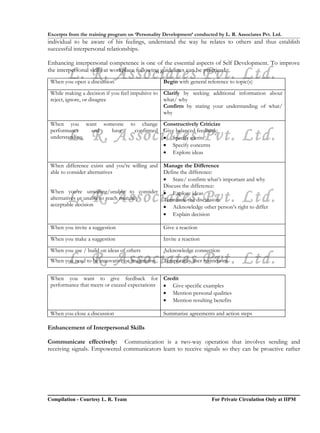
  • 79.
    Excerpts from thetraining program on ‘Personality Development’ conducted by L. R. Associates Pvt. Ltd. implications. It also requires the awareness of and the ability to device ‘criteria’ for selecting between these alternatives. It is such qualities that an individual needs to develop in him in order to be an effective manager. It can L. R. Associates Pvt. Ltd. be done through the interaction between the employee and his colleagues, his boss and through specific training programs and, most important of all, through self-learning. In this direction, it becomes very important for an individual to identify the “defense mechanisms” that he uses to rationalize his present behaviour. Self-Discipline Personal Effectiveness Being personally effective is one of the important aspects in Self Development. One pre-condition for L. R. Associates Pvt. Ltd. personal effectiveness is self-awareness. A person who understands himself is likely to be more effective. Personal effectiveness depends partly on self-understanding and partly on the use of such understanding with care. Several factors contribute to personal effectiveness: • Self-Disclosure: Willingness of a person to be open to others and to share the relevant feelings, knowledge etc. with others. • Feedback: Through feedback that a person receives from others, he may become aware of some strengths and some weaknesses, which only others, who observe and are affected by his behaviour, may be able to communicate. L. R. Associates Pvt. Ltd. • Perceptiveness: Perceptiveness would mean a person’s sensitivity to feelings of the other person, and the situation in which both interact. It also means being sensitive to the cues, which he may pick up to determine both the extent and the manner of self-disclosure as well as feedback. It is perceptiveness of the person in making both self-disclosure and feedback effective in improving one’s behaviour. A combination of these makes for interpersonal effectiveness. This combined with high initiative and action-orientation enhances personal and managerial effectiveness. L. R. Associates Pvt. Ltd. Self-Awareness and Personal Effectiveness An ‘Effective Person’ is one who has a high degree of self-awareness. Such self-awareness is characterized by a good insight into one’s own strengths and weaknesses. In addition, effective individuals are constantly searching for opportunities to test themselves in new situations, gain more insights into their own personality, improve upon their strengths and overcome their weaknesses. Every individual’s personality (attitudes, values, habits, abilities, competencies etc.) can be considered as consisting of four parts in terms of his self-awareness and awareness of others. These include the following: • An ‘open’ or a ‘public’ personality which consists of those aspects that he is aware of (known to him) and which others around him are aware of. • A ‘private’, or a ‘closed’ part (his knowledge, attitudes, habits, abilities, competencies, weaknesses, strengths etc.) which only he is aware of and which others are not aware of; • A ‘blind’ part which he is not aware of, but others are aware of and • A ‘dark’ or ‘hidden’ part which neither the individual nor others are aware of. Compilation - Courtesy L. R. Team For Private Circulation Only at IIPM
  • 80.
    Excerpts from thetraining program on ‘Personality Development’ conducted by L. R. Associates Pvt. Ltd. If 100 points have to be assigned to all the four parts together, for most people the first three parts may get less than 10 points and the ‘dark’ or ‘unexplored’ part may get over 90 points. This is because in our lifetime we do not get enough opportunities to discover our own strengths, our potential and L. R. Associates Pvt. Ltd. abilities. Every choice we make in our education, profession, career etc. helps us to explore and discover only a small part of our talent, at the same time narrowing the scope or closing the doors to discover many other parts. Self-awareness means a better recognition of one’s Qualities, Strengths, Weaknesses and Competencies etc. Such awareness leads to better choices and better decision-making. This is because an individual who is more aware of his strengths and weakness can recognize and look for opportunities where his strengths can help him achieve success and avoid (or at least be prepared to face) situations where his weaknesses may create problems for him. If such self-awareness is to be high, ‘blind spots’ need to be L. R. Associates Pvt. Ltd. reduced and ‘dark parts’ need to be explored. Both these can be facilitated through high initiative, activity level, risk-taking, self-disclosure, and openness to feedback with interpersonal sensitivity. L. R. Associates Pvt. Ltd. L. R. Associates Pvt. Ltd. Compilation - Courtesy L. R. Team For Private Circulation Only at IIPM