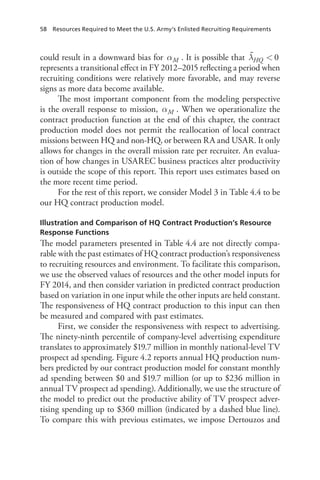
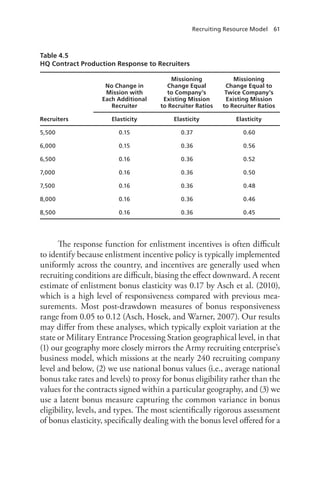
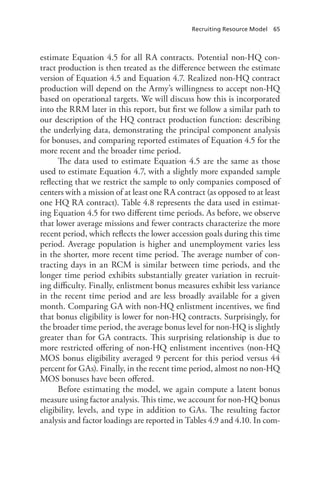
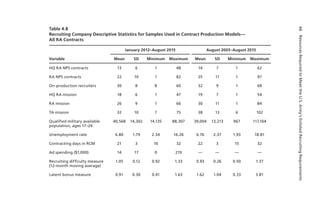
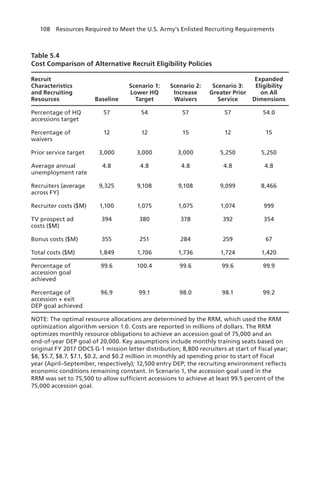
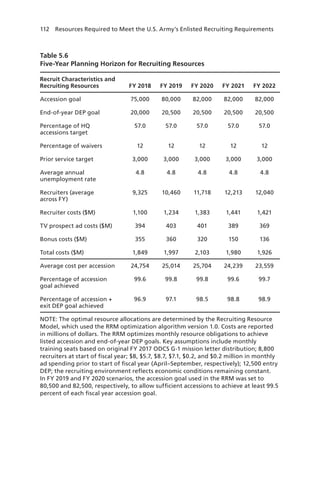
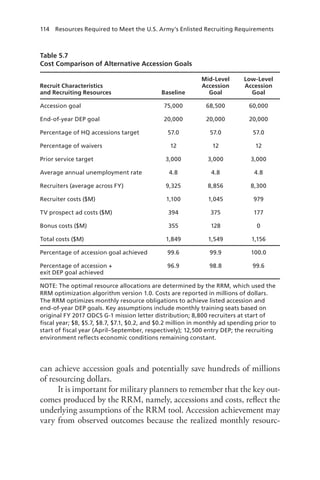
Resources Required to Meet
the U.S. Army’s Enlisted
Recruiting Requirements
Under Alternative Recruiting
Goals, Conditions, and
Eligibility Policies
David Knapp, Bruce R. Orvis, Christopher E. Maerzluft, Tiffany Tsai
C O R P O R A T I O N
Limited Print and Electronic Distribution Rights
This document and trademark(s) contained herein are protected by law. This representation
of RAND intellectual property is provided for noncommercial use only. Unauthorized
posting of this publication online is prohibited. Permission is given to duplicate this
document for personal use only, as long as it is unaltered and complete. Permission is
required from RAND to reproduce, or reuse in another form, any of its research documents
for commercial use. For information on reprint and linking permissions, please visit
www.rand.org/pubs/permissions.
The RAND Corporation is a research organization that develops solutions to public
policy challenges to help make communities throughout the world safer and more secure,
healthier and more prosperous. RAND is nonprofit, nonpartisan, and committed to the
public interest.
RAND’s publications do not necessarily reflect the opinions of its research clients and sponsors.
Support RAND
Make a tax-deductible charitable contribution at
www.rand.org/giving/contribute
www.rand.org
Library of Congress Cataloging-in-Publication Data is available for this publication.
ISBN: 978-1-9774-0020-8
For more information on this publication, visit www.rand.org/t/RR2364
Published by the RAND Corporation, Santa Monica, Calif.
© Copyright 2018 RAND Corporation
R® is a registered trademark.
Cover: Photo courtesy of U.S. Army Recruiting Command.
iii
Preface
This report documents research and analysis conducted as part of a proj-
ect entitled Resources Needed to Meet Army’s Enlisted Accession Require-
ments, sponsored by the Assistant Secretary of the Army for Manpower
& Reserve Affairs. The purpose of the project was to enhance the effec-
tiveness and efficiency of the Army’s use of the suite of available recruit-
ing resources and policies by optimizing the required resource levels
and mix to support future recruiting under changing enlisted accession
requirements, varying labor market conditions and recruiting environ-
ments, and alternative recruit eligibility policies, and by enabling the
assessment of alternative courses of action.
The Project Unique Identification Code (PUIC) for the project
that produced this document is HQD146830.
This research was conducted within RAND Arroyo Center’s Per-
sonnel, Training, and Health Program. RAND Arroyo Center, part of
the RAND Corporation, is a federally funded research and develop-
ment center (FFRDC) sponsored by the United States Army.
RAND operates under a “Federal-Wide Assurance”
(FWA00003425) and complies with the Code of Federal Regulations for
the Protection of Human Subjects Under United States Law (45 CFR 46),
also known as “the Common Rule,” as well as with the implementa-
tion guidance set forth in DoD Instruction 3216.02. As applicable, this
compliance includes reviews and approvals by RAND’s Institutional
Review Board (the Human Subjects Protection Committee) and by the
U.S. Army. The views of sources utilized in this study are solely their
own and do not represent the official policy or position of DoD or the
U.S. government.
v
Table of Contents
Preface. . . . . . . . . . . . . . . . . . . . . . . . . . . . . . . . . . . . . . . . . . . . . . . . . . . . . . . . . . . . . . . . . . . . . . . . . . . . . . iii
Figures. . . . . . . . . . . . . . . . . . . . . . . . . . . . . . . . . . . . . . . . . . . . . . . . . . . . . . . . . . . . . . . . . . . . . . . . . . . . . . vii
Tables. . . . . . . . . . . . . . . . . . . . . . . . . . . . . . . . . . . . . . . . . . . . . . . . . . . . . . . . . . . . . . . . . . . . . . . . . . . . . . . ix
Summary. . . . . . . . . . . . . . . . . . . . . . . . . . . . . . . . . . . . . . . . . . . . . . . . . . . . . . . . . . . . . . . . . . . . . . . . . . . xi
Acknowledgments. . . . . . . . . . . . . . . . . . . . . . . . . . . . . . . . . . . . . . . . . . . . . . . . . . . . . . . . . . . . . . xvii
Abbreviations.. . . . . . . . . . . . . . . . . . . . . . . . . . . . . . . . . . . . . . . . . . . . . . . . . . . . . . . . . . . . . . . . . . . . xix
CHAPTER ONE
Introduction. . . . . . . . . . . . . . . . . . . . . . . . . . . . . . . . . . . . . . . . . . . . . . . . . . . . . . . . . . . . . . . . . . . . . . . . 1
Background. . . . . . . . . . . . . . . . . . . . . . . . . . . . . . . . . . . . . . . . . . . . . . . . . . . . . . . . . . . . . . . . . . . . . . . . . . 1
Purpose of the Report. . . . . . . . . . . . . . . . . . . . . . . . . . . . . . . . . . . . . . . . . . . . . . . . . . . . . . . . . . . . . . 4
Our Approach. . . . . . . . . . . . . . . . . . . . . . . . . . . . . . . . . . . . . . . . . . . . . . . . . . . . . . . . . . . . . . . . . . . . . . . 4
Organization of the Report. . . . . . . . . . . . . . . . . . . . . . . . . . . . . . . . . . . . . . . . . . . . . . . . . . . . . . . . 7
CHAPTER TWO
Overview of Recent Resource Use and Eligibility Policies.. . . . . . . . . . . . . . . . 9
Recruiting Goals and Environment.. . . . . . . . . . . . . . . . . . . . . . . . . . . . . . . . . . . . . . . . . . . . . . 9
Recruiting Resources. . . . . . . . . . . . . . . . . . . . . . . . . . . . . . . . . . . . . . . . . . . . . . . . . . . . . . . . . . . . . . 10
Recruit Eligibility Policies.. . . . . . . . . . . . . . . . . . . . . . . . . . . . . . . . . . . . . . . . . . . . . . . . . . . . . . . . 16
Related Research. . . . . . . . . . . . . . . . . . . . . . . . . . . . . . . . . . . . . . . . . . . . . . . . . . . . . . . . . . . . . . . . . . . 19
CHAPTER THREE
Data Used for This Study.. . . . . . . . . . . . . . . . . . . . . . . . . . . . . . . . . . . . . . . . . . . . . . . . . . . . . . . 25
Army Data. . . . . . . . . . . . . . . . . . . . . . . . . . . . . . . . . . . . . . . . . . . . . . . . . . . . . . . . . . . . . . . . . . . . . . . . . . 25
Television Advertising Data.. . . . . . . . . . . . . . . . . . . . . . . . . . . . . . . . . . . . . . . . . . . . . . . . . . . . . 27
Economic and Demographic Data.. . . . . . . . . . . . . . . . . . . . . . . . . . . . . . . . . . . . . . . . . . . . . . 31
Remaining Technical Notes. . . . . . . . . . . . . . . . . . . . . . . . . . . . . . . . . . . . . . . . . . . . . . . . . . . . . . 32
vi  Resources Required to Meet the U.S. Army’s Enlisted Recruiting Requirements
CHAPTER FOUR
Recruiting Resource Model.. . . . . . . . . . . . . . . . . . . . . . . . . . . . . . . . . . . . . . . . . . . . . . . . . . . . 35
Contract Production. . . . . . . . . . . . . . . . . . . . . . . . . . . . . . . . . . . . . . . . . . . . . . . . . . . . . . . . . . . . . . . 37
Theoretical Model. . . . . . . . . . . . . . . . . . . . . . . . . . . . . . . . . . . . . . . . . . . . . . . . . . . . . . . . . . . . . . 38
Identifying Model Parameters.. . . . . . . . . . . . . . . . . . . . . . . . . . . . . . . . . . . . . . . . . . . . . . . . 43
Data and Estimation of HQ Contract Production. . . . . . . . . . . . . . . . . . . . . . . . . . 45
Illustration and Comparison of HQ Contract
Production’s Resource Response Functions.. . . . . . . . . . . . . . . . . . . . . . . . . . . . . 58
Data and Estimation of RA Contract Production. . . . . . . . . . . . . . . . . . . . . . . . . . 64
Illustration and Comparison of HQ and RA Contract
Production’s Resource Response Functions.. . . . . . . . . . . . . . . . . . . . . . . . . . . . . 73
Operationalizing the Contract Production Models in the RRM. . . . . . . . . . 75
DEP Retention Model.. . . . . . . . . . . . . . . . . . . . . . . . . . . . . . . . . . . . . . . . . . . . . . . . . . . . . . . . . . . . 79
Operationalizing the DEP Retention Model in the RRM.. . . . . . . . . . . . . . . . . 82
Cost Allocation Model. . . . . . . . . . . . . . . . . . . . . . . . . . . . . . . . . . . . . . . . . . . . . . . . . . . . . . . . . . . . 85
RRM Validation. . . . . . . . . . . . . . . . . . . . . . . . . . . . . . . . . . . . . . . . . . . . . . . . . . . . . . . . . . . . . . . . . . 86
CHAPTER FIVE
Model Demonstration and Optimization.. . . . . . . . . . . . . . . . . . . . . . . . . . . . . . . . . . . 89
Optimization Algorithm. . . . . . . . . . . . . . . . . . . . . . . . . . . . . . . . . . . . . . . . . . . . . . . . . . . . . . . . . 90
Analyzing Current Resourcing and Eligibility Plans. . . . . . . . . . . . . . . . . . . . . . . . . 97
Alternative Recruiting Environments.. . . . . . . . . . . . . . . . . . . . . . . . . . . . . . . . . . . . . . . . . . 99
Alternative Resourcing Strategies. . . . . . . . . . . . . . . . . . . . . . . . . . . . . . . . . . . . . . . . . . . . . . 102
Alternative Recruit Eligibility Policies. . . . . . . . . . . . . . . . . . . . . . . . . . . . . . . . . . . . . . . . . 103
Midyear Policy Changes. . . . . . . . . . . . . . . . . . . . . . . . . . . . . . . . . . . . . . . . . . . . . . . . . . . . . . . . 107
Five-Year Planning. . . . . . . . . . . . . . . . . . . . . . . . . . . . . . . . . . . . . . . . . . . . . . . . . . . . . . . . . . . . . . . 109
Alternative Accession Goals.. . . . . . . . . . . . . . . . . . . . . . . . . . . . . . . . . . . . . . . . . . . . . . . . . . . . 113
Summary.. . . . . . . . . . . . . . . . . . . . . . . . . . . . . . . . . . . . . . . . . . . . . . . . . . . . . . . . . . . . . . . . . . . . . . . . . 113
CHAPTER SIX
Conclusions. . . . . . . . . . . . . . . . . . . . . . . . . . . . . . . . . . . . . . . . . . . . . . . . . . . . . . . . . . . . . . . . . . . . . . 119
APPENDIX
A. Example of Changes in Production Elasticities. . . . . . . . . . . . . . . . . . . . . . . 123
References. . . . . . . . . . . . . . . . . . . . . . . . . . . . . . . . . . . . . . . . . . . . . . . . . . . . . . . . . . . . . . . . . . . . . . . . 127
vii
Figures
	 2.1	 Contract Mission Achievement for GAs and the
Civilian Unemployment Rate (FY 2003–2015).. . . . . . . . . . . . . . . . . . 13
	 2.2	 Recruiters and Recruiting Companies and Centers
(FY 2003–2015).. . . . . . . . . . . . . . . . . . . . . . . . . . . . . . . . . . . . . . . . . . . . . . . . . . . . . . 14
	 2.3	 GA MOS Bonus Levels and Eligibility (FY 2003–2015). . . . . . . . 15
	 2.4	 GA Quick-Ship Bonus Levels and Take Rates
(FY 2003–2015).. . . . . . . . . . . . . . . . . . . . . . . . . . . . . . . . . . . . . . . . . . . . . . . . . . . . . . 16
	 2.5	 NPS Medical and Conduct Waivers (FY 2003–2014). . . . . . . . . . . 18
	 2.6	 HQ and Prior Service Contracts (FY 2003–2014). . . . . . . . . . . . . . . 19
	 3.1	 Army TV Advertising Spending by Month
(FY 2012–2015). . . . . . . . . . . . . . . . . . . . . . . . . . . . . . . . . . . . . . . . . . . . . . . . . . . . . . . 31
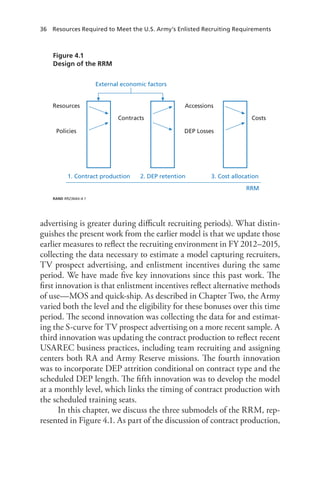
	 4.1	 Design of the RRM. . . . . . . . . . . . . . . . . . . . . . . . . . . . . . . . . . . . . . . . . . . . . . . . . 36
	 4.2	 HQ Contract Production Response to
TV Prospect Advertising.. . . . . . . . . . . . . . . . . . . . . . . . . . . . . . . . . . . . . . . . . . . . 59
	 4.3	 RA and HQ Contract Production Response to
TV Prospect Advertising.. . . . . . . . . . . . . . . . . . . . . . . . . . . . . . . . . . . . . . . . . . . . 74
	 5.1	 Predicted Monthly Accession Achievement Under
Alternative Recruiting Environments. . . . . . . . . . . . . . . . . . . . . . . . . . . . 102
	 5.2	 Monthly Accessions and Recruiters Under
Alternative Resourcing Plans. . . . . . . . . . . . . . . . . . . . . . . . . . . . . . . . . . . . . . 105
ix
Tables
	 2.1	 End Strength, Recruiting Goals and Achievement,
and Recruit Quality (FY 1980–2015). . . . . . . . . . . . . . . . . . . . . . . . . . . . . . 11
	 2.2	 Fiscal Year Advertising Expenditures.. . . . . . . . . . . . . . . . . . . . . . . . . . . . . . 17
	 4.1	 Recruiting Company Descriptive Statistics for
Samples Used in Contract Production Models—HQ.. . . . . . . . . . . 47
	 4.2	 Principal Component Analysis: Bonus Variables—
Eigenvalues. . . . . . . . . . . . . . . . . . . . . . . . . . . . . . . . . . . . . . . . . . . . . . . . . . . . . . . . . . . . 49
	 4.3	 Principal Component Analysis: Bonus Variables—
Factor Loadings. . . . . . . . . . . . . . . . . . . . . . . . . . . . . . . . . . . . . . . . . . . . . . . . . . . . . . . 49
	 4.4	 Contract Production Models—HQ, NPS. . . . . . . . . . . . . . . . . . . . . . . . . 51
	 4.5	 HQ Contract Production Response to Recruiters. . . . . . . . . . . . . . . . 61
	 4.6	 HQ Contract Production Response to
Enlistment Incentive Eligibility. . . . . . . . . . . . . . . . . . . . . . . . . . . . . . . . . . . . . 63
	 4.7	 HQ Contract Production Response to
Enlistment Incentive Levels. . . . . . . . . . . . . . . . . . . . . . . . . . . . . . . . . . . . . . . . 64
	 4.8	 Recruiting Company Descriptive Statistics for
Samples Used in Contract Production Models—
All RA Contracts. . . . . . . . . . . . . . . . . . . . . . . . . . . . . . . . . . . . . . . . . . . . . . . . . . . . 66
	 4.9	 Principal Component Analysis: Bonus Variables for
All RA Contracts—Eigenvalues. . . . . . . . . . . . . . . . . . . . . . . . . . . . . . . . . . . 68
	 4.10	 Principal Component Analysis: Bonus Variables for
All RA Contracts—Factor Loadings. . . . . . . . . . . . . . . . . . . . . . . . . . . . . . . 69
	 4.11	 Contract Production Models—All RA Contracts. . . . . . . . . . . . . . . . 71
	 4.12	 RA Contract Production Response to Recruiters. . . . . . . . . . . . . . . . . 75
	 4.13	 RA Contract Production Response to
Enlistment Incentive Eligibility. . . . . . . . . . . . . . . . . . . . . . . . . . . . . . . . . . . . . 76
x  Resources Required to Meet the U.S. Army’s Enlisted Recruiting Requirements
	 4.14	 RA Contract Production Response to
Enlistment Incentive Levels. . . . . . . . . . . . . . . . . . . . . . . . . . . . . . . . . . . . . . . . 77
	 4.15	 Starting Distribution of DEP Length by
Accession Category. . . . . . . . . . . . . . . . . . . . . . . . . . . . . . . . . . . . . . . . . . . . . . . . . . . 82
	 4.16	 DEP Attrition by Accession Category and
Scheduled DEP Length. . . . . . . . . . . . . . . . . . . . . . . . . . . . . . . . . . . . . . . . . . . . . . 83
	 4.17	 In-Sample Validation Test of the RRM.. . . . . . . . . . . . . . . . . . . . . . . . . . 88
	 5.1	 Criterion Function Weights. . . . . . . . . . . . . . . . . . . . . . . . . . . . . . . . . . . . . . . . . 93
	 5.2	 Cost Comparison for Alternative
Recruiting Environments. . . . . . . . . . . . . . . . . . . . . . . . . . . . . . . . . . . . . . . . . . 101
	 5.3	 Cost Comparison of Alternative Resource Strategies.. . . . . . . . . . 104
	 5.4	 Cost Comparison of Alternative Recruit Eligibility
Policies. . . . . . . . . . . . . . . . . . . . . . . . . . . . . . . . . . . . . . . . . . . . . . . . . . . . . . . . . . . . . . . 108
	 5.5	 Cost Comparison of Midyear Policy Changes. . . . . . . . . . . . . . . . . . 110
	 5.6	 Five-Year Planning Horizon for Recruiting Resources. . . . . . . . . 112
	 5.7	 Cost Comparison of Alternative Accession Goals. . . . . . . . . . . . . . 114
	 A.1	 Illustration of Elasticity Calculation
Under Alternative Assumptions.. . . . . . . . . . . . . . . . . . . . . . . . . . . . . . . . . . 124
xi
Summary
The research described in this report is intended to enhance the effec-
tiveness and efficiency of the Army’s use of recruiting resources and
enlistment eligibility policies by optimizing the required resource levels
and mix to support future recruiting under changing enlisted accession
requirements, varying labor market conditions and recruiting environ-
ments, and alternative recruit eligibility policies, and by enabling the
assessment of alternative courses of action.
The Army spent on average $1.5 billion annually in 2016 dollars on
recruiting resources (including recruiter compensation) from fiscal year
(FY) 2001 to FY 2014, and nearly $2.0 billion annually in FY 2008 and
FY 2009.1 The variation in cost reflects differences in both the recruiting
environment and the accession mission. Recruiting is a complex process,
requiring enlistment contracts to be signed months in advance of the
enlistee starting Basic Combat Training, and there is a nontrivial prob-
ability that enlistees will cancel their contracts during this time period.
The resources used to produce additional contracts, such as recruiters,
bonuses, and advertising, differ not only in their cost per additional con-
tract produced but also in time elapsed between resource use and pro-
ductive response. Additionally, the Army alters recruit eligibility policies
to achieve its annual accession requirement. During difficult recruiting
1	 Recruiters, advertising, and enlistment bonuses offered to prospective recruits peaked
in FY 2007–2008. Because bonuses are paid upon completion of Initial Entry Training
(IET)—and for bonuses over $10,000, the remainder is paid out over the recruit’s term of
enlistment—the actual costs incurred by the Army peaked in FY 2008–2009.
xii  Resources Required to Meet the U.S. Army’s Enlisted Recruiting Requirements
environments, it has offered additional enlistment waivers, permitted
more soldiers with prior service to enlist, and lowered educational and
test score requirements.
Understanding how recruiting resources and enlistment eligibil-
ity policies work together as a system under varying recruiting require-
ments and environments is critical for decisionmakers who want to use
their limited resources to efficiently and effectively achieve the Army’s
accession requirements. This research builds on earlier work by Defense
Manpower Data Center researchers on the effectiveness and lead times
of alternative recruiting resources in generating enlistment contracts and
accessions. The Recruiting Resource Model (RRM) developed in this
report considers the relationship among the monthly level and mix of
recruiting resources, recruit eligibility policies, accumulated contracts,
and training seat targets. It models how these factors combine to pro-
duce monthly accessions and the number of enlistment contracts at the
fiscal year’s end that are scheduled to access in the following fiscal year.
The RRM reflects the complex sequence of events leading to an
accession. It consists of a contract production submodel, a Delayed
Entry Program (DEP) retention submodel, and a cost allocation sub-
model. The contract production submodel weighs the trade-offs between
economic conditions and resources used to produce overall and high-
quality (HQ) enlistment contracts (where HQ reflects the Department
of Defense [DoD] standard of contracts where the enlistee has a formal
high school diploma and scores in the upper fiftieth percentile of the
Armed Forces Qualification Test). Based on the contract characteristics
(e.g., HQ contract, quick-ship bonus) and training seat vacancies, con-
tracts are scheduled to leave for basic training (i.e., access into the Army)
at a specific time. The time between contract and accession is known
as the time in the DEP. The DEP retention submodel captures the
probabilistic cancellation of the enlistment contract over these months.
The third submodel accounts for the resourcing costs that were paid to
achieve the fiscal year’s enlistment contracts and accessions.
The contract production model is designed to reflect the Army’s
business model—namely, team recruiting and the dual missioning of
recruiters to recruit for both the Regular (active) Army and the U.S.
Army Reserve—of the Army’s recruiting enterprise that has been in
Summary xiii
place since FY 2012. The parameters of the contract production model
are estimated using Army and economic data that are signals of the
recruiting environment, the Army’s spending on measurable recruiting
resources, and U.S. Army Recruiting Command (USAREC) mission-
ing at the recruiting company-month level. The contract production
model is specified to allow for diminishing returns in resources, includ-
ing the possibility of threshold and saturation effects for advertising, and
for alternative methods of enlistment incentive use (e.g., critical skills
or quick-ship bonuses). Whether resourcing, missioning, population, or
time-invariant properties of recruiting companies are associated with
greater contract production depends on the model’s parameters, which
are determined by its estimation using the detailed Army data. The
estimated model reveals that enlistment contract production is sensi-
tive to all recruiting resources, including recruiters, bonuses, and TV
prospect advertising.
Scheduled DEP lengths increase during good recruiting environ-
ments, as limited short-term training seat availability necessitates longer
wait times. However, DEP attrition rates are greater for contracts with
longer wait times, as the enlistees find alternative opportunities. The
DEP retention submodel is calibrated based on observed transition rates
of contracts being canceled while waiting to access. The transition rates
differ by contract quality, type, and scheduled time in the DEP. The
cost allocation model accounts for costs based on the contracts that
access. Some costs are paid regardless, such as advertising and recruiter
costs. However, other costs, such as enlistment incentives, are based on
the contract accessing. The cost allocation model accounts for the costs
in the month the Army becomes obligated to pay them—that is, the
month the recruit signs the enlistment contract (contingent on accession
for incentives). Accounting for costs when they are used for contract
production links resourcing and cost in a structured way, which permits
the creation of an optimization algorithm to identify cost-minimizing
resource portfolios.
An optimization algorithm is developed to find the cost-minimiz-
ing portfolio of recruiting resources conditional on the recruiting envi-
ronment and Army-established recruit eligibility policies. The optimiza-
tion algorithm has three objectives: (1) produce enough accessions to fill
xiv  Resources Required to Meet the U.S. Army’s Enlisted Recruiting Requirements
each month’s training seats; (2) achieve a target number of contracts in
the DEP that are scheduled to access in the next fiscal year, also known
as the entry pool; and (3) minimize total costs. We refer to the combina-
tion of the RRM and the optimization algorithm as the RRM tool. We
discuss using the RRM tool to predict execution year accessions and the
entry pool for the following year from a specified resourcing plan (i.e., a
nonoptimized outcome). We also provide six examples of how the RRM
tool can be used to inform policymakers concerning potential resource
and policy trade-offs or preparing for alternative recruiting conditions
or requirements. These examples include cost trade-offs based on
1.	 alternative recruiting environments
2.	 alternative resourcing strategies
3.	 alternative recruit eligibility policies
4.	 within-year goal or policy changes
5.	 five-year planning
6.	 alternative accession goals.
These examples demonstrate the versatility of the RRM tool for con-
sidering trade-offs across the recruiting enterprise. In doing so, it can
provide resourcing alternatives that achieve accession goals and poten-
tially save hundreds of millions of resourcing dollars.
The examples demonstrate important strategic-level trade-offs.
As the difficulty level of recruiting changes in response to changes in
accession requirements or recruiting conditions, success and efficiency
require different mixes and levels of recruiting resources and enlist-
ment eligibility policies. In combination with recruiting environment
predictions from the Recruiting Difficulty Index tool of Wenger et al.
(forthcoming), Army planners can use the RRM tool to consider the
potential cost and resourcing requirements for a range of recruiting con-
tingencies. Our example of alternative resource strategies demonstrates
that a strategy emphasizing one resource in lieu of other resources (e.g.,
bonuses when policymakers are reactive to a difficult recruiting environ-
ment rather than being proactive in planning for it) can be substantially
more expensive than using a mix of resources. Additionally, we show
that changing recruit eligibility policies can reduce recruiting resource
Summary xv
costs substantially. When the RRM tool is used in combination with
the Recruit Selection Tool (Orvis et al., forthcoming), policymakers can
consider the first-term costs associated with broadening eligibility crite-
ria in addition to the recruiting costs. Within-year analyses demonstrate
the substantial cost savings and higher probability of goal achievement
when resources are adjusted optimally to deal with changing accession
requirements. The five-year planning example demonstrates how poli-
cymakers can use the RRM tool to determine efficient and effective
resourcing and eligibility policies to meet long-range recruiting objec-
tives and to weigh the desirability and feasibility of alternative objectives
in supporting end-strength goals.
The RRM tool is not prescriptive. It informs Army planners and
leaders regarding potential trade-offs in monthly recruiting resources
conditional on recruit eligibility policies and the recruiting environ-
ment, over both short and long time periods. It does this through a
coherent, mathematically based model that yields consistent results with
explicit assumptions and caveats. Consequently, it represents a step for-
ward in helping Army leaders shape a cost-efficient strategy capable of
achieving Army’s accession requirements. The continued success of the
RRM tool will require updating the model to reflect the current effec-
tiveness of recruiting resources, and future enhancements could include
integration with existing planning and budgeting models to make the
RRM tool a budgeting resource in addition to a strategic resource.
xvii
Acknowledgments
We are appreciative of the support of our sponsor, Mr. Mark Davis, the
Deputy Assistant Secretary of the Army for Marketing, and his office
for their support of the research documented in this report, includ-
ing John Jessup, Shawn McCurry, Alicia McCleary, Jeff Sterling, John
Keeter, Jan Jedrych, James Ortiz, LTC Chike Robertson, MAJ Trent
Geisler, Heather Whitehouse, and Terrance Mann. At Headquarters,
Department of the Army, G-1, we are grateful for feedback at differ-
ent phases of this project from COL Joanne Moore, Mr. Roy Wallace,
MAJ Larry Tobin, LTC Tom Kucik, CPT Eric O’Connor, Dr. Bob
Steinrauf, and LTC Robert Nowicki. We also wish to express our thanks
to COL Ken Burkman, Mike Nelson, Joe Baird, and Rick Ayer at the
U.S. Army Recruiting Command. At RAND, we would like to thank
Christine DeMartini, Jan Hanley, Laurie McDonald, Teague Ruder,
and Whitney Dudley for their programming assistance, and Chris Guo
and Steven Garber for their technical expertise in the initial stages of
this research. Finally, we received helpful comments from our reviewers,
Jim Hosek of RAND and Matt Goldberg of IDA.
xix
Abbreviations
AFQT	 Armed Forces Qualification Test
AMRG	 Army Marketing and Research Group
BLS	 Bureau of Labor Statistics
CPI-U	 Consumer Price Index–Urban Consumers
DEP	 Delayed Entry Program
DMDC	 Defense Manpower Data Center
DoD	 Department of Defense
EIRB	 Enlistment Incentive Review Board
FY	 fiscal year
GA	 graduate alpha
HQ	 high quality
HQDA	 Headquarters, Department of the Army
HRC	 Human Resources Command
IET	 Initial Entry Training
MOS	 Military Occupational Specialty
NPS	 non–prior service
ODCS	 Office of the Deputy Chief of Staff
RA	 Regular Army
RCM	 recruiting contract month
RRM	 Recruiting Resource Model
RSM	 recruiting ship month
TA	 Total Army
USAR	 U.S. Army Reserve
USAREC	 U.S. Army Recruiting Command
1
CHAPTER ONE
Introduction
Background
Since 2001, between 57,000 and 80,000 enlisted soldiers per fiscal year
have accessed into the Regular Army (RA). To accomplish this acces-
sion level, the U.S. Army Recruiting Command (USAREC) must sign
8–10 percent more enlistment contracts to account for individuals not
following through with their contracts.
As a result, the Army’s recruiting enterprise is substantial, with over
8,000 recruiters placed at over 1,300 recruiting centers across the country
(as of May 2017), a national advertising campaign directed by the Army
Marketing and Research Group (AMRG), and an enlistment incentive
(i.e., bonus) structure managed at least quarterly by the Enlistment Incen-
tive Review Board (EIRB). In fiscal year (FY) 2008 and FY 2009, nearly
$2.0 billion in 2016 dollars was spent per year on recruiting.1 The average
1	 This estimate is provided to give the reader a sense of magnitude and is based only on
marketing and incentive costs and required recruiter numbers provided by the Office of the
Deputy Chief of Staff, G-1 (ODCS G-1): marketing, $328 million; enlistment incentives, $669
million; and recruiters, $944 million. Both marketing and enlistment incentives are inflated
by the Bureau of Labor Statistics (BLS) Consumer Price Index–Urban Consumers (CPI-U)
to 2016 dollars, while the figure for recruiters reflects the average cost per recruiter in 2016
($118,000 per recruiter) provided by Headquarters, Department of the Army (HQDA). The
actual number of recruiters in the field likely deviates from the required recruiting force due
to USAREC’s operational requirements. Enlistment incentives reflect current and anniversary
payments, not the amounts obligated to contracts written during the fiscal year. Recruiters,
advertising, and enlistment bonuses offered to prospective recruits peaked in FY 2007–2008.
Because bonuses are paid upon completion of Initial Entry Training (IET)—and for bonuses
over $10,000, the remainder is paid out over the remainder of the recruit’s term of enlistment—
the actual costs incurred by the Army peaked in FY 2008–2009.
2  Resources Required to Meet the U.S. Army’s Enlisted Recruiting Requirements
over FY 2001 to FY 2014 was $1.5 billion in 2016 dollars. The average
annual cost of an accession accounting only for recruiters, bonuses, and
marketing ranged from $15,500 (FY 2004) to $27,700 (FY 2009), with
the average cost over FY 2001 to FY 2014 being $20,300.2 The variation
in cost reflects differences in both recruiting environments and the acces-
sion mission. When difficult environments and large missions combine,
as in FY 2005–2008, the marginal cost of a recruiting contract can be
far larger than the average contract cost.
Recruiting resources differ not only in their cost per additional
contract produced but also in time elapsed between resource use and
productive response. For example, bonuses have the most immediate
impact, but are relatively expensive. Additional recruiters and advertis-
ing are less costly, but require more planning time and time to produce
enlistment contracts. Training seats are distributed unevenly across the
fiscal year, adding another component to the Army planners’ calculus.
Resourcing needs to be planned such that contracts are produced with
sufficient lead time to ensure that the enlistees fill the available train-
ing seats.
Resources are not the only policy levers that the Army employs
to achieve its recruiting mission. The Army uses a suite of recruiting
resources and recruit eligibility policies to achieve its annual accession
requirement. Department of Defense (DoD) Instruction 1145.01 estab-
lishes benchmarks for recruiting success, including 60 percent of fiscal
year accessions scoring in the upper fiftieth percentile of the Armed
Forces Qualification Test (AFQT) national distribution, and 90 per-
cent high school diploma graduates. Consistent with DoD practice,
this report will refer to enlistments that exhibit both of these charac-
teristics as high-quality (HQ) enlistments. DoD Instruction 1304.26
established additional qualifications for enlistments related to age, citi-
zenship, education, aptitude, medical condition, physical fitness, depen-
dency, conduct, and drug and alcohol use. Importantly, this instruction
also establishes criteria for providing waivers based on current or past
medical, dependent, conduct, and drug issues. The issuance of waivers is
2	 We follow the same methodology as in footnote 1 and take the average over this time
period, not accounting for differences in annual accession requirements.
Introduction 3
devolved to the services. Finally, while annual Army enlistment targets
typically focus on non–prior service (NPS) recruits, HQDA regularly
establishes Prior Service Business Rules that guide the ability of recruit-
ers to enlist individuals with prior military experience. Determination
of a potential prior service recruit’s eligibility to reenter the Army is typi-
cally based on his or her previous service record, Military Occupational
Specialty (MOS), and last pay grade, or the recruit’s willingness to be
retrained in a limited set of high-need occupations.
As with recruiting resources, recruit eligibility policies are expanded
during difficult recruiting conditions and limited at other times. For
example, analysis of contracting data indicates that prior service acces-
sions from FY 2001 to FY 2014 ranged from a low of 921 in FY 2012
to over 13,000 in FY 2007. Additionally, accessions fell below estab-
lished education and aptitude benchmarks during FY 2006–2008,3 and
waivers exceeded 20 percent in FY 2007. Expanding recruit eligibility
can offer a less expensive means of achieving recruiting goals. Waiver
rates and quality benchmarks represent barriers to entry that, if relaxed,
could permit an expansion of the potential recruit pool.
In ever-changing recruiting environments, the relative value of
alternative resource and eligibility policy approaches to meeting the
accession requirements will vary. There is a strong association between
the tightening of the external labor market (i.e., the civilian unemploy-
ment rate decreases) and the ability of USAREC to meet its monthly
contract mission. Wenger et al. (forthcoming) examines the relationship
between the fraction of contract mission achieved for graduate alphas
(GAs) and the unemployment rate. GAs are HQ contracts that are
available to ship at any time because they have already graduated from
high school. However, they are also in demand in the civilian labor
market. A simple regression relating a monthly measure of the fraction
of contract mission achieved for GAs to the civilian unemployment rate
has an R-squared of 0.59, which indicates that 59 percent of the vari-
3	 During this period, the Office of the Secretary of Defense gave the Army permission to
enlist up to 10 percent of its recruits into the Tier Two Attrition Screen program. In effect,
this increased the OSD-approved ceiling for youth with Tier Two education credentials from
10 percent of accessions to 20 percent.
4  Resources Required to Meet the U.S. Army’s Enlisted Recruiting Requirements
ance in the fraction of contract mission achieved for GAs is explained
by variance in the unemployment rate.
Purpose of the Report
Understanding how recruiting resources and recruit eligibility policies
work together as a system under varying recruiting requirements and
environments is critical for decisionmakers who want to use their lim-
ited resources to efficiently and effectively achieve the Army’s acces-
sion requirements. This research builds on earlier work by manpower
researchers, including many from RAND Arroyo Center, on the effec-
tiveness and lead times of alternative recruiting resources in generating
enlistment contracts and accessions. The Recruiting Resource Model
(RRM) developed in this report considers the relationship among the
monthly level and mix of recruiting resources, recruit eligibility poli-
cies, accumulated contracts, and training seat targets. It models how
these factors combine to produce monthly accessions and the number of
enlistment contracts at the fiscal year’s end that are scheduled to access
in the following fiscal year.
Our Approach
The RRM reflects the complex sequence of events leading to an acces-
sion. It consists of a contract production submodel, a Delayed Entry
Program (DEP) retention submodel, and a cost allocation submodel.
The contract production submodel weighs the trade-offs between
economic conditions and resources used to produce overall and HQ
enlistment contracts. Based on the contract characteristics (e.g., HQ
contract, quick-ship bonus) and training seat vacancies, contracts are
scheduled to leave for basic training (i.e., access into the Army) at a
specific time. The time between contract and accession is known as the
time in the DEP. The DEP retention submodel captures the probabi-
listic attrition of the contract from the DEP (and out of the potential
accession pool) over these months. The third submodel accounts for the
Introduction 5
resourcing costs that were paid to achieve the fiscal year’s enlistment
contracts and accessions.
The contract production model is designed to reflect the business
model of the Army’s recruiting enterprise in place between FY 2012
and FY 2015. The parameters of the contract production model are esti-
mated using Army and economic data that are signals of the recruiting
environment, the Army’s spending on measurable recruiting resources,
and USAREC missioning by the recruiting company-month level. The
contract production model is specified to allow for diminishing returns
in resources, including the possibility of threshold and saturation effects
for advertising, and for alternative methods of enlistment incentive use
(e.g., MOS or quick-ship). The contract production model is designed
around recruiters—if there is no recruiter at a recruiting company or
that company has no contract mission or there are no youth living in the
recruiting company’s geographic bounds, then the contract production
model would yield no contracts. Recruiting resources and environment
may augment the recruiters’ productive ability, and a greater mission—
all else equal—may incentivize contract production. Additionally,
recruiting companies with more youth in their geographic bounds may
produce more contracts, and there may be persistent differences between
regions based on unobserved factors such as differential propensity to
enlist. Whether resourcing, missioning, population, or time-invariant
properties of recruiting companies are associated with greater contract
production depends on the model’s parameters, which are determined
by its estimation using the detailed Army data.
Scheduled DEP lengths increase during good recruiting environ-
ments, as limited short-term training seat availability necessitates longer
wait times. However, DEP attrition rates are greater for contracts with
longer wait times, as the enlistees find alternative opportunities. The
DEP retention submodel is calibrated based on observed transition rates
of contracts being canceled while waiting to access. The transition rates
differ by contract quality, type, and scheduled time in the DEP. The
cost allocation model accounts for costs based on the contracts that
access. Some costs are paid regardless, such as advertising and recruiter
costs. However, other costs, such as enlistment incentives, are based on
the contract accessing. The cost allocation model accounts for the costs
6  Resources Required to Meet the U.S. Army’s Enlisted Recruiting Requirements
in the month the Army becomes obligated to pay them—the month
the enlistee signs the contract, or the month a TV commercial is aired.
Accounting for costs when they are used for contract production links
resourcing and cost in a structured way, which permits the creation of an
optimization algorithm to identify cost-minimizing resource portfolios.
We develop an optimization algorithm designed to find the cost-
minimizing portfolio of recruiting resources conditional on the recruit-
ing environment and Army-established recruit eligibility policies. The
optimization algorithm has three objectives: (1) produce enough acces-
sions to fill each month’s training seats; (2) achieve a target number of
contracts in the DEP that are scheduled to access in the next fiscal year,
also known as the entry pool; and (3) minimize total costs. We refer to
the combination of the RRM and the optimization algorithm as the
RRM tool. We provide a number of examples for how the RRM tool
may be used, including predicting execution year accessions and the
entry pool for the following year from a specified resourcing plan (i.e.,
a nonoptimized outcome), and six optimized outcomes:
1.	 Determine a cost-minimizing resourcing plan for a fiscal year
(i.e., optimized outcome)
2.	 Compare the sensitivity of resourcing plans under alternative
recruiting environments
3.	 Compare alternative resourcing plans (e.g., incentive-centric
versus an optimized resource strategy)
4.	 Compare cost trade-offs of alternative eligibility policies
5.	 Consider within-year changes in resourcing plans necessary to
achieve an accession mission (e.g., halfway through the fiscal
year, what policy levers can be used to achieve the accession mis-
sion and what would be the cost-minimizing portfolio for the
remaining six months of the fiscal year)
6.	 Consider multiple year resourcing scenarios.
The RRM is a versatile framework that can be adapted and updated
to reflect changes in the efficacy of resources, changes in the structure of
the recruiting enterprise, and lessons learned about the responsiveness of
contract production to changes in recruit eligibility policies. The RRM
Introduction 7
tool reported on and developed in this report should be viewed as a
resource that can help Army leaders understand the complex trade-offs
involved in recruiting, and that can be updated and improved to meet
the Army’s operational needs.
Organization of the Report
Chapter Two describes the use of recruiting resources, enlistment eli-
gibility policies, and the recruiting environment since FY 2003, and
discusses past research on enlistment supply. Chapter Three discusses
the data we use in this analysis, as well as past measures of enlistment
supply’s responsiveness to recruiting resources and the recruiting envi-
ronment. Chapter Four presents an overview of the model and dis-
cusses each submodel in depth. It concludes with an in-sample valida-
tion test. Chapter Five discusses how the optimization algorithm works,
and provides six examples of analyses using the RRM tool that can
clarify the trade-offs in alternative resourcing policies, trade-offs for
expanding recruit eligibility, and extensions for long-term budgeting
or efficient short-term reallocation of resources for achieving a change
in annual accession goals. Chapter Six provides our conclusions and
recommendations.
9
CHAPTER TWO
Overview of Recent Resource Use and Eligibility
Policies
This chapter describes accession goals and key measures of the recruit-
ing environment since FY 2003, and then describes how recruiting
resources were used and recruit eligibility policies were set to achieve
those goals.1 We do not detail every policy lever used during this time
frame, but instead focus on some of the most consistently used resource
and policy levers. We conclude by briefly reviewing past work on enlist-
ment supply and where this model fits within the context of past work.
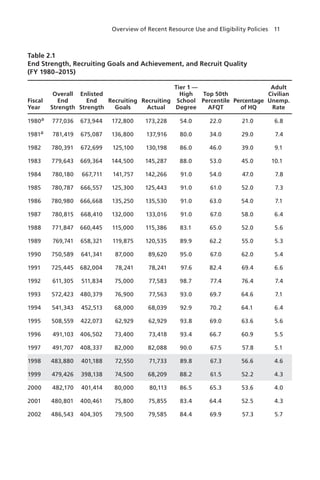
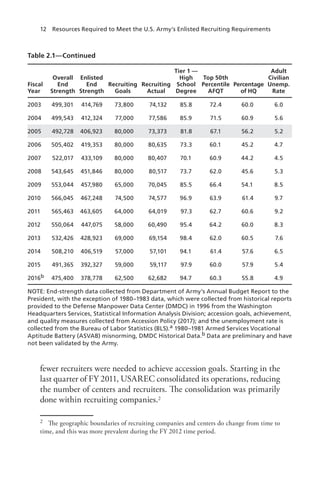
Recruiting Goals and Environment
From 2003 to 2015, accession goals varied from a high of 80,000 to a
low of 57,000 enlisted accessions. During this time frame, the accession
goal was missed only once, in 2005. From FY 2005 to FY 2008, the
Army set high enlistment goals to increase RA end strength to 540,000.
These numbers, while high compared with recent accession goals, are
low compared with history. As detailed in Table 2.1, during FY 1980–
1984 the average recruiting goal was 144,000. The Army has failed to
achieve its accession goals three times since 1980: FY 1998, FY 1999,
and FY 2005 (Accession Policy, 2017). These times have been character-
ized by declining unemployment, an initially high fraction of AFQT
I-IIIA recruits in the year (or initial year) of the failure, and lower
1	 FY 2003 represents the first complete fiscal year where we have consistently collected Army
data for recruiters, missioning, and contract level.
10  Resources Required to Meet the U.S. Army’s Enlisted Recruiting Requirements
quality achievement in the year(s) immediately following the missed
recruiting goals. This is suggestive evidence that policy response to a
worsening recruiting environment, at least in terms of relaxing eligibil-
ity restrictions, occurred too late.
Wenger et al. (forthcoming) evaluated a number of alternative
measures of the recruiting environment. The most indicative of their
measures of the recruiting environment was the fraction of contract
mission achieved for GAs, defined as a high school graduate in the top
fiftieth percentile of the AFQT. GAs are the most likely recruits to be
supply constrained, and since they have already graduated, they can
access at any time. Figure 2.1 demonstrates the monthly relationship
between the contract mission achievement rate and the civilian unem-
ployment rate. Unemployment and contract mission achievement are
strongly related. After missing contract mission in FY 2005, the Army
responded by expanding eligibility and increasing recruiting resources,
as we will demonstrate next. The response to expanded eligibility can be
seen in Figure 2.1 by contrasting all RA contract mission achievement
with GA contract mission achievement. During FY 2006–2008, the
Army leaned heavily on expanded eligibility to meet recruiting objec-
tives, driving RA contract mission achievement closer to 100 percent,
while GA contract mission achievement remained persistently low.
The relaxation of eligibility criteria is primarily reflected in Table 2.1
through a decrease in Tier 1 enlistments.
Recruiting Resources
This report focuses on three recruiting resources: recruiters, enlistment
incentives, and advertising. Recruiters are assigned to centers, which
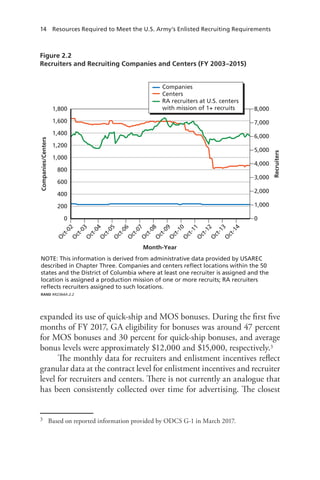
report to recruiting companies. Figure 2.2 depicts changes in USAREC
companies and centers from FY 2003 to FY 2015. After accession mis-
sion failure in FY 2005, many additional recruiters were added to
the recruiting field. The number of recruiters remained relatively flat
through FY 2007, at which point more recruiters were placed at centers.
The number of RA recruiters at centers in the 50 states and Washington,
D.C., reached its peak in June 2009. As recruiting conditions improved,
Overview of Recent Resource Use and Eligibility Policies  11
Table 2.1
End Strength, Recruiting Goals and Achievement, and Recruit Quality
(FY 1980–2015)
Fiscal
Year
Overall
End
Strength
Enlisted
End
Strength
Recruiting
Goals
Recruiting
Actual
Tier 1 —
High
School
Degree
Top 50th
Percentile
AFQT
Percentage
of HQ
Adult
Civilian
Unemp.
Rate
1980a 777,036 673,944 172,800 173,228 54.0 22.0 21.0 6.8
1981a 781,419 675,087 136,800 137,916 80.0 34.0 29.0 7.4
1982 780,391 672,699 125,100 130,198 86.0 46.0 39.0 9.1
1983 779,643 669,364 144,500 145,287 88.0 53.0 45.0 10.1
1984 780,180 667,711 141,757 142,266 91.0 54.0 47.0 7.8
1985 780,787 666,557 125,300 125,443 91.0 61.0 52.0 7.3
1986 780,980 666,668 135,250 135,530 91.0 63.0 54.0 7.1
1987 780,815 668,410 132,000 133,016 91.0 67.0 58.0 6.4
1988 771,847 660,445 115,000 115,386 83.1 65.0 52.0 5.6
1989 769,741 658,321 119,875 120,535 89.9 62.2 55.0 5.3
1990 750,589 641,341 87,000 89,620 95.0 67.0 62.0 5.4
1991 725,445 682,004 78,241 78,241 97.6 82.4 69.4 6.6
1992 611,305 511,834 75,000 77,583 98.7 77.4 76.4 7.4
1993 572,423 480,379 76,900 77,563 93.0 69.7 64.6 7.1
1994 541,343 452,513 68,000 68,039 92.9 70.2 64.1 6.4
1995 508,559 422,073 62,929 62,929 93.8 69.0 63.6 5.6
1996 491,103 406,502 73,400 73,418 93.4 66.7 60.9 5.5
1997 491,707 408,337 82,000 82,088 90.0 67.5 57.8 5.1
1998 483,880 401,188 72,550 71,733 89.8 67.3 56.6 4.6
1999 479,426 398,138 74,500 68,209 88.2 61.5 52.2 4.3
2000 482,170 401,414 80,000 80,113 86.5 65.3 53.6 4.0
2001 480,801 400,461 75,800 75,855 83.4 64.4 52.5 4.3
2002 486,543 404,305 79,500 79,585 84.4 69.9 57.3 5.7
12  Resources Required to Meet the U.S. Army’s Enlisted Recruiting Requirements
Fiscal
Year
Overall
End
Strength
Enlisted
End
Strength
Recruiting
Goals
Recruiting
Actual
Tier 1 —
High
School
Degree
Top 50th
Percentile
AFQT
Percentage
of HQ
Adult
Civilian
Unemp.
Rate
2003 499,301 414,769 73,800 74,132 85.8 72.4 60.0 6.0
2004 499,543 412,324 77,000 77,586 85.9 71.5 60.9 5.6
2005 492,728 406,923 80,000 73,373 81.8 67.1 56.2 5.2
2006 505,402 419,353 80,000 80,635 73.3 60.1 45.2 4.7
2007 522,017 433,109 80,000 80,407 70.1 60.9 44.2 4.5
2008 543,645 451,846 80,000 80,517 73.7 62.0 45.6 5.3
2009 553,044 457,980 65,000 70,045 85.5 66.4 54.1 8.5
2010 566,045 467,248 74,500 74,577 96.9 63.9 61.4 9.7
2011 565,463 463,605 64,000 64,019 97.3 62.7 60.6 9.2
2012 550,064 447,075 58,000 60,490 95.4 64.2 60.0 8.3
2013 532,426 428,923 69,000 69,154 98.4 62.0 60.5 7.6
2014 508,210 406,519 57,000 57,101 94.1 61.4 57.6 6.5
2015 491,365 392,327 59,000 59,117 97.9 60.0 57.9 5.4
2016b 475,400 378,778 62,500 62,682 94.7 60.3 55.8 4.9
NOTE: End-strength data collected from Department of Army’s Annual Budget Report to the
President, with the exception of 1980–1983 data, which were collected from historical reports
provided to the Defense Manpower Data Center (DMDC) in 1996 from the Washington
Headquarters Services, Statistical Information Analysis Division; accession goals, achievement,
and quality measures collected from Accession Policy (2017); and the unemployment rate is
collected from the Bureau of Labor Statistics (BLS).a 1980–1981 Armed Services Vocational
Aptitude Battery (ASVAB) misnorming, DMDC Historical Data.b Data are preliminary and have
not been validated by the Army.
fewer recruiters were needed to achieve accession goals. Starting in the
last quarter of FY 2011, USAREC consolidated its operations, reducing
the number of centers and recruiters. The consolidation was primarily
done within recruiting companies.2
2	 The geographic boundaries of recruiting companies and centers do change from time to
time, and this was more prevalent during the FY 2012 time period.
Table 2.1—Continued
Overview of Recent Resource Use and Eligibility Policies 13
Figure 2.1
Contract Mission Achievement for GAs and the Civilian Unemployment
Rate (FY 2003–2015)
NOTE: Contract mission achievement is based on USAREC and Human Resources
Command (HRC) administrative data discussed in Chapter Three. BLS produces the
monthly adult civilian unemployment rate.
RAND RR2364A-2.1
200
180
160
140
120
100
80
60
40
20
0
12
10
8
6
4
2
0
Contractmissionachieved,GA(percent)
Unemploymentrate(percent)
Month-Year
O
ct-02
O
ct-03
O
ct-04
O
ct-05
O
ct-06
O
ct-07
O
ct-08
O
ct-09
O
ct-10
O
ct-11
O
ct-12
O
ct-13
O
ct-14
Contract mission achievement, GA
Contract mission achievement, all RA
Civilian unemployment rate
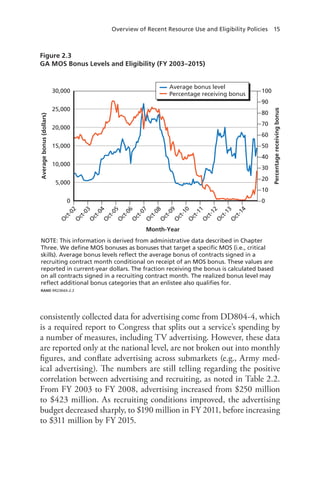
The use of enlistment incentives has also changed dramatically
over time, as demonstrated in Figures 2.3 and 2.4. From June 2003
to June 2005, the Army sharply expanded GA MOS bonus eligibil-
ity for contracts written from 55 percent to 90 percent and quick-ship
bonuses from 4 percent in March 2003 to 58 percent in March 2005.
As recruiting conditions remained tough, both bonus levels and eli-
gibility expanded. At their height in September 2007, 89 percent of
GA enlistment contracts received a quick-ship bonus, with the aver-
age bonus being $25,000 (equivalent to about $29,300 in May 2017).
During FY 2009, quick-ship bonuses were abruptly turned off, and
MOS bonuses were reduced significantly in both level and eligibility.
During FY 2013–2014, GA eligibility for MOS bonuses was restricted;
however, bonus levels were increased. Starting in FY 2015, the Army
14 Resources Required to Meet the U.S. Army’s Enlisted Recruiting Requirements
Figure 2.2
Recruiters and Recruiting Companies and Centers (FY 2003–2015)
NOTE: This information is derived from administrative data provided by USAREC
described in Chapter Three. Companies and centers reflect locations within the 50
states and the District of Columbia where at least one recruiter is assigned and the
location is assigned a production mission of one or more recruits; RA recruiters
reflects recruiters assigned to such locations.
RAND RR2364A-2.2
1,800
1,600
1,400
1,200
1,000
800
600
400
200
0
8,000
7,000
6,000
5,000
4,000
3,000
2,000
1,000
0
Companies/Centers
Recruiters
Month-Year
O
ct-02
O
ct-03
O
ct-04
O
ct-05
O
ct-06
O
ct-07
O
ct-08
O
ct-09
O
ct-10
O
ct-11
O
ct-12
O
ct-13
O
ct-14
Companies
Centers
RA recruiters at U.S. centers
with mission of 1+ recruits
expanded its use of quick-ship and MOS bonuses. During the first five
months of FY 2017, GA eligibility for bonuses was around 47 percent
for MOS bonuses and 30 percent for quick-ship bonuses, and average
bonus levels were approximately $12,000 and $15,000, respectively.3
The monthly data for recruiters and enlistment incentives reflect
granular data at the contract level for enlistment incentives and recruiter
level for recruiters and centers. There is not currently an analogue that
has been consistently collected over time for advertising. The closest
3 Based on reported information provided by ODCS G-1 in March 2017.
Overview of Recent Resource Use and Eligibility Policies 15
consistently collected data for advertising come from DD804-4, which
is a required report to Congress that splits out a service’s spending by
a number of measures, including TV advertising. However, these data
are reported only at the national level, are not broken out into monthly
figures, and conflate advertising across submarkets (e.g., Army med-
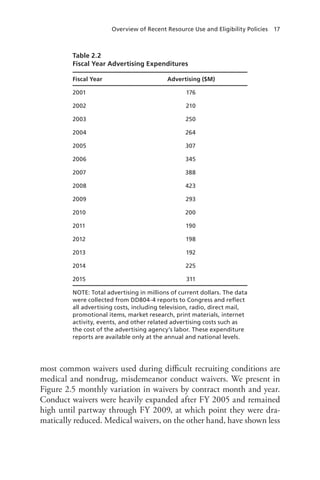
ical advertising). The numbers are still telling regarding the positive
correlation between advertising and recruiting, as noted in Table 2.2.
From FY 2003 to FY 2008, advertising increased from $250 million
to $423 million. As recruiting conditions improved, the advertising
budget decreased sharply, to $190 million in FY 2011, before increasing
to $311 million by FY 2015.
Figure 2.3
GA MOS Bonus Levels and Eligibility (FY 2003–2015)
NOTE: This information is derived from administrative data described in Chapter
Three. We define MOS bonuses as bonuses that target a specific MOS (i.e., critical
skills). Average bonus levels reflect the average bonus of contracts signed in a
recruiting contract month conditional on receipt of an MOS bonus. These values are
reported in current-year dollars. The fraction receiving the bonus is calculated based
on all contracts signed in a recruiting contract month. The realized bonus level may
reflect additional bonus categories that an enlistee also qualifies for.
RAND RR2364A-2.3
30,000
25,000
20,000
15,000
10,000
5,000
0
100
90
80
70
60
50
40
30
20
10
0
Averagebonus(dollars)
Percentagereceivingbonus
Month-Year
O
ct-02
O
ct-03
O
ct-04
O
ct-05
O
ct-06
O
ct-07
O
ct-08
O
ct-09
O
ct-10
O
ct-11
O
ct-12
O
ct-13
O
ct-14
Average bonus level
Percentage receiving bonus
16 Resources Required to Meet the U.S. Army’s Enlisted Recruiting Requirements
Recruit Eligibility Policies
As mentioned in the introduction, one of the Army’s main recruiting
objectives is to achieve HQ accessions. HQ enlistees qualify for a wider
breadth of MOS, have fewer conduct issues, and are much less likely to
attrit. However, during difficult recruiting conditions, eligibility policies
have become a lever that can be used to meet the primary recruiting
objective: the accession goal.
A key policy is the number of enlistment waivers the Army chooses
to grant. Waivers can be given for a number of reasons, but the two
Figure 2.4
GA Quick-Ship Bonus Levels and Take Rates (FY 2003–2015)
NOTE: This information is derived from administrative data described in Chapter
Three. We define quick-ship bonuses as bonuses that require a very short DEP period
in order to qualify. Average bonus levels reflect the average bonus of contracts
signed in a recruiting contract month conditional on receipt of a quick-ship bonus.
These values are reported in current-year dollars. The fraction receiving the bonus is
calculated based on all contracts signed in a recruiting contract month. The realized
bonus level may reflect additional bonus categories that an enlistee also qualifies for.
The odd high average bonus level during FY 2010 reflects a very targeted bonus
given to very few contracts.
RAND RR2364A-2.4
30,000
25,000
20,000
15,000
10,000
5,000
0
100
90
80
70
60
50
40
30
20
10
0
Averagebonus(dollars)
Percentagereceivingbonus
Month-Year
O
ct-02
O
ct-03
O
ct-04
O
ct-05
O
ct-06
O
ct-07
O
ct-08
O
ct-09
O
ct-10
O
ct-11
O
ct-12
O
ct-13
O
ct-14
Average bonus level
Percentage receiving bonus
Overview of Recent Resource Use and Eligibility Policies  17
Table 2.2
Fiscal Year Advertising Expenditures
Fiscal Year Advertising ($M)
2001 176
2002 210
2003 250
2004 264
2005 307
2006 345
2007 388
2008 423
2009 293
2010 200
2011 190
2012 198
2013 192
2014 225
2015 311
NOTE: Total advertising in millions of current dollars. The data
were collected from DD804-4 reports to Congress and reflect
all advertising costs, including television, radio, direct mail,
promotional items, market research, print materials, internet
activity, events, and other related advertising costs such as
the cost of the advertising agency’s labor. These expenditure
reports are available only at the annual and national levels.
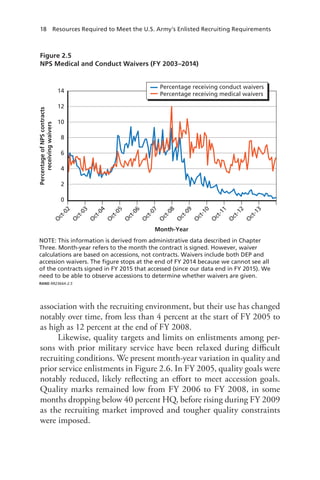
most common waivers used during difficult recruiting conditions are
medical and nondrug, misdemeanor conduct waivers. We present in
Figure 2.5 monthly variation in waivers by contract month and year.
Conduct waivers were heavily expanded after FY 2005 and remained
high until partway through FY 2009, at which point they were dra-
matically reduced. Medical waivers, on the other hand, have shown less
18 Resources Required to Meet the U.S. Army’s Enlisted Recruiting Requirements
Figure 2.5
NPS Medical and Conduct Waivers (FY 2003–2014)
NOTE: This information is derived from administrative data described in Chapter
Three. Month-year refers to the month the contract is signed. However, waiver
calculations are based on accessions, not contracts. Waivers include both DEP and
accession waivers. The figure stops at the end of FY 2014 because we cannot see all
of the contracts signed in FY 2015 that accessed (since our data end in FY 2015). We
need to be able to observe accessions to determine whether waivers are given.
RAND RR2364A-2.5
14
12
10
8
6
4
2
0
PercentageofNPScontracts
receivingwaivers
Month-Year
O
ct-02
O
ct-03
O
ct-04
O
ct-05
O
ct-06
O
ct-07
O
ct-08
O
ct-09
O
ct-10
O
ct-11
O
ct-12
O
ct-13
Percentage receiving conduct waivers
Percentage receiving medical waivers
association with the recruiting environment, but their use has changed
notably over time, from less than 4 percent at the start of FY 2005 to
as high as 12 percent at the end of FY 2008.
Likewise, quality targets and limits on enlistments among per-
sons with prior military service have been relaxed during difficult
recruiting conditions. We present month-year variation in quality and
prior service enlistments in Figure 2.6. In FY 2005, quality goals were
notably reduced, likely reflecting an effort to meet accession goals.
Quality marks remained low from FY 2006 to FY 2008, in some
months dropping below 40 percent HQ, before rising during FY 2009
as the recruiting market improved and tougher quality constraints
were imposed.
Overview of Recent Resource Use and Eligibility Policies 19
Prior service is an important eligibility characteristic that can be
expanded during difficult recruiting conditions. During FY 2006–
2008, in the majority of months, more than 1,000 prior service con-
tracts were signed, leading to thousands of prior service accessions by
month. From FY 2012 to FY 2014, the ODCS G-1 mission letter rou-
tinely targeted zero prior service accessions—a sharp change from half
a decade earlier. However, even during this more recent period, the zero
prior service targets were not achieved.
Related Research
There is an extensive line of research that has focused on enlistment
supply—that is, the willingness of individuals to enlist in the mil-
itary. This research has evaluated the responsiveness of enlistments
Figure 2.6
HQ and Prior Service Contracts (FY 2003–2014)
NOTE: This information is derived from administrative data described in Chapter Three.
RAND RR2364A-2.6
1,600
1,400
1,200
1,000
800
600
400
200
0
70
60
50
40
30
20
10
0
Priorservicecontracts
PercentageofHQcontracts
Month-Year
O
ct-02
O
ct-03
O
ct-04
O
ct-05
O
ct-06
O
ct-07
O
ct-08
O
ct-09
O
ct-10
O
ct-11
O
ct-12
O
ct-13
Prior service contracts
Percentage of HQ contracts
20  Resources Required to Meet the U.S. Army’s Enlisted Recruiting Requirements
to resource use, including education incentives, enlistment bonuses,
advertising, and recruiters. Rarely has it touched on eligibility policy, as
it has remained focused on the most supply-constrained portion of the
potential enlistment population: HQ contracts. This literature consists
mostly of models estimated on data prior to FY 2012. Asch, Hosek,
and Warner (2007) provide a review of post-drawdown estimates from
this literature, covering primarily the 1990s. An important caveat of
this literature is that few estimates result from causal analyses, meaning
that the estimated economic models measure the association between
the use of a resource and contract production rather than measure how
much greater contract production is because of the use of a resource.
Measuring associations has led to biased estimates for some recruiting
resources. The standard example is enlistment bonuses. A simple corre-
lation between enlistment bonuses and contracts might yield a negative
association, reflecting the use of bonuses when recruiting conditions
are difficult. Even controlling for other factors in a regression context
may be insufficient, particularly if only national measures are available.
Recent research—including that of Warner, Simon, and Payne (2001,
2003) and Asch et al. (2010)—has circumvented the endogeneity
problem by relying on geographical variation (in these cases, at the
state level) in the response to enlistment incentives to identify the
relationship between contract production and enlistment incentives.
An older study by Polich, Dertouzos, and Press (1986) evaluated a
bonus experiment in which a subset of recruiting regions were offered
a more generous enlistment incentive. This type of experiment more
closely approximates a causal measure because it compares the enlist-
ment responses of regions that differ only in the level of bonuses offered
and terms of service the bonuses are linked to.4 In general, whether
through an experimental or a nonexperimental technique exploiting
4	 Similar national experiments were carried out to assess alternative educational incentives
(the Educational Assistance Test Program); combined active and reserve service (the 2+2+4
Recruiting Experiment); expansion of the market to youth without traditional high school
diplomas (GED Plus) and to youth wanting to attend college for up to two years after enlisting
but before accessing (College First); and the expansion effects of a home ownership/business
start-up incentive (Army Advantage Fund).
Overview of Recent Resource Use and Eligibility Policies  21
geographical variation, this literature has found that HQ contract pro-
duction is responsive to enlistment bonuses, and the measured response
using these techniques has been similar. Bonuses tend to be a relatively
expensive resource when compared with recruiters, but less expensive
than raising basic pay. This literature has not distinguished between
enlistment bonuses for shipping quickly and enlistment incentives for
critical skills.
Whereas the role of recruiters and enlistment incentives are fre-
quently accounted for in these models, detailed data on advertising are
less common. Three studies make use of detailed advertising data below
the national level (Dertouzos and Garber, 2003; Dertouzos, 2009;
Warner, Simon, and Payne, 2001), and all three find that advertising
is strongly associated with HQ enlistment contracts. Warner, Simon,
and Payne (2001) evaluate all three resources in the same modeling
framework; they find that the cost of producing an additional contract
from advertising for the Army was less expensive than using recruiters or
enlistment incentives. Efficiency suggests that the lowest-cost mixture
of resources should be used to produce the last contract. Given Warner,
Simon, and Payne’s (2001) estimates, recruiting objectives could have
been achieved at a lower cost by increasing advertising or recruiters
while decreasing the use of enlistment incentives.
The challenge with the aforementioned analysis is that these esti-
mates represent a point in time. There is no guarantee that resources
will be equally productive as time progresses, or that recruiting prac-
tices will remain the same, or that the propensity to serve will remain
the same. Consequently, it is important to update models of enlist-
ment supply to ensure they reflect current circumstances. For example,
with the introduction of the 9-11 GI bill in 2009, the role of col-
lege funds as an enlistment incentive has been effectively eliminated.
Additionally, the role of recruiter effort in the Army has changed
as USAREC moved away from individual missioning toward team
recruiting, where missions are handled at the center and company
levels. Such changes can affect the estimated productivity of enlist-
ment bonuses (which were typically offered alongside education incen-
tives in the 1990s) or recruiter write rates (which have decreased since
2001).
22  Resources Required to Meet the U.S. Army’s Enlisted Recruiting Requirements
Additionally, the previous analyses were not designed to allow
for Army planners to consider alternative combinations of resourcing
policies. In part this is because the models would need to capture other
parts of the recruiting process, like recruit eligibility policies, non-HQ
production, and DEP attrition and accession. Additionally, allowing
Army planners to try alternative policies would require a tool they could
use for balancing resources and an optimization algorithm for weigh-
ing one resource relative to another. Finally, it would require a model
that balances all resources; and, as previously mentioned, consistently
collecting detailed advertising data has remained elusive, with the last
detailed Army advertising data collected from 2002 to 2004 (Dertou-
zos, 2009). The development of the RRM tool, described in Chapters
Four and Five, is meant to address the need for a dynamic and interac-
tive policy tool that will allow Army planners to consider alternative
scenarios based on a contract production function that captures trade-
offs across the major recruiting resources.5
In lieu of experimental data, the RRM tool faces many of the same
empirical challenges mentioned above. However, it updates models of
contract production to reflect recent recruiting experience, the present
use of enlistment incentives, and current recruiting practices. It also
provides alternative framing, focusing not on enlistment supply (i.e.,
the willingness of a qualified individual to enlist) but on the produc-
tive potential of a recruiting company over time as resources, eligibility
policies, and recruiting conditions change. As part of this research, we
went to great lengths to work with the Army’s ad agency and AMRG
to ensure that the requisite advertising data were collected for television;
in future work we aim to analyze the relationship between internet and
social media advertising and enlistment. Additionally, the RRM tool
was developed in such a way as to allow Army planners to consider a
variety of resourcing and eligibility alternatives, while also making the
model flexible enough that it can be updated. The aim is to provide a
5	 The RRM tool differs from Goldberg, Kimko, and Li (2015), who predict future outcomes
using only recruiters and exogenous variables outside the Army’s control. Their model may be
effective at predicting recruiting environment; however, it cannot be used to consider alterna-
tive resourcing policies.
Overview of Recent Resource Use and Eligibility Policies  23
planning tool that can improve resourcing efficiency and allow senior
leaders to consider trade-offs between eligibility policy and resources
while also improving the likelihood of the Army achieving accession
and recruit quality goals.
25
CHAPTER THREE
Data Used for This Study
Data were collected from a number of sources and broadly divided
into three categories: military data, advertising data, and economic
and demographic data. In this chapter, we review the data available to
inform our study. We conclude this chapter with some more technical
notes about the timing of when measures were calculated. The end result
of the data collection is a company-level analytical dataset with monthly
measures covering August 2002 through September 2015.
We conduct our analysis at the recruiting company-month level
because it is the most disaggregated geography for which we have con-
sistent Army measures. A major objective of our data collection was to
ensure that observed values correctly correspond to a specific month and
recruiting company. For example, we are cautious to ensure resources
and outputs are allocated to the correct geography. In this way, we
ensure resources, such as recruiters and advertising, can be associated
with the contract production in the appropriate area and at the same
time.
Army Data
Army data are drawn primarily from databases maintained by the U.S.
Army HRC and USAREC, and strategic guidance is issued by ODCS
G-1 within HQDA.
Data on recruiters are collected from a recruiter database main-
tained by USAREC for purposes of tracking each recruiter’s current
status and assignment. The file reflects a monthly snapshot of each
26  Resources Required to Meet the U.S. Army’s Enlisted Recruiting Requirements
recruiter, an indicator of his or her company and center assignment, and
an indicator of whether the recruiter is on production (versus on leave
or other alternative duty assignment). It covers the time period from
August 2002 until September 2015.
Data on contract missioning are collected through a contract mis-
sioning system used and maintained by USAREC to allocate and report
contract mission goals and achievements. It records key measures at the
recruiting brigade, battalion, company, and center levels. The system is
populated by USAREC allocating a monthly mission to each brigade.
Each brigade then allocates a contract mission to each of its battalions.
Each battalion then allocates a contract mission to each of its compa-
nies. Finally, each company then allocates a contract mission to each of
its recruiting centers. This system can be used to generate monthly mea-
sures of the contract mission at the respective brigade, battalion, com-
pany, or center level for key missioning categories including GAs, senior
alphas (i.e., a high school senior scoring in the top fiftieth percentile on
the AFQT), and others (i.e., not GAs or senior alphas) in both the RA
and U.S. Army Reserve (USAR) components. From the missioning and
recruiter data, we compute the number of recruiters on production at
the center level by summing the number of recruiters at centers with a
production mission of at least one recruit, and the monthly GA contract
mission by summing the mission assigned to recruiting centers in the 50
states and the District of Columbia with at least one recruiter on pro-
duction at the center.1 Requiring a center to have at least one recruiter
and a nonzero contract mission is done to control for the opening and
closing of centers, which can spuriously increase the estimate of the true
mission assigned in a month.
Data on contracts written and which of the recruits accessed are
collected from the RA Analyst file maintained by HRC. This file cap-
tures every contract written from FY 2001 to the present. It reports key
measures of these contracts, including when the contract was signed, the
recruiter associated with the contract, the cumulative amount and types
of bonuses associated with the contract, educational background and
1	 In some fiscal years, the recording of missioning at the center level is inconsistent. In these
cases, we use missioning at the company level.
Data Used for This Study  27
the outcomes of military qualification tests, the projected accession date
for the contract, and the actual accession date for the contract, among
other variables. From these data, we compute key monthly contract
measures including the average DEP length, monthly attrition rates
based on time scheduled in the DEP, the fraction of recruits accepting
each type of bonus at a national level, total contracts written at a com-
pany level, and contracts written for specific subgroups (e.g., GAs—
enlistment contracts where the individual has a high school diploma and
scores at or above the fiftieth percentile on the AFQT) at a company
level. In computing these measures, we again limit the sample to con-
tracts written at centers with a nonzero contract mission in the 50 states
or the District of Columbia with at least one recruiter on production at
the recruiting center. This sample selection means that the model pre-
sented in Chapter Four relies on economic and demographic measures
measured consistently in the 50 states and the District of Columbia.
Data on the total training seats planned for future months are col-
lected from the accession mission letter issued by HQDA’s ODCS G-1.
The mission letter represents strategic guidance to USAREC and the
Training and Doctrine Command reflecting the number of accessions
they should plan by month during the fiscal year. The mission letter
specifies quality and overall accession targets. Since the quality targets
in the mission letter rarely change, we use only the accession mission.
The mission letter is released at least once a year to set the next fiscal year
targets. If the overall accession mission changes, or if projected acces-
sions exceed or fall short of the original fiscal year targets, then a new
mission letter may be released updating the monthly targets.
Television Advertising Data
Our analysis focuses on the resources exercised in the recruiting com-
pany area during a month and prior months (for resources with delayed
effects). Data on advertising take three common forms—planned, pur-
chased, and actual. Moreover, the date that payments are made may
also differ from when the commercials are aired, based on the networks’
billing cycles. Our analysis matches actual payments with the dates
28  Resources Required to Meet the U.S. Army’s Enlisted Recruiting Requirements
commercials are aired and the realized marketing impressions for the
aired commercials measured by a third-party media analytics service.
We worked with AMRG and the Army’s advertising agency to collect
this information for national TV advertising, which typically represents
around 71 percent of media expenditures. National advertising differs
from local advertising in that it is purchased through national media
networks and these contracts guarantee a minimal number of national
impressions achieved, but do not guarantee local impressions achieved.
Both national and local TV advertising result in local impressions, but
AMRG and the Army’s ad agency use only national advertising.2 With
the focus on actual TV advertising cost, we exclude fixed costs associ-
ated with the Army’s marketing contract, as well as costs associated with
marketing events, local advertising, and internet advertising. These are
not incorporated into our analysis due to lack of the required data.3
We discuss the implications of this for the model and interpreting the
model’s results in Chapter Five.
We collect two types of TV advertising data: impressions and
costs. Impressions are a function of gross rating points (GRP) and popu-
lation size.4 GRP is a measure of viewership and is collected in different
2	 Occasionally, local TV advertising may be placed by a USAREC recruiting organization
(i.e., battalion, company, or center), but data on impressions and spending are not available
for this activity.
3	 For these factors to systematically bias our results, they would have to be highly correlated
with the use of the resources that we model: bonuses, recruiters, and TV prospect advertising.
Decisions on local events and advertising are made by USAREC battalions or companies and
are likely not coordinated with the advertising agency’s national advertising campaign, or
with enlistment incentives that are set nationally, or with recruiters, who are assigned based
on persistent need. Therefore, it is unlikely that local event or advertising activity will bias
our national resourcing measures. They could be used to explain additional unaccounted-for
differences, however. Internet advertising could bias our measured estimates if the variation
in use and geography were highly correlated with our resourcing measures in a causal way.
Since both geographical and time variation would have to be highly correlated with internet
advertising for this bias to occur, we believe that it is unlikely to be a major issue, but will
pursue this question in future research.
4	 That function is Impressions = (GRP/100) × Population Size. If an ad campaign results
in 20 percent of the target seeing the advertising four times on average, then the campaign’s
size is 80 GRPs, or 0.8 impressions per person.
Data Used for This Study  29
ways for each media market. Methods for measuring GRP include local
people meter, set metered, and diary markets. Local-people-metered
markets continuously collect viewership information from households
where the meters have been installed and on the persons within them.
Set-metered markets continuously collect information from households,
and separate diaries of one week’s viewing behavior for all individuals
within a sample of households. Diary markets rely only on the one-
week diaries for viewership behavior, and are more common in smaller
media markets. Diaries are collected four times a year, in February,
May, July, and November, also known as sweep periods. Continuous
collection methods allow the third-party media analytics firm to project
the number of national impressions from specific advertisements. The
national impression measure can then be projected to the local level
using person-based meters and diary-based measures.5
Projections to local media markets are not typically done, however.
Dertouzos and Garber (2003) used data from the 1982–1984 Adver-
tising Mix Test, which resulted in detailed local advertising data col-
lection, to make such projections. As part of this research, we worked
with AMRG and the Army’s ad agency to do these projections based on
the advertising that occurred during FY 2012–2015, which represents
the longest period for which this level of detailed data have been col-
lected. To make these projections, the ad agency used a tool provided by
the third-party media analytics firm that distributes achieved national-
level GRP to local media markets using the sweeps week measures in
each fiscal year.6 TV activity was based on and run against November
sweep periods for FYs 2012, 2014, and 2015. For FY 2013, the February
sweep period was used because the New York media market delivery
was unavailable for November due to weather-related reasons. Each
population has its own GRP measure. Target populations for Army
advertising include prospects, defined as males aged 18–24, and influ-
encers, all adults aged 35–54. For better accuracy, local impressions are
5	 Diary-based measures may be underreported or overreported due to recall error.
6	 Day parts were custom created according to individual fiscal years, but were limited to
what was available within the tool’s database (e.g., Discovery Military and Discovery Science
were not available).
30  Resources Required to Meet the U.S. Army’s Enlisted Recruiting Requirements
calculated by media market TV sizes for each target population specific
to each fiscal year. The sizes of these populations are also measured
during sweep weeks. The result is a monthly measure of TV advertising
impressions by target population for each marketing area.
The Army ad agency provided data on actual monthly TV adver-
tising costs. During this time period, the Army marketing plan included
advertising targeted at prospect and influencer markets. In Figure 3.1,
we demonstrate variation in ad spending during FY 2012–2015 based
on the target audiences for the Army marketing plan.
Variation in advertising during this time frame was substantial,
with advertising increasing during FY 2015 as the recruiting environ-
ment became more difficult. Advertising campaigns aimed at prospects
reflect a mixture of advertisements aired on TV shows that appeal to the
prospect population. It is possible for these campaigns to also generate
influencer impressions. Analogously, the influencer campaigns reflect a
mixture of advertisements aired on TV shows that appeal to the influ-
encer population, but may yield a combination of prospect and influ-
encer impressions. These campaigns have differing goals. A prospect
campaign is aimed at generating awareness among potential recruits
about an Army career, whereas an influencer campaign is aimed at gen-
erating awareness about the Army among a population that is largely
ineligible to enlist. A potential by-product of an influencer’s positive
perception of the Army is that this individual might be more likely
in the future to recommend or support the Army as a potential career
option. Campaigns may not specifically target prospects or influencers;
for example, if the objective were to improve the perception of the Army
brand, that might result in a campaign targeted at the general adult
population segment aged 18–49. The design of the campaign depends
on the objective. One shortcoming of the impressions data provided by
the Army’s ad agency was that it did not separate prospect impressions
by the prospect campaign versus the influencer campaign, or influencer
impressions by the influencer campaign versus the prospect campaign.
Our objective in this research is to determine the optimal mix of
recruiting resources to achieve annual accession and DEP goals. To do
this, our analysis focuses on the resources exercised in the recruiting
company area during a month and prior months (for resources with
Data Used for This Study 31
Figure 3.1
Army TV Advertising Spending by Month (FY 2012–2015)
NOTE: Cost numbers based on data provided by the Army’s ad agency reflecting
actual monthly spending on advertising, distributed by advertising campaign type.
Prospect advertising campaigns focus on a mixture of advertising that is attractive to
males aged 18–24. Influencer advertising campaigns focus on a mixture of advertising
that is attractive to adults aged 35–54.
RAND RR2364A-3.1
20
18
16
14
12
10
8
6
4
2
0
Spending($M)
Month-Year
O
ct-11
Jan-12A
pr-12
Jul-12
O
ct-12
Jan-13A
pr-13
Jul-13
O
ct-13
Jan-14A
pr-14
Jul-14
O
ct-14
Jan-15A
pr-15
Jul-15
Prospects
Influencers
delayed effects). Given the different focuses of the prospect and influ-
encer campaigns, our analysis uses only TV prospect impressions, as
this campaign has the most direct theoretical effect on contract produc-
tion. Additionally, we use TV advertising spending associated with the
prospect advertising campaign in our analysis because this campaign by
design influences immediate and near-term contract production.
Economic and Demographic Data
Since recruiting varies based on economic differences and population
size, we incorporate economic and demographic factors into the model.
We use the Woods and Poole projections of qualified military available
32  Resources Required to Meet the U.S. Army’s Enlisted Recruiting Requirements
by zip code based on U.S. Census population data as our main measure
of the enlistment-eligible population. Qualified military available are
defined as U.S. citizens 17–24 years of age who are eligible and available
for enlisted military service without a waiver. Ineligibility is based on
(1)  medical/physical, (2)  overweight, (3)  mental health, (4)  drugs,
(5) conduct, (6) dependents, and (7) aptitude criteria.7
Unemployment rates are measured using the Current Population
Survey, a household survey administered on a monthly basis by the U.S.
Census Bureau, and reflect the official definition of unemployment for
reporting purposes. The U.S. Bureau of Labor Statistics computes these
measures and projects county-level unemployment rates on a monthly
basis.
Remaining Technical Notes
In general, data were collected so that they would correspond to the
recruiting resources, enlistment eligibility policies, and economic con-
ditions in effect as of each calendar month from August 2002 through
September 2015. This fully covers the Army’s fiscal years from 2003
to 2016, as well as the last two months of FY 2002. However, not all
data neatly correspond to calendar months. Contract-related measures
correspond to recruiting contract months (RCMs), which typically run
from the middle of the prior month to the middle of the current month
(e.g., the May 2017 RCM runs from April 14 to May 11). Starting in
2014, USAREC changed this terminology to “phaseline”; however, we
retain the original terminology in this report. Accession-related mea-
sures correspond to recruiting ship months (RSMs). The RSM ends on
the last business day preceding the last Monday of the month, except
7	 Estimates of qualified military available are calculated by applying experienced rejection
rates to military available from the geographical area using data from the National Health and
Nutrition Examination Survey, National Survey on Drug Use and Health, Joint Advertising
Market Research and Studies Youth Poll surveys, Military Entrance Processing Command
Production Applicants AFQT Score Database, Woods and Poole Economics’ Population
Estimates, and the 1997 Profile of American Youth. (See Joint Advertising Market Research
and Studies [2016].)
Data Used for This Study  33
in September, when it corresponds to the last day of the fiscal year. The
end of an RSM typically falls between the end of an RCM and the
end of a calendar month. This difference in timing is unavoidable, as
some measures are recorded using only one type of month measure. For
example, contract mission is allocated only at the RCM level. Likewise,
national economic measures are reported at the calendar-month level
and typically reflect outcome measures from surveys administered over
the course of that month. The modeling method described in Chapter
Four considers a variety of specifications that account for lagged effects
from key measures of broad economic and Army-specific data.
35
CHAPTER FOUR
Recruiting Resource Model
The RRM developed in this chapter reflects the complex sequence of
events associated with recruiting, represented in Figure 4.1. Resources
and policies set by Army agencies produce contracts. DEP length affects
a recruit’s willingness to follow through with his or her contract. Who
accesses determines costs through bonuses paid and the need to recruit
additional people to replace the training seats for canceled contracts.
Finally, economic factors may change the cost and rate of success in
meeting the accession goal at multiple stages.
An early version of the RRM (Orvis et al., 2016) built on exist-
ing research to assess an optimal resource mix model. It focused on the
same resources: recruiters, TV advertising, and enlistment incentives.
It calibrated resource-productivity functions representing how resource
levels relate to contract production based on previous estimates from
the enlistment supply literature described in Chapter Two. Some of the
measures were estimated over 30 years ago; for example, the last mea-
sures of enlistment incentive responsiveness or responsiveness to TV
advertising were based on randomized controlled experiments (the gold
standard of the program evaluation literature) from the early to mid-
1980s. As described in Chapter Two, many studies since then have had
the data necessary to measure responsiveness only for some resources.
In particular, data on television advertising have been difficult to col-
lect. Analyzing the enlistment responsiveness to advertising requires
detailed data beyond what are typically collected by the Army. Measur-
ing exposure to advertising in local markets is necessary to separate the
relationship between enlistments and advertising exposure from factors
correlated with national levels of advertising spending (e.g., spending on
36  Resources Required to Meet the U.S. Army’s Enlisted Recruiting Requirements
advertising is greater during difficult recruiting periods). What distin-
guishes the present work from the earlier model is that we update those
earlier measures to reflect the recruiting environment in FY 2012–2015,
collecting the data necessary to estimate a model capturing recruiters,
TV prospect advertising, and enlistment incentives during the same
period. We have made five key innovations since this past work. The
first innovation is that enlistment incentives reflect alternative methods
of use—MOS and quick-ship. As described in Chapter Two, the Army
varied both the level and the eligibility for these bonuses over this time
period. The second innovation was collecting the data for and estimat-
ing the S-curve for TV prospect advertising on a more recent sample. A
third innovation was updating the contract production to reflect recent
USAREC business practices, including team recruiting and assigning
centers both RA and Army Reserve missions. The fourth innovation
was to incorporate DEP attrition conditional on contract type and the
scheduled DEP length. The fifth innovation was to develop the model
at a monthly level, which links the timing of contract production with
the scheduled training seats.
In this chapter, we discuss the three submodels of the RRM, rep-
resented in Figure 4.1. As part of the discussion of contract production,
Figure 4.1
Design of the RRM
RAND RR2364A-4.1
External economic factors
Contracts Costs
Accessions
DEP Losses
Resources
Policies
1. Contract production 2. DEP retention 3. Cost allocation
RRM
Recruiting Resource Model  37
we discuss identification of the key model parameters and how they
compare with past measures, and produce illustrations of the marginal
responsiveness to each resource (all else equal).
Contract Production
Team-based recruiting was the primary recruiting method during
FY 2012–2015. This means that a contract mission is allocated at the
center or company level, and that success or failure is determined by
the entire team’s efforts in achieving the center’s or company’s contract
goal (i.e., where the team is composed of the recruiters assigned to the
center or company). Functionally, a mission is assigned to the company
by the battalion, which has its mission assigned by its brigade leadership
in consultation with USAREC.
The focus on recruiting teams alters the focal level of the analysis.
Specifically, our unit of observation should reflect the level on which
production takes place, so that the contract production function can
represent the underlying mechanism that produces contracts. Our con-
ceptual model is inspired by past work (Dertouzos and Garber, 2003);
however, it makes the contract production function more explicit.
Before the model is described, a conceptual note. In develop-
ing this model, we theorize that the recruiter is the critical underlying
resource needed to generate a contract. Regardless of how a potential
recruit initially expresses interest (e.g., through GoArmy.com, at an
event, showing up at a center), the center’s recruiting team is respon-
sible for meeting with the potential recruit, taking the interested recruit
to the Military Entrance Processing Station for physical and aptitude
testing, and interacting with him or her during the time between sign-
ing the contract and shipping to basic training. In fact, many recruiters
maintain a relationship with their recruits for years to come. Thus, the
number of recruiters in a recruiting team is the primary input in our
specification, and other components augment the recruiting team’s pro-
ductive ability. Those other components may influence recruiter effort
(e.g., eligible population, team mission) or increase the recruiting team’s
productive ability (e.g., number of days in a contracting month, the
38  Resources Required to Meet the U.S. Army’s Enlisted Recruiting Requirements
offering of a bonus, or advertising). However, if there were no recruiters,
then our specification would predict zero contracts.
Theoretical Model
Let Cst represent the number of contracts written at company s in
recruiting contract month t . Similarly, Rst represents the number of
recruiters, Mst represents the mission at this company in this recruit-
ing contract month, and Pst represents the number of qualified military
available in the geographic area covered by the company in this month.
The production of contracts at the company level is defined as
,(4.1)
where
f REt1( )  
represents a nonlinear function of the national recruiting
environment in month t
f UEst2( ) represents a nonlinear function of the local unemploy-
ment rate in month t for company s’s geographic area
f ADst3( )  represents a nonlinear function of dollars spent tar-
geting the relevant age group for prospective enlistees in month t
for company s’s geographic area
f Bonust4( ) represents a nonlinear function for a vector of  bonus-
related variables, Bonust , that reflects the level and eligibility rate
of bonuses at the national level
βXst represents other factors augmenting production that vary
by month and/or company, such as the number of days in month
t available for signing a contract
sγ represents a company-fixed effect that captures time-invariant
factors during this time frame of analysis (which include educa-
tional composition of local area, propensity to serve in the local
area, etc.)
stε represents unobserved transitory factors that could affect
company s’s contract-writing ability during month t, such that
N~ ,st 0
2
ε β σ( ).
Recruiting Resource Model  39
This functional form has several interesting conceptual moti-
vations. First, note that the core of the production function,
R M P st
M P
st
M
st
P1
( )⋅ ⋅α α α α− −
, relies on recruiters, mission, and the
eligible population to be nonnegative in order to produce any con-
tracts. Second, the functional form exhibits constant returns to scale,
suggesting that if you doubled recruiters, mission, and the population,
then contracts written would also double. Third, the functional form
in Equation 4.1 represents a classical constant returns to scale Cobb-
Douglas production function in economics, where recruiters, mission,
and eligible population represent the main factors of contract produc-
tion at the company level and the exponential term in Equation 4.1
reflects the technical efficiency of the company’s production. The ele-
ments in the exponential term influence technical efficiency by making
it easier or harder for recruiters to produce contracts (e.g., more advertis-
ing increases awareness among potential recruiters; higher unemploy-
ment rate means fewer employment options for the eligible popula-
tion). Fourth, assuming 0,1P Mα α ( )+ ∈ and 0,1Pα ( )∈ , then this
production technology suggests diminishing returns from increasing
only recruiters or contract mission. Conceptually, this says that adding
recruiters and increasing contracting mission have a limited ability to
produce further contracts without enlarging the eligibility base. Finally,
if , 0,1M Pα α ( )∈ , the form R M Pst
M P
st
M
st
P1
⋅ ⋅α α α α− −
highlights the
trade-off between the number of recruiters in the field trying to sign
contracts, represented by Rst , and recruiter effort. In this case, com-
pany mission, M ,st is a proxy for effort. In setting the mission, if the
battalion could drive recruiters to be more productive without the need
to increase the number of recruiters, then 1M Pα α= − . However, if
inducing more effort by setting higher goals has a limit, then we would
expect 1M Pα α − . If the battalion cannot induce any additional
effort (i.e., each additional recruiter will produce a set amount regardless
of the missioning goals), then 0Mα = . The results of previous research
(Dertouzos and Garber, 2006) suggest that 0 Mα , indicating that
recruiting team effort plays an important role in overall production.
The nonlinear production function, Equation 4.1, can be trans-
formed into a more estimable form by taking the logarithm of both sides
and reorganizing Rst , resulting in the following:
40 Resources Required to Meet the U.S. Army’s Enlisted Recruiting Requirements
	. (4.2)
We can further define the structure of β( ) ( )= ⋅f UE ln UEst UE st2 ,
( )f ADst3 , ( )f ADst3 , ( )f Bonust4 , and the elements of Xst . For the
present analysis, we define β β β( )= ⋅ + ⋅ +f RE RE REt RE t RE t RE1 ,1 ,2
2
,3
β β+ ⋅ + ⋅E RE RE  t RE t RE t,2
2
,3
3
so that national difficulty in recruiting can
have increasing and diminishing effects. Additionally, we define
β( ) ( )= ⋅f UE ln UEst UE st2 , consistent with the past literature on enlist-
ment contract supply. The resulting coefficient, UEβ , will represent the
percentage change response of contracts per recruiter for a given per-
centage change in unemployment.
We define f AD g ADst m
m
s t m3 0
5
,∑ ( )( ) = =
=
− , where
g ADs t m,( )− is defined as the S-curve of lag m, a functional form
introduced by Dertouzos and Garber (2003) that represents the unique
nature of advertising, where a little advertising has minimal effect, but
as marketing saturation increases and individuals are exposed to pro-
motional images of the Army, the returns to advertising increase. How-
ever, the S-curve also captures market saturation, whereby an additional
dollar spent in a market with high exposure yields no additional con-
tracts. The functional form of the S-curve is given by
+
, (4.3)
where κ θ=m
m
for [ ]∈m 2,5 , and the parameters κ0 , κ1, θ , and μ
are parameters to be estimated. The specification follows from Der-
touzos and Garber (2003), where the specification for κm allows for
delayed effects of TV advertising. Identification of the S-curve in Equa-
tion 4.3 relies on variation in television advertising impressions in the
recruiting company area relative to other areas. TV advertising impres-
sions vary significantly over FY 2012–2015 due in part to changes in
funds allocated to TV advertising, but also due to geographic variation
in TV viewership. To the degree that a company area is more likely to
watch TV, we can exploit the variation in dollars spent per impression
Recruiting Resource Model  41
within a company area to identify the returns to advertising. Note that
the effect of television advertising is assumed to be additive within the
augmentation term, meaning that it is substitutable with other factors
in this term (but not directly with recruiters or contract mission). It is
also important to note that national advertising could be endogenous,
meaning that it may be increased in response to poor aggregate recruit-
ing conditions. Our setup, where the parameters of Equation 4.3 are
identified using within-company variation in exposure to advertising,
should reduce the likelihood of this bias since TV advertising is not
changed in response to company-level recruiting conditions.
The bonus function is defined as β( )= ⋅f Bonus Bt BONUS4 ,1
β β( )= ⋅ + ⋅Bonus Bonus Bonust BONUS t Bonus t,1 ,2
2
. The variable Bonust reflects the
principal component measure of quick-ship bonus eligibility, quick-ship
bonus level, MOS bonus eligibility, and MOS bonus level. These vari-
ables are highly collinear. Rather than include these measures indepen-
dently, we estimate a principal components factor model and extract the
first principal component. This allows us to utilize the common variance
of the economic indicators and use the factor weights to calculate the
principal component measure of these four bonus factors.
Our measure of recruiter effort, as described above, uses contract
missioning at the company level as a proxy. However, company-level
recruiters may have competing demands for their time. First, it is gener-
ally perceived that meeting total mission is more important than meet-
ing mission for specific quality types. Second, while our focus here has
been on active component contracts, since FY 2012, USAREC centers
and companies have been missioned to recruit across the Total Army
(TA), which includes the RA and the USAR.1 This means that a center
may be tasked to recruit both active and reserve component contracts.
Therefore, greater pressure through higher reserve component mission-
ing may draw attention away from active component missioning. As a
result, we redefine Mst to reflect this potential tradeoff:
1	 The TA also includes the Army National Guard (ARNG); ARNG recruits its own force.
We do not include ARNG in our analysis of USAREC recruiting.
42  Resources Required to Meet the U.S. Army’s Enlisted Recruiting Requirements
	
( ) ( )= ⋅
λ λ
M M Mst st
RA RA
st
TA TA
,	(4.4)
where we assume constant returns to scale (λ λ+ =1RA TA ) and λTA
will reflect the substitution or complementarity of the TA recruiting
effort. If λ  0TA , then greater reserve component missioning reduces
effort toward writing active component contracts. While we would
expect active and reserve component contract writing to be substitut-
able, it is also possible that they are complementary (λ  0TA ) if search-
ing for individuals interested in the reserve actually reveals people inter-
ested in active service. Equation 4.4 causes Equation 4.2 to become
	
𝑙𝑙𝑙𝑙
𝐶𝐶!
!
𝑅𝑅!
= 𝜆𝜆! 𝑙𝑙𝑙𝑙
𝑀𝑀!
!
𝑅𝑅!
+ 𝜆𝜆! 𝑙𝑙𝑙𝑙
𝑀𝑀!
!
𝑅𝑅!
+ 𝛼𝛼! 𝑙𝑙𝑙𝑙
𝑃𝑃!
𝑅𝑅!
𝑓𝑓!(𝑅𝑅𝐸𝐸!) + 𝑓𝑓!(𝑈𝑈𝐸𝐸!) + 𝑓𝑓! 𝐴𝐴𝐷𝐷! + 𝑓𝑓! 𝐵𝐵𝐵𝐵𝐵𝐵𝐵𝐵𝐵𝐵!
+𝛽𝛽𝑋𝑋! + 𝛾𝛾! + 𝜀𝜀!,
	
	(4.5)
where λ λ α= ⋅RA RA M and λ λ α= ⋅TA TA M .
Finally, we will incorporate a number of factors as additional con-
trols into our model through Xst . We incorporate as a control the
number of days in a recruiting contract month. More days eligible for
signing a contract means that more contracts can be signed (in this
case, variation is only over time, not company). We also include indica-
tors for each recruiting contract month to capture seasonal variation in
contract write rates.
HQ enlistment contracts are typically a limiting factor in achiev-
ing annual accession goals. We hypothesize that resource responsiveness
may be more limited for this particular type of contract, and it may be
more sensitive to resource choices. We adapt the contract production
model in Equation 4.1 to focus on HQ enlistment contracts. Specifi-
cally, Equation 4.4 is adapted to include HQ mission targets:
	
( ) ( ) ( )= ⋅ ⋅
λ λ λ
M M M Mst st
HQ HQ
st
RA RA
st
TA TA
,	(4.6)
where Mst
HQ
is the HQ active component mission for the company in
that RCM. We assume constant returns to scale (λ λ λ+ + =1HQ RA TA )
Recruiting Resource Model 43
and λHQ reflects the responsiveness to a greater relative HQ contract
mission. Since Mst
RA
equals the sum of HQ and non-HQ missions for
the active component, there is an implied equivalence between HQ and
non-HQ contracts in Mst
RA
. Adding ( )
λ
Mst
HQ HQ
allows the model to
capture differences in the efficacy of additional HQ missions relative
to any active missioning.2 For example, if λ  0RA , then increasing the
ratio of non-HQ to HQ missions results in greater HQ contract pro-
duction. If true, this could reflect that greater effort at producing any
contracts increases the probability of recruiters finding potential HQ
enlistees. Additionally, Bonust is substituted for Bonust and reflects
the principal component measure of HQ quick-ship bonus eligibil-
ity, HQ quick-ship bonus level, HQ MOS bonus eligibility, and HQ
MOS bonus level. Adapting Equation 4.5 to reflect these changes, the
model for HQ contract production (Cst
HQ ) in company s and RCM
t becomes:
𝑙𝑙𝑙𝑙
𝐶𝐶!
!
𝑅𝑅!
= 𝜆𝜆! 𝑙𝑙𝑙𝑙
𝑀𝑀!
!
𝑅𝑅!
+ 𝜆𝜆! 𝑙𝑙𝑙𝑙
𝑀𝑀!
!
𝑅𝑅!
+ 𝜆𝜆! 𝑙𝑙𝑙𝑙
𝑀𝑀!
!
𝑅𝑅!
+𝛼𝛼! 𝑙𝑙𝑙𝑙
𝑃𝑃!
𝑅𝑅!
+ 𝑓𝑓!(𝑅𝑅𝐸𝐸!) + 𝑓𝑓!(𝑈𝑈𝐸𝐸!) + 𝑓𝑓! 𝐴𝐴𝐷𝐷!
+𝑓𝑓! 𝐵𝐵𝐵𝐵𝐵𝐵𝐵𝐵𝐵𝐵! + 𝛽𝛽𝑋𝑋! + 𝛾𝛾! + 𝜀𝜀!,
	
(4.7)
where λ α λ= ⋅HQ m HQ .
Identifying Model Parameters
The parameters of the model in Equation 4.7 can be estimated on
national data, but we choose to use company-level data instead.
Our reason for using more granular data is concern regarding the
2 A mathematical transformation of Equation 4.6 may be helpful for inter-
pretability. Note that the active component mission is composed of HQ and
non-HQ ( M M Mst
RA
st
HQ
st
nonHQ
= + ) and that the TA mission is com-
posed of the active and reserve components ( M M Mst
TA
st
RA
st
RC
= + ). Extract-
ing Mst
HQ
from the last two elements of Equation 4.6 results in a function com-
posed of the HQ mission and the ratio of other missions to the HQ mission:posed of the HQ mission and the ratio of other missions to the HQ mission:
+ + +
.
44  Resources Required to Meet the U.S. Army’s Enlisted Recruiting Requirements
endogeneity of resource decisionmaking. Endogeneity is where the
outcome can influence the response. If the Army is resourcing to
meet its accession mission, then the choice and level of resources will
reflect what is required to achieve that mission. Consequently, we
might observe a decrease in accessions from one year to the next,
but an increase in bonus use. If the Army raised bonuses because it
observed that recruiting difficulty was increasing, then a correlation
between bonuses and accessions would yield a negative relationship. It
is unlikely that bonuses would decrease enlistment. Instead, we would
say that the estimate of the bonus parameter is biased, because the
variation in the underlying data intended to capture the relationship
between enlistments and bonuses is capturing another factor, such as
recruiting difficulty.
To ensure that the estimated response to a resource is actually
reflective of its productivity (and not the Army’s response), we require
measures on the right-hand side of Equation 4.7 that are independent
of the outcome on the left-hand side. While this is easily true of exter-
nal factors like unemployment rate or days in an RCM, resources are
likely to be endogenous nationally. Resources assigned at the local level,
while influenced at the margins by the local commander, are generally
outside the local commander’s control. Bonus eligibility and levels are
determined nationally by the EIRB. Advertising buys are mostly deter-
mined and purchased nationally, while locally regions will differ in how
much youth watch television. Even recruiter assignments, while poten-
tially influenced by a local commander, are set by USAREC. Using
local variation in resourcing requires that an estimated parameter, to be
significantly different from zero, must demonstrate on average, across
all companies, that a higher level of that resource (holding other mea-
sures on the right-hand side of Equation 4.7 constant) is consistently
associated with a change (positive or negative) in the outcome on the
left-hand side (i.e., HQ contracts). Additionally, long lead times for
getting resources into the field due to the programming and recruiter
assignment process reduces the likelihood that resources can be brought
to bear on a local area within the month when need is anticipated by a
local commander.
Recruiting Resource Model  45
Even with these considerations, it is still possible that resources do
have some residual endogeneity, and this will lead to bias in the param-
eter estimates. The potential for endogeneity should be kept in mind
when interpreting our estimates.
Data and Estimation of HQ Contract Production
The data used to estimate Equation 4.7 come from the datasets described
in Chapter Three. The data are aggregated to the recruiting-company
level based on the recruiting station identification (RSID) code and
the RCM. Recruiting stations (now called centers) within a recruiting
company are included only if they have a mission including at least
one HQ contract, have one or more recruiters on duty, and fall within
one of the 50 states or the District of Columbia. Since nonrecruiting
data (e.g., unemployment, TV advertising, and youth population) are
not recorded by RCM, we lag these values by one month. For example,
since the March RCM typically covers the last half of February and the
first half of March, we assign nonrecruiting information from February
to the March RCM. Additionally, nonrecruiting data are not provided
for recruiting-company areas, so we translate the data into recruiting
company areas using the zip codes of the RSID.
When data are not available at the zip code level, we generate an
estimate of the nonrecruiting-level measure for the recruiting company
area by reweighting the measure’s level based on the 2010 Census popu-
lation. For example, in the case of TV advertising, the data are reported
at the designated marketing area (DMA) level. Consider the possibility
of a recruiting company that has 60 percent of DMA A’s population
and 40 percent of DMA B’s population based on the 2010 Census. To
transform TV advertising impressions measured at the DMA level to
the recruiting company level, we assume that TV advertising impres-
sions are constant across the zip codes of the DMA. Consequently, the
recruiting station’s TV advertising impressions will reflect 60 percent
of DMA A’s TV ad impressions plus 40 percent of DMA B’s TV ad
impressions.
Table 4.1 represents the data used in estimating Equation 4.7
for two different time periods. The shorter time period represents the
46  Resources Required to Meet the U.S. Army’s Enlisted Recruiting Requirements
months for which we have TV advertising data on impressions and
spending. We observe that lower average missions and fewer contracts
characterize the more recent period, which reflects the lower accession
goals during this time period. Average population is higher and unem-
ployment varies less in the shorter, more recent time period. The average
number of contracting days in an RCM is similar between time peri-
ods. Wenger et al.’s (forthcoming) measure of recruiting difficulty indi-
cates that, on average, recruiting companies slightly exceeded their HQ
contract goals during the more recent time period (e.g., a measure of
1.05 suggests that the moving average of national GA contract mission
achievement was 5 percent above goal). The longer time period exhibits
substantially greater variation in recruiting difficulty. Finally, enlistment
bonus measures exhibit less variance in the recent time period, and are
less broadly available for a given month.
Before estimating the model, we compute a latent bonus measure
using factor analysis. Rather than include the measures for bonus level,
eligibility, and type independently, we estimate a principal components
factor model and extract the first principal component. This allows us to
utilize the common variance across the different bonus measures. The
resulting factor analysis and factor loadings are reported in Tables 4.2
and 4.3. In computing the factor analysis, we use the full time period
we have available for these measures, August 2003–August 2015.
The results in Table 4.2 suggest that the factors load on a single
common factor, judged by an eigenvalue exceeding one. Table 4.3 indi-
cates that, for this factor, all four elements have significant importance,
with quick-ship bonus measures being relatively more important than
MOS bonus measures. The predicted bonus measure based on the first
principal component ranges from a minimum of 0.33 to a maximum
of 3.81, with a mean of 1.62 and standard deviation of 1.04 over the
sample period. From January 2012 to August 2015, the mean is 0.91
with standard deviation of 0.30, reflecting the lesser use of incentives
during this time period.
The model in Equation 4.7 is estimated using a nonlinear least
squares estimator that accounts for company-level fixed effects using a
RecruitingResourceModel 47
Table 4.1
Recruiting Company Descriptive Statistics for Samples Used in Contract Production Models—HQ
Variable
January 2012–August 2015 August 2003–August 2015
Mean SD Minimum Maximum Mean SD Minimum Maximum
HQ RA NPS contracts 13 6 1 48 14 7 1 62
RA NPS contracts 22 10 1 82 25 11 1 97
On-production recruiters 30 8 8 60 32 9 1 68
HQ RA mission 18 6 1 47 19 7 1 54
RA mission 26 9 1 66 30 11 1 84
TA mission 32 10 7 75 38 13 6 102
Qualified military available
population, ages 17–24
40,568 14,302 14,135 88,307 39,004 13,213 967 117,104
Unemployment rate 6.80 1.79 2.34 16.26 6.76 2.37 1.93 18.81
Contracting days in RCM 21 3 16 32 22 3 15 32
Ad spending ($1,000) 14 17 0 219 — — — —
Recruiting difficulty measure
(12-month moving average)
1.05 0.12 0.92 1.33 0.93 0.26 0.50 1.37
Latent bonus measure 0.91 0.30 0.41 1.63 1.62 1.04 0.33 3.81
48 ResourcesRequiredtoMeettheU.S.Army’sEnlistedRecruitingRequirements
Variable
January 2012–August 2015 August 2003–August 2015
Mean SD Minimum Maximum Mean SD Minimum Maximum
Bonus level conditional on
receiving an MOS bonus, GAs
13,823 3,582 6,962 19,846 12,212 5,733 3,976 26,359
Percentage taking an MOS
bonus, GAs
3.2 3.2 0.7 14.4 44.3 31.2 0.7 90.5
Bonus level conditional on
receiving a quick-ship bonus,
GAs
5,688 5,537 — 17,455 9,615 8,388 — 26,910
Percentage taking a quick-ship
bonus, GAs
3.9 8.0 0.0 34.9 24.6 28.2 0.0 88.9
Sample size 8,877 33,936
NOTE: Dashes indicate no bonus availability.
Table 4.1—Continued
Recruiting Resource Model  49
Table 4.2
Principal Component Analysis: Bonus Variables—Eigenvalues
Component Eigenvalue Difference Proportion Cumulative
Comp1 2.89 2.11 0.72 0.72
Comp2 0.78 0.58 0.20 0.92
Comp3 0.20 0.07 0.05 0.97
Comp4 0.13 — 0.03 1.00
Table 4.3
Principal Component Analysis: Bonus Variables—Factor Loadings
Variable Comp1 Comp2 Comp3 Comp4
Bonus level conditional on receiving
an MOS bonus, GAs
0.73 0.66 0.11 0.16
Percentage taking an MOS bonus,
GAs
0.79 –0.57 0.02 0.21
Bonus level conditional on receiving
a quick-ship bonus, GAs
0.93 0.08 –0.36 –0.09
Percentage taking a quick-ship
bonus, GAs
0.94 –0.11 0.25 –0.22
50  Resources Required to Meet the U.S. Army’s Enlisted Recruiting Requirements
within estimator.3 Model 1 of Table 4.4 reports the estimated param-
eters using only January 2012–August 2015 company-level data.4
The results for Model 1 are generally intuitive. We observe that
a greater population, higher unemployment, and more recruiting days
in a month are associated with more HQ contracts. The parameters
of the TV advertising response function (e.g., κ0,κ1,θ,µ ) reflect the
advertising S-curve, that is, κ0,µ  0, θ ( )∈ 0,1 . We estimate κ  01 ,
which is unusual, but the estimate is not statistically different from
zero. The results suggest that recruiting is associated with contracts
in the month of the advertisement airing, but not with the month
after, and that there is a notable delayed but diminishing effect of
TV prospect advertising for two to five months after the advertising
has aired. We find that λ  0RA , indicating that a larger RA mis-
sion, regardless of quality, has the potential to increase HQ enlist-
ments in a recruiting company. Additionally, we find that λ  0TA ,
indicating that a larger USAR mission has the potential to decrease
HQ enlistments in a recruiting company. Based on the economic
model above, α λ λ λ= + + = 0.10M HQ RA TA , which means that
α α α= − − =1 0.24R M P , which means that greater HQ missions
and more recruiters lead to more HQ contracts, albeit with diminish-
ing returns to each.
One unintuitive relationship is λ  0HQ . The implication is that
for a constant RA mission, a greater share of the overall mission focused
3	 Prior to estimating our model, we conducted an experiment to verify that the parameters
of a hypothetical model resembling Equation 4.7 that included an S-curve and company-level
fixed effects could be recovered using a nonlinear least squares estimation technique with a
within estimator. The within estimator relates the variation in a company’s resources over
time with variation in its contract production. This experiment involved creating a synthetic
dataset given a user-parameterized model with a prespecified number of companies, each with
its own individual fixed effect, and differential exposure to advertising. Using our nonlinear
least squares methodology, we were able to successfully recover the user-specified param-
eters. A similar methodology using maximum likelihood was inconsistent, likely because of
the interactions between our nonlinear model and the optimization algorithm used by the
maximum likelihood estimation algorithm.
4	 We did not use the first quarter of FY 2012 (October 2011–December 2011), because of
incomplete advertising data. We did not use September 2015, because the contract data for
this month were incomplete at the time our analytical dataset was produced.
Recruiting Resource Model  51
Table 4.4
Contract Production Models—HQ, NPS
Time Period
Model 1 Model 2 Model 3
January 2012–
August 2015
August 2003–
August 2015
January 2012–
August 2015
λ
∼
HQ , mission (RA, HQ only) –0.10**
(0.05)
0.12***
(0.02)
–0.19***
(0.04)
λ
∼
RA, mission (RA) 0.51***
(0.06)
0.29***
(0.02)
0.59***
(0.06)
λ
∼
TA, mission (RA and USAR) –0.31***
(0.07)
— –0.24***
(0.07)
αP  , youth population 0.66***
(0.06)
0.38***
(0.01)
0.66***
(0.06)
βUE , unemployment rate 0.20***
(0.06)
0.45***
(0.01)
0.30***
(0.05)
Days in RCM 0.03***
(0.002)
0.02***
(0.001)
0.02***
(0.001)
βBONUS,1, latent bonus measure –0.68***
(0.12)
0.26***
(0.02)
+
βBONUS,2, latent bonus measure
(squared)
0.30***
(0.06)
–0.05***
(0.004)
+
βRE,1, recruiting difficulty
measure
28.00*
(16.99)
–3.75***
(0.46)
+
βRE,2, recruiting difficulty
measure (squared)
–19.88
(15.12)
5.54***
(0.52)
+
βRE,3, recruiting difficulty
measure (cubic)
4.27
(4.47)
–2.23***
(0.18)
+
κ0 0.11***
(0.03)
— 0.12***
(0.03)
κ1 –0.03
(0.03)
— –0.03
(0.03)
θ 0.39***
(0.04)
— 0.40***
(0.04)
μ 4.83***
(0.49)
— 4.83***
(0.46)
October 0.17***
(0.03)
0.10***
(0.01)
0.13***
(0.02)
52  Resources Required to Meet the U.S. Army’s Enlisted Recruiting Requirements
Time Period
Model 1 Model 2 Model 3
January 2012–
August 2015
August 2003–
August 2015
January 2012–
August 2015
November 0.04
(0.02)
0.06***
(0.01)
–0.06**
(0.02)
December 0.14***
(0.02)
0.09***
(0.01)
0.07***
(0.02)
January (omitted)
February 0.17***
(0.03)
0.08***
(0.01)
0.15***
(0.02)
March 0.10***
(0.03)
0.00
(0.01)
–0.01
(0.02)
April 0.17***
(0.02)
–0.01
(0.01)
0.04**
(0.02)
May 0.19***
(0.02)
0.00
(0.01)
0.08***
(0.02)
June 0.19***
(0.02)
0.00
(0.01)
0.08***
(0.02)
July 0.12***
(0.02)
0.05***
(0.01)
0.05**
(0.02)
August 0.10***
(0.02)
0.12***
(0.01)
0.03
(0.02)
September –0.02
(0.02)
0.05***
(0.01)
–0.04*
(0.02)
Sample size (company-month
obs.) R-squared
8,887
0.90
33,936
0.50
8,887
0.89
NOTE: All models reflect parameter estimates of Equation 4.7. Robust standard errors
are in parentheses. Statistical significance of the parameter estimates is denoted by
*** if p.01, ** if p.05, and * if p.1. Models 1 and 3 are estimated using nonlinear
least squares with a within estimator. Model 2 is estimated using ordinary least
squares with a within estimator. Model 2 excludes a response function for both TV
advertising (because data are unavailable before January 2012) and TA missioning
(because team recruiting was not widely done before 2012). The latent bonus
measure is computed from the principal component analysis discussed in the text,
and the recruiting difficulty measure reflects the 12-month moving average of the
GA mission achievement ratio. The marker “+” indicates that Model 3 imposes the
parameter estimates from Model 2.
Table 4.4—Continued
Recruiting Resource Model  53
on HQ production reduces a recruiter’s HQ production. We discuss
potential rationale for this estimate after introducing and reporting the
results of Models 2 and 3.
As part of Model 1, we incorporated a latent bonus measure based
on principal component analysis that reflected the common variation
between eligibility and bonus levels for quick-ship and MOS bonuses
(similar to the analysis reported in Tables 4.2 and 4.3). However, the
estimated parameters in Model 1 reflect a negative association between
bonuses and HQ enlistments over a low range of the latent bonus mea-
sure (it is positive at high ranges of the bonus measure). This suggests the
counterintuitive result that more bonuses (e.g., either through greater
bonus eligibility or through high bonus levels) result in fewer HQ con-
tracts over this lower range. This likely reflects the use of bonuses when
recruiting is difficult, leading to an endogeneity problem. This point is
further discussed below.
Additionally, we estimated the response to the 12-month moving
average of Wenger et al.’s (forthcoming) measure of recruiting difficulty.
Their measure of recruiting difficulty was the mission attainment for
HQ contracts, so the 12-month average reflects persistent, recent past
difficulty in achieving HQ contract mission.5 The estimated param-
eters suggest little responsiveness to this measure of recruiting difficulty
between 80 and 120 percent HQ contract mission attainment, which is
the region for which this measure is available during the January 2012–
August 2015 time period.
Given the limited time frame, it is possible that the key national
measures, particularly bonuses, are not identified independently of
contemporaneous Army responses to the recruiting environment. Past
research has noted that parameters for recruiting resources can be biased
because the Army increases their use in response to difficult recruiting
conditions. The design of the model provides for geographic and time
variation in TV prospect advertising and recruiters, allowing for iden-
tification of these parameters based on within-company variation over
time. The identification of the national-level bonus and recruiting dif-
5	 This measure is not endogenous, because it reflects the previous 12-month HQ mission
attainment at the national level.
54  Resources Required to Meet the U.S. Army’s Enlisted Recruiting Requirements
ficulty measures is based on common national differences independent
of the other factors (e.g., if bonus eligibility is expanded, then all recruit-
ing companies should exhibit a common, proportionate increase in HQ
contract production). During Model 1’s limited time frame, bonuses
were most heavily used in mid-2015, as the recruiting environment
was worsening, likely leading to the unintuitive result and conflating
changes in recruiting difficulty with bonuses.
We address this issue by estimating the model in Equation 4.7
over a longer time period, August 2003–August 2015. This requires
excluding the response function for TV prospect advertising due to
lack of data. We also omit a measure for TA contract mission since the
time frame largely reflects a period before RA recruiters were writing
USAR contracts.6 The results are presented in Model 2 in Table 4.4. In
this model, the parameters of both national level measures—the latent
bonus measure and recruiting difficulty—reflect logical functional rela-
tionships within the observed ranges. The latent bonus measure exhibits
diminishing returns. The measure of recruiting difficulty exhibits an
S-curve relationship over the observable ranges of the difficulty mea-
sures. Specifically, the effect of difficulty plateaus below between 0.45
and 0.50 and above between 1.15 and 1.20, with an inflection point
between 0.85 and 0.90. Intuitively, these measurements suggest that
in very difficult (easy) recruiting environments, a worsening (improv-
ing) recruiting environment will not have a substantial negative (posi-
tive) effect on HQ contract production. However, an improvement in
the recruiting environment between 0.5 and 1.2, characterized by an
increasing level of the recruiting difficulty measure, yields substantial
increases in HQ contract production. We will discuss the translation
between these measures and predicted changes in HQ contracts later
in this chapter.
Briefly we also consider some relative comparisons between the
common parameters estimated across Models 1 and 2. In the broader
time period, the role of population, αP , was less important in overall
company HQ contract production, as the coefficient decreased from 0.66
6	 In additional model runs incorporating the TA mission, we found similar parameter esti-
mates. Results are available from the authors upon request.
Recruiting Resource Model  55
to 0.38. The role of recruiter effort, α λ λ λ= + + = 0.41M HQ RA TA ,
increased substantially, and the role of the number of recruiters in a
company decreased slightly, α α α= − − =1 0.21R M P .7 The change
may be attributable, in part, to the switch from individual-level to
center-level missioning. Additionally, the association between the local
unemployment rate and contract production was larger in the broader
time frame (0.45 versus 0.20), and the association between days in an
RCM was similar across the two models.
Since the objective of this work is to produce a contract produc-
tion model that accounts for sensitivity to different recruiting resources,
we impose the national-level response functions estimated on August
2003–August 2015 data on Equation 4.7 and reestimate Model 1.
This reflects a strong assumption that responsiveness to these national-
level measures is constant over time.8 Later in this chapter, we com-
pare resources’ responsiveness with previous estimates and find that
response rates to national-level bonuses are consistent with past esti-
mates, and that the responsiveness to recruiting difficulty is intuitive.
7	 We set 0TAλ = in Model 2 since this encompasses a time period when USAREC did
not mission RA recruiters with a USAR mission.
8	 In Equation 4.1, the recruiting company’s innate productivity is determined by
R M P st
M P
st
M
st
P1
( )⋅ ⋅α α α α− −
. This innate productivity is augmented by the factors in
the exponential term, which include the national measure of recruiting difficulty and the
national bonus measure. Because these measures are captured only at the national level,
looking at only four years provides limited variation by which to identify their response (as
highlighted by the odd results in Model 1). This is what motivated our estimation of Model
2. Imposing the response to these measures on Model 3 reflects a strong assumption that how
these measures augment a company’s productivity remains constant. We recognize that this
is a strong assumption, and later in this chapter we will compare the responsiveness of these
elements with other measures and compare the nonimposed measurements with their earlier
estimates. As we highlight later in the chapter, we find that the bonus elasticity is similar to
previous measures, and that the recruiting difficulty measure reflects a reasonable pattern of
responsiveness (this is in lieu of a comparison since there are not previous results to compare
with). We see two alternatives to imposing these parameters. The first would be to impose
parameters (i.e., calibrate) based on previous estimates. The second would be to exclude these
factors from the contract production model. Neither of these is appealing relative to our
chosen method, since the first would omit the recruiting difficulty measure, and the second
would omit a resource (i.e., bonuses) that past estimates suggest expands contract production
and for which the Army invests significant funds with the expectation that it expands the
market.
56  Resources Required to Meet the U.S. Army’s Enlisted Recruiting Requirements
We refer to the new model as Model 3. Comparing Models 1 and 3,
we observe that the local youth population remains an important deter-
minant of HQ contract production. The role of contract missioning
increases in relative importance compared with the number of recruit-
ers, α α= =0.16, 0.18M R . Additionally, HQ contract production
becomes relatively more responsive to local unemployment compared
with Model 1, and the associations of days in the RCM and seasonality
are largely the same. In terms of the response function for TV prospect
advertising, the parameter estimates do not meaningfully change.
Model 3 again reflects the unintuitive relationship: λ  0HQ . This
negative effect is not desirable, because it implies that for a constant RA
mission, a greater share of the overall mission focused on HQ produc-
tion led to a decrease in HQ production. To understand the potential
drivers of this relationship, we calculated two ratios: the monthly ratio
of HQ mission to overall contract mission and the monthly ratio of HQ
contracts to overall contract production. Ratios are chosen because they
are independent of the recruiting mission and contract magnitudes.
When the HQ mission/Overall RA mission ratio was plotted over time,
it ranged between 0.6 and 0.7 in most years from 2002 through 2015.
The HQ contract/Overall RA contract ratio declined from the first
quarter of FY 2012 to the second quarter of FY 2014, dropping from
0.61 to 0.56. At the same time, the HQ mission/Overall RA mission
rose from 0.63 to 0.74. This relationship is reflected in the regression
parameters, where λ  0HQ . As mentioned, this negative effect is not
desirable. A plausible inference is that the programming and allocation
of recruiting resources did not keep pace with the changing recruit-
ing environment and mission. If resourcing had been adequate and
responsive to conditions, we might have expected no decrease in the
HQ contract/​Overall RA contract ratio.
We consider a few potential theoretical rationales for λ  0HQ .
One is that missioning a larger share of overall RA contract produc-
tion for HQ encourages recruiters to pursue strategies that limit overall
production, which incidentally leads to lower HQ contract produc-
tion. Recruiters do not know with certainty whether an individual is
HQ until after interacting with him or her (at least for determining
whether he or she has a high school diploma) or until the potential
Recruiting Resource Model  57
recruit visits a military entrance processing station to take the AFQT
(although recruiters can give potential recruits a preliminary test like the
AFQT during an interaction before the Military Entrance Processing
Station). An example might help illustrate the potential mechanism. A
recruiter tasked with a larger fraction of HQ might set up a booth at a
community college instead of at a jobs center. The recruiter’s motivation
for doing this is that he or she expects the rate of HQ individuals to be
greater at the community college. If the rate of potential interest in the
Army is substantially greater at the latter than at the former, then it is
possible that the overall HQ production may decrease.
An alternative explanation for this result is endogeneity. It is pos-
sible that after a period of sustained success, company leadership estab-
lishes greater quality goals. If recruiters respond to a post-successful
period by reducing effort, then the simultaneous actions of the leader-
ship and recruiting force could generate this association.
There is notable variation within Table 4.4 between the relative
importance of αM and the direction of λHQ . In Model 2, λ  0HQ ,
and the relative importance of missioning, αM , is greater than in Models
1 and 3. We do not know what drives the difference in mission-based
productivity, or the sign reversal between Model 2 and Models 1 and
3. One possibility is that starting in FY 2012, USAREC changed its
business practices toward team recruiting. As discussed in the text,
this meant that recruiting centers, not individual recruiters, were held
accountable for contract production. Around the same time, these cen-
ters were also made responsible for the USAR mission. The dynamics
of how the change in USAREC business practices might affect the
measured response of αM and the direction of λHQ are not clear.
Similar parameters in past work that specifically address how a greater
fraction of HQ missions is related to HQ contract production do not
exist. Dertouzos and Garber (2008) examine a switch from individual
to team recruiting from 1999 to 2001. They find that team recruiting
is associated with greater production, except in particularly easy or par-
ticularly difficult recruiting environments. This suggests that missioning
and environment may interact in a nonlinear way that is not captured
by the theoretical model presented above. The easier recruiting environ-
ment of FY 2012–2015 (as compared with the whole of FY 2003–2015)
58  Resources Required to Meet the U.S. Army’s Enlisted Recruiting Requirements
could result in a downward bias for αM . It is possible that λ  0HQ
represents a transitional effect in FY 2012–2015 reflecting a period when
recruiting conditions were relatively more favorable, and may reverse
signs as more data become available.
The most important component from the modeling perspective
is the overall response to mission, αM . When we operationalize the
contract production function at the end of this chapter, the contract
production model does not permit the reallocation of local contract
missions between HQ and non-HQ, or between RA and USAR. It only
allows for changes in the overall mission rate per recruiter. An evalua-
tion of how changes in USAREC business practices alter productivity
is outside the scope of this report. This report uses estimates based on
the more recent time period.
For the rest of this report, we consider Model 3 in Table 4.4 to be
our HQ contract production model.
Illustration and Comparison of HQ Contract Production’s Resource
Response Functions
The model parameters presented in Table 4.4 are not directly compa-
rable with the past estimates of HQ contract production’s responsiveness
to recruiting resources and environment. To facilitate this comparison,
we use the observed values of resources and the other model inputs for
FY 2014, and then consider variation in predicted contract production
based on variation in one input while the other inputs are held constant.
The responsiveness of HQ contract production to this input can then
be measured and compared with past estimates.
First, we consider the responsiveness with respect to advertising.
The ninety-ninth percentile of company-level advertising expenditure
translates to approximately $19.7 million in monthly national-level TV
prospect ad spending. Figure 4.2 reports annual HQ production num-
bers predicted by our contract production model for constant monthly
ad spending between $0 and $19.7 million (or up to $236 million in
annual TV prospect ad spending). Additionally, we use the structure of
the model to predict out the productive ability of TV prospect adver-
tising spending up to $360 million (indicated by a dashed blue line).
To compare this with previous estimates, we impose Dertouzos and
Recruiting Resource Model 59
Garber’s (2003) estimates of the S-curve in 2014 dollars. We find that
the response function for TV prospect advertising indicates (1) that TV
advertising continues to be an important recruiting lever for the Army,
and (2) while TV advertising is less effective at lower expenditure levels
than in past estimates, it still reflects an S-curve that exhibits threshold
and saturation levels for TV ad spending.
Figure 4.2
HQ Contract Production Response to TV Prospect Advertising
NOTE: HQ production model estimates, both in and out of sample, correspond to HQ
contract production predictions using Model 3 of Table 4.4 and holding other
resources in FY 2014 constant. Estimates of the TV advertising response function are
from Orvis et al. (2016) and are based on Dertouzos and Garber (2003) estimates
using the Advertising Mix Test results from the mid-1980s. Orvis et al. (2016) update
this response function to 2012 based on adjustments for overall inflation (Consumer
Price Index–Urban Consumers [CPI-U]) as measured by the U.S. BLS, inflation in
advertising expenditures, and changes in the youth population level. For the
purposes of this comparison, we further inflated these values to 2014 dollars using
BLS’s CPI-U. In all cases, the monthly national TV expenditure is held constant. The
prior estimates do not distinguish between influencer and prospect TV advertising,
whereas the response function in Model 3 of Table 4.4 is limited to only TV prospect
advertising (i.e., advertising impressions for males aged 18–24).
RAND RR2364A-4.2
16,000
14,000
12,000
10,000
8,000
6,000
4,000
2,000
0
0 50 100 150 200 250 300 350
HQ contract production
model (within sample)
HQ contract production
model (out of sample)
Prior estimate based on
1980’s data
HQenlistmentcontracts
Annual spending TV advertising ($M)
60  Resources Required to Meet the U.S. Army’s Enlisted Recruiting Requirements
Next, we consider the response to the number of recruiters. When
adjusting the number of recruiters in Model 3 of Table 4.4, we assume
the recruiters are increased or decreased proportionately across recruit-
ing companies.9 Increasing recruiters can be sensitive to how contract
missioning is adjusted in response. We consider three cases: missions do
not increase as recruiters increase, missions increase by existing mission
ratios within each company, and missions increase by twice the exist-
ing mission ratios within each company. For example, if in a recruiting
company the ratio of HQ contract missions to recruiters is 1 and the
average RA mission to recruiters ratio is 2, then if an additional recruiter
is added to the company, missions will increase by 1 and 2, respectively.
We include the “twice the existing mission ratios” case because it reflects
that missioning changes can outpace recruiter changes when the recruit-
ing objectives are changing, resulting in an above-unit-average change
in contract missions. Table 4.5 presents estimates of the percentage
change in HQ enlistment contracts relative to the percentage change in
recruiters at specific recruiter levels (i.e., elasticity). Estimated elasticity
ranges from 0.15 to 0.60, depending on assumptions regarding contract
missioning and the number of recruiters. Since changes in recruiter
levels are generally associated with changes in missioning, we would
expect our elasticity to fall somewhere between the last two columns’
levels in Table 4.5 for the given number of recruiters. Past work from
the post-1990s military drawdown has found recruiter elasticities that
range from 0.41 to 0.63 (Asch et al., 2010; Asch, Hosek, and Warner,
2007), with the exception of Dertouzos and Garber (2003), who find
an elasticity of 0.11. Comparing the results in Table 4.5 with these past
results, our estimated recruiter elasticities for a missioning change equal
to the company’s existing mission to recruiter ratios are somewhat lower
than those in previous reports. This could reflect the move to team
recruiting, differences in recruiter motivation over time, or other factors
affecting recruiter productivity.
9	 It is possible that recruiters are inefficiently allocated across companies. While the con-
tract production function we estimate in Model 3 of Table 4.4 could be used to determine an
efficient reallocation of recruiters, it is outside the scope of the present work.
Recruiting Resource Model  61
Table 4.5
HQ Contract Production Response to Recruiters
Recruiters
No Change in
Mission with
Each Additional
Recruiter
Missioning
Change Equal
to Company’s
Existing Mission
to Recruiter Ratios
Missioning
Change Equal to
Twice Company’s
Existing Mission
to Recruiter Ratios
Elasticity Elasticity Elasticity
5,500 0.15 0.37 0.60
6,000 0.15 0.36 0.56
6,500 0.16 0.36 0.52
7,000 0.16 0.36 0.50
7,500 0.16 0.36 0.48
8,000 0.16 0.36 0.46
8,500 0.16 0.36 0.45
The response function for enlistment incentives is often difficult
to identify because enlistment incentive policy is typically implemented
uniformly across the country, and incentives are generally used when
recruiting conditions are difficult, biasing the effect downward. A recent
estimate of enlistment bonus elasticity was 0.17 by Asch et al. (2010),
which is a high level of responsiveness compared with previous mea-
surements. Most post-drawdown measures of bonus responsiveness
range from 0.05 to 0.12 (Asch, Hosek, and Warner, 2007). Our results
may differ from these analyses, which typically exploit variation at the
state or Military Entrance Processing Station geographical level, in that
(1) our geography more closely mirrors the Army recruiting enterprise’s
business model, which missions at the nearly 240 recruiting company
level and below, (2) we use national bonus values (i.e., average national
bonus take rates and levels) to proxy for bonus eligibility rather than the
values for the contracts signed within a particular geography, and (3) we
use a latent bonus measure capturing the common variance in bonus
eligibility, levels, and types. The most scientifically rigorous assessment
of bonus elasticity, specifically dealing with the bonus level offered for a
62  Resources Required to Meet the U.S. Army’s Enlisted Recruiting Requirements
fixed eligibility level, was made as part of the Enlistment Bonus Experi-
ment that took place in the early 1980s (Polich, Dertouzos, and Press,
1986). In this case, the authors found a bonus elasticity of between
0.07 and 0.08. Our estimates are reported in Tables 4.6 and 4.7. The
estimates in Table 4.6 reflect the expansion of a $12,000 MOS or quick-
ship bonus to a growing pool of eligible training seats for which a poten-
tial enlistee may choose to sign up. Quick-ship bonuses are estimated
to be slightly more productive than MOS bonuses for HQ contracts.
Estimated elasticities range from 0.02 to 0.11. Both bonus types exhibit
diminishing returns. When MOS and quick-ship bonuses are increased
in tandem, the point of diminishing returns occurs sooner due to sub-
stitutability between the bonus types.
Table 4.7 presents similar measures of the HQ contract produc-
tion’s response to increases in enlistment bonus levels. We find that HQ
contract production increases with increasing bonus levels and that,
similar to expanding eligibility, increasing bonus levels for both bonus
types exhibits increasing responsiveness at low levels of bonuses, but
diminishing at high levels. The results in Table 4.7 are most analogous
to those in the Enlistment Bonus Experiment. The experiment fixed the
MOSs eligible for bonuses and allowed the bonus level to differ between
specific recruiting areas and length of enlistment contract. In the Enlist-
ment Bonus Experiment, the control group was offered a $5,000 MOS
bonus (equivalent to about $12,000 in today’s dollars) and the first
experimental group was offered an $8,000 bonus for the same MOS
and same four-year contract length (equivalent to about $20,000). The
second experimental group was offered either an $8,000 bonus for the
same MOS and same four-year contract length or a $4,000 bonus for a
three-year contract length for the same MOS. HQ enlistments into the
eligible MOS represented just under 30 percent of all HQ enlistments
during the baseline (preceding) year (see Table 3 of Polich, Dertouzos,
and Press [1986]). Our estimates in Table 4.7 of $12,000 and $20,000,
respectively, suggest that our measured bonus elasticity is greater than
earlier estimates, but in the same relative region as the Enlistment Bonus
Experiment and past measures of bonus responsiveness.
These measures of bonus elasticity are closely related to the con-
cept of economic rent, which in the present context means the fraction
Recruiting Resource Model  63
Table 4.6
HQ Contract Production Response to Enlistment Incentive Eligibility
Eligibility (%)
Expansion of
$12,000 MOS
Bonus Eligibility
Expansion of
$12,000 Quick-
Ship Bonus
Eligibility
Expansion of
$12,000 MOS and
Quick-Ship Bonus
Eligibility
Elasticity Elasticity Elasticity
10 0.02 0.02 0.03
20 0.03 0.04 0.05
30 0.05 0.06 0.06
40 0.06 0.08 0.06
50 0.07 0.09 0.06
60 0.08 0.10 0.04
70 0.09 0.11 0.02
80 0.10 0.11 –0.01
NOTE: When considering one bonus type, the other bonus type is assumed to have
a zero bonus level and eligibility. The results presented here are mainly intended
to provide the reader with a sense of the potential range of elasticities, which is
important for comparing them with previous estimates. Within a given column,
elasticities may increase due to a high initial baseline level of production; for
example, an increase from 30,000 to 31,000 HQ contracts is a small percentage
change relative to the 50 percent increase of expanding eligibility from 20 to
30 percentage points. The initial increase followed by a decrease in elasticity of
expanding eligibility for both bonuses is reflective of sharper diminishing returns
and is not indicative that expanding both results in lower production. See Table A.1
for additional discussion relating to Table 4.6.
of additional bonus dollars paid to recruits who would have enlisted
without the additional bonus dollars. Using our estimated elasticity of
0.09 for $12,000 and 30 percent eligibility from Table 4.7, this means
that increasing the bonus level by 10 percent would yield only 0.9 per-
cent more HQ enlistment contracts, indicating that over 90 percent
of the additional dollars paid go to enlistees who would have signed a
contract without the increase in the bonus. Even for the most general
measures of elasticity from the past literature, the implied economic rent
from bonuses is above 80 percent. This does not mean that enlistment
64  Resources Required to Meet the U.S. Army’s Enlisted Recruiting Requirements
Table 4.7
HQ Contract Production Response to Enlistment Incentive Levels
Average Bonus
Level ($)
Increase in MOS
Bonus Level with
30% Eligibility
Increase in
Quick-Ship Bonus
Level with 30%
Eligibility
Increase in MOS
and Quick-Ship
Bonus Level with
30% Eligibility
Elasticity Elasticity Elasticity
4,000 0.04 0.03 0.05
8,000 0.07 0.06 0.09
12,000 0.09 0.08 0.10
16,000 0.11 0.10 0.09
20,000 0.13 0.11 0.05
24,000 0.13 0.12 0.00
NOTE: When considering one bonus type, the other bonus type is assumed to have
a zero bonus level and eligibility. The results presented here are mainly intended to
provide the reader with a sense of the potential range of elasticities. See note below
Table 4.6 for additional detail on interpretation.
bonuses are an inefficient recruiting resource; it just means that the cost
per contract from additional dollars spent is far greater than the face
value of the bonus offered.
Data and Estimation of RA Contract Production
In an earlier version of the RRM, non-HQ enlistment contracts were
assumed to be a fixed proportion of overall contracts, and HQ contract
production could be traded for non-HQ contract production in a for-
mulaic way that was independent of resource levels (Orvis et al., 2016).
However, recruiting resources may act disproportionately on non-HQ
contracts. Consider enlistment incentives. Since the determination of
HQ is based on test scores and educational attainment, it is likely that
non-HQ enlistees have fewer outside options, making enlistment a
comparatively better option and requiring lower enlistment incentives.
Operationally, the Army recognizes this, limiting enlistment incentives
for non-HQ and often offering a lower incentive level. As an alternative
to a formulaic trade-off between HQ and non-HQ contracts, we instead
Recruiting Resource Model  65
estimate Equation 4.5 for all RA contracts. Potential non-HQ con-
tract production is then treated as the difference between the estimate
version of Equation 4.5 and Equation 4.7. Realized non-HQ contract
production will depend on the Army’s willingness to accept non-HQ
based on operational targets. We will discuss how this is incorporated
into the RRM later in this report, but first we follow a similar path to
our description of the HQ contract production function: describing
the underlying data, demonstrating the principal component analysis
for bonuses, and comparing reported estimates of Equation 4.5 for the
more recent and the broader time period.
The data used to estimate Equation 4.5 are the same as those
used to estimate Equation 4.7, with a slightly more expanded sample
reflecting that we restrict the sample to only companies composed of
centers with a mission of at least one RA contract (as opposed to at least
one HQ RA contract). Table 4.8 represents the data used in estimat-
ing Equation 4.5 for two different time periods. As before, we observe
that lower average missions and fewer contracts characterize the more
recent period, which reflects the lower accession goals during this time
period. Average population is higher and unemployment varies less
in the shorter, more recent time period. The average number of con-
tracting days in an RCM is similar between time periods, and the
longer time period exhibits substantially greater variation in recruit-
ing difficulty. Finally, enlistment bonus measures exhibit less variance
in the recent time period and are less broadly available for a given
month. Comparing GA with non-HQ enlistment incentives, we find
that bonus eligibility is lower for non-HQ contracts. Surprisingly, for
the broader time period, the average bonus level for non-HQ is slightly
greater than for GA contracts. This surprising relationship is due to
more restricted offering of non-HQ enlistment incentives (non-HQ
MOS bonus eligibility averaged 9 percent for this period versus 44
percent for GAs). Finally, in the recent time period, almost no non-HQ
MOS bonuses have been offered.
Before estimating the model, we again compute a latent bonus
measure using factor analysis. This time, we account for non-HQ bonus
eligibility, levels, and type in addition to GAs. The resulting factor
analysis and factor loadings are reported in Tables 4.9 and 4.10. In com-
66 ResourcesRequiredtoMeettheU.S.Army’sEnlistedRecruitingRequirements
Table 4.8
Recruiting Company Descriptive Statistics for Samples Used in Contract Production Models—
All RA Contracts
Variable
January 2012–August 2015 August 2003–August 2015
Mean SD Minimum Maximum Mean SD Minimum Maximum
HQ RA NPS contracts 13 6 1 48 14 7 1 62
RA NPS contracts 22 10 1 82 25 11 1 97
On-production recruiters 30 8 8 60 32 9 1 68
HQ RA mission 18 6 1 47 19 7 1 54
RA mission 26 9 1 66 30 11 1 84
TA mission 32 10 7 75 38 13 6 102
Qualified military available
population, ages 17–24
40,568 14,302 14,135 88,307 39,004 13,213 967 117,104
Unemployment rate 6.80 1.79 2.34 16.26 6.76 2.37 1.93 18.81
Contracting days in RCM 21 3 16 32 22 3 15 32
Ad spending ($1,000) 14 17 0 219 — — — —
Recruiting difficulty measure
(12-month moving average)
1.05 0.12 0.92 1.33 0.93 0.26 0.50 1.37
Latent bonus measure 0.91 0.30 0.41 1.63 1.62 1.04 0.33 3.81
RecruitingResourceModel 67
Table 4.8—Continued
Variable
January 2012–August 2015 August 2003–August 2015
Mean SD Minimum Maximum Mean SD Minimum Maximum
Bonus level conditional on
receiving an MOS bonus, GAs
13,823 3,582 6,962 19,846 12,214 5,733 3,976 26,359
Percentage taking an MOS
bonus, GAs
3.2 3.2 0.7 14.4 44.4 31.2 0.7 90.5
Bonus level conditional on
receiving a quick-ship bonus,
GAs
5,688 5,537 — 17,455 9,617 8,387 — 26,910
Percentage taking a quick-ship
bonus, GAs
3.9 8.0 0.0 34.9 24.6 28.2 0.0 88.9
Bonus level conditional on
receiving an MOS bonus,
non-HQ
12,040 12,112 — 40,000 12,540 8,321 — 40,000
Percentage taking an MOS
bonus, non-HQ
0.1 0.1 0.0 0.6 9.2 15.1 0.0 74.3
Bonus level conditional on
receiving a quick-ship bonus,
non-HQ
2,951 4,458 — 13,527 7,161 7,079 — 26,000
Percentage taking a quick-ship
bonus, non-HQ
2.1 7.1 0.0 35.2 14.4 18.6 0.0 54.8
Sample size 8,912 33,959
68  Resources Required to Meet the U.S. Army’s Enlisted Recruiting Requirements
Table 4.9
Principal Component Analysis: Bonus Variables for All RA Contracts—
Eigenvalues
Component Eigenvalue Difference Proportion Cumulative
Comp1 4.93 3.84 0.62 0.62
Comp2 1.10 0.39 0.14 0.75
Comp3 0.71 0.25 0.09 0.84
Comp4 0.45 0.02 0.06 0.90
Comp5 0.43 0.23 0.05 0.95
Comp6 0.20 0.08 0.02 0.98
Comp7 0.12 0.05 0.01 0.99
Comp8 0.06 — 0.01 1.00
puting the factor analysis, we use the full time period we have available
for these measures, August 2003–August 2015.
The results in Table 4.9 suggest that the factors load primarily on
a single common factor, but that there is a second important common
factor, judged by an eigenvalue exceeding one. Table 4.10 indicates that
for the first common factor, seven of the eight elements have signifi-
cant importance, with quick-ship bonus measures being relatively more
important than the MOS bonus measures. The bonus level of a non-HQ
MOS bonus takes on notably less importance than the other seven mea-
sures. The predicted bonus measure based on the first principal com-
ponent ranges from a minimum of 0.25 to a maximum of 3.53, with
a mean of 1.42 and standard deviation of 1.02 over the sample period.
From January 2012 to August 2015, the mean is 0.68 with standard
deviation of 0.28, reflecting the lesser use of incentives during this time
period. For consistency with our HQ contract production model, we
use only the first principal component.10
10	 The second principal component in Table 4.10 reflects a trade-off between MOS bonus
levels and eligibility. During FY 2003–2012, bonus levels were raised in tandem with eligi-
bility. However, the second component is likely capturing that MOS bonus levels grew more
RecruitingResourceModel 69
Table 4.10
Principal Component Analysis: Bonus Variables for All RA Contracts—Factor Loadings
Variable Comp1 Comp2 Comp3 Comp4 Comp5 Comp6 Comp7 Comp8
Bonus level conditional on receiving
an MOS bonus, GAs
0.68 0.45 –0.50 0.16 0.13 0.19 –0.03 0.07
Percentage taking an MOS bonus, GAs 0.79 –0.37 0.34 –0.06 –0.15 0.29 0.04 0.07
Bonus level conditional on receiving a
quick-ship bonus, GAs
0.90 –0.03 –0.26 –0.24 –0.01 0.00 0.20 –0.13
Percentage taking a quick-ship
bonus, GAs
0.93 –0.05 –0.01 0.12 –0.24 0.00 –0.22 –0.12
Bonus level conditional on receiving
an MOS bonus, non-HQ
0.24 0.86 0.43 –0.06 –0.10 0.01 0.04 –0.02
Percentage taking an MOS bonus,
non-HQ
0.77 –0.11 0.29 0.17 0.53 –0.02 –0.01 –0.04
Bonus level conditional on receiving a
quick-ship bonus, non-HQ
0.87 0.01 –0.02 –0.44 0.06 –0.17 –0.10 0.10
Percentage taking a quick-ship
bonus, non-HQ
0.87 –0.07 0.01 0.36 –0.20 –0.23 0.11 0.08
70  Resources Required to Meet the U.S. Army’s Enlisted Recruiting Requirements
The model in Equation 4.5 is estimated using a nonlinear least
squares estimator that accounts for company-level fixed effects using a
within estimator. Model 1 of Table 4.11 reports the estimated param-
eters using only January 2012–August 2015 company-level data.
We follow a methodology for estimating Equation 4.5 that is simi-
lar to the methodology we followed for estimating Equation 4.7, and
the results are similar. Given the similarity between the procedures, we
highlight here only key differences. The parameters of the TV advertis-
ing response function (i.e.., κ0,κ1,θ,µ ) reflect the advertising S-curve,
that is, κ0,κ1,µ  0, θ ( )∈ 0,1 . In the HQ contract production func-
tion, we found κ  01 , but not statistically different from zero.
As with the HQ contract production function, the national-level
measures produced odd results, so we addressed this issue by estimating
the model in Equation 4.5 over a longer time period, August 2003–
August 2015. The results are presented in Model 2 in Table 4.11. In this
model, the parameters of the latent bonus measure exhibit diminishing
returns. The measure of recruiting difficulty exhibits an S-curve rela-
tionship over the 0.60 and 1.15 ranges of the difficulty measures. Spe-
cifically, the effect of difficulty plateaus below between 0.60 and 0.65
and above between 1.10 and 1.15, with an inflection point between 0.90
and 0.95. Unlike the HQ contract production model, extreme values of
recruiting difficulty show an odd pattern that likely reflects the Army’s
operational response under these circumstances. At levels of difficulty
below 0.6, the response function sharply increases, while at levels above
1.15, it sharply falls. This pattern likely reflects that in these extreme
circumstances, the Army loosens or tightens recruit eligibility require-
ments to meet accession goals. Namely, when the ratio is low, eligibility
is increased to help ensure meeting overall RA production goals. Thus,
the measure of RA production (vs. HQ production) relative to recruit-
ing difficulty spikes up. Conversely, when GA production is high, the
Army tightens eligibility to further increase recruit quality, and thus the
quickly than expanding eligibility, particularly during difficult recruiting times. Figure 2.3
provides an illustration for GA MOS contracts. Our interpretation of this is that it is more
likely a structural Army response rather than a labor supply response, which is an additional
motivation for its exclusion from the contract production model.
Recruiting Resource Model  71
Table 4.11
Contract Production Models—All RA Contracts
Time Period
Model 1 Model 2 Model 3
January 2012–
August 2015
August 2003–
August 2015
January 2012–
August 2015
λ
∼
RA, mission (RA) 0.39***
(0.04)
0.35***
(0.01)
0.40***
(0.04)
λ
∼
TA, mission (RA and USAR) –0.26***
(0.05)
— –0.22***
(0.05)
αP  , youth population 0.63***
(0.05)
0.43***
(0.01)
0.62***
(0.05)
βUE , unemployment rate 0.32***
(0.05)
0.36***
(0.01)
0.42***
(0.04)
Days in RCM 0.02***
(0.001)
0.02***
(0.001)
0.02***
(0.001)
βBONUS,1, latent bonus measure –0.71***
(0.06)
0.14***
(0.01)
+
βBONUS,2, latent bonus measure
(squared)
0.49***
(0.04)
–0.01***
(0.003)
+
βRE,1, recruiting difficulty
measure
122.90***
(14.00)
–5.36***
(0.35)
+
βRE,2, recruiting difficulty
measure (squared)
–106.36***
(12.36)
6.53***
(0.39)
+
βRE,3, recruiting difficulty
measure (cubic)
30.42***
(3.62)
–2.45***
(0.14)
+
κ0 0.19***
(0.03)
— 0.16***
(0.02)
κ1 0.02
(0.02)
— 0.01
(0.02)
θ 0.51***
(0.02)
— 0.43***
(0.02)
μ 4.70***
(0.25)
— 5.83***
(0.35)
October 0.19***
(0.02)
0.14***
(0.01)
0.17***
(0.02)
November 0.03
(0.02)
0.09***
(0.01)
–0.02
(0.02)
72  Resources Required to Meet the U.S. Army’s Enlisted Recruiting Requirements
Time Period
Model 1 Model 2 Model 3
January 2012–
August 2015
August 2003–
August 2015
January 2012–
August 2015
December 0.12***
(0.02)
0.07***
(0.01)
0.09***
(0.02)
January (omitted) — — —
February 0.16***
(0.02)
0.08***
(0.01)
0.12***
(0.02)
March 0.09***
(0.02)
0.04***
(0.01)
0.04**
(0.02)
April 0.17***
(0.02)
0.02***
(0.01)
0.13***
(0.02)
May 0.20***
(0.02)
0.03***
(0.01)
0.15***
(0.02)
June 0.12***
(0.02)
0.04***
(0.01)
0.12***
(0.02)
July 0.08***
(0.02)
0.07***
(0.01)
0.09***
(0.02)
August 0.07***
(0.02)
0.12***
(0.01)
0.06***
(0.01)
September 0.01
(0.02)
0.09***
(0.01)
0.00
(0.02)
Sample size (company-month
obs.) R-squared
8,912
0.79
33,959
0.61
8,912
0.78
NOTE: All models reflect parameter estimates of Equation 4.5. Models 1 and 3
are estimated using nonlinear least squares with a within estimator. Model 2 is
estimated using ordinary least squares with a within estimator. Model 2 excludes
response function for both TV advertising (because data are unavailable before
January 2012) and TA missioning (because team recruiting was not widely done
before 2012). The latent bonus measure is computed from the principal component
analysis discussed in the text, and the recruiting difficulty measure reflects the
12-month moving average of the GA mission achievement ratio. The marker “+”
indicates that Model 3 imposes the parameter estimates from Model 2.
Table 4.11—Continued
Recruiting Resource Model  73
overall production measure falls relative to recruiting difficulty. Later
on, we will discuss how these pressures will be handled in the RRM.
As before, we impose the parameters for the national-level response
functions and reestimate Model 1. These results are presented in Model
3 in Table 4.11. Imposing the national-level parameters does not mean-
ingfully alter the other parameters in Model 1. Briefly, we consider some
relative comparisons between the common parameters estimated across
Models 2 and 3. In the broader time period, the role of population (αP )
was less important in overall company contract production (as it was
for the HQ contract production function), as it decreased from 0.63
to 0.43. The role of recruiter effort (α λ λ= +M RA TA ) increased sub-
stantially in the broader time period from 0.13 to 0.35, and the role of
the number of recruiters in a company (α α α= − −1R M P ) decreased
slightly from 0.24 to 0.22. As before, we note that this change may be
attributable, in part, to the switch from individual-level to center-level
missioning. An evaluation of how changes in USAREC business prac-
tices alter productivity is outside the scope of this report.
For the rest of this report, we consider Model 3 in Table 4.11 to
be our RA contract production model.
Illustration and Comparison of HQ and RA Contract Production’s
Resource Response Functions
The enlistment supply literature focuses on HQ contracts, so there are no
direct comparisons for the RA contract production model as there were
for the HQ contract production model. Instead, we present the compari-
son of the RA and HQ contract production’s responsiveness to recruiting
resources. Theoretically, non-HQ enlistees should be more responsive to
recruiting resources, holding all else constant, as they have fewer outside
options and are typically demand constrained. Consequently, our com-
parisons between the two production functions should exhibit a greater
relative responsiveness to resources for the RA production function.
Figure 4.3 compares HQ with RA contract production for specific
levels of annual TV prospect advertising. At every level, the respon-
siveness of RA contract production to TV advertising is substantially
greater.
74 Resources Required to Meet the U.S. Army’s Enlisted Recruiting Requirements
Figure 4.3
RA and HQ Contract Production Response to TV Prospect Advertising
NOTE: HQ production model estimates, both in and out of sample, correspond to HQ
contract production predictions using Model 3 of Table 4.4 and holding other
resources in FY 2014 constant. Similarly, RA production model estimates, both in and
out of sample, correspond to RA contract production predictions using Model 3 of
Table 4.11 and holding other resources in FY 2014 constant. In all cases, the monthly
national TV prospect advertising expenditure is held constant.
RAND RR2364A-4.3
40,000
35,000
30,000
25,000
20,000
15,000
10,000
5,000
0
0 50 100 150 200 250 300 350
Enlistmentcontracts
Annual spending TV advertising ($M)
HQ contract production model (within sample)
HQ contract production model (out of sample)
RA contract production model (within sample)
RA contract production model (out of sample)
In Tables 4.12–4.14, we consider responsiveness to recruiters and
enlistment incentives. The RA contract production model finds elastici-
ties generally 0.01 to 0.03 greater for recruiters relative to the measured
recruiter elasticities for HQ contract production (see Table 4.5). For
enlistment bonuses, increases in quick-ship or MOS bonus eligibility
increase elasticities by up to 0.02, while increases in bonus levels typi-
cally have somewhat lower responsiveness compared with the HQ con-
tract production model (see Table 4.7). These results suggest that for
HQ contracts, the offer of an enlistment incentive may be particularly
salient in the enlistment decision and that it is easier for recruiters to
produce non-HQ contracts, all else equal.
Recruiting Resource Model  75
Table 4.12
RA Contract Production Response to Recruiters
Recruiters
No Change in
Mission with Each
Additional Recruiter
Additional
Missioning Equal
to Company’s
Existing Mission
to Recruiter Ratios
Additional
Missioning Equal
to Twice Company’s
Existing Mission
to Recruiter Ratios
Elasticity Elasticity Elasticity
5,500 0.16 0.39 0.65
6,000 0.16 0.39 0.60
6,500 0.17 0.39 0.56
7,000 0.17 0.39 0.54
7,500 0.17 0.39 0.52
8,000 0.17 0.39 0.50
8,500 0.17 0.39 0.49
Operationalizing the Contract Production Models in the RRM
In the RRM, the contract production model is the framework by which
the relative values of resources are compared. It links the use of a specific
resource to overall and HQ contracts generated by that resource. The
other two components of the RRM, namely, the DEP retention and
cost allocation models, allow contracts and resources to be linked back
to accessions and costs. Accessions and recruit quality are the two main
goals of the recruiting enterprise, and the objective of the RRM is to
help military planners accomplish these goals at minimal cost.
The previous analysis suggests that our HQ and RA contract
production models act in sensible ways. For the HQ contract produc-
tion model, our comparisons with past studies also suggest that our
estimated response rates for different recruiting resources fit well with
prior estimates, with the advantage of the present models being that
they reflect the shift in focus of contract production from the recruiter
to the recruiting center, reflect a longer recruiting history experience,
and capture the three key recruiting resources in a common modeling
framework.
76  Resources Required to Meet the U.S. Army’s Enlisted Recruiting Requirements
Table 4.13
RA Contract Production Response to Enlistment Incentive Eligibility
Eligibility (%)
Expansion of
$12,000 MOS
Bonus Eligibility
Expansion of
$12,000 Quick-
Ship Bonus
Eligibility
Expansion of
$12,000 MOS and
Quick-Ship Bonus
Eligibility
Elasticity Elasticity Elasticity
10 0.02 0.02 0.03
20 0.04 0.04 0.06
30 0.06 0.06 0.09
40 0.07 0.07 0.11
50 0.09 0.08 0.12
60 0.10 0.10 0.13
70 0.11 0.11 0.13
80 0.12 0.12 0.12
NOTE: Expansion in bonus eligibility is done evenly for HQ and non-HQ contracts.
When considering one bonus type, the other bonus type is assumed to have a
zero bonus level and eligibility. The results presented here are mainly intended
to provide the reader with a sense of the potential range of elasticities. See note
below Table 4.6 for additional detail on interpretation. A key difference in this
result as compared with Table 4.6 is that the simultaneous expansion of eligibility
for both incentives is associated with an increasing elasticity. This reflects that the
growth rate of RA production remains relatively high even at high bonus offerings.
Expansion of eligibility still exhibits diminishing returns, however.
To operationalize the use of the contract production model, we
need to make several assumptions regarding how the RRM will use
it, and about the relationship between contract production and recruit
eligibility policies, such as HQ targets, enlistment waiver rates, and
number of enlistments permitted among former service members (prior
service recruits).
Since the contract production models are at the company level,
and there are on average around 236 companies per month, a complete
analysis would require specifying HQ, RA, and USAR mission, recruit-
ers, the local unemployment rate, local exposure to advertising, and
contracting days in a month for every recruiting company. This level of
Recruiting Resource Model  77
detail would be too onerous for an analyst and would delay the quick
analysis of resourcing trade-offs this research aims to provide. Therefore,
we use FY 2014 as our baseline, as it reflects the last, full fiscal year of
our estimation sample. We assume that changes in recruiting resources
and environments are distributed to the company level based on com-
pany-to-national ratios in FY 2014. For example, if the unemployment
rate increases by X percent, then we assume that the unemployment rate
in the local area also increases by X percent. If recruiters are increased
nationally, then the increase in recruiter levels is distributed proportion-
ately across the country. For missioning, we assume missioning increases
as recruiters are added in proportion to the company’s existing mis-
sion to recruiter ratio in FY 2014. This point is important, because
we are implicitly assuming that additional recruiter productivity is not
Table 4.14
RA Contract Production Response to Enlistment Incentive Levels
Average Bonus
Level ($)
Increase in MOS
Bonus Level with
30% Eligibility
Increase in
Quick-Ship Bonus
Level with 30%
Eligibility
Increase in MOS
and Quick-Ship
Bonus Level with
30% Eligibility
Elasticity Elasticity Elasticity
4,000 0.01 0.02 0.03
8,000 0.03 0.04 0.06
12,000 0.04 0.06 0.08
16,000 0.06 0.08 0.10
20,000 0.07 0.10 0.12
24,000 0.08 0.11 0.12
NOTE: Expansion in bonus eligibility is done evenly for HQ and non-HQ contracts.
When considering one bonus type, the other bonus type is assumed to have a
zero bonus level and eligibility. The results presented here are mainly intended
to provide the reader with a sense of the potential range of elasticities. See note
below Table 4.6 for additional detail on interpretation. A key difference in this
result as compared with Table 4.6 is that the simultaneous expansion of eligibility
for both incentives is associated with an increasing elasticity. This reflects that the
growth rate of RA production remains relatively high even at high bonus offerings.
Expansion of bonus levels still exhibits diminishing returns, however.
78  Resources Required to Meet the U.S. Army’s Enlisted Recruiting Requirements
achieved through increased recruiter effort. This assumption is neces-
sary because increased effort is costless in the context of a resourcing
model. Additionally, the contract production model does not permit the
reallocation of local contract missions between HQ and non-HQ, or
between RA and USAR. Advertising dollars are distributed to the local
level based on the companies’ imputed share of overall TV prospect
viewership. Finally, contracting days in each RCM are assumed to be
the same as in FY 2014. These assumptions can be changed, and they
can be updated as additional years of data become available.
Once the inputs to the contract production model are chosen, the
production models produce monthly predictions for RA and HQ con-
tracts. Potential non-HQ contracts correspond to the difference between
these two values. If the production of non-HQ contracts exceeds the
target non-HQ contracting rate, then the excess non-HQ contracts are
not signed. Conceptually, this reflects that the Army is selective and
regulates how many non-HQ contracts are produced.
We operationalize changes in the waiver rates by increasing the
number of contracts produced by proportionate deviations from the
historical waiver rate (calibrated to 11.7 percent, the waiver rate during
this time period). Mathematically, postwaiver contract levels are deter-
mined by
C post = C pre ⋅
1−whistorical
1−wtarget
⎛
⎝
⎜⎜⎜
⎞
⎠
⎟⎟⎟
,
where whistorical is the historical waiver rate for the period the contract
production models are estimated and wtarget is the target number of
waivers chosen by the analyst.11 Waiver rates are assumed to influence
11	 Let Cpost
= Cpre
+ wtarget
× Cpost
– whistorical
× Cpre
. Then, Cpost
× (1 – wtarget
 ) = Cpre
– whistorical
× Cpre
, and Cpost
× (1 – wtarget
 ) = Cpre
× (1 – whistorical
 ). This means that Cpost
= Cpre
× (1 –
whistorical
 ) / (1 – wtarget 
). Intuitively, this relationship expands contract production in a
fixed proportion relative to the historical level. For example, if the historical waiver
rate was 10 percent during the period when the contract production function was
estimated, and the Army expanded the percentage of waivers to 20 percent, then the
function would increase production by (1 – 0.1) / (1 – 0.2) = 1.125, which corresponds
to a production increase of 12.5 percent. This form assumes that the historical waiver
Recruiting Resource Model  79
both HQ and non-HQ production proportionately. If the target waiver
rate exceeds the historical waiver rate, the number of contracts produced
increases; if the target waiver rate is below the historical waiver rate, it
will reduce the number of contracts produced.
Finally, since the contract production models reflect NPS pro-
duction, prior service contracts are produced based on target prior ser-
vice accessions and these contracts are uniformly distributed across the
RCM within the fiscal year. The target HQ contracting rate determines
the proportion of HQ versus non-HQ prior service contracts.
The contract production model takes the following as inputs:
resourcing levels, eligibility policy (i.e., target HQ percentage, waiver
rates, prior service accession targets), recruiting environment (i.e.,
unemployment rate and the recruiting difficulty measure from Wenger
et al. [forthcoming]), and the observed distribution of recruiting compa-
nies, recruiters, advertising exposure (the ratio of company-area impres-
sions relative to national impressions), and local unemployment rates
observed in FY 2014. The contract production model’s outputs are the
number of contracts produced by type (i.e., HQ or non-HQ) and with
or without a quick-ship bonus.
DEP Retention Model
Once contracts are produced by the contract production function, they
are assigned a DEP length based on existing training seat vacancies.
The distribution of training seats reflects the distribution of target HQ
contracts and is scaled to reflect the accession goals. While the enlistee
is waiting to access, he or she has a probability of canceling the enlist-
rate is already reflected in the contract production function and that an expansion or
contraction of the waiver rate has an effect on contract production that is indepen-
dent of recruiting resources. In essence, we are assuming these contracts are demand
constrained—they are ready and willing to enlist only if the Army accepts them. In
extreme cases, for examples beyond waiver rates observed in recent history (a bit over
20 percent for our sample period), this assumption may not be valid. If the contracts
produced through waivers were not demand constrained, then the contract produc-
tion function would predict more contracts are produced than in reality.
80  Resources Required to Meet the U.S. Army’s Enlisted Recruiting Requirements
ment contract. The DEP retention model captures the probability of
contract cancelation between the month the contract is signed and the
month that the recruit is scheduled to access.
Contracts produced from the contract production model are cat-
egorized by quick-ship and non-quick-ship bonuses, which will have
different DEP schedules. HQ contracts can be either GA or senior alpha
contracts, with the key distinction being that senior alpha contracts are
scheduled for longer DEP times (hence are not eligible for quick-ship
bonuses) and have different attrition rates. Senior alpha contracts are
assumed to be a fixed proportion of HQ contract production. We use
the historical rate of 21 percent from Orvis et al. (2016). We do not
distinguish between senior and nonsenior contracts for non-HQ.12
DEP schedules (i.e., the months a contract is scheduled to be in the
DEP) and attrition rates differ by the following five categories:
1.	 GA contracts with a quick-ship bonus
2.	 GA contracts without a quick-ship bonus
3.	 Senior alpha contracts without a quick-ship bonus
4.	 Non-HQ contracts with a quick-ship bonus
5.	 Non-HQ contracts without a quick-ship bonus.
The original DEP schedules for each category are assigned based
on a parameterized distribution. We begin with the distribution of DEP
schedules available in FY 2014. These distributions for the three acces-
sion categories (i.e., GAs, senior alphas, and non-HQ) are presented
in Table 4.15. However, recognizing that these distributions are long
relative to historical averages, we shorten the average DEP length to 70
days (i.e., 2.3 months), as presented in the last two columns of Table
12	 The DEP retention model does not track the month of contract production. Consequently,
senior alpha contracts are not necessarily assigned to access in the summer months. Addition-
ally, senior non-HQ contracts are not separated from other non-HQ contracts. We do not
anticipate that this has a notable impact on the outcome of the model, as senior alpha contracts
and GA contracts fill similar HQ training seat requirements (i.e., the model does not consider
the difference between senior alpha and GA contracts when judging whether accessions are
achieving quality requirements). These simplifications reduce the computational complexity
of the model but could be amended in future iterations.
Recruiting Resource Model  81
4.15. The DEP retention model schedules non-quick-ship contracts to
training seats based on the original distribution for senior alphas, and
the new distributions for GA and non-HQ contracts. The DEP reten-
tion model considers attrition rates (Table 4.16) and the distribution
of training seats when assigning contracts a scheduled DEP length. If
the training seats in a specific accession month are filled sufficiently to
account for attrition, then the scheduled DEP length of contracts is
extended to the earliest month where a vacancy exists. For example, if
a contract is written in January and would normally be scheduled to
access in March, but March’s training seats are full, then the contract
is written for April. Consequently, while Table 4.15 reflects the starting
distribution of scheduled DEP lengths, the realized distribution may
be longer depending on training seat vacancies. Quick-ship bonuses
are typically written for DEP lengths of 30 days or less, although these
bonuses are occasionally used for DEP lengths of 31–60 days as well.
We parameterize our starting quick-ship DEP length distributions to
place 90 percent of contracts in DEP for one month or less (i.e., not
more than 30 days) and 10 percent of contracts in DEP for between one
and two months (i.e., 31–60 days). As with non-quick-ship bonuses, if
training seat vacancies do not exist in a given month, then the scheduled
DEP length is extended. In Table 4.15, the average DEP length for each
range of days is shown in months (e.g., the average for 1–30 days is less
than one month, the average for 31–60 days is one month, and so forth).
Once a contract is assigned a scheduled DEP length, the contract
progresses through the DEP. Each month, the contract has a random
probability of being canceled. We calibrate the DEP retention model
using FY 2014 contract cancellation rates based on months scheduled to
be in the DEP. The cumulative attrition rates (i.e., the probability of ever
canceling a contract) from this time period are presented in Table 4.16
by scheduled DEP length. Generally speaking, the longer a contract is
scheduled to be in the DEP, the more likely it will be canceled. Devia-
tions from this trend in Table 4.16 are generally due to small sample
sizes. Additionally, most contracts are canceled in the last two months
before the recruit is scheduled to access. This could be due to either the
recruit delaying the decision or the recruiter giving the recruit more time
to reconsider. Regardless, the results presented in Table 4.16 indicate
82  Resources Required to Meet the U.S. Army’s Enlisted Recruiting Requirements
that this is an important factor to account for, particularly at the end
of the fiscal year. Entry pools for the next fiscal year that have longer
average scheduled DEP lengths may require additional contracts to be
written to compensate for the higher DEP attrition.
Operationalizing the DEP Retention Model in the RRM
In the RRM, the DEP retention model is the framework by which con-
tracts fill training seats and how the RRM accounts for contract cancel-
lations. To operationalize the use of the DEP retention model, we need
Table 4.15
Starting Distribution of DEP Length by Accession Category
Months Scheduled
to Be in DEP
% of GAs
(Original)
% Senior
Alphas
(Original)
% Non-HQ
(Original)
% GAs
(New)
% Non-HQ
(New)
Less than 1 month 2 0 1 8 12
1 16 0 8 24 27
2 24 1 21 29 32
3 31 4 28 21 12
4 19 12 19 12 8
5 3 12 6 2 2
6 2 10 3 2 1
7 2 11 3 1 1
8 1 11 3 0 1
9 1 11 2 0 1
10 0 5 1 0 0
11 0 8 2 0 1
12 0 6 1 0 1
13 0 6 1 0 0
14 0 2 0 0 0
Average months in DEP 2.9 7.7 3.9 2.3 2.3
Recruiting Resource Model  83
Table 4.16
DEP Attrition by Accession Category and Scheduled DEP Length
Months
Scheduled
to Be in DEP
% of GA
Cumulative
Attrition
% of GA
Attrition
Occurring
in Two
Months
Before
Ship Date
% of Senior
Alpha
Cumulative
Attrition
% of
Senior
Alpha
Attrition
Occurring
in Two
Months
Before
Ship Date
% of
Non-HQ
Cumulative
Attrition
% of
Non-HQ
Attrition
Occurring
in Two
Months
Before
Ship Date
Less than
1 month
3 100 + + 3 100
1 4 100 13 100 4 100
2 5 86 4 100 6 89
3 7 80 9 90 7 82
4 8 79 8 87 9 80
5 13 84 12 85 11 83
6 10 89 13 84 16 88
7 12 79 14 87 17 86
8 14 78 16 69 17 80
9 15 76 18 75 18 75
10 24 38 16 81 21 69
11 15 75 17 77 24 80
12 21 100 21 64 24 65
13 + + 22 74 25 71
14 + + 22 60 21 68
NOTE: Cumulative attrition reflects the percentage of contracts that are ever canceled.
The marker “+” corresponds to a category with a sample size of zero (see Table 4.15), and
hence could not be calculated. Because the sample size is zero, it will never be populated
in the RRM. The rates for cells with non-zero sizes represent raw rates. We could have used
a smoothing function to deal with small cell sizes at the higher values of months scheduled
in the DEP, but chose not to do so because of the trivial impact of the small cells on our
calculations.
84  Resources Required to Meet the U.S. Army’s Enlisted Recruiting Requirements
to make several assumptions regarding how the RRM will use it, and
the relationship between scheduling and training seats. Additionally, we
need to assign contracts that are in the entry pool (i.e., contracts that
exist at the beginning of the year) to existing training seats.
In reality, training seats are associated with a specific vacancy in an
MOS training program. Whether a recruit is HQ may determine his or
her eligibility for certain MOSs and hence eligibility for certain training
seats. MOS eligibility characteristics and the timing of MOS training
programs are determined by the needs of the Army. However, specifying
every MOS’s vacancy levels, timing, and eligibility criteria would result
in a level of detail that would be too onerous for an analyst and would
delay the quick analysis of resourcing trade-offs this research aims to
provide. We simplify this process by making assumptions regarding
the typical distribution of DEP lengths, and make the DEP retention
model flexible enough to extend contract lengths as necessary based on
training seat vacancies. As discussed, we use FY 2014 for parameterizing
the DEP length distributions, as it reflects the last, full fiscal year of our
estimation sample, but we shorten the average DEP length to reflect a
lower operational bound. We set this value at 70 days (2.3 months) to
reflect the generally perceived notion that shorter average DEP length
needs to be incentivized through quick-ship bonuses.13
Another issue is how contracts in the entry pool for the current
year are to be assigned to quality levels and DEP lengths given that
they were produced outside the contract production model. Ideally,
we would know their remaining DEP length and their distribution
of quality. However, this information is not typically provided for the
entry pool—simply the number of recruits is provided—and would
be onerous for the analyst to calculate from the contract records data-
base. Consequently, we simplify this process by assuming that the entry
pool is composed of fixed GA, senior alpha, and non-HQ percentages
(36.35 percent, 19.30 percent, and 44.45 percent, respectively), with a
fixed number of months they each have remaining in the DEP (based
13	 This is not to suggest that quick-ship bonuses are required to get a recruit to ship within
60 days (in fact, Table 4.15 suggests that many recruits do so without these incentives), but
that these bonuses are necessary to achieve an average DEP length below two months.
Recruiting Resource Model  85
on Orvis et al. [2016]). We use FY 2014 contract cancellation rates
based on months scheduled to be in the DEP to impute a distribution
for how many months the contracts were originally scheduled for. For
example, for GA contracts with one month remaining in the DEP at
the beginning of the fiscal year, we impute a value for what fraction
of those contracts had a DEP length of one month, two months, and
so on. Based on the results in Table 4.16, if an entry pool is composed
more heavily of contracts signed with longer DEP lengths, then more
contracts are likely to be canceled in the current fiscal year.
The DEP retention model takes the following as inputs: the output
of the contract production model; a user-specified training seat dis-
tribution, accession goal, target HQ accession percentage, and entry
pool size; and the calibrated measures described above using observed
FY 2014’s distribution of DEP length and DEP attrition rates. Varia-
tion in external economic conditions influences DEP retention because
higher rates of contract production during particularly good recruiting
conditions result in longer DEP lengths (and hence greater attrition).
The DEP retention model’s outputs are accessions by month of the
fiscal year and by type (e.g., HQ or non-HQ), the number of contracts
in the DEP for the next year (i.e., entry pool for next fiscal year), and
the number of eventual accessions by type for contracts signed in the
current fiscal year.
Cost Allocation Model
Resourcing costs are allocated to the month a resource is used. For
advertising, this corresponds to the month the advertising originally
airs. For recruiters, we follow HQDA guidance and allocate a constant
recruiter annual cost of $118,000 per year, or about $9,800 per month.14
The recruiter cost reflects the number of recruiters on production in a
month times the cost per recruiter. Finally, bonus costs reported in the
model reflect obligations made during the fiscal year. These costs are
14	 This value was provided to RAND by HQDA.
86  Resources Required to Meet the U.S. Army’s Enlisted Recruiting Requirements
based on the contracts that access since bonuses are not paid for can-
celed contracts.15
The cost allocation model takes the following as inputs: (1) the
resourcing levels used in the contract production model, and (2) the cur-
rent and future fiscal year accessions produced from those resources to
determine the bonus costs. The cost allocation model’s outputs are the
total resourcing cost commitment by month for each of the resources.
RRM Validation
The complex sequence of steps represented by Figure 4.1 and discussed
over the course of this chapter makes it important to validate the
model to ensure it can accurately reproduce observed results for key
outcomes of interest. As described above, the appropriate advertising
data were made available for FY 2012–2015; this limited our validation
to FY 2013–2015 since the model must account for lagged effects of
advertising.16 The RRM has been adapted into a software program that
can be run by an analyst who specifies the following inputs:
•	 Size of the entry pool
•	 Recruit eligibility policy (waiver rate, HQ rate, number of prior
service accessions)
15	 This likely reflects an overestimate for realized costs for the accessions during a
given fiscal year. This is because bonuses up to $10,000 are paid upon completion of
IET, and IET attrition is around 12 percent historically. Moreover, remaining pay-
ments for bonuses greater than $10,000 are paid out in equal installments (“anniver-
sary payments”) throughout the recruit’s term of enlistment. Attrition over the first
term averages 30–35 percent, historically. At the same time, however, anniversary
payments needing to be made to past years’ recruits are not currently included in
the RRM. Including anniversary payments would increase realized costs. Given the
richness of the RRM, future versions could accommodate attrition and anniversary
payments in accounting for costs. This would require further research on the interac-
tion between enlistment incentives, IET completion, and first-term continuation.
16	 The RRM is designed to predict the outcome of resources allocated over a fiscal year. Since
six months of pre–fiscal year advertising data are required given the nature of the advertising
response function, the RRM cannot be validated on FY 2012.
Recruiting Resource Model  87
•	 Fiscal year resourcing levels (including TV prospect advertising
costs for six months prior to the start of the fiscal year)
•	 Monthly unemployment rates
•	 Monthly measure of recruiting difficulty
•	 Distribution of training seats across the fiscal year.
To conduct an in-sample validation of the RRM, we use the real-
ized values for these inputs. The results are presented in Table 4.17. The
model does very well for 2014, the year used for the underlying distribu-
tion of company-level and DEP characteristics, and 2015. It also does
reasonably well in 2013 when the accession goal was approximately
12,000 greater than in 2014. It is important to recognize that these
results are generated from the aggregation of the recruiting companies’
predicted outputs based on recruiting resources, recruit eligibility poli-
cies, and recruiting environment. The model does not rely on a previous
year’s production level17 and captures the productivity of resources in a
structured way. In the next chapter, we demonstrate how the RRM can
be used to consider the cost trade-offs of alternative resourcing or recruit
eligibility plans, determine optimal resourcing policies for alternative
recruiting goals, and determine differences in resourcing requirements
under alternative recruiting conditions.
17	 The exception concerns the entry pool for the current year, which is an input to the RRM,
or when the RRM is used for a multiple-year scenario, which uses the exit DEP for a given
year as the entry pool for the following year.
88  Resources Required to Meet the U.S. Army’s Enlisted Recruiting Requirements
Table 4.17
In-Sample Validation Test of the RRM
FY 2013 FY 2014 FY 2015
Contracts 68,145 62,307 62,359
Accessions 69,085 57,101 59,177
Exit DEP 18,816 16,479 15,207
Contracts predicted 64,189 60,942 62,743
Accessions predicted 69,085 57,102 59,177
Exit DEP predicted 16,232 16,828 14,885
% of contracts 94 98 101
% of accessions 100 100 100
% of accessions + exit DEP 97 100 100
NOTE: The first three rows reflect realized values in FY 2013–2015. The second three
rows reflect the predictions of the RRM. The final three rows reflect how close the
predicted values were to the realized values. Accession goals will be close to 100
percent if sufficient contracts are produced within the fiscal year in a timely way
to meet training seat vacancies. Since training seats cannot be overfilled, surplus
production results in contracts having extended DEP lengths.
89
CHAPTER FIVE
Model Demonstration and Optimization
The RRM, discussed in detail in the last chapter, can be used to predict
how a chosen set of recruiting resources, recruit eligibility policies, and
the recruiting environment combine to produce accessions, an entry
pool for the following year, and a resourcing cost. Military planners
can use the RRM to determine whether the current resourcing plan is
sufficient to achieve the Army’s recruiting and quality goals. It is also
possible to consider alternative combinations of resources, eligibility
policies, and environments. This can assist military planners wanting
to allocate resources in the most cost-efficient way, provide senior lead-
ers with potential cost-eligibility trade-offs, or help leaders prepare for
a potential change in the recruiting environment.
In this chapter, we introduce an optimization algorithm that is
integrated with the RRM to provide a planning resource we refer to
as the RRM tool. The algorithm determines the optimal allocation of
resource levels and mix based on accession goals, entry pool goals for
the next fiscal year, recruit eligibility policies, and resource costs. We
begin by discussing use of the tool to predict production for a fixed
resourcing plan under fixed or varying recruiting or eligibility condi-
tions. This type of analysis can be used to help policymakers identify
potential problems in meeting the Army’s recruiting requirements under
an existing plan and policy set. We then provide six examples of how the
RRM tool can be used to inform policymakers about potential trade-
offs or prepare for alternative environments. These examples include
cost trade-offs based on
90  Resources Required to Meet the U.S. Army’s Enlisted Recruiting Requirements
1.	 alternative recruiting environments
2.	 alternative resourcing strategies
3.	 alternative recruit eligibility policies
4.	 midyear goal or policy changes
5.	 five-year planning
6.	 alternative accession goals.
These examples demonstrate the versatility of the RRM. We conclude
this chapter by discussing important conceptual details when using
the RRM tool for planning purposes and potential extensions of the
RRM tool that might further increase its versatility and applicability
for military planners.
Optimization Algorithm
A key goal of this research is to determine an optimal resource mix
for accomplishing recruiting targets. We define optimal as being the
cost-minimizing bundle of resources that accomplishes the fiscal year
accession and DEP goals conditional on a distribution of training seats
across the fiscal year, an initial entry pool, starting resource levels (i.e.,
initial level of recruiters, prior six months of TV ad spending), enlist-
ment quality objectives (e.g., HQ target, enlistment waivers, prior ser-
vice accessions), and the recruiting environment.
The RRM produces estimates of fiscal year accessions, end-of-
year DEP, and obligated costs.1 Since these outcomes do not reflect a
common unit, we must establish a criterion function that will weigh
outcomes relative to one another and produce a single measure. We call
this common, single measure the criterion value. Conceptually, the cri-
terion value represents a way of comparing the cost difference between
missing an accession goal by 100 recruits and spending an additional
$1 million on recruiting resources. The criterion function will determine
the point at which the optimization algorithm stops resourcing in par-
1	 We use the terminology “obligated” costs because it reflects payment commitments, such
as bonuses, which may be paid out in future fiscal years.
Model Demonstration and Optimization  91
ticularly difficult scenarios. Let ADifft represent the difference between
monthly accessions and the training seat goals for month t, A Diff  1 t
represent the difference between monthly accessions and the training
seat goals for month t + 1 as of month t, DEPDifft represent the DEP
shortfall in a given month, and Costt represent the obligated costs from
the resources allocated for that given month. Additionally, given the
difference in units between dollars and accessions, we introduce weight
vectors for accession-based differences that can vary based on whether
the difference is positive or negative: WA for the current month’s acces-
sion difference, WA1 for month t + 1’s accession difference, and WDEP
for the DEP difference. The criterion function is specified as
  
( ) ( )
( )
+ +
+
f ADiff W f A Diff W
f DEPDiff W Cost
, 1 ,
, ,
 
t A t A
t DEP t
1Criterion =
(5.1)
where the function ( )⋅f is represented by a piecewise function that
gives different weights (i.e. { }=W W W,  ,X X X,1 ,2 ) to negative differ-
ences as compared to positive differences:
( )
( )
( )
=
⋅ 
⋅ ≥
f XDiff W
W XDiff XDiff
W XDiff XDiff
,
 if    0
 if    0
 t X
X t t
X t t
,1
2
,2
2{ ,
and X is a placeholder for current accessions (A), next month’s acces-
sions (A1), and the current DEP.
The assumed weights of the criterion function are specified in
Table 5.1. These relationships can be distilled mathematically into
a more intuitive comparison. Missing a monthly accession goal by a
shortfall of 100 training seats is equivalent to paying $15 million.2 Put
another way, the model would be willing to pay up to $15 million
in additional resources to avoid missing by 100 training seats in that
2	 Following the formula just above, the difference is squared and then multiplied by the
negative shortfall accession weight of 1,500 in Table 5.1.
92  Resources Required to Meet the U.S. Army’s Enlisted Recruiting Requirements
month, or an average of $150,000 per contract. Willingness to pay
diminishes the closer the model gets to the goals. The willingness to pay
to avoid missing the first of the 100 training seats is $300,000, while
the willingness to pay to avoid the last training seat missed is almost
zero dollars. Since the model must be forward-looking to ensure that
it achieves the target DEP size by the end of the fiscal year, the RRM
keeps track of how many contracts are currently in the DEP relative
to the target DEP size. The attained DEP size is based on the start-
ing DEP size, the target end-of-year DEP size, and the distribution
of training seats across the year. Missing the monthly DEP target by
a shortfall of 1,000 contracts is equivalent to paying $30 million. Put
another way, the model would be willing to pay up to $30 million in
additional resources to avoid missing by 1,000 contracts in that month,
or an average of $30,000 per contract. Again, the willingness to pay to
reduce the shortfall diminishes as the model gets closer to achieving the
objective. Specifically, it is willing to pay $60,000 to reduce the DEP
shortfall for the first of the 1,000 contracts, while the willingness to pay
to eliminate the last contract shortfall in the DEP is almost zero dollars.
The parameterizations of the criterion function in Table 5.1 were cali-
brated to reflect differences in the size of monthly accession goals rela-
tive to the DEP size (e.g., common monthly accession goals range from
4,500 to 9,000 depending on the month of the year, whereas a preferred
target DEP size would generally be at least 25 percent of annual acces-
sion goals, or about 17,000 in FY 2017) and to give strong priority to
achieving accession goals (hence the substantially greater weight).3 The
choice of parameterizations also reflects extensive testing by the authors.
The optimization algorithm finds the most cost-effective combi-
nation of resources to achieve the monthly training seat goals and the
end-of-year DEP size goal. The optimization algorithm works by calcu-
lating the marginal criterion value of each resource (e.g., the cost of one
additional contract) and increases the resources with the lowest marginal
criterion value. On the first iteration, enlistment incentives and TV ad
spending begin at zero spending, and recruiters begin at a prespecified
3	 Historically, Army planners have been willing to reduce the end-of-year DEP size in order
to meet current accession goals.
Model Demonstration and Optimization  93
starting point (this should match how many on-production recruiters the
Army plans to have available at recruiting centers in the United States at
the start of the fiscal year). The optimization algorithm tests an increase
in enlistment incentive eligibility by 10 percentage points, an increase
and a decrease in recruiters by 100, and an increase in TV ad spending
by $1 million and $5 million in a month. To account for the nonlineari-
ties associated with TV ad spending, we calculate the marginal criterion
value for a small and a large change in TV advertising. The optimiza-
tion continues to increase these resources in these increments until it
cannot find a more cost-effective manner of increasing resources. At
this point, all of the above increments are reduced to 10 percent of their
original increment, and the search process begins again, until it cannot
find a more cost-effective manner of increasing resources. Finally, all
of the increments are reduced to 1 percent of their original increments,
and the search process begins again, until it cannot find a more cost-
effective manner of increasing resources. At this point, the optimization
algorithm moves to the next month. For example, in the initial round,
increases or decreases in recruiters are evaluated in increments of 100;
in the second round, changes are evaluated in increments of 10; and in
the final round, changes are evaluated in increments of 1.
The algorithm may not be able to find a more cost-effective manner
of increasing resources, either because it achieves its goals or because it
simply cannot produce enough contracts in a given month to achieve
Table 5.1
Criterion Function Weights
Negative Differences
(Shortfall)
Positive Differences
(Surplus)
Current accessions 1,500 750
Next month’s accessions
(October–August)
30 7.5
Next month’s accessions
(September)
0 0
Exit DEP 30 7.5
NOTE: The values in the table represent the weights of Equation 5.1 as chosen by the
authors.
94  Resources Required to Meet the U.S. Army’s Enlisted Recruiting Requirements
the month’s accession and DEP targets. It is important to remember
that when the RRM achieves its training seat goals for a given month
(controlling for planned attrition), it extends the DEP of new contracts
over future months (i.e., it builds the DEP size). Therefore, accession
shortfalls typically occur when training seat goals are aggressive, and the
model is unable to produce contracts that will access in a timely fashion.
Examples of aggressive training seat goals include having a high training
seat goal near the start of the fiscal year, when there is insufficient time
to build the DEP, and having a prolonged period of high accession goals
at the end of the year, where the model has to both fill immediate train-
ing seat vacancies and ensure a large DEP is sustained. In these cases,
the optimization algorithm will likely choose to use quick-ship bonuses,
with their shorter DEP lengths, to meet immediate training seat vacan-
cies. In using the RRM tool, we assume the Army’s objective is first to
achieve the accession goal with its original monthly accession target. If
the RRM tool is unable to efficiently allocate resources to achieve its
goal given the existing distribution of monthly accession goals, then we
raise the accession target to allow accessions to be produced in other
months rather than stating that the Army is unable to achieve its annual
accession goal. This process is repeated manually in small increments
until at least 99.5 percent of the accession goal is achieved or further
increases yield no appreciable gains.
Given the nature of our estimated TV advertising response func-
tion, where advertising in the past may influence current production,
the optimization algorithm allows the model to increase TV advertising
in previous months within the fiscal year. For example, when deter-
mining the optimal resourcing in November, the model will consider
increasing October’s TV ad spending. (It will not consider pre–fiscal
year spending, as that is assumed to be fixed.) Likewise, in September,
it will look retrospectively across the entire fiscal year. If the algorithm
does consider increasing a past month’s ad spending to meet the current
month’s goals, it will account for the additional marginal cost incurred
in the past period as part of its current cost when making the decision.4
4	 This only applies during the monthly optimization process. When numbers are reported,
the cost is allocated to the month when TV ad money is spent.
Model Demonstration and Optimization  95
Allowing retrospective TV ad spending is critical to efficient planning
and can help the algorithm appropriately resource training seat targets
in future months.
Additionally, we impose a few constraints on the optimization
algorithm. First, based on our analysis of historical records, the number
of recruiters is constrained to not increase by more than 1.6 percent in
a month or to decrease by more than 1.0 percent in a month. Annu-
ally, this amounts to a maximum increase of 21 percent or a maximum
decrease of 11 percent, which closely reflects the sharpest annual on-pro-
duction RA recruiter growth and shrinkage rates observed in FY 2005
and FY 2012, respectively. These “throttles” for recruiter growth and
shrinkage are intended to reflect operational limitations on changing
the size of the recruiter workforce. Growing the number of recruiters
in the short term can be accomplished through assignment extensions,
and over the longer term, it can also be accomplished by identifying an
increased number of qualified noncommissioned officers (NCO) for
training and transfer to a new recruiting assignment. Drawing down the
recruiter workforce in the short run generally requires waiting for the
expiration of the recruiter’s assignment, which creates a natural throttle
on decreasing the size of the recruiter workforce. Over the longer term,
reduction can also be accomplished by identifying a decreased number
of qualified NCOs for training and transfer to a new recruiting assign-
ment. Also, we limit enlistment incentives for non-HQ to be no greater
than enlistment incentives for HQ contracts. This is meant to reflect
how enlistment incentives are typically offered: at higher rates (both
level and eligibility) to HQ contracts. Finally, the optimization algo-
rithm sets bounds on ad spending, bonus levels, and bonus eligibility.
Namely, ad spending cannot exceed $40 million in any month, eligibil-
ity cannot exceed 90 percent for enlistment incentives, and bonus levels
cannot exceed $40,000.5
5	 These bounds are chosen based on previously observed maximums (e.g., as in the case of
bonus eligibility), technical maximums (i.e., bonuses cannot exceed $40,000 for enlistment
incentives), or levels above which the productivity is extremely small (i.e., $40 million is well
above TV prospect advertising’s saturation point).
96  Resources Required to Meet the U.S. Army’s Enlisted Recruiting Requirements
Finally, the optimization algorithm does not currently allow opti-
mization over enlistment bonus levels. Given the nature of our principal
component model for bonuses, increasing bonus levels at low levels of
contract production would result in an artificial increase in contract
production for zero cost. In an optimization setting, this may lead to
spurious results. Consequently, we only permit optimization over bonus
eligibility and require a specified bonus level for each bonus type.
The optimization algorithm loops over each month in the fiscal
year. After it reaches the final month, the optimization algorithm is
repeated a second time, starting with the final level of TV ad spend-
ing, and optimizing over all resources again. This last step is intended
to ensure that changes in TV advertising in earlier months of the fiscal
year do not result in the inappropriate overuse of enlistment incen-
tives or recruiters. As an example, consider the following scenario. Sup-
pose enlistment incentives were used in October with zero ad spending.
However, in December, the algorithm determines that it is optimal to
use TV ad spending in October to meet its goals for December. In this
case, October will now result in more contracts produced, potentially
making it unnecessary to offer enlistment incentives (or potentially
reducing their need).
In developing this optimization algorithm, we considered several
alternative optimization algorithms. The alternative optimization algo-
rithms included both derivative and nonderivative methods of optimiz-
ing. However, because of the nonlinearities of the contract production
function and the complex interrelationship among the elements of the
RRM, we found that these alternatives typically resulted in suboptimal
resource allocation. The optimization algorithm developed in this chap-
ter reflects the underlying design of the RRM and captures the complex
interrelationships that are part of the Army recruiting effort.
The final result of the optimization algorithm is an efficient alloca-
tion of resources, contracts, and accessions across the fiscal year. In the
next sections, we provide several examples of using the RRM in prac-
tice. Unless otherwise specified, we use the optimization algorithm. The
optimization algorithm as presented here is referred to as version 1.0, in
anticipation that future updates to the RRM tool after this report will
reflect improvements in this process. The version of the RRM tool and
Model Demonstration and Optimization  97
its algorithm are reported in the output produced by the RRM tool in
order to facilitate comparisons among users.
Analyzing Current Resourcing and Eligibility Plans
The RRM can consider an existing recruiting resource and recruit eli-
gibility plan for a fiscal year and, without optimizing resources, predict
whether the plan is capable of achieving the accession and end-of-year
DEP goals. For example, consider a hypothetical resourcing and eligi-
bility plan:
•	 Resources:
–– MOS bonuses: 43 percent bonus eligibility for HQ contracts,
with a $12,000 average bonus. No eligibility for non-HQ con-
tracts. This corresponds to levels and eligibility from October
to December 2016.
–– Quick-ship bonuses: 35 percent bonus eligibility for HQ con-
tracts, with a $15,000 average bonus. No eligibility for non-HQ
contracts. This corresponds to levels and eligibility from Octo-
ber to December 2016.
–– TV prospect advertising: $3 million per month, including the
six months prior to the fiscal year. Corresponds to a low level
of TV prospect advertising.
–– Recruiters: 8,100 on-production recruiters per month. This cor-
responds to the level as of October 2016.
•	 Recruit eligibility:
–– HQ percentage: 55 percent with traditional high school diploma
and scoring in the top half of the AFQT score distribution. This
corresponds to the HQ percentage in FY 2016.
–– Enlistment waivers: 12 percent with waivers. This corresponds
to the FY 2012–2016 average. The FY 2016 waiver rate was
12.6 percent.
–– Prior service accessions: 3,000. This corresponds to the approxi-
mate number of prior service in FY 2016.
98  Resources Required to Meet the U.S. Army’s Enlisted Recruiting Requirements
•	 Recruiting environment:
–– Civilian unemployment rate: 4.8 percent. This corresponds to
the rate as of October 2016.
–– Contracts in DEP at start of FY 2017: 16,522.
–– Training seat distribution: Monthly training seats based on
original FY 2017 ODCS G-1 mission letter distribution, pro-
portionately scaled up to reflect an annual accession goal of
68,500.
The RRM predicts that this combination of resources, eligibility
policies, and environment would result in 62,867 accessions in FY 2017
and an entry pool for the following year of approximately 13,380. The
total cost is estimated at $1.3 billion, divided 73 percent, 3 percent, and
24 percent among recruiters ($956 million), TV prospect advertising
($36 million), and enlistment incentives ($312 million).6 These results
suggest that this resourcing plan would have been sufficient to meet the
original FY 2017 accession goal of 62,500, but would have been insuf-
ficient to meet the revised FY 2017 accession goal of 68,500.
The plan evaluated above did not make use of the RRM’s opti-
mization algorithm. In the next six examples, we demonstrate how
the RRM tool can be used strategically to inform policymakers about
potential trade-offs or to prepare for alternative environments.
6	 As discussed earlier, by design, the costs estimated by the RRM tool are intended to allow
decisionmakers to examine strategic choices in recruiting resourcing and enlistment eligibil-
ity policies and differ from the exact amounts that would need to be budgeted for a given
fiscal year. For example, among the costs included, the estimated bonus cost is conservative,
because, due to attrition, the eventual payout for bonuses will be less than the amount indi-
cated, since it is paid upon completing IET and, for bonuses exceeding $10,000, the amount
in excess of $10,000 is paid out in equal installments on annual anniversaries of accession
across the first term. A consequence of this is that when the RRM optimizes across resources,
it will overestimate the cost of expanding bonus eligibility relative to the other resources at the
margin. The recruiter cost supplied by HQDA is based on compensation rather than recruit-
ing operations. TV prospect advertising cost represents the cost of media buys and, thus, is a
subset of all marketing costs. Last, some costs, such as those related to the Military Entrance
Processing Command, are not included in the RRM tool. As noted, the tool can be adapted
for budgeting purposes; we expect to carry out the budget adaptation in future work.
Model Demonstration and Optimization  99
Alternative Recruiting Environments
An important part of resource planning is considering potential contin-
gencies. In this section, we consider how alternative recruiting environ-
ments would alter optimal resource planning for FY 2018 based on the
observed environment as of the start of FY 2017. We consider a hypo-
thetical example where the accession goal for 2018 is 75,000 and the
target entry pool for FY 2019 is 20,000. We assume the entry pool for
FY 2018 is only 12,500. Recruit eligibility characteristics are assumed
to be a target HQ accession goal of 57 percent, 12 percent enlistment
waivers, and 3,000 prior service accessions. The training seat distribu-
tion is assumed to follow the distribution of seats in the October 2016
ODCS G-1 mission letter, with training seats concentrated in January
and July–September.7 The starting number of on-production recruiters
at centers is assumed to be 8,800, and TV prospect ad spending in the
last six months of the fiscal year ranges from $5.6 to $8 million in April
to July, with near-zero spending in August and September. These char-
acteristics represent our baseline scenario and will be used as a common
reference point throughout this chapter.
For this example, we consider two scenarios reflecting alternative,
potential recruiting environments. The first scenario assumes that the
economic environment begins to revert to the long-run mean (by the
end of FY 2022) at the beginning of FY 2017, with unemployment
rising from 4.8 percent, where it was at the beginning of FY 2017, to 5.2
percent on average over FY 2018. Likewise, the other economic inputs
in Wenger et al.’s (forthcoming) Recruiting Difficulty Index model,
including housing starts and the University of Michigan Consumer
Sentiment Index, also move toward their long-run means over this time
period. We assume the noneconomic variables in the Recruiting Dif-
ficulty Index model are unchanged over this period (e.g., adverse events
measure). The second scenario assumes that the recruiting environment
is where it was at the beginning of FY 2017, with unemployment hold-
ing constant at 4.8 percent through FY 2018. Variation in the recruiting
environment affects the RRM through two vehicles: unemployment
7	 The specific training seat distribution is provided in Figure 5.3.
100  Resources Required to Meet the U.S. Army’s Enlisted Recruiting Requirements
rate and national recruiting difficulty. Changes in the unemployment
rate filter down to the company level by assuming a change in the local
level unemployment rate that is proportional to the national trend. The
recruiting environment predictions, based on Wenger et al.’s (forth-
coming) Recruiting Difficulty Index, are in the form of the 12-month
moving averages of GA contract mission attainment rates.
Table 5.2 demonstrates that the recruiting objective is feasible
if all resources are used; however, the cost and resource usage varies
between the two scenarios. Under the more difficult recruiting envi-
ronment (Scenario 2), the model predicts an additional $238 million is
required (relative to Scenario 1). All resources are increased to meet the
objective, but 75 percent ($178 million) of the additional resources are
allocated to bonuses. The model finds heavy use of quick-ship bonuses
from February to April is required in order to meet a significant May
accession goal. Figure 5.1 reveals that even with heavier bonus usage,
Scenario 2 requires some training seats to be pushed beyond May,
increasing the numbers from June to September in order to meet the
accession goal.8 Prior to May, the distribution of training seats is such
that even with a more difficult recruiting environment, the RRM pre-
dicts the Army would be able to achieve its first- and second-quarter
accession targets.
Ultimately, achieving the accession requirement in the more dif-
ficult recruiting environment comes at the sacrifice of DEP for the next
fiscal year—in Scenario 2 the DEP for next year is almost 3,000 short
(only 96.9 percent of the accession goal plus exit DEP goal of 95,000
was achieved). It is important to be careful in interpreting these results:
one should not automatically interpret the missed DEP goal as an
indicator that it is not possible for both the accession and DEP goals
to be achieved under the more difficult Scenario 2. That is because we
have assumed a fixed training seat distribution that permits training
seats to be pushed later in the fiscal year only when they are missed. A
forward-looking planner using the RRM should consider a variety of
training seat distributions or, alternatively, a higher accession or DEP
8	 There are limitations on reallocating training seats and increasing the number of trainees
per class.
Model Demonstration and Optimization  101
Table 5.2
Cost Comparison for Alternative Recruiting Environments
Recruit Characteristics
and Recruiting Resources
Scenario 1:
FY 2018 Recruiting
Environment
Scenario 2:
FY 2018 Recruiting
Environment
Percentage of HQ
accessions target
57 57
Percentage of waivers 12 12
Prior service target 3,000 3,000
Average annual
unemployment rate
5.2 4.8
Recruiters (average
across FY)
9,196 9,325
Recruiter costs ($M) 1,085 1,100
TV prospect ad costs ($M) 349 394
Bonus costs ($M) 177 355
Total costs ($M) 1,611 1,849
Percentage of accession
goal achieved
99.6 99.6
Percentage of accession +
exit DEP goal achieved
99.0 96.9
NOTE: The optimal resource allocations are determined by the RRM, which used the
RRM optimization algorithm version 1.0. Costs are reported in millions of dollars.
The RRM optimizes monthly resource obligations to achieve an accession goal of
75,000 and an end-of-year DEP goal of 20,000. Key assumptions include monthly
training seats based on original FY 2017 ODCS G-1 mission letter distribution; 8,800
recruiters at start of fiscal year; $8, $5.7, $8.7, $7.1, $0.2, and $0.2 million in monthly
ad spending prior to start of fiscal year (April–September, respectively); 12,500 entry
DEP; recruiting environment varies, as described in text.
goal that will allow overproduction during the year and change the
resourcing balance. These outcomes may result in lower costs, greater
DEP production, or both. We will expand on important conceptual
details when using the RRM tool for planning purposes at the end of
this chapter.
102 Resources Required to Meet the U.S. Army’s Enlisted Recruiting Requirements
Figure 5.1
Predicted Monthly Accession Achievement Under Alternative Recruiting
Environments
NOTE: See note below Table 5.2.
RAND RR2364A-5.1
10,000
9,000
8,000
7,000
6,000
5,000
4,000
3,000
2,000
1,000
0
01-18 02-18 03-18 04-18 05-18 06-18 07-18 08-18 09-18 10-18 11-18 12-18
Scenario 1
Scenario 2
Monthly accession goals
MonthlyAccessions
Month
Alternative Resourcing Strategies
A key strength of the RRM when combined with the optimization
algorithm described in this chapter is its ability to determine the
cost-efficient allocation of resources. In this section, we consider an
incentive-centric strategy. Incentives are considered to be a fast-acting
resource that can be deployed when objectives change or when difficult
recruiting conditions arise. In these cases, other resources often cannot
be changed quickly enough to meet training seat objectives. However,
that responsiveness comes at a cost, which is what we illustrate here.
In this example, we consider a scenario where a planner follows an
incentive-centric strategy from the beginning of the fiscal year. We
define an incentive-centric strategy as one where the optimization algo-
rithm attempts to achieve the recruiting objectives by changing only
enlistment incentives (i.e., it fixes recruiters at their starting level and
TV prospect ad spending at zero). After this initial attempt, it does a
Model Demonstration and Optimization  103
second run through the optimization algorithm allowing all resources
to increase (and decrease in the case of recruiters), but it will not decrease
bonuses. Using the same example as in the last section with a constant
recruiting environment, Table 5.3 presents a comparison between a
full-optimization strategy (allowing all three resources to be used) and
the incentive-centric strategy just outlined. The result is a $354 million
difference to accomplish the fiscal year accession goals. The cost differ-
ence is driven by an additional $419 million being spent on bonuses,
$37 million less spent on TV advertising, and $27 million less spent
on recruiters.
The dynamics of how the accession goals are achieved, despite a
sharp increase in bonus spending, are quite informative. In Figure 5.2,
we overlay the monthly accession achievement produced by the RRM
and the monthly recruiter numbers. At an accession target of 75,000,
the incentive-centric scenario was unable to use resources in an efficient
way to meet the monthly accession targets, particularly at the end of the
fiscal year. In order to accomplish 75,000 accessions during the fiscal
year, we increased the accession target to 78,000, which allowed greater
production earlier in the first half of the fiscal year.
This example highlights the importance of appropriate resource
allocation when sufficient planning time is available. The initial focus
on enlistment incentives allows the incentive-centric strategy to achieve
the accessions through July; however, in doing so, not only is the policy
more expensive, but it also places the recruiting enterprise at a disad-
vantage heading into the summer months, as the recruiting force is too
small to accomplish the summer recruiting objectives. By the summer
months, recruiters cannot be increased sufficiently to make up the dif-
ference. Consequently, the model underproduces in the last couple of
months of the fiscal year, and bonuses are insufficient to make up the
difference.
Alternative Recruit Eligibility Policies
The cost of the last contract produced when the accession goal is 75,000
is far greater than the cost of the last contract produced when the acces-
104  Resources Required to Meet the U.S. Army’s Enlisted Recruiting Requirements
Table 5.3
Cost Comparison of Alternative Resource Strategies
Recruit Characteristics
and Recruiting Resources
Full Optimization
Strategy
Incentive-Centric
Strategy
Percentage of HQ accessions
target
57 57
Percentage of waivers 12 12
Prior service target 3,000 3,000
Average annual unemployment
rate
4.8 4.8
Recruiters (average across FY) 9,325 9,093
Recruiter costs ($M) 1,100 1,073
TV prospect ad costs ($M) 394 357
Bonus costs ($M) 355 774
Total costs ($M) 1,849 2,203
Percentage of accession
goal achieved
99.6 99.8
Percentage of accession +
exit DEP goal achieved
96.9 98.3
NOTE: The optimal resource allocations are determined by the RRM, which used the
RRM optimization algorithm version 1.0. Costs are reported in millions of dollars. The
RRM optimizes monthly resource obligations to achieve an accession goal of 75,000
and an end-of-year DEP goal of 20,000. Key assumptions include monthly training
seats based on original FY 2017 ODCS G-1 mission letter distribution; 8,800 recruiters
at FY start; $8, $5.7, $8.7, $7.1, $0.2, and $0.2 million in monthly ad spending prior to
start of fiscal year (April–September, respectively); 12,500 entry DEP; the recruiting
environment reflects economic conditions remaining constant. In the incentive-
centric scenario, bonuses are used first to accomplish fiscal year objectives and,
if there is an accession shortfall, the RRM uses other resources to make up the
difference. In the incentive-centric scenario, the accession goal used in the RRM was
set to 78,000 to allow sufficient accessions to achieve at least 99.5 percent of the
75,000 accession goal.
Model Demonstration and Optimization 105
sion goal is only 60,000. Likewise, the cost of the last contract produced
in difficult recruiting conditions is far greater than the last contract
produced in an easy recruiting environment. To ensure that the Army
reaches its accession goals, expanding recruit eligibility represents an
alternative that lowers immediate costs and can help achieve particularly
onerous recruiting objectives. The RRM can be used to consider the cost
trade-offs of changing recruit eligibility requirements. A separate model,
known as the Recruit Selection Tool (see Orvis et al., forthcoming), can
be used in conjunction with the RRM tool to consider the accession and
first-term cost trade-offs of expanding eligibility. This includes changes
in recruiting requirements and costs due to changes in attrition rates,
changes in costs related to training performance and throughput, and,
as appropriate, the greater Regular Military Compensation costs of prior
service recruits, among other outcomes.
Figure 5.2
Monthly Accessions and Recruiters Under Alternative Resourcing Plans
NOTE: See notes to Table 5.3.
RAND RR2364A-5.2
12,000
10,000
8,000
6,000
4,000
2,000
0
Month
O
ctoberN
ovem
berD
ecem
ber
January
February
M
arch
A
pril
M
ay
June
July
A
ugustSeptem
ber
Accessions (full optimization)
Accessions (incentive-centric)
Recruiters (full optimization)
Recruiters (incentive-centric)
Training seat goal
MonthlyAccessions
106  Resources Required to Meet the U.S. Army’s Enlisted Recruiting Requirements
Before considering an example illustrating the RRM-related cost
trade-offs of alternative recruit eligibility policies, it is important to
remember how eligibility enters into the RRM. For quality targets, the
RRM has separate contract production functions for HQ and for over-
all RA contracts. Lowering the target HQ rate allows more non-HQ to
be produced (up to the goal or to the ceiling that the RA production
function can produce for RA contracts). For waivers, the RRM ampli-
fies overall contract production by the ratio of the target waiver rate
to the historical waiver rate during the period when the contract pro-
duction functions were estimated. Finally, for prior service, the RRM
distributes additional prior service contracts evenly across the year. The
model assumes that the additional contracts produced through waiv-
ers and prior service allotments occur at the target HQ rate. Addition-
ally, since changes in the recruiting environment and resources directly
affect contract production, they alter the number of recruits gained
through HQ and waiver goal changes in recruit eligibility policies, and
vice versa. These assumptions regarding how eligibility enters the RRM
mean that this model assumes that eligibility criteria are limited by the
Army’s demand. Consequently, an expansion in eligibility opens the
doors to individuals who would have enlisted, all else equal. In extreme
cases this assumption may not hold true, leading to underestimating
actual recruiting costs, if the resources required to recruit these addi-
tional individuals at the margin exceed those used in the RRM. It is
important that a user of the RRM tool remember these assumptions
when interpreting the model’s output.
In Table 5.4 we consider three separate expansions of recruit eligi-
bility policy for our baseline accession goal of 75,000 with 57 percent
HQ target, 12 percent waivers, and 3,000 prior service accessions. In
each case, we consider an expansion of 3 percentage points relative to
the accession goal:
1.	 Lower HQ target to 54 percent
2.	 Increase waivers to 15 percent
3.	 Increase prior service accessions to 5,250 (e.g., achieve an addi-
tional 3 percent of the accession goal through prior service acces-
sions).
Model Demonstration and Optimization  107
Accession achievement is similar across the scenarios, but reduc-
tions in costs range from $113 million for expanded waivers to $143 mil-
lion for decreasing the HQ target. The last column in Table 5.4 con-
siders changes in all three criteria. The reduction in costs for changing
all three criteria is $429 million, which is $47 million less than the
cumulative reductions of each eligibility lever applied individually. This
suggests that the eligibility policies are interrelated, but to a relatively
limited degree.
The results in Table 5.4 indicate that expanding eligibility can
significantly reduce resource costs during the fiscal year. As a result,
recruit eligibility represents an important policy lever that Army plan-
ners should consider when developing resourcing plans.
Midyear Policy Changes
Sudden changes in recruiting requirements or the environment may
force a correction to earlier resourcing plans. The optimization algo-
rithm can be adjusted to optimize over shorter periods within the
fiscal year. For example, in FY 2017 following the passage of the 2017
National Defense Authorization Act, the Army increased the fiscal year
accession requirement from 62,500 to 68,500. This change occurred
in January, the start of the second quarter of FY 2017. Consequently,
resources needed to be increased and reallocated to meet this new,
higher accession goal.
The RRM allows for this type of midyear analysis. In Table 5.3,
we demonstrated that an incentive-centric resourcing plan was costly.
In Table 5.5, we reproduce this result in the first column for reference.
In the next column, we consider an alternative where the RRM is per-
mitted to efficiently allocate resources starting at the beginning of the
fourth quarter. Costs are lower by $143 million and the accession target
is still achieved, because even a little time allows for the resourcing plan
to efficiently reallocate resources. Then, in the next two columns we
consider an earlier start date at the beginning of the third and second
quarters, respectively. As optimal resourcing is started sooner, overall
resourcing costs are substantively reduced. The last column reproduces
108  Resources Required to Meet the U.S. Army’s Enlisted Recruiting Requirements
Table 5.4
Cost Comparison of Alternative Recruit Eligibility Policies
Recruit
Characteristics
and Recruiting
Resources Baseline
Scenario 1:
Lower HQ
Target
Scenario 2:
Increase
Waivers
Scenario 3:
Greater Prior
Service
Expanded
Eligibility
on All
Dimensions
Percentage of HQ
accessions target
57 54 57 57 54.0
Percentage of
waivers
12 12 15 12 15
Prior service target 3,000 3,000 3,000 5,250 5,250
Average annual
unemployment rate
4.8 4.8 4.8 4.8 4.8
Recruiters (average
across FY)
9,325 9,108 9,108 9,099 8,466
Recruiter costs ($M) 1,100 1,075 1,075 1,074 999
TV prospect ad
costs ($M)
394 380 378 392 354
Bonus costs ($M) 355 251 284 259 67
Total costs ($M) 1,849 1,706 1,736 1,724 1,420
Percentage of
accession goal
achieved
99.6 100.4 99.6 99.6 99.9
Percentage of
accession + exit
DEP goal achieved
96.9 99.1 98.0 98.1 99.2
NOTE: The optimal resource allocations are determined by the RRM, which used the RRM
optimization algorithm version 1.0. Costs are reported in millions of dollars. The RRM
optimizes monthly resource obligations to achieve an accession goal of 75,000 and an
end-of-year DEP goal of 20,000. Key assumptions include monthly training seats based on
original FY 2017 ODCS G-1 mission letter distribution; 8,800 recruiters at start of fiscal year;
$8, $5.7, $8.7, $7.1, $0.2, and $0.2 million in monthly ad spending prior to start of fiscal
year (April–September, respectively); 12,500 entry DEP; the recruiting environment reflects
economic conditions remaining constant. In Scenario 1, the accession goal used in the
RRM was set to 75,500 to allow sufficient accessions to achieve at least 99.5 percent of the
75,000 accession goal.
Model Demonstration and Optimization  109
the optimal resourcing plan if it were started in the first quarter, which
is simply the optimal resourcing plan from Table 5.2.
Table 5.5 demonstrates cost savings from adjusting resources sooner
rather than later. The optimization algorithm is also flexible enough
to consider alternative timing for when resources can be changed. A
common example is that of advertising. The Army advertising budget
corresponds to the calendar year, as opposed to the fiscal year. If adver-
tising dollars for a calendar year are spent before the October start of
the next fiscal year, then the advertising budget may not be able to be
changed for the first quarter of the next fiscal year. The optimization
algorithm for the RRM is designed to allow the military planner flexi-
bility in choosing which resources can be optimized and when resources
can be changed.
Five-Year Planning
In addition to next fiscal year planning and midyear adjustments, Army
planners are routinely called on to make resource planning assumptions
for a five-year period ending up to seven years in the future. This type
of planning requires substantial assumptions regarding accession goals
and the recruiting environment. As demonstrated above, both the goals
and the environment can have a dramatic effect on cost. The RRM tool
has been developed with this long-term planning in mind. It can take
national-level outputs from one year and use them as inputs for the next
year. The required inputs for a five-year resourcing assessment include
target accession goals for each fiscal year and the DEP goal for the
next fiscal year; recruit eligibility targets for each fiscal year; recruiting
environment assumptions for all 60 months; monthly distribution of
training seats; and starting levels of resources (e.g., recruiters and prior
six months of TV prospect advertising). Also, this assessment, along
with all assessments using the RRM tool, makes the assumption that
the geographical distribution of recruiters, unemployment, missioning,
population, and contract productivity remain as they were in FY 2014.
As a demonstration of the five-year planning capability, we consider an
example using our baseline scenario of a 75,000 accession goal in 2018
110  Resources Required to Meet the U.S. Army’s Enlisted Recruiting Requirements
Table 5.5
Cost Comparison of Midyear Policy Changes
Recruit
Characteristics
and Recruiting
Resources
Incentive-
Centric
Resourcing
Plan
Resources
Are
Optimally
Allocated
Starting in
4th Quarter
Resources
Are
Optimally
Allocated
Starting in
3rd Quarter
Resources
Are
Optimally
Allocated
Starting in
2nd Quarter
Resources
Are
Optimally
Allocated
Starting in
1st Quarter
Percentage of HQ
accessions target
57 57 57 57 57
Percentage of
waivers
12 12 12 12 12
Prior service target 3,000 3,000 3,000 3,000 3,000
Average annual
unemployment rate
4.8 4.8 4.8 4.8 4.8
Recruiters (average
across FY)
9,093 9,103 9,127 9,318 9,325
Recruiter costs ($M) 1,073 1,074 1,077 1,100 1,100
TV prospect ad
costs ($M)
357 353 357 367 394
Bonus costs ($M) 774 633 529 429 355
Total costs ($M) 2,203 2,060 1,963 1,896 1,849
Percentage of
accession goal
achieved
99.8 99.6 100.5 100.0 99.6
Percentage of
accession + exit
DEP goal achieved
98.3 97.6 97.5 97.5 96.9
NOTE: The optimal resource allocations are determined by the RRM, which used the RRM
optimization algorithm version 1.0. Costs are reported in millions of dollars. The RRM
optimizes monthly resource obligations to achieve an accession goal of 75,000 and an
end-of-year DEP goal of 20,000. Key assumptions include monthly training seats based on
original FY 2017 ODCS G1 mission letter distribution; 8,800 recruiters at start of fiscal year;
$8, $5.7, $8.7, $7.1, $0.2, and $0.2 million in monthly ad spending prior to start of fiscal
year (April–September, respectively); 12,500 entry DEP; the recruiting environment reflects
economic conditions remaining constant. In the third-quarter scenario, the accession goal
used in the RRM was set to 75,500 to allow sufficient accessions to achieve at least 99.5
percent of the 75,000 accession goal.
Model Demonstration and Optimization  111
that plans to grow the force by increasing accession goals to 80,000 in
FY 2019, and to 82,000 from FY 2020 to FY 2022. In each case, we
set the end-of-year DEP target to 25 percent of the next year’s accession
goal. We maintain the constant recruiting environment assumption
with continuing low unemployment and a persistent recruiting diffi-
culty index based on Wenger et al.’s (forthcoming) model. Table 5.6
presents the results. Starting in FY 2019, each year takes the past year’s
end-of-year recruiter levels, DEP, and advertising as a starting point
for its optimization. The model finds that the recruiting objectives are
generally achievable despite the persistently difficult recruiting environ-
ment. The RRM tool predicts that to grow the accessions and the DEP
over the first two years of this example, the recruiting force will need to
be gradually increased over this time period, TV prospect advertising
will need to be increased and maintained at high levels, and bonuses will
need to be used heavily in conjunction with the other resources. Over
the next three years, given an established and substantial entry pool,
bonuses are predicted to be used less heavily, but all resources are used
to produce the higher accession goals. Growth in the end-of-year DEP
and the recruiting force over the first three years establishes a foundation
with which to meet the sustained high level of recruiting demand for
the last two years of the planning horizon. Consequently, the average
cost per accession is continually falling over this period.
The five-year planning results in Table 5.6 using the RRM tool
optimize results within year and distribute the entry pool for each year
based on the methods described in Chapter Four. It is possible that
more cost-efficient five-year planning outcomes could be achieved if the
model were optimized over all five years.9 It is important to remember
that reported costs correspond to the resources committed to during
the fiscal year, which may differ from how resources are accounted for
in Army budgeting. This is particularly important for enlistment incen-
tives, which are paid in anniversary payments over the recruit’s first term
of service for bonuses exceeding $10,000. This means that the cost of
these bonuses, for Army budget purposes, can be distributed across
9	 While this is a potential extension of the optimization algorithm, it would substantially
increase computational time from hours to days.
112  Resources Required to Meet the U.S. Army’s Enlisted Recruiting Requirements
Table 5.6
Five-Year Planning Horizon for Recruiting Resources
Recruit Characteristics and
Recruiting Resources FY 2018 FY 2019 FY 2020 FY 2021 FY 2022
Accession goal 75,000 80,000 82,000 82,000 82,000
End-of-year DEP goal 20,000 20,500 20,500 20,500 20,500
Percentage of HQ
accessions target
57.0 57.0 57.0 57.0 57.0
Percentage of waivers 12 12 12 12 12
Prior service target 3,000 3,000 3,000 3,000 3,000
Average annual
unemployment rate
4.8 4.8 4.8 4.8 4.8
Recruiters (average
across FY)
9,325 10,460 11,718 12,213 12,040
Recruiter costs ($M) 1,100 1,234 1,383 1,441 1,421
TV prospect ad costs ($M) 394 403 401 389 369
Bonus costs ($M) 355 360 320 150 136
Total costs ($M) 1,849 1,997 2,103 1,980 1,926
Average cost per accession 24,754 25,014 25,704 24,239 23,559
Percentage of accession
goal achieved
99.6 99.8 99.8 99.6 99.7
Percentage of accession +
exit DEP goal achieved
96.9 97.1 98.5 98.8 98.9
NOTE: The optimal resource allocations are determined by the Recruiting Resource
Model, which used the RRM optimization algorithm version 1.0. Costs are reported
in millions of dollars. The RRM optimizes monthly resource obligations to achieve
listed accession and end-of-year DEP goals. Key assumptions include monthly
training seats based on original FY 2017 ODCS G-1 mission letter distribution; 8,800
recruiters at start of fiscal year; $8, $5.7, $8.7, $7.1, $0.2, and $0.2 million in monthly
ad spending prior to start of fiscal year (April–September, respectively); 12,500 entry
DEP; the recruiting environment reflects economic conditions remaining constant.
In FY 2019 and FY 2020 scenarios, the accession goal used in the RRM was set to
80,500 and 82,500, respectively, to allow sufficient accessions to achieve at least 99.5
percent of each fiscal year accession goal.
Model Demonstration and Optimization  113
multiple fiscal years and can be reduced by attrition. We will expand on
important conceptual details when using the RRM tool for planning
purposes at the end of this chapter.
Alternative Accession Goals
Our examples of the RRM tool’s capabilities have thus far focused on a
75,000 accession goal (the average of the post-drawdown era, FY 1994–
2010), but this goal is high relative to post–FY 2010 accession goals,
which have ranged from 57,000 to 69,000. In this example, we consider
our baseline scenario, but with the lower accession goals of 68,500 and
60,000. In Table 5.7, as accession goals are decreased, total costs fall by
$301 million and $693 million relative to our baseline scenario. The
allocation of resources decreases markedly, with the recruiter force opti-
mally decreasing in size as the accession goals decline, and TV prospect
advertising and bonuses decreasing markedly. Bonus costs decrease the
quickest as accession goals fall. This is due to the high initial starting
level of recruiters (8,800) and the fact that, with sufficient planning
time, enlistment incentives can be avoided by resourcing appropriately
in the first two quarters of the fiscal year, in order to build contracts to
meet high fourth-quarter accession goals.
Summary
The RRM produces monthly accessions and end-of-year DEP size for a
specified level of recruiting resources, enlistment eligibility policies, the
recruiting environment, and the training seat distribution. When com-
bined with an optimization algorithm, the RRM can be used by Army
planners to compare costs and mission achievement across a range of
alternative environmental, resource, eligibility, training seat, and timing
assumptions. We refer to this resource as the RRM tool. This chapter
has highlighted many examples of how the RRM tool can be used. It
represents a versatile tool for considering trade-offs across the recruit-
ing enterprise. In doing so, it can provide resourcing alternatives that
114  Resources Required to Meet the U.S. Army’s Enlisted Recruiting Requirements
Table 5.7
Cost Comparison of Alternative Accession Goals
Recruit Characteristics
and Recruiting Resources Baseline
Mid-Level
Accession
Goal
Low-Level
Accession
Goal
Accession goal 75,000 68,500 60,000
End-of-year DEP goal 20,000 20,000 20,000
Percentage of HQ accessions target 57.0 57.0 57.0
Percentage of waivers 12 12 12
Prior service target 3,000 3,000 3,000
Average annual unemployment rate 4.8 4.8 4.8
Recruiters (average across FY) 9,325 8,856 8,300
Recruiter costs ($M) 1,100 1,045 979
TV prospect ad costs ($M) 394 375 177
Bonus costs ($M) 355 128 0
Total costs ($M) 1,849 1,549 1,156
Percentage of accession goal achieved 99.6 99.9 100.0
Percentage of accession +
exit DEP goal achieved
96.9 98.8 99.6
NOTE: The optimal resource allocations are determined by the RRM, which used the
RRM optimization algorithm version 1.0. Costs are reported in millions of dollars.
The RRM optimizes monthly resource obligations to achieve listed accession and
end-of-year DEP goals. Key assumptions include monthly training seats based on
original FY 2017 ODCS G-1 mission letter distribution; 8,800 recruiters at start of
fiscal year; $8, $5.7, $8.7, $7.1, $0.2, and $0.2 million in monthly ad spending prior to
start of fiscal year (April–September, respectively); 12,500 entry DEP; the recruiting
environment reflects economic conditions remaining constant.
can achieve accession goals and potentially save hundreds of millions
of resourcing dollars.
It is important for military planners to remember that the key out-
comes produced by the RRM, namely, accessions and costs, reflect the
underlying assumptions of the RRM tool. Accession achievement may
vary from observed outcomes because the realized monthly resourc-
Model Demonstration and Optimization  115
ing levels, eligibility, environment, and training seat distribution differ
from the assumptions made. For example, the RRM does not allow for
monthly training seat vacancies to be overfilled unless previous months’
vacancies have not been filled. The RRM reflects a contract production
function estimated on FY 2012–2015 data, and assumes the geograph-
ical distribution of recruiting companies, recruiters, advertising viewer-
ship, population, missioning, and DEP attrition rates from FY 2014. As
time passes, these distributions could change, potentially causing the
predicted results to deviate more from the observed results. Addition-
ally, changes in eligibility conditions generally assume that eligibility
policy constrains demand. At very expanded levels of eligibility, it is
possible that these assumptions are not valid and that further eligibility
expansion exhibits diminishing marginal productivity. The RRM tool
assumes that all recruiting resources are flexible, which may not be true
because of separate allocations in the Army’s budget or required lead
time to change resourcing. There may also be reasons for using recruit-
ing resources that are not captured by the RRM tool, such as using
enlistment incentives for directing recruits into specific MOSs, using
TV advertising to build the Army brand, and retaining a high level of
recruiters to ensure against future difficult recruiting environments. As
discussed, the RRM tool minimizes the cost of the resources needed
to achieve a specific month’s training seat goals, and this annual obli-
gated cost is what is reflected in our bottom-line numbers throughout
this chapter. The cost used for this optimization may differ from the
cost required for Army budgeting purposes. For example, bonus costs
assume bonuses are paid to those who access (which accounts for DEP
attrition), but, as discussed earlier, large bonuses are actually paid over
the enlistee’s first term, which means bonus costs may be lower due to
first-term attrition. Another example is that the RRM does not consider
the cost of non–TV prospect advertising, which includes TV advertis-
ing aimed at influencers, advertising through other media (e.g., social
media, internet), or the fixed costs of marketing contracts.
In light of the assumptions above, we encourage users of the RRM
tool to consider the following checks when conducting an analysis with
the tool. First, ensure that assumptions are consistent when comparing
across alternative scenarios—the tool outputs both starting assump-
116  Resources Required to Meet the U.S. Army’s Enlisted Recruiting Requirements
tions and the optimal allocation of resources for comparative purposes.
Second, when considering high accession goals, like the baseline sce-
nario used in this chapter, consider testing slightly higher accession and
DEP goals before concluding that a specific accession goal is unachiev-
able.10 For reasons laid out in the discussion of the optimization algo-
rithm, the algorithm may stop resourcing an objective because it con-
siders the resources required to achieve the last 100 or so training seats
in a month as being too expensive. Raising accession goals reflects that
the Army will overfill training seat vacancies, and will generally result
in exceeding the annual accession goal by a small margin. Third, the
RRM tool is most effective when comparing trade-offs for planning
purposes, so we encourage users to focus on the differences in relative
costs rather than the exact cost levels. Since the costs for determining
optimal resourcing may differ from how the Army allocates costs for
budgeting, it is important to establish a baseline level from which to
compare the results when considering the cost implications of changes
in resourcing and eligibility policy strategies.
The caveats described above suggest some important potential
extensions for the RRM tool. First, while the model is currently focused
on informing the recruiting enterprise, its output can be adapted to
inform both budget and training planning. As the model tracks acces-
sion timing and characteristics, it can be adapted to allocate costs and
training seats commensurate with what is required for Army planning
purposes. Second, the model could be adapted to incorporate USAR
accessions. Third, the model could be adapted to examine the role of
internet and social media advertising (this project is currently under
way). Finally, the model could be adapted to examine potential options
for reallocating resources across recruiting companies.
While the assumptions and caveats associated with the model may
seem substantial, they are explicit and integrated into a coherent, math-
10	 The ideal level to raise the accession goals in the RRM tool to ensure at least 100 percent
of the accession goal is achieved varies based on the size of the accession goal and can influ-
ence the overall cost level. For lower goals, this is generally not needed, as 100 percent of the
accession goal is typically achieved. A starting point is 150 percent of the difference between
the predicted accession level and the accession goal. For persistent accession shortfalls, con-
sider reallocating training seats.
Model Demonstration and Optimization  117
ematically based model that yields consistent results. Consequently, the
RRM tool is a valuable addition to the suite of the Army’s planning
tools. The RRM tool can quickly inform Army planners and leaders
regarding potential trade-offs in monthly recruiting resources, recruit
eligibility, environment, and training seat vacancies over both short and
long time periods.
119
CHAPTER SIX
Conclusions
Over the past five years, the U.S. Army has recruited between 57,000
and 69,000 enlisted soldiers each year. Its recruiting enterprise is the
largest among the military services. At the same time, recent recruiting
requirements have been considerably lower than some historical num-
bers. The Army recruited 80,000 soldiers per year from FY 2006 to
FY 2008, and averaged 136,000 per year during the 1980s. While recent
accession requirements have been lower, demand for quality recruits and
the recruiting market have changed, with the unemployment rate well
below 5 percent in FY 2017, and the percentage of high school diploma
holders averaging above 95 percent over the last five years.
Recruiting is a complex process. Enlistment contracts must be
signed months in advance of the enlistee starting Basic Combat Train-
ing, and some recruits cancel their contracts during this time period.
The resources used to attract new recruits, such as recruiters, bonuses,
and advertising, differ not only in their productivity but also in time
elapsed between resource use and productive response. The Army spent
on average $1.5 billion annually in 2016 dollars on recruiting resources
(including recruiter compensation) from FY 2001 to FY 2014, and
nearly $2.0 billion annually in FY 2008 and FY 2009.1 Historically, the
Army tightens recruit eligibility policies during good recruiting envi-
ronments to increase the average quality of its recruits, while during
1	 As noted earlier, recruiters, advertising, and enlistment bonuses offered to prospective
recruits peaked in FY 2007–2008. Because bonuses are paid upon completion of IET—and
for bonuses over $10,000, the remainder is paid out over the remainder of the recruit’s term
of enlistment—the actual costs incurred by the Army peaked in FY 2008–2009.
120  Resources Required to Meet the U.S. Army’s Enlisted Recruiting Requirements
difficult recruiting conditions it relaxes eligibility policies to achieve its
annual accession requirement. During difficult recruiting conditions,
it has offered additional enlistment waivers, permitted more soldiers
with prior service to enlist, and lowered educational and test score
requirements.
Understanding how recruiting resources and enlistment eligibility
policies work together as a system under varying recruiting requirements
and environments is critical for decisionmakers who want to use their
limited resources to efficiently and effectively achieve the Army’s acces-
sion requirements. The RRM developed in this report considers the
relationship among the monthly level and mix of recruiting resources,
the recruiting environment, recruit eligibility policies, accumulated con-
tracts, and training seat targets. It models how these factors combine to
produce monthly accessions and the number of enlistment contracts at
the fiscal year’s end that are scheduled to access in the following fiscal
year.
The RRM reflects the complex sequence of events leading to an
accession. It consists of a contract production submodel, a DEP reten-
tion submodel, and a cost allocation submodel. The contract produc-
tion submodel weighs the trade-offs between economic conditions and
resources used to produce overall and HQ enlistment contracts (where
HQ reflects the DoD standard of contracts where the enlistee has a
formal high school diploma and scores in the upper fiftieth percentile
of the AFQT). Based on the contract characteristics (e.g., HQ contract,
quick-ship bonus) and training seat vacancies, contracts are scheduled
to leave for basic training (i.e., access into the Army) at a specific time.
The time between contract and accession is known as the time in the
DEP. The DEP retention submodel captures the probabilistic cancella-
tion of the enlistment contract over these months. The third submodel
accounts for the resourcing costs that were paid in order to achieve the
fiscal year’s enlistment contracts and accessions.
The RRM by itself can only make predictions regarding whether
a resourcing plan is sufficient to achieve an accession mission. To deter-
mine an efficient allocation of resources, we also develop an optimiza-
tion algorithm. This algorithm is designed to find the cost-minimizing
portfolio of recruiting resources conditional on the recruiting environ-
Conclusions 121
ment and Army-established recruit eligibility policies. It has three objec-
tives: (1) produce enough accessions to fill each month’s training seats;
(2) achieve a target number of contracts in the DEP that are scheduled
to access in the next fiscal year, also known as the entry pool; and
(3) minimize total costs. We refer to the combination of the RRM and
the optimization algorithm as the RRM tool.
We demonstrate using the RRM to analyze an accession goal for
a specified resourcing plan, and provide six examples of how the RRM
tool can be used to inform policymakers concerning potential resource
and policy trade-offs, or how it can be used to prepare for alterna-
tive recruiting conditions or requirements. These examples include cost
trade-offs based on
1.	 alternative recruiting environments
2.	 alternative resourcing strategies
3.	 alternative recruit eligibility policies
4.	 within-year goal or policy changes
5.	 five-year planning
6.	 alternative accession goals.
These examples demonstrate the versatility of the RRM tool for consid-
ering trade-offs across the recruiting enterprise. The RRM can provide
resourcing alternatives to Army leadership that can achieve accession
goals and potentially save hundreds of millions of dollars. Thus, it is a
valuable addition to the suite of the Army’s planning tools.
The examples provided in this report demonstrate important stra-
tegic-level trade-offs. As the difficulty level of recruiting changes in
response to changes in accession requirements or changes in recruit-
ing conditions, success and efficiency require different mixes and levels
of recruiting resources and enlistment eligibility policies. In combi-
nation with recruiting environment predictions from the Recruiting
Difficulty Index tool of Wenger et al. (forthcoming), Army planners
can use the RRM tool to consider the potential cost and resourcing
requirements for a range of recruiting contingencies. Our example of
alternative resourcing strategies demonstrates that a strategy emphasiz-
ing one resource in lieu of other resources (e.g., bonuses when policy-
122  Resources Required to Meet the U.S. Army’s Enlisted Recruiting Requirements
makers are reactive to a difficult recruiting environment rather than
being proactive in planning for it) can be substantially more expensive
than using a mix of resources. Additionally, we show that changing
recruit eligibility policies can reduce recruiting resource costs substan-
tially. When the RRM is used in combination with the Recruit Selec-
tion Tool (Orvis et al., forthcoming), policymakers can consider the
first-term costs associated with broadening eligibility criteria in addition
to the recruiting costs. Within-year analyses demonstrate the substantial
cost savings and higher probability of goal achievement when resources
are optimally adjusted to deal with changing accession requirements.
The five-year planning example demonstrates how policymakers can
use the RRM tool to determine efficient and effective resourcing and
eligibility policies to meet long-range recruiting objectives and to weigh
the desirability and feasibility of alternative objectives in supporting
end-strength goals.
The RRM tool is not prescriptive. It informs Army planners and
leaders regarding potential trade-offs in monthly recruiting resources
conditional on recruit eligibility policies and the recruiting environment,
over both short and long time periods. It does this through a coherent,
mathematically based model that yields consistent results with explicit
assumptions and caveats. Consequently, it represents a step forward in
helping Army leaders shape a cost-efficient strategy capable of achieving
the Army’s accession requirements. The continued success of the RRM
tool will require updating the model to reflect the current effectiveness
of recruiting resources, and future enhancements could include integra-
tion with existing planning and budgeting models to make the RRM
tool a budgeting resource in addition to a strategic resource.
123
APPENDIX A
Example of Changes in Production Elasticities
This appendix deals with a technical issue related to how measured
elasticities on a production curve that exhibit diminishing or constant
returns to an input could result in increasing or increasing then decreas-
ing elasticities over a range of inputs. The source of this result is related
to the relative change in the input compared with the output. Consider
the two illustrative examples in Table A.1.
The first example reflects constant returns of output Y from a fixed
increment of input X. The second example reflects diminishing returns
of output Y from a fixed increment of input X. Recall that an elasticity is
calculated as the percentage change in output Y divided by a percentage
change in input X. The point elasticity at a point midway between input
X1 and X2 (e.g., calculating the elasticity at 0.1 [midpoint] would use
=X 01 and =X 0.22 ) is calculated numerically using the following
midpoint formula:
Elasticity = 
Y2−Y1
Y2 +Y1( )/ 2
⎛
⎝
⎜⎜⎜⎜
⎞
⎠
⎟⎟⎟⎟
X2− X1
X2 + X1( )/ 2
⎛
⎝
⎜⎜⎜⎜
⎞
⎠
⎟⎟⎟⎟
where Y1 corresponds to the output from X1 , and Y2 corresponds
to the output from X2 , all else equal. In both of these examples, the
output Y starts from a relatively high level, suggesting that, while X
has a positive impact in producing Y, it represents a small fraction of
overall production. Consequently, as input X increases, the percentage
124  Resources Required to Meet the U.S. Army’s Enlisted Recruiting Requirements
Table A.1
Illustration of Elasticity Calculation Under Alternative Assumptions
Example 1: Constant Returns
Input X Output Y
Percentage
Change in X
Percentage
Change in Y Elasticity
0.0 30,000
0.1 30,930 2.00 0.06 0.03
0.2 31,860 1.00 0.06 0.06
0.3 32,790 0.67 0.06 0.09
0.4 33,720 0.50 0.06 0.11
0.5 34,650 0.40 0.05 0.13
0.6 35,580 0.33 0.05 0.16
0.7 36,510 0.29 0.05 0.18
0.8 37,440 0.25 0.05 0.20
0.9 38,370 0.22 0.05 0.22
1.0 39,300
Example 2: Diminishing Returns
Input X Output Y
Percentage
Change in X
Percentage
Change in Y Elasticity
0.0 30,000
0.1 33,000 2.00 0.15 0.08
0.2 35,000 1.00 0.10 0.10
0.3 36,500 0.67 0.07 0.10
0.4 37,500 0.50 0.05 0.09
0.5 38,250 0.40 0.03 0.08
0.6 38,750 0.33 0.02 0.06
0.7 39,000 0.29 0.01 0.03
0.8 39,125 0.25 0.01 0.02
0.9 39,225 0.22 0.00 0.02
1.0 39,300
NOTE: The numbers provided in this table are illustrative.
Example of Changes in Production Elasticities  125
change in Y is relatively small and diminishing, as represented in the
fourth column. However, the dynamics of the elasticity measurement
are driven by the sharp decrease in the percentage change in X. Analyti-
cally, if the output function is = + +Y a bX cX 2
, then the elasticity
becomes:
∂
∂
⋅ =
+
+ +
Y
X
X
Y
bX cX
a bX cX
Elasticity =   
2 2
2
If =c 0, then the production function exhibits constant returns.
In this case, as bX grows relative to a , the elasticity converges toward
one from below. If c 0 as in the case of diminishing returns, then
elasticity grows if X increases but will eventually decrease.
The increasing and decreasing nature of the elasticities reported
in Chapter Four reflect the mechanical relationship derived here. The
important takeaway for the purposes of this report is the range of poten-
tial elasticities. If the range of potential elasticities were outside what
had been previously reported in the enlistment supply literature, then it
would be notable. The results reported in Chapter Four, however, typi-
cally fall within ranges previously observed in the literature.
127
References
Accession Policy, “Accession Goals, Achievement and Quality,” Office of the
Under Secretary of Defense for Personnel and Readiness, 2017.
Asch, Beth, Paul Heaton, James Hosek, Paco Martorelli, Curtis Simon, and John
Warner, Cash Incentives and Military Enlistment, Attrition, and Reenlistment, Santa
Monica, Calif.: RAND Corporation, MG-950-OSD, 2010.
Asch, Beth, James Hosek, and John Warner, “New Economics of Manpower in the
Post-Cold War Era,” in Todd Sandler and Keith Harley, eds., Handbook of Defense
Economics, Amsterdam, Netherlands: Elsevier, 2007, pp. 1076–1138.
Bureau of Labor Statistics, “Civilian Unemployment Rate: 16 Years and Over.” As
of April 5, 2018:
https://data.bls.gov/
Defense Manpower Data Center. As of April 5, 2018:
https://www.dmdc.osd.mil/appj/dwp/dwp_reports.jsp
Dertouzos, James N., The Cost-Effectiveness of Military Advertising: Evidence from
2002–2004, Santa Monica, Calif.: RAND Corporation, DB-565-OSD, 2009.
Dertouzos, James N., and Steven Garber, Is Military Advertising Effective? An
Estimation Methodology and Applications to Recruiting in the 1980s and 90s, Santa
Monica, Calif.: RAND Corporation, MR-1591-OSD, 2003.
———, Human Resource Management and Army Recruiting: Analyses of Policy
Options, Santa Monica, Calif.: RAND Corporation, MG-433-A, 2006.
———, Performance Evaluation and Army Recruiting, Santa Monica, Calif.:
RAND Corporation, MG-562-A, 2008.
Goldberg, Lawrence, Dennis D. Kimko, and Maggie X. Li, Analysis and Forecasts
of Army Enlistment Supply, Alexandria, Va.: Institute for Defense Analyses, NS
D-5466, 2015.
128  Resources Required to Meet the U.S. Army’s Enlisted Recruiting Requirements
Joint Advertising Market Research and Studies, The Target Population for Military
Recruitment: Youth Eligible to Enlist Without a Waiver, Monterey, Calif.: Defense
Manpower Data Center, 2016.
Orvis, Bruce R., Steven Garber, Philip Hall-Partyka, Christopher Maerzluft, and
Tiffany Tsai, Recruiting Strategies to Support the Army’s All-Volunteer Force, Santa
Monica, Calif.: RAND Corporation, RR-1211-A, 2016.
Orvis, Bruce R., Christopher E. Maerzluft, Sung-Bou Kim, Michael G. Shanley,
and Heather Krull. Prospective Outcome Assessment for Alternative Recruit Selection
Policies, Santa Monica, Calif.: RAND Corporation, forthcoming.
Polich, J. Michael, James N. Dertouzos, and S. James Press, The Enlistment Bonus
Experiment, Santa Monica, Calif.: RAND Corporation, R-3353-FMP, 1986.
Warner, John, Curtis Simon, and Deborah Payne, Enlistment Supply in the
1990’s: A Study of the Navy College Fund and Other Enlistment Incentive Programs,
Washington, D.C.: Defense Manpower Data Center, DMDC Report No. 2000-
015, 2001.
———, “The Military Recruiting Productivity Slowdown: The Roles of Resources,
Opportunity Cost, and the Tastes in Youth,” Defence and Peace Economics, Vol. 14,
No. 5, 2003, pp. 329–342.
Wenger, Jeffrey, David Knapp, Bruce R. Orvis, and Tiffany Tsai, Developing
a National Recruiting Difficulty Index: A Multi-Equation Endogenous Regressor
Approach, Santa Monica, Calif.: RAND Corporation, forthcoming.
ARROYO CENTER
www.rand.org
RR-2364-A
$25.50
The purpose of the project was to enhance the effectiveness and efficiency of
the Army’s use of the suite of available recruiting resources and policies by
optimizing the required resource levels and mix to support future recruiting
under changing enlisted accession requirements, varying labor market conditions
and recruiting environments, and alternative recruit eligibility policies and
by enabling the assessment of alternative courses of action. Understanding
how recruiting resources and recruit eligibility policies work together as a
system under varying recruiting requirements and environments is critical
for decisionmakers who want to use their limited resources to efficiently and
effectively achieve the Army’s accession requirements. The recruiting resource
model developed in this report considers the relationship among the monthly
level and mix of recruiting resources, recruit eligibility policies, accumulated
contracts, and training seat targets. It models how these factors combine to
produce monthly accessions and the number of enlistment contracts at the fiscal
year’s end that are scheduled to access in the following fiscal year.
9 7 8 1 9 7 7 4 0 0 2 0 8
ISBN-13 978-1-9774-0020-8
ISBN-10 1-9774-0020-5
52550

Rand rr2364

  • 1.
    Resources Required toMeet the U.S. Army’s Enlisted Recruiting Requirements Under Alternative Recruiting Goals, Conditions, and Eligibility Policies David Knapp, Bruce R. Orvis, Christopher E. Maerzluft, Tiffany Tsai C O R P O R A T I O N
  • 2.
    Limited Print andElectronic Distribution Rights This document and trademark(s) contained herein are protected by law. This representation of RAND intellectual property is provided for noncommercial use only. Unauthorized posting of this publication online is prohibited. Permission is given to duplicate this document for personal use only, as long as it is unaltered and complete. Permission is required from RAND to reproduce, or reuse in another form, any of its research documents for commercial use. For information on reprint and linking permissions, please visit www.rand.org/pubs/permissions. The RAND Corporation is a research organization that develops solutions to public policy challenges to help make communities throughout the world safer and more secure, healthier and more prosperous. RAND is nonprofit, nonpartisan, and committed to the public interest. RAND’s publications do not necessarily reflect the opinions of its research clients and sponsors. Support RAND Make a tax-deductible charitable contribution at www.rand.org/giving/contribute www.rand.org Library of Congress Cataloging-in-Publication Data is available for this publication. ISBN: 978-1-9774-0020-8 For more information on this publication, visit www.rand.org/t/RR2364 Published by the RAND Corporation, Santa Monica, Calif. © Copyright 2018 RAND Corporation R® is a registered trademark. Cover: Photo courtesy of U.S. Army Recruiting Command.
  • 3.
    iii Preface This report documentsresearch and analysis conducted as part of a proj- ect entitled Resources Needed to Meet Army’s Enlisted Accession Require- ments, sponsored by the Assistant Secretary of the Army for Manpower & Reserve Affairs. The purpose of the project was to enhance the effec- tiveness and efficiency of the Army’s use of the suite of available recruit- ing resources and policies by optimizing the required resource levels and mix to support future recruiting under changing enlisted accession requirements, varying labor market conditions and recruiting environ- ments, and alternative recruit eligibility policies, and by enabling the assessment of alternative courses of action. The Project Unique Identification Code (PUIC) for the project that produced this document is HQD146830. This research was conducted within RAND Arroyo Center’s Per- sonnel, Training, and Health Program. RAND Arroyo Center, part of the RAND Corporation, is a federally funded research and develop- ment center (FFRDC) sponsored by the United States Army. RAND operates under a “Federal-Wide Assurance” (FWA00003425) and complies with the Code of Federal Regulations for the Protection of Human Subjects Under United States Law (45 CFR 46), also known as “the Common Rule,” as well as with the implementa- tion guidance set forth in DoD Instruction 3216.02. As applicable, this compliance includes reviews and approvals by RAND’s Institutional Review Board (the Human Subjects Protection Committee) and by the U.S. Army. The views of sources utilized in this study are solely their own and do not represent the official policy or position of DoD or the U.S. government.
  • 5.
    v Table of Contents Preface.. . . . . . . . . . . . . . . . . . . . . . . . . . . . . . . . . . . . . . . . . . . . . . . . . . . . . . . . . . . . . . . . . . . . . . . . . . . . . iii Figures. . . . . . . . . . . . . . . . . . . . . . . . . . . . . . . . . . . . . . . . . . . . . . . . . . . . . . . . . . . . . . . . . . . . . . . . . . . . . . vii Tables. . . . . . . . . . . . . . . . . . . . . . . . . . . . . . . . . . . . . . . . . . . . . . . . . . . . . . . . . . . . . . . . . . . . . . . . . . . . . . . ix Summary. . . . . . . . . . . . . . . . . . . . . . . . . . . . . . . . . . . . . . . . . . . . . . . . . . . . . . . . . . . . . . . . . . . . . . . . . . . xi Acknowledgments. . . . . . . . . . . . . . . . . . . . . . . . . . . . . . . . . . . . . . . . . . . . . . . . . . . . . . . . . . . . . . xvii Abbreviations.. . . . . . . . . . . . . . . . . . . . . . . . . . . . . . . . . . . . . . . . . . . . . . . . . . . . . . . . . . . . . . . . . . . . xix CHAPTER ONE Introduction. . . . . . . . . . . . . . . . . . . . . . . . . . . . . . . . . . . . . . . . . . . . . . . . . . . . . . . . . . . . . . . . . . . . . . . . 1 Background. . . . . . . . . . . . . . . . . . . . . . . . . . . . . . . . . . . . . . . . . . . . . . . . . . . . . . . . . . . . . . . . . . . . . . . . . . 1 Purpose of the Report. . . . . . . . . . . . . . . . . . . . . . . . . . . . . . . . . . . . . . . . . . . . . . . . . . . . . . . . . . . . . . 4 Our Approach. . . . . . . . . . . . . . . . . . . . . . . . . . . . . . . . . . . . . . . . . . . . . . . . . . . . . . . . . . . . . . . . . . . . . . . 4 Organization of the Report. . . . . . . . . . . . . . . . . . . . . . . . . . . . . . . . . . . . . . . . . . . . . . . . . . . . . . . . 7 CHAPTER TWO Overview of Recent Resource Use and Eligibility Policies.. . . . . . . . . . . . . . . . 9 Recruiting Goals and Environment.. . . . . . . . . . . . . . . . . . . . . . . . . . . . . . . . . . . . . . . . . . . . . . 9 Recruiting Resources. . . . . . . . . . . . . . . . . . . . . . . . . . . . . . . . . . . . . . . . . . . . . . . . . . . . . . . . . . . . . . 10 Recruit Eligibility Policies.. . . . . . . . . . . . . . . . . . . . . . . . . . . . . . . . . . . . . . . . . . . . . . . . . . . . . . . . 16 Related Research. . . . . . . . . . . . . . . . . . . . . . . . . . . . . . . . . . . . . . . . . . . . . . . . . . . . . . . . . . . . . . . . . . . 19 CHAPTER THREE Data Used for This Study.. . . . . . . . . . . . . . . . . . . . . . . . . . . . . . . . . . . . . . . . . . . . . . . . . . . . . . . 25 Army Data. . . . . . . . . . . . . . . . . . . . . . . . . . . . . . . . . . . . . . . . . . . . . . . . . . . . . . . . . . . . . . . . . . . . . . . . . . 25 Television Advertising Data.. . . . . . . . . . . . . . . . . . . . . . . . . . . . . . . . . . . . . . . . . . . . . . . . . . . . . 27 Economic and Demographic Data.. . . . . . . . . . . . . . . . . . . . . . . . . . . . . . . . . . . . . . . . . . . . . . 31 Remaining Technical Notes. . . . . . . . . . . . . . . . . . . . . . . . . . . . . . . . . . . . . . . . . . . . . . . . . . . . . . 32
  • 6.
    vi  Resources Requiredto Meet the U.S. Army’s Enlisted Recruiting Requirements CHAPTER FOUR Recruiting Resource Model.. . . . . . . . . . . . . . . . . . . . . . . . . . . . . . . . . . . . . . . . . . . . . . . . . . . . 35 Contract Production. . . . . . . . . . . . . . . . . . . . . . . . . . . . . . . . . . . . . . . . . . . . . . . . . . . . . . . . . . . . . . . 37 Theoretical Model. . . . . . . . . . . . . . . . . . . . . . . . . . . . . . . . . . . . . . . . . . . . . . . . . . . . . . . . . . . . . . 38 Identifying Model Parameters.. . . . . . . . . . . . . . . . . . . . . . . . . . . . . . . . . . . . . . . . . . . . . . . . 43 Data and Estimation of HQ Contract Production. . . . . . . . . . . . . . . . . . . . . . . . . . 45 Illustration and Comparison of HQ Contract Production’s Resource Response Functions.. . . . . . . . . . . . . . . . . . . . . . . . . . . . . 58 Data and Estimation of RA Contract Production. . . . . . . . . . . . . . . . . . . . . . . . . . 64 Illustration and Comparison of HQ and RA Contract Production’s Resource Response Functions.. . . . . . . . . . . . . . . . . . . . . . . . . . . . . 73 Operationalizing the Contract Production Models in the RRM. . . . . . . . . . 75 DEP Retention Model.. . . . . . . . . . . . . . . . . . . . . . . . . . . . . . . . . . . . . . . . . . . . . . . . . . . . . . . . . . . . 79 Operationalizing the DEP Retention Model in the RRM.. . . . . . . . . . . . . . . . . 82 Cost Allocation Model. . . . . . . . . . . . . . . . . . . . . . . . . . . . . . . . . . . . . . . . . . . . . . . . . . . . . . . . . . . . 85 RRM Validation. . . . . . . . . . . . . . . . . . . . . . . . . . . . . . . . . . . . . . . . . . . . . . . . . . . . . . . . . . . . . . . . . . 86 CHAPTER FIVE Model Demonstration and Optimization.. . . . . . . . . . . . . . . . . . . . . . . . . . . . . . . . . . . 89 Optimization Algorithm. . . . . . . . . . . . . . . . . . . . . . . . . . . . . . . . . . . . . . . . . . . . . . . . . . . . . . . . . 90 Analyzing Current Resourcing and Eligibility Plans. . . . . . . . . . . . . . . . . . . . . . . . . 97 Alternative Recruiting Environments.. . . . . . . . . . . . . . . . . . . . . . . . . . . . . . . . . . . . . . . . . . 99 Alternative Resourcing Strategies. . . . . . . . . . . . . . . . . . . . . . . . . . . . . . . . . . . . . . . . . . . . . . 102 Alternative Recruit Eligibility Policies. . . . . . . . . . . . . . . . . . . . . . . . . . . . . . . . . . . . . . . . . 103 Midyear Policy Changes. . . . . . . . . . . . . . . . . . . . . . . . . . . . . . . . . . . . . . . . . . . . . . . . . . . . . . . . 107 Five-Year Planning. . . . . . . . . . . . . . . . . . . . . . . . . . . . . . . . . . . . . . . . . . . . . . . . . . . . . . . . . . . . . . . 109 Alternative Accession Goals.. . . . . . . . . . . . . . . . . . . . . . . . . . . . . . . . . . . . . . . . . . . . . . . . . . . . 113 Summary.. . . . . . . . . . . . . . . . . . . . . . . . . . . . . . . . . . . . . . . . . . . . . . . . . . . . . . . . . . . . . . . . . . . . . . . . . 113 CHAPTER SIX Conclusions. . . . . . . . . . . . . . . . . . . . . . . . . . . . . . . . . . . . . . . . . . . . . . . . . . . . . . . . . . . . . . . . . . . . . . 119 APPENDIX A. Example of Changes in Production Elasticities. . . . . . . . . . . . . . . . . . . . . . . 123 References. . . . . . . . . . . . . . . . . . . . . . . . . . . . . . . . . . . . . . . . . . . . . . . . . . . . . . . . . . . . . . . . . . . . . . . . 127
  • 7.
    vii Figures 2.1 ContractMission Achievement for GAs and the Civilian Unemployment Rate (FY 2003–2015).. . . . . . . . . . . . . . . . . . 13 2.2 Recruiters and Recruiting Companies and Centers (FY 2003–2015).. . . . . . . . . . . . . . . . . . . . . . . . . . . . . . . . . . . . . . . . . . . . . . . . . . . . . . 14 2.3 GA MOS Bonus Levels and Eligibility (FY 2003–2015). . . . . . . . 15 2.4 GA Quick-Ship Bonus Levels and Take Rates (FY 2003–2015).. . . . . . . . . . . . . . . . . . . . . . . . . . . . . . . . . . . . . . . . . . . . . . . . . . . . . . 16 2.5 NPS Medical and Conduct Waivers (FY 2003–2014). . . . . . . . . . . 18 2.6 HQ and Prior Service Contracts (FY 2003–2014). . . . . . . . . . . . . . . 19 3.1 Army TV Advertising Spending by Month (FY 2012–2015). . . . . . . . . . . . . . . . . . . . . . . . . . . . . . . . . . . . . . . . . . . . . . . . . . . . . . . 31 4.1 Design of the RRM. . . . . . . . . . . . . . . . . . . . . . . . . . . . . . . . . . . . . . . . . . . . . . . . . 36 4.2 HQ Contract Production Response to TV Prospect Advertising.. . . . . . . . . . . . . . . . . . . . . . . . . . . . . . . . . . . . . . . . . . . . 59 4.3 RA and HQ Contract Production Response to TV Prospect Advertising.. . . . . . . . . . . . . . . . . . . . . . . . . . . . . . . . . . . . . . . . . . . . 74 5.1 Predicted Monthly Accession Achievement Under Alternative Recruiting Environments. . . . . . . . . . . . . . . . . . . . . . . . . . . . 102 5.2 Monthly Accessions and Recruiters Under Alternative Resourcing Plans. . . . . . . . . . . . . . . . . . . . . . . . . . . . . . . . . . . . . . 105
  • 9.
    ix Tables 2.1 EndStrength, Recruiting Goals and Achievement, and Recruit Quality (FY 1980–2015). . . . . . . . . . . . . . . . . . . . . . . . . . . . . . 11 2.2 Fiscal Year Advertising Expenditures.. . . . . . . . . . . . . . . . . . . . . . . . . . . . . . 17 4.1 Recruiting Company Descriptive Statistics for Samples Used in Contract Production Models—HQ.. . . . . . . . . . . 47 4.2 Principal Component Analysis: Bonus Variables— Eigenvalues. . . . . . . . . . . . . . . . . . . . . . . . . . . . . . . . . . . . . . . . . . . . . . . . . . . . . . . . . . . . 49 4.3 Principal Component Analysis: Bonus Variables— Factor Loadings. . . . . . . . . . . . . . . . . . . . . . . . . . . . . . . . . . . . . . . . . . . . . . . . . . . . . . . 49 4.4 Contract Production Models—HQ, NPS. . . . . . . . . . . . . . . . . . . . . . . . . 51 4.5 HQ Contract Production Response to Recruiters. . . . . . . . . . . . . . . . 61 4.6 HQ Contract Production Response to Enlistment Incentive Eligibility. . . . . . . . . . . . . . . . . . . . . . . . . . . . . . . . . . . . . 63 4.7 HQ Contract Production Response to Enlistment Incentive Levels. . . . . . . . . . . . . . . . . . . . . . . . . . . . . . . . . . . . . . . . 64 4.8 Recruiting Company Descriptive Statistics for Samples Used in Contract Production Models— All RA Contracts. . . . . . . . . . . . . . . . . . . . . . . . . . . . . . . . . . . . . . . . . . . . . . . . . . . . 66 4.9 Principal Component Analysis: Bonus Variables for All RA Contracts—Eigenvalues. . . . . . . . . . . . . . . . . . . . . . . . . . . . . . . . . . . 68 4.10 Principal Component Analysis: Bonus Variables for All RA Contracts—Factor Loadings. . . . . . . . . . . . . . . . . . . . . . . . . . . . . . . 69 4.11 Contract Production Models—All RA Contracts. . . . . . . . . . . . . . . . 71 4.12 RA Contract Production Response to Recruiters. . . . . . . . . . . . . . . . . 75 4.13 RA Contract Production Response to Enlistment Incentive Eligibility. . . . . . . . . . . . . . . . . . . . . . . . . . . . . . . . . . . . . 76
  • 10.
    x  Resources Requiredto Meet the U.S. Army’s Enlisted Recruiting Requirements 4.14 RA Contract Production Response to Enlistment Incentive Levels. . . . . . . . . . . . . . . . . . . . . . . . . . . . . . . . . . . . . . . . 77 4.15 Starting Distribution of DEP Length by Accession Category. . . . . . . . . . . . . . . . . . . . . . . . . . . . . . . . . . . . . . . . . . . . . . . . . . . 82 4.16 DEP Attrition by Accession Category and Scheduled DEP Length. . . . . . . . . . . . . . . . . . . . . . . . . . . . . . . . . . . . . . . . . . . . . . 83 4.17 In-Sample Validation Test of the RRM.. . . . . . . . . . . . . . . . . . . . . . . . . . 88 5.1 Criterion Function Weights. . . . . . . . . . . . . . . . . . . . . . . . . . . . . . . . . . . . . . . . . 93 5.2 Cost Comparison for Alternative Recruiting Environments. . . . . . . . . . . . . . . . . . . . . . . . . . . . . . . . . . . . . . . . . . 101 5.3 Cost Comparison of Alternative Resource Strategies.. . . . . . . . . . 104 5.4 Cost Comparison of Alternative Recruit Eligibility Policies. . . . . . . . . . . . . . . . . . . . . . . . . . . . . . . . . . . . . . . . . . . . . . . . . . . . . . . . . . . . . . . 108 5.5 Cost Comparison of Midyear Policy Changes. . . . . . . . . . . . . . . . . . 110 5.6 Five-Year Planning Horizon for Recruiting Resources. . . . . . . . . 112 5.7 Cost Comparison of Alternative Accession Goals. . . . . . . . . . . . . . 114 A.1 Illustration of Elasticity Calculation Under Alternative Assumptions.. . . . . . . . . . . . . . . . . . . . . . . . . . . . . . . . . . 124
  • 11.
    xi Summary The research describedin this report is intended to enhance the effec- tiveness and efficiency of the Army’s use of recruiting resources and enlistment eligibility policies by optimizing the required resource levels and mix to support future recruiting under changing enlisted accession requirements, varying labor market conditions and recruiting environ- ments, and alternative recruit eligibility policies, and by enabling the assessment of alternative courses of action. The Army spent on average $1.5 billion annually in 2016 dollars on recruiting resources (including recruiter compensation) from fiscal year (FY) 2001 to FY 2014, and nearly $2.0 billion annually in FY 2008 and FY 2009.1 The variation in cost reflects differences in both the recruiting environment and the accession mission. Recruiting is a complex process, requiring enlistment contracts to be signed months in advance of the enlistee starting Basic Combat Training, and there is a nontrivial prob- ability that enlistees will cancel their contracts during this time period. The resources used to produce additional contracts, such as recruiters, bonuses, and advertising, differ not only in their cost per additional con- tract produced but also in time elapsed between resource use and pro- ductive response. Additionally, the Army alters recruit eligibility policies to achieve its annual accession requirement. During difficult recruiting 1 Recruiters, advertising, and enlistment bonuses offered to prospective recruits peaked in FY 2007–2008. Because bonuses are paid upon completion of Initial Entry Training (IET)—and for bonuses over $10,000, the remainder is paid out over the recruit’s term of enlistment—the actual costs incurred by the Army peaked in FY 2008–2009.
  • 12.
    xii  Resources Requiredto Meet the U.S. Army’s Enlisted Recruiting Requirements environments, it has offered additional enlistment waivers, permitted more soldiers with prior service to enlist, and lowered educational and test score requirements. Understanding how recruiting resources and enlistment eligibil- ity policies work together as a system under varying recruiting require- ments and environments is critical for decisionmakers who want to use their limited resources to efficiently and effectively achieve the Army’s accession requirements. This research builds on earlier work by Defense Manpower Data Center researchers on the effectiveness and lead times of alternative recruiting resources in generating enlistment contracts and accessions. The Recruiting Resource Model (RRM) developed in this report considers the relationship among the monthly level and mix of recruiting resources, recruit eligibility policies, accumulated contracts, and training seat targets. It models how these factors combine to pro- duce monthly accessions and the number of enlistment contracts at the fiscal year’s end that are scheduled to access in the following fiscal year. The RRM reflects the complex sequence of events leading to an accession. It consists of a contract production submodel, a Delayed Entry Program (DEP) retention submodel, and a cost allocation sub- model. The contract production submodel weighs the trade-offs between economic conditions and resources used to produce overall and high- quality (HQ) enlistment contracts (where HQ reflects the Department of Defense [DoD] standard of contracts where the enlistee has a formal high school diploma and scores in the upper fiftieth percentile of the Armed Forces Qualification Test). Based on the contract characteristics (e.g., HQ contract, quick-ship bonus) and training seat vacancies, con- tracts are scheduled to leave for basic training (i.e., access into the Army) at a specific time. The time between contract and accession is known as the time in the DEP. The DEP retention submodel captures the probabilistic cancellation of the enlistment contract over these months. The third submodel accounts for the resourcing costs that were paid to achieve the fiscal year’s enlistment contracts and accessions. The contract production model is designed to reflect the Army’s business model—namely, team recruiting and the dual missioning of recruiters to recruit for both the Regular (active) Army and the U.S. Army Reserve—of the Army’s recruiting enterprise that has been in
  • 13.
    Summary xiii place since FY 2012.The parameters of the contract production model are estimated using Army and economic data that are signals of the recruiting environment, the Army’s spending on measurable recruiting resources, and U.S. Army Recruiting Command (USAREC) mission- ing at the recruiting company-month level. The contract production model is specified to allow for diminishing returns in resources, includ- ing the possibility of threshold and saturation effects for advertising, and for alternative methods of enlistment incentive use (e.g., critical skills or quick-ship bonuses). Whether resourcing, missioning, population, or time-invariant properties of recruiting companies are associated with greater contract production depends on the model’s parameters, which are determined by its estimation using the detailed Army data. The estimated model reveals that enlistment contract production is sensi- tive to all recruiting resources, including recruiters, bonuses, and TV prospect advertising. Scheduled DEP lengths increase during good recruiting environ- ments, as limited short-term training seat availability necessitates longer wait times. However, DEP attrition rates are greater for contracts with longer wait times, as the enlistees find alternative opportunities. The DEP retention submodel is calibrated based on observed transition rates of contracts being canceled while waiting to access. The transition rates differ by contract quality, type, and scheduled time in the DEP. The cost allocation model accounts for costs based on the contracts that access. Some costs are paid regardless, such as advertising and recruiter costs. However, other costs, such as enlistment incentives, are based on the contract accessing. The cost allocation model accounts for the costs in the month the Army becomes obligated to pay them—that is, the month the recruit signs the enlistment contract (contingent on accession for incentives). Accounting for costs when they are used for contract production links resourcing and cost in a structured way, which permits the creation of an optimization algorithm to identify cost-minimizing resource portfolios. An optimization algorithm is developed to find the cost-minimiz- ing portfolio of recruiting resources conditional on the recruiting envi- ronment and Army-established recruit eligibility policies. The optimiza- tion algorithm has three objectives: (1) produce enough accessions to fill
  • 14.
    xiv  Resources Requiredto Meet the U.S. Army’s Enlisted Recruiting Requirements each month’s training seats; (2) achieve a target number of contracts in the DEP that are scheduled to access in the next fiscal year, also known as the entry pool; and (3) minimize total costs. We refer to the combina- tion of the RRM and the optimization algorithm as the RRM tool. We discuss using the RRM tool to predict execution year accessions and the entry pool for the following year from a specified resourcing plan (i.e., a nonoptimized outcome). We also provide six examples of how the RRM tool can be used to inform policymakers concerning potential resource and policy trade-offs or preparing for alternative recruiting conditions or requirements. These examples include cost trade-offs based on 1. alternative recruiting environments 2. alternative resourcing strategies 3. alternative recruit eligibility policies 4. within-year goal or policy changes 5. five-year planning 6. alternative accession goals. These examples demonstrate the versatility of the RRM tool for con- sidering trade-offs across the recruiting enterprise. In doing so, it can provide resourcing alternatives that achieve accession goals and poten- tially save hundreds of millions of resourcing dollars. The examples demonstrate important strategic-level trade-offs. As the difficulty level of recruiting changes in response to changes in accession requirements or recruiting conditions, success and efficiency require different mixes and levels of recruiting resources and enlist- ment eligibility policies. In combination with recruiting environment predictions from the Recruiting Difficulty Index tool of Wenger et al. (forthcoming), Army planners can use the RRM tool to consider the potential cost and resourcing requirements for a range of recruiting con- tingencies. Our example of alternative resource strategies demonstrates that a strategy emphasizing one resource in lieu of other resources (e.g., bonuses when policymakers are reactive to a difficult recruiting environ- ment rather than being proactive in planning for it) can be substantially more expensive than using a mix of resources. Additionally, we show that changing recruit eligibility policies can reduce recruiting resource
  • 15.
    Summary xv costs substantially. Whenthe RRM tool is used in combination with the Recruit Selection Tool (Orvis et al., forthcoming), policymakers can consider the first-term costs associated with broadening eligibility crite- ria in addition to the recruiting costs. Within-year analyses demonstrate the substantial cost savings and higher probability of goal achievement when resources are adjusted optimally to deal with changing accession requirements. The five-year planning example demonstrates how poli- cymakers can use the RRM tool to determine efficient and effective resourcing and eligibility policies to meet long-range recruiting objec- tives and to weigh the desirability and feasibility of alternative objectives in supporting end-strength goals. The RRM tool is not prescriptive. It informs Army planners and leaders regarding potential trade-offs in monthly recruiting resources conditional on recruit eligibility policies and the recruiting environ- ment, over both short and long time periods. It does this through a coherent, mathematically based model that yields consistent results with explicit assumptions and caveats. Consequently, it represents a step for- ward in helping Army leaders shape a cost-efficient strategy capable of achieving Army’s accession requirements. The continued success of the RRM tool will require updating the model to reflect the current effec- tiveness of recruiting resources, and future enhancements could include integration with existing planning and budgeting models to make the RRM tool a budgeting resource in addition to a strategic resource.
  • 17.
    xvii Acknowledgments We are appreciativeof the support of our sponsor, Mr. Mark Davis, the Deputy Assistant Secretary of the Army for Marketing, and his office for their support of the research documented in this report, includ- ing John Jessup, Shawn McCurry, Alicia McCleary, Jeff Sterling, John Keeter, Jan Jedrych, James Ortiz, LTC Chike Robertson, MAJ Trent Geisler, Heather Whitehouse, and Terrance Mann. At Headquarters, Department of the Army, G-1, we are grateful for feedback at differ- ent phases of this project from COL Joanne Moore, Mr. Roy Wallace, MAJ Larry Tobin, LTC Tom Kucik, CPT Eric O’Connor, Dr. Bob Steinrauf, and LTC Robert Nowicki. We also wish to express our thanks to COL Ken Burkman, Mike Nelson, Joe Baird, and Rick Ayer at the U.S. Army Recruiting Command. At RAND, we would like to thank Christine DeMartini, Jan Hanley, Laurie McDonald, Teague Ruder, and Whitney Dudley for their programming assistance, and Chris Guo and Steven Garber for their technical expertise in the initial stages of this research. Finally, we received helpful comments from our reviewers, Jim Hosek of RAND and Matt Goldberg of IDA.
  • 19.
    xix Abbreviations AFQT Armed ForcesQualification Test AMRG Army Marketing and Research Group BLS Bureau of Labor Statistics CPI-U Consumer Price Index–Urban Consumers DEP Delayed Entry Program DMDC Defense Manpower Data Center DoD Department of Defense EIRB Enlistment Incentive Review Board FY fiscal year GA graduate alpha HQ high quality HQDA Headquarters, Department of the Army HRC Human Resources Command IET Initial Entry Training MOS Military Occupational Specialty NPS non–prior service ODCS Office of the Deputy Chief of Staff RA Regular Army RCM recruiting contract month RRM Recruiting Resource Model RSM recruiting ship month TA Total Army USAR U.S. Army Reserve USAREC U.S. Army Recruiting Command
  • 21.
    1 CHAPTER ONE Introduction Background Since 2001,between 57,000 and 80,000 enlisted soldiers per fiscal year have accessed into the Regular Army (RA). To accomplish this acces- sion level, the U.S. Army Recruiting Command (USAREC) must sign 8–10 percent more enlistment contracts to account for individuals not following through with their contracts. As a result, the Army’s recruiting enterprise is substantial, with over 8,000 recruiters placed at over 1,300 recruiting centers across the country (as of May 2017), a national advertising campaign directed by the Army Marketing and Research Group (AMRG), and an enlistment incentive (i.e., bonus) structure managed at least quarterly by the Enlistment Incen- tive Review Board (EIRB). In fiscal year (FY) 2008 and FY 2009, nearly $2.0 billion in 2016 dollars was spent per year on recruiting.1 The average 1 This estimate is provided to give the reader a sense of magnitude and is based only on marketing and incentive costs and required recruiter numbers provided by the Office of the Deputy Chief of Staff, G-1 (ODCS G-1): marketing, $328 million; enlistment incentives, $669 million; and recruiters, $944 million. Both marketing and enlistment incentives are inflated by the Bureau of Labor Statistics (BLS) Consumer Price Index–Urban Consumers (CPI-U) to 2016 dollars, while the figure for recruiters reflects the average cost per recruiter in 2016 ($118,000 per recruiter) provided by Headquarters, Department of the Army (HQDA). The actual number of recruiters in the field likely deviates from the required recruiting force due to USAREC’s operational requirements. Enlistment incentives reflect current and anniversary payments, not the amounts obligated to contracts written during the fiscal year. Recruiters, advertising, and enlistment bonuses offered to prospective recruits peaked in FY 2007–2008. Because bonuses are paid upon completion of Initial Entry Training (IET)—and for bonuses over $10,000, the remainder is paid out over the remainder of the recruit’s term of enlistment— the actual costs incurred by the Army peaked in FY 2008–2009.
  • 22.
    2  Resources Requiredto Meet the U.S. Army’s Enlisted Recruiting Requirements over FY 2001 to FY 2014 was $1.5 billion in 2016 dollars. The average annual cost of an accession accounting only for recruiters, bonuses, and marketing ranged from $15,500 (FY 2004) to $27,700 (FY 2009), with the average cost over FY 2001 to FY 2014 being $20,300.2 The variation in cost reflects differences in both recruiting environments and the acces- sion mission. When difficult environments and large missions combine, as in FY 2005–2008, the marginal cost of a recruiting contract can be far larger than the average contract cost. Recruiting resources differ not only in their cost per additional contract produced but also in time elapsed between resource use and productive response. For example, bonuses have the most immediate impact, but are relatively expensive. Additional recruiters and advertis- ing are less costly, but require more planning time and time to produce enlistment contracts. Training seats are distributed unevenly across the fiscal year, adding another component to the Army planners’ calculus. Resourcing needs to be planned such that contracts are produced with sufficient lead time to ensure that the enlistees fill the available train- ing seats. Resources are not the only policy levers that the Army employs to achieve its recruiting mission. The Army uses a suite of recruiting resources and recruit eligibility policies to achieve its annual accession requirement. Department of Defense (DoD) Instruction 1145.01 estab- lishes benchmarks for recruiting success, including 60 percent of fiscal year accessions scoring in the upper fiftieth percentile of the Armed Forces Qualification Test (AFQT) national distribution, and 90 per- cent high school diploma graduates. Consistent with DoD practice, this report will refer to enlistments that exhibit both of these charac- teristics as high-quality (HQ) enlistments. DoD Instruction 1304.26 established additional qualifications for enlistments related to age, citi- zenship, education, aptitude, medical condition, physical fitness, depen- dency, conduct, and drug and alcohol use. Importantly, this instruction also establishes criteria for providing waivers based on current or past medical, dependent, conduct, and drug issues. The issuance of waivers is 2 We follow the same methodology as in footnote 1 and take the average over this time period, not accounting for differences in annual accession requirements.
  • 23.
    Introduction 3 devolved to theservices. Finally, while annual Army enlistment targets typically focus on non–prior service (NPS) recruits, HQDA regularly establishes Prior Service Business Rules that guide the ability of recruit- ers to enlist individuals with prior military experience. Determination of a potential prior service recruit’s eligibility to reenter the Army is typi- cally based on his or her previous service record, Military Occupational Specialty (MOS), and last pay grade, or the recruit’s willingness to be retrained in a limited set of high-need occupations. As with recruiting resources, recruit eligibility policies are expanded during difficult recruiting conditions and limited at other times. For example, analysis of contracting data indicates that prior service acces- sions from FY 2001 to FY 2014 ranged from a low of 921 in FY 2012 to over 13,000 in FY 2007. Additionally, accessions fell below estab- lished education and aptitude benchmarks during FY 2006–2008,3 and waivers exceeded 20 percent in FY 2007. Expanding recruit eligibility can offer a less expensive means of achieving recruiting goals. Waiver rates and quality benchmarks represent barriers to entry that, if relaxed, could permit an expansion of the potential recruit pool. In ever-changing recruiting environments, the relative value of alternative resource and eligibility policy approaches to meeting the accession requirements will vary. There is a strong association between the tightening of the external labor market (i.e., the civilian unemploy- ment rate decreases) and the ability of USAREC to meet its monthly contract mission. Wenger et al. (forthcoming) examines the relationship between the fraction of contract mission achieved for graduate alphas (GAs) and the unemployment rate. GAs are HQ contracts that are available to ship at any time because they have already graduated from high school. However, they are also in demand in the civilian labor market. A simple regression relating a monthly measure of the fraction of contract mission achieved for GAs to the civilian unemployment rate has an R-squared of 0.59, which indicates that 59 percent of the vari- 3 During this period, the Office of the Secretary of Defense gave the Army permission to enlist up to 10 percent of its recruits into the Tier Two Attrition Screen program. In effect, this increased the OSD-approved ceiling for youth with Tier Two education credentials from 10 percent of accessions to 20 percent.
  • 24.
    4  Resources Requiredto Meet the U.S. Army’s Enlisted Recruiting Requirements ance in the fraction of contract mission achieved for GAs is explained by variance in the unemployment rate. Purpose of the Report Understanding how recruiting resources and recruit eligibility policies work together as a system under varying recruiting requirements and environments is critical for decisionmakers who want to use their lim- ited resources to efficiently and effectively achieve the Army’s acces- sion requirements. This research builds on earlier work by manpower researchers, including many from RAND Arroyo Center, on the effec- tiveness and lead times of alternative recruiting resources in generating enlistment contracts and accessions. The Recruiting Resource Model (RRM) developed in this report considers the relationship among the monthly level and mix of recruiting resources, recruit eligibility poli- cies, accumulated contracts, and training seat targets. It models how these factors combine to produce monthly accessions and the number of enlistment contracts at the fiscal year’s end that are scheduled to access in the following fiscal year. Our Approach The RRM reflects the complex sequence of events leading to an acces- sion. It consists of a contract production submodel, a Delayed Entry Program (DEP) retention submodel, and a cost allocation submodel. The contract production submodel weighs the trade-offs between economic conditions and resources used to produce overall and HQ enlistment contracts. Based on the contract characteristics (e.g., HQ contract, quick-ship bonus) and training seat vacancies, contracts are scheduled to leave for basic training (i.e., access into the Army) at a specific time. The time between contract and accession is known as the time in the DEP. The DEP retention submodel captures the probabi- listic attrition of the contract from the DEP (and out of the potential accession pool) over these months. The third submodel accounts for the
  • 25.
    Introduction 5 resourcing costs thatwere paid to achieve the fiscal year’s enlistment contracts and accessions. The contract production model is designed to reflect the business model of the Army’s recruiting enterprise in place between FY 2012 and FY 2015. The parameters of the contract production model are esti- mated using Army and economic data that are signals of the recruiting environment, the Army’s spending on measurable recruiting resources, and USAREC missioning by the recruiting company-month level. The contract production model is specified to allow for diminishing returns in resources, including the possibility of threshold and saturation effects for advertising, and for alternative methods of enlistment incentive use (e.g., MOS or quick-ship). The contract production model is designed around recruiters—if there is no recruiter at a recruiting company or that company has no contract mission or there are no youth living in the recruiting company’s geographic bounds, then the contract production model would yield no contracts. Recruiting resources and environment may augment the recruiters’ productive ability, and a greater mission— all else equal—may incentivize contract production. Additionally, recruiting companies with more youth in their geographic bounds may produce more contracts, and there may be persistent differences between regions based on unobserved factors such as differential propensity to enlist. Whether resourcing, missioning, population, or time-invariant properties of recruiting companies are associated with greater contract production depends on the model’s parameters, which are determined by its estimation using the detailed Army data. Scheduled DEP lengths increase during good recruiting environ- ments, as limited short-term training seat availability necessitates longer wait times. However, DEP attrition rates are greater for contracts with longer wait times, as the enlistees find alternative opportunities. The DEP retention submodel is calibrated based on observed transition rates of contracts being canceled while waiting to access. The transition rates differ by contract quality, type, and scheduled time in the DEP. The cost allocation model accounts for costs based on the contracts that access. Some costs are paid regardless, such as advertising and recruiter costs. However, other costs, such as enlistment incentives, are based on the contract accessing. The cost allocation model accounts for the costs
  • 26.
    6  Resources Requiredto Meet the U.S. Army’s Enlisted Recruiting Requirements in the month the Army becomes obligated to pay them—the month the enlistee signs the contract, or the month a TV commercial is aired. Accounting for costs when they are used for contract production links resourcing and cost in a structured way, which permits the creation of an optimization algorithm to identify cost-minimizing resource portfolios. We develop an optimization algorithm designed to find the cost- minimizing portfolio of recruiting resources conditional on the recruit- ing environment and Army-established recruit eligibility policies. The optimization algorithm has three objectives: (1) produce enough acces- sions to fill each month’s training seats; (2) achieve a target number of contracts in the DEP that are scheduled to access in the next fiscal year, also known as the entry pool; and (3) minimize total costs. We refer to the combination of the RRM and the optimization algorithm as the RRM tool. We provide a number of examples for how the RRM tool may be used, including predicting execution year accessions and the entry pool for the following year from a specified resourcing plan (i.e., a nonoptimized outcome), and six optimized outcomes: 1. Determine a cost-minimizing resourcing plan for a fiscal year (i.e., optimized outcome) 2. Compare the sensitivity of resourcing plans under alternative recruiting environments 3. Compare alternative resourcing plans (e.g., incentive-centric versus an optimized resource strategy) 4. Compare cost trade-offs of alternative eligibility policies 5. Consider within-year changes in resourcing plans necessary to achieve an accession mission (e.g., halfway through the fiscal year, what policy levers can be used to achieve the accession mis- sion and what would be the cost-minimizing portfolio for the remaining six months of the fiscal year) 6. Consider multiple year resourcing scenarios. The RRM is a versatile framework that can be adapted and updated to reflect changes in the efficacy of resources, changes in the structure of the recruiting enterprise, and lessons learned about the responsiveness of contract production to changes in recruit eligibility policies. The RRM
  • 27.
    Introduction 7 tool reported onand developed in this report should be viewed as a resource that can help Army leaders understand the complex trade-offs involved in recruiting, and that can be updated and improved to meet the Army’s operational needs. Organization of the Report Chapter Two describes the use of recruiting resources, enlistment eli- gibility policies, and the recruiting environment since FY 2003, and discusses past research on enlistment supply. Chapter Three discusses the data we use in this analysis, as well as past measures of enlistment supply’s responsiveness to recruiting resources and the recruiting envi- ronment. Chapter Four presents an overview of the model and dis- cusses each submodel in depth. It concludes with an in-sample valida- tion test. Chapter Five discusses how the optimization algorithm works, and provides six examples of analyses using the RRM tool that can clarify the trade-offs in alternative resourcing policies, trade-offs for expanding recruit eligibility, and extensions for long-term budgeting or efficient short-term reallocation of resources for achieving a change in annual accession goals. Chapter Six provides our conclusions and recommendations.
  • 29.
    9 CHAPTER TWO Overview ofRecent Resource Use and Eligibility Policies This chapter describes accession goals and key measures of the recruit- ing environment since FY 2003, and then describes how recruiting resources were used and recruit eligibility policies were set to achieve those goals.1 We do not detail every policy lever used during this time frame, but instead focus on some of the most consistently used resource and policy levers. We conclude by briefly reviewing past work on enlist- ment supply and where this model fits within the context of past work. Recruiting Goals and Environment From 2003 to 2015, accession goals varied from a high of 80,000 to a low of 57,000 enlisted accessions. During this time frame, the accession goal was missed only once, in 2005. From FY 2005 to FY 2008, the Army set high enlistment goals to increase RA end strength to 540,000. These numbers, while high compared with recent accession goals, are low compared with history. As detailed in Table 2.1, during FY 1980– 1984 the average recruiting goal was 144,000. The Army has failed to achieve its accession goals three times since 1980: FY 1998, FY 1999, and FY 2005 (Accession Policy, 2017). These times have been character- ized by declining unemployment, an initially high fraction of AFQT I-IIIA recruits in the year (or initial year) of the failure, and lower 1 FY 2003 represents the first complete fiscal year where we have consistently collected Army data for recruiters, missioning, and contract level.
  • 30.
    10  Resources Requiredto Meet the U.S. Army’s Enlisted Recruiting Requirements quality achievement in the year(s) immediately following the missed recruiting goals. This is suggestive evidence that policy response to a worsening recruiting environment, at least in terms of relaxing eligibil- ity restrictions, occurred too late. Wenger et al. (forthcoming) evaluated a number of alternative measures of the recruiting environment. The most indicative of their measures of the recruiting environment was the fraction of contract mission achieved for GAs, defined as a high school graduate in the top fiftieth percentile of the AFQT. GAs are the most likely recruits to be supply constrained, and since they have already graduated, they can access at any time. Figure 2.1 demonstrates the monthly relationship between the contract mission achievement rate and the civilian unem- ployment rate. Unemployment and contract mission achievement are strongly related. After missing contract mission in FY 2005, the Army responded by expanding eligibility and increasing recruiting resources, as we will demonstrate next. The response to expanded eligibility can be seen in Figure 2.1 by contrasting all RA contract mission achievement with GA contract mission achievement. During FY 2006–2008, the Army leaned heavily on expanded eligibility to meet recruiting objec- tives, driving RA contract mission achievement closer to 100 percent, while GA contract mission achievement remained persistently low. The relaxation of eligibility criteria is primarily reflected in Table 2.1 through a decrease in Tier 1 enlistments. Recruiting Resources This report focuses on three recruiting resources: recruiters, enlistment incentives, and advertising. Recruiters are assigned to centers, which report to recruiting companies. Figure 2.2 depicts changes in USAREC companies and centers from FY 2003 to FY 2015. After accession mis- sion failure in FY 2005, many additional recruiters were added to the recruiting field. The number of recruiters remained relatively flat through FY 2007, at which point more recruiters were placed at centers. The number of RA recruiters at centers in the 50 states and Washington, D.C., reached its peak in June 2009. As recruiting conditions improved,
  • 31.
    Overview of RecentResource Use and Eligibility Policies  11 Table 2.1 End Strength, Recruiting Goals and Achievement, and Recruit Quality (FY 1980–2015) Fiscal Year Overall End Strength Enlisted End Strength Recruiting Goals Recruiting Actual Tier 1 — High School Degree Top 50th Percentile AFQT Percentage of HQ Adult Civilian Unemp. Rate 1980a 777,036 673,944 172,800 173,228 54.0 22.0 21.0 6.8 1981a 781,419 675,087 136,800 137,916 80.0 34.0 29.0 7.4 1982 780,391 672,699 125,100 130,198 86.0 46.0 39.0 9.1 1983 779,643 669,364 144,500 145,287 88.0 53.0 45.0 10.1 1984 780,180 667,711 141,757 142,266 91.0 54.0 47.0 7.8 1985 780,787 666,557 125,300 125,443 91.0 61.0 52.0 7.3 1986 780,980 666,668 135,250 135,530 91.0 63.0 54.0 7.1 1987 780,815 668,410 132,000 133,016 91.0 67.0 58.0 6.4 1988 771,847 660,445 115,000 115,386 83.1 65.0 52.0 5.6 1989 769,741 658,321 119,875 120,535 89.9 62.2 55.0 5.3 1990 750,589 641,341 87,000 89,620 95.0 67.0 62.0 5.4 1991 725,445 682,004 78,241 78,241 97.6 82.4 69.4 6.6 1992 611,305 511,834 75,000 77,583 98.7 77.4 76.4 7.4 1993 572,423 480,379 76,900 77,563 93.0 69.7 64.6 7.1 1994 541,343 452,513 68,000 68,039 92.9 70.2 64.1 6.4 1995 508,559 422,073 62,929 62,929 93.8 69.0 63.6 5.6 1996 491,103 406,502 73,400 73,418 93.4 66.7 60.9 5.5 1997 491,707 408,337 82,000 82,088 90.0 67.5 57.8 5.1 1998 483,880 401,188 72,550 71,733 89.8 67.3 56.6 4.6 1999 479,426 398,138 74,500 68,209 88.2 61.5 52.2 4.3 2000 482,170 401,414 80,000 80,113 86.5 65.3 53.6 4.0 2001 480,801 400,461 75,800 75,855 83.4 64.4 52.5 4.3 2002 486,543 404,305 79,500 79,585 84.4 69.9 57.3 5.7
  • 32.
    12  Resources Requiredto Meet the U.S. Army’s Enlisted Recruiting Requirements Fiscal Year Overall End Strength Enlisted End Strength Recruiting Goals Recruiting Actual Tier 1 — High School Degree Top 50th Percentile AFQT Percentage of HQ Adult Civilian Unemp. Rate 2003 499,301 414,769 73,800 74,132 85.8 72.4 60.0 6.0 2004 499,543 412,324 77,000 77,586 85.9 71.5 60.9 5.6 2005 492,728 406,923 80,000 73,373 81.8 67.1 56.2 5.2 2006 505,402 419,353 80,000 80,635 73.3 60.1 45.2 4.7 2007 522,017 433,109 80,000 80,407 70.1 60.9 44.2 4.5 2008 543,645 451,846 80,000 80,517 73.7 62.0 45.6 5.3 2009 553,044 457,980 65,000 70,045 85.5 66.4 54.1 8.5 2010 566,045 467,248 74,500 74,577 96.9 63.9 61.4 9.7 2011 565,463 463,605 64,000 64,019 97.3 62.7 60.6 9.2 2012 550,064 447,075 58,000 60,490 95.4 64.2 60.0 8.3 2013 532,426 428,923 69,000 69,154 98.4 62.0 60.5 7.6 2014 508,210 406,519 57,000 57,101 94.1 61.4 57.6 6.5 2015 491,365 392,327 59,000 59,117 97.9 60.0 57.9 5.4 2016b 475,400 378,778 62,500 62,682 94.7 60.3 55.8 4.9 NOTE: End-strength data collected from Department of Army’s Annual Budget Report to the President, with the exception of 1980–1983 data, which were collected from historical reports provided to the Defense Manpower Data Center (DMDC) in 1996 from the Washington Headquarters Services, Statistical Information Analysis Division; accession goals, achievement, and quality measures collected from Accession Policy (2017); and the unemployment rate is collected from the Bureau of Labor Statistics (BLS).a 1980–1981 Armed Services Vocational Aptitude Battery (ASVAB) misnorming, DMDC Historical Data.b Data are preliminary and have not been validated by the Army. fewer recruiters were needed to achieve accession goals. Starting in the last quarter of FY 2011, USAREC consolidated its operations, reducing the number of centers and recruiters. The consolidation was primarily done within recruiting companies.2 2 The geographic boundaries of recruiting companies and centers do change from time to time, and this was more prevalent during the FY 2012 time period. Table 2.1—Continued
  • 33.
    Overview of RecentResource Use and Eligibility Policies 13 Figure 2.1 Contract Mission Achievement for GAs and the Civilian Unemployment Rate (FY 2003–2015) NOTE: Contract mission achievement is based on USAREC and Human Resources Command (HRC) administrative data discussed in Chapter Three. BLS produces the monthly adult civilian unemployment rate. RAND RR2364A-2.1 200 180 160 140 120 100 80 60 40 20 0 12 10 8 6 4 2 0 Contractmissionachieved,GA(percent) Unemploymentrate(percent) Month-Year O ct-02 O ct-03 O ct-04 O ct-05 O ct-06 O ct-07 O ct-08 O ct-09 O ct-10 O ct-11 O ct-12 O ct-13 O ct-14 Contract mission achievement, GA Contract mission achievement, all RA Civilian unemployment rate The use of enlistment incentives has also changed dramatically over time, as demonstrated in Figures 2.3 and 2.4. From June 2003 to June 2005, the Army sharply expanded GA MOS bonus eligibil- ity for contracts written from 55 percent to 90 percent and quick-ship bonuses from 4 percent in March 2003 to 58 percent in March 2005. As recruiting conditions remained tough, both bonus levels and eli- gibility expanded. At their height in September 2007, 89 percent of GA enlistment contracts received a quick-ship bonus, with the aver- age bonus being $25,000 (equivalent to about $29,300 in May 2017). During FY 2009, quick-ship bonuses were abruptly turned off, and MOS bonuses were reduced significantly in both level and eligibility. During FY 2013–2014, GA eligibility for MOS bonuses was restricted; however, bonus levels were increased. Starting in FY 2015, the Army
  • 34.
    14 Resources Requiredto Meet the U.S. Army’s Enlisted Recruiting Requirements Figure 2.2 Recruiters and Recruiting Companies and Centers (FY 2003–2015) NOTE: This information is derived from administrative data provided by USAREC described in Chapter Three. Companies and centers reflect locations within the 50 states and the District of Columbia where at least one recruiter is assigned and the location is assigned a production mission of one or more recruits; RA recruiters reflects recruiters assigned to such locations. RAND RR2364A-2.2 1,800 1,600 1,400 1,200 1,000 800 600 400 200 0 8,000 7,000 6,000 5,000 4,000 3,000 2,000 1,000 0 Companies/Centers Recruiters Month-Year O ct-02 O ct-03 O ct-04 O ct-05 O ct-06 O ct-07 O ct-08 O ct-09 O ct-10 O ct-11 O ct-12 O ct-13 O ct-14 Companies Centers RA recruiters at U.S. centers with mission of 1+ recruits expanded its use of quick-ship and MOS bonuses. During the first five months of FY 2017, GA eligibility for bonuses was around 47 percent for MOS bonuses and 30 percent for quick-ship bonuses, and average bonus levels were approximately $12,000 and $15,000, respectively.3 The monthly data for recruiters and enlistment incentives reflect granular data at the contract level for enlistment incentives and recruiter level for recruiters and centers. There is not currently an analogue that has been consistently collected over time for advertising. The closest 3 Based on reported information provided by ODCS G-1 in March 2017.
  • 35.
    Overview of RecentResource Use and Eligibility Policies 15 consistently collected data for advertising come from DD804-4, which is a required report to Congress that splits out a service’s spending by a number of measures, including TV advertising. However, these data are reported only at the national level, are not broken out into monthly figures, and conflate advertising across submarkets (e.g., Army med- ical advertising). The numbers are still telling regarding the positive correlation between advertising and recruiting, as noted in Table 2.2. From FY 2003 to FY 2008, advertising increased from $250 million to $423 million. As recruiting conditions improved, the advertising budget decreased sharply, to $190 million in FY 2011, before increasing to $311 million by FY 2015. Figure 2.3 GA MOS Bonus Levels and Eligibility (FY 2003–2015) NOTE: This information is derived from administrative data described in Chapter Three. We define MOS bonuses as bonuses that target a specific MOS (i.e., critical skills). Average bonus levels reflect the average bonus of contracts signed in a recruiting contract month conditional on receipt of an MOS bonus. These values are reported in current-year dollars. The fraction receiving the bonus is calculated based on all contracts signed in a recruiting contract month. The realized bonus level may reflect additional bonus categories that an enlistee also qualifies for. RAND RR2364A-2.3 30,000 25,000 20,000 15,000 10,000 5,000 0 100 90 80 70 60 50 40 30 20 10 0 Averagebonus(dollars) Percentagereceivingbonus Month-Year O ct-02 O ct-03 O ct-04 O ct-05 O ct-06 O ct-07 O ct-08 O ct-09 O ct-10 O ct-11 O ct-12 O ct-13 O ct-14 Average bonus level Percentage receiving bonus
  • 36.
    16 Resources Requiredto Meet the U.S. Army’s Enlisted Recruiting Requirements Recruit Eligibility Policies As mentioned in the introduction, one of the Army’s main recruiting objectives is to achieve HQ accessions. HQ enlistees qualify for a wider breadth of MOS, have fewer conduct issues, and are much less likely to attrit. However, during difficult recruiting conditions, eligibility policies have become a lever that can be used to meet the primary recruiting objective: the accession goal. A key policy is the number of enlistment waivers the Army chooses to grant. Waivers can be given for a number of reasons, but the two Figure 2.4 GA Quick-Ship Bonus Levels and Take Rates (FY 2003–2015) NOTE: This information is derived from administrative data described in Chapter Three. We define quick-ship bonuses as bonuses that require a very short DEP period in order to qualify. Average bonus levels reflect the average bonus of contracts signed in a recruiting contract month conditional on receipt of a quick-ship bonus. These values are reported in current-year dollars. The fraction receiving the bonus is calculated based on all contracts signed in a recruiting contract month. The realized bonus level may reflect additional bonus categories that an enlistee also qualifies for. The odd high average bonus level during FY 2010 reflects a very targeted bonus given to very few contracts. RAND RR2364A-2.4 30,000 25,000 20,000 15,000 10,000 5,000 0 100 90 80 70 60 50 40 30 20 10 0 Averagebonus(dollars) Percentagereceivingbonus Month-Year O ct-02 O ct-03 O ct-04 O ct-05 O ct-06 O ct-07 O ct-08 O ct-09 O ct-10 O ct-11 O ct-12 O ct-13 O ct-14 Average bonus level Percentage receiving bonus
  • 37.
    Overview of RecentResource Use and Eligibility Policies  17 Table 2.2 Fiscal Year Advertising Expenditures Fiscal Year Advertising ($M) 2001 176 2002 210 2003 250 2004 264 2005 307 2006 345 2007 388 2008 423 2009 293 2010 200 2011 190 2012 198 2013 192 2014 225 2015 311 NOTE: Total advertising in millions of current dollars. The data were collected from DD804-4 reports to Congress and reflect all advertising costs, including television, radio, direct mail, promotional items, market research, print materials, internet activity, events, and other related advertising costs such as the cost of the advertising agency’s labor. These expenditure reports are available only at the annual and national levels. most common waivers used during difficult recruiting conditions are medical and nondrug, misdemeanor conduct waivers. We present in Figure 2.5 monthly variation in waivers by contract month and year. Conduct waivers were heavily expanded after FY 2005 and remained high until partway through FY 2009, at which point they were dra- matically reduced. Medical waivers, on the other hand, have shown less
  • 38.
    18 Resources Requiredto Meet the U.S. Army’s Enlisted Recruiting Requirements Figure 2.5 NPS Medical and Conduct Waivers (FY 2003–2014) NOTE: This information is derived from administrative data described in Chapter Three. Month-year refers to the month the contract is signed. However, waiver calculations are based on accessions, not contracts. Waivers include both DEP and accession waivers. The figure stops at the end of FY 2014 because we cannot see all of the contracts signed in FY 2015 that accessed (since our data end in FY 2015). We need to be able to observe accessions to determine whether waivers are given. RAND RR2364A-2.5 14 12 10 8 6 4 2 0 PercentageofNPScontracts receivingwaivers Month-Year O ct-02 O ct-03 O ct-04 O ct-05 O ct-06 O ct-07 O ct-08 O ct-09 O ct-10 O ct-11 O ct-12 O ct-13 Percentage receiving conduct waivers Percentage receiving medical waivers association with the recruiting environment, but their use has changed notably over time, from less than 4 percent at the start of FY 2005 to as high as 12 percent at the end of FY 2008. Likewise, quality targets and limits on enlistments among per- sons with prior military service have been relaxed during difficult recruiting conditions. We present month-year variation in quality and prior service enlistments in Figure 2.6. In FY 2005, quality goals were notably reduced, likely reflecting an effort to meet accession goals. Quality marks remained low from FY 2006 to FY 2008, in some months dropping below 40 percent HQ, before rising during FY 2009 as the recruiting market improved and tougher quality constraints were imposed.
  • 39.
    Overview of RecentResource Use and Eligibility Policies 19 Prior service is an important eligibility characteristic that can be expanded during difficult recruiting conditions. During FY 2006– 2008, in the majority of months, more than 1,000 prior service con- tracts were signed, leading to thousands of prior service accessions by month. From FY 2012 to FY 2014, the ODCS G-1 mission letter rou- tinely targeted zero prior service accessions—a sharp change from half a decade earlier. However, even during this more recent period, the zero prior service targets were not achieved. Related Research There is an extensive line of research that has focused on enlistment supply—that is, the willingness of individuals to enlist in the mil- itary. This research has evaluated the responsiveness of enlistments Figure 2.6 HQ and Prior Service Contracts (FY 2003–2014) NOTE: This information is derived from administrative data described in Chapter Three. RAND RR2364A-2.6 1,600 1,400 1,200 1,000 800 600 400 200 0 70 60 50 40 30 20 10 0 Priorservicecontracts PercentageofHQcontracts Month-Year O ct-02 O ct-03 O ct-04 O ct-05 O ct-06 O ct-07 O ct-08 O ct-09 O ct-10 O ct-11 O ct-12 O ct-13 Prior service contracts Percentage of HQ contracts
  • 40.
    20  Resources Requiredto Meet the U.S. Army’s Enlisted Recruiting Requirements to resource use, including education incentives, enlistment bonuses, advertising, and recruiters. Rarely has it touched on eligibility policy, as it has remained focused on the most supply-constrained portion of the potential enlistment population: HQ contracts. This literature consists mostly of models estimated on data prior to FY 2012. Asch, Hosek, and Warner (2007) provide a review of post-drawdown estimates from this literature, covering primarily the 1990s. An important caveat of this literature is that few estimates result from causal analyses, meaning that the estimated economic models measure the association between the use of a resource and contract production rather than measure how much greater contract production is because of the use of a resource. Measuring associations has led to biased estimates for some recruiting resources. The standard example is enlistment bonuses. A simple corre- lation between enlistment bonuses and contracts might yield a negative association, reflecting the use of bonuses when recruiting conditions are difficult. Even controlling for other factors in a regression context may be insufficient, particularly if only national measures are available. Recent research—including that of Warner, Simon, and Payne (2001, 2003) and Asch et al. (2010)—has circumvented the endogeneity problem by relying on geographical variation (in these cases, at the state level) in the response to enlistment incentives to identify the relationship between contract production and enlistment incentives. An older study by Polich, Dertouzos, and Press (1986) evaluated a bonus experiment in which a subset of recruiting regions were offered a more generous enlistment incentive. This type of experiment more closely approximates a causal measure because it compares the enlist- ment responses of regions that differ only in the level of bonuses offered and terms of service the bonuses are linked to.4 In general, whether through an experimental or a nonexperimental technique exploiting 4 Similar national experiments were carried out to assess alternative educational incentives (the Educational Assistance Test Program); combined active and reserve service (the 2+2+4 Recruiting Experiment); expansion of the market to youth without traditional high school diplomas (GED Plus) and to youth wanting to attend college for up to two years after enlisting but before accessing (College First); and the expansion effects of a home ownership/business start-up incentive (Army Advantage Fund).
  • 41.
    Overview of RecentResource Use and Eligibility Policies  21 geographical variation, this literature has found that HQ contract pro- duction is responsive to enlistment bonuses, and the measured response using these techniques has been similar. Bonuses tend to be a relatively expensive resource when compared with recruiters, but less expensive than raising basic pay. This literature has not distinguished between enlistment bonuses for shipping quickly and enlistment incentives for critical skills. Whereas the role of recruiters and enlistment incentives are fre- quently accounted for in these models, detailed data on advertising are less common. Three studies make use of detailed advertising data below the national level (Dertouzos and Garber, 2003; Dertouzos, 2009; Warner, Simon, and Payne, 2001), and all three find that advertising is strongly associated with HQ enlistment contracts. Warner, Simon, and Payne (2001) evaluate all three resources in the same modeling framework; they find that the cost of producing an additional contract from advertising for the Army was less expensive than using recruiters or enlistment incentives. Efficiency suggests that the lowest-cost mixture of resources should be used to produce the last contract. Given Warner, Simon, and Payne’s (2001) estimates, recruiting objectives could have been achieved at a lower cost by increasing advertising or recruiters while decreasing the use of enlistment incentives. The challenge with the aforementioned analysis is that these esti- mates represent a point in time. There is no guarantee that resources will be equally productive as time progresses, or that recruiting prac- tices will remain the same, or that the propensity to serve will remain the same. Consequently, it is important to update models of enlist- ment supply to ensure they reflect current circumstances. For example, with the introduction of the 9-11 GI bill in 2009, the role of col- lege funds as an enlistment incentive has been effectively eliminated. Additionally, the role of recruiter effort in the Army has changed as USAREC moved away from individual missioning toward team recruiting, where missions are handled at the center and company levels. Such changes can affect the estimated productivity of enlist- ment bonuses (which were typically offered alongside education incen- tives in the 1990s) or recruiter write rates (which have decreased since 2001).
  • 42.
    22  Resources Requiredto Meet the U.S. Army’s Enlisted Recruiting Requirements Additionally, the previous analyses were not designed to allow for Army planners to consider alternative combinations of resourcing policies. In part this is because the models would need to capture other parts of the recruiting process, like recruit eligibility policies, non-HQ production, and DEP attrition and accession. Additionally, allowing Army planners to try alternative policies would require a tool they could use for balancing resources and an optimization algorithm for weigh- ing one resource relative to another. Finally, it would require a model that balances all resources; and, as previously mentioned, consistently collecting detailed advertising data has remained elusive, with the last detailed Army advertising data collected from 2002 to 2004 (Dertou- zos, 2009). The development of the RRM tool, described in Chapters Four and Five, is meant to address the need for a dynamic and interac- tive policy tool that will allow Army planners to consider alternative scenarios based on a contract production function that captures trade- offs across the major recruiting resources.5 In lieu of experimental data, the RRM tool faces many of the same empirical challenges mentioned above. However, it updates models of contract production to reflect recent recruiting experience, the present use of enlistment incentives, and current recruiting practices. It also provides alternative framing, focusing not on enlistment supply (i.e., the willingness of a qualified individual to enlist) but on the produc- tive potential of a recruiting company over time as resources, eligibility policies, and recruiting conditions change. As part of this research, we went to great lengths to work with the Army’s ad agency and AMRG to ensure that the requisite advertising data were collected for television; in future work we aim to analyze the relationship between internet and social media advertising and enlistment. Additionally, the RRM tool was developed in such a way as to allow Army planners to consider a variety of resourcing and eligibility alternatives, while also making the model flexible enough that it can be updated. The aim is to provide a 5 The RRM tool differs from Goldberg, Kimko, and Li (2015), who predict future outcomes using only recruiters and exogenous variables outside the Army’s control. Their model may be effective at predicting recruiting environment; however, it cannot be used to consider alterna- tive resourcing policies.
  • 43.
    Overview of RecentResource Use and Eligibility Policies  23 planning tool that can improve resourcing efficiency and allow senior leaders to consider trade-offs between eligibility policy and resources while also improving the likelihood of the Army achieving accession and recruit quality goals.
  • 45.
    25 CHAPTER THREE Data Usedfor This Study Data were collected from a number of sources and broadly divided into three categories: military data, advertising data, and economic and demographic data. In this chapter, we review the data available to inform our study. We conclude this chapter with some more technical notes about the timing of when measures were calculated. The end result of the data collection is a company-level analytical dataset with monthly measures covering August 2002 through September 2015. We conduct our analysis at the recruiting company-month level because it is the most disaggregated geography for which we have con- sistent Army measures. A major objective of our data collection was to ensure that observed values correctly correspond to a specific month and recruiting company. For example, we are cautious to ensure resources and outputs are allocated to the correct geography. In this way, we ensure resources, such as recruiters and advertising, can be associated with the contract production in the appropriate area and at the same time. Army Data Army data are drawn primarily from databases maintained by the U.S. Army HRC and USAREC, and strategic guidance is issued by ODCS G-1 within HQDA. Data on recruiters are collected from a recruiter database main- tained by USAREC for purposes of tracking each recruiter’s current status and assignment. The file reflects a monthly snapshot of each
  • 46.
    26  Resources Requiredto Meet the U.S. Army’s Enlisted Recruiting Requirements recruiter, an indicator of his or her company and center assignment, and an indicator of whether the recruiter is on production (versus on leave or other alternative duty assignment). It covers the time period from August 2002 until September 2015. Data on contract missioning are collected through a contract mis- sioning system used and maintained by USAREC to allocate and report contract mission goals and achievements. It records key measures at the recruiting brigade, battalion, company, and center levels. The system is populated by USAREC allocating a monthly mission to each brigade. Each brigade then allocates a contract mission to each of its battalions. Each battalion then allocates a contract mission to each of its compa- nies. Finally, each company then allocates a contract mission to each of its recruiting centers. This system can be used to generate monthly mea- sures of the contract mission at the respective brigade, battalion, com- pany, or center level for key missioning categories including GAs, senior alphas (i.e., a high school senior scoring in the top fiftieth percentile on the AFQT), and others (i.e., not GAs or senior alphas) in both the RA and U.S. Army Reserve (USAR) components. From the missioning and recruiter data, we compute the number of recruiters on production at the center level by summing the number of recruiters at centers with a production mission of at least one recruit, and the monthly GA contract mission by summing the mission assigned to recruiting centers in the 50 states and the District of Columbia with at least one recruiter on pro- duction at the center.1 Requiring a center to have at least one recruiter and a nonzero contract mission is done to control for the opening and closing of centers, which can spuriously increase the estimate of the true mission assigned in a month. Data on contracts written and which of the recruits accessed are collected from the RA Analyst file maintained by HRC. This file cap- tures every contract written from FY 2001 to the present. It reports key measures of these contracts, including when the contract was signed, the recruiter associated with the contract, the cumulative amount and types of bonuses associated with the contract, educational background and 1 In some fiscal years, the recording of missioning at the center level is inconsistent. In these cases, we use missioning at the company level.
  • 47.
    Data Used forThis Study  27 the outcomes of military qualification tests, the projected accession date for the contract, and the actual accession date for the contract, among other variables. From these data, we compute key monthly contract measures including the average DEP length, monthly attrition rates based on time scheduled in the DEP, the fraction of recruits accepting each type of bonus at a national level, total contracts written at a com- pany level, and contracts written for specific subgroups (e.g., GAs— enlistment contracts where the individual has a high school diploma and scores at or above the fiftieth percentile on the AFQT) at a company level. In computing these measures, we again limit the sample to con- tracts written at centers with a nonzero contract mission in the 50 states or the District of Columbia with at least one recruiter on production at the recruiting center. This sample selection means that the model pre- sented in Chapter Four relies on economic and demographic measures measured consistently in the 50 states and the District of Columbia. Data on the total training seats planned for future months are col- lected from the accession mission letter issued by HQDA’s ODCS G-1. The mission letter represents strategic guidance to USAREC and the Training and Doctrine Command reflecting the number of accessions they should plan by month during the fiscal year. The mission letter specifies quality and overall accession targets. Since the quality targets in the mission letter rarely change, we use only the accession mission. The mission letter is released at least once a year to set the next fiscal year targets. If the overall accession mission changes, or if projected acces- sions exceed or fall short of the original fiscal year targets, then a new mission letter may be released updating the monthly targets. Television Advertising Data Our analysis focuses on the resources exercised in the recruiting com- pany area during a month and prior months (for resources with delayed effects). Data on advertising take three common forms—planned, pur- chased, and actual. Moreover, the date that payments are made may also differ from when the commercials are aired, based on the networks’ billing cycles. Our analysis matches actual payments with the dates
  • 48.
    28  Resources Requiredto Meet the U.S. Army’s Enlisted Recruiting Requirements commercials are aired and the realized marketing impressions for the aired commercials measured by a third-party media analytics service. We worked with AMRG and the Army’s advertising agency to collect this information for national TV advertising, which typically represents around 71 percent of media expenditures. National advertising differs from local advertising in that it is purchased through national media networks and these contracts guarantee a minimal number of national impressions achieved, but do not guarantee local impressions achieved. Both national and local TV advertising result in local impressions, but AMRG and the Army’s ad agency use only national advertising.2 With the focus on actual TV advertising cost, we exclude fixed costs associ- ated with the Army’s marketing contract, as well as costs associated with marketing events, local advertising, and internet advertising. These are not incorporated into our analysis due to lack of the required data.3 We discuss the implications of this for the model and interpreting the model’s results in Chapter Five. We collect two types of TV advertising data: impressions and costs. Impressions are a function of gross rating points (GRP) and popu- lation size.4 GRP is a measure of viewership and is collected in different 2 Occasionally, local TV advertising may be placed by a USAREC recruiting organization (i.e., battalion, company, or center), but data on impressions and spending are not available for this activity. 3 For these factors to systematically bias our results, they would have to be highly correlated with the use of the resources that we model: bonuses, recruiters, and TV prospect advertising. Decisions on local events and advertising are made by USAREC battalions or companies and are likely not coordinated with the advertising agency’s national advertising campaign, or with enlistment incentives that are set nationally, or with recruiters, who are assigned based on persistent need. Therefore, it is unlikely that local event or advertising activity will bias our national resourcing measures. They could be used to explain additional unaccounted-for differences, however. Internet advertising could bias our measured estimates if the variation in use and geography were highly correlated with our resourcing measures in a causal way. Since both geographical and time variation would have to be highly correlated with internet advertising for this bias to occur, we believe that it is unlikely to be a major issue, but will pursue this question in future research. 4 That function is Impressions = (GRP/100) × Population Size. If an ad campaign results in 20 percent of the target seeing the advertising four times on average, then the campaign’s size is 80 GRPs, or 0.8 impressions per person.
  • 49.
    Data Used forThis Study  29 ways for each media market. Methods for measuring GRP include local people meter, set metered, and diary markets. Local-people-metered markets continuously collect viewership information from households where the meters have been installed and on the persons within them. Set-metered markets continuously collect information from households, and separate diaries of one week’s viewing behavior for all individuals within a sample of households. Diary markets rely only on the one- week diaries for viewership behavior, and are more common in smaller media markets. Diaries are collected four times a year, in February, May, July, and November, also known as sweep periods. Continuous collection methods allow the third-party media analytics firm to project the number of national impressions from specific advertisements. The national impression measure can then be projected to the local level using person-based meters and diary-based measures.5 Projections to local media markets are not typically done, however. Dertouzos and Garber (2003) used data from the 1982–1984 Adver- tising Mix Test, which resulted in detailed local advertising data col- lection, to make such projections. As part of this research, we worked with AMRG and the Army’s ad agency to do these projections based on the advertising that occurred during FY 2012–2015, which represents the longest period for which this level of detailed data have been col- lected. To make these projections, the ad agency used a tool provided by the third-party media analytics firm that distributes achieved national- level GRP to local media markets using the sweeps week measures in each fiscal year.6 TV activity was based on and run against November sweep periods for FYs 2012, 2014, and 2015. For FY 2013, the February sweep period was used because the New York media market delivery was unavailable for November due to weather-related reasons. Each population has its own GRP measure. Target populations for Army advertising include prospects, defined as males aged 18–24, and influ- encers, all adults aged 35–54. For better accuracy, local impressions are 5 Diary-based measures may be underreported or overreported due to recall error. 6 Day parts were custom created according to individual fiscal years, but were limited to what was available within the tool’s database (e.g., Discovery Military and Discovery Science were not available).
  • 50.
    30  Resources Requiredto Meet the U.S. Army’s Enlisted Recruiting Requirements calculated by media market TV sizes for each target population specific to each fiscal year. The sizes of these populations are also measured during sweep weeks. The result is a monthly measure of TV advertising impressions by target population for each marketing area. The Army ad agency provided data on actual monthly TV adver- tising costs. During this time period, the Army marketing plan included advertising targeted at prospect and influencer markets. In Figure 3.1, we demonstrate variation in ad spending during FY 2012–2015 based on the target audiences for the Army marketing plan. Variation in advertising during this time frame was substantial, with advertising increasing during FY 2015 as the recruiting environ- ment became more difficult. Advertising campaigns aimed at prospects reflect a mixture of advertisements aired on TV shows that appeal to the prospect population. It is possible for these campaigns to also generate influencer impressions. Analogously, the influencer campaigns reflect a mixture of advertisements aired on TV shows that appeal to the influ- encer population, but may yield a combination of prospect and influ- encer impressions. These campaigns have differing goals. A prospect campaign is aimed at generating awareness among potential recruits about an Army career, whereas an influencer campaign is aimed at gen- erating awareness about the Army among a population that is largely ineligible to enlist. A potential by-product of an influencer’s positive perception of the Army is that this individual might be more likely in the future to recommend or support the Army as a potential career option. Campaigns may not specifically target prospects or influencers; for example, if the objective were to improve the perception of the Army brand, that might result in a campaign targeted at the general adult population segment aged 18–49. The design of the campaign depends on the objective. One shortcoming of the impressions data provided by the Army’s ad agency was that it did not separate prospect impressions by the prospect campaign versus the influencer campaign, or influencer impressions by the influencer campaign versus the prospect campaign. Our objective in this research is to determine the optimal mix of recruiting resources to achieve annual accession and DEP goals. To do this, our analysis focuses on the resources exercised in the recruiting company area during a month and prior months (for resources with
  • 51.
    Data Used forThis Study 31 Figure 3.1 Army TV Advertising Spending by Month (FY 2012–2015) NOTE: Cost numbers based on data provided by the Army’s ad agency reflecting actual monthly spending on advertising, distributed by advertising campaign type. Prospect advertising campaigns focus on a mixture of advertising that is attractive to males aged 18–24. Influencer advertising campaigns focus on a mixture of advertising that is attractive to adults aged 35–54. RAND RR2364A-3.1 20 18 16 14 12 10 8 6 4 2 0 Spending($M) Month-Year O ct-11 Jan-12A pr-12 Jul-12 O ct-12 Jan-13A pr-13 Jul-13 O ct-13 Jan-14A pr-14 Jul-14 O ct-14 Jan-15A pr-15 Jul-15 Prospects Influencers delayed effects). Given the different focuses of the prospect and influ- encer campaigns, our analysis uses only TV prospect impressions, as this campaign has the most direct theoretical effect on contract produc- tion. Additionally, we use TV advertising spending associated with the prospect advertising campaign in our analysis because this campaign by design influences immediate and near-term contract production. Economic and Demographic Data Since recruiting varies based on economic differences and population size, we incorporate economic and demographic factors into the model. We use the Woods and Poole projections of qualified military available
  • 52.
    32  Resources Requiredto Meet the U.S. Army’s Enlisted Recruiting Requirements by zip code based on U.S. Census population data as our main measure of the enlistment-eligible population. Qualified military available are defined as U.S. citizens 17–24 years of age who are eligible and available for enlisted military service without a waiver. Ineligibility is based on (1)  medical/physical, (2)  overweight, (3)  mental health, (4)  drugs, (5) conduct, (6) dependents, and (7) aptitude criteria.7 Unemployment rates are measured using the Current Population Survey, a household survey administered on a monthly basis by the U.S. Census Bureau, and reflect the official definition of unemployment for reporting purposes. The U.S. Bureau of Labor Statistics computes these measures and projects county-level unemployment rates on a monthly basis. Remaining Technical Notes In general, data were collected so that they would correspond to the recruiting resources, enlistment eligibility policies, and economic con- ditions in effect as of each calendar month from August 2002 through September 2015. This fully covers the Army’s fiscal years from 2003 to 2016, as well as the last two months of FY 2002. However, not all data neatly correspond to calendar months. Contract-related measures correspond to recruiting contract months (RCMs), which typically run from the middle of the prior month to the middle of the current month (e.g., the May 2017 RCM runs from April 14 to May 11). Starting in 2014, USAREC changed this terminology to “phaseline”; however, we retain the original terminology in this report. Accession-related mea- sures correspond to recruiting ship months (RSMs). The RSM ends on the last business day preceding the last Monday of the month, except 7 Estimates of qualified military available are calculated by applying experienced rejection rates to military available from the geographical area using data from the National Health and Nutrition Examination Survey, National Survey on Drug Use and Health, Joint Advertising Market Research and Studies Youth Poll surveys, Military Entrance Processing Command Production Applicants AFQT Score Database, Woods and Poole Economics’ Population Estimates, and the 1997 Profile of American Youth. (See Joint Advertising Market Research and Studies [2016].)
  • 53.
    Data Used forThis Study  33 in September, when it corresponds to the last day of the fiscal year. The end of an RSM typically falls between the end of an RCM and the end of a calendar month. This difference in timing is unavoidable, as some measures are recorded using only one type of month measure. For example, contract mission is allocated only at the RCM level. Likewise, national economic measures are reported at the calendar-month level and typically reflect outcome measures from surveys administered over the course of that month. The modeling method described in Chapter Four considers a variety of specifications that account for lagged effects from key measures of broad economic and Army-specific data.
  • 55.
    35 CHAPTER FOUR Recruiting ResourceModel The RRM developed in this chapter reflects the complex sequence of events associated with recruiting, represented in Figure 4.1. Resources and policies set by Army agencies produce contracts. DEP length affects a recruit’s willingness to follow through with his or her contract. Who accesses determines costs through bonuses paid and the need to recruit additional people to replace the training seats for canceled contracts. Finally, economic factors may change the cost and rate of success in meeting the accession goal at multiple stages. An early version of the RRM (Orvis et al., 2016) built on exist- ing research to assess an optimal resource mix model. It focused on the same resources: recruiters, TV advertising, and enlistment incentives. It calibrated resource-productivity functions representing how resource levels relate to contract production based on previous estimates from the enlistment supply literature described in Chapter Two. Some of the measures were estimated over 30 years ago; for example, the last mea- sures of enlistment incentive responsiveness or responsiveness to TV advertising were based on randomized controlled experiments (the gold standard of the program evaluation literature) from the early to mid- 1980s. As described in Chapter Two, many studies since then have had the data necessary to measure responsiveness only for some resources. In particular, data on television advertising have been difficult to col- lect. Analyzing the enlistment responsiveness to advertising requires detailed data beyond what are typically collected by the Army. Measur- ing exposure to advertising in local markets is necessary to separate the relationship between enlistments and advertising exposure from factors correlated with national levels of advertising spending (e.g., spending on
  • 56.
    36  Resources Requiredto Meet the U.S. Army’s Enlisted Recruiting Requirements advertising is greater during difficult recruiting periods). What distin- guishes the present work from the earlier model is that we update those earlier measures to reflect the recruiting environment in FY 2012–2015, collecting the data necessary to estimate a model capturing recruiters, TV prospect advertising, and enlistment incentives during the same period. We have made five key innovations since this past work. The first innovation is that enlistment incentives reflect alternative methods of use—MOS and quick-ship. As described in Chapter Two, the Army varied both the level and the eligibility for these bonuses over this time period. The second innovation was collecting the data for and estimat- ing the S-curve for TV prospect advertising on a more recent sample. A third innovation was updating the contract production to reflect recent USAREC business practices, including team recruiting and assigning centers both RA and Army Reserve missions. The fourth innovation was to incorporate DEP attrition conditional on contract type and the scheduled DEP length. The fifth innovation was to develop the model at a monthly level, which links the timing of contract production with the scheduled training seats. In this chapter, we discuss the three submodels of the RRM, rep- resented in Figure 4.1. As part of the discussion of contract production, Figure 4.1 Design of the RRM RAND RR2364A-4.1 External economic factors Contracts Costs Accessions DEP Losses Resources Policies 1. Contract production 2. DEP retention 3. Cost allocation RRM
  • 57.
    Recruiting Resource Model 37 we discuss identification of the key model parameters and how they compare with past measures, and produce illustrations of the marginal responsiveness to each resource (all else equal). Contract Production Team-based recruiting was the primary recruiting method during FY 2012–2015. This means that a contract mission is allocated at the center or company level, and that success or failure is determined by the entire team’s efforts in achieving the center’s or company’s contract goal (i.e., where the team is composed of the recruiters assigned to the center or company). Functionally, a mission is assigned to the company by the battalion, which has its mission assigned by its brigade leadership in consultation with USAREC. The focus on recruiting teams alters the focal level of the analysis. Specifically, our unit of observation should reflect the level on which production takes place, so that the contract production function can represent the underlying mechanism that produces contracts. Our con- ceptual model is inspired by past work (Dertouzos and Garber, 2003); however, it makes the contract production function more explicit. Before the model is described, a conceptual note. In develop- ing this model, we theorize that the recruiter is the critical underlying resource needed to generate a contract. Regardless of how a potential recruit initially expresses interest (e.g., through GoArmy.com, at an event, showing up at a center), the center’s recruiting team is respon- sible for meeting with the potential recruit, taking the interested recruit to the Military Entrance Processing Station for physical and aptitude testing, and interacting with him or her during the time between sign- ing the contract and shipping to basic training. In fact, many recruiters maintain a relationship with their recruits for years to come. Thus, the number of recruiters in a recruiting team is the primary input in our specification, and other components augment the recruiting team’s pro- ductive ability. Those other components may influence recruiter effort (e.g., eligible population, team mission) or increase the recruiting team’s productive ability (e.g., number of days in a contracting month, the
  • 58.
    38  Resources Requiredto Meet the U.S. Army’s Enlisted Recruiting Requirements offering of a bonus, or advertising). However, if there were no recruiters, then our specification would predict zero contracts. Theoretical Model Let Cst represent the number of contracts written at company s in recruiting contract month t . Similarly, Rst represents the number of recruiters, Mst represents the mission at this company in this recruit- ing contract month, and Pst represents the number of qualified military available in the geographic area covered by the company in this month. The production of contracts at the company level is defined as ,(4.1) where f REt1( )   represents a nonlinear function of the national recruiting environment in month t f UEst2( ) represents a nonlinear function of the local unemploy- ment rate in month t for company s’s geographic area f ADst3( )  represents a nonlinear function of dollars spent tar- geting the relevant age group for prospective enlistees in month t for company s’s geographic area f Bonust4( ) represents a nonlinear function for a vector of  bonus- related variables, Bonust , that reflects the level and eligibility rate of bonuses at the national level βXst represents other factors augmenting production that vary by month and/or company, such as the number of days in month t available for signing a contract sγ represents a company-fixed effect that captures time-invariant factors during this time frame of analysis (which include educa- tional composition of local area, propensity to serve in the local area, etc.) stε represents unobserved transitory factors that could affect company s’s contract-writing ability during month t, such that N~ ,st 0 2 ε β σ( ).
  • 59.
    Recruiting Resource Model 39 This functional form has several interesting conceptual moti- vations. First, note that the core of the production function, R M P st M P st M st P1 ( )⋅ ⋅α α α α− − , relies on recruiters, mission, and the eligible population to be nonnegative in order to produce any con- tracts. Second, the functional form exhibits constant returns to scale, suggesting that if you doubled recruiters, mission, and the population, then contracts written would also double. Third, the functional form in Equation 4.1 represents a classical constant returns to scale Cobb- Douglas production function in economics, where recruiters, mission, and eligible population represent the main factors of contract produc- tion at the company level and the exponential term in Equation 4.1 reflects the technical efficiency of the company’s production. The ele- ments in the exponential term influence technical efficiency by making it easier or harder for recruiters to produce contracts (e.g., more advertis- ing increases awareness among potential recruiters; higher unemploy- ment rate means fewer employment options for the eligible popula- tion). Fourth, assuming 0,1P Mα α ( )+ ∈ and 0,1Pα ( )∈ , then this production technology suggests diminishing returns from increasing only recruiters or contract mission. Conceptually, this says that adding recruiters and increasing contracting mission have a limited ability to produce further contracts without enlarging the eligibility base. Finally, if , 0,1M Pα α ( )∈ , the form R M Pst M P st M st P1 ⋅ ⋅α α α α− − highlights the trade-off between the number of recruiters in the field trying to sign contracts, represented by Rst , and recruiter effort. In this case, com- pany mission, M ,st is a proxy for effort. In setting the mission, if the battalion could drive recruiters to be more productive without the need to increase the number of recruiters, then 1M Pα α= − . However, if inducing more effort by setting higher goals has a limit, then we would expect 1M Pα α − . If the battalion cannot induce any additional effort (i.e., each additional recruiter will produce a set amount regardless of the missioning goals), then 0Mα = . The results of previous research (Dertouzos and Garber, 2006) suggest that 0 Mα , indicating that recruiting team effort plays an important role in overall production. The nonlinear production function, Equation 4.1, can be trans- formed into a more estimable form by taking the logarithm of both sides and reorganizing Rst , resulting in the following:
  • 60.
    40 Resources Requiredto Meet the U.S. Army’s Enlisted Recruiting Requirements . (4.2) We can further define the structure of β( ) ( )= ⋅f UE ln UEst UE st2 , ( )f ADst3 , ( )f ADst3 , ( )f Bonust4 , and the elements of Xst . For the present analysis, we define β β β( )= ⋅ + ⋅ +f RE RE REt RE t RE t RE1 ,1 ,2 2 ,3 β β+ ⋅ + ⋅E RE RE  t RE t RE t,2 2 ,3 3 so that national difficulty in recruiting can have increasing and diminishing effects. Additionally, we define β( ) ( )= ⋅f UE ln UEst UE st2 , consistent with the past literature on enlist- ment contract supply. The resulting coefficient, UEβ , will represent the percentage change response of contracts per recruiter for a given per- centage change in unemployment. We define f AD g ADst m m s t m3 0 5 ,∑ ( )( ) = = = − , where g ADs t m,( )− is defined as the S-curve of lag m, a functional form introduced by Dertouzos and Garber (2003) that represents the unique nature of advertising, where a little advertising has minimal effect, but as marketing saturation increases and individuals are exposed to pro- motional images of the Army, the returns to advertising increase. How- ever, the S-curve also captures market saturation, whereby an additional dollar spent in a market with high exposure yields no additional con- tracts. The functional form of the S-curve is given by + , (4.3) where κ θ=m m for [ ]∈m 2,5 , and the parameters κ0 , κ1, θ , and μ are parameters to be estimated. The specification follows from Der- touzos and Garber (2003), where the specification for κm allows for delayed effects of TV advertising. Identification of the S-curve in Equa- tion 4.3 relies on variation in television advertising impressions in the recruiting company area relative to other areas. TV advertising impres- sions vary significantly over FY 2012–2015 due in part to changes in funds allocated to TV advertising, but also due to geographic variation in TV viewership. To the degree that a company area is more likely to watch TV, we can exploit the variation in dollars spent per impression
  • 61.
    Recruiting Resource Model 41 within a company area to identify the returns to advertising. Note that the effect of television advertising is assumed to be additive within the augmentation term, meaning that it is substitutable with other factors in this term (but not directly with recruiters or contract mission). It is also important to note that national advertising could be endogenous, meaning that it may be increased in response to poor aggregate recruit- ing conditions. Our setup, where the parameters of Equation 4.3 are identified using within-company variation in exposure to advertising, should reduce the likelihood of this bias since TV advertising is not changed in response to company-level recruiting conditions. The bonus function is defined as β( )= ⋅f Bonus Bt BONUS4 ,1 β β( )= ⋅ + ⋅Bonus Bonus Bonust BONUS t Bonus t,1 ,2 2 . The variable Bonust reflects the principal component measure of quick-ship bonus eligibility, quick-ship bonus level, MOS bonus eligibility, and MOS bonus level. These vari- ables are highly collinear. Rather than include these measures indepen- dently, we estimate a principal components factor model and extract the first principal component. This allows us to utilize the common variance of the economic indicators and use the factor weights to calculate the principal component measure of these four bonus factors. Our measure of recruiter effort, as described above, uses contract missioning at the company level as a proxy. However, company-level recruiters may have competing demands for their time. First, it is gener- ally perceived that meeting total mission is more important than meet- ing mission for specific quality types. Second, while our focus here has been on active component contracts, since FY 2012, USAREC centers and companies have been missioned to recruit across the Total Army (TA), which includes the RA and the USAR.1 This means that a center may be tasked to recruit both active and reserve component contracts. Therefore, greater pressure through higher reserve component mission- ing may draw attention away from active component missioning. As a result, we redefine Mst to reflect this potential tradeoff: 1 The TA also includes the Army National Guard (ARNG); ARNG recruits its own force. We do not include ARNG in our analysis of USAREC recruiting.
  • 62.
    42  Resources Requiredto Meet the U.S. Army’s Enlisted Recruiting Requirements ( ) ( )= ⋅ λ λ M M Mst st RA RA st TA TA , (4.4) where we assume constant returns to scale (λ λ+ =1RA TA ) and λTA will reflect the substitution or complementarity of the TA recruiting effort. If λ 0TA , then greater reserve component missioning reduces effort toward writing active component contracts. While we would expect active and reserve component contract writing to be substitut- able, it is also possible that they are complementary (λ 0TA ) if search- ing for individuals interested in the reserve actually reveals people inter- ested in active service. Equation 4.4 causes Equation 4.2 to become 𝑙𝑙𝑙𝑙 𝐶𝐶! ! 𝑅𝑅! = 𝜆𝜆! 𝑙𝑙𝑙𝑙 𝑀𝑀! ! 𝑅𝑅! + 𝜆𝜆! 𝑙𝑙𝑙𝑙 𝑀𝑀! ! 𝑅𝑅! + 𝛼𝛼! 𝑙𝑙𝑙𝑙 𝑃𝑃! 𝑅𝑅! 𝑓𝑓!(𝑅𝑅𝐸𝐸!) + 𝑓𝑓!(𝑈𝑈𝐸𝐸!) + 𝑓𝑓! 𝐴𝐴𝐷𝐷! + 𝑓𝑓! 𝐵𝐵𝐵𝐵𝐵𝐵𝐵𝐵𝐵𝐵! +𝛽𝛽𝑋𝑋! + 𝛾𝛾! + 𝜀𝜀!, (4.5) where λ λ α= ⋅RA RA M and λ λ α= ⋅TA TA M . Finally, we will incorporate a number of factors as additional con- trols into our model through Xst . We incorporate as a control the number of days in a recruiting contract month. More days eligible for signing a contract means that more contracts can be signed (in this case, variation is only over time, not company). We also include indica- tors for each recruiting contract month to capture seasonal variation in contract write rates. HQ enlistment contracts are typically a limiting factor in achiev- ing annual accession goals. We hypothesize that resource responsiveness may be more limited for this particular type of contract, and it may be more sensitive to resource choices. We adapt the contract production model in Equation 4.1 to focus on HQ enlistment contracts. Specifi- cally, Equation 4.4 is adapted to include HQ mission targets: ( ) ( ) ( )= ⋅ ⋅ λ λ λ M M M Mst st HQ HQ st RA RA st TA TA , (4.6) where Mst HQ is the HQ active component mission for the company in that RCM. We assume constant returns to scale (λ λ λ+ + =1HQ RA TA )
  • 63.
    Recruiting Resource Model43 and λHQ reflects the responsiveness to a greater relative HQ contract mission. Since Mst RA equals the sum of HQ and non-HQ missions for the active component, there is an implied equivalence between HQ and non-HQ contracts in Mst RA . Adding ( ) λ Mst HQ HQ allows the model to capture differences in the efficacy of additional HQ missions relative to any active missioning.2 For example, if λ 0RA , then increasing the ratio of non-HQ to HQ missions results in greater HQ contract pro- duction. If true, this could reflect that greater effort at producing any contracts increases the probability of recruiters finding potential HQ enlistees. Additionally, Bonust is substituted for Bonust and reflects the principal component measure of HQ quick-ship bonus eligibil- ity, HQ quick-ship bonus level, HQ MOS bonus eligibility, and HQ MOS bonus level. Adapting Equation 4.5 to reflect these changes, the model for HQ contract production (Cst HQ ) in company s and RCM t becomes: 𝑙𝑙𝑙𝑙 𝐶𝐶! ! 𝑅𝑅! = 𝜆𝜆! 𝑙𝑙𝑙𝑙 𝑀𝑀! ! 𝑅𝑅! + 𝜆𝜆! 𝑙𝑙𝑙𝑙 𝑀𝑀! ! 𝑅𝑅! + 𝜆𝜆! 𝑙𝑙𝑙𝑙 𝑀𝑀! ! 𝑅𝑅! +𝛼𝛼! 𝑙𝑙𝑙𝑙 𝑃𝑃! 𝑅𝑅! + 𝑓𝑓!(𝑅𝑅𝐸𝐸!) + 𝑓𝑓!(𝑈𝑈𝐸𝐸!) + 𝑓𝑓! 𝐴𝐴𝐷𝐷! +𝑓𝑓! 𝐵𝐵𝐵𝐵𝐵𝐵𝐵𝐵𝐵𝐵! + 𝛽𝛽𝑋𝑋! + 𝛾𝛾! + 𝜀𝜀!, (4.7) where λ α λ= ⋅HQ m HQ . Identifying Model Parameters The parameters of the model in Equation 4.7 can be estimated on national data, but we choose to use company-level data instead. Our reason for using more granular data is concern regarding the 2 A mathematical transformation of Equation 4.6 may be helpful for inter- pretability. Note that the active component mission is composed of HQ and non-HQ ( M M Mst RA st HQ st nonHQ = + ) and that the TA mission is com- posed of the active and reserve components ( M M Mst TA st RA st RC = + ). Extract- ing Mst HQ from the last two elements of Equation 4.6 results in a function com- posed of the HQ mission and the ratio of other missions to the HQ mission:posed of the HQ mission and the ratio of other missions to the HQ mission: + + + .
  • 64.
    44  Resources Requiredto Meet the U.S. Army’s Enlisted Recruiting Requirements endogeneity of resource decisionmaking. Endogeneity is where the outcome can influence the response. If the Army is resourcing to meet its accession mission, then the choice and level of resources will reflect what is required to achieve that mission. Consequently, we might observe a decrease in accessions from one year to the next, but an increase in bonus use. If the Army raised bonuses because it observed that recruiting difficulty was increasing, then a correlation between bonuses and accessions would yield a negative relationship. It is unlikely that bonuses would decrease enlistment. Instead, we would say that the estimate of the bonus parameter is biased, because the variation in the underlying data intended to capture the relationship between enlistments and bonuses is capturing another factor, such as recruiting difficulty. To ensure that the estimated response to a resource is actually reflective of its productivity (and not the Army’s response), we require measures on the right-hand side of Equation 4.7 that are independent of the outcome on the left-hand side. While this is easily true of exter- nal factors like unemployment rate or days in an RCM, resources are likely to be endogenous nationally. Resources assigned at the local level, while influenced at the margins by the local commander, are generally outside the local commander’s control. Bonus eligibility and levels are determined nationally by the EIRB. Advertising buys are mostly deter- mined and purchased nationally, while locally regions will differ in how much youth watch television. Even recruiter assignments, while poten- tially influenced by a local commander, are set by USAREC. Using local variation in resourcing requires that an estimated parameter, to be significantly different from zero, must demonstrate on average, across all companies, that a higher level of that resource (holding other mea- sures on the right-hand side of Equation 4.7 constant) is consistently associated with a change (positive or negative) in the outcome on the left-hand side (i.e., HQ contracts). Additionally, long lead times for getting resources into the field due to the programming and recruiter assignment process reduces the likelihood that resources can be brought to bear on a local area within the month when need is anticipated by a local commander.
  • 65.
    Recruiting Resource Model 45 Even with these considerations, it is still possible that resources do have some residual endogeneity, and this will lead to bias in the param- eter estimates. The potential for endogeneity should be kept in mind when interpreting our estimates. Data and Estimation of HQ Contract Production The data used to estimate Equation 4.7 come from the datasets described in Chapter Three. The data are aggregated to the recruiting-company level based on the recruiting station identification (RSID) code and the RCM. Recruiting stations (now called centers) within a recruiting company are included only if they have a mission including at least one HQ contract, have one or more recruiters on duty, and fall within one of the 50 states or the District of Columbia. Since nonrecruiting data (e.g., unemployment, TV advertising, and youth population) are not recorded by RCM, we lag these values by one month. For example, since the March RCM typically covers the last half of February and the first half of March, we assign nonrecruiting information from February to the March RCM. Additionally, nonrecruiting data are not provided for recruiting-company areas, so we translate the data into recruiting company areas using the zip codes of the RSID. When data are not available at the zip code level, we generate an estimate of the nonrecruiting-level measure for the recruiting company area by reweighting the measure’s level based on the 2010 Census popu- lation. For example, in the case of TV advertising, the data are reported at the designated marketing area (DMA) level. Consider the possibility of a recruiting company that has 60 percent of DMA A’s population and 40 percent of DMA B’s population based on the 2010 Census. To transform TV advertising impressions measured at the DMA level to the recruiting company level, we assume that TV advertising impres- sions are constant across the zip codes of the DMA. Consequently, the recruiting station’s TV advertising impressions will reflect 60 percent of DMA A’s TV ad impressions plus 40 percent of DMA B’s TV ad impressions. Table 4.1 represents the data used in estimating Equation 4.7 for two different time periods. The shorter time period represents the
  • 66.
    46  Resources Requiredto Meet the U.S. Army’s Enlisted Recruiting Requirements months for which we have TV advertising data on impressions and spending. We observe that lower average missions and fewer contracts characterize the more recent period, which reflects the lower accession goals during this time period. Average population is higher and unem- ployment varies less in the shorter, more recent time period. The average number of contracting days in an RCM is similar between time peri- ods. Wenger et al.’s (forthcoming) measure of recruiting difficulty indi- cates that, on average, recruiting companies slightly exceeded their HQ contract goals during the more recent time period (e.g., a measure of 1.05 suggests that the moving average of national GA contract mission achievement was 5 percent above goal). The longer time period exhibits substantially greater variation in recruiting difficulty. Finally, enlistment bonus measures exhibit less variance in the recent time period, and are less broadly available for a given month. Before estimating the model, we compute a latent bonus measure using factor analysis. Rather than include the measures for bonus level, eligibility, and type independently, we estimate a principal components factor model and extract the first principal component. This allows us to utilize the common variance across the different bonus measures. The resulting factor analysis and factor loadings are reported in Tables 4.2 and 4.3. In computing the factor analysis, we use the full time period we have available for these measures, August 2003–August 2015. The results in Table 4.2 suggest that the factors load on a single common factor, judged by an eigenvalue exceeding one. Table 4.3 indi- cates that, for this factor, all four elements have significant importance, with quick-ship bonus measures being relatively more important than MOS bonus measures. The predicted bonus measure based on the first principal component ranges from a minimum of 0.33 to a maximum of 3.81, with a mean of 1.62 and standard deviation of 1.04 over the sample period. From January 2012 to August 2015, the mean is 0.91 with standard deviation of 0.30, reflecting the lesser use of incentives during this time period. The model in Equation 4.7 is estimated using a nonlinear least squares estimator that accounts for company-level fixed effects using a
  • 67.
    RecruitingResourceModel 47 Table 4.1 Recruiting CompanyDescriptive Statistics for Samples Used in Contract Production Models—HQ Variable January 2012–August 2015 August 2003–August 2015 Mean SD Minimum Maximum Mean SD Minimum Maximum HQ RA NPS contracts 13 6 1 48 14 7 1 62 RA NPS contracts 22 10 1 82 25 11 1 97 On-production recruiters 30 8 8 60 32 9 1 68 HQ RA mission 18 6 1 47 19 7 1 54 RA mission 26 9 1 66 30 11 1 84 TA mission 32 10 7 75 38 13 6 102 Qualified military available population, ages 17–24 40,568 14,302 14,135 88,307 39,004 13,213 967 117,104 Unemployment rate 6.80 1.79 2.34 16.26 6.76 2.37 1.93 18.81 Contracting days in RCM 21 3 16 32 22 3 15 32 Ad spending ($1,000) 14 17 0 219 — — — — Recruiting difficulty measure (12-month moving average) 1.05 0.12 0.92 1.33 0.93 0.26 0.50 1.37 Latent bonus measure 0.91 0.30 0.41 1.63 1.62 1.04 0.33 3.81
  • 68.
    48 ResourcesRequiredtoMeettheU.S.Army’sEnlistedRecruitingRequirements Variable January 2012–August 2015August 2003–August 2015 Mean SD Minimum Maximum Mean SD Minimum Maximum Bonus level conditional on receiving an MOS bonus, GAs 13,823 3,582 6,962 19,846 12,212 5,733 3,976 26,359 Percentage taking an MOS bonus, GAs 3.2 3.2 0.7 14.4 44.3 31.2 0.7 90.5 Bonus level conditional on receiving a quick-ship bonus, GAs 5,688 5,537 — 17,455 9,615 8,388 — 26,910 Percentage taking a quick-ship bonus, GAs 3.9 8.0 0.0 34.9 24.6 28.2 0.0 88.9 Sample size 8,877 33,936 NOTE: Dashes indicate no bonus availability. Table 4.1—Continued
  • 69.
    Recruiting Resource Model 49 Table 4.2 Principal Component Analysis: Bonus Variables—Eigenvalues Component Eigenvalue Difference Proportion Cumulative Comp1 2.89 2.11 0.72 0.72 Comp2 0.78 0.58 0.20 0.92 Comp3 0.20 0.07 0.05 0.97 Comp4 0.13 — 0.03 1.00 Table 4.3 Principal Component Analysis: Bonus Variables—Factor Loadings Variable Comp1 Comp2 Comp3 Comp4 Bonus level conditional on receiving an MOS bonus, GAs 0.73 0.66 0.11 0.16 Percentage taking an MOS bonus, GAs 0.79 –0.57 0.02 0.21 Bonus level conditional on receiving a quick-ship bonus, GAs 0.93 0.08 –0.36 –0.09 Percentage taking a quick-ship bonus, GAs 0.94 –0.11 0.25 –0.22
  • 70.
    50  Resources Requiredto Meet the U.S. Army’s Enlisted Recruiting Requirements within estimator.3 Model 1 of Table 4.4 reports the estimated param- eters using only January 2012–August 2015 company-level data.4 The results for Model 1 are generally intuitive. We observe that a greater population, higher unemployment, and more recruiting days in a month are associated with more HQ contracts. The parameters of the TV advertising response function (e.g., κ0,κ1,θ,µ ) reflect the advertising S-curve, that is, κ0,µ 0, θ ( )∈ 0,1 . We estimate κ 01 , which is unusual, but the estimate is not statistically different from zero. The results suggest that recruiting is associated with contracts in the month of the advertisement airing, but not with the month after, and that there is a notable delayed but diminishing effect of TV prospect advertising for two to five months after the advertising has aired. We find that λ 0RA , indicating that a larger RA mis- sion, regardless of quality, has the potential to increase HQ enlist- ments in a recruiting company. Additionally, we find that λ 0TA , indicating that a larger USAR mission has the potential to decrease HQ enlistments in a recruiting company. Based on the economic model above, α λ λ λ= + + = 0.10M HQ RA TA , which means that α α α= − − =1 0.24R M P , which means that greater HQ missions and more recruiters lead to more HQ contracts, albeit with diminish- ing returns to each. One unintuitive relationship is λ 0HQ . The implication is that for a constant RA mission, a greater share of the overall mission focused 3 Prior to estimating our model, we conducted an experiment to verify that the parameters of a hypothetical model resembling Equation 4.7 that included an S-curve and company-level fixed effects could be recovered using a nonlinear least squares estimation technique with a within estimator. The within estimator relates the variation in a company’s resources over time with variation in its contract production. This experiment involved creating a synthetic dataset given a user-parameterized model with a prespecified number of companies, each with its own individual fixed effect, and differential exposure to advertising. Using our nonlinear least squares methodology, we were able to successfully recover the user-specified param- eters. A similar methodology using maximum likelihood was inconsistent, likely because of the interactions between our nonlinear model and the optimization algorithm used by the maximum likelihood estimation algorithm. 4 We did not use the first quarter of FY 2012 (October 2011–December 2011), because of incomplete advertising data. We did not use September 2015, because the contract data for this month were incomplete at the time our analytical dataset was produced.
  • 71.
    Recruiting Resource Model 51 Table 4.4 Contract Production Models—HQ, NPS Time Period Model 1 Model 2 Model 3 January 2012– August 2015 August 2003– August 2015 January 2012– August 2015 λ ∼ HQ , mission (RA, HQ only) –0.10** (0.05) 0.12*** (0.02) –0.19*** (0.04) λ ∼ RA, mission (RA) 0.51*** (0.06) 0.29*** (0.02) 0.59*** (0.06) λ ∼ TA, mission (RA and USAR) –0.31*** (0.07) — –0.24*** (0.07) αP  , youth population 0.66*** (0.06) 0.38*** (0.01) 0.66*** (0.06) βUE , unemployment rate 0.20*** (0.06) 0.45*** (0.01) 0.30*** (0.05) Days in RCM 0.03*** (0.002) 0.02*** (0.001) 0.02*** (0.001) βBONUS,1, latent bonus measure –0.68*** (0.12) 0.26*** (0.02) + βBONUS,2, latent bonus measure (squared) 0.30*** (0.06) –0.05*** (0.004) + βRE,1, recruiting difficulty measure 28.00* (16.99) –3.75*** (0.46) + βRE,2, recruiting difficulty measure (squared) –19.88 (15.12) 5.54*** (0.52) + βRE,3, recruiting difficulty measure (cubic) 4.27 (4.47) –2.23*** (0.18) + κ0 0.11*** (0.03) — 0.12*** (0.03) κ1 –0.03 (0.03) — –0.03 (0.03) θ 0.39*** (0.04) — 0.40*** (0.04) μ 4.83*** (0.49) — 4.83*** (0.46) October 0.17*** (0.03) 0.10*** (0.01) 0.13*** (0.02)
  • 72.
    52  Resources Requiredto Meet the U.S. Army’s Enlisted Recruiting Requirements Time Period Model 1 Model 2 Model 3 January 2012– August 2015 August 2003– August 2015 January 2012– August 2015 November 0.04 (0.02) 0.06*** (0.01) –0.06** (0.02) December 0.14*** (0.02) 0.09*** (0.01) 0.07*** (0.02) January (omitted) February 0.17*** (0.03) 0.08*** (0.01) 0.15*** (0.02) March 0.10*** (0.03) 0.00 (0.01) –0.01 (0.02) April 0.17*** (0.02) –0.01 (0.01) 0.04** (0.02) May 0.19*** (0.02) 0.00 (0.01) 0.08*** (0.02) June 0.19*** (0.02) 0.00 (0.01) 0.08*** (0.02) July 0.12*** (0.02) 0.05*** (0.01) 0.05** (0.02) August 0.10*** (0.02) 0.12*** (0.01) 0.03 (0.02) September –0.02 (0.02) 0.05*** (0.01) –0.04* (0.02) Sample size (company-month obs.) R-squared 8,887 0.90 33,936 0.50 8,887 0.89 NOTE: All models reflect parameter estimates of Equation 4.7. Robust standard errors are in parentheses. Statistical significance of the parameter estimates is denoted by *** if p.01, ** if p.05, and * if p.1. Models 1 and 3 are estimated using nonlinear least squares with a within estimator. Model 2 is estimated using ordinary least squares with a within estimator. Model 2 excludes a response function for both TV advertising (because data are unavailable before January 2012) and TA missioning (because team recruiting was not widely done before 2012). The latent bonus measure is computed from the principal component analysis discussed in the text, and the recruiting difficulty measure reflects the 12-month moving average of the GA mission achievement ratio. The marker “+” indicates that Model 3 imposes the parameter estimates from Model 2. Table 4.4—Continued
  • 73.
    Recruiting Resource Model 53 on HQ production reduces a recruiter’s HQ production. We discuss potential rationale for this estimate after introducing and reporting the results of Models 2 and 3. As part of Model 1, we incorporated a latent bonus measure based on principal component analysis that reflected the common variation between eligibility and bonus levels for quick-ship and MOS bonuses (similar to the analysis reported in Tables 4.2 and 4.3). However, the estimated parameters in Model 1 reflect a negative association between bonuses and HQ enlistments over a low range of the latent bonus mea- sure (it is positive at high ranges of the bonus measure). This suggests the counterintuitive result that more bonuses (e.g., either through greater bonus eligibility or through high bonus levels) result in fewer HQ con- tracts over this lower range. This likely reflects the use of bonuses when recruiting is difficult, leading to an endogeneity problem. This point is further discussed below. Additionally, we estimated the response to the 12-month moving average of Wenger et al.’s (forthcoming) measure of recruiting difficulty. Their measure of recruiting difficulty was the mission attainment for HQ contracts, so the 12-month average reflects persistent, recent past difficulty in achieving HQ contract mission.5 The estimated param- eters suggest little responsiveness to this measure of recruiting difficulty between 80 and 120 percent HQ contract mission attainment, which is the region for which this measure is available during the January 2012– August 2015 time period. Given the limited time frame, it is possible that the key national measures, particularly bonuses, are not identified independently of contemporaneous Army responses to the recruiting environment. Past research has noted that parameters for recruiting resources can be biased because the Army increases their use in response to difficult recruiting conditions. The design of the model provides for geographic and time variation in TV prospect advertising and recruiters, allowing for iden- tification of these parameters based on within-company variation over time. The identification of the national-level bonus and recruiting dif- 5 This measure is not endogenous, because it reflects the previous 12-month HQ mission attainment at the national level.
  • 74.
    54  Resources Requiredto Meet the U.S. Army’s Enlisted Recruiting Requirements ficulty measures is based on common national differences independent of the other factors (e.g., if bonus eligibility is expanded, then all recruit- ing companies should exhibit a common, proportionate increase in HQ contract production). During Model 1’s limited time frame, bonuses were most heavily used in mid-2015, as the recruiting environment was worsening, likely leading to the unintuitive result and conflating changes in recruiting difficulty with bonuses. We address this issue by estimating the model in Equation 4.7 over a longer time period, August 2003–August 2015. This requires excluding the response function for TV prospect advertising due to lack of data. We also omit a measure for TA contract mission since the time frame largely reflects a period before RA recruiters were writing USAR contracts.6 The results are presented in Model 2 in Table 4.4. In this model, the parameters of both national level measures—the latent bonus measure and recruiting difficulty—reflect logical functional rela- tionships within the observed ranges. The latent bonus measure exhibits diminishing returns. The measure of recruiting difficulty exhibits an S-curve relationship over the observable ranges of the difficulty mea- sures. Specifically, the effect of difficulty plateaus below between 0.45 and 0.50 and above between 1.15 and 1.20, with an inflection point between 0.85 and 0.90. Intuitively, these measurements suggest that in very difficult (easy) recruiting environments, a worsening (improv- ing) recruiting environment will not have a substantial negative (posi- tive) effect on HQ contract production. However, an improvement in the recruiting environment between 0.5 and 1.2, characterized by an increasing level of the recruiting difficulty measure, yields substantial increases in HQ contract production. We will discuss the translation between these measures and predicted changes in HQ contracts later in this chapter. Briefly we also consider some relative comparisons between the common parameters estimated across Models 1 and 2. In the broader time period, the role of population, αP , was less important in overall company HQ contract production, as the coefficient decreased from 0.66 6 In additional model runs incorporating the TA mission, we found similar parameter esti- mates. Results are available from the authors upon request.
  • 75.
    Recruiting Resource Model 55 to 0.38. The role of recruiter effort, α λ λ λ= + + = 0.41M HQ RA TA , increased substantially, and the role of the number of recruiters in a company decreased slightly, α α α= − − =1 0.21R M P .7 The change may be attributable, in part, to the switch from individual-level to center-level missioning. Additionally, the association between the local unemployment rate and contract production was larger in the broader time frame (0.45 versus 0.20), and the association between days in an RCM was similar across the two models. Since the objective of this work is to produce a contract produc- tion model that accounts for sensitivity to different recruiting resources, we impose the national-level response functions estimated on August 2003–August 2015 data on Equation 4.7 and reestimate Model 1. This reflects a strong assumption that responsiveness to these national- level measures is constant over time.8 Later in this chapter, we com- pare resources’ responsiveness with previous estimates and find that response rates to national-level bonuses are consistent with past esti- mates, and that the responsiveness to recruiting difficulty is intuitive. 7 We set 0TAλ = in Model 2 since this encompasses a time period when USAREC did not mission RA recruiters with a USAR mission. 8 In Equation 4.1, the recruiting company’s innate productivity is determined by R M P st M P st M st P1 ( )⋅ ⋅α α α α− − . This innate productivity is augmented by the factors in the exponential term, which include the national measure of recruiting difficulty and the national bonus measure. Because these measures are captured only at the national level, looking at only four years provides limited variation by which to identify their response (as highlighted by the odd results in Model 1). This is what motivated our estimation of Model 2. Imposing the response to these measures on Model 3 reflects a strong assumption that how these measures augment a company’s productivity remains constant. We recognize that this is a strong assumption, and later in this chapter we will compare the responsiveness of these elements with other measures and compare the nonimposed measurements with their earlier estimates. As we highlight later in the chapter, we find that the bonus elasticity is similar to previous measures, and that the recruiting difficulty measure reflects a reasonable pattern of responsiveness (this is in lieu of a comparison since there are not previous results to compare with). We see two alternatives to imposing these parameters. The first would be to impose parameters (i.e., calibrate) based on previous estimates. The second would be to exclude these factors from the contract production model. Neither of these is appealing relative to our chosen method, since the first would omit the recruiting difficulty measure, and the second would omit a resource (i.e., bonuses) that past estimates suggest expands contract production and for which the Army invests significant funds with the expectation that it expands the market.
  • 76.
    56  Resources Requiredto Meet the U.S. Army’s Enlisted Recruiting Requirements We refer to the new model as Model 3. Comparing Models 1 and 3, we observe that the local youth population remains an important deter- minant of HQ contract production. The role of contract missioning increases in relative importance compared with the number of recruit- ers, α α= =0.16, 0.18M R . Additionally, HQ contract production becomes relatively more responsive to local unemployment compared with Model 1, and the associations of days in the RCM and seasonality are largely the same. In terms of the response function for TV prospect advertising, the parameter estimates do not meaningfully change. Model 3 again reflects the unintuitive relationship: λ 0HQ . This negative effect is not desirable, because it implies that for a constant RA mission, a greater share of the overall mission focused on HQ produc- tion led to a decrease in HQ production. To understand the potential drivers of this relationship, we calculated two ratios: the monthly ratio of HQ mission to overall contract mission and the monthly ratio of HQ contracts to overall contract production. Ratios are chosen because they are independent of the recruiting mission and contract magnitudes. When the HQ mission/Overall RA mission ratio was plotted over time, it ranged between 0.6 and 0.7 in most years from 2002 through 2015. The HQ contract/Overall RA contract ratio declined from the first quarter of FY 2012 to the second quarter of FY 2014, dropping from 0.61 to 0.56. At the same time, the HQ mission/Overall RA mission rose from 0.63 to 0.74. This relationship is reflected in the regression parameters, where λ 0HQ . As mentioned, this negative effect is not desirable. A plausible inference is that the programming and allocation of recruiting resources did not keep pace with the changing recruit- ing environment and mission. If resourcing had been adequate and responsive to conditions, we might have expected no decrease in the HQ contract/​Overall RA contract ratio. We consider a few potential theoretical rationales for λ 0HQ . One is that missioning a larger share of overall RA contract produc- tion for HQ encourages recruiters to pursue strategies that limit overall production, which incidentally leads to lower HQ contract produc- tion. Recruiters do not know with certainty whether an individual is HQ until after interacting with him or her (at least for determining whether he or she has a high school diploma) or until the potential
  • 77.
    Recruiting Resource Model 57 recruit visits a military entrance processing station to take the AFQT (although recruiters can give potential recruits a preliminary test like the AFQT during an interaction before the Military Entrance Processing Station). An example might help illustrate the potential mechanism. A recruiter tasked with a larger fraction of HQ might set up a booth at a community college instead of at a jobs center. The recruiter’s motivation for doing this is that he or she expects the rate of HQ individuals to be greater at the community college. If the rate of potential interest in the Army is substantially greater at the latter than at the former, then it is possible that the overall HQ production may decrease. An alternative explanation for this result is endogeneity. It is pos- sible that after a period of sustained success, company leadership estab- lishes greater quality goals. If recruiters respond to a post-successful period by reducing effort, then the simultaneous actions of the leader- ship and recruiting force could generate this association. There is notable variation within Table 4.4 between the relative importance of αM and the direction of λHQ . In Model 2, λ 0HQ , and the relative importance of missioning, αM , is greater than in Models 1 and 3. We do not know what drives the difference in mission-based productivity, or the sign reversal between Model 2 and Models 1 and 3. One possibility is that starting in FY 2012, USAREC changed its business practices toward team recruiting. As discussed in the text, this meant that recruiting centers, not individual recruiters, were held accountable for contract production. Around the same time, these cen- ters were also made responsible for the USAR mission. The dynamics of how the change in USAREC business practices might affect the measured response of αM and the direction of λHQ are not clear. Similar parameters in past work that specifically address how a greater fraction of HQ missions is related to HQ contract production do not exist. Dertouzos and Garber (2008) examine a switch from individual to team recruiting from 1999 to 2001. They find that team recruiting is associated with greater production, except in particularly easy or par- ticularly difficult recruiting environments. This suggests that missioning and environment may interact in a nonlinear way that is not captured by the theoretical model presented above. The easier recruiting environ- ment of FY 2012–2015 (as compared with the whole of FY 2003–2015)
  • 78.
    58  Resources Requiredto Meet the U.S. Army’s Enlisted Recruiting Requirements could result in a downward bias for αM . It is possible that λ 0HQ represents a transitional effect in FY 2012–2015 reflecting a period when recruiting conditions were relatively more favorable, and may reverse signs as more data become available. The most important component from the modeling perspective is the overall response to mission, αM . When we operationalize the contract production function at the end of this chapter, the contract production model does not permit the reallocation of local contract missions between HQ and non-HQ, or between RA and USAR. It only allows for changes in the overall mission rate per recruiter. An evalua- tion of how changes in USAREC business practices alter productivity is outside the scope of this report. This report uses estimates based on the more recent time period. For the rest of this report, we consider Model 3 in Table 4.4 to be our HQ contract production model. Illustration and Comparison of HQ Contract Production’s Resource Response Functions The model parameters presented in Table 4.4 are not directly compa- rable with the past estimates of HQ contract production’s responsiveness to recruiting resources and environment. To facilitate this comparison, we use the observed values of resources and the other model inputs for FY 2014, and then consider variation in predicted contract production based on variation in one input while the other inputs are held constant. The responsiveness of HQ contract production to this input can then be measured and compared with past estimates. First, we consider the responsiveness with respect to advertising. The ninety-ninth percentile of company-level advertising expenditure translates to approximately $19.7 million in monthly national-level TV prospect ad spending. Figure 4.2 reports annual HQ production num- bers predicted by our contract production model for constant monthly ad spending between $0 and $19.7 million (or up to $236 million in annual TV prospect ad spending). Additionally, we use the structure of the model to predict out the productive ability of TV prospect adver- tising spending up to $360 million (indicated by a dashed blue line). To compare this with previous estimates, we impose Dertouzos and
  • 79.
    Recruiting Resource Model59 Garber’s (2003) estimates of the S-curve in 2014 dollars. We find that the response function for TV prospect advertising indicates (1) that TV advertising continues to be an important recruiting lever for the Army, and (2) while TV advertising is less effective at lower expenditure levels than in past estimates, it still reflects an S-curve that exhibits threshold and saturation levels for TV ad spending. Figure 4.2 HQ Contract Production Response to TV Prospect Advertising NOTE: HQ production model estimates, both in and out of sample, correspond to HQ contract production predictions using Model 3 of Table 4.4 and holding other resources in FY 2014 constant. Estimates of the TV advertising response function are from Orvis et al. (2016) and are based on Dertouzos and Garber (2003) estimates using the Advertising Mix Test results from the mid-1980s. Orvis et al. (2016) update this response function to 2012 based on adjustments for overall inflation (Consumer Price Index–Urban Consumers [CPI-U]) as measured by the U.S. BLS, inflation in advertising expenditures, and changes in the youth population level. For the purposes of this comparison, we further inflated these values to 2014 dollars using BLS’s CPI-U. In all cases, the monthly national TV expenditure is held constant. The prior estimates do not distinguish between influencer and prospect TV advertising, whereas the response function in Model 3 of Table 4.4 is limited to only TV prospect advertising (i.e., advertising impressions for males aged 18–24). RAND RR2364A-4.2 16,000 14,000 12,000 10,000 8,000 6,000 4,000 2,000 0 0 50 100 150 200 250 300 350 HQ contract production model (within sample) HQ contract production model (out of sample) Prior estimate based on 1980’s data HQenlistmentcontracts Annual spending TV advertising ($M)
  • 80.
    60  Resources Requiredto Meet the U.S. Army’s Enlisted Recruiting Requirements Next, we consider the response to the number of recruiters. When adjusting the number of recruiters in Model 3 of Table 4.4, we assume the recruiters are increased or decreased proportionately across recruit- ing companies.9 Increasing recruiters can be sensitive to how contract missioning is adjusted in response. We consider three cases: missions do not increase as recruiters increase, missions increase by existing mission ratios within each company, and missions increase by twice the exist- ing mission ratios within each company. For example, if in a recruiting company the ratio of HQ contract missions to recruiters is 1 and the average RA mission to recruiters ratio is 2, then if an additional recruiter is added to the company, missions will increase by 1 and 2, respectively. We include the “twice the existing mission ratios” case because it reflects that missioning changes can outpace recruiter changes when the recruit- ing objectives are changing, resulting in an above-unit-average change in contract missions. Table 4.5 presents estimates of the percentage change in HQ enlistment contracts relative to the percentage change in recruiters at specific recruiter levels (i.e., elasticity). Estimated elasticity ranges from 0.15 to 0.60, depending on assumptions regarding contract missioning and the number of recruiters. Since changes in recruiter levels are generally associated with changes in missioning, we would expect our elasticity to fall somewhere between the last two columns’ levels in Table 4.5 for the given number of recruiters. Past work from the post-1990s military drawdown has found recruiter elasticities that range from 0.41 to 0.63 (Asch et al., 2010; Asch, Hosek, and Warner, 2007), with the exception of Dertouzos and Garber (2003), who find an elasticity of 0.11. Comparing the results in Table 4.5 with these past results, our estimated recruiter elasticities for a missioning change equal to the company’s existing mission to recruiter ratios are somewhat lower than those in previous reports. This could reflect the move to team recruiting, differences in recruiter motivation over time, or other factors affecting recruiter productivity. 9 It is possible that recruiters are inefficiently allocated across companies. While the con- tract production function we estimate in Model 3 of Table 4.4 could be used to determine an efficient reallocation of recruiters, it is outside the scope of the present work.
  • 81.
    Recruiting Resource Model 61 Table 4.5 HQ Contract Production Response to Recruiters Recruiters No Change in Mission with Each Additional Recruiter Missioning Change Equal to Company’s Existing Mission to Recruiter Ratios Missioning Change Equal to Twice Company’s Existing Mission to Recruiter Ratios Elasticity Elasticity Elasticity 5,500 0.15 0.37 0.60 6,000 0.15 0.36 0.56 6,500 0.16 0.36 0.52 7,000 0.16 0.36 0.50 7,500 0.16 0.36 0.48 8,000 0.16 0.36 0.46 8,500 0.16 0.36 0.45 The response function for enlistment incentives is often difficult to identify because enlistment incentive policy is typically implemented uniformly across the country, and incentives are generally used when recruiting conditions are difficult, biasing the effect downward. A recent estimate of enlistment bonus elasticity was 0.17 by Asch et al. (2010), which is a high level of responsiveness compared with previous mea- surements. Most post-drawdown measures of bonus responsiveness range from 0.05 to 0.12 (Asch, Hosek, and Warner, 2007). Our results may differ from these analyses, which typically exploit variation at the state or Military Entrance Processing Station geographical level, in that (1) our geography more closely mirrors the Army recruiting enterprise’s business model, which missions at the nearly 240 recruiting company level and below, (2) we use national bonus values (i.e., average national bonus take rates and levels) to proxy for bonus eligibility rather than the values for the contracts signed within a particular geography, and (3) we use a latent bonus measure capturing the common variance in bonus eligibility, levels, and types. The most scientifically rigorous assessment of bonus elasticity, specifically dealing with the bonus level offered for a
  • 82.
    62  Resources Requiredto Meet the U.S. Army’s Enlisted Recruiting Requirements fixed eligibility level, was made as part of the Enlistment Bonus Experi- ment that took place in the early 1980s (Polich, Dertouzos, and Press, 1986). In this case, the authors found a bonus elasticity of between 0.07 and 0.08. Our estimates are reported in Tables 4.6 and 4.7. The estimates in Table 4.6 reflect the expansion of a $12,000 MOS or quick- ship bonus to a growing pool of eligible training seats for which a poten- tial enlistee may choose to sign up. Quick-ship bonuses are estimated to be slightly more productive than MOS bonuses for HQ contracts. Estimated elasticities range from 0.02 to 0.11. Both bonus types exhibit diminishing returns. When MOS and quick-ship bonuses are increased in tandem, the point of diminishing returns occurs sooner due to sub- stitutability between the bonus types. Table 4.7 presents similar measures of the HQ contract produc- tion’s response to increases in enlistment bonus levels. We find that HQ contract production increases with increasing bonus levels and that, similar to expanding eligibility, increasing bonus levels for both bonus types exhibits increasing responsiveness at low levels of bonuses, but diminishing at high levels. The results in Table 4.7 are most analogous to those in the Enlistment Bonus Experiment. The experiment fixed the MOSs eligible for bonuses and allowed the bonus level to differ between specific recruiting areas and length of enlistment contract. In the Enlist- ment Bonus Experiment, the control group was offered a $5,000 MOS bonus (equivalent to about $12,000 in today’s dollars) and the first experimental group was offered an $8,000 bonus for the same MOS and same four-year contract length (equivalent to about $20,000). The second experimental group was offered either an $8,000 bonus for the same MOS and same four-year contract length or a $4,000 bonus for a three-year contract length for the same MOS. HQ enlistments into the eligible MOS represented just under 30 percent of all HQ enlistments during the baseline (preceding) year (see Table 3 of Polich, Dertouzos, and Press [1986]). Our estimates in Table 4.7 of $12,000 and $20,000, respectively, suggest that our measured bonus elasticity is greater than earlier estimates, but in the same relative region as the Enlistment Bonus Experiment and past measures of bonus responsiveness. These measures of bonus elasticity are closely related to the con- cept of economic rent, which in the present context means the fraction
  • 83.
    Recruiting Resource Model 63 Table 4.6 HQ Contract Production Response to Enlistment Incentive Eligibility Eligibility (%) Expansion of $12,000 MOS Bonus Eligibility Expansion of $12,000 Quick- Ship Bonus Eligibility Expansion of $12,000 MOS and Quick-Ship Bonus Eligibility Elasticity Elasticity Elasticity 10 0.02 0.02 0.03 20 0.03 0.04 0.05 30 0.05 0.06 0.06 40 0.06 0.08 0.06 50 0.07 0.09 0.06 60 0.08 0.10 0.04 70 0.09 0.11 0.02 80 0.10 0.11 –0.01 NOTE: When considering one bonus type, the other bonus type is assumed to have a zero bonus level and eligibility. The results presented here are mainly intended to provide the reader with a sense of the potential range of elasticities, which is important for comparing them with previous estimates. Within a given column, elasticities may increase due to a high initial baseline level of production; for example, an increase from 30,000 to 31,000 HQ contracts is a small percentage change relative to the 50 percent increase of expanding eligibility from 20 to 30 percentage points. The initial increase followed by a decrease in elasticity of expanding eligibility for both bonuses is reflective of sharper diminishing returns and is not indicative that expanding both results in lower production. See Table A.1 for additional discussion relating to Table 4.6. of additional bonus dollars paid to recruits who would have enlisted without the additional bonus dollars. Using our estimated elasticity of 0.09 for $12,000 and 30 percent eligibility from Table 4.7, this means that increasing the bonus level by 10 percent would yield only 0.9 per- cent more HQ enlistment contracts, indicating that over 90 percent of the additional dollars paid go to enlistees who would have signed a contract without the increase in the bonus. Even for the most general measures of elasticity from the past literature, the implied economic rent from bonuses is above 80 percent. This does not mean that enlistment
  • 84.
    64  Resources Requiredto Meet the U.S. Army’s Enlisted Recruiting Requirements Table 4.7 HQ Contract Production Response to Enlistment Incentive Levels Average Bonus Level ($) Increase in MOS Bonus Level with 30% Eligibility Increase in Quick-Ship Bonus Level with 30% Eligibility Increase in MOS and Quick-Ship Bonus Level with 30% Eligibility Elasticity Elasticity Elasticity 4,000 0.04 0.03 0.05 8,000 0.07 0.06 0.09 12,000 0.09 0.08 0.10 16,000 0.11 0.10 0.09 20,000 0.13 0.11 0.05 24,000 0.13 0.12 0.00 NOTE: When considering one bonus type, the other bonus type is assumed to have a zero bonus level and eligibility. The results presented here are mainly intended to provide the reader with a sense of the potential range of elasticities. See note below Table 4.6 for additional detail on interpretation. bonuses are an inefficient recruiting resource; it just means that the cost per contract from additional dollars spent is far greater than the face value of the bonus offered. Data and Estimation of RA Contract Production In an earlier version of the RRM, non-HQ enlistment contracts were assumed to be a fixed proportion of overall contracts, and HQ contract production could be traded for non-HQ contract production in a for- mulaic way that was independent of resource levels (Orvis et al., 2016). However, recruiting resources may act disproportionately on non-HQ contracts. Consider enlistment incentives. Since the determination of HQ is based on test scores and educational attainment, it is likely that non-HQ enlistees have fewer outside options, making enlistment a comparatively better option and requiring lower enlistment incentives. Operationally, the Army recognizes this, limiting enlistment incentives for non-HQ and often offering a lower incentive level. As an alternative to a formulaic trade-off between HQ and non-HQ contracts, we instead
  • 85.
    Recruiting Resource Model 65 estimate Equation 4.5 for all RA contracts. Potential non-HQ con- tract production is then treated as the difference between the estimate version of Equation 4.5 and Equation 4.7. Realized non-HQ contract production will depend on the Army’s willingness to accept non-HQ based on operational targets. We will discuss how this is incorporated into the RRM later in this report, but first we follow a similar path to our description of the HQ contract production function: describing the underlying data, demonstrating the principal component analysis for bonuses, and comparing reported estimates of Equation 4.5 for the more recent and the broader time period. The data used to estimate Equation 4.5 are the same as those used to estimate Equation 4.7, with a slightly more expanded sample reflecting that we restrict the sample to only companies composed of centers with a mission of at least one RA contract (as opposed to at least one HQ RA contract). Table 4.8 represents the data used in estimat- ing Equation 4.5 for two different time periods. As before, we observe that lower average missions and fewer contracts characterize the more recent period, which reflects the lower accession goals during this time period. Average population is higher and unemployment varies less in the shorter, more recent time period. The average number of con- tracting days in an RCM is similar between time periods, and the longer time period exhibits substantially greater variation in recruit- ing difficulty. Finally, enlistment bonus measures exhibit less variance in the recent time period and are less broadly available for a given month. Comparing GA with non-HQ enlistment incentives, we find that bonus eligibility is lower for non-HQ contracts. Surprisingly, for the broader time period, the average bonus level for non-HQ is slightly greater than for GA contracts. This surprising relationship is due to more restricted offering of non-HQ enlistment incentives (non-HQ MOS bonus eligibility averaged 9 percent for this period versus 44 percent for GAs). Finally, in the recent time period, almost no non-HQ MOS bonuses have been offered. Before estimating the model, we again compute a latent bonus measure using factor analysis. This time, we account for non-HQ bonus eligibility, levels, and type in addition to GAs. The resulting factor analysis and factor loadings are reported in Tables 4.9 and 4.10. In com-
  • 86.
    66 ResourcesRequiredtoMeettheU.S.Army’sEnlistedRecruitingRequirements Table 4.8 Recruiting CompanyDescriptive Statistics for Samples Used in Contract Production Models— All RA Contracts Variable January 2012–August 2015 August 2003–August 2015 Mean SD Minimum Maximum Mean SD Minimum Maximum HQ RA NPS contracts 13 6 1 48 14 7 1 62 RA NPS contracts 22 10 1 82 25 11 1 97 On-production recruiters 30 8 8 60 32 9 1 68 HQ RA mission 18 6 1 47 19 7 1 54 RA mission 26 9 1 66 30 11 1 84 TA mission 32 10 7 75 38 13 6 102 Qualified military available population, ages 17–24 40,568 14,302 14,135 88,307 39,004 13,213 967 117,104 Unemployment rate 6.80 1.79 2.34 16.26 6.76 2.37 1.93 18.81 Contracting days in RCM 21 3 16 32 22 3 15 32 Ad spending ($1,000) 14 17 0 219 — — — — Recruiting difficulty measure (12-month moving average) 1.05 0.12 0.92 1.33 0.93 0.26 0.50 1.37 Latent bonus measure 0.91 0.30 0.41 1.63 1.62 1.04 0.33 3.81
  • 87.
    RecruitingResourceModel 67 Table 4.8—Continued Variable January 2012–August2015 August 2003–August 2015 Mean SD Minimum Maximum Mean SD Minimum Maximum Bonus level conditional on receiving an MOS bonus, GAs 13,823 3,582 6,962 19,846 12,214 5,733 3,976 26,359 Percentage taking an MOS bonus, GAs 3.2 3.2 0.7 14.4 44.4 31.2 0.7 90.5 Bonus level conditional on receiving a quick-ship bonus, GAs 5,688 5,537 — 17,455 9,617 8,387 — 26,910 Percentage taking a quick-ship bonus, GAs 3.9 8.0 0.0 34.9 24.6 28.2 0.0 88.9 Bonus level conditional on receiving an MOS bonus, non-HQ 12,040 12,112 — 40,000 12,540 8,321 — 40,000 Percentage taking an MOS bonus, non-HQ 0.1 0.1 0.0 0.6 9.2 15.1 0.0 74.3 Bonus level conditional on receiving a quick-ship bonus, non-HQ 2,951 4,458 — 13,527 7,161 7,079 — 26,000 Percentage taking a quick-ship bonus, non-HQ 2.1 7.1 0.0 35.2 14.4 18.6 0.0 54.8 Sample size 8,912 33,959
  • 88.
    68  Resources Requiredto Meet the U.S. Army’s Enlisted Recruiting Requirements Table 4.9 Principal Component Analysis: Bonus Variables for All RA Contracts— Eigenvalues Component Eigenvalue Difference Proportion Cumulative Comp1 4.93 3.84 0.62 0.62 Comp2 1.10 0.39 0.14 0.75 Comp3 0.71 0.25 0.09 0.84 Comp4 0.45 0.02 0.06 0.90 Comp5 0.43 0.23 0.05 0.95 Comp6 0.20 0.08 0.02 0.98 Comp7 0.12 0.05 0.01 0.99 Comp8 0.06 — 0.01 1.00 puting the factor analysis, we use the full time period we have available for these measures, August 2003–August 2015. The results in Table 4.9 suggest that the factors load primarily on a single common factor, but that there is a second important common factor, judged by an eigenvalue exceeding one. Table 4.10 indicates that for the first common factor, seven of the eight elements have signifi- cant importance, with quick-ship bonus measures being relatively more important than the MOS bonus measures. The bonus level of a non-HQ MOS bonus takes on notably less importance than the other seven mea- sures. The predicted bonus measure based on the first principal com- ponent ranges from a minimum of 0.25 to a maximum of 3.53, with a mean of 1.42 and standard deviation of 1.02 over the sample period. From January 2012 to August 2015, the mean is 0.68 with standard deviation of 0.28, reflecting the lesser use of incentives during this time period. For consistency with our HQ contract production model, we use only the first principal component.10 10 The second principal component in Table 4.10 reflects a trade-off between MOS bonus levels and eligibility. During FY 2003–2012, bonus levels were raised in tandem with eligi- bility. However, the second component is likely capturing that MOS bonus levels grew more
  • 89.
    RecruitingResourceModel 69 Table 4.10 Principal ComponentAnalysis: Bonus Variables for All RA Contracts—Factor Loadings Variable Comp1 Comp2 Comp3 Comp4 Comp5 Comp6 Comp7 Comp8 Bonus level conditional on receiving an MOS bonus, GAs 0.68 0.45 –0.50 0.16 0.13 0.19 –0.03 0.07 Percentage taking an MOS bonus, GAs 0.79 –0.37 0.34 –0.06 –0.15 0.29 0.04 0.07 Bonus level conditional on receiving a quick-ship bonus, GAs 0.90 –0.03 –0.26 –0.24 –0.01 0.00 0.20 –0.13 Percentage taking a quick-ship bonus, GAs 0.93 –0.05 –0.01 0.12 –0.24 0.00 –0.22 –0.12 Bonus level conditional on receiving an MOS bonus, non-HQ 0.24 0.86 0.43 –0.06 –0.10 0.01 0.04 –0.02 Percentage taking an MOS bonus, non-HQ 0.77 –0.11 0.29 0.17 0.53 –0.02 –0.01 –0.04 Bonus level conditional on receiving a quick-ship bonus, non-HQ 0.87 0.01 –0.02 –0.44 0.06 –0.17 –0.10 0.10 Percentage taking a quick-ship bonus, non-HQ 0.87 –0.07 0.01 0.36 –0.20 –0.23 0.11 0.08
  • 90.
    70  Resources Requiredto Meet the U.S. Army’s Enlisted Recruiting Requirements The model in Equation 4.5 is estimated using a nonlinear least squares estimator that accounts for company-level fixed effects using a within estimator. Model 1 of Table 4.11 reports the estimated param- eters using only January 2012–August 2015 company-level data. We follow a methodology for estimating Equation 4.5 that is simi- lar to the methodology we followed for estimating Equation 4.7, and the results are similar. Given the similarity between the procedures, we highlight here only key differences. The parameters of the TV advertis- ing response function (i.e.., κ0,κ1,θ,µ ) reflect the advertising S-curve, that is, κ0,κ1,µ 0, θ ( )∈ 0,1 . In the HQ contract production func- tion, we found κ 01 , but not statistically different from zero. As with the HQ contract production function, the national-level measures produced odd results, so we addressed this issue by estimating the model in Equation 4.5 over a longer time period, August 2003– August 2015. The results are presented in Model 2 in Table 4.11. In this model, the parameters of the latent bonus measure exhibit diminishing returns. The measure of recruiting difficulty exhibits an S-curve rela- tionship over the 0.60 and 1.15 ranges of the difficulty measures. Spe- cifically, the effect of difficulty plateaus below between 0.60 and 0.65 and above between 1.10 and 1.15, with an inflection point between 0.90 and 0.95. Unlike the HQ contract production model, extreme values of recruiting difficulty show an odd pattern that likely reflects the Army’s operational response under these circumstances. At levels of difficulty below 0.6, the response function sharply increases, while at levels above 1.15, it sharply falls. This pattern likely reflects that in these extreme circumstances, the Army loosens or tightens recruit eligibility require- ments to meet accession goals. Namely, when the ratio is low, eligibility is increased to help ensure meeting overall RA production goals. Thus, the measure of RA production (vs. HQ production) relative to recruit- ing difficulty spikes up. Conversely, when GA production is high, the Army tightens eligibility to further increase recruit quality, and thus the quickly than expanding eligibility, particularly during difficult recruiting times. Figure 2.3 provides an illustration for GA MOS contracts. Our interpretation of this is that it is more likely a structural Army response rather than a labor supply response, which is an additional motivation for its exclusion from the contract production model.
  • 91.
    Recruiting Resource Model 71 Table 4.11 Contract Production Models—All RA Contracts Time Period Model 1 Model 2 Model 3 January 2012– August 2015 August 2003– August 2015 January 2012– August 2015 λ ∼ RA, mission (RA) 0.39*** (0.04) 0.35*** (0.01) 0.40*** (0.04) λ ∼ TA, mission (RA and USAR) –0.26*** (0.05) — –0.22*** (0.05) αP  , youth population 0.63*** (0.05) 0.43*** (0.01) 0.62*** (0.05) βUE , unemployment rate 0.32*** (0.05) 0.36*** (0.01) 0.42*** (0.04) Days in RCM 0.02*** (0.001) 0.02*** (0.001) 0.02*** (0.001) βBONUS,1, latent bonus measure –0.71*** (0.06) 0.14*** (0.01) + βBONUS,2, latent bonus measure (squared) 0.49*** (0.04) –0.01*** (0.003) + βRE,1, recruiting difficulty measure 122.90*** (14.00) –5.36*** (0.35) + βRE,2, recruiting difficulty measure (squared) –106.36*** (12.36) 6.53*** (0.39) + βRE,3, recruiting difficulty measure (cubic) 30.42*** (3.62) –2.45*** (0.14) + κ0 0.19*** (0.03) — 0.16*** (0.02) κ1 0.02 (0.02) — 0.01 (0.02) θ 0.51*** (0.02) — 0.43*** (0.02) μ 4.70*** (0.25) — 5.83*** (0.35) October 0.19*** (0.02) 0.14*** (0.01) 0.17*** (0.02) November 0.03 (0.02) 0.09*** (0.01) –0.02 (0.02)
  • 92.
    72  Resources Requiredto Meet the U.S. Army’s Enlisted Recruiting Requirements Time Period Model 1 Model 2 Model 3 January 2012– August 2015 August 2003– August 2015 January 2012– August 2015 December 0.12*** (0.02) 0.07*** (0.01) 0.09*** (0.02) January (omitted) — — — February 0.16*** (0.02) 0.08*** (0.01) 0.12*** (0.02) March 0.09*** (0.02) 0.04*** (0.01) 0.04** (0.02) April 0.17*** (0.02) 0.02*** (0.01) 0.13*** (0.02) May 0.20*** (0.02) 0.03*** (0.01) 0.15*** (0.02) June 0.12*** (0.02) 0.04*** (0.01) 0.12*** (0.02) July 0.08*** (0.02) 0.07*** (0.01) 0.09*** (0.02) August 0.07*** (0.02) 0.12*** (0.01) 0.06*** (0.01) September 0.01 (0.02) 0.09*** (0.01) 0.00 (0.02) Sample size (company-month obs.) R-squared 8,912 0.79 33,959 0.61 8,912 0.78 NOTE: All models reflect parameter estimates of Equation 4.5. Models 1 and 3 are estimated using nonlinear least squares with a within estimator. Model 2 is estimated using ordinary least squares with a within estimator. Model 2 excludes response function for both TV advertising (because data are unavailable before January 2012) and TA missioning (because team recruiting was not widely done before 2012). The latent bonus measure is computed from the principal component analysis discussed in the text, and the recruiting difficulty measure reflects the 12-month moving average of the GA mission achievement ratio. The marker “+” indicates that Model 3 imposes the parameter estimates from Model 2. Table 4.11—Continued
  • 93.
    Recruiting Resource Model 73 overall production measure falls relative to recruiting difficulty. Later on, we will discuss how these pressures will be handled in the RRM. As before, we impose the parameters for the national-level response functions and reestimate Model 1. These results are presented in Model 3 in Table 4.11. Imposing the national-level parameters does not mean- ingfully alter the other parameters in Model 1. Briefly, we consider some relative comparisons between the common parameters estimated across Models 2 and 3. In the broader time period, the role of population (αP ) was less important in overall company contract production (as it was for the HQ contract production function), as it decreased from 0.63 to 0.43. The role of recruiter effort (α λ λ= +M RA TA ) increased sub- stantially in the broader time period from 0.13 to 0.35, and the role of the number of recruiters in a company (α α α= − −1R M P ) decreased slightly from 0.24 to 0.22. As before, we note that this change may be attributable, in part, to the switch from individual-level to center-level missioning. An evaluation of how changes in USAREC business prac- tices alter productivity is outside the scope of this report. For the rest of this report, we consider Model 3 in Table 4.11 to be our RA contract production model. Illustration and Comparison of HQ and RA Contract Production’s Resource Response Functions The enlistment supply literature focuses on HQ contracts, so there are no direct comparisons for the RA contract production model as there were for the HQ contract production model. Instead, we present the compari- son of the RA and HQ contract production’s responsiveness to recruiting resources. Theoretically, non-HQ enlistees should be more responsive to recruiting resources, holding all else constant, as they have fewer outside options and are typically demand constrained. Consequently, our com- parisons between the two production functions should exhibit a greater relative responsiveness to resources for the RA production function. Figure 4.3 compares HQ with RA contract production for specific levels of annual TV prospect advertising. At every level, the respon- siveness of RA contract production to TV advertising is substantially greater.
  • 94.
    74 Resources Requiredto Meet the U.S. Army’s Enlisted Recruiting Requirements Figure 4.3 RA and HQ Contract Production Response to TV Prospect Advertising NOTE: HQ production model estimates, both in and out of sample, correspond to HQ contract production predictions using Model 3 of Table 4.4 and holding other resources in FY 2014 constant. Similarly, RA production model estimates, both in and out of sample, correspond to RA contract production predictions using Model 3 of Table 4.11 and holding other resources in FY 2014 constant. In all cases, the monthly national TV prospect advertising expenditure is held constant. RAND RR2364A-4.3 40,000 35,000 30,000 25,000 20,000 15,000 10,000 5,000 0 0 50 100 150 200 250 300 350 Enlistmentcontracts Annual spending TV advertising ($M) HQ contract production model (within sample) HQ contract production model (out of sample) RA contract production model (within sample) RA contract production model (out of sample) In Tables 4.12–4.14, we consider responsiveness to recruiters and enlistment incentives. The RA contract production model finds elastici- ties generally 0.01 to 0.03 greater for recruiters relative to the measured recruiter elasticities for HQ contract production (see Table 4.5). For enlistment bonuses, increases in quick-ship or MOS bonus eligibility increase elasticities by up to 0.02, while increases in bonus levels typi- cally have somewhat lower responsiveness compared with the HQ con- tract production model (see Table 4.7). These results suggest that for HQ contracts, the offer of an enlistment incentive may be particularly salient in the enlistment decision and that it is easier for recruiters to produce non-HQ contracts, all else equal.
  • 95.
    Recruiting Resource Model 75 Table 4.12 RA Contract Production Response to Recruiters Recruiters No Change in Mission with Each Additional Recruiter Additional Missioning Equal to Company’s Existing Mission to Recruiter Ratios Additional Missioning Equal to Twice Company’s Existing Mission to Recruiter Ratios Elasticity Elasticity Elasticity 5,500 0.16 0.39 0.65 6,000 0.16 0.39 0.60 6,500 0.17 0.39 0.56 7,000 0.17 0.39 0.54 7,500 0.17 0.39 0.52 8,000 0.17 0.39 0.50 8,500 0.17 0.39 0.49 Operationalizing the Contract Production Models in the RRM In the RRM, the contract production model is the framework by which the relative values of resources are compared. It links the use of a specific resource to overall and HQ contracts generated by that resource. The other two components of the RRM, namely, the DEP retention and cost allocation models, allow contracts and resources to be linked back to accessions and costs. Accessions and recruit quality are the two main goals of the recruiting enterprise, and the objective of the RRM is to help military planners accomplish these goals at minimal cost. The previous analysis suggests that our HQ and RA contract production models act in sensible ways. For the HQ contract produc- tion model, our comparisons with past studies also suggest that our estimated response rates for different recruiting resources fit well with prior estimates, with the advantage of the present models being that they reflect the shift in focus of contract production from the recruiter to the recruiting center, reflect a longer recruiting history experience, and capture the three key recruiting resources in a common modeling framework.
  • 96.
    76  Resources Requiredto Meet the U.S. Army’s Enlisted Recruiting Requirements Table 4.13 RA Contract Production Response to Enlistment Incentive Eligibility Eligibility (%) Expansion of $12,000 MOS Bonus Eligibility Expansion of $12,000 Quick- Ship Bonus Eligibility Expansion of $12,000 MOS and Quick-Ship Bonus Eligibility Elasticity Elasticity Elasticity 10 0.02 0.02 0.03 20 0.04 0.04 0.06 30 0.06 0.06 0.09 40 0.07 0.07 0.11 50 0.09 0.08 0.12 60 0.10 0.10 0.13 70 0.11 0.11 0.13 80 0.12 0.12 0.12 NOTE: Expansion in bonus eligibility is done evenly for HQ and non-HQ contracts. When considering one bonus type, the other bonus type is assumed to have a zero bonus level and eligibility. The results presented here are mainly intended to provide the reader with a sense of the potential range of elasticities. See note below Table 4.6 for additional detail on interpretation. A key difference in this result as compared with Table 4.6 is that the simultaneous expansion of eligibility for both incentives is associated with an increasing elasticity. This reflects that the growth rate of RA production remains relatively high even at high bonus offerings. Expansion of eligibility still exhibits diminishing returns, however. To operationalize the use of the contract production model, we need to make several assumptions regarding how the RRM will use it, and about the relationship between contract production and recruit eligibility policies, such as HQ targets, enlistment waiver rates, and number of enlistments permitted among former service members (prior service recruits). Since the contract production models are at the company level, and there are on average around 236 companies per month, a complete analysis would require specifying HQ, RA, and USAR mission, recruit- ers, the local unemployment rate, local exposure to advertising, and contracting days in a month for every recruiting company. This level of
  • 97.
    Recruiting Resource Model 77 detail would be too onerous for an analyst and would delay the quick analysis of resourcing trade-offs this research aims to provide. Therefore, we use FY 2014 as our baseline, as it reflects the last, full fiscal year of our estimation sample. We assume that changes in recruiting resources and environments are distributed to the company level based on com- pany-to-national ratios in FY 2014. For example, if the unemployment rate increases by X percent, then we assume that the unemployment rate in the local area also increases by X percent. If recruiters are increased nationally, then the increase in recruiter levels is distributed proportion- ately across the country. For missioning, we assume missioning increases as recruiters are added in proportion to the company’s existing mis- sion to recruiter ratio in FY 2014. This point is important, because we are implicitly assuming that additional recruiter productivity is not Table 4.14 RA Contract Production Response to Enlistment Incentive Levels Average Bonus Level ($) Increase in MOS Bonus Level with 30% Eligibility Increase in Quick-Ship Bonus Level with 30% Eligibility Increase in MOS and Quick-Ship Bonus Level with 30% Eligibility Elasticity Elasticity Elasticity 4,000 0.01 0.02 0.03 8,000 0.03 0.04 0.06 12,000 0.04 0.06 0.08 16,000 0.06 0.08 0.10 20,000 0.07 0.10 0.12 24,000 0.08 0.11 0.12 NOTE: Expansion in bonus eligibility is done evenly for HQ and non-HQ contracts. When considering one bonus type, the other bonus type is assumed to have a zero bonus level and eligibility. The results presented here are mainly intended to provide the reader with a sense of the potential range of elasticities. See note below Table 4.6 for additional detail on interpretation. A key difference in this result as compared with Table 4.6 is that the simultaneous expansion of eligibility for both incentives is associated with an increasing elasticity. This reflects that the growth rate of RA production remains relatively high even at high bonus offerings. Expansion of bonus levels still exhibits diminishing returns, however.
  • 98.
    78  Resources Requiredto Meet the U.S. Army’s Enlisted Recruiting Requirements achieved through increased recruiter effort. This assumption is neces- sary because increased effort is costless in the context of a resourcing model. Additionally, the contract production model does not permit the reallocation of local contract missions between HQ and non-HQ, or between RA and USAR. Advertising dollars are distributed to the local level based on the companies’ imputed share of overall TV prospect viewership. Finally, contracting days in each RCM are assumed to be the same as in FY 2014. These assumptions can be changed, and they can be updated as additional years of data become available. Once the inputs to the contract production model are chosen, the production models produce monthly predictions for RA and HQ con- tracts. Potential non-HQ contracts correspond to the difference between these two values. If the production of non-HQ contracts exceeds the target non-HQ contracting rate, then the excess non-HQ contracts are not signed. Conceptually, this reflects that the Army is selective and regulates how many non-HQ contracts are produced. We operationalize changes in the waiver rates by increasing the number of contracts produced by proportionate deviations from the historical waiver rate (calibrated to 11.7 percent, the waiver rate during this time period). Mathematically, postwaiver contract levels are deter- mined by C post = C pre ⋅ 1−whistorical 1−wtarget ⎛ ⎝ ⎜⎜⎜ ⎞ ⎠ ⎟⎟⎟ , where whistorical is the historical waiver rate for the period the contract production models are estimated and wtarget is the target number of waivers chosen by the analyst.11 Waiver rates are assumed to influence 11 Let Cpost = Cpre + wtarget × Cpost – whistorical × Cpre . Then, Cpost × (1 – wtarget  ) = Cpre – whistorical × Cpre , and Cpost × (1 – wtarget  ) = Cpre × (1 – whistorical  ). This means that Cpost = Cpre × (1 – whistorical  ) / (1 – wtarget  ). Intuitively, this relationship expands contract production in a fixed proportion relative to the historical level. For example, if the historical waiver rate was 10 percent during the period when the contract production function was estimated, and the Army expanded the percentage of waivers to 20 percent, then the function would increase production by (1 – 0.1) / (1 – 0.2) = 1.125, which corresponds to a production increase of 12.5 percent. This form assumes that the historical waiver
  • 99.
    Recruiting Resource Model 79 both HQ and non-HQ production proportionately. If the target waiver rate exceeds the historical waiver rate, the number of contracts produced increases; if the target waiver rate is below the historical waiver rate, it will reduce the number of contracts produced. Finally, since the contract production models reflect NPS pro- duction, prior service contracts are produced based on target prior ser- vice accessions and these contracts are uniformly distributed across the RCM within the fiscal year. The target HQ contracting rate determines the proportion of HQ versus non-HQ prior service contracts. The contract production model takes the following as inputs: resourcing levels, eligibility policy (i.e., target HQ percentage, waiver rates, prior service accession targets), recruiting environment (i.e., unemployment rate and the recruiting difficulty measure from Wenger et al. [forthcoming]), and the observed distribution of recruiting compa- nies, recruiters, advertising exposure (the ratio of company-area impres- sions relative to national impressions), and local unemployment rates observed in FY 2014. The contract production model’s outputs are the number of contracts produced by type (i.e., HQ or non-HQ) and with or without a quick-ship bonus. DEP Retention Model Once contracts are produced by the contract production function, they are assigned a DEP length based on existing training seat vacancies. The distribution of training seats reflects the distribution of target HQ contracts and is scaled to reflect the accession goals. While the enlistee is waiting to access, he or she has a probability of canceling the enlist- rate is already reflected in the contract production function and that an expansion or contraction of the waiver rate has an effect on contract production that is indepen- dent of recruiting resources. In essence, we are assuming these contracts are demand constrained—they are ready and willing to enlist only if the Army accepts them. In extreme cases, for examples beyond waiver rates observed in recent history (a bit over 20 percent for our sample period), this assumption may not be valid. If the contracts produced through waivers were not demand constrained, then the contract produc- tion function would predict more contracts are produced than in reality.
  • 100.
    80  Resources Requiredto Meet the U.S. Army’s Enlisted Recruiting Requirements ment contract. The DEP retention model captures the probability of contract cancelation between the month the contract is signed and the month that the recruit is scheduled to access. Contracts produced from the contract production model are cat- egorized by quick-ship and non-quick-ship bonuses, which will have different DEP schedules. HQ contracts can be either GA or senior alpha contracts, with the key distinction being that senior alpha contracts are scheduled for longer DEP times (hence are not eligible for quick-ship bonuses) and have different attrition rates. Senior alpha contracts are assumed to be a fixed proportion of HQ contract production. We use the historical rate of 21 percent from Orvis et al. (2016). We do not distinguish between senior and nonsenior contracts for non-HQ.12 DEP schedules (i.e., the months a contract is scheduled to be in the DEP) and attrition rates differ by the following five categories: 1. GA contracts with a quick-ship bonus 2. GA contracts without a quick-ship bonus 3. Senior alpha contracts without a quick-ship bonus 4. Non-HQ contracts with a quick-ship bonus 5. Non-HQ contracts without a quick-ship bonus. The original DEP schedules for each category are assigned based on a parameterized distribution. We begin with the distribution of DEP schedules available in FY 2014. These distributions for the three acces- sion categories (i.e., GAs, senior alphas, and non-HQ) are presented in Table 4.15. However, recognizing that these distributions are long relative to historical averages, we shorten the average DEP length to 70 days (i.e., 2.3 months), as presented in the last two columns of Table 12 The DEP retention model does not track the month of contract production. Consequently, senior alpha contracts are not necessarily assigned to access in the summer months. Addition- ally, senior non-HQ contracts are not separated from other non-HQ contracts. We do not anticipate that this has a notable impact on the outcome of the model, as senior alpha contracts and GA contracts fill similar HQ training seat requirements (i.e., the model does not consider the difference between senior alpha and GA contracts when judging whether accessions are achieving quality requirements). These simplifications reduce the computational complexity of the model but could be amended in future iterations.
  • 101.
    Recruiting Resource Model 81 4.15. The DEP retention model schedules non-quick-ship contracts to training seats based on the original distribution for senior alphas, and the new distributions for GA and non-HQ contracts. The DEP reten- tion model considers attrition rates (Table 4.16) and the distribution of training seats when assigning contracts a scheduled DEP length. If the training seats in a specific accession month are filled sufficiently to account for attrition, then the scheduled DEP length of contracts is extended to the earliest month where a vacancy exists. For example, if a contract is written in January and would normally be scheduled to access in March, but March’s training seats are full, then the contract is written for April. Consequently, while Table 4.15 reflects the starting distribution of scheduled DEP lengths, the realized distribution may be longer depending on training seat vacancies. Quick-ship bonuses are typically written for DEP lengths of 30 days or less, although these bonuses are occasionally used for DEP lengths of 31–60 days as well. We parameterize our starting quick-ship DEP length distributions to place 90 percent of contracts in DEP for one month or less (i.e., not more than 30 days) and 10 percent of contracts in DEP for between one and two months (i.e., 31–60 days). As with non-quick-ship bonuses, if training seat vacancies do not exist in a given month, then the scheduled DEP length is extended. In Table 4.15, the average DEP length for each range of days is shown in months (e.g., the average for 1–30 days is less than one month, the average for 31–60 days is one month, and so forth). Once a contract is assigned a scheduled DEP length, the contract progresses through the DEP. Each month, the contract has a random probability of being canceled. We calibrate the DEP retention model using FY 2014 contract cancellation rates based on months scheduled to be in the DEP. The cumulative attrition rates (i.e., the probability of ever canceling a contract) from this time period are presented in Table 4.16 by scheduled DEP length. Generally speaking, the longer a contract is scheduled to be in the DEP, the more likely it will be canceled. Devia- tions from this trend in Table 4.16 are generally due to small sample sizes. Additionally, most contracts are canceled in the last two months before the recruit is scheduled to access. This could be due to either the recruit delaying the decision or the recruiter giving the recruit more time to reconsider. Regardless, the results presented in Table 4.16 indicate
  • 102.
    82  Resources Requiredto Meet the U.S. Army’s Enlisted Recruiting Requirements that this is an important factor to account for, particularly at the end of the fiscal year. Entry pools for the next fiscal year that have longer average scheduled DEP lengths may require additional contracts to be written to compensate for the higher DEP attrition. Operationalizing the DEP Retention Model in the RRM In the RRM, the DEP retention model is the framework by which con- tracts fill training seats and how the RRM accounts for contract cancel- lations. To operationalize the use of the DEP retention model, we need Table 4.15 Starting Distribution of DEP Length by Accession Category Months Scheduled to Be in DEP % of GAs (Original) % Senior Alphas (Original) % Non-HQ (Original) % GAs (New) % Non-HQ (New) Less than 1 month 2 0 1 8 12 1 16 0 8 24 27 2 24 1 21 29 32 3 31 4 28 21 12 4 19 12 19 12 8 5 3 12 6 2 2 6 2 10 3 2 1 7 2 11 3 1 1 8 1 11 3 0 1 9 1 11 2 0 1 10 0 5 1 0 0 11 0 8 2 0 1 12 0 6 1 0 1 13 0 6 1 0 0 14 0 2 0 0 0 Average months in DEP 2.9 7.7 3.9 2.3 2.3
  • 103.
    Recruiting Resource Model 83 Table 4.16 DEP Attrition by Accession Category and Scheduled DEP Length Months Scheduled to Be in DEP % of GA Cumulative Attrition % of GA Attrition Occurring in Two Months Before Ship Date % of Senior Alpha Cumulative Attrition % of Senior Alpha Attrition Occurring in Two Months Before Ship Date % of Non-HQ Cumulative Attrition % of Non-HQ Attrition Occurring in Two Months Before Ship Date Less than 1 month 3 100 + + 3 100 1 4 100 13 100 4 100 2 5 86 4 100 6 89 3 7 80 9 90 7 82 4 8 79 8 87 9 80 5 13 84 12 85 11 83 6 10 89 13 84 16 88 7 12 79 14 87 17 86 8 14 78 16 69 17 80 9 15 76 18 75 18 75 10 24 38 16 81 21 69 11 15 75 17 77 24 80 12 21 100 21 64 24 65 13 + + 22 74 25 71 14 + + 22 60 21 68 NOTE: Cumulative attrition reflects the percentage of contracts that are ever canceled. The marker “+” corresponds to a category with a sample size of zero (see Table 4.15), and hence could not be calculated. Because the sample size is zero, it will never be populated in the RRM. The rates for cells with non-zero sizes represent raw rates. We could have used a smoothing function to deal with small cell sizes at the higher values of months scheduled in the DEP, but chose not to do so because of the trivial impact of the small cells on our calculations.
  • 104.
    84  Resources Requiredto Meet the U.S. Army’s Enlisted Recruiting Requirements to make several assumptions regarding how the RRM will use it, and the relationship between scheduling and training seats. Additionally, we need to assign contracts that are in the entry pool (i.e., contracts that exist at the beginning of the year) to existing training seats. In reality, training seats are associated with a specific vacancy in an MOS training program. Whether a recruit is HQ may determine his or her eligibility for certain MOSs and hence eligibility for certain training seats. MOS eligibility characteristics and the timing of MOS training programs are determined by the needs of the Army. However, specifying every MOS’s vacancy levels, timing, and eligibility criteria would result in a level of detail that would be too onerous for an analyst and would delay the quick analysis of resourcing trade-offs this research aims to provide. We simplify this process by making assumptions regarding the typical distribution of DEP lengths, and make the DEP retention model flexible enough to extend contract lengths as necessary based on training seat vacancies. As discussed, we use FY 2014 for parameterizing the DEP length distributions, as it reflects the last, full fiscal year of our estimation sample, but we shorten the average DEP length to reflect a lower operational bound. We set this value at 70 days (2.3 months) to reflect the generally perceived notion that shorter average DEP length needs to be incentivized through quick-ship bonuses.13 Another issue is how contracts in the entry pool for the current year are to be assigned to quality levels and DEP lengths given that they were produced outside the contract production model. Ideally, we would know their remaining DEP length and their distribution of quality. However, this information is not typically provided for the entry pool—simply the number of recruits is provided—and would be onerous for the analyst to calculate from the contract records data- base. Consequently, we simplify this process by assuming that the entry pool is composed of fixed GA, senior alpha, and non-HQ percentages (36.35 percent, 19.30 percent, and 44.45 percent, respectively), with a fixed number of months they each have remaining in the DEP (based 13 This is not to suggest that quick-ship bonuses are required to get a recruit to ship within 60 days (in fact, Table 4.15 suggests that many recruits do so without these incentives), but that these bonuses are necessary to achieve an average DEP length below two months.
  • 105.
    Recruiting Resource Model 85 on Orvis et al. [2016]). We use FY 2014 contract cancellation rates based on months scheduled to be in the DEP to impute a distribution for how many months the contracts were originally scheduled for. For example, for GA contracts with one month remaining in the DEP at the beginning of the fiscal year, we impute a value for what fraction of those contracts had a DEP length of one month, two months, and so on. Based on the results in Table 4.16, if an entry pool is composed more heavily of contracts signed with longer DEP lengths, then more contracts are likely to be canceled in the current fiscal year. The DEP retention model takes the following as inputs: the output of the contract production model; a user-specified training seat dis- tribution, accession goal, target HQ accession percentage, and entry pool size; and the calibrated measures described above using observed FY 2014’s distribution of DEP length and DEP attrition rates. Varia- tion in external economic conditions influences DEP retention because higher rates of contract production during particularly good recruiting conditions result in longer DEP lengths (and hence greater attrition). The DEP retention model’s outputs are accessions by month of the fiscal year and by type (e.g., HQ or non-HQ), the number of contracts in the DEP for the next year (i.e., entry pool for next fiscal year), and the number of eventual accessions by type for contracts signed in the current fiscal year. Cost Allocation Model Resourcing costs are allocated to the month a resource is used. For advertising, this corresponds to the month the advertising originally airs. For recruiters, we follow HQDA guidance and allocate a constant recruiter annual cost of $118,000 per year, or about $9,800 per month.14 The recruiter cost reflects the number of recruiters on production in a month times the cost per recruiter. Finally, bonus costs reported in the model reflect obligations made during the fiscal year. These costs are 14 This value was provided to RAND by HQDA.
  • 106.
    86  Resources Requiredto Meet the U.S. Army’s Enlisted Recruiting Requirements based on the contracts that access since bonuses are not paid for can- celed contracts.15 The cost allocation model takes the following as inputs: (1) the resourcing levels used in the contract production model, and (2) the cur- rent and future fiscal year accessions produced from those resources to determine the bonus costs. The cost allocation model’s outputs are the total resourcing cost commitment by month for each of the resources. RRM Validation The complex sequence of steps represented by Figure 4.1 and discussed over the course of this chapter makes it important to validate the model to ensure it can accurately reproduce observed results for key outcomes of interest. As described above, the appropriate advertising data were made available for FY 2012–2015; this limited our validation to FY 2013–2015 since the model must account for lagged effects of advertising.16 The RRM has been adapted into a software program that can be run by an analyst who specifies the following inputs: • Size of the entry pool • Recruit eligibility policy (waiver rate, HQ rate, number of prior service accessions) 15 This likely reflects an overestimate for realized costs for the accessions during a given fiscal year. This is because bonuses up to $10,000 are paid upon completion of IET, and IET attrition is around 12 percent historically. Moreover, remaining pay- ments for bonuses greater than $10,000 are paid out in equal installments (“anniver- sary payments”) throughout the recruit’s term of enlistment. Attrition over the first term averages 30–35 percent, historically. At the same time, however, anniversary payments needing to be made to past years’ recruits are not currently included in the RRM. Including anniversary payments would increase realized costs. Given the richness of the RRM, future versions could accommodate attrition and anniversary payments in accounting for costs. This would require further research on the interac- tion between enlistment incentives, IET completion, and first-term continuation. 16 The RRM is designed to predict the outcome of resources allocated over a fiscal year. Since six months of pre–fiscal year advertising data are required given the nature of the advertising response function, the RRM cannot be validated on FY 2012.
  • 107.
    Recruiting Resource Model 87 • Fiscal year resourcing levels (including TV prospect advertising costs for six months prior to the start of the fiscal year) • Monthly unemployment rates • Monthly measure of recruiting difficulty • Distribution of training seats across the fiscal year. To conduct an in-sample validation of the RRM, we use the real- ized values for these inputs. The results are presented in Table 4.17. The model does very well for 2014, the year used for the underlying distribu- tion of company-level and DEP characteristics, and 2015. It also does reasonably well in 2013 when the accession goal was approximately 12,000 greater than in 2014. It is important to recognize that these results are generated from the aggregation of the recruiting companies’ predicted outputs based on recruiting resources, recruit eligibility poli- cies, and recruiting environment. The model does not rely on a previous year’s production level17 and captures the productivity of resources in a structured way. In the next chapter, we demonstrate how the RRM can be used to consider the cost trade-offs of alternative resourcing or recruit eligibility plans, determine optimal resourcing policies for alternative recruiting goals, and determine differences in resourcing requirements under alternative recruiting conditions. 17 The exception concerns the entry pool for the current year, which is an input to the RRM, or when the RRM is used for a multiple-year scenario, which uses the exit DEP for a given year as the entry pool for the following year.
  • 108.
    88  Resources Requiredto Meet the U.S. Army’s Enlisted Recruiting Requirements Table 4.17 In-Sample Validation Test of the RRM FY 2013 FY 2014 FY 2015 Contracts 68,145 62,307 62,359 Accessions 69,085 57,101 59,177 Exit DEP 18,816 16,479 15,207 Contracts predicted 64,189 60,942 62,743 Accessions predicted 69,085 57,102 59,177 Exit DEP predicted 16,232 16,828 14,885 % of contracts 94 98 101 % of accessions 100 100 100 % of accessions + exit DEP 97 100 100 NOTE: The first three rows reflect realized values in FY 2013–2015. The second three rows reflect the predictions of the RRM. The final three rows reflect how close the predicted values were to the realized values. Accession goals will be close to 100 percent if sufficient contracts are produced within the fiscal year in a timely way to meet training seat vacancies. Since training seats cannot be overfilled, surplus production results in contracts having extended DEP lengths.
  • 109.
    89 CHAPTER FIVE Model Demonstrationand Optimization The RRM, discussed in detail in the last chapter, can be used to predict how a chosen set of recruiting resources, recruit eligibility policies, and the recruiting environment combine to produce accessions, an entry pool for the following year, and a resourcing cost. Military planners can use the RRM to determine whether the current resourcing plan is sufficient to achieve the Army’s recruiting and quality goals. It is also possible to consider alternative combinations of resources, eligibility policies, and environments. This can assist military planners wanting to allocate resources in the most cost-efficient way, provide senior lead- ers with potential cost-eligibility trade-offs, or help leaders prepare for a potential change in the recruiting environment. In this chapter, we introduce an optimization algorithm that is integrated with the RRM to provide a planning resource we refer to as the RRM tool. The algorithm determines the optimal allocation of resource levels and mix based on accession goals, entry pool goals for the next fiscal year, recruit eligibility policies, and resource costs. We begin by discussing use of the tool to predict production for a fixed resourcing plan under fixed or varying recruiting or eligibility condi- tions. This type of analysis can be used to help policymakers identify potential problems in meeting the Army’s recruiting requirements under an existing plan and policy set. We then provide six examples of how the RRM tool can be used to inform policymakers about potential trade- offs or prepare for alternative environments. These examples include cost trade-offs based on
  • 110.
    90  Resources Requiredto Meet the U.S. Army’s Enlisted Recruiting Requirements 1. alternative recruiting environments 2. alternative resourcing strategies 3. alternative recruit eligibility policies 4. midyear goal or policy changes 5. five-year planning 6. alternative accession goals. These examples demonstrate the versatility of the RRM. We conclude this chapter by discussing important conceptual details when using the RRM tool for planning purposes and potential extensions of the RRM tool that might further increase its versatility and applicability for military planners. Optimization Algorithm A key goal of this research is to determine an optimal resource mix for accomplishing recruiting targets. We define optimal as being the cost-minimizing bundle of resources that accomplishes the fiscal year accession and DEP goals conditional on a distribution of training seats across the fiscal year, an initial entry pool, starting resource levels (i.e., initial level of recruiters, prior six months of TV ad spending), enlist- ment quality objectives (e.g., HQ target, enlistment waivers, prior ser- vice accessions), and the recruiting environment. The RRM produces estimates of fiscal year accessions, end-of- year DEP, and obligated costs.1 Since these outcomes do not reflect a common unit, we must establish a criterion function that will weigh outcomes relative to one another and produce a single measure. We call this common, single measure the criterion value. Conceptually, the cri- terion value represents a way of comparing the cost difference between missing an accession goal by 100 recruits and spending an additional $1 million on recruiting resources. The criterion function will determine the point at which the optimization algorithm stops resourcing in par- 1 We use the terminology “obligated” costs because it reflects payment commitments, such as bonuses, which may be paid out in future fiscal years.
  • 111.
    Model Demonstration andOptimization  91 ticularly difficult scenarios. Let ADifft represent the difference between monthly accessions and the training seat goals for month t, A Diff  1 t represent the difference between monthly accessions and the training seat goals for month t + 1 as of month t, DEPDifft represent the DEP shortfall in a given month, and Costt represent the obligated costs from the resources allocated for that given month. Additionally, given the difference in units between dollars and accessions, we introduce weight vectors for accession-based differences that can vary based on whether the difference is positive or negative: WA for the current month’s acces- sion difference, WA1 for month t + 1’s accession difference, and WDEP for the DEP difference. The criterion function is specified as    ( ) ( ) ( ) + + + f ADiff W f A Diff W f DEPDiff W Cost , 1 , , ,   t A t A t DEP t 1Criterion = (5.1) where the function ( )⋅f is represented by a piecewise function that gives different weights (i.e. { }=W W W,  ,X X X,1 ,2 ) to negative differ- ences as compared to positive differences: ( ) ( ) ( ) = ⋅ ⋅ ≥ f XDiff W W XDiff XDiff W XDiff XDiff ,  if    0  if    0  t X X t t X t t ,1 2 ,2 2{ , and X is a placeholder for current accessions (A), next month’s acces- sions (A1), and the current DEP. The assumed weights of the criterion function are specified in Table 5.1. These relationships can be distilled mathematically into a more intuitive comparison. Missing a monthly accession goal by a shortfall of 100 training seats is equivalent to paying $15 million.2 Put another way, the model would be willing to pay up to $15 million in additional resources to avoid missing by 100 training seats in that 2 Following the formula just above, the difference is squared and then multiplied by the negative shortfall accession weight of 1,500 in Table 5.1.
  • 112.
    92  Resources Requiredto Meet the U.S. Army’s Enlisted Recruiting Requirements month, or an average of $150,000 per contract. Willingness to pay diminishes the closer the model gets to the goals. The willingness to pay to avoid missing the first of the 100 training seats is $300,000, while the willingness to pay to avoid the last training seat missed is almost zero dollars. Since the model must be forward-looking to ensure that it achieves the target DEP size by the end of the fiscal year, the RRM keeps track of how many contracts are currently in the DEP relative to the target DEP size. The attained DEP size is based on the start- ing DEP size, the target end-of-year DEP size, and the distribution of training seats across the year. Missing the monthly DEP target by a shortfall of 1,000 contracts is equivalent to paying $30 million. Put another way, the model would be willing to pay up to $30 million in additional resources to avoid missing by 1,000 contracts in that month, or an average of $30,000 per contract. Again, the willingness to pay to reduce the shortfall diminishes as the model gets closer to achieving the objective. Specifically, it is willing to pay $60,000 to reduce the DEP shortfall for the first of the 1,000 contracts, while the willingness to pay to eliminate the last contract shortfall in the DEP is almost zero dollars. The parameterizations of the criterion function in Table 5.1 were cali- brated to reflect differences in the size of monthly accession goals rela- tive to the DEP size (e.g., common monthly accession goals range from 4,500 to 9,000 depending on the month of the year, whereas a preferred target DEP size would generally be at least 25 percent of annual acces- sion goals, or about 17,000 in FY 2017) and to give strong priority to achieving accession goals (hence the substantially greater weight).3 The choice of parameterizations also reflects extensive testing by the authors. The optimization algorithm finds the most cost-effective combi- nation of resources to achieve the monthly training seat goals and the end-of-year DEP size goal. The optimization algorithm works by calcu- lating the marginal criterion value of each resource (e.g., the cost of one additional contract) and increases the resources with the lowest marginal criterion value. On the first iteration, enlistment incentives and TV ad spending begin at zero spending, and recruiters begin at a prespecified 3 Historically, Army planners have been willing to reduce the end-of-year DEP size in order to meet current accession goals.
  • 113.
    Model Demonstration andOptimization  93 starting point (this should match how many on-production recruiters the Army plans to have available at recruiting centers in the United States at the start of the fiscal year). The optimization algorithm tests an increase in enlistment incentive eligibility by 10 percentage points, an increase and a decrease in recruiters by 100, and an increase in TV ad spending by $1 million and $5 million in a month. To account for the nonlineari- ties associated with TV ad spending, we calculate the marginal criterion value for a small and a large change in TV advertising. The optimiza- tion continues to increase these resources in these increments until it cannot find a more cost-effective manner of increasing resources. At this point, all of the above increments are reduced to 10 percent of their original increment, and the search process begins again, until it cannot find a more cost-effective manner of increasing resources. Finally, all of the increments are reduced to 1 percent of their original increments, and the search process begins again, until it cannot find a more cost- effective manner of increasing resources. At this point, the optimization algorithm moves to the next month. For example, in the initial round, increases or decreases in recruiters are evaluated in increments of 100; in the second round, changes are evaluated in increments of 10; and in the final round, changes are evaluated in increments of 1. The algorithm may not be able to find a more cost-effective manner of increasing resources, either because it achieves its goals or because it simply cannot produce enough contracts in a given month to achieve Table 5.1 Criterion Function Weights Negative Differences (Shortfall) Positive Differences (Surplus) Current accessions 1,500 750 Next month’s accessions (October–August) 30 7.5 Next month’s accessions (September) 0 0 Exit DEP 30 7.5 NOTE: The values in the table represent the weights of Equation 5.1 as chosen by the authors.
  • 114.
    94  Resources Requiredto Meet the U.S. Army’s Enlisted Recruiting Requirements the month’s accession and DEP targets. It is important to remember that when the RRM achieves its training seat goals for a given month (controlling for planned attrition), it extends the DEP of new contracts over future months (i.e., it builds the DEP size). Therefore, accession shortfalls typically occur when training seat goals are aggressive, and the model is unable to produce contracts that will access in a timely fashion. Examples of aggressive training seat goals include having a high training seat goal near the start of the fiscal year, when there is insufficient time to build the DEP, and having a prolonged period of high accession goals at the end of the year, where the model has to both fill immediate train- ing seat vacancies and ensure a large DEP is sustained. In these cases, the optimization algorithm will likely choose to use quick-ship bonuses, with their shorter DEP lengths, to meet immediate training seat vacan- cies. In using the RRM tool, we assume the Army’s objective is first to achieve the accession goal with its original monthly accession target. If the RRM tool is unable to efficiently allocate resources to achieve its goal given the existing distribution of monthly accession goals, then we raise the accession target to allow accessions to be produced in other months rather than stating that the Army is unable to achieve its annual accession goal. This process is repeated manually in small increments until at least 99.5 percent of the accession goal is achieved or further increases yield no appreciable gains. Given the nature of our estimated TV advertising response func- tion, where advertising in the past may influence current production, the optimization algorithm allows the model to increase TV advertising in previous months within the fiscal year. For example, when deter- mining the optimal resourcing in November, the model will consider increasing October’s TV ad spending. (It will not consider pre–fiscal year spending, as that is assumed to be fixed.) Likewise, in September, it will look retrospectively across the entire fiscal year. If the algorithm does consider increasing a past month’s ad spending to meet the current month’s goals, it will account for the additional marginal cost incurred in the past period as part of its current cost when making the decision.4 4 This only applies during the monthly optimization process. When numbers are reported, the cost is allocated to the month when TV ad money is spent.
  • 115.
    Model Demonstration andOptimization  95 Allowing retrospective TV ad spending is critical to efficient planning and can help the algorithm appropriately resource training seat targets in future months. Additionally, we impose a few constraints on the optimization algorithm. First, based on our analysis of historical records, the number of recruiters is constrained to not increase by more than 1.6 percent in a month or to decrease by more than 1.0 percent in a month. Annu- ally, this amounts to a maximum increase of 21 percent or a maximum decrease of 11 percent, which closely reflects the sharpest annual on-pro- duction RA recruiter growth and shrinkage rates observed in FY 2005 and FY 2012, respectively. These “throttles” for recruiter growth and shrinkage are intended to reflect operational limitations on changing the size of the recruiter workforce. Growing the number of recruiters in the short term can be accomplished through assignment extensions, and over the longer term, it can also be accomplished by identifying an increased number of qualified noncommissioned officers (NCO) for training and transfer to a new recruiting assignment. Drawing down the recruiter workforce in the short run generally requires waiting for the expiration of the recruiter’s assignment, which creates a natural throttle on decreasing the size of the recruiter workforce. Over the longer term, reduction can also be accomplished by identifying a decreased number of qualified NCOs for training and transfer to a new recruiting assign- ment. Also, we limit enlistment incentives for non-HQ to be no greater than enlistment incentives for HQ contracts. This is meant to reflect how enlistment incentives are typically offered: at higher rates (both level and eligibility) to HQ contracts. Finally, the optimization algo- rithm sets bounds on ad spending, bonus levels, and bonus eligibility. Namely, ad spending cannot exceed $40 million in any month, eligibil- ity cannot exceed 90 percent for enlistment incentives, and bonus levels cannot exceed $40,000.5 5 These bounds are chosen based on previously observed maximums (e.g., as in the case of bonus eligibility), technical maximums (i.e., bonuses cannot exceed $40,000 for enlistment incentives), or levels above which the productivity is extremely small (i.e., $40 million is well above TV prospect advertising’s saturation point).
  • 116.
    96  Resources Requiredto Meet the U.S. Army’s Enlisted Recruiting Requirements Finally, the optimization algorithm does not currently allow opti- mization over enlistment bonus levels. Given the nature of our principal component model for bonuses, increasing bonus levels at low levels of contract production would result in an artificial increase in contract production for zero cost. In an optimization setting, this may lead to spurious results. Consequently, we only permit optimization over bonus eligibility and require a specified bonus level for each bonus type. The optimization algorithm loops over each month in the fiscal year. After it reaches the final month, the optimization algorithm is repeated a second time, starting with the final level of TV ad spend- ing, and optimizing over all resources again. This last step is intended to ensure that changes in TV advertising in earlier months of the fiscal year do not result in the inappropriate overuse of enlistment incen- tives or recruiters. As an example, consider the following scenario. Sup- pose enlistment incentives were used in October with zero ad spending. However, in December, the algorithm determines that it is optimal to use TV ad spending in October to meet its goals for December. In this case, October will now result in more contracts produced, potentially making it unnecessary to offer enlistment incentives (or potentially reducing their need). In developing this optimization algorithm, we considered several alternative optimization algorithms. The alternative optimization algo- rithms included both derivative and nonderivative methods of optimiz- ing. However, because of the nonlinearities of the contract production function and the complex interrelationship among the elements of the RRM, we found that these alternatives typically resulted in suboptimal resource allocation. The optimization algorithm developed in this chap- ter reflects the underlying design of the RRM and captures the complex interrelationships that are part of the Army recruiting effort. The final result of the optimization algorithm is an efficient alloca- tion of resources, contracts, and accessions across the fiscal year. In the next sections, we provide several examples of using the RRM in prac- tice. Unless otherwise specified, we use the optimization algorithm. The optimization algorithm as presented here is referred to as version 1.0, in anticipation that future updates to the RRM tool after this report will reflect improvements in this process. The version of the RRM tool and
  • 117.
    Model Demonstration andOptimization  97 its algorithm are reported in the output produced by the RRM tool in order to facilitate comparisons among users. Analyzing Current Resourcing and Eligibility Plans The RRM can consider an existing recruiting resource and recruit eli- gibility plan for a fiscal year and, without optimizing resources, predict whether the plan is capable of achieving the accession and end-of-year DEP goals. For example, consider a hypothetical resourcing and eligi- bility plan: • Resources: –– MOS bonuses: 43 percent bonus eligibility for HQ contracts, with a $12,000 average bonus. No eligibility for non-HQ con- tracts. This corresponds to levels and eligibility from October to December 2016. –– Quick-ship bonuses: 35 percent bonus eligibility for HQ con- tracts, with a $15,000 average bonus. No eligibility for non-HQ contracts. This corresponds to levels and eligibility from Octo- ber to December 2016. –– TV prospect advertising: $3 million per month, including the six months prior to the fiscal year. Corresponds to a low level of TV prospect advertising. –– Recruiters: 8,100 on-production recruiters per month. This cor- responds to the level as of October 2016. • Recruit eligibility: –– HQ percentage: 55 percent with traditional high school diploma and scoring in the top half of the AFQT score distribution. This corresponds to the HQ percentage in FY 2016. –– Enlistment waivers: 12 percent with waivers. This corresponds to the FY 2012–2016 average. The FY 2016 waiver rate was 12.6 percent. –– Prior service accessions: 3,000. This corresponds to the approxi- mate number of prior service in FY 2016.
  • 118.
    98  Resources Requiredto Meet the U.S. Army’s Enlisted Recruiting Requirements • Recruiting environment: –– Civilian unemployment rate: 4.8 percent. This corresponds to the rate as of October 2016. –– Contracts in DEP at start of FY 2017: 16,522. –– Training seat distribution: Monthly training seats based on original FY 2017 ODCS G-1 mission letter distribution, pro- portionately scaled up to reflect an annual accession goal of 68,500. The RRM predicts that this combination of resources, eligibility policies, and environment would result in 62,867 accessions in FY 2017 and an entry pool for the following year of approximately 13,380. The total cost is estimated at $1.3 billion, divided 73 percent, 3 percent, and 24 percent among recruiters ($956 million), TV prospect advertising ($36 million), and enlistment incentives ($312 million).6 These results suggest that this resourcing plan would have been sufficient to meet the original FY 2017 accession goal of 62,500, but would have been insuf- ficient to meet the revised FY 2017 accession goal of 68,500. The plan evaluated above did not make use of the RRM’s opti- mization algorithm. In the next six examples, we demonstrate how the RRM tool can be used strategically to inform policymakers about potential trade-offs or to prepare for alternative environments. 6 As discussed earlier, by design, the costs estimated by the RRM tool are intended to allow decisionmakers to examine strategic choices in recruiting resourcing and enlistment eligibil- ity policies and differ from the exact amounts that would need to be budgeted for a given fiscal year. For example, among the costs included, the estimated bonus cost is conservative, because, due to attrition, the eventual payout for bonuses will be less than the amount indi- cated, since it is paid upon completing IET and, for bonuses exceeding $10,000, the amount in excess of $10,000 is paid out in equal installments on annual anniversaries of accession across the first term. A consequence of this is that when the RRM optimizes across resources, it will overestimate the cost of expanding bonus eligibility relative to the other resources at the margin. The recruiter cost supplied by HQDA is based on compensation rather than recruit- ing operations. TV prospect advertising cost represents the cost of media buys and, thus, is a subset of all marketing costs. Last, some costs, such as those related to the Military Entrance Processing Command, are not included in the RRM tool. As noted, the tool can be adapted for budgeting purposes; we expect to carry out the budget adaptation in future work.
  • 119.
    Model Demonstration andOptimization  99 Alternative Recruiting Environments An important part of resource planning is considering potential contin- gencies. In this section, we consider how alternative recruiting environ- ments would alter optimal resource planning for FY 2018 based on the observed environment as of the start of FY 2017. We consider a hypo- thetical example where the accession goal for 2018 is 75,000 and the target entry pool for FY 2019 is 20,000. We assume the entry pool for FY 2018 is only 12,500. Recruit eligibility characteristics are assumed to be a target HQ accession goal of 57 percent, 12 percent enlistment waivers, and 3,000 prior service accessions. The training seat distribu- tion is assumed to follow the distribution of seats in the October 2016 ODCS G-1 mission letter, with training seats concentrated in January and July–September.7 The starting number of on-production recruiters at centers is assumed to be 8,800, and TV prospect ad spending in the last six months of the fiscal year ranges from $5.6 to $8 million in April to July, with near-zero spending in August and September. These char- acteristics represent our baseline scenario and will be used as a common reference point throughout this chapter. For this example, we consider two scenarios reflecting alternative, potential recruiting environments. The first scenario assumes that the economic environment begins to revert to the long-run mean (by the end of FY 2022) at the beginning of FY 2017, with unemployment rising from 4.8 percent, where it was at the beginning of FY 2017, to 5.2 percent on average over FY 2018. Likewise, the other economic inputs in Wenger et al.’s (forthcoming) Recruiting Difficulty Index model, including housing starts and the University of Michigan Consumer Sentiment Index, also move toward their long-run means over this time period. We assume the noneconomic variables in the Recruiting Dif- ficulty Index model are unchanged over this period (e.g., adverse events measure). The second scenario assumes that the recruiting environment is where it was at the beginning of FY 2017, with unemployment hold- ing constant at 4.8 percent through FY 2018. Variation in the recruiting environment affects the RRM through two vehicles: unemployment 7 The specific training seat distribution is provided in Figure 5.3.
  • 120.
    100  Resources Requiredto Meet the U.S. Army’s Enlisted Recruiting Requirements rate and national recruiting difficulty. Changes in the unemployment rate filter down to the company level by assuming a change in the local level unemployment rate that is proportional to the national trend. The recruiting environment predictions, based on Wenger et al.’s (forth- coming) Recruiting Difficulty Index, are in the form of the 12-month moving averages of GA contract mission attainment rates. Table 5.2 demonstrates that the recruiting objective is feasible if all resources are used; however, the cost and resource usage varies between the two scenarios. Under the more difficult recruiting envi- ronment (Scenario 2), the model predicts an additional $238 million is required (relative to Scenario 1). All resources are increased to meet the objective, but 75 percent ($178 million) of the additional resources are allocated to bonuses. The model finds heavy use of quick-ship bonuses from February to April is required in order to meet a significant May accession goal. Figure 5.1 reveals that even with heavier bonus usage, Scenario 2 requires some training seats to be pushed beyond May, increasing the numbers from June to September in order to meet the accession goal.8 Prior to May, the distribution of training seats is such that even with a more difficult recruiting environment, the RRM pre- dicts the Army would be able to achieve its first- and second-quarter accession targets. Ultimately, achieving the accession requirement in the more dif- ficult recruiting environment comes at the sacrifice of DEP for the next fiscal year—in Scenario 2 the DEP for next year is almost 3,000 short (only 96.9 percent of the accession goal plus exit DEP goal of 95,000 was achieved). It is important to be careful in interpreting these results: one should not automatically interpret the missed DEP goal as an indicator that it is not possible for both the accession and DEP goals to be achieved under the more difficult Scenario 2. That is because we have assumed a fixed training seat distribution that permits training seats to be pushed later in the fiscal year only when they are missed. A forward-looking planner using the RRM should consider a variety of training seat distributions or, alternatively, a higher accession or DEP 8 There are limitations on reallocating training seats and increasing the number of trainees per class.
  • 121.
    Model Demonstration andOptimization  101 Table 5.2 Cost Comparison for Alternative Recruiting Environments Recruit Characteristics and Recruiting Resources Scenario 1: FY 2018 Recruiting Environment Scenario 2: FY 2018 Recruiting Environment Percentage of HQ accessions target 57 57 Percentage of waivers 12 12 Prior service target 3,000 3,000 Average annual unemployment rate 5.2 4.8 Recruiters (average across FY) 9,196 9,325 Recruiter costs ($M) 1,085 1,100 TV prospect ad costs ($M) 349 394 Bonus costs ($M) 177 355 Total costs ($M) 1,611 1,849 Percentage of accession goal achieved 99.6 99.6 Percentage of accession + exit DEP goal achieved 99.0 96.9 NOTE: The optimal resource allocations are determined by the RRM, which used the RRM optimization algorithm version 1.0. Costs are reported in millions of dollars. The RRM optimizes monthly resource obligations to achieve an accession goal of 75,000 and an end-of-year DEP goal of 20,000. Key assumptions include monthly training seats based on original FY 2017 ODCS G-1 mission letter distribution; 8,800 recruiters at start of fiscal year; $8, $5.7, $8.7, $7.1, $0.2, and $0.2 million in monthly ad spending prior to start of fiscal year (April–September, respectively); 12,500 entry DEP; recruiting environment varies, as described in text. goal that will allow overproduction during the year and change the resourcing balance. These outcomes may result in lower costs, greater DEP production, or both. We will expand on important conceptual details when using the RRM tool for planning purposes at the end of this chapter.
  • 122.
    102 Resources Requiredto Meet the U.S. Army’s Enlisted Recruiting Requirements Figure 5.1 Predicted Monthly Accession Achievement Under Alternative Recruiting Environments NOTE: See note below Table 5.2. RAND RR2364A-5.1 10,000 9,000 8,000 7,000 6,000 5,000 4,000 3,000 2,000 1,000 0 01-18 02-18 03-18 04-18 05-18 06-18 07-18 08-18 09-18 10-18 11-18 12-18 Scenario 1 Scenario 2 Monthly accession goals MonthlyAccessions Month Alternative Resourcing Strategies A key strength of the RRM when combined with the optimization algorithm described in this chapter is its ability to determine the cost-efficient allocation of resources. In this section, we consider an incentive-centric strategy. Incentives are considered to be a fast-acting resource that can be deployed when objectives change or when difficult recruiting conditions arise. In these cases, other resources often cannot be changed quickly enough to meet training seat objectives. However, that responsiveness comes at a cost, which is what we illustrate here. In this example, we consider a scenario where a planner follows an incentive-centric strategy from the beginning of the fiscal year. We define an incentive-centric strategy as one where the optimization algo- rithm attempts to achieve the recruiting objectives by changing only enlistment incentives (i.e., it fixes recruiters at their starting level and TV prospect ad spending at zero). After this initial attempt, it does a
  • 123.
    Model Demonstration andOptimization  103 second run through the optimization algorithm allowing all resources to increase (and decrease in the case of recruiters), but it will not decrease bonuses. Using the same example as in the last section with a constant recruiting environment, Table 5.3 presents a comparison between a full-optimization strategy (allowing all three resources to be used) and the incentive-centric strategy just outlined. The result is a $354 million difference to accomplish the fiscal year accession goals. The cost differ- ence is driven by an additional $419 million being spent on bonuses, $37 million less spent on TV advertising, and $27 million less spent on recruiters. The dynamics of how the accession goals are achieved, despite a sharp increase in bonus spending, are quite informative. In Figure 5.2, we overlay the monthly accession achievement produced by the RRM and the monthly recruiter numbers. At an accession target of 75,000, the incentive-centric scenario was unable to use resources in an efficient way to meet the monthly accession targets, particularly at the end of the fiscal year. In order to accomplish 75,000 accessions during the fiscal year, we increased the accession target to 78,000, which allowed greater production earlier in the first half of the fiscal year. This example highlights the importance of appropriate resource allocation when sufficient planning time is available. The initial focus on enlistment incentives allows the incentive-centric strategy to achieve the accessions through July; however, in doing so, not only is the policy more expensive, but it also places the recruiting enterprise at a disad- vantage heading into the summer months, as the recruiting force is too small to accomplish the summer recruiting objectives. By the summer months, recruiters cannot be increased sufficiently to make up the dif- ference. Consequently, the model underproduces in the last couple of months of the fiscal year, and bonuses are insufficient to make up the difference. Alternative Recruit Eligibility Policies The cost of the last contract produced when the accession goal is 75,000 is far greater than the cost of the last contract produced when the acces-
  • 124.
    104  Resources Requiredto Meet the U.S. Army’s Enlisted Recruiting Requirements Table 5.3 Cost Comparison of Alternative Resource Strategies Recruit Characteristics and Recruiting Resources Full Optimization Strategy Incentive-Centric Strategy Percentage of HQ accessions target 57 57 Percentage of waivers 12 12 Prior service target 3,000 3,000 Average annual unemployment rate 4.8 4.8 Recruiters (average across FY) 9,325 9,093 Recruiter costs ($M) 1,100 1,073 TV prospect ad costs ($M) 394 357 Bonus costs ($M) 355 774 Total costs ($M) 1,849 2,203 Percentage of accession goal achieved 99.6 99.8 Percentage of accession + exit DEP goal achieved 96.9 98.3 NOTE: The optimal resource allocations are determined by the RRM, which used the RRM optimization algorithm version 1.0. Costs are reported in millions of dollars. The RRM optimizes monthly resource obligations to achieve an accession goal of 75,000 and an end-of-year DEP goal of 20,000. Key assumptions include monthly training seats based on original FY 2017 ODCS G-1 mission letter distribution; 8,800 recruiters at FY start; $8, $5.7, $8.7, $7.1, $0.2, and $0.2 million in monthly ad spending prior to start of fiscal year (April–September, respectively); 12,500 entry DEP; the recruiting environment reflects economic conditions remaining constant. In the incentive- centric scenario, bonuses are used first to accomplish fiscal year objectives and, if there is an accession shortfall, the RRM uses other resources to make up the difference. In the incentive-centric scenario, the accession goal used in the RRM was set to 78,000 to allow sufficient accessions to achieve at least 99.5 percent of the 75,000 accession goal.
  • 125.
    Model Demonstration andOptimization 105 sion goal is only 60,000. Likewise, the cost of the last contract produced in difficult recruiting conditions is far greater than the last contract produced in an easy recruiting environment. To ensure that the Army reaches its accession goals, expanding recruit eligibility represents an alternative that lowers immediate costs and can help achieve particularly onerous recruiting objectives. The RRM can be used to consider the cost trade-offs of changing recruit eligibility requirements. A separate model, known as the Recruit Selection Tool (see Orvis et al., forthcoming), can be used in conjunction with the RRM tool to consider the accession and first-term cost trade-offs of expanding eligibility. This includes changes in recruiting requirements and costs due to changes in attrition rates, changes in costs related to training performance and throughput, and, as appropriate, the greater Regular Military Compensation costs of prior service recruits, among other outcomes. Figure 5.2 Monthly Accessions and Recruiters Under Alternative Resourcing Plans NOTE: See notes to Table 5.3. RAND RR2364A-5.2 12,000 10,000 8,000 6,000 4,000 2,000 0 Month O ctoberN ovem berD ecem ber January February M arch A pril M ay June July A ugustSeptem ber Accessions (full optimization) Accessions (incentive-centric) Recruiters (full optimization) Recruiters (incentive-centric) Training seat goal MonthlyAccessions
  • 126.
    106  Resources Requiredto Meet the U.S. Army’s Enlisted Recruiting Requirements Before considering an example illustrating the RRM-related cost trade-offs of alternative recruit eligibility policies, it is important to remember how eligibility enters into the RRM. For quality targets, the RRM has separate contract production functions for HQ and for over- all RA contracts. Lowering the target HQ rate allows more non-HQ to be produced (up to the goal or to the ceiling that the RA production function can produce for RA contracts). For waivers, the RRM ampli- fies overall contract production by the ratio of the target waiver rate to the historical waiver rate during the period when the contract pro- duction functions were estimated. Finally, for prior service, the RRM distributes additional prior service contracts evenly across the year. The model assumes that the additional contracts produced through waiv- ers and prior service allotments occur at the target HQ rate. Addition- ally, since changes in the recruiting environment and resources directly affect contract production, they alter the number of recruits gained through HQ and waiver goal changes in recruit eligibility policies, and vice versa. These assumptions regarding how eligibility enters the RRM mean that this model assumes that eligibility criteria are limited by the Army’s demand. Consequently, an expansion in eligibility opens the doors to individuals who would have enlisted, all else equal. In extreme cases this assumption may not hold true, leading to underestimating actual recruiting costs, if the resources required to recruit these addi- tional individuals at the margin exceed those used in the RRM. It is important that a user of the RRM tool remember these assumptions when interpreting the model’s output. In Table 5.4 we consider three separate expansions of recruit eligi- bility policy for our baseline accession goal of 75,000 with 57 percent HQ target, 12 percent waivers, and 3,000 prior service accessions. In each case, we consider an expansion of 3 percentage points relative to the accession goal: 1. Lower HQ target to 54 percent 2. Increase waivers to 15 percent 3. Increase prior service accessions to 5,250 (e.g., achieve an addi- tional 3 percent of the accession goal through prior service acces- sions).
  • 127.
    Model Demonstration andOptimization  107 Accession achievement is similar across the scenarios, but reduc- tions in costs range from $113 million for expanded waivers to $143 mil- lion for decreasing the HQ target. The last column in Table 5.4 con- siders changes in all three criteria. The reduction in costs for changing all three criteria is $429 million, which is $47 million less than the cumulative reductions of each eligibility lever applied individually. This suggests that the eligibility policies are interrelated, but to a relatively limited degree. The results in Table 5.4 indicate that expanding eligibility can significantly reduce resource costs during the fiscal year. As a result, recruit eligibility represents an important policy lever that Army plan- ners should consider when developing resourcing plans. Midyear Policy Changes Sudden changes in recruiting requirements or the environment may force a correction to earlier resourcing plans. The optimization algo- rithm can be adjusted to optimize over shorter periods within the fiscal year. For example, in FY 2017 following the passage of the 2017 National Defense Authorization Act, the Army increased the fiscal year accession requirement from 62,500 to 68,500. This change occurred in January, the start of the second quarter of FY 2017. Consequently, resources needed to be increased and reallocated to meet this new, higher accession goal. The RRM allows for this type of midyear analysis. In Table 5.3, we demonstrated that an incentive-centric resourcing plan was costly. In Table 5.5, we reproduce this result in the first column for reference. In the next column, we consider an alternative where the RRM is per- mitted to efficiently allocate resources starting at the beginning of the fourth quarter. Costs are lower by $143 million and the accession target is still achieved, because even a little time allows for the resourcing plan to efficiently reallocate resources. Then, in the next two columns we consider an earlier start date at the beginning of the third and second quarters, respectively. As optimal resourcing is started sooner, overall resourcing costs are substantively reduced. The last column reproduces
  • 128.
    108  Resources Requiredto Meet the U.S. Army’s Enlisted Recruiting Requirements Table 5.4 Cost Comparison of Alternative Recruit Eligibility Policies Recruit Characteristics and Recruiting Resources Baseline Scenario 1: Lower HQ Target Scenario 2: Increase Waivers Scenario 3: Greater Prior Service Expanded Eligibility on All Dimensions Percentage of HQ accessions target 57 54 57 57 54.0 Percentage of waivers 12 12 15 12 15 Prior service target 3,000 3,000 3,000 5,250 5,250 Average annual unemployment rate 4.8 4.8 4.8 4.8 4.8 Recruiters (average across FY) 9,325 9,108 9,108 9,099 8,466 Recruiter costs ($M) 1,100 1,075 1,075 1,074 999 TV prospect ad costs ($M) 394 380 378 392 354 Bonus costs ($M) 355 251 284 259 67 Total costs ($M) 1,849 1,706 1,736 1,724 1,420 Percentage of accession goal achieved 99.6 100.4 99.6 99.6 99.9 Percentage of accession + exit DEP goal achieved 96.9 99.1 98.0 98.1 99.2 NOTE: The optimal resource allocations are determined by the RRM, which used the RRM optimization algorithm version 1.0. Costs are reported in millions of dollars. The RRM optimizes monthly resource obligations to achieve an accession goal of 75,000 and an end-of-year DEP goal of 20,000. Key assumptions include monthly training seats based on original FY 2017 ODCS G-1 mission letter distribution; 8,800 recruiters at start of fiscal year; $8, $5.7, $8.7, $7.1, $0.2, and $0.2 million in monthly ad spending prior to start of fiscal year (April–September, respectively); 12,500 entry DEP; the recruiting environment reflects economic conditions remaining constant. In Scenario 1, the accession goal used in the RRM was set to 75,500 to allow sufficient accessions to achieve at least 99.5 percent of the 75,000 accession goal.
  • 129.
    Model Demonstration andOptimization  109 the optimal resourcing plan if it were started in the first quarter, which is simply the optimal resourcing plan from Table 5.2. Table 5.5 demonstrates cost savings from adjusting resources sooner rather than later. The optimization algorithm is also flexible enough to consider alternative timing for when resources can be changed. A common example is that of advertising. The Army advertising budget corresponds to the calendar year, as opposed to the fiscal year. If adver- tising dollars for a calendar year are spent before the October start of the next fiscal year, then the advertising budget may not be able to be changed for the first quarter of the next fiscal year. The optimization algorithm for the RRM is designed to allow the military planner flexi- bility in choosing which resources can be optimized and when resources can be changed. Five-Year Planning In addition to next fiscal year planning and midyear adjustments, Army planners are routinely called on to make resource planning assumptions for a five-year period ending up to seven years in the future. This type of planning requires substantial assumptions regarding accession goals and the recruiting environment. As demonstrated above, both the goals and the environment can have a dramatic effect on cost. The RRM tool has been developed with this long-term planning in mind. It can take national-level outputs from one year and use them as inputs for the next year. The required inputs for a five-year resourcing assessment include target accession goals for each fiscal year and the DEP goal for the next fiscal year; recruit eligibility targets for each fiscal year; recruiting environment assumptions for all 60 months; monthly distribution of training seats; and starting levels of resources (e.g., recruiters and prior six months of TV prospect advertising). Also, this assessment, along with all assessments using the RRM tool, makes the assumption that the geographical distribution of recruiters, unemployment, missioning, population, and contract productivity remain as they were in FY 2014. As a demonstration of the five-year planning capability, we consider an example using our baseline scenario of a 75,000 accession goal in 2018
  • 130.
    110  Resources Requiredto Meet the U.S. Army’s Enlisted Recruiting Requirements Table 5.5 Cost Comparison of Midyear Policy Changes Recruit Characteristics and Recruiting Resources Incentive- Centric Resourcing Plan Resources Are Optimally Allocated Starting in 4th Quarter Resources Are Optimally Allocated Starting in 3rd Quarter Resources Are Optimally Allocated Starting in 2nd Quarter Resources Are Optimally Allocated Starting in 1st Quarter Percentage of HQ accessions target 57 57 57 57 57 Percentage of waivers 12 12 12 12 12 Prior service target 3,000 3,000 3,000 3,000 3,000 Average annual unemployment rate 4.8 4.8 4.8 4.8 4.8 Recruiters (average across FY) 9,093 9,103 9,127 9,318 9,325 Recruiter costs ($M) 1,073 1,074 1,077 1,100 1,100 TV prospect ad costs ($M) 357 353 357 367 394 Bonus costs ($M) 774 633 529 429 355 Total costs ($M) 2,203 2,060 1,963 1,896 1,849 Percentage of accession goal achieved 99.8 99.6 100.5 100.0 99.6 Percentage of accession + exit DEP goal achieved 98.3 97.6 97.5 97.5 96.9 NOTE: The optimal resource allocations are determined by the RRM, which used the RRM optimization algorithm version 1.0. Costs are reported in millions of dollars. The RRM optimizes monthly resource obligations to achieve an accession goal of 75,000 and an end-of-year DEP goal of 20,000. Key assumptions include monthly training seats based on original FY 2017 ODCS G1 mission letter distribution; 8,800 recruiters at start of fiscal year; $8, $5.7, $8.7, $7.1, $0.2, and $0.2 million in monthly ad spending prior to start of fiscal year (April–September, respectively); 12,500 entry DEP; the recruiting environment reflects economic conditions remaining constant. In the third-quarter scenario, the accession goal used in the RRM was set to 75,500 to allow sufficient accessions to achieve at least 99.5 percent of the 75,000 accession goal.
  • 131.
    Model Demonstration andOptimization  111 that plans to grow the force by increasing accession goals to 80,000 in FY 2019, and to 82,000 from FY 2020 to FY 2022. In each case, we set the end-of-year DEP target to 25 percent of the next year’s accession goal. We maintain the constant recruiting environment assumption with continuing low unemployment and a persistent recruiting diffi- culty index based on Wenger et al.’s (forthcoming) model. Table 5.6 presents the results. Starting in FY 2019, each year takes the past year’s end-of-year recruiter levels, DEP, and advertising as a starting point for its optimization. The model finds that the recruiting objectives are generally achievable despite the persistently difficult recruiting environ- ment. The RRM tool predicts that to grow the accessions and the DEP over the first two years of this example, the recruiting force will need to be gradually increased over this time period, TV prospect advertising will need to be increased and maintained at high levels, and bonuses will need to be used heavily in conjunction with the other resources. Over the next three years, given an established and substantial entry pool, bonuses are predicted to be used less heavily, but all resources are used to produce the higher accession goals. Growth in the end-of-year DEP and the recruiting force over the first three years establishes a foundation with which to meet the sustained high level of recruiting demand for the last two years of the planning horizon. Consequently, the average cost per accession is continually falling over this period. The five-year planning results in Table 5.6 using the RRM tool optimize results within year and distribute the entry pool for each year based on the methods described in Chapter Four. It is possible that more cost-efficient five-year planning outcomes could be achieved if the model were optimized over all five years.9 It is important to remember that reported costs correspond to the resources committed to during the fiscal year, which may differ from how resources are accounted for in Army budgeting. This is particularly important for enlistment incen- tives, which are paid in anniversary payments over the recruit’s first term of service for bonuses exceeding $10,000. This means that the cost of these bonuses, for Army budget purposes, can be distributed across 9 While this is a potential extension of the optimization algorithm, it would substantially increase computational time from hours to days.
  • 132.
    112  Resources Requiredto Meet the U.S. Army’s Enlisted Recruiting Requirements Table 5.6 Five-Year Planning Horizon for Recruiting Resources Recruit Characteristics and Recruiting Resources FY 2018 FY 2019 FY 2020 FY 2021 FY 2022 Accession goal 75,000 80,000 82,000 82,000 82,000 End-of-year DEP goal 20,000 20,500 20,500 20,500 20,500 Percentage of HQ accessions target 57.0 57.0 57.0 57.0 57.0 Percentage of waivers 12 12 12 12 12 Prior service target 3,000 3,000 3,000 3,000 3,000 Average annual unemployment rate 4.8 4.8 4.8 4.8 4.8 Recruiters (average across FY) 9,325 10,460 11,718 12,213 12,040 Recruiter costs ($M) 1,100 1,234 1,383 1,441 1,421 TV prospect ad costs ($M) 394 403 401 389 369 Bonus costs ($M) 355 360 320 150 136 Total costs ($M) 1,849 1,997 2,103 1,980 1,926 Average cost per accession 24,754 25,014 25,704 24,239 23,559 Percentage of accession goal achieved 99.6 99.8 99.8 99.6 99.7 Percentage of accession + exit DEP goal achieved 96.9 97.1 98.5 98.8 98.9 NOTE: The optimal resource allocations are determined by the Recruiting Resource Model, which used the RRM optimization algorithm version 1.0. Costs are reported in millions of dollars. The RRM optimizes monthly resource obligations to achieve listed accession and end-of-year DEP goals. Key assumptions include monthly training seats based on original FY 2017 ODCS G-1 mission letter distribution; 8,800 recruiters at start of fiscal year; $8, $5.7, $8.7, $7.1, $0.2, and $0.2 million in monthly ad spending prior to start of fiscal year (April–September, respectively); 12,500 entry DEP; the recruiting environment reflects economic conditions remaining constant. In FY 2019 and FY 2020 scenarios, the accession goal used in the RRM was set to 80,500 and 82,500, respectively, to allow sufficient accessions to achieve at least 99.5 percent of each fiscal year accession goal.
  • 133.
    Model Demonstration andOptimization  113 multiple fiscal years and can be reduced by attrition. We will expand on important conceptual details when using the RRM tool for planning purposes at the end of this chapter. Alternative Accession Goals Our examples of the RRM tool’s capabilities have thus far focused on a 75,000 accession goal (the average of the post-drawdown era, FY 1994– 2010), but this goal is high relative to post–FY 2010 accession goals, which have ranged from 57,000 to 69,000. In this example, we consider our baseline scenario, but with the lower accession goals of 68,500 and 60,000. In Table 5.7, as accession goals are decreased, total costs fall by $301 million and $693 million relative to our baseline scenario. The allocation of resources decreases markedly, with the recruiter force opti- mally decreasing in size as the accession goals decline, and TV prospect advertising and bonuses decreasing markedly. Bonus costs decrease the quickest as accession goals fall. This is due to the high initial starting level of recruiters (8,800) and the fact that, with sufficient planning time, enlistment incentives can be avoided by resourcing appropriately in the first two quarters of the fiscal year, in order to build contracts to meet high fourth-quarter accession goals. Summary The RRM produces monthly accessions and end-of-year DEP size for a specified level of recruiting resources, enlistment eligibility policies, the recruiting environment, and the training seat distribution. When com- bined with an optimization algorithm, the RRM can be used by Army planners to compare costs and mission achievement across a range of alternative environmental, resource, eligibility, training seat, and timing assumptions. We refer to this resource as the RRM tool. This chapter has highlighted many examples of how the RRM tool can be used. It represents a versatile tool for considering trade-offs across the recruit- ing enterprise. In doing so, it can provide resourcing alternatives that
  • 134.
    114  Resources Requiredto Meet the U.S. Army’s Enlisted Recruiting Requirements Table 5.7 Cost Comparison of Alternative Accession Goals Recruit Characteristics and Recruiting Resources Baseline Mid-Level Accession Goal Low-Level Accession Goal Accession goal 75,000 68,500 60,000 End-of-year DEP goal 20,000 20,000 20,000 Percentage of HQ accessions target 57.0 57.0 57.0 Percentage of waivers 12 12 12 Prior service target 3,000 3,000 3,000 Average annual unemployment rate 4.8 4.8 4.8 Recruiters (average across FY) 9,325 8,856 8,300 Recruiter costs ($M) 1,100 1,045 979 TV prospect ad costs ($M) 394 375 177 Bonus costs ($M) 355 128 0 Total costs ($M) 1,849 1,549 1,156 Percentage of accession goal achieved 99.6 99.9 100.0 Percentage of accession + exit DEP goal achieved 96.9 98.8 99.6 NOTE: The optimal resource allocations are determined by the RRM, which used the RRM optimization algorithm version 1.0. Costs are reported in millions of dollars. The RRM optimizes monthly resource obligations to achieve listed accession and end-of-year DEP goals. Key assumptions include monthly training seats based on original FY 2017 ODCS G-1 mission letter distribution; 8,800 recruiters at start of fiscal year; $8, $5.7, $8.7, $7.1, $0.2, and $0.2 million in monthly ad spending prior to start of fiscal year (April–September, respectively); 12,500 entry DEP; the recruiting environment reflects economic conditions remaining constant. can achieve accession goals and potentially save hundreds of millions of resourcing dollars. It is important for military planners to remember that the key out- comes produced by the RRM, namely, accessions and costs, reflect the underlying assumptions of the RRM tool. Accession achievement may vary from observed outcomes because the realized monthly resourc-
  • 135.
    Model Demonstration andOptimization  115 ing levels, eligibility, environment, and training seat distribution differ from the assumptions made. For example, the RRM does not allow for monthly training seat vacancies to be overfilled unless previous months’ vacancies have not been filled. The RRM reflects a contract production function estimated on FY 2012–2015 data, and assumes the geograph- ical distribution of recruiting companies, recruiters, advertising viewer- ship, population, missioning, and DEP attrition rates from FY 2014. As time passes, these distributions could change, potentially causing the predicted results to deviate more from the observed results. Addition- ally, changes in eligibility conditions generally assume that eligibility policy constrains demand. At very expanded levels of eligibility, it is possible that these assumptions are not valid and that further eligibility expansion exhibits diminishing marginal productivity. The RRM tool assumes that all recruiting resources are flexible, which may not be true because of separate allocations in the Army’s budget or required lead time to change resourcing. There may also be reasons for using recruit- ing resources that are not captured by the RRM tool, such as using enlistment incentives for directing recruits into specific MOSs, using TV advertising to build the Army brand, and retaining a high level of recruiters to ensure against future difficult recruiting environments. As discussed, the RRM tool minimizes the cost of the resources needed to achieve a specific month’s training seat goals, and this annual obli- gated cost is what is reflected in our bottom-line numbers throughout this chapter. The cost used for this optimization may differ from the cost required for Army budgeting purposes. For example, bonus costs assume bonuses are paid to those who access (which accounts for DEP attrition), but, as discussed earlier, large bonuses are actually paid over the enlistee’s first term, which means bonus costs may be lower due to first-term attrition. Another example is that the RRM does not consider the cost of non–TV prospect advertising, which includes TV advertis- ing aimed at influencers, advertising through other media (e.g., social media, internet), or the fixed costs of marketing contracts. In light of the assumptions above, we encourage users of the RRM tool to consider the following checks when conducting an analysis with the tool. First, ensure that assumptions are consistent when comparing across alternative scenarios—the tool outputs both starting assump-
  • 136.
    116  Resources Requiredto Meet the U.S. Army’s Enlisted Recruiting Requirements tions and the optimal allocation of resources for comparative purposes. Second, when considering high accession goals, like the baseline sce- nario used in this chapter, consider testing slightly higher accession and DEP goals before concluding that a specific accession goal is unachiev- able.10 For reasons laid out in the discussion of the optimization algo- rithm, the algorithm may stop resourcing an objective because it con- siders the resources required to achieve the last 100 or so training seats in a month as being too expensive. Raising accession goals reflects that the Army will overfill training seat vacancies, and will generally result in exceeding the annual accession goal by a small margin. Third, the RRM tool is most effective when comparing trade-offs for planning purposes, so we encourage users to focus on the differences in relative costs rather than the exact cost levels. Since the costs for determining optimal resourcing may differ from how the Army allocates costs for budgeting, it is important to establish a baseline level from which to compare the results when considering the cost implications of changes in resourcing and eligibility policy strategies. The caveats described above suggest some important potential extensions for the RRM tool. First, while the model is currently focused on informing the recruiting enterprise, its output can be adapted to inform both budget and training planning. As the model tracks acces- sion timing and characteristics, it can be adapted to allocate costs and training seats commensurate with what is required for Army planning purposes. Second, the model could be adapted to incorporate USAR accessions. Third, the model could be adapted to examine the role of internet and social media advertising (this project is currently under way). Finally, the model could be adapted to examine potential options for reallocating resources across recruiting companies. While the assumptions and caveats associated with the model may seem substantial, they are explicit and integrated into a coherent, math- 10 The ideal level to raise the accession goals in the RRM tool to ensure at least 100 percent of the accession goal is achieved varies based on the size of the accession goal and can influ- ence the overall cost level. For lower goals, this is generally not needed, as 100 percent of the accession goal is typically achieved. A starting point is 150 percent of the difference between the predicted accession level and the accession goal. For persistent accession shortfalls, con- sider reallocating training seats.
  • 137.
    Model Demonstration andOptimization  117 ematically based model that yields consistent results. Consequently, the RRM tool is a valuable addition to the suite of the Army’s planning tools. The RRM tool can quickly inform Army planners and leaders regarding potential trade-offs in monthly recruiting resources, recruit eligibility, environment, and training seat vacancies over both short and long time periods.
  • 139.
    119 CHAPTER SIX Conclusions Over thepast five years, the U.S. Army has recruited between 57,000 and 69,000 enlisted soldiers each year. Its recruiting enterprise is the largest among the military services. At the same time, recent recruiting requirements have been considerably lower than some historical num- bers. The Army recruited 80,000 soldiers per year from FY 2006 to FY 2008, and averaged 136,000 per year during the 1980s. While recent accession requirements have been lower, demand for quality recruits and the recruiting market have changed, with the unemployment rate well below 5 percent in FY 2017, and the percentage of high school diploma holders averaging above 95 percent over the last five years. Recruiting is a complex process. Enlistment contracts must be signed months in advance of the enlistee starting Basic Combat Train- ing, and some recruits cancel their contracts during this time period. The resources used to attract new recruits, such as recruiters, bonuses, and advertising, differ not only in their productivity but also in time elapsed between resource use and productive response. The Army spent on average $1.5 billion annually in 2016 dollars on recruiting resources (including recruiter compensation) from FY 2001 to FY 2014, and nearly $2.0 billion annually in FY 2008 and FY 2009.1 Historically, the Army tightens recruit eligibility policies during good recruiting envi- ronments to increase the average quality of its recruits, while during 1 As noted earlier, recruiters, advertising, and enlistment bonuses offered to prospective recruits peaked in FY 2007–2008. Because bonuses are paid upon completion of IET—and for bonuses over $10,000, the remainder is paid out over the remainder of the recruit’s term of enlistment—the actual costs incurred by the Army peaked in FY 2008–2009.
  • 140.
    120  Resources Requiredto Meet the U.S. Army’s Enlisted Recruiting Requirements difficult recruiting conditions it relaxes eligibility policies to achieve its annual accession requirement. During difficult recruiting conditions, it has offered additional enlistment waivers, permitted more soldiers with prior service to enlist, and lowered educational and test score requirements. Understanding how recruiting resources and enlistment eligibility policies work together as a system under varying recruiting requirements and environments is critical for decisionmakers who want to use their limited resources to efficiently and effectively achieve the Army’s acces- sion requirements. The RRM developed in this report considers the relationship among the monthly level and mix of recruiting resources, the recruiting environment, recruit eligibility policies, accumulated con- tracts, and training seat targets. It models how these factors combine to produce monthly accessions and the number of enlistment contracts at the fiscal year’s end that are scheduled to access in the following fiscal year. The RRM reflects the complex sequence of events leading to an accession. It consists of a contract production submodel, a DEP reten- tion submodel, and a cost allocation submodel. The contract produc- tion submodel weighs the trade-offs between economic conditions and resources used to produce overall and HQ enlistment contracts (where HQ reflects the DoD standard of contracts where the enlistee has a formal high school diploma and scores in the upper fiftieth percentile of the AFQT). Based on the contract characteristics (e.g., HQ contract, quick-ship bonus) and training seat vacancies, contracts are scheduled to leave for basic training (i.e., access into the Army) at a specific time. The time between contract and accession is known as the time in the DEP. The DEP retention submodel captures the probabilistic cancella- tion of the enlistment contract over these months. The third submodel accounts for the resourcing costs that were paid in order to achieve the fiscal year’s enlistment contracts and accessions. The RRM by itself can only make predictions regarding whether a resourcing plan is sufficient to achieve an accession mission. To deter- mine an efficient allocation of resources, we also develop an optimiza- tion algorithm. This algorithm is designed to find the cost-minimizing portfolio of recruiting resources conditional on the recruiting environ-
  • 141.
    Conclusions 121 ment and Army-establishedrecruit eligibility policies. It has three objec- tives: (1) produce enough accessions to fill each month’s training seats; (2) achieve a target number of contracts in the DEP that are scheduled to access in the next fiscal year, also known as the entry pool; and (3) minimize total costs. We refer to the combination of the RRM and the optimization algorithm as the RRM tool. We demonstrate using the RRM to analyze an accession goal for a specified resourcing plan, and provide six examples of how the RRM tool can be used to inform policymakers concerning potential resource and policy trade-offs, or how it can be used to prepare for alterna- tive recruiting conditions or requirements. These examples include cost trade-offs based on 1. alternative recruiting environments 2. alternative resourcing strategies 3. alternative recruit eligibility policies 4. within-year goal or policy changes 5. five-year planning 6. alternative accession goals. These examples demonstrate the versatility of the RRM tool for consid- ering trade-offs across the recruiting enterprise. The RRM can provide resourcing alternatives to Army leadership that can achieve accession goals and potentially save hundreds of millions of dollars. Thus, it is a valuable addition to the suite of the Army’s planning tools. The examples provided in this report demonstrate important stra- tegic-level trade-offs. As the difficulty level of recruiting changes in response to changes in accession requirements or changes in recruit- ing conditions, success and efficiency require different mixes and levels of recruiting resources and enlistment eligibility policies. In combi- nation with recruiting environment predictions from the Recruiting Difficulty Index tool of Wenger et al. (forthcoming), Army planners can use the RRM tool to consider the potential cost and resourcing requirements for a range of recruiting contingencies. Our example of alternative resourcing strategies demonstrates that a strategy emphasiz- ing one resource in lieu of other resources (e.g., bonuses when policy-
  • 142.
    122  Resources Requiredto Meet the U.S. Army’s Enlisted Recruiting Requirements makers are reactive to a difficult recruiting environment rather than being proactive in planning for it) can be substantially more expensive than using a mix of resources. Additionally, we show that changing recruit eligibility policies can reduce recruiting resource costs substan- tially. When the RRM is used in combination with the Recruit Selec- tion Tool (Orvis et al., forthcoming), policymakers can consider the first-term costs associated with broadening eligibility criteria in addition to the recruiting costs. Within-year analyses demonstrate the substantial cost savings and higher probability of goal achievement when resources are optimally adjusted to deal with changing accession requirements. The five-year planning example demonstrates how policymakers can use the RRM tool to determine efficient and effective resourcing and eligibility policies to meet long-range recruiting objectives and to weigh the desirability and feasibility of alternative objectives in supporting end-strength goals. The RRM tool is not prescriptive. It informs Army planners and leaders regarding potential trade-offs in monthly recruiting resources conditional on recruit eligibility policies and the recruiting environment, over both short and long time periods. It does this through a coherent, mathematically based model that yields consistent results with explicit assumptions and caveats. Consequently, it represents a step forward in helping Army leaders shape a cost-efficient strategy capable of achieving the Army’s accession requirements. The continued success of the RRM tool will require updating the model to reflect the current effectiveness of recruiting resources, and future enhancements could include integra- tion with existing planning and budgeting models to make the RRM tool a budgeting resource in addition to a strategic resource.
  • 143.
    123 APPENDIX A Example ofChanges in Production Elasticities This appendix deals with a technical issue related to how measured elasticities on a production curve that exhibit diminishing or constant returns to an input could result in increasing or increasing then decreas- ing elasticities over a range of inputs. The source of this result is related to the relative change in the input compared with the output. Consider the two illustrative examples in Table A.1. The first example reflects constant returns of output Y from a fixed increment of input X. The second example reflects diminishing returns of output Y from a fixed increment of input X. Recall that an elasticity is calculated as the percentage change in output Y divided by a percentage change in input X. The point elasticity at a point midway between input X1 and X2 (e.g., calculating the elasticity at 0.1 [midpoint] would use =X 01 and =X 0.22 ) is calculated numerically using the following midpoint formula: Elasticity =  Y2−Y1 Y2 +Y1( )/ 2 ⎛ ⎝ ⎜⎜⎜⎜ ⎞ ⎠ ⎟⎟⎟⎟ X2− X1 X2 + X1( )/ 2 ⎛ ⎝ ⎜⎜⎜⎜ ⎞ ⎠ ⎟⎟⎟⎟ where Y1 corresponds to the output from X1 , and Y2 corresponds to the output from X2 , all else equal. In both of these examples, the output Y starts from a relatively high level, suggesting that, while X has a positive impact in producing Y, it represents a small fraction of overall production. Consequently, as input X increases, the percentage
  • 144.
    124  Resources Requiredto Meet the U.S. Army’s Enlisted Recruiting Requirements Table A.1 Illustration of Elasticity Calculation Under Alternative Assumptions Example 1: Constant Returns Input X Output Y Percentage Change in X Percentage Change in Y Elasticity 0.0 30,000 0.1 30,930 2.00 0.06 0.03 0.2 31,860 1.00 0.06 0.06 0.3 32,790 0.67 0.06 0.09 0.4 33,720 0.50 0.06 0.11 0.5 34,650 0.40 0.05 0.13 0.6 35,580 0.33 0.05 0.16 0.7 36,510 0.29 0.05 0.18 0.8 37,440 0.25 0.05 0.20 0.9 38,370 0.22 0.05 0.22 1.0 39,300 Example 2: Diminishing Returns Input X Output Y Percentage Change in X Percentage Change in Y Elasticity 0.0 30,000 0.1 33,000 2.00 0.15 0.08 0.2 35,000 1.00 0.10 0.10 0.3 36,500 0.67 0.07 0.10 0.4 37,500 0.50 0.05 0.09 0.5 38,250 0.40 0.03 0.08 0.6 38,750 0.33 0.02 0.06 0.7 39,000 0.29 0.01 0.03 0.8 39,125 0.25 0.01 0.02 0.9 39,225 0.22 0.00 0.02 1.0 39,300 NOTE: The numbers provided in this table are illustrative.
  • 145.
    Example of Changesin Production Elasticities  125 change in Y is relatively small and diminishing, as represented in the fourth column. However, the dynamics of the elasticity measurement are driven by the sharp decrease in the percentage change in X. Analyti- cally, if the output function is = + +Y a bX cX 2 , then the elasticity becomes: ∂ ∂ ⋅ = + + + Y X X Y bX cX a bX cX Elasticity =    2 2 2 If =c 0, then the production function exhibits constant returns. In this case, as bX grows relative to a , the elasticity converges toward one from below. If c 0 as in the case of diminishing returns, then elasticity grows if X increases but will eventually decrease. The increasing and decreasing nature of the elasticities reported in Chapter Four reflect the mechanical relationship derived here. The important takeaway for the purposes of this report is the range of poten- tial elasticities. If the range of potential elasticities were outside what had been previously reported in the enlistment supply literature, then it would be notable. The results reported in Chapter Four, however, typi- cally fall within ranges previously observed in the literature.
  • 147.
    127 References Accession Policy, “AccessionGoals, Achievement and Quality,” Office of the Under Secretary of Defense for Personnel and Readiness, 2017. Asch, Beth, Paul Heaton, James Hosek, Paco Martorelli, Curtis Simon, and John Warner, Cash Incentives and Military Enlistment, Attrition, and Reenlistment, Santa Monica, Calif.: RAND Corporation, MG-950-OSD, 2010. Asch, Beth, James Hosek, and John Warner, “New Economics of Manpower in the Post-Cold War Era,” in Todd Sandler and Keith Harley, eds., Handbook of Defense Economics, Amsterdam, Netherlands: Elsevier, 2007, pp. 1076–1138. Bureau of Labor Statistics, “Civilian Unemployment Rate: 16 Years and Over.” As of April 5, 2018: https://data.bls.gov/ Defense Manpower Data Center. As of April 5, 2018: https://www.dmdc.osd.mil/appj/dwp/dwp_reports.jsp Dertouzos, James N., The Cost-Effectiveness of Military Advertising: Evidence from 2002–2004, Santa Monica, Calif.: RAND Corporation, DB-565-OSD, 2009. Dertouzos, James N., and Steven Garber, Is Military Advertising Effective? An Estimation Methodology and Applications to Recruiting in the 1980s and 90s, Santa Monica, Calif.: RAND Corporation, MR-1591-OSD, 2003. ———, Human Resource Management and Army Recruiting: Analyses of Policy Options, Santa Monica, Calif.: RAND Corporation, MG-433-A, 2006. ———, Performance Evaluation and Army Recruiting, Santa Monica, Calif.: RAND Corporation, MG-562-A, 2008. Goldberg, Lawrence, Dennis D. Kimko, and Maggie X. Li, Analysis and Forecasts of Army Enlistment Supply, Alexandria, Va.: Institute for Defense Analyses, NS D-5466, 2015.
  • 148.
    128  Resources Requiredto Meet the U.S. Army’s Enlisted Recruiting Requirements Joint Advertising Market Research and Studies, The Target Population for Military Recruitment: Youth Eligible to Enlist Without a Waiver, Monterey, Calif.: Defense Manpower Data Center, 2016. Orvis, Bruce R., Steven Garber, Philip Hall-Partyka, Christopher Maerzluft, and Tiffany Tsai, Recruiting Strategies to Support the Army’s All-Volunteer Force, Santa Monica, Calif.: RAND Corporation, RR-1211-A, 2016. Orvis, Bruce R., Christopher E. Maerzluft, Sung-Bou Kim, Michael G. Shanley, and Heather Krull. Prospective Outcome Assessment for Alternative Recruit Selection Policies, Santa Monica, Calif.: RAND Corporation, forthcoming. Polich, J. Michael, James N. Dertouzos, and S. James Press, The Enlistment Bonus Experiment, Santa Monica, Calif.: RAND Corporation, R-3353-FMP, 1986. Warner, John, Curtis Simon, and Deborah Payne, Enlistment Supply in the 1990’s: A Study of the Navy College Fund and Other Enlistment Incentive Programs, Washington, D.C.: Defense Manpower Data Center, DMDC Report No. 2000- 015, 2001. ———, “The Military Recruiting Productivity Slowdown: The Roles of Resources, Opportunity Cost, and the Tastes in Youth,” Defence and Peace Economics, Vol. 14, No. 5, 2003, pp. 329–342. Wenger, Jeffrey, David Knapp, Bruce R. Orvis, and Tiffany Tsai, Developing a National Recruiting Difficulty Index: A Multi-Equation Endogenous Regressor Approach, Santa Monica, Calif.: RAND Corporation, forthcoming.
  • 149.
    ARROYO CENTER www.rand.org RR-2364-A $25.50 The purposeof the project was to enhance the effectiveness and efficiency of the Army’s use of the suite of available recruiting resources and policies by optimizing the required resource levels and mix to support future recruiting under changing enlisted accession requirements, varying labor market conditions and recruiting environments, and alternative recruit eligibility policies and by enabling the assessment of alternative courses of action. Understanding how recruiting resources and recruit eligibility policies work together as a system under varying recruiting requirements and environments is critical for decisionmakers who want to use their limited resources to efficiently and effectively achieve the Army’s accession requirements. The recruiting resource model developed in this report considers the relationship among the monthly level and mix of recruiting resources, recruit eligibility policies, accumulated contracts, and training seat targets. It models how these factors combine to produce monthly accessions and the number of enlistment contracts at the fiscal year’s end that are scheduled to access in the following fiscal year. 9 7 8 1 9 7 7 4 0 0 2 0 8 ISBN-13 978-1-9774-0020-8 ISBN-10 1-9774-0020-5 52550