Chapter 8

Strategy Formulation and
Implementation
Strategic Planning
 Strategic

planning has taken on new

importance in today’s world of
globalization, deregulation, advancing
technology, and changing demographics,
and lifestyles
2

Copyright © 2005 by South-Western, a division of Thomson Learning. All rights reserved.

Manager’s Challenge: Nintendo
Strategy Formulation and
Implementation
 Strategic
–
–
–
–

Management

Definition
Components
Model of Strategic Management Process
Models of Strategy Formation

 Managerial

Tools to Implement Strategic

Plans
3

Topics:
Chapter 8

Copyright © 2005 by South-Western, a division of Thomson Learning. All rights reserved.
Thinking Strategically






4

Answers to the following define an overall
direction for the organization's grand strategy
Where is the organization now?
Where does the organization want to be?
What changes are among competitors?
What courses of action will help us achieve our
goals?

Copyright © 2005 by South-Western, a division of Thomson Learning. All rights reserved.
Strategic Management
 Set

of decisions and actions used to
implement strategies that will provide a
competitively superior fit between the
organization and its environment so as to
achieve organizational goals

 Responsibility

5

= top managers &
chief executive

Copyright © 2005 by South-Western, a division of Thomson Learning. All rights reserved.
Strategic Management
Managers ask such questions as...
What changes and trends are occurring?
 Who are our customers?
 What products or services should we offer?
 How can we offer these products or
services most efficiently?


6

Copyright © 2005 by South-Western, a division of Thomson Learning. All rights reserved.
Grand Strategy
General plan of major action to achieve
long-term goals
 Falls into three general categories
A separate grand
1. Growth
strategy can be
2. Stability
defined for global
3. Retrenchment
operations


Ethical Dilemma: A Great Deal for Whom?

7

Copyright © 2005 by South-Western, a division of Thomson Learning. All rights reserved.
Grand Strategy: Growth
 Growth

can be promoted internally by
investing in expansion or externally by
acquiring additional business divisions
-

8

Internal growth = can include development of new
or changed products
External growth = typically involves diversification
– businesses related to current product lines or
into new areas

Copyright © 2005 by South-Western, a division of Thomson Learning. All rights reserved.
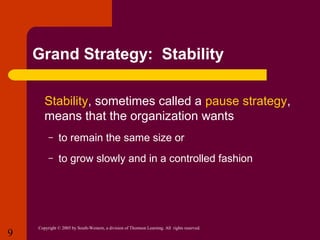
Grand Strategy: Stability
 Stability,

sometimes called a pause strategy,
means that the organization wants
–
–

9

to remain the same size or
to grow slowly and in a controlled fashion

Copyright © 2005 by South-Western, a division of Thomson Learning. All rights reserved.
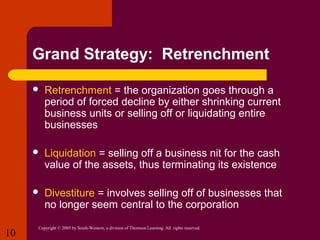
Grand Strategy: Retrenchment




Liquidation = selling off a business nit for the cash
value of the assets, thus terminating its existence



10

Retrenchment = the organization goes through a
period of forced decline by either shrinking current
business units or selling off or liquidating entire
businesses

Divestiture = involves selling off of businesses that
no longer seem central to the corporation

Copyright © 2005 by South-Western, a division of Thomson Learning. All rights reserved.
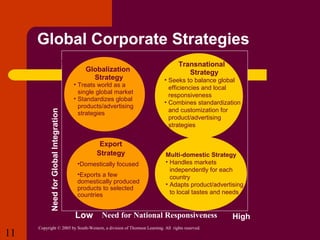
Global Corporate Strategies

Need for Global Integration

High

Low

11

Globalization
Strategy

• Treats world as a
single global market
• Standardizes global
products/advertising
strategies

Export
Strategy
•Domestically focused
•Exports a few
domestically produced
products to selected
countries

Transnational
Strategy
• Seeks to balance global
efficiencies and local
responsiveness
• Combines standardization
and customization for
product/advertising
strategies

Multi-domestic Strategy
• Handles markets
independently for each
country
• Adapts product/advertising
to local tastes and needs

Low Need for National Responsiveness

Copyright © 2005 by South-Western, a division of Thomson Learning. All rights reserved.

High
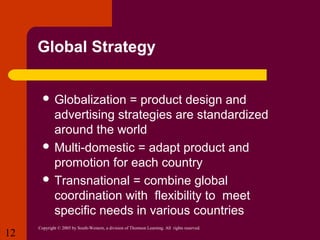
Global Strategy
 Globalization

= product design and
advertising strategies are standardized
around the world
 Multi-domestic = adapt product and
promotion for each country
 Transnational = combine global
coordination with flexibility to meet
specific needs in various countries
12

Copyright © 2005 by South-Western, a division of Thomson Learning. All rights reserved.
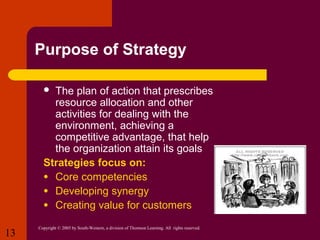
Purpose of Strategy
The plan of action that prescribes
resource allocation and other
activities for dealing with the
environment, achieving a
competitive advantage, that help
the organization attain its goals
Strategies focus on:
● Core competencies
● Developing synergy
● Creating value for customers


13

Copyright © 2005 by South-Western, a division of Thomson Learning. All rights reserved.
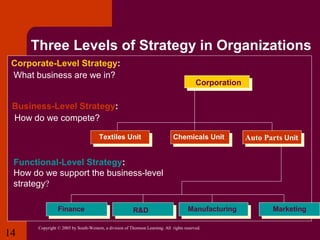
Three Levels of Strategy in Organizations
Corporate-Level Strategy:
What business are we in?

Corporation

Business-Level Strategy:
How do we compete?
Textiles Unit

Chemicals Unit

Auto Parts Unit

Functional-Level Strategy:
How do we support the business-level
strategy?
Finance

14

R&D

Manufacturing

Copyright © 2005 by South-Western, a division of Thomson Learning. All rights reserved.

Marketing
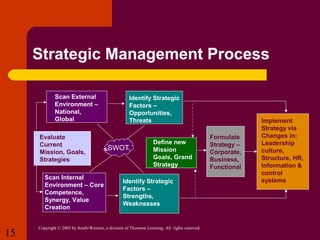
Strategic Management Process
Scan External
Environment –
National,
Global
Evaluate
Current
Mission, Goals,
Strategies
Scan Internal
Environment – Core
Competence,
Synergy, Value
Creation

15

Identify Strategic
Factors –
Opportunities,
Threats

SWOT

Define new
Mission
Goals, Grand
Strategy

Identify Strategic
Factors –
Strengths,
Weaknesses

Copyright © 2005 by South-Western, a division of Thomson Learning. All rights reserved.

Formulate
Strategy –
Corporate,
Business,
Functional

Implement
Strategy via
Changes in:
Leadership
culture,
Structure, HR,
Information &
control
systems
Strategy Formulation vs.
Implementation


Strategy Formulation = stage of strategic
management that involves planning and decision
making that lead to the establishment of the
organization’s goals and of a specific strategic plan



Strategy Implementation = stage of strategic
management that involves the use of managerial
and organizational tools to direct resources toward
achieving strategic outcomes
Experiential Exercise: Developing Strategy for a Small Business

16

Copyright © 2005 by South-Western, a division of Thomson Learning. All rights reserved.
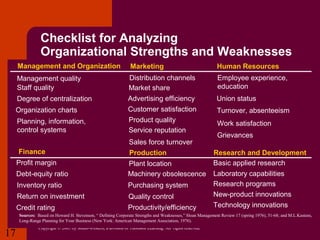
Checklist for Analyzing
Organizational Strengths and Weaknesses
Management and Organization

Marketing

Planning, information,
control systems

Distribution channels
Market share
Advertising efficiency
Customer satisfaction
Product quality
Service reputation

Finance

Sales force turnover
Production

Management quality
Staff quality
Degree of centralization
Organization charts

Profit margin
Debt-equity ratio

Plant location
Machinery obsolescence

Inventory ratio

Purchasing system

Return on investment

Quality control

Credit rating

Productivity/efficiency

Human Resources
Employee experience,
education
Union status
Turnover, absenteeism
Work satisfaction
Grievances
Research and Development
Basic applied research
Laboratory capabilities
Research programs
New-product innovations
Technology innovations

Sources: Based on Howard H. Stevenson, “ Defining Corporate Strengths and Weaknesses,” Sloan Management Review 17 (spring 1976), 51-68; and M.L.Kastens,
Long-Range Planning for Your Business (New York: American Management Association, 1976).

17

Copyright © 2005 by South-Western, a division of Thomson Learning. All rights reserved.
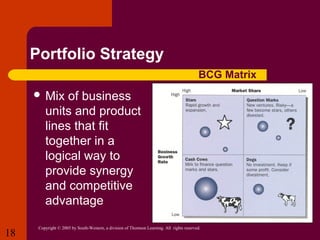
Portfolio Strategy
BCG Matrix
 Mix

of business
units and product
lines that fit
together in a
logical way to
provide synergy
and competitive
advantage

18

Copyright © 2005 by South-Western, a division of Thomson Learning. All rights reserved.
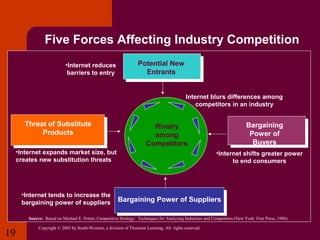
Five Forces Affecting Industry Competition
•Internet reduces
barriers to entry

Potential New
Entrants
Internet blurs differences among
competitors in an industry

Threat of Substitute
Products
•Internet expands market size, but
creates new substitution threats

•Internet tends to increase the
bargaining power of suppliers

Bargaining
Power of
Buyers

Rivalry
among
Competitors

•Internet shifts greater power
to end consumers

Bargaining Power of Suppliers

Source: Based on Michael E. Porter, Competitive Strategy: Techniques for Analyzing Industries and Competitors (New York: Free Press, 1980).

19

Copyright © 2005 by South-Western, a division of Thomson Learning. All rights reserved.
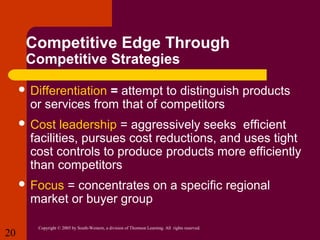
Competitive Edge Through
Competitive Strategies
 Differentiation

= attempt to distinguish products
or services from that of competitors

 Cost

leadership = aggressively seeks efficient
facilities, pursues cost reductions, and uses tight
cost controls to produce products more efficiently
than competitors

 Focus

= concentrates on a specific regional
market or buyer group

20

Copyright © 2005 by South-Western, a division of Thomson Learning. All rights reserved.
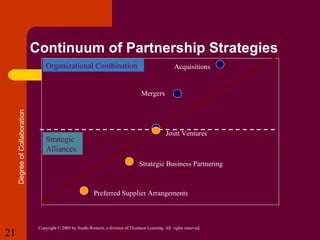
Continuum of Partnership Strategies
Organizational Combination

Acquisitions

Degree of Collaboration

Mergers

Strategic
Alliances

Joint Ventures

Strategic Business Partnering

Preferred Supplier Arrangements
Low

21

Degree of Collaboration

Copyright © 2005 by South-Western, a division of Thomson Learning. All rights reserved.

High
Implementing Strategy Tools
 Leadership
 Structural

design
 Information and control systems
 Human resources

22

Copyright © 2005 by South-Western, a division of Thomson Learning. All rights reserved.
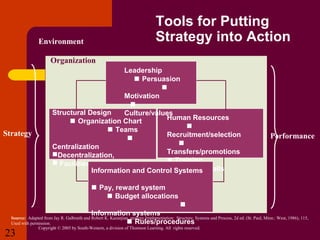
Tools for Putting
Strategy into Action

Environment
Organization

Strategy

Leadership
 Persuasion

Motivation

Structural Design
Culture/values
Human Resources
 Organization Chart

 Teams
Recruitment/selection


Centralization
Transfers/promotions
Decentralization,
 Training
 Facilities, task design
 Layoffs/recalls
Information and Control Systems

Performance

 Pay, reward system
 Budget allocations

Information systems
 Rules/procedures

Source: Adapted from Jay R. Galbraith and Robert K. Kazanjian, strategy Implementation: Structure, Systems and Process, 2d ed. (St. Paul, Minn.: West, 1986), 115,
Used with permission.
Copyright © 2005 by South-Western, a division of Thomson Learning. All rights reserved.

23

Ch 08

  • 1.
  • 2.
    Strategic Planning  Strategic planninghas taken on new importance in today’s world of globalization, deregulation, advancing technology, and changing demographics, and lifestyles 2 Copyright © 2005 by South-Western, a division of Thomson Learning. All rights reserved. Manager’s Challenge: Nintendo
  • 3.
    Strategy Formulation and Implementation Strategic – – – – Management Definition Components Model of Strategic Management Process Models of Strategy Formation  Managerial Tools to Implement Strategic Plans 3 Topics: Chapter 8 Copyright © 2005 by South-Western, a division of Thomson Learning. All rights reserved.
  • 4.
    Thinking Strategically      4 Answers tothe following define an overall direction for the organization's grand strategy Where is the organization now? Where does the organization want to be? What changes are among competitors? What courses of action will help us achieve our goals? Copyright © 2005 by South-Western, a division of Thomson Learning. All rights reserved.
  • 5.
    Strategic Management  Set ofdecisions and actions used to implement strategies that will provide a competitively superior fit between the organization and its environment so as to achieve organizational goals  Responsibility 5 = top managers & chief executive Copyright © 2005 by South-Western, a division of Thomson Learning. All rights reserved.
  • 6.
    Strategic Management Managers asksuch questions as... What changes and trends are occurring?  Who are our customers?  What products or services should we offer?  How can we offer these products or services most efficiently?  6 Copyright © 2005 by South-Western, a division of Thomson Learning. All rights reserved.
  • 7.
    Grand Strategy General planof major action to achieve long-term goals  Falls into three general categories A separate grand 1. Growth strategy can be 2. Stability defined for global 3. Retrenchment operations  Ethical Dilemma: A Great Deal for Whom? 7 Copyright © 2005 by South-Western, a division of Thomson Learning. All rights reserved.
  • 8.
    Grand Strategy: Growth Growth can be promoted internally by investing in expansion or externally by acquiring additional business divisions - 8 Internal growth = can include development of new or changed products External growth = typically involves diversification – businesses related to current product lines or into new areas Copyright © 2005 by South-Western, a division of Thomson Learning. All rights reserved.
  • 9.
    Grand Strategy: Stability Stability, sometimes called a pause strategy, means that the organization wants – – 9 to remain the same size or to grow slowly and in a controlled fashion Copyright © 2005 by South-Western, a division of Thomson Learning. All rights reserved.
  • 10.
    Grand Strategy: Retrenchment   Liquidation= selling off a business nit for the cash value of the assets, thus terminating its existence  10 Retrenchment = the organization goes through a period of forced decline by either shrinking current business units or selling off or liquidating entire businesses Divestiture = involves selling off of businesses that no longer seem central to the corporation Copyright © 2005 by South-Western, a division of Thomson Learning. All rights reserved.
  • 11.
    Global Corporate Strategies Needfor Global Integration High Low 11 Globalization Strategy • Treats world as a single global market • Standardizes global products/advertising strategies Export Strategy •Domestically focused •Exports a few domestically produced products to selected countries Transnational Strategy • Seeks to balance global efficiencies and local responsiveness • Combines standardization and customization for product/advertising strategies Multi-domestic Strategy • Handles markets independently for each country • Adapts product/advertising to local tastes and needs Low Need for National Responsiveness Copyright © 2005 by South-Western, a division of Thomson Learning. All rights reserved. High
  • 12.
    Global Strategy  Globalization =product design and advertising strategies are standardized around the world  Multi-domestic = adapt product and promotion for each country  Transnational = combine global coordination with flexibility to meet specific needs in various countries 12 Copyright © 2005 by South-Western, a division of Thomson Learning. All rights reserved.
  • 13.
    Purpose of Strategy Theplan of action that prescribes resource allocation and other activities for dealing with the environment, achieving a competitive advantage, that help the organization attain its goals Strategies focus on: ● Core competencies ● Developing synergy ● Creating value for customers  13 Copyright © 2005 by South-Western, a division of Thomson Learning. All rights reserved.
  • 14.
    Three Levels ofStrategy in Organizations Corporate-Level Strategy: What business are we in? Corporation Business-Level Strategy: How do we compete? Textiles Unit Chemicals Unit Auto Parts Unit Functional-Level Strategy: How do we support the business-level strategy? Finance 14 R&D Manufacturing Copyright © 2005 by South-Western, a division of Thomson Learning. All rights reserved. Marketing
  • 15.
    Strategic Management Process ScanExternal Environment – National, Global Evaluate Current Mission, Goals, Strategies Scan Internal Environment – Core Competence, Synergy, Value Creation 15 Identify Strategic Factors – Opportunities, Threats SWOT Define new Mission Goals, Grand Strategy Identify Strategic Factors – Strengths, Weaknesses Copyright © 2005 by South-Western, a division of Thomson Learning. All rights reserved. Formulate Strategy – Corporate, Business, Functional Implement Strategy via Changes in: Leadership culture, Structure, HR, Information & control systems
  • 16.
    Strategy Formulation vs. Implementation  StrategyFormulation = stage of strategic management that involves planning and decision making that lead to the establishment of the organization’s goals and of a specific strategic plan  Strategy Implementation = stage of strategic management that involves the use of managerial and organizational tools to direct resources toward achieving strategic outcomes Experiential Exercise: Developing Strategy for a Small Business 16 Copyright © 2005 by South-Western, a division of Thomson Learning. All rights reserved.
  • 17.
    Checklist for Analyzing OrganizationalStrengths and Weaknesses Management and Organization Marketing Planning, information, control systems Distribution channels Market share Advertising efficiency Customer satisfaction Product quality Service reputation Finance Sales force turnover Production Management quality Staff quality Degree of centralization Organization charts Profit margin Debt-equity ratio Plant location Machinery obsolescence Inventory ratio Purchasing system Return on investment Quality control Credit rating Productivity/efficiency Human Resources Employee experience, education Union status Turnover, absenteeism Work satisfaction Grievances Research and Development Basic applied research Laboratory capabilities Research programs New-product innovations Technology innovations Sources: Based on Howard H. Stevenson, “ Defining Corporate Strengths and Weaknesses,” Sloan Management Review 17 (spring 1976), 51-68; and M.L.Kastens, Long-Range Planning for Your Business (New York: American Management Association, 1976). 17 Copyright © 2005 by South-Western, a division of Thomson Learning. All rights reserved.
  • 18.
    Portfolio Strategy BCG Matrix Mix of business units and product lines that fit together in a logical way to provide synergy and competitive advantage 18 Copyright © 2005 by South-Western, a division of Thomson Learning. All rights reserved.
  • 19.
    Five Forces AffectingIndustry Competition •Internet reduces barriers to entry Potential New Entrants Internet blurs differences among competitors in an industry Threat of Substitute Products •Internet expands market size, but creates new substitution threats •Internet tends to increase the bargaining power of suppliers Bargaining Power of Buyers Rivalry among Competitors •Internet shifts greater power to end consumers Bargaining Power of Suppliers Source: Based on Michael E. Porter, Competitive Strategy: Techniques for Analyzing Industries and Competitors (New York: Free Press, 1980). 19 Copyright © 2005 by South-Western, a division of Thomson Learning. All rights reserved.
  • 20.
    Competitive Edge Through CompetitiveStrategies  Differentiation = attempt to distinguish products or services from that of competitors  Cost leadership = aggressively seeks efficient facilities, pursues cost reductions, and uses tight cost controls to produce products more efficiently than competitors  Focus = concentrates on a specific regional market or buyer group 20 Copyright © 2005 by South-Western, a division of Thomson Learning. All rights reserved.
  • 21.
    Continuum of PartnershipStrategies Organizational Combination Acquisitions Degree of Collaboration Mergers Strategic Alliances Joint Ventures Strategic Business Partnering Preferred Supplier Arrangements Low 21 Degree of Collaboration Copyright © 2005 by South-Western, a division of Thomson Learning. All rights reserved. High
  • 22.
    Implementing Strategy Tools Leadership  Structural design  Information and control systems  Human resources 22 Copyright © 2005 by South-Western, a division of Thomson Learning. All rights reserved.
  • 23.
    Tools for Putting Strategyinto Action Environment Organization Strategy Leadership  Persuasion  Motivation  Structural Design Culture/values Human Resources  Organization Chart   Teams Recruitment/selection   Centralization Transfers/promotions Decentralization,  Training  Facilities, task design  Layoffs/recalls Information and Control Systems Performance  Pay, reward system  Budget allocations  Information systems  Rules/procedures Source: Adapted from Jay R. Galbraith and Robert K. Kazanjian, strategy Implementation: Structure, Systems and Process, 2d ed. (St. Paul, Minn.: West, 1986), 115, Used with permission. Copyright © 2005 by South-Western, a division of Thomson Learning. All rights reserved. 23

Editor's Notes