A Strategic Business Imperative Cypress Management Group Corporation Victor Brown Managing Partner/Enterprise Architect 02/28/10 Managing Master Data  © 2009 CMGC
What if you could …  Find all of the data relevant to a Customer in one place Be confident that the data is accurate and up to date Be confident that the data is complete Retrieve all of the significant relationships that a Customer has with other business entities—Marketing, Support, Finance Send automated alerts when key Customer data changes See/access data and relationships at any “point in time” Rely on the availability of the data (managed, high-availability platform) And … 02/28/10 Managing Master Data  © 2009 CMGC
And, what if you could …  Create a view like this with a single call to a federated data service 02/28/10 Managing Master Data  © 2009 CMGC
Challenges No trusted “Single Version of the Truth” Multiple Systems of Entry (SOE)  Inconsistent data—value may vary depending on the source Poor quality—data may be incorrect, stale or missing Data stovepipes—separate versions of data maintained in “local” applications Full, accurate representation of global relationships between entities No comprehensive 360   view of key business entities Customers Branch Offices 02/28/10 Managing Master Data  © 2009 CMGC
Goals Consistent, Accurate and Timely Enterprise Master Data Maximize benefits of accurate master data across the Enterprise Improve operational integrity and agility Define a roadmap to the optimal/target state Protect current investments Information as a Service (IaaS) implemented via data services Define process for eliciting global adoption of MDM and data services 02/28/10 Managing Master Data  © 2009 CMGC
Prerequisites Identify Preliminary Master Data Domains High-level business entities Candidates for initial implementation (roadmap) Understand how data will be used Use Cases Styles of use Collaboration Operations Analytics All of the above Create/implement metadata strategy Identify source systems Within a data domain, is there an authoritative source? Multiple sources? Identify consumers Rationalize semantics Select appropriate MDM pattern(s) Map pattern to business model/requirements Employ multiple patterns when appropriate 02/28/10 Managing Master Data  © 2009 CMGC
MDM Services Interface Services  (DVL) Data Quality Management Event Management Lifecycle Management Hierarchy and Relationship Management Security & Privacy Search Logging Master Data History Data MetaData Identifies events that happen in the MDM system and triggers a response Hierarchies consist of master data entities that can logically be structured into parent–child relationships.  Relationship Services manage groupings between master data entities within the same domain and relationships across master data domains. Security Services authorize access for users and groups to request Lifecycle Management and Search Services. Search Services are requested by Lifecycle Management Inquiry Services and MDM Data Quality Management Services, or by an application or user interface. Lifecycle Management Services provide business and information services to create, access, and manage master data   held within the Master Data Repository. Data Quality Services manage data quality, standardize data, determine duplicate master data entities, and maintain cross-reference information.  ID Management ID Management ensures consistent identification of entities in a data domain, e.g., Customer. Database that contains CI’s master data content. This database may be external from the MDM tool’s internal data repository. Data Virtualization (data services) provides data to consumers via a Web service  interface or a virtual database interface.  Contains a record of every change to the Master data. Updated by the Logging service. Logging Services record transaction history, event history, and the changes that have been made to master data at that point in time. Illustrates functions required for a robust MDM solution. 02/28/10 Managing Master Data  © 2009 CMGC MDM  Repository
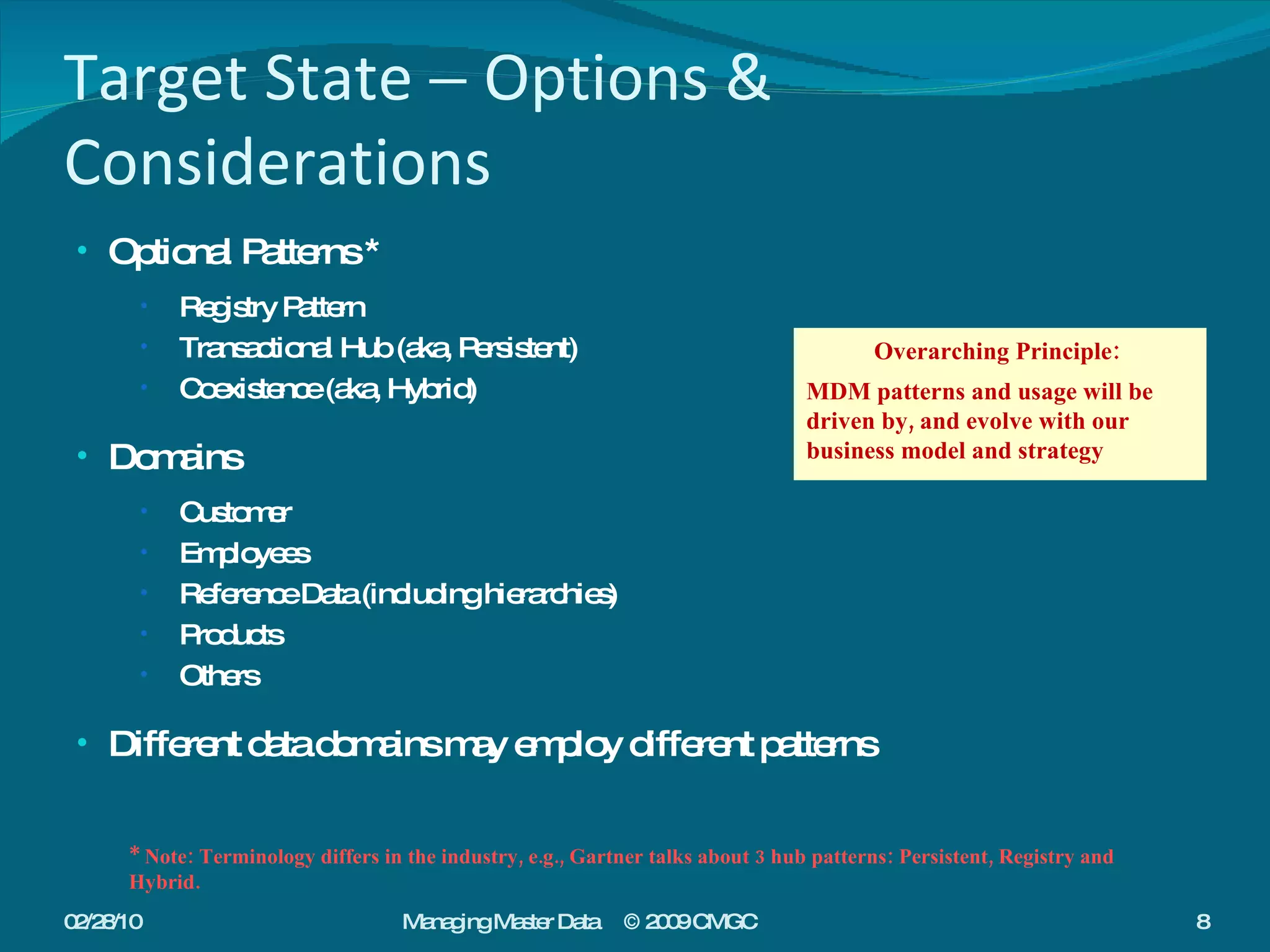
Target State    Options & Considerations Optional Patterns * Registry Pattern Transactional Hub (aka, Persistent) Coexistence (aka, Hybrid) Domains Customer Employees Reference Data (including hierarchies) Products Others Different data domains may employ different patterns Overarching Principle:  MDM patterns and usage will be driven by, and evolve with our business model and strategy * Note: Terminology differs in the industry, e.g., Gartner talks about 3 hub patterns: Persistent, Registry and Hybrid. 02/28/10 Managing Master Data  © 2009 CMGC
Registry Pattern Characteristics Reference system Read-only reference data for downstream consumers Minimum data redundancy Source systems provide data-of-record Cleans/matches source systems’ identifying information Benefits Federates multiple sources of data Source data is always current (but not necessarily consistent) Relatively quick and easy to implement Cons Does not ensure quality (except for ID data) Depends on source systems to ensure quality Authoritative only for ID data Cannot guarantee SLA — source systems availability and performance dictate MDM SLA 02/28/10 Managing Master Data  © 2009 CMGC
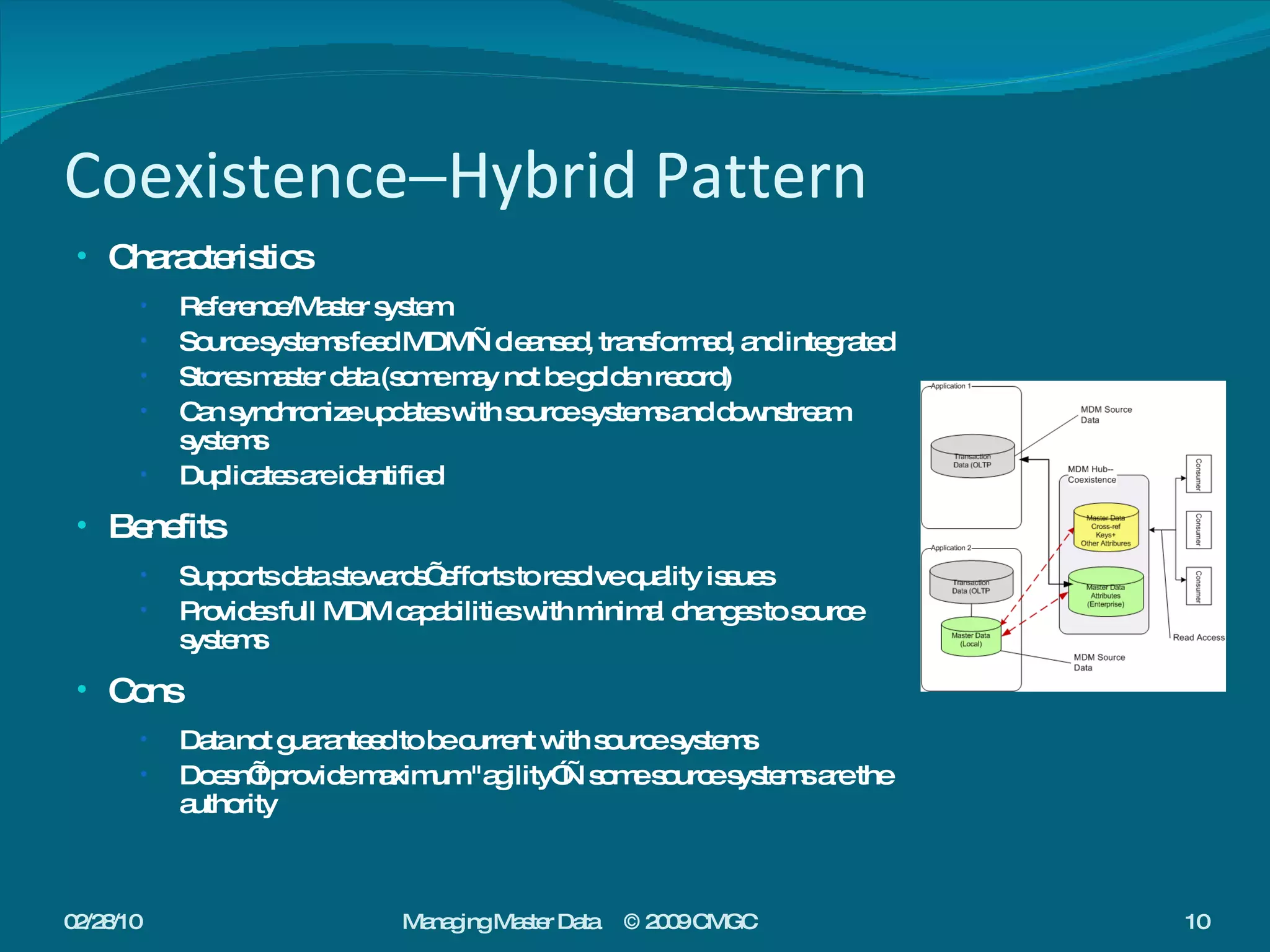
Coexistence  Hybrid Pattern Characteristics Reference/Master system Source systems feed MDM—cleansed, transformed, and integrated Stores master data (some may not be golden record) Can synchronize updates with source systems and downstream systems Duplicates are identified Benefits Supports data stewards’ efforts to resolve quality issues Provides full MDM capabilities with minimal changes to source systems Cons Data not guaranteed to be current with source systems Doesn’t provide maximum "agility”—some source systems are the authority 02/28/10 Managing Master Data  © 2009 CMGC
Transactional Pattern Characteristics Centralized single version of the truth (golden record) Operational component of the IT infrastructure Supports Operations, Collaboration, and Analytical Updates directly to MDM via services Serves as a component of the EDW (dimensions) Can provide augmented data, not present in sources Benefits Single authoritative data Enforces data quality and consistency Data is current (updates are direct) Governance and security — e. g., access, audits, attribute-level Cons Cost and challenges to implement because source systems must be modified to update MDM (possible mitigations include incremental implementation, mixed styles, hybrids) Operational SLAs –— availability, performance, etc. 02/28/10 Managing Master Data  © 2009 CMGC
Conclusion & Best Practice Each MDM pattern has strengths and weaknesses and must be coordinated with the enterprise data strategy Optimal leverage of MDM typically involves a combination of patterns Selection of the best pattern for each scenario requires business involvement and sponsorship Implement in an iterative process Clearly define the business case for each iteration 02/28/10 Managing Master Data  © 2009 CMGC
Our Roadmap (General Approach) Target State 1 Registry Pattern Investment to establish platform (H/W, S/W) Extend to provide data federation (Beneficiary) Target State 2 —Hybrid/ Transactional Hub Evolve from Registry to Coexistence Pattern Begin converting selected data domains to Transactional End state is a hybrid (multi-form) pattern that uses all three patterns Evolutionary adoption  Controls risk Provides the opportunity to learn through experience and adjust as necessary Provides early ROI 02/28/10 Managing Master Data  © 2009 CMGC
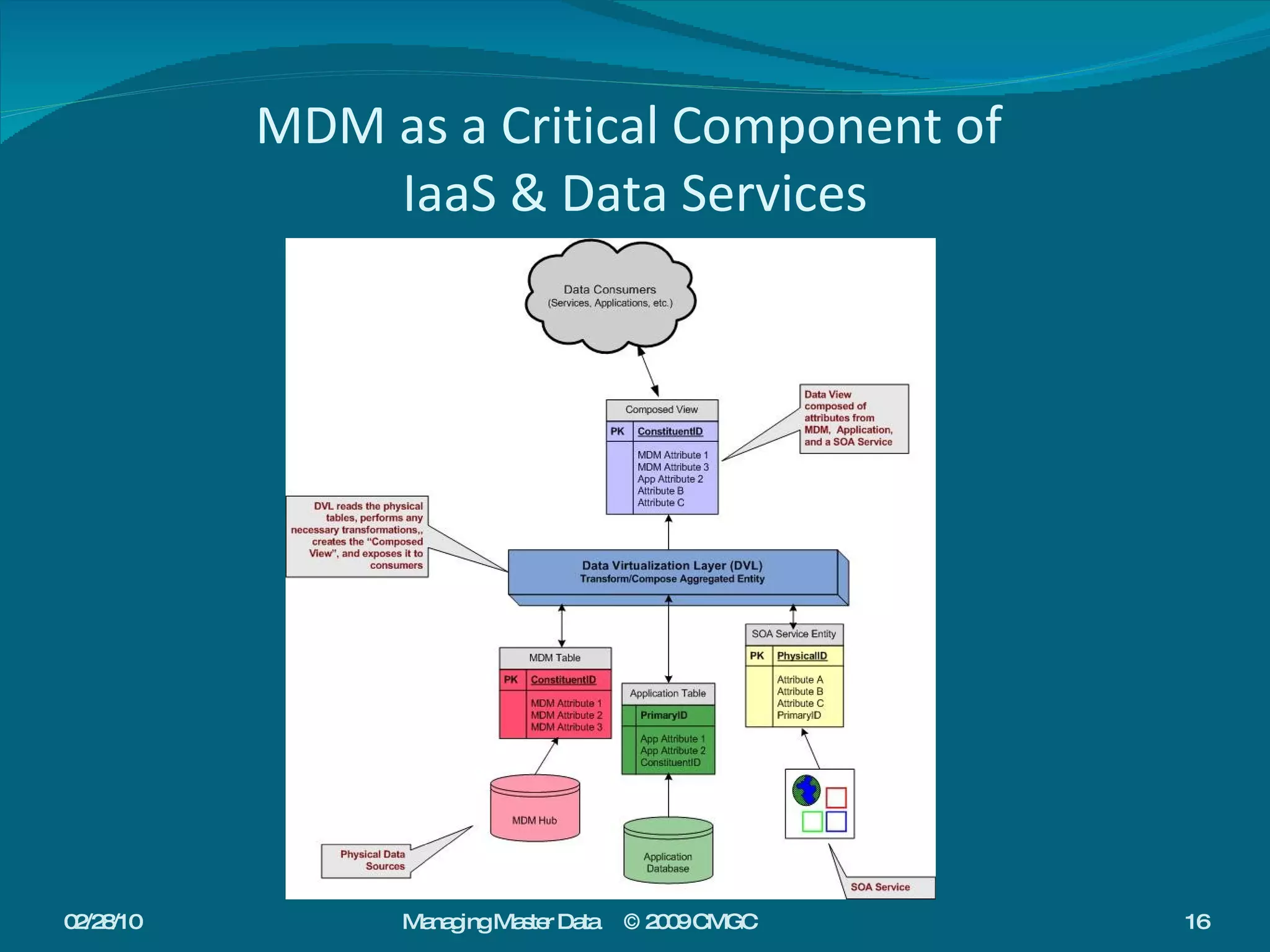
Supplementary Material This document presents definitions, benefits and implementation options for planning a Master Data Management (MDM) solution. MDM, however, is most effective when it is implemented as a component of a broader enterprise data services architecture. MDM works in concert with other architectural mechanisms    Enterprise Data Warehouse, data services and ODS    to provide a robust IaaS “cloud.” 02/28/10 Managing Master Data  © 2009 CMGC
MDM and Enterprise Data Warehouse MDM repository may extend and supplement the Enterprise Data Warehouse by providing dimensions 02/28/10 Managing Master Data  © 2009 CMGC
MDM as a Critical Component of  IaaS & Data Services 02/28/10 Managing Master Data  © 2009 CMGC
Contact Cypress Management Group Corporation www.cmgc.net Denver, Colorado San Francisco, California 877.408.5399 [email_address] Or Contact Victor Brown directly at 303.928.9198 415.516.1369 [email_address] 02/28/10 Managing Master Data  © 2009 CMGC

MDM Strategy & Roadmap

  • 1.
    A Strategic BusinessImperative Cypress Management Group Corporation Victor Brown Managing Partner/Enterprise Architect 02/28/10 Managing Master Data © 2009 CMGC
  • 2.
    What if youcould … Find all of the data relevant to a Customer in one place Be confident that the data is accurate and up to date Be confident that the data is complete Retrieve all of the significant relationships that a Customer has with other business entities—Marketing, Support, Finance Send automated alerts when key Customer data changes See/access data and relationships at any “point in time” Rely on the availability of the data (managed, high-availability platform) And … 02/28/10 Managing Master Data © 2009 CMGC
  • 3.
    And, what ifyou could … Create a view like this with a single call to a federated data service 02/28/10 Managing Master Data © 2009 CMGC
  • 4.
    Challenges No trusted“Single Version of the Truth” Multiple Systems of Entry (SOE) Inconsistent data—value may vary depending on the source Poor quality—data may be incorrect, stale or missing Data stovepipes—separate versions of data maintained in “local” applications Full, accurate representation of global relationships between entities No comprehensive 360  view of key business entities Customers Branch Offices 02/28/10 Managing Master Data © 2009 CMGC
  • 5.
    Goals Consistent, Accurateand Timely Enterprise Master Data Maximize benefits of accurate master data across the Enterprise Improve operational integrity and agility Define a roadmap to the optimal/target state Protect current investments Information as a Service (IaaS) implemented via data services Define process for eliciting global adoption of MDM and data services 02/28/10 Managing Master Data © 2009 CMGC
  • 6.
    Prerequisites Identify PreliminaryMaster Data Domains High-level business entities Candidates for initial implementation (roadmap) Understand how data will be used Use Cases Styles of use Collaboration Operations Analytics All of the above Create/implement metadata strategy Identify source systems Within a data domain, is there an authoritative source? Multiple sources? Identify consumers Rationalize semantics Select appropriate MDM pattern(s) Map pattern to business model/requirements Employ multiple patterns when appropriate 02/28/10 Managing Master Data © 2009 CMGC
  • 7.
    MDM Services InterfaceServices (DVL) Data Quality Management Event Management Lifecycle Management Hierarchy and Relationship Management Security & Privacy Search Logging Master Data History Data MetaData Identifies events that happen in the MDM system and triggers a response Hierarchies consist of master data entities that can logically be structured into parent–child relationships. Relationship Services manage groupings between master data entities within the same domain and relationships across master data domains. Security Services authorize access for users and groups to request Lifecycle Management and Search Services. Search Services are requested by Lifecycle Management Inquiry Services and MDM Data Quality Management Services, or by an application or user interface. Lifecycle Management Services provide business and information services to create, access, and manage master data held within the Master Data Repository. Data Quality Services manage data quality, standardize data, determine duplicate master data entities, and maintain cross-reference information. ID Management ID Management ensures consistent identification of entities in a data domain, e.g., Customer. Database that contains CI’s master data content. This database may be external from the MDM tool’s internal data repository. Data Virtualization (data services) provides data to consumers via a Web service interface or a virtual database interface. Contains a record of every change to the Master data. Updated by the Logging service. Logging Services record transaction history, event history, and the changes that have been made to master data at that point in time. Illustrates functions required for a robust MDM solution. 02/28/10 Managing Master Data © 2009 CMGC MDM Repository
  • 8.
    Target State  Options & Considerations Optional Patterns * Registry Pattern Transactional Hub (aka, Persistent) Coexistence (aka, Hybrid) Domains Customer Employees Reference Data (including hierarchies) Products Others Different data domains may employ different patterns Overarching Principle: MDM patterns and usage will be driven by, and evolve with our business model and strategy * Note: Terminology differs in the industry, e.g., Gartner talks about 3 hub patterns: Persistent, Registry and Hybrid. 02/28/10 Managing Master Data © 2009 CMGC
  • 9.
    Registry Pattern CharacteristicsReference system Read-only reference data for downstream consumers Minimum data redundancy Source systems provide data-of-record Cleans/matches source systems’ identifying information Benefits Federates multiple sources of data Source data is always current (but not necessarily consistent) Relatively quick and easy to implement Cons Does not ensure quality (except for ID data) Depends on source systems to ensure quality Authoritative only for ID data Cannot guarantee SLA — source systems availability and performance dictate MDM SLA 02/28/10 Managing Master Data © 2009 CMGC
  • 10.
    Coexistence  HybridPattern Characteristics Reference/Master system Source systems feed MDM—cleansed, transformed, and integrated Stores master data (some may not be golden record) Can synchronize updates with source systems and downstream systems Duplicates are identified Benefits Supports data stewards’ efforts to resolve quality issues Provides full MDM capabilities with minimal changes to source systems Cons Data not guaranteed to be current with source systems Doesn’t provide maximum "agility”—some source systems are the authority 02/28/10 Managing Master Data © 2009 CMGC
  • 11.
    Transactional Pattern CharacteristicsCentralized single version of the truth (golden record) Operational component of the IT infrastructure Supports Operations, Collaboration, and Analytical Updates directly to MDM via services Serves as a component of the EDW (dimensions) Can provide augmented data, not present in sources Benefits Single authoritative data Enforces data quality and consistency Data is current (updates are direct) Governance and security — e. g., access, audits, attribute-level Cons Cost and challenges to implement because source systems must be modified to update MDM (possible mitigations include incremental implementation, mixed styles, hybrids) Operational SLAs –— availability, performance, etc. 02/28/10 Managing Master Data © 2009 CMGC
  • 12.
    Conclusion & BestPractice Each MDM pattern has strengths and weaknesses and must be coordinated with the enterprise data strategy Optimal leverage of MDM typically involves a combination of patterns Selection of the best pattern for each scenario requires business involvement and sponsorship Implement in an iterative process Clearly define the business case for each iteration 02/28/10 Managing Master Data © 2009 CMGC
  • 13.
    Our Roadmap (GeneralApproach) Target State 1 Registry Pattern Investment to establish platform (H/W, S/W) Extend to provide data federation (Beneficiary) Target State 2 —Hybrid/ Transactional Hub Evolve from Registry to Coexistence Pattern Begin converting selected data domains to Transactional End state is a hybrid (multi-form) pattern that uses all three patterns Evolutionary adoption Controls risk Provides the opportunity to learn through experience and adjust as necessary Provides early ROI 02/28/10 Managing Master Data © 2009 CMGC
  • 14.
    Supplementary Material Thisdocument presents definitions, benefits and implementation options for planning a Master Data Management (MDM) solution. MDM, however, is most effective when it is implemented as a component of a broader enterprise data services architecture. MDM works in concert with other architectural mechanisms  Enterprise Data Warehouse, data services and ODS  to provide a robust IaaS “cloud.” 02/28/10 Managing Master Data © 2009 CMGC
  • 15.
    MDM and EnterpriseData Warehouse MDM repository may extend and supplement the Enterprise Data Warehouse by providing dimensions 02/28/10 Managing Master Data © 2009 CMGC
  • 16.
    MDM as aCritical Component of IaaS & Data Services 02/28/10 Managing Master Data © 2009 CMGC
  • 17.
    Contact Cypress ManagementGroup Corporation www.cmgc.net Denver, Colorado San Francisco, California 877.408.5399 [email_address] Or Contact Victor Brown directly at 303.928.9198 415.516.1369 [email_address] 02/28/10 Managing Master Data © 2009 CMGC