Hexaware is a leading global provider of IT and BPO services. The company has
achieved leadership position in domains such as Banking, Financial Services, Insur-
ance, Transportation, Logistics and HR-IT solutions, Hexaware focuses on delivering
business results leveraging technology solutions and specializes in Business Intelli-
gence & Analytics, Enterprise Applications, Independent Testing and Legacy Moderniza-
tion.
Hexaware has been providing business technology solutions for over 18 years and offers
world class service delivery, technology leadership and skilled human capital.


NA Headquarters         :    1095 Cranbury South River Road,
                             Suite 10, Jamesburn, NJ 08831
                             Main: 609-409-6950,
                             Fax: 609-409-6910

INDIA Headquarters      :    152, Sector - 3, Millennium Business Park
                             “A” Block, TTC Inductrial Area, Mahape,
                             Navi Mumbai - 400 710
                             Tel.: +91-22-67919595,
                             Fax: +91-22-67919500
                                                                                         Hexaware’s Q & A Guide to
EU Headquarters         :    4th Floor, Cornwall House, 55-57 High Street,               Master Data Management
                             Slough Berkshire SL1 1DZ, UK
                             Tele: +44(0)1753 217160,                                    Actionable Intelligence Enabled
                             Fax: +44(0)1753 217161

APAC Headquarters       :    180 Cecil Street,
                             #09-03, Bangkok Bank Building,
                             Singapore 069546
                             Tel.: +65-63253020
                                                                                         www.hexaware.com
                                                                                         Hexaware Technologies. All rights reserved.
01. What are the different types of data available in an organization?   1   Click


     02. What data should constitute master data?                             2   Click


     03. What is Master Data Management (MDM)?                                2   Click


     04. What are the key characteristics of MDM system?                      3   Click


     05. What is MDM hub?                                                     3   Click


     06. What are the different architecture styles of MDM hub systems?       5   Click


     07. What are the key benefits of implementing MDM?                       7   Click


     08. What is the difference between data warehouse and MDM?               7   Click


     09. How can data warehouse systems leverage MDM?                         9   Click


     10. What are the challenges in implementing MDM?                         9   Click


     11. Do leading Vendors support MDM?                                      10 Click


     12. Can MDM be implemented with Open Source?                             11 Click


www.hexaware.com
Hexaware Technologies. All rights reserved.
1       What are the different types of data available in an organization?                2    What data should constitute master data?

 Data available in an organization can be classified into five types:                       Master data are the core elements of the business that are applied to multiple
                                                                                            transactions and are used to categorize, aggregate, and evaluate the
 Unstructured – Data that cannot be organized into identifiable structure. E.g.             transaction data. Master data is not transaction data but is almost always
 emails, web pages, word processor documents etc.                                           involved with transactional data. For example: Consider a single transaction
                                                                                            "John Doe sold one laser printer, product number MX0315, from Scanners &
 Transactional – Data that forms the transactions processed by the operational              Printers product family for $90 on 12th December 2011". Master data
 systems of the enterprise, e.g. sales, trades, etc. Transactional data typically           elements in this transaction are Salesperson (John Doe), Product Group
 describes the activities or transactions of the business. Transactional data               (Scanners & Printers), Product (Laser Printer) and Product Number
 typically captures the verbs, such as sale, delivery, purchase, email, and                 (MX0315). It can be observed that Master data is synonymous to Dimensions
 revocation.                                                                                in a data warehouse.

 Metadata – Data that describes the data held in the enterprise information                       What is Master Data Management (MDM)?
                                                                                             3
 architecture, e.g. definitions of tables and columns in the system catalog of a
 database, or entities and attributes in a data model.
                                                                                            MDM is a set of tools, technology and processes required to create and
                                                                                            maintain master data. MDM ensures that an organization's critical information
 Hierarchical – Stores the relationships between data such as organizational
                                                                                            (customers, vendors, products, employees, locations) is uniquely identified,
 hierarchy, product lines etc.
                                                                                            accurately defined and consistently applied across that organization's
                                                                                            operational systems – spanning geographic, line-of-business, and application
 Master – Master data are the critical nouns of a business and fall generally
                                                                                            silo boundaries.
 into four groupings: people, things, places, and concepts. It should be the
 single trusted source of data that everyone in an enterprise relies on and uses.


www.hexaware.com
Hexaware Technologies. All rights reserved.                                         1   2
4       What are the key characteristics of MDM system?
                                                                                       CRM             ERP             SharePoint            HR              Finance
 A MDM system typically enables:

 Data Governance – It should provide robust security for the underlying
 models, define data governance policies and procedures, and support
 workflows to implement data governance policies.
                                                                                                                                                Master Data
                                                                                                            Web Services
 Metadata Management – MDM system should have the ability to manage                                                                            Syncronization
 business & process metadata.                                                         MDM Hub


 Data Repository – MDM system should have the ability to model entities,                                    Data Quality
 attributes, complex hierarchies and relationships among the entities.
                                                                                                                                              Metadata Store

 Data Integration – MDM system should integrate with both source and                                     Stewards hip and
                                                                                                                                                  Workflow
                                                                                                            Governance
 subscribing systems, ideally in both batch and real-time modes. It should
 support system of entry and system of record operations.
                                                                                                           Entity Version                    Hierarchy Version
                                                                                                               Control                            Control
 Data Quality – MDM system should have high data quality processes
 supporting standardization, de-duplication, match and merge etc.


   5       What is MDM hub?
                                                                                                        Entity Management                 Hierarchy Management

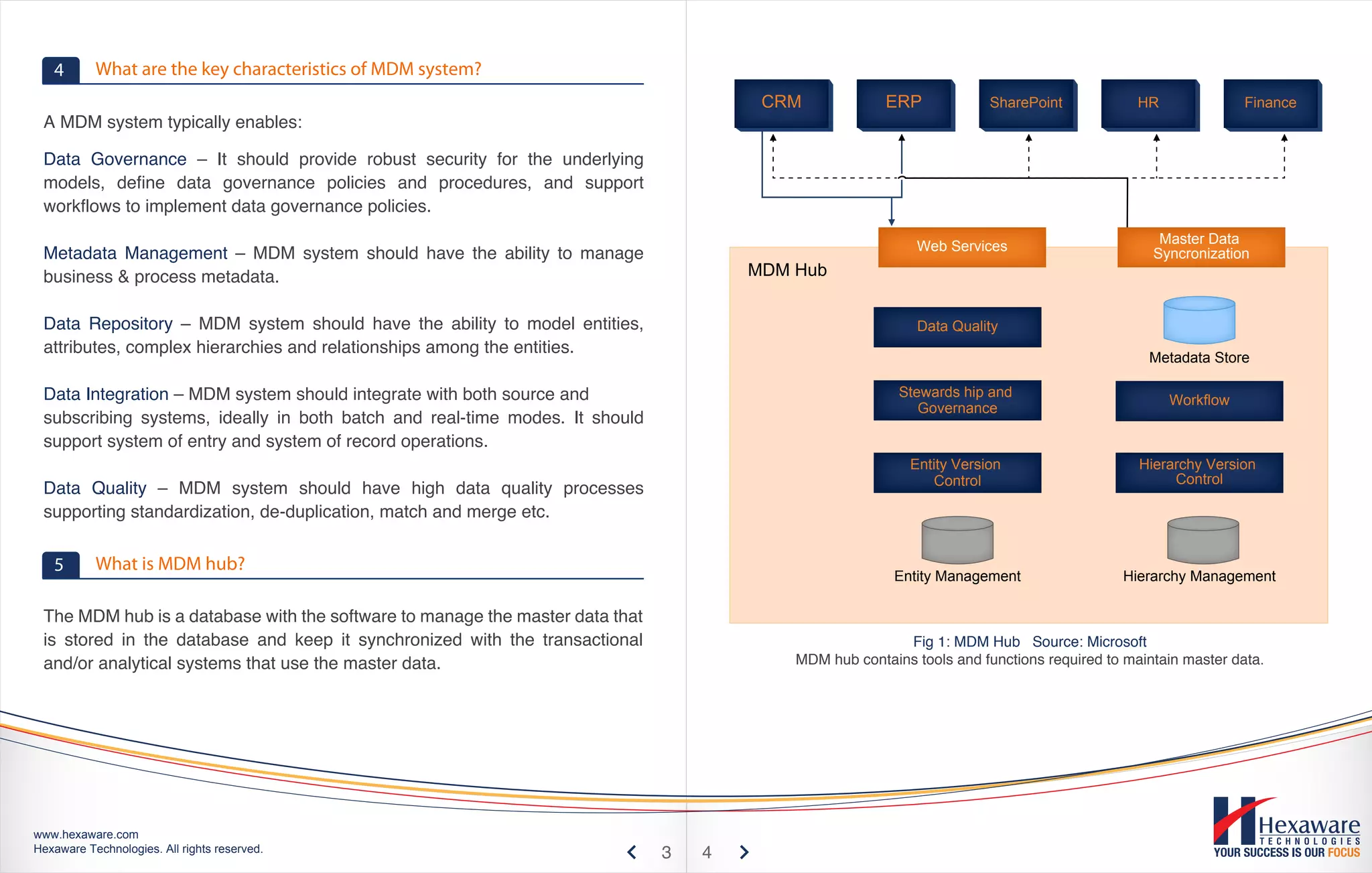
 The MDM hub is a database with the software to manage the master data that
 is stored in the database and keep it synchronized with the transactional                               Fig 1: MDM Hub Source: Microsoft
 and/or analytical systems that use the master data.                                      MDM hub contains tools and functions required to maintain master data.


www.hexaware.com
Hexaware Technologies. All rights reserved.                                   3   4
6       What are the different architecture styles of MDM hub systems?                   master entity in the MDM hub, so that a significant number of MDM queries
                                                                                            can be satisfied directly from the hub database, and only queries that refer-
 There are three basic architectures available namely Repository, Registry and              ence less-common attributes have to reference the
 Hybrid.                                                                                    application database.

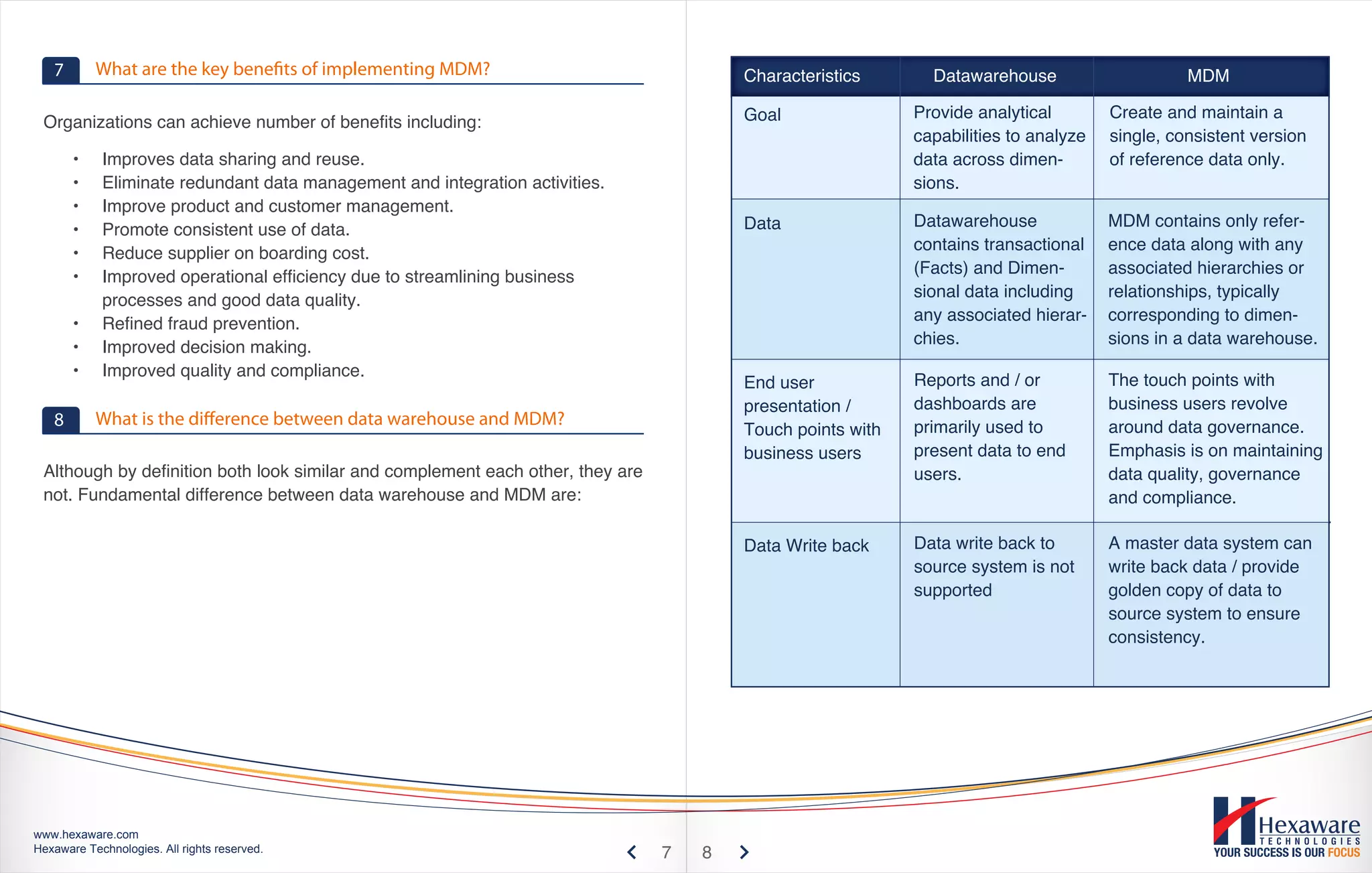
 Repository Model                                                                           Gartner has identified four different implementation styles for MDM based on
 Master data for an enterprise is stored in a single database. The repository               criteria like authoring sour ce, data persistence or storage, data latency etc.
 data model must include all the attributes required by all the applications that           This is depicted below:
 use the master data. The applications that consume, create, or maintain
 master data are all modified to use the master data in the hub, instead of the
 master data previously maintained in the application database. For example,
 the Order Entry and CRM applications would be modified to use the same set
 of customer tables in the master-data hub, instead of their own data stores.                                   Consolidation        Registry         Centralized        Coexistence

                                                                                              Author           Master Data       Author in          Author in Hub     Author anywhere
 Registry Model                                                                                                                  distributed
                                                                                                               authored in
 Registry model is opposite of repository model. Master data is maintained in                                  Operational       systems
 the application databases, and the MDM hub contains lists of keys that can be                                 Systems

 used to find all the related records for a particular master-data item. None of              Persistence      Hub stores a      Hub Stores index   Hub persists      Persist anywhere
                                                                                                               copy apart from   of master data     master data,
 the master-data records is stored in the MDM hub. For example, if there are                                                                        copies exist in
                                                                                                               author
 records for a particular customer in the CRM, Order Entry, and Customer Ser-                                                                       edges
 vice databases, the MDM hub would contain a mapping of the keys for these                                                       Hub is System      Hub is System     System of Refer-
                                                                                              Validation       Hub is System
 three records to a common key.                                                                                of Refrence       of Reference       of Record         ence / Record
 Hybrid Model
                                                                                              Consumer of      Downstream        Operational and    Upstream          Upstream
 As the name implies, the hybrid model includes features of both the repository               Master Data      Analytics and     Analytical         Operations        Operations
 and registry models. The hybrid model leaves the master-data records in the                                   Reporting
 application databases and maintains keys in the MDM hub, as the registry                     Data Latency     Batch to real     Batch to event     Real time         Publish / Subscribe,
 model does. But it also replicates the most important attributes for each                                     time              driven                               event-driven

                                                                                             Source: Gartner


www.hexaware.com
Hexaware Technologies. All rights reserved.                                         5   6
7       What are the key benefits of implementing MDM?                               Characteristics       Datawarehouse                     MDM

                                                                                        Goal                Provide analytical        Create and maintain a
 Organizations can achieve number of benefits including:
                                                                                                            capabilities to analyze   single, consistent version
       •    Improves data sharing and reuse.                                                                data across dimen-        of reference data only.
       •    Eliminate redundant data management and integration activities.                                 sions.
       •    Improve product and customer management.
       •    Promote consistent use of data.                                             Data                Datawarehouse             MDM contains only refer-
       •    Reduce supplier on boarding cost.                                                               contains transactional    ence data along with any
       •    Improved operational efficiency due to streamlining business                                    (Facts) and Dimen-        associated hierarchies or
            processes and good data quality.                                                                sional data including     relationships, typically
       •    Refined fraud prevention.                                                                       any associated hierar-    corresponding to dimen-
       •    Improved decision making.                                                                       chies.                    sions in a data warehouse.
       •    Improved quality and compliance.
                                                                                        End user            Reports and / or          The touch points with
                                                                                        presentation /      dashboards are            business users revolve
   8       What is the difference between data warehouse and MDM?                                           primarily used to         around data governance.
                                                                                        Touch points with
                                                                                        business users      present data to end       Emphasis is on maintaining
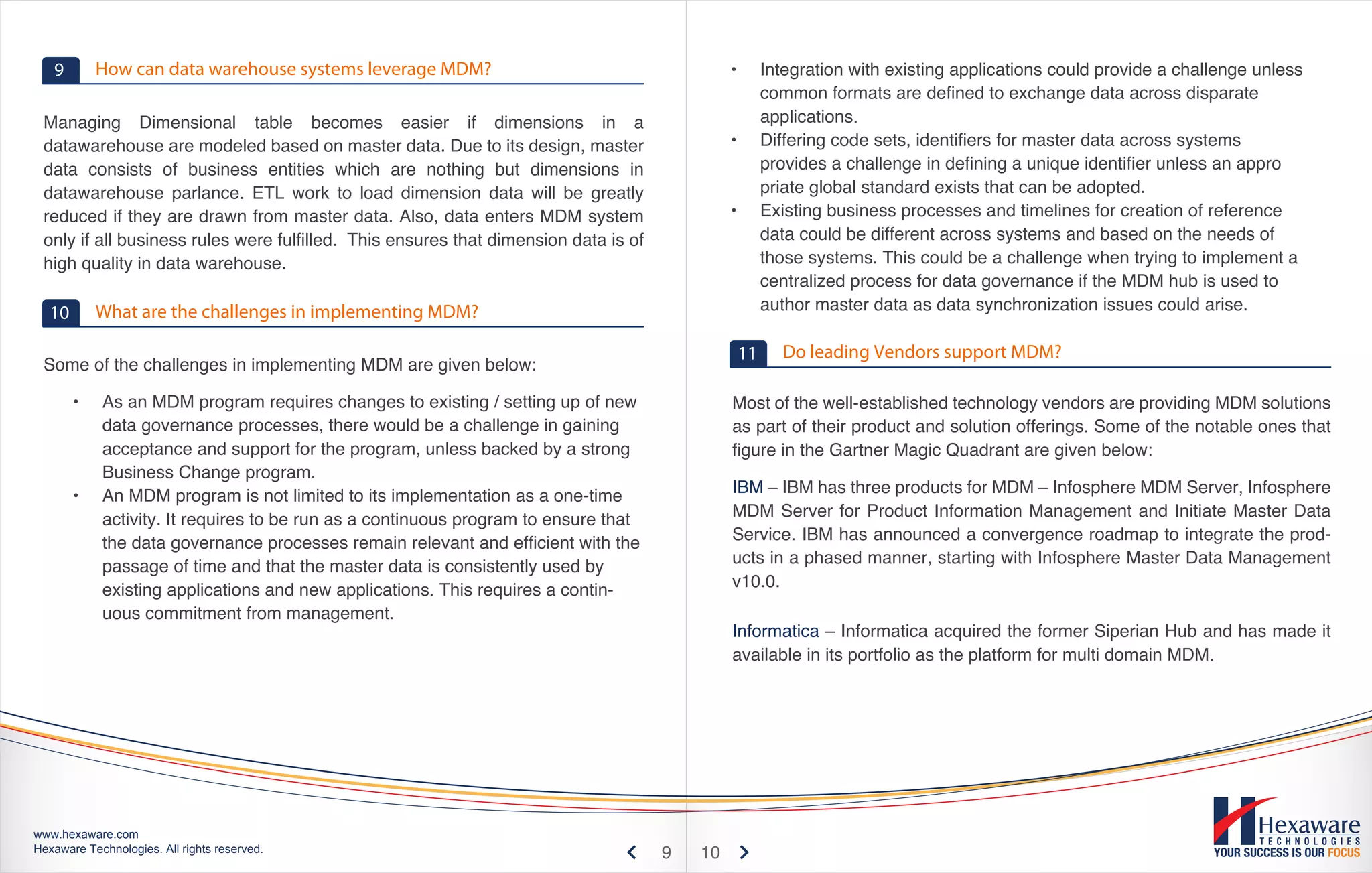
 Although by definition both look similar and complement each other, they are                               users.                    data quality, governance
 not. Fundamental difference between data warehouse and MDM are:                                                                      and compliance.

                                                                                        Data Write back     Data write back to        A master data system can
                                                                                                            source system is not      write back data / provide
                                                                                                            supported                 golden copy of data to
                                                                                                                                      source system to ensure
                                                                                                                                      consistency.


www.hexaware.com
Hexaware Technologies. All rights reserved.                                     7   8
9        How can data warehouse systems leverage MDM?                                      •        Integration with existing applications could provide a challenge unless
                                                                                                       common formats are defined to exchange data across disparate
 Managing Dimensional table becomes easier if dimensions in a                                          applications.
 datawarehouse are modeled based on master data. Due to its design, master                    •        Differing code sets, identifiers for master data across systems
 data consists of business entities which are nothing but dimensions in                                provides a challenge in defining a unique identifier unless an appro
 datawarehouse parlance. ETL work to load dimension data will be greatly                               priate global standard exists that can be adopted.
 reduced if they are drawn from master data. Also, data enters MDM system                     •        Existing business processes and timelines for creation of reference
 only if all business rules were fulfilled. This ensures that dimension data is of                     data could be different across systems and based on the needs of
 high quality in data warehouse.                                                                       those systems. This could be a challenge when trying to implement a
                                                                                                       centralized process for data governance if the MDM hub is used to
   10       What are the challenges in implementing MDM?                                               author master data as data synchronization issues could arise.

                                                                                                  11     Do leading Vendors support MDM?
 Some of the challenges in implementing MDM are given below:

        •   As an MDM program requires changes to existing / setting up of new                Most of the well-established technology vendors are providing MDM solutions
            data governance processes, there would be a challenge in gaining                  as part of their product and solution offerings. Some of the notable ones that
            acceptance and support for the program, unless backed by a strong                 figure in the Gartner Magic Quadrant are given below:
            Business Change program.
        •   An MDM program is not limited to its implementation as a one-time                 IBM – IBM has three products for MDM – Infosphere MDM Server, Infosphere
            activity. It requires to be run as a continuous program to ensure that            MDM Server for Product Information Management and Initiate Master Data
            the data governance processes remain relevant and efficient with the              Service. IBM has announced a convergence roadmap to integrate the prod-
            passage of time and that the master data is consistently used by                  ucts in a phased manner, starting with Infosphere Master Data Management
            existing applications and new applications. This requires a contin-               v10.0.
            uous commitment from management.
                                                                                              Informatica – Informatica acquired the former Siperian Hub and has made it
                                                                                              available in its portfolio as the platform for multi domain MDM.


www.hexaware.com
Hexaware Technologies. All rights reserved.                                          9   10
Oracle – Oracle has 3 products as part of its MDM portfolio – Oracle Fusion
 Customer Hub, Oracle CDH and Oracle Siebel UCM.
                                                                                            Business Intelligence & Analytics
   12      Can MDM be implemented with Open Source?
                                                                                             Our Business Intelligence & Analytics solutions help you transform
                                                                                             into a dynamic enterprise through actionable intelligence. We have
 Not many Open Source vendors exist in the MDM space. Talend, a global
                                                                                             more than 50 patent pending innovations which help you with faster
 company operating in the open source data integration space, has introduced
                                                                                             & efficient deployment & over 85 plus satisfied customers across
 an open source MDM as part of its portfolio. The product comes in 2 editions
                                                                                             diverse industries. From consulting, articulation and development, to
 – a community edition that is available at no charge and a licensed Enterprise
                                                                                             deployment and support, Hexaware can architect and implement
 edition.
                                                                                             data warehouses and BI systems, employing solution accelerators,
                                                                                             process frameworks and jumpstart analytical kits, for any part of your
                                                                                             business process.


                                                                                            Thank you for reading our E- Book, in case you have any queries
                                                                                            please write back to us at corporatemarketing@hexaware.com


                                                                                                     For more information on our BI&A services please visit us at
                                                                                                     http://hexaware.com/business-intelligence-analytics.htm


                                                                                            To keep up with the industry’s latest trends in BI/ DW please visit our
                                                                                            blogs @ http://blogs.hexaware.com/index/business-intelligence


www.hexaware.com
Hexaware Technologies. All rights reserved.                                       11   12

Ebook - The Guide to Master Data Management

  • 1.
    Hexaware is aleading global provider of IT and BPO services. The company has achieved leadership position in domains such as Banking, Financial Services, Insur- ance, Transportation, Logistics and HR-IT solutions, Hexaware focuses on delivering business results leveraging technology solutions and specializes in Business Intelli- gence & Analytics, Enterprise Applications, Independent Testing and Legacy Moderniza- tion. Hexaware has been providing business technology solutions for over 18 years and offers world class service delivery, technology leadership and skilled human capital. NA Headquarters : 1095 Cranbury South River Road, Suite 10, Jamesburn, NJ 08831 Main: 609-409-6950, Fax: 609-409-6910 INDIA Headquarters : 152, Sector - 3, Millennium Business Park “A” Block, TTC Inductrial Area, Mahape, Navi Mumbai - 400 710 Tel.: +91-22-67919595, Fax: +91-22-67919500 Hexaware’s Q & A Guide to EU Headquarters : 4th Floor, Cornwall House, 55-57 High Street, Master Data Management Slough Berkshire SL1 1DZ, UK Tele: +44(0)1753 217160, Actionable Intelligence Enabled Fax: +44(0)1753 217161 APAC Headquarters : 180 Cecil Street, #09-03, Bangkok Bank Building, Singapore 069546 Tel.: +65-63253020 www.hexaware.com Hexaware Technologies. All rights reserved.
  • 2.
    01. What arethe different types of data available in an organization? 1 Click 02. What data should constitute master data? 2 Click 03. What is Master Data Management (MDM)? 2 Click 04. What are the key characteristics of MDM system? 3 Click 05. What is MDM hub? 3 Click 06. What are the different architecture styles of MDM hub systems? 5 Click 07. What are the key benefits of implementing MDM? 7 Click 08. What is the difference between data warehouse and MDM? 7 Click 09. How can data warehouse systems leverage MDM? 9 Click 10. What are the challenges in implementing MDM? 9 Click 11. Do leading Vendors support MDM? 10 Click 12. Can MDM be implemented with Open Source? 11 Click www.hexaware.com Hexaware Technologies. All rights reserved.
  • 3.
    1 What are the different types of data available in an organization? 2 What data should constitute master data? Data available in an organization can be classified into five types: Master data are the core elements of the business that are applied to multiple transactions and are used to categorize, aggregate, and evaluate the Unstructured – Data that cannot be organized into identifiable structure. E.g. transaction data. Master data is not transaction data but is almost always emails, web pages, word processor documents etc. involved with transactional data. For example: Consider a single transaction "John Doe sold one laser printer, product number MX0315, from Scanners & Transactional – Data that forms the transactions processed by the operational Printers product family for $90 on 12th December 2011". Master data systems of the enterprise, e.g. sales, trades, etc. Transactional data typically elements in this transaction are Salesperson (John Doe), Product Group describes the activities or transactions of the business. Transactional data (Scanners & Printers), Product (Laser Printer) and Product Number typically captures the verbs, such as sale, delivery, purchase, email, and (MX0315). It can be observed that Master data is synonymous to Dimensions revocation. in a data warehouse. Metadata – Data that describes the data held in the enterprise information What is Master Data Management (MDM)? 3 architecture, e.g. definitions of tables and columns in the system catalog of a database, or entities and attributes in a data model. MDM is a set of tools, technology and processes required to create and maintain master data. MDM ensures that an organization's critical information Hierarchical – Stores the relationships between data such as organizational (customers, vendors, products, employees, locations) is uniquely identified, hierarchy, product lines etc. accurately defined and consistently applied across that organization's operational systems – spanning geographic, line-of-business, and application Master – Master data are the critical nouns of a business and fall generally silo boundaries. into four groupings: people, things, places, and concepts. It should be the single trusted source of data that everyone in an enterprise relies on and uses. www.hexaware.com Hexaware Technologies. All rights reserved. 1 2
  • 4.
    4 What are the key characteristics of MDM system? CRM ERP SharePoint HR Finance A MDM system typically enables: Data Governance – It should provide robust security for the underlying models, define data governance policies and procedures, and support workflows to implement data governance policies. Master Data Web Services Metadata Management – MDM system should have the ability to manage Syncronization business & process metadata. MDM Hub Data Repository – MDM system should have the ability to model entities, Data Quality attributes, complex hierarchies and relationships among the entities. Metadata Store Data Integration – MDM system should integrate with both source and Stewards hip and Workflow Governance subscribing systems, ideally in both batch and real-time modes. It should support system of entry and system of record operations. Entity Version Hierarchy Version Control Control Data Quality – MDM system should have high data quality processes supporting standardization, de-duplication, match and merge etc. 5 What is MDM hub? Entity Management Hierarchy Management The MDM hub is a database with the software to manage the master data that is stored in the database and keep it synchronized with the transactional Fig 1: MDM Hub Source: Microsoft and/or analytical systems that use the master data. MDM hub contains tools and functions required to maintain master data. www.hexaware.com Hexaware Technologies. All rights reserved. 3 4
  • 5.
    6 What are the different architecture styles of MDM hub systems? master entity in the MDM hub, so that a significant number of MDM queries can be satisfied directly from the hub database, and only queries that refer- There are three basic architectures available namely Repository, Registry and ence less-common attributes have to reference the Hybrid. application database. Repository Model Gartner has identified four different implementation styles for MDM based on Master data for an enterprise is stored in a single database. The repository criteria like authoring sour ce, data persistence or storage, data latency etc. data model must include all the attributes required by all the applications that This is depicted below: use the master data. The applications that consume, create, or maintain master data are all modified to use the master data in the hub, instead of the master data previously maintained in the application database. For example, the Order Entry and CRM applications would be modified to use the same set of customer tables in the master-data hub, instead of their own data stores. Consolidation Registry Centralized Coexistence Author Master Data Author in Author in Hub Author anywhere Registry Model distributed authored in Registry model is opposite of repository model. Master data is maintained in Operational systems the application databases, and the MDM hub contains lists of keys that can be Systems used to find all the related records for a particular master-data item. None of Persistence Hub stores a Hub Stores index Hub persists Persist anywhere copy apart from of master data master data, the master-data records is stored in the MDM hub. For example, if there are copies exist in author records for a particular customer in the CRM, Order Entry, and Customer Ser- edges vice databases, the MDM hub would contain a mapping of the keys for these Hub is System Hub is System System of Refer- Validation Hub is System three records to a common key. of Refrence of Reference of Record ence / Record Hybrid Model Consumer of Downstream Operational and Upstream Upstream As the name implies, the hybrid model includes features of both the repository Master Data Analytics and Analytical Operations Operations and registry models. The hybrid model leaves the master-data records in the Reporting application databases and maintains keys in the MDM hub, as the registry Data Latency Batch to real Batch to event Real time Publish / Subscribe, model does. But it also replicates the most important attributes for each time driven event-driven Source: Gartner www.hexaware.com Hexaware Technologies. All rights reserved. 5 6
  • 6.
    7 What are the key benefits of implementing MDM? Characteristics Datawarehouse MDM Goal Provide analytical Create and maintain a Organizations can achieve number of benefits including: capabilities to analyze single, consistent version • Improves data sharing and reuse. data across dimen- of reference data only. • Eliminate redundant data management and integration activities. sions. • Improve product and customer management. • Promote consistent use of data. Data Datawarehouse MDM contains only refer- • Reduce supplier on boarding cost. contains transactional ence data along with any • Improved operational efficiency due to streamlining business (Facts) and Dimen- associated hierarchies or processes and good data quality. sional data including relationships, typically • Refined fraud prevention. any associated hierar- corresponding to dimen- • Improved decision making. chies. sions in a data warehouse. • Improved quality and compliance. End user Reports and / or The touch points with presentation / dashboards are business users revolve 8 What is the difference between data warehouse and MDM? primarily used to around data governance. Touch points with business users present data to end Emphasis is on maintaining Although by definition both look similar and complement each other, they are users. data quality, governance not. Fundamental difference between data warehouse and MDM are: and compliance. Data Write back Data write back to A master data system can source system is not write back data / provide supported golden copy of data to source system to ensure consistency. www.hexaware.com Hexaware Technologies. All rights reserved. 7 8
  • 7.
    9 How can data warehouse systems leverage MDM? • Integration with existing applications could provide a challenge unless common formats are defined to exchange data across disparate Managing Dimensional table becomes easier if dimensions in a applications. datawarehouse are modeled based on master data. Due to its design, master • Differing code sets, identifiers for master data across systems data consists of business entities which are nothing but dimensions in provides a challenge in defining a unique identifier unless an appro datawarehouse parlance. ETL work to load dimension data will be greatly priate global standard exists that can be adopted. reduced if they are drawn from master data. Also, data enters MDM system • Existing business processes and timelines for creation of reference only if all business rules were fulfilled. This ensures that dimension data is of data could be different across systems and based on the needs of high quality in data warehouse. those systems. This could be a challenge when trying to implement a centralized process for data governance if the MDM hub is used to 10 What are the challenges in implementing MDM? author master data as data synchronization issues could arise. 11 Do leading Vendors support MDM? Some of the challenges in implementing MDM are given below: • As an MDM program requires changes to existing / setting up of new Most of the well-established technology vendors are providing MDM solutions data governance processes, there would be a challenge in gaining as part of their product and solution offerings. Some of the notable ones that acceptance and support for the program, unless backed by a strong figure in the Gartner Magic Quadrant are given below: Business Change program. • An MDM program is not limited to its implementation as a one-time IBM – IBM has three products for MDM – Infosphere MDM Server, Infosphere activity. It requires to be run as a continuous program to ensure that MDM Server for Product Information Management and Initiate Master Data the data governance processes remain relevant and efficient with the Service. IBM has announced a convergence roadmap to integrate the prod- passage of time and that the master data is consistently used by ucts in a phased manner, starting with Infosphere Master Data Management existing applications and new applications. This requires a contin- v10.0. uous commitment from management. Informatica – Informatica acquired the former Siperian Hub and has made it available in its portfolio as the platform for multi domain MDM. www.hexaware.com Hexaware Technologies. All rights reserved. 9 10
  • 8.
    Oracle – Oraclehas 3 products as part of its MDM portfolio – Oracle Fusion Customer Hub, Oracle CDH and Oracle Siebel UCM. Business Intelligence & Analytics 12 Can MDM be implemented with Open Source? Our Business Intelligence & Analytics solutions help you transform into a dynamic enterprise through actionable intelligence. We have Not many Open Source vendors exist in the MDM space. Talend, a global more than 50 patent pending innovations which help you with faster company operating in the open source data integration space, has introduced & efficient deployment & over 85 plus satisfied customers across an open source MDM as part of its portfolio. The product comes in 2 editions diverse industries. From consulting, articulation and development, to – a community edition that is available at no charge and a licensed Enterprise deployment and support, Hexaware can architect and implement edition. data warehouses and BI systems, employing solution accelerators, process frameworks and jumpstart analytical kits, for any part of your business process. Thank you for reading our E- Book, in case you have any queries please write back to us at corporatemarketing@hexaware.com For more information on our BI&A services please visit us at http://hexaware.com/business-intelligence-analytics.htm To keep up with the industry’s latest trends in BI/ DW please visit our blogs @ http://blogs.hexaware.com/index/business-intelligence www.hexaware.com Hexaware Technologies. All rights reserved. 11 12