Explaining Crime Classical-Neoclassical General Deterrence Rational Choice Routine Activity Positivist Social Disorganization Social Learning Neutralization Strain Control Other/Real World Application

Which do you agree with most?
Classical-Neoclassical
General Deterrence
General Deterrence Severity Exceed the amount of damage done to society Celerity Swiftness-promptness of punishment after crime Certainty Commonsense? The more likely punishment is the more fearful the offender of being caught

Rational Choice Builds on deterrence, started neoclassical school Assumes Every crime has a purpose Criminals choose to commit crime based on limited ability to weigh benefits and risks Three parts Initiation (leads up to first offense) Habituation (continued offending) Desistence (becomes noncriminal or changes crime)
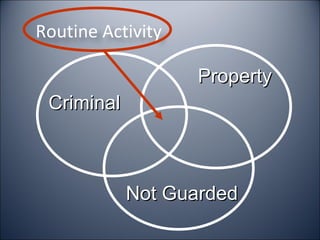
Routine Activity Focus on why crimes occur at specific places and times Posits that crime is the function of the space-time convergence of a motivated offender, suitable target, and lack of capable guardianship.
Criminal Property Not Guarded Routine Activity
Positivist
 
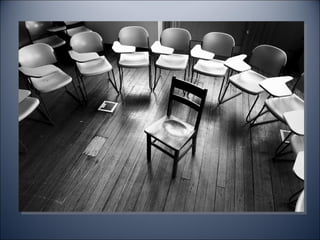
Social Disorganization Rapid changes in an areas characteristics allows crime to occur. People in areas of residential mobility lack a mutual trust with neighbors. Higher crime occurs when neighbors don’t know each other well.
 
Social Learning Criminal behavior is learned Delinquency occurs when more conditions are favorable to breaking the law than unfavorable A person becomes a criminal when more of their friends are criminals or support them Criminals learn  Motive Attitude Technique
 
Neutralization People believe crime is wrong, commit it anyway, and still believe crime is wrong Offenders rationalize actions, creating exceptions for their actions
 
Strain 1 (Merton) Americans want the dream and work ethic Strain is the  disjunction  between goals and means, and provokes response Innovate by rejecting tradition (steal, etc.) Turn to ritualism (keep working with limited results) Retreat and turn to drugs Rebel – create new goals and means (sometimes forming new community)
 
Strain 2 (Cohen) Also known as status frustration Goals based on status, not finances Middle class is the standard Lower classes humiliated, seek status elsewhere
 
Strain 3 (Cloward-Ohlin) Youth look for alternative goals If illegitimate alternative supports skills, may join criminal group (gang). If illegitimate alternative does not support skills, may join a conflict group (gang). If neither criminal nor conflict associations work, may resort to retreating (drugs).
 
Strain 4 (Agnew) Strain is caused by Removal of positive valued stimuli Presentation of negative stimuli People commit crimes when they lose something they like or someone does something they don’t like
 
Control 1 (Hirschi) Focus on why people aren’t criminal Four social factors affect delinquency Attachment (affection for parents/school) Commitment (investment in criminal activity) Involvement (if no free time, no opportunity) Belief (belief/consensus that a thing is wrong prevents us from doing it
 
Control 2 (Gottfredson-Hirschi) Poor child-rearing is the root cause of all crime as it results in low self-control
 
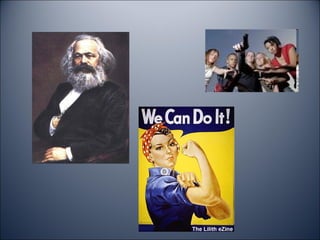
Other Critical theory – crime is a normal function of certain groups Marxist theory – conflict exists between upper-lower classes Feminist theories – females less likely to commit crimes Life course theories – teenage youth account for most crime
Real World Application
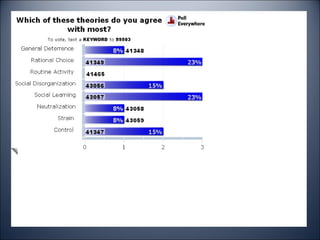
Which do you agree with most? General Deterrence Rational Choice Routine Activity Social Disorganization Social Learning Neutralization Strain Control Text message or Internet
The poll you downloaded is embedded on the next slide. You may view it by running the slideshow. Feel free to copy the slide with the poll to another presentation or build your presentation starting from this one. - The Poll Everywhere Team Poll Everywhere
Internet vote  http://tinyurl.com/theory4860 Text vote 99503
 
Review Scientific v. non-scientific theory Assumptions made in neoclassical school Which theory focuses on why people don’t become criminals What part of Strain theory describes crime for money?
That’s all . . .
 

Security Administration I 4 Explaining Crime

  • 1.
  • 2.
    Explaining Crime Classical-NeoclassicalGeneral Deterrence Rational Choice Routine Activity Positivist Social Disorganization Social Learning Neutralization Strain Control Other/Real World Application
  • 3.
    Which do youagree with most?
  • 4.
  • 5.
  • 6.
    General Deterrence SeverityExceed the amount of damage done to society Celerity Swiftness-promptness of punishment after crime Certainty Commonsense? The more likely punishment is the more fearful the offender of being caught
  • 7.
    Rational Choice Buildson deterrence, started neoclassical school Assumes Every crime has a purpose Criminals choose to commit crime based on limited ability to weigh benefits and risks Three parts Initiation (leads up to first offense) Habituation (continued offending) Desistence (becomes noncriminal or changes crime)
  • 8.
    Routine Activity Focuson why crimes occur at specific places and times Posits that crime is the function of the space-time convergence of a motivated offender, suitable target, and lack of capable guardianship.
  • 9.
    Criminal Property NotGuarded Routine Activity
  • 10.
  • 11.
  • 12.
    Social Disorganization Rapidchanges in an areas characteristics allows crime to occur. People in areas of residential mobility lack a mutual trust with neighbors. Higher crime occurs when neighbors don’t know each other well.
  • 13.
  • 14.
    Social Learning Criminalbehavior is learned Delinquency occurs when more conditions are favorable to breaking the law than unfavorable A person becomes a criminal when more of their friends are criminals or support them Criminals learn Motive Attitude Technique
  • 15.
  • 16.
    Neutralization People believecrime is wrong, commit it anyway, and still believe crime is wrong Offenders rationalize actions, creating exceptions for their actions
  • 17.
  • 18.
    Strain 1 (Merton)Americans want the dream and work ethic Strain is the disjunction between goals and means, and provokes response Innovate by rejecting tradition (steal, etc.) Turn to ritualism (keep working with limited results) Retreat and turn to drugs Rebel – create new goals and means (sometimes forming new community)
  • 19.
  • 20.
    Strain 2 (Cohen)Also known as status frustration Goals based on status, not finances Middle class is the standard Lower classes humiliated, seek status elsewhere
  • 21.
  • 22.
    Strain 3 (Cloward-Ohlin)Youth look for alternative goals If illegitimate alternative supports skills, may join criminal group (gang). If illegitimate alternative does not support skills, may join a conflict group (gang). If neither criminal nor conflict associations work, may resort to retreating (drugs).
  • 23.
  • 24.
    Strain 4 (Agnew)Strain is caused by Removal of positive valued stimuli Presentation of negative stimuli People commit crimes when they lose something they like or someone does something they don’t like
  • 25.
  • 26.
    Control 1 (Hirschi)Focus on why people aren’t criminal Four social factors affect delinquency Attachment (affection for parents/school) Commitment (investment in criminal activity) Involvement (if no free time, no opportunity) Belief (belief/consensus that a thing is wrong prevents us from doing it
  • 27.
  • 28.
    Control 2 (Gottfredson-Hirschi)Poor child-rearing is the root cause of all crime as it results in low self-control
  • 29.
  • 30.
    Other Critical theory– crime is a normal function of certain groups Marxist theory – conflict exists between upper-lower classes Feminist theories – females less likely to commit crimes Life course theories – teenage youth account for most crime
  • 31.
  • 32.
    Which do youagree with most? General Deterrence Rational Choice Routine Activity Social Disorganization Social Learning Neutralization Strain Control Text message or Internet
  • 33.
    The poll youdownloaded is embedded on the next slide. You may view it by running the slideshow. Feel free to copy the slide with the poll to another presentation or build your presentation starting from this one. - The Poll Everywhere Team Poll Everywhere
  • 34.
    Internet vote http://tinyurl.com/theory4860 Text vote 99503
  • 35.
  • 36.
    Review Scientific v.non-scientific theory Assumptions made in neoclassical school Which theory focuses on why people don’t become criminals What part of Strain theory describes crime for money?
  • 37.
  • 38.