

Lisa DuBois Low 
Director of Communications & Multimedia 
Texas Tech Alumni Association 
@ldlow | #prdisruption 
Storytelling: Simple Tips 
for Developing High Impact 
Content for Increased 
Audience Engagement.
1 
DON’T 
WRITE COPY, 
#PRDISRUPTION 
1
 Make an EMOTIONAL 
connection with their 
audience. 
 ENGAGE their listeners. 
 Are exceptional talkers, but 
even better LISTENERS.
BLAH 
BLAH 
BLAH 
BLAH 
BLAH 
BLAH 
BLAH
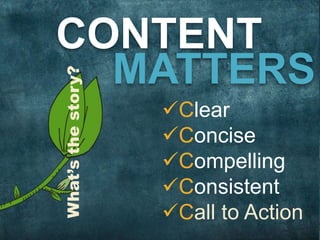
3CONTENT 
MATTERS 
Clear 
Concise 
Compelling 
Consistent 
Call to Action 
What’s the story?
HELP 
THEM 
WHAT YOU 
ARE 
2
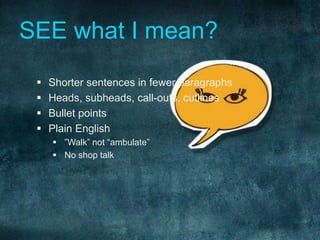
SEE what I mean? 
 Shorter sentences in fewer paragraphs 
 Heads, subheads, call-outs, cutlines 
 Bullet points 
 Plain English 
 ”Walk” not “ambulate” 
 No shop talk
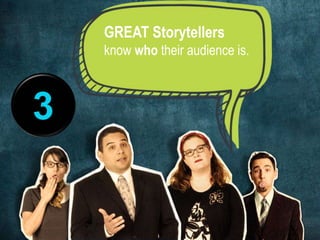
GREAT Storytellers 
know who their audience is. 
3
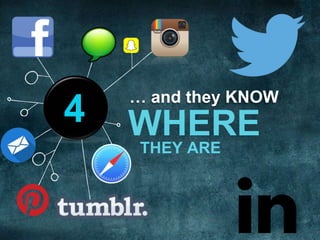
… and they KNOW 4
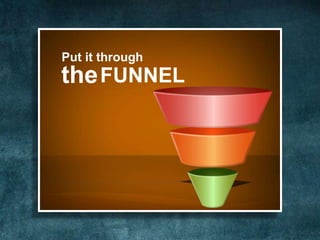
Put it through 
theFUNNEL
5 
BREAKING BAD 
[the RULES] 
#PRDISRUPTION
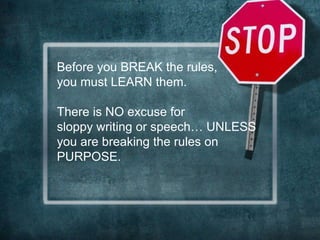
Before you BREAK the rules, 
you must LEARN them. 
There is NO excuse for 
sloppy writing or speech… UNLESS 
you are breaking the rules on 
PURPOSE.
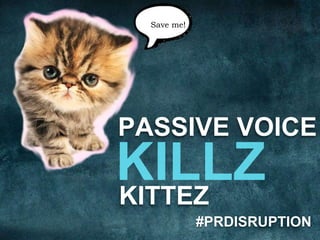
Save me! 
PASSIVE VOICE 
KITTEZ 
#PRDISRUPTION
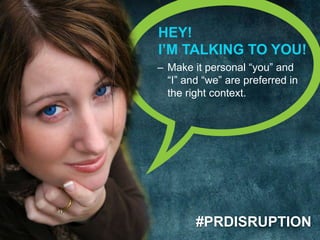
HEY! 
I’M TALKING TO YOU! 
– Make it personal “you” and 
“I” and “we” are preferred in 
the right context. 
#PRDISRUPTION
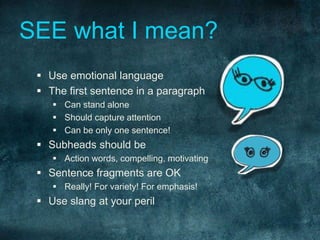
SEE what I mean? 
 Use emotional language 
 The first sentence in a paragraph 
 Can stand alone 
 Should capture attention 
 Can be only one sentence! 
 Subheads should be 
 Action words, compelling, motivating 
 Sentence fragments are OK 
 Really! For variety! For emphasis! 
 Use slang at your peril
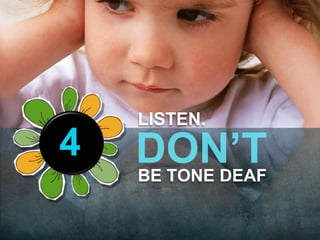
LISTEN. 
BE TONE DEAF 
4
IF STORYTELLING 
IS KING, 
MEASUREMENT 
IS QUEEN 
5
READ 
ANDTWEET
@ldlow 
lisa.low@ttu.edu 
Use #PRDisruption and share YOUR disruptive ideas!

Storytelling: Simple Tips for Developing High Impact Content for Increased Audience Engagement.

  • 1.
    Lisa DuBois Low Director of Communications & Multimedia Texas Tech Alumni Association @ldlow | #prdisruption Storytelling: Simple Tips for Developing High Impact Content for Increased Audience Engagement.
  • 2.
    1 DON’T WRITECOPY, #PRDISRUPTION 1
  • 3.
     Make anEMOTIONAL connection with their audience.  ENGAGE their listeners.  Are exceptional talkers, but even better LISTENERS.
  • 4.
    BLAH BLAH BLAH BLAH BLAH BLAH BLAH
  • 5.
    3CONTENT MATTERS Clear Concise Compelling Consistent Call to Action What’s the story?
  • 6.
    HELP THEM WHATYOU ARE 2
  • 7.
    SEE what Imean?  Shorter sentences in fewer paragraphs  Heads, subheads, call-outs, cutlines  Bullet points  Plain English  ”Walk” not “ambulate”  No shop talk
  • 8.
    GREAT Storytellers knowwho their audience is. 3
  • 9.
  • 11.
    Put it through theFUNNEL
  • 12.
    5 BREAKING BAD [the RULES] #PRDISRUPTION
  • 13.
    Before you BREAKthe rules, you must LEARN them. There is NO excuse for sloppy writing or speech… UNLESS you are breaking the rules on PURPOSE.
  • 14.
    Save me! PASSIVEVOICE KITTEZ #PRDISRUPTION
  • 15.
    HEY! I’M TALKINGTO YOU! – Make it personal “you” and “I” and “we” are preferred in the right context. #PRDISRUPTION
  • 16.
    SEE what Imean?  Use emotional language  The first sentence in a paragraph  Can stand alone  Should capture attention  Can be only one sentence!  Subheads should be  Action words, compelling, motivating  Sentence fragments are OK  Really! For variety! For emphasis!  Use slang at your peril
  • 17.
  • 18.
    IF STORYTELLING ISKING, MEASUREMENT IS QUEEN 5
  • 20.
  • 22.
    @ldlow lisa.low@ttu.edu Use#PRDisruption and share YOUR disruptive ideas!

Editor's Notes

  • #2 1
  • #3 2
  • #4 Let me tell you why. My favorite definition of a good storyteller is from a leadership recruitment firm 1. Good storytellers make an emotional connection with their audience. A good storyteller is not somebody who relies solely on fact or appeals only to people’s rationality. A good storyteller is somebody who creates a deep emotional bond with their audience. 2. Good storytellers engage their listeners. Good storytellers don’t just pique your interest — they capture your imagination. They make it so you can’t help but become involved in their stories. 3. Good storytellers are exceptional talkers, but even better listeners. Listening plays such an important role because storytelling is just as much about receiving feedback as it is about transmitting the message — and in order for a story to be well-received, you first have to know who’s on the other end. They read body language and audience responses.
  • #5 But guess what, you aren’t face to face with your audience most of the time. And they don’t have the time or interest to read through your boring copy, no matter how brilliant you think it is.
  • #6 When you’re telling me a story, you better know what it is. Have you talked about nut graphs? It’s the newsworthy element of your story.   I’m more likely to pay attention when you follow the five“c’s.” Be Clear, Concise, Compelling. Which means you have to know the story backwards and forwards. Be Consistent. No one likes an inconsistent story. But an engaging and compelling story, we want to hear again and again. Use a call to action: any ideas what might qualify? Read more, buy now, join now, rsvp, like, RT, etc.   I use these 5 c’s frequently in my own writing.
  • #7 Literally help your audience SEE what you are SAYING them. Bring your story to life with photos, illustrations, pull quotes, cutlines, infographics, etc. Don’t have a budget? Free images are everywhere. Chances are your smart phone is perfect for many shots. Free sources include Microsoft Office, StockXchange, Flickr, Morgue file and wikipedia. I believe the library also offers royalty free images. Just make sure before you use something that you’re not guilty of stealing/copyright violations. People are visual creatures. Straight, dense text, no matter how good the story is just won’t cut it. Visuals also go a long way in telling your story in a few seconds. When I developed Texas Tech Today, my goal for each story was to convey the heart of it in the headline, blurb, subheads, images and cutline so our readers could grasp it in just a few seconds. Ask anyone who has ever worked for me how much emphasis I put on these elements. They’ll probably get PTSD flashbacks.
  • #8 Let’s look at an example. I’m a dog lover and rescue advocate. I’ve worked with most of the animal rescue in Lubbock. Let’s look at Lubbock Animal Services. What’s cuter than a bunch of orphaned puppies getting new owners? Storytelling opportunities GALORE. Right? Shorter sentences in fewer paragraphs Heads, subheads, call-outs, cutlines Bullet points Plain English ”Walk” not “ambulate” No shop talk Why use a word like circumvent. Discuss web page.
  • #9 Great storytellers know who they are talking to. Your audience can’t be EVERYONE. The difference between a d good storyteller and a great one … they don’t just take the time to find out who their audience is; they also take the time to figure out the type of messages their audience is most likely to be receptive to. Then they tailor their message specifically to that audience.   Great storytellers know it’s all about communication, and communication is a two way street. Social media has turned PR and brand management into the wild, wild west where we have limited control. To me, at it’s heart, brand management is now a conversation.  
  • #10 Knowing WHO their audience is and WHERE is just as important. Because WHERE dictates how much or how little space you have to grab their attention. And guess what, they aren’t just in one place. They have laptops, desktops, smart phones, tablets. They visit your website, sign up for email, follow you on social, receive your direct mail. You’ve got to surround sound, multimedia, multiplatform. STRATEGIC. My goal for each and every platform is to connect with my audience where they are. Make it easy for them to connect with me.
  • #11 So where do you start. I put everything in a pile. Whatever reference material I think I might need. Old materials, brochures, news releases, articles, social posts. The bigger the project, the bigger the pile and the more I put myself in my audience’s place (personas), I role play, I brainstorm with my team, with my friends, with my family. My facebook and twitter friends are sometimes guinea pigs. I test, test, test. I nearly always end up with more than I need. Then I apply the 5 c’s. Copy that doesn’t meet those criteria I save for future projects (you can never have too much content).
  • #12 I go from large to small. Press release to magazine story to web story to email; Facebook, Tumblr, Insta; ending with Twitter. The story gets smaller, tighter, more active, likeable and sharable as it goes. It’s amazing how concise you can be when forced into 140 characters. Now a word about social. The obvious questions are, “is this likeable?” “shareable” Retweetable. I’ll let you in on a little secret. People share all kinds of stuff without really reading it.
  • #13 Now it’s time to BREAK THE RULES.
  • #14 Before you BREAK the rules, you must LEARN them. if you aspire to be a communicator of any kind…employers and colleagues might overlook it a time or two, but it’s NOT ACCEPTABLE. My high school freshman pointed out that his English teacher doesn’t allow them to do many of the things I’m advocating. I get it, rules are important. Breaking the rules is not the same thing as being ignorant of them.
  • #15 Every time a PR writer uses passive voice, a kitten dies. Don’t be that guy. Just don’t do it. Write like you speak. Sentences in active voice are more concise than those in passive voice because fewer words are required to express action in active voice than in passive. But guess what, you can’t use active voice for earned media. Know the rules. For example “The TTAA will hold a pregame party at the Frazier Alumni Pavilion.” How about, “Join us at the Frazier Alumni Pavilion pregame party.”
  • #16 Make it personal “you” and “I” and “we” are preferred in the right context. Remember, storytellers engage and connect. The fastest way to do that is to talk to me like I’m a human. Have a conversation with your audience. Again, this is a no-no for earned media.
  • #17 Don’t give me a press release and pretend it’s a story. A press release is an excellent place to START! If earned media is important to your organization, ALWAYS start with a release and work your way down. ALWAYS start with your nut graph, ask yourself, what the story is. Use emotional language The first sentence in a paragraph Can stand alone Should capture attention Can be only one sentence! Subheads should be Action words, compelling, motivating Sentence fragments are OK Really! For variety! For emphasis! Use slang and hashtags at your peril … and put quotes around the slang.
  • #18 Listen first, speak second. PR and communications professionals always have their ear to the ground. They read local, regional and global news. The eavesdrop on their competition. Information is power. It would be tone deaf for me to promote alcoholic beverages at the Frazier Alumni Pavilion in the midst of the breaking news about the student who died from alcohol poisoning.
  • #19 Nearly everything can be measured for free. Use Google Analytics and each platform typically has some analytics. Klout will give you a relative measurement of all. What works? What doesn’t? Listen to the feedback you receive on social.
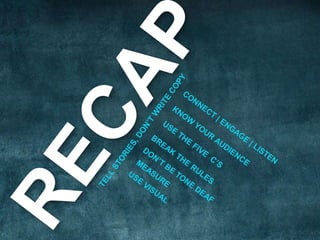
  • #20 Let’s recap, shall we?
  • #21 How do you grow superior writing AKA storytelling skills? According to Dave Kerpen of Likeable Media. Read, write and tweet. Daily. Follow both Kerpen and Likeable Media and read the article: http://www.linkedin.com/today/post/article/20130221123241-15077789-want-to-be-taken-seriously-become-a-better-writer
  • #22 So let’s practice. Any questions before we start? I’m going to show a short video. Then I’m going to ask you which of my storytelling superpowers I used to write and produce it. AND I want you to tell me who my audience is. Now, I’m going to help you with your homework. Let’s craft some tweets about what you’ve learned about storytelling today.
  • #23 Follow me: Twitter, Instagram, LinkedIn, Pinterest, Tumblr, Slideshare, WordPress. Contact me for one-on-one, need a source for a story? Hands-on? I love to work with students. I hire Red Raider alumni and students. We have great internships. Your best contact for openings is Aleesa Ross. Questions? Comments? Share your thoughts on the hashtag!