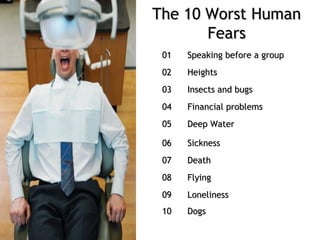
The 10 Worst HumanThe 10 Worst Human
FearsFears
0101 Speaking before a groupSpeaking before a group
0202 HeightsHeights
0303 Insects and bugsInsects and bugs
0404 Financial problemsFinancial problems
0505 Deep WaterDeep Water
0606 SicknessSickness
0707 DeathDeath
0808 FlyingFlying
0909 LonelinessLoneliness
1010 DogsDogs
Source: Book of Lists, USA
ObjectivesObjectives
Become aware of the important elements
of a presentation.
Prepare and deliver an effective
presentation
Building the Base
Platform Skills
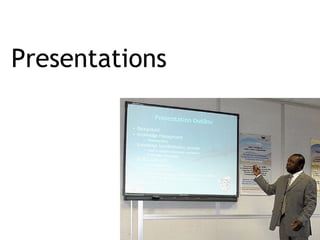
Presentations
Great PresentationGreat Presentation
1.1. Great DesignGreat Design
2.2. Great DeliveryGreat Delivery
Think of a topic on which you would be making a 5 to 7
mins presentation
Outline the Purpose of the PresentationOutline the Purpose of the Presentation
 You need to define your purpose for giving theYou need to define your purpose for giving the
presentationpresentation
 Purpose of PresentationPurpose of Presentation
 ToTo sell your Product/Servicesell your Product/Service
 To Inform / TeachTo Inform / Teach
 To Motivate / InspireTo Motivate / Inspire
 To InstructTo Instruct
 To PersuadeTo Persuade
 To EntertainTo Entertain
‘If I had eight hours to
chop down a tree,
I’d spend six
sharpening my axe!’
Abraham Lincoln
Audience Analysis
Understand AudienceUnderstand Audience
 Who is in your audience?Who is in your audience?
 Are they novice / key members for makingAre they novice / key members for making
decisions?decisions?
 Why are they there?Why are they there?
 What do they know about you?What do they know about you?
 What is their current knowledge of the topic?What is their current knowledge of the topic?
 What do they want / need to know?What do they want / need to know?
 What is their background / experience /What is their background / experience /
Education?Education?
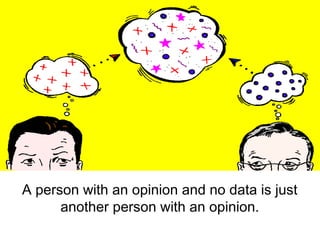
A person with an opinion and no data is just
another person with an opinion.
Research the TopicResearch the Topic
 What are the key books/journals/websites relating toWhat are the key books/journals/websites relating to
your topic?your topic?
 Is there someone in particular that you should interviewIs there someone in particular that you should interview
for information?for information?
 Do you have any existing notes on the topic?Do you have any existing notes on the topic?
 Are there any other sources that you think could beAre there any other sources that you think could be
useful?useful?
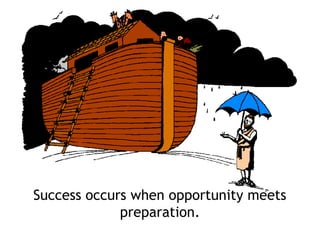
Success occurs when opportunity meets
preparation.
Begin with the end in mind…
CloseClose
 Most important stage along with openingMost important stage along with opening
 Why write close firstWhy write close first
 Focus on outcomeFocus on outcome
 Helps you edit contentHelps you edit content
 Reinforces the connection between yourReinforces the connection between your
presentation and challenges facing the audiencepresentation and challenges facing the audience
 Action RequiredAction Required
How Will You CloseHow Will You Close
 How will you signal your close?How will you signal your close?
 How will you summarise your main points?How will you summarise your main points?
 What action is required from theWhat action is required from the
audience?audience?
 How will you close with impact?How will you close with impact?
Open with ImpactOpen with Impact
 Impact TitleImpact Title
 Presentation Skills vs. Present or PerishPresentation Skills vs. Present or Perish
 PacePace
 Fast paced vs. Laid backFast paced vs. Laid back
 ConnectConnect
 Story, Question, Joke, Quote, Arresting FactStory, Question, Joke, Quote, Arresting Fact
 BenefitBenefit
 Expectations from the sessionExpectations from the session
 ObjectivesObjectives
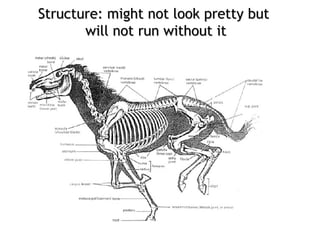
Structure: might not look pretty butStructure: might not look pretty but
will not run without itwill not run without it
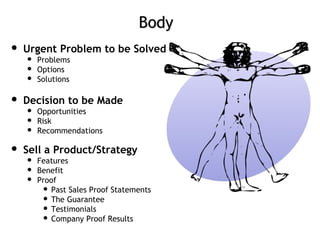
BodyBody
 Urgent Problem to be Solved
 Problems
 Options
 Solutions
 Decision to be Made
 Opportunities
 Risk
 Recommendations
 Sell a Product/Strategy
 Features
 Benefit
 Proof
 Past Sales Proof Statements
 The Guarantee
 Testimonials
 Company Proof Results
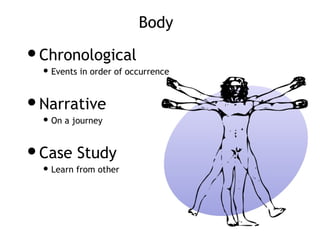
Body
Chronological
 Events in order of occurrence
Narrative
 On a journey
Case Study
 Learn from other
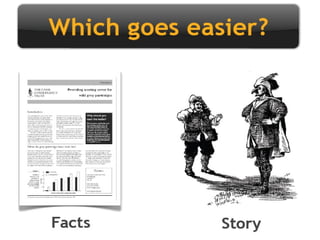
Body - Tell StoriesBody - Tell Stories
 Good stories haveGood stories have
Interesting, clear beginningsInteresting, clear beginnings
Provocative, engaging content in the middleProvocative, engaging content in the middle
A clear, logical conclusionA clear, logical conclusion
Clear Take away’sClear Take away’s
Can be related to the point that you want toCan be related to the point that you want to
makemake
Structure : Repeat 3 TimesStructure : Repeat 3 Times
 It has been shown that it takes at least 3It has been shown that it takes at least 3
repetitions of information for people to be ablerepetitions of information for people to be able
to absorb and retainto absorb and retain
 This leads to the following approach toThis leads to the following approach to
presentation:presentation:
 Tell them what you’re going to tell themTell them what you’re going to tell them
 Tell themTell them
 Tell them what you told themTell them what you told them
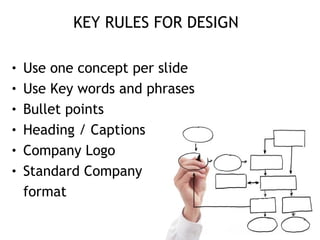
KEY RULES FOR DESIGN
• Use one concept per slide
• Use Key words and phrases
• Bullet points
• Heading / Captions
• Company Logo
• Standard Company
format
Top three things that annoy them
about bad PowerPoint presentations:
 The speaker read the slides to us – 67.4%
 Full sentences instead of bullet points – 45.4%
 Text so small I couldn't read it – 45.0%
Source: What annoys Audiences about Power point presentations?
Dave Paradi, Author of The Visual Slide Revolution
Results from the 2009 Annoying PowerPoint
Survey
 Layout
 Consistency
Placement of Text and images
Fonts and Sizes
Background colour
Style and treatment of the slides
Language check
 Colour
 Density of Text on slides
 Drawing – Charts/ Figures / Tables
KEY RULES FOR DESIGN
GREAT DELIVERY OF PRESENTATIONS
• Voice
• Managing Time
• Language
• Movement
• Body Language
VOICE
10/20/30 Rule of PowerPoint
A PPT should have ten slides
No more than twenty minutes
font no smaller than thirty points
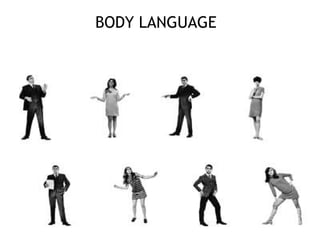
BODY LANGUAGE
BE PREPARED FOR EXCEGENCY…
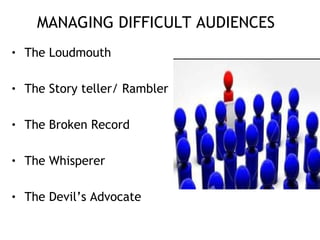
MANAGING DIFFICULT AUDIENCES
• The Loudmouth
• The Story teller/ Rambler
• The Broken Record
• The Whisperer
• The Devil’s Advocate
The PRESENTATION…
The PRESENTATION…
THE PRESENTATION…
High Impact Presentation

High Impact Presentation

  • 2.
    The 10 WorstHumanThe 10 Worst Human FearsFears 0101 Speaking before a groupSpeaking before a group 0202 HeightsHeights 0303 Insects and bugsInsects and bugs 0404 Financial problemsFinancial problems 0505 Deep WaterDeep Water 0606 SicknessSickness 0707 DeathDeath 0808 FlyingFlying 0909 LonelinessLoneliness 1010 DogsDogs Source: Book of Lists, USA
  • 4.
    ObjectivesObjectives Become aware ofthe important elements of a presentation. Prepare and deliver an effective presentation Building the Base Platform Skills
  • 5.
  • 6.
    Great PresentationGreat Presentation 1.1.Great DesignGreat Design 2.2. Great DeliveryGreat Delivery
  • 7.
    Think of atopic on which you would be making a 5 to 7 mins presentation
  • 9.
    Outline the Purposeof the PresentationOutline the Purpose of the Presentation  You need to define your purpose for giving theYou need to define your purpose for giving the presentationpresentation  Purpose of PresentationPurpose of Presentation  ToTo sell your Product/Servicesell your Product/Service  To Inform / TeachTo Inform / Teach  To Motivate / InspireTo Motivate / Inspire  To InstructTo Instruct  To PersuadeTo Persuade  To EntertainTo Entertain
  • 10.
    ‘If I hadeight hours to chop down a tree, I’d spend six sharpening my axe!’ Abraham Lincoln
  • 11.
  • 12.
    Understand AudienceUnderstand Audience Who is in your audience?Who is in your audience?  Are they novice / key members for makingAre they novice / key members for making decisions?decisions?  Why are they there?Why are they there?  What do they know about you?What do they know about you?  What is their current knowledge of the topic?What is their current knowledge of the topic?  What do they want / need to know?What do they want / need to know?  What is their background / experience /What is their background / experience / Education?Education?
  • 14.
    A person withan opinion and no data is just another person with an opinion.
  • 15.
    Research the TopicResearchthe Topic  What are the key books/journals/websites relating toWhat are the key books/journals/websites relating to your topic?your topic?  Is there someone in particular that you should interviewIs there someone in particular that you should interview for information?for information?  Do you have any existing notes on the topic?Do you have any existing notes on the topic?  Are there any other sources that you think could beAre there any other sources that you think could be useful?useful?
  • 16.
    Success occurs whenopportunity meets preparation.
  • 17.
    Begin with theend in mind…
  • 18.
    CloseClose  Most importantstage along with openingMost important stage along with opening  Why write close firstWhy write close first  Focus on outcomeFocus on outcome  Helps you edit contentHelps you edit content  Reinforces the connection between yourReinforces the connection between your presentation and challenges facing the audiencepresentation and challenges facing the audience  Action RequiredAction Required
  • 19.
    How Will YouCloseHow Will You Close  How will you signal your close?How will you signal your close?  How will you summarise your main points?How will you summarise your main points?  What action is required from theWhat action is required from the audience?audience?  How will you close with impact?How will you close with impact?
  • 21.
    Open with ImpactOpenwith Impact  Impact TitleImpact Title  Presentation Skills vs. Present or PerishPresentation Skills vs. Present or Perish  PacePace  Fast paced vs. Laid backFast paced vs. Laid back  ConnectConnect  Story, Question, Joke, Quote, Arresting FactStory, Question, Joke, Quote, Arresting Fact  BenefitBenefit  Expectations from the sessionExpectations from the session  ObjectivesObjectives
  • 22.
    Structure: might notlook pretty butStructure: might not look pretty but will not run without itwill not run without it
  • 24.
    BodyBody  Urgent Problemto be Solved  Problems  Options  Solutions  Decision to be Made  Opportunities  Risk  Recommendations  Sell a Product/Strategy  Features  Benefit  Proof  Past Sales Proof Statements  The Guarantee  Testimonials  Company Proof Results
  • 25.
    Body Chronological  Events inorder of occurrence Narrative  On a journey Case Study  Learn from other
  • 26.
    Body - TellStoriesBody - Tell Stories  Good stories haveGood stories have Interesting, clear beginningsInteresting, clear beginnings Provocative, engaging content in the middleProvocative, engaging content in the middle A clear, logical conclusionA clear, logical conclusion Clear Take away’sClear Take away’s Can be related to the point that you want toCan be related to the point that you want to makemake
  • 28.
    Structure : Repeat3 TimesStructure : Repeat 3 Times  It has been shown that it takes at least 3It has been shown that it takes at least 3 repetitions of information for people to be ablerepetitions of information for people to be able to absorb and retainto absorb and retain  This leads to the following approach toThis leads to the following approach to presentation:presentation:  Tell them what you’re going to tell themTell them what you’re going to tell them  Tell themTell them  Tell them what you told themTell them what you told them


  • 30.
    KEY RULES FORDESIGN • Use one concept per slide • Use Key words and phrases • Bullet points • Heading / Captions • Company Logo • Standard Company format
  • 31.
    Top three thingsthat annoy them about bad PowerPoint presentations:  The speaker read the slides to us – 67.4%  Full sentences instead of bullet points – 45.4%  Text so small I couldn't read it – 45.0% Source: What annoys Audiences about Power point presentations? Dave Paradi, Author of The Visual Slide Revolution Results from the 2009 Annoying PowerPoint Survey
  • 32.
     Layout  Consistency Placementof Text and images Fonts and Sizes Background colour Style and treatment of the slides Language check  Colour  Density of Text on slides  Drawing – Charts/ Figures / Tables KEY RULES FOR DESIGN
  • 33.
    GREAT DELIVERY OFPRESENTATIONS • Voice • Managing Time • Language • Movement • Body Language
  • 34.
  • 35.
    10/20/30 Rule ofPowerPoint A PPT should have ten slides No more than twenty minutes font no smaller than thirty points
  • 36.
  • 37.
    BE PREPARED FOREXCEGENCY…
  • 41.
    MANAGING DIFFICULT AUDIENCES •The Loudmouth • The Story teller/ Rambler • The Broken Record • The Whisperer • The Devil’s Advocate
  • 42.
  • 43.
  • 44.