Emotive Language
Chris Gatt
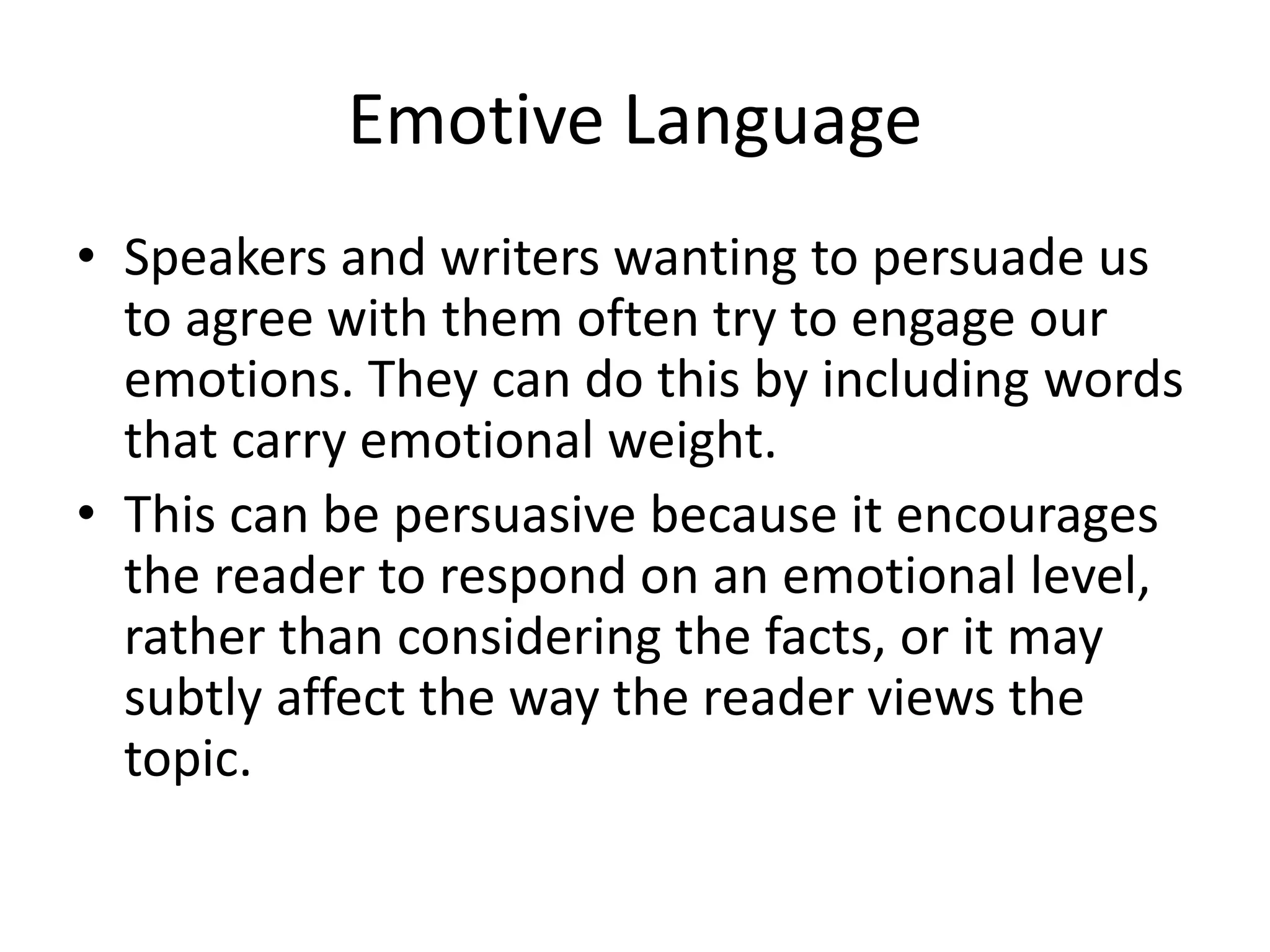
Emotive Language
• Speakers and writers wanting to persuade us
to agree with them often try to engage our
emotions. They can do this by including words
that carry emotional weight.
• This can be persuasive because it encourages
the reader to respond on an emotional level,
rather than considering the facts, or it may
subtly affect the way the reader views the
topic.
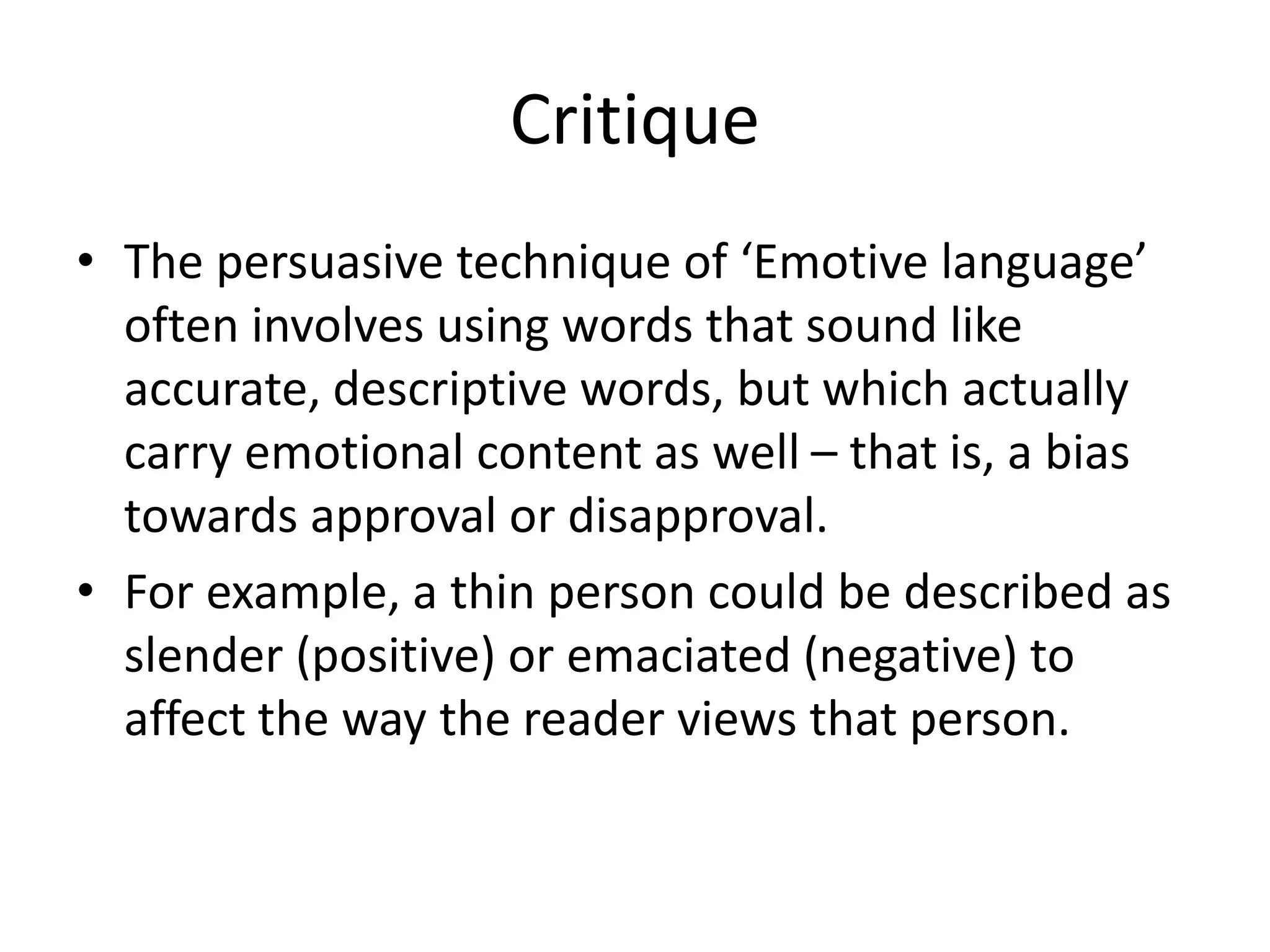
Critique
• The persuasive technique of ‘Emotive language’
often involves using words that sound like
accurate, descriptive words, but which actually
carry emotional content as well – that is, a bias
towards approval or disapproval.
• For example, a thin person could be described as
slender (positive) or emaciated (negative) to
affect the way the reader views that person.
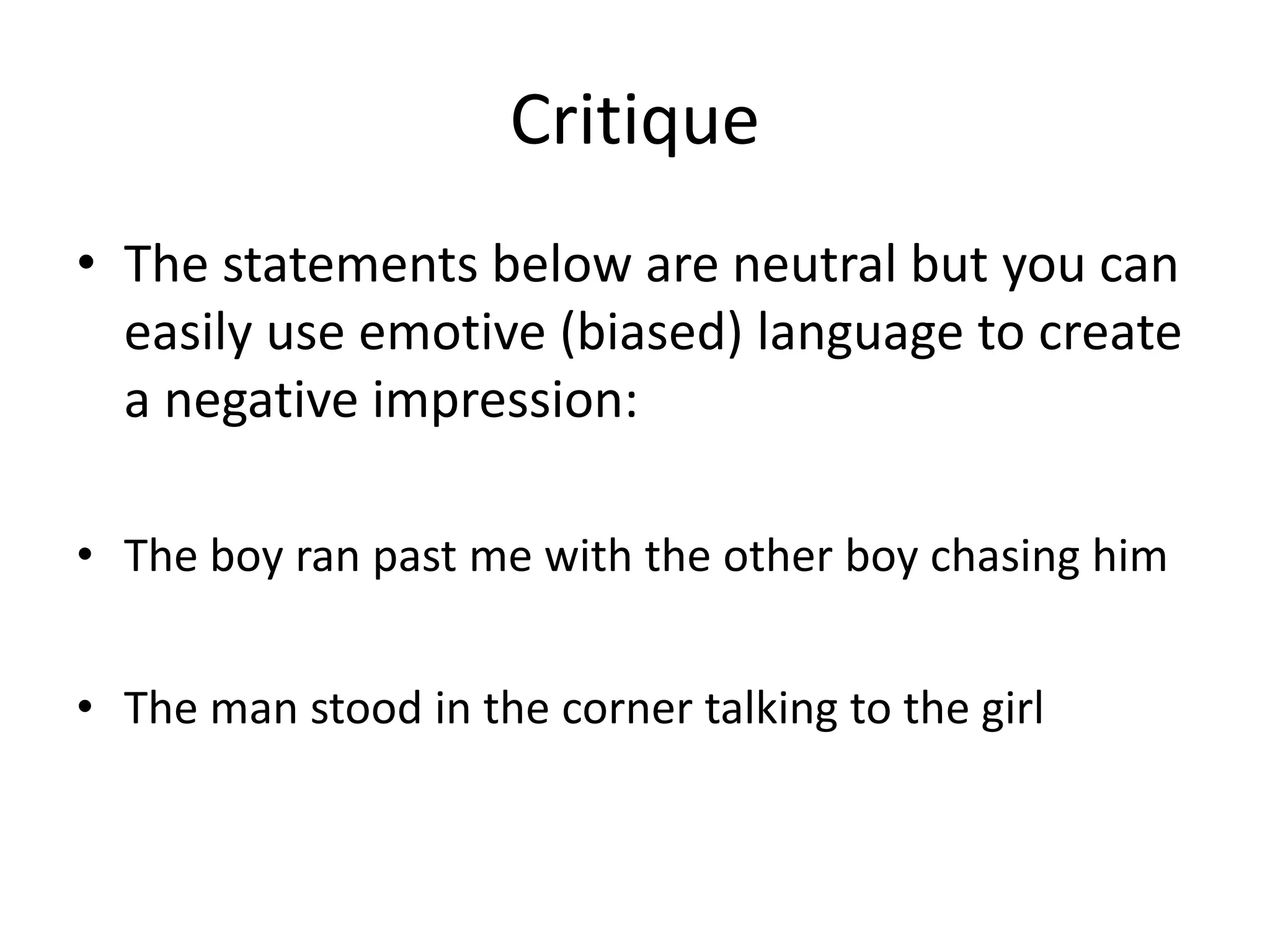
Critique
• The statements below are neutral but you can
easily use emotive (biased) language to create
a negative impression:
• The boy ran past me with the other boy chasing him

• The man stood in the corner talking to the girl
Critique
• The statements below are neutral but you can
easily use emotive (biased) language to create
a negative impression:
thug

fled

• The boy ran past me with the other boy chasing him
sleazy

dark

hitting on

young

• The man stood in the corner talking to the girl

^

^

^
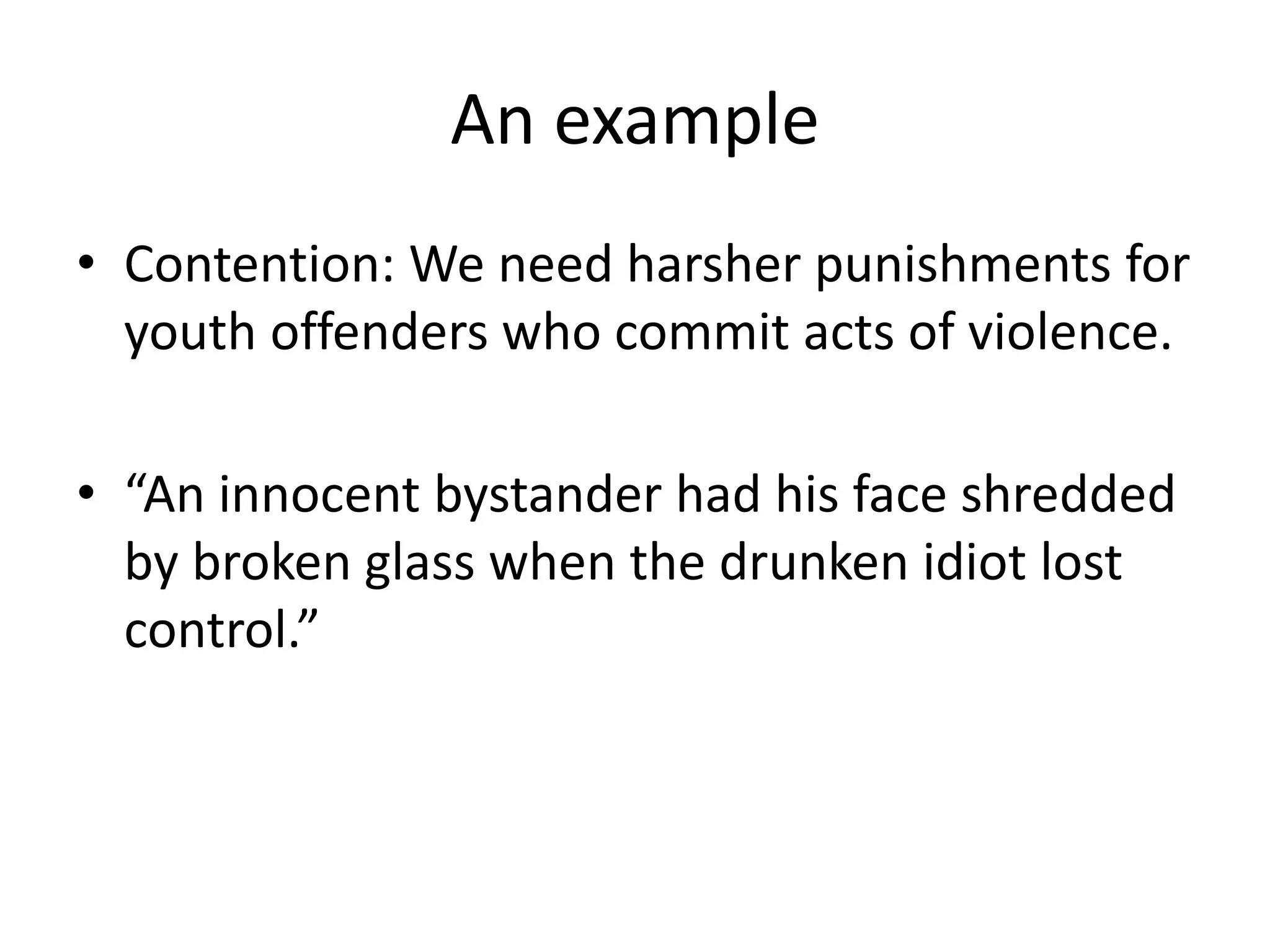
An example
• Contention: We need harsher punishments for
youth offenders who commit acts of violence.
• “An innocent bystander had his face shredded
by broken glass when the drunken idiot lost
control.”
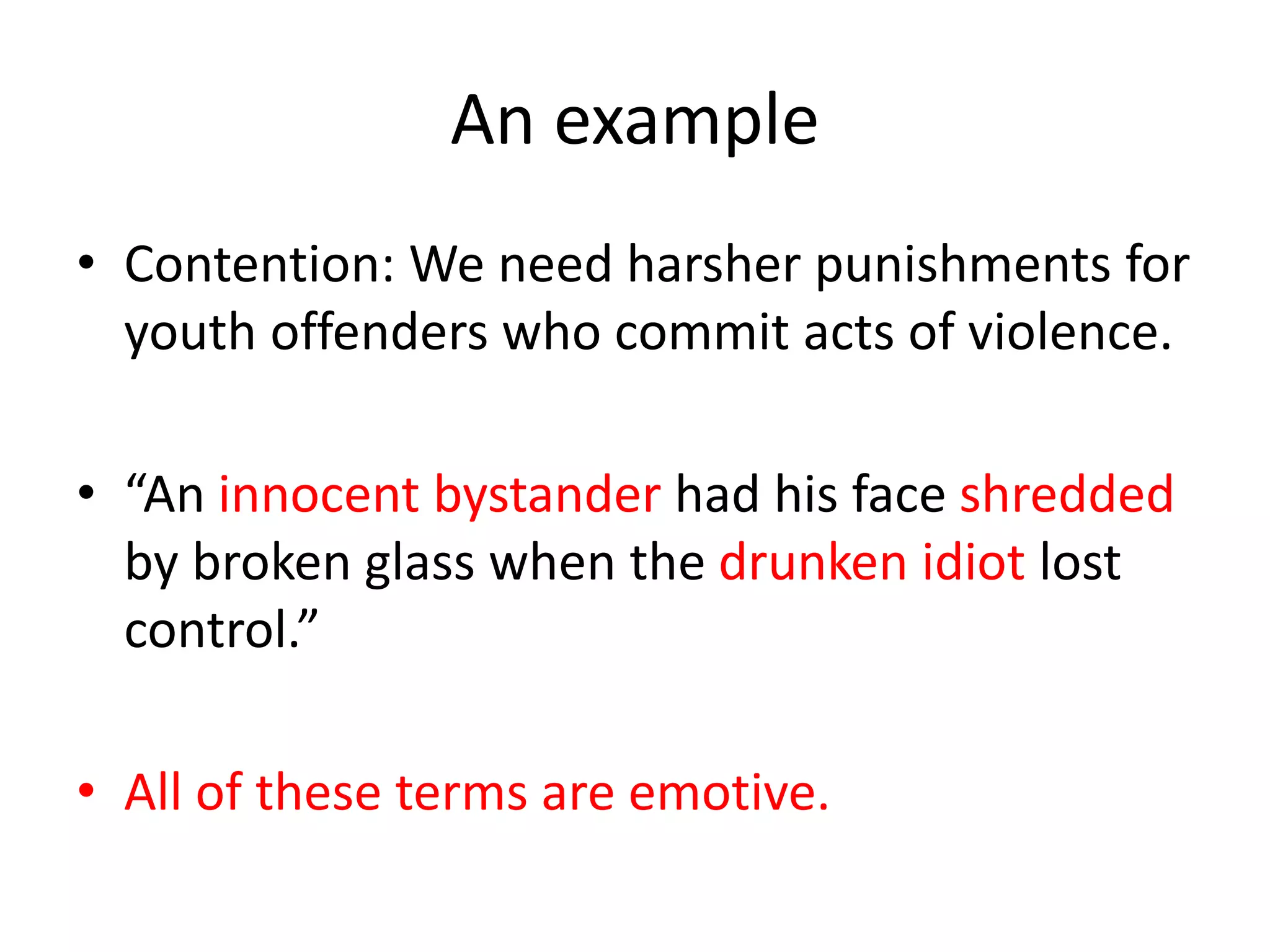
An example
• Contention: We need harsher punishments for
youth offenders who commit acts of violence.
• “An innocent bystander had his face shredded
by broken glass when the drunken idiot lost
control.”
• All of these terms are emotive.
Discussion (C-grade)
• The writer uses emotive language to make the
reader feel sorry for the victim and anger
towards the perpetrator. This makes the
reader agree with the contention because we
want to see justice for this shocking crime.
Discussion (A-grade)
• The writer uses emotive language to make us feel sympathetic
towards the victim and critical of the perpetrator. Describing the

victim as an ‘innocent bystander’ makes us feel sympathetic
towards them as they didn’t deserve to get injured and we may also
feel fear as it could happen to anyone. Saying that their face was
‘shredded’ is very graphic and shocks the reader. We feel
disapproval and possibly anger towards the perpetrator as they
committed this horrible crime and are nothing more than a
‘drunken idiot’. This makes us agree as the violence was severe and
we can clearly identify a ‘good guy’ and ‘bad guy’. By making us
angry at the outset of the article, we are less inclined to read the
rest of the argument objectively so will be more likely to accept the
call for harsher punishments for youth offenders who commit acts
of violence.

Emotive language analysis

  • 1.
  • 2.
    Emotive Language • Speakersand writers wanting to persuade us to agree with them often try to engage our emotions. They can do this by including words that carry emotional weight. • This can be persuasive because it encourages the reader to respond on an emotional level, rather than considering the facts, or it may subtly affect the way the reader views the topic.
  • 3.
    Critique • The persuasivetechnique of ‘Emotive language’ often involves using words that sound like accurate, descriptive words, but which actually carry emotional content as well – that is, a bias towards approval or disapproval. • For example, a thin person could be described as slender (positive) or emaciated (negative) to affect the way the reader views that person.
  • 4.
    Critique • The statementsbelow are neutral but you can easily use emotive (biased) language to create a negative impression: • The boy ran past me with the other boy chasing him • The man stood in the corner talking to the girl
  • 5.
    Critique • The statementsbelow are neutral but you can easily use emotive (biased) language to create a negative impression: thug fled • The boy ran past me with the other boy chasing him sleazy dark hitting on young • The man stood in the corner talking to the girl ^ ^ ^
  • 6.
    An example • Contention:We need harsher punishments for youth offenders who commit acts of violence. • “An innocent bystander had his face shredded by broken glass when the drunken idiot lost control.”
  • 7.
    An example • Contention:We need harsher punishments for youth offenders who commit acts of violence. • “An innocent bystander had his face shredded by broken glass when the drunken idiot lost control.” • All of these terms are emotive.
  • 8.
    Discussion (C-grade) • Thewriter uses emotive language to make the reader feel sorry for the victim and anger towards the perpetrator. This makes the reader agree with the contention because we want to see justice for this shocking crime.
  • 9.
    Discussion (A-grade) • Thewriter uses emotive language to make us feel sympathetic towards the victim and critical of the perpetrator. Describing the victim as an ‘innocent bystander’ makes us feel sympathetic towards them as they didn’t deserve to get injured and we may also feel fear as it could happen to anyone. Saying that their face was ‘shredded’ is very graphic and shocks the reader. We feel disapproval and possibly anger towards the perpetrator as they committed this horrible crime and are nothing more than a ‘drunken idiot’. This makes us agree as the violence was severe and we can clearly identify a ‘good guy’ and ‘bad guy’. By making us angry at the outset of the article, we are less inclined to read the rest of the argument objectively so will be more likely to accept the call for harsher punishments for youth offenders who commit acts of violence.