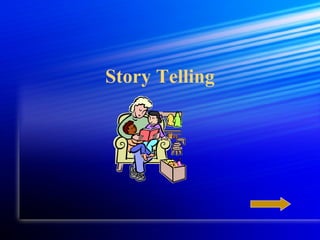
Story Telling
Storytelling “ Storytelling begins with the notion that in the not too distant future, sharing one’s stories through the multiple mediums of digital imagery, text, voice, sound , music, video and animation will be the principle hobby of the world’s people.”  -Anonymous Contents
Contents What makes a good storyteller? Seven Elements Performance Tips Helpful Web Sites
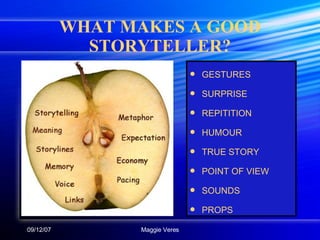
WHAT MAKES A GOOD STORYTELLER? GESTURES SURPRISE REPITITION HUMOUR TRUE STORY POINT OF VIEW SOUNDS PROPS
Seven Elements A Point of View A Dramatic Question Emotional Content The Gift of Your Voice The Power of  Props Economy Pacing Contents
A Point of View All stories are told to make a point. You, as the author, need to figure out what you intend the viewer to “get.” What message are you trying to convey? In other words, what is the theme? Contents
A Dramatic Question A good story has a “hook” that will hold the attention of the audience until the story is over. Many stories end dramatically with a “Punchline” Contents
Emotional Content A story that deals with our emotions,  - such as loss, love, loneliness, courage, acceptance, rejection, hardship, etc. - will help the audience maintain their attention. Contents
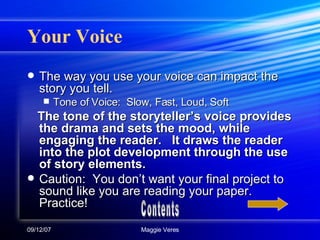
Your Voice The way you use your voice can impact the story you tell.  Tone of Voice:  Slow, Fast, Loud, Soft The tone of the storyteller’s voice provides the drama and sets the mood, while engaging the reader.  It draws the reader into the plot development through the use of story elements. Caution:  You don’t want your final project to sound like you are reading your paper.  Practice! Contents
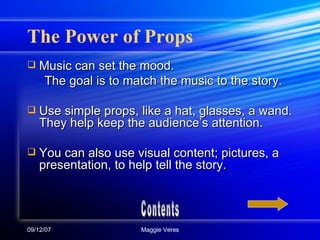
The Power of Props Music can set the mood. The goal is to match the music to the story. Use simple props, like a hat, glasses, a wand. They help keep the audience’s attention. You can also use visual content; pictures, a presentation, to help tell the story. Contents
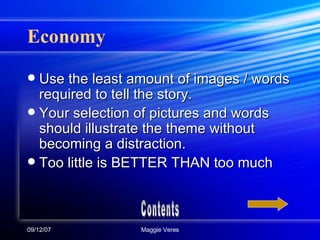
Economy Use the least amount of images / words required to tell the story.  Your selection of pictures and words should illustrate the theme without becoming a distraction. Too little is BETTER THAN too much Contents
The Last Tip THERE IS NO ONE WAY! RULES ARE MEANT TO BE BROKEN!
Pacing Changing the pace of the story can be very effective.  The narrative can have pauses, the music can change tempo, and the images can be set to enter at different rates of speed.  Changing pace allows the audience to concentrate, think, and maintain interest. Contents
Presentation Quicktime Movie ( iMovie ,  MovieMaker ) PowerPoint Flash HyperStudio Keynote (Apple) Advanced Movie Editors (Casablanca, Final Cut Pro) Contents
Websites Digitales Center for Digital Storytelling A Collection of Sites Contents

Storytelling

  • 1.
  • 2.
    Storytelling “ Storytellingbegins with the notion that in the not too distant future, sharing one’s stories through the multiple mediums of digital imagery, text, voice, sound , music, video and animation will be the principle hobby of the world’s people.” -Anonymous Contents
  • 3.
    Contents What makesa good storyteller? Seven Elements Performance Tips Helpful Web Sites
  • 4.
    WHAT MAKES AGOOD STORYTELLER? GESTURES SURPRISE REPITITION HUMOUR TRUE STORY POINT OF VIEW SOUNDS PROPS
  • 5.
    Seven Elements APoint of View A Dramatic Question Emotional Content The Gift of Your Voice The Power of Props Economy Pacing Contents
  • 6.
    A Point ofView All stories are told to make a point. You, as the author, need to figure out what you intend the viewer to “get.” What message are you trying to convey? In other words, what is the theme? Contents
  • 7.
    A Dramatic QuestionA good story has a “hook” that will hold the attention of the audience until the story is over. Many stories end dramatically with a “Punchline” Contents
  • 8.
    Emotional Content Astory that deals with our emotions, - such as loss, love, loneliness, courage, acceptance, rejection, hardship, etc. - will help the audience maintain their attention. Contents
  • 9.
    Your Voice Theway you use your voice can impact the story you tell. Tone of Voice: Slow, Fast, Loud, Soft The tone of the storyteller’s voice provides the drama and sets the mood, while engaging the reader. It draws the reader into the plot development through the use of story elements. Caution: You don’t want your final project to sound like you are reading your paper. Practice! Contents
  • 10.
    The Power ofProps Music can set the mood. The goal is to match the music to the story. Use simple props, like a hat, glasses, a wand. They help keep the audience’s attention. You can also use visual content; pictures, a presentation, to help tell the story. Contents
  • 11.
    Economy Use theleast amount of images / words required to tell the story. Your selection of pictures and words should illustrate the theme without becoming a distraction. Too little is BETTER THAN too much Contents
  • 12.
    The Last TipTHERE IS NO ONE WAY! RULES ARE MEANT TO BE BROKEN!
  • 13.
    Pacing Changing thepace of the story can be very effective. The narrative can have pauses, the music can change tempo, and the images can be set to enter at different rates of speed. Changing pace allows the audience to concentrate, think, and maintain interest. Contents
  • 14.
    Presentation Quicktime Movie( iMovie , MovieMaker ) PowerPoint Flash HyperStudio Keynote (Apple) Advanced Movie Editors (Casablanca, Final Cut Pro) Contents
  • 15.
    Websites Digitales Centerfor Digital Storytelling A Collection of Sites Contents