SUBMITTED TO: MA’M SUMAIRA AKBAR (HOD)
SUBMITTED BY: AYESHA TAHIR
SUBJECT: “OPERATING SYSTEM”
TOPIC: “STORAGE DEVICES & OPERATING SYSTEM SERVICES”
DEPARTMENT OF COMPUTER SCIENCE
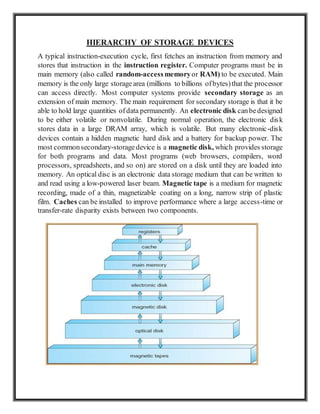
HIERARCHY OF STORAGE DEVICES
A typical instruction-execution cycle, first fetches an instruction from memory and
stores that instruction in the instruction register. Computer programs must be in
main memory (also called random-accessmemoryor RAM) to be executed. Main
memory is the only large storagearea (millions to billions ofbytes)that the processor
can access directly. Most computer systems provide secondary storage as an
extension of main memory. The main requirement for secondary storage is that it be
able to hold large quantities ofdata permanently. An electronic disk canbedesigned
to be either volatile or nonvolatile. During normal operation, the electronic disk
stores data in a large DRAM array, which is volatile. But many electronic-disk
devices contain a hidden magnetic hard disk and a battery for backup power. The
most commonsecondary-storagedevice is a magnetic disk, which provides storage
for both programs and data. Most programs (web browsers, compilers, word
processors, spreadsheets, and so on) are stored on a disk until they are loaded into
memory. An optical disc is an electronic data storage medium that can be written to
and read using a low-powered laser beam. Magnetic tape is a medium for magnetic
recording, made of a thin, magnetizable coating on a long, narrow strip of plastic
film. Caches can be installed to improve performance where a large access-time or
transfer-rate disparity exists between two components.
OPERATING SYSTEM SERVICES
An operating system provides an environment for the execution of programs. It
provides certain services to programs and to the users of those programs. The
specific services provided, of course, differ from one operating system to another,
but we can identify common classes. These operating-system services are provided
for the convenience of the programmer, to make the programming task easier.
 Providing an interface to the user, e.g. command line, graphical user interface
(GUI).
 Running applications Process Management, e.g. All process from start to shut
down. Booting Open, Save, Install, Copy, Print, Send, etc.
 Managing system resources, e.g. Installing drivers required for input, coordinating
among peripherals, output, power, communication devices, Coordinating among
peripherals.
 Managing security and access rights, e.g. Virus management, Alert messages,
Dialogue boxes, Firewall, Passwords/Access protection.
 Memory Management, e.g. Primary RAM-ROM, Secondary – Hard Disc, CD,
DVD, Pen etc.
 Performs basic computer tasks, e.g. managing the various peripheral devices e.g.
mouse, keyboard.
 Provides file management, which refers to the way that the operating system
manipulates, stores, retrieves and saves data.
EMBEDED OPERATING SYSTEM (OS):
Embedded computers are the most prevalent form ofcomputers in existence. These
devices are found everywhere, from car engines and manufacturing robots to VCRs
and microwave ovens. They tend to have very specific tasks. The systems they run
on are usually primitive, and so the operating systems provide limited features.
Usually, they have little or no user interface, preferring to spend their time
monitoring and managing hardware devices, suchas automobile engines and robotic
arms.
These embedded systems vary considerably. Some are general-purpose computers,
running standard operating systems, others are hardware devices providing just the
functionality desired, and others are hardware devices with application-specific
integrated circuits (ASICs) that perform their tasks without an operating system.
REAL-TIME OPERATING SYSTEMS:
Embedded systems almost always run real-time operating systems. A real-time
system is used when rigid time requirements have been placed on the operation of a
processoror the flow of data; thus, it is often used as a control device in a dedicated
application. Sensors bring data to the computer. The computer must analyze the data
and possibly adjust controls to modify the sensor inputs. Systems that control
scientific experiments, medical imaging systems, industrial control systems, and
certain display systems are real-time systems. Some automobile engine fuel-
injection systems, home-appliance controllers, and weapon systems are also real-
time systems.
MONOLITHIC KERNEL:
“A monolithic kernel is an operating system software framework that holds all
privileges to access input/output(I/O) devices, memory, hardwareinterruptsand the
CPU stack.” Monolithic kernels tend to be larger than other kernels (A kernel is
indispensable and therefore the mostimportant partof an operating system.)because
they deal with so many aspects of computer processing at the lowest level, and
therefore have to incorporate code that interfaces with many devices, I/O and
interrupt channels, and other hardware operators.
BATCH OPERATING SYSTEM:
To avoid the problems of early systems the batch processing systems were
introduced. The problem of early systems was more setup time. So, “theproblem of
more set up time was reduced by processing the jobs in batches, known as
batch processing system.” In this approach similar jobs were submitted to the
CPU for processing and were run together. The main function of a batch processing
system is to automatically keep executing the jobs in a batch.
Each user prepares his job on an off-line device like punch cards and submits it to
the computer operator. To speed up processing, jobs with similar needs are batched
together and run as a group. The programmers leave their programs with the operator
and the operator then sorts the programs with similar requirements into batches. So,
in the batch processing system, the batched jobs were executed automatically one
after another saving its time by performing the activities (like loading of compiler)
only for once. It resulted in improved system utilization due to reduced turnaround
time.
The problems with Batch Systems are as follows:
 Lack of interaction between the user and the job.
 CPU is often idle, because the speed of the mechanical I/O devices is slower
than the CPU.
 Difficult to provide the desired priority.
REFRENCES:
https://en.wikipedia.org/wiki/Magnetic_tape
http://images.slideplayer.com/10/2801584/slides/slide_7.jpg
http://searchstorage.techtarget.com/definition/optical-disc
https://www.techopedia.com/definition/27003/monolithic-kernel
http://www.aboutlinux.info/2006/05/monolithic-kernel-vs-microkernel-which.html
https://www.tutorialspoint.com/operating_system/os_types.htm
http://ecomputernotes.com/fundamental/disk-operating-system/batch-processing-operating-
system
Book: Operating System Concepts by Abraham Silberschatz, Peter Baer Galvin, Greg
Gagne, chapter#1,2.
|********|********|

STORAGE DEVICES & OPERATING SYSTEM SERVICES

  • 1.
    SUBMITTED TO: MA’MSUMAIRA AKBAR (HOD) SUBMITTED BY: AYESHA TAHIR SUBJECT: “OPERATING SYSTEM” TOPIC: “STORAGE DEVICES & OPERATING SYSTEM SERVICES” DEPARTMENT OF COMPUTER SCIENCE
  • 2.
    HIERARCHY OF STORAGEDEVICES A typical instruction-execution cycle, first fetches an instruction from memory and stores that instruction in the instruction register. Computer programs must be in main memory (also called random-accessmemoryor RAM) to be executed. Main memory is the only large storagearea (millions to billions ofbytes)that the processor can access directly. Most computer systems provide secondary storage as an extension of main memory. The main requirement for secondary storage is that it be able to hold large quantities ofdata permanently. An electronic disk canbedesigned to be either volatile or nonvolatile. During normal operation, the electronic disk stores data in a large DRAM array, which is volatile. But many electronic-disk devices contain a hidden magnetic hard disk and a battery for backup power. The most commonsecondary-storagedevice is a magnetic disk, which provides storage for both programs and data. Most programs (web browsers, compilers, word processors, spreadsheets, and so on) are stored on a disk until they are loaded into memory. An optical disc is an electronic data storage medium that can be written to and read using a low-powered laser beam. Magnetic tape is a medium for magnetic recording, made of a thin, magnetizable coating on a long, narrow strip of plastic film. Caches can be installed to improve performance where a large access-time or transfer-rate disparity exists between two components.
  • 3.
    OPERATING SYSTEM SERVICES Anoperating system provides an environment for the execution of programs. It provides certain services to programs and to the users of those programs. The specific services provided, of course, differ from one operating system to another, but we can identify common classes. These operating-system services are provided for the convenience of the programmer, to make the programming task easier.  Providing an interface to the user, e.g. command line, graphical user interface (GUI).  Running applications Process Management, e.g. All process from start to shut down. Booting Open, Save, Install, Copy, Print, Send, etc.  Managing system resources, e.g. Installing drivers required for input, coordinating among peripherals, output, power, communication devices, Coordinating among peripherals.  Managing security and access rights, e.g. Virus management, Alert messages, Dialogue boxes, Firewall, Passwords/Access protection.  Memory Management, e.g. Primary RAM-ROM, Secondary – Hard Disc, CD, DVD, Pen etc.  Performs basic computer tasks, e.g. managing the various peripheral devices e.g. mouse, keyboard.  Provides file management, which refers to the way that the operating system manipulates, stores, retrieves and saves data. EMBEDED OPERATING SYSTEM (OS): Embedded computers are the most prevalent form ofcomputers in existence. These devices are found everywhere, from car engines and manufacturing robots to VCRs and microwave ovens. They tend to have very specific tasks. The systems they run on are usually primitive, and so the operating systems provide limited features. Usually, they have little or no user interface, preferring to spend their time
  • 4.
    monitoring and managinghardware devices, suchas automobile engines and robotic arms. These embedded systems vary considerably. Some are general-purpose computers, running standard operating systems, others are hardware devices providing just the functionality desired, and others are hardware devices with application-specific integrated circuits (ASICs) that perform their tasks without an operating system. REAL-TIME OPERATING SYSTEMS: Embedded systems almost always run real-time operating systems. A real-time system is used when rigid time requirements have been placed on the operation of a processoror the flow of data; thus, it is often used as a control device in a dedicated application. Sensors bring data to the computer. The computer must analyze the data and possibly adjust controls to modify the sensor inputs. Systems that control scientific experiments, medical imaging systems, industrial control systems, and certain display systems are real-time systems. Some automobile engine fuel- injection systems, home-appliance controllers, and weapon systems are also real- time systems. MONOLITHIC KERNEL: “A monolithic kernel is an operating system software framework that holds all privileges to access input/output(I/O) devices, memory, hardwareinterruptsand the CPU stack.” Monolithic kernels tend to be larger than other kernels (A kernel is indispensable and therefore the mostimportant partof an operating system.)because they deal with so many aspects of computer processing at the lowest level, and therefore have to incorporate code that interfaces with many devices, I/O and interrupt channels, and other hardware operators. BATCH OPERATING SYSTEM: To avoid the problems of early systems the batch processing systems were introduced. The problem of early systems was more setup time. So, “theproblem of more set up time was reduced by processing the jobs in batches, known as batch processing system.” In this approach similar jobs were submitted to the CPU for processing and were run together. The main function of a batch processing system is to automatically keep executing the jobs in a batch.
  • 5.
    Each user prepareshis job on an off-line device like punch cards and submits it to the computer operator. To speed up processing, jobs with similar needs are batched together and run as a group. The programmers leave their programs with the operator and the operator then sorts the programs with similar requirements into batches. So, in the batch processing system, the batched jobs were executed automatically one after another saving its time by performing the activities (like loading of compiler) only for once. It resulted in improved system utilization due to reduced turnaround time. The problems with Batch Systems are as follows:  Lack of interaction between the user and the job.  CPU is often idle, because the speed of the mechanical I/O devices is slower than the CPU.  Difficult to provide the desired priority. REFRENCES: https://en.wikipedia.org/wiki/Magnetic_tape http://images.slideplayer.com/10/2801584/slides/slide_7.jpg http://searchstorage.techtarget.com/definition/optical-disc https://www.techopedia.com/definition/27003/monolithic-kernel http://www.aboutlinux.info/2006/05/monolithic-kernel-vs-microkernel-which.html https://www.tutorialspoint.com/operating_system/os_types.htm http://ecomputernotes.com/fundamental/disk-operating-system/batch-processing-operating- system Book: Operating System Concepts by Abraham Silberschatz, Peter Baer Galvin, Greg Gagne, chapter#1,2. |********|********|