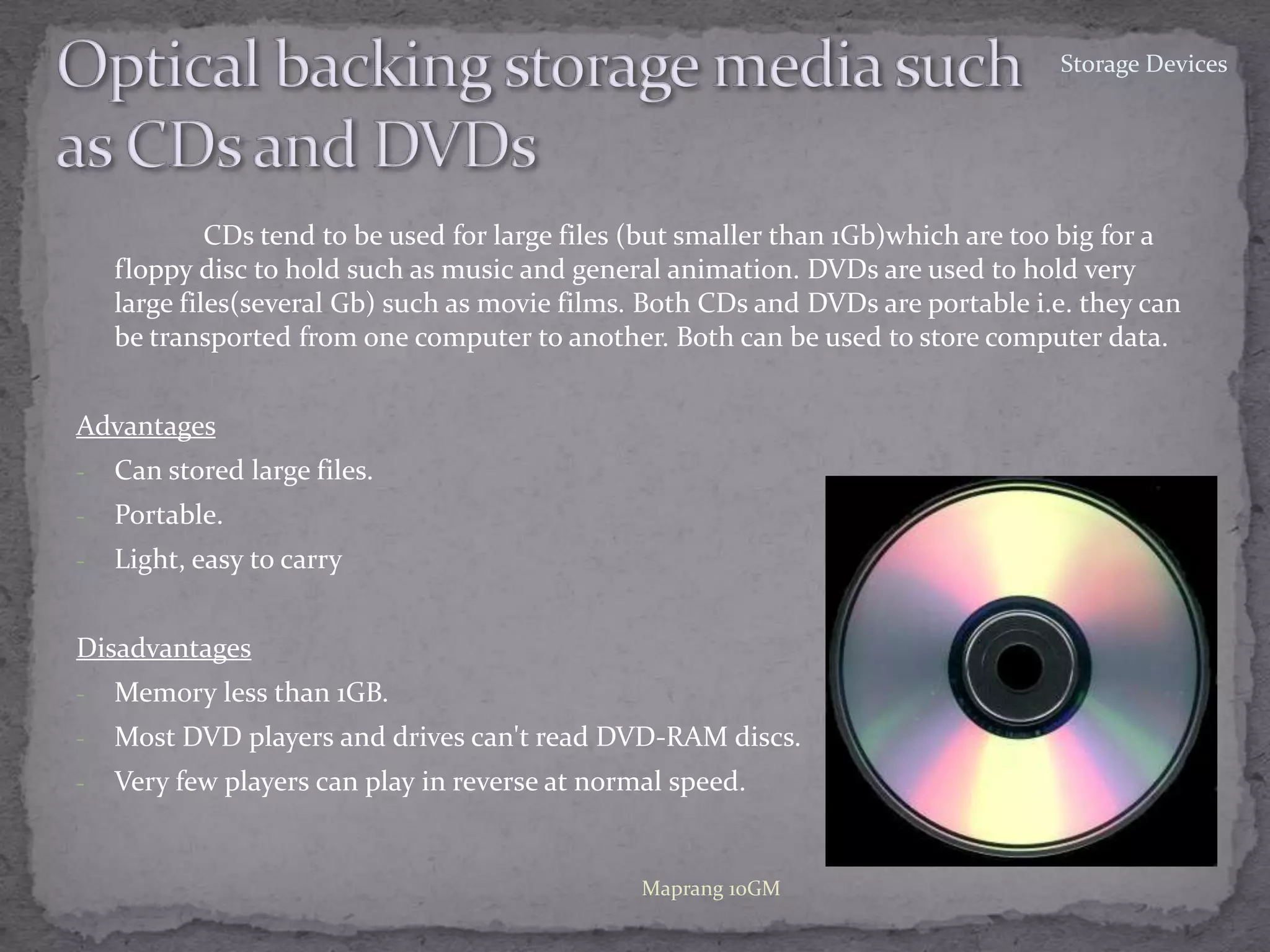
Optical backing storage media suchas CDs and DVDs		CDs tend to be used for large files (but smaller than 1Gb)which are too big for a floppy disc to hold such as music and general animation. DVDs are used to hold very large files(several Gb) such as movie films. Both CDs and DVDs are portable i.e. they can be transported from one computer to another. Both can be used to store computer data.AdvantagesCan stored large files.
Portable.
Light, easy to carryDisadvantagesMemory less than 1GB.
Most DVD players and drives can't read DVD-RAM discs.
Very few players can play in reverse at normal speed.   Maprang 10GM
		Applications which require the prevention of deletion of data, accidental or otherwise. CDs used by software companies for distributing software programs and data; by Music companies for distributing music albums and by book publishers for distributing encyclopedias, reference books etc. DVDs used by film distributors.AdvantagesCan stored data permanently.
They are not expensive.
A CD-ROM is a storage media that has a better longevity for storing data in a moderately small space, when added to the fact that they can be stacked in a small space the amount of storage per cubic foot goes up. DisadvantagesCan not delete or edit saved data.CD ROM/DVD ROMMaprang 10GM
	Applications which require a single ‘burning’ of data, e.g. CDs– recording of music downloads from the Internet, recording of music from MP3 format, recording of data for archiving or backup purposes. DVDs – recording of film movies and television programs.AdvantagesLight and thin
Not expensive

Storage Devices

  • 1.
    Optical backing storagemedia suchas CDs and DVDs CDs tend to be used for large files (but smaller than 1Gb)which are too big for a floppy disc to hold such as music and general animation. DVDs are used to hold very large files(several Gb) such as movie films. Both CDs and DVDs are portable i.e. they can be transported from one computer to another. Both can be used to store computer data.AdvantagesCan stored large files.
  • 2.
  • 3.
    Light, easy tocarryDisadvantagesMemory less than 1GB.
  • 4.
    Most DVD playersand drives can't read DVD-RAM discs.
  • 5.
    Very few playerscan play in reverse at normal speed. Maprang 10GM
  • 6.
    Applications which requirethe prevention of deletion of data, accidental or otherwise. CDs used by software companies for distributing software programs and data; by Music companies for distributing music albums and by book publishers for distributing encyclopedias, reference books etc. DVDs used by film distributors.AdvantagesCan stored data permanently.
  • 7.
    They are notexpensive.
  • 8.
    A CD-ROM isa storage media that has a better longevity for storing data in a moderately small space, when added to the fact that they can be stacked in a small space the amount of storage per cubic foot goes up. DisadvantagesCan not delete or edit saved data.CD ROM/DVD ROMMaprang 10GM
  • 9.
    Applications which requirea single ‘burning’ of data, e.g. CDs– recording of music downloads from the Internet, recording of music from MP3 format, recording of data for archiving or backup purposes. DVDs – recording of film movies and television programs.AdvantagesLight and thin
  • 10.
  • 11.
  • 12.
    Applications which requirethe updating of information and ability to record over old data. Not suitable for music recording but is very useful for keeping generations of files. DVDs have between five and ten times the capacity of CDs.Advantages Less expensive than Blu-ray.
  • 13.
    It generally holdsabout 650 mb of data or 74 minutes of audio.DisadvantagesSlower to write (respond)CD RW/DVD RWMaprang 10GM
  • 14.
    Housed in acartridge. Used in video recorders, camcorders and computer memory.Advantagessuperior quality of the discs
  • 15.
    Less problem aboutformatting and finalising.
  • 16.
  • 17.
    12x media isnot reportedly available in Europe
  • 18.
    DVD-RAM media havealways been more expensive than other types of DVD. DVD RAMMaprang 10GM
  • 19.
    Used in videorecorders and computer memory as well as games consoles – main rival to blu-ray.AdvantagesCheaper price comparing to Blu-ray
  • 20.
  • 21.
    More user/consumer friendly.DisadvantagesHDDVD holds a maximum of 30 GB of data, while a dual-layer Blu-ray carries 50 GB.
  • 22.
    Expensive thana normal CD.HD DVDMaprang 10GM
  • 23.
    Used in videorecorders and computer memory as well as games consoles. Largest storage capacity of optical media.AdvantagesLight and thin.
  • 24.
  • 25.
    Huge storage capacity.Disadvantages-More expensive than HD DVD Blu-rayMaprang 10GM
  • 26.
    Smallest form ofmemory, used as removable storage. More robust than other forms of storage. More expensive than other forms but can be easily written to and updated.AdvantagesThe random access speed for reading is faster because it doesn't need a head to read or write data.
  • 27.
    Reading performance willbe more stable because the data search doesn't depend on where the data is located.DisadvantagesThe writing speed of a Solid State is slower compared to the conventional hard disk.Solid state backing storageMaprang 10GM
  • 28.
    Can store upto many Gb. Used to transport files and backup data from computer to computer.AdvantagesSize is smaller than DVD or CD.
  • 29.
  • 30.
    The design ismore fashionable
  • 31.
    Very easily allowsyou to transport documents from one computer to another.
  • 32.
    It holds alot more data than a floppy disk.
  • 33.
    Not expensive. Disadvantages-Easily lost because it is small.Memory sticks/Pen drivesMaprang 10GM
  • 34.
    Used in digitalcameras, palmtops, mobile phones, MP3 players.AdvantagesSmall, easy to carry around
  • 35.
    Easy to transportdata from one to another.
  • 36.
    it holdslots more data than a floppy disk.DisadvantagesMost computer doesn’t have flash card devices to connect them to the computer so, we have to buy one.
  • 37.
    Easily lost.Flash memorycardsMaprang 10GM