Mpox (Monkey Pox)
DR.P.B.PRAVEENKUMAR
SECOND YEAR POST GRADUATE
DEPARTMENT OF MICROBIOLOGY
THANJAVUR MEDICAL COLLEGE
SYNOPSIS
• Introduction
• Global and current Scenario
• Indian Scenario
• Epidemiology
• Clinical features & complications
• Laboratory diagnosis
• Case, Reinfection definitions
• Treatment
• Surveillance (Reporting), Mpox death definition & prevention strategies
• Vaccination
INTRODUCTION
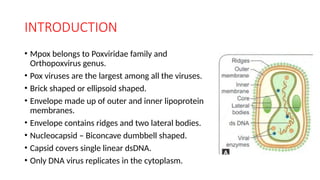
• Mpox belongs to Poxviridae family and
Orthopoxvirus genus.
• Pox viruses are the largest among all the viruses.
• Brick shaped or ellipsoid shaped.
• Envelope made up of outer and inner lipoprotein
membranes.
• Envelope contains ridges and two lateral bodies.
• Nucleocapsid – Biconcave dumbbell shaped.
• Capsid covers single linear dsDNA.
• Only DNA virus replicates in the cytoplasm.
INTRODUCTION (CONT.)
• Pox viruses are grouped into eight genera.
• Only four genera cause human infections.
ORTHOPOXVIRUS Variola
Vaccinia
Monkeypox
Cowpox
Buffalopox
Cantagalo and Aracatuba
PARAPOXVIRUS Orf
Pseudocowpox (Paravaccinia)
Bovine papular stomatitis
Deerpox
Sealpox
MOLLUSCIPOXVIRUS Molluscum contagiosum
YATAPOXVIRUS Tanapox
Yabapox
INTRODUCTION (CONT.)
Two distinct genetic clades of the monkeypox virus
Clade I (Central African / Congo Basin)  Subclades Ia & Ib
Clade Ib -More deadly and infectious; Primarily through household
contact frequently infects children
Clade II (West African)  Subclades IIa & IIb
Clade IIb – Spread mainly through sexual contact
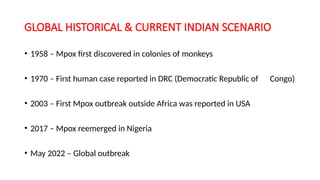
GLOBAL HISTORICAL & CURRENT INDIAN SCENARIO
• 1958 – Mpox first discovered in colonies of monkeys
• 1970 – First human case reported in DRC (Democratic Republic of Congo)
• 2003 – First Mpox outbreak outside Africa was reported in USA
• 2017 – Mpox reemerged in Nigeria
• May 2022 – Global outbreak
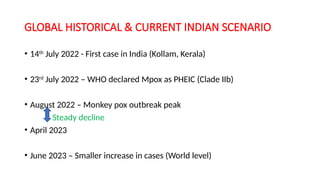
GLOBAL HISTORICAL & CURRENT INDIAN SCENARIO
• 14th
July 2022 - First case in India (Kollam, Kerala)
• 23rd
July 2022 – WHO declared Mpox as PHEIC (Clade IIb)
• August 2022 – Monkey pox outbreak peak
Steady decline
• April 2023
• June 2023 – Smaller increase in cases (World level)
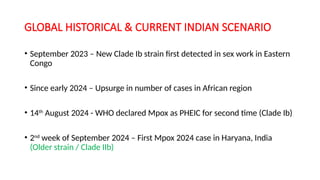
GLOBAL HISTORICAL & CURRENT INDIAN SCENARIO
• September 2023 – New Clade Ib strain first detected in sex work in Eastern
Congo
• Since early 2024 – Upsurge in number of cases in African region
• 14th
August 2024 - WHO declared Mpox as PHEIC for second time (Clade Ib)
• 2nd
week of September 2024 – First Mpox 2024 case in Haryana, India
(Older strain / Clade IIb)
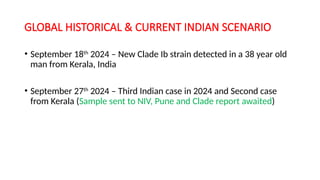
GLOBAL HISTORICAL & CURRENT INDIAN SCENARIO
• September 18th
2024 – New Clade Ib strain detected in a 38 year old
man from Kerala, India
• September 27th
2024 – Third Indian case in 2024 and Second case
from Kerala (Sample sent to NIV, Pune and Clade report awaited)
INCUBATION PERIOD:
Usually from 6 to 13 days but can range from 5 to 21 days.
PERIOD OF COMMUNICABILITY:
1-2 days before the rash to until all the scabs fall off/get subsided.
MODE OF TRANSMISSION
HUMAN - HUMAN TRANSMISSION
• Face to face
• Skin to skin
• Mouth to mouth
• Skin contact
• Respiratory droplet
• Mother to fetus
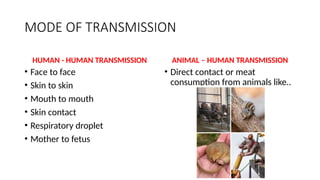
ANIMAL – HUMAN TRANSMISSION
• Direct contact or meat
consumption from animals like..
CLINICAL FEATURES
PRODROME (0-5 DAYS):
• Fever
• Lymphadenopathy (Occurs with fever onset,
periauricular/axillary/cervical/inguinal, Unilateral or bilateral)
• Headache, muscle ache & exhaustion
• Chills and/or sweats
• Sore throat and cough
CLINICAL FEATURES (CONT.)
SKIN INVOLVEMENT (RASH):
• Usually begins within 1-3 days of fever onset
• Centrifugal spread
• Lasting for 2-4 weeks
• Deep seated, well circumscribed and often develop umbilication
• Lesions are painful until healing phase occurs
• Classical lesion is vesico-pustular
• Predilection for palm and soles is characteristic
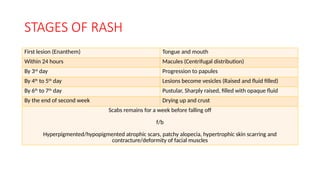
STAGES OF RASH
First lesion (Enanthem) Tongue and mouth
Within 24 hours Macules (Centrifugal distribution)
By 3rd
day Progression to papules
By 4th
to 5th
day Lesions become vesicles (Raised and fluid filled)
By 6th
to 7th
day Pustular, Sharply raised, filled with opaque fluid
By the end of second week Drying up and crust
Scabs remains for a week before falling off
f/b
Hyperpigmented/hypopigmented atrophic scars, patchy alopecia, hypertrophic skin scarring and
contracture/deformity of facial muscles
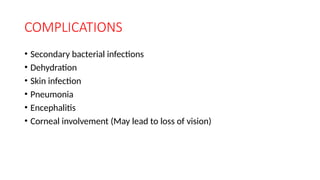
COMPLICATIONS
• Secondary bacterial infections
• Dehydration
• Skin infection
• Pneumonia
• Encephalitis
• Corneal involvement (May lead to loss of vision)
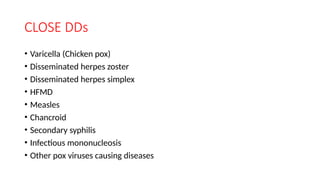
CLOSE DDs
• Varicella (Chicken pox)
• Disseminated herpes zoster
• Disseminated herpes simplex
• HFMD
• Measles
• Chancroid
• Secondary syphilis
• Infectious mononucleosis
• Other pox viruses causing diseases
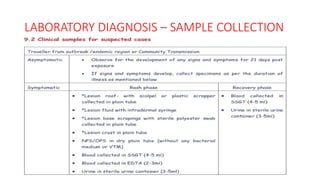
LABORATORY DIAGNOSIS – SAMPLE COLLECTION
IMPORTANT POINTS TO REMEMBER REGARDING SAMPLE COLLECTION
• Best sample – Collected from lesion at any stage of the rash from multiple
sites
• In the absence of skin lesions – Prefer NPS/OPS/anal/rectal swab
• Blood sample is least preferable. (If collected, centrifuge it and then
transport it)
• Store the sample at 4⁰C & transport to Kings Institute after triple layer
packaging along with case reporting form
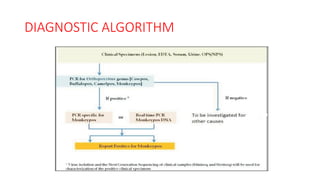
DIAGNOSTIC ALGORITHM
CASE DEFINITIONS
SUSPECTED CASE:
A person of any age with history of travel to affected countries
within last 21 days presenting with an unexplained acute rash and one
or more of the following signs or symptoms-
• Swollen lymph nodes
• Fever (>38.5⁰C)
• Headache
• Body aches
• Profound weakness
CASE DEFINITIONS (CONT.)
PROBABLE CASE:
A suspected case, clinically compatible illness and has an epidemiological link to a
confirmed case.

Epidemiological links:
Face-to-face exposure, including health care workers without appropriate PPE, direct
physical contact with skin or skin lesions, including sexual contact or contact with
contaminated materials such as clothing, bedding or utensils is suggestive of a strong
epidemiological link.
CASE DEFINITIONS (CONT.)
CONFIRMED CASE:
A case which is laboratory confirmed for monkey pox virus (by
detection of unique sequences of viral DNA either by polymerase chain
reaction (PCR) and/or sequencing).
CASE DEFINITIONS (CONT.)
DISCARDED CASE:
A suspected or probable case for which laboratory testing of lesion
fluid, skin specimens or crusts by PCR and/or sequencing is negative for
Mpox.
Retrospectively detected probable case for which
lesion no longer be adequately performed (Crusts
fall off) and no other specimen is found PCR-
positive…This case will come under…..??
REMAIN CLASSIFIED AS PROBABLE CASE
Shall we discard suspected or probable case based
on negative result from an oropharyngeal, anal or
rectal swab or from a blood test alone?????
SHOULD NOT BE DISCARDED
MPOX REINFECTION DEFINITIONS
Suspected Mpox reinfection:
A Confirmed case of Mpox and
• Has a documented history of a previous episode of mpox as a
suspect/probable/confirmed case.
• Full clinical resolution of that previous episode is still unclear
MPOX REINFECTION DEFINITIONS (cont.)
Probable Mpox reinfection:
A Confirmed case of Mpox and
• Has a documented history of a previous episode of mpox as a
probable/confirmed case.
• Full clinical resolution of that previous episode occurred
• Time between resolution of previous episode and onset of new symptoms is
less than three months.
MPOX REINFECTION DEFINITIONS (cont.)
Confirmed Mpox reinfection: (Main definition)
A Confirmed case of Mpox and
• Has a documented history of a previous episode of mpox as a confirmed case.
• Full clinical resolution of that previous episode occurred
• Time between resolution of previous episode and onset of new symptoms is
three months or more.
• When possible, strain differentiation is undertaken using genetic sequencing.
MPOX REINFECTION DEFINITIONS (cont.)
Confirmed Mpox reinfection: (Alternate definition)
A Confirmed case of Mpox or
• Has a probable Mpox reinfection with significant strain differentiation
between the two MPXV infections (different and descendant lineages)
using genetic sequencing.
TREATMENT
• Patient isolation
• Protection of skin and mucous membrane
• Rehydration
• Symptomatic Mx
• Antibiotics to treat secondary bacterial infections
Drugs may be considered:
• Tecovirimat
• Vaccinia Immune Globulin Intravenous
• Cidofovir and Brincidofovir
HIGHLIGHTS ON SURVEILLANCE OF MPOX
• Even one case of Mpox is to be considered as an outbreak
Key stake holders in surveillance are:
• NACO
• IDSP
• Points of entries (PoEs)
• Antenatal clinics
• Pediatric OPDs
• Designated Lab network
For suspected cases, alert the surveillance system via this link
https://ihip.mohfw.gov.in/cbs/#!/
CONTACT TRACING
• A contact is defined as any person, who has one or more of the
following exposures with a probable or confirmed case of Mpox
during the period of communicability.
• Home quarantine and active follow up for contacts of confirmed cases
• Self monitoring for contacts of probable cases
• Monitor at least daily for 21 days
MPOX DEATH DEFINITION
• It is defined as a death in a probable or confirmed Mpox case unless
the alternative cause of death is trauma.
Suspected Mpox death:
• In endemic setting, where laboratory confirmation of Mpox is limited,
death among persons with suspected (Clinically compatible) Mpox.
• Diagnosis for Mpox can also be confirmed after death if there is
sufficient lesion material to perform PCR.
PREVENTIVE MEASURES
• Avoid contact with any materials such as bedding, clothing.
• Isolation of patients from others
• Good hand hygiene practice
• Use appropriate PPE when caring for patients
• Follow BMW rules properly
• Waste water surveillance
• Proper advisories for International passengers (APHO/PHO/LPHO)
• Give high alerts to all POEs.
VACCINATION
THREE VACCINES ARE CURRENTLY LICENSED FOR MPOX
• Modified Vaccinia Ankara-BN (MVA-BN, JYNNEOS, Imvamune or
Imvanex) – Two doses (Approved in USA, Canada & Europe)
• LC16-KMB (Licensed in Japan)
• OrthopoxVac (Licensed in Russia)
• Vaccination only for individuals at high risk of exposure
• In India, as of now no advisories regarding vaccination
THANK YOU

MONKEYPOX (MPOX) LATEST GUIDELINES 2024 .pptx

  • 1.
    Mpox (Monkey Pox) DR.P.B.PRAVEENKUMAR SECONDYEAR POST GRADUATE DEPARTMENT OF MICROBIOLOGY THANJAVUR MEDICAL COLLEGE
  • 2.
    SYNOPSIS • Introduction • Globaland current Scenario • Indian Scenario • Epidemiology • Clinical features & complications • Laboratory diagnosis • Case, Reinfection definitions • Treatment • Surveillance (Reporting), Mpox death definition & prevention strategies • Vaccination
  • 3.
    INTRODUCTION • Mpox belongsto Poxviridae family and Orthopoxvirus genus. • Pox viruses are the largest among all the viruses. • Brick shaped or ellipsoid shaped. • Envelope made up of outer and inner lipoprotein membranes. • Envelope contains ridges and two lateral bodies. • Nucleocapsid – Biconcave dumbbell shaped. • Capsid covers single linear dsDNA. • Only DNA virus replicates in the cytoplasm.
  • 4.
    INTRODUCTION (CONT.) • Poxviruses are grouped into eight genera. • Only four genera cause human infections. ORTHOPOXVIRUS Variola Vaccinia Monkeypox Cowpox Buffalopox Cantagalo and Aracatuba PARAPOXVIRUS Orf Pseudocowpox (Paravaccinia) Bovine papular stomatitis Deerpox Sealpox MOLLUSCIPOXVIRUS Molluscum contagiosum YATAPOXVIRUS Tanapox Yabapox
  • 5.
    INTRODUCTION (CONT.) Two distinctgenetic clades of the monkeypox virus Clade I (Central African / Congo Basin)  Subclades Ia & Ib Clade Ib -More deadly and infectious; Primarily through household contact frequently infects children Clade II (West African)  Subclades IIa & IIb Clade IIb – Spread mainly through sexual contact
  • 6.
    GLOBAL HISTORICAL &CURRENT INDIAN SCENARIO • 1958 – Mpox first discovered in colonies of monkeys • 1970 – First human case reported in DRC (Democratic Republic of Congo) • 2003 – First Mpox outbreak outside Africa was reported in USA • 2017 – Mpox reemerged in Nigeria • May 2022 – Global outbreak
  • 7.
    GLOBAL HISTORICAL &CURRENT INDIAN SCENARIO • 14th July 2022 - First case in India (Kollam, Kerala) • 23rd July 2022 – WHO declared Mpox as PHEIC (Clade IIb) • August 2022 – Monkey pox outbreak peak Steady decline • April 2023 • June 2023 – Smaller increase in cases (World level)
  • 8.
    GLOBAL HISTORICAL &CURRENT INDIAN SCENARIO • September 2023 – New Clade Ib strain first detected in sex work in Eastern Congo • Since early 2024 – Upsurge in number of cases in African region • 14th August 2024 - WHO declared Mpox as PHEIC for second time (Clade Ib) • 2nd week of September 2024 – First Mpox 2024 case in Haryana, India (Older strain / Clade IIb)
  • 9.
    GLOBAL HISTORICAL &CURRENT INDIAN SCENARIO • September 18th 2024 – New Clade Ib strain detected in a 38 year old man from Kerala, India • September 27th 2024 – Third Indian case in 2024 and Second case from Kerala (Sample sent to NIV, Pune and Clade report awaited)
  • 10.
    INCUBATION PERIOD: Usually from6 to 13 days but can range from 5 to 21 days. PERIOD OF COMMUNICABILITY: 1-2 days before the rash to until all the scabs fall off/get subsided.
  • 11.
    MODE OF TRANSMISSION HUMAN- HUMAN TRANSMISSION • Face to face • Skin to skin • Mouth to mouth • Skin contact • Respiratory droplet • Mother to fetus ANIMAL – HUMAN TRANSMISSION • Direct contact or meat consumption from animals like..
  • 12.
    CLINICAL FEATURES PRODROME (0-5DAYS): • Fever • Lymphadenopathy (Occurs with fever onset, periauricular/axillary/cervical/inguinal, Unilateral or bilateral) • Headache, muscle ache & exhaustion • Chills and/or sweats • Sore throat and cough
  • 13.
    CLINICAL FEATURES (CONT.) SKININVOLVEMENT (RASH): • Usually begins within 1-3 days of fever onset • Centrifugal spread • Lasting for 2-4 weeks • Deep seated, well circumscribed and often develop umbilication • Lesions are painful until healing phase occurs • Classical lesion is vesico-pustular • Predilection for palm and soles is characteristic
  • 14.
    STAGES OF RASH Firstlesion (Enanthem) Tongue and mouth Within 24 hours Macules (Centrifugal distribution) By 3rd day Progression to papules By 4th to 5th day Lesions become vesicles (Raised and fluid filled) By 6th to 7th day Pustular, Sharply raised, filled with opaque fluid By the end of second week Drying up and crust Scabs remains for a week before falling off f/b Hyperpigmented/hypopigmented atrophic scars, patchy alopecia, hypertrophic skin scarring and contracture/deformity of facial muscles
  • 15.
    COMPLICATIONS • Secondary bacterialinfections • Dehydration • Skin infection • Pneumonia • Encephalitis • Corneal involvement (May lead to loss of vision)
  • 16.
    CLOSE DDs • Varicella(Chicken pox) • Disseminated herpes zoster • Disseminated herpes simplex • HFMD • Measles • Chancroid • Secondary syphilis • Infectious mononucleosis • Other pox viruses causing diseases
  • 17.
    LABORATORY DIAGNOSIS –SAMPLE COLLECTION
  • 18.
    IMPORTANT POINTS TOREMEMBER REGARDING SAMPLE COLLECTION • Best sample – Collected from lesion at any stage of the rash from multiple sites • In the absence of skin lesions – Prefer NPS/OPS/anal/rectal swab • Blood sample is least preferable. (If collected, centrifuge it and then transport it) • Store the sample at 4⁰C & transport to Kings Institute after triple layer packaging along with case reporting form
  • 19.
  • 20.
    CASE DEFINITIONS SUSPECTED CASE: Aperson of any age with history of travel to affected countries within last 21 days presenting with an unexplained acute rash and one or more of the following signs or symptoms- • Swollen lymph nodes • Fever (>38.5⁰C) • Headache • Body aches • Profound weakness
  • 21.
    CASE DEFINITIONS (CONT.) PROBABLECASE: A suspected case, clinically compatible illness and has an epidemiological link to a confirmed case. Epidemiological links: Face-to-face exposure, including health care workers without appropriate PPE, direct physical contact with skin or skin lesions, including sexual contact or contact with contaminated materials such as clothing, bedding or utensils is suggestive of a strong epidemiological link.
  • 22.
    CASE DEFINITIONS (CONT.) CONFIRMEDCASE: A case which is laboratory confirmed for monkey pox virus (by detection of unique sequences of viral DNA either by polymerase chain reaction (PCR) and/or sequencing).
  • 23.
    CASE DEFINITIONS (CONT.) DISCARDEDCASE: A suspected or probable case for which laboratory testing of lesion fluid, skin specimens or crusts by PCR and/or sequencing is negative for Mpox.
  • 24.
    Retrospectively detected probablecase for which lesion no longer be adequately performed (Crusts fall off) and no other specimen is found PCR- positive…This case will come under…..?? REMAIN CLASSIFIED AS PROBABLE CASE
  • 25.
    Shall we discardsuspected or probable case based on negative result from an oropharyngeal, anal or rectal swab or from a blood test alone????? SHOULD NOT BE DISCARDED
  • 26.
    MPOX REINFECTION DEFINITIONS SuspectedMpox reinfection: A Confirmed case of Mpox and • Has a documented history of a previous episode of mpox as a suspect/probable/confirmed case. • Full clinical resolution of that previous episode is still unclear
  • 27.
    MPOX REINFECTION DEFINITIONS(cont.) Probable Mpox reinfection: A Confirmed case of Mpox and • Has a documented history of a previous episode of mpox as a probable/confirmed case. • Full clinical resolution of that previous episode occurred • Time between resolution of previous episode and onset of new symptoms is less than three months.
  • 28.
    MPOX REINFECTION DEFINITIONS(cont.) Confirmed Mpox reinfection: (Main definition) A Confirmed case of Mpox and • Has a documented history of a previous episode of mpox as a confirmed case. • Full clinical resolution of that previous episode occurred • Time between resolution of previous episode and onset of new symptoms is three months or more. • When possible, strain differentiation is undertaken using genetic sequencing.
  • 29.
    MPOX REINFECTION DEFINITIONS(cont.) Confirmed Mpox reinfection: (Alternate definition) A Confirmed case of Mpox or • Has a probable Mpox reinfection with significant strain differentiation between the two MPXV infections (different and descendant lineages) using genetic sequencing.
  • 30.
    TREATMENT • Patient isolation •Protection of skin and mucous membrane • Rehydration • Symptomatic Mx • Antibiotics to treat secondary bacterial infections Drugs may be considered: • Tecovirimat • Vaccinia Immune Globulin Intravenous • Cidofovir and Brincidofovir
  • 31.
    HIGHLIGHTS ON SURVEILLANCEOF MPOX • Even one case of Mpox is to be considered as an outbreak Key stake holders in surveillance are: • NACO • IDSP • Points of entries (PoEs) • Antenatal clinics • Pediatric OPDs • Designated Lab network For suspected cases, alert the surveillance system via this link https://ihip.mohfw.gov.in/cbs/#!/
  • 32.
    CONTACT TRACING • Acontact is defined as any person, who has one or more of the following exposures with a probable or confirmed case of Mpox during the period of communicability. • Home quarantine and active follow up for contacts of confirmed cases • Self monitoring for contacts of probable cases • Monitor at least daily for 21 days
  • 33.
    MPOX DEATH DEFINITION •It is defined as a death in a probable or confirmed Mpox case unless the alternative cause of death is trauma. Suspected Mpox death: • In endemic setting, where laboratory confirmation of Mpox is limited, death among persons with suspected (Clinically compatible) Mpox. • Diagnosis for Mpox can also be confirmed after death if there is sufficient lesion material to perform PCR.
  • 34.
    PREVENTIVE MEASURES • Avoidcontact with any materials such as bedding, clothing. • Isolation of patients from others • Good hand hygiene practice • Use appropriate PPE when caring for patients • Follow BMW rules properly • Waste water surveillance • Proper advisories for International passengers (APHO/PHO/LPHO) • Give high alerts to all POEs.
  • 35.
    VACCINATION THREE VACCINES ARECURRENTLY LICENSED FOR MPOX • Modified Vaccinia Ankara-BN (MVA-BN, JYNNEOS, Imvamune or Imvanex) – Two doses (Approved in USA, Canada & Europe) • LC16-KMB (Licensed in Japan) • OrthopoxVac (Licensed in Russia) • Vaccination only for individuals at high risk of exposure • In India, as of now no advisories regarding vaccination
  • 36.