Stomach
ABSITE Prep
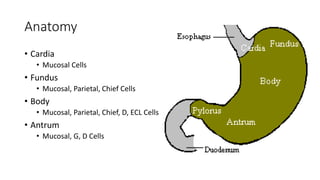
Anatomy
• Cardia
• Mucosal Cells
• Fundus
• Mucosal, Parietal, Chief Cells
• Body
• Mucosal, Parietal, Chief, D, ECL Cells
• Antrum
• Mucosal, G, D Cells
Cell Functions
• Chief Cells – 40% - Pepsinogen  Pepsin at pH <5
• Parietal Cells – HCl, Intrinsic Factor
• Pernicious anemia – autoimmune disease against Parietal Cells, no IF  B12
deficiency
• Mucous Cells – Mucous, Bicarb
• G Cells – Gastrin
• D Cells – Somatostatin
• ECL – Serotonin
• ECL-Like – Histamine
• Increases HCl production through cAMP (‘Happy cAMPer’)
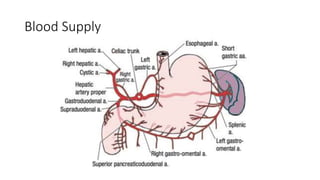
Blood Supply
Gastritis
• Stress
• Curling - >30% TBSA Burns, due to mucosal ischemia
• Curling Iron Burns – Curling ulcer
• Cushing – Severe head trauma, due to increased gastrin and HCl
hypersecretion
• Cushing was neurosurgeon, Head trauma – Cushing ulcer
• Alkaline Reflux
• Bile reflux in the stomach – s/p pyloroplasty or Billroth II
• Sx – Post-prandial abdominal pain,
• Dx – EGD
• Tx - RnY
Peptic Ulcer Disease
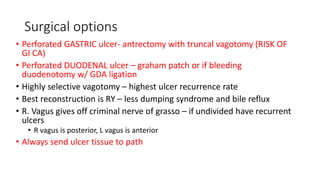
• H. pylori infection - #1 RF
• MCC: H. pylori, followed by NSAIDs
• H. Pylori Tx – PPI, Amoxicillin with Clarithromycin or Flagyl
• ‘CAP’ or ‘CAMO’
• Confirm eradication with urea breath test
• Presents with bleeding – ALWAYS EGD with some adjunct
• Indications for surgery: perforation, bleeding despite endoscopic
therapy, obstruction
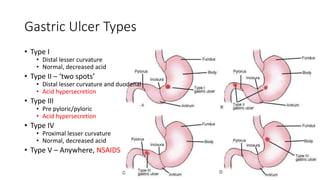
Gastric Ulcer Types
• Type I
• Distal lesser curvature
• Normal, decreased acid
• Type II – ‘two spots’
• Distal lesser curvature and duodenal
• Acid hypersecretion
• Type III
• Pre pyloric/pyloric
• Acid hypersecretion
• Type IV
• Proximal lesser curvature
• Normal, decreased acid
• Type V – Anywhere, NSAIDS
Surgical options
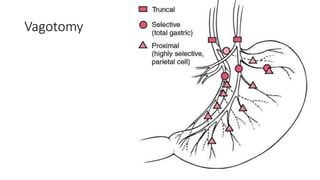
• Perforated GASTRIC ulcer- antrectomy with truncal vagotomy (RISK OF
GI CA)
• Perforated DUODENAL ulcer – graham patch or if bleeding
duodenotomy w/ GDA ligation
• Highly selective vagotomy – highest ulcer recurrence rate
• Best reconstruction is RY – less dumping syndrome and bile reflux
• R. Vagus gives off criminal nerve of grasso – if undivided have recurrent
ulcers
• R vagus is posterior, L vagus is anterior
• Always send ulcer tissue to path
Vagotomy
UGI Bleeding
• Dx/Tx: reverse anticoagulation, EGD w/ adjuncts
• Active pulsatile bleeding and visible vessel are highest re-bleeding risks
• If liver failure and from esophageal varices --> EGD w/ banding, TIPS if
local therapy fails
• If unable to find source --> angiography --> tagged RBC scan
• Gastric varices w/o esophageal varices – hx of pancreatitis – thing splenic
vein thrombosis. Dx with US. For symptomatic pts ---> splenectomy
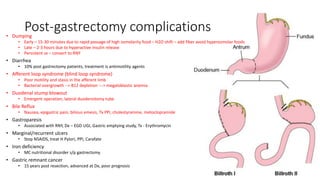
Post-gastrectomy complications• Dumping
• Early – 15-30 minutes due to rapid passage of high osmolarity food – H2O shift – add fiber avoid hyperosmolar foods
• Late – 2-3 hours due to hyperactive insulin release
• Persistent sx – convert to RNY
• Diarrhea
• 10% post gastrectomy patients, treatment is antimotility agents
• Afferent loop syndrome (blind loop syndrome)
• Poor motility and stasis in the afferent limb
• Bacterial overgrowth --> B12 depletion ---> megaloblastic anemia
• Duodenal stump blowout
• Emergent operation, lateral duodenotomy tube
• Bile Reflux
• Nausea, epigastric pain, bilious emesis, Tx PPI, cholestyramine, metoclopramide
• Gastroparesis
• Associated with RNY, Dx – EGD UGI, Gastric emptying study, Tx - Erythromycin
• Marginal/recurrent ulcers
• Stop NSAIDS, treat H Pylori, PPI, Carafate
• Iron deficiency
• MC nutritional disorder s/p gastrectomy
• Gastric remnant cancer
• 15 years post resection, advanced at Dx, poor prognosis
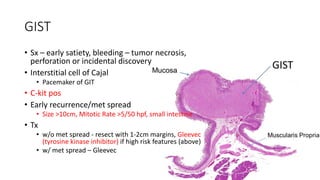
GIST
• Sx – early satiety, bleeding – tumor necrosis,
perforation or incidental discovery
• Interstitial cell of Cajal
• Pacemaker of GIT
• C-kit pos
• Early recurrence/met spread
• Size >10cm, Mitotic Rate >5/50 hpf, small intestine
• Tx
• w/o met spread - resect with 1-2cm margins, Gleevec
(tyrosine kinase inhibitor) if high risk features (above)
• w/ met spread – Gleevec
Adenocarcinoma
• Risk Factors – Nitrosamines (smoked meat), Chronic H. pylori/Ulcer
Dx, Pernicious anemia, Atrophic gastritis, Smoking, HNPCC
• Intestinal or diffuse
• Sx – Abdominal pain/Weight loss
• Dx – EGD, CT, Laparoscopy – disease staging
• Tx - Resection, negative margins, en bloc with greater omentum and
lymph nodes. Goal is 16 nodes.
• D1 – Perigastric
• D2 – Perigastric + Celiac + Hepatic + Splenic lymph nodes
• Chemo – if N+, T3, T4 – epirubicin, cisplatin, 5-FU
Gastric Lymphoma
• Sx – pain, weight loss, fatigue/anemia
• Dx – PE, LDH, Microglobulin, CT of Chest Abd/Pelvis
• MALToma
• Early Stage – Treat with eradication of H Pylori
• Late Stage – treat as NHL
• Non Hodgkin
• Doxorubicin and cyclophosphamide
• Surgery +/- XRT for non responders, recurrent disease, or complication with
chemo

Stomach Review

  • 1.
  • 2.
    Anatomy • Cardia • MucosalCells • Fundus • Mucosal, Parietal, Chief Cells • Body • Mucosal, Parietal, Chief, D, ECL Cells • Antrum • Mucosal, G, D Cells
  • 3.
    Cell Functions • ChiefCells – 40% - Pepsinogen  Pepsin at pH <5 • Parietal Cells – HCl, Intrinsic Factor • Pernicious anemia – autoimmune disease against Parietal Cells, no IF  B12 deficiency • Mucous Cells – Mucous, Bicarb • G Cells – Gastrin • D Cells – Somatostatin • ECL – Serotonin • ECL-Like – Histamine • Increases HCl production through cAMP (‘Happy cAMPer’)
  • 4.
  • 5.
    Gastritis • Stress • Curling- >30% TBSA Burns, due to mucosal ischemia • Curling Iron Burns – Curling ulcer • Cushing – Severe head trauma, due to increased gastrin and HCl hypersecretion • Cushing was neurosurgeon, Head trauma – Cushing ulcer • Alkaline Reflux • Bile reflux in the stomach – s/p pyloroplasty or Billroth II • Sx – Post-prandial abdominal pain, • Dx – EGD • Tx - RnY
  • 6.
    Peptic Ulcer Disease •H. pylori infection - #1 RF • MCC: H. pylori, followed by NSAIDs • H. Pylori Tx – PPI, Amoxicillin with Clarithromycin or Flagyl • ‘CAP’ or ‘CAMO’ • Confirm eradication with urea breath test • Presents with bleeding – ALWAYS EGD with some adjunct • Indications for surgery: perforation, bleeding despite endoscopic therapy, obstruction
  • 7.
    Gastric Ulcer Types •Type I • Distal lesser curvature • Normal, decreased acid • Type II – ‘two spots’ • Distal lesser curvature and duodenal • Acid hypersecretion • Type III • Pre pyloric/pyloric • Acid hypersecretion • Type IV • Proximal lesser curvature • Normal, decreased acid • Type V – Anywhere, NSAIDS
  • 8.
    Surgical options • PerforatedGASTRIC ulcer- antrectomy with truncal vagotomy (RISK OF GI CA) • Perforated DUODENAL ulcer – graham patch or if bleeding duodenotomy w/ GDA ligation • Highly selective vagotomy – highest ulcer recurrence rate • Best reconstruction is RY – less dumping syndrome and bile reflux • R. Vagus gives off criminal nerve of grasso – if undivided have recurrent ulcers • R vagus is posterior, L vagus is anterior • Always send ulcer tissue to path
  • 9.
  • 10.
    UGI Bleeding • Dx/Tx:reverse anticoagulation, EGD w/ adjuncts • Active pulsatile bleeding and visible vessel are highest re-bleeding risks • If liver failure and from esophageal varices --> EGD w/ banding, TIPS if local therapy fails • If unable to find source --> angiography --> tagged RBC scan • Gastric varices w/o esophageal varices – hx of pancreatitis – thing splenic vein thrombosis. Dx with US. For symptomatic pts ---> splenectomy
  • 11.
    Post-gastrectomy complications• Dumping •Early – 15-30 minutes due to rapid passage of high osmolarity food – H2O shift – add fiber avoid hyperosmolar foods • Late – 2-3 hours due to hyperactive insulin release • Persistent sx – convert to RNY • Diarrhea • 10% post gastrectomy patients, treatment is antimotility agents • Afferent loop syndrome (blind loop syndrome) • Poor motility and stasis in the afferent limb • Bacterial overgrowth --> B12 depletion ---> megaloblastic anemia • Duodenal stump blowout • Emergent operation, lateral duodenotomy tube • Bile Reflux • Nausea, epigastric pain, bilious emesis, Tx PPI, cholestyramine, metoclopramide • Gastroparesis • Associated with RNY, Dx – EGD UGI, Gastric emptying study, Tx - Erythromycin • Marginal/recurrent ulcers • Stop NSAIDS, treat H Pylori, PPI, Carafate • Iron deficiency • MC nutritional disorder s/p gastrectomy • Gastric remnant cancer • 15 years post resection, advanced at Dx, poor prognosis
  • 12.
    GIST • Sx –early satiety, bleeding – tumor necrosis, perforation or incidental discovery • Interstitial cell of Cajal • Pacemaker of GIT • C-kit pos • Early recurrence/met spread • Size >10cm, Mitotic Rate >5/50 hpf, small intestine • Tx • w/o met spread - resect with 1-2cm margins, Gleevec (tyrosine kinase inhibitor) if high risk features (above) • w/ met spread – Gleevec
  • 13.
    Adenocarcinoma • Risk Factors– Nitrosamines (smoked meat), Chronic H. pylori/Ulcer Dx, Pernicious anemia, Atrophic gastritis, Smoking, HNPCC • Intestinal or diffuse • Sx – Abdominal pain/Weight loss • Dx – EGD, CT, Laparoscopy – disease staging • Tx - Resection, negative margins, en bloc with greater omentum and lymph nodes. Goal is 16 nodes. • D1 – Perigastric • D2 – Perigastric + Celiac + Hepatic + Splenic lymph nodes • Chemo – if N+, T3, T4 – epirubicin, cisplatin, 5-FU
  • 14.
    Gastric Lymphoma • Sx– pain, weight loss, fatigue/anemia • Dx – PE, LDH, Microglobulin, CT of Chest Abd/Pelvis • MALToma • Early Stage – Treat with eradication of H Pylori • Late Stage – treat as NHL • Non Hodgkin • Doxorubicin and cyclophosphamide • Surgery +/- XRT for non responders, recurrent disease, or complication with chemo

Editor's Notes

  • #5 Celiac trunk: left gastric, common hepatic, splenic Splenic braches into left gastroepiploic and short gastric Greater curvature: R/L gastroepiploics, short gastric R gastroepiploic: branch of the gastroduodenal artery Lesser curvature: R/L gastrics R gastric is a branch of the proper hepatic artery after the GDA takes off Pylorus: gastroduodenal artery