Microstate and configuration& Stirling's
Approximation
By:
Rashid Khan F2017067044
Microstate
A microstate is a specific way in which we can arrange the
energy of the system. Many microstates are
indistinguishable from each other. The more
indistinguishable microstates, the higher the entropy. The
best way to wrap your head around this idea can be to look
at a very small scale example. An isolated system will
spontaneously transition between states such that the
entropy of the system is increased to its maximum value.
Why is this? Is there some strange force pushing things to
higher entropy states? The simple fact is that if a final state
has higher entropy, it is simply more likely to exist from the
myriad of possible states. These states contain
distributions of molecules and energies that are the most
probable.
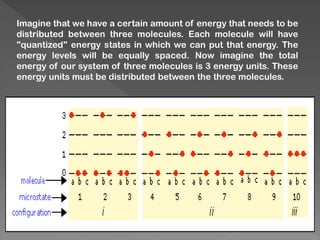
Imagine that we have a certain amount of energy that needs to be
distributed between three molecules. Each molecule will have
"quantized" energy states in which we can put that energy. The
energy levels will be equally spaced. Now imagine the total
energy of our system of three molecules is 3 energy units. These
energy units must be distributed between the three molecules.
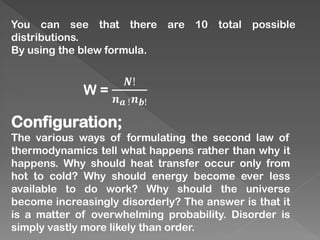
You can see that there are 10 total possible
distributions.
By using the blew formula.
W =
𝑵!
𝒏 𝒂 ! 𝒏 𝒃!
Configuration;
The various ways of formulating the second law of
thermodynamics tell what happens rather than why it
happens. Why should heat transfer occur only from
hot to cold? Why should energy become ever less
available to do work? Why should the universe
become increasingly disorderly? The answer is that it
is a matter of overwhelming probability. Disorder is
simply vastly more likely than order.
Exaples:
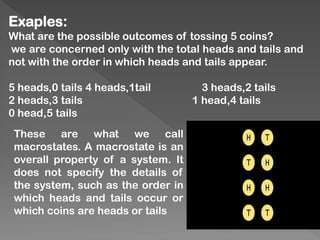
What are the possible outcomes of tossing 5 coins?
we are concerned only with the total heads and tails and
not with the order in which heads and tails appear.
5 heads,0 tails 4 heads,1tail 3 heads,2 tails
2 heads,3 tails 1 head,4 tails
0 head,5 tails
These are what we call
macrostates. A macrostate is an
overall property of a system. It
does not specify the details of
the system, such as the order in
which heads and tails occur or
which coins are heads or tails
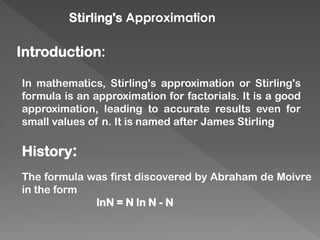
Stirling's Approximation
Introduction:
In mathematics, Stirling's approximation or Stirling's
formula is an approximation for factorials. It is a good
approximation, leading to accurate results even for
small values of n. It is named after James Stirling
History:
The formula was first discovered by Abraham de Moivre
in the form
lnN = N ln N - N
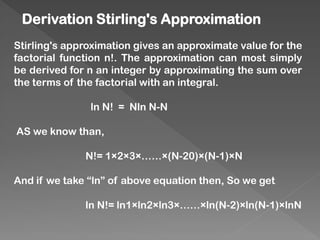
Derivation Stirling's Approximation
Stirling's approximation gives an approximate value for the
factorial function n!. The approximation can most simply
be derived for n an integer by approximating the sum over
the terms of the factorial with an integral.
ln N! = Nln N-N
AS we know than,
N!= 1×2×3×……×(N-20)×(N-1)×N
And if we take “ln” of above equation then, So we get
ln N!= ln1×ln2×ln3×……×ln(N-2)×ln(N-1)×lnN
The equation can also be derived using the
integral definition of the factorial,
ln 𝑁! = ‫׬‬1
𝑁
1 ln 𝑛 𝑑𝑥
As we know the role of
Integration by parts
∫u v dx = u∫v dx −∫u' (∫v dx) dx
So, the above equation become
ln 𝑁! = [n ln n] 𝑁
1
-‫׬‬1
𝑁
𝑥.
1
𝑥
𝑑𝑥
ln 𝑁 = N ln N – 1 ln 1- ‫׬‬1
𝑁
1 𝑑𝑥
ln𝑁 = N ln N – 0 - ‫׬‬1
𝑁
1 𝑑𝑥
= N ln N – [x] 𝑁
1
=N ln N – [N-1]
= N ln N –N + 1
We Can neglect 1 because there is large quantity
present so the is no effect on the eq.
Now solve the values of limits of integration
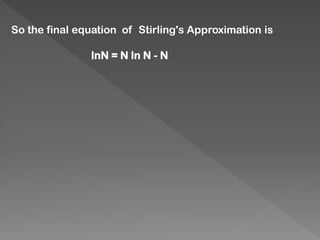
So the final equation of Stirling's Approximation is
lnN = N ln N - N

Stirling's approximation & microstate and configuration

  • 1.
    Microstate and configuration&Stirling's Approximation By: Rashid Khan F2017067044
  • 2.
    Microstate A microstate isa specific way in which we can arrange the energy of the system. Many microstates are indistinguishable from each other. The more indistinguishable microstates, the higher the entropy. The best way to wrap your head around this idea can be to look at a very small scale example. An isolated system will spontaneously transition between states such that the entropy of the system is increased to its maximum value. Why is this? Is there some strange force pushing things to higher entropy states? The simple fact is that if a final state has higher entropy, it is simply more likely to exist from the myriad of possible states. These states contain distributions of molecules and energies that are the most probable.
  • 3.
    Imagine that wehave a certain amount of energy that needs to be distributed between three molecules. Each molecule will have "quantized" energy states in which we can put that energy. The energy levels will be equally spaced. Now imagine the total energy of our system of three molecules is 3 energy units. These energy units must be distributed between the three molecules.
  • 4.
    You can seethat there are 10 total possible distributions. By using the blew formula. W = 𝑵! 𝒏 𝒂 ! 𝒏 𝒃! Configuration; The various ways of formulating the second law of thermodynamics tell what happens rather than why it happens. Why should heat transfer occur only from hot to cold? Why should energy become ever less available to do work? Why should the universe become increasingly disorderly? The answer is that it is a matter of overwhelming probability. Disorder is simply vastly more likely than order.
  • 5.
    Exaples: What are thepossible outcomes of tossing 5 coins? we are concerned only with the total heads and tails and not with the order in which heads and tails appear. 5 heads,0 tails 4 heads,1tail 3 heads,2 tails 2 heads,3 tails 1 head,4 tails 0 head,5 tails These are what we call macrostates. A macrostate is an overall property of a system. It does not specify the details of the system, such as the order in which heads and tails occur or which coins are heads or tails
  • 6.
    Stirling's Approximation Introduction: In mathematics,Stirling's approximation or Stirling's formula is an approximation for factorials. It is a good approximation, leading to accurate results even for small values of n. It is named after James Stirling History: The formula was first discovered by Abraham de Moivre in the form lnN = N ln N - N
  • 7.
    Derivation Stirling's Approximation Stirling'sapproximation gives an approximate value for the factorial function n!. The approximation can most simply be derived for n an integer by approximating the sum over the terms of the factorial with an integral. ln N! = Nln N-N AS we know than, N!= 1×2×3×……×(N-20)×(N-1)×N And if we take “ln” of above equation then, So we get ln N!= ln1×ln2×ln3×……×ln(N-2)×ln(N-1)×lnN
  • 8.
    The equation canalso be derived using the integral definition of the factorial, ln 𝑁! = ‫׬‬1 𝑁 1 ln 𝑛 𝑑𝑥 As we know the role of Integration by parts ∫u v dx = u∫v dx −∫u' (∫v dx) dx So, the above equation become ln 𝑁! = [n ln n] 𝑁 1 -‫׬‬1 𝑁 𝑥. 1 𝑥 𝑑𝑥
  • 9.
    ln 𝑁 =N ln N – 1 ln 1- ‫׬‬1 𝑁 1 𝑑𝑥 ln𝑁 = N ln N – 0 - ‫׬‬1 𝑁 1 𝑑𝑥 = N ln N – [x] 𝑁 1 =N ln N – [N-1] = N ln N –N + 1 We Can neglect 1 because there is large quantity present so the is no effect on the eq. Now solve the values of limits of integration
  • 10.
    So the finalequation of Stirling's Approximation is lnN = N ln N - N