Numerical Methods
in Computing
Submitted To:
Dr. Zeeshan
Submitted By:
Hafiz Furqan Ahmad (2020-ME-538)
Usman Bajwa(2020-ME-508)
Sarmad Altaf (2020-ME-520)
Zaid Buzal (2020-ME-531)
CENTRAL DIFFERENCE INTERPOLATION
FORMULA
Introduction
 The central difference interpolation formula is a method for estimating
the value of a function at a particular point based on its known values
at nearby points. It is often used in numerical analysis and scientific
computing.
 The central difference interpolation formula is derived by
approximating the function using a Taylor series expansion and then
solving for the desired value at the point of interest. The formula is
given by:
f(x) ≈ (f(x+h) - f(x-h)) / (2h)
Where h is small increment
 This formula can be used to estimate the value of a function at any
point x, as long as the values of the function at x-h and x+h are
known.
STIRLINGS FORMULA
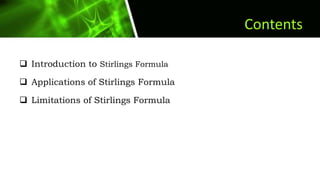
Contents
 Introduction to Stirlings Formula
 Applications of Stirlings Formula
 Limitations of Stirlings Formula
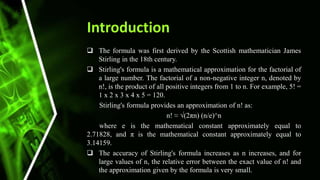
Introduction
 The formula was first derived by the Scottish mathematician James
Stirling in the 18th century.
 Stirling's formula is a mathematical approximation for the factorial of
a large number. The factorial of a non-negative integer n, denoted by
n!, is the product of all positive integers from 1 to n. For example, 5! =
1 x 2 x 3 x 4 x 5 = 120.
Stirling's formula provides an approximation of n! as:
n! ≈ √(2πn) (n/e)^n
where e is the mathematical constant approximately equal to
2.71828, and π is the mathematical constant approximately equal to
3.14159.
 The accuracy of Stirling's formula increases as n increases, and for
large values of n, the relative error between the exact value of n! and
the approximation given by the formula is very small.
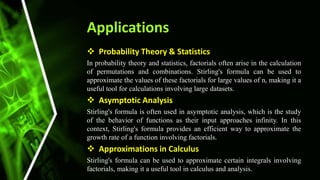
Applications
 Probability Theory & Statistics
In probability theory and statistics, factorials often arise in the calculation
of permutations and combinations. Stirling's formula can be used to
approximate the values of these factorials for large values of n, making it a
useful tool for calculations involving large datasets.
 Asymptotic Analysis
Stirling's formula is often used in asymptotic analysis, which is the study
of the behavior of functions as their input approaches infinity. In this
context, Stirling's formula provides an efficient way to approximate the
growth rate of a function involving factorials.
 Approximations in Calculus
Stirling's formula can be used to approximate certain integrals involving
factorials, making it a useful tool in calculus and analysis.
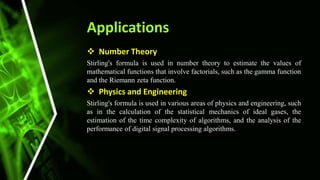
Applications
 Number Theory
Stirling's formula is used in number theory to estimate the values of
mathematical functions that involve factorials, such as the gamma function
and the Riemann zeta function.
 Physics and Engineering
Stirling's formula is used in various areas of physics and engineering, such
as in the calculation of the statistical mechanics of ideal gases, the
estimation of the time complexity of algorithms, and the analysis of the
performance of digital signal processing algorithms.
BESSELS FORMULA
Contents
 Introduction to Bessels Formula
 Applications of Bessels Formula
 Limitations of Bessels Formula
Introduction
 Bessel's formula is a mathematical formula that relates a Fourier series
to a complex integral involving a Bessel function. It was first derived
by the German mathematician Friedrich Bessel in the early 19th
century and is an important tool in the study of wave phenomena and
Fourier analysis.
 Bessel's formula can be used to express a Fourier series in terms of a
complex integral involving a Bessel function of the first kind. This
allows for the efficient computation of Fourier series coefficients,
especially for functions with cylindrical symmetry or those that can be
approximated by cylindrical harmonics.
Applications:
 Electromagnetics:
The Bessel formula is used to solve problems involving the propagation of
electromagnetic waves in cylindrical or spherical waveguides. In
particular, Bessel functions arise in the solution of Maxwell's equations for
these geometries.
 Acoustics:
The Bessel formula is used to model the behavior of sound waves in
cylindrical or spherical geometries. Bessel functions describe the resonant
frequencies of cylindrical and spherical resonators.
 Heat transfer:
The Bessel formula is used to solve problems involving heat transfer in
cylindrical or spherical geometries. Bessel functions arise in the solution
of the heat equation in these geometries.
Applications:
 Quantum Mechanics:
The Bessel formula is used to describe the wave function of a particle in a
cylindrical or spherical potential well. Bessel functions arise in the
solution of the Schrödinger equation for these geometries.
 Signal Processing:
The Bessel formula is used to design filters for signal processing applications. Bessel
filters have a maximally flat frequency response in the passband and a slower roll-off
than other filter types.
 Image Processing:
The Bessel formula is used to describe the diffraction pattern of a circular aperture or
a spherical lens. The intensity distribution of the diffracted light is given by the
square of the modulus of the Bessel function.
Thank You

Numerical Methods in Computing-1.pptx

  • 1.
    Numerical Methods in Computing SubmittedTo: Dr. Zeeshan Submitted By: Hafiz Furqan Ahmad (2020-ME-538) Usman Bajwa(2020-ME-508) Sarmad Altaf (2020-ME-520) Zaid Buzal (2020-ME-531)
  • 2.
  • 3.
    Introduction  The centraldifference interpolation formula is a method for estimating the value of a function at a particular point based on its known values at nearby points. It is often used in numerical analysis and scientific computing.  The central difference interpolation formula is derived by approximating the function using a Taylor series expansion and then solving for the desired value at the point of interest. The formula is given by: f(x) ≈ (f(x+h) - f(x-h)) / (2h) Where h is small increment  This formula can be used to estimate the value of a function at any point x, as long as the values of the function at x-h and x+h are known.
  • 4.
  • 5.
    Contents  Introduction toStirlings Formula  Applications of Stirlings Formula  Limitations of Stirlings Formula
  • 6.
    Introduction  The formulawas first derived by the Scottish mathematician James Stirling in the 18th century.  Stirling's formula is a mathematical approximation for the factorial of a large number. The factorial of a non-negative integer n, denoted by n!, is the product of all positive integers from 1 to n. For example, 5! = 1 x 2 x 3 x 4 x 5 = 120. Stirling's formula provides an approximation of n! as: n! ≈ √(2πn) (n/e)^n where e is the mathematical constant approximately equal to 2.71828, and π is the mathematical constant approximately equal to 3.14159.  The accuracy of Stirling's formula increases as n increases, and for large values of n, the relative error between the exact value of n! and the approximation given by the formula is very small.
  • 7.
    Applications  Probability Theory& Statistics In probability theory and statistics, factorials often arise in the calculation of permutations and combinations. Stirling's formula can be used to approximate the values of these factorials for large values of n, making it a useful tool for calculations involving large datasets.  Asymptotic Analysis Stirling's formula is often used in asymptotic analysis, which is the study of the behavior of functions as their input approaches infinity. In this context, Stirling's formula provides an efficient way to approximate the growth rate of a function involving factorials.  Approximations in Calculus Stirling's formula can be used to approximate certain integrals involving factorials, making it a useful tool in calculus and analysis.
  • 8.
    Applications  Number Theory Stirling'sformula is used in number theory to estimate the values of mathematical functions that involve factorials, such as the gamma function and the Riemann zeta function.  Physics and Engineering Stirling's formula is used in various areas of physics and engineering, such as in the calculation of the statistical mechanics of ideal gases, the estimation of the time complexity of algorithms, and the analysis of the performance of digital signal processing algorithms.
  • 9.
  • 10.
    Contents  Introduction toBessels Formula  Applications of Bessels Formula  Limitations of Bessels Formula
  • 11.
    Introduction  Bessel's formulais a mathematical formula that relates a Fourier series to a complex integral involving a Bessel function. It was first derived by the German mathematician Friedrich Bessel in the early 19th century and is an important tool in the study of wave phenomena and Fourier analysis.  Bessel's formula can be used to express a Fourier series in terms of a complex integral involving a Bessel function of the first kind. This allows for the efficient computation of Fourier series coefficients, especially for functions with cylindrical symmetry or those that can be approximated by cylindrical harmonics.
  • 12.
    Applications:  Electromagnetics: The Besselformula is used to solve problems involving the propagation of electromagnetic waves in cylindrical or spherical waveguides. In particular, Bessel functions arise in the solution of Maxwell's equations for these geometries.  Acoustics: The Bessel formula is used to model the behavior of sound waves in cylindrical or spherical geometries. Bessel functions describe the resonant frequencies of cylindrical and spherical resonators.  Heat transfer: The Bessel formula is used to solve problems involving heat transfer in cylindrical or spherical geometries. Bessel functions arise in the solution of the heat equation in these geometries.
  • 13.
    Applications:  Quantum Mechanics: TheBessel formula is used to describe the wave function of a particle in a cylindrical or spherical potential well. Bessel functions arise in the solution of the Schrödinger equation for these geometries.  Signal Processing: The Bessel formula is used to design filters for signal processing applications. Bessel filters have a maximally flat frequency response in the passband and a slower roll-off than other filter types.  Image Processing: The Bessel formula is used to describe the diffraction pattern of a circular aperture or a spherical lens. The intensity distribution of the diffracted light is given by the square of the modulus of the Bessel function.
  • 14.